Hostname: page-component-76d6cb85b7-5qg8f Total loading time: 0 Render date: 2026-07-11T18:26:37.214Z Has data issue: false hasContentIssue false

Longitudinal associations between gaming and academic motivation during middle childhood – CORRIGENDUM

Published online by Cambridge University Press:  19 February 2026

Gabriel Arantes Tiraboschi
Affiliation:
Département d’enseignement au préscolaire et au primaire, Université de Sherbrooke , Sherbrooke, QC, Canada Département de psychoéducation, Université de Sherbrooke , Sherbrooke, QC, Canada
Gabrielle Garon-Carrier
Affiliation:
Département de psychoéducation, Université de Sherbrooke , Sherbrooke, QC, Canada
Sheri Madigan
Affiliation:
Department of Psychology, University of Calgary , Calgary, AB, Canada Alberta Children’s Hospital Research Institute, University of Calgary , Calgary, AB, Canada
Jonathan Smith
Affiliation:
Département d’enseignement au préscolaire et au primaire, Université de Sherbrooke , Sherbrooke, QC, Canada
Rachel Surprenant
Affiliation:
Département d’enseignement au préscolaire et au primaire, Université de Sherbrooke , Sherbrooke, QC, Canada
Caroline Fitzpatrick*
Affiliation:
Département d’enseignement au préscolaire et au primaire, Université de Sherbrooke , Sherbrooke, QC, Canada Department of Childhood Education, University of Johannesburg, Johannesburg, South Africa
*
Corresponding author: Caroline Fitzpatrick; Email: caroline.fitzpatrick@usherbrooke.ca
Rights & Permissions [Opens in a new window]

Abstract

Information

Type
Corrigendum
Creative Commons
Creative Common License - CCCreative Common License - BY
This is an Open Access article, distributed under the terms of the Creative Commons Attribution licence (http://creativecommons.org/licenses/by/4.0), which permits unrestricted re-use, distribution and reproduction, provided the original article is properly cited.
Copyright
© The Author(s), 2026. Published by Cambridge University Press
Figure 0

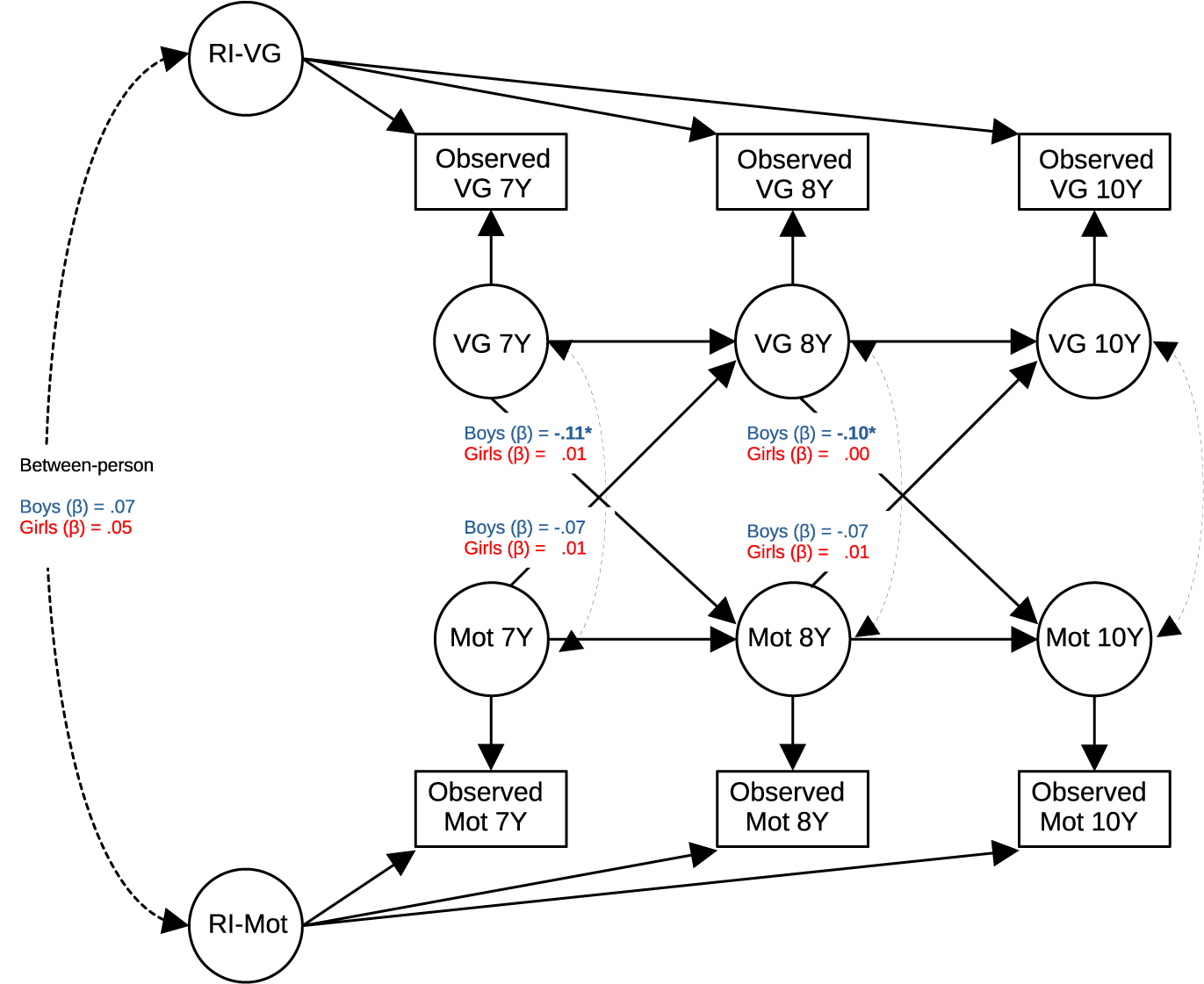
Figure 1. Random-intercept cross-lagged panel model of academic motivation and video game playing between ages 7 and 10. Each shape represents a variable. Circles are latent variables, and rectangles are observable variables. Straight arrows represent regressions, and curved arrows represent covariances. Asterisks indicate significant associations (p < .05). Indicated in the picture are the standardized estimates of the cross-lagged within-person effects and the between-person associations. Factor loadings of random intercepts were constrained to 1.00. Mot, academic motivation; RI, random-intercept latent variable; Observed, observed variables at data collection; VG, video game playing levels; Y, age in years. Data compiled from the final master file of the Québec Longitudinal Study of Child Development (1998–2023), ©Gouvernement du Québec, Institut de la statistique du Québec, Canada.