

Hostname: page-component-5f7774ffb-p5w8z Total loading time: 0 Render date: 2026-02-21T05:28:53.855Z Has data issue: false hasContentIssue false

Longitudinal associations between gaming and academic motivation during middle childhood – CORRIGENDUM

Published online by Cambridge University Press:  19 February 2026

Gabriel Arantes Tiraboschi
Affiliation:
Département d’enseignement au préscolaire et au primaire, Université de Sherbrooke , Sherbrooke, QC, Canada Département de psychoéducation, Université de Sherbrooke , Sherbrooke, QC, Canada
Gabrielle Garon-Carrier
Affiliation:
Département de psychoéducation, Université de Sherbrooke , Sherbrooke, QC, Canada
Sheri Madigan
Affiliation:
Department of Psychology, University of Calgary , Calgary, AB, Canada Alberta Children’s Hospital Research Institute, University of Calgary , Calgary, AB, Canada
Jonathan Smith
Affiliation:
Département d’enseignement au préscolaire et au primaire, Université de Sherbrooke , Sherbrooke, QC, Canada
Rachel Surprenant
Affiliation:
Département d’enseignement au préscolaire et au primaire, Université de Sherbrooke , Sherbrooke, QC, Canada
Caroline Fitzpatrick*
Affiliation:
Département d’enseignement au préscolaire et au primaire, Université de Sherbrooke , Sherbrooke, QC, Canada Department of Childhood Education, University of Johannesburg, Johannesburg, South Africa
*
Corresponding author: Caroline Fitzpatrick; Email: caroline.fitzpatrick@usherbrooke.ca
Rights & Permissions [Opens in a new window]

Abstract

Information

Type
Corrigendum
Creative Commons
Creative Common License - CCCreative Common License - BY
This is an Open Access article, distributed under the terms of the Creative Commons Attribution licence (http://creativecommons.org/licenses/by/4.0), which permits unrestricted re-use, distribution and reproduction, provided the original article is properly cited.
Copyright
© The Author(s), 2026. Published by Cambridge University Press

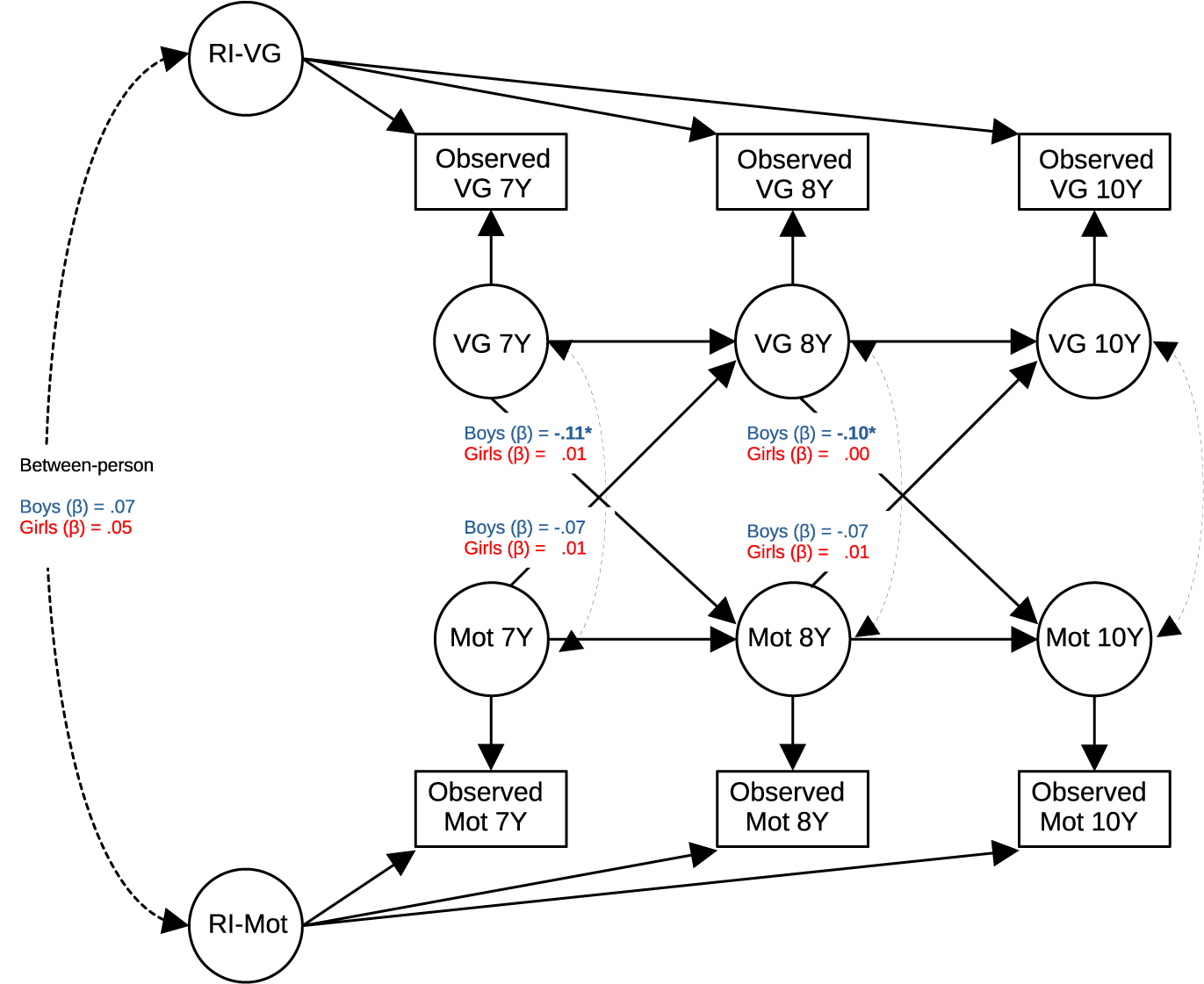
When this article was originally published in Psychological Medicine it contained an error with Figure 1. The correct version can be found below:

Figure 1. Random-intercept cross-lagged panel model of academic motivation and video game playing between ages 7 and 10. Each shape represents a variable. Circles are latent variables, and rectangles are observable variables. Straight arrows represent regressions, and curved arrows represent covariances. Asterisks indicate significant associations (p < .05). Indicated in the picture are the standardized estimates of the cross-lagged within-person effects and the between-person associations. Factor loadings of random intercepts were constrained to 1.00. Mot, academic motivation; RI, random-intercept latent variable; Observed, observed variables at data collection; VG, video game playing levels; Y, age in years. Data compiled from the final master file of the Québec Longitudinal Study of Child Development (1998–2023), ©Gouvernement du Québec, Institut de la statistique du Québec, Canada.

The authors apologise for this error.
References

Tiraboschi, GA., Garon-Carrier, G., Madigan, S., Smith, J., Surprenant, R., & Fitzpatrick, C. (2025). Longitudinal associations between gaming and academic motivation during middle childhoodPsychological Medicine. 55, e235. https://doi.org/10.1017/S0033291725101153.CrossRefGoogle ScholarPubMed
Figure 0

Figure 1. Random-intercept cross-lagged panel model of academic motivation and video game playing between ages 7 and 10. Each shape represents a variable. Circles are latent variables, and rectangles are observable variables. Straight arrows represent regressions, and curved arrows represent covariances. Asterisks indicate significant associations (p < .05). Indicated in the picture are the standardized estimates of the cross-lagged within-person effects and the between-person associations. Factor loadings of random intercepts were constrained to 1.00. Mot, academic motivation; RI, random-intercept latent variable; Observed, observed variables at data collection; VG, video game playing levels; Y, age in years. Data compiled from the final master file of the Québec Longitudinal Study of Child Development (1998–2023), ©Gouvernement du Québec, Institut de la statistique du Québec, Canada.
