

Introduction
What drives institutional reforms in regional organisations? And what explains the institutional design of ASEAN? Despite many differences, conventional approaches to the institutional design of regional organisations more generally and ASEAN in particular are united in regarding them as either determined by factors endogenous to the region − such as varying state interests or collective norms (Acharya Reference Acharya2009a; Solingen Reference Solingen2014)− or as exogenously driven, most importantly by hegemonic states like the US or China (Beeson Reference Beeson2013; Katzenstein Reference Katzenstein2005). This article complements these approaches with a diffusion account for ASEAN's institutional design. It joins a more recent literature on regional organisations in arguing that explanations for institutional reforms within regional organisations are influenced by the institutional designs of other regional organisations (Börzel and Risse Reference Börzel and Risse2011; Risse Reference Risse, Börzel and Risse2016).
Building on a strand in the diffusion literature emphasising that diffusion rarely leads to convergence (Beckert Reference Beckert2010; Klinger-Vidra and Schleifer Reference Klinger-Vidra and Schleifer2014; Radaelli Reference Radaelli2005), the article makes two genuine contributions. First, it argues that given the complexity of institutional design decisions, members of regional organisations hardly ever borrow from a single organisation, but engage in modular design: they select institutional templates from a variety of regional as well as international organisations. Second, it argues that cognitive priors and contextual conditions determine what template is chosen. Finally, and contrary to arguments that institutional borrowing might increase the expectations-deliverance gap within regional organisations, it argues that if conducted in a consistent way, modular adoption might lead to substantial innovation and success.
The article's claim will be developed in a case study constituting an empirical puzzle: why has ASEAN with its Charter reform of 2007 committed to an economic single market along the path of the European Community (EC)? And why has it not adopted those institutions that are associated with the EC's success, a regional court and a supranational commission? As a result of the ASEAN Charter, ASEAN has a reformed Secretariat, but it does not feature a supranational commission, not even by name. Instead of a regional court, member states adopted a protocol modelled after the arbitration mechanism of the General Agreement on Tariffs and Trade (GATT), the predecessor of the World Trade Organization (WTO). The article argues that designing a regional organisation through substantial reforms constitutes a modular design process, where specific factors influence which design modules are being considered and which ones are being selected. One is the cognitive prior of a regional organisation or its member states. ASEAN is well known for its less legalistic approach to regional institution-building. Members screen available models according to the sovereignty costs that each imposes. The second is context: not all contexts are equally well suited for the EU model of regional integration, and not all contexts supply only the EU model. The question then is how context influences a decision to adopt a specific institution. Here, drawing on the international political economy literature, a regional organisation's position within the global economy will be emphasised as one such condition. The argument is that context influences the supply of available modules for institutional design.
The structure of the paper is as follows. The next section argues that conventional approaches to the question of “what drives institutional reforms in regional organisations?” miss out on an important driver of institutional design choices – diffusion. They, therefore, overestimate the influence of international and state-level factors for institutional design. Based on a typological approach on the one hand, and illustrated with the literature on ASEAN on the other, four generic theoretical approaches to institutional design will be identified: identity- and interest-driven approaches, a hegemonic approach, a globalisation approach, and, finally, a diffusion approach. Diffusion refers to a situation of interdependent decision-making, in which the adoption of institutions and policies by one actor alters the probability of another actor making a similar decision. This section is organised as a review demonstrating the specific contribution of a diffusion approach. It does not attempt to develop testable hypotheses that can later be used to deduce observable implications for ASEAN. The third section briefly develops the concept of modular design, cognitive priors, and contextual conditions. The fourth section provides an illustration of the modular design explanation in the case of ASEAN.
What Drives Institutional Reforms in Regional Organisations?
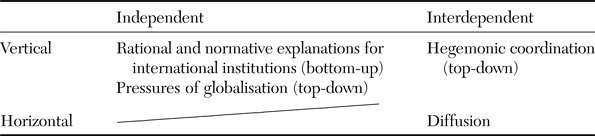
What drives institutional reforms in regional organisations? The literature on regionalism more generally, and on ASEAN in particular, is united in its approach to either regard domestic factors or international influences as principal drivers of reform. More recently, these approaches have been complemented by a diffusion approach to institutional design. In the following, four ideal-typical approaches will be identified: an identity- and interest-driven approach to institutional design, a hegemonic approach, a globalisation approach, and a diffusion approach. These approaches serve as heuristic devices to differentiate diffusion from other explanations. The four approaches can be typologically classified according to two dimensions: whether they regard institutional designs as emerging in dependence on one another or independently and whether they regard them as outcomes of vertically coordinated (inter-)actions or as outcomes of horizontal interactions (Levi-Faur Reference Levi-Faur2005: 25). The distinction between vertical and horizontal influences on institutional design primarily denotes whether institutions or policies are chiefly thought of as determined by factors on lower or higher levels of analysis (e.g. state characteristics or international factors) or whether they are determined by factors on the same level of analysis (e.g. by other regional organisations).
Rational and normative designs of international institutions
Most theories of regionalism, especially in the Western context, locate the main drivers of institution-building within the respective region. They view institutions primarily as reflecting processes and structures of a region that works from the inside out.
Identity- and interest-driven approaches to institutional design alike take the interactions among states or state characteristics − and therefore factors within the region − as starting points for an explanation of institutional designs. Because state characteristics vary considerably, this literature expects substantial variation: as Acharya and Johnston (Reference Acharya and Johnston2007: 15–16) note, “regional arrangements vary considerably in their institutional design”.
Rationalist and historical institutional approaches to Asian regionalism can be found here, too. International institutions have common causes − a functional demand for information, rules, and arbitration (Keohane Reference Keohane1984) − but vary as a function of the nature of cooperation problems. Institutions change because patterns of interdependence shift, generating a demand for new institutions and reform. In this vein, Koremenos (Reference Koremenos2007) explains the variation among dispute settlement mechanisms (DSMs). States are unlikely to create more legalised DSMs if they are not needed. Khong and Nesadurai (Reference Khong, Nesadurai, Acharya and Johnston2007) explain ASEAN's evolution from a minimal institutional design (where member states were not prepared to delegate sovereignty) to greater economic interdependence between its members, leading them to expand ASEAN's tasks, its membership, and decision-making competences. A similar argument for considering domestic factors as a source of institutional design is made by proponents of the developmental state in Asia (Beeson and Breslin Reference Beeson, Breslin, Buzan and Zhang2014; Haggard Reference Haggard, Pekkanen, Ravenhill and Foot2014; Stubbs Reference Stubbs, Beeson and Stubbs2012). The argument here is that the existence of developmental states in Asia constitutes an institutional legacy associated with a distinct form of regionalism − regionalisation without regionalism − which has also shaped institutional designs.
Constructivist approaches focus on an ideational state and regional characteristics as determinants of institutional design. Most prominently and drawing on a categorical distinction between regional organisations in the West and non-Western regions, Acharya (Reference Acharya2009b) argues that the institutional design of an organisation is determined by members’ understanding of regionalism. In the case of regional organisations outside of Europe, there is a stronger emphasis on norms of sovereignty, non-interference, and territorial integrity, and a less legalistic approach (Ba Reference Ba and Zaum2013).
Although constructivist and rationalist approaches to institutional design start from very different behavioural assumptions about actors, they are united in the underlying proposition that regional institutions develop independently of one another and are determined primarily by factors that are endogenous to the region, such as norms and identities and state or interest-group preferences. Therefore, these theories occupy the lower left cell of Table 1.
Table 1. Where does the design of international institutions come from? A typology.
Hegemonic approaches to international institutions
From a realist and hegemonic-stability-theoretical point of view, international institutions are set up and dominated by the most powerful state in the system, which influences their design. Regional institutions emerge through the actions of a hegemon “powerful enough to maintain the essential rules governing interstate relations, and willing to do so” (Keohane and Nye Reference Keohane and Nye1977: 44). Institutional transformations after wars provide an example, providing victorious countries with “the power to dismantle existing institutional forms and impose upon the defeated enemy guidelines for the design of new political institutions” (Beckert Reference Beckert2010: 153). Hegemonic imposition can be categorised as a coordinating, interdependence-type driver because institutional design decisions are primarily made by the hegemon for all institutions it dominates and not independently for each of the institutions.
Quite a number of authors have argued that Asian regionalism is an outcome of hegemonic coordination. The penetration of the region by the US and the economic liberalism promoted by the US through its core state Japan after the end of World War II have made Asia “porous” (Katzenstein Reference Katzenstein2005). At the same time, the channelling of liberalism through the domestic, network-like structures of Japan has ensured that major institutions exhibit considerable informality and are not very institutionalised. The combination of US power and domestic structures thus explains institutional designs. Similarly, Mark Beeson (Reference Beeson2013) argues that as US and European influence wanes in Southeast Asia and trade with China increases, ASEAN as an institution will reflect growing Chinese influence. From this perspective of vertical coordination, ASEAN's institutional development is driven by the major power(s) it interacts with, imposing an institutional design on them.
Globalisation-driven approaches to institutional design
An important literature on the effects of globalisation on states assumes that increasing integration and interdependence in the world economy and the tightened institutional arrangements that come with it also lead to the strengthening of regional integration (Mauro et al. Reference Mauro, Dees and McKibbin2008). Hence, regional integration is progressing parallel to increased global integration. Consequently, the expectation here is that increasing global integration also leads to greater regional integration, with those states and regions that are more integrated into global structures also developing more similar regional institutions (Dees et al. Reference Dees, di Mauro, Pesaran and Smith2007). In conceptual terms, according to proponents of globalisation, such regionalisation and subsequently the development of similar institutional designs occur because governments within a region react independently to common pressures operating in a top-down manner (vertical).
In this vein, a number of authors argue that the face of regionalism changes with increasing globalisation. Whereas the earlier regionalism was marked by protectionist provisions of “embedded regionalism”, i.e. state-driven regional projects aiming at the protection of specific domestic interests, the new regionalism is shaped by new actors, such as global businesses seeking to change the political context in which global exchange takes place. Consequently, in Asia as in other regions, the new regionalism is constructed as competitive regionalism (Hameiri and Jayasuriya Reference Hameiri, Jayasuriya, Beeson and Stubbs2012), with the state or state authority retreating relative to the market. Shahar Hameiri suggests viewing states and regions as similar phenomena: at the heart of regionalisation is the attempt by actors and coalitions to relocate the governance of particular issues beyond the scope of national governance and politics (Hameiri Reference Hameiri2013: 314). Here, institutional reforms are an outcome of competitive pressures of globalisation whereby the decisions are taken independently of other regional organisations (upper right corner of Table 1).
Diffusion as driver of institutional designs
Diffusion approaches in general try to explain the spatial spread of institutions, rules, and practices over time (Elkins and Simmons Reference Elkins and Simmons2005; Gilardi Reference Gilardi, Carlsnaes, Risse and Simmons2012) through the voluntary adoption by other actors (Maggetti and Gilardi Reference Maggetti and Gilardi2016). Regional institutional designs can be treated like innovations that diffuse under specific conditions. Source and adopting institution are linked through specific channels, which provide the venues for distinct diffusion mechanisms: learning, mimicking, competition, and coercion (Gilardi Reference Gilardi, Carlsnaes, Risse and Simmons2012). The interesting point about these mechanisms is that they involve very different factors, resulting in the adoption of similar institutions as one possible outcome. Consequently, the answer to the question of “what drives institutional reforms?” varies significantly even among diffusion theories. The common assumption is, however, that actors do not make decisions independently of actors in other regional organisations. The key question is what makes them orient themselves toward and observe decisions in other regional organisations.
Proponents of rational learning claim that the design of international institutions comes from more successful organisations. Learning is associated with information on the effects of institutional choices generated by others (Gilardi Reference Gilardi2010: 651). Government officials and individuals in organisations systematically screen the population of other regional organisations for information about the effectiveness of specific institutions and policies to evaluate the consequences of introducing policy innovations. A variant of rational learning is social learning. Here, institutional designs do not come from more successful organisations, but from close peers, i.e. those organisations tied more closely to the adopter and interacting with the adopter more regularly. These ties can be any type of interaction that indexes the degree to which two regional organisations are likely to be aware of each other's policies and to serve as prominent referents for each other (Beck et al. Reference Beck, Gleditsch and Beardsley2006), such as geographical proximity, similar language, culture, and colonial history or high levels of interaction. The risk of “social learning” is that actors might learn wrong lessons because they do not make the effort of screening all available information.
Proponents of mimicry as diffusion mechanism contend that institutional design comes from organisations associated with high prestige and legitimacy and not necessarily associated with functionality (Meyer and Rowan Reference Meyer, Rowan, Powell and DiMaggio1991). Thus, the answer that is consistent with this mechanism is as follows: ASEAN's institutional design comes from an international social structure in which norms prescribing regional integration and specific regional institutions have become deeply embedded. These might also be disseminated by international organisations that help institutionalising specific discourses and programs (Lee and Strang Reference Lee and Strang2006). Especially if other regional organisations have already adopted similar policies and institutions, the social pressure to conform to these norms increases.
Proponents of competitive pressures answer the question about institutional design as follows: institutional design comes from similarly positioned regional organisations constituting competitors for scarce resources. This mechanism is defined as “the imitation of the behaviour of others who are in a similar position in the social space, but not necessarily others with whom the potential adopter communicates” (Valente Reference Valente1999: 14). Competition for foreign direct investment, for example, forces them to develop similar institutions signalling efficiency, rule-adherence, and security for investors. Here, globalisation pressures as drivers of institutional reforms and competition are notoriously difficult to analytically separate. In the case of competitive pressures, regional organisations experience globalising pressures, but the adoption of particular designs is determined by the decisions of their competitors.
The final diffusion mechanism is soft coercion. Soft coercion is different from hegemonic coordination as it relies on incentives rather than imposition. It is, therefore, a voluntary adoption mechanism. Proponents expect actors to adopt institutional designs that they would otherwise not accept if these institutions and policies are linked to specific resources that positively alter the cost–benefit analysis of actors. Through direct engagement, external actors may change “the relative size of payoffs associated with alternatives” (Braun and Gilardi Reference Braun and Fabrizio2006: 310). From this perspective, the answer to the question of institutional design is as follows: it comes from wealthy sponsors. For example, the EU Commission, as part of a larger effort to support regional and global integration, has provided intensive training on the nuts and bolts of regional economic integration to ASEAN officials (Martin 2009).
A number of studies argue that ASEAN has adopted institutional designs from the EU or European institutions more generally (Jetschke Reference Jetschke2009). Without explicitly adopting a diffusion approach, Ba (Reference Ba2014) argues that ASEAN's increasing integration in international economic structures, as well as the Asian Financial Crisis, have challenged ASEAN's own longstanding standards of legitimacy and prompted an adaptation process leading to the acceptance of international norms and standards. She calls for greater attention to regional organisations’ own standards of legitimacy. Jetschke and Murray (Reference Jetschke and Murray2012) argue in the case of the ASEAN Economic Community (AEC) that a mixture of learning, competition, and mimicry explains similarity with the EU. Members have capitalised on the legitimacy of European institutions even if ASEAN ultimately remains differently organised than the EU. Finally, Rüland and Bechle (Reference Rüland and Bechle2014) make a diffusion argument for ASEAN's parliament. In a comparative study of ASEAN and MERCOSUR, they contend that ASEAN has introduced a parliamentary body because of external pressures for isomorphic reforms, but has ultimately managed to localise the democratic norms associated with parliaments. This has allowed ASEAN members not only to maintain their cognitive prior on sovereignty but has also shielded them from demands for a democratisation of the organisation.
In sum, diffusion approaches have established themselves firmly on the agenda of the institutional design literature.
From EU Diffusion to Modular Design
The diffusion literature provides an important corrective to the existing literature on regional institutional design. Yet it is not itself unproblematic.
First, the earlier literature assumed that diffusion would lead to a gradual convergence of institutions and policies among states (isomorphism) (Holzinger and Knill Reference Holzinger and Knill2005; Meyer and Rowan Reference Meyer, Rowan, Powell and DiMaggio1991). More recent approaches argue for conceiving of diffusion as a more open-ended process, which also allows for adaptations of policies and institutions and even their rejection (Beckert Reference Beckert2010; Radaelli Reference Radaelli2005; Risse Reference Risse, Börzel and Risse2016). Klinger-Vidra and Schleifer (Reference Klinger-Vidra and Schleifer2014: 265) contend that a key result of the extant literature on diffusion is that “diffusion processes often do not result in complete convergence”. Duina and Lenz (Reference Duina and Lenz2016) conceive of diffusion as a process progressing in stages defined by problematisation, the framing of a solution, and the scripting of policies. For ASEAN, Beeson and Stone (Reference Beeson and Stone2013) argue most forcefully that the transfer of EU institutions from Europe to Asia has been uneven and marked by selectivity, translation, and deviation (Beeson and Stone Reference Beeson and Stone2013: 8). But what determines divergence? This question is pertinent, as the ASEAN puzzle derives from the fact that member states opted for convergence concerning the adoption of a single market, but chose divergence regarding key institutions associated with the European single market.
Second, the literature remains to a certain degree EU-centric. As Beeson and Stone (Reference Beeson and Stone2013: 12) note, there is an “implicit Euro-centrism putting Europe as the geopolitical and economic centre. That is, that policy initiative and innovation on region-building has emanated from the EU moving outwards to surrounding states and other regions.” More generally, the diffusion literature on regionalism studies the effect of a specific organisation on other organisations. Most of the approaches actually demonstrate that the EU remains an important reference point for regional organisations in questions of institutional design choices (and also other regional organisations; see Jetschke and Murray Reference Jetschke and Murray2012; Lenz Reference Lenz2012) and consequently focus on the transfer of institutions from the EU to organisations outside of Europe. Diffusion processes from other regional or international organisations have received less attention.
Going beyond the existing literature, this article claims that members of regional organisations hardly ever borrow from a single organisation but practice what will be called − for lack of a better term − modular design. Modular design refers to the selection of institutional templates from a variety of regional as well as international organisations. A modular approach to international institutions is characterised by functional partitioning into discrete modules that can be combined. Actors subdivide a system (such as a regional organisation) into smaller parts that can be independently assessed and then used in different systems. Thus, the scope condition for modular design is that institutional design choices can be transformed from a single choice over an institution into a hierarchal decision-making process in which institutions are adopted step by step. Modular design differs from localisation, which refers to the adaptation of an adopted norm or institution to existing ideas and contextual factors (Acharya Reference Acharya2004; Beeson and Stone Reference Beeson and Stone2013). Modular design captures other actors searching for and introducing completely different parts not associated with the adopted institution. Why is a modular design approach a likely strategy for regional organisations?
A modular design is a likely institutional design strategy especially for a number of reasons. Modularity is an attribute of a complex system (Campagnolo and Camuffo 2009: 259). Unlike in the case of the adoption of policy choices such as on liberalisation (Simmons and Elkins Reference Simmons and Elkins2004) or regulatory agencies (Radaelli Reference Radaelli2005), decisions on the design of regional organisations are fairly complex. Actors have to make decisions on different types of institutions, such as whether to have a parliament or a regional court, and they involve judgements on how the institutions would operate in a different context. Institutional design choices in regional organisations have hierarchical, nearly decomposable structures. For example, a regional organisation's design can be divided into designs for different issue-areas. In this case, the decision-making structures for an economic sector would differ from that for security, as is the case of the EU and the African Union. The African Union has established a security architecture that is a virtual copy of the UN Security Council. At the same time, it has established an economic community modelled after the EU. Regional institutions can also be divided according to different functions in a policy-cycle: proposals have to be made; decisions have to be taken, legitimised, and implemented; progress has to be monitored; compliance has to be assessed, and non-compliance sanctioned (if necessary). For each of these functions, different bodies can be designed, and different institutions could theoretically serve as models. Especially if there are functional equivalents for disaggregated components, modular design becomes a likely strategy. The key examples from the institutional design literature are DSMs. There exists not only a large variety of different institutions, but also a literature theorising differences between them (Chase et al. Reference Chase, Yanovich, Crawford and Ugaz2013; Hicks and Kim Reference Hicks and Kim2015; Koremenos Reference Koremenos2007; Smith Reference Smith2000). The question, therefore, is what factors determine the overall degree of convergence with the different modules of existing institutions, once the decision to adopt has been taken.
Here, the existing literature already provides insights. One factor − emphasised by rationalist and constructivist scholarship alike − is attitudes toward the appropriate level of regional political integration. Especially the literature on ASEAN but also on regional integration in Latin America suggests that attitudes toward regional designs vary, depending on the nature of member states’ political systems, political and economic differentiation among member states, or normative conceptions about sovereignty. In the ASEAN literature, this approach is intricately connected with the term “cognitive prior” and the ASEAN Way (Acharya Reference Acharya2001). The ASEAN Way is basically a shortcut for different explanations of why states vary in their propensity to delegate to regional institutions. These include a well-established liberal literature in political science finding a systematic relationship between domestic political systems and their interest groups and the level of delegation (Milner and Kubota Reference Milner and Kubota2005) as well as a literature focusing on a greater degree of heterogeneity among member states (Capanelli et al. Reference Capanelli, Lee and Petri2010). In short, cognitive priors might have an impact on the selection of specific modules for the design of a regional organisation.
A second factor is structural. Not all regional organisations are positioned similarly in the international political economy or the international system more generally. As Krapohl and Fink (Reference Krapohl and Fink2012) demonstrate, regional organisations vary widely on structural variables of intra- versus extra-regional interdependence and high versus low economic asymmetries. Whereas most Western organisations like the EU and NAFTA exhibit a high degree of intraregional trade, almost all regional organisations in the non-Western world are characterised by high trade dependence from northern countries and low volumes of intraregional trade. This leads to different regional integration paths and different concepts of regional integration. The best known is the concept of “open regionalism”, promoted by the WTO and adopted early on by Asia, positing non-discrimination between members and non-members of a regional trade bloc (Wei and Frankel Reference Wei and Frankel1998).
ASEAN's position in international trade structures is quite different from that of the EU. While trade among EU members accounts for more than 60 per cent of the EU's intraregional trade, trade with external partners accounts for 75 per cent of overall trade in ASEAN. Only about one-quarter of ASEAN's trade is intraregional (Asian Development Bank 2010). Moreover, ASEAN has a fairly balanced distribution of external trade with its major trade partners, the US, Japan, Europe, and China. Each of them accounts for approximately one-quarter of ASEAN's external trade, and ASEAN is a driver of several regional cooperation initiatives involving these states, such as the Asia-Pacific Economic Cooperation (APEC). Thus, differences in position in the international political economy and the diversity of trade partners may influence which models are being supplied. Thus, the overall causal relationship existing between diffusion and contextual conditions is as follows: Contextual conditions, such as in this case individual position within the structure of international political economy or joint membership in international institutions, determine the overall set of institutional templates being considered by the members of a given regional organisation. Varying contextual conditions activate different diffusion mechanisms. For example, a regional organisation having more and stronger direct ties (trade, colonial experience, membership etc.) to other regional and international organisations will be supplied with more templates than a regional organisation with fewer or weaker direct ties. Overall then, the set of institutional templates is determined jointly by context conditions and the diffusion mechanisms at work. Cognitive priors, defined as preferences over the level of delegation to a regional organisation, influence which template is ultimately chosen. The process of selecting and building from institutional templates a specific institutional design is called modular design. Diffusion is driving the institutional design agenda of regional organisations in the sense that diffusion partly determines institutional design.
In the following, ASEAN's decision to adopt a single market along the lines of the EC will be explored with divergence of institutions (a court and a secretariat) that are associated with the success of the EC.
For each case study, the initial evidence for diffusion is based on a comparison of text documents between the ASEAN Charter and treaties by other regional and international organisations. Process tracing relies on the available secondary literature, newspaper reports, and personal interviews with key decision-makers conducted mainly in 2010.
Case Study: Diffusion of the Common Market, Dispute Settlement, and the Secretariat
Common market: Diffusion from the EU
After the Asian Financial Crisis of 1997–98, ASEAN governments decided to pursue regional integration along the lines of a single market. This decision indicated a break with ASEAN's earlier practice of pursuing liberalisation through free trade areas. ASEAN's most important project in this regard had been the ASEAN Free Trade Area (AFTA), a project initially set up in 1992 with the aim of integrating the ASEAN economies.
Circumstantial evidence such as similarities in treaty language and particular scope conditions suggests that diffusion played a role in the decision to pursue a single market: the AEC echoes the EC in important ways. This becomes most evident in the emphasis on specific market freedoms and economic competition. The AEC Blueprint (ASEAN 2007) defines economic freedoms “free flow of goods, services and investment facilitated movement of business persons, professionals, talents and labour; and freer flow of capital” − echoing the four economic freedoms of the EC (free flow of goods, persons, services, and capital). While there is divergence in specific terms, such as “free flow” vs. “freer flow”, it is clear that the AEC has borrowed from the EC. Moreover, public statements by Southeast Asian policy-makers suggest that decision-makers looked at other regional organisations. In 2003, Malaysia's Prime Minister, Mahathir Mohamad, openly called on ASEAN to establish an ASEAN Union. During ASEAN's 8th Summit in Phnom Penh in 2002, Singapore's Prime Minister, Goh Chok Tong, circulated the idea of ASEAN following the European single market of the 1950s. Then ASEAN Secretary-General Ong Keng Yong explained that the planned AEC would still be committed to multilateralism (Dürkop Reference Dürkop2003).
Here, the question arises why ASEAN member states and representatives in the ASEAN Secretariat considered the EC model at all. Why did they not consider progressing toward a free trade area? What were the diffusion drivers of this move?
As Plummer (Reference Plummer2006) argues, the motivation to pursue integration along a single market was driven by several factors, some of which stemmed from ASEAN's own internal (endogenous) development, such as the desire to create a comprehensive post-AFTA agenda; others were externally driven. In particular, the emergence of free trade areas worldwide created a perceived need to deepen economic integration within ASEAN as well (Plummer Reference Plummer2006: 7). Other authors (Ravenhill Reference Ravenhill2008) and statements from ASEAN decision-makers indicate that competitive pressures also influenced the option of proceeding along a single market. The redirection of Foreign Direct Investment from ASEAN countries to China heightened the need for a more comprehensive model than a free trade area alone. It also became clear that pursuing the option of bilateral free trade agreements might “jeopardize ASEAN integration, as all members were free to pursue their own commercial-policy agenda” (Plummer Reference Plummer2006: 7).
However, the decision also needs to be explained in the context of ASEAN's fundamental institutional crisis that emerged after the Asian Financial Crisis. There was a broad perception that ASEAN needed to “re-invent” itself (Ravenhill and Emmers Reference Ravenhill and Emmers2010; Tay et al. Reference Tay, Estanislao and Soesastro2001) and that especially its structure had to become more formalised, thus redirecting the attention to the EC.
A statement by Ong Keng Yong, ASEAN's Secretary-General between 2003 and 2007, explicitly makes the link. ASEAN reforms would not only be about remaining competitive but also about offering something that would distinguish ASEAN from other investment regions, thereby making it more attractive. ASEAN's former Secretary-General recalls that ASEAN members felt that “we need to come out with some new creative ideas, to maintain Southeast Asia attractiveness vis-à-vis China and vis-à-vis the emerging giant called India”.Footnote 2 In mid-2005,
again the leaders felt that we must convince the other people around the world that ASEAN is not a flight-by-night operation, it is not just an informal gathering of leaders in a particular region but it is a credible institution which will be around for a long, long time.
What will that one distinguishing feature be? – In China the rule of law is not established, in India, the rule of law is established but very slow … so the argument was: If we can put ASEAN forward as a rules-based regime, where things can be predicted, where things can be accountable and if anything goes wrong there is a due process, there is a set of rules and regulations to settle the concern of the business people, basically the risk of the business men will be minimised.Footnote 3
The most economically advanced countries, Singapore, Malaysia, and Thailand, took the initiative in ASEAN to convince the other leaders of an ASEAN Charter as a symbolic document providing ASEAN with legal clout.
Thus, process tracing indicates that both endogenous and exogenous factors influenced the decision and that different drivers of diffusion were at work. Competitive pressures (competition) and the insight that FTAs would not be feasible anymore (learning from experience) determined the move beyond a free trade area. In particular, a consensus emerged that ASEAN should distinguish itself from other free trade areas (including the domestic markets of China and India) through a legalistic approach. This created a demand for a model of integration embodying such legal integration, which oriented decision-makers toward the EC as a model of successful regional integration (learning for the success of the EU). At that time, the EU had not yet been affected by the financial crisis. Thus, competitive pressures and learning interacted in the decision to proceed along the model of the EC. It is important to note here that in 2001 neither the EU nor the US had yet embarked on a project for regional integration support with ASEAN. As such, soft coercion as a mechanism driving reforms in ASEAN can be excluded, as well as the imposition of reforms. The key puzzle here is why the convergence on a single market did not lead to the adoption of and, therefore, convergence on other institutions that are associated with the EC, such as a commission and a DSM in the form of a regional court.
Dispute settlement: GATT mechanism instead of a (regional) court
Given the discussion of the adoption of a single market, an astonishing feature of the AEC is that it has not adopted a permanent regional court similar to the European Court of Justice (ECJ). One author has dubbed the absence of a regional court “a conspicuous omission from the Charter organ structure” (Naldi Reference Naldi2014: 13). The ECJ has been a central driver in the EC, so much that it is widely regarded in the scholarly literature as a motor of integration. Its reputation in this regard stems from several key decisions, which have spurred economic integration (Blauberger Reference Blauberger2012; Burley and Mattli Reference Burley and Mattli1993). Considerable debate exists over the question of whether the court's rulings have worked against the interests of member states (Burley and Mattli Reference Burley and Mattli1993) or in line with them (Garrett Reference Garrett1995).
From a functional perspective, the absence of an ASEAN court is puzzling as well. ASEAN continued to be preoccupied with making the organisation more efficient and rules-based, especially by improving compliance with agreements. The ASEAN Secretariat officially states that:
legal instruments on legal personality of ASEAN and the development of dispute settlement mechanisms among the Member States will facilitate the smooth and effective functioning of ASEAN, as well as fostering ASEAN into a rules-based organization. This will help ASEAN Member States integrate with confidence, which will move ASEAN forward as an ASEAN Community. (ASEAN 2009)
Given the emphasis on integration through law, the setting up of a court modelled after the ECJ would have made ASEAN's move toward a common market more credible. Are we looking at an instance of failed diffusion? In the following, it will be argued that the DSM is not a case of failed diffusion but of modular adoption. ASEAN members simply adopted a DSM from an organisation other than the EU, namely the WTO.
Out of the DSMs that ASEAN has adopted (see Naldi Reference Naldi2014 for an excellent overview), the Vientiane Protocol on Enhanced Dispute Settlement Procedure (2004) is the important one for the AEC. As becomes evident from public statements and a close comparison between the 1996 Protocol on Dispute Settlement Mechanism, the 2004 ASEAN Protocol on Enhanced Dispute Settlement Mechanism and the Understanding on Rules and Procedures Governing the Settlement of Disputes under the WTO, ASEAN's protocol of 2004 virtually copies phrases from the WTO, but has erased all references to an arbitration tribunal. A plagiarism software (turnitin.com) normally used to detect plagiarism among student papers found 139 instances of correspondence between the ASEAN protocol and the WTO text. Similarities cover the structure of the documents as well as individual paragraphs. The key question is why ASEAN members adopted a DSM modelled after the WTO. And why was the ECJ not considered a serious option at this point?
Preparations for an ASEAN DSM go back to 1995, when such a mechanism was first intensively discussed among ASEAN members. At this time, ASEAN already was substantially changing from a regional organisation primarily founded to deal with security challenges in the region to one oriented also toward free trade. The conclusion of the GATT-Uruguay Round on the one hand and the emergence of the North American Free Trade Agreement (NAFTA) area and APEC on the other drew “ASEAN into the free trade arena” (Kaplan Reference Kaplan1996: 147), raising also the question of how to trigger the harmonisation and integration of the various legal systems in ASEAN member states. At the 27th ASEAN Economic Ministers Meeting in 1995, ASEAN announced that it would establish a dispute resolution framework. The decision triggered a more extended discussion on the pros and cons of different DSMs with a number of publications systematically comparing the WTO, NAFTA, and the EU. At that time, the GATT had just become the WTO, and dispute settlement within the GATT had moved from arbitration to adjudication through a tribunal.
It already then became clear that many ASEAN member states were divided about the form of dispute settlement that would feature a court. Malaysia's Minister of Trade and Industry, Dato’ Seri Rafidah Aziz, for example, cautioned against establishing a court for ASEAN (in Bangkok Post, 7 September 1995, as quoted in Kaplan Reference Kaplan1996: 151), while the Thai government suggested establishing a regional court.Footnote 4
While the EU court was discussed at least in academic circles, it was not recommended as a viable DSM for ASEAN. The primary reason for not considering it was the high sovereignty costs of such a court and its legalistic approach, which was perceived as being not compatible with ASEAN's cognitive prior of a form of sovereignty preserving a less legalistic and informal approach to regional integration. As Jeffrey A. Kaplan stated in 1996, “[g]iven its success at informal cooperation and each member's natural aversion to ceding any measure of sovereignty to a supranational organization, ASEAN has approved commitments to added institutionalization with little enthusiasm” (Kaplan Reference Kaplan1996: 152). The task was, according to Kaplan, nevertheless to devise a DSM addressing the pressing need to harmonise ASEAN trade law, the high requirements of ASEAN members to retain as much sovereignty as possible, and the desire to avoid the bureaucratic overburdening of the ASEAN Secretariat. Kaplan then examined and systematically compared the DSM of the GATT, the WTO, and NAFTA − not the ECJ, which he rejected as too ambitious. He found the formal appellate review of the WTO “one of the WTO's most striking features … too legalistic a structure for ASEAN's less formal style” (Kaplan Reference Kaplan1996: 168). Yet he also rejected the NAFTA Dispute Settlement Understanding: the institutional structure of NAFTA with its system of a trilateral commission responsible for agenda setting, implementation, and dispute settlement, according to Kaplan, was “overly developed for ASEAN's needs” (Kaplan Reference Kaplan1996: 168). However, Kaplan also found the concept of the NAFTA Secretariat as a “political troubleshooting body” to be a helpful model for a revamped AFTA Council or ASEAN Secretariat (Kaplan Reference Kaplan1996: 168). As this example of modular design reasoning demonstrates, several templates were available to ASEAN.
In September 1996, ASEAN members eventually agreed on what was then called a “landmark dispute settlement accord” (Agence France press 1996). The DSM was, according to a press statement, “modelled on the new dispute arbitration process of the World Trade Organization” and would not foreclose a resort to the WTO by ASEAN member states in a case of conflict (Xinhua News Agency 1996).
While the question of a DSM appeared to be settled, it reappeared in the context of discussions on the ASEAN Charter. As mentioned earlier, ASEAN member states interpreted ASEAN's crisis as one requiring a complete overhaul of its institutional structures toward more institutionalisation, adherence to the rule of law, and compliance management. As news reports indicate, the EU model of regional integration was discussed as one of the models to consider in reform discussions (Business World 2007).
Process tracing of the adoption of the DSM reveals that the ASEAN High Level Task Force (HLTF) delegated to prepare a draft of the DSM indeed again considered a court. Members again examined the DSMs under the WTO and the one under its predecessor, the GATT, not the ECJ. According to Walter Woon, a member of the HLTF, “there was some discussion by the HLTF on whether to provide for adjudication as well as arbitration.” The initial draft of the DSM even foresaw the adjudication model of the WTO. According to the draft, the ASEAN Coordinating Council (made up of foreign ministers) would have received competences to settle bilateral disputes acting as an adjudicating body. Yet most of the member countries disagreed with the proposal. One reason, according to Vasin Teeravechyan, head of ASEAN's High Level Legal Experts Group, was that “no single country in the world [had] used it as a compulsory measure except in the World Trade Organization” (2009). Thus, the WTO adjudication mechanism was rejected because at that time it was considered not feasible. The WTO mechanism was also not considered to provide a regional DSM.
Why was the ECJ at this time not an option? Again, ASEAN's cognitive prior and contextual conditions explain why ASEAN members ultimately rejected the ECJ as dispute settlement for ASEAN in favour of another DSM. First, given ASEAN's preference for a flexible approach, the GATT and WTO template appeared as a more logical choice for the AEC. As in the mid-1990s, when a DSM was first discussed in ASEAN circles, decision-makers evaluated the practicability of different DSM approaches through the lenses of an established ASEAN approach. Decision-makers regularly emphasised that the DSM needed to fit ASEAN's needs and preference for a flexible approach and the constraints of the ASEAN Secretariat. A legalistic approach, represented by the EU and NAFTA, was contrasted with a flexible Asian approach aiming at non-coercive compliance management. Since the current WTO model includes adjudication and access to a tribunal, there was basically only the GATT as an alternative to court. By 2009, however, ASEAN's information on the validity of ASEAN's cognitive prior was also updated by the experience with the existing 1996 Protocol. That is, learning from experience had taken place. No ASEAN member had ever utilised the DSM under the 1996 Protocol. ASEAN members had taken disputes to the WTO instead. Given ASEAN members’ preference for using the WTO DSM as an external mechanism, it became even more apparent that there was no functional need for an ECJ-like DSM and that the WTO could serve as an alternative venue for dispute resolution (Kim and Hofmann Reference Kim and Hofmann2010).
Here, it also becomes apparent how context influenced the choice for a DSM. Given ASEAN's position in a globalised economy, the high degree of external trade required a different model for dispute settlement than that of the ECJ. Conversely, through its trade partners, quite different institutional choices became available. Consequently, the ECJ did not impose itself naturally on decision-makers. Concerning regional DSMs, in the course of 2004, the ASEAN approach of shunning legally binding commitments and adopting an approach aiming at voluntary cooperation rather than enforcement had received wide acceptance in the region. Here, APEC turned out to be an important vehicle. By 2004, APEC members had developed their distinct approach to regional integration, which was widely praised as an alternative model of cooperation (Marceau Reference Marceau, Yasuhei, Yanovic and Bohanes2007). APEC not only promotes its own idea of regional integration based on “concerted unilateral liberalization” (Yamazawa and Urata Reference Yamazawa, Urata and Yamazawa2000: 53), building on extant regional expertise, it has also adopted and elaborated ASEAN's soft law approach. While APEC has considered the establishment of a DSM only fairly recently, it was at the forefront of providing guidelines for DSMs in the APEC region. In 2004, an APEC working group published a best practice guideline for free trade arrangements in the APEC region (APEC 2004). The initiative was taken against the backdrop of a number of free trade agreements that were perceived to threaten economic integration within the APEC region. The guidelines on the one hand urged all FTAs to have proper dispute settlement but recommended “avoiding duplication with the WTO dispute settlement mechanism where appropriate” (APEC 2004). Hence, given their joint membership in the WTO and APEC and, therefore, greater familiarity with the WTO mechanism(s), a clear preference for a DSM modelled after the WTO became apparent.
Secretariat: adoption of an idea
The same contextual conditions that influenced the adoption of the DSM also conditioned the reform of the ASEAN Secretariat (ASEC). ASEAN members only established a Secretariat in 1992 and since then have gradually strengthened its competences. From an institution that primarily served as a “post-office” (Deepak Nair), it was designed as a chief administrative office in 1992. Since then, there has been a continuous discussion about strengthening the competences and capacity of ASEC (for a good discussion, see Nair Reference Nair2016). While it was clear in the discussion of the ASEAN Charter that reforms would encompass an institutional reform of the secretariat, it was also clear that ASEAN's cognitive prior conditioned which institutional designs were evaluated. Reform proposals for ASEC regularly mentioned that the competences of the secretariat had to be expanded. Yet ASEAN's collective opposition to a supranational institution was seen as a condition for the adoption of reforms.
Ong Keng Yong recalls that ASEC intensively studied the role of the EU Commission and decided that a similar setup or competences were not feasible. However, ASEC found the idea helpful for conceptualising the Secretary-General and the Secretariat as a “guardian of treaties”:
We actually looked at various specific legal provisions, on the EU side, whether it is from the EU Charter or the operation of the EU Commission. For example, when we provide in our Charter for the mandate of the Secretariat of ASEAN we also looked at what the EU Commission has done. We could not follow everything, but we took the principle.Footnote 5
According to Ong, the Secretariat learned to understand itself as an administrator of the ASEAN identity. “Nobody else promotes anything about ASEAN, not even a single country claiming to be ASEAN. The only one to promote it would be the Secretariat or the EU Commission”.Footnote 6 Even if these things have “not yet come up to the front”, according to the former Secretary-General, ASEAN “picked up a lot from the interaction with the EU”, and the principles are embodied in the Charter.Footnote 7
According to the ASEAN Charter, the ASEAN General Secretariat is now able to formally monitor progress in the implementation of ASEAN agreements (ASEAN Charter 2007: art. 11, 2(b)), and the Charter explicitly enshrines the independence of the Secretary-General. The individual blueprints to the three communities even provide the secretariat with the mandate to gather information from member states and compile reports on their compliance with decisions made at the ASEAN level and to conduct its own studies on specific policies of the ASEAN Community.
Instutitutional Choices, Modular Design, and Innovation in Regional Organisations
This article has asked what determines the institutional design of regional organisations. It started from the puzzle of why ASEAN members have decided to follow the model of the EC's single market with the ASEAN Charter reforms but then did not adopt those institutions associated with the success of the EC, a regional court and a supranational commission. Building on a more recent strand of the diffusion literature emphasising that diffusion might not lead to convergence with an existing model, this contribution has argued that regional organisations establish institutional designs in a modular way. Modular design refers to the multidirectional influence of other regional or international institutions on any given regional organisation, resulting in a selective adoption of institutional templates. In their design for the AEC, member states have drawn on the EU's single market on the one hand, but have drawn on the WTO to create a DSM.
The modular design approach advances research on regional organisations such as ASEAN in specific ways. First, it focuses on the population of regional organisations as emerging actors in international relations and the various networks that exist between them. Second, it reorients the research programmes on the institutional design of international institutions toward a much more fine-grained analysis of the variability of governance mechanisms of international and regional organisations. More specifically, research on ASEAN's institutional design is advanced by describing ASEAN's specific approach to regionalism in greater detail and by providing a more accurate explanation of existing approaches to ASEAN's set-up.
The perennial question, primarily asked by scholars studying the independence of international organisations (Haftel and Thompson Reference Haftel and Thompson2006; Hooghe and Marks Reference Hooghe and Marks2015) but also by students of ASEAN, is whether modular design has made ASEAN more effective. Proponents of international political integration evaluate the success of a regional organisation according to whether reforms have increased the decision-making and enforcement capacities of these organisations (Lake Reference Lake2007).
As argued elsewhere (Jetschke et al. Reference Jetschke, Theiner, Marggraf and Münch2016), this is perhaps not the most important question to ask. One could even argue that – given the acute crisis of the EU as a model of integration – there is a need to develop organisations that are efficient but exhibit less delegation. Modular design might be a solution to the question of ‘how much delegation?’, precisely because it allows governments to choose among a set of potentially equally effective module institutions. ASEAN members have systematically developed their own approach to regional integration, relying very much on self-commitment, flexibility, and a non-coercive form of compliance management. ASEAN has not adopted ‘compliance’ procedures (the very term remains controversial among members). Thus, within the confines of the ASEAN Way, an innovative sovereignty-preserving integration approach that deserves closer scrutiny has been developed by borrowing from and integrating with other international organisations. ASEAN relies on international organisations where possible (as on the WTO in the case of dispute settlement) and tries to avoid a duplication of institutions. Whether the ASEAN approach will be successful in practice remains to be seen. In terms of increasing the attractiveness for investors, ASEAN has definitely achieved its goals. The 2015 investment report jointly published by the ASEAN Secretariat and the United Nations Conference on Trade and Development (UNCTAD) reports a record inflow of investments for ASEAN (ASEAN Secretariat and UNCTAD 2015). While international developments − instability in the Middle East, sanctions against Russia, and insecurity in China − have to be taken into account for investment decisions, ASEAN has obviously managed to brand itself as an attractive region.



