





The octocoral genus Heliopora is widely distributed in the Indo-West Pacific, where it can easily be recognized because of its blue calcium carbonate coral skeleton (Taninaka et al. Reference Taninaka, Maggioni, Seveso, Huang, Townsend, Richards, Tang, Wada, Kikuchi, Yuasa, Kanai, de Palmas, Phongsuwan and Yasuda2021; Veron Reference Veron2000; Zann and Bolton Reference Zann and Bolton1985). For many years, only a single species was recognized, Heliopora coerulea (Pallas, 1766), but recently two species were added, all showing overlapping distribution ranges with their congeners (Richards et al. Reference Richards, Yasuda, Kikuchi, Foster, Mitsuyuki, Stat, Suyama and Wilson2018, Reference Richards, Haines, Scaps and Ader2020; Zhang et al. Reference Zhang, Hu, Yang, Zhang, Wei, Yu, Luo, Wei and Zhou2026). Thus previous reports dealing with ‘Heliopora coerulea’ may actually concern one of its look-alike species, which show slightly different morphologies and reproduction seasons (Villanueva Reference Villanueva2016). It is unclear whether they react in different ways to environmental stressors. Therefore, when no accurate identification can be made in the field, it is necessary to categorize them as ‘Heliopora’ or ‘Heliopora sp.’, depending on whether it concerns the genus or a single unidentified species, respectively.
Heliopora corals are usually found at shallow depths on corals reefs, down to 30 m but most commonly above 10 m (Zann and Bolton Reference Zann and Bolton1985), where they have been reported to be locally common, abundant, or even dominant, such as in Taiwan (Benayahu et al. Reference Benayahu, Jeng, Perkol-Finkel and Dai2004), the Seychelles (Latypov Reference Latypov2009), Japan (Satoh et al. Reference Satoh, Noda, Hisata, Yoshioka, Nagata, Yamakawa, Castelló and Reimer2026), and the Philippines (Azcuna et al. Reference Azcuna, Sanchez-Escalona and Onda2025). In some areas, extensive, monospecific stands have been observed, such as at 8–12 m depth in the Chagos Archipelago (Sheppard Reference Sheppard1979) and at 3–4 m depth in the Lakshadweep Archipelago (Sreenath et al. Reference Sreenath, Anto, Raju, Jasmine, Sreeram, Ranjith and Joshi2021), both located in the central Indian Ocean. In addition, several large aggregations were reported from southern Japan, West Pacific, at depths from 1 to 14 m (Reimer et al. Reference Reimer, Mizukami, Fourreau, Abram, Britta, Sato, Ueda, Nakakouji and Tamae2024; Takino et al. Reference Takino, Watanabe, Motooka, Nadaoka, Yasuda and Taira2010; Yasuda et al. Reference Yasuda, Abe, Takino, Kimura, Lian, Nagai, Nakano and Nadaoka2012).
The abundance and dominance of Heliopora on shallow Indo-Pacific reefs can partly be explained by its resistance to stressors that may locally cause mass mortality (75–100%) in other reef coral species, allowing Heliopora corals to survive, grow, and reproduce where other species cannot. Moreover, the surrounding dead corals can serve as settling area for its larvae, which have the tendency to remain close, up to 350 m away from their parent colonies (Atrigenio et al. Reference Atrigenio, Aliño and Conaco2017; Harii and Kayanne Reference Harii and Kayanne2003; Taninaka et al. Reference Taninaka, Bernardo, Saito, Nagai, Ueno, Kitano, Nakamura and Yasuda2019). For example, Heliopora has been shown to grow faster at higher temperatures and resists bleaching at temperatures where scleractinian corals do bleach (Guzman et al. Reference Guzman, Atrigenio, Shinzato, Aliño and Conaco2019; Harii et al. Reference Harii, Hongo, Ishihara, Ide and Kayanne2014; Kayanne et al. Reference Kayanne, Harii, Ide and Akimoto2002; Ryan et al. Reference Ryan, Hanmer and Kench2019). Another cause of severe mortality in reef corals is population outbreaks by corallivorous sea stars of the genus Acanthaster (Foo et al. Reference Foo, Millican and Byrne2024; Garing et al. Reference Garing, McWilliam, Tebbett, Levering and Pratchett2026), which does not appear to affect Heliopora (Tkachenko et al. Reference Tkachenko, Dung and Ha2022).
There is, however, a threat against which Heliopora corals do not have much defence, which is aggressive behaviour by neighbouring benthic organisms when competing for space (Dai Reference Dai1990; Sheppard Reference Sheppard1979). Healthy coral reefs are able to grow when they show a high cover of reef-building invertebrates, such as scleractinian corals, whereas soft-bodied organisms, such as algae and sponges, do not contribute to the stony reef structure (Smith et al. Reference Smith, Brainard, Carter, Grillo, Edwards, Harris, Lewis, Obura, Rohwer, Sala, Vroom and Sandin2016). Since space for benthic organisms is limited, both reef-building and non-reef-building species compete for suitable places where they can settle and expand (Chadwick and Morrow Reference Chadwick, Morrow, Dubinsky and Stambler2011; de Voogd et al. Reference de Voogd, Becking, Hoeksema, Noor and van Soest2003; McCook et al. Reference McCook, Jompa and Diaz-Pulido2001). Some aggressive corals are able to harm neighbouring opponents by using long mesenterial filaments or sweeper tentacles that contain toxic chemical compounds (Lapid and Chadwick Reference Lapid and Chadwick2006; Roff et al. Reference Roff, Dove and Dunn2009). Foliaceous and branching corals are able to outcompete adjacent competitors by overgrowing or overtopping them (Álvarez-Noriega et al. Reference Álvarez-Noriega, Baird, Dornelas, Madin and Connolly2018; García-Hernández et al. Reference García-Hernández, van Moorsel and Hoeksema2017), whereas massive corals are more likely to engage in direct confrontations in which they block each other’s expansion and one of them causes tissue damage in its neighbour (Chadwick and Morrow Reference Chadwick, Morrow, Dubinsky and Stambler2011; Lang Reference Lang1973). The difference between overgrowing (as epibiosis) and overtopping is that overgrowing corals have direct contact with the subordinate or even use it as substrate for attachment and that overtopping corals keep a distance but harm the subordinate by overshading it. It is also possible that competitors have direct contact without causing harm to each other or they may remain at a distance from each other, which are considered neutral interactions or stand-off situations (Aerts and van Soest Reference Aerts and van Soest1997; Hoeksema et al. Reference Hoeksema, Samimi-Namin and Vermeij2024; Monchanin et al. Reference Monchanin, de Jonge and Mehrotra2025).
In relation to competing coral species, Heliopora corals have been documented to be subordinate (Dai Reference Dai1990), neutral (Sheppard Reference Sheppard1979; Zann and Bolton Reference Zann and Bolton1985), but also aggressive, depending on the interacting species and environmental stressors, such as eutrophication, sedimentation, and storms (Atrigenio et al. Reference Atrigenio, Conaco, Guzman, Yap and Aliño2020; Rodriguez et al. Reference Rodriguez, Segumalian, Lalas and Maningas2020). These variable outcomes demand for further in-depth studies on the interactions between Heliopora and its competitors for space, which can tell us more about its future prospects as a reef builder. Here, we report on some detailed observations from Indonesia, which may help to better understand Heliopora‘s role in Indo-Pacific reef coral communities.
During a coral reef survey in May 2015 at Pulau Weh, an island off North Sumatra (western Indonesia), several colonies of branching Heliopora were encountered in varying stages of being overgrown or overtopped by two encrusting colonies of Porites rus (Forskål, 1775). This species can be common and even dominant in various reef habitats, where it can be recognized by its smooth coenosteum with tiny white polyps in between ridges on its surface (Veron Reference Veron2000). Colonies are known to display a large variety in sizes and growth forms, either laminar and encrusting, submassive, or massive, possibly with branches or columns (Lenz and Edmunds Reference Lenz and Edmunds2017; Padilla-Gamiño et al. Reference Padilla-Gamiño, Hanson, Stat and Gates2012; Veron Reference Veron2000). Both specimens were found in slightly murky water (7–10 m depth) near residential areas and a ferry port at the west side of the island. Although the reef communities here had been exposed to a strong tsunami in 2004, this caused no visible changes in their species composition (Baird et al. Reference Baird, Campbell, Anggoro, Ardiwijaya, Fadli, Herdiana, Kartawijaya, Mahyiddin, Mukminin, Pardede, Pratchett, Rudi and Siregar2005). In 2010, a major bleaching event occurred in Southeast Asia (Guest et al. Reference Guest, Baird, Maynard, Muttaqin, Edwards, Campbell, Yewdall, Affendi and Chou2012; Hoeksema et al. Reference Hoeksema, Matthews and Yeemin2012; Yeemin et al. Reference Yeemin, Pengsakun, Yucharoen, Klinthong, Sangmanee and Sutthacheep2013). In Pulau Weh, this caused much mortality (>50%) among branching corals of the genera Acropora and Pocillopora (Guest et al. Reference Guest, Baird, Maynard, Muttaqin, Edwards, Campbell, Yewdall, Affendi and Chou2012), and, as a consequence, corals of the genera Heliopora and Porites became more dominant (Rudi et al. Reference Rudi, Campbell, Hoey, Fadli, Linkie and Baird2012; Utama and Budiyanto Reference Utama and Budiyanto2017; Utama and Hadi Reference Utama and Hadi2018).
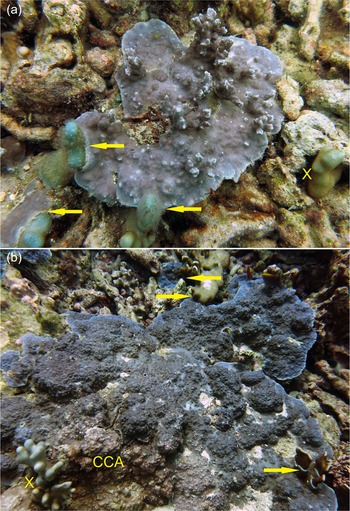
Porites rus corals competing with Heliopora were growing in lateral directions, around and over the nearest upright Heliopora branches, which had their tips still free (Figure 1). Heliopora corals without nearest-neighbour contact were not affected. One Porites colony was partly overgrown and killed by crustose coralline algae (CCA), which halted its expansion towards a nearby Heliopora coral and prevented it from becoming harmful (Figure 1b). The Heliopora corals showed either rounded branches (Figure 1a, b) or flattened branches (Figure 1b), suggesting that they may belong to different species (Richards et al. Reference Richards, Yasuda, Kikuchi, Foster, Mitsuyuki, Stat, Suyama and Wilson2018, Reference Richards, Haines, Scaps and Ader2020; Zhang et al. Reference Zhang, Hu, Yang, Zhang, Wei, Yu, Luo, Wei and Zhou2026). Heliopora corals were either overgrown and in direct contact with the aggressor (Figure 1a) or were overtopped with some distance between the two competitors (Figure 1b).
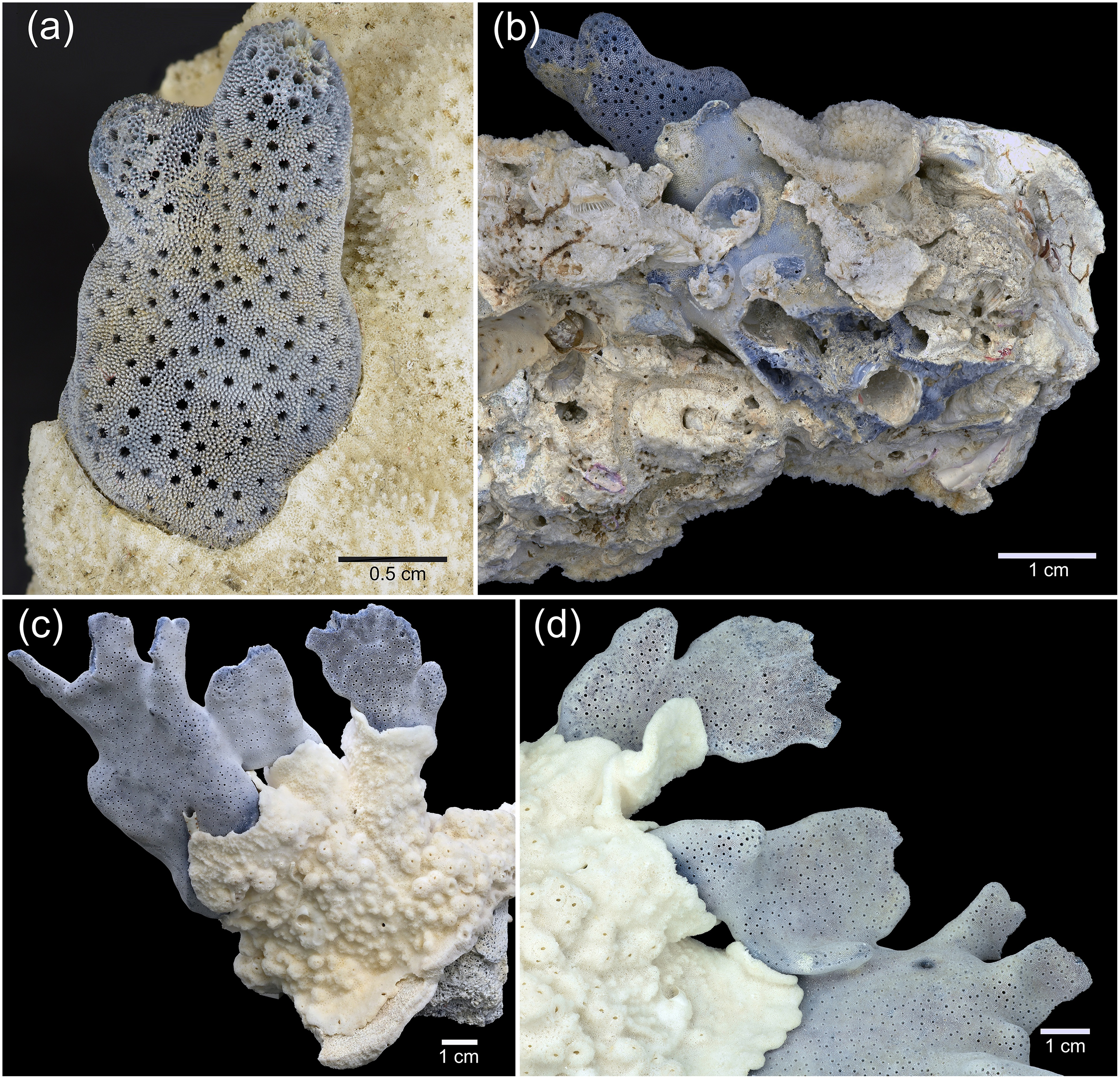
In addition to underwater observations on Heliopora interacting with neigbouring corals, collection material was studied in which blue octocorals served as substrate for scleractinians. Two Montipora skeletons from Southwest Sulawesi (Indonesia) in the coral collection of Naturalis (catalogue numbers RMNH.COEL.15627 and RMNH.COEL.23241) were sampled with their substrate consisting of Heliopora corals (Figure 2). Both specimens were from Kudingareng Keke, an uninhabited island in the Spermonde Archipelago; the first one was collected in 1979 and the second one in 1994. This island is known for its high coral diversity and located in relatively clear water, 13 km offshore from a major river outlet and from Makassar, the largest city in eastern Indonesia (Hoeksema Reference Hoeksema2012, Polónia et al. Reference Polónia, Cleary, de Voogd, Renema, Hoeksema, Martins and Gomes2015). The first colony, a Montipora hispida (Dana, 1846), had nearly encapsulated its host by tightly overgrowing it, leaving no space in between them and using it as a substrate (Figure 2a), whereas the other one (Montipora hoffmeisteri Wells 1954) kept a distance of a few millimetres from its living substrate while it was becoming overtopped (Figure 2b). This distance suggests that Heliopora’s very thin layer of soft tissue (Bouillon and Houvenaghel-Crevecoeur Reference Bouillon and Houvenaghel-Crevecoeur1970; Moseley Reference Moseley1876), and its dense cover of tiny polyps (Liu et al. Reference Liu, Fan and Dai2005; Toh et al. Reference Toh, Ng, Toh, Afiq-Rosli, Taira, Loke and Chou2016) offered resistance against its aggressor, preventing direct-contact overgrowth.
These observations show that even Porites corals, otherwise known to range from intermediate to subordinate aggressive (Dai Reference Dai1990; Monchanin et al. Reference Monchanin, de Jonge and Mehrotra2025; Sheppard Reference Sheppard1979), can overgrow or overtop Heliopora. In this case, the aggressor is P. rus, which in various localities appeared to be the most abundant species among its congeners (Dai Reference Dai1990; Idjadi and Karlson Reference Idjadi and Karlson2007; Rinkevich and Sakai Reference Rinkevich and Sakai2001). In the present study (Figure 1b), a large area of P. rus was overgrown by a thin layer of CCA representing the so-called ‘inhibitor’ functional type (Buenau et al. Reference Buenau, Price and Nisbet2012), which may be able to cover large parts of coral colonies (Hill et al. Reference Hill, Lymperaki and Hoeksema2021). The CCA appears to have stopped the P. rus coral from reaching a Heliopora, which remained free from contact (Figure 1b). Montipora corals, on the other hand, have a reputation of showing weak degrees of aggression in interactions with their opponents, such as neutral (Sheppard Reference Sheppard1979) and moderately to subordinate (Dai Reference Dai1990). Despite this, they were able to smother Heliopora corals (Figure 2).
Competition for space between branching Heliopora colonies (n = 4) and encrusting Porites rus at Pulau Weh, Indonesia. Expanding P. rus colonies are in contact with Heliopora colonies and overgrowing or overtopping most of them (arrows). Heliopora not in contact with the aggressor are marked by an X. (a) Smallest colony of P. rus in interaction with three Heliopora corals with round branches. (b) Largest colony of P. rus, part of which is overgrown and smothered by pink crustose coralline algae (CCA), preventing further contact with Heliopora (n = 4). Three Heliopora corals show flat branches; the other one (X) shows round branches. The P. rus coral around the Heliopora with flat branches (right corner below) is overtopping Photo credit: Agus Budiyanto.

Coral skeletons of branching Heliopora sp. (blue colour) being overgrown by encrusting Montipora corals (white colour) off Southwest Sulawesi, Indonesia. Museum collection material: (a, b) Round branches of Heliopora sp. almost completely encapsulated by a M. hispida colony (RMNH.COEL.15627) collected in 1979 (leg. H. Moll), showing tight contact between the two corals; (c, d) Flat branches of Heliopora sp. with their base incorporated by a M. hoffmeisteri colony (RMNH.COEL.23241) collected in 1994 (leg. B.W. Hoeksema), keeping a few millimetres distance from its competitor. Photo credit: R.S.U.
The four cases of the present study are consistent with Heliopora’s rank as a subordinate competitor for space in direct interactions with Montipora and Porites. The interactions consisted of the aggressors either overgrowing or overtopping Heliopora corals, which look very similar and probably have the same effect on the subordinate. In all observed interactions Heliopora branch tips had remained free, potentially leading to a situation in which they become covered, smothered, killed, and hidden from sight. Some recent studies suggest that Heliopora could become more dominant on degraded coral reefs that were exposed to warming sea water and eutrophication, either by overgrowing other corals (Atrigenio et al. Reference Atrigenio, Conaco, Guzman, Yap and Aliño2020) or by preventing juvenile settlement of competing species (Rodriguez et al. Reference Rodriguez, Segumalian, Lalas and Maningas2020). In contrast to many other reef corals, Heliopora is able to resist bleaching during elevated seawater temperatures (Kayanne et al. Reference Kayanne, Harii, Ide and Akimoto2002; Ryan et al. Reference Ryan, Hanmer and Kench2019). Among its opponents, Montipora corals have been reported to show modest to high mortality during bleaching events (Depczynski et al. Reference Depczynski, Gilmour, Ridgway, Barnes, Heyward, Holmes, Moore, Radford, Thomson, Tinkler and Wilson2013; McClanahan Reference McClanahan2004), in contrast to P. rus, which appears to be more bleaching resistant and heat tolerant (Lenihan et al. Reference Lenihan, Adjeroud, Kotchen, Hench and Nakamura2008; Lenz and Edmunds Reference Lenz and Edmunds2017). Moreover, similar to Heliopora on shallow fore reefs, P. rus is also able to build monospecific stands, but these appear to be limited to sheltered lagoons (Brooks et al. Reference Brooks, Holbrook and Schmitt2007; Idjadi and Karlson Reference Idjadi and Karlson2007; Lenz and Edmunds Reference Lenz and Edmunds2017).
In future scenarios, many reef corals are expected to disappear because of warming seawater and other environmental stressors (Carpenter et al. Reference Carpenter, Abrar, Aeby, Aronson, Banks, Bruckner, Chiriboga, Cortés, Delbeek, DeVantier, Edgar, Edwards, Fenner, Guzmán, Hoeksema, Hodgson, Johan, Licuanan, Livingstone, Lovell, Moore, Obura, Ochavillo, Polidoro, Precht, Quibilan, Reboton, Richards, Rogers, Sanciangco, Sheppard, Sheppard, Smith, Stuart, Turak, Veron, Wallace, Weil and Wood2008; Gutierrez et al. Reference Gutierrez, Polidoro, Obura, Cabada-Blanco, Linardich, Pettersson, Pearce-Kelly, Kemppinen, Jose Alvarado, Alvarez-Filip, Banaszak, Casado de Amezua, Crabbe, Croquer, Feingold, Goergen, Goffredo, Hoeksema, Huang, Kennedy, Kersting, Kitahara, Kružić, Miller, Nunes, Quimbayo, Rivera-Sosa, Rodríguez-Martínez, Santodomingo, Sweet, Vermeij, Villamizar, Aeby, Alliji, Bayley, Couce, Cowburn, Nuñez Lendo, Porter, Samimi-Namin, Shlesinger and Wilson2024), but Heliopora corals may become strong survivors (Atrigenio et al. Reference Atrigenio, Conaco, Guzman, Yap and Aliño2020; Rodriguez et al. Reference Rodriguez, Segumalian, Lalas and Maningas2020). Among its competitors, the bleaching-resistant P. rus may also become more abundant and widespread. Hence, Heliopora and its opponent P. rus, both have the potential to become more important inhabitants of future coral reefs, increasing their chances to become engaged in battles for living space.
Acknowledgements
We are grateful to our former friend and colleague, Agus Budiyanto, who provided digital field images taken at Pulau Weh. Unfortunately, he passed away in 2025 and therefore we dedicate this paper to his memory. The Research Centre for Oceanography – BRIN provided logistical support through the Widya Nusantara Expedition. We thank Hannco Bakker for his help in the Naturalis coral collection at Leiden. We thank the editor and two anonymous reviewers for their constructive comments, which improved the manuscript considerably.
Funding statement
This research was funded through a scholarship from the Indonesia Endowment Fund for Education (LPDP), Ministry of Finance of the Republic of Indonesia (contract number: SKPB10354/LPDP/LPDP.3/2024).
Open access funding provided by University of Groningen.
Competing interests
There are no competing interests to declare.

 Open access

