


The greatest challenge in the transition to consultant psychiatrist may be in developing a professional identity, with taking up appropriate authority and discerning one's position in the leadership/managerial system of the organisation in which one works (Reference Wilkie and RaffaelliWilkie & Raffaelli, 2005). Mentoring and discussion groups for those making the transition have been implemented to meet this need (Reference DeanDean, 2003; Reference Wilkie and RaffaelliWilkie & Raffaelli, 2005). Experiential learning is thought to be the most effective method of gaining insight into one's emotions and their possible impact on behaviour (Reference Pfeiffer and BallewPfeiffer & Ballew, 1988).
The core and general module of the current psychiatry training curriculum (Royal College of Psychiatrists, 2006) makes explicit the competencies that are to be developed, including in the new ST4-ST6 grades. Competencies relevant to leadership include critical self-awareness, working constructively within teams, identifying and rectifying team dysfunctions (including unconscious processes), making judgements and recommendations on resource allocation, taking up authority and appropriately assuming, delegating and devolving responsibility (Royal College of Psychiatrists, 2006).
This article describes the delivery and outcome of a 1-day experiential group relations conference commissioned by specialist registrars in psychotherapy in June 2006. This conference replaced the usual 6-monthly UK psychotherapy specialist registrars’ educational meeting. Feedback from participants was elicited immediately after the training day, and again at 9-month follow-up. The model and its delivery are described in detail, and the feedback from participants is discussed.
The conference was structured basing on the ‘group relations training model’, pioneered in the late 1950s by the Tavistock Institute of Human Relations and later by other international organisations, including the A.K. Rice Institute for the Study of Social Systems in the USA and the Israel Association for the Study of Group and Organisational Processes (Reference Miller, Trist and MurrayMiller, 1990). The methodology typically explores issues of authority, leadership, task and role, and is internationally established as a valid model for learning through direct experience (Reference Miller, Trist and MurrayMiller, 1990; Reference Khaleelee, Bruner, Nutkevitch and SherKhaleelee, 2003).
The essentials of this approach are that of learning through direct experience with the task, resources and time available clearly defined, providing a contained space for learning. The conference design deliberately raises anxiety, resulting in the emergence of psychological defences, at the individual and group level. By offering a psychoanalytic understanding to the meaning of participants’ experience in the ‘here and now’, these defences can be identified and reflected upon. Participants are then encouraged to draw analogies between their insights and their behaviour in their workplace.
Method
A limit of 28 places was offered, owing to physical and staffing constraints. There were 4 staff members and 27 participants. The overall aims of the conference were for participants to understand their own involvement in organisational processes and to enable managers and consultants to work more effectively. These aims would be achieved through the task of studying the conference as a temporary organisation. Participants were encouraged to observe and reflect on organisational behaviour as it unfolded during the day.
For example, participants were invited to reflect on how they and staff exercised authority, to examine and develop their own leadership capacities, and to study what facilitates effective leadership.
To achieve this, the conference provided a context in which the study of the inter-relatedness of individual, group and organisational structure was possible.
Role of staff
The staff took up both managerial and process consultant roles. The former meant providing a programme to meet the overall learning aims and manage the day as a whole. The latter meant offering their observations and hypotheses concerning the unfolding processes to the membership.
Conference structure
The conference ran for 5 hours, excluding breaks. The main event was designed specifically to give the participants an opportunity to directly explore and address their learning needs. There were four stages: an opening plenary, a resource management event, review/application groups, and a closing plenary.
Opening plenary
Participants were introduced to the programme, the roles of the staff, and the method of learning through direct experience. They were then invited to share their thoughts on crossing the boundary into the conference, and on their anticipation and anxieties about the day ahead.
The resource management event
The success of any group enterprise is dependent upon the group's ability to identify, manage and utilise its resources, as well as its capacity to allow individuals to exercise appropriate authority in their role, and to delegate authority to others. The resource management event was designed to mirror some of these challenges. Participants were asked to volunteer for assessor and leadership roles, and were given two tasks:
-
1) To identify participants’ learning needs in relation to the above themes.
-
2) Using the resources of the membership (e.g. their experiences of leadership and working in groups), to develop and run a brief programme of events to meet these learning needs.
Review/application groups
The participants formed groups of seven, each with a staff member. Staff worked in management and consultant roles. Each group was given two specific tasks:
-
1) Task 1: to review what they have learned at the conference and to identify further learning aims.
-
2) Task 2: to apply what they have learned at the conference to personal work-related issues.
Closing plenary
This gave both the staff and participants an opportunity to review the day, and to share their thoughts at the end of the conference.
Results and discussion
The day's events: Conference Directors’ observations
In spite of high anxiety, participants quickly engaged with the task and used the resources available to them appropriately. Volunteer leaders were able to successfully harness the resources of the membership, and all groups were able to make a short presentation. In each case, the presentation linked to a real ‘here and now experience’ of the day, which was used to explore themes such as authority, leadership and followership, competition, and the appropriate management of personal and professional boundaries.
In the review/application groups, participants reflected on the roles they had taken up during the day, and linked these to their experience of their professional environment. Differences between particular people pertained to how advanced they were in their training programme. Those who anticipated taking up consultant posts in the next 12 months were focused on questions of leadership and authority, while those just starting their specialist training felt daunted by the anticipation that they would need to develop a capacity for self-authorisation.
At the closing plenary some participants wanted active feedback on their performance. Most were able to reflect on their participation and learn from the experience of others.
Evaluation immediately after the conference
Delegates rated each part of the training event, using a 5-point Likert scale (1 ‘not at all useful’, 3 ‘moderately useful’, 5 ‘extremely useful’) and free text feedback; they were also invited to offer suggestions for future conferences. The forms were returned by 14 delegates, with 10 having given feedback. The results are shown in Table 1 and indicate a high level of satisfaction with the training.
Conference evaluation immediately after the event

| Element | n | Median score1 |
|---|---|---|
| Opening plenary2 | 14 | 4 |
| Resource management event | 14 | 5 |
| Review/application groups | 13 | 5 |
| Closing plenary | 11 | 4 |
| Overall organisation of the conference | 13 | 5 |
| Extent to which the conference met delegates’ expectations | 13 | 5 |
Evaluation after 9 months
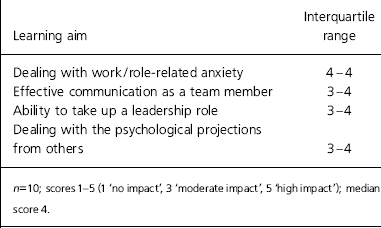
At 9 months we evaluated the longer-term benefits of attending the Experiential Group Relations Conference for delegates around four key issues, using a 5-point Likert scale (1 ‘no impact’, 3 ‘moderate impact’, 5 ‘high impact’) and free text comments. The results are summarised in Table 2. This time 10 delegates responded. Most of them were in their 4th year of training (range 1-6 years).
The long-term impact of the conference upon the delegates’ learning (at 9-month follow-up)
| Learning aim | Interquartile range |
|---|---|
| Dealing with work/role-related anxiety | 4–4 |
| Effective communication as a team member | 3–4 |
| Ability to take up a leadership role | 3–4 |
| Dealing with the psychological projections from others | 3–4 |
The ratings of the event's impact on delegates’ learning were similar for the four areas, with median Likert scores of 4, indicating a greater than moderate impact.
Free text responses
The most significant issues for the delegates immediately after the conference and at 9-month follow-up were the emotional experiences on the day and the quality of learning.
The emotional experience
At initial evaluation, most respondents described anxious/painful feelings, some said they felt exposed or defensive, others felt helped. Specific causes of anxiety were staff seeming to withhold information, time pressure and uncertainty about the task. At follow-up, one participant continued to find the experience very difficult. For others, difficult feelings were seen as mainly arising out of conflict between the volunteer leaders and other participants.
The quality of learning
At initial evaluation, participants felt they were helped to reflect on their experiences, although some had been too restrained and defensive. Most participants commented that the learning experience was different to, but enhancing, prior learning. All agreed that the event was a powerful illustration of organisational dynamics and had afforded learning from observing others, feeling strong emotions that arise in a power differential, and understanding the importance of communication.
Some complained about practical matters on the day, such as lunch and restrictions on the number of delegates. One participant suggested that the Likert scale we used for evaluation was prone to bias in favour of a positive response.
At follow-up, some participants reported an increase in capacity for self-reflection, understanding what a management role might ‘feel’ like, effective communication, awareness of group dynamics and of one's own weaknesses. Regarding the impact of the event on their ability to take up a leadership role, comments were very varied, from losing confidence, to identifying a need for more training, through to having gained insight into groups and organisational dynamics, and their own behaviour in various roles, and at the other extreme, to not having learnt anything from participating in the conference. This was partly related to the stage of training of the individual. One respondent said that the learning experience of dealing with projections at the event was highly retained, others commented that it was easier to recognise than to effectively deal with them. One participant said that the event had probably contributed to their own successfully handling of a transition to a consultant post. Almost all respondents (nine out of ten) said they would be willing to attend again and would recommend the event to others.
Conclusions
At 9-month follow-up there is evidence to suggest that participation in the conference has made a longer-term contribution to participants’ learning, particularly in relation to self-awareness in role, and the requirements of good leadership. For some, the conference had shaken their confidence, and this would suggest the need for follow-up, for instance through action learning sets or personal mentoring, which could help participants reflect and work on their strengths and weaknesses. Further thought needs to be given to the timing of such a conference in relation to the stage of training of participants, possibly offering one early on and again in the final year of training.
Offering an experiential learning event in the context of a wider training that is very much about achieving predetermined benchmarks creates the need for a rapid re-orientation in the membership. The participants were, on the whole, highly sophisticated, with a degree of self-awareness and capacity for critical reflection. Most had been in personal therapy as part of their training. While it remains to be explored how useful such an approach might be in the training of other professionals, this training model may contribute to the achievement of core and general competencies for all trainee psychiatrists.
Declaration of interest
S.B. is Regional Development Officer for Consultancy Training and organising tutor of an MA programme, Psychoanalytic Approaches to Consultation and the Organisation, offered by the Tavistock and Portman NHS Trust. She has received payment for directing group relations conferences.
Acknowledgements
We thank Dr Sheena Pollet for comments on the manuscript. Thanks also to the other members of the Organising Committee and to Asher Giora, Secretary of the Specialist Registrars in Psychotherapy Peer Group.


 Open access


eLetters
No eLetters have been published for this article.