

In the summer of 2012, Peter said to me: “I have become an expert on Parkinson’s dementia.” He paused with a smile, his quiet humor intact after more than two decades of Parkinson’s disease. His next sentence came out after a bit of effort. “It is all about the synapses and abnormal pruning.”
Peter was 60 years old in 1991 when he was diagnosed with Parkinson’s disease. When I was a medical student home on holiday, I noticed a change in his gait and asked, “Dad: do you think you have Parkinson’s disease?” He replied, “Yes. I am worried about that.” For years after that, Peter was under clinical care for Parkinson’s. The treatment primarily consisted of lifestyle changes and as little L-dopamine as possible to control his symptoms. He did well for the first decade or more after diagnosis. He continued seeing patients, socializing, attending events and traveling. As the years passed, in the second decade after diagnosis, Peter needed to increase the medicine to control his symptoms and compensate for the low levels of the neurotransmitter dopamine that is characteristic of Parkinson’s. The progression of the disease is often gradual, over years. Peter had been an avid hiker, with a long and fast stride. His gait visibly declined over these years, at first changing to smaller, slower steps, and later to the shuffling gait of Parkinson’s disease.
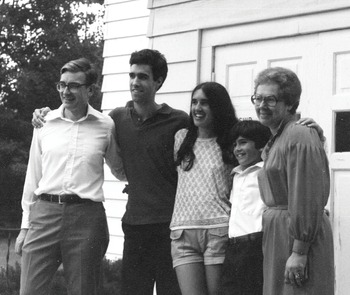
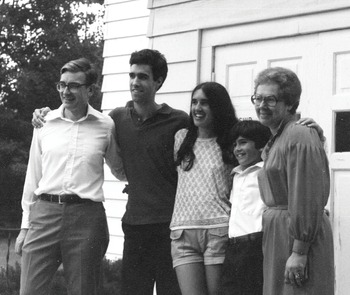
Parkinson’s disease’s progression is gradual, but insidious. The voice diminishes and muscles become more rigid. Facial expressions, and seemingly emotions, fade. Movement becomes difficult and tremors become common. Mental status starts to wax and wane. The social network for people with Parkinson’s disease narrows. For Peter as well, less and less time was spent interacting with friends, and he spent more time with his family (Figure 19.1).
In 2003, after Peter retired from the University of Chicago, Janellen was invited to spend a year as a fellow at the Wissenschaftskolleg, an interdisciplinary institute in the western part of Berlin.Wissenschaftkolleg brings together scientists from around the world, to discuss work in the social and natural sciences. Peter was interested in living in Germany for the year. Until his father passed away around 1990, he had enjoyed almost yearly visits to Europe for work and to see his father and brothers in Munich. He particularly enjoyed visits to his father. As Janellen later said, “Richard enjoyed good conversation.” An earlier family letter said, “Opa Huttenlocher is really quite a card – constantly coming up with funny lines but also dead set in his own ideas. Somehow, Wolfie [Wolfgang] and I got to discussing atomic power and Opa could not tolerate any opinion other than his own which is pro-Nuke.” Peter saved the many letters that Richard sent to him over the years. He was proud of his father’s many patents and that he started a chemistry journal, Tensid (now known as Tenside Surfactants and Detergents). On a recent visit to Munich’s Englischer Garten with Wolfgang, we walked to the Bogenhausen neighborhood and passed the Carl Hanser Verlag building, home to the publishing company where Richard worked on the Tensid journal. This was close to the Thomas Mann house in Munich, a villa on a quiet tree-lined street in Bogenhausen. Thomas Mann, the winner of the Nobel Prize in Literature in 1929 and author of The Magic Mountain, fled Germany in 1933. He wrote political works that criticized the Nazi regime and were banned by the government. He also publicly declared his support for German writers who had been exiled by the German government. Like Peter’s mother, Thomas Mann’s citizenship was rescinded and he was banned from working in Germany. He moved to Switzerland and then to the United States. Peter had previously shared stories that, during the war, Richard, Dieter and Peter listened to Mann’s anti-Nazi speeches that were broadcast by the BBC on the long-wave radio to Germany.
Many years had passed since Richard’s death when Janellen received the invitation to work in Berlin, but Peter welcomed a year in Europe in the twilight of his career. Living again in Germany provided thought-provoking stimulation, some more welcome and some less so, especially with the challenges of Parkinson’s disease. He relished the opportunity to see the Munich family and to visit places from his childhood. Peter’s brothers Wolfgang and Götz visited him in Berlin, and his US family also visited. During this time, Peter’s health rallied and he seemed to effortlessly hop on and off buses during exploratory trips around Berlin. The rich, lush western regions of Berlin and the Brandenburg Gate stood in contrast to the former East Berlin, still stark but with a raw and lively young energy.
During the year in Berlin, one journey was to his childhood home in Braubach with his wife, daughter and grandchildren. The trip took a diversion to Harburg, a medieval village with a castle and many small farms. Peter’s family friends farmed in Harburg and, for a few summers, young Peter had gone alone by train to work on their farm. Peter described the summers on the farm: he traveled loaded with a suitcase full of soap from his father’s chemical company, which he would offer in exchange for meat – pork – from the farm. He worked for several weeks on the farm to further cover the cost (and perhaps to keep him productively busy). Farms were short of help at the time and Peter was a hard worker. On the train route back home, the luggage would be heavy with meat, but Peter pretended the luggage was light as he quickly walked past guards, avoiding the guard dogs in particular. It was against the law to transport meat since food was being rationed and meat was prioritized for soldiers. It was strategic to have a young boy transport the meat because he was less likely to arouse suspicion or to be punished if he was discovered.
As Peter and his family drove in 2003 across a bridge into the town of Harburg and turned on a bend in the road, Peter exclaimed: “That is where the barn was that housed the pigs!” The “barn” site was now a government bureau with computers and workers. But the old farmhouse was still intact and clearly continued to be used as a residence. Without advance notice Peter knocked on the door and, sure enough, Annie, the farmer’s daughter, a few years older than Peter, answered. She looked and examined him for a moment standing on her doorstep. They quickly recognized each other despite the elapsed years and she exclaimed “Peter!” in delight. She served tea and German kuchen as if she had been preparing for the visit. The conversation quickly turned to the war. Her family was anti-Nazi but that had become untenable for her father. He had to join the party late in the war to sell his grain, and the Nazis confiscated their meat. She lamented that many of the Nazis in town later became the town leaders after the war but people in town did not speak about the war. At the end of the war, the Nazis had bombed the old bridge into town to try to stop the Allied forces. As Annie said: “even if all of the women and children in town were on the bridge, the German soldiers would have bombed it.” The 70-plus-year-old Annie was sprightly and showed Peter around the remaining farm buildings. Peter and Annie looked at each other sadly and hugged before departing.
It was during the year in Berlin that Janellen first noticed some cognitive decline with Peter. Parkinson’s disease can be associated with both early cognitive dysfunction and later dementia. Janellen raised concerns about cognitive decline in a family email during their time at the Wissenshaftkolleg, 13 years after his diagnosis of Parkinson’s disease. First in jest, Peter and Janellen wrote:
Hi,
I hope you answer your email. I am afraid that we thought the phone was the doorbell. We are yoyos. A colleague was here and pointed out the problem. We should have because no one was ever at the door. Hiccup.
Love,
Mom and Dad
Then a more serious email from Janellen:
Hi,
You know I didn’t respond to you last night in terms of what I have been thinking. As you know, Parkinson’s slows down all processes. There is considerable recent work in psychology showing this effect in memory – slowing down in search processes. It is my idea that this is Dad’s problem. Whenever he sets his mind to a problem he is as sharp as ever. I notice that when he is distracted like with the wonderful presence of his daughter and grandchildren, wonderful new things like concerts, that is when the system sort of “blows.” I am trying to think of ways to make him realize that he will find whatever information it is that he cannot find “on-line” fast and make him look less bewildered and out of it. He always had a slight tendency that way anyhow. So, your cognitive psychologist mom is trying to think out how to help him cope. But I do believe the problem is isolated this way. Do you think this is a possible interpretation?
All my love,
Mom
After their return to the United States, Janellen spent the subsequent years helping Peter (and herself) cope with progressing Parkinson’s disease, especially by keeping active. She organized attendance at concerts and plays, dinners out with friends and travel to visit family. After their return from Berlin, Peter needed more help. He selected a Polish immigrant as his caregiver. Josef was an incredibly kind man, with some language gaps but with a shared interest and advanced knowledge of classical music. Together, Peter, Janellen and Josef attended many concerts and traveled for family visits.
On Peter’s final trip to Europe at the age of 80, Peter and Janellen visited family when they were on sabbatical in Basel, Switzerland. The extended family had a reunion in the Swiss mountains, which included Peter’s brother Wolfgang. One afternoon, Wolfgang and Peter decided the two of them would take a drive and Janellen reluctantly agreed, reluctant because she was concerned about Peter and trusted neither Wolfgang’s fast driving nor his judgment with Peter. Janellen displayed increasing angst when, after many hours, the brothers still failed to return. Then, as evening descended, Wolfgang and Peter arrived in Wolfgang’s sports car – with big smiles. They had driven through the mountains, stopped at a few cafes, and spontaneously taken a boat trip across the lake. Peter looked mischievously happy. Quiet and pleased. Wolfgang looked like a scolded schoolboy, but also thrilled to have taken his older brother, with advanced Parkinson’s disease, on such an adventure.
Even with advancing Parkinson’s disease, Peter continued to ponder synaptic pruning and its implications. When musing that he had become a first-hand expert on Parkinson’s dementia (“it is all about synaptic pruning”), he may have hit upon something. Parkinson’s disease is most associated with a loss of neurons in the midbrain basal ganglia structure known as the substantia nigra and the associated loss of dopamine production. The dementia is associated with the presence of cortical and subcortical alpha-synuclein/Lewy bodies, but post-mortem studies of patients with Parkinson’s disease dementia often reveal the co-existence of pathologies associated with Alzheimer’s disease. Recent findings (discussed in a previous chapter) suggest that microglial cells and abnormal synaptic pruning may be implicated in Alzheimer’s disease. Is Parkinson’s disease dementia also mediated in part by aberrant synaptic pruning? Recent evidence suggests that this may be the case.