


1. Introduction
Women in the legal profession face significant barriers to leadership roles across the globe, despite increased gender diversity among law school graduates and in entry-level positions (Reich et al., Reference Reich, Gordon and Edwards1973; Anderson et al., Reference Anderson, Butler and Sloan1987; Gorman, Reference Gorman2005, Reference Gorman2006; Nakamura, Reference Nakamura2014; Arce and Segura, Reference Arce, Segura, Stone, Dennis, Rizova, Smith and Hou2015; Zhu et al., Reference Zhu, Zhao and Liu2020; U.S. Bureau of Labor Statistics, 2021). In Western countries, most law firm partners are men, especially in private firms, even though women are half of recent law school graduates (Dixon and Seron, Reference Dixon and Seron1995; Hagan and Kay, Reference Hagan and Kay1995; Wilkins and Gulati, Reference Wilkins and Gulati1996; Kay and Hagan, Reference Kay and Hagan1998; Reichman and Sterling, Reference Reichman and Sterling2004; Gorman, Reference Gorman2005; Heinz et al., Reference Heinz, Nelson, Sandefur and Lauman2005; Phillips, Reference Phillips2005; Gorman, Reference Gorman2006; Kay and Gorman, Reference Kay and Gorman2008; Gorman and Kmec, Reference Gorman and Kmec2009; Kay and Gorman, Reference Kay and Gorman2012; Wallace and Kay, Reference Wallace and Kay2012; Cochrane, Reference Cochrane2017; Peery, Reference Peery2018; Sommerlad and Sanderson, Reference Sommerlad and Sanderson2019). In Asian countries like India, China, Japan, and South Korea, women have increasingly entered entry-level legal positions, but men continue to dominate partner and leadership positions (Lee, Reference Lee2009; Choe, Reference Choe2010; Park et al., Reference Park, Song, Kang, Yoon, Ko, Kim, Son and Chun2012; Nakamura, Reference Nakamura2014; Ballakrishnen, Reference Ballakrishnen2017a, Reference Ballakrishnen2017b; Zheng et al., Reference Zheng, Ai and Liu2017; Zhu et al., Reference Zhu, Zhao and Liu2020). The underrepresentation of women among law firm partners has been a persistent feature of legal fields worldwide.
However, a growing need for legal services in emerging markets creates opportunities to disrupt this persistent pattern. The case of South Korea offers a valuable example, because the Korean government significantly reformed regulations governing legal education, professional qualifications, and firms from 2007 to 2011 to enhance its legal services field to compete in global markets (John, Reference John2012). These reforms, including the 2007 Act on the Establishment and Management of Professional Law Schools (AEMP) and changes to the Attorney-at-Law Act (ALA) in 2011, rapidly transformed institutionalized structures and organizational practices in the South Korean legal field in ways that increased opportunities for women lawyers (Zucker, Reference Zucker1977; Mahoney and Thelen, Reference Mahoney and Thelen2010; Korean Bar Association, 2016). The 2007–2011 legal reforms expanded both the number of lawyers and the number of law firms in South Korea by transforming the system of legal education and loosening regulations for establishing a new law firm (Lee et al., Reference Lee, Rhee and Hwang2015; Korean Bar Association, 2016). These legal reforms may have disrupted traditional patterns in the male-dominated legal field because they coincided with trends towards higher education and labour force participation among women, important domestic events like the election of South Korea’s first female president, and government efforts to signal a commitment to gender equality. As a result, the South Korean case is a fruitful one for examining shifts in the gender composition of the legal field following institutional change.
In this paper, we use data on partners who established law firms in South Korea from 2000 to 2016 to analyse changes in the gender composition of law firm partners during a period of legal and regulatory change. To examine gender diversity, we used generalized linear models (GLM) to analyse the proportion of female founding partners. We find that the proportion of female founding law firm partners increased significantly after the 2007–2011 reforms. While the field had not yet experienced the full effects of the legal reforms by 2016, and more recent data are not available, we argue that institutional changes to South Korea’s regulation of the legal field encouraged more women to become law firm co-founders and transformed the gender composition of the legal field.
2. Gender inequality in the legal profession
Research on the legal profession has found persistent gender inequality due to its history as a high-status, male-dominated profession (Kay and Gorman, Reference Kay and Gorman2008). The growing number of female law school graduates has expanded women’s access to entry-level legal positions over time, but women lawyers remain underrepresented in private law firms, corporate legal departments, and judicial positions, particularly at higher organizational levels (Dixon and Seron, Reference Dixon and Seron1995; Kay and Hagan, Reference Kay and Hagan1998; Reichman and Sterling, Reference Reichman and Sterling2004; Peery, Reference Peery2018; Sterling and Chanow, Reference Sterling and Chanow2021). Legal fields are also internally sex-segregated, with women lawyers more likely to work in legal specialities or practice areas with lower prestige (Dixon and Seron, Reference Dixon and Seron1995; Kay and Gorman, Reference Kay and Gorman2008; Azocar and Ferree, Reference Azocar and Ferree2015). In the United States and Canada, women lawyers are more likely to work in government and in-house counsel positions, while men dominate corporate law and private law firms (Dixon and Seron, Reference Dixon and Seron1995; Noonan et al., Reference Noonan, Corcoran and Courant2005; Wallace and Kay, Reference Wallace and Kay2012). In South Korea, women lawyers often work on family law cases, which may limit their career mobility (Korean Bar Association, 2020). Sex segregation within the legal field and women’s underrepresentation in leadership positions both contribute to gender inequality in law.
Research on gender in the legal profession has found that discrimination and gender stereotypes contribute to gender inequality in hiring, promotion, and compensation, using metaphors like “sticky floors,” “broken steps,” and “glass ceilings” (Reichman and Sterling, Reference Reichman and Sterling2004; Gorman and Kmec, Reference Gorman and Kmec2009). The “glass ceiling” metaphor refers to the invisible barriers that hinder women’s progression to leadership positions, especially law firm partnerships (Kay and Hagan, Reference Kay and Hagan1995; Gorman and Kmec, Reference Gorman and Kmec2009). Research on the glass ceiling has found that gender stereotypes, same-gender preferences, and structural barriers all contribute to the underrepresentation of women in partner positions (Epstein et al., Reference Epstein, Sauté, Oglensky and Gever1995; Kay and Hagan, Reference Kay and Hagan1995; Gorman, Reference Gorman2005; Gorman, Reference Gorman2006). As a result, women lawyers often lack role models, mentors, and professional networking opportunities, which limits their access to the resources and guidance necessary for reaching leadership positions. Gender discrimination in the workplace can create exclusionary environments that hinder career advancement for women (Kay and Hagan, Reference Kay and Hagan1995).
Challenges to balancing work and family also contribute to a “motherhood penalty” in the legal profession, since long working hours and demanding work environments disproportionately burden women with caregiving responsibilities. Women lawyers with children have fewer opportunities and promotions and lower compensation, compared to their male or childless female counterparts and face biases that assume they are less committed to their careers or less competent than their peers (Kay and Hagan, Reference Kay and Hagan1998; Williams, Reference Williams2003; Wallace, Reference Wallace2006; Wallace and Kay, Reference Wallace and Kay2012). As a result, women lawyers are more likely to exit the legal field (Korean Bar Association, 2020; Ganguli et al., Reference Ganguli, Hausmann and Viarengo2021; Sterling and Chanow, Reference Sterling and Chanow2021). The motherhood penalty is significant in Western countries, and it also creates a disadvantage in Asian countries (Park et al., Reference Park, Song, Kang, Yoon, Ko, Kim, Son and Chun2012; Nakamura, Reference Nakamura2014; Korean Bar Association, 2016; Reference Zheng, Ai and LiuZheng et al., Reference Zheng, Ai and Liu2017).
The historically male-dominated culture of the legal field continues to shape patterns of gender inequality in the profession. Men’s position as traditional incumbents of the legal field gives male lawyers better access to “law-firm capital,” defined as the tacit social and cultural capital that is essential for managing impressions, constructing social networks, and attracting a legal clientele (Bourdieu, Reference Bourdieu1984, Reference Bourdieu1985, Reference Bourdieu1990; Kay and Hagan, Reference Kay and Hagan1998; Garth and Sterling, Reference Garth and Sterling2018). Additionally, research on organizational genealogies in law firms has revealed the entrenchment of norms and practices from the time of firm establishment, leading to organizational inertia. Organizational inertia imprints cognitive, interactional, and institutional routines at the time of an organization’s founding, reproduces organizational divisions of labour over time, and makes firms resistant to change (Stinchcombe, Reference Stinchcombe and March1965; Tomaskovic-Devey and Stainback, Reference Tomaskovic-Devey and Stainback2007; Stainback and Tomaskovic-Devey, Reference Stainback and Tomaskovic-Devey2012). In law firms, foundational patterns contribute to the persistence of gender inequality in diverse locations like Silicon Valley (Phillips, Reference Phillips2005), India’s elite professional firms, and “global” law firms (Ballakrishnen, Reference Ballakrishnen2017a, Reference Ballakrishnen2017b). There are similar patterns across cultural and regional contexts, including Korea and Japan, where legislative structures and legal education systems may inadvertently reinforce gender stratification within the legal field (Nakamura, Reference Nakamura2014; Oh, Reference Oh2017). As a result, it is difficult for women to advance and attain equal representation over time in firms that are male-dominated at their time of establishment.
However, institutional change can create external pressures that disrupt established cultural norms and organizational inertia (Liu and Halliday, Reference Liu and Halliday2009; Lee, Reference Lee2013; Liu and Wu, Reference Liu and Wu2016). These disruptions may, in turn, contribute to shifts in the demographic composition of jobs or in the status and prestige attached to them. Many occupations that have desegregated have faced significant institutional changes in the form of new technologies or regulations, which can influence their required skills or the supply of available workers (Tomaskovic-Devey and Stainback, Reference Tomaskovic-Devey and Stainback2007; Reskin and Roos, Reference Reskin and Roos2009; Stainback and Tomaskovic-Devey, Reference Stainback and Tomaskovic-Devey2012). Additionally, changes in organizational structure can contribute to gender desegregation, as in the case of “global” law firms in India that use gender diversity to signal meritocracy and modernity, in distinction to traditional Indian law firms (Ballakrishnen, Reference Ballakrishnen2017a, Reference Ballakrishnen2017b). Theories of law and organizations also illuminate how changes in legal regulations can generate external pressure on existing organizational fields and produce changes in their gender composition (Guthrie and Roth Reference Guthrie and Roth1999; Zucker Reference Zucker1977). In this way, legal and regulatory changes can act as catalysts for increasing gender equity.
3. Institutional change and gender diversity
While research on gender and labour markets reveals a high and persistent overall level of gender segregation, especially in the professions, the existing literature suggests that at least three types of legal regulations can influence gender diversity within firms: (1) Equal Employment Opportunity (EEO) laws, (2) rules governing educational credentials, and (3) regulations for establishing or operating an organization in the field (Jolly et al., Reference Jolly, Grimm and Wozniak1990; Tomaskovic-Devey and Stainback, Reference Tomaskovic-Devey and Stainback2007; Huffman et al., Reference Huffman, Cohen and Pearlman2010; Stainback and Tomaskovic-Devey, Reference Stainback and Tomaskovic-Devey2012). These types of regulations are not all created equal, leading theorists to question what types of government initiatives lead to more gender equity and under what conditions.
First, some laws mandate EEO and prohibit employers from discriminating against protected groups. EEO laws target the “demand side” of the labour market (employers) by requiring organizations to follow principles of non-discrimination in their hiring, promotion, and compensation practices. Some research has found that laws that prohibit discrimination in hiring and promotion can increase job opportunities for women and minorities, especially at the entry level, thus helping underrepresented groups to enter occupations and professions that previously excluded them (Guthrie and Roth, Reference Guthrie and Roth1999; Tomaskovic-Devey and Stainback, Reference Tomaskovic-Devey and Stainback2007; Huffman et al., Reference Huffman, Cohen and Pearlman2010). However, research has found inconsistent effects of EEO policies, depending on occupational and firm characteristics like training and skill requirements, firm size, and location (Coe and Snower, Reference Coe and Snower1997; U.S. Equal Employment Opportunity Commission, 2003; Kalev et al., Reference Kalev, Dobbin and Kelly2006; Timmers et al., Reference Timmers, Willemsen and Tijdens2010; Groeneveld and Verbeek, Reference Groeneveld and Verbeek2012; Williams et al., Reference Williams, Kilanski and Muller2014; Cook and Glass, Reference Cook and Glass2015; Bertrand et al., Reference Bertrand, Black, Jensen and Lleras-Muney2019). EEO policies tend to have their weakest effects in high-paying occupations, large firms, private firms, and competitive markets (Bielby and Baron, Reference Bielby and Baron1986; Dixon and Seron, Reference Dixon and Seron1995; U.S. Equal Employment Opportunity Commission, 2003; Roth, Reference Roth2006; Williams et al., Reference Williams, Kilanski and Muller2014). This has led some to argue that EEO mandates promote symbolic compliance, but they often fall short of driving meaningful change—particularly in well-established professional fields (Edelman, Reference Edelman1992, Reference Edelman2016). One reason for the limited effectiveness of EEO legal mandates is that they attempt to influence subjective employment decisions in fields with longstanding divisions of labour and organizational cultures, where organizational inertia produces resistance to substantive change (Stinchcombe, Reference Stinchcombe and March1965; Hannan and Freeman, Reference Hannan and Freeman1984; Tomaskovic-Devey and Stainback, Reference Tomaskovic-Devey and Stainback2007; Hirsh, Reference Hirsh2009).
The second and third types of regulation influence the supply side of the market, or the pool of available workers and the number of organizations in a field. The second type of law that can influence gender diversity is rules governing educational credentials. Professions like law and medicine maintain social closure by excluding outsiders, erecting boundaries against non-traditional workers, and restricting access to opportunities within their domain (Freidson, Reference Freidson1984; Abbott, Reference Abbott1988; Murphy, Reference Murphy1988; Tomaskovic-Devey, Reference Tomaskovic-Devey1993; Weeden, Reference Weeden2002). One of their strategies for maintaining social closure is control over professional education. However, governments can limit professions’ authority by changing regulations that accredit educational programmes and regulating licensing requirements in ways that, intentionally or unintentionally, open professions to underrepresented groups. Thus, educational regulations can undermine social closure in the professions, limit traditional incumbents’ advantages, and increase diversity in the field. Previous research has found that women are more likely to enter male-dominated occupations when education and training requirements change, so policies that change professional credentials can break down barriers to entry and promote gender diversity in professional occupations (Jolly et al., Reference Jolly, Grimm and Wozniak1990; Reskin and Roos, Reference Reskin and Roos2009; Huffman et al., Reference Huffman, Cohen and Pearlman2010; Stainback and Tomaskovic-Devey, Reference Stainback and Tomaskovic-Devey2012; Lorsch and McTague, Reference Lorsch and McTague2016).
The third type includes administrative rules for establishing or operating an organization within a field. When laws reduce barriers for new organizations to enter a field and/or encourage expansion of the field itself, they can create new openings for underrepresented groups. Previous research has illustrated that growth in the demand for workers in a particular occupation or field can promote the integration of underrepresented groups, like women in male-dominated occupations (Tomaskovic-Devey and Stainback, Reference Tomaskovic-Devey and Stainback2007; Reskin and Roos, Reference Reskin and Roos2009; Stainback and Tomaskovic-Devey, Reference Stainback and Tomaskovic-Devey2012). When this occurs, the men who remain in the field often move into higher positions, thus retaining a relative advantage, while women find new opportunities to enter the field at lower levels. If these entry-level opportunities are more attractive to women workers than other available employment, this process is likely to produce a shift towards gender desegregation over time (Reskin and Roos, Reference Reskin and Roos2009). Once more, women are in the pipeline, some will find opportunities to move into leadership roles, especially if the field continues to grow. Thus, existing research suggests that regulations that expand the number of workers or firms can promote diversity over time (Michelson, Reference Michelson2013).
In South Korea, the 2007–2011 legal reforms—the AEMP and ALA amendments—represented the second and third types of regulations over the supply side of the legal field. During this period, the government introduced a new law school system, established a new bar exam, and loosened restrictions on founding law firms. These reforms expanded both the pool of new lawyers and the number of law firms.
4. The Korean legal field
South Korean law firms have traditionally had elite, male-dominated professional norms and organizational cultures. Historically, most judges, prosecutors, and law firm partners were men who graduated from elite universities such as Seoul National, Yonsei, and Korea universities (Kim, Reference Kim2001; Kim et al., Reference Kim, Kim, Suh and Rhee2003; Cho, Reference Cho2016). For licensed lawyers, there are five major career paths in South Korea: self-employment as solo practitioners, employment in domestic law firms, government service, judicial or prosecutorial positions, and in-house counsel roles in private companies. Among these, employment in domestic law firms is the most common (Lee et al., Reference Lee, Rhee and Hwang2015). These firms traditionally practised across all areas of law, and relatively few lawyers maintained distinct areas of expertise (Korean Bar Association, 2010, p. 166), although specialization in particular areas of law has increased in recent years. South Korean law firms are heavily concentrated in the capital city of Seoul, which houses the largest legal services market and the country’s highest judicial institutions (Korean Bar Association, 2010, p. 30; Jeon and Kim, Reference Jeon and Kim2015). This geographical centralization results in intense competition for corporate clients in the capital. In December 2016, roughly two-thirds of all South Korean law firms (659 out of 990) were based in Seoul (Korean Ministry of Justice, 2017), a proportion that remained consistent in 2024, with 1003 of 1504 firms (67%) located in the capital (Korean Bar Association, 2024).
From 2007 to 2011, in an effort to expand the Korean legal field and effectively compete in the global economy, the South Korean government introduced the AEMP Law Schools and substantially amended the ALA (John, Reference John2012). The 2007–2011 Korean legal reforms restructured the legal field in South Korea in three ways: (1) by regulating a new law school system; (2) by introducing a new national bar exam; and (3) by reducing regulatory barriers to establishing a firm.
The legal education system was established in 1971 prior to the reforms. Under that system, aspiring lawyers with at least 35 university credits had to take three separate examinations to compete for admission to the national Judicial Research and Training Institute (JRTI), a government-administered independent institution. In the 1990s, these entrance examinations had a pass rate of less than 5% (Korean Ministry of Justice, 2004). Students who passed would take two years of additional courses at the JRTI after their Bachelor’s degree. High barriers to entry limited the number of lawyers in the Korean legal field, and graduates of the JRTI faced relatively little competition (Choe, Reference Choe2010; John, Reference John2012; Kim, Reference Kim and Yang2013). The JRTI also had a tiered outcome structure, under which top-performing graduates were eligible to become judges or prosecutors—roles that are common precursors to law firm partnership (Hong, Reference Hong2011).
In July 2007, the Korean government enacted the AEMP, which launched a new law school system and reformed legal education in Korea. The government authorized 25 universities to establish law schools based on their geographical location, faculty qualifications, graduate outcomes in the legal field, budget capacity, and student financial support. The government assigned a fixed number of students that law schools could admit each year, from 40 to 150 students. The first law school admission test was taken in August 2008. The universities that established law schools agreed to stop offering legal education at the undergraduate level and began to admit postgraduate law students in 2009. In terms of location, the Korean government also aimed to reduce the concentration of lawyers in Seoul and meet the demand for legal services outside Seoul. As a result, ten of the 25 new law schools (40%) were outside Seoul.
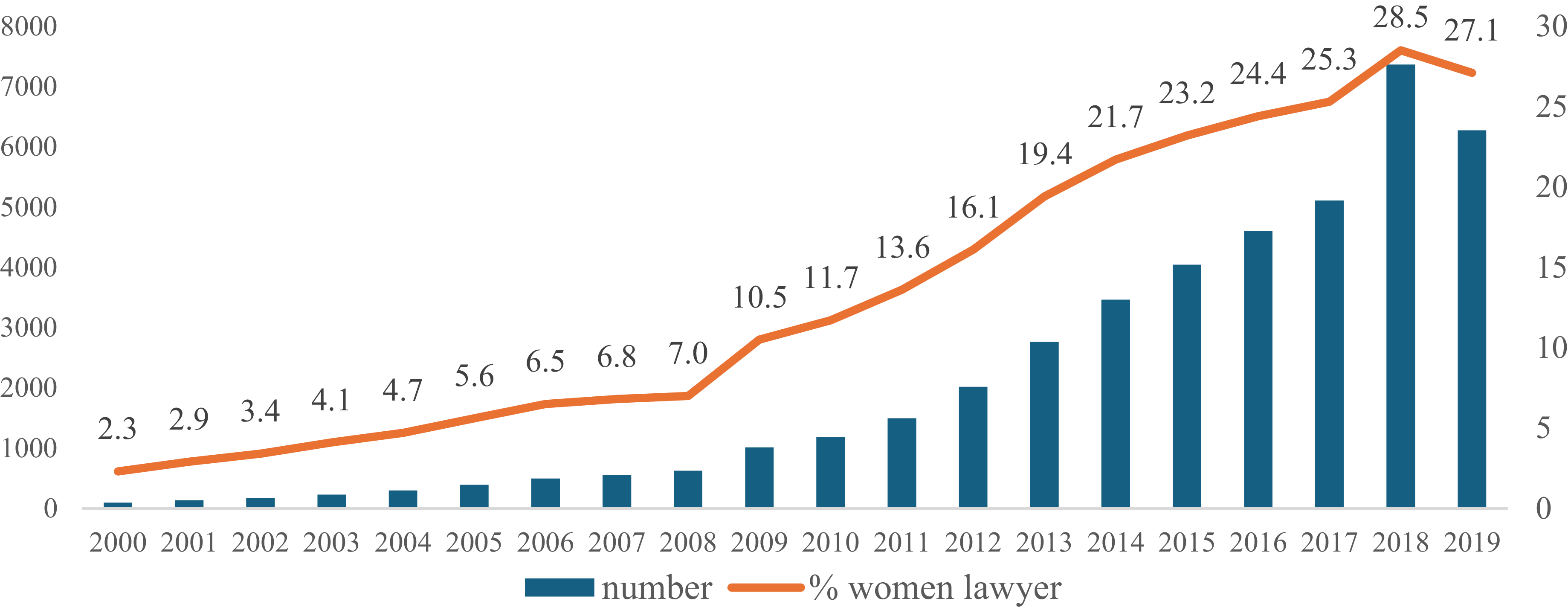
While most Korean lawyers under the old legal education system were men, there has been a gradual rise in the proportion of women lawyers in South Korea since 2000. Figure 1 illustrates the growth in the number and percentage of women lawyers in South Korea from 2000 to 2019.Footnote 1 The establishment of the new law school system in 2007–2009 created an opportunity for South Korea to introduce educational policies that encouraged a sharper increase in the number and proportion of women among new lawyers after 2007 (Association of Korean Law Schools, 2021).
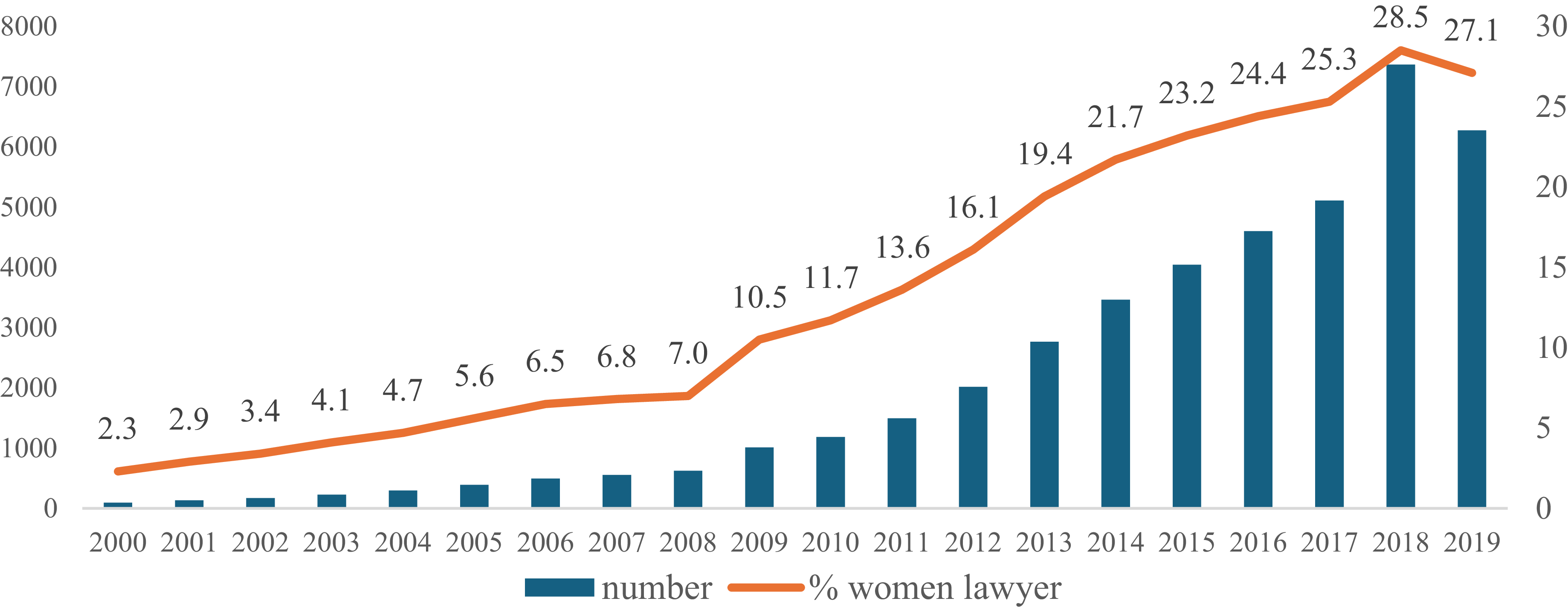
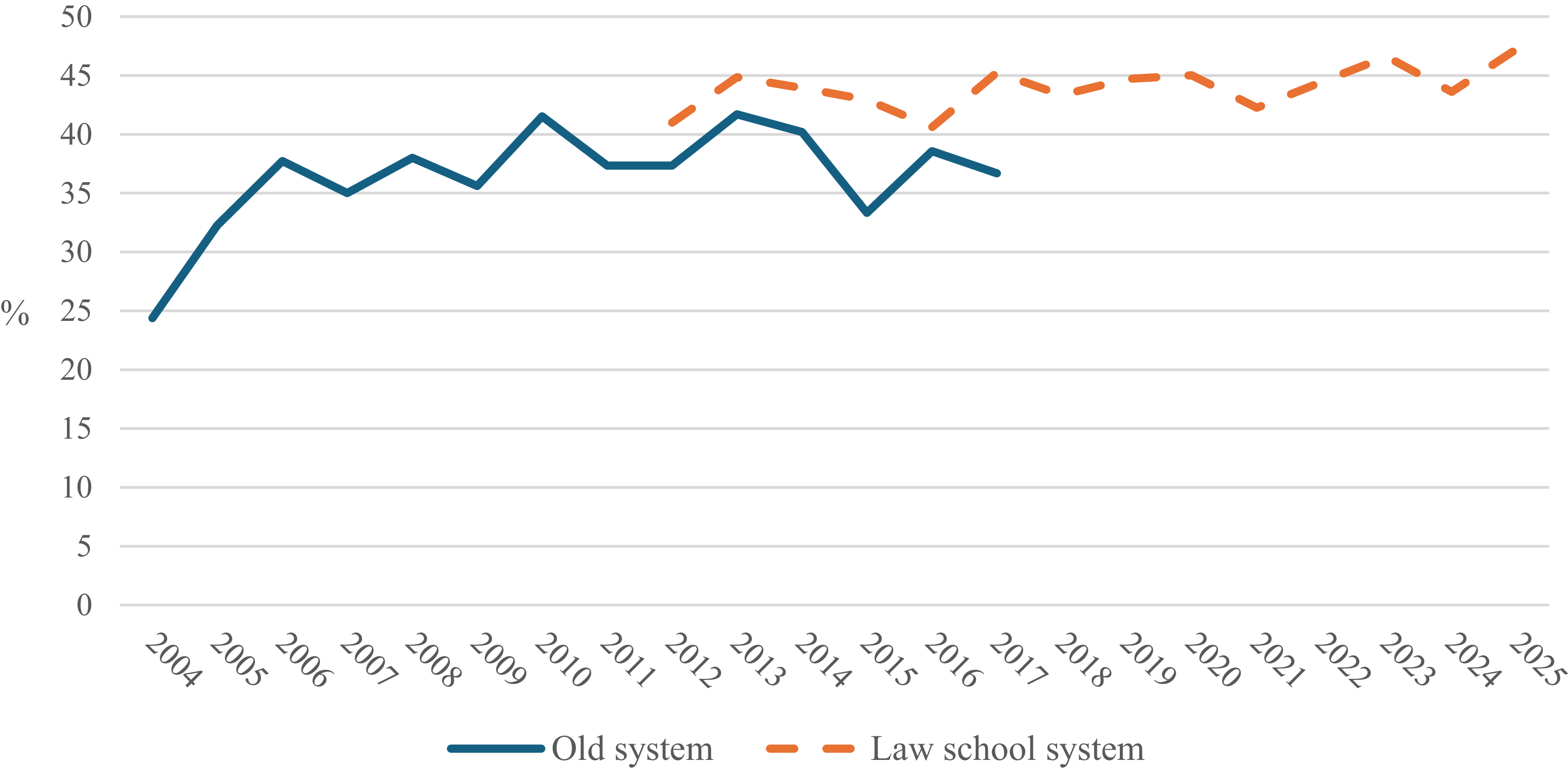
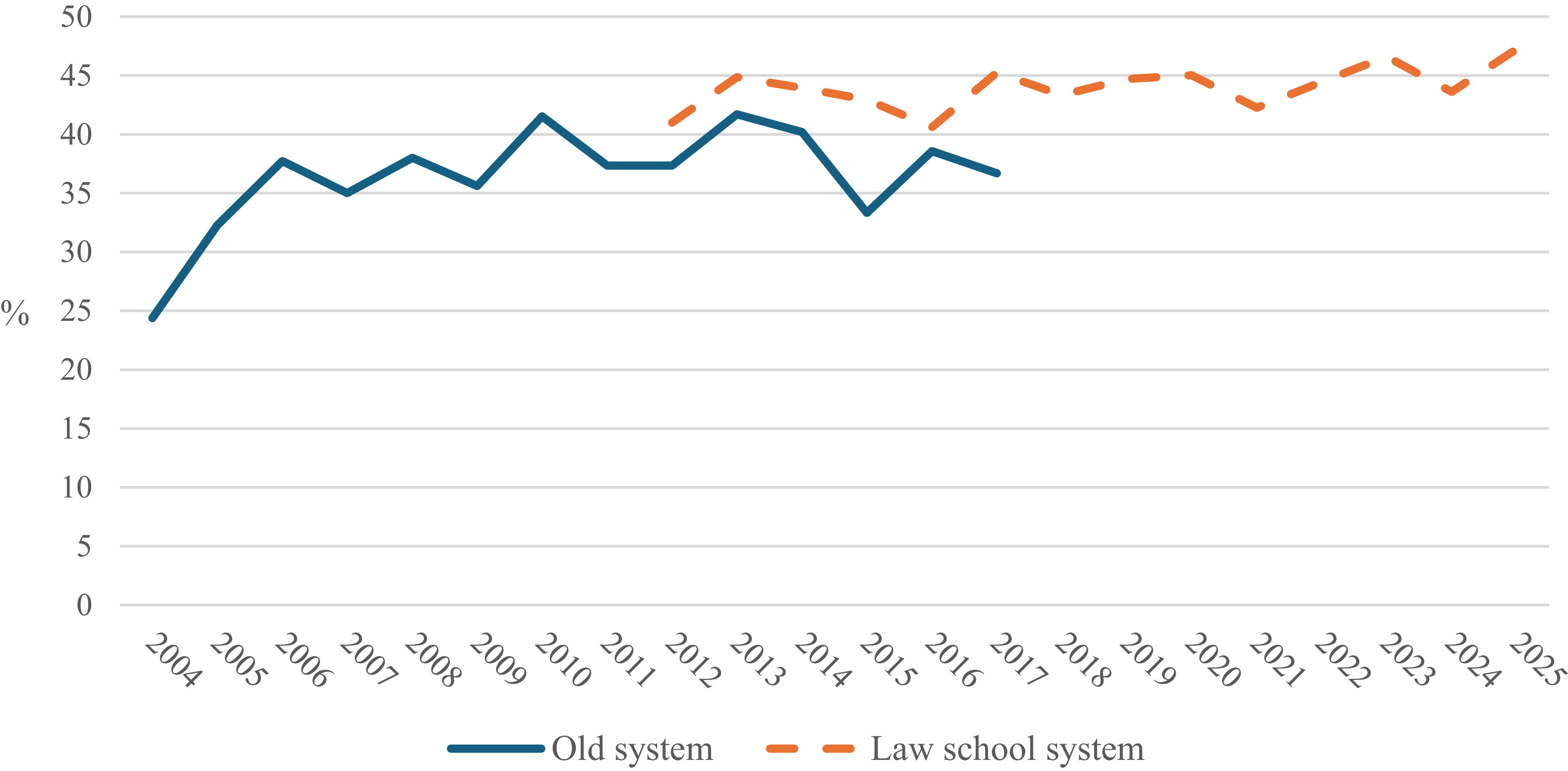
The 2007 AEMP included some targeted gender diversity initiatives. The government designated one new law school, which is affiliated with an existing all-female university, as a women-only law school. The AEMP also authorized a law school evaluation committee to evaluate gender diversity outcomes in the new law schools. The committee mandated that law schools must hire women as a minimum of 10% of their faculty and 20% of their newly hired faculty, where they could act as role models for a growing number of women students (Korean Law School Evaluation Committee, 2011, p. 93). In 2012, women represented 13.3% of law professors in South Korea (Park et al., Reference Park, Song, Kang, Yoon, Ko, Kim, Son and Chun2012, p. 119). As of 2023, 20.8% of law professors were women. The evaluation committee also required law schools to reduce obstacles to graduation for students with childcare responsibilities, which disproportionately affect women (Korean Law School Evaluation Committee, 2011, p. 102). These targeted regulations signalled the Korean government’s investment in gender diversity in the legal field and aimed to support women’s successful completion of law school. In response, more women entered the Korean legal field after the implementation of the law school system (Lee, Reference Lee2009). Figure 2 illustrates the percentage of women among newly qualified lawyers. It compares the old training system with the new law school system and shows a substantial increase in the percentage of women among new lawyers after law school graduates began taking the bar exam.
The percentage of women among newly qualified lawyers, 2004–2025.
Source: The Korean Ministry of Personnel Management.
While the expansion of the Korean legal field overall meant that the traditional incumbents of the field (men) still had abundant opportunities, the regulations explicitly targeting gender diversity ensured that these opportunities were not exclusive to male lawyers (Reskin and Roos, Reference Reskin and Roos2009). The expansion of the Korean legal field overall should have promoted gender desegregation after May 2011, even for lawyers who graduated through the old system and did not directly experience the effects of gender diversity initiatives in the law schools.
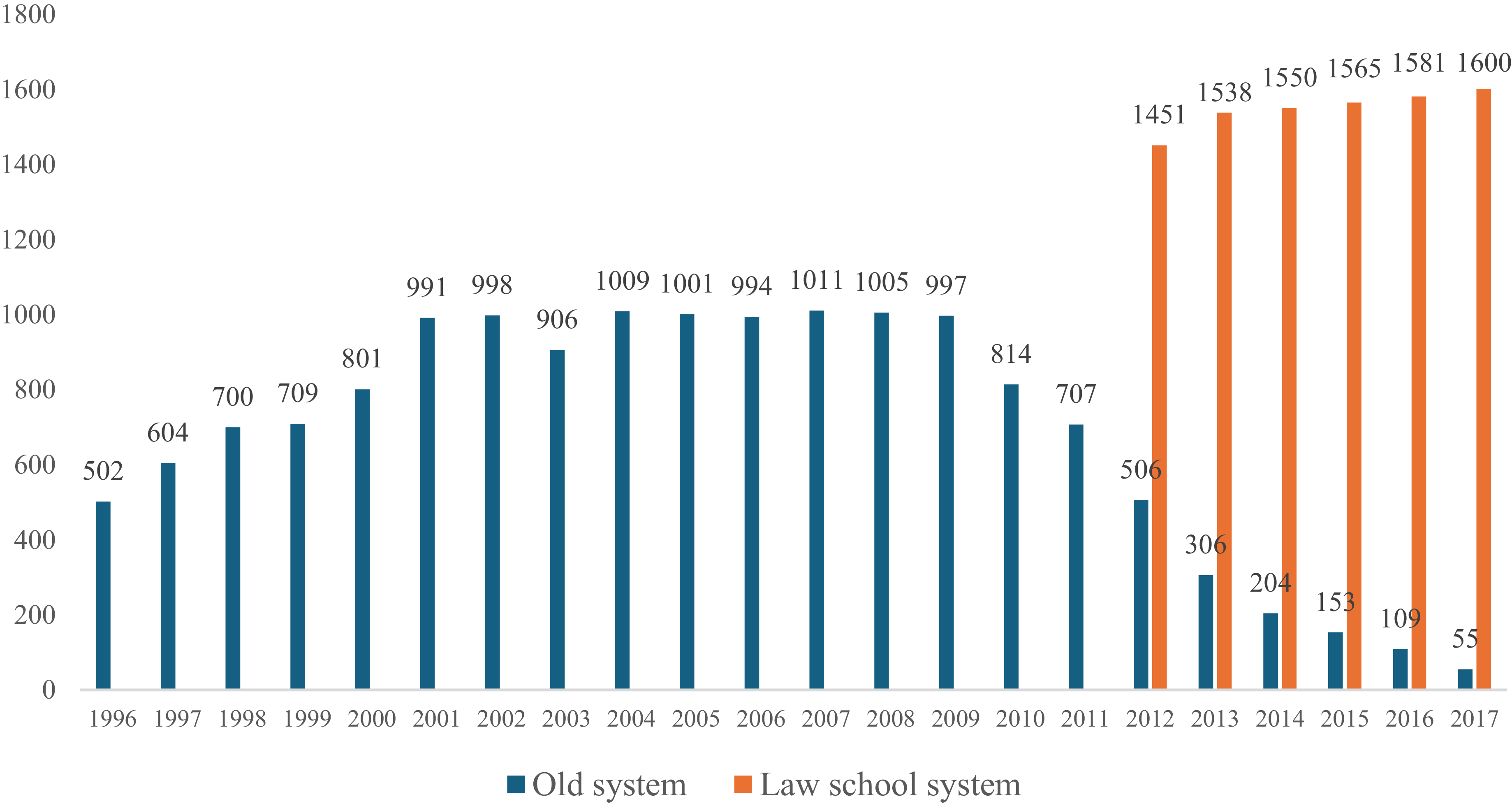
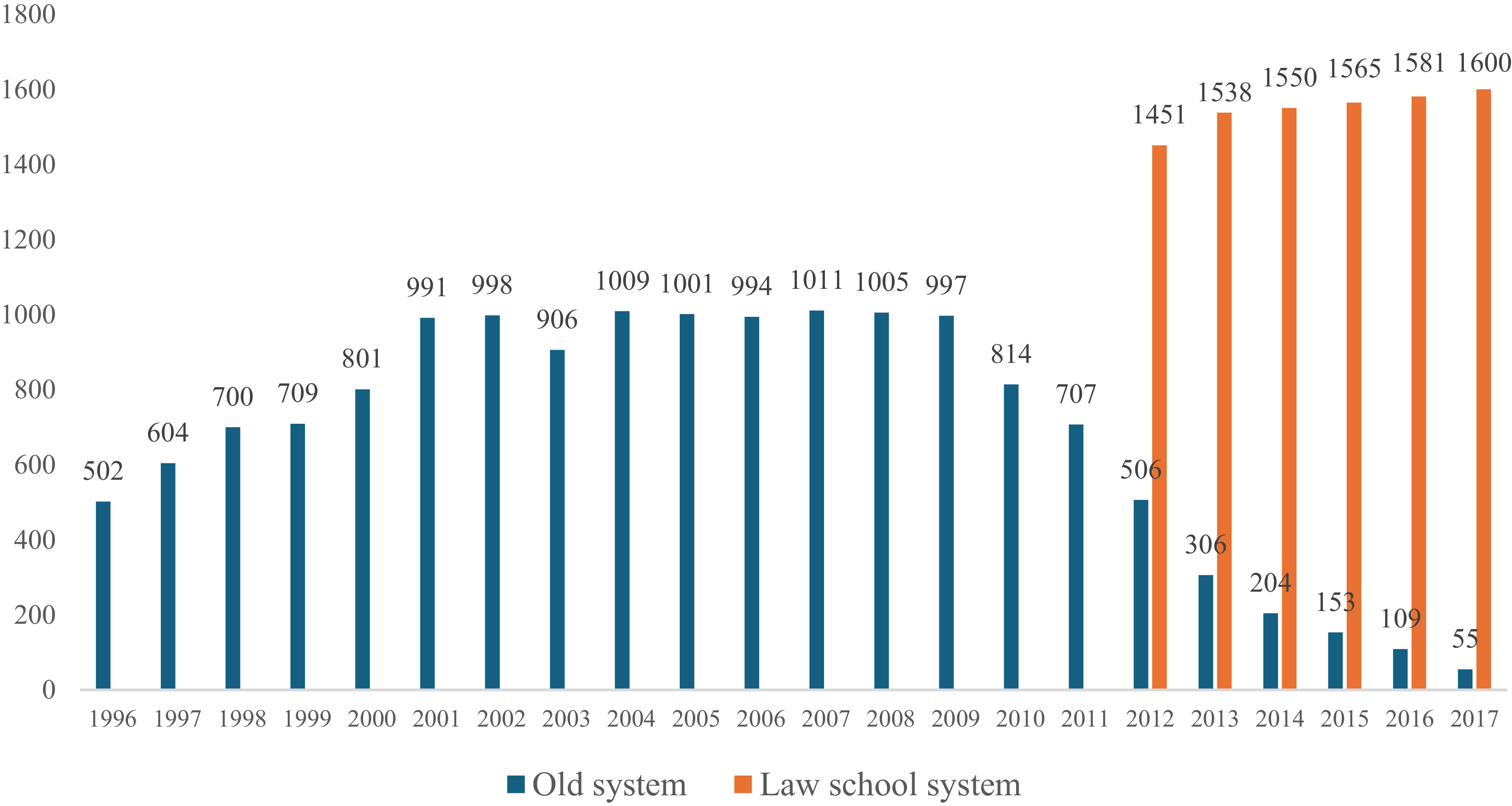
In addition to these changes to legal education, the 2011 ALA amendments aimed to expand both the pool of qualified lawyers and the number of private law firms (Kim, Reference Kim and Yang2013). The South Korean government regulates the legal labour market through the ALA (Law No. 10627), which it introduced in 1947 and has gradually amended. In May 2011, the Korean government amended the ALA to standardize lawyer qualifications with a new national bar exam. The amendments redefined a qualified lawyer as a person who has completed two years of courses at the JRTI, is qualified as a judge or public prosecutor, or has passed the bar exam (Article 4). This change codified the equivalence between graduates of the JRTI under the old legal education system and graduates of the new law schools.Footnote 2 Figure 3 shows a sharp rise in the number of newly qualified lawyers following the introduction of the law school system. Between 2012 and 2017, the new national bar exam had an average pass rate of 66.2% (a figure that declined to 52.3% in 2025).
The population of newly qualified lawyers under the old and new education systems in Korea, 1996–2017.
Source: The Korean Ministry of Justice and the Association of Korean Law Schools.
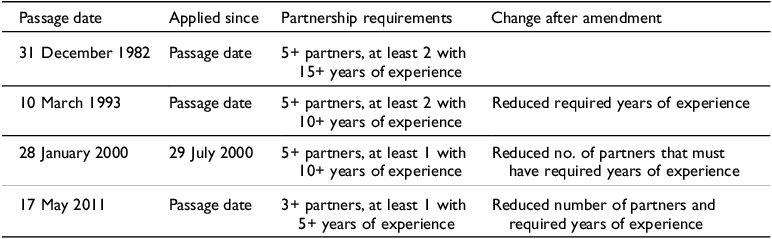
The 2011 ALA amendments also expanded the Korean legal field by reducing barriers to establishing a new law firm. Table 1 shows the changes in law firm founding requirements since 1983, the first year that South Korea regulated law firms. The 2011 amendments reduced the number of partners required to establish a firm from five to three (Article 45), leading to a decrease in the average size of Korean law firms. Most Korean law firms had close to the minimum size required by the ALA and, as the number of law firms increased, their average size shrank from 9.4 partners in 2009 to 7.1 in 2024 (Korean Bar Association, 2010, p. 29; Korean Bar Association, 2024). Given that several large law firms skew the average (e.g., the largest firm employs about 352 lawyers in 2024),Footnote 3 many law firms are slightly larger than the minimum number of founding partners required. Even in firms exceeding this minimum, partner lawyers often outnumber associate lawyers. In 2024, the South Korean legal sector included 6087 law firm partners compared to 4650 associates (Korean Bar Association, 2024), meaning partners accounted for 57% of lawyers in Korean law firms.
ALA amendments affecting the establishment of a new law firm in South Korea
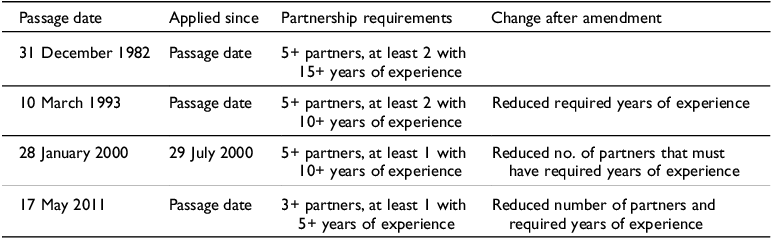
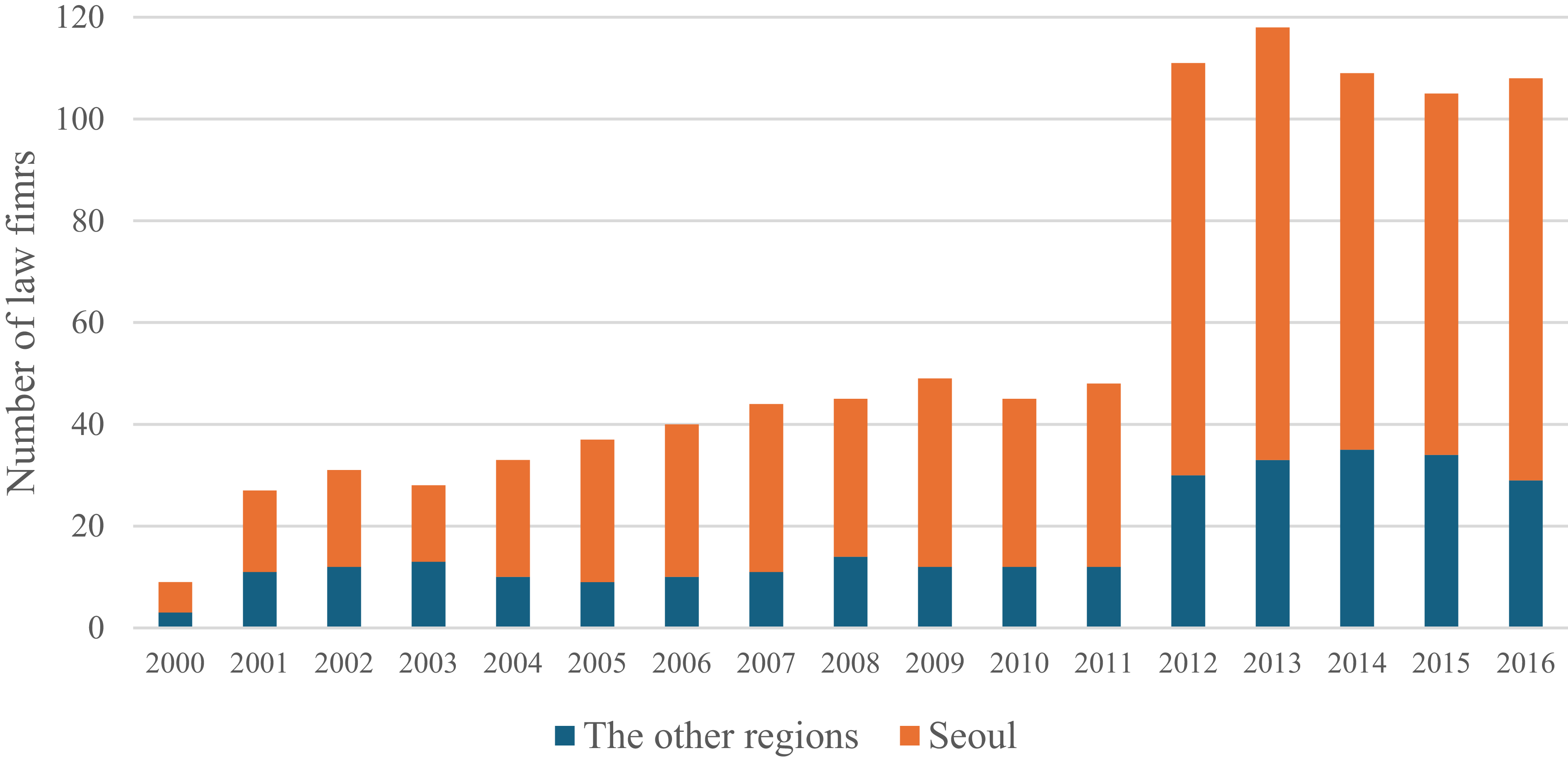
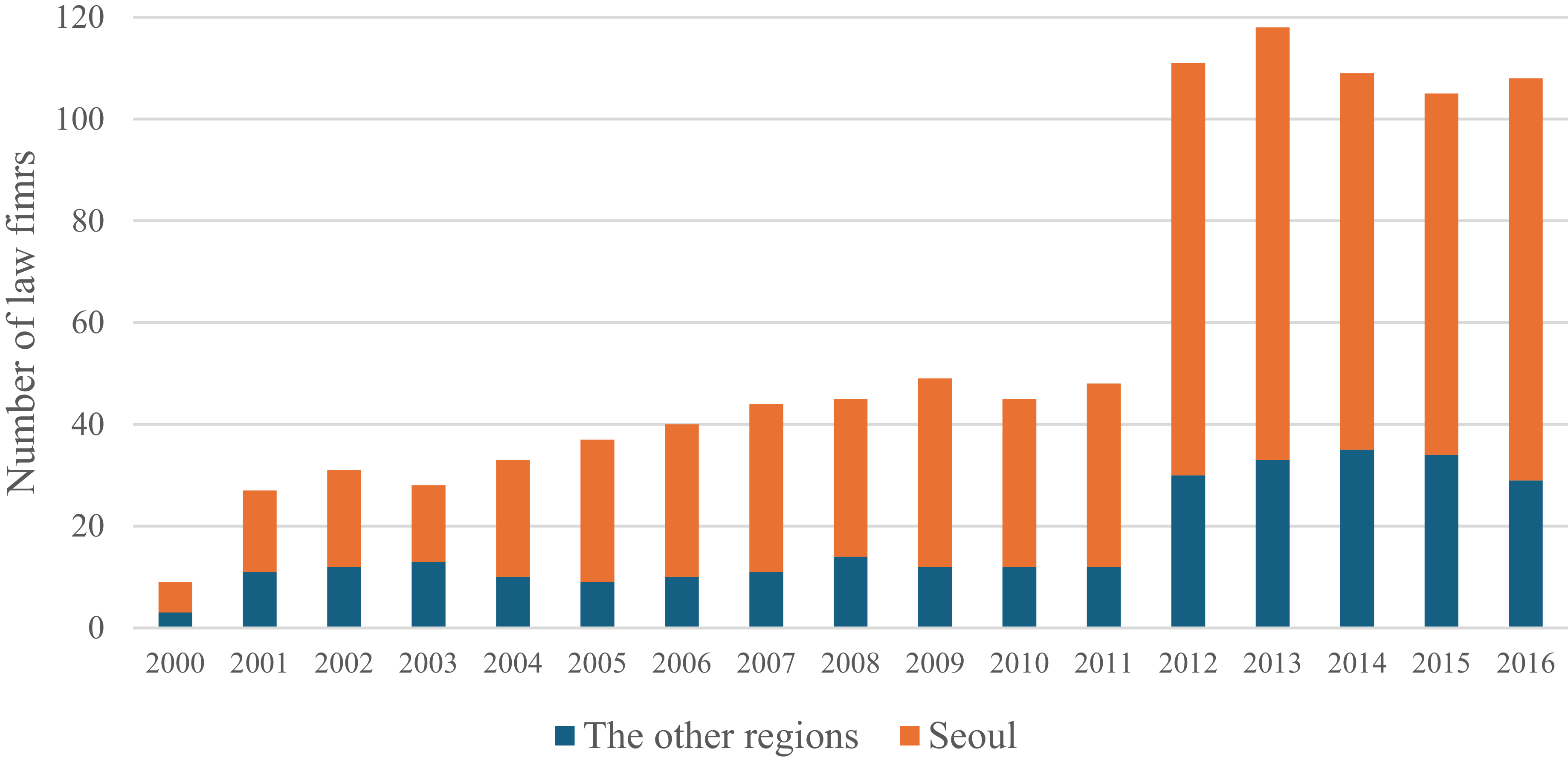
The 2011 ALA amendments reduced the amount of work experience needed to establish a law firm, from a minimum of 10 years to 5 years (Article 45) (Table 1). Since 2011, at least one founding partner must have at least 5 years of work experience in the legal field. The number of new law firms also grew dramatically, from 488 firms before the 2011 ALA amendments to 990 firms from 2012 to 2016, representing more than 100 new law firms each year. The field grew further to 1504 firms by December 2024 (Korean Bar Association, 2024). Figure 4 illustrates the number of private law firms from 2000 to 2016 and the proportion of firms in Seoul. It reveals a dramatic rise in the number of firms immediately after 2011, as well as the continued regional dominance of Seoul in the Korean legal field.
Law firms established in South Korea, 2000–2016 (N = 987 firms).
Source: The Korean Bar Association Directories and the Korean Ministry of Justice.
Can legal reforms promote gender diversity among founding partners in law firms? We focus on two key features of the reforms: (1) the expansion of the legal field—particularly, the increase in newly qualified lawyers and newly established firms—and (2) targeted gender diversity regulations introduced through the new legal education system. We argue that both elements are likely to have facilitated greater representation of traditionally underrepresented groups, such as women, among founding partners, especially given the relatively flat organizational structure of Korean law firms (Smith-Doerr, Reference Smith-Doerr2004; Gorman and Kay, Reference Gorman, Kay and Sarat2010). In addition, the male-dominated culture of older law firms may have motivated women lawyers to establish their own firms. Reports from the Korean Bar Association (2016, 2020) on the working conditions of female lawyers have revealed that many women lawyers in Korea explicitly cited the male-dominated culture of their previous workplaces—typically established law firms—as a reason for founding their own firms. Rather than continuing to work in firms with male-dominated cultures, women lawyers may take advantage of the expansion of the field to join or found new firms (Korean Bar Association, 2020). This aligns with patterns observed in other countries, where female lawyers tend to prefer newer firms for similar reasons (Ballakrishnen, Reference Ballakrishnen2017b). Thus, we hypothesize that the expansion of the legal field and the implementation of gender-focused reforms—through the 2007 AEMP and the 2011 ALA amendments—should have encouraged more women to become founding partners after July 2007 and especially after May 2011, leading to an increase in the proportion of women among founding partners after these reforms:
H1: The proportion of women among law firm partners will increase after the July 2007 AEMP, which established the new law school system and signalled the value of gender diversity in the Korean legal field, compared to the period before July 2007.
H2: The proportion of women among law firm partners will increase after the 2011 ALA amendments, which reduced barriers to establishing a law firm.
At the same time, the high competition for legal clients among lawyers and firms in the larger legal market of Seoul may continue to provide advantages to male lawyers as traditional incumbents of the field (Korean Bar Association, 2020; Park et al., Reference Park, Song, Kang, Yoon, Ko, Kim, Son and Chun2012). With changes to the legal education system and the introduction of a new bar exam, assessing a lawyer’s competence has become uncertain. In this context, men, as the traditional incumbents, are often assumed to be more competent than women (Gorman, Reference Gorman2006; Park et al., Reference Park, Song, Kang, Yoon, Ko, Kim, Son and Chun2012). A 2020 report from the Korean Bar Association featured a statement from a female lawyer who was told that law firms in Seoul prioritize the selection of men over other qualifications to make hiring decisions (Korean Bar Association, 2020, p. 44). In fact, while government efforts to increase gender diversity signal that they value such diversity, that virtue does not necessarily correlate to competitiveness or status in the profession. As a result, we hypothesize that there will be less gender diversity in Seoul compared to other regions:
H3: Gender diversity among law firm partners will increase less in Seoul than in other regions, in response to the AEMP in July 2007 and the ALA amendments in May 2011.
5. Data and methods
To test the above hypotheses, we used data on founding partners in newly established Korean law firms from a list of law firms and their founding partners from Human Rights and Justice, the journal of the Korean Bar Association, and notices posted by the Korean Ministry of Justice. The data contain information about newly established firms from 29 July 2000 to 31 December 2016. Our data contain the full population of new law firms in South Korea during this period, and our unit of observation is the law firm (in other words, the establishment). The time frame of interest is determined by the dates when the government amended the ALA requirements for founding a law firm (Table 1). In the 1980s and 1990s, 142 Korean law firms—76 in Seoul, 66 in other regions—were established. We focused on the period since July 2000 due to the limited number of Korean law firms before 2000, the lack of available data on older firms, and the desirability of comparing time periods of similar length (2000–2007, 2007–2011, and 2011–2016). The data sources stopped publishing data on founding partners after 2016. Thus, no data were available after 2016, and we were unable to analyse subsequent years.
The first author used two research engines, Lawtimes and LAWnB, to obtain individual information about each founding partner, including their gender, age, educational background, and work experiences. This yielded data on 1007 law firms established in Korea from July 2000 to December 2016. We restrict the analysis to unlimited liability partnerships (ULPs) because they represent most Korean law firms (1504 compared to 78 limited liability partnerships (LLPs) in December 2024). Additionally, most LLPs are established by existing ULP law firms that change their partnership type. We excluded 16 firms due to missing data and four firms with partnerships based on family relationships or established by a merger between two existing firms, leaving 987 firms (and their 4085 founding partners) for analysis. Among these firms, 697 were in Seoul and 290 were in other regions. Although the data sources did not include information on partner or firm income, clientele, or legal specialization—factors examined in previous research—they provided key factors relevant to the Korean legal field. These included whether a partner graduated from a prestigious university, had prior experience as a judge or prosecutor, and the length of their professional work experience.
While much of the existing research on gender representation among lawyers has focused on established law firms (Gorman, Reference Gorman2006; Gorman and Kmec, Reference Gorman and Kmec2009; Kay and Gorman, Reference Kay and Gorman2012), our study centres on newly founded law firms and their founding partners for two key reasons. First, the rapid growth of new firms suggests that they are actively reshaping the contours of the South Korean legal field (Figure 4). When women actively participate in the founding of law firms—opportunities that were traditionally limited by the male-dominated culture of the legal profession—it suggests a cultural shift in the gendered boundaries of the legal profession (Ballakrishnen, Reference Ballakrishnen2017b). Second, diversity among founding partners plays a critical role in shaping a firm’s culture and can influence its long-term organizational trajectory, including future patterns of diversity (Phillips, Reference Phillips2005). More diversity among partners in the formative period, when foundational norms and practices are established, can lay the groundwork for the ongoing culture of these firms (Phillips, Reference Phillips2005). This is particularly significant in the Korean context, where most law firms are small and partner-heavy; the composition of founding partners, therefore, reflects not only leadership at the firm level but also structural changes across the legal profession.
5.1. Dependent variable: Gender diversity
We measure gender diversity by the proportion of female founding partners. This ranges from 0, indicating all-male founding partners (629 of 987 firms, or 63.7%), to 1, indicating all-female founding partners (9 of 987 firms, or 0.9%). Notably, there were no law firms with only female partners before the 2011 ALA amendments.
5.2. Independent variables: The Korean legal reforms
Our primary independent variables of interest are two points in time: the July 2007 passage of the AEMP that established the law school system and the May 2011 ALA amendments, which represent the final stage of the Korean legal reforms. The passage of the AEMP signalled the Korean government’s investment in both expanding legal education and increasing gender diversity within the legal field. The 2011 ALA amendments completed the law school system, introduced a new bar exam and loosened the requirements to establish a firm. The first graduates of the new law schools graduated in 2012. We used two indicator variables for these time points: one for law firm establishment between July 2007 and April 2011 (after the AEMP), and one for law firm establishment after the 2011 ALA amendments (May 2011 through 2016). The pre-reform period, from July 2000 to June 2007, serves as a reference group.
5.3. Control variables
We control for whether a firm is established in Seoul (1, outside Seoul = 0), as we expect this to moderate the relationship between the legal reforms and women’s representation among founding partners. Interaction terms between these legal reforms and firm location allow us to test whether the effects of these reforms on diversity among founding partners differ based on a firm’s location in or outside Seoul.
Previous research has demonstrated the importance of firm characteristics like firm size for increasing diversity in a firm (U.S. Equal Employment Opportunity Commission, 2003; Kay and Gorman, Reference Kay and Gorman2008; Kay and Gorman, Reference Kay and Gorman2012), so the models control the number of founding partners (size). We control for the average work experience (in years) of founding partners in law at the time of firm establishment. The work experience of each founding partner is calculated by subtracting the year they obtained their legal credentials from the year they founded the law firm. We also control for two key factors valued in the Korean legal field, such as graduating from one of the most prestigious universities in South Korea (Seoul National University as the most prestigious or Korea or Yonsei University as the next most prestigious) and having experience as a judge or prosecutor (Kim, Reference Kim2001; Kim et al., Reference Kim, Kim, Suh and Rhee2003; Cho, Reference Cho2016; Korean Bar Association, 2020). To summarize, our models control for the proportion of partners who graduated from Seoul National University, those who graduated from Korea or Yonsei University, and those with experience as judges or prosecutors.
5.4. Analytical strategy
We use GLMs with a logit link (link function) and the binomial family (variance function) to analyse the proportion of founding partners in Korean law firms that were female.Footnote 4 GLMs are widely used for modelling dependent variables that are proportions bounded between 0 and 1 (Papke and Wooldridge, Reference Papke and Wooldridge2008; Wooldridge, Reference Wooldridge2013). We also obtain robust standard errors that are reliable under different model specifications. The first model is a baseline model with control variables only, and the second model tests the effects of the 2007 AEMP and the 2011 ALA amendments on diversity. The third model analyses the effects of interactions between the founding location (Seoul or outside Seoul) and the 2007 AEMP and 2011 ALA amendments. We use the “margins” command in Stata to compute average marginal effects for each independent and control variable. This approach provides more meaningful results than raw coefficients, particularly in nonlinear models where the effect of a one-unit change in a predictor on the log-odds scale does not translate into a constant or intuitive change in predicted probabilities—especially when interaction terms are included (Norton, Wang and Ai, Reference Norton, Wang and Ai2004; Mood, Reference Mood2009; Long and Freese, Reference Long and Freese2014).
6. Results
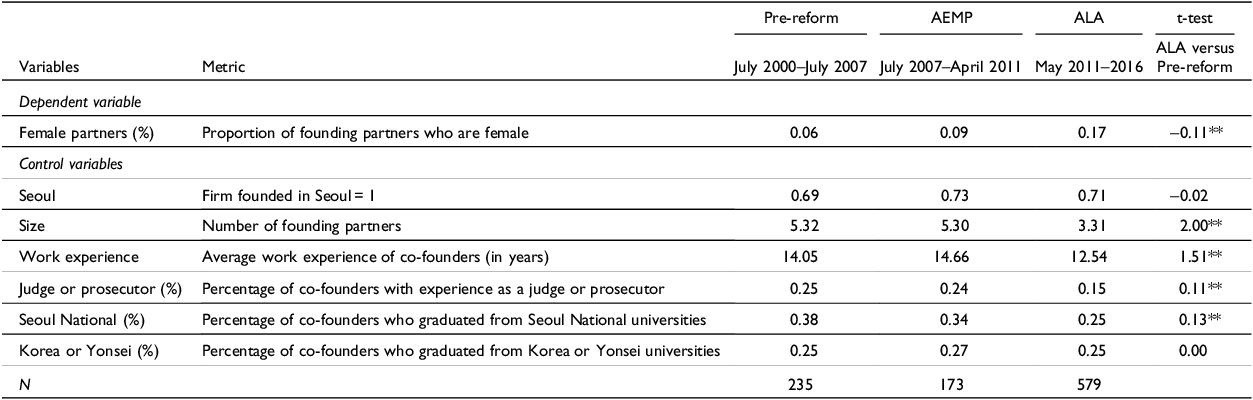
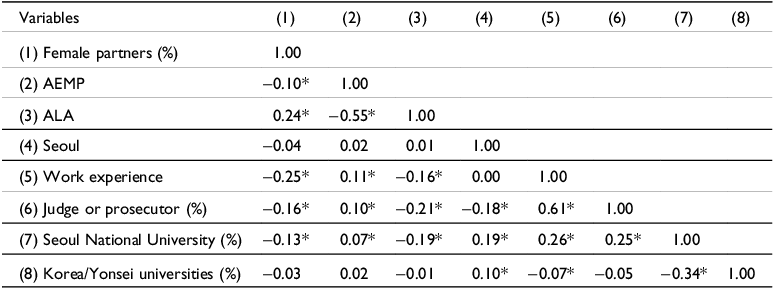
Table 2 presents descriptive statistics for all law firms by establishment period: the pre-reform period (July 2000 to July 2007), from the AEMP to April 2011, and after the 2011 ALA amendments. The t-test in Table 2 compares the pre-reform period with the period following the 2011 ALA amendments. Table 2 clearly reveals an increase in the proportion of women founding partners after the AEMP and especially after the 2011 ALA amendments compared to the pre-reform period. The number of new firms also accelerated after 2011, with 579 new law firms from May 2011 to 2016 compared to 408 from 2000 to May 2011. About 70% of new law firms were in Seoul, both before and after the legal reforms. There was a significant decrease in the average work experience of founding partners over time, from over 14 years in the pre-reform period to 12.5 years between 2011 and 2016. Additionally, the percentage of founders who had worked as a judge/prosecutor and graduated from Seoul National University decreased after the 2011 ALA amendments. Correlations between all measures are available in the Appendix (Table A1).
Descriptive statistics and metrics for founding partners of newly established law firms in South Korea, 2000–2016
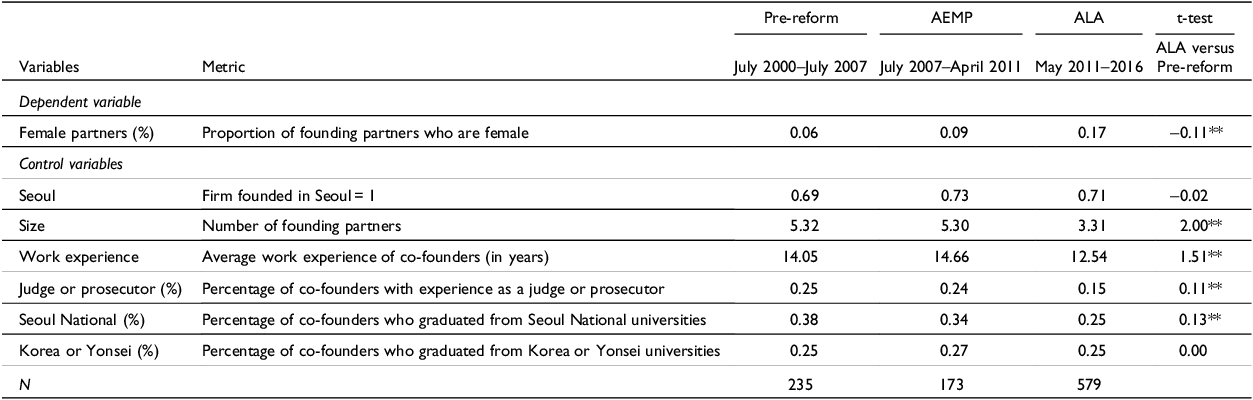
Note: Figures rounded to two significant digits; *p < 0.05; **p < 0.01 (two-tailed tests).
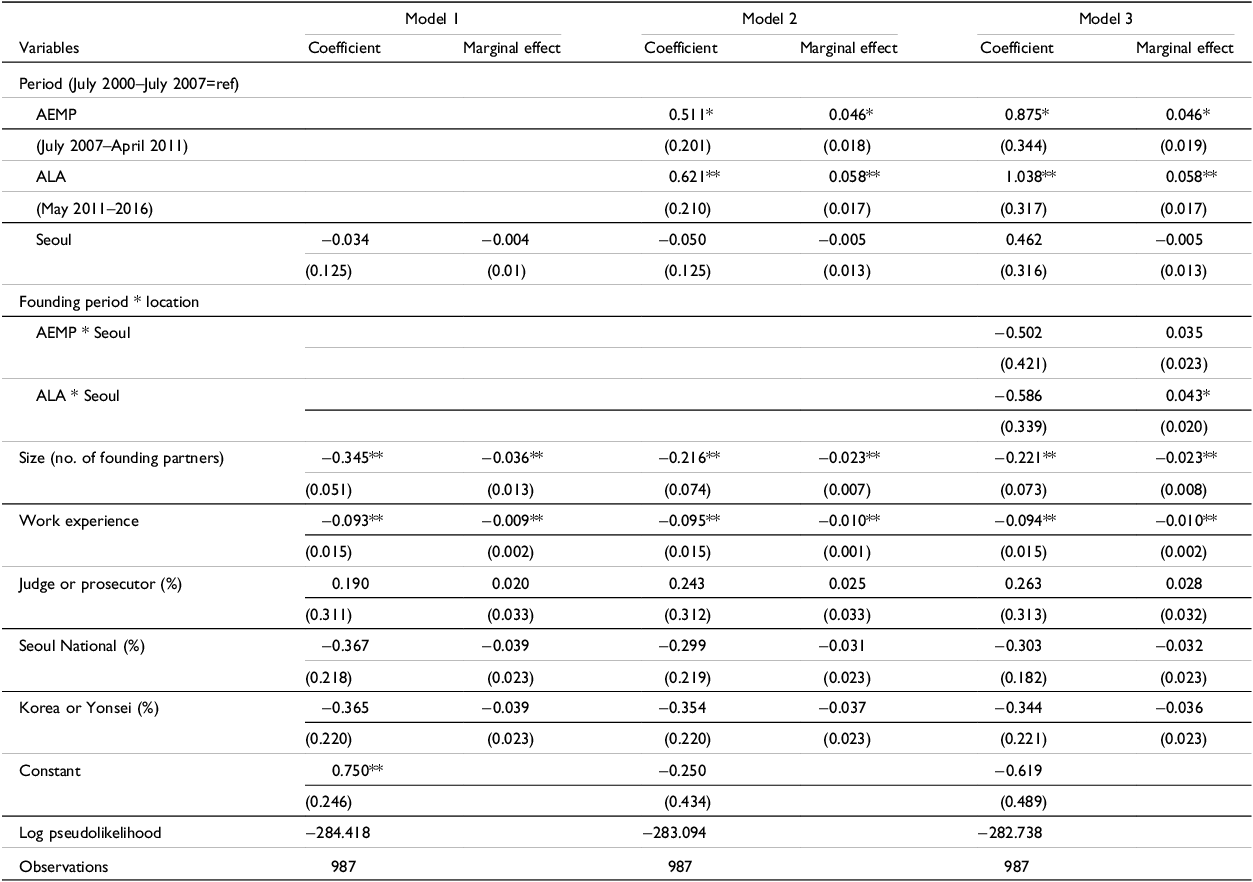
Table 3 presents the results of GLM models predicting the effect of the 2007 AEMP and the 2011 ALA amendments on the proportion of founding partners who were women. Model 1 is the baseline model with control variables only. As expected, the proportion of partners who were female was smaller in larger firms with more founding partners. An increased size of one partner is associated with a 3.6% decrease in the proportion of female founding partners. In Model 1, firms in Seoul have an average proportion of females that is 0.4% lower than outside Seoul. The lack of statistical significance may be an artefact of the very small magnitude of this effect.Footnote 5 Each one-year increase in average partner experience is associated with about a 1% reduction in the proportion of female founding partners, while an increase of 1% in the proportion of founding partners with experience as a judge or prosecutor is associated with a 2% increase in the proportion of female founding partners. An increase of 1% in the proportion of founding partners that graduated from Seoul National University or from Korea or Yonsei universities is associated with a 3.9% decrease in the proportion of female founding partners.
Generalized linear models predicting the proportion of women among founding partners in Korean law firms, 2000–2016 (N = 987)
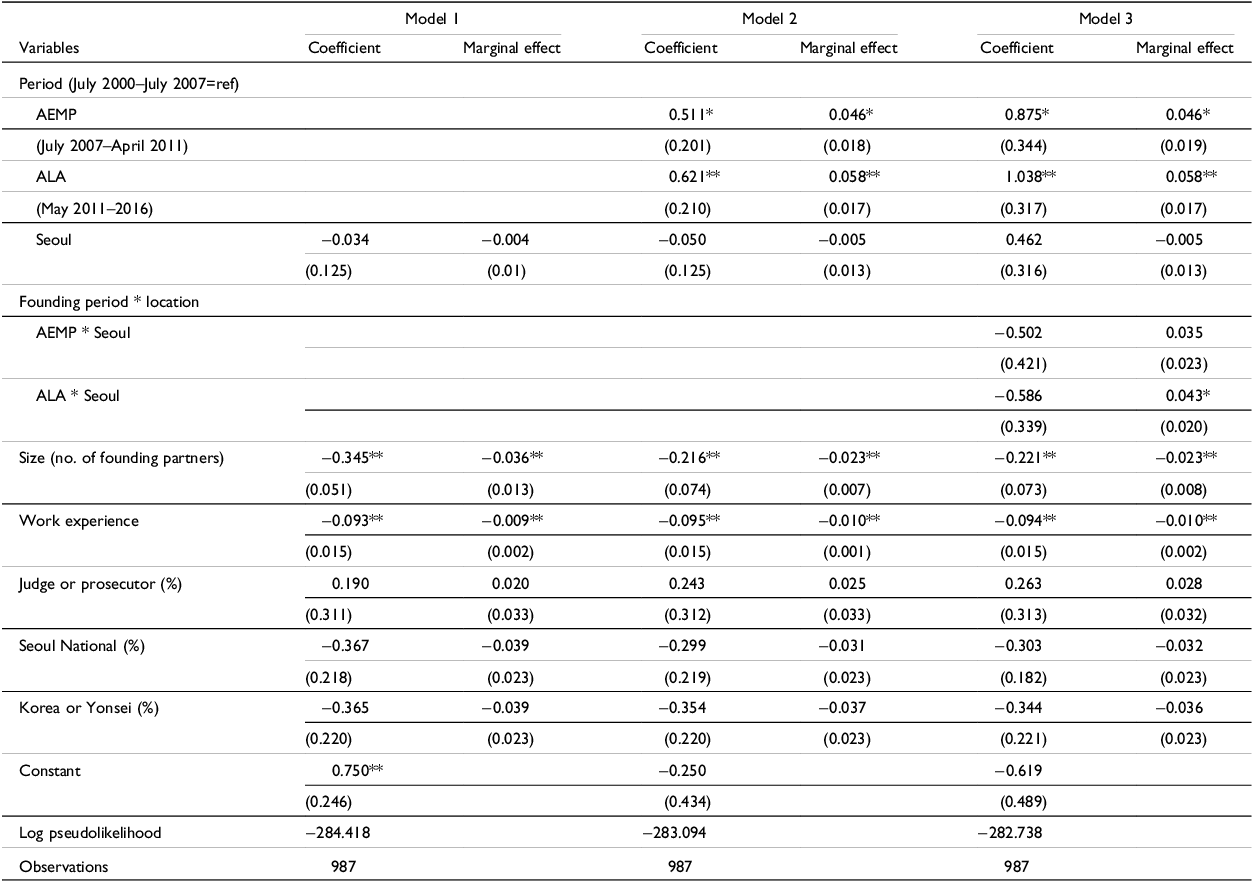
Note: Figures rounded to three significant digits; robust standard errors in parentheses.
*p < 0.05; **p < 0.01 (two-tailed tests).
Model 2 tests the effects of the 2007 AEMP and the 2011 ALA amendments, with results that support the hypotheses H1 and H2. The predicted proportion of female founding partners is 4.6% higher after the AEMP and 5.8% higher after the 2011 ALA amendments compared to the 2000–2007 period. The effects of control variables were similar to Model 1.
Model 3 adds interactions between location in Seoul and the legislative time periods (2007–2011 AEMP and 2011–2016 after the ALA amendments). In Model 3, the main effects of both legal reform variables remain statistically significant even after the interaction term is included. While the coefficients of our interaction terms are not statistically significant, the marginal effect of the interaction term between the 2011 ALA amendments and founding in Seoul is statistically significant and positive.Footnote 6 These results provide mixed evidence with some contradiction to H3. Law firms established in Seoul after the amendments have an additional 4.3% increase in the predicted proportion of female founding partners. Both the AEMP period and the post-ALA period are associated with significant increases in the proportion of women among founding law firm partners, and the interaction terms suggest that the combined effect of legal reform and geographical context becomes more apparent over time, particularly as the reforms mature in the post-ALA period.
7. Discussion and conclusions
This study examined changes in the gender diversity of founding partners in new South Korean law firms before and after changes in regulations of the legal field (2000–2016). During this period, the Korean government passed regulations that aimed to expand the legal field and signalled a commitment to increased gender diversity in the legal profession. We analysed changes in gender diversity following the 2007 AEMP and the 2011 ALA amendments, both of which reshaped the supply side of the Korean legal field. These reforms introduced a new law school system, revised the credentialing process for lawyers, and loosened restrictions on establishing firms—encouraging the expansion of the legal field in terms of both the number of qualified lawyers and law firms. They also coincided with educational policies aimed at increasing gender diversity among new lawyers (Jeon, Reference Jeon2011; Choe, Reference Choe2015; Lee et al., Reference Lee, Rhee and Hwang2015; Association of Korean Law Schools, 2021). After these regulatory reforms, the total number of new lawyers and new law firms in South Korea increased substantially (Figures 3 and 4), and the number and percentage of women lawyers grew dramatically (Figure 1). The proportion of founding law firm partners who were women increased significantly after these reforms, and this increase in gender diversity is particularly evident in law firms founded in Seoul following the 2011 ALA amendments (Table 3). The expansion of the field, coupled with diversity efforts in the new legal education system, appears to have opened opportunities for women lawyers to establish law firms. As a result, we argue that policy interventions into the supply side of a profession—especially in a context where the field is expanding—can meaningfully increase gender diversity within the profession.
While it is not possible to establish causality, we argue that the new law school system and other regulatory changes played a role in the dramatic increase in the proportion of women lawyers in South Korea after the first law school students graduated in 2012 (Figure 1). The Korean case offers a valuable illustration of the potential impact of regulatory policy on the gender composition of a professional field. Similar interventions could have different effects in other political, cultural, and economic contexts, but the type of supply-side policy embodied in the 2007–2011 Korean legal reforms holds promise for producing substantive change in the gender composition of a prestigious profession.
The gender diversity of founding partners in Korean law firms clearly increased following the 2007–2011 legal reforms, although it is uncertain whether this greater diversity also produced more gender equality (Park et al., Reference Park, Song, Kang, Yoon, Ko, Kim, Son and Chun2012). Women lawyers in South Korea have reported challenges, including glass ceilings and motherhood penalties, due to the male-dominated culture in the legal field (Kwon and Kwon, Reference Kwon and Kwon2018; Korean Bar Association, 2020). As previous literature on gender inequality in the legal profession has found in other settings, gender inequality is sticky and persistent in legal culture (Kay and Gorman, Reference Kay and Gorman2008). However, a growing number of women obtaining professional credentials in law, the growing presence of women at entry-level positions, and an increase in the proportion of women among founding partners of new firms may gradually drive cultural change within the legal field (Kanter, Reference Kanter1977; Reskin and Roos, Reference Reskin and Roos2009).
The representation of women in professions is symbolically important for gender equality and may strengthen public confidence in the judiciary and legal institutions (Kay and Gorman, Reference Kay and Gorman2008; Kenney, Reference Kenney2012). Gender diversity can also encourage reforms in workplace policies like maternity leave, anti-harassment policies, and flexible work arrangements that improve professional sustainability for all lawyers (Hagan and Kay, Reference Hagan and Kay1995). Policy support is needed to bridge gender diversity to gender equality (Korean Bar Association, 2020). Additionally, the increase in women lawyers may expand gender-responsive legal aid in some areas, since women who experience gender-related legal harms, like sexual harassment, domestic violence, or workplace discrimination, often prefer female lawyers to represent them, and female judges are more likely to recognize harms in these cases (Rhode, Reference Rhode2003; Boyd et al., Reference Boyd, Epstein and Martin2010; Chun, Reference Chun2014).
In the South Korean case, we expect that the increased gender diversity of founding partners after the 2007–2011 legal reforms may also promote more gender equality in the legal field for at least three reasons. First, rapid growth in the pool of lawyers and the number of law firms (Figures 3 and 4) increased opportunities for qualified women in this previously male-dominated occupation, as women filled in the gaps created by growing demand (Tomaskovic-Devey and Stainback, Reference Tomaskovic-Devey and Stainback2007; Reskin and Roos, Reference Reskin and Roos2009). The legal profession retained its prestige and status as Korea aimed to increase its global competitiveness, so these opportunities for women to enter a high-status profession should have reduced gender inequality in the overall Korean labour force. Gender desegregation of a field often mitigates structural inequalities and is a prerequisite for increasing equality (Kanter, Reference Kanter1977). Additionally, Korean women lawyers have described gender inequalities as consequences of stark gender segregation, suggesting that greater women’s representation could weaken male-dominated norms (Korean Bar Association, 2020, p. 47); notably, their representation rose more rapidly after the 2011 reforms. Second, reduced barriers to establishing new firms can provide women lawyers with opportunities to operate outside traditional firms and to take leadership roles that might not be available in male-dominated legal firms that suffer from organizational inertia (Ballakrishnen, Reference Ballakrishnen2017b; Zhu et al., Reference Zhu, Zhao and Liu2020). The rising proportion of women among founding partners suggests that women lawyers increasingly viewed establishing a firm as a viable career path outside male-dominated structures and workplace norms (Kanter, Reference Kanter1977; Korean Bar Association, 2020). Third, the South Korean legal reforms included explicit gender diversity policies within the law school system, such as a women-only law school, quotas for female law professors, and childcare support for law school students. These provisions signalled that the Korean government wanted to promote gender diversity in the legal field. While articulating the value of diversity does not always produce actual change, the regulatory signal that accompanied the restructuring of the Korean legal field could have encouraged more gender diversity among founding partners. Moving forward, we expect further gender desegregation in Korean law firms beyond the 2000–2016 period as more law school graduates enter the profession with exposure to gender diversity initiatives in law schools and as more of those graduates are women (Figures 1 and 2).
7.1. Limitations
There are several limitations to this study. First, the data capture founding law firm partners only, and the analysis cannot account for the number or characteristics of other lawyers, paralegals, or other staff in newly established law firms. Data on other legal workers were not available in the list of law firms and founding partners that we used to collect the data for this study. Since the field contains more small than large firms and more partners than associate lawyers, our data capture the modal path for lawyers in South Korea but may not be generalizable to other career paths. Second, we have no data on the types of law that each firm practices or the types of clients that they represent, both of which may influence partner diversity as well as pay and prestige in the legal field (Kay and Gorman, Reference Kay and Gorman2025). While Korean lawyers and law firms have traditionally practised in all areas of law, specialization has become more common over time. Third, we have no data on founding partners’ marital status, parental status, or income, all of which are relevant for understanding gender inequality in the legal field. Finally, our data cover the period from 2000 to 2016. As more lawyers enter the profession through the law school system, studying the impact of Korean legal reforms over a broader timeframe, including more recent years, will become important (Park et al., Reference Park, Song, Kang, Yoon, Ko, Kim, Son and Chun2012, p. 91). Unfortunately, more recent data were not available from our sources (Human Rights and Justice, the journal of the Korean Bar Association, and notices posted by the Korean Ministry of Justice). While we found an increase in the proportion of female founding partners from 2011 to 2016, we expect further growth after 2016 as more law school graduates enter the legal field (Figure 1). At the same time, the ALA amendments were enforced immediately after their passage without a grace period, and they accompanied a significant increase in the size of the legal field and the proportion of founding partners who were women. Future research on the Korean legal field, now over a decade after the first law school graduates entered the field, might find stronger effects of these reforms on gender diversity among founding partners.
Despite its limitations, this study contributes to ongoing discussions of gender inequality in the legal profession and institutional efforts to advance gender diversity. The 2007–2011 Korean legal reforms primarily influenced the supply side of the legal field by introducing a new law school system and easing regulations for establishing law firms. While previous research shows that gender inequality in the legal professions is resistant to change, these reforms produced a tangible shift—an increase in the proportion of women founding partners. Gender diversity initiatives in the new law school system, including a women-only law school, quotas for female law professors, and childcare support for law school students, also signalled a commitment to changing the male-dominated culture of the field. Concurrently, the field’s overall expansion created new opportunities for women lawyers without reducing opportunities for men who are the traditional incumbents of the field. The findings of this study offer insights for future research on the impact of regulating the supply side of the legal field on gender outcomes like leadership opportunities for women. Although the findings cannot determine a causal influence of the legal reforms and may not be directly generalizable to other countries or contexts, they provide valuable insights into the plausible effects of legal reforms on gender diversity in a professional field.
Acknowledgements
We received feedback on an earlier draft from Joe Galaskiewicz and Jane Zavisca at the University of Arizona.
Competing interests
There are no conflicts of interest to declare.
Appendix
Correlations
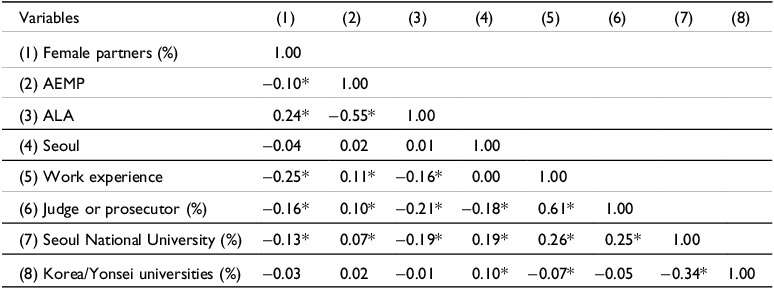
*p < 0.05, **p < 0.01 (two-tailed tests).

 Open access

