





Impact statement
This study highlights how Nigeria’s renewable energy transition is perceived in practice, drawing exclusively on expert and stakeholder interviews. It shows that while renewable energy projects offer health, education and livelihood gains, they also risk reinforcing injustices through displacement, cultural disruption and weak reparative measures. By evidencing how energy justice principles are undermined in implementation, the study provides policymakers and practitioners with clear direction on strengthening participation, accountability and equity in future transition planning.
Introduction
Global South nations continue to face persistent energy poverty, shaping their development trajectory, with nations like Nigeria having more than 40% of the population lacking access to reliable, affordable and modern energy services. This deficit restricts health, education, livelihoods and climate resilience, reinforcing multidimensional poverty and regional inequality. In line with Sustainable Development Goal 7 (SDG 7), which calls for universal access to affordable, reliable, sustainable and modern energy, the transition to renewable energy is increasingly framed not only as a climate mitigation strategy but also as a social and developmental necessity. Renewable energy, therefore, represents a potential pathway out of entrenched energy poverty, offering opportunities for improved well-being, reduced fossil-fuel dependence and long-term sustainability (Jenniches, Reference Jenniches2018; Urban, Reference Urban2019; Kumar, Reference Kumar2020; Bogdanov et al., Reference Bogdanov, Ram, Aghahosseini, Gulagi, Oyewo, Child, Caldera, Sadovskaia, Farfan, Barbosa, Fasihi, Khalili, Traber and Breyer2021). International frameworks, such as the Paris Agreement, underscore the dual role of renewable energy in mitigating greenhouse gas emissions and enhancing adaptive capacity, while also offering pathways out of energy poverty and environmental degradation in developing contexts (United Nations, 2024; Urban, Reference Urban2019; Bogdanov et al., Reference Bogdanov, Ram, Aghahosseini, Gulagi, Oyewo, Child, Caldera, Sadovskaia, Farfan, Barbosa, Fasihi, Khalili, Traber and Breyer2021).
While the momentum for renewable energy continues to grow, the discourse surrounding the energy transition remains disproportionately focused on fiscal and technological considerations (technical), often at the expense of social and environmental dimensions. Non-economic impacts, defined as losses and damages not easily measured in monetary terms or traded in markets (UNFCCC, 2013, 2018), include critical issues such as displacement, mobility restrictions, loss of cultural heritage, health risks and biodiversity degradation. However, for this study, the term “Non-economic impact” is borrowed to portray the diverse social and environmental dimensions and impacts of Nigeria’s energy transition, which arguably remain strikingly underrepresented in both academic research and policy frameworks. Across the literature, economic benefits, such as cost savings, job creation and GDP growth, receive extensive attention (Ezugwu, Reference Ezugwu2015; Urban, Reference Urban2019; Kumar, Reference Kumar2020; Haar, Reference Haar2023), while the non-economic impacts are often sidelined or selectively presented in positive terms (Jenniches, Reference Jenniches2018; Okonkwo et al., Reference Okonkwo, Edoziuno, Adediran, Ibitogbe, Mahamood and Akinlabi2021). Kumar and Turner (Reference Kumar, Turner, Bombaerts, Jenkins, Sanusi and Guoyu2020, p. 157) even highlight how “technical focus can obscure other societal energy justice issues.”
Theories of climate justice, environmental justice and social justice all emphasise the importance of fairness, equity and inclusion in developing and enforcing environmental and energy policies. Together, these justice frameworks lay the foundation for the energy justice theory. Energy justice is “a global energy system that fairly distributes both the benefits and burdens of energy services and contributes to more representative and inclusive energy decision-making” (Hanke et al., Reference Hanke, Guyet and Feenstra2021, p. 3). It identifies energy injustices linked to race, gender, ethnicity, class, disability, age and spatial or temporal inequities (Kruger and McCauley, Reference Kruger, McCauley, Bombaerts, Jenkins, Sanusi and Guoyu2020; Hanke et al., Reference Hanke, Guyet and Feenstra2021). Rooted in social, climate and environmental justice (Sovacool and Dworkin, Reference Sovacool and Dworkin2015; McCauley, Reference McCauley2018), energy justice addresses fairness and equity concerns emerging within renewable energy systems (Kruger and McCauley, Reference Kruger, McCauley, Bombaerts, Jenkins, Sanusi and Guoyu2020). Its three central tenets are: (1) procedural justice include fair processes and inclusive stakeholder participation in decision-making (Hanke et al., Reference Hanke, Guyet and Feenstra2021; Morocco-Clarke, Reference Morocco-Clarke2023; Ren et al., Reference Ren, Guan, Qiu, Levin and Heleno2023); (2) distributional justice includes the equitable allocation of energy burdens and benefits across time, space, classes and regions (Kruger and McCauley, Reference Kruger, McCauley, Bombaerts, Jenkins, Sanusi and Guoyu2020; Hanke et al., Reference Hanke, Guyet and Feenstra2021); and (3) recognitional justice, which addresses misrecognition and the marginalisation of affected groups in planning and practice (Kruger and McCauley, Reference Kruger, McCauley, Bombaerts, Jenkins, Sanusi and Guoyu2020; Hanke et al., Reference Hanke, Guyet and Feenstra2021). Building on these pillars, this study argues for the inclusion of restorative (or reparative) justice, which is another energy justice tenet that has been on debate, emphasising the need for policies and practices that repair historical and ongoing energy harms through livelihood restoration, community partnership and forms of redress that go beyond monetary compensation (Heffron and Talus, Reference Heffron and Talus2016; Morocco-Clarke, Reference Morocco-Clarke2023; Nsude et al., Reference Nsude, Loraamm, Wimhurst, God’sgift and Debnath2024). Restorative justice has long been central to climate and environmental justice debates because it acknowledges and seeks repairs for repairs historical and ongoing harms caused by extractive and unequal energy systems, ensuring that decarbonisation does not reproduce past injustices but redistributes benefits, power and decision-making to affected communities (Schlosberg and Collins, Reference Schlosberg and Collins2014; Adelman, Reference Adelman2016; Chapman and Ahmed, Reference Chapman and Ahmed2021; Perry, Reference Perry2021; Sultana, Reference Sultana2022; Tan, Reference Tan2023) and arguably needs to be integrated into energy-transition governance to enable a just and sustainable transition, particularly in developing global south nations like Nigeria with high energy demand.
A recent review of Africa’s Just Energy Transition Partnerships reveals a “critical gap” in recognising social and environmental concerns, noting that the social dimension has not received “the same level of attention as the technical and economic aspects” (Phemelo, Reference Phemelo2024, pp. 1–2). Globally, too, scholars highlight that the social pillar of sustainability has long been neglected or subordinated to economic growth in energy policy discourses (Axon and Morrissey, Reference Axon and Morrissey2020). This imbalance is also evident in Nigeria’s own fiscal landscape. Between 2021 and 2022, while Nigeria mobilised approximately USD 2.5 billion for climate action, it simultaneously spent over USD 9.3 billion subsidising fossil fuels, with efforts being made to monitor the progress, signalling a persistent structural preference for economic mechanisms over socially and ecologically informed interventions (Stout et al., Reference Stout, Gupta, Balm and Meattle2025). Analysts further argue that few meaningful “green” fiscal incentives have been implemented, and there are growing calls for energy policy to go beyond narrowly framed economic incentives towards more integrated approaches that foreground political, social and environmental priorities (Stout et al., Reference Stout, Gupta, Balm and Meattle2025).
This underscores a fundamental asymmetry in how the transition is being pursued and studied: budgets, subsidies and investment flows are more often tracked, while the less tangible, but no less critical, social and ecological trade-offs remain poorly quantified, conceptually marginalised and under-prioritised, highlighting a critical gap. By focusing squarely on these neglected dimensions, this study contributes to the urgent task of rebalancing the energy transition conversation towards a more equitable and comprehensive understanding, one that is essential for advancing a truly just and sustainable transition in Nigeria and beyond.
Nigeria, Africa’s most populous nation and largest economy, epitomises both the promise and the challenge of this era. Long anchored in a fossil-fuel rentier model (Obi, Reference Obi2010), the country has suffered chronic underinvestment in grid infrastructure, frequent blackouts and persistent energy poverty (Akorede et al., Reference Akorede, Ibrahim, Amuda, Otuoze and Olufeagba2017; Elum and Momodu, Reference Elum and Momodu2017). At the same time, Nigeria possesses vast solar, wind and biomass potential (IRENA, 2023), making the case for renewables not merely an environmental necessity but also a strategic development opportunity aligned with global just transition efforts. In response, the government has introduced a growing suite of renewable energy and energy transition policies and projects that rhetorically aim to align with global justice-based principles. However, how these policies translate from intent to practice remains both uneven and underexplored, and this gap in implementation intersects with a broader oversight in the literature and policymaking on the inadequate attention to non-economic dimensions. It is therefore essential to examine not only whether Nigeria’s transition policies embed the principles of energy justice but also how these non-economic dimensions are accounted for, operationalised and experienced in practice. This dual focus, on policy content and implementation, and on the extent to which non-economic impacts are recognised and addressed, is vital for assessing whether Nigeria’s energy transition is truly just, inclusive and sustainable.
Nigeria’s renewable energy landscape
Nigeria’s renewable energy (RE) potential is vast, including solar, wind, hydropower, biomass and geothermal resources (Nwozor et al., Reference Nwozor, Oshewolo, Owoeye and Okidu2021; Okonkwo et al., Reference Okonkwo, Edoziuno, Adediran, Ibitogbe, Mahamood and Akinlabi2021). Despite this, over 44% of the population remains without electricity, highlighting significant underutilisation (Nwozor et al., Reference Nwozor, Oshewolo, Owoeye and Okidu2021; Okonkwo et al., Reference Okonkwo, Edoziuno, Adediran, Ibitogbe, Mahamood and Akinlabi2021). Solar energy is particularly promising, with 6 h of daily sunlight capable of generating over 4.85 × 10¹² kilowatt-hours daily. Wind energy shows potential but is not yet connected to the national grid and hydropower, Nigeria’s largest renewable energy source, has only 14% utilisation (Oluleye and Adeyewa, Reference Oluleye and Adeyewa2016; Omeiza et al., Reference Omeiza, Ojongbede, Thomas and Olufeagba2019; Okonkwo et al., Reference Okonkwo, Edoziuno, Adediran, Ibitogbe, Mahamood and Akinlabi2021). Biomass and bioenergy, with around 200 billion kg of biomass and 2.58 billion gigajoules of energy, represented about 51% of total energy use in 2015 (Okonkwo et al., Reference Okonkwo, Edoziuno, Adediran, Ibitogbe, Mahamood and Akinlabi2021).
The geographical division of Nigeria shows a highly industrialised and densely populated south rich in oil, while the north, though less dense, has significant renewable energy resources (Adewuyi et al., Reference Adewuyi, Kiptoo, Afolayan, Amara, Alawode and Senjyu2020). However, poor implementation and planning have caused severe environmental degradation and poverty in the south, while the north struggles with a weak electricity transmission network (Adewuyi et al., Reference Adewuyi, Kiptoo, Afolayan, Amara, Alawode and Senjyu2020; Nwozor et al., Reference Nwozor, Oshewolo, Owoeye and Okidu2021; Okonkwo et al., Reference Okonkwo, Edoziuno, Adediran, Ibitogbe, Mahamood and Akinlabi2021). Despite Nigeria’s policies like the National Energy Master Plan (NEMP) aimed at diversifying into renewables (Okonkwo et al., Reference Okonkwo, Edoziuno, Adediran, Ibitogbe, Mahamood and Akinlabi2021), progress has been minimal, with hydropower being the only notable renewable technology in use (Elum and Momodu, Reference Elum and Momodu2017; Okonkwo et al., Reference Okonkwo, Edoziuno, Adediran, Ibitogbe, Mahamood and Akinlabi2021). Renewable energy initiatives are primarily driven by foreign and non-governmental organisations, particularly in rural areas (Okonkwo et al., Reference Okonkwo, Edoziuno, Adediran, Ibitogbe, Mahamood and Akinlabi2021). Key challenges include inadequate laws, insufficient funds, poor investment incentives, political issues, market distortions and low research standards (Elum and Momodu, Reference Elum and Momodu2017; ENERGYPEDIA, 2021; Okonkwo et al., Reference Okonkwo, Edoziuno, Adediran, Ibitogbe, Mahamood and Akinlabi2021). Technical issues with wind turbines, a lack of local manufacturing and insufficient public awareness also hinder progress (Oyedepo et al., Reference Oyedepo, Babalola, Nwanya, Kilanko, Leramo, Aworinde, Adekeye, Oyebanji, Abidakun and Agberegha2018; Adejumobi and Shobayo, 2015; Nyika et al., Reference Nyika2020). These studies also point to significant challenges, but lack a thorough evaluation of non-economic impacts and energy justice in renewable energy policies and projects. Nwozor et al. (Reference Nwozor, Oshewolo, Owoeye and Okidu2021) identified a significant disparity between Nigeria’s energy transition goals and their implementation. Despite ambitious targets, the study, like many others, finds minimal progress in shifting from fossil fuels to renewable energy, attributing this lag to structural deficiencies, inconsistent policies, an unfavourable investment climate and a lack of commitment from key stakeholders. In the face of mounting climate effects, social inequities, energy sovereignty and resource governance issues, integrating energy justice into transition planning has become paramount. For Nigeria, the stakes are especially high: an unjust transition could exacerbate regional disparities, entrench vulnerabilities and hinder energy sovereignty. Yet without systematic research, policymakers and practitioners lack the insights needed to design interventions that are both effective and equitable.
Having identified the gap and scope of study, this study will aim to address that by asking the following questions:
RQ1: To what extent do Nigeria’s renewable energy and energy transition policies integrate energy justice principles?
RQ2: How effectively are energy justice principles implemented in Nigeria’s renewable energy and energy transition practices?
RQ3: Based on policy and practice, can Nigeria’s energy transition be considered just overall?
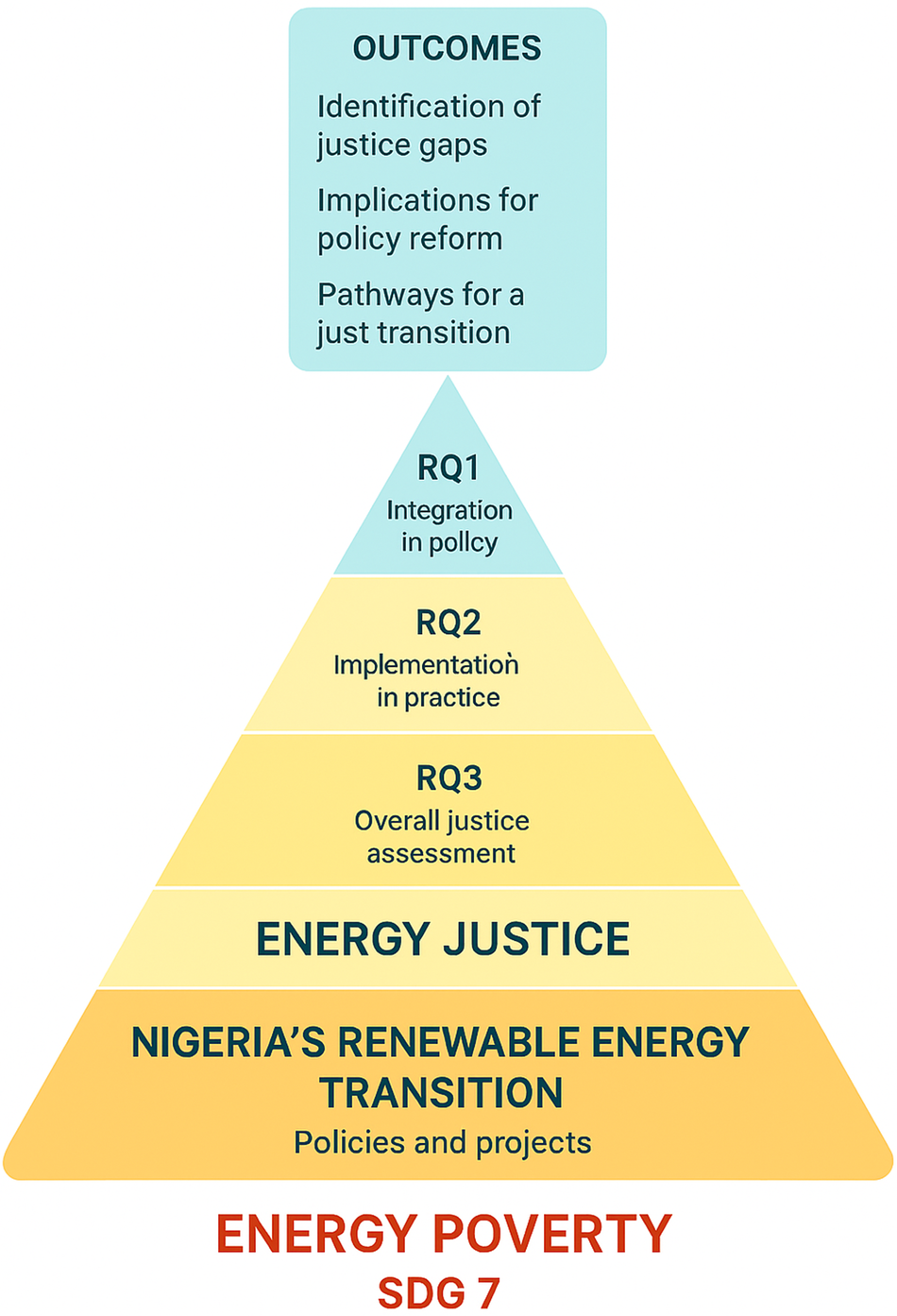
This study has six sections, with the first section providing an introduction. Section “Background” reviews relevant theories from the literature around issues like energy justice and its theoretical and some practical applications globally and within Nigeria. Section “Materials and methods” details the research methodology, while Sections “Results” and “Discussion” present the research findings and discussion chapters, respectively. Section “Conclusion and policy implications” concludes with a summary of findings and expert recommendations for future research, policy and practice (Figure 1).
Conceptual framework for analysing Nigeria’s renewable energy transition. Note: The framework illustrates how the study begins with the foundational challenge of energy poverty (aligned with SDG 7), evaluates Nigeria’s renewable energy policies and projects through the four principles of energy justice and operationalises this analysis through three research questions, leading to outcomes that identify justice gaps and policy pathways for a more equitable transition.

Background
Climate change and energy justice
Climate change, amongst other issues, has led scholars to question energy systems, especially in developed nations (e.g., Barandiarán et al., Reference Barandiarán, Damluji, Miescher, Pellow and Walker2022). However, energy issues disproportionately affect vulnerable, indigenous and marginalised populations in developing nations, where the harmful impacts of extractive energy production are acutely felt (Barandiarán et al., Reference Barandiarán, Damluji, Miescher, Pellow and Walker2022). Barandiarán et al. (Reference Barandiarán, Damluji, Miescher, Pellow and Walker2022) argued for shifting away from dominant narratives promising unchecked benefits and overlooking exploitations and injustices, advocating instead for narratives that amplify vulnerable voices and ensure equitable distribution of burdens and benefits. While transitioning to renewable energy is essential due to fossil fuels’ adverse impacts (Krey and Clarke, Reference Krey and Clarke2011; Ezugwu, Reference Ezugwu2015; Osunmuyiwa et al., Reference Osunmuyiwa, Biermann and Kalfagianni2017; Pellow, Reference Pellow2017; Shamasunder, Reference Shamasunder2018; Urban, Reference Urban2019; Müller et al., Reference Müller, Neumann, Elsner and Claar2021; Barandiarán et al., Reference Barandiarán, Damluji, Miescher, Pellow and Walker2022), it also presents challenges, risking exacerbated vulnerabilities if not justly implemented (Barandiarán et al., Reference Barandiarán, Damluji, Miescher, Pellow and Walker2022). Renewable energy minerals are often tied to systems of extractivism and exploitation, particularly in global South nations like Nigeria, where historical injustices rooted in neocolonialism, colonialism and the resource curse complicate the energy transition (Adeola, Reference Adeola and Steady2009; Animashaun et al., Reference Animashaun, Wossink and Imai2023).
Though reliant on global markets, these energy systems have significant local equity, justice and sustainability implications. They are not entirely fossil-free, as lithium batteries and hydro dams remain carbon-intensive, highlighting the need for careful implementation to avoid replicating the pitfalls of fossil fuel systems (see Barandiarán et al., Reference Barandiarán, Damluji, Miescher, Pellow and Walker2022; Günther, Reference Günther2023; Haar, Reference Haar2023). Challenging Eurocentric framings of justice, energy and development helps avoid relegating the local and Indigenous voices to a lesser priority “elsewhere” (Barandiarán et al., Reference Barandiarán, Damluji, Miescher, Pellow and Walker2022, p. 7). The last decade has seen scholars increasingly apply a critical energy justice lens to energy systems, identifying and addressing inequities (see Goldthau and Sovacool, Reference Goldthau and Sovacool2012; McCauley et al., Reference McCauley, Heffron, Stephan and Jenkins2013; Sovacool and Dworkin, Reference Sovacool and Dworkin2015; Jenkins et al., Reference Jenkins, McCauley, Heffron, Stephan and Rehner2016; Barandiarán et al., Reference Barandiarán, Damluji, Miescher, Pellow and Walker2022). Bailey and Darkal (Reference Bailey and Darkal2018) reveal a gap between theoretical support for renewable energy and actual practice, with opposition driven by place attachments and technological and procedural issues.
Applications of energy justice to renewable energy projects
An analysis of energy justice interventions in renewable projects worldwide reveals recurrent themes of procedural neglect, distributional inequity and recognition failures, alongside isolated instances of responsive remediation.
Procedural neglect and power imbalances
Poor processes and unbalanced power dynamics routinely undermine community participation and oversight. In Mexico, the United States, Kenya, Mozambique and Sierra Leone, Nsude et al. (Reference Nsude, Loraamm, Wimhurst, God’sgift and Debnath2024) document how inadequate Environmental Impact Assessments (EIAs) and opaque decision-making precipitated cultural heritage loss, biodiversity damage and forced displacement in 102 renewable energy projects spanning wind, solar, biomass and geothermal installations between 2001 and 2021. The Dakatcha Woodland Biofuel Project in Kenya exemplifies this procedural failure; despite a court injunction, developers advanced without meaningful consultation or proper EIA, provoking sustained community resistance (Nsude et al., Reference Nsude, Loraamm, Wimhurst, God’sgift and Debnath2024, p. 9). Similarly, Kruger and McCauley’s (Reference Kruger, McCauley, Bombaerts, Jenkins, Sanusi and Guoyu2020) study of hydropower development in the Democratic Republic of Congo highlighted how vulnerable groups were excluded from key decision-making processes. In Zambia, Duvenage et al. (Reference Duvenage, Taplin and Stringer2012a, Reference Duvenage, Taplin and Stringer2012b) showed that biofuel expansions for export markets were driven largely by external actors with greater resources and technical knowledge, leaving smallholders excluded and exposed to land dispossession and soil degradation.
Distributional inequities and environmental harms
Even where renewable projects proceed, empirical studies show benefits and burdens are often unevenly distributed. Nsude et al. (Reference Nsude, Loraamm, Wimhurst, God’sgift and Debnath2024) report that pollution and ecosystem loss disproportionately afflict marginalised communities, while economic gains accrue elsewhere. Keady et al. (Reference Keady, Panikkar, Nelson and Zia2021) document how low-income and non-White households in Vermont experience heightened energy vulnerability because of structural discrimination. Hydropower and biofuel case studies reveal similar dynamics: Kruger and McCauley (Reference Kruger, McCauley, Bombaerts, Jenkins, Sanusi and Guoyu2020) identify inconsistent delivery of promised benefits in a DRC hydropower scheme, and Duvenage et al. (Reference Duvenage, Taplin and Stringer2012a, Reference Duvenage, Taplin and Stringer2012b) highlight land loss and exclusion in Zambia. Kumar and Turner (Reference Kumar, Turner, Bombaerts, Jenkins, Sanusi and Guoyu2020) further show that inadequate life cycle policies for off-grid solar shift e-waste and toxic exposures onto marginalised informal workers in the Global South.
Recognition failures and social ruins
Beyond tangible harms, renewable transitions can leave social ruins when the lived experiences of affected communities go unacknowledged. Kumar and Turner (Reference Kumar, Turner, Bombaerts, Jenkins, Sanusi and Guoyu2020) document this recognition gap in solar e-waste management through ethnographic work in Nairobi and Bihar. Their question, “What happens to people’s lives, livelihoods, and lifestyles when solar breaks down?” (p. 156), points to the invisibility of cultural dislocation, livelihood loss and health risks in both national regulations and international frameworks such as the Basel Convention. By framing e-waste as a purely technical issue, prevailing policies overlook the everyday socio-cultural burdens of affected communities, creating an ethical vacuum where responsibility is absent.
Responsive remediation and pathways forward
Amid these gaps, a handful of projects demonstrate the potential for corrective action, further highlighting the limited attention typically given to reparative or restorative dimensions. Nsude et al. (Reference Nsude, Loraamm, Wimhurst, God’sgift and Debnath2024) highlight California’s Ivanpah Solar Project, where sustained community advocacy led to strengthened Environmental Impact Assessments (EIAs), expanded habitat protections and new permits that integrated local concerns (p. 10). This case illustrates that when procedural inclusivity and accountability mechanisms are embedded, distributional and recognition injustices can be mitigated and communities are better positioned to hold developers accountable. These case studies underscore that without intentional integration of procedural fairness, equitable distribution of benefits and burdens, genuine recognition of affected communities and enforceable mechanisms for remediation, renewable energy development risks perpetuating old injustices in new forms. For Nigeria’s transition, this literature makes clear that embedding comprehensive energy justice principles at every stage, from policy design and project implementation through to end-of-life management, is essential to ensure that clean energy not only decarbonises the grid but also advances social equity, environmental stewardship and community well-being.
Application of energy justice within the Nigerian energy sector
This section examines energy justice application within Nigeria’s fossil fuel industry, where Morocco-Clarke (Reference Morocco-Clarke2023) critiques the frequent violations of Nigeria’s Environmental Impact Act (EIA), leading to procedural justice breaches and conflicts between local communities and oil companies. Despite the Gas Re-Injection Act of 1979, continued gas flaring underscores the weak implementation of energy justice principles. The distributive justice lens highlights the exploitation of regions like the Niger Delta by oil explorers and the federal government, resulting in significant losses of land, properties, cultures and lives due to conflicts (Morocco-Clarke, Reference Morocco-Clarke2023). This reflects the resource curse paradox, where resource-rich areas experience inverse development, violent conflicts, losses and poor well-being (Sala-i-Martin and Subramanian, Reference Sala-i-Martin and Subramanian2013; Asiegbu et al., Reference Asiegbu, Ikeanyibe, Abang, Nwosu and Ugwu2024). Morocco-Clarke (Reference Morocco-Clarke2023, p. 260) then notes that the Niger Delta, rich in oil and gas, faces intense exploration activities that disrupt local livelihoods, causing poverty and environmental degradation. Morocco-Clarke (Reference Morocco-Clarke2023) applies a recognitional justice lens to highlight Nigeria’s historical and ongoing severe individual, social and environmental losses from oil exploration, with harsh responses to activism, such as the 1995 execution of nine Ogoni protesters (Amnesty International, 2017). The rejection of Senator Ben Murray-Bruce’s bill to phase out petrol cars by 2035 illustrates a recognitional injustice (Busari, Reference Busari2019). The Senate rejected the bill for lacking extensive financial or economic implications. The Deputy Senate President’s comment, “…we should do everything possible to frustrate the sale of electric cars in Nigeria to enable us to sell our oil” (Morocco-Clarke, Reference Morocco-Clarke2023, p. 262), underscores a narrow focus on economic benefits, neglecting broader non-economic implications, which could have provided more nuance to their claims.
Reparative justice’s foundation has been discussed in criminal jurisprudence, emphasising acknowledgment, compensation and remediation for harm rather than punishment (Morocco-Clarke, Reference Morocco-Clarke2023). Applying this lens, the author highlights issues such as continued gas flaring despite regulatory measures and the ineffectiveness of regulatory bodies like NOSDRA and NESREA in enforcing policies and regulating projects. Transparency issues within these agencies and the government, including inconsistent records of environmental events like oil spills, exacerbate energy sector-induced losses and damages, weakening reparative justice (Amnesty International, 2018). Morocco-Clarke recommends establishing an Energy Justice Office/Department, like the United States, to address these issues.
Materials and methods
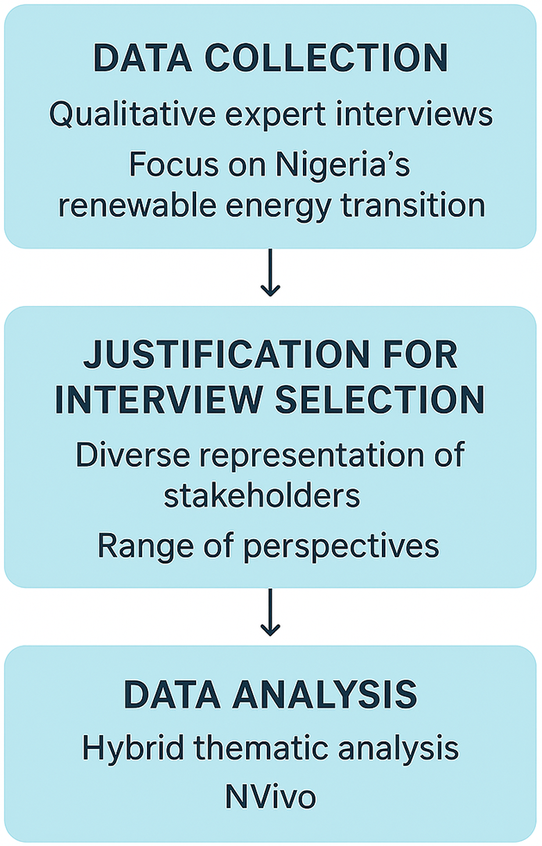
This section details the study’s research design, methodology and analysis strategy. Prior study of energy transition literature revealed that Nigeria’s energy transition plan starts with a limited use of renewables, aiming to eventually shift to predominantly renewable sources. Therefore, the study prioritised renewables in data collection and analysis to align with this holistic transition approach (Figure 2).
Overview of the study’s methodological approach.

Data collection and interview selection
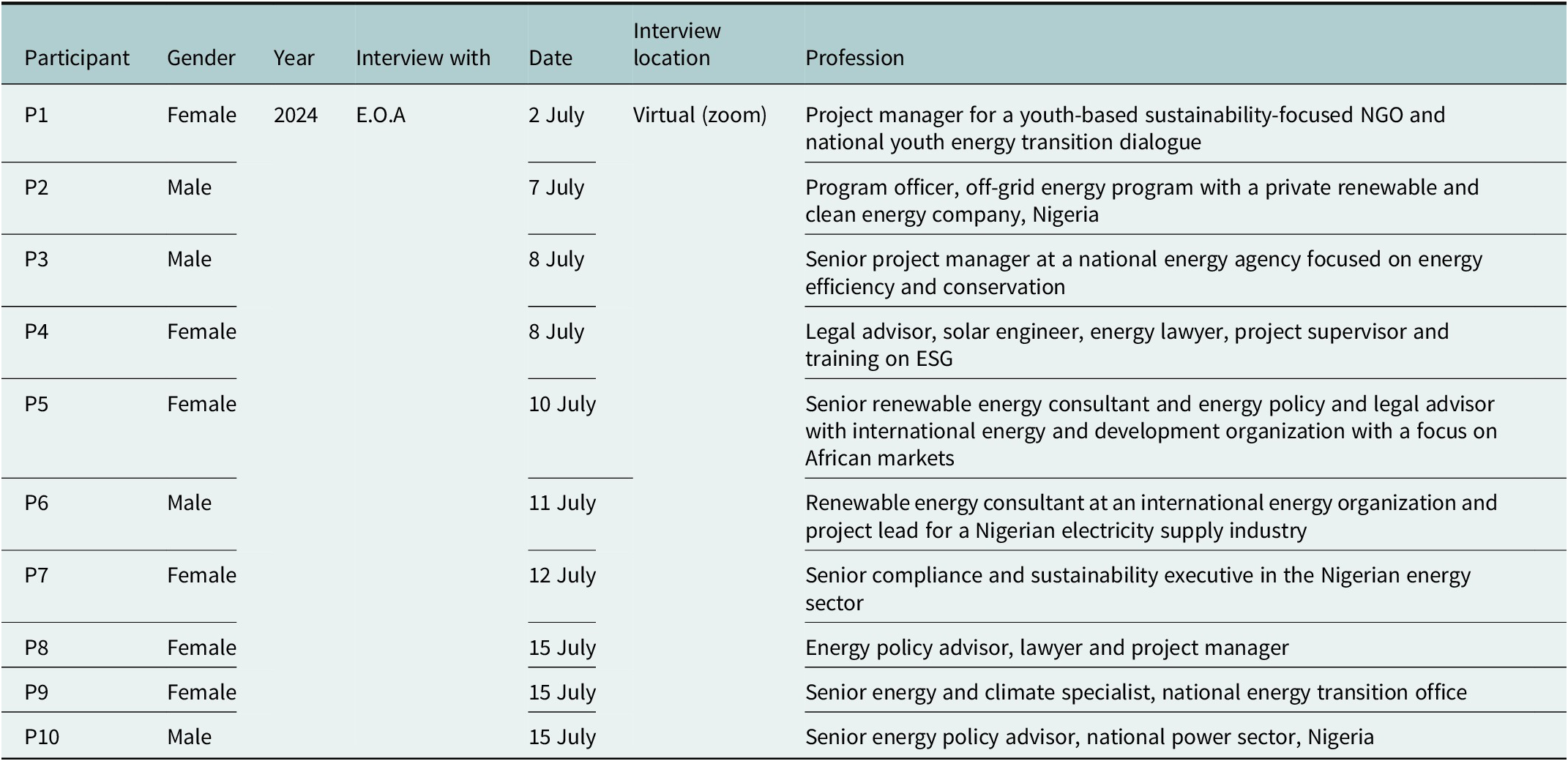
This study adopted a qualitative research design centred on semi-structured expert interviews to generate in-depth insights into how energy justice principles are interpreted and operationalised within Nigeria’s renewable energy transition. Ten expert participants were selected through purposive sampling based on demonstrable knowledge of the Nigerian energy sector, particularly renewable energy policy, planning and implementation and supplemented by snowballing approaches to identify additional relevant stakeholders. The final cohort included experts from government agencies, renewable-energy companies, academia and civil society organisations, thereby capturing a diverse cross-section of professional, institutional and regional perspectives.
Interviews were conducted virtually on Zoom in English between 2 and 18 July 2024, each lasting an average of 50 minutes. All interviews were recorded and transcribed with informed consent. The breadth of professional backgrounds represented, including policy designers, project implementers, energy regulators and sector analysts, enabled the study to draw on a wide range of practical experiences and theoretical knowledge. Together, these 10 interviews offered sufficient depth to reach thematic saturation and to generate nuanced insights into the promises, tensions and justice considerations shaping Nigeria’s transition landscape.
Ethics and research integrity
All data collection procedures complied with the ethical requirements of SOAS, University of London where the study gained ethical approval from. Participation was voluntary, participants were fully briefed on study aims, confidentiality was assured and contributors retained the right to withdraw at any stage. No identifying personal information is reported in this manuscript. AI tools (ChatGPT, GPT-4/5 and Grammarly) were used solely for language editing and refinement; all data analysis, coding and interpretation were undertaken exclusively by the authors, consistent with emerging guidelines for transparent use of generative AI in scholarly work (Han et al., Reference Han, Qiu, Lichtfouse, Han, Qiu and Lichtfouse2024).
Data analysis
Interview data underwent hybrid thematic analysis in NVivo, combining deductive coding aligned to our three research questions with inductive identification of emergent sub-themes. Transcripts from 10 expert interviews were coded line-by-line into nodes corresponding to three themes aligning with the core research question: (1) non-economic social and environmental impacts, including both positive and negative ecosystem, individual and social effects; (2) energy justice in policies, covering fairness, effectiveness, stakeholder engagement, policy localisation, procedural injustices, unfair policy impacts and underlying rationales; and (3) energy justice in practice, encompassing visions for Nigeria’s renewable future, the nexus of loss and damage with renewables and expert recommendations. All coding was reviewed collaboratively to ensure intercoder reliability.
We selected thematic analysis for its flexibility in exploring complex, context-sensitive constructs such as justice, permitting both theory-driven and data-driven insights. NVivo was chosen for its robust code-management capabilities, auditability and ability to facilitate systematic comparisons across a large collection of text. Its open-access availability to our team ensured consistency in coding and streamlined the triangulation of expert interview findings with the existing literature.
Results
Results from interviews
Non-economic impacts
The non-economic impacts of renewable energy and energy transition projects, as reported by participants, were categorised into positive and negative effects across social and environmental dimensions. The positive effects will be discussed first.
Perceived positive non-economic impacts
According to interviewees, the provision of clean energy has contributed to perceived improvements in health and well-being: P1 commented that “the problem of anxiety will be reduced,” and P6 said, “…communities will be very happy.” Participants also reported perceived gains in quality of life linked to the project, including extended business hours, improved educational opportunities and greater nighttime safety from enhanced lighting. P10 observed that the “school system became improved…even at night provides security for the people.” Several participants noted gendered effects: P3 stated that “women-led businesses are able to thrive more.”
As mentioned, rural communities have experienced socioeconomic growth through enhanced agricultural activities, access to potable water and new job opportunities, thereby reducing poverty. P10 remarked, “…water boreholes, the potable water is now provided.” Environmentally, the shift to renewable energy has reduced air and noise pollution and decreased deforestation as communities move away from wood as a primary energy source. P4 stated, “…they reduce pollution in the air…it reduces noise pollution.” Technologies like biogas have promoted sustainable resource use and minimised waste, as P7 explained, “sustainable use of resources; you reduce waste because renewable energy, such as biogas technology, uses waste to produce biogas for clean cooking and energy, and then the byproducts can be used as fertiliser for farmers in rural communities.”
Perceived negative non-economic impacts
Participants raised concerns about negative environmental impacts, such as electronic waste from outdated energy devices and illegal mining for minerals like lithium, which lead to land degradation and water pollution. Land use conflicts, especially with large-scale projects like solar farms and hydropower plants, result in the loss of arable land, ecosystem disruptions, community displacement, deforestation and soil degradation. P4 remarked, “It brings about land issues…farmlands are destroyed too.” Socially, displacement and resettlement due to energy projects have caused tensions and land ownership disputes. Cultural resistance was also noted, with new technologies sometimes disrupting traditional lifestyles in areas with strong cultural norms. P4 highlighted, “With the energy transition, we have mini-grids now in smaller communities, so it brings about land issues… one of the most strenuous issues,” while P10 added, “…begin to change even cultures.” Additionally, the influx of workers for energy projects has, in some cases, led to increased gender-based violence, mining and child labour issues, underscoring the need for community engagement and protective measures. P10 noted, “illegal mining which often uses women and child labour,” and P6 mentioned, “…renewable energy may cause more illegal miners to expand.” P9 emphasised, “For years now, unfortunately, it’s more or less been a resource grab where the local, critical minerals are mined, with no refining or value addition on the continent, and shipped out.”
Energy justice in policies and gaps in practice
This section explores expert opinions on energy justice integration in policies and practices. The interviews revealed diverse views, with mentions of procedural, distributive, recognitional and reparative justice in varying degrees. Seven out of 10 experts (70%) expressed positive views, believing energy justice principles are reflected in current policies. For instance, Participant 10 (P10) stated, “…all of them are captured in the energy transition. We really did extensive work on them.” Similarly, P2 noted, “…If you look at the latest electricity act of the country and also even the role that the government has taken with the design of the energy transition plan, the ETP for Nigeria, you begin to see that these dimensions are captured very clearly.” However, when discussing practical implementation, all 10 experts observed various energy injustices across renewable energy technologies and other transition projects. This highlighted concerns about the limitations of energy justice in practice despite its supposed theoretical presence in policies. Also, a majority highlighted policy ineffectiveness, like P3, mentioning that “The problem is how effective these policies are; they are not effective…” It showed that some experts might be “out of touch” with either the policies themselves, on-the-ground challenges or that while energy justice is theoretically captured in policies, it fails to materialise in practice.
Notably, six experts pointed out that, while energy justice is captured within policies, it often fails to materialise in practice, revealing significant implementation gaps. As P6 explained, “I’ve been active in the design of some of these policies… It shows some promises in mitigating the social and environmental impact of renewable energy projects. It’s just that the effectiveness of the policy itself in practice is still very limited.” A recurring theme was the disconnect between policy design and community or vulnerable group engagement. While experts acknowledged the importance of engagement during project implementation, they noted its absence during the policy design phase. According to P7, “… I’ve had the opportunity to participate in drafting policies, providing input, and trying to ensure inclusivity. And I will tell you the truth: communities are not being carried along; maybe they are during projects but not in policy…Everybody sits in Abuja (Nigeria Capital), develops policies…, and then suddenly, we have a policy.” The responses indicated that while energy justice is mostly captured in policies, it is often absent in practice, particularly in engaging communities and vulnerable groups during policy design. Six experts also acknowledged that energy justice dimensions are considered during some renewable energy projects, reflecting the complexity and multiplicity of expert perspectives. Despite these nuances, the dominant view leaned towards recognising energy justice within policies, but with significant gaps and inconsistencies in practical application due to implementation challenges and other issues highlighted, like structural and neocolonial issues. While it may appear that the analysis involves more than 10 participants, it is because some experts expressed multiple, sometimes contradictory, perspectives during the interviews. Participant 6 highlighted distributive justice efforts, noting the success in achieving universal electricity access, especially in underserved regions, with projects spread across all geopolitical zones. Reparative justice was evident in discussions on resettlement plans, infrastructure and livelihood restoration for impacted communities. P5 remarked, “Reparative justice was reflected in discussions around resettlement plans, infrastructure and livelihood restoration plans captured in policies for impacted communities.” Recognitional justice was indicated by mandatory stakeholder engagement during projects.
Despite these acknowledgements, some experts criticised the policies as insufficient, ineffective and inadequate. P1 stated, “…we always struggle here. I don’t think policies are just, honestly.” P6 added, “The Federal Government’s resettlement and compensation strategies are grossly inadequate and limited.” Issues such as policy fragmentation, lack of vulnerable group participation, insufficient contextualisation and data deficiencies were also identified. Concerns about policy instability, particularly government unpredictability, further undermine ongoing efforts. Participant 7 noted, “The problem is that government policies say one thing and do another….It’s very confusing… Yes, the policy is there, but the government can change their mind…”
Following these findings on policy integration and identified gaps between theory and practice, the next section will delve deeper into expert opinions on energy justice in practice.
Energy justice in practice
Expert opinions on the integration of energy justice in Nigerian policies reflect a mix of acknowledgment and critique. All experts highlighted various energy injustices encountered while implementing renewable energy projects, pointing to issues such as policy fragmentation, inadequate community involvement during policy design and the inconsistent application of justice principles in practice. The predominant concern was the disparity between policy intentions and their execution, exacerbated by government unpredictability and insufficient policy robustness. These issues will be further examined in detail and structured under contrasting positive and negative expert views on the different energy justice tenets.
Negative views on energy justice in practice
Procedural justice issues in practice. Experts identified significant procedural justice issues in implementing energy projects in Nigeria. A recurring concern was the inefficacy of legal systems, characterised by lengthy bureaucratic processes and backlogged cases, often causing extensive project delays. P3 noted, “Cases can linger in the legal system for up to 10 years,” highlighting deep-seated judicial issues. Additionally, experts pointed out poor local inclusion and the dominance of international actors in project planning, with P3 lamenting that “local renewable energy companies are not carried along” in many instances. Accountability within government and regulatory agencies was another major issue. P7 highlighted the abandonment of significant projects like the Katsina wind farm: “After spending four billion, it is now abandoned.” Despite policy provisions, gaps in gender access were noted, with P7 stating, “…even with agencies like National Environmental Standards and Regulations Enforcement Agency (NESREA), there’s no accountability,” P3 said, “…many people see courts as places where you can bribe your way…” The lack of consistent government funding and reliance on external funding were also critical, with P7 noting that “most completed projects done in time are by international financiers.” Government inconsistency and sudden policy changes were also detrimental to project implementation, while the pervasive lack of accountability among government officials was linked to job security. P3 observed that “government officials tend to have high levels of job security and cannot be easily fired, unlike in the private sector.”
Furthermore, poor standards and maintenance of solar and renewable energy technologies were highlighted, with reports of malfunctioning solar PV systems. P4 commented, “Some PV projects are not working or are operating at 50% capacity,” reflecting inadequate supervision and maintenance. The limited knowledge of energy justice and energy transition concepts among stakeholders was also noted, with P6 expressing concerns that renewable energy projects could exacerbate illegal mining activities.
Distributional justice issues. The experts identified several distributional justice issues in past and current energy systems, particularly the ongoing environmental harm at project sites. P1 highlighted the plight of Niger Delta communities, stating, “Many people are still suffering in oil-affected areas, and the same goes for renewable energy projects, particularly due to abandonment.” This underscores persistent inequities in distributing environmental burdens. Distributional justice concerns were also evident in access-related issues, particularly inequities in who benefits from renewable energy projects and whose needs are deprioritised. Experts highlighted that electricity access, job creation and infrastructure improvements are often captured by better-resourced groups, while vulnerable communities face persistent exclusion and bear disproportionate burdens such as land loss, displacement and environmental risks. As P8 explained, “Whoever has the money gets to determine a lot,” illustrating how financial influence skews outcomes and reinforces elite capture of benefits. Some participants also extended distributional concerns to the broader material justice dimensions of the energy transition, drawing attention to power dynamics in project financing and critical mineral exploitation in Nigeria (e.g., Zamfara, Plateau). P7 noted that “fights erupt daily over minerals,” highlighting the violent contestation linked to resource extraction, while P2 observed that “after the mining is done, it’s taken to other countries for manufacturing and then sold back at a much higher value,” underscoring the inequities of global supply chains. Job displacement and the lack of long-term job security for local communities were additional concerns, with P10 stating, “Communities are mostly employed during the construction phase, but after that, they are left out.” This reflects the short-term nature of employment opportunities provided by these projects, which do not contribute to sustainable community development.
Recognitional justice issues. Recognition justice issues were highlighted by several experts, who pointed to a disconnect between project developers and local communities. P6 warned that this disconnect “may lead to resistance in community expectations,” indicating the potential for conflict if community needs and concerns are not adequately addressed. The lack of sufficient attention to those negatively affected by projects was another concern, with P6 noting that “the gap in meeting needs is wide.” The tokenistic nature of community engagement was also criticised, with P7 stating, “They (being local communities and vulnerable groups) are just brought in at the project phase because, at that level, it is necessary… at the policy level, they are ignored.” This reflects a broader issue of misrecognition, where communities are not meaningfully included in decision-making processes, leading to perceptions of “greenwashing” by developers and policymakers.
Restorative/reparative justice issues. Significant gaps in reparative justice were identified, with experts highlighting ongoing environmental and biodiversity harm caused by energy projects and inadequate repair and compensation mechanisms. P1 questioned the fairness of these practices, stating, “…we still have pollution everywhere from past fossil fuel projects and also issues hydropower dams have caused to people and ecosystems.…How do you want these people to begin this new phase? There’s no future if we haven’t healed from our past.” P3 echoed this sentiment, noting that “energy is seen as a form of development, but when the government develops a site, they don’t often look deeply at compensation.” Compensation marginalisation was underscored, with P3 discussing Niger Delta communities’ struggles to secure adequate compensation: “They have to fight for their compensation… even when compensated, the money is taken away.” The participant explained that, despite government efforts, corrupt systems deplete funds before they reach communities, leaving them with little or nothing. Inadequate compensation was a recurring theme, with P6 stating, “Compensation is inadequate and not enough,” reflecting broader issues of insufficient reparative measures for affected communities.
Positive views on energy justice
Despite the predominance of critiques regarding energy injustices in Nigeria, six experts acknowledged positive government efforts to integrate energy justice into practice. These experts highlighted initiatives like exclusivity agreements and adherence to World Bank standards aimed at promoting procedural justice. P5 noted the effectiveness of these measures: “In my experience working with Sustainable Energy for All (SEforALL) and in Nigeria, we worked closely with communities… this approach helped us understand their concerns and needs, ensuring their input was considered in project planning,” demonstrating a structured approach to community engagement, crucial for procedural justice. However, it is important to note that this engagement was often linked to efforts to reduce project vandalism. As P5 stated, “Extensive stakeholder engagement is conducted between private sector developers and the communities… to ensure the community feels a sense of ownership, to avoid vandalising projects.” While this suggests procedural justice, it also raises questions about whether these engagements prioritise genuine community perspectives or are primarily driven by the need to secure infrastructure.
P9 offered a more optimistic view, arguing that “implementation is not necessarily an issue in Nigeria. I think the signals are there.” They cited projects where companies must demonstrate justice efforts, “Part of the selection criteria, a lot of companies have to… ensure that what their environmental and social sustainability plan is, their plans for maintenance and management of the systems to ensure that there are no issues.” This contrasts with the more critical perspectives of other experts, highlighting divergent opinions on the efficacy of current practices.
Distributional justice efforts. Positive distributional justice efforts were highlighted by two experts, who recognised attempts to achieve fairness by ensuring the equitable distribution of projects across Nigeria’s geopolitical zones. P5 emphasised, “At least one state from each zone benefits from these renewable energy projects. When I was heading [a national-level renewable energy-related project], this was a priority… We made sure to have a project in each geopolitical zone,” citing a solar hybrid project that involved universities across different zones. This demonstrates a commitment to regional equity in the distribution of renewable energy resources, a key aspect of distributional justice.
Recognitional justice efforts. Some efforts towards recognitional justice were acknowledged, particularly in the context of gender inclusivity in project decision-making. P5, describing mini-grid projects, highlighted that “gender inclusivity in project decision-making was prioritised,” reflecting a significant focus on this aspect of social justice. However, inclusivity efforts seem limited, with gender being the primary focus, while other vulnerable groups, such as Indigenous peoples, people with disabilities and youth, were notably absent. This suggests that despite progress in one area of recognitional justice, a gap remains in addressing the needs of all marginalised groups. Furthermore, P5 noted that livelihood restoration efforts were integrated into projects when land was appropriated for solar energy initiatives. “The great thing about the REA, the World Bank, and the AfDB is that they made it mandatory for companies to have gender-based violence specialists on their teams and plans to prevent such situations. These were requirements before signing grant agreements or EPC contracts. We also relied on World Bank policies, which included livelihood restoration plans to ensure people were not economically impacted if their lands were taken for projects.” This emphasis on economic impacts, while important, signals a continued prioritisation of economic concerns over non-economic impacts, such as social and cultural disruptions, which are equally crucial for achieving true recognitional justice. While these measures are commendable, they also highlight Nigeria’s reliance on external standards and policies, raising concerns about the country’s capacity to develop and maintain localised policy efforts.
Reparative justice efforts. Three experts highlighted reparative justice efforts, including compensation for communities affected by past harm and land appropriated for renewable energy projects. P4 stated, “In Nigeria, there are compensation mechanisms… One requirement for any energy company to carry out a project is the community development agreements. These legally binding agreements outline the benefits communities will receive…” P5 shared a personal example: “While leading [a national renewable energy project], …we identified sites for solar hybrid power plants on university campuses. However, some were occupied by local community members for residential and agricultural purposes. In such cases, we sought alternative sites within the universities. If the original sites were most suitable, we ensured livelihood restoration plans were in place, and those negatively impacted were duly compensated.” This demonstrates a commitment to fair compensation and minimising harm to local communities during project implementation. P6 also discussed reparative justice during the conceptual phase of the Mambilla hydropower project, where resettlement plans were carefully outlined, signalling a proactive approach to addressing potential negative impacts.
Some experts also linked local energy injustices to global North injustices; however, we left those out as they are beyond the scope of this paper.
Optimism for the future
Most participants expressed optimism about the future of renewable energy technologies and the energy transition in Nigeria. This optimism reflects a belief in the potential for positive change despite significant obstacles and a commitment to continuing the journey towards a more just and sustainable energy future.
Discussion
The expert interviews reveal a dual reality, painting a familiar but important tension on how renewable projects in Nigeria deliver clear, measurable (non)economic benefits (improved lighting, extended business and school hours, reduced local air/noise pollution and some livelihood gains), while at the same time generating serious social and environmental harms such as e-waste, land conflicts, displacement, cultural disruption, informal mineral extraction and short-term employment. This pattern echoes findings from other contexts where the promise of renewables coexists with uneven outcomes (Kumar and Turner, Reference Kumar, Turner, Bombaerts, Jenkins, Sanusi and Guoyu2020; Nsude et al., Reference Nsude, Loraamm, Wimhurst, God’sgift and Debnath2024) and shows that the problem is less about whether justice is named and more about how it is done in practice (Heffron and Talus, Reference Heffron and Talus2016; Bailey and Darkal, Reference Bailey and Darkal2018).
The four justice dimensions that emerged from the interviews (procedural, distributional, recognitional and reparative) map neatly onto recurring critiques in the energy-justice literature:
-
1. Procedural justice: Experts described community “consultations” as coming too late in the process and serving primarily to secure project approval and protect infrastructure rather than to share power or shape outcomes. As one interviewee put it, engagement was often done “…to ensure the community feels a sense of ownership, to avoid vandalising projects” (P5), and another noted communities are “brought in at the project phase” rather than at conception (P7). In practice, this risk-management approach, engagement as social licence, leaves grievances unaddressed and helps explain tangible consequences reported by participants, such as siting conflicts, vandalism and eventual project abandonment. This pattern aligns with critiques that participation is frequently subordinated to technical or investor timelines (Jenkins et al., Reference Jenkins, McCauley, Heffron, Stephan and Rehner2016; Bailey and Darkal, Reference Bailey and Darkal2018) and shows how tokenistic consultation can convert procedural shortcomings into concrete implementation failures.
-
2. Distributional justice: Interviewees noted that benefits, such as jobs and infrastructure, are frequently short-lived or captured by better-resourced actors, while burdens like land loss, pollution and e-waste disproportionately fall on vulnerable groups. This finding is consistent with scholarship showing that renewable transitions can reproduce spatial and socio-economic inequities when value chains and maintenance are neglected (Kumar and Turner, Reference Kumar, Turner, Bombaerts, Jenkins, Sanusi and Guoyu2020; Nwozor et al., Reference Nwozor, Oshewolo, Owoeye and Okidu2021). Our data illustrate this through mechanisms like abandoned projects, one-off construction hires and limited local processing. Experts also stressed how financial and political influence shape outcomes, with one noting that “Whoever has the money gets to determine a lot” (P8), underscoring elite capture of distributional benefits. Some participants further extended distributional concerns into material justice, drawing attention to critical mineral exploitation and global supply chains. For instance, “fights erupt daily over minerals” in Zamfara and Plateau (P7), while others observed that mined resources are exported cheaply and re-imported at much higher value (P2). While these insights sit more directly under clean energy material justice frameworks, they remain relevant here because they highlight how extractive political economies reinforce dependency and limit the equitable sharing of transition benefits (Sovacool et al., 2020; Bainton and Owen, 2021).
-
3. Recognitional justice: Experts repeatedly stressed that marginalised groups remain largely unseen in transition planning, with recognition often reduced to token gender quotas. This resonates with McCauley’s (Reference McCauley2018) argument that recognition is foundational to equitable outcomes, a dynamic seen in other Global South contexts (Nsude et al., Reference Nsude, Loraamm, Wimhurst, God’sgift and Debnath2024). Interviewees described how limited recognition fosters resistance, erodes trust and devalues local knowledge systems. For example, cultural practices tied to land and livelihoods were often ignored in planning, generating resentment and, in some cases, active opposition to renewable projects.
-
4. Restorative/reparative justice: Restorative justice was consistently cited as the weakest element. Experts noted that compensation frameworks were either absent, poorly enforced or corrupted. Where reparations did occur, they were limited to cash transfers that failed to restore livelihoods or address deeper social harms. Several participants argued that reparations should be conceived more broadly to include long-term livelihood restoration, environmental monitoring and community empowerment. Without such measures, injustices from past and ongoing projects remain unresolved, undermining trust in future transition efforts.
Conclusion and policy implications
This study examined Nigeria’s renewable energy transition through the lens of energy justice and finds a dual reality. Interviews reveal that renewable energy projects are delivering meaningful social and environmental gains, improved lighting and night-time safety, extended business and school hours, enhanced agricultural and livelihood opportunities and reductions in localised air and noise pollution. These non-economic benefits reflect the transition’s developmental promise and align with SDG 7’s ambition to expand access to modern energy services. At the same time, the findings make visible a set of significant and persistent harms, including e-waste, land conflicts, encroachment on farmlands, displacement, cultural disruption, informal and unsafe mineral extraction, gendered vulnerabilities and the short-term nature of employment opportunities. These harms are disproportionately borne by marginalised and rural communities and risk reinforcing existing inequities rather than alleviating them.
Across the interviews, a consistent pattern emerged: energy justice principles appear to be referenced in policy frameworks more often than they are meaningfully realised in practice. The problem is therefore not a lack of justice language or intent, but weak implementation structures. Four interlinked findings stand out. First, procedural justice failures sit at the core of most grievances. Communities typically seem to be engaged late in the process and instrumentally (invited in to secure acceptance, avoid vandalism or complete regulatory paperwork) rather than to shape project direction, likely leading to mistrust, siting disputes and, in extreme cases, abandoned infrastructure. Second, distributional benefits appear uneven and short-lived: projects often create temporary construction jobs or concentrated gains for better-resourced actors, while environmental burdens and land loss fall disproportionately on poorer households. Third, recognitional justice remains narrow in scope. Beyond gender, many vulnerable groups appear largely absent from policy design and decision-making, and traditional knowledge systems and cultural values receive insufficient attention. Fourth, restorative or reparative justice mechanisms remain the weakest element. Compensation systems are fragmented or inadequately enforced, livelihood restoration is rarely completed in full and legacy harms from fossil fuel and hydropower projects remain unresolved, undermining trust in current transition efforts. Together, these findings address the study’s three research questions. First, they show that while Nigeria’s renewable energy and energy-transition policies reference key energy justice principles, their integration remains largely declarative rather than operational. Second, the interviews demonstrate that implementation in practice is uneven and frequently weak, with procedural, distributional, recognitional and restorative deficits producing tangible social and environmental harms. Third, when policy intent and practical outcomes are considered together, the evidence suggests that Nigeria’s renewable energy transition may be characterised as at best “ongoing” but not yet substantively just.
These suggest that Nigeria’s renewable energy transition can be viewed as in progress rather than substantively just: the transition is delivering benefits, but justice risks and unresolved harms persist, and without these being resolved, the country risks sustaining an unjust path dependency. Strengthening implementation rather than merely expanding policy statements will be critical if the transition is to reduce, rather than reproduce, inequality.
To move towards a more substantively just transition, this study identifies several actionable priorities.
-
1. Institutionalise upstream participation by requiring documented inclusion of communities, especially vulnerable groups, at the earliest stages of project conception and siting, not only at implementation.
-
2. Embed accountability and enforcement, including independent audits, performance-linked financing and sanctions for non-compliance with social and environmental obligations.
-
3. Localise benefits through procurement by integrating local content, skills transfer and long-term employment stipulations to retain value within communities and reduce extractive project models.
-
4. Mandate full life cycle planning, including enforceable e-waste and end-of-life management requirements for all RE infrastructure.
-
5. Strengthen reparative justice, moving beyond one-off compensation to livelihood restoration, long-term monitoring and community oversight of remediation.
-
6. Broaden social inclusion frameworks, ensuring that gender initiatives are matched by explicit provisions for Indigenous groups, youth, persons with disabilities and other marginalised populations.
-
7. Invest in data and transparency, with publicly accessible indicators on displacement, land conversion, e-waste, emissions outcomes, job longevity and compensation effectiveness.
A just energy transition in Nigeria will require not only technical expansion of renewable capacity but also institutional structures capable of confronting historical injustices, preventing new forms of harm and redistributing authority and benefits more equitably. The findings of this study provide an empirical basis for such reforms and highlight the importance of centring communities and justice principles in both policy and practice as Nigeria pursues a sustainable energy future. A minority of interviewees, largely those working closely with government initiatives, reported more positive impressions of policy and project practice. These views likely reflect positional familiarity with select projects and do not negate the broader critique; instead, they suggest variability in practice and the feasibility of better implementation where political will and resources exist. Understanding the conditions under which these more positive outcomes occur is a useful next step. This study is interview-focused and experts provide system-level insight into mechanisms and governance failures, but cannot replace the lived testimony of directly affected households. To operationalise recommendations and ensure equitable outcomes, future research should prioritise: (a) community-level qualitative and quantitative studies disaggregated by gender, age and disability; (b) subnational case studies to map geographic variation and indigenous communities; (c) empirical tracing of critical minerals and e-waste value chains; and (d) quantitative indicators to triangulate expert claims. The study could not gather first-hand opinions from directly impacted communities on the non-economic impacts and energy justice dimensions of renewable energy and energy transition projects. To address this limitation, the study leveraged expert perspectives, triangulated findings with existing literature and focused on expert recommendations for improving community engagement and addressing justice gaps in Nigeria’s energy transition (Table 1).
List of interviewees

Open peer review
To view the open peer review materials for this article, please visit https://doi.org/10.1017/etr.2026.10010.
Data availability statement
All relevant data are included in the manuscript. Additional resources will be made available upon request.
Acknowledgements
The authors would like to thank all participants who generously shared their time and expertise for this study. The authors are also grateful to colleagues at SOAS, University of London and the University of Birmingham for their feedback during project development.
Author contribution
Excel Obumneme Amaefule (E.O.A): Conceptualized the study; designed the methodology; conducted the empirical research, including data collection and analysis; led the interpretation of findings; and drafted the original manuscript. Coordinated the revision process in response to editorial and reviewer feedback, integrated structural and conceptual revisions across the manuscript and prepared the clean and tracked versions for resubmission. Reviewed and approved the final manuscript, taking responsibility for its overall integrity and accuracy.
Ros Taplin (R.T.): Provided supervision throughout the research process, reviewed and edited the manuscript for structure and argument and advised on ethics and the study design.
Chinedu C. Nsude (C.C.N.): reviewed and edited manuscript for structure, flow and alignment to objectives. Reviewed the final draft for rigour and quality assessment in preparation for submission. Provided substantial intellectual and editorial support during the revision stage; led the drafting, structuring and formatting of the detailed response to the editor and reviewers; edited the manuscript to improve clarity, coherence, flow and alignment with the revised research questions and journal expectations; and conducted a rigorous quality and readiness review in preparation for final submission.
Financial support
This research received no external funding.
Competing interests
The authors declare none.
Change of authorship
All authors agree with all parts of the work, including the final draft and order of name listing for publication.
Inclusivity statement
This study was designed to ensure inclusivity in both scope and analysis. Expert participants were purposively sampled to reflect diversity across government, academia, civil society and the private sector, ensuring representation of varied perspectives on Nigeria’s energy transition. Beyond technical expertise, we also ensured inclusivity based on gender, with 6 out of 10 experts identifying as female. While the study did not involve vulnerable communities directly, it explicitly centred non-economic impacts and justice considerations, issues that disproportionately affect marginalised populations, thereby amplifying concerns that are often overlooked in technical or economic framings of energy policy.

 Open access


Comments
Dear Dr. Ucal and Guest Editors,
On behalf of my co-authors, I am pleased to submit our manuscript entitled “Energy Justice in Practice: Non-Economic Impacts of Nigeria’s Renewable Energy Transition” for consideration in the themed collection Energy Poverty and Justice in Sustainable Energy Transitions in Cambridge Prisms: Energy Transitions.
Our study addresses the multidimensional nature of energy poverty and justice in Nigeria, Africa’s most populous nation and one of the world’s most fossil-fuel-dependent economies. Using a qualitative methodology that combines policy analysis with expert interviews, the paper explores how renewable energy transitions generate both benefits and harms beyond economic indicators. We show that while policies reference equity and inclusion, governance frameworks are undermined by vague accountability mechanisms, tokenistic participation, and a lack of reparative justice, producing outcomes that exacerbate rather than alleviate energy poverty.
This research makes three contributions directly relevant to the themed collection:
Theoretical: it advances energy justice debates by connecting justice principles to the lived realities of energy poverty, demonstrating how procedural, recognitional, and distributional justice are operationalised in transition contexts.
Empirical: it highlights the non-economic dimensions of Nigeria’s energy transition, including health, education, cultural, and environmental impacts often omitted from mainstream policy discourses.
Practical: it offers evidence to guide inclusive governance and policy frameworks, emphasising how just transition strategies can safeguard vulnerable groups and mitigate multidimensional energy poverty.
Given Nigeria’s regional significance and its role in global climate action, our findings will resonate with broader comparative debates on energy poverty and justice in sustainable transitions.
We confirm that this manuscript has not been published elsewhere and is not under consideration by any other journal. All authors have approved the submission.
Thank you very much for considering our work for this important themed collection. We look forward to your response.
Sincerely,
Excel Obumneme Amaefule (Corresponding Author)
On behalf of the co-authors