Introduction
During the last 10 years, the Institute for Atmospheric and Earth System Research (INAR) at the University of Helsinki (www.helsinki.fi/en/inar-institute-for-atmospheric-and-earth-system-research) has been active in finding practices for upscaling its research approach, for solving global Grand Challenges (GCs), particularly climate change (CC) and poor air quality (AQ) in polluted megacities and for bridging the research outcomes for the use of society. Stemming from research excellence and accomplishments (e.g. Kulmala et al., Reference Kulmala, Riipinen, Sipilä, Manninen, Petäjä, Junninen and Kerminen2007, Reference Kulmala, Kontkanen, Junninen, Lehtipalo, Manninen, Nieminen and Worsnop2013, Reference Kulmala, Ezhova, Kalliokoski, Noe, Vesala, Lohila and Kerminen2020a), INAR has been motivated by the science diplomacy dimension called “science-in-diplomacy” that is based on the idea that the political decisions should be based on science-based information (Royal Society, 2010). The foundation of INAR’s success in science is the comprehensive atmospheric and ecosystem observations performed in a flagship station called Station for Measuring Atmosphere Ecosystem Relations (SMEAR II, Hari & Kulmala, Reference Hari and Kulmala2005). The SMEAR-II station is located in Hyytiälä, Finland, and it has been in operation since 1995. The station has been a test laboratory for developing the comprehensive and integrated measurement concept and novel technological solutions, new measurement devices and carrying out parallel measurements on atmospheric composition and meteorology in many ways together with the biological processes in the soil – water – vegetation – atmosphere continuum. All these activities have given INAR a huge research capacity underlined by a constant and impactful research output with a wide scientific perspective. During the last decades, INAR and its predecessors have contributed to policy processes such as in the Intergovernmental Panel on Climate Change (IPCC) reporting (2019), delivered policy briefings for government(s) and provided professional perspectives in high profile journals like Nature (Kulmala, Reference Kulmala2015, Reference Kulmala2018).
At the same time, INAR has launched several initiatives for science diplomacy and built these upon its international scientific collaboration and networks, especially with the researchers coming from Russia and China. Collaborative research in Russia has been focused on CC, AQ, dynamics of the land–atmosphere interactions and feedbacks covering topics like permafrost thawing, greenhouse gas (GHG) emissions and sink processes, aerosol formation, environmental health and Artic greening and browning (e.g. Paasonen et al., Reference Paasonen, Asmi, Petaja, Kajos, Aijala, Junninen and Kulmala2013; Ezhova et al., Reference Ezhova, Ylivinkka, Kuusk, Komsaare, Vana, Krasnova and Kulmala2018, Reference Ezhova, Orlov, Suhonen, Kaverin, Mahura, Gennadinik and Kulmala2020; Petäjä et al., Reference Petäjä, Duplissy, Tabakova, Schmale, Altstädter, Ancellet and Lappalainen2020). In China, INAR’s collaboration interest has been on understanding the complex air pollution cocktail (Kulmala, Reference Kulmala2015) including feedbacks with boundary layer processes and atmospheric aerosol population (Ding et al., Reference Ding, Huang, Nie, Sun, Kerminen, Petäjä and Fu2016a; Petäjä et al., Reference Petäjä, Järvi, Kerminen, Ding, Sun, Nie and Kulmala2016), particularly in the most polluted megacity environments. The results have underlined the importance of secondary aerosol formation as the initial step for haze formation (Kulmala et al., Reference Kulmala, Dada, Daellenbach, Yan, Stolzenburg, Kontkanen and Kerminen2020b; Chu et al., Reference Chu, Dada, Liu, Yao, Wang, Du and Kulmala2020). As a whole, we have provided a significant science-based information pool to develop mitigation and adaptions strategies and increase our holistic system understanding on climate and climate–AQ interactions (e.g. Kulmala et al., Reference Kulmala, Alekseychik, Paramonov, Laurila, Asmi, Arneth and Kerminen2011a,b; Wang et al., Reference Wang, Zhao, Wang, Yang, Xing, Morawska and Hao2017; de Jesus et al., Reference de Jesus, Thompson, Knibbs, Kowalski, Cyrys, Niemi and Morawska2020).
Pan-Eurasian Experiment (PEEX) Programme (www.atm.helsinki.fi/peex) (Lappalainen et al., Reference Lappalainen, Kerminen, Petäjä, Kurten, Baklanov, Shvidenko and Kulmala2016a) is based on four interconnected pillars bringing research, research infrastructure, capacity building (education, outreach) and society impact under the same umbrella (Kulmala et al., Reference Kulmala, Zilitinkevich, Lappalainen, Kyrö and Kontkanen2015a; Lappalainen, Borisova, Liang, Enroth, & Kulmala, Reference Lappalainen, Borisova, Liang, Enroth and Kulmala2016; Lappalainen et al., Reference Lappalainen, Altimir, Kerminen, Petäjä, Makkonen, Alekseychik and Kulmala2019; Bobylev et al., Reference Bobylev, Chereshnya, Kulmala, Lappalainen, Petäjä, Solov’eva and Tynkkynen2018). This combination of these pillars is needed for a paradigm shift to cope with the GCs like CC and AQ (Wang, Guan, & Cai, Reference Wang, Guan and Cai2019). Today PEEX collaboration covers over 40 universities or research institutes from Russia and China and is a significant platform for “science-in-diplomacy” and even for the “science-for-diplomacy”. Along with PEEX, the other initiative, namely, the Global Network of Stations Measuring Earth Surface and Atmosphere Interactions (GlobalSMEAR), a global Earth observatory, the framework describes a technological solution, an integrated research infrastructure and in situ station concept to address and manage environmental challenges at the global scale (Hari et al., Reference Hari, Petäjä, Bäck, Kerminen, Lappalainen, Vihma and Kulmala2016; Kulmala, Reference Kulmala2018; Alekseychik et al., Reference Alekseychik, Lappalainen, Petäjä, Zaitseva, Heimann, Laurila and Kulmala2016).
The most recent international collaboration activity coordinated by INAR is the Arena for the gap analysis of the existing Arctic Science Co-Operations (AASCO). AASCO, a 2-year project funded by Prince Albert Foundation for 2020–2021, is a task force to enhance the multidisciplinary collaboration between Arctic marine sciences and terrestrial ecology aimed at delivering science-based message for the Artic policymaking.
INAR started as a small research group at the University of Helsinki Physics Department in 1990’s and is today an institute at the University of Helsinki of ca. 260 researchers. INAR is one of world-leading institutes in atmospheric sciences, working in a strongly multidisciplinary manner. During this journey, INAR has built not only research networks but also contacts outside academia with international organisations, companies, ministries, non-governmental organisations and with the education sector. All these sectors are interested in dialogue and exchange of ideas about the novel science-based solutions for environmental challenges and how to best support the United Nations 17 global goals for sustainable development (United Nations, 2015). To support this work, from 2015 onwards, INAR has hosted the European centre for the International Eurasian Academy of Science (IEAS) (www.atm.helsinki.fi/m/ieaseurope). Furthermore, annual Sofia Earth Forum organised in Helsinki together with INAR and the Sofia Cultural Centre provides a dialogue forum for the IEAS members and professionals inside and outside the academia.
The aim of this paper is to present the conceptual science-in-diplomacy approach at INAR and introduce our showcases, PEEX, GlobalSMEAR, AASCO, IEAS and the Sofia Earth Forum as practical examples of science-in-diplomacy.
Conceptual thinking for the science-in-diplomacy
Conceptual thinking behind the science-in-diplomacy has been presented by Kulmala et al. (Reference Kulmala, Lappalainen, Petäjä, Kurten, Kerminen, Viisanen and Zilitinkevich2015) “while the growing population needs more fresh water, food and energy it causes and escallates Grand Challenges (GC) such as climate change, declining air quality, loss of biodiversity and shortages of fresh water and food supplies. The GCs, controling the human well-being, are highly connected and interlinked and cannot be solved separately”. We need large-scale, cross-country scientific collaboration to solve these the GCs (Royal Society, 2010). A key insight is that the GCs cannot be solved neither locally nor in isolation (Wang et al., Reference Wang, Zhao, Wang, Yang, Xing, Morawska and Hao2017). As a step forward, joint and integrated efforts and problem-solving are required.
As a practical example, the observations show a continuously increasing trend of CO2 concentrations (www.co2.earth/daily-co2) and there is an increasing urgency of societies to adapt to CC and mitigate CC. This puts the science diplomacy under pressure and highlights the “science-for-fast-tract-diplomacy”. As summarised in Kulmala et al. (Reference Kulmala, Lappalainen, Petäjä, Kurten, Kerminen, Viisanen and Zilitinkevich2015), the potential solutions are typically tightly coupled with each other. Thus, there is an urgent and enormous need for global scale Research Infrastructures (RI) and big open data. We need to combine the harmonised comprehensive open data with the excellent scientific expertise to provide novel insights required for solving the GCs. International agreements on open data (Agreement on Enhancing International Arctic Scientific Cooperation are needed to support the practical implementation of open data access (Berkman, Kullerud, Pope, Vylegzhanin, & Young, Reference Berkman, Kullerud, Pope, Vylegzhanin and Young2017). For example, INAR offers joint co-authorship to the data providers. This has been especially an important motivation asset in the frame of PEEX programme when collaborating with the Russian and Chinese research teams. Furthermore, INAR provides free, easy access to the University of Helsinki-hosted SMEAR station data by the SmartSMEAR e-platform (smear.avaa.csc.fi/) (Junninen et al., Reference Junninen, Lauri, Keronen, Aalto, Hiltunen, Hari and Kulmala2009). Without the dialogue and science diplomacy between the scientific community, stakeholders and general public in and between countries, we are not able to formulate and communicate the scientific knowledge perceivable for the policymakers and, moreover, cannot have the new policies legitimated.
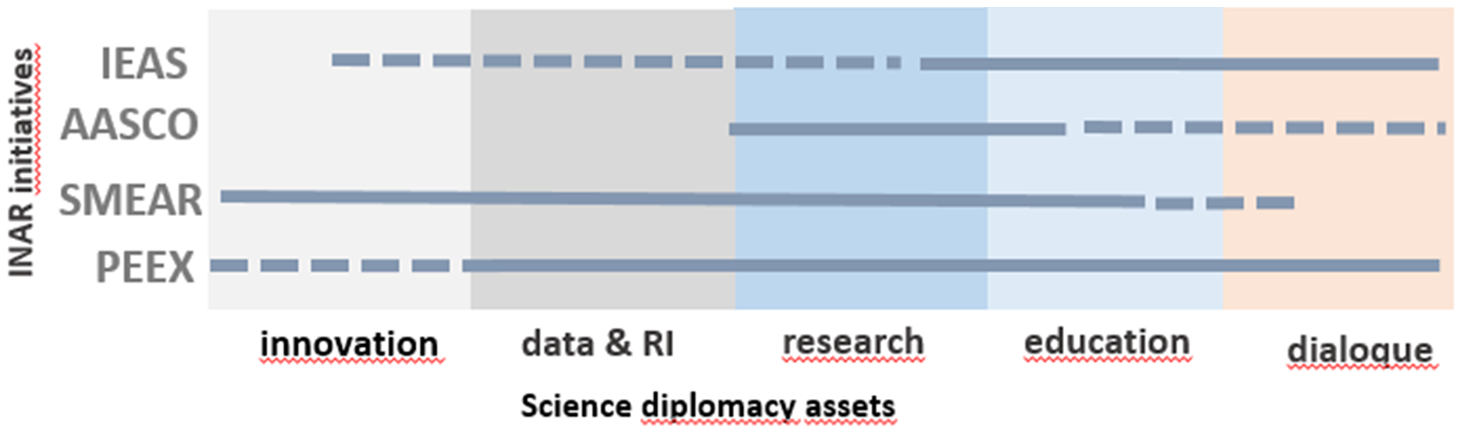
The foundation to meet the GCs and maximise the scientific impact on society has been summarised, for example, in the Earth System Manifesto released by Kulmala et al. (www.atm.helsinki.fi/peex/images/manifesti_peex_ru_hub2.pdf). The manifesto serves as a science diplomacy framework and lists three interactive tasks on global observation network, hubs bridging scientific knowledge to political information and a joint global agenda supporting technological development to tackle the GCs. The INAR science-in-diplomacy is built on these ideas and on the conceptual thinking. We contribute with our science and RI expertise and capacity, climate education and its openings of science-diplomacy-in-action to answer GCs in a pro-active manner inside and outside academia, in Finland and internationally. A summary of the science diplomacy assets in different initiatives is provided in Figure 1.
Fig. 1.
Coverage of the focus areas of the INAR science diplomacy activities: PEEX, GlobalSMEAR, AASCO and IEAS/Sofia Earth Forum process.
Showcases of science diplomacy in action
Pan-Eurasian Experiment (PEEX): GlobalSMEAR
INAR’s predecessor organisations started bilateral research activities with the Russian scientists of theoretical aerosol physics during the late Soviet times in early 1990’s. The turning point for the more intensive collaboration with the Russian research groups was initiated in 2011 with the support by Professor Sergej Zilitinkevich (1936 – 2021). He brought his international networks and collaboration with several academicians of Russian Academy of Sciences (RAS) to the frameworks of INAR. Zilitinkevich was a world-class physicist in atmospheric sciences, especially in the field of boundary layer dynamics and turbulence. He utilised his knowledge widely in different scientific disciplines and had a wide personal contact network and was, together with Academician Markku Kulmala, one of the initiators of the PEEX. PEEX was introduced in 2011 in an overview paper on the aerosol and GHG observation activities in Siberia, including the idea on the pan-Siberian experiment (PSE) research programmes and observation network from Scandinavia to China (Kulmala et al., Reference Kulmala, Alekseychik, Paramonov, Laurila, Asmi, Arneth and Kerminen2011a). Subsequently, the PEEX kick-off meeting was held in October 2012 in Helsinki. The most active institutes were University of Helsinki, Finnish Meteorological Institute, Institute of Geography, Moscow State University, Institute for Scientific Research of Aerospace Monitoring (AEROCOSMOS), Institute of Atmospheric Optics (Siberian branch) of the RASs and the former Institute of Remote Sensing and Digital Earth (RADI) under the Chinese Academy of Sciences (CAS), currently titled “The Aerospace Information Research Institute (AIR)” – CAS.
The ideas and concepts were further elaborated in a co-design process, which led to the joint PEEX Science Plan, which was published in 2015 (Lappalainen, Borisova, Liang, Enroth, & Kulmala, Reference Lappalainen, Kulmala and Zilitinkevich2015). The PEEX research network currently covers ca. 4000 researchers and over 40 official collaboration agreements have been signed with universities and research organisations located mostly in Russia and China (www.atm.helsinki.fi/peex/index.php/mou). In 2011, we opened PEEX special Issues in Atmospheric Physic and Chemistry. The Part I of the ACP PEEX special issue (2016–2020) consists of 56 papers (acp.copernicus.org/articles/special_issue395.html). The research overview of the published ACP PEEX Part I special issue is under preparation (Lappalainen et al., Reference Lappalainen, Petäjä, Vihma, Räisänen, Baklanov, Chalov and Kulmala2022). The Part II of ACP PEEX special issue was opened in 2021 (acp.copernicus.org/articles/special_issue1103.html).
To support scientific advances, PEEX has organised six science conferences in years 2012–2018. The special issues (ACP PEEX special issues Parts I, II; Geography, Environment, Sustainability No. 02, v.09, 2016) and conference proceedings (Kulmala et al., Reference Kulmala, Zilitinkevich, Lappalainen, Kyrö and Kontkanen2015a; Lappalainen et al., Reference Lappalainen, Borisova, Liang, Enroth and Kulmala2016, 2017) have served as platforms for the PEEX research community to distribute information on their recent results. In addition, PEEX Headquarters (HQ) in Helsinki coordinate the PEEX Blog and release newsletter on a regular basis, and provide education forums, particularly for young scientists, to introduce their results and learn about communicating science to the wider audience.
The backbone of the research approach has been the Finnish Centre of Excellence in “Atmospheric Science - From Molecular and Biological processes to the Global Climate” and, starting from 2020, the Finnish flagship programme “Atmosphere and Climate Competence Center” (ACCC) coordinated by INAR.
PEEX is largely based on collaboration with universities and research institutes in Russia and in China. The scope of CC and its future development and related political decisions, especially, of Russia and China are, and will be, affecting the atmospheric composition regionally but will also have a global impact on the future development of humankind. The PEEX Science Plan focuses on these issues and introduces research questions in the context of GHG emissions, critical atmospheric processes, ecosystem structural changes, the Arctic Ocean in the climate system, human actions on land-use changes and urbanisation. The fundamental part of the plan is to fill in the observational gap in the Northern Eurasian region and establish a land–atmosphere in situ station network in Russia and China as part of the global observation systems (Alekseychik et al., Reference Alekseychik, Lappalainen, Petäjä, Zaitseva, Heimann, Laurila and Kulmala2016; Vihma et al., Reference Vihma, Uotila, Sandven, Pozdnyakov, Makshtas, Pelyasov and Kulmala2019; Petäjä et al., Reference Petäjä, Ganzei, Lappalainen, Tabakova, Makkonen, Räisänen and Kondrat’ev2021). The implementation of such a station infrastructure together with research and education activities in Russia and China would require high-level political support and national investments. Based on the current trends, the atmospheric CO2 concentrations will exceed the critical value of 500 ppm in the year 2050 (OECD Environmental Outlook Baseline projections (Marchal et al., Reference Marchal, van Vuuren, Clapp, Chateau, Magné, Lanzi and van Vliet2012). This trend sets us a tentative timeframe to act and a serious science-in-diplomacy challenge to convince the investors in Russia and China of the necessity to invest in climate solutions.
PEEX Russia
For setting up the preparatory phase for PEEX in Russia, we needed a momentum to match world-class scientists and their networks. This led to a joint science plan showing us the future direction. Furthermore, we built a new network and collaboration framework at an institutional level (universities, research institutes) for PEEX and established PEEX HQ – Russia at the Moscow State University and several local project offices and/or contact points with local actors. This collaboration opened doors for important positions and contacts in the RASs and the Russian Geographical Society, which has enabled dialogue with the decision-makers on a science-in-diplomacy basis. For the transition and in order to move from the PEEX preparatory phase to the PEEX implementation phase, we need big data, in practice, to establish the first SMEAR benchmarked station in Russia. This is foreseen to be realised in near future as one of the tasks of the new Russian Mega Grant project (2021–2023) called “Megapolis - heat and pollution island: interdisciplinary hydroclimatic, geochemical and ecological analysis” coordinated by the Moscow State University.
PEEX China
Air pollution in China not only affects the quality of life in gigacity environment (e.g. Kulmala et al., Reference Kulmala, Kokkonen, Pekkanen, Paatero, Petäjä, Kerminen and Ding2021), but also has interactions with the global climate (Kulmala, Reference Kulmala2015). INAR started an intensive collaboration with the Nanjing University (NJU) already in 2009. The cornerstone for the science collaboration has been the NJU-hosted Station for Observing Regional Processes of the Earth System (SORPES) (Ding et al., Reference Ding, Fu, Yang, Sun, Zheng, Xie and Kulmala2013, Reference Ding, Nie, Huang, Chi, Sun, Kerminen and Fu2016b) in Nanjing with a similar type of comprehensive measurement concept like the SMEAR station concept in Finland. To guarantee the continuation of the observations and the full usage of the data for research, and for bridging the research to policies, the joint INAR-NJU research has been consolidated by establishing a Joint international research laboratory of Atmospheric and Earth System Sciences (JIRLATEST, jirlatest.nju.edu.cn/main.htm).
A new, SMEAR benchmarked, Beijing Haze station (Liu et al., Reference Liu, Yan, Feng, Zheng, Fan, Zhang and Kulmala2020) in a city centre of Beijing started itsoperation in 2019. The station serves as an example of a successful bilateral partnership. The station is hosted by the Beijing University of Chemical Technology (BUCT) and works in close collaboration with INAR.
INAR focus has been on solving the AQ – air pollution challenge in China. The INAR activities in China have led to science-in-diplomacy-in-action and high-level recognitions. Markku Kulmala was nominated as a foreign member of Chinese Academy of Sciences (CAS) in 2017. This dialogue and contacts have been a pathway for expanding the SMEAR-based in situ station network and Chinese bodies (cites, research organisations) investing for several new comprehensive stations in China in the coming years (Kulmala et al., Reference Kulmala, Kokkonen, Pekkanen, Paatero, Petäjä, Kerminen and Ding2021).
GlobalSMEAR
In China collaboration, the PEEX is especially integrated with the Station for Measuring Earth Surface – Atmosphere Relations, the GlobalSMEAR approach. GlobalSMEAR, followed by PEEX, is an integrated measurement concept and technology-driven initiative of INAR (Hari & Kulmala, Reference Hari and Kulmala2005; Hari et al., Reference Hari, Petäjä, Bäck, Kerminen, Lappalainen, Vihma and Kulmala2016; Kulmala, Reference Kulmala2018, www.atm.helsinki.fi/globalsmear). The GlobalSMEAR measurements are designed to provide comprehensive open data for environmental monitoring (Kulmala, Reference Kulmala2015, Reference Kulmala2018; Kulmala et al., Reference Kulmala, Lappalainen, Petäjä, Kurten, Kerminen, Viisanen and Zilitinkevich2015; Petäjä et al., Reference Petäjä, Järvi, Kerminen, Ding, Sun, Nie and Kulmala2016). GlobalSMEAR would not only benefit the research community by providing a large pool of harmonised data, but also policymakers and private companies. SMEAR type observation system would enable to test and verify the realisation of new climate policies and carbon footprint of companies. This comprehensive station framework is an integrated approach and is based on co-located and standardised measurements of the European research infrastructures: Integarted Carbon Observation System (ICOS), Aerosol, Clouds and Trace Gases Research Infrastructure (ACTRIS), Integrated European Long-Term Ecosystem, critical zone and socio-ecological Research Infrastructure (eLTER), Infrastructure for Analysis and Experimentation on Ecosystems (AnaEE) together with GEO Global Earth Observation System of Systems (GEOSS) and World Meteorological Organization Global Atmospheric Watch (WMO-GAW).
A larger frame of reference for the PEEX and GlobalSMEAR collaboration with the Chinese research institutes interested in atmospheric – ecosystem monitoring is provided by the President Xi’s Silk Road Economic Belt and the 21st-Century Maritime Silk Road initiative (B&R). The foreseen environmental risks across the new economic Silk Road region are related to the changing climate–AQ interactions, air pollution, changing monsoon dynamics, land degradation and the melting of Tibetan Plateau glaciers. It is evident that a novel science and technology-based framework with critical resources are needed. PEEX and GlobalSMEAR complement the recently launched international scientific programme called Digital Belt and Road (DBAR). PEEX and GlobalSMEAR provide the guidelines for the novel ground-based observations, science and education agenda while DBAR provides a big data platform on Earth observation from China and from the countries along the Belt and Road region. The DBAR and PEEX programmes are complementary assets for monitoring ecological environment, urbanisation, cultural heritage, environmental status in the coastal zones and Arctic cold regions supporting the sustainable development of the regions (Lappalainen et al., Reference Lappalainen, Kulmala, Kujansuu, Petäjä, Mahura, de Leeuw and Huadong2018).
Arctic science co-operations
There is an increasing need for the science diplomacy in the Arctic context. The Arctic as a “zone of peace” and exceptional area in world politics is meeting the challenge of a race of resources together with the consequent emerging conflicts in the Arctic. At the same time, this geopolitical situation is impacted by CC and has made Arctic geopolitics global (Heininen, Reference Heininen2018).
INAR activities are focused on Arctic and boreal regimes. Recently, we have started several new activities related to Arctic research and the development of the Arctic research infrastructures, which provides us a capacity for the Artic relevant science diplomacy activities. INAR is collaborating on several ongoing and past Arctic projects, such as FORCeS, CRiSIS, INTAROS, INTERACT (e.g. Petäjä et al., Reference Petäjä, Duplissy, Tabakova, Schmale, Altstädter, Ancellet and Lappalainen2020), and collaborates with Svalbard Integrated Arctic Earth Observing System and Villum Research station in Northern Greenland (e.g. Beck et al., Reference Beck, Sarnela, Junninen, Hoppe, Garmash, Bianchi and Sipilä2021). The work in INAR is closely connected to SAON process, paving the way for sustainable Arctic observations (Starkweather et al., Reference Starkweather, Larsen, Kruemmel, Eicken, Arthurs, Bradley and Wilkinson2021).
The most recent science diplomacy activity is Arena for the gap analysis of the existing AASCO which is a 2-year project in 2020–2021, coordinated by INAR and funded by Prince Albert Foundation. AASCO is an example of a targeted, short-term intensive task force directly allocated to the policy process. The scientific focus is on a holistic and integrated understanding of the Arctic and high latitude atmosphere – ocean – terrestrial ecosystems interactions and feedbacks. AASCO is bringing these research communities together to discuss large-scale research questions and data needs. AASCO will deliver a White paper on “Arctic feedbacks and interactions, synthesis and future research needs”, which gives a science-based message to the Arctic policymaking processes on the most challenging research questions to be solved in the near future (ref.).
IEAS and Sofia earth forum
INAR has been hosting the European centre for the IEAS (www.atm.helsinki.fi/m/ieaseurope) since 2015. The IEAS European Centre comprises 70 IEAS European members (www.atm.helsinki.fi/m/ieaseurope/images/IEAS_Acad_Directory), who represent different disciplines from natural to political sciences, humanities and social sciences. The European Centre is a branch of the IEAS, which has a UNESCO partnership status. Thus, the UN global goals of sustainable development give the context for the discussions and dialogue for the IEAS. The members are motivated to go over different boundaries and find together practical solutions for the GCs. This allows multi- and cross-disciplinary education to be addressed by the IEAS.
Annual Sofia Earth Forum, organised in Helsinki together with INAR and the Sofia Cultural Centre, with a changing yearly focus, provides a dialogue forum for the IEAS members and professionals inside and outside the academia. As a whole, Sofia Earth Forum process encourages participants to bring up new ideas and perspectives on how to make a paradigmatic change and meet the global challenges. The first Sofia Earth Forum was held in June 2016 by the initiative of Metropolitan Ambrosius and Academician Markku Kulmala. The role of Prof. Sergej Zilitinkevich (1936–2021) was also fundamental in bridging academic scholars coming from Russia, Europe and USA to the Sofia Earth Forum process. In 2016, a group of academics and church representatives gathered together and had their first discussion with a more philosophical thought and sound of voice on the solutions on the GCs.
The latest Sofia Earth Forum was organised just before the COVID-19 pandemic in December 2019 and it gathered together a wide spectrum of influential persons, scientists, church representatives, politicians, chancellors and technology experts of the Finnish society to discuss around the same table on the steps needed towards carbon neutral future. In this case, the policymakers were directly involved in the process, and the policy recommendations were formulated together. In the conclusions, the forum says “We need to increase the aspects of solidarity and joint & several liability in the political solutions. The policy actions should always be communicated in a way that they are understandable for the general public, us all, and that we all can digest such policies. The legitimacy originates from our values associated with feelings of good and benefits rather than with our fears and discomfort” (Sofia Forum Suomi).



 Open access


Introduction
During the last 10 years, the Institute for Atmospheric and Earth System Research (INAR) at the University of Helsinki (www.helsinki.fi/en/inar-institute-for-atmospheric-and-earth-system-research) has been active in finding practices for upscaling its research approach, for solving global Grand Challenges (GCs), particularly climate change (CC) and poor air quality (AQ) in polluted megacities and for bridging the research outcomes for the use of society. Stemming from research excellence and accomplishments (e.g. Kulmala et al., Reference Kulmala, Riipinen, Sipilä, Manninen, Petäjä, Junninen and Kerminen2007, Reference Kulmala, Kontkanen, Junninen, Lehtipalo, Manninen, Nieminen and Worsnop2013, Reference Kulmala, Ezhova, Kalliokoski, Noe, Vesala, Lohila and Kerminen2020a), INAR has been motivated by the science diplomacy dimension called “science-in-diplomacy” that is based on the idea that the political decisions should be based on science-based information (Royal Society, 2010). The foundation of INAR’s success in science is the comprehensive atmospheric and ecosystem observations performed in a flagship station called Station for Measuring Atmosphere Ecosystem Relations (SMEAR II, Hari & Kulmala, Reference Hari and Kulmala2005). The SMEAR-II station is located in Hyytiälä, Finland, and it has been in operation since 1995. The station has been a test laboratory for developing the comprehensive and integrated measurement concept and novel technological solutions, new measurement devices and carrying out parallel measurements on atmospheric composition and meteorology in many ways together with the biological processes in the soil – water – vegetation – atmosphere continuum. All these activities have given INAR a huge research capacity underlined by a constant and impactful research output with a wide scientific perspective. During the last decades, INAR and its predecessors have contributed to policy processes such as in the Intergovernmental Panel on Climate Change (IPCC) reporting (2019), delivered policy briefings for government(s) and provided professional perspectives in high profile journals like Nature (Kulmala, Reference Kulmala2015, Reference Kulmala2018).
At the same time, INAR has launched several initiatives for science diplomacy and built these upon its international scientific collaboration and networks, especially with the researchers coming from Russia and China. Collaborative research in Russia has been focused on CC, AQ, dynamics of the land–atmosphere interactions and feedbacks covering topics like permafrost thawing, greenhouse gas (GHG) emissions and sink processes, aerosol formation, environmental health and Artic greening and browning (e.g. Paasonen et al., Reference Paasonen, Asmi, Petaja, Kajos, Aijala, Junninen and Kulmala2013; Ezhova et al., Reference Ezhova, Ylivinkka, Kuusk, Komsaare, Vana, Krasnova and Kulmala2018, Reference Ezhova, Orlov, Suhonen, Kaverin, Mahura, Gennadinik and Kulmala2020; Petäjä et al., Reference Petäjä, Duplissy, Tabakova, Schmale, Altstädter, Ancellet and Lappalainen2020). In China, INAR’s collaboration interest has been on understanding the complex air pollution cocktail (Kulmala, Reference Kulmala2015) including feedbacks with boundary layer processes and atmospheric aerosol population (Ding et al., Reference Ding, Huang, Nie, Sun, Kerminen, Petäjä and Fu2016a; Petäjä et al., Reference Petäjä, Järvi, Kerminen, Ding, Sun, Nie and Kulmala2016), particularly in the most polluted megacity environments. The results have underlined the importance of secondary aerosol formation as the initial step for haze formation (Kulmala et al., Reference Kulmala, Dada, Daellenbach, Yan, Stolzenburg, Kontkanen and Kerminen2020b; Chu et al., Reference Chu, Dada, Liu, Yao, Wang, Du and Kulmala2020). As a whole, we have provided a significant science-based information pool to develop mitigation and adaptions strategies and increase our holistic system understanding on climate and climate–AQ interactions (e.g. Kulmala et al., Reference Kulmala, Alekseychik, Paramonov, Laurila, Asmi, Arneth and Kerminen2011a,b; Wang et al., Reference Wang, Zhao, Wang, Yang, Xing, Morawska and Hao2017; de Jesus et al., Reference de Jesus, Thompson, Knibbs, Kowalski, Cyrys, Niemi and Morawska2020).
Pan-Eurasian Experiment (PEEX) Programme (www.atm.helsinki.fi/peex) (Lappalainen et al., Reference Lappalainen, Kerminen, Petäjä, Kurten, Baklanov, Shvidenko and Kulmala2016a) is based on four interconnected pillars bringing research, research infrastructure, capacity building (education, outreach) and society impact under the same umbrella (Kulmala et al., Reference Kulmala, Zilitinkevich, Lappalainen, Kyrö and Kontkanen2015a; Lappalainen, Borisova, Liang, Enroth, & Kulmala, Reference Lappalainen, Borisova, Liang, Enroth and Kulmala2016; Lappalainen et al., Reference Lappalainen, Altimir, Kerminen, Petäjä, Makkonen, Alekseychik and Kulmala2019; Bobylev et al., Reference Bobylev, Chereshnya, Kulmala, Lappalainen, Petäjä, Solov’eva and Tynkkynen2018). This combination of these pillars is needed for a paradigm shift to cope with the GCs like CC and AQ (Wang, Guan, & Cai, Reference Wang, Guan and Cai2019). Today PEEX collaboration covers over 40 universities or research institutes from Russia and China and is a significant platform for “science-in-diplomacy” and even for the “science-for-diplomacy”. Along with PEEX, the other initiative, namely, the Global Network of Stations Measuring Earth Surface and Atmosphere Interactions (GlobalSMEAR), a global Earth observatory, the framework describes a technological solution, an integrated research infrastructure and in situ station concept to address and manage environmental challenges at the global scale (Hari et al., Reference Hari, Petäjä, Bäck, Kerminen, Lappalainen, Vihma and Kulmala2016; Kulmala, Reference Kulmala2018; Alekseychik et al., Reference Alekseychik, Lappalainen, Petäjä, Zaitseva, Heimann, Laurila and Kulmala2016).
The most recent international collaboration activity coordinated by INAR is the Arena for the gap analysis of the existing Arctic Science Co-Operations (AASCO). AASCO, a 2-year project funded by Prince Albert Foundation for 2020–2021, is a task force to enhance the multidisciplinary collaboration between Arctic marine sciences and terrestrial ecology aimed at delivering science-based message for the Artic policymaking.
INAR started as a small research group at the University of Helsinki Physics Department in 1990’s and is today an institute at the University of Helsinki of ca. 260 researchers. INAR is one of world-leading institutes in atmospheric sciences, working in a strongly multidisciplinary manner. During this journey, INAR has built not only research networks but also contacts outside academia with international organisations, companies, ministries, non-governmental organisations and with the education sector. All these sectors are interested in dialogue and exchange of ideas about the novel science-based solutions for environmental challenges and how to best support the United Nations 17 global goals for sustainable development (United Nations, 2015). To support this work, from 2015 onwards, INAR has hosted the European centre for the International Eurasian Academy of Science (IEAS) (www.atm.helsinki.fi/m/ieaseurope). Furthermore, annual Sofia Earth Forum organised in Helsinki together with INAR and the Sofia Cultural Centre provides a dialogue forum for the IEAS members and professionals inside and outside the academia.
The aim of this paper is to present the conceptual science-in-diplomacy approach at INAR and introduce our showcases, PEEX, GlobalSMEAR, AASCO, IEAS and the Sofia Earth Forum as practical examples of science-in-diplomacy.
Conceptual thinking for the science-in-diplomacy
Conceptual thinking behind the science-in-diplomacy has been presented by Kulmala et al. (Reference Kulmala, Lappalainen, Petäjä, Kurten, Kerminen, Viisanen and Zilitinkevich2015) “while the growing population needs more fresh water, food and energy it causes and escallates Grand Challenges (GC) such as climate change, declining air quality, loss of biodiversity and shortages of fresh water and food supplies. The GCs, controling the human well-being, are highly connected and interlinked and cannot be solved separately”. We need large-scale, cross-country scientific collaboration to solve these the GCs (Royal Society, 2010). A key insight is that the GCs cannot be solved neither locally nor in isolation (Wang et al., Reference Wang, Zhao, Wang, Yang, Xing, Morawska and Hao2017). As a step forward, joint and integrated efforts and problem-solving are required.
As a practical example, the observations show a continuously increasing trend of CO2 concentrations (www.co2.earth/daily-co2) and there is an increasing urgency of societies to adapt to CC and mitigate CC. This puts the science diplomacy under pressure and highlights the “science-for-fast-tract-diplomacy”. As summarised in Kulmala et al. (Reference Kulmala, Lappalainen, Petäjä, Kurten, Kerminen, Viisanen and Zilitinkevich2015), the potential solutions are typically tightly coupled with each other. Thus, there is an urgent and enormous need for global scale Research Infrastructures (RI) and big open data. We need to combine the harmonised comprehensive open data with the excellent scientific expertise to provide novel insights required for solving the GCs. International agreements on open data (Agreement on Enhancing International Arctic Scientific Cooperation are needed to support the practical implementation of open data access (Berkman, Kullerud, Pope, Vylegzhanin, & Young, Reference Berkman, Kullerud, Pope, Vylegzhanin and Young2017). For example, INAR offers joint co-authorship to the data providers. This has been especially an important motivation asset in the frame of PEEX programme when collaborating with the Russian and Chinese research teams. Furthermore, INAR provides free, easy access to the University of Helsinki-hosted SMEAR station data by the SmartSMEAR e-platform (smear.avaa.csc.fi/) (Junninen et al., Reference Junninen, Lauri, Keronen, Aalto, Hiltunen, Hari and Kulmala2009). Without the dialogue and science diplomacy between the scientific community, stakeholders and general public in and between countries, we are not able to formulate and communicate the scientific knowledge perceivable for the policymakers and, moreover, cannot have the new policies legitimated.
The foundation to meet the GCs and maximise the scientific impact on society has been summarised, for example, in the Earth System Manifesto released by Kulmala et al. (www.atm.helsinki.fi/peex/images/manifesti_peex_ru_hub2.pdf). The manifesto serves as a science diplomacy framework and lists three interactive tasks on global observation network, hubs bridging scientific knowledge to political information and a joint global agenda supporting technological development to tackle the GCs. The INAR science-in-diplomacy is built on these ideas and on the conceptual thinking. We contribute with our science and RI expertise and capacity, climate education and its openings of science-diplomacy-in-action to answer GCs in a pro-active manner inside and outside academia, in Finland and internationally. A summary of the science diplomacy assets in different initiatives is provided in Figure 1.
Coverage of the focus areas of the INAR science diplomacy activities: PEEX, GlobalSMEAR, AASCO and IEAS/Sofia Earth Forum process.
Showcases of science diplomacy in action
Pan-Eurasian Experiment (PEEX): GlobalSMEAR
INAR’s predecessor organisations started bilateral research activities with the Russian scientists of theoretical aerosol physics during the late Soviet times in early 1990’s. The turning point for the more intensive collaboration with the Russian research groups was initiated in 2011 with the support by Professor Sergej Zilitinkevich (1936 – 2021). He brought his international networks and collaboration with several academicians of Russian Academy of Sciences (RAS) to the frameworks of INAR. Zilitinkevich was a world-class physicist in atmospheric sciences, especially in the field of boundary layer dynamics and turbulence. He utilised his knowledge widely in different scientific disciplines and had a wide personal contact network and was, together with Academician Markku Kulmala, one of the initiators of the PEEX. PEEX was introduced in 2011 in an overview paper on the aerosol and GHG observation activities in Siberia, including the idea on the pan-Siberian experiment (PSE) research programmes and observation network from Scandinavia to China (Kulmala et al., Reference Kulmala, Alekseychik, Paramonov, Laurila, Asmi, Arneth and Kerminen2011a). Subsequently, the PEEX kick-off meeting was held in October 2012 in Helsinki. The most active institutes were University of Helsinki, Finnish Meteorological Institute, Institute of Geography, Moscow State University, Institute for Scientific Research of Aerospace Monitoring (AEROCOSMOS), Institute of Atmospheric Optics (Siberian branch) of the RASs and the former Institute of Remote Sensing and Digital Earth (RADI) under the Chinese Academy of Sciences (CAS), currently titled “The Aerospace Information Research Institute (AIR)” – CAS.
The ideas and concepts were further elaborated in a co-design process, which led to the joint PEEX Science Plan, which was published in 2015 (Lappalainen, Borisova, Liang, Enroth, & Kulmala, Reference Lappalainen, Kulmala and Zilitinkevich2015). The PEEX research network currently covers ca. 4000 researchers and over 40 official collaboration agreements have been signed with universities and research organisations located mostly in Russia and China (www.atm.helsinki.fi/peex/index.php/mou). In 2011, we opened PEEX special Issues in Atmospheric Physic and Chemistry. The Part I of the ACP PEEX special issue (2016–2020) consists of 56 papers (acp.copernicus.org/articles/special_issue395.html). The research overview of the published ACP PEEX Part I special issue is under preparation (Lappalainen et al., Reference Lappalainen, Petäjä, Vihma, Räisänen, Baklanov, Chalov and Kulmala2022). The Part II of ACP PEEX special issue was opened in 2021 (acp.copernicus.org/articles/special_issue1103.html).
To support scientific advances, PEEX has organised six science conferences in years 2012–2018. The special issues (ACP PEEX special issues Parts I, II; Geography, Environment, Sustainability No. 02, v.09, 2016) and conference proceedings (Kulmala et al., Reference Kulmala, Zilitinkevich, Lappalainen, Kyrö and Kontkanen2015a; Lappalainen et al., Reference Lappalainen, Borisova, Liang, Enroth and Kulmala2016, 2017) have served as platforms for the PEEX research community to distribute information on their recent results. In addition, PEEX Headquarters (HQ) in Helsinki coordinate the PEEX Blog and release newsletter on a regular basis, and provide education forums, particularly for young scientists, to introduce their results and learn about communicating science to the wider audience.
The backbone of the research approach has been the Finnish Centre of Excellence in “Atmospheric Science - From Molecular and Biological processes to the Global Climate” and, starting from 2020, the Finnish flagship programme “Atmosphere and Climate Competence Center” (ACCC) coordinated by INAR.
PEEX is largely based on collaboration with universities and research institutes in Russia and in China. The scope of CC and its future development and related political decisions, especially, of Russia and China are, and will be, affecting the atmospheric composition regionally but will also have a global impact on the future development of humankind. The PEEX Science Plan focuses on these issues and introduces research questions in the context of GHG emissions, critical atmospheric processes, ecosystem structural changes, the Arctic Ocean in the climate system, human actions on land-use changes and urbanisation. The fundamental part of the plan is to fill in the observational gap in the Northern Eurasian region and establish a land–atmosphere in situ station network in Russia and China as part of the global observation systems (Alekseychik et al., Reference Alekseychik, Lappalainen, Petäjä, Zaitseva, Heimann, Laurila and Kulmala2016; Vihma et al., Reference Vihma, Uotila, Sandven, Pozdnyakov, Makshtas, Pelyasov and Kulmala2019; Petäjä et al., Reference Petäjä, Ganzei, Lappalainen, Tabakova, Makkonen, Räisänen and Kondrat’ev2021). The implementation of such a station infrastructure together with research and education activities in Russia and China would require high-level political support and national investments. Based on the current trends, the atmospheric CO2 concentrations will exceed the critical value of 500 ppm in the year 2050 (OECD Environmental Outlook Baseline projections (Marchal et al., Reference Marchal, van Vuuren, Clapp, Chateau, Magné, Lanzi and van Vliet2012). This trend sets us a tentative timeframe to act and a serious science-in-diplomacy challenge to convince the investors in Russia and China of the necessity to invest in climate solutions.
PEEX Russia
For setting up the preparatory phase for PEEX in Russia, we needed a momentum to match world-class scientists and their networks. This led to a joint science plan showing us the future direction. Furthermore, we built a new network and collaboration framework at an institutional level (universities, research institutes) for PEEX and established PEEX HQ – Russia at the Moscow State University and several local project offices and/or contact points with local actors. This collaboration opened doors for important positions and contacts in the RASs and the Russian Geographical Society, which has enabled dialogue with the decision-makers on a science-in-diplomacy basis. For the transition and in order to move from the PEEX preparatory phase to the PEEX implementation phase, we need big data, in practice, to establish the first SMEAR benchmarked station in Russia. This is foreseen to be realised in near future as one of the tasks of the new Russian Mega Grant project (2021–2023) called “Megapolis - heat and pollution island: interdisciplinary hydroclimatic, geochemical and ecological analysis” coordinated by the Moscow State University.
PEEX China
Air pollution in China not only affects the quality of life in gigacity environment (e.g. Kulmala et al., Reference Kulmala, Kokkonen, Pekkanen, Paatero, Petäjä, Kerminen and Ding2021), but also has interactions with the global climate (Kulmala, Reference Kulmala2015). INAR started an intensive collaboration with the Nanjing University (NJU) already in 2009. The cornerstone for the science collaboration has been the NJU-hosted Station for Observing Regional Processes of the Earth System (SORPES) (Ding et al., Reference Ding, Fu, Yang, Sun, Zheng, Xie and Kulmala2013, Reference Ding, Nie, Huang, Chi, Sun, Kerminen and Fu2016b) in Nanjing with a similar type of comprehensive measurement concept like the SMEAR station concept in Finland. To guarantee the continuation of the observations and the full usage of the data for research, and for bridging the research to policies, the joint INAR-NJU research has been consolidated by establishing a Joint international research laboratory of Atmospheric and Earth System Sciences (JIRLATEST, jirlatest.nju.edu.cn/main.htm).
A new, SMEAR benchmarked, Beijing Haze station (Liu et al., Reference Liu, Yan, Feng, Zheng, Fan, Zhang and Kulmala2020) in a city centre of Beijing started itsoperation in 2019. The station serves as an example of a successful bilateral partnership. The station is hosted by the Beijing University of Chemical Technology (BUCT) and works in close collaboration with INAR.
INAR focus has been on solving the AQ – air pollution challenge in China. The INAR activities in China have led to science-in-diplomacy-in-action and high-level recognitions. Markku Kulmala was nominated as a foreign member of Chinese Academy of Sciences (CAS) in 2017. This dialogue and contacts have been a pathway for expanding the SMEAR-based in situ station network and Chinese bodies (cites, research organisations) investing for several new comprehensive stations in China in the coming years (Kulmala et al., Reference Kulmala, Kokkonen, Pekkanen, Paatero, Petäjä, Kerminen and Ding2021).
GlobalSMEAR
In China collaboration, the PEEX is especially integrated with the Station for Measuring Earth Surface – Atmosphere Relations, the GlobalSMEAR approach. GlobalSMEAR, followed by PEEX, is an integrated measurement concept and technology-driven initiative of INAR (Hari & Kulmala, Reference Hari and Kulmala2005; Hari et al., Reference Hari, Petäjä, Bäck, Kerminen, Lappalainen, Vihma and Kulmala2016; Kulmala, Reference Kulmala2018, www.atm.helsinki.fi/globalsmear). The GlobalSMEAR measurements are designed to provide comprehensive open data for environmental monitoring (Kulmala, Reference Kulmala2015, Reference Kulmala2018; Kulmala et al., Reference Kulmala, Lappalainen, Petäjä, Kurten, Kerminen, Viisanen and Zilitinkevich2015; Petäjä et al., Reference Petäjä, Järvi, Kerminen, Ding, Sun, Nie and Kulmala2016). GlobalSMEAR would not only benefit the research community by providing a large pool of harmonised data, but also policymakers and private companies. SMEAR type observation system would enable to test and verify the realisation of new climate policies and carbon footprint of companies. This comprehensive station framework is an integrated approach and is based on co-located and standardised measurements of the European research infrastructures: Integarted Carbon Observation System (ICOS), Aerosol, Clouds and Trace Gases Research Infrastructure (ACTRIS), Integrated European Long-Term Ecosystem, critical zone and socio-ecological Research Infrastructure (eLTER), Infrastructure for Analysis and Experimentation on Ecosystems (AnaEE) together with GEO Global Earth Observation System of Systems (GEOSS) and World Meteorological Organization Global Atmospheric Watch (WMO-GAW).
A larger frame of reference for the PEEX and GlobalSMEAR collaboration with the Chinese research institutes interested in atmospheric – ecosystem monitoring is provided by the President Xi’s Silk Road Economic Belt and the 21st-Century Maritime Silk Road initiative (B&R). The foreseen environmental risks across the new economic Silk Road region are related to the changing climate–AQ interactions, air pollution, changing monsoon dynamics, land degradation and the melting of Tibetan Plateau glaciers. It is evident that a novel science and technology-based framework with critical resources are needed. PEEX and GlobalSMEAR complement the recently launched international scientific programme called Digital Belt and Road (DBAR). PEEX and GlobalSMEAR provide the guidelines for the novel ground-based observations, science and education agenda while DBAR provides a big data platform on Earth observation from China and from the countries along the Belt and Road region. The DBAR and PEEX programmes are complementary assets for monitoring ecological environment, urbanisation, cultural heritage, environmental status in the coastal zones and Arctic cold regions supporting the sustainable development of the regions (Lappalainen et al., Reference Lappalainen, Kulmala, Kujansuu, Petäjä, Mahura, de Leeuw and Huadong2018).
Arctic science co-operations
There is an increasing need for the science diplomacy in the Arctic context. The Arctic as a “zone of peace” and exceptional area in world politics is meeting the challenge of a race of resources together with the consequent emerging conflicts in the Arctic. At the same time, this geopolitical situation is impacted by CC and has made Arctic geopolitics global (Heininen, Reference Heininen2018).
INAR activities are focused on Arctic and boreal regimes. Recently, we have started several new activities related to Arctic research and the development of the Arctic research infrastructures, which provides us a capacity for the Artic relevant science diplomacy activities. INAR is collaborating on several ongoing and past Arctic projects, such as FORCeS, CRiSIS, INTAROS, INTERACT (e.g. Petäjä et al., Reference Petäjä, Duplissy, Tabakova, Schmale, Altstädter, Ancellet and Lappalainen2020), and collaborates with Svalbard Integrated Arctic Earth Observing System and Villum Research station in Northern Greenland (e.g. Beck et al., Reference Beck, Sarnela, Junninen, Hoppe, Garmash, Bianchi and Sipilä2021). The work in INAR is closely connected to SAON process, paving the way for sustainable Arctic observations (Starkweather et al., Reference Starkweather, Larsen, Kruemmel, Eicken, Arthurs, Bradley and Wilkinson2021).
The most recent science diplomacy activity is Arena for the gap analysis of the existing AASCO which is a 2-year project in 2020–2021, coordinated by INAR and funded by Prince Albert Foundation. AASCO is an example of a targeted, short-term intensive task force directly allocated to the policy process. The scientific focus is on a holistic and integrated understanding of the Arctic and high latitude atmosphere – ocean – terrestrial ecosystems interactions and feedbacks. AASCO is bringing these research communities together to discuss large-scale research questions and data needs. AASCO will deliver a White paper on “Arctic feedbacks and interactions, synthesis and future research needs”, which gives a science-based message to the Arctic policymaking processes on the most challenging research questions to be solved in the near future (ref.).
IEAS and Sofia earth forum
INAR has been hosting the European centre for the IEAS (www.atm.helsinki.fi/m/ieaseurope) since 2015. The IEAS European Centre comprises 70 IEAS European members (www.atm.helsinki.fi/m/ieaseurope/images/IEAS_Acad_Directory), who represent different disciplines from natural to political sciences, humanities and social sciences. The European Centre is a branch of the IEAS, which has a UNESCO partnership status. Thus, the UN global goals of sustainable development give the context for the discussions and dialogue for the IEAS. The members are motivated to go over different boundaries and find together practical solutions for the GCs. This allows multi- and cross-disciplinary education to be addressed by the IEAS.
Annual Sofia Earth Forum, organised in Helsinki together with INAR and the Sofia Cultural Centre, with a changing yearly focus, provides a dialogue forum for the IEAS members and professionals inside and outside the academia. As a whole, Sofia Earth Forum process encourages participants to bring up new ideas and perspectives on how to make a paradigmatic change and meet the global challenges. The first Sofia Earth Forum was held in June 2016 by the initiative of Metropolitan Ambrosius and Academician Markku Kulmala. The role of Prof. Sergej Zilitinkevich (1936–2021) was also fundamental in bridging academic scholars coming from Russia, Europe and USA to the Sofia Earth Forum process. In 2016, a group of academics and church representatives gathered together and had their first discussion with a more philosophical thought and sound of voice on the solutions on the GCs.
The latest Sofia Earth Forum was organised just before the COVID-19 pandemic in December 2019 and it gathered together a wide spectrum of influential persons, scientists, church representatives, politicians, chancellors and technology experts of the Finnish society to discuss around the same table on the steps needed towards carbon neutral future. In this case, the policymakers were directly involved in the process, and the policy recommendations were formulated together. In the conclusions, the forum says “We need to increase the aspects of solidarity and joint & several liability in the political solutions. The policy actions should always be communicated in a way that they are understandable for the general public, us all, and that we all can digest such policies. The legitimacy originates from our values associated with feelings of good and benefits rather than with our fears and discomfort” (Sofia Forum Suomi).
Conclusions
We need science-in-diplomacy in several scales to be able to build the chain from data to excellent research and education, and from the science-based knowledge to policymaking. INAR examples are bottom-up science-in-diplomacy activities and are demonstrating how persistent it is to build trust. A broader, science-for-diplomacy approach is needed in cross-cutting issues like open and FAIR data (European Union FAIR Findable; Accessible; Interoperable; Re-usable principles) (Wilkinson et al., Reference Wilkinson, Dumontier, Aalbersberg, Axton, Baak, Blomberg and Mons2016) as geopolitics are often hindering data availability. High-level science can open doors for building constructive international partnerships and avail science-for-diplomacy processes making international agreements needed in this context. In 2020, the Finnish INAR consortium (INAR University of Helsinki, Finnish Meteorological Institute, Tampere University, University of Eastern Finland) was granted by Academy of Finland to establish the Atmosphere and Climate Competence Center (ACCC, acccflagship.fi/). The ACCC will provide national umbrella, resources and continuation for upscaling PEEX and GlobalSMEAR, IEAS, Sofia Earth Forum process and AASCO initiatives. The ACCC aims to improve the reliability of the climate science used to evaluate the adequacy of the nationally determined contributions (NDCs) for limiting the global warming well below 2 degrees (Paris Agreement). This will be done by improving the future CC estimates and developing the monitoring of climate change, e.g. GHGs and other climate factors. Furthermore, ACCC will elaborate methods for calculating and verifying the climate impacts of different actions. These methods can be used to determine the NDCs in Finland, the EU and other countries worldwide.
Acknowledgements
This work was supported by Academy of Finland grant No 337549 (Atmosphere and Climate Competence Centre, ACCC), Kulmala Academy of Finland professorship (AQ–climate interactions and feedbacks), Wihuri Foundation grant for Sofia Earth Forum years 2020/2021, Prince Albert Foundation No 2858 (AASCO), Russian mega grant “Megapolis – heat and pollution island”, Academy of Finland project (ACRoBEAR, 334792), Jane and Aatos Erkko Foundation, European Research Council, ERC, No. 742206 (ATM-GTP).
This overview is dedicated to honour the memory of Professor Sergej Zilitinkevich (1936–2021). His contribution to the success of INAR’ initiatives such as PEEX, IEAS, Sofia Forum was fundamental. He is a role model of an academic scholar whose work goes beyond a successful scientific career to wider research impact to bridge academics and other society actors with different backgrounds in various ways and scales.
Conflicts of interest
None.