

Introduction
Rice is the most important staple food source for more than half of the world's population, where more than 90% of rice is cultivated in Asia (Yadav and Kumar, Reference Yadav and Kumar2018). Rice blast disease caused by the fungus Magnaporthe oryzae is one of the most frequent and destructive diseases of rice causing a heavy loss of yield in all rice-growing regions (Wang et al., Reference Wang, Lee, Wang, Ma, Bianco, Ji, Yan and Bao2014). One of the most effective methods to control this disease is using resistant cultivars. The interaction between rice and rice blast fungus follows the gene-for-gene concept. A resistance gene (R) in a plant corresponds to an avirulence gene (AVR) in a blast pathogen. The AVR gene synthesizes an effector protein, which is recognized by a resistance protein, a product of the rice R gene. This interaction can activate hypersensitive response (HR) and finally leads to active defence responses (Flor, Reference Flor1971; Gururani et al., Reference Gururani, Venkatesh, Upadhyaya, Nookaraju, Pandey and Park2012). At present, more than 100 rice blast resistance genes are mapped on different rice chromosomes, which 25 resistance genes have been successfully cloned including Pib, Pita, Pid2, Pi9, Pi2, Piz-t, Pi36, Pi37, Pikm, Pi5, Pit, Pid3, Pi21, Pish, Pb1, Pik, Pikp, Pikh, Pia, Pi1, Pi64 and Pi50 (Kalia and Rathour, Reference Kalia and Rathour2019).
Thailand has diverse rice cultivation areas. The north and the south of Thailand feature mountainous geography. Rice varieties growing in these regions are mostly landraces, which are well adapted to the colder climates. The northeast region is well known for the cultivation of long-grain and glutinous rice varieties. In the central region, long-grain and non-glutinous rice varieties are cultivated during the rainy season (The Global Rice Science Partnership, 2013). The diverse geography and climatic features provide a high level of rice genetic diversity in Thailand, which also has been demonstrated by Moonsap et al. (Reference Moonsap, Laksanavilat, Tasanasuwan, Kate-Ngam and Jantasuriyarat2019) using Indel markers. There are more than 100,000 landraces, improved and elite rice varieties, which many of them exhibit resistant reactions to rice blast disease (Srikeaw, Reference Srikeaw2010). It is very important to identify these rice varieties that have the potential to be used as a source for the blast-resistant in the rice breeding programme and to develop a Thai rice core germplasm so that everyone can benefit from using this core set of germplasm for the blast-resistant purposes.
Molecular markers have been widely used to find variation in organisms both at individuals and population levels (Tharachand et al., Reference Tharachand, Immanuel and Mythili2012). In this study, we aimed to identify rice blast resistance genes in Thai, Japanese and worldwide rice varieties and to develop a catalogue of the rice blast resistance genes using gene-specific DNA markers. Ten rice blast resistance genes were selected for the cataloguing based on the importance of their potential for the rice blast-resistance to the rice blast fungus population in Thailand and around the world.
Materials and methods
Plant materials
Three hundred and eighty-four Thai rice varieties including 363 landrace rice and 21 improved rice varieties, 43 Japanese rice and 24 International rice varieties were used in this study (online Supplementary Table S1). IRRI-inbred blast resistant lines (IRBLs) provided by the International Rice Research Institute (IRRI) were used as a positive control. Lijiangxintuanheigu (LTH) was used as IRBL background and susceptible control.
DNA extraction
Rice seeds were soaked in water for five days and transferred to a mini tray with sterile soil in greenhouse condition. Genomic DNA was extracted from 21-day-old leaf samples by cetyltrimethylammonium bromide (CTAB) method (20 mM EDTA, 0.1 M Tris-HCl pH 8.0, 1.4 M NaCl, 2% CTAB, plus 0.4% β-mercaptoethanol) (Doyle and Doyle, Reference Doyle and Doyle1987). DNA quality was checked by a 1% of agarose gel electrophoresis, stained with ViSafe Green Gel Stain (Vivantis Technologies Sdn. Bhd., Malaysia), and photographed by The Gel Doc XR + System (Bio-Rad Laboratories, Inc., USA). DNA quantity was checked by Nano Drop 2000 spectrophotometer (Thermo Fisher Scientific Inc., Waltham, MA, USA).
DNA marker analysis
The primer sequences of ten DNA markers for rice blast resistance genes are shown in Table 1. The PCR amplification was performed in a 20 μl reaction containing, 12.6 μl of sterile distilled water, 2 μl of 10 × PCR buffer (100 mM Tris-HCl, 500 mM KCl), 0.25 μl of 50 mM MgCl2, 0.5 μL of 10 mM dNTPs solution mix, 1 μl of each 5 μM primer, 0.3 μL of Taq DNA polymerase (5 units/μl) (Vivantis, Shah Alam, Malaysia), and 2 μl of rice genomic DNA (50 ng). The PCR cycling programme consists of an initial denaturation for 2 min at 94 °C, 35 cycles of 30 s of denaturation at 94 °C, 30 s of annealing temperature depending on the primer pair (Table 1), 30 s of extension at 72 °C and a final extension at 72 °C for 5 min. The PCR products were stained with 1 μl of 10X-orange-G loading dye ViSafe Green Gel Stain (Vivantis, Shah Alam, Malaysia) and run using 1.5% agarose gel electrophoresis at 100 V for 40 min. The gels were photographed under ultraviolet light by The Gel Doc XR + System (Bio-Rad Laboratories, Inc., Singapore). For CAPs marker, 5 μl of PCR product was digested with 3 units of fast digest restriction enzymes (Table 1), 1 μl of 10 × digesting buffer, and 3.7 μl of sterile distilled water at 37 °C for overnight. The product was determined using 2% agarose gel electrophoresis and photographed under ultraviolet light. The DNA bands were scored R and S as the blast-resistant and -susceptible rice varieties respectively. All DNA markers were repeated at least twice, which showed the same results.
Gene-specific markers for rice blast resistance genes
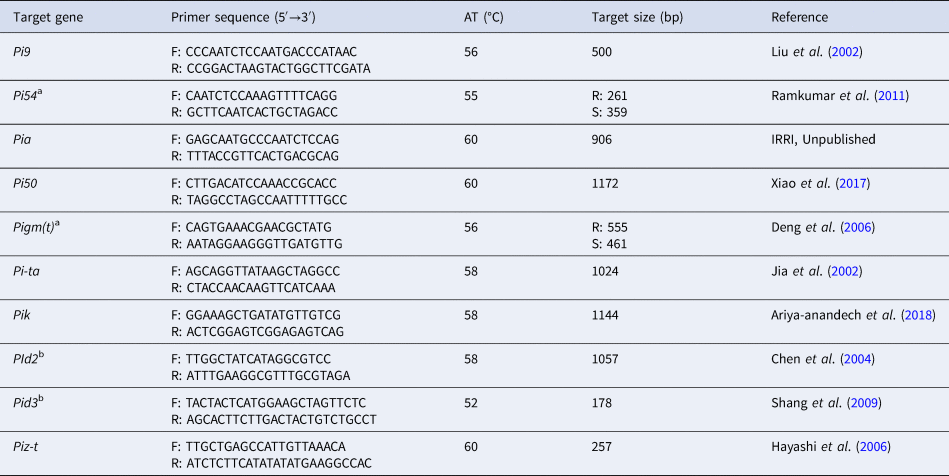
a Indel marker, resistant allele and susceptible allele were detected by different sizes.
b CAPs marker, PCR products were digested with a restriction enzyme to identify resistant or susceptible allele, the Pid2 gene was digested with MluI enzyme and the Pid3 gene was digested with BamHI enzyme.
R gene sequence confirmation
To confirm the sequences of rice blast resistance genes from gene-specific primers, three positive samples from each gene were randomly selected. PCR products were purified with a Qiaquick gel extraction kit (QAIGEN, Germany) and sequenced by a commercial sequencing service provider (U2Bio, Bangkok, Thailand) using gene-specific primers. The DNA sequences were confirmed by the alignment with the reference gene sequences obtained from the GenBank database.
Results
Distribution frequency of rice blast resistance genes in Thai, Japanese and International rice varieties
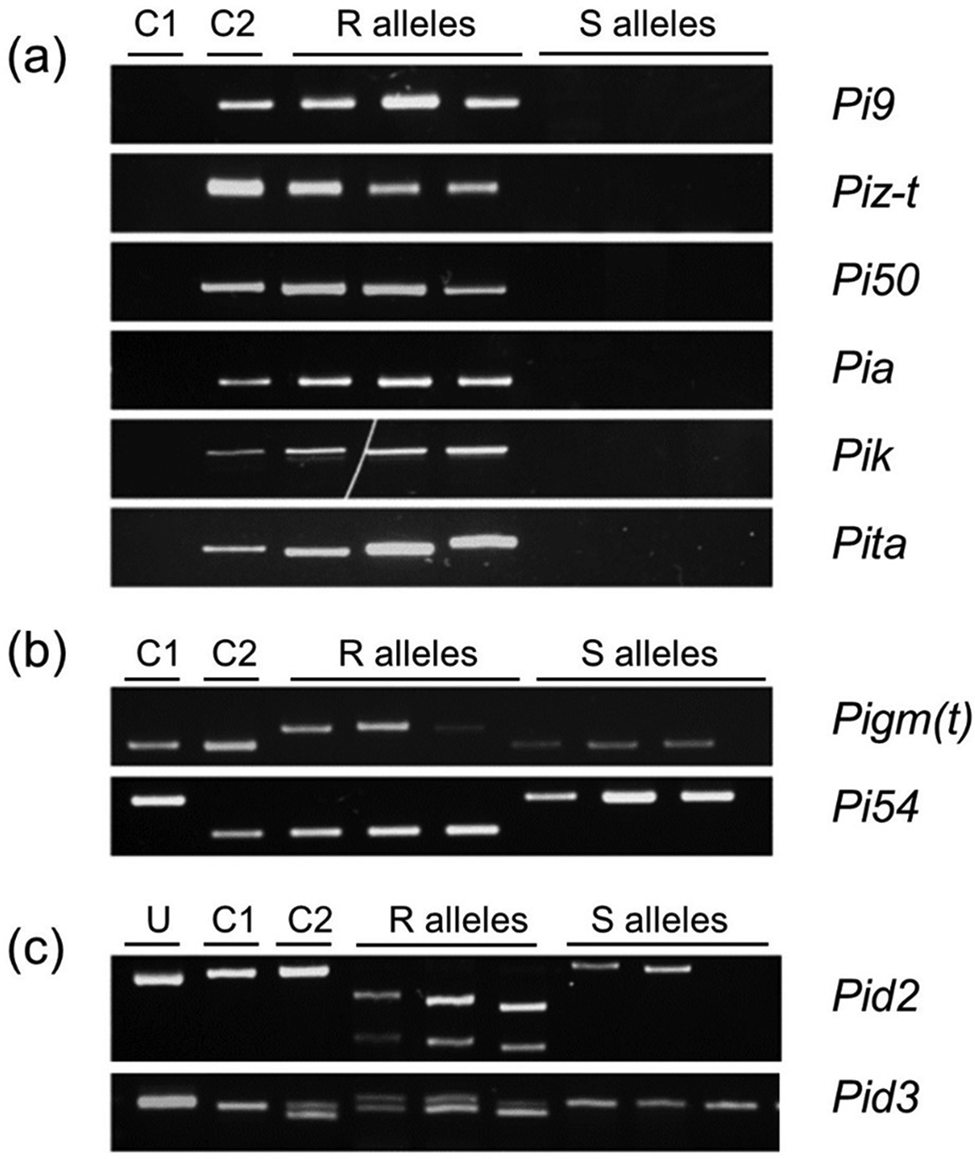
Thai, Japanese and International rice varieties were screened for ten major rice blast resistance genes: Pi9, Piz-t, Pi50, Pigm(t), Pid2, Pid3, Pia, Pik, Pi54 and Pita using gene-specific DNA markers. The DNA markers for the Pi9, Piz-t, Pi50, Pik, Pia and Pita genes are dominant allele-specific markers. A resistant allele showed a positive DNA band with expected size, while a susceptible allele showed an absent band (Fig. 1). The gene-specific marker for the Pi9 gene successfully detected the resistant allele in 199 Thai rice varieties (51.82%), 31 Japanese rice varieties (72.09%) and 16 International rice varieties (66.67%) (Table 2). A 257 bp DNA band from the Piz-t gene-specific marker was detected in 70 (18.23%), 2 (4.65%) and 2 (8.33%) rice varieties from Thailand, Japan and worldwide respectively (Table 2). The Pi50 gene was found in 99 Thai rice varieties (25.78%) and was not detected in Japanese and International rice varieties (Table 2). Forty-eight Thai rice varieties (12.50%), 33 Japanese rice varieties (76.74%) and 7 international rice varieties (29.17%) showed 1144 bp positive amplicon of the Pik gene-specific marker (Table 2). The presence of the blast resistance gene Pia was determined by the visualization of 906 bp amplicon in 133 (34.63%), 7 (16.28%) and 2 (8.33%) Thai, Japanese and International rice varieties respectively (Table 2). The Pita gene was detected by the 1024 bp amplicon in 127 (33.07%), 7 (16.28%) and 2 (8.33%) Thai, Japanese and International rice varieties (Table 2). The PCR products of three positive samples from each gene containing the rice blast resistance allele were sequenced. The sequences were deposited in GenBank and accession numbers of all sequences were shown in online Supplementary Table S2. Sequences were then compared with the reference blast resistance gene sequences from NCBI GenBank (DQ285630.1, CCD28558.1, AKS24975.1, KY225903.1, AB604626 and AF207842.1 for Pi9, Piz-t, Pi50, Pik, Pia and Pita respectively). The alignment results confirmed the presence of the rice blast resistance genes.
Gel electrophoresis detection of ten rice blast resistance genes using gene-specific primers, (a) the results of the dominant allele-specific marker (b) the results of the co-dominant allele-specific marker, InDel (c) the results of the co-dominant allele-specific marker, CAPs. Rice varieties used as a negative control (C1) include Nipponbare, KDML105 and Lijiangxintuanheigu (LTH). Rice varieties used as a positive control (C2) include IRBL9-w (Pi9), IRBLzt-T(Piz-t), IRBLz5-CA(Pi50), IRBLa-A(Pia), Jao Hom Nin (Pik, Pi54), IRBLta-K1(Pita), Nipponbare (Pigm(t), Pid2, Pid3). U indicates an uncut amplicon. Note no IRBL positive control (C2) for Pigm(t) and Pid2 genes.
Distribution of rice blast resistance genes in Thai rice germplasm, Japanese rice and International rice varieties

The Pigm(t) and Pi54 genes were screened by the gene-specific Indel markers, which gave two different amplicon sizes. The resistant allele of the Pigm(t) showed the 555 bp amplicon and the susceptible allele showed the 461 bp amplicon (Fig. 1). The resistant allele was observed in 205 Thai rice varieties (53.39%), 15 Japanese rice varieties (34.88%) and 8 International rice varieties (33.33%) (Table 2). Two Thai rice varieties contained Pigm(t) resistant allele, ‘Nhew dam’ and ‘Hom’, and one rice variety, ‘Nhew ubon1’ which contained a susceptible allele were sequenced and the sequences were deposited in GenBank, accession number OM236475 to OM236477 respectively (online Supplementary Table S2). The sequence alignment showed 100% sequence identity with the reference Pigm(t) sequence (GenBank KU904633.2). There is a 94 bp insertion or deletion difference between the resistant and susceptible allele of the Pigm(t) rice blast resistance gene. The resistant allele of the Pi54 gene showed a 261 bp amplicon and the susceptible allele showed a 359 bp amplicon (Fig. 1). Thirty-seven Thai rice varieties (9.64%), 14 Japanese rice varieties (32.56%) and 15 International rice varieties (62.50%) showed the resistant allele (Table 2). To confirm the resistant and susceptible allele of the Pi54 allele, one rice variety ‘Homdong’, that contained a resistant allele, and two rice varieties ‘Dorhom’ and ‘Khaw tud ngon’ that contained a susceptible allele were sequenced and deposited in GenBank, accession number OM236490 to OM236492 respectively (online Supplementary Table S2). These sequences were aligned with the Pi54 reference sequences (GenBank AP014967.1, AY914077.1) and the result confirmed that there is a 143 bp insertion or deletion region between resistant and susceptible allele.
The Pid2 and Pid3 genes were screened by the gene-specific CAPs markers. The 1057 bp PCR product of the Pid2 gene was digested with the MluI enzyme, the resistant allele showed two DNA bands with 657 and 400 bp fragments (Fig. 1). This resistant allele was detected in 190 Thai rice varieties (49.48%) but no Japanese rice and International rice varieties contained the Pid2 resistant allele (Table 2). The 1057 bp PCR product of the Pid2 gene-specific primer before the digestion with MluI enzyme from three Thai rice varieties ‘RD12’, ‘KDML105’ and ‘Khaw jao Prachinb’ were sequenced and the sequences were deposited in GenBank, accession number OM236478 to OM236480 respectively (online Supplementary Table S2). The sequence alignment with the Pid2 reference sequence (GenBank KP738455.1) confirmed the presence of the Pid2 gene. For the Pid3 gene, 178 bp PCR product of the Pid3 gene-specific primer was digested with the BamHI enzyme (Fig. 1). The resistant allele of the Pid3 gene showed two DNA bands with 153 and 35 bp fragments in 337 Thai rice varieties (87.76%), 2 Japanese rice varieties (4.65%) and 8 International rice varieties (33.33%), respectively (Table 2). The 178 bp PCR product before digestion with BamHI enzyme from three Thai rice varieties ‘Je san’, ‘KDML105’ and ‘Nhew dang’ were sequenced and the sequences were deposited in GenBank, accession number OM236481 to OM236483 respectively (online Supplementary Table S2). The sequence alignment with the Pid3 reference sequence (GenBank FJ773286.1) confirmed the presence of the Pid3 gene.
Geographical distribution of rice blast resistance genes in Thai landrace rice varieties
Rice blast resistance Pid3 gene is the most frequently found in Thai germplasm with 337 from 384 (87.76%) rice varieties (Table 3). The Pi9 gene was frequently found in northern, northeast landrace rice varieties and the improved rice varieties, 67 of 96 (67.79%), 58 of 87 (66.67%) and 16 of 21 (76.19%), respectively but only found 22 out of 92 (23.91%) in southern rice varieties (Table 3). The Piz-t and Pi50 genes were mostly found in northeast rice varieties. The Pigm(t) gene was equally found in about 50% of all regions but found only 6 out of 21 (28.57%) in improved rice varieties. The Pid2 gene was the most found in southern landrace rice varieties. The Pia gene showed the highest frequency in central landrace rice varieties (51.14%) and improved rice varieties (52.38%), while the Pik and Pi54 genes were rarely found in Thai landrace and improved rice varieties (12.50 and 9.64% respectively) (Table 3). The presence of different rice blast resistance genes was geographically distinctly distributed. The Pid3 and Pi9 genes were dominant in northern and northeast regions. While the Pid3, Pigm(t) and Pia genes were dominant in the central region, and the Pid2, Pid3 and Pigm(t) genes were dominant in the southern region. All improved rice varieties contain the Pid3 resistant allele, while none contain the Pi54 gene (Table 3).
The geographical distribution of the resistant alleles for the rice blast resistance genes in Thai landrace rice varieties

The majority of Thai landrace rice varieties carry several rice blast resistance genes
Almost all Thai landrace rice varieties in this study (382 from 384, 99.48%) contained at least one rice blast resistance gene (Fig. 2, online Supplementary Table S1). The highest number of eight rice blast resistance genes were found in two rice varieties ‘Hom’ (Pi9, Piz-t, Pi50, Pid2, Pid3, Pigm(t), Pia and Pik genes) and ‘Bak mouy’ (Pi9, Piz-t, Pi50, Pid2, Pid3, Pigm(t), Pia and Pita genes) (online Supplementary Table S1). Six rice varieties ‘Kaen-Jan’, ‘Leung-Aon’, ‘Hom phae pha lo’, ‘Phitsanulok 60-1’, ‘Se sa’ and ‘Sang Yod Phattalung’ have seven rice blast resistance genes (online Supplementary Table S1) and 117 (30.47%) Thai rice varieties have at least 5 rice blast resistance genes (Fig. 2).
Distribution of rice varieties bearing variable numbers of the rice blast resistance genes. Bar graphs show the different number of blast resistance genes of each group, ranging from 0 to 8 genes. Hight of the bar charts shows the percentage of rice samples and the number of samples shown in the bracket.

Rice blast resistance genes in Japanese and International rice varieties
All Japanese rice varieties carried at least one rice blast resistance gene, but none has more than 5 resistance genes. Four Japanese rice varieties namely, ‘Nankai-Mochi 50’, ‘Tosanishiki’, ‘Kantou-Mochi 201’ and ‘Etsunan 230’ carry the highest number of five rice blast resistance genes. Noted that these four Japanese rice varieties show three different combinations of the resistance genes (‘Nankai-Mochi 50’ and ‘Tosanishiki’ have the same combination of resistance genes) (online Supplementary Table S1). Of 24 International rice varieties included in this study, only one rice variety ‘PLA3’ from India has eight rice blast resistant genes and only one rice variety ‘Irri338’ from Korea has five rice blast resistance genes. The rest of screened International rice varieties contain only one or two resistance genes. Two rice varieties namely, ‘Nucleoryza’ from Austria and ‘L.K.V.R.’ from Hungary have no resistance gene. Our results indicate that rice germplasm from Thailand, Japan and worldwide have different rice blast resistance gene profiles and that Thai landrace rice varieties serve as good sources of the rice blast resistance genes for the breeding programme.
Discussion
We demonstrated that the gene-specific DNA markers can be successfully used to identify the resistant allele of the rice blast resistance gene. Our study showed that 382 of 384 Thai rice varieties (~99%) contained at least one rice blast resistance gene with two rice varieties carrying the highest number of eight rice blast resistance genes. While all 43 Japanese rice varieties found at least one rice blast resistance gene and 91.67% of the screened International rice varieties in this study contained the rice blast resistance genes. Only two of 384 Thai rice varieties showed no positive result for the rice blast resistance gene. The genetic frequency of 10 major rice blast resistance genes in Thai rice germplasm ranged from 9.64 to 87.76%. This result was consistent with a previous report by Teerasan et al. (Reference Teerasan, Srikaew, Phaitreejit, Kate-Ngam and Jantasuriyarat2019) that Thai landrace rice varieties and recommended rice varieties contain several rice blast resistance genes, Pid3, Pi54 and Pigm(t). Kim et al. (Reference Kim, Ahn, Kim and Shim2010) reported that the aromatic rice germplasm contains many major rice blast resistance genes, Piz, Piz-t, Pik, Pik-m, Pik-p and Pit. Imam et al. (Reference Imam, Alam, Mandal, Variar and Shukla2014) reported the genetic frequency of nine rice blast resistance genes, Pi-z, Piz-t, Pi-k, Pik-p, Pik-h, Pi-ta/Pi-ta2, Pi-ta, Pi-9 and Pi-b, ranged from 6 to 97% in the selected set of Indian rice germplasm. Singh et al. (Reference Singh, Singh, Arya, Singh and Singh2015) screened 10 rice blast resistance genes in 192 rice accessions using SSR markers and found that the genetic frequencies of Piz-5, Pi9, Pitp(t), Pi1, Pi5(t), Pi33, Pib, Pi27(t), Pik-h and Pita ranging from 19.79 to 54.69%, and 17 accessions harboured 7–8 blast resistance genes and Liang et al. (Reference Liang, Yan, Peng, Ji, Zeng, Wu and Yang2017) reported the frequency of 11 major rice blast resistance genes, Pi-d2, Pi-z, Piz-t, Pi-9, Pi-36, Pi-37, Pi5, Pi-b, Pik-p, Pik-h and Pi-ta2, ranged from 9.4 to 100.0% in 32 Chinese rice varieties. All the studies indicated that landrace rice varieties serve as a great source of rice blast resistance genes.
Four rice blast resistance genes, Pi9, Piz-t, Pi50 and Pigm(t) included in this study conferred broad-spectrum resistance to rice blast fungus. The Pi9 rice blast resistance gene originated from wild rice species, Oryza minuta and it was introgressed to an Indica rice cultivar 75-1-127. It was resistant to 43 fungal isolates from 13 different countries (Liu et al., Reference Liu, Lu, Zen and Wang2002). About half of the screened Thai rice varieties showed the positive DNA band for the Pi9 resistant allele. This result is consistent with the findings of Phaitreejit et al. (Reference Phaitreejit, Srikaew, Jantasuriyarat, Sreewongchai and Katengam2011). The Pigm(t) rice blast resistance gene was found in the Chinese rice cultivar Gumei4 (GM4) (Deng et al., Reference Deng, Zhu, Shen and He2006). Fifty-three per cent of Thai rice varieties in this study contained the resistant allele of the Pigm(t) gene. On the other hand, less than twenty per cent of Thai rice varieties in this study contained the Piz-t gene.
The Pid2 rice blast resistance gene is a major resistance gene located on rice chromosome 6. It was reported in Chinese rice varieties ‘Digu’ (Chen et al., Reference Chen, Li, Xu, Zha, Ling, Ma, Wang, Wang, Cao, Ma, Shang, Zhao, Zhou and Zhu2004). In this study, approximately 50% of Thai rice varieties contained the Pid2 gene. Ali et al. (Reference Ali, Hyun, Choi, Lee, Oh, Park and Lee2016) screened the rice blast resistance gene in 2509 accessions of rice germplasm from different geographic regions of Asia and Europe. They found that the Pid2 gene was presented in 462 accessions from all regions except North Asia. In contrast, the Pid3 rice blast resistance gene was first reported in the rice variety ‘Gumei 2’. It was located on rice chromosome 6 (Shang et al., Reference Shang, Tao, Chen, Zou, Lei, Wang, Li, Zhao, Zhang, Lu, Xu, Cheng, Wan and Zhu2009). Promchuay and Nilthong (Reference Promchuay and Nilthong2017) reported that 44 of 86 accessions from upland rice in the north of Thailand contained the Pid3 gene.
The Pik, Pi54 and Pia rice blast resistance genes were found at low frequency in Thai landraces rice varieties, which is consistent with the report by Ariya-anandech et al. (Reference Ariya-anandech, Chaipanya, Teerasan, Kate-Ngam and Jantasuriyarat2018). ‘Jao Hom Nin’ (JHN) rice variety, one of the rice blast resistance gene donors for the rice breeding programme in Thailand, harboured the Pik gene (Chaipanya et al., Reference Chaipanya, Telebanco-Yanoria, Quime, Longya, Korinsak, Korinsak, Toojinda, Vanavichit, Jantasuriyarat and Zhou2017). The Pik gene is shown to be an effective blast resistance gene for the rice blast population in Thailand (Chaipanya et al., Reference Chaipanya, Telebanco-Yanoria, Quime, Longya, Korinsak, Korinsak, Toojinda, Vanavichit, Jantasuriyarat and Zhou2017; Longya et al., Reference Longya, Chaipanya, Franceschetti, Maidment, Banfield and Jantasuriyarat2019). It was used as a donor to produce resistant rice varieties including ‘Ban Tang’ and ‘San Par Tong1’ (Wongsaprom et al., Reference Wongsaprom, Sirithunya, Vanavichit, Pantuwan, Jongdee, Sidhiwong, Lanceras-Siangliw and Toojinda2010; Nalampangnoenplab, Reference Nalampangnoenplab2011). The Pi54 gene was highly resistant to the rice blast fungus isolates from north-western Himalayan (Sharma et al., Reference Sharma, Rai, Gupta, Vijayan, Devanna and Ray2012) and the rice blast isolates from India (Ramkumar et al., Reference Ramkumar, Srinivasarao, Madhan, Sudarshan, Sivaranjani, Gopalakrishna, Neeraja, Balachandran, Sundaram, Prasad, Shobh, Rama, Viraktamath and Madhav2011). Since these Pik, Pi54 and Pia genes were present at a low frequency in Thai landrace rice varieties and the improved rice varieties, they can be introgressed into Thai rice varieties to enhance the rice blast disease resistance.
The Pita and Pita2 rice blast resistance genes were allelic and mapped near the centromere of chromosome 12 (Bryan et al., Reference Bryan, Wu, Farrall, Jia, Hershey, McAdams, Faulk, Donaldson, Tarchini and Valent2000; Koide et al., Reference Koide, Kobayashi, Xu and Fukuta2009). These genes were commonly used in rice breeding programmes worldwide. The Pita gene was found in many indica rice varieties. For example, the landrace cultivar ‘Tadukan’ in the Philippines and ‘Tetep’ in Vietnam, as well as in japonica rice in Japan and US (Bryan et al., Reference Bryan, Wu, Farrall, Jia, Hershey, McAdams, Faulk, Donaldson, Tarchini and Valent2000; Jia et al., Reference Jia, Wang and Singh2002).
In summary, ten gene-specific DNA markers were used to screen for the rice blast resistance genes in Thai landrace rice varieties, Japanese rice varieties and the International rice varieties. The results indicated that Thai landrace rice varieties were a great source of the rice blast resistance gene pool, which can be used in the rice blast-resistant breeding programme in the future.
Supplementary material
The supplementary material for this article can be found at https://doi.org/10.1017/S1479262122000089.
Acknowledgements
We are thankful to Rice Department, Thailand for providing Thai rice seeds and Yamaguchi University for Japanese rice and International rice sets. This research was supported by the graduate scholarship provided by the Center of Excellence on Agricultural Biotechnology, Science and Technology Postgraduate Education and Research Development Office (PERDO), Commission on Higher Education, Ministry of Education, the National Research Council of Thailand (NRCT) in the 2019 and 2020 fiscal year, the 2017 Kasetsart University-Yamaguchi University Short Visit Program (2017 KU-YU SSSV) and Ubon Ratchathani University.



