

Introduction
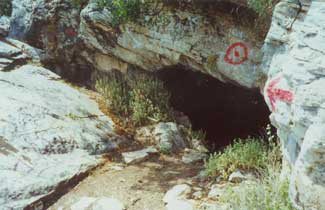
The excavations in Leontari Cave (Lion's Cave) (Figure 1) began in 2003 as a joint project of the University of Athens and the Greek Ministry of Culture (Karali & Mavridis in press; Karali, Mavridis & Kormazopoulou in press).
The entrance of Leontari Cave, Mt Hymmetos, Athens (Photo by F.Mavridis).

Leontari Cave is situated in a very rocky area of Hymettos Mountain (Municipality of Glyka Nera), 691m above sea level, in the wider region of the fertile plain of Mesogaia, where recent rescue excavations brought to light important finds of various Neolithic phases (Reference KakavogianniKakavogianni 2002).Many other cave and open air sites of various periods are located in the vicinity of Leontari cave forming a complicated, mountainous cultural landscape.
The location of the cave is significant, with a panoramic view over Attica, both the mainland and the coast, and in good weather conditions South Euboea is visible (Figure 2).
A view from Leontari Cave early in the morning. Moisture covers the city of Athens and suburbs (Photo by F.Mavridis).

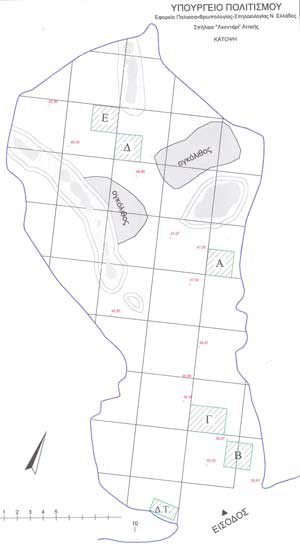
Leontari Cave consists of two areas (Figure 3), with the main one taking direct light from the entrance and a second one which is formed by a sudden drop of 1-1.5m in the floor level, forming the deepest section of the cave. It has a length of c. 50m, maximum width c. 20m, maximum height c. 20m, and maximum depth c. 6m.
Cultural landscapes of the Aegean Late and Final Neolithic
During the Late Neolithic Ib - II (Final Neolithic or Chalcolithic, from about the second half of the fifth millennium BC onwards), there is evidence of more intensive exploitation of caves and general colonisation of marginal environments (Reference DiamantDiamant 1974; Reference HamilakisHamilakis 2003; Mavridis in press). Several explanations have been offered for the increased importance of upland locations and marginal environments during this period, mainly using economic criteria, usually related to the exploitation of the secondary products of animals, and transhumance patterns of seasonal movements in the landscape. However, the Late and especially the Final Neolithic of the Aegean represent periods during which major changes are seen in several aspects of material culture, ideology and symbolism. The transition to the Final Neolithic in the Aegean features in the replacement of fine painted decorated wares by others, commonly referred to as coarse wares. However, pottery does not lose its importance, but its meaning is transformed in all stages of production, circulation, and consumption (Mavridis in press). During the Late Neolithic Ib, IIa phases, social power and reproduction are not strictly connected to the bounded space of the Neolithic village, but to the remote and marginal as well (Reference HamilakisHamilakis 2003). However, it needs to be clarified what 'remote and marginal' was for ancient societies. In this period, caves and upland locations seem to be part of a community's broader social space that followed a more complicated system of landscape exploitation.
Plan of Leontari Cave with the trenches excavated so far (Drawn by Th. Hatzitheodorou).

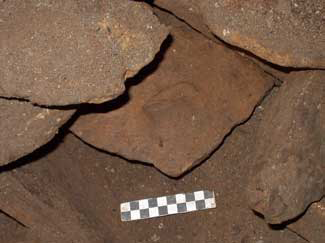
Pottery sherd of a large pithoid upon a stone floor (Photo by F.Mavridis).

Excavations at Leontari Cave
The main aim of the excavation is to explore:1) the early prehistory of Athens, where due to continuous habitation and building activity prehistoric finds are scarce and often do not originate from secure stratified layers; and 2) the role of the specific cave in the settlement patterns of the Late and Final Neolithic. Pottery finds show that the cave was used during the Late Neolithic Ia-Ib and IIa phases, ranging from about the first half of the fifth millennium BC to the beginning of the fourth millennium BC. A detailed examination of all environmental remains, such as seeds, carbonised wood, phytoliths, along with the study of the cave's geomorphology and micro-stratigraphy will shed more light on many aspects of Neolithic cave occupation, such as spatial patterns, economic activities, seasonal character etc. Changes in spatial patterns, as well as in the role and meaning of material culture, relate to the intensive exploitation of caves. The ongoing excavations in Leontari Cave indicate that such shifts did not connect only to new economic practices but to changes in all aspects of society. In the case of Leontari Cave, a strong symbolic component is evident, the exact meaning of which will be better clarified by a detailed examination of the archaeological material and an additional future field research. A significant amount of stone and clay idols, fine chipped stone and ground stone tools, pottery, and other artefacts such as clay horn handles and horn cores found associated with undisturbed stone floors, trapped inside mud deposits created by stagnant waters, offer a unique opportunity to explore ideological and symbolic patterns related to specific contexts and social environments. The presence of undisturbed layers of occupation that were recovered during the excavation of Leontari Cave will help the identification of changing patterns in the use of space and the role of caves in relation to this important transitional stage between the Late and the Final Neolithic of the Aegean sequence.
Acknowledgements
We are grateful to the University of Athens and the Institute for Aegean Prehistory that made this research possible. We are also grateful to the Director of the Ephorate of Palaeoanthropology-Speleology of the Greek Ministry of Culture, Dr. S. Samartzidou for her keen interest and continuous support.