

Introduction
Antimicrobial resistance (AMR) poses significant public health challenges, including longer hospital stays, higher mortality rates, and substantial economic burdens, all leading to intangible costs. In 2007, AMR increased hospitalizations by 2.5 million and caused 25,000 annual deaths in European hospitals, costing about 1.5 billion Euros. 1,Reference Fair and Tor2 By 2015, the situation had worsened considerably, with an estimated 671,689 infections caused by antibiotic-resistant bacteria and approximately 33,110 attributable deaths in the EU/EEA, Reference Cassini, Högberg, Plachouras, Quattrocchi, Hoxha and Simonsen3 reaching an estimated €1.1 billion annually. 4 In the United States, AMR accounted for 23,000 deaths annually, with direct costs exceeding 20 billion USD and indirect costs over 30 billion USD per year. 5
Vietnam faces a high rate of drug-resistant bacteria, with hospitals in the south reporting multidrug resistance rates of 74.6% for E. coli, nearly 60% for K. pneumoniae, and 90% for A. baumannii. 6,7 Resistance to carbapenem, a “Watch” antibiotic class in the WHO Aware list, has reached 50%, especially in gram-negative bacteria carrying beta-lactamase genes. 7 From 2009 to 2018, antibiotic sales doubled, with 88% of urban and 91% of rural antibiotics sold without prescriptions. 8,Reference Nga, Chuc, Hoa, Hoa, Nguyen and Loan9
Recognizing the global threat of AMR, the World Health Assembly adopted an action plan in 2015 emphasizing public education and training on AMR. 10 Since 2013, Vietnam’s Ministry of Health has also implemented a NAP addressing public health policies, education, professional training, research, and collaboration. 11,12 Inappropriate antibiotic use remains the main driver of AMR, influenced by educational level, profession, and age. Reference Effah, Amoah, Liu, Agboyibor, Miao and Wang13–Reference Muflih, Al-Azzam, Karasneh, Conway and Aldeyab16 This study assessed public awareness and knowledge of antibiotic use and AMR in Vietnam, examining demographic factors to identify knowledge gaps and inform targeted campaigns and policies tackling this issue.
Methods
Study design and participants
An online anonymous cross-sectional survey was conducted from December 3, 2021, to December 15, 2021, via Google Forms to assess public knowledge of antibiotic use and AMR in Vietnam. Participants were recruited via social media platforms such as Facebook, Zalo, Viber, and WhatsApp, through university networks, healthcare groups, and personal connections, targeting all individuals aged 18+ who consented to participate. Respondents were grouped by profession into health and nonhealth workers.
Questionnaire construction
The questionnaire (Appendices, Table A1), adapted from World Health Organization (WHO), was initially tested on a small group of volunteers for feedback and validation before being widely distributed. It assessed knowledge of antibiotics, AMR, deliberate behaviors, and opinions on AMR awareness campaigns and programs.
Data analysis
Responses were coded and analyzed using SPSS 21 and Microsoft Excel 16.5. Demographics were analyzed with descriptive statistics, presented as frequencies and percentages. Females and ages 18–30 were reference categories for gender and age, while health workers were reference categories for education and profession.
The association between knowledge levels about antibiotics and AMR and demographic factors—including gender, age, educational background, profession, hospitalization history, antibiotic use history, and attitudes toward antibiotics—was analyzed using the χ 2 test in STATA16. The strength of these associations was evaluated using Cramer’s V.
Results
General characteristics of respondents
A total of 866 respondents participated, with 298 (65.6%) males and 568 (34.4%) females (Table 1). They were distributed within five age groups 18–30 years (507), 31–40 years (173), 41–50 (128), and above 50 (58). In addition, 372 (43.0%) respondents had a health educational background (Veterinary Medicine—Medicine—Pharmacy); while 53.5% of total adults worked in the health sector.
General statistics of respondents

Antibiotic consumption habits and knowledge of antibiotics
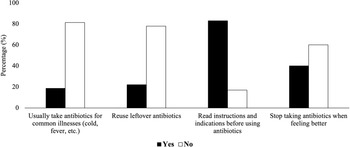
Habits of antimicrobial use were assessed with four statements (Figure 1; Appendices, Table A2). While over 80% of respondents reported reading instructions and avoiding antibiotics for colds or fevers, 22.1% reused leftover antibiotics, and 40% stopped taking them when feeling better. This indicates that understanding proper antibiotic use does not always translate to good consumption habits.
Antibiotic consumption habits reported by participants.

When quizzed on antibiotics, most respondents demonstrated a general understanding of their purpose, effects, common types, and correct usage. Over 80% answered all ten knowledge questions correctly (Figure 2; Appendices, Table A3–4). Of these, 66.4% had high knowledge (≥80% correct), and 25.98% showed moderate knowledge (≥50% correct). However, only 32.9% were aware that 75% of antibiotics are used in agriculture (Appendices, Table A3).
Knowledge of antibiotics and AMR in participants. Knowledge scores of participants were calculated and classified as high, moderate, and low based on the number of accurate responses to statements in the survey.

Knowledge and attitudes about AMR
The analysis of participants’ knowledge and attitudes toward AMR is summarized in Figure 2, Table 2, and Appendices, Table A3–4. While 95.8% reported familiarity with AMR, most exhibited moderate (52.08%) to high (41.22%) knowledge levels. However, 54.3% incorrectly believed “AMR bacteria require a higher dose of antibiotics to treat” (Appendices, Table A3). Regarding attitudes, 17.0% were neutral, and 9.1% agreed with “AMR can be solved soon” (Table 2). Although 84.9% viewed AMR as a public health concern, 27.8% believed it affects only frequent antibiotic users, and a 37.0% held the view that they would not be personally affected if they used antibiotics appropriately.
Attitude about the AMR problem—perspective on the scope of the AMR problem

Demographic factors associated with knowledge of antibiotics and AMR
Antibiotic knowledge levels varied significantly by gender, age, education, profession, and antibiotic use history but not by hospitalization history (Appendices, Table A5). Male participants showed greater disparities, with higher percentages in both “high” and “low” knowledge levels. Participants aged 31+ had significantly more knowledge than younger groups, while those with health-related backgrounds or prior antibiotic use demonstrated notably higher knowledge (Cramer’s V > 0.25).
AMR knowledge was significantly influenced by age, education, profession, and antibiotic use history (Appendices, Table A6). The proportion of “high-level” AMR knowledge decreased with age, from the highest in the 18–30 group to the lowest in those aged 50+. Participants with health-related backgrounds or prior antibiotic use had better AMR knowledge than others. The history of antibiotic use also affects the level of AMR knowledge in which people who used to use antibiotics have a higher level of AMR understanding than those who have never used it.
Opinions about antibiotics and AMR awareness promotion
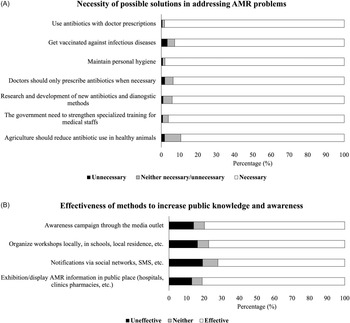
The majority of respondents agree about the necessity of the suggested AMR fighting measures (Figure 3; Appendices, Table A9–10). The least agreed-upon solutions were in reducing antibiotic use in agriculture (89.38%) and keeping vaccination up-to-date (92.73%). However, 3.23% and 1.73% of respondents thought that vaccination and reducing antibiotic use in agriculture are not necessary measures in addressing the AMR problem. Generally, there is no significant difference in opinions between demographic factors (age, gender, education, and professions) (data not shown).
Public opinions on (A) potential solutions to the AMR problems and (B) the effectiveness of different outreach methods in improving public knowledge about antibiotics and AMR.

Among four outreach options, displaying information in public spaces (hospitals, pharmacies, and so on) was deemed effective by 81.18% of respondents, while only 72.17% thought messages through social media and SMS as effective.
Discussion
The general state of antibiotics practice in Vietnam
The emergence of AMR has been a major challenge to public health, and it is linked to the overuse and overprescription of antibiotics in medicine and agriculture. To overcome the AMR problem, cultural contexts such as the prescription and use of antibiotics are of particular interest. The result of the survey demonstrated that approximately 80.0% of respondents had taken antibiotics, 29.0% were within the last 6 months, many of which were without consulting with a doctor. This high prevalence of antibiotic use is of importance, showing, first, the extensive usage of antibiotics and, second, the extensive consequence of AMR, affecting a large proportion of the population.
Previous research suggests that the overprescription and dispensing of antibiotics in Low- and Middle-Income Countries (LMICs) often arise from a lack of comprehension regarding AMR and appropriate antibiotic use among prescribers and dispensers. Reference Radyowijati and Haak17 Nevertheless, despite widespread awareness and knowledge of AMR, there is still a tendency to misuse antibiotics for treating conditions such as colds, fevers, and skin infections. Reference Pearson and Chandler18 Furthermore, it is now very easy for people to purchase antibiotics due to the high density of retail pharmacies in Vietnam, with an average of 102 outlets per 100,000 population. This is significantly higher than the global average of 25 outlets per 100,000 population. Reference Beardsley, Chambers, Lam, Zawahir, Le and Nguyen19 This behavior might be influenced by systemic and sociocultural factors. The healthcare system often faces overcrowding and complex procedures, prompting many individuals to bypass clinical visits in favor of faster access through pharmacies. Moreover, cultural perceptions play a role: professional medical care is often sought only for severe conditions, while minor illnesses are typically managed with over-the-counter medications based on prior experience or informal advice from family members. In Vietnam, pharmacy personnel exhibit a diverse understanding of antibiotics and AMR, however, they frequently resort to prescribing antibiotics to patients in pursuit of rapid treatment outcomes. Previous studies highlight a notable disparity between pharmacists’ theoretical knowledge and its practical application. Reference Hoa, Lan, Phuc, Chuc and Lundborg20,Reference McKinn, Trinh, Drabarek, Trieu, Nguyen and Cao21 Moreover, certain Vietnamese communities, particularly those in rural areas, lack sufficient knowledge about antibiotics and awareness of AMR.
Considering the current regulations and practices where antibiotics are widely available in pharmacies and can be obtained without a doctor’s prescription, the above-average high prevalence of antibiotics usage, the apparent misuse of antibiotics, and the lack of awareness among the population are all alarming.
Public awareness of antibiotics and AMR: national and global perspectives
In this study, public knowledge about antibiotics and AMR was found to correlate with the education/professions of the respondents, gender, age, and history of antibiotic use. Understandably, knowledge tends to increase with age and the frequency of antibiotic use, or it is associated well with education level. In a regional context, Ha et al. found that in the northern highlands of Vietnam, only 55.8% of respondents were aware of AMR. Reference Van, Nguyen and Nguyen22 This difference may come from the slight bias of the studied population. In our study, the survey was shared online via the network of our research team who are based in universities, medical centers, and hospitals and mostly in the south of Vietnam. Thus, it can influence the study population and increase awareness of antibiotics compared to the general population.
Education and income levels were again shown to be strong predictors of AMR knowledge. Nguyen et al. found that 86.8% of 1,626 participants purchased antibiotics without a prescription, demonstrated a reduced understanding of how to use them, and lacked awareness of what AMR entails. Reference Nguyen, Do, Nguyen, Nguyen, Meyer and Godman23 Many of those were of a lower educational level, mostly male, and many were freelance workers. Similarly, Di KN et al. reported that respondents with an educational level above high school had 2.663 times higher knowledge scores than those with lower educational levels. Reference Di, Tay, Ponnampalavanar, Pham and Wong24 Higher-income individuals also showed more knowledge about antibiotics and AMR than lower-income individuals. Reference Di, Tay, Ponnampalavanar, Pham and Wong24
At the global level, these findings are consistent with patterns observed elsewhere. Muflih et al. found that, in Jordan, people living in urban areas had better knowledge of antibiotics than in rural areas, Reference Muflih, Al-Azzam, Karasneh, Conway and Aldeyab16 while another study found respondents in affluent areas had a better understanding of AMR than those in deprived areas of London. Reference Abdel-Qader, Albassam, Ismael, El-Shara, Shehri and Almutairi25
However, as in our study, a common concern across countries is the persistent gap between knowledge and behavior. While 89.0% knew they should follow through with their antibiotic prescription, 40.0% stopped taking antibiotics when they felt better. This gap between awareness and practice was noted in other studies, specifically among the students of the School of Medicine in Italy, more than 15.0% of the students stopped taking antibiotics when symptoms improved and used leftover antibiotics without consulting a doctor. Reference Scaioli, Gualano, Gili, Masucci, Bert and Siliquini15
In addition, misconceptions remain widespread, especially regarding the role of agriculture in AMR. In our study, 15% did not believe antibiotic regulation in agriculture is necessary, and over 35% believed AMR only affects those who frequently use antibiotics and 37.0% thought that they would not be personally affected if they used antibiotics appropriately. As Widayati, A. et al. reported, the public held inaccurate beliefs about the appropriate usage of antibiotics, these misconceptions might also contribute to the inappropriate use of antibiotics. Reference Widayati, Suryawati, de Crespigny and Hiller26
Public health interventions and solutions
Vietnam has been reported to have one of the highest rates of AMR in Asia. Reference Torumkuney, Kundu, Van, Nguyen and Pham27 The primary cause might stem from the overconsumption of antibiotics not only in medicine but also in agriculture contributing to the escalating issue of antimicrobial-resistant bacteria in food. Reference Carrique-Mas, Choisy, Van Cuong, Thwaites and Baker28,Reference Schar, Zhao, Wang, Larsson, Gilbert and Van Boeckel29
Vietnam has made significant policy and institutional progress in addressing AMR over the past two decades. Following the 2010 Hanoi Declaration, Vietnam officially adopted the One Health approach to optimize the health of people, animals, and the environment, especially focusing on the control of zoonotic diseases and AMR. Reference Nguyen-Viet, Lam, Nguyen-Mai, Trang, Phuong and Tuan30,31 The approach seeks to educate and provide training to young community members through funded fellowships and training opportunities. Mitchell et al. provide evidence for the benefits of a multisectoral approach, including the benefit that this approach increases communication between parties and helps to standardize the solutions and methods for all parties involved. Reference Mitchell32 Our study reinforces this perspective, underscoring that education is among the most critical components for combating AMR and should remain central to future policy development.
This commitment materialized further in 2013 when Vietnam became one of the first countries in WHO’s Western Pacific region to implement a National Action Plan (NAP) on AMR, targeting the human health, livestock, and aquaculture sectors. 11,12,Reference Nguyen-Viet, Lam, Nguyen-Mai, Trang, Phuong and Tuan30 Since then, several concrete advancements have been implemented. In the period 2016–2020, the MoH, in collaboration with the Ministry of Agriculture and Rural Development and Ministry of Natural Resources and Environment, established a national AMR surveillance system (Decision 6211/QD-BYT) and issued several regulatory circulars to guide antibiotic use across hospitals, veterinary medicine, livestock feed, and veterinary prescription. Reference Nguyen-Viet, Lam, Nguyen-Mai, Trang, Phuong and Tuan30 Academic and research institutions have also played a significant role in supporting the research and management of emerging infectious diseases and antimicrobial-resistant bacteria.
Nonetheless, despite these institutional structures and regulatory advancements, critical challenges remain. The knowledge-practice gap observed in our study, such as widespread self-medication and early discontinuation of antibiotics, highlights the need for a renewed and strengthened national strategy. Future action plans should prioritize sustained enforcement, public education, and local-level engagement to ensure a broader and more equitable impact.
Strategic action plan to enhance an understanding of antibiotics and AMR in the general public
AMR has risen across medicine and agriculture, partly due to the widespread use of antibiotics in livestock production. Food and food-related products can also serve as vectors for antimicrobial-resistant bacteria, contributing to the spread of AMR. Urgent action is needed to boost awareness and responsible antibiotic use. This study proposes strategies for surveillance, education, and communication at national and international levels to combat AMR.
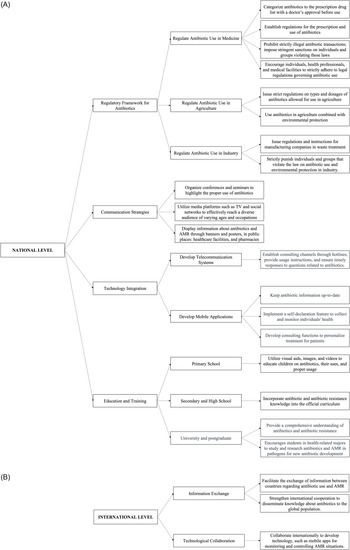
Nationally, legislation regulating antibiotic use in healthcare, agriculture, and industry is critical. Collaboration between the MoH, Ministry of Agriculture, and Ministry of Environment is essential to establish rules on antibiotic acquisition, usage, and disposal, with regular inspections ensuring compliance. Effective communication strategies targeting all citizens, especially in remote areas, should leverage mass media and smart technologies, supported by government funding. Tailored educational curricula are vital to fostering responsible antibiotic use (Figure 4).
Globally, combating AMR requires international cooperation in information sharing and support. Organizations like WHO and FAO play crucial roles in connecting nations and aiding underdeveloped regions (Figure 4).
Strengths and limitations
This study’s strength lies in its large respondent pool, enabling a robust and up-to-date evaluation of public knowledge on antibiotic use and AMR. The findings reveal critical gaps between awareness and behavior, offering valuable insights for developing national strategies to enhance public knowledge and reduce AMR-related healthcare burdens. However, the study has limitations. (1) The online convenience sampling may have introduced nonresponse bias, with younger, female, and health-sector-employed individuals being overrepresented, potentially skewing results. (2) Reliance on multiple-choice questions may have encouraged socially desirable responses, obscuring underlying misconceptions. Incorporating qualitative methods could provide deeper insights into these misconceptions and respondent perspectives. (3) The survey was conducted briefly during the period of the COVID-19 pandemic, which potentially influenced the results due to increased public awareness of infectious diseases, including AMR. Therefore, similar studies should be conducted under different time frames and social contexts to assess the robustness and generalizability of the findings.
Conclusion
This study explored public awareness and attitudes toward antibiotics and AMR in Vietnam. While most respondents were aware of antibiotics and AMR, this knowledge often failed to translate into proper antibiotic use. Awareness levels varied by age and health-sector education, emphasizing the need for targeted educational interventions to correct misconceptions and promote responsible behaviors.
Strategic action plans at (A) national and (B) international levels to to improve public knowledge, attitudes, and awareness regarding antibiotic use and AMR.

Supplementary material
The supplementary material for this article can be found at https://doi.org/10.1017/ash.2025.10034.
Acknowledgements
We sincerely thank all survey participants for their contributions by completing and sharing the survey. We also acknowledge the partial support from the USAID PHER Project for the author’s participation and presentation of this study at the VIAN Summer Workshop 2023, and from the SSEAC Project for the author’s participation in the “Developing a Roadmap for Better One Health AMR Research in Southeast Asia Workshop 2023.”
Author contributions
The author(s) read and approved the final manuscript.
Financial support
This study has not received any particular funding.
Competing interests
The authors have no conflict of interest to declare.
Declaration of generative AI in scientific writing
The author(s) used Chat GPT 4.0 (OpenAI, 2024) during preparation for this work to correct grammar errors, and improve writing quality. After using this tool, the author(s) reviewed and edited the content as needed and take(s) full responsibility for the content of the publication.





 Open access

