





Introduction
Less than two-thirds of individuals experiencing a first-episode psychosis (FEP) show significant improvements in terms of quality of life or mental well-being over the long-term, even after symptom onset (Harrow, Jobe, & Tong, Reference Harrow, Jobe and Tong2022; Lally et al., Reference Lally, Ajnakina, Stubbs, Cullinane, Murphy, Gaughran and Murray2017; Peralta et al., Reference Peralta, García De Jalón, Moreno-Izco, Peralta, Janda, Sánchez-Torres and Cuesta2022). It is therefore important to identify potentially modifiable factors that are amenable to interventions and could therefore contribute to improving clinical, cognitive, and functional outcomes (Fusar-Poli, McGorry, & Kane, Reference Fusar-Poli, McGorry and Kane2017; Penadés et al., Reference Penadés, Forte, Mezquida, Andrés, Catalán and Segura2024; Vieta et al., Reference Vieta, Salagre, Grande, Carvalho, Fernandes, Berk and Suppes2018). An umbrella meta-analysis identified high educational attainment as a consistent predictor of remission, while maintaining social relationships, engaging in intellectually stimulating work, and attaining higher levels of education as favorable prognostic indicators (Solmi et al., Reference Solmi, Cortese, Vita, De Prisco, Radua, Dragioti and Correll2023). These factors are intrinsically linked to the concept of cognitive reserve (CR), which reflects the brain’s ability to cope with pathology to minimize symptoms and their impact (Bora, Reference Bora2015; Stern et al., Reference Stern, Arenaza-Urquijo, Bartrés-Faz, Belleville, Cantilon, Chetelat and Van Loenhoud2020). CR has been identified as a protective factor in FEP, influencing cognitive, clinical, and functional outcomes (Amoretti et al., Reference Amoretti, Bernardo, Bonnin, Bioque, Cabrera, Mezquida and Torrent2016, Reference Amoretti, Cabrera, Torrent, Mezquida, Lobo, González-Pinto and Balanzá-Martínez2018; Ayesa-Arriola et al., Reference Ayesa-Arriola, De La Foz, Murillo-García, Vázquez-Bourgon, Juncal-Ruiz, Gómez-Revuelta and Crespo-Facorro2023; Camprodon-Boadas et al., Reference Camprodon-Boadas, de la Serna, Baeza, Puig, Ilzarbe, Sugranyes and Castro-Fornieles2021; de la Serna et al., Reference de la Serna, Andrés-Perpiñá, Puig, Baeza, Bombin, Bartrés-Faz and Castro-Fornieles2013; Leeson et al., Reference Leeson, Sharma, Harrison, Ron, Barnes and Joyce2011). As far as we know, CR is shaped by a complex interplay of genetic and socioenvironmental factors (Amoretti & Ramos-Quiroga, Reference Amoretti and Ramos-Quiroga2021; Barnett, Salmond, Jones, & Sahakian, Reference Barnett, Salmond, Jones and Sahakian2006; Stern et al., Reference Stern, Arenaza-Urquijo, Bartrés-Faz, Belleville, Cantilon, Chetelat and Van Loenhoud2020).
Recent advances in polygenic risk scores (PRS) have accelerated efforts to disentangle the genetic architecture of complex multi-component traits like CR. PRS aggregate an individual’s genetic predisposition for specific traits or disorders, offering a powerful tool to study complex phenotypes (Lappalainen, Li, Ramachandran, & Gusev, Reference Lappalainen, Li, Ramachandran and Gusev2024). PRS for cognitive phenotypes, such as intelligence (PRSIQ) (Savage et al., Reference Savage, Jansen, Stringer, Watanabe, Bryois, De Leeuw and Posthuma2018) and cognitive performance (PRSCP) (Lee et al., Reference Lee, Wedow, Okbay, Kong, Maghzian, Zacher and Turley2018), represent intuitive investigative targets due to their well-established correlation with CR (Leeson et al., Reference Leeson, Sharma, Harrison, Ron, Barnes and Joyce2011; Molina-García et al., Reference Molina-García, Fraguas, Del Rey-Mejías, Mezquida, Sánchez-Torres, Amoretti and Parellada2021). However, CR extends beyond cognitive metrics, encompassing adaptive processes shaped by socioenvironmental engagement (Amoretti & Ramos-Quiroga, Reference Amoretti and Ramos-Quiroga2021). This broader conceptualization has driven interest in PRS for educational attainment (PRSEA) (Lee et al., Reference Lee, Wedow, Okbay, Kong, Maghzian, Zacher and Turley2018) and occupational attainment (PRSOA) (Ko et al., Reference Ko, Kim, Kim, Jung, Shim, Cha and Won2022), which capture genetic predispositions influencing not only intellectual growth but also access to cognitively stimulating environments. Among these, PRSEA is one of the most extensively studied proxy markers for CR in psychosis (Clougher et al., Reference Clougher, Segura, Forte, Mezquida, Cuesta, Vieta and Mas2024; Forte et al., Reference Forte, Clougher, Segura, Mezquida, Sánchez-Torres, Vieta and Balanzá-Martínez2024). Research has shown that both CR and negative symptoms mediate the relationship between PRSEA and functional outcomes (Clougher et al., Reference Clougher, Segura, Forte, Mezquida, Cuesta, Vieta and Mas2024). These findings suggest that individuals with a higher genetic predisposition for educational attainment tend to develop greater CR, which, in turn, contributes to improved clinical and functional prognosis. Further studies have reinforced these results, highlighting the role of cognition in this relationship and strengthening the link between PRSEA and CR (Forte et al., Reference Forte, Clougher, Segura, Mezquida, Sánchez-Torres, Vieta and Balanzá-Martínez2024). Similarly, PRS for physical activity (PRSPA) are increasingly studied (Klimentidis et al., Reference Klimentidis, Raichlen, Bea, Garcia, Wineinger, Mandarino and Going2018), as exercise may enhance cognitive performance (Perlini, Rossetti, Girelli, & Bellani, Reference Perlini, Rossetti, Girelli and Bellani2024). Physical activity is also a vital contributor to CR, with evidence suggesting that higher levels can strengthen CR, thereby preserving or improving cognitive function in older adults (Zhang et al., Reference Zhang, Wu, Wang, Ye and Zheng2024). Notably, lower CR in schizophrenia spectrum disorders has prompted investigations into psychiatric PRS. Schizophrenia PRS (PRSSZ), while primarily reflecting genetic liability for the disorder, also captures variants associated with cognitive dysfunction (Legge et al., Reference Legge, Cardno, Allardyce, Dennison, Hubbard, Pardiñas and Walters2021). This dual role positions PRSSZ as a valuable tool for exploring how genetic risk for psychosis intersects with CR. However, genetic predispositions alone do not fully account for individual differences in CR. Clinical and environmental factors, particularly those present early in life, also play a critical role.
The development of CR is intricately linked to premorbid factors, which can either reinforce or buffer genetic predispositions. In psychotic disorders, this process is particularly complex, as the neurodevelopmental nature of the disease may itself impact the accumulation of CR. Pathological processes can interfere with education, occupational attainment, and general intelligence, potentially influencing the amount of CR accumulated before disease onset (Bora, Reference Bora2015). Consequently, when assessing CR in individuals with FEP, it’s crucial to consider early-life environmental and clinical factors. While family history of psychosis may contribute to cognitive deficits (McGrath et al., Reference McGrath, Wray, Pedersen, Mortensen, Greve and Petersen2014), its impact on CR is less clear (Ayesa-Arriola et al., Reference Ayesa-Arriola, De La Foz, Murillo-García, Vázquez-Bourgon, Juncal-Ruiz, Gómez-Revuelta and Crespo-Facorro2023). Nonetheless, higher levels of CR are generally associated with a later onset of psychosis, moderating the impact of psychopathology (Herrero et al., Reference Herrero, Contador, Stern, Fernández-Calvo, Sánchez and Ramos2020; Leeson et al., Reference Leeson, Sharma, Harrison, Ron, Barnes and Joyce2011; Rajji, Ismail, & Mulsant, Reference Rajji, Ismail and Mulsant2009), becoming a key factor at illness onset (Ayesa-Arriola et al., Reference Ayesa-Arriola, De La Foz, Murillo-García, Vázquez-Bourgon, Juncal-Ruiz, Gómez-Revuelta and Crespo-Facorro2023). Environmental factors such as birth weight (BW) and socioeconomic status (SES) also play crucial roles. BW, an indicator of prenatal development, has been linked to cognitive deficits and increased schizophrenia risk (Cannon, Jones, & Murray, Reference Cannon, Jones and Murray2002; Vassos et al., Reference Vassos, Sham, Kempton, Trotta, Stilo, Gayer-Anderson and Morgan2020). In the general population, BW has been directly related to attained educational levels (Krishna et al., Reference Krishna, Krishnaveni, Sargur, Kumaran, Kumar, Nagaraj and Fall2022) and Intelligence Quotient (IQ) (Gu et al., Reference Gu, Wang, Liu, Luo, Wang, Hou and Song2017), both measures related to CR. Finally, SES further influences CR by shaping access to cognitively enriching activities (Wilson et al., Reference Wilson, Mendes De Leon, Barnes, Schneider, Bienias, Evans and Bennett2002), and it may have a more significant impact on cognitive performance in individuals with psychosis compared to healthy controls (Schwartz et al., Reference Schwartz, Zhang, Stucky, Michael and Rapkin2019).
Given the critical role of CR in shaping outcomes in FEP, a comprehensive framework must account for its multifactorial origins, where genetic predispositions, clinical, and socioenvironmental factors scaffold CR. This integrative perspective is particularly relevant in psychosis, where these domains influence cognitive and clinical trajectories. We hypothesize that, while all these factors contribute to CR in FEP, clinical and environmental influences play a predominant role. To test this hypothesis, this study examines these influences by analyzing a cohort of non-affective FEP patients and developing a model that clarifies their relative contributions. Furthermore, given the overlapping nature of many clinical and genetic influences, we aimed to avoid a strict gene–environment dichotomy. We recognize that some clinically assessed variables, such as family history of psychosis or age at onset, may partly reflect underlying genetic vulnerability and should therefore be interpreted within an integrative framework.
Material and methods
Sample
The sample was drawn from the ‘Phenotype-Genotype Interaction: Application of a Predictive Model in First Psychotic Episodes (PEPs study)’ (Bernardo et al., Reference Bernardo, Bioque, Parellada, Saiz Ruiz, Cuesta, Llerena and Cabrera2013, Reference Bernardo, Cabrera, Arango, Bioque, Castro-Fornieles, Cuesta and Vieta2019), a multicenter, naturalistic, and longitudinal study, performed through the Biomedical Research Network Center for Mental Health (CIBERSAM)(Arango & Vieta, Reference Arango and Vieta2025; Salagre et al., Reference Salagre, Arango, Artigas, Ayuso-Mateos, Bernardo, Castro-Fornieles and Vieta2019). A total of 335 patients with a FEP were recruited from 16 centers across Spain from April 2009 to April 2011.
The inclusion criteria for the PEPs study were as follows: (1) age between 7 and 35 years at baseline; (2) less than 12 months of history of psychotic symptoms; (3) fluent in Spanish; and (4) provide written informed consent. Exclusion criteria included: (1) intellectual disability; (2) history of head trauma with loss of consciousness, and (3) organic disease with mental implications.
For the present study, a subset of FEP patients was selected based on the following criteria: (1) passed genetic quality control (described in Section “Evaluation”: Biological samples), (2) minimum age of 16 years (in alignment with the age range typically covered by most evaluation tools), (3) self-reported European ancestry, and (4) diagnosis within the Schizophrenia Spectrum Disorder to ensure more homogeneous sample diagnoses. Patients with affective first-episode patients were excluded due to distinct characteristics in terms of clinical course, functional outcome, and antipsychotic treatments. A total of 174 patients met these criteria and were included in the study.
The Clinical Research Ethics Committee of all participating centers approved the PEPs Project, which was conducted following the ethical principles of the Declaration of Helsinki and Good Clinical Practice.
Evaluation
Clinical, environmental, and sociodemographic
Diagnoses were established using the Structured Clinical Interview for DSM (SCID-I-II) (Gibbon & Spitzer, Reference Gibbon and Spitzer1997) following DSM-IV-TR criteria and confirmed at the 1-year follow-up visit to ensure diagnostic stability. As a result, only patients with non-affective psychosis were included in the final sample. The Positive and Negative Syndrome Scale (PANSS) (Kay, Fiszbein, & Opler, Reference Kay, Fiszbein and Opler1987) was used to assess psychopathology. Higher scores indicate greater symptom severity.
The age at onset of symptoms of a psychotic illness was assessed retrospectively using the Symptom Onset in Schizophrenia (SOS) scale (Perkins et al., Reference Perkins, Leserman, Jarskog, Graham, Kazmer and Lieberman2000). This instrument gathers information about the onset of mental symptoms through a comprehensive evaluation that considers the perspectives of the patient, their family members, and the clinician.
Socioeconomic status (SES) (Hollingshead & Redlich, Reference Hollingshead and Redlich2007) was assessed using the Hollingshead Two-Factor Index of Social Position, which considers both parental occupation and education to determine an individual’s socioeconomic rank.
BW was obtained either through a patient or family interview or from the medical record and was recorded as a continuous variable in grams.
Family history of psychosis in first-degree relatives was determined through an interview, where participants at baseline were asked to report family history of psychiatric disorders, namely affective and psychotic disorders.
CR assessment
CR was evaluated using a proxy measure, drawing on established literature concerning patients with severe mental disorders (Barnett et al., Reference Barnett, Salmond, Jones and Sahakian2006), particularly FEP (S. Amoretti et al., Reference Amoretti, Bernardo, Bonnin, Bioque, Cabrera, Mezquida and Torrent2016, Reference Amoretti, Cabrera, Torrent, Mezquida, Lobo, González-Pinto and Balanzá-Martínez2018). This proxy incorporated indicators of premorbid intelligence, educational attainment, and lifetime engagement in leisure, social, and physical activities. Estimated premorbid IQ was evaluated with the Vocabulary subtest of the Wechsler Adult Intelligence Scale (WAIS-III) as a measure reflecting crystallized intelligence. Education was assessed considering the number of years of education completed as well as parents’ educational level, and lifetime school performance, assessed by the Premorbid Adjustment Scale (PAS) scholastic performance subdomain (Cannon-Spoor, Potkin, & Jed Wyatt, Reference Cannon-Spoor, Potkin and Jed Wyatt1982). Finally, participation in leisure, social, and physical activities was assessed by the FAST (Rosa et al., Reference Rosa, Sánchez-Moreno, Martínez-Aran, Salamero, Torrent, Reinares and Vieta2007). We included leisure activities and interpersonal relationships subdomains as indirect indicators of engagement in cognitively stimulating and socially active behaviors. These specific domains have been previously used as proxies of reserve, particularly in early psychosis populations (e.g. Amoretti et al., Reference Amoretti, Bernardo, Bonnin, Bioque, Cabrera, Mezquida and Torrent2016, Reference Amoretti, Cabrera, Torrent, Mezquida, Lobo, González-Pinto and Balanzá-Martínez2018) and align with theoretical frameworks that conceptualize CR as shaped by lifelong educational, social, and leisure activities. For each participant, a CR Score was created via a Principal Components Analysis (PCA). Higher scores indicate higher CR.
The Kaiser–Meyer–Olkin measure of sampling adequacy was 0.650, and Bartlett’s test of sphericity was significant (χ2 = 420.938, df = 10, p<0.001), supporting the suitability of the data for factor analysis. A single component was extracted, explaining 52.01% of the total variance. All variables showed high loadings on this component: number of years of education (0.832), estimated IQ (0.813), lifetime school performance (0.798), leisure activity (0.763), interpersonal functioning (0.751), and parents’ educational level (0.634). The resulting factor score was used as a continuous composite index of CR for each participant.
Biological samples
K2EDTA BD Vacutainer EDTA tubes (Becton Dickinson, Franklin Lakes, New Jersey) were used to collect blood samples, which were subsequently stored at 20°C prior to shipment to the central laboratory for further analysis. The MagNA Pure LC DNA isolation kit – large volume and MagNA Pure LC 2.0 Instrument (Roche Diagnostics GmbH, Mannheim, Germany) supported DNA extraction, and DNA concentration was determined by absorbance (ND1000, NanoDrop, Wilmington, Delaware). Specifically, 2.5 μg of genomic DNA was sent for genotyping at the Spanish National Genotyping Centre (CeGen) using Axiom™ Spain Biobank Array (developed in the University of Santiago de Compostela, Spain).
PRS calculation
Genotyping data were submitted to the Michigan Imputation Server (Das et al., Reference Das, Forer, Schönherr, Sidore, Locke, Kwong, Vrieze, Chew, Levy, McGue, Schlessinger, Stambolian, Loh, Iacono, Swaroop, Scott, Cucca, Kronenberg, Boehnke, Abecasis and Fuchsberger2016), following the standard pipeline for Minimac4 software and setting a European population reference from build GRCh37/hg19, reference panel HRC 1.1 2016, and Eagle v2.4 phasing.
For the PRS calculation, GWAS summary results were obtained. The PRS were constructed for schizophrenia (PRSSZ; 69,396 cases and 236,642 controls) (Trubetskoy et al., Reference Trubetskoy, Pardiñas, Qi, Panagiotaropoulou, Awasthi, Bigdeli and van Os2022), intelligence (PRSIQ; 269,867 individuals) (Savage et al., Reference Savage, Jansen, Stringer, Watanabe, Bryois, De Leeuw and Posthuma2018), cognitive performance (PRSCP; 257,841 individuals) (Lee et al., Reference Lee, Wedow, Okbay, Kong, Maghzian, Zacher and Turley2018) educational attainment (PRSEA; 1,131,881 individuals) (Lee et al., Reference Lee, Wedow, Okbay, Kong, Maghzian, Zacher and Turley2018), occupational attainment (PRSOA; 248,847 individuals) (Ko et al., Reference Ko, Kim, Kim, Jung, Shim, Cha and Won2022) and moderate to vigorous physical activity (PRSPA; 377,234 individuals) (Klimentidis et al., Reference Klimentidis, Raichlen, Bea, Garcia, Wineinger, Mandarino and Going2018). Duplicated and unknown-strand GWAS summary single-nucleotide polymorphisms (SNPs) were excluded.
Quality control was performed with PLINK v1.07 (Purcell et al., Reference Purcell, Neale, Todd-Brown, Thomas, Ferreira, Bender, Maller, Sklar, de Bakker, Daly and Sham2007). Inclusion criteria for SNPs were minor allele frequency > 0.01, Hardy–Weinberg equilibrium p > 10−6, marker missingness < 0.10, and imputation INFO > 0.80. Pruning was done using a window/step size of 200/50 kb and r2 > 0.25. Sample quality control included individuals with heterozygosity values within three standard deviations (SD) from the mean, a missingness rate of < 0.10, matching chromosomal and database-labeled sex, and relatedness π-hat < 0.125.
The PRS were constructed using PRS-CS, a method that implements a high-dimensional Bayesian regression to perform a continuous shrinkage of SNP effect sizes using GWAS summary statistics and an external linkage disequilibrium (LD) reference panel (Ge, Chen, Ni, Feng, & Smoller, Reference Ge, Chen, Ni, Feng and Smoller2019). The LD reference panel was constructed using a European subsample of the UK Biobank (Bycroft et al., Reference Bycroft, Freeman, Petkova, Band, Elliott, Sharp, Motyer, Vukcevic, Delaneau, O’Connell, Cortes, Welsh, Young, Effingham, McVean, Leslie, Allen, Donnelly and Marchini2018). For the remaining parameters, the default options as implemented in PRS-CS were adopted.
Statistical analysis
The overall missingness in the dataset was 2.2%. Key variables with missing data included family history of psychosis (12%), BW (28%), and age at onset (6%). Little’s MCAR (Missing Completely at Random) test was performed on numeric variables, confirming that missingness was consistent with the MCAR assumption. To further explore the nature of missingness, a logistic regression model was fitted to evaluate whether missingness could be explained by observed variables, revealing evidence of missing at random (MAR), specifically for socioeconomic status and sex.
Missing data were imputed using the Multiple Imputation by Chained Equations (MICE) method. Predictive mean matching (PMM) was employed for continuous variables, while logistic regression was used for binary variables. The number of imputations (m) was determined by estimating the proportion of missing information using an averaged missingness approach over incomplete variables, yielding m=15. The primary analysis was conducted using a randomly selected imputed dataset, while the consistency of the results was verified through a sensitivity analysis across the remaining 14 imputed datasets.
To identify those variables associated with CR, univariate regression analyses were performed. Each variable was independently tested as a regressor of CR using a generalized linear model.
Two multivariable regression models were developed to assess the combined effects of regressors: One incorporating environmental, clinical, and genetic variables (Model 1) and another only environmental and clinical variables (Model 2). Stepwise selection based on the Akaike Information Criterion (AIC) was used to identify the set of regressors that optimize model fit, that is, maximize goodness-of-fit while minimizing complexity. Multicollinearity among variables was evaluated using Variance Inflation Factors (VIF), and all variables included in the final models met the threshold of VIF<5.
Model performance was compared using the adjusted R2 (adj.R2) and Root Mean Squared Error (RMSE). adj.R2 quantified the variance explained by each model, while RMSE assessed prediction accuracy by comparing predicted CR values to observed values. Differences in adj.R2 and RMSE between the two models were calculated to quantify the additional explanatory power and predictive accuracy provided by genetic variables.
All analyses were conducted using R version 4.3.1 within the RStudio environment (R Core Team, 2017).
Results
Sample characteristics
A total of 174 patients with a FEP were included in the present study. The sample comprised 29.3% females (n = 51), with a mean age of 25.5 (SD = 5.3), and age at onset of 25.7 years (SD = 5.3). The mean CR score was 75.5 (SD = 11.3), and the mean BW was 3298 grams (SD = 536). Regarding socioeconomic status, 21% of the sample belonged to the high socioeconomic group, 10% to the medium-high, 26% to the medium, 32% medium-low, and 9.2% to the low group. A positive family history of psychosis was reported in 16.1% (n = 28) of the sample. At the psychopathological level, the mean for baseline PANSS positive was 18.3 (SD = 8.2), negative 18.8 (SD = 7.8), general 37.3 (SD = 12.1), and total 74.4 (SD = 23.5).
Univariate associations with CR
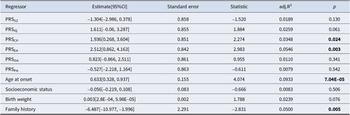
In the univariate analysis, the associations between individual regressors and CR were assessed, with sex included as a covariate. PRSCP and PRSEA showed significant positive associations with CR (p = 0.024, p = 0.003, respectively). No other PRS exhibited significant associations (p > 0.05) (Table 1).
Univariate analysis of factors associated with CR

Note: Significant associations are marked in bold. CP, cognitive performance; EA, educational attainment; IQ, general intelligence; OA, occupational attainment; PA, physical activity; PRS, Polygenic Risk Score; SZ, schizophrenia.
Among clinical and environmental factors, age at onset and family history were also significantly associated with CR (p = 7.04×10⁻⁵, p = 0.005; respectively), with earlier onset and a positive family history negatively associated with CR levels. In contrast, SES and BW did not show significant associations (p > 0.05) (Table 1).
Multivariable models: genetic, clinical, and environmental contributions to CR
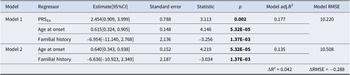
In the multivariable analysis including environmental, clinical, and genetic variables (Model 1), stepwise selection identified PRSEA, age at onset, and family history as the most relevant factors associated with CR. All selected variables showed significant associations in the final model: higher PRSEA (p = 0.002) was associated with higher levels of CR, while earlier age at onset (p = 5.32×10⁻⁵) and positive family history (p = 0.001) were associated with lower CR. This model explained 17.7% of the variance in CR (adj.R2 = 0.177) and had an RMSE of 10.220 (Table 2).
Multivariable analysis of factors associated with cognitive reserve, with a model including environmental, clinical and genetic variables (Model 1) and other including only environmental and clinical variables (Model 2). Significant associations are marked in bold

Abbreviations: PRS= Polygenic Risk Score; EA: educational attainment; RMSE: Root Mean Squared Error
In the multivariable analysis including only environmental and clinical variables (Model 2), earlier age at onset and a positive family history of psychosis were significantly associated with lower CR in the final model (p = 3.97×10⁻⁵, p = 0.003, respectively). This model explained 13.5% of the variance in CR (adj.R2 = 0.135) and had an RMSE of 11.342 (Table 2).
The inclusion of PRSEA in the first model improved the explanatory power (Δadj.R2 = 0.042) and predictive accuracy (ΔRMSE = −0.288) compared to the second model.
Validation across imputed datasets
To confirm that the main analysis, conducted on the first imputed dataset, was robust to imputation uncertainty, all analyses were repeated across the remaining 14 imputed datasets as a sensitivity analysis. CR was computed via PCA using only individuals with complete data for all CR constituent variables. Consequently, neither CR nor its component variables were included in the imputation models. Thus, the value of CR for each participant remained fixed and unchanged across all imputed datasets. The univariate analyses consistently identified PRSCP and PRSEA, age at onset, and family history as factors significantly associated with CR. BW was associated with CR in datasets 2 and 6 (Supplementary Table S1).
In the multivariable model including environmental, clinical, and genetic variables, all datasets included PRSEA, age at onset, and family history, which were consistently associated with CR, except for family history and age at onset in dataset 13. The AIC criterion selected BW in models for datasets 6, 11, and 13, with a significant association with CR in datasets 6 and 13. Dataset 14 included PRSOA, which was associated with CR (Supplementary Table S2).
In the multivariable model including only environmental and clinical variables, age at onset and family history were consistently associated with CR in all datasets, except for family history in datasets 11 and 13. BW was included and associated with CR in datasets 6, 11, and 13 (Supplementary Table S3).
Model performance metrics were consistent across imputations. adj.R2 values for the first models consistently explained a greater proportion of variance compared to the second models (Δadj.R2 > 0), with RMSE differences reflecting the additional explanatory power provided by including PRS (ΔRMSE < 0).
Discussion
The present study provides novel insights into the multifaceted contributions to CR in non-affective FEP. Three key findings warrant particular attention. First, our results highlight the contribution of the genetic liability to educational attainment, a family history of psychosis, and age of onset as key factors influencing CR. While the latter two are collected through clinical assessments, they may themselves reflect underlying genetic vulnerability, underscoring the difficulty of establishing a strict dichotomy between clinical/environmental and genetic factors. Second, focusing on the genetic contribution as captured by polygenic scores, our findings confirm that PRS to educational attainment emerges as the principal determinant of CR, more so than PRS associated with cognition, occupational or physical activities, and even schizophrenia liability. Finally, the comparison between the model incorporating clinical, environmental, and genetic variables and the one including only clinical and environmental factors revealed that the addition of genetic factors led to a significant but relatively modest improvement in explanatory and predictive power. Moreover, it is important to note that some clinical variables – such as family history – may also reflect underlying genetic liability, thereby blurring a strict separation between categories. Accordingly, the following discussion examines these findings in depth, shedding light on the distinct contributions to CR in FEP.
Individual variations in CR are shaped by differences in underlying cognitive and functional brain processes (Stern et al., Reference Stern, Arenaza-Urquijo, Bartrés-Faz, Belleville, Cantilon, Chetelat and Van Loenhoud2020). These processes arise from the interplay between innate factors – such as those established in utero or determined genetically – and cumulative socioenvironmental exposures (Bora, Reference Bora2015). In our study, while examining various factors potentially influencing CR, only family history of psychosis, age at onset, and PRSCP and PRSEA reached statistical significance. Consistent with previous research, an earlier age of onset of psychosis was associated with lower CR, emphasizing that early disruptions in cognitive maturation may act as precursors to poorer long-term outcomes (Correll et al., Reference Correll, Arango, Fagerlund, Galderisi, Kas and Leucht2024; Molina-García et al., Reference Molina-garcía, Fraguas, Del Rey-Mejías, Mezquida, Sánchez-torres, Amoretti and Parellada2021). In fact, in psychotic disorders, the accumulation of CR may itself be affected by the disease process, as early-onset symptoms can disrupt education, occupational attainment, and engagement with other cognitively enriching activities (Amoretti & Ramos-Quiroga, Reference Amoretti and Ramos-Quiroga2021; Barnett et al., Reference Barnett, Salmond, Jones and Sahakian2006). Early onset has also been linked to accelerated grey matter loss, impaired neuroplasticity, and cognitive decline (Boos et al., Reference Boos, Aleman, Cahn, Hulshoff Pol and Kahn2007). Furthermore, the family aggregation of cognitive deficits in psychosis spectrum disorders is well-documented, with evidence indicating that these deficits often precede the onset of clinical symptoms and persist across generations (McGrath et al., Reference McGrath, Wray, Pedersen, Mortensen, Greve and Petersen2014). Family history in this context represents a multifaceted concept, encompassing both genetic predisposition and environmental influence. On one hand, the genetic burden associated with a positive family history is commonly used as a proxy for genetic susceptibility (Lu et al., Reference Lu, Pouget, Andreassen, Djurovic, Esko, Hultman and Sullivan2018). On the other hand, family history also encompasses family and environmental influences that, although not directly inherited, are shaped by parental characteristics and subsequently affect the family environment and upbringing (Balbona, Kim, & Keller, Reference Balbona, Kim and Keller2022; Kendler & Neale, Reference Kendler and Neale2009). Indeed, a study by Verdolini et al. further supports this notion by demonstrating that both the family environment and a positive paternal psychiatric history significantly influence the functioning of individuals with FEP (Verdolini et al., Reference Verdolini, Amoretti, Mezquida, Cuesta, Pina-Camacho, García-Rizo and Bernardo2021).
While genetic factors are known to modulate both psychopathological and cognitive abilities (Valli & McGuire, Reference Valli and McGuire2023), their contribution to CR remains less well understood. Previous studies in this cohort have shown a high correlation between cognitive PRS in network analyses incorporating other PRS and clinical outcomes (Gil-Berrozpe et al., Reference Gil-Berrozpe, Segura, Sánchez-Torres, Amoretti, Giné-Servén, Vieta and Bernardo2025). Our findings confirm the previously reported association between PRSCP and PRSEA with CR in this FEP cohort (Segura et al., Reference Segura, Mezquida, Martínez-Pinteño, Gassó, Rodriguez, Moreno-Izco and Bernardo2023). Extending these findings, our study provides a more nuanced explanation of CR architecture by identifying PRSEA as the primary genetic contributor to CR. While previous studies conducted within the same cohort (Clougher et al., Reference Clougher, Segura, Forte, Mezquida, Cuesta, Vieta and Mas2024; Forte et al., Reference Forte, Clougher, Segura, Mezquida, Sánchez-Torres, Vieta and Balanzá-Martínez2024) have also reported an association between PRSEA and CR, they did not examine the contribution of other PRS. However, it is worth noting that the reference GWAS used to estimate PRSEA and PRSCP are based on the same sample (Lee et al., Reference Lee, Wedow, Okbay, Kong, Maghzian, Zacher and Turley2018), with the GWAS for PRSEA having a considerably larger sample size and thus greater statistical power. In any case, PRSEA encompasses genetic factors influencing skills relevant to academic achievement beyond purely cognitive ability, such as effective communication and collaboration skills (Domingue et al., Reference Domingue, Belsky, Conley, Harris and Boardman2015). In the same way, CR represents a broader concept than any single cognitive measure (Amoretti et al., Reference Amoretti, Cabrera, Torrent, Bonnín, Mezquida, Garriga and Bernardo2019). It includes a wide range of life experiences and activities that together enhance cognitive adaptability, enabling individuals to better manage and adjust to changes associated with psychopathology (Stern et al., Reference Stern, Arenaza-Urquijo, Bartrés-Faz, Belleville, Cantilon, Chetelat and Van Loenhoud2020). As expected, PRSCP was significantly associated with CR in the univariate analysis, suggesting a potential link between cognitive performance-related genetic factors and CR. However, this association did not persist in the multivariable model. A possible explanation, similar to PRSIQ and PRSCP is that both are derived from a more narrowly defined construct related to cognitive performance only (Lee et al., Reference Lee, Wedow, Okbay, Kong, Maghzian, Zacher and Turley2018; Savage et al., Reference Savage, Jansen, Stringer, Watanabe, Bryois, De Leeuw and Posthuma2018). As a result, it may not fully capture the broader cognitive adaptability and compensatory mechanisms that define CR (Amoretti et al., Reference Amoretti, Bernardo, Bonnin, Bioque, Cabrera, Mezquida and Torrent2016). This suggests that while PRSCP may capture aspects of cognitive ability relevant to CR, its contribution is likely overshadowed by other genetic and environmental influences when considered in a multivariable framework. Overall, these observations suggest that PRSEA encapsulates a broader array of sociocultural factors associated with CR.
Finally, incorporating the PRSEA into our model improved its explanatory power compared to the version including only clinical and environmental factors. Although the improvement was modest, this result is consistent with findings in psychiatric genetics, where polygenic scores typically account for a small proportion of variance but can offer meaningful insights when combined with complementary domains (Salagre & Vieta, Reference Salagre and Vieta2021b). The aim was not to develop a predictive model for clinical use, but rather to explore whether polygenic influences contribute to the understanding of CR variability. In this sense, while the genetic contribution is not clinically significant at present, it supports the conceptual value of integrating genetic information into multifactorial models of protective factors, such as CR. Within the broader framework of precision psychiatry – which seeks to tailor diagnostic, prognostic, and therapeutic strategies to individual characteristics by integrating genetic, clinical, cognitive, environmental, and lifestyle information (Salagre & Vieta, Reference Salagre and Vieta2021a, Reference Salagre and Vieta2021b; Vieta & Salagre, Reference Vieta and Salagre2021) – these findings contribute by examining potential contributors to CR, a construct known to modulate outcomes in psychosis (Herrero et al., Reference Herrero, Contador, Stern, Fernández-Calvo, Sánchez and Ramos2020). CR is individually variable and potentially modifiable and may help explain functional, clinical, and cognitive heterogeneity (Amoretti & Ramos-Quiroga, Reference Amoretti and Ramos-Quiroga2021). Even though it is not expected that the inclusion of genetic scores replace clinical assessment of CR, it is important to advance in the understanding of the complex, multifactorial nature of CR through an integrative approach. In this sense, explanatory models in precision psychiatry are crucial for elucidating the relationships between predictive variables. By clarifying these associations, such models enhance the interpretability of findings and facilitate their communication to clinicians and patients. This interpretability is fundamental for the effective clinical implementation of precision-based approaches. Although exploratory, this model may support the early identification of individuals at higher risk for low CR and inform the development of personalized interventions targeting modifiable protective factors.
This study presents several noteworthy strengths. First, it investigated one of the largest, multicentric, and well-defined samples of FEP patients in Spain, resulting in reliable data that can be applied to a wider population. Additionally, the PRS calculations leveraged the most comprehensive GWAS datasets. This enhanced the capture of genetic variants relevant to the investigated phenotypes. Furthermore, the use of PRS-CS method for PRS calculation overcomes the limitation of arbitrary SNP p-value thresholding by refining the estimated effect of each locus. Nevertheless, some limitations should be considered when interpreting these findings. First, CR was assessed after the onset of FEP, using a proxy index derived through PCA of well-established indicators such as education, occupation, and estimated premorbid IQ. While conceptually and statistically grounded, this approach reduces the multifaceted nature of CR to a single latent factor and may not fully capture its complexity. At the time of data collection (2009), validated instruments specifically designed for clinical populations, such as the Cognitive Reserve Assessment Scale in Health (CRASH) for adults (Amoretti et al., Reference Amoretti, Cabrera, Torrent, Bonnín, Mezquida, Garriga and Bernardo2019) or the Cognitive Reserve questionnaire for Adolescents (CoRe-A) for children and adolescents (Camprodon-Boadas et al., Reference Camprodon-Boadas, de la Serna, Baeza, Ilzarbe, Puig, Andrés-Perpiñá and Castro-Fornieles2024), were not yet available. More recent tools like CRASH offer notable advantages: they assess CR across diverse domains (e.g. academic and parental education, occupational complexity, training, multilingualism, leisure activities, and sociability), account for modifiable and life-span factors, and are tailored to the realities of individuals with severe mental illness. In particular, CRASH captures CR-building activities across three distinct life stages – childhood/adolescence, adulthood, and the previous year – which is especially relevant for understanding changes in cognitive engagement over time in clinical populations. CRASH also treats premorbid IQ as a complementary, not central, feature, enhancing conceptual clarity. Compared to PCA-based proxies, such multidimensional instruments allow for a more comprehensive and ecologically valid assessment of CR. Future studies should incorporate these tools to more accurately model CR and its role in clinical outcomes. Second, the sample was limited to individuals of European ancestry, which may limit the generalizability of the findings to other populations. Future research should include more diverse samples to examine the role of genetic and environmental factors in CR across different ethnic groups. Finally, although the number of candidate predictors was limited and supported by prior theoretical evidence, and the sample size was sufficient to support multivariable modeling, the use of stepwise AIC may still carry a risk of overfitting and should be considered a methodological limitation.
Conclusion
These findings underscore the potential of precision psychiatry in providing a more comprehensive understanding of CR in non-affective FEP, a key factor influencing clinical, cognitive, and functional outcomes. Early identification of individuals with a family history of psychosis and an early age of onset is particularly important, along with considering genetic predisposition to educational attainment, as these factors significantly impact CR and, therefore, prognosis.
Supplementary material
The supplementary material for this article can be found at http://doi.org/10.1017/S0033291725101360.
PEPs Group
Anaid Perez-Ramos3,4, Nora Guasch-Capella3, Renzo Abregú-Crespo4,7, Rocío Panadero4,7, Alexandra Roldán15, Anna Alonso-Solís16, Ana González-Pinto4,17, Guillermo Cano4,17, Concepción De-la-Cámara4,18,19, David Vaquero-Puyuelo18, Juan Nacher Rosello4,20, Carlos Cañete Nicolás21, Daniel Bergé4,10, Laura Martínez-Sadurní4,10, Derek Clougher1,2,4, Laura Julià22, Josefina Castro-Fornieles4,11, Inmaculada Baeza4,11, Leticia González Blanco4,23, Francesco Dal Santo4,23, Rafael Segarra Echevarria4,24, Arantzazu Zabala Rabadán4,24, Roberto Rodriguez Jimenez4,25, Estela Jiménez-López4,26, Judith Usall27, Anna Butjosa4,28, Salvador Sarró4,29, Edith Pomarol-Clotet4,29, Angela Ibañez30, Ana M. Sánchez-Torres8,9, Vicent Balanzá31
15Psychiatry Department, Hospital de la Santa Creu i Sant Pau, IIB SANT PAU, Barcelona, Spain
16Mental Health Division, Fundació Althaia, Xarxa Assistencial Universitaria de Manresa, Manresa, Spain
17Araba University Hospital, Bioaraba Research Institute, Gasteiz, Spain. University of the Basque Country (UPV-EHU), Bilbao, Spain
18Hospital Clínico Universitario and Instituto de Investigación Sanitaria (IIS) Aragón, Zaragoza
19Department of Medicine and Psychiatry, Universidad de Zaragoza
20Institute of Biotechnology and Biomedicine (BIOTECMED), Universitat de València, Burjassot, Spain. Biomedical Research Institute of Valencia (INCLIVA), Valencia, Spain
21Servicio de Psiquiatría Hospital Clínico Universitario de Valencia, Spain
22Institute of Neurosciences, IDIBAPS, Barcelona, Catalonia, Spain
23FEA S° de Psiquiatría, Hospital Universitario Central de Asturias, Instituto de Investigación Sanitaria del Principado de Asturias (ISPA)
24Profesor Agregado. Área de Psiquiatría. Departamento de Neurociencias, Universidad del País Vasco UPV/EHU. Instituto de Investigación Sanitaria BioCruces Bizkaia
25Universidad Complutense de Madrid (UCM), Spain; Department of Psychiatry, Instituto de Investigación Sanitaria Hospital 12 de Octubre (imas12), Madrid, Spain
26Health and Social Research Center, Universidad de Castilla-La Mancha, Cuenca, Spain
27Institut de Recerca Sant Joan de Déu, Parc Sanitari Sant Joan de Déu, Sant Boi de Llobregat, Spain
28Parc Sanitari Sant Joan de Déu, CIBERSAM, Doctor Antoni Pujadas, Sant Boi de Llobregat, Spain; Hospital Infanto-juvenil Sant Joan de Déu, Institut de Recerca Sant Joan de Déu, Esplugues de Llobregat, Spain
29FIDMAG Germanes Hospitalàries Research Foundation, Barcelona, Spain
30Department of Psychiatry, Hospital Universitario Ramon y Cajal, Universidad de Alcala, Instituto Ramon y Cajal de Investigacion Sanitaria (IRYCIS), Madrid, Spain
31Service of Psychiatry, Hospital Clínic Universitari, València; Universitat de València, INCLIVA, València, Spain. CIBERSAM, Spain
Data availability statement
The data that support the findings of this study are available on request from the corresponding authors.
Acknowledgments
We are extremely grateful to all participants.
This study is part of a coordinated-multicenter Project, funded by the Ministerio de Economía y Competitividad (PI08/0208; PI11/00325; PI14/00612), Instituto de Salud Carlos III – Fondo Europeo de Desarrollo Regional. Unión Europea. Una manera de hacer Europa, Centro de Investigación Biomédica en Red de salud Mental, CIBERSAM, by the CERCA Programme/Generalitat de Catalunya AND Secretariad’Universitats i Recerca del Departamentd’Economia I Coneixement (2021 SGR 01120). Departament de Salut de la Generalitat de Catalunya, en la convocatoria corresponent a l’any 2017 de concessió de subvencions del Pla Estratègic de Recerca i Innovació en Salut (PERIS) 2016-2020, modalitat Projectes de recerca orientats a l’atenció primària, amb el codi d’expedient SLT006/17/00345.
M. F. Forte received the support of ‘Contratos predoctorales de formación en investigación en salud’ (PFIS22) (FI22/00185) from the Instituto de Salud Carlos III (ISCIII) with European funds from the Recovery, Transformation and Resilience Plan, by virtue of the Resolution of the Directorate of the Carlos III Health Institute, O.A., M.P. of December 14, 2022, granting Predoctoral Research Training Contracts in Health (PFIS Contracts). Funded by the European Union Next Generation EU. She has also been granted a mobility grant, MV24/00050, pursuant to the award resolution dated December 26, 2024, issued by the Directorate of the Instituto de Salud Carlos III O.A.M.P., granting mobility fellowships within the framework of the 2024 call of the Strategic Action in Health 2021–2023.
E. Vieta thanks the support of the Spanish Ministry of Science, Innovation and Universities (PI15/00283; PI18/00805; PI21/00787; PI24/00432) integrated into the Plan Nacional de I+D+I and co-financed by the ISCIII-Subdirección General de Evaluación y el Fondo Europeo de Desarrollo Regional (FEDER); CIBERSAM; and the Comissionat per a Universitats i Recerca del DIUE de la Generalitat de Catalunya to the Bipolar Disorders Group (2021 SGR 1358) and the project SLT006/17/00357, from PERIS 2016-2020 (Departament de Salut). CERCA Programme/Generalitat de Catalunya.
G. Mezquida is a Serra Hunter Fellow, and thanks the Tenure-elegible Lecturer Serra-Hunter program (UB-LE-212-024, Generalitat de Catalunya).
C. Torrent has been supported through a ‘Miguel Servet’ postdoctoral contract (CPI14/00175) and a Miguel Servet II contract (CPII19/00018) and thanks the support of the Spanish Ministry of Innovation and Science (PI17/01066, PI20/00344 and PI24/00407), funded by the Instituto de Salud Carlos III and cofinanced by the European Union (FEDER) ‘Una manera de hacer Europa’.
S. Amoretti thanks the support of the Spanish Ministry of Innovation and Science (PI24/00671), funded by the Instituto de Salud Carlos III and cofinanced by the European Union (FEDER) ‘Una manera de hacer Europa’. This work was also supported by La Marato-TV3 ´ Foundation grants 202234–32 (to S. Amoretti); 202234–30 (to E. Vieta).
E. De la Serna thanks the support of the Spanish Ministry of Innovation and Science (PI20/00654), funded by the Instituto de Salud Carlos III and cofinanced by the European Union (FEDER) ‘Una manera de hacer Europa’.
Funding statement
This study is part of a coordinated-multicenter Project, funded by the Ministerio de Economía y Competitividad (PI08/0208; PI11/00325; PI14/00612), Instituto de Salud Carlos III – Fondo Europeo de Desarrollo Regional. Unión Europea. Una manera de hacer Europa. The funding sources had no role in the design of this study; analysis and interpretation of the data; preparation, review, or approval of the manuscript; and decision to submit the manuscript for publication.
Competing interests
E. Vieta has received grants and served as consultant, advisor or CME speaker for the following entities: AB-Biotics, Abbott, AbbVie, Adamed, Alcediag, Angelini, Biogen, Beckley-Psytech, Biohaven, Boehringer-Ingelheim, Casen-Recordati, Celon Pharma, Compass, Dainippon Sumitomo Pharma, Esteve, Ethypharm, Ferrer, Gedeon Richter, GH Research, Glaxo-Smith Kline, HMNC, Intra-Cellular therapies, Idorsia, Johnson & Johnson, Lundbeck, Luye Pharma, Medincell, Merck, Mitsubishi Tanabe Pharma, Newron, Novartis, Organon, Orion Corporation, Otsuka, Roche, Rovi, Sage, Sanofi-Aventis, Sunovion, Takeda, Teva, and Viatris, outside the submitted work.
Ethical standards
The authors assert that all procedures contributing to this work comply with the ethical standards of the relevant national and institutional committees on human experimentation and with the Helsinki Declaration of 1975, as revised in 2008.


 Open access

