

In April 1981, the situation was very bad. I was all over Serrano for him to give me a direct line to Eduardo de Castro Neiva, the BB vice president of international offices. If I was without a cent, the BB had cash overseas.
—Ernane Galveas, “A mãe de todas as crises do Brasil,” by Claudia Safatle, Valor Econômico, August 10, 2012
Developmentalism and state-led finance have long been defining characteristics of Brazilian capitalism. Despite political shifts from pro-market to left-wing administrations, government discretionary powers still heavily influence Brazil’s national economy. Within the financial sector, albeit with some modifications in the institutional and regulatory landscape, the banking industry continues to operate largely under the legal framework and financial architecture established by the 1964 Banking Act, enacted by the military dictatorship during the heyday of Brazilian state developmentalism. Indeed, despite the increase in the autonomy of the Brazilian Central Bank (BCB) and its expanded regulatory and supervisory capacities over the past three decades, the federal government has retained significant control over the national credit system through targeted lending policies and state-owned financial institutions (Taylor Reference Taylor2009, Reference Taylor2020; Stallings and Studart Reference Stallings and Studart2006).
Banco do Brasil (BB), a mixed private-public bank primarily owned by the Brazilian federal government, has been central to the state’s financial activism and the pursuit of national objectives. As a leading commercial banking institution in terms of financial assets and one of the largest deposit-taking entities in the country, BB has historically provided crucial financing for the agricultural sector at affordable rates.Footnote 1 During the Lula and Rousseff administrations, it also intervened to lower interest rates when deemed too high and provided countercyclical lending (Mettenheim Reference Mettenheim2010). Despite debates over privatization during market-oriented reforms in the 1990s and under President Bolsonaro from 2018 to 2022, BB has remained a crucial tool for developmental policy.Footnote 2 Even during President Cardoso’s tenure, when eleven regional state banks were privatized between 1995 and 2002, BB retained a special role, strengthening its position by acquiring several competitors (Schapiro Reference Schapiro2023). Similarly, under Bolsonaro’s presidency, there were public calls for BB to reduce interest rates for the agricultural sector, highlighting its entrenched role in Brazilian policymaking, regardless of prevailing political and ideological government backgrounds.Footnote 3
This article is concerned with the financial actions and policymaking functions of BB at the dawn of Brazilian state developmentalism and the establishment of the nation’s modern banking system from 1964 to 1982. Following its rise to power in April 1964, the military government implemented a series of significant reforms aimed at restructuring the financial system to reinforce its performance and influence in the national economy (Galveas Reference Galveas1982; Simonsen Reference Simonsen1974). This sectorwide overhaul laid the foundation for unprecedented economic growth during the Brazilian economic miracle from 1968 to 1973, enabling the state to continue its vigorous pursuit of industrialization throughout the 1970s until the onset of the debt crisis in 1982 (and beyond). During this period, BB underwent substantial changes and redefinitions in its powers and position within the financial and monetary system, yet it maintained a prominent status and pivotal role. As the country’s largest bank and financial institution, BB was a cornerstone of the developmental state and economic policies during the dictatorship (Cortes and Marcondes Reference Cortes and Marcondes2018, 206–208; Mettenheim Reference Mettenheim2010, 82–86).
Scholarly analysis of BB during this period has predominantly focused on its role in financing public deficits and economic programs for the Brazilian government (Ayres et al. Reference Ayres, Garcia, Guillen, Kehoe, Timothy and Nicolini2021; Lago 1989; Carneiro Reference Carneiro1989). In this article, I take a different angle and examine the bank’s engagement with foreign finance and its activities in the international capital markets. Between 1964 and 1982, amid Brazil’s increasing integration into the global banking system and inflows of foreign capital, BB significantly expanded its operations overseas. Earlier research has underscored BB’s countercyclical economic policy function by lending during challenging international financial conditions (Cruz Reference Cruz1984). The article extends the analysis, showing how BB leveraged its branches in the United States and London to raise dollars abroad to help meet Brazil’s foreign exchange needs and manage external deficits. It contends that this strategy enabled the government to avoid seeking assistance from the International Monetary Fund (IMF) and its associated austerity programs during the balance-of-payment crises of the 1970s. Moreover, it bolstered Brazil’s state-led development model when other countries in the region were scaling back.Footnote 4 At the end of 1974, for example, Brazil launched the II National Development Plan (II PND), a five-year economic project marked by substantial public spending that sharply contrasted with the IMF’s agenda. This analysis introduces a previously overlooked dimension of the financial arm of the developmental state in Brazilian capitalism (Musacchio and Lazzarini Reference Musacchio and Lazzarini2014, Reference Musacchio and Lazzarini2016; Hermann Reference Hermann2002; Ioris Reference Ioris2014).
My account draws on a large variety of secondary sources and recently disclosed archival material in Brazil, the United States, and England that has not yet been used for this purpose. The minutes (atas) of the Conselho Monetario Nacional (CMN), the governing body of the country’s monetary policy, which was chaired by the secretary of finance and integrated with a varying number of other members, including BB’s president (Franco Reference Franco2017; Armijo Reference Armijo1989), have been digitized and made available online at the central bank’s website.Footnote 5 The notes and supportive documents of the minutes proved a rich and useful source, as they deal with the activities of BB overseas. Although access to the minutes of BB’s board itself was not granted on the grounds of bank secrecy laws (sigilo bancário), I do rely on a collection of internal documents and newspaper clips on the bank’s strategy to expand abroad housed at the Centro Cultural Banco do Brasil (CCBB) in Rio de Janeiro. Regarding data, I gathered the balance sheets published in Revista Bancaria Brasileira and here provide new evidence on the operations of its US branches and agencies from the forms that the bank was required to file with the Federal Financial Institutions Examinations Council (FFIEC) known as FFIEC 002 Report Forms, and in London with archival evidence from the Bank of England. Finally, I draw on insightful contemporary research by Paulo Davidoff Cruz and unpublished dissertations he supervised at Campinas, as well as archival documents from Federal Reserve Bank of New York (FRBNY) and Lloyds Bank on the external debt renegotiations between Brazil and its international creditors.
This article begins with an overview of the historical backdrop of BB and its evolving role within the Brazilian financial system following the reforms enacted by the military government between 1964 and 1967. The second and third sections analyze the driving forces and the processes behind BB’s internationalization and its involvement in global capital markets, respectively. The fourth section scrutinizes the foundational principles and risks associated with BB’s international financial intermediation activities. The fifth section examines the challenges of BB’s foreign financial activities in the wake of the international debt crisis of 1982. In the conclusions, I discuss the causal origins and limitations of its role, as well as the implications for understanding the challenges at stake during the debt crisis of the 1980s and the broader political economy of Brazilian banking and state-led finance.
Historical context
The period leading to the international debt crisis of the 1980s stands as one of the most significant in modern Brazilian developmentalism. After years of stagnation and financial upheaval, the country entered a phase of unprecedented economic growth, characterized by aggressive recourse to external borrowing and the accumulation of macroeconomic imbalances (Cardoso and Fishlow Reference Cardoso, Fishlow and Jeffrey1989; Cardoso and Dornbusch Reference Cardoso, Dornbusch, Barry and Peter1989; Batista Reference Batista1987). From 1967 to 1973, during the Brazilian economic miracle, gross domestic product (GDP) surged at an average annual pace of 11 percent while the industrial sector expanded even faster, maintaining high growth levels throughout the decade (Lago 1989; Carneiro Reference Carneiro1989; Carneiro and Modiano Reference Carneiro and Modiano1989). With virtually every major sector increasingly dependent on international capital markets for funding, foreign finance played a central role in Brazil’s economic development post-1967, becoming a critical component in managing international reserves and the country’s external position (Pereira Reference Pereira1974; Frieden Reference Frieden1987; Bacha and Malan Reference Bacha, Malan and Stepan1989).
The domestic banking sector was closely intertwined with these developments. After its rise to power in 1964, the military government implemented a series of institutional reforms aimed at restructuring the financial system and bolstering the banking industry’s role within the national economy and domestic investment processes. Law 4595 established a specialized banking system, where commercial banks became the core of financial conglomerates encompassing various entities such as investment banks, leasing companies, and mortgage banks (World Bank 1984; Welch Reference Welch1993). This restructuring led to an increase in the number and diversity of financial intermediaries and facilitated the consolidation of the banking sector through mergers and acquisitions, encouraged by the government to concentrate the industry into fewer, larger institutions (Fonseca and Sanvicente 1977; Tavares Reference Tavares1985; Tavares and Carvalheiro Reference Tavares and Carvalheiro1985). As a result, there was a notable acceleration in financial intermediation, with its growth rate averaging twice that of GDP growth between 1968 and 1979.
Within this system, BB emerged as a standout institution. One significant characteristic was its identification as a commercial bank, engaging in typical banking activities such as accepting deposits and extending credit to economic actors, like other banks. However, BB distinguished itself by being the largest bank in the country, having substantial weight in Brazil’s commercial banking sector. By 1980, its domestic assets reached $41 billion, or 45 percent of the total assets of the Brazilian commercial banking system. Its deposit base was notably larger (three to four times larger) than that of other major banks like Bradesco and Banespa.Footnote 6 Moreover, BB’s loan portfolio accounted for 40 percent of the total lending provided by commercial banks. Notably, it held exclusive rights as the depository institution for government entities and individuals dealing with federal public funds, with accounts from the federal government forming a significant portion of its savings and time deposit base. Additionally, BB’s extensive network of several hundred agencies and branches nationwide provided unparalleled geographical coverage for banking services.Footnote 7
BB also played a significant role in intermediating foreign capital with local borrowers. Following the enactment of Resolution 63 by the BCB in August 1967, which permitted commercial and investment banks to obtain loans from international banks in the Euromarket and then lend these funds domestically (known as operações de repasse), the Brazilian banking sector became increasingly involved in external financial intermediation (Alvarez Reference Alvarez2021). This resolution directly integrated the domestic banking system into Brazil’s foreign indebtedness circuit, establishing a mechanism through which domestic banks could channel international liquidity into the country (Wellons Reference Wellons1977, 286–319). By the 1980s, external borrowing by commercial banks through Resolution 63 amounted to $7.5 billion, with $2.2 billion from foreign banks operating in Brazil and the remaining $5 billion from national banks. BB emerged as the largest player in this type of operation, accounting for as much as $1.6 billion or 21.3 percent of the total commercial banking system. In comparison, this amount was 60 percent larger than Citibank’s, the second-largest actor in Resolution 63 operations in Brazil, and 2.7 and 3.9 times larger than Banespa and Bradesco, which ranked third and fourth, respectively.
The second significant and unique aspect of BB was its role as a monetary authority. While serving as Brazil’s de facto central bank before the banking reform of 1964, Law 4595 reshaped the governance of the Brazilian monetary and financial systems. It created the CMN and the BCB, which began operations in April 1965, thus redefining BB’s responsibilities. Although the central bank took over its previous tasks related to banking supervision, currency issuance, and market operations, BB was not sidelined. It retained influence as a monetary authority, with its president participating on the CMN board and contributing to defining and executing the nation’s monetary and credit policies (Franco Reference Franco2017). This role distinguished BB from other commercial banks, as it was integrally involved in the monetary system (Armijo Reference Armijo1989; Novelli Reference Novelli2001; Pinheiro Reference Pinheiro2011).
A notable function of BB, in its capacity as a monetary authority, was its engagement with foreign exchange operations. Under the crawling peg exchange system initiated in August 1968, which lasted until the currency crisis of 1983, foreign exchange transactions in Brazil were managed by the BCB, BB, authorized commercial banks, and currency exchange brokers (Fendt Reference Fendt and Williamson1981; Coes Reference Coes1995, 130–133). BB was a leading figure in this arena, handling a significant share of the country’s foreign exchange dealings. Its operations in foreign currency went beyond its own business needs, encompassing transactions on behalf of other government entities, such as the national treasury and the BCB. Indeed, BB handled the Brazilian government’s foreign accounts and fulfilled its international financial commitments, managing, for example, the nation’s external debt obligations to international lenders (Banco do Brasil 1968). Furthermore, BB carried out numerous transactions for the central bank, such as buying foreign currency from exporters using BCB funds for investments abroad and then rerouting those funds back to the BCB (Freitas Reference Freitas1989, 190–191).
The significance of BB in the exchange markets was closely tied to its central role within the Brazilian foreign trade system. One of the primary responsibilities of BB, acting as an agent of the federal government, was to oversee and execute commercial exchange services and national trade policies. Its Foreign Trade Portfolio (CACEX) functioned as the operational arm of the Foreign Trade National Council (CONCEX). Among its various duties, CACEX was tasked with issuing import and export licenses, monitoring commercial operations abroad, and regulating international trade activities. Participation in international trade operations was restricted to individuals and companies registered with CACEX. Notably, BB handled the collection of trade tariffs on imports and the majority of export proceeds, including the accounts of major foreign trade players such as Petrobras and the mining company Vale do Rio Doce (IMF 1974, 70–80). Furthermore, BB played a vital role in promoting Brazilian exports by providing trade finance and administering government subsidies, thereby exerting significant influence over Brazil’s trade balance cash flow. This underscores the central position that BB held within the Brazilian developmental state regarding international trade and foreign exchange markets.
Several additional factors contributed to BB’s prominent role in Brazil’s foreign exchange operations. First, all public sector agencies conducted foreign currency transactions exclusively through BB. Second, authorized banks were mandated to surrender any excess foreign currency to the central bank at the end of each business day, funneling it through BB, which was also responsible for providing foreign exchange (on behalf of the BCB) to address oversold positions of authorized banks with their customers (IMF 1974, 70–80). Furthermore, BB’s influence in the foreign exchange markets extended to its involvement in capital movements and Brazil’s external indebtedness process. This encompassed the operations under Resolution 63 and the provision of international loans through Law 4131 to both the Brazilian public and private nonfinancial sectors, as detailed in subsequent sections.
The internationalization of Banco do Brasil
As the primary agent of international trade and a key player in foreign exchange policy, BB developed a dominant position in both Brazilian international finance and the global capital markets. Between 1967 and 1982, a period marked by substantial capital inflows into the country and increased external indebtedness, the bank significantly expanded its international presence and strengthened its foreign activities. Figure 1 depicts BB’s extensive expansion abroad during this era. Following the establishment of its first overseas agencies in Asuncion and Montevideo in 1942 and 1945, respectively, no new foreign banking offices were opened until 1960. Subsequently, the bank embarked on a rapid growth phase, which was especially notable in the late 1960s and 1970s.
Evolution of BB’s international banking network, 1960–1982
Source: Freitas (Reference Freitas1989); Andrade and Da Silva (Reference Andrade and da Silva1982).

Promoting Brazilian trade was a significant impetus for BB’s early international expansion. In the context of the formation of the Latin American Free Trade Association (LAFTA) in 1960, the bank initially directed its foreign office openings towards Latin America, as observed in Figure 1, with a specific focus on member countries such as Argentina, Brazil, Chile, Mexico, Paraguay, Peru, and Uruguay. Aligned with government policies to stimulate exports and enhance economic ties within the region, the bank sought to promote Brazilian products abroad and facilitate trading routes with foreign markets. According to a bank official quoted in an internal review article, “the policy [was] to export, to attack potential markets, and the Bank abroad covered all the phase of exports. Imports too.”Footnote 8 After the initial expansion in Latin America, BB pursued a broader strategy to diversify Brazil’s export base and expand its commercial relations globally. By 1982, its vast international network of over seventy banking offices spanned more than thirty countries across five continents.
In addition, BB frequently engaged in domestic banking activities within host countries. The fact that, in 1982, of the bank’s seventy-one foreign banking offices, only twenty-one were representative offices and the remaining fifty were agencies or branches underscores the significance of its banking activities abroad. Unlike representative offices, which lacked the authorization to conduct direct operations and could only refer business to their headquarters, branches and agencies had the autonomy to engage in financial transactions independently. Overall, while specific provisions may vary depending on the host country’s legal standing and regulatory framework, foreign offices with an agency or branch license were generally permitted to undertake businesses under conditions similar to those of domestic banks. This included a wide range of operations, from retail banking—such as accepting deposits and providing loans—to wholesale banking, primarily focused on serving businesses, corporations, and other financial institutions rather than individual customers.
Access to international capital markets, and in particular the US market and Euromarkets, was another significant catalyst in the internationalization process of the bank. In 1967, the bank initiated discussions with the office of the Superintendent of Banks of the State of New York to apply for a license to establish a branch in New York City. As outlined in a letter by Banco do Brasil President Nestor Jost to Deputy Alexander R. Billington in September 1967: “The principal source of business expected for the proposed branch [was] the large number of American firms and concerns which [were] interested in Brazil, either as a commercial partner or as an outlet for their overseas investments.”Footnote 9 It was “expected that the loans and other credit to be extended by the proposed New York branch of Banco do Brasil [would] be largely concerned with commercial and financial transactions between Brazilian and American firms.”Footnote 10 Deposits from these firms as the basis of their operations with Brazil as well as loans to American exporters or importers were featured as main activities. But the letter also highlighted the “additional sources of funds [that would] be available in the New York money market,” since the branch could engage with wholesale interbank transactions.
Established in 1969, the New York branch swiftly emerged as a cornerstone of BB’s international banking endeavors throughout the ensuing decade. By 1982, it boasted a workforce of 250 employees occupying a nine-floor building at 550 Fifth Avenue, making it the largest international foreign banking office in terms of personnel. Alongside the New York City branch, the US presence of BB included three strategically located agencies in key regional financial centers such as San Francisco, Los Angeles, and Miami, all established in 1973, 1974, and 1979, respectively. These branches and agencies came to exert significant influence on BB’s activities within the United States and globally. Within the bank’s expansive network, they provided vital conduits for accessing dollar funding through their clients and tapping into the vast American money markets. This access was instrumental in effectively managing the foreign exchange requirements of the head office and its counterparts worldwide.
In tandem with the establishment of the New York branch, BB was actively pursuing entry into the UK market. As the capital of the Eurodollar market, London held significant allure for foreign banks and was a central hub for international banking, making it a priority destination for BB.Footnote 11 The London branch was officially opened in 1970, and by 1973, internal reviews hailed its success. It was noted as “the champion among foreign affiliates in fundraising ($775 million at the end 1972, almost 40 percent of the total raised by all agencies abroad) and in obtaining gross profits greater than $5 million (a third of the foreign network).”Footnote 12 Furthermore, with the development of the Euromarkets and the subsequent surge of dollar liquidity into the city after the 1973 oil shock, the London branch experienced significant expansion in both size and business volume. Between 1973 and 1982, its staff more than doubled from thirty-one to seventy-six employees, and total assets soared to $3.8 million as of June 1982—considerably larger than the consolidated $2.5 million of the branch and three agencies in the United States.Footnote 13
As of mid-1982, BB’s international network of fifty overseas agencies and branches managed a business volume totaling $22.6 billion, representing over a third of the bank’s total assets of $62.2 billion. The remaining two-thirds of assets were managed by 2,403 domestic banking offices. These figures underscore the significance of the bank’s foreign network compared to its domestic operations.Footnote 14 BB’s head office and domestic affiliates also participated in international capital markets directly from Brazil by securing direct and syndicated loans from banks in the Euromarkets, engaging in short-term cross-border operations related to export and import finance, and occasionally issuing securities overseas.
Euromarkets and balance-of-payment financing
The growth of Euromarkets and the expansion of international banking brought significant changes to global finance and how countries managed their financial imbalances (Wellons Reference Wellons1987; Cohen and Basagni Reference Cohen and Basagni1981; Kapstein Reference Kapstein1994). As these markets expanded and more money flowed into international banks, private commercial banks became increasingly important as sources of capital for countries in need of foreign currency. After the 1973 oil shock, as large amounts of money from oil-producing nations were deposited in London, a surge in international lending to developing countries took place—so-called petrodollar recycling—and Brazil emerged as a major recipient of those funds (Cline Reference Cline1984, Reference Cline1995). International bank loans quickly became the primary source of foreign financing for Brazil (and other Latin American countries), surpassing the previous dominance of multilateral organizations and governments from industrialized nations (Wellons Reference Wellons1977; Moffitt Reference Moffitt1984).
Indeed, foreign finance and international banks played a crucial role in the Brazilian government’s efforts to manage balance-of-payment issues during this period. On November 30, 1971, the CMN approved the Politica de Endividamento Externo (External Indebtedness Policy), a proposal by board member Paulo H. Pereira Lira to regulate the country’s external borrowing.Footnote 15 The policy positioned the Euromarkets at the core of the strategy to address external imbalances and the hiato de recursos (e.g., balance-of-trade deficits). It achieved this by regulating maturity and other financial conditions of Law 4131 and Resolution 63 loan operations, which were the primary mechanisms for Brazilian external borrowing.Footnote 16 By 1982, obligations to commercial banks made up as much as three-quarters of Brazil’s total external debt, of which about 70 percent were borrowed by the public and private sectors under Law 4131 and 30 percent by the banking sector under Resolution 63.Footnote 17
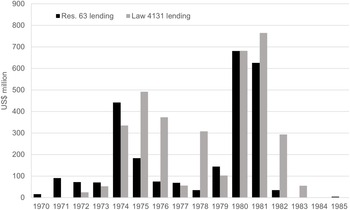
BB assumed a distinctive role within this international economic context and financial policy framework. During the first oil crisis of 1973, BB became a significant source of balance-of-payments financing when international liquidity to Brazil tightened, a fact highlighted by Paulo Davidoff Cruz. By leveraging its overseas network, the bank was able to extend loans under Law 4131 and Resolution 63 to domestic borrowers. Figure 2 depicts the trend of these international loans throughout the period. The graph illustrates a notable surge in lending volume in the mid-1970s. While Law 4131 and Resolution 63 credits by BB’s foreign branches totaled $327 million between 1970 and 1973, they jumped to $777 million in 1974 alone, reaching a cumulative $1.2 billion in the subsequent two years. In essence, during each year from 1974 to 1976, BB funneled 5.8 times more money back to Brazil than in the entire 1970–1973 period. This lending activity occurred amid a severe balance-of-payment crisis as the trade balance, which had been in equilibrium from 1968 to 1973, plummeted into a deficit of 4.5 percent of GDP in 1974 and remained negative over the next two years.
International loans from BB’s foreign banking offices to Brazil
Source: Based on data from Cruz (Reference Cruz1984).

BB’s role in financing the balance of payments is also notably evident following the second oil shock and the Federal Reserve’s decision to raise interest rates from late 1979 onwards. After briefly achieving equilibrium in 1977, the trade balance fell into a minor deficit in 1978 and further worsened to 1.2–1.3 percent of GDP in 1979–1980. While the trade deficit was less severe than the previous crisis, significant changes occurred in the service account. As Brazil’s external debt surged and international interest rates exceeded 20 percent following the Volcker Shock, the burden of foreign debt payments increased substantially, leading to current account deficits widening to 4.5–5.3 percent of GDP from 1979 to 1982. In this context, loans from BB’s overseas branches surged to $1.3 billion annually, compared to an average of $283 million between 1977 and 1979 (Figure 2). In 1982, with the onset of the international debt crisis in August and the subsequent shutdown of international capital markets to Latin America, lending levels from BB’s foreign offices dropped sharply to $327 million and continued to fall to $59 million between 1983 and 1985.
Moreover, the volume of BB’s international loans during balance-of-payment crises was substantial not only in absolute terms but also relative to the total credit flow into the country. While they represented only 3.6 percent of the country’s total external borrowing under Law 4131 and Resolution 63 between 1970 and 1973, the participation grew to as much as 20 percent in 1974 and 11.1 percent in 1975–1976. Likewise, the corresponding shares were 20 percent and 12 percent in 1980 and 1981, respectively, a notable increase from the 2.5 percent share between 1977 and 1979. This pattern, as emphasized by Paulo Davidoff Cruz, reflects a countercyclical economic policy role: BB escalated international lending precisely during periods when the country faced pressing foreign exchange needs and encountered challenges in borrowing in the Euromarkets from other banks. Figure 3 illustrates the ratio of Law 4131 and Resolution 63 loans from BB’s foreign branches to those from other banks, alongside the current account deficit from 1970 to 1982. Consistent with Davidoff Cruz’s assertion, both ratios exhibit a positive correlation, indicating that BB activated lending from its foreign network to address the hiato de recursos when the market was less inclined to lend.
Relation between the share of BB foreign lending to Brazil and current account deficits
Source: Based on data from Cruz (Reference Cruz1984).

Additional evidence from Lloyds Bank archives underscores the distinctive role of BB’s international lending during the early stages of the 1982 crisis. In a letter dated November 29, 1982, to Lloyds Bank International, the Bank of London and South America in Sao Paulo provided an update on the composition and situation of Brazil’s foreign obligations. It attached a detailed list of Resolution 63 loans made by all international banks between 1980 and August 1982, which revealed the prominent position of BB. With a disbursement of $1.3 billion, constituting approximately 10.6 percent of all Resolution 63 loans, BB was the primary lender. Citibank, a main international creditor for Brazil, came close with $1.2 billion, followed by Chase Manhattan Bank and Lloyds International Bank, providing $501 million and $401 million, respectively. The letter also drew “attention to the volume and trend of loans made by foreign branches of Brazilian banks,” which included Banespa, Banco Real, Banco Economico, and Comind, among others, which together loaned $723 million.Footnote 18
Although these figures shed light on BB’s policy function, they offer a limited understanding of its effectiveness in addressing the country’s external imbalances. A hypothetical scenario without BB’s interventions offers a useful benchmark for assessing its role. For example, during the balance-of-payments crises of 1974 and 1975, the external deficits would have been 1.8 and 1.7 times larger, respectively, without the dollars from BB’s Law 4131 and Resolution 63 loans. This suggests that international reserves, which declined from $6.5 billion in 1973 to $5.4 and $4.1 billion in 1974 and 1975, would have fallen by an additional 14 percent and 16 percent, respectively. It is difficult to imagine how the country could have managed such external imbalances without facing a currency crisis or seeking IMF assistance, a fate that befell many Latin American countries with even lesser external disequilibrium. As another reference, during the 1983 currency crisis, the Brazilian government withdrew $2.9 billion from the IMF, a figure comparable to the $1.9 billion lent by BB in 1974–1976.
Underpinnings and weaknesses of the external management strategy
While the significance of BB’s international lending for balance-of-payment financing is clear, the origins of the resources used and the associated risks are less well understood. Recent research has shown that international money markets and wholesale interbank liquidity were crucial sources of dollar funding for Latin American banks operating in major international financial centers and the Euromarkets (Alvarez Reference Alvarez2015, Reference Alvarez2023). Unlike deposits, these transactions consisted of short-term funding arrangements or credit lines among banks. BB was no exception, as this section will demonstrate, with its international lending and interbank borrowing operations being intricately interconnected.
Indeed, the international interbank market formed the backbone of BB’s overseas funding base and its ability to fulfill its economic policy role of providing balance-of-payment financing. Data compiled by Paula Penido de Freitas on the funding structure of BB’s international network at a consolidated level illustrates the extent of, and increasing reliance on, wholesale market transactions. In 1975, interbank funding represented 30 percent of the total, growing to 45.3 percent in 1978 and surging to 76.3 percent in 1982 as deposits declined (Freitas Reference Freitas1989, 192). This heightened dependence on interbank liquidity—inherently more volatile than retail deposits—to support asset expansion, particularly for financing outflows through long-term international Law 4131 and Resolution 63 loans, implied higher risks.Footnote 19 The problem lies in the accumulation of significant maturity mismatches and indirect foreign exchange exposure on BB’s balance sheet, rendering its financial position and the balance-of-payment management model vulnerable to global financial fluctuations.
An analysis of the situation of the agencies and branches in the US provides a clear illustration of the underlying model. Given the dominant role of the USD in Brazil’s balance of payments, the behavior of offices with direct access to dollar liquidity, whose parent bank had monetary authority standing and preponderant participation in the foreign exchange markets, is of special relevance. Figure 4 illustrates the composition of the assets and liabilities of BB’s US agencies and branches as of June 1982. Interbank money market instruments accounted for as much as 95.8 percent of total liabilities, while the remaining portion consisted essentially of deposits from the head offices and affiliates. These figures clearly indicate the predominant role of wholesale liquidity as virtually the sole source of dollar funding, with financial institutions being the main suppliers. On the assets side, claims with the head office and affiliates represent about 62 percent, indicating that the dollars raised in the interbank markets were largely allocated to other agencies and branches outside the US. This suggests that the US offices acted as suppliers of dollar liquidity for the rest of the banking network.
Composition of assets and liabilities of the US agencies and branches of BB, June 1982, millions of dollars
Source: FFIEC Call Report 002.

Figure 5 provides further insights into the relationship between the operations of the US branches and agencies in the interbank market and their affiliates. It plots the net position vis-à-vis the US interbank market and their counterparts overseas for the period between the second quarter of 1980 up to the third quarter of 1985, calculated as the difference between assets and liabilities each quarter. A negative net position on interbank transactions indicates higher obligations than claims, meaning that the agencies and branches were net borrowers or takers of funds in the market. Conversely, the positive net position with the head office and affiliates results from larger claims than liabilities, meaning that the US agencies and branches supplied them with funds. The inverse association between these two variables underscores an interconnected funding relationship, with a strong negative correlation. This indicates that virtually every additional dollar raised in the interbank market by the US agencies and branches was transferred to affiliates abroad, and vice versa. These dollars were fundamental to the international loans granted by BB’s foreign offices to Brazil.
Relation between interbank borrowing and internal funding of the US agencies and branches of BB, II 1980 and III 1985
Note: Net position is computed as assets minus liabilities.
Source: FFIEC Call Report 002

The use of money markets to provide balance-of-payment financing eventually drew attention from US national authorities. The Hearings before the Subcommittee on International Finance and Monetary Policy of the Committee on Banking, Housing, and Urban Affairs of the US Senate, held in February 1983, raised concerns about potential abuses in the Federal Fund market by foreign banks. The chief financial officer (CFO) of First National Bank of Chicago, W. J. McDonough, was questioned regarding statements of a witness that “in 1981, and to an increasing degree in 1982, branches of Mexican and Brazilian banks and some others used their access to this market to fund their nations’ continuing and growing foreign exchange deficits.”Footnote 20 McDonough acknowledged that “it [was] certainly clear by hindsight, and probably something that we should have noticed as it was beginning to take place, that they were using—they were rolling overnight money on constant levels and sending it back home for balance of payment support.”Footnote 21 Although it is unclear whether international banks fully grasped BB’s activities, the multitude and impersonal nature of interbank transactions might have caused lending banks to overlook the ultimate use of the funds and the associated risks.
The balance sheet structure of the London branch followed a similar pattern. As the epicenter of the Euromarkets, the city provided direct access to dollar liquidity through its large Eurodollar market. As in the United States, wholesale liquidity and interbank transactions constituted most of BB’s branch funding base. According to the reconstruction of its balance sheet composition and maturity structure by the Bank of England’s Task Force, these components represented up to 95 percent of total liabilities as of November 1982. The wholesale nature of the funding is further evident in its short-term maturity structure, with two-thirds maturing within 3 months and the remaining third between 3 months and 6 months. The branch had a negative net position with UK banks and a net positive one with banks overseas, including its affiliates, indicating that the Eurodollars raised in London also served as a source of funding and liquidity for the international network.Footnote 22
The significance of BB’s involvement in international interbank market operations for balance-of-payment management was expressly acknowledged by Brazilian monetary authorities. In its capacity as official agent in foreign exchange markets and tasked with managing the central bank and government’s liquid assets abroad, BB was authorized to “keep current accounts with commercial banks overseas, not only for the provision of its own services, but also for the use of credit lines designated to meet the need of the balance of payments.”Footnote 23 But this practice involved inherent risks that compromised the long-term viability of the strategy. While interbank credit during normal times had low spreads and was automatically renewed, financial distress in the market could render them more expensive and difficult to roll over. For banks heavily reliant on dollar wholesale liquidity with limited access to alternative funding sources, as was the case of BB in the United States and London, this situation could lead to serious liquidity issues and potentially impact their stability and solvency.
Outburst and collapse of the model
With the deterioration of global financial conditions after the second oil and Volcker shocks in 1979, securing external financing in the Euromarkets to cover Brazil’s balance-of-payment deficits became increasingly arduous (Devlin Reference Devlin1989; Cline Reference Cline1995). By 1981, Carlos Eduardo de Freitas, chair of the International Reserves Department, made clear how critical the situation of the BCB was. With international reserves and BB’s foreign lending seemingly insufficient to cover the required dollars for servicing the country’s external obligations, the central bank turned to opening more direct credit lines with BB and internally borrowing dollars from it to bridge liquidity gaps. Freitas likened the situation to “cycling a bike every day and all day,” maneuvering foreign exchange levels by utilizing BB’s external resources and tapping into its foreign credit lines to stabilize international reserves.Footnote 24
The events and distress experienced in the Eurodollar market in 1982 further exacerbated this arrangement’s challenges. With the eruption of the Falklands War and the turmoil involving Banco Ambrossiano, Pennsquare, and Drysdale, Brazil’s borrowing capacity in the Euromarkets faltered. In response, monetary authorities instituted a unique cash account (Caixa Única) between BB and the BCB, alongside the establishment of a liquidity fund (Fundo de Liquidez).Footnote 25 Under this new framework, both institutions’ cash balances abroad were consolidated, with resources obtained by BB in international markets directed to a readily available fund to address Caixa Única shortfalls. To ensure the repayment of foreign commitments, the liquidity fund was to keep a balance of $1 billion, equivalent to approximately 20 percent of the country’s rolling-over operations. But the outbreak of the Mexican crisis on August 20, 1982, dealt a new, major blow to the international capital markets, severely affecting BB’s interbank operations and its ability to raise foreign exchange.
As of August 12, 1982, the liquidity fund held $1.73 billion, of which $1.5 billion (90.8 percent) was in cash, with the remaining $158 million in bank papers. However, over the following month, the fund experienced a loss of $1.3 billion, leaving an outstanding balance of $210 million in cash and $132 million in bank papers. The decrease in liquidity was primarily attributed to remittances to the BCB ($755 million) and reimbursements to BB creditors ($633 million). Table 1 presents balance projections of the Caixa Única for the second half of September, computed by BB and presented to the CMN, under various fundraising scenarios. Projections indicate a worsening negative balance, reaching a deficit of approximately $1 billion—about a fifth of Brazil’s international reserves—by month’s end in the absence of additional borrowing. To offset this deficit, BB had to raise an average of $80 million per day in foreign markets. In pursuit of this goal, BB made concerted efforts “with a firm and aggressive attitude, but cautious enough to avoid the disastrous consequence that may arise from the spread of distrust within the foreign banking community.”Footnote 26
Balance projections of Caixa Única of BB-BCB, millions of dollars

Source: Ata de Sessão Extraordinaria, CMN, September 15, 1982.
However, international wholesale interbank markets saw a liquidity contraction, particularly impacting banks with ties to Latin America and defaulting countries (Alvarez Reference Alvarez2023). Figure 6 illustrates the evolution of total liabilities for BB’s US agencies and branches, including the interbank and money market components, between 1980 and 1985. It depicts a significant drop and near disappearance of bank deposits in the final quarter of 1981, partially offset by increased recourse to hot money credit lines until September 1982. At that time, the general manager of the New York branch, Mr. Bohn, assured US financial authorities that the bank was “quite liquid,” indicating they could “easily go for a month without feeling a pinch” even if the markets were too close to them.Footnote 27 However, as shown in Figure 6, BB’s interbank funding in the US shrank again in the last quarter of 1982 and continued to decrease until stabilizing towards the end of 1983. This drop affected not only the US branches and agencies but also the entire international network, which experienced a sharp contraction of wholesale funding: consolidated interbank term deposits declined from $5.2 billion to $2.6 billion between June and December 1982, marking a 50 percent decline in six months.Footnote 28
Evolution of the liabilities of the US agencies and branches of BB, 1978–1985
Source: FFIEC 002 Call Report

The compounding impact of these funding losses inflicted a severe liquidity squeeze and financial strains on BB. While the bank attempted to cover “the deposit drains through assets reduction, use of internal liquidity, support from the Central Bank of Brazil, and use of overnight credit lines,” the measures proved insufficient or too risky to resolve the issues and stabilize the situation effectively.Footnote 29 On the one hand, a significant portion of the dollar assets comprised illiquid long-term Law 4131 and Resolution 63 credits, along with other international loans. On the other hand, amid a balance-of-payment crisis in which external interbank liquidity had been used to bolster international reserves, the reversal process was impossible. The BB’s financing challenges abroad accumulated in the United States, “with each of the overseas centers passing its shortfall on to New York like a hot potato at the end of the day, where the cumulative need has to be dealt with.”Footnote 30 The result was “a bigger and bigger shortage in New York, which [was] covered by official funds and by overnight deposits (up to several hundred million dollars) by the major US banks.”Footnote 31 However, heightened reliance on “large nightly overdrafts” escalated risks, as they “could be pulled at any time,” further compromising the financial position of the US branches and agencies, particularly New York.Footnote 32
Eventually, a liquidity and solvency crisis erupted at BB’s New York branch. On December 8, 1982, the branch faced the first in a series of shortfalls to cover cash flow and balance its financial position. Discussions emerged regarding the possibility of withdrawing the bank from the Clearing House Interbank Payment System (CHIPS) or placing it in “quarantine,” thereby reducing its borrowing limits and margin for rollover operations, with the aim of shielding the US banking system from the spread of its payment problems (Langoni Reference Langoni1987, 31–32). However, under the guidance of Bankers’ Trust—Brazil’s clearing bank in the system—a safety net was organized involving six other leading US banks providing financial assistance: Citibank, Chase Manhattan, Bank of America, Manufacturers Hanover, Chemical Bank, and Morgan Bank. Together, these banks committed $350 million—$ 50 million each—in short-term funding readily available to address the financial needs of the New York branch in case of a repayment emergency (revolving credit lines). Avoiding the collapse of BB in New York was crucial for Brazil and its foreign creditors, given its essential role in the country’s external debt payment system and in managing the foreign exchange market and external accounts of the BCB.
The situation of BB abroad was integral to external debt renegotiations and managing the country’s financial fallout. With the onset of the international debt crisis, the Brazilian government approached the IMF and foreign creditor banks for assistance in balancing the external accounts in 1982 and devising a financing plan for 1983. The program proposed by Brazilian authorities comprised a four-part package, with Project 4—Interbank Credit Lines specifically aimed at restoring and stabilizing the interbank credit lines with BB and other Brazilian banks overseas (Cerqueira Reference Cerqueira1997). By the end of 1982, interbank deposits with foreign agencies and branches of Brazilian banks amounted to $6.23 billion, of which BB accounted for $3.43 billion, or 55 percent. The project required the commitment of 260 international banks to maintain these credit lines at approximately $6 billion. Banker Trust was the coordinator and the bank responsible for overseeing the situation, contacting the other creditor banks in case of withdrawals, and ensuring that deposits uphold the $6 billion base. Preventing sudden outflows in the interbank market was crucial to securing BB’s liquidity and solvency position and halting the drain on dwindling international reserves, which stood at $3.9 billion at year end.
No formal accord was reached, and the erosion continued during the first months of 1983. However, by the middle of the year, the interbank deposit base stabilized roughly at the target level of Project 4. To protect against further funding losses, an official agreement was established within the framework of the Project D—Interbank Commitment Letter of the Financial Package for 1984. On January 17, 1984, the BCB and the creditor banks signed a document to maintain the interbank credit lines at $5.4 billion. Creditor banks had the option to deposit funds with any Brazilian bank abroad or the central bank in the form of thirty-day rollover deposits at an interest rate of 5/8ths over LIBOR plus a 1/8th commission. The agreement was renewed in 1986 as part of the third renegotiating phase and extended until the end of March 1987. As part of the Financial Plan of 1987–1988 signed on September 22, 1988, a new interbank commitment letter agreement for $4.7 billion was reached with creditor banks for another two and a half years, until its final resolution with the Brady Plan in 1992.
Conclusion
This article has examined the involvement of BB with international finance and external indebtedness from the enactment of the Banking Law of 1964 until the debt crisis of 1982, an aspect that has been overlooked in scholarly discourse. While existing literature emphasizes BB’s contributions to the developmental state through funding government and economic programs, this article reveals its significant involvement in balance-of-payment financing. BB’s access to dollar liquidity in the United States and the Euromarkets proved crucial for the Brazilian government in raising foreign exchange and addressing external imbalances during significant macroeconomic disequilibrium.
These findings offer new insights into the forces and mechanisms underlying Brazil’s state-led capitalist model during this crucial period in its developmental history. Following its rise to power in 1964 in a context of high economic and financial turmoil, the military government entered into eight consecutive Standby agreements and stabilization programs with the IMF (1966–1972) for financial aid contingent upon adopting economic policies to reduce fiscal deficits and restore financial stability and economic sustainability. However, during the turbulent years from the oil shock of 1973 to 1982, unlike many of its Latin American neighbors, Brazil did not subscribe to any IMF adjustment program nor suffered a currency crisis, despite its heavy dependence on imported oil and relatively adverse terms of trade. With the full operation of its branches in the United States and London, BB was instrumental for the Brazilian government to bypass the IMF and reaffirm its commitment to ISI policies and state developmentalism at a time when other countries in the region retrenched. This is important not only because it enhances our understanding of the factors underlying the resilience and duration of these policies in Brazil; it also complements recent research on the significance of government-owned financial institutions, such as Caixa Econômica Federal (CEF) and Banco Nacional do Desenvolvimento (BNDES), in Brazilian state capitalism (Musacchio and Lazzarini Reference Musacchio and Lazzarini2014, Reference Musacchio and Lazzarini2016).
This raises, however, questions about the origins of this framework and its implications. What were the causal factors behind such a role for BB, and what were the limitations in bypassing the IMF? The accessed documents do not provide any concrete or specific evidence suggesting that it resulted from a deliberate decision by Brazilian policymakers. Rather, it appears to have emerged as a response to the oil shock of 1973, with the federal government subsequently recognizing its potential and utilizing it again to address the country’s foreign exchange needs later in the decade. Yet while successful for navigating the balance-of-payment problems of the mid-1970s, the scale and scope of Brazil’s macroeconomic imbalances and the global shocks of the end of the 1970s and early 1980s were arguably too substantial to overcome. By then, not only had the country’s external indebtedness multiplied several times over 1975–1976, but interest rates had also more than tripled. Moreover, the outbreak of the Mexican crisis in August 1982 triggered substantial distress in the international US money and London Eurocurrency markets, which were the main sources of funding for BB dollars, undermining its capacity to continue leveraging interbank credit lines to circumvent the IMF. In 1983, Brazil returned to knock on the doors of the IMF to negotiate financial assistance conditioned on an austerity program, marking the beginning of a period of market-oriented neoliberal reforms.
The article also has implications for ongoing debates concerning the political economy of Brazilian banking and regulatory structures. Since the conclusion of the first Basel Accord during the final stages of the international debt crisis of the 1980s, the standards established by the Basel Committee on Banking Supervision (BCBS) of G10 countries have progressively become globalized, shaping domestic banking regulations worldwide. In the developing world, Brazil has actively pursued full adoption of Basel standards, in contrast to some of its Latin American counterparts—such as Mexico, Chile, and Argentina—which have implemented them to a lesser extent or have resorted to superficial compliance (Schapiro Reference Schapiro2024). Brazil’s extensive convergence to the Basel regulatory model, despite its state-led finance approach, is noteworthy, as is the significant operational independence its central bank has acquired for monetary and regulatory purposes. The 1982 debt crisis was a pivotal moment in Brazil’s monetary and banking supervisory governance, and the financial and monetary entanglements between BB and the BCB were a major underlying issue in driving these changes (BCB 2019; Nóbrega and Loyola 2006). Indeed, BB progressively relinquished its monetary authority powers until the enactment of Plan Cruzado in 1986 and the subsequent Constitutional Reform of 1988, which heralded the autonomy of the central bank and stripped BB of its former policymaking roles in the monetary system, repositioning it as a commercial banking institution.
Finally, BB’s participation in the country’s external indebtedness process holds implications for our understanding of the debt crisis of the 1980s. The financial fallout of 1982 marked the downfall of Brazil’s robust growth model, which relied heavily on foreign borrowing and import substitution, plunging the country into the “lost decade”: a mãe de todas as crises (the mother of all crises) that Brazil experienced thereafter, as emphasized in the epigraph at the beginning of this article. The significant involvement of BB with foreign finance and its precarious situation following the Mexican default offer a fresh perspective on the challenges faced by the Brazilian government in addressing the crisis. In 1987, an external debt audit conducted by the BCB revealed that BB was Brazil’s second-largest creditor after the World Bank’s International Bank for Reconstruction and Development (IBRD), holding larger claims than any other foreign and domestic private creditor banks. While beyond the scope of this article, BB’s substantial exposure to Brazil’s default and reliance on dwindling short-term interbank credit from foreign banks undoubtedly created significant challenges for Brazilian policymakers. Further research is needed to assess how this may have influenced Brazil’s bargaining position in debt negotiations and the resolution of BB’s foreign claims and debts.
Acknowledgments
I am especially grateful to Rory Miller, Marco Molteni, Gail Triner, and Leo Weller for their insightful feedback on the various iterations of this article. The article has benefited greatly from comments and suggestions from LARR’s associate editor Rosa Luz Duran and three anonymous reviewers. I also thank Paula Vedovelli and Teresa de Novaes Marques for their help in accessing the archives of the Centro Cultural do Banco do Brasil and the Brazilian Central Bank, respectively. Participants at seminars and workshops at the University of Oxford, Rutgers University, and EESP-FGV, where this research was presented, are also thanked for their valuable comments and questions. Financial support from the Swiss National Science Foundation (SNSF) is gratefully acknowledged (Grant N° P400PG_180653).



 Open access

