


3.1 Introduction
Public opinion surveys consistently demonstrate that international trade is viewed favourably by most citizens. However, when people are asked about trade with specific countries, differences emerge as people are more supportive of trade with some countries than with others. This suggests that they have preferences for certain trading partners. While citizens have only an indirect influence on a country’s trade policy, political elites such as legislators have a direct say in these policies. Similar to citizens, political elites also may have preferences for certain trading partners over others. In light of these observations, this contribution poses two questions. First, what factors explain attitudes towards trade with different countries? Second, do the factors that determine trading partner preferences differ between citizens and political elites?
We address these questions for the case of Latin American countries. Data from the Design of Trade Agreements (DESTA) project (Dür et al. Reference Dür, Baccini and Elsig2014) show that these countries have been particularly active in forging trade agreements. Importantly, countries in Latin America have reached out to Western partners, such as the United States (US) and the European Union (EU), but also to non-Western countries, in particular China. Which of these entities becomes the major trading partner has important implications, as China, the EU, and the US put forward substantially different models of trade liberalization.
In answering these questions, we present three broad explanations for trading partner preferences, all of which are applicable to both citizens and political elites. For one, economic interests may matter. While trade is generally welfare-enhancing, specific groups within a country may nonetheless lose from an increase in trade with a particular trading partner. In a Latin American country, for example, a person working in the textile sector may welcome more trade with the US (whose textile industry generally is not competitive internationally, see e.g. Huber et al. Reference Huber, Stiller and Dür2023) but loathe more trade with China (which has an internationally highly competitive textile industry). Second, geopolitical concerns may influence preferences for trading partners. Trade can cause dependencies that one side may use to exert power over the other (Hirschman Reference Hirschman1945). At the same time, trade may cement alliances (Jackson and Nei Reference Jackson and Nei2015). People consider the potential effects of trade on security; therefore, they can be expected to have a preference for allies as trading partners (Carnegie and Gaikwad Reference Carnegie and Gaikwad2022). Finally, the choice of preferred trading partner could be a function of political ideology. For ideological reasons, people may have a greater affinity to some countries than to others. For example, preferential trade agreements with the US most clearly follow the idea of market liberalization and open trade. Thus, right-wing individuals could prefer trading with the US (e.g., vis-à-vis agreements with China) because the underlying ideational orientation of the trading partner fits their view on the economy.
Empirically, we scrutinize these theoretical propositions by investigating two core actors in the formulation of trade policy in Latin America: citizens and members of parliament. First, we use public opinion data from the Latinobarómetro that asked respondents about their evaluation of trade with the US and China. We take the differences between the assessments of these two trading partners as our dependent variable, which is the support for the US relative to China. Second, we use the Latin American Elites Database, which contains data from surveys of members of parliament in a series of Latin American countries since 1994. Among other questions, the legislators were asked to evaluate free trade agreements with the US and the EU, and the Pacific Alliance and the Bolivarian Alliance for the Peoples of Our America. We calculate the differences between the assessment of a free trade agreement with the US and the other assessments to arrive at our dependent variables.
The results indicate that political ideology is an important predictor of preferences for trading partners for both political elites and citizens. By contrast, the findings only offer partial support for the other two explanations. Specifically, economic considerations only matter for legislators’ preferences and geopolitical considerations only for citizens’ preferences.
In two ways, our study contributes to a better understanding of the political economy of trade, especially for the case of Latin America. On the one hand, whereas a large literature analyses trade attitudes in general (Kuo and Naoi Reference Kuo, Naoi and Martin2015; Stiller et al. Reference Stiller, Dür and Huber2022), so far only a few studies have looked at the question of whether and how trade attitudes vary across trading partners. (For some exceptions, see Chiang et al. Reference Chiang, Liu and Wen2013; Spilker et al. Reference Spilker, Bernauer and Umaña2016; Jungherr et al. Reference Jungherr, Mader, Schoen and Wuttke2018; Kim et al. Reference Kim, Park, Rhee and Yang2023.) Our study shows that trade support is multifaceted, and understanding trade attitudes requires going beyond questions on whether someone favours trade in the abstract. Such generic questions fall short of capturing attitudes towards trade, given that there is considerable variation across trading partners in terms of trade support. As done here, this variation across trading partners can help disentangle different explanations that shape attitudes towards trade. On the other hand, we compare the trade attitudes of political elites and citizens. We detect some differences, but also important parallels across these two actor types. In fact, our key takeaway in this respect is that legislator and citizen attitudes towards trade are more similar than different. This finding is good news for democratic representation in an increasingly politicized policy area and has important implications for the responsiveness of political elites to citizens’ views on trade as well as the emerging literature on the elite-citizen gap (Dellmuth et al. Reference Dellmuth, Scholte, Tallberg and Verhaegen2022).
3.2 Argument
Three major factors can shape actors’ preferences with respect to the choice of trading partner: economic considerations, geopolitical considerations, and ideology. In the following, we discuss these three factors and how they might influence the preferences for trading partners of citizens and legislators.
3.2.1 Economic Considerations
Let’s start with economic considerations, a person’s economic fortunes may differ across potential trading partners. Following the Stolper-Samuelson theorem, high-skilled workers should benefit more from an agreement with a country at a lower level of development (Alt and Gilligan Reference Alt and Gilligan1994). This is so because trade liberalization with such a country should increase (relative) domestic demand for high-skilled workers and hence their wages and job opportunities. By contrast, the trade liberalization entailed by an agreement with a more highly developed country should reduce demand for high-skilled workers and hence their wages. For low-skilled workers, the expectation is just the opposite. Chiang et al. (Reference Chiang, Liu and Wen2013) found support for these expectations in Taiwan. In their study, high-skilled workers showed greater support for a trade agreement with both China and the US, but the difference to low-skilled workers was higher for the former than for the latter, which they interpret as support for the Stolper-Samuelson theorem.
The Stolper-Samuelson theorem is not the only attempt at explaining the distributional effects of trade. ‘New new’ trade theory starts from the observation that only a small number of ‘superstar’ firms engage in trade (Osgood et al. Reference Osgood2017). These firms hire the most productive workers, many of whom can be expected to be highly skilled. The expectation hence is for international trade to generally benefit high-skilled workers (Burstein and Vogel Reference Burstein and Vogel2017). Still, even following this newer reasoning, it can be argued that high-skilled citizens should be relatively more supportive of trade with less advanced economies. As before, this is so because exports to such countries should generally consist of relatively more capital-intensive goods and services, which require relatively more input from high-skilled workers.
Two objections can be raised against the economic-considerations argument. For one, citizens may have very little understanding of the distributional consequences of trade (Rho and Tomz Reference Rho and Tomz2017). While this is plausible, it can be argued that whenever people directly experience the distributional effects of trade, they can correctly attribute them. For example, American voters have been shown to change their electoral behaviour in response to rising trade exposure (Baccini and Weymouth Reference Baccini and Weymouth2021). Moreover, citizens may receive cues from better-informed actors, such as trade unions or political parties, remedying their relative lack of knowledge.
The second objection concerns the fact that only a minority of citizens directly experience the wage- or job-related consequences of trade. This is so because a significant proportion of a society at any time does not participate in the labour market (e.g., because they are retired, in long-term unemployment) or produces nontradable services (for the role of employment status and trade attitudes, see also Stiller et al. Reference Stiller, Dür and Huber2022). In addition, sociotropic, rather than self-interested considerations, could drive attitudes towards trade. Hence, the effect of economic considerations may only be indirect (Schaffer and Spilker Reference Schaffer and Spilker2019). The elite cues referred to above, however, may also be available to citizens not directly affected by trade. Citizens who previously participated in the labour market may also have had direct experiences with the effects of trade in the past. To the extent that this objection is still valid, our estimates below will underestimate the role of skill level on trading partner preferences.
For legislators, the economic argument needs to be adapted in two ways. On the one hand, the problem of lack of information should be less pertinent for them. They can be expected to have sufficient knowledge to understand the consequences of trade with different trading partners. On the other hand, trade does not really affect demand for and the wages of legislators. Their economic considerations thus most likely relate less to the effects of trade directly for them, and more to the effects of trade for the economic well-being of the citizens that they represent (Dür et al. Reference Dür, Huber and Stiller2023). On average, an increase in trade is expected to enhance economic growth in all countries. In practice, at least in the short term, an increase in import competition can produce economic losses in some parts of a country. To the extent that economic considerations are important for them, legislators hence should favour trading partners that maximize the economic opportunities for the citizens they represent while minimizing the economic disruption created by trade. Following the discussion above, this is a function of the share of high-skilled workers in a district: the greater the share of high-skilled citizens in a district, the greater the preference for an economically less developed trading partner should be. Two hypotheses summarize this reasoning concerning economic considerations:
H1b: The higher the average skill level of the workers legislators represent, the more they prefer relatively less economically developed trading partners.
3.2.2 Geopolitical Considerations
Preferences for partner countries may also be shaped by geopolitical considerations. To the extent that geopolitics is important, both citizens and legislators can be expected to prefer allies rather than adversaries as trading partners. This is so because trade with other countries tends to have security externalities (Gowa and Mansfield Reference Gowa and Mansfield1993), which imply that trade with allies positively influences a country’s national security whereas trade with adversaries negatively affects a country’s security. Following this line of argument, Bailey (Reference Bailey2003) concluded that geopolitical concerns made the American public support early Cold War US trade policy. Similarly, the findings by Jungherr et al. (Reference Jungherr, Mader, Schoen and Wuttke2018) indicate a role for geopolitics in individual-level preferences for trading partners. Concretely, they find that German citizens who are highly supportive of US leadership in foreign policy were more supportive of the planned Transatlantic Trade and Investment Partnership (TTIP). DiGiuseppe and Kleinberg (Reference DiGiuseppe and Kleinberg2019) found that security considerations play a large role in shaping individual trade preferences in the US. Finally, Carnegie and Gaikwad (Reference Carnegie and Gaikwad2022) show that citizens prefer trade with allies but increase support for trade with enemies if they are told that trade can promote peace.
While it is likely that the importance of geopolitics for citizens varies over time and across countries, partly as a function of what happens in the world, at least broad notions of whether a country is friendly or not can serve as a heuristic for citizens to judge the consequences of a trade agreement with that country. In fact, they may rather have a general view of a country as a friend or a foe than understand the exact economic consequences of a trade agreement with that country. Alternatively, citizens may see trade as a means to advance peace and hence prefer trade with hostile countries (Bulman Reference Bulman2022). We do not deem this likely, however, as we expect citizens to lack the political sophistication to make this link between trade and peace (unless explicitly told about this link, as was done by Carnegie and Gaikwad Reference Carnegie and Gaikwad2022).
For legislators, geopolitical concerns should be of even greater importance on average, as they have a better understanding of the security externalities of trade. They may care about geopolitics for intrinsic reasons. Alternatively, re-election concerns may make them pay attention to geopolitics. The latter applies if citizens take geopolitical considerations seriously and hold politicians accountable that do not share this preference. Two hypotheses result from this argument:
H2a: Citizens prefer countries as trading partners that are (perceived as) geopolitical allies.
3.2.3 Ideological Considerations
Finally, political ideology may play a role in trade partner preferences. Some countries may be seen as ideologically closer than others. In support of this line of reasoning, Spilker et al. (Reference Spilker, Bernauer and Umaña2016) found that citizens prefer partner countries in trade agreements that are culturally similar. Steiner (Reference Steiner2018) stresses the role of postmaterialist concerns in creating opposition to TTIP. The best overall approximation of a person’s political ideology, however, remains the left-right dimension (Jost et al. Reference Jost, Federico and Napier2009). On this dimension, the political right can be defined as conservative and accepting of inequality, whereas the political left is associated with change and equality. The ideological position on the left–right dimension also should matter for people’s economic views. A person towards the right tends to support capitalism with (relatively) little state intervention. By contrast, a person towards the left tends to favour state intervention in markets and redistributive policies. This can (such as for a considerable number of citizens in some Latin American countries) but does not need to include rejection of capitalism as a form of organizing the economy.
There is much debate about the extent to which people really ascribe to a consistent political ideology (Zaller Reference Zaller1992; Jost et al. Reference Jost, Federico and Napier2009; Carmines and D’Amico Reference Carmines and D’Amico2015). It seems plausible enough, however, that people have at least broad notions of their own ideological leanings and also of what kind of ideology at least a select number of prominent countries represent. For example, the US stands representative of a relatively free-market, capitalist country. China, by contrast, represents a country with a much stronger state involvement in the economy. Following this reasoning, right-wing citizens might show a greater preference for the US as a trading partner than left-wing citizens. Note that this is a relative argument: even citizens on the left may prefer the US as a trading partner (e.g., because of concern about human rights abuses in China), but this preference may be weaker than in the case of citizens on the right.
Whereas the relevance of political ideology for citizens’ attitudes can be disputed, for legislators it seems clear that they possess sufficient political sophistication to adopt ideologically consistent political attitudes. Their leaning on the left–right dimension can thus also be expected to matter for their preferences with respect to trade agreement partners. In fact, Bohigues and Rivas (Reference Bohigues and Rivas2019) have already shown that among Latin American legislators, those further to the right are more supportive of trade agreements with the US and the EU than those further to the left. We again derive two hypotheses from this reasoning:
3.2.4 Summary
In Table 3.1, we summarize the various arguments presented. In the following two sections, we test these expectations using data for citizens and legislators in the case of Latin America. While we formulated the argument generically, there are some specificities to Latin America that are useful when testing the argument. For one, the US plays a strong role as a geopolitical ally for some countries and as a geopolitical adversary for others. This facilitates testing the geopolitical considerations argument. Moreover, the left–right dimension is very strong in Latin America, with a large number of citizens placed on either end of the spectrum.
| Citizens | Legislators | |
|---|---|---|
| Economic considerations | High-skilled individuals: greater support for labour-abundant trading partners and vice versa | Greater share of high-skilled workers among constituents: more support for labour-abundant trading partners and vice versa |
| Geopolitical considerations | Greater support for allies as trading partners | Greater support for allies as trading partners |
| Ideology | Greater support for trading partners that are seen as ideologically aligned | Greater support for trading partners that are seen as ideologically aligned |
3.3 Citizens’ Trading Partner Preferences
In order to test the three hypotheses concerning citizens’ attitudes, we rely on the 2020 Latinobarometro survey.Footnote 1 This public opinion project conducts annual surveys with a representative sample of Latin American citizens. Specifically, it collects data for about 1,000 citizens each from eighteen Latin American countries.Footnote 2 The 2020 wave of the survey includes a question with respect to two potential trading partners that reads: ‘What is your opinion on trade between [USA/China] and (country)? Is it very favorable (1), somewhat favorable (2), somewhat unfavorable (3), or very unfavorable (4) for the economic development of the country?’ In this chapter, we thus use this question for all 20,204 respondents in the eighteen countries outlined above.
We propose two ways of operationalizing preferences for one trading partner over the other. First, we reverse the scale (so higher values indicate more positive perceptions of the US and China) and subtract the perceptions regarding China from those regarding the US. Thereby we create a variable that can theoretically range from −3 to 3, with higher values indicating relatively better perceptions of trade with the US. The mean for this variable (0.089) indicates a slight preference for the US as a trading partner, but this varies strongly across countries in Latin America, as shown in Figure 3.1. For example, citizens in Venezuela have a strong preference for China, while citizens in several other countries show a clear preference for the US. Second, we recode this variable into a categorical variable, which indicates whether the respondent prefers the US to China, China to the US, or is indifferent (with the last functioning as the reference category). In Venezuela, 39.6 per cent of respondents favour China, whereas only 21.3 per cent depict a clear preference for the USA. In contrast, 33.1 per cent of Colombian respondents prefer the USA, while only 13.5 per cent prefer China. The former variable functions as our main dependent variable and the latter as a robustness check.

Following much of the literature on the topic, we operationalize skill levels based on formal education (see, e.g.,Scheve and Slaughter Reference Scheve and Slaughter2001: Menéndez González et al. Reference Menéndez González, Owen and Walter2023). The survey asked respondents about their age when they finished their formal education. We dichotomize this variable and label those who were older than eighteen years when they finished their education as highly skilled (Education high). When used to explain general trade attitudes, education has the disadvantage that it can proxy for a series of broader attitudes that people have. For example, more highly educated people tend to be more cosmopolitan, which may affect people’s views of trade. In our case, this is less of a concern, as we try to explain relative preferences for different trading partners. Still, years of schooling may not fully capture what we are interested in. We thus include information on respondents’ type of employment as a second measure for skill levels in our models. Concretely, we classify respondents who indicated that they are working as professionals, business owners, or in management as high-skilled (High-skilled employment).Footnote 3 The correlation between the two proxies for skill levels is relatively low (r = 0.2), making it possible for us to include both in the same model. As the US is economically more highly developed than China, Hypothesis 1a lets us expect negative coefficients for these two variables.
To capture geopolitical orientation, we utilize two questions that ask respondents about their perceptions concerning their country’s relationship with the US and China, respectively.Footnote 4 Similar to our dependent variable, we subtract the score for China from the one for the US and obtain a variable ranging from −3 to 3, with higher values indicating a better-perceived relationship with the US (Perception relationship). These two questions allow us to capture a subjective notion of alliance: not all people within a country need to have the same perception of which country is an ally. At the country level, moreover, we include disagreement between the country and the US in United Nations General Assembly (UNGA) voting in the model (US Disagreement in UNGA voting). Data for this variable comes from Bailey et al. (Reference Bailey, Strezhnev and Voeten2017) and captures the distance in ideal points based on UNGA voting. Specifically, we take the absolute distance between a country and the US and use a three-year moving average to account for minor fluctuations in individual years. Lower values indicate that the country and the US pursue a more similar foreign policy, which – while not equivalent to – seems at least a precondition for the status as allies. Whereas Perception relationship captures a subjective perception of allies, this variable tries to capture objective aspects of alliances. Following Hypothesis 2a, the coefficients for Perception relationship should be positive, whereas for US Disagreement in UNGA voting it should be negative.
Finally, we capture political ideology using a standard item asking respondents to self-place themselves on a scale from 0 (left) to 10 (right) (Political ideology). As discussed before, we expect left-wing respondents to have a relatively worse perception of the US than China. A positive coefficient on Political ideology would hence support Hypothesis 3a.
In the models below, we control for a series of variables at the individual and country levels. Specifically, this concerns respondents’ age and gender, generic trade support, and satisfaction with democracy and the economy. At the country level, moreover, we include the relative strength of trade ties between the country and the US and China as a control variable.Footnote 5 Given the numerical character of our dependent variable, we use linear mixed effects models. A mixed effects model allows us to use random intercepts at the country level to control for country-level factors while also including a country-level measure of relative trade ties.Footnote 6
Table 3.2 summarizes the findings. In Model 1, we use the dependent variable that results from subtracting the rating of trade with China from the rating of trade with the US. In this model, we do not find support for the economic explanation (Hypothesis 1a). Neither of the two variables capturing high-skilled workers is statistically significant, although the one for High-skilled employment has the right sign (negative) and nearly reaches statistical significance. By contrast, the coefficient for Education high even has the wrong sign. In short, the evidence is at variance with Hypothesis 1a.
| Model 1 | Model 2 | ||
|---|---|---|---|
| (Pro-USA) | (Pro-CN) | ||
| Education high | 0.00 | 0.03 | -0.04 |
| (0.02) | (0.06) | (0.07) | |
| High-skilled employment | −0.04 | −0.06 | 0.15* |
| (0.02) | (0.06) | (0.07) | |
| Perception relationship | 0.30*** | 0.51*** | −0.40*** |
| (0.01) | (0.03) | (0.03) | |
| US Disagreement in UNGA voting | 0.07* | −0.06 | −0.07 |
| (0.03) | (0.04) | (0.04) | |
| Political ideology | 0.04*** | 0.05*** | −0.08*** |
| (0.00) | (0.01) | (0.01) | |
| Age | 0.00 | 0.01** | 0.00 |
| (0.00) | (0.00) | (0.00) | |
| Gender (female) | 0.02 | 0.02 | −0.13* |
| (0.02) | (0.06) | (0.06) | |
| Trade support | 0.03 | −0.04 | −0.15*** |
| (0.01) | (0.04) | (0.05) | |
| Satisfaction with democracy | −0.05*** | −0.04 | 0.05 |
| (0.01) | (0.04) | (0.04) | |
| Satisfaction with the economy | −0.03* | −0.09* | 0.05 |
| (0.01) | (0.04) | (0.05) | |
| Relative trade ties | 0.03* | −0.05* | −0.10*** |
| (0.01) | (0.02) | (0.02) | |
| Intercept | −0.32* | −0.50* | 0.21 |
| (0.12) | (0.21) | (0.20) | |
| AIC | 22370.20 | 14801.52 | |
| BIC | 22468.79 | 15181.76 | |
| Log likelihood | −11171.10 | −7346.76 | |
| Num. Obs. | 8447 | 8447 | |
| Num. Groups: country_short | 18 | ||
| Var: country_short (Intercept) | 0.00 | ||
| Var: Residual | 0.82 | ||
| Deviance | 14,693.52 | ||
| K | 3 | ||
Source: Own calculations. * p < 0.05, ** p < 0.01, ***, p < 0.001.
However, the results lend some support to the geopolitical explanation (Hypothesis 2a). The coefficients for both Perception relationship and US Disagreement in UNGA voting are positive and statistically significant. Respondents that rate their countries’ relationship with the US relatively better favour the US as a trading partner. At the same time, contrary to the geopolitical considerations expectation, respondents from countries with a foreign policy broadly aligned with the US are less likely to favour the US as a trading partner. The effect of the Perception relationship variable is large. Moving this predictor by one step on the scale from −3 (best relationship with China, worst with the US) to 3 (excellent relationship with the US but very poor relationship with China) increases the preference in favour of the US as a trading partner by 0.3 points on the scale from −3 to 3. In contrast, the effect for US Disagreement in UNGA voting, which runs counter to the geopolitical considerations expectation, is substantially smaller. One step in dissimilarity increases support for the US by 0.07, on a scale that runs from 1.6 to 4.2. Hence, we consider this broadly supportive for H2a.
Finally, the model hints at an effect of political ideology (Hypothesis 3a). A positioning towards the right goes hand in hand with a preference for the US as a trading partner. Again, the effect is of substantive relevance, although much smaller than the one for Perception relationship. Concretely, the model predicts a shift of preferences in favour of the US by 0.4 on the seven-point scale when an individual moves from being far-left to far-right.
With respect to the control variables, citizens who are satisfied with the state of democracy and the economy are less supportive of trade with the US. The positive and statistically significant coefficient for the relative trade ties variable indicates that more trade with the US (relative to China) improves respondents’ views of the US as a trading partner. This may hint at economic reasoning, but it is also possible that this reflects geopolitical considerations, as trade and geopolitical alliances often go together.
Model 2 in Table 3.2 reports results from a multinomial regression model that relies on the categorical version of our dependent variable. This model includes country-fixed effects rather than random effects. The results are similar to those reported before. In terms of Hypothesis 1a, the coefficient for High-skilled employment now is positive and statistically significant in the equation with pro-China attitudes as the dependent variable. This is in line with the economic considerations explanation as the higher skilled should benefit from trade with a country that mostly relies on low-skilled workers. The coefficients for Education high, however, are not statistically significant and even have the wrong signs. Support for the economic considerations explanations hence remains tenuous. The positive and strongly statistically significant coefficients for Perception relationship continue to support Hypothesis 2a. In the pro-USA equation of the model, the second variable that we use to measure geopolitical allies (US Disagreement in UNGA voting) now has the expected sign (negative) but still fails to reach statistical significance. Political ideology, finally, works as expected in Hypothesis 3a.
Overall, for citizens we have found most support for the ideology argument and some support for the geopolitical considerations expectation. Economic considerations, at least as operationalized here, do not seem to play a major role in shaping preferences over trading partners.
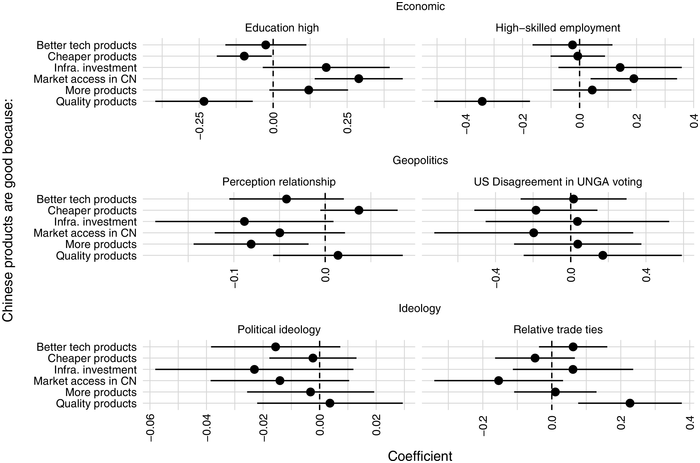
The Latinobarometro also includes two questions that ask people to indicate why they perceive trade with China as good or bad. These two questions allow us to probe a bit deeper into people’s reasoning when thinking about China as a trading partner. Individuals were asked to pick from a list or indicate ‘none’ or ‘all’.Footnote 7 In analysing the responses, we use a multilevel logistic regression with the same covariates as before. Figures 3.2 and 3.3 present the results. On the x-axis, they present the respective reason, whereas the y-axis shows the regression coefficient, and the individual panels correspond to the predictors. Ranges represent 95 per cent confidence intervals.
Reasons why trade with China is good.
Note: Figure 3.2 depicts the unstandardized regression coefficients from various mixed effects logistic regression models, which estimate whether an individual selected the respective label (e.g., ‘Better tech products’) or all reasons as a response to a question on the benefits of trade with China (see footnote 7 on the precise wording). Both economic variables are dummies. The perception of the relationship ranges from −3 to +3, with higher values expressing more sympathy for the US vis-à-vis China. US Disagreement in the UNGA is a numeric variable with a range of 3. Political ideology is captured on a seven-point range, and relative trade ties range from −0.47 to +6.23. See replication files for individual models.
Reasons why trade with China is bad.
Note: Figure 3.3 depicts the unstandardized regression coefficients from various mixed effects logistic regression models, which estimate whether an individual selected the respective label (e.g., ‘Chinese workers take our jobs’) or all reasons as a response to a question on the disadvantages of trade with China (see footnote 7 on the precise wording). Both economic variables are dummies. The perception of the relationship ranges from −3 to +3, with higher values expressing more sympathy for the US vis-à-vis China. US Disagreement in the UNGA is a numeric variable with a range of 3. Political ideology is captured on a seven-point range, and relative trade ties range from −0.47 to +6.23. See replication files for individual models.
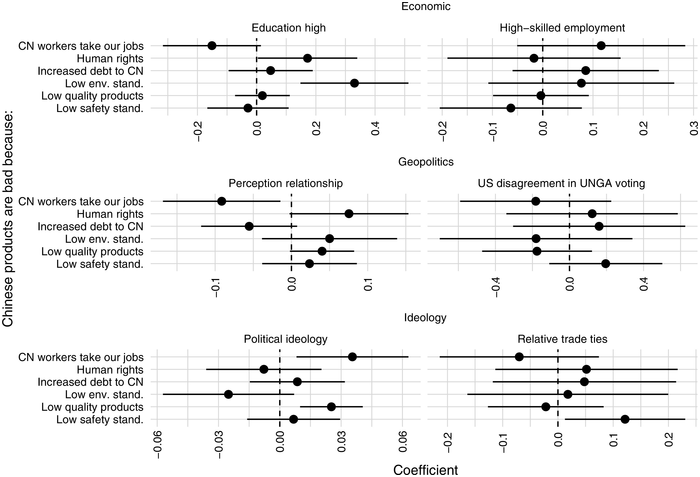
Figure 3.2 provides important additional information to assess the three theoretical arguments. Individuals with high education and high skills perceive market access to China as a core benefit of trading with China. This is perfectly in line with the economic considerations argument. They are also less likely to perceive the (high) quality of Chinese products, potentially also in line with their awareness of their comparative advantage. In contrast, we do not find meaningful variation with regard to the two other sets of arguments. This is additional evidence in favour of the economic considerations argument.
Figure 3.3 investigates the related question on the negative consequences of trade with China. We find that highly educated individuals are somewhat less concerned with job loss due to Chinese trade (significant at the 10 per cent level) and worry about human rights and environmental standards. The latter two are potential indicators that education also captures cosmopolitanism. Individuals perceiving a more positive relationship with the US are less concerned about jobs but more concerned with human rights standards in China. Finally, right-wing individuals are more concerned about job losses. Overall, these findings provide some additional support for the economic consideration argumentation but also indicate that political ideology plays a role.
3.4 Legislators’ Trading Partner Preferences
To estimate political elites’ attitudes towards trading partners, we use data from the Parliamentary Elites of Latin America project (Alcántara Reference Alcántara2019). This project has conducted several surveys with legislators in national parliaments from across Latin America. Between 2005 and 2019, the questionnaire also contained questions concerning the preferences of legislators with respect to a series of partners in trade agreements. Concretely, the question reads: ‘On a scale from 1 to 10, where “1” means very negative and “10” means very positive, how do you evaluate [a free trade agreement with the US/a free trade agreement with the EU/the Bolivarian Alliance/the Pacific Alliance]?’ In this chapter, we use data for up to 1,753 legislators, who give answers with respect to at least two partners in trade agreements.
Similar to what we did for citizens above, we calculate the dependent variables for legislators as the difference between a legislator’s evaluation of a free trade agreement with the US and their other three evaluations. For example, we subtract the evaluation of the EU as a trading partner from the evaluation of the US as a trading partner. The resulting three variables can range from −9 to 9. ALBA implies increasing the importance of countries such as Venezuela, Cuba, Nicaragua, and Bolivia as trading partners. The Pacific Alliance has Chile, Colombia, Mexico, and Peru as members. We always keep the US as a reference point to make this analysis as similar to the one for citizens as possible.
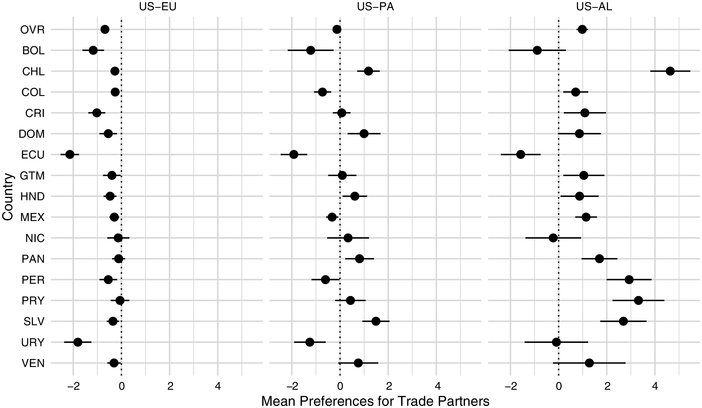
Figure 3.4 describes these variables. On average (as indicated by the estimate across all legislators, labelled ‘OVR’), legislators have a slight preference (0.69) for the EU vis-à-vis the US, no real preference for the US vis-à-vis the Pacific Alliance (the Pacific Alliance is slightly preferred by 0.13, but this is indistinguishable from zero), and a strong preference for trade with the US, compared to ALBA (0.98). At the country level, we find more interesting variation. Uruguay and Ecuador are particularly fond of the EU as a trade partner vis-à-vis the US. Legislators from Ecuador are on average 2.14 points more in favour of the EU. Interestingly, there is not a single country in which the legislators, on average, prefer the US to the EU. The picture is more diverse when it comes to the Pacific Alliance. The US is the preferred partner for legislators in Chile, the Dominican Republic, Honduras, Panama, and El Salvador, whereas legislators from Bolivia, Ecuador, and Uruguay strongly prefer the Pacific Alliance. Finally, only Ecuadorian legislators prefer ALBA as a partner compared to the US. Legislators from all other countries are either indifferent (Bolivia, Nicaragua, Uruguay, and Venezuela) or (strongly) prefer the US. For example, the average rating of the US is 4.64 points higher than the rating of ALBA among Chilean legislators.
Mean preferences for trade partners among Latin American legislators.
We operationalize the average skill level of the workers that legislators represent (Hypothesis 1b) with the mean year of schooling of people in the legislator’s district (Average skill level). The data for this variable comes from Smits and Permanyer (Reference Smits and Permanyer2019). Moreover, we rely on the district’s gross national income per capita to operationalize the idea underlying Hypothesis 1b (GNIpc (region, log)). This data also stems from Smits and Permanyer (Reference Smits and Permanyer2019). Richer districts, on average, should contain a larger number of high-skilled workers. Given the argument that forms the basis for Hypothesis 1b, the expectation is for these two variables to have little explanatory power in the model comparing the US and the EU as trading partners (because both trading partners are at approximately the same level of development). By contrast, the coefficients for these variables should be negative in the models comparing the US to ALBA and the Pacific Alliance, as these entities consist of countries at lower levels of economic development than the US. To capture geopolitical allies or foes, we again rely on voting data from the United Nations General Assembly (Agreement in UNGA voting). Finally, for ideology, we use legislators’ placement on the left–right dimension (Political ideology). We expect more right-wing respondents to always prefer the US in the comparisons that we focus on, although this effect should be weakest for the Pacific Alliance, which is an explicitly right-wing alternative to ALBA.
In terms of control variables, we include legislators’ age, gender, education, and income in the models. Moreover, we control for whether legislators are members of parties in the government. Finally, we also include the relative importance of the US and the other countries as trading partners in the model, following the equation provided in footnote 2 (Relative share partners).
In Table 3.3, we report results from the three models. We find no support for either the economic or geopolitical considerations explanations. With respect to the former (H1b), the coefficients for the GNIpc (region, log) variable have the expected signs, but they never reach statistical significance. The coefficients for Mean years of schooling even have the wrong signs. In none of the models does US disagreement in UNGA voting reach statistical significance, and only in one has it the expected sign (H2b). By contrast, Political ideology has considerable explanatory power. Across all three models, the respective coefficient is positive, meaning that respondents further to the right consistently prefer the US as a trading partner. This preference is weakest for the EU and strongest for ALBA. Especially the latter effect is not surprising as ALBA is generally considered a left-wing alternative to other trade agreements. This evidence thus is in line with Hypothesis 3b.
| Model 3 | Model 4 | Model 5 | |
|---|---|---|---|
| (US–EU) | (US–PA) | (US–ALBA) | |
| Mean years of schooling | 0.08 | −0.03 | −0.03 |
| (0.06) | (0.10) | (0.12) | |
| GNIpc (region, log) | −0.34 | 0.12 | 0.43 |
| (0.22) | (0.40) | (0.50) | |
| US disagreement in UNGA voting | 0.01 | −0.01 | 0.47 |
| (0.15) | (0.33) | (0.39) | |
| Political ideology | 0.21*** | 0.45*** | 1.20*** |
| (0.02) | (0.03) | (0.04) | |
| Relative trade ties | 0.22* | 0.13 | −0.02 |
| (0.09) | (0.16) | (0.14) | |
| Age | 0.00 | 0.01 | 0.02* |
| (0.00) | (0.01) | (0.01) | |
| Primary education | 1.25 | −1.83 | -0.00 |
| (1.69) | (2.60) | (3.46) | |
| Secondary education | 1.72 | −1.61 | −1.15 |
| (1.65) | (2.51) | (3.36) | |
| Tertiary education | 1.88 | −0.48 | 0.32 |
| (1.64) | (2.49) | (3.34) | |
| Income (1,000–4,000 USD) | −0.22 | −0.10 | 0.99 |
| (0.39) | (0.64) | (0.85) | |
| Income (4,000–7,000 USD) | −0.02 | −0.04 | 1.35 |
| (0.40) | (0.66) | (0.87) | |
| Income (7,000–10,000 USD) | 0.06 | 0.34 | 2.13* |
| (0.42) | (0.70) | (0.91) | |
| Income > 10,000 USD) | 0.19 | 0.34 | 2.34** |
| (0.42) | (0.70) | (0.91) | |
| Government | −0.32*** | −0.58*** | −0.92*** |
| (0.09) | (0.16) | (0.19) | |
| Intercept | −1.23 | −2.82 | −11.94* |
| (2.48) | (4.28) | (5.49) | |
| AIC | 6100.93 | 5762.60 | 8404.97 |
| BIC | 6202.77 | 5859.64 | 8507.00 |
| Log likelihood | −3031.46 | −2862.30 | −4183.49 |
| Num. obs. | 1572 | 1221 | 1587 |
| Num. groups: district | 378 | 323 | 372 |
| Num. groups: country_year | 30 | 23 | 30 |
| Var: district (Intercept) | 0.00 | 0.02 | 0.03 |
| Var: country_year (Intercept) | 0.19 | 0.72 | 1.42 |
| Var: Residual | 2.65 | 6.09 | 10.95 |
Source: Own calculations. * p < 0.05, ** p < 0.01, ***, p < 0.001.
3.5 Discussion and Conclusion
This chapter contributes to a better understanding of citizens’ and legislators’ trade partner preferences. Utilizing high-quality survey data with citizens and legislators, our findings suggest important commonalities and minor differences between the two sets of actors. Overall, ideology is the most consistent predictor of which trade partner citizens and legislators prefer. Right-wing citizens and legislators are more supportive of the US as a trading partner than of other partners such as China, the EU, or smaller regional organizations. While legislators’ preferences seem to be entirely driven by ideological considerations, the picture is more diverse among citizens. Citizens’ attitudes also indicate some influence of geopolitical and economic considerations.
These differences should not come as too much of a surprise. For one, given their level of political sophistication, legislators can easily apply their ideological leaning to the specific case of trade agreements. Geopolitical considerations, in contrast, may show up in citizens’ trade partner preferences because they reflect citizens’ generic notions of specific countries. In that sense, we may not so much capture geopolitics in these answers as broader positive or negative views of countries. Geopolitics may show up to a lesser extent in legislators’ attitudes as they have better individual resources to form opinions on trade partners and do not rely on generic notions of countries. Finally, economic considerations are harder to measure for legislators than for citizens. Legislators in multimember districts may follow differential strategies when representing low- or high-skilled workers. That is, while some legislators in one district may represent high-skilled citizens, others represent citizens with lower skills. In contrast, their skill level has substantially more direct consequences for individuals, meaning that they should react more directly to this variable when forming attitudes towards trade partners.
These findings have important implications. First, the findings provide a more comprehensive picture of trade attitudes. Ideology seems to be an important driver of preferences regarding trading partners. As a result, at least in Latin America right-wing individuals and legislators are particularly keen on trade with the US, whereas left-leaning individuals and legislators are potentially more open to other partners. At the same time, while economic interests do not have much explanatory power regarding trade partner preferences, this does not render economic interests irrelevant. Rather, economic considerations may be more important in forming attitudes on trade in general. Additionally, the more fine-grained analysis of citizens’ perceptions of trade with China provides important insights into which dimensions of trade are perceived as good or bad. Economic considerations, particularly as captured by high education, behave as expected and suggest that individuals with higher education are aware of the comparative advantage they enjoy vis-à-vis a trade partner focused on low-skilled workers.
Second, the findings suggest a certain degree of responsiveness of political elites. The elite-citizen gap is rather small, as ideology is a core driver among both groups. Potentially, voting for right-wing candidates would allow right-wing individuals to see their views on trade partners realized. At the same time, there are differences with regard to geopolitical and economic considerations. These differences may be rooted in variation in the levels of sophistication across legislators and citizens. While citizens may need to rely on country cues to form their opinions, a better understanding of the matter may allow legislators not to depend on geopolitical cues. Economic considerations are less pronounced among legislators. This could be because citizens experience the consequences of trade depending on their skills more directly, whereas legislators may follow different electoral strategies.
Future research could extend the analysis to more partners and compare them more systematically. At the moment, we rely on secondary data that provides trade partner preferences for the US and China among citizens, and the US, EU, PELA, and ALBA for legislators. Thus, the comparison between legislators and citizens is imperfect. The more detailed perceptions of positives and negatives regarding trade with China in the Latinobarometro provide interesting additional evidence. At the same time, it hints at a more nuanced picture potentially in line with the economic argument. This may speak to slight differences in the underlying concepts. Stiller et al. (Reference Stiller, Dür and Huber2022) have similarly suggested that general trade attitudes may be less discriminatory, whereas concrete perceptions of trade consequences show a substantially more nuanced pattern. Hence, some of our arguments may speak more to the general sympathy towards specific trade partners, whereas economic considerations are particularly prevalent when evaluating the concrete (economic) consequences of trade with specific partners. Ideally, future research would compare both general partner preferences as well as concrete perceptions of trade with different partners.


 Open access