

Over the last 20 years, several democracies have seen the emergence of radical right-wing populist (RRP) actors, movements, and political parties that have challenged democratic governance. In its contemporary form, this phenomenon was originally identified in Europe, and subsequently, in the United States with the 2016 and 2024 presidential elections. Given its rather rapid spread and association with democratic backsliding, political scientists have devoted significant attention to the identification of the factors behind its emergence and have advanced several explanations. While the rise of RRP candidates and political parties in Europe is often linked directly to economic insecurity and a backlash against post-materialism (Inglehart and Norris Reference Inglehart and Norris2016; Zagórski et al. Reference Zagórski, Rama and Cordero2021; Jansesberger et al. Reference Jansesberger, Lefkofridi and Mühlböck2021; Gest et al. Reference Gest, Reny and Mayer2018; Halikiopoulou and Vlandas Reference Halikiopoulou and Vlandas2020), recent work suggests that the strategies of RRP political candidates and parties in Latin America differ in important ways from their North American or European counterparts. RRP candidates and parties in Latin America often use contentious social issues, such as abortion and LGBT+ rights, as additional tools to mobilize support (Borges et al. Reference Borges, Vommaro, Loyd, Borges, Loyd and Vommaro2024).
In this study, we explore these issues using the 2018 presidential election in Costa Rica as an example. In that election, a right-wing, Evangelical candidate, Fabricio Alvarado Muñoz of the Restauración Nacional party (RN), surprised many observers by winning first place in the first round of voting, largely by mobilizing anti-incumbent, nativist sentiment and opposition to same-sex marriage (SSM), not only among Evangelicals but also other segments of Costa Rican society. Though Alvarado Muñoz ultimately did not become president after the second round of voting, the 2018 Costa Rican presidential race can nonetheless provide insights into the politics of RRP actors (RRPA) in Latin America. We show how Alvarado Muñoz’s early success is consistent with the strategies used by RRPA elsewhere in Latin America, who combine multiple discursive frames, particularly around governance and social issues, rather than economic precarity, to attract voters from a range of diverse backgrounds.
The next section provides a theoretical overview of explanations for the rise of RRP actors, with a focus on how these movements have adapted their discursive messaging to attract voters in Latin America. We then provide an overview of the 2018 presidential campaign, with an emphasis on the ways in which Alvarado Muñoz of the RN used criticism of the incumbent party’s governance and a corruption scandal as well as the issue of SSM to appeal to voters. To further test the relevance of existing explanations for RRP candidate support, we analyze a nationally representative survey collected shortly after the first round of voting in 2018. Consistent with existing research (León-Carvajal and Pineda-Sancho Reference León-Carvajal and Pineda-Sancho2023; Pignataro and Cascante Reference Pignataro and Cascante2019), we show that supporters of the RN candidate were significantly less likely to support SSM or to have a positive view of the incumbent government’s performance. We also show, however, that the RN candidate drew support based on these issues in the first round from a wide range of demographic groups, beyond the obvious support he could expect from Evangelicals. In this way, we add nuance to our understanding of the ways in which RRP candidates mobilize support among broad cross-sections of society using governance and social issues.
Theoretical Explanations for Rise of RRP Movements
We begin with an overview of theoretical explanations for the rise of RRP movements, first with a focus on Europe before pivoting to such movements in the Americas. First, one explanation, generally known as a the “material hypothesis” (Inglehart and Norris Reference Inglehart and Norris2016), relates to economic grievance. Probing this hypothesis, scholars have identified a relationship between voters’ feelings of economic insecurity and their casting of a ballot for RRP parties in the European context (Zagórski et al. Reference Zagórski, Rama and Cordero2021; Jansesberger et al. Reference Jansesberger, Lefkofridi and Mühlböck2021; Halikiopoulou and Vlandas Reference Halikiopoulou and Vlandas2016; Georgiadou et al. Reference Georgiadou, Rori and Roumanias2018; Han Reference Han2016; Spruyt et al. Reference Spruyt, Keppens and Van Droogenbroeck2016; Carreras Reference Carreras2012b). Sometimes referring to the “losers of globalization,” associations have been found between support for these actors and economic hardships attributed to trade shocks (Milner Reference Milner2021), gross domestic product (GDP) decline and unemployment increase (Rama and Cordero Reference Rama and Cordero2018), and technological change causing fear of economic issues, such as work automation and job loss (Milner Reference Milner2021; Im et al. Reference Im, Mayer, Palier and Rovny2019).
Second, research shows that the emergence of RRPA is associated with a backlash to the diffusion of liberal values, particularly in Europe. Authors have found an association between support for these candidates and a sense of loss in traditional social values among supporters (Gest et al. Reference Gest, Reny and Mayer2018; Halikiopoulou and Vlandas Reference Halikiopoulou and Vlandas2020; Inglehart and Norris Reference Inglehart and Norris2016, Reference Inglehart and Norris2017; Gidron and Hall Reference Gidron and Hall2017; Hainmueller and Hopkins Reference Hainmueller and Hopkins2014; Gidron and Mijs Reference Gidron and Mijs2019; Akkerman et al. Reference Redondo, Ronald and Guzmán Castillo2017; Norris Reference Norris2005; Norris and Inglehart Reference Norris and Inglehart2019; Mudde Reference Mudde2004). In Europe, RRP actors mobilize support among the electorate through the deployment of distinct ideological frames around nativism (combining nationalism and xenophobia), authoritarianism (advocating for a strict and orderly society and calling for harsh law-and-order policies), and populism (dividing society between “pure” people and a “corrupt” elite) (Mudde Reference Mudde2004, Reference Mudde2007). RRP actors promise the delivery of policy proposals based on these ideological frames with radical anti-democratic tendencies, such as the bypassing of democratic institutions.
Latin America has not been immune to RRP movements, though the political dynamics in the region differ in important ways from those in Europe and the United States. The subsidence of the Pink Tide in Latin America over the last ten years saw the emergence of several political actors that appear to share some ideological characteristics with their RRP counterparts elsewhere, such as Jair Bolsonaro in Brazil, José Antonio Katz in Chile, Guido Manini Ríos in Uruguay, Fabricio Alvarado Muñoz in Costa Rica, and Javier Milei in Argentina. Footnote 1 Research on the politics surrounding the irruption of these actors point to discursive similarities. On the economic front, for example, leaders such as Bolsonaro, Kast, and Alvarado Muñoz ran election campaigns partly based on the denunciation of their countries’ economic situation and administrative mismanagement (Borges et al. Reference Borges, Vommaro, Loyd, Borges, Loyd and Vommaro2024; Rennó Reference Rennó2020; Díaz et al. Reference Díaz, Kaltwsser and Zanotti2023; Zanotti et al. Reference Zanotti, Rama and Tanscheit2023; Madariaga and Rovira Kaltwasser Reference Madariaga and Rovira Kaltwasser2019). However, given the relative success of Pink Tide governments in mobilizing electorates around redistributive issues and in reducing poverty and inequality during the export boom of the 2000s and 2010s, and partly due to the organizational weakness of the region’s right-wing political parties in post-transition Latin America (Borges et al. Reference Borges, Vommaro, Loyd, Borges, Loyd and Vommaro2024), RRP politicians have attempted to galvanize electorates through the deployment of ideational and cultural discursive frames as these actors have become less secular than previous right-wing political parties.
Taking advantage of the corruption scandals that rocked numerous leftist governments, these actors have attempted to secure electoral support through an anti-incumbency discourse with a clear focus on cultural issues. Within a context of political party-system fragmentation, successful right-wing actors and parties have mobilized people ideationally along cultural cleavages and through the crafting of political identities based on ideological frames that resemble those of their European counterparts. Adopting an “anti-establishment” approach, RRP politicians have constructed enemies to blame for voters’ cultural insecurities, such as globalist progressive elites. These actors tend to take reactionary stances on internationalism, and they appeal to nativist ideas. They blame global elites and international institutions for imposing foreign ideologies on societies and allege an infringement on national sovereignty based around majoritarian conceptions of democracy (Borges et al. Reference Borges, Vommaro, Loyd, Borges, Loyd and Vommaro2024; Rennó Reference Rennó2020; Madariaga and Rovira Kaltwasser Reference Madariaga and Rovira Kaltwasser2019). Kast and his Republican Party in Chile, for example, have framed a discourse clearly anchored in authoritarian, nativist, and populist ideas with clear proposals to eliminate migration and secure borders, appealing to notions of popular sovereignty and denouncing international treaties (Díaz et al. Reference Díaz, Kaltwsser and Zanotti2023).
A salient element of proposals advanced by Latin American RRP actors is a direct appeal to traditional moral values. Work on these actors shows that the post-transition partisan right has pivoted to the deployment of a cultural agenda to mobilize sectors that are resistant to changes in family structures and to the expansion of Sexual and Reproductive Rights (SRR) (Borges et al. Reference Borges, Vommaro, Loyd, Borges, Loyd and Vommaro2024). These appeals have taken place within the broader context of a social backlash over the last two decades to the rapid expansion of SSR in the region, a phenomenon that has been labelled as “neo-conservatism” by Latin American scholars (Vaggione and Campos Machado Reference Vaggione and Machado2020). RRPA have taken advantage of such a backlash to politicize cultural issues and mobilize electorates (Payne and Aruska de Sousa Santos Reference Payne and Sousa Santos2021; Zarember et al. Reference Zarember, Tabbush and Friedman2021; Biroli and Caminotti Reference Biroli and Caminotti2020; Pérez-Betancour and Rocha-Carpiuc Reference Pérez-Betancur and Rocha-Carpiuc2020; Biroli Reference Biroli2018; Corrales Reference Corrales2021). Sexual politics, for example, played a significant role in the election of Bolsonaro in Brazil in 2018 (Payne and Aruska de Sousa Santos Reference Payne and Sousa Santos2021; Rennó Reference Rennó2020) and the defeat of the 2016 referendum on the peace accord in Colombia (Beltrán and Creely Reference Beltrán and Creely2018; Corredor Reference Corredor2021; Vigoya and Rodríguez Rondón Reference Vigoya and Rodríguez Rondón2017; Rodríguez Rondón Reference Rodríguez Rondón2017).
As part of this process, RRPA have framed their messaging by deploying anti-genderism: a rejection of abortion, SSM, and sex education, core SRR policies. Footnote 2 Calling it “gender ideology” and relying on fear, neo-conservative actors amplify exaggerated, but credible, threats to traditional religious values and denounce the perceived imposition of socially constructed ideas around gender and sexuality by progressive elites (Bárcenas Barajas Reference Bárcenas Barajas2021; Corredor Reference Corredor2021; Biroli Reference Biroli2018; Biroli and Caminotti Reference Biroli and Caminotti2020; Vaggione Reference Vaggione2022; Rousseau Reference Rousseau2020; Miskolci Reference Miskolci2018). Within this regional cultural backlash, research shows that SSM has become the most polarizing issue and one that has been used strategically by RRP politicians (Borges and Vigidal Reference Borges, Vidigal, Borges, Loyd and Vommaro2024). Indeed, the expansion of SSM rights in the region has provided these actors with a great opportunity to mobilize opposition to queer rights. While Latin America did not experience the post-materialist turn that triggered a cultural backlash in Western Europe and elsewhere, evidence suggests that progressive cultural changes, such as advancement of queer rights, have indeed polarized mass publics in the region (Borges et al. Reference Borges, Vommaro, Loyd, Borges, Loyd and Vommaro2024). And religion has been a central part of the phenomenon: the politicization of religious identities, following the rapid expansion of Evangelical churches across the region, has been found to be a major determinant of the social cultural backlash in Latin America (Borges et al. Reference Borges, Vommaro, Loyd, Borges, Loyd and Vommaro2024).
Thus far, our discussion has highlighted similarities and differences in the political and discursive strategies of political movements and politicians in Europe and Latin America who have generally identified as both populist and right-wing in the literature. These similarities and differences between Latin American RRP movements and their brethren elsewhere pose a challenge for comparativists who seek to balance conceptual precision and comprehensive comparative explanations. Conceptually, Mudde (Reference Mudde2007, 24–29) highlights nativism, authoritarianism (or anti-liberalism), and radical-right ideology as the core features of what he terms populist radical-right parties in Europe, where radical includes elements of anti-democratic values as well. As our preceding discussion emphasizes, RRP movements in Latin America often embrace the same three core characteristics of nativist, anti-liberal, and radical-right ideological discourses, but in slightly different ways. For example, post-materialism in Latin America has been belated, uneven, and less pronounced than in Europe, and material values still prevail (Kestler Reference Kestler2022). Nonetheless, as we explain above, RRP movements in the region have used the expansion of SSR to mobilize voters by framing SSR not only in right-wing ideological terms but also as foreign, liberal ideas that undermine national sovereignty, effectively repackaging core features identified by Mudde (Reference Mudde2004) in European RRP movements. Further, even though materialist values are more widespread in Latin America than in Europe, due to high levels of poverty and inequality, some scholars have argued that opportunities for the emergence of radical right-wing candidates exist due to their proposed tougher attitude toward crime in the world’s most violent region and the “crisis of democratic representation” stemming from corruption, suggesting that the theories developed to explain the emergence of RRP movements in Europe can be useful in explaining the emergence of such movements in Latin America (Zanotti Reference Zanotti2024). Given these similarities, the RRP conceptualization has been applied to Latin American politicians such as Bolsonaro, Kast, Maini Ríos, and Milei based on the degree to which they exhibit populist and radical-right discursive practices (Kestler Reference Kestler2022). Footnote 3
Nevertheless, the transferability and applicability of these theories to the Latin American reality pose difficulties for comparativists because the context is different, and RRP movements remix the core elements of nativism, authoritarianism, and radical-right ideology in novel ways to garner support. In addition, right-wing voter identification has in fact remained constant in Latin America (23%) over the last two decades (Kestler Reference Kestler2022). As a result, scholars have argued that support for these actors is likely to be temporal and their emergence mostly a reaction to failures by incumbents, mostly leftists (e.g., corruption) within the collapse of political party systems, and not the result of structural, cultural changes (Luna and Rovira Kaltwasser Reference Luna and Rovira Kaltwasser2021). In our analysis of the RN presidential candidate, Alvarado Muñoz, we seek to highlight the ways in which his discursive strategies reflect the core conceptual characteristics of RRP candidates, including nativism, authoritarianism, and radical-right ideology. Like other RPP actors elsewhere in Latin America, however, Alvarado Muñoz’s deployment of these discursive frames took on a specifically Latin American flavor, combining nativism based on a rejection of foreign economic and social values with opposition to SSM and criticism of the incumbent party for corruption and economic mismanagement.
The 2018 Costa Rican General Elections
The Context
An anomaly in a region notorious for political volatility, Costa Rican politics has been defined by remarkable democratic stability. Since the first post-civil war elections in 1953, the country has held 18 regularly scheduled free and fair elections every four years that have seen, uninterruptedly, the election of a president and 57 deputies to its National Assembly. For close to six decades (1953–2010), elections were contested by two main political forces: the dominant (center-left) National Liberation Party (Partido de Liberación Nacional, PLN) and an opposition party, which since 1983, became the (center-right) Social Christian Unity Party (Partido Unidad Social Cristiana, PUSC). These two parties anchored a firm bipartisan system central to Costa Rica’s democracy, which was once identified as having Latin America’s most institutionalized party system (Mainwaring Reference Mainwaring and Mainwaring2018). The country’s bipartisan stability is best captured by the fact that a run-off presidential election after the first ballot had never been needed until 2002, which was repeated in 2014 and 2018.
Costa Rica’s politics, and in particular its party system, has undergone two important changes since the turn of the century. The first is a broad process of political realignment. Footnote 4 In tandem with the general global shift to market-friendly economics, the PLN moved from a social-democratic position to a more economic-liberal one during the early 1980s and early 1990s. The party’s rightward slide produced a void on the left of the spectrum, providing ideological space for the emergence of new leftist parties. The space vacated by the PLN was progressively occupied by a new left party, the Partido Acción Ciudadana (PAC). The PLN’s rightward move also blurred the ideological lines between the PLN and the PUSC, weakening the latter. This ideological reorganization induced a realignment of the electorate, some of which withdrew support from the two traditionally dominant parties in favor of smaller ones (Carreras Reference Carreras2012a). The process accelerated as support for the PLN and PUSC continued to decrease. Footnote 5 Costa Rica’s partisan duopoly thus unraveled as both parties’ combined share of the vote decreased steadily: from 97.4% in 1994 for general elections, to 80.6% in 2002 and 60.3% in 2014; and from 92.98% for the legislative elections in 1994, to 63.16% and 49.19% respectively (Cascante and Lara Escalanate Reference Cascante and Lara Escalante2021).
The second change regards political fragmentation. While voters have expressed some disaffection with politics, Footnote 6 voting abstentions, a common sign of political dealignment, has not increased significantly. Footnote 7 Rather, voters increased support for smaller parties all while maintaining electoral engagement. The number of political parties has thus progressively increased. The Effective Number of Parties index Footnote 8 has gone from 2.11 in the presidential and 2.29 in the legislative elections of 1994, to 4.37 and 4.87 in 2014 respectively (Cascante and Lara Escalante Reference Cascante and Lara Escalante2021). In 2018, 13 political parties fielded candidates for the presidency, and 20 parties competed for seats in the National Assembly, the highest number of parties competing in elections since 1953. Meanwhile, the weakening of the major political parties’ national presence coincided with the regional concentration of political support of several smaller parties in a limited number of cantons. The level of political party “nationalization” has therefore decreased. According to Cascante and Camacho Sánchez’s “nationalization index,” Costa Rica’s political party nationalization decreased from 0.89 in 1994 to 0.79 in 2016 (Reference Cascante and Sánchez2019, 201).
The rightward slide of a more fragmented parliament also involved the incursion and increased presence of Evangelical Christians in the National Assembly. Evangelical organizations decided to enter electoral politics in an attempt influence policy more directly in part as a result of their inability to secure a constitutional reform that would enshrine equality of religion in the 1990s (Fuentes Belgrave 2018, 88). Footnote 9 The decision has yielded results: the number of deputies elected to the National Assembly from parties representing the Evangelical movement has increased from one in 1998, to three in 2014, one of whom was Alvarado Muñoz with the RN. In 2018, the RN won 14 seats during voting that coincided with the first round of voting for the president.
The Political Tremor
The 2018 Costa Rican general elections campaign unfolded in two distinct phases separated by the Inter-American Court of Human Rights’s (IACHR) decision on SSM released that January. Footnote 10 Before January, the electorate was engaged but undecided, a sign of the political realignment and fragmentation described above. In October, 79% of Costa Ricans intended to vote (Alfaro Redondo et al. Reference Redondo, Ronald and Guzmán Castillo2017a), but only 25% intended to vote for the PLN or PUSC candidates (15% and 11% respectively), with another 40% still undecided in November (Alfaro Redondo et al. Reference Redondo, Ronald and Guzmán Castillo2017b). Only 6% of decided voters expressed support for the candidates who eventually faced off during the run-off election on April 1, 2018: 2% for Alvarado Muñoz (RN) and 4% for Alvarado Quesada (PAC) (Alfaro Redondo et al. Reference Redondo, Ronald and Guzmán Castillo2017b).
The campaign also unfolded within a larger context shaped by a corruption scandal and distinct economic conditions. In mid-2017, a corruption scandal (the cementazo) rocked Costa Rica’s political class, eventually leading to the removal of a Supreme Court Judge, an Attorney General, Central Bank officials, and deputies of the Legislative Assembly. The scandal became a central electoral issue and fostered a generalized feeling of political disaffection and implicated members of the PAC-led administration (Cascante and Lara Escalante Reference Cascante and Lara Escalante2021). In November of that year, over 88% of those polled stated that they had heard about the scandal, 54.5% that they were following the case closely (Alfaro Redondo et al. Reference Redondo, Ronald and Guzmán Castillo2017b), and corruption was ranked as the second most important issue facing the country in October (Alfaro Redondo et al. Reference Redondo, Ronald and Guzmán Castillo2017a).
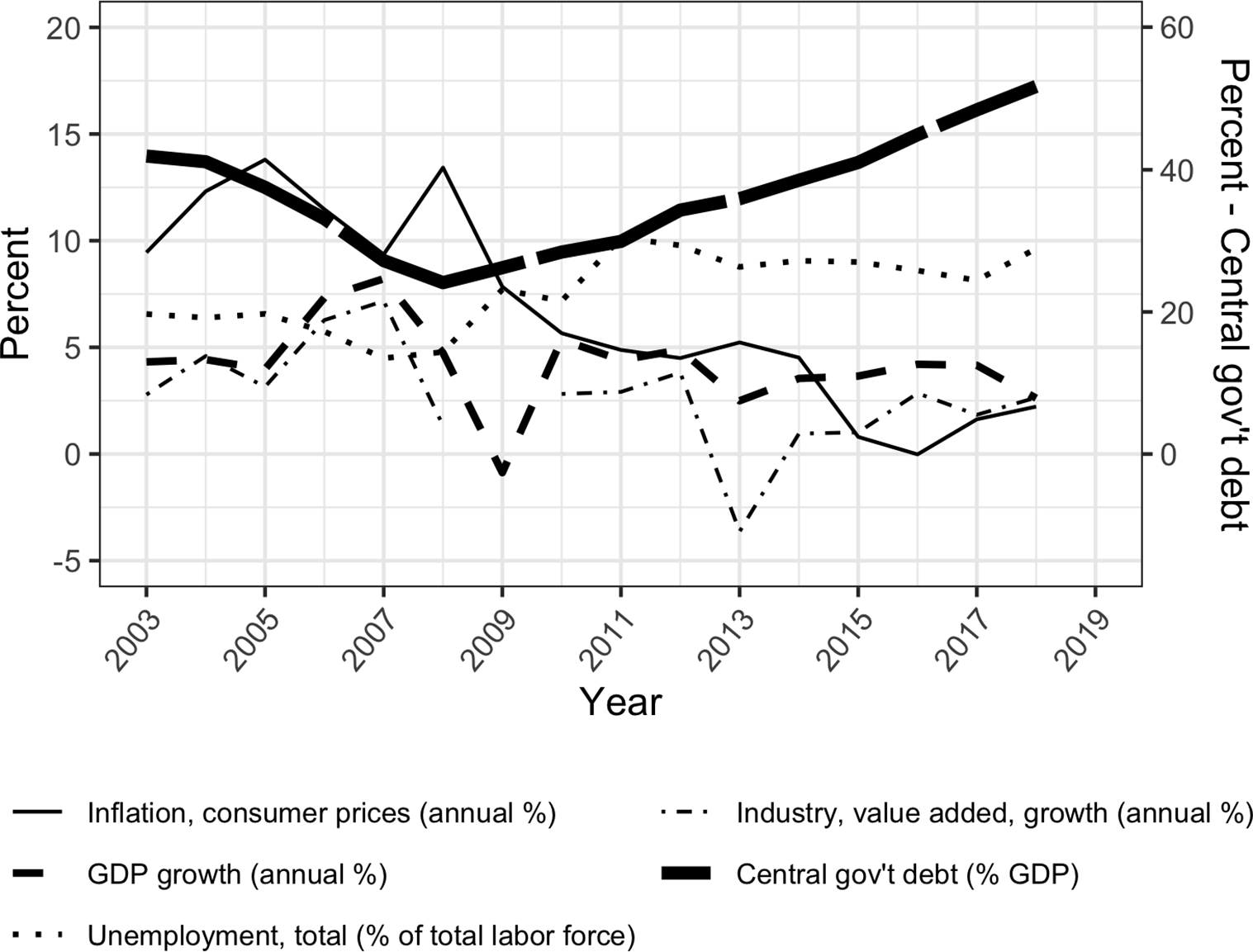
On the economic front, as the election unfolded, the PAC administration led by Luís Guillermo Solís (2014–18) framed the country’s economic situation as one of “fiscal insolvency.” Alerting Costa Ricans of imminent bankruptcy given the country’s increasing fiscal deficit and increasing debt, his government failed on three occasions to gain legislative support for his economic reform program, which sought to overhaul the taxation system to increase government revenue (Borges Reference Borges2017). In August 2017, Solís tabled a series of proposals as a one last attempt to “salvage the country” from insolvency in a “matter of months” (La República, August 2, 2017). By the end of 2017, Costa Ricans reported that unemployment was the number one problem facing the country, while the country’s economic situation was third (Alfaro Redondo et al. Reference Redondo, Ronald and Guzmán Castillo2017a). Economic indicators, plotted in Figure 1, are mixed. In 2017–18, central government debt had been trending upward for several years, while unemployment consistently had been higher than normal for a decade. Other key economic indicators, such as economic growth, industry output, and inflation, suggested the economy was relatively healthy. Nonetheless, the incumbent government led by the PAC primed people to be concerned about government debt and economic performance.
Economic Trends in Costa Rica, 2003–18.
Source: Inflation through industry value added growth from World Bank (2022), and central government public debt as a percentage of GDP from CEPAL (2022).

In 2016, Guillermo Solís had requested an advisory opinion on the legality of Costa Rica’s lack of recognition of SSM to the IACHR. In January 2018, the IACHR advised that the country’s failure to recognize SSM was a violation of human rights, and the opinion changed the electoral campaign dramatically. Immediately after the ruling was made public, Alvarado Muñoz stated clearly and publicly his opposition to the ruling, and the RN went on to weaponize SSM, focusing their campaign almost entirely on this issue. The day of the ruling, in interviews and three Facebook live videos, Alvarado Muñoz re-asserted the position he and his party had held for several years: marriage is between a man and a woman, and the traditional marriage is the foundation of society (El Mundo, La República, January 10, 2018, Semanario Universidad, January 24, 2018). He repeated this perspective over the next several weeks (for example @FabriAlvarado7 2018), but also framed it as an imposition on Costa Rica by liberal elites, and, ironically since Costa Rica requested the court’s advisory opinion, an infringement on the country’s sovereignty. Declaring that “we are not willing to accept an LGTB and pro-abortion agenda and gender ideology,” he argued that the court’s decision had been the result of an agreement forged by liberal accomplices (compadre hablado), between the PAC government and the international institution, knowing “full well what the [court’s] response would be” (El Mundo, January 11; Reuters, February 1, 2018). He further argued that, beyond his opposition to SSM, Costa Ricans were “outraged” by the “imposition of laws” by an international organization (La República, January 25, 2018). Alvarado Muñoz’s denunciation of the opinion was framed as an attack on the county’s popular sovereignty adhering to a view articulated by Costa Rica’s socially conservative actors that is based on a democratic “majority principle:” democracy should represent the values of the majority, which opposes a globalist ideology that supports SRRs (León-Carvajal and Pineda-Sancho Reference León-Carvajal and Pineda-Sancho2023). As such, the IACHR opinion was framed as a globalist attack on the very character of Costa Rican democracy. He thus proposed rejecting the decision, withdrawing Costa Rica from the court, and making the elections of February 4 “our referendum on marriage between a man and a woman” (Reuters, February 1, 2018; La República, January 25, 2018). Alvarado Muñoz’s public statements attracted significant public attention. Within days, his social media videos had been reproduced 445,000 times and shared 13,00 times, and by January 13, his name had the highest Google Trends search popularity score in the country (Semanario Universidad, January 24, 2018).
By the time of the election’s first round, the debate over SSM was central. RN’s discourse on this issue gained significant traction and appeared to have resonated with an ample number of voters. Within 10 days of the IACHR ruling, he led polls with 17% of support from decided voters (Alfaro Redondo et al. Reference Redondo, Ronald and Guzmán Castillo2018a). He led in the first round of the elections held on February 4, with 24.99% of the vote. Alvarado Quesada (PAC) came second with 21.63%. PLN and PUSC candidates came in third and fourth places and earned a combined 34.62% of the vote. RN won 14 seats in the National Assembly, consolidating the socially conservative and religious vote. Footnote 11
Hypotheses
Drawing on the theoretical debates about RRP support in Latin America, we develop several hypotheses that explain the effectiveness of the discursive frames deployed by Alvarado Muñoz during the 2018 Costa Rican presidential election.
First, the 2018 election unfolded in a context within which the sitting government had framed Costa Rica’s economic situation as being one of economic insolvency. Alvarado Muñoz blamed the incumbent PAC Solís-led administration, and, by extension, the establishment, for economic mismanagement and increased socio-economic exclusion. At the same time, we know that, in contrast to electorates in industrial democracies, material values are more widespread in Latin America (Borges et al. Reference Borges, Vommaro, Loyd, Borges, Loyd and Vommaro2024; Kestler Reference Kestler2022), potentially making Costa Ricans particularly sensitive to economic concerns and suggesting that:
H1: Support for RN was stronger among those who thought the economy was doing poorly.
Second, because right-wing parties have had difficulties mobilizing support around economic issues in Latin America, they have resorted to the deployment of frames that blame establishment parties and actors for a variety of society’s problems, often couched on allegations of corruption and mismanagement. We thus expect:
H2: Support for RN was stronger among those critical of the incumbent government’s management.
Third, while in some cases, such as Chile, RRPA have deployed nativist frames calling for an end to migration, in Costa Rica Alvarado Muñoz developed and deployed a frame that alleged the imposition of an international globalist agenda. His campaign systematically criticized international organizations, such as the United Nations, for intervening in the country’s internal affairs, including criticism of the ICHR decision on SSM. The RN candidate argued that the ICHR opinion was an imposition of values espoused by a liberal minority and which go against traditional values shared by the country’s democratic majority (León Carvajal and Pineda-Sancho Reference León-Carvajal and Pineda-Sancho2023). We thus expect:
H3: Support for RN was stronger among those who believed that international organizations should not interfere in the upholding of human rights.
Fourth, we consider the specific issue of SSM, which was central to Alvardo Muñoz’s campaign. This was consistent with the region’s neo-conservative backlash against the advance of SSR, where SSM has become one of the most polarizing cultural issues in Latin America.
We thus propose that:
H4: Support for RN was strong among those who opposed SSM.
Of course, not every political argument will appeal equally to all voters, which is why candidates, like Alvarado Muñoz, often use multiple discursive frames within a single political campaign. This strategy is particularly important for RRP candidates, who cannot rely on redistributive promises to attract low-income voters for fear of alienating the support of traditional right-leaning supporters concentrated in upper socio-economic strata. Other political arguments, like anti-incumbency or opposition to SSR, are also likely to appeal to varying degrees to different constituencies. For example, given the strong association between religiosity and Evangelical religious affiliation and opposition to SSM (Corrales Reference Corrales2021; Mcadams and Lance Reference Mcadams and Lance2013; Dion and Díez Reference Dion and Díez2017), those groups were most likely to be persuaded to vote for Alvarado Muñoz due to this issue. For these reasons, in the analysis below, we also test the hypotheses above on demographic subgroups to account for this potential subgroup heterogeneity.
Data and Analysis: Public Opinion Evidence from Costa Rica’s 2018 General Election
In this section, we consider whether public opinion evidence is consistent with the theoretical hypotheses during Costa Rica’s 2018 general election (Dion and Díez Reference Dion and Díez2026). We analyze a nationally representative sample of Costa Rican adults collected March 19–21, 2018, approximately the midpoint between the first (February 4) and second (April 1) round of presidential votes. Footnote 12 First, we consider whether someone voted for Alvarado Muñoz, the RN candidate, in the first round of voting. In our sample, 28.8% (247) of respondents reported voting for the RN, of the 859 who indicated they voted in the first round. Our sample includes a slightly higher proportion of respondents indicating that they voted for RN and a lower proportion of non-voters than in the official first round results (see Table 1). We regress first-round vote choice on measures of our key theoretical and control variables. We also repeat our analyses by religious identity, income, education, and age to understand the extent to which the correlates of support vary by demographic or social groups.
Vote for RN in Round 1

Note: Weights adjust for age and education. For weighted, adjusted counts using sampling weight in parentheses. Population estimates from International Foundation for Electoral Systems (IFES) (n.d.). based on valid votes and voter registration estimates.
First, to measure the resonance of economic concerns, we measure sociotropic evaluations of the economy in which respondents rated the economic situation in the country as very bad, bad, OK, or good/very good. Household economic situation is measured as to whether respondents’ household monthly income sufficiently covers expenses on a scale of very difficult, difficult, just enough, or can save. Footnote 13 Second, we also measure respondents’ evaluation of the incumbent government’s general performance based on how respondents rated the current government’s management (“la gestión del gobierno actual” in Spanish) on a scale of good/very good, OK, bad, or very bad. Given the corruption scandal and government’s fiscal woes, we want to account for anti-incumbency bias. Those who think the current government has performed badly will be more likely, all else being equal, to vote for RN. Third, responsiveness to nationalistic messaging by the RN campaign is measured using a question asking whether respondents agreed whether “the United Nations should intervene if a country violates human rights” or “even if a country violates human rights, national sovereignty should be respected, and the United Nations should not intervene.” Footnote 14 About 12.7% of respondents did not know how to answer this question, which we include as a separate category in our analyses. Those who reject UN intervention in domestic human rights are expected to be more likely to support the RN candidate. Finally, we include opposition to SSM rights, which we expect to be positively associated with RN candidate support. Opposition to SSM rights is measured with a question asking whether same-sex couples should have the right to marry (“casarse” in Spanish), on a zero (“strongly agree”) to five (“strongly disagree”) scale.
In addition, to these correlates of right-wing populist support, we also include additional control or socio-demographic indicators. We include opposition to a woman’s access to abortion for any reason, also measured on a zero to five scale for two reasons, First, like attitudes to SSM, attitudes to abortion are often associated with post-materialist values, and second, practicing Evangelicals and Catholics usually also oppose rights to abortion (Blofield Reference Blofield2006; Engeli et al. Reference Engeli, Green-Pedersen and Larsen2012). In our sample, beliefs about SSM and abortion rights are only moderately correlated (r = 0.416, p < 0.001). Therefore, if opposition to SSM rights is more strongly and significantly associated with support for the RN than opposition to abortion rights, it would suggest that post-material values were not driving voters to the RN, but the specific issue of SSM. Because some research on right-wing populism outside of Latin America suggests political marginalization correlates with right-wing populist support, we include a measure based on a question asking respondents the extent to which they agree with the statement, “People like me do not have a voice in government decisions,” on a six-point scale anchored with strongly disagree and strongly agree. The correlations between evaluations of the economy, government management, economic situation, cultural values, and political marginalization are weak to moderate but statistically significant at conventional levels (except political marginalization, see Table 1 in the Supplementary Material). Together, this suggests that these measures capture distinct attitudes among Costa Ricans.
Respondents were also asked about their religious affiliation and how often they attend religious services. Given the important role that religious leaders and churches played during the campaign, we also distinguish between those who practice their faith regularly based on frequency of attending religious services at least once a month or more. The non-practicing are those without a religious identity (16.9% of respondents overall) or who identify with a faith but report never attending services (or non-practicing believers, 14.3% of respondents). Footnote 15 We expect RN support to be higher among Evangelicals given that they are, on average, more conservative and religious (Corrales Reference Corrales2021; Mcadams and Lance Reference Mcadams and Lance2013). We also include controls for education, age, and gender.
Multivariate Analysis of Round 1 Support for RN
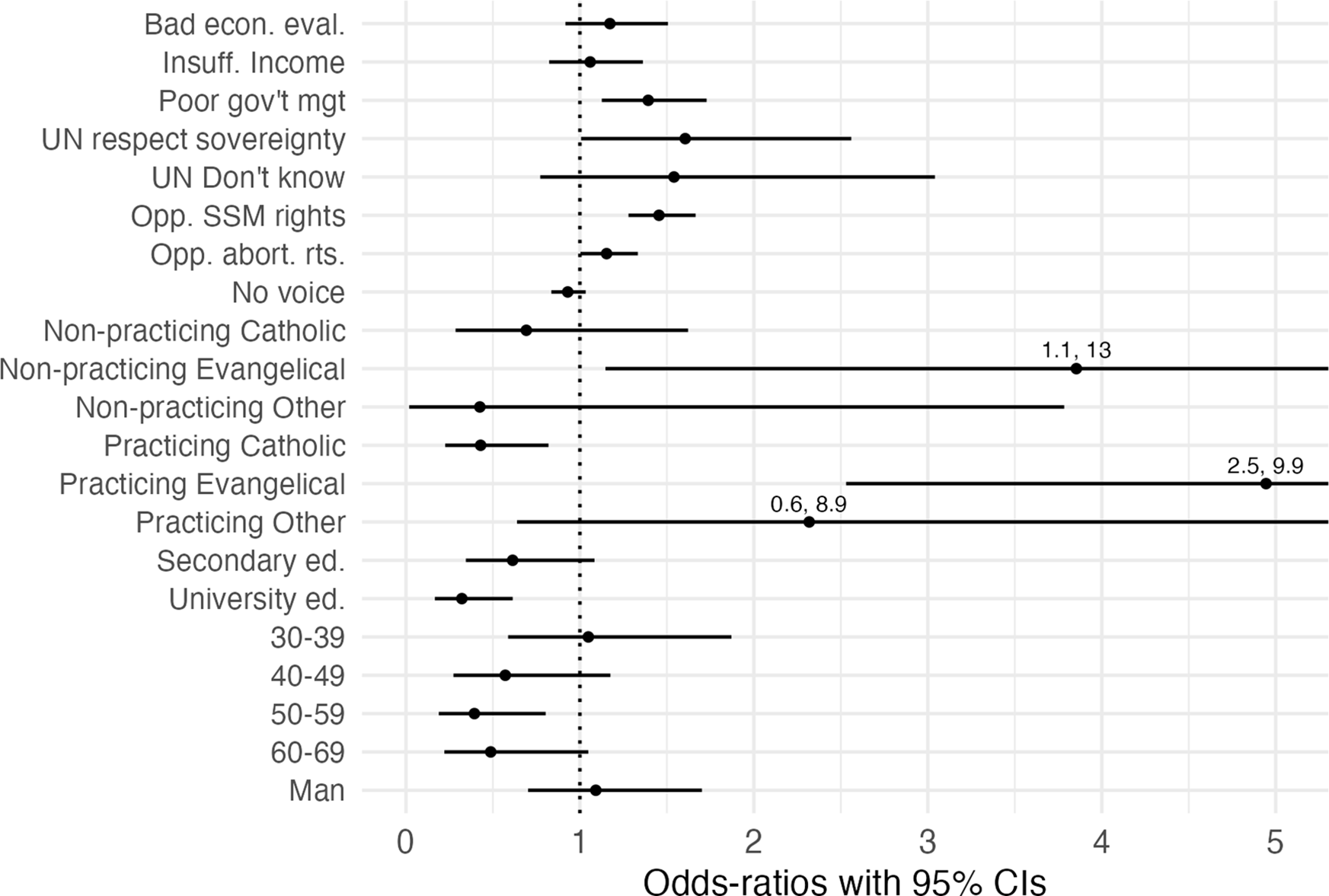
We begin by regressing reported vote for RN on a complete model of voter characteristics and attitudes. See Figure 2 and Supplementary Material Table 2, column 1. Overall, the results suggest that supporters of the RN candidate were significantly more likely to think the incumbent government was poorly managed (H2), to believe that International Organizations should not intervene to uphold human rights (H3), and to oppose SSM rights (H4), while household or national economic beliefs were not significantly associated with RN candidate support (H1). Overall, voters who were more critical of the incumbent government had nearly 40% higher odds (OR = 1.393) of reporting voting for RN in the first round. Those who oppose IO interventions in domestic affairs had about 60% higher odds (OR = 1.605) of reporting voting for the RN candidate than those who agreed that IOs should intervene to protect human rights. Voters expressing stronger opposition to SSM also reported about 46% higher odds (OR = 1.455) of supporting the RN candidate. Together, these results are highly consistent with other findings in the region that suggest that right-wing populists mobilize support by deploying frames that are critical of establishment political parties and actors (anti-incumbency frame), international elites and organizations (nativist frame), and liberal cultural values.
Vote for RN, Round 1.
Note: Political attitudes or beliefs included but not plotted. Complete results included in Supplementary Material Table 2, Column 1.

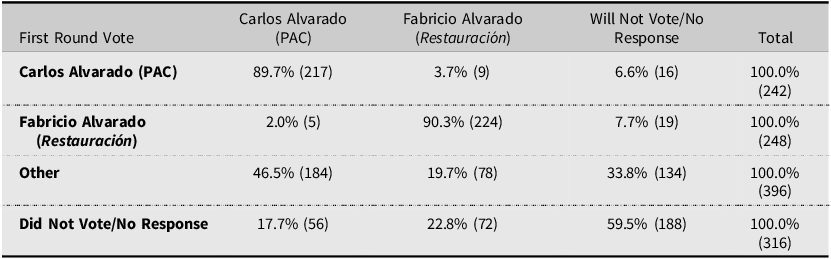
Second-Round Vote Intention by Reported First-Round Vote

For full table, χ 2 = 438.87 (df = 2, p < 0.001). If sample is restricted to those who did not vote, respond, or voted for another candidate in round one, χ 2 = 69.45 (df = 2, p < 0.001).
Contrary to patterns of support for right-wing populism in Europe, economic grievances were not strongly associated with support for the right-wing candidate. Similarly, supporters of the RN candidate were not significantly more likely to believe they had no voice in politics. We included opposition to abortion rights to assess opposition to post-materialist values, and though voters who express more opposition to absolute abortion rights were statistically more likely to vote for the RN candidate, the odds only increased 15% (OR = 1.154), which is substantively a third of the size of the association between opposition to SSM and right-wing candidate support. These results confirm the general pattern found in Latin America of SSM being the most polarizing cultural issue and one with significant mobilizing potential.
As expected, Evangelical Christians, both practicing and non-practicing, were significantly more likely than non-practicing (the reference category) Costa Ricans to report voting for RN in Round 1, while practicing Catholics were significantly less likely than the non-religious to report having voted for RN (see Figure 2). Non-practicing Evangelical voters were either 2.8 times more likely (OR = 3.854) and practicing Evangelical voters were nearly four times more likely (OR = 4.945) to report voting for the RN candidate compared to voters with no faith. In contrast, practicing Catholic voters reported about 57% lower odds (OR = 0.429) of voting for the RN candidate than non-believers. Those with at least some post-secondary education also reported significantly less support for the RN candidate, or about 68% lower odds (OR = 0.321) of voting for him in the first round, than those with those who had not attended high school. Older generations were also more likely to report voting for the RN candidate, and there was no significant difference between men and women.
Because we are interested not only in overall patterns of support but also why support for RN varied by subpopulations, we estimated logistic regression models by the potential demographic correlates of RN support: religious practice, income, education, and age. In Figure 3, we plot the odds ratios with 95% confidence intervals for key measures of attitudes and beliefs described above, across each subgroup. See Supplementary Material Table 2 for complete model results. Economic beliefs (H1), either about the national economy or household income, are not associated with support for the RN candidate among any subgroup. However, poor government management (H2) is statistically associated with a stronger likelihood of reporting voting for the RN candidate in the first round among non-Evangelical voters, lower income voters, those with no university education, and those over 40 years old. These findings are consistent with work which suggests that RRPA can attract support from unexpected groups, such as less educated, poorer, and non-Evangelical voters, for whom the messianic messaging of saving the country from incompetence and corruption appears to resonate (Rennó Reference Rennó2020). The anti-establishment frame, a proxy for corruption, appears to have reached some groups within the context of Costa Rica’s cementazo scandal. They are also consistent with a more general pattern in Latin America that saw the erosion of support for incumbent leftist governments in the region (Luna and Rovira Kaltwasser Reference Luna and Rovira Kaltwasser2021). The anti-establishment frame thus appears to have been partially successful in attracting support from unexpected groups.
Vote for RN and attitudes, Round 1.
Note: Respondent demographics included but not plotted. Complete results included in Supplementary Material Table 2, Columns 2–9.

The measure of anti-IO sentiment (H3) is only significantly associated with a higher likelihood of voting for the RN among Evangelical voters, suggesting that they were more aware of the candidate’s messaging on this point than other voters. Finally, consistent with the dynamics of the campaigns and our expectations, opposition to the right to SSM (H4) is consistently statistically significantly associated with a higher likelihood of voting for the RN candidate across all demographic subgroups. In contrast, opposition to abortion rights is only statistically significantly associated with voting for the RN among voters who are struggling financially. Together, these results on SSM and abortion rights suggest that the specific issue of SSM was used to appeal to a subset of voters, rather than a broader backlash against post-materialism. Put differently, beyond Evangelicals, only opposition to SSM consistently attracted voters across all demographic subgroups.
Costa Rica’s National Assembly is elected through closed-list proportional representation by province. As mentioned above, NR won 14 out of 57 seats (24.6%) and PAC won 10 out of 57 (17.5%) seats in the National Assembly during the first round of voting in 2018. Only Liberación Nacional (PLN) won more seats, winning 17 out of 57 (29.8%). We cannot directly measure whether voters strategically split their votes between the presidential election and the National Assembly election, though the evidence is suggestive. The NR won a proportion of seats that was comparable to the share of its presidential candidate’s vote share (25%). In contrast, the PAC presidential candidate came second, but the party’s seat share put it in third place in the National Assembly. Furthermore, when we compute the correlation in vote share for each party’s presidential candidate and its vote share for the National Assembly at the level of voting locations, the correlation is highest for RN voters (0.927), with the lowest correlation of the three for the PAC (0.903, see Tables 7 and 8 in the Supplementary Material).
Round 2, Support for RN
While Alvarado Muñoz modulated somewhat his discourse after the first round of elections by, for example, stating that the decision to withdraw Costa Rica from the IACHR was not final and that he would appoint “homosexuals” to cabinet posts (La República, March 26, 2018), his opposition to SSM continued to be central to the RN campaign (Cascante and Vindas Reference Cascante and Vindas2019, 28–33). His discourse continued to gain traction: indeed, to the surprise (and panic) of many, polling showed him in a statistical tie with the establishment candidate at 43% (versus 42%) a week before the election (Alfaro Redondo et al. Reference Redondo, Ronald, Cascante and Guzmán Castillo2018b) to be held on April 1. This was a ceiling for RN support, however, because RN earned only 39.4% of the vote versus 60.6% for the PAC in the second round.
According to our March 2018 survey, about 90% of first-round supporters of RN and PAC planned to repeat their vote for the same candidate in the second round (see Table 2). Among those that supported other parties in the first round, most (46.5%) indicated that they would vote for the PAC candidate in the second round. By comparison, about a third indicated they would not vote or refused to respond, and nearly 20% (19.7%) said they would vote for RN. Most respondents who did not respond or reported not voting in round one (59.5%) did not respond or plan to vote in the second round.
Multivariate Analysis of Round 2 Support for RN
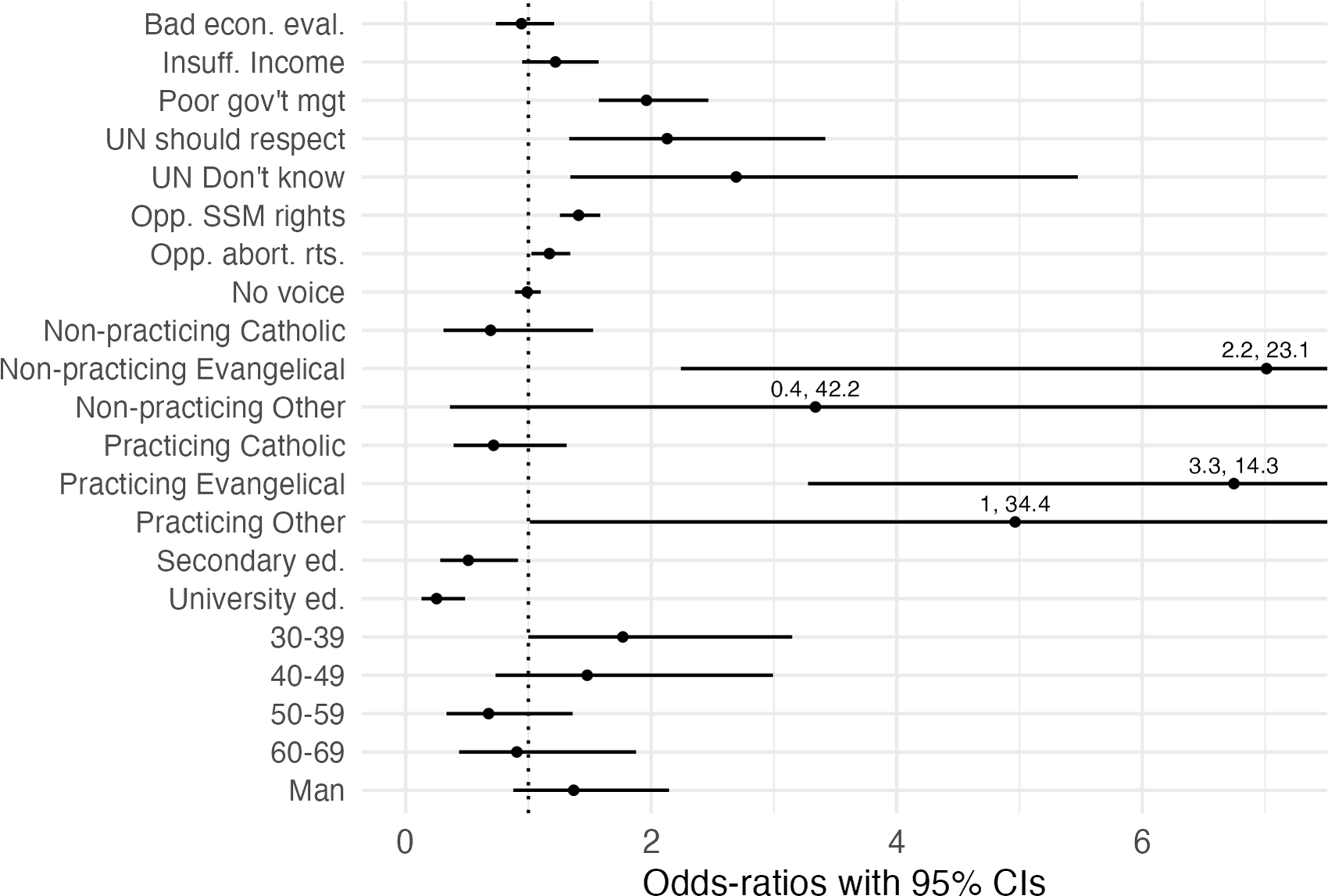
As the election moved into the second-round vote, intention to vote for RN was generally correlated with the same characteristics that mattered in the first round and that correlation in fact intensified among some groups. For example, intention to vote for RN became even more likely among Evangelical and less educated voters. Age and gender follow similar patterns to those of the first round of voting. See Figure 4 and Supplementary Material Table 3. Like the first-round analysis, we also estimate the model separately for subgroups. See Figure 5 and Supplementary Material Table 3.
Vote for RN and Key Demographic Groups, Round 2.
Note: Political attitudes or beliefs included but not plotted. Complete results included in Supplementary Material Table 3, Column 1.

Vote for RN and Attitudes, Round 2.
Note: Respondent demographics included but not plotted. Complete results included in SM Table 3, Columns 2–9. Odds ratio for UN Don’t know response by Evangelicals (2.04 × 10⁸) omitted due to scale.

When faced with a choice between a candidate from the incumbent party’s government (PAC) and one that used SSM as an issue to mobilize support (RN), it is not surprising that critical opinions about the current government’s management (H2), rejection of IO intervention in domestic affairs (H3), and opposition to SSM (H4) would be strongly associated with higher probabilities of supporting the RN candidate. Specifically, economic beliefs (H1) and political marginalization remain uncorrelated with the likelihood of voting for the RN candidate in the second round, overall and across all subgroups. Footnote 16 Increases in criticism of the incumbent government’s management (H2) were associated with nearly twice the odds (OR = 1.962) of voting for RN, which was stronger overall and was a significant predictor of RN support across all demographic groups. This makes sense if voters who were critical of the incumbent party (PAC) and voted for a party other than RN or PAC in the first round switched their vote to RN in the runoff between PAC and RN candidates. In the second round, the RN candidate also gains some support among respondents who reject internationalism (H3), particularly among non-Evangelicals, those with less money or at least some university education, and those under 40. These results suggest that the RN’s nationalistic messaging, probing the cultural argument, resonated among some not usually identified with neo-conservatism. Finally, even though the RN candidate moderated his position somewhat before the second round, opposition to SSM (H4) continued to be a key correlate of voter support in the second round. Increases in opposition to SSM were associated with an average 40% higher odds (OR = 1.409) of voting for the RN in the second round, though the same odds were nearly double among Evangelical voters.
Discussion: The Limits of Morality Politics?
Despite important differences among them, research has shown that RRPA tend to deploy a variety of frames to galvanize Latin American electorates within a context of weak organizational structures and the persistence of materialist values in some countries and sectors of the region. Our results show that while the economic frame around the mismanagement of the economy gained some traction in the 2018 Costa Rican election, the cultural frames around nativist ideas and opposition to SSM had the most galvanizing potential. Of particular importance is the finding that the frame opposing SSM gained traction among all socio-economic sectors of Costa Rican society, challenging post-materialist ideas. A major question that arises is whether the 2018 electoral tremor was a junctural event or part of a broader rightward shift in Costa Rican politics and in the region more generally. The answer to this question captures an apparent Latin American contradiction: while support for SSM has increased in several countries in the region and more than 80% of Latin Americans live in a country where it is a right, SSM is the most polarizing cultural issue and its weaponization, as the evidence we provide here suggests, has significant galvanizing effects across varied demographic groups. As Borges et al. suggest (Reference Borges, Vommaro, Loyd, Borges, Loyd and Vommaro2024, 15–17), SSM appears to be the most polarizing issue given that, while support has increased rapidly in some countries (Argentina, Mexico, Brazil, Chile, and Uruguay), opposition to it continues to be resilient among conservative nuclei. Opposition to SSM has the potential to continue to galvanize electorates.
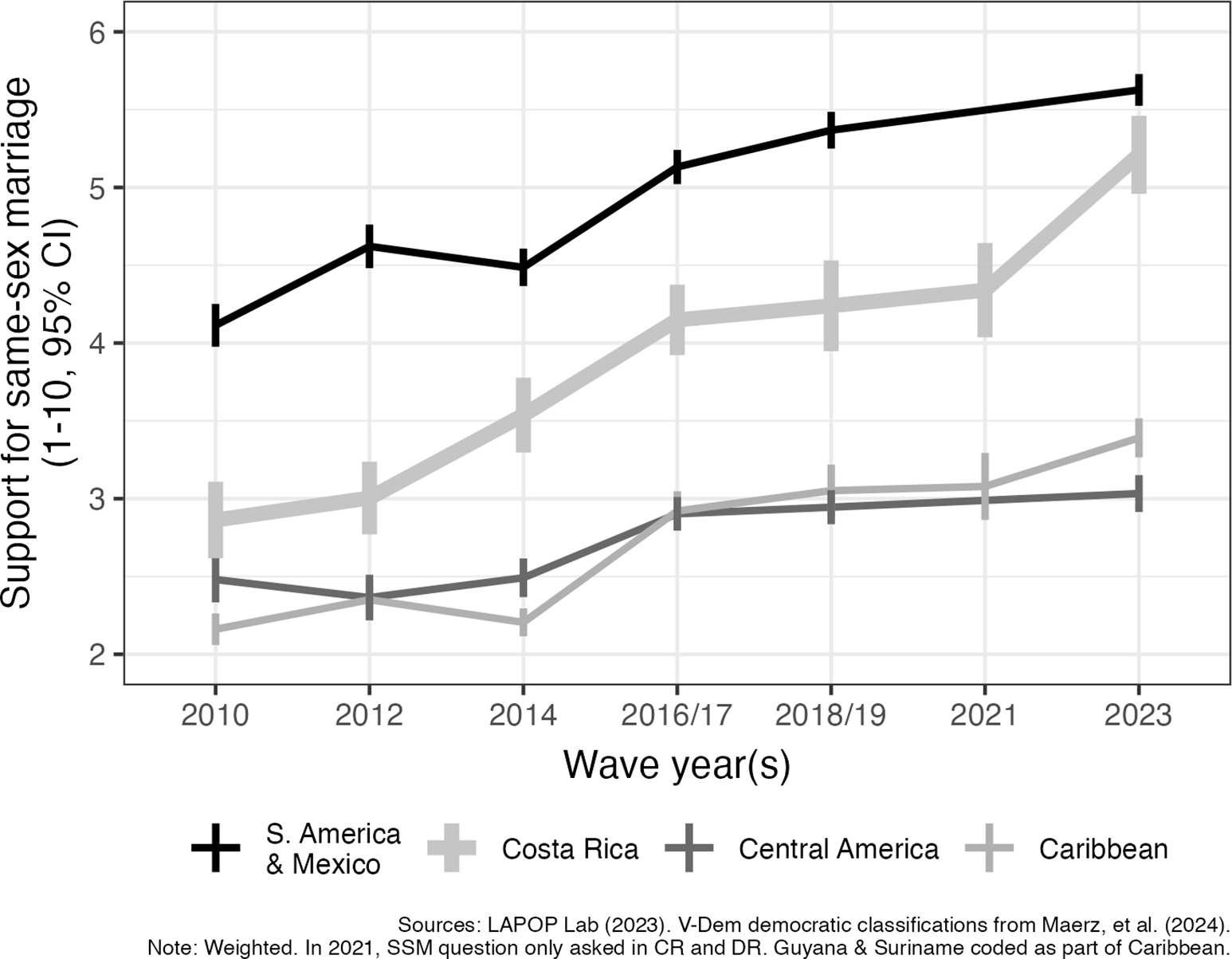
Our analysis contributes to this puzzle. In the case of Costa Rica, social conservatives continued to mobilize and oppose SSM in the aftermath of the 2018 election while popular support increased, inching closer to the Latin American average (Mexico and South America) and growing faster than the Central American average (see Figure 6), and despite the fact the country’s Constitutional Chamber ruled in August 2018 that the National Assembly align legislation to conform with the IACHR opinion. As has happened elsewhere when the adoption of SSM marriage appears imminent (Díez Reference Díez2015), Costa Rican RRPAs proposed the adoption of same-sex civil unions as a compromise: they submitted five bills to the assembly to that effect, none of which received majority support despite the increase in Evangelical representation. After these efforts, the social conservative movement lost strength and legitimacy (León-Carvajal and Pineda-Sancho Reference León-Carvajal and Pineda-Sancho2023). Alvarado Muñoz, who ran for president again in 2022 as the leader of a new party he founded in late 2018 (Nueva República, NR), came in third in the first round, and won seven seats in the Legislative Assembly. The 2022 RN candidate attracted less than 1% of the first-round vote, and no seats in the assembly. In effect, the salience of SSM appears to have receded such that the new, socially conservative populist elected in 2022, Rodrigo Chaves Robles, campaigned with a promise not to regress on gay rights, having declared that “these are struggles that I respect, and I guarantee that they [LGTB people] will continue to be unscathed (incólumes) in their victories” (see Arce Reference Arce2022).
Support for SSM in Latin American Democracies and Costa Rica, 2010–23.
Note: Includes electoral and liberal democracies, according to V-Dem from Maerz et al. (Reference Maerz, Edgell, Hellemeier, Illchenko and Fox2024), during year of survey. Footnote 17

In the Supplementary Material, we regress support for SSM rights, coded as disapproval vs approval, on the covariates used in our voting analysis using our 2018 survey and another carried out by Alfaro Redondo et al. (Reference Redondo, Ronald, Matamoros, Peralta and Bonilla2019) a year later. Footnote 18 The results of the logistic regressions are in Supplementary Material Figure 1 and Tables 4–6. Generally, these results suggest that similar characteristics are associated with SSM approval in both years. We interpret these results to suggest that the underlying “politics” of SSM did not shift in meaningful ways in 2018 or 2019. That is, as an issue, SSM continued to divide public opinion in consistent and predictable ways in both years. What changed, however, was the presence (or absence) of a national campaign or debate centered on this issue.
Nevertheless, while the public discussion of SSM may have receded in Costa Rica, evidence suggests that there has been an uptick in voter identification as “right-wing” in the country in recent years. That may not only explain Chaves’s victory, but his decision to weaponize other divisive cultural issues, such as abortion. Indeed, Chaves may have campaigned with a promise to respect gay rights, but a repudiation of “gender ideology” was central to his campaign and he was clear in his opposition to other divisive cultural issues, such as abortion and assisted dying. His opposition to abortion was not only discursive: he submitted a bill to the assembly in early 2025 to expand penalties for abortion, and on October 15 of the same year, he narrowed access to assisted dying by annulling a protocol enacted by his predecessor in 2019. Such moves appear to be linked to his need for support from Evangelical deputies in Congress (Díez Reference Díez2025). This all suggests that the weaponization of cultural issues can continue to have a galvanizing effect and that it may be about selecting the next most divisive issue on the menu.
Conclusion
Latin America has seen the irruption of RRPA over the last decade in the aftermath of the region’s Pink Tide. Given their weak organizational capacity and challenges in mobilizing electorates around redistributive issues, RRPA have developed and deployed a variety of discursive frames to attract electoral support. This study analyzed the 2018 election in Latin America’s oldest democracy to gauge the effectiveness of these frames across demographic groups. The results suggest that economic frames have weaker traction than anti-establishment and cultural frames, and that opposition to SSM was the frame with the strongest galvanizing effect across a wide range of demographic groups, beyond the expected ones. This finding is consistent with other studies of RRP movements in Latin America, where economic grievances are not as concentrated among the economically vulnerable as they are in Europe.
A question that naturally arises is whether the weaponization of SSM was the result of Costa Rica’s 2018 junctural context or part of broader, structural dynamics. While the debate over SSM subsided in Costa Rica after 2018 due to the weakening of the social conservative movement, the weaponization of abortion by Chaves during the 2022 election suggests that RRPA can weaponize other divisive cultural issues. Our analysis highlights the ways in which RRP candidates and parties can use morality and SSR politics and anti-globalist sentiment to mobilize support among some voters. Though our observational data limit our ability to make causal claims, the evidence we have presented suggests that, in the 2018 election, the cultural explanations appear to have had some effect among some subgroups beyond the ones expected to support conservative messaging on social issues. Opposition to SSM, but not abortion, was a key correlate of RN vote intention, and the candidate’s nationalistic messaging was particularly associated with second-round support. In contrast, economic issues were not central to the neo-conservative candidate’s support in each round of the election. Some anti-incumbent sentiment, likely related to either corruption or government debt, also explained RN support, particularly in the second round of the election.
Our study contributes to larger debates in comparative politics on the emergence of RRPA. On the one hand, RRPA in Latin America share some similarities with their European counterparts in the development and deployment of discursive frames related to nativism, anti-liberalism, and radical right-wing ideology to attract electoral support. Radical right-wing ideology that rejects liberal democratic values is another common through line in RRP movements in both regions. On the other hand, our study, like others who have examined similar political movements in Latin America, suggests that RRP movements in the region have slightly different ways of packaging core discourses. Similar to elsewhere in the region, concerns about national sovereignty in Costa Rica were not about immigration and ethnopluralism as in Europe, but about the imposition of foreign liberal values. Likewise, economic concerns were not focused on those negatively impacted by globalization as in Europe, but more on problems of economic mismanagement and elite corruption. Though Alvarado Muñoz ultimately lost the 2018 Costa Rican presidential election, other right-wing candidates have continued to use discourses around rejection of SSR as foreign values to mobilize right-wing voters. This latter trend is consistent with broader tendencies in Latin America for RRP discourses to be used and adapted to local conditions to mobilize electoral support.
Supplementary Material
To view supplementary material for this article, please visit https://doi.org/10.1017/lap.2026.10051.
Data availability statement
Data files can be accessed at https://doi.org/10.7910/DVN/4SBWXQ.
Acknowledgments
The authors thank Felipe Alpízar, María José Cascante, Ronald Alfaro Redondo, and the entire team at the Centro de Investigación y Estudios Políticos of the University of Costa Rica for their incredible support in providing the data used for this study. All errors of analysis are entirely our own.
Competing interests
The authors declare none.





 Open access

