


Introduction
This study aims to investigate how social capital in organizations can mitigate the effect of perceived organizational politics on employee performance. Research (Hochwarter et al., Reference Hochwarter, Rosen, Jordan, Ferris, Ejaz and Maher2020) indicates that many employees are reluctant to engage in politics in the organization and perceive it as negative (Rosen, Ferris, Brown, Chen & Yan, Reference Rosen, Ferris, Brown, Chen and Yan2013). When employees perceive their organization as political, many of them experience workplace stress (Fiaz & Qureshi, Reference Fiaz and Qureshi2021), which leads to poor employee outcomes (De Clercq & Pereira, Reference De Clercq and Pereira2024) and negatively affects employee performance (Randev, Jha & Shukla, Reference Randev, Jha and Shukla2025). Nevertheless, organizational politics is almost inevitable, so reducing its negative effects is critical (Husted, Moufahim & Fredriksson, Reference Husted, Moufahim and Fredriksson2022).
Perceived organizational politics may be considered a job demand according to Job Demands-Resources (JD-R) theory (Demerouti, Bakker, Nachreiner & Schaufeli, Reference Demerouti, Bakker, Nachreiner and Schaufeli2001). This theory suggests that the negative effects of demands can be mitigated by job resources (Bakker, Demerouti & Verbeke, Reference Bakker, Demerouti and Verbeke2004). One such job resource is social capital (Nyathi, Reference Nyathi2024), an intangible asset that arises from social relationships (Putnam, Reference Putnam1995); in organizations (Adler & Kwon, Reference Adler and Kwon2002), social capital contributes to employee well-being and performance (Parker, Halgin & Borgatti, Reference Parker, Halgin and Borgatti2016).
The current study focuses on two levels of social capital in organizations: personal and intra-organizational social capital (Ben-Hador, Reference Ben-Hador2017). Personal social capital (Ratten, Reference Ratten2024) is an intangible asset of an individual employee composed of personal relationships with friends, family, acquaintances, and colleagues, yielding personal benefits such as career advancement. Intra-organizational social capital (Nonino, Reference Nonino2013) refers to the relationships within and between organizational groups and is beneficial to the performance and well-being of group members (Kidron & Vinarski-Peretz, Reference Kidron and Vinarski-Peretz2022).
Several gaps have been observed in the literature regarding the connections between perceived organizational politics, social capital, and performance (Fahmy, Soliman, Khairy & Ashour, Reference Fahmy, Soliman, Khairy and Ashour2024). The first gap concerns the connections between social capital levels and employee performance; a positive link was found between social capital and performance (Cao, Chen, Hu & Hsiao, Reference Cao, Chen, Hu and Hsiao2025). However, there is instability in the relationship between personal social capital, intra-organizational social capital, and employee performance (Ben-Hador, Reference Ben-Hador2019). Therefore, the exact effect of social capital levels on performance is ambiguous.
The second gap concerns the connection between perceived organizational politics and performance. Typically, perceived organizational politics is negatively related to outcomes such as performance (Randev et al., Reference Randev, Jha and Shukla2025). However, Turek’s (2022) findings show that perceived organizational politics may not harm performance when variables such as supervision quality buffer the effect. Thus, there are inconsistent findings that require further study.
Additionally, there is still a gap in understanding how personal and intra-organizational social capital interacts with perceived organizational politics and employee performance (De Clercq & Pereira, Reference De Clercq and Pereira2022). Some studies have investigated how social capital moderates or mediates the impact of perceived organizational politics. For example, social capital can buffer the negative effects of perceived organizational politics on engagement (Fahmy et al., Reference Fahmy, Soliman, Khairy and Ashour2024), but few studies integrate all three constructs into a single model examining direct and interactive paths to performance; therefore, establishing such a model would reduce the research gap.
The current study consists of two phases: a qualitative pilot study and a quantitative study. The qualitative phase was conducted to determine whether the variables converge to themes and how they are related to each other; the quantitative phase was then conducted to fill in the gaps described above.
The study’s contributions lie in both its theoretical novelty and practical implications. Distinguishing between the effects of the two levels of social capital on employee performance in a politically perceived environment expands social capital theory (Adler & Kwon, Reference Adler and Kwon2002). Moreover, the study contributes to the development of perceived organizational politics as a moderator (Goo, Choi & Choi, Reference Goo, Choi and Choi2022) and demonstrates that employee political perceptions are not necessarily negative. Nevertheless, if negative, intra-organizational social capital can mitigate these effects, contributing to the JD-R theory and establishing perceived organizational politics as a demand and intra-organizational social capital as a resource. Moreover, this study has practical value; to minimize the damage caused by perceived organizational politics, managers can cultivate intra-organizational social capital within their units.
This study is structured as follows: first, a literature review is presented on perceived organizational politics and social capital, followed by a review of employee performance and hypothesis development. Second, the method section describes the qualitative pilot study, followed by the quantitative data collection in two samples. Next, the results are presented, and a discussion including implications, limitations, and conclusion is provided.
Literature review
Perceived organizational politics
Organizational politics is driven by power relations (Ben-Hador, Reference Ben-Hador2024) that can be found in all organizations to varying degrees (Husted et al., Reference Husted, Moufahim and Fredriksson2022). Employees are often directly or indirectly involved in power struggles and influence tactics to secure or maximize their interests (Sowmya & Panchanatham, Reference Sowmya and Panchanatham2012). Organizational roles and processes are affected by politics, which are often hidden or outside of rules and regulations (Toegel et al., Reference Toegel, Levy and Jonsen2022).
There has been much debate about whether organizational politics is positive or negative (Fahmy et al., Reference Fahmy, Soliman, Khairy and Ashour2024). Several scholars (Zahid, Butt & Khan, Reference Zahid, Butt and Khan2022) note that organizational politics has positive aspects, such as advancing the objectives of an organization. According to Butts, Casper, and Yang (Reference Butts, Casper and Yang2013), organizational politics can serve a variety of individual purposes, including achieving personal goals, protecting or improving professional reputations, and obtaining resources and benefits from the organization.
However, in most cases, organizational politics is synonymous with manipulation and coercion, is perceived as contrary to the organization’s common good, and adversely affects performance (Ferris & King, Reference Ferris and King1991). Studies (for example, Sanson & Courpasson, Reference Sanson and Courpasson2022) have linked organizational politics to negative consequences for employees, including lower job satisfaction, lower performance at work, decreased organizational commitment, lower attendance, and low morale (Randev et al., Reference Randev, Jha and Shukla2025).
Perceived organizational politics (POP) reflects employee opinions and viewpoints toward organizational politics (Yang, Reference Yang2017). As De Clercq and Pereira (Reference De Clercq and Pereira2024) reported, employees often view perceived organizational politics as dysfunctional, which leads to distance from management and counterproductive responses. Sowmya and Panchanathan (Reference Sowmya and Panchanatham2012) asserted that perceived organizational politics are associated with negative emotional states such as job stress and job burnout. Zhou and Liu (Reference Zhou and Liu2023) reported a curvilinear relationship between perceived organizational politics and employee behavior. Consequently, Hochwarter et al. (Reference Hochwarter, Rosen, Jordan, Ferris, Ejaz and Maher2020) claimed that perceived organizational politics has a complicated relationship with outcomes and suggested continuing to research the relationship between perceived organizational politics and other organizational variables, especially employee outcome variables.
An outcome variable that is negatively connected to perceived organizational politics is employee performance (Bhattarai, Reference Bhattarai2021). Shrestha (Reference Shrestha2021) contends that organizational politics negatively impacts employee job performance and calls for leaders and administrators to reduce unnecessary organizational politics. Some scholars (such as Nazir, Khadim, Asadullah & Syed, Reference Nazir, Khadim, Asadullah and Syed2024) claim that the negative relationship between perceived organizational politics and employee performance is mitigated by variables such as organizational justice, political behavior, or emotional exhaustion (Sun & Chen, Reference Sun and Chen2017). Randev et al. (Reference Randev, Jha and Shukla2025), for example, reported a negative effect of perceived organizational politics on employee performance mediated by opportunistic silence. Another variable that may mitigate the negative effect of perceived organizational politics on employee performance is social capital (Hochwarter et al., Reference Hochwarter, Rosen, Jordan, Ferris, Ejaz and Maher2020).
Social capital in organizations
Social capital is an intangible asset that represents the advantages of social relationships (Lin, Reference Lin, Lin, Cook and Burt2001); therefore, Coleman (Reference Coleman1988) referred to it as a bridge between sociology and economics. Putnam (Reference Putnam1995) suggested that social capital enhances society’s efficiency by facilitating coordinated actions through the combination of trust, norms, and networks. Portes (Reference Portes2024) noted that social capital benefits society in many ways, including through social control, supporting the family, and enhancing interpersonal relationships. In organizations, social capital is a vital concept that highlights the importance of social life for employees; for example, it has a significant effect on employee health, mental stability, satisfaction, and welfare (Gao et al., Reference Gao, Weaver, Dai, Jia, Liu, Jin and Fu2014). Moreover, it affects tangible outcomes such as intrapreneurial activities (Klein & Ben-Hador, Reference Klein and Ben-Hador2025) and even economic profit (Lee, Jang & Choi, Reference Lee, Jang and Choi2016).
According to Halpern (Reference Halpern2005), social capital can be divided into three levels: large-scale groups (such as countries), groups (such as communities and families), and individuals. Nienaber (Reference Nienaber2022) claimed that organizations consist of individual, team, and enterprise levels; Hence, in organizations, social capital is divided into three levels: personal, intra-organizational, and external social capital (Ben-Hador, Reference Ben-Hador2017). As most employees are not directly impacted by the external social capital level, the current study investigates the personal and intra-organizational social capital levels (Ratten, Reference Ratten2024).
Personal social capital (Ben-Hador, Eckhaus & Klein, Reference Ben-Hador, Eckhaus and Klein2021) refers to the benefits that are derived from personal connections from outside the organization, such as acquaintances, friends, neighbors, and family, as well as from inside the organization with personal friends (Ben-Hador & Eckhaus, Reference Ben-Hador and Eckhaus2019). Personal social capital is linked to personal career outcomes such as advancement, gaining power, and even higher salaries (Peters & Stringham, Reference Peters and Stringham2006), along with emotional outcomes such as job satisfaction. As personal social capital is an asset of the individual, McElroy (Reference McElroy2002) called this level of social capital “egocentric” because it reflects the value individuals place on relationships with other people within the organization in order to achieve their own personal goals.
Intra-organizational social capital (Kidron & Vinarski-Peretz, Reference Kidron and Vinarski-Peretz2022) is derived from connections within and between formal and informal groups and teams in organizations (Ben-Hador, Reference Ben-Hador2016). It comprises shared goals, information and knowledge sharing, reciprocity, trust, and norms (Adler & Kwon, Reference Adler and Kwon2002). Many benefits can be gained from a high level of intra-organizational social capital, including enhanced employee performance and job satisfaction (Bakker, Hendriks & Korzilius, Reference Bakker, Hendriks and Korzilius2022). Organizations highly value this level of social capital since it greatly benefits them (Ben-Hador, Reference Ben-Hador2019).
The distinction between social capital levels is attributed by Yu and Junshu (Reference Yu and Junshu2013) to the social networking ties theory of Granovetter (Reference Granovetter1973), which distinguishes between weak and strong ties, claiming that the latter are imperative for close relationships and support. Conversely, weak ties can be useful for receiving information and finding jobs. According to Yu and Junshu (Reference Yu and Junshu2013), personal social capital consists primarily of weak ties, as most people have many weak ties and only some strong ties (Kim & Fernandez, Reference Kim and Fernandez2023). In contrast, intra-organizational SC is based on strong ties within the organization because it is derived from mutual trust (Ortiz, Donate & Guadamillas, Reference Ortiz, Donate and Guadamillas2021).
The distinction between social capital levels may help to narrow the research gap regarding the relationship between social capital and perceived organizational politics. Some researchers (De Clercq & Pereira, Reference De Clercq and Pereira2022; Fahmy et al., Reference Fahmy, Soliman, Khairy and Ashour2024) have reported that social capital decreases the negative political perceptions of employees. However, others did not find such an effect (Su, Zhou & Yang, Reference Su, Zhou and Yang2024). Therefore, it is possible that only intra-organizational social capital decreases the negative political perceptions of employees, whereas personal social capital, owing to its egocentric nature (McElroy, Reference McElroy2002), does not. The intra-organizational social capital effect may be evidenced if it also increases employee performance in a perceived political environment.
Employee performance and hypothesis development
Employee performance (Parker et al., Reference Parker, Halgin and Borgatti2016) is widely used to evaluate the effectiveness of employees (Wandycz-Mejias, Roldán Salgueiro & Lopez-Cabrales, Reference Wandycz-Mejias, Roldán Salgueiro and Lopez-Cabrales2024). Babin and Boles (Reference Babin and Boles1996) defined employee performance as the level of productivity of employees compared with their colleagues in terms of work-related behaviors and outcomes; hence, employee performance plays a significant role in determining an organization’s results (Carmeli, Ben-Hador, Waldman & Rupp, Reference Carmeli, Ben-Hador, Waldman and Rupp2009). Pugliese et al. (Reference Pugliese, Pica, Bonaiuto, Cancellieri, van Knippenberg and Bonaiuto2024) reported that an organization’s performance is determined by its employee willingness to work for its success, namely, employee performance.
Therefore, studies have examined the factors that hinder and enhance employee performance (i.e., Audenaert, Decramer, Lange & Vanderstraeten, Reference Audenaert, Decramer, Lange and Vanderstraeten2016), and social capital has been found to have a significant influence (Ben-Hador, Reference Ben-Hador2019). According to Huang, Yu, Shao, Yu, and Li (Reference Huang, Yu, Shao, Yu and Li2021), employee performance is directly related to social capital; for example, Oldroyd and Morris (Reference Oldroyd and Morris2012) reported a positive relationship between social capital and employee performance.
Leana and Van Buren (Reference Leana and Van Buren2012), however, did not find such a direct connection, and Ibarra, Kilduff, and Tsai (Reference Ibarra, Kilduff and Tsai2005) reported contradictory results. These contradictory results may be attributed to different levels of social capital (Ben-Hador, Reference Ben-Hador2017). When researchers distinguished between the personal level and the intra-organizational level (Xu et al., Reference Xu, Hou, Zhang, Yu, Guan and Liu2022), a direct connection was found between intra-organizational social capital and performance (Ben-Hador, Reference Ben-Hador2016) but not between personal social capital and performance (Ben-Hador, Reference Ben-Hador2019). Rhee and Ji (Reference Rhee and Ji2011) concluded that personal social capital does not correlate with employee performance, suggesting that it can serve personal interests that may conflict with company goals. Nevertheless, since a direct connection between intra organizational social capital and performance has been established (Ben-Hador & Eckhaus, Reference Ben-Hador and Eckhaus2019), the first hypothesis is as follows:
Hypothesis 1: Intra-organizational social capital is positively connected to employee performance.
Despite the certainty regarding the relationship between intra-organizational social capital and performance, there should also be a relationship between personal social capital and performance. Members of a group must have social capital capabilities for the group to have intra-organizational social capital, and since intra-organizational social capital is primarily based on personal social capital (Ben-Hador, Reference Ben-Hador2019). Therefore, it is hypothesized that intra-organizational social capital mediates these relationship:
Hypothesis 2: Intra-organizational social capital mediates the connection between personal social capital and employee performance.
The next hypothesis concerns the relationship between employee performance and perceived organizational politics (Hochwarter et al., Reference Hochwarter, Rosen, Jordan, Ferris, Ejaz and Maher2020). Researchers have established that perceived organizational politics negatively affects employee performance (Jeong & Kim, Reference Jeong and Kim2022; Randev et al., Reference Randev, Jha and Shukla2025; Shrestha, Reference Shrestha2021), possibly because when employees believe that their reward is determined by political behavior, rather than competence, they disengage or withhold their efforts (Ferris & Kacmar, Reference Ferris and Kacmar1992). Therefore, it was hypothesized that:
Hypothesis 3: Perceived organizational politics is negatively connected to employee performance.
Finally, to mitigate the negative impact of organizational politics on employee performance, we attempted to examine whether intra-organizational social capital moderates this relationship. This moderation effect can be supported by the JD-R theory (Demerouti et al., Reference Demerouti, Bakker, Nachreiner and Schaufeli2001). This theory suggests that all work environments have specific job demands and job resources. Job demands are aspects of a job that require sustained effort and are associated with physiological or psychological costs, such as workload, emotional demands, or organizational politics (Bakker & Demerouti, Reference Bakker and Demerouti2007). Perceived organizational politics may be a hindrance that typically generates stress and reduces motivation, leading to negative outcomes such as decreased performance, and therefore is considered a job demand (Crawford, LePine & Rich, Reference Crawford, LePine and Rich2010). Job resources, on the other hand, are physical, psychological, or organizational aspects that help reduce job demands, achieve work goals, or stimulate personal growth (Bakker & Demerouti, Reference Bakker and Demerouti2007). Social capital, particularly intra-organizational social capital, may function as a job resource under the JD-R model, as it provides emotional support, access to information, and collaborative work that buffers the negative effects of job demands and enhances performance (Tims, Bakker & Derks, Reference Tims, Bakker and Derks2013). Therefore, according to JD-R theory (Bakker et al., Reference Bakker, Demerouti and Verbeke2004), employees who perceive their environment as politically charged may still perform well if they have intra-organizational social capital (De Clercq & Pereira, Reference De Clercq and Pereira2022); thus, the last hypothesis is as follows:
Hypothesis 4: Intra-organizational social capital moderates the connection between perceived organizational politics and employee performance.
To establish the variables and hypotheses to obtain initial approval and additional insights, a qualitative pilot study was conducted prior to the quantitative study.
Phase 1 – qualitative pilot study
Method
A pilot study is a small-scale, preliminary study conducted prior to a larger study to evaluate its feasibility and potential problems (Malmqvist, Hellberg, Möllås, Rose & Shevlin, Reference Malmqvist, Hellberg, Möllås, Rose and Shevlin2019). Even though a pilot study does not guarantee success, it increases the chances of conducting a successful study since it can provide valuable insights (Van Teijlingen & Hundley, Reference Van Teijlingen and Hundley2002). A qualitative pilot study is usually conducted to improve the overall credibility of a study (Williams-mcbean, Reference Williams-mcbean2019) and determine the significance of research variables (Malmqvist et al., Reference Malmqvist, Hellberg, Möllås, Rose and Shevlin2019).
In the present study, a pilot study was conducted using a qualitative method (Denzin & Lincoln, 2000) to understand a phenomenon in depth without the need for a large sample size (Smollan & Griffiths, Reference Smollan and Griffiths2024). Nevertheless, since this is a pilot study, some elements of the qualitative study were omitted, including the research question, because the aim of the pilot is to extract variables and better understand what we were looking for (Williams-mcbean, Reference Williams-mcbean2019). Moreover, the results are presented in a shorter format, with the quotes presented in a table, and the focus is on how the pilot study shaped the quantitative study (Van Teijlingen & Hundley, Reference Van Teijlingen and Hundley2002).
Participants and procedure
The participants included 30 respondents from three countries, Israel, Australia, and Cyprus. These three locations are all Western countries but are very different in cultural dimensions such as uncertainty avoidance (Hofstede, Reference Hofstede2009; Cyprus was not measured; instead, we looked for the Greek index that resembled Greek Cyprus, where the study took place) that was found to be related to perceptions of politics in the organization (Stewart, Gulzaib & Morris, Reference Stewart, Gulzaib and Morris2019). To ensure a broad representation of the diversity of opinions, we selected interviewees who represent a range of employees in terms of age, sector, and country.
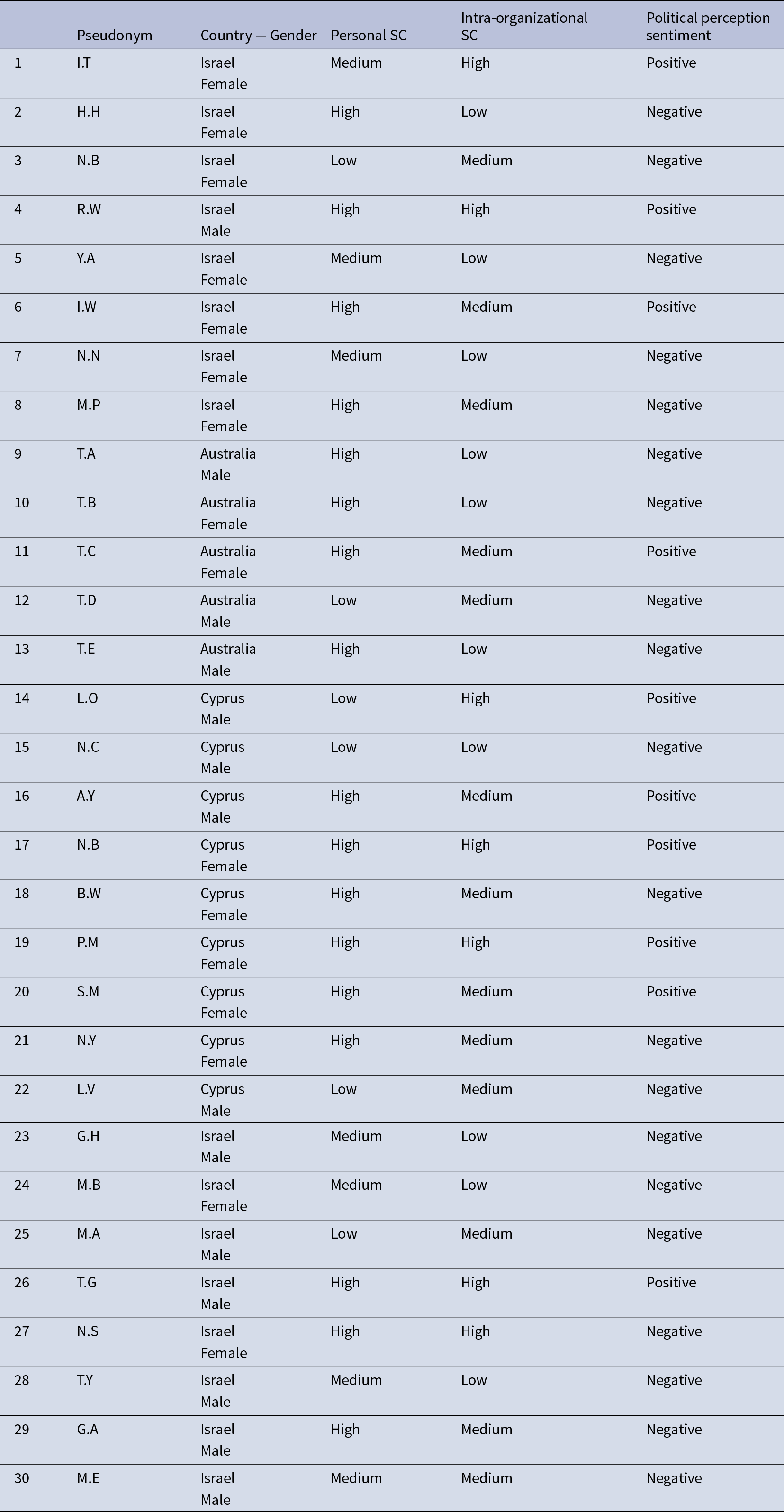
Sixteen women and 14 men participated, and their ages ranged between 24 and 73 years. Participants were recruited through personal contacts of the researchers (convenience sample) and were employed for at least one year in the same organization. Except for one participant who is both employed and self-employed, all the participants are employed in organizations. Table 1 shows the participants and the evaluations the researchers determined for personal and intra-organizational social capital, as well as their sentiment toward organizational politics:
Qualitative pilot participant characteristics

Note: SC = Social capital.
The interview protocol (Appendix 1) was broad and general and dealt with personal and intra-organizational social capital and organizational politics. The interviews were conducted by the researchers. Most of the interviews (25) were conducted via “Zoom” and were recorded and automatically transcribed using an automatic transcription application (“Gladia”). The interviews lasted 15–50 min. Before the interviews began, an explanation of the general research process and data anonymity was provided.
The data were analyzed manually using the “content analysis” approach, which involves categorizing recorded or written verbal materials into groups with similar meanings (Cho & Lee, Reference Cho and Lee2014). To extract the research themes, related codes are assigned based on the interview protocol (Maleki, Dehghan Nayeri, Hamidieh & Pouraboli, Reference Maleki, Dehghan Nayeri, Hamidieh and Pouraboli2024). All the transcribed data were read, and an Excel spreadsheet was created with initial categories according to the interview outline. By relying on the content and coding of the themes, the relationships between the themes were extracted, and the variables and understandings were confirmed.
Although it was a pilot study, it must demonstrate trustworthiness (Haq, Rasheed, Rashid & Akhter, Reference Haq, Rasheed, Rashid and Akhter2023). Trustworthiness was ensured by triangulation (Cho & Lee, Reference Cho and Lee2014), which was achieved by performing interviews in three countries with two interviewers and data coded by two coders (the coding table is presented in Appendix 2). The use of representative quotations presented in the “Findings” section increases credibility (Lincoln & Guba, Reference Lincoln and Guba1986). Ethics was maintained by ensuring participant anonymity, reading their rights before interviewing, and receiving approval from the university ethics committee.
Pilot findings
A qualitative pilot study was conducted to characterize the variables and their importance, as well as to help generate research hypotheses.
As shown in Table 1, participants have different levels of personal and intra-organizational social capital, as well as different sentiments regarding organizational politics. In general, organizational politics were perceived negatively by most participants. Positive perceptions appeared to be confined to participants with high intra-organizational social capital, but more research is needed to confirm this.
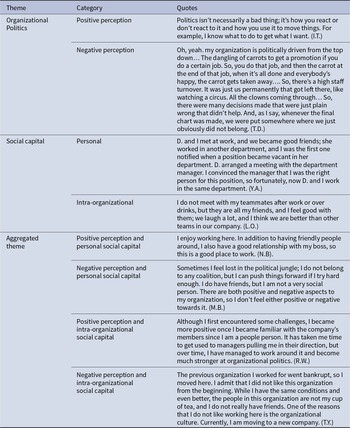
The two focuses that were investigated were confirmed as qualitative themes: (1) social capital, consisting of personal social capital and intra-organizational social capital and (2) perceptions of organizational politics, which could be positive or negative (as most of the perceptions were negative, even if the answers were not negative, they were coded as positive). In the aggregated theme, positive and negative organizational politics perceptions were combined with personal and intra-organizational social capital. Table 2 offers a representative illustration of the categories and combinations.
Qualitative pilot themes and quotes
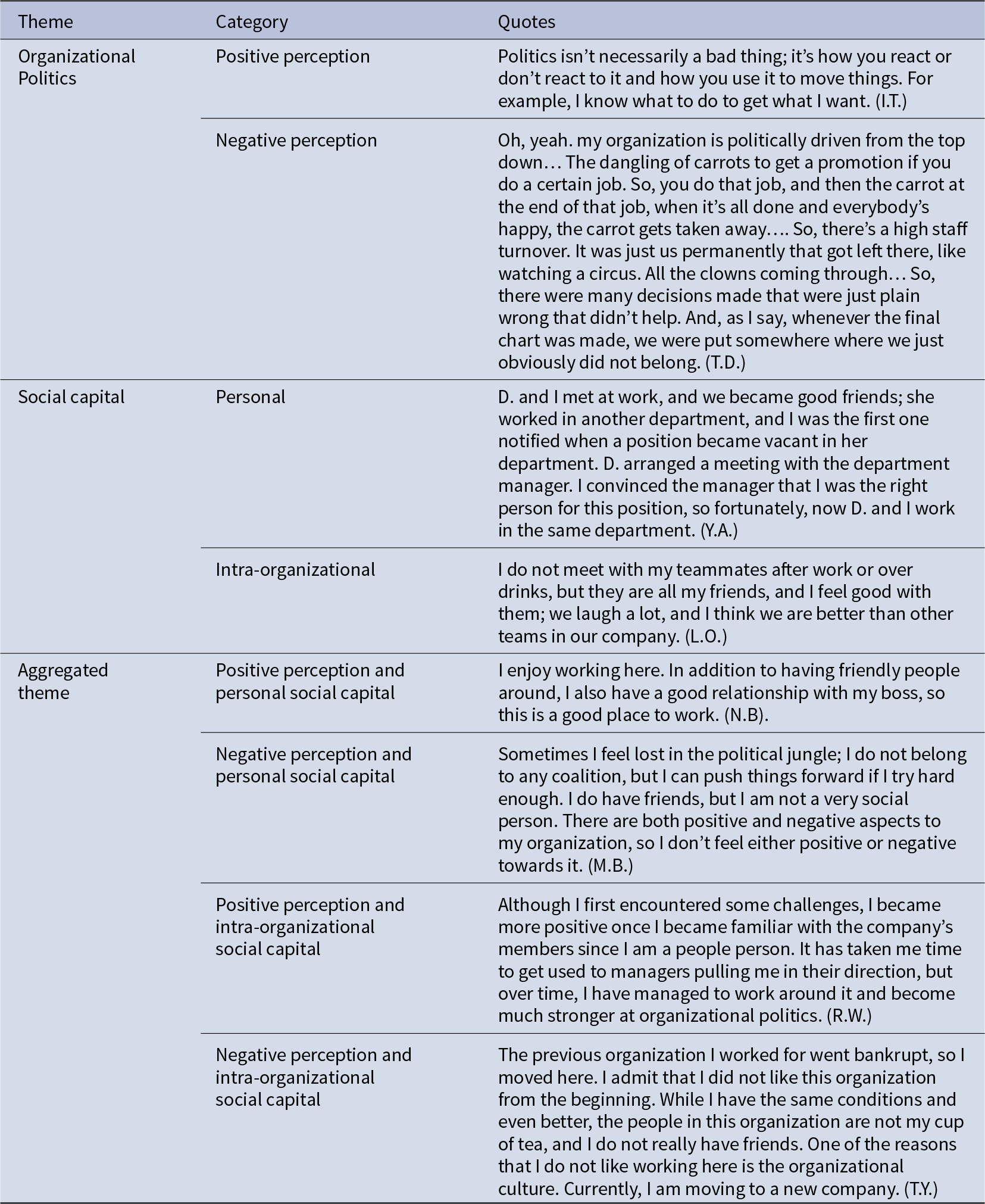
The pilot findings indicate that organizational politics perceptions are influenced by social capital, especially intra-organizational social capital, which is associated with a more positive perception of organizational politics among participants. Unfortunately, in attempting to diagnose the participants’ performance qualitatively, there were no references to negative self-performance; therefore, it appears that qualitative tools are less useful for diagnosing performance. In conclusion, the pilot study confirms personal social capital, intra-organizational social capital, and perceptions of organizational politics variables, and shows that the variables are related and that there is a mutual influence; however, the direction of the relationship cannot be determined. Therefore, an analysis that measures the relationships between variables more accurately is needed. Additionally, the performance variable could not be extracted, so quantitative research should be conducted to allow for a more objective and accurate examination of employee performance.
Phase 2 – quantitative study
After conducting the qualitative pilot, a quantitative study was conducted in which, rather than understanding respondent subjective perceptions (Doran, Burden & Shryane, Reference Doran, Burden and Shryane2022), the variables, including employee performance, were measured (Yang, Reference Yang2017). To validate the research data, the data were collected twice, separately, from two different samples of respondents from different workplaces. Additionally, the second sample data were collected 4 months after the first sample data collection was completed. To ensure that the samples were taken from different sources, the data collectors were instructed not to send the questionnaire to people who had already answered it, and the second questionnaire included a screening question. The participants in the quantitative research were all Israelis, and the questionnaires were in Hebrew. As the original questionnaires were in English, they were translated to Hebrew and then retranslated back to English for double-checking by a linguistic editor; multiple imputation was used to minimize missing data.
Participants
Sample 1
A total of 907 employees responded to surveys distributed online through “Google Forms”; among the participants, 49.1% were female, the average age was 31.3 years (SD = 11.22), and 47% had a bachelor’s or master’s degree. A total of 36% of the respondents held a managerial position. A total of 78% of the respondents worked in traditional sectors such as textiles, fashion, and food, whereas 22% worked in high-tech and finance. Thirty percent of the respondents worked for large companies (500 + employees).
Sample 2
Four months later, 762 respondents from different organizations answered the questionnaires via “Google Forms”; 58% of the respondents were females, the average age was 33.2 years (SD = 10.02), and 60.3% had a bachelor’s degree or higher. Among the respondents, 24% held a managerial position. A total of 63% of the respondents worked in traditional sectors, while 30% worked in high-tech and finance; 38.3% of the respondents were from large companies (500 + employees).
Measurements
The measurements were applied in both rounds:
Employee Performance – We used Black and Porter’s (Reference Black and Porter1991) performance questionnaire to measure employee performance levels. The scale contains five items for respondent self-evaluation of performance compared with their coworkers (sample item “my performance in general”; Cronbach’s alpha = 0.871). The response scale ranged from 1 well below average to 5 well above average.
Intra-organizational social capital – This was measured via a questionnaire developed by Carmeli et al. (Reference Carmeli, Ben-Hador, Waldman and Rupp2009). The items are measured on a 5-point Likert scale ranging from 1-strongly disagree to 5-strongly agree, consisting of six items such as ‘I share common goals with my teammates’, with a Cronbach’s alpha of 0.852.
Personal social capital – The questionnaire was developed by Ben-Hador et al. (Reference Ben-Hador, Eckhaus and Klein2021) and includes 23 statements, such as ‘I volunteer in places outside my workplace’. The response scale was a 5-point Likert scale (from 1-strongly disagree to 5-strongly agree), with a Cronbach’s alpha of 0.879.
Perceived organizational politics – The questionnaire was developed by Ferris and Kacmar (Reference Ferris and Kacmar1992) and was improved by Kacmar and Carlson (Reference Kacmar and Carlson1997). We used the first factor that pertains to coalitions, for example, “There has always been an influential group in this department that no one ever crosses,” and the second factor that refers to interpersonal politics, for example, “People in this organization attempt to build themselves up by tearing others down.” Altogether, 14 items were measured; nevertheless, all the questions were found to be one factor, so the questionnaire was considered as one factor in this study. The response scale ranged from 1-strongly disagree to 5-strongly agree; the Cronbach’s alpha was 0.873.
Quantitative findings
Since all the data were collected through self-reporting at a single time point, two statistical tests were conducted to ensure that the collected data for the first sample did not exhibit characteristics of a single general factor. First, to assess the potential for common method bias, we conducted Harman’s single-factor test (Podsakoff, MacKenzie, Lee & Podsakoff, Reference Podsakoff, MacKenzie, Lee and Podsakoff2003). All 47 items from the study constructs were entered into an unrotated principal component factor analysis. The results showed that the first factor accounted for 19.59% of the variance, which is below the 50% threshold and would indicate substantial common method bias.
Subsequently, a confirmatory factor analysis (CFA), using R (lavaan package), was conducted to verify that all the items were distributed across four distinct factors. Owing to the large number of items in two of the questionnaires (personal social capital and perceived organizational politics), several parcels were computed for these questionnaires based on their theoretical foundation. The analysis supported the assertion that four distinct factors indeed exist: χ2(127) = 713.61, p < .001; χ2/df = 5.62; TLI = 0.905; CFI = 0.921; RMSEA [90% CI] = 0.071 [0.066, 0.077]; SRMR = 0.068.
The reliability analysis revealed satisfactory to excellent internal consistency across all four factors. The composite reliability coefficients, which were calculated using McDonald’s omega, were consistent with these findings, ranging from 0.75 to 0.85.
Convergent validity was assessed using Average Variance Extracted (AVE) values. Three factors demonstrated adequate convergent validity with AVE values above the recommended 0.50 threshold: performance (AVE = 0.56), intra-organizational social capital (AVE = 0.54), and organizational politics (AVE = 0.60). However, personal social capital had an AVE value of 0.42, which falls slightly below the conventional threshold, suggesting potential concerns regarding convergent validity for this factor. Similar analyses were conducted for the second sample. First, Harman’s single-factor test (Podsakoff et al., Reference Podsakoff, MacKenzie, Lee and Podsakoff2003) revealed that all 47 items entered into an unrotated principal component factor analysis, accounted for only 18.19% of the variance. Second, a confirmatory factor analysis (CFA), using R (lavaan package), verified four distinct factors: χ2(117) = 568.76, p < .001; χ2/df = 4.86; TLI = 0.902; CFI = 0.925; RMSEA [90% CI] = 0.071 [0.065, 0.077]; SRMR = 0.080. McDonald’s omega, ranging from 0.80 to 0.87, revealed satisfactory to excellent internal consistency across all four factors. Two factors demonstrated adequate convergent validity, with AVE values above the recommended 0.50 threshold: intra-organizational social capital (AVE = 0.55) and organizational politics (AVE = 0.67). However, performance had an AVE value of 0.49, and personal social capital had an AVE value of 0.46, which falls slightly below the conventional threshold, suggesting potential concerns regarding convergent validity for this factor.
In conclusion, it can be inferred that the four variables are distinct from one another and do not represent a single common general measure.
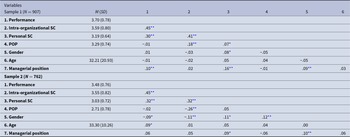
Table 3 presents the means, standard deviations, and correlations among the research variables and the demographic variables for the two samples. As can be seen, for the two samples, it was found that intra-organizational social capital is indeed positively connected to employee performance and personal social capital. Thus, the higher the intra-organizational social capital, the higher the performance and personal social capital. However, it was not found that perceived organizational politics is associated with employee performance.
Means, standard deviations, and correlations of the study variables for samples 1 and 2
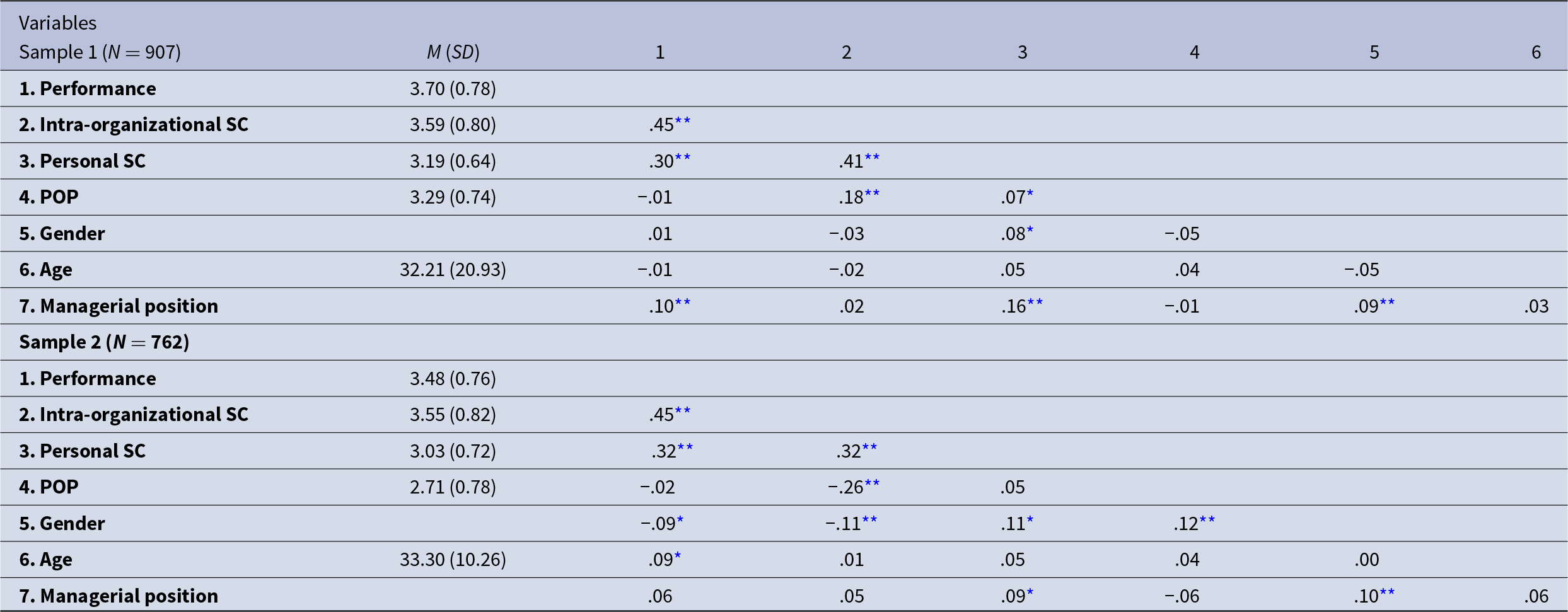
* Note: p < .05, **p < 0.01; SC = Social Capital, POP = Perceived Organizational Politics.
To test whether intra-organizational social capital mediates the relationship between personal social capital and performance, mediation analysis was performed via Process (Hayes, 2022), Model 4. The bootstrapping technique, which uses 5,000 resamples, was employed to generate 95% confidence intervals for testing the significance of the indirect effects in the analysis.
To test whether intra-organizational social capital moderates the relationship between organizational politics and performance, moderation analysis was performed via Process (Hayes, 2022), Model 1.
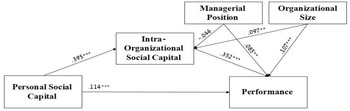
The meditation of the relationship between personal social capital and performance through intra-organizational social capital for sample 1.

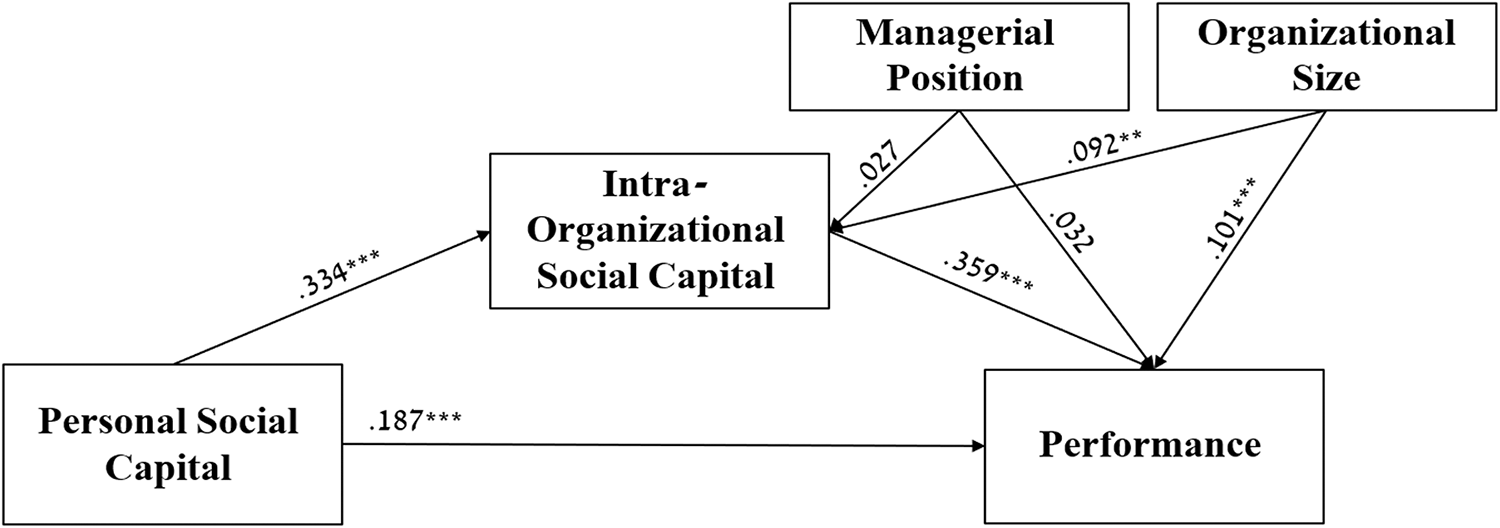
The mediation of the relationship between personal social capital and performance through intra-organizational social capital for sample 2.
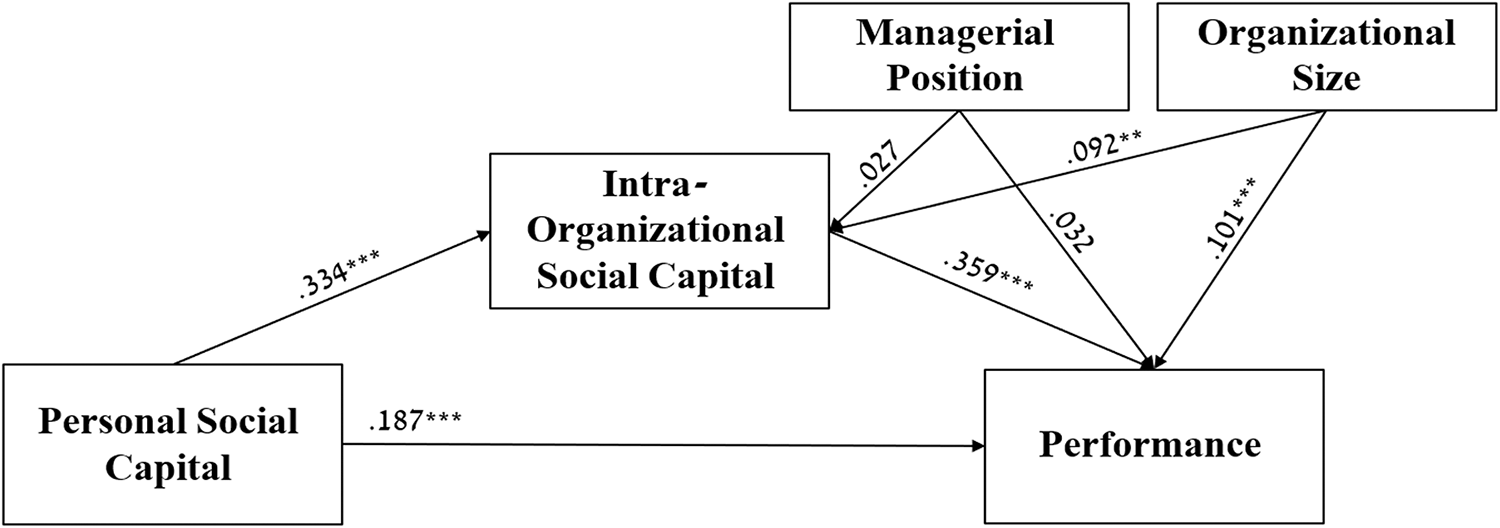
The models were examined multiple times, once without control variables and again with age, gender, education, managerial position, and organizational size as control variables. However, these variables, regardless of whether they were significant or non-significant, did not alter the statistical model being tested. Therefore, since only managerial position and organizational size were found to be significant, the models reported here include these two variables, which, as mentioned, did not change the statistical model being tested.
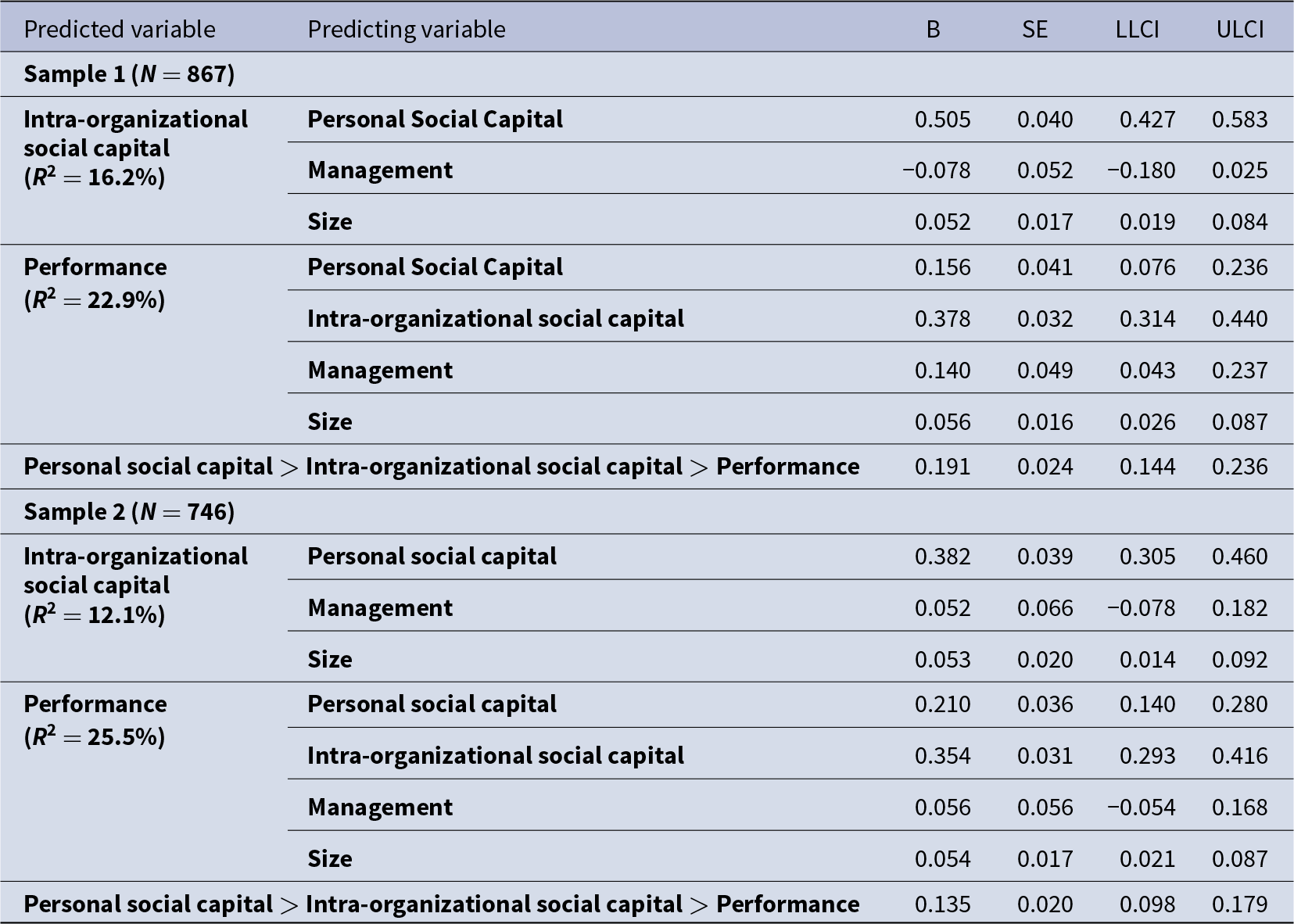
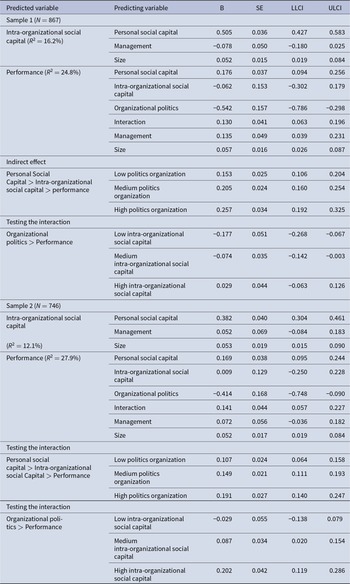
For both samples, the analysis indicates that personal social capital positively and significantly predicts intra-organizational social capital. Personal social capital and intra-organizational social capital positively and significantly predict performance. The mediation effect between personal social capital and performance through intra-organizational social capital was found to be statistically significant, B = 0.191, S.E. = 0.024, CI; 0.144–0.236, for sample 1; and B = 0.135, S.E. = 0.020, CI; 0.098 – 0.179, for sample 2. Thus, the higher the level of personal social capital, the higher the level of intra-organizational social capital, and the higher the level of intra-organizational social capital, the higher the level of performance (see Table 4 and Figs. 1 and 2).
Mediation relationships for sample 1 and sample 2
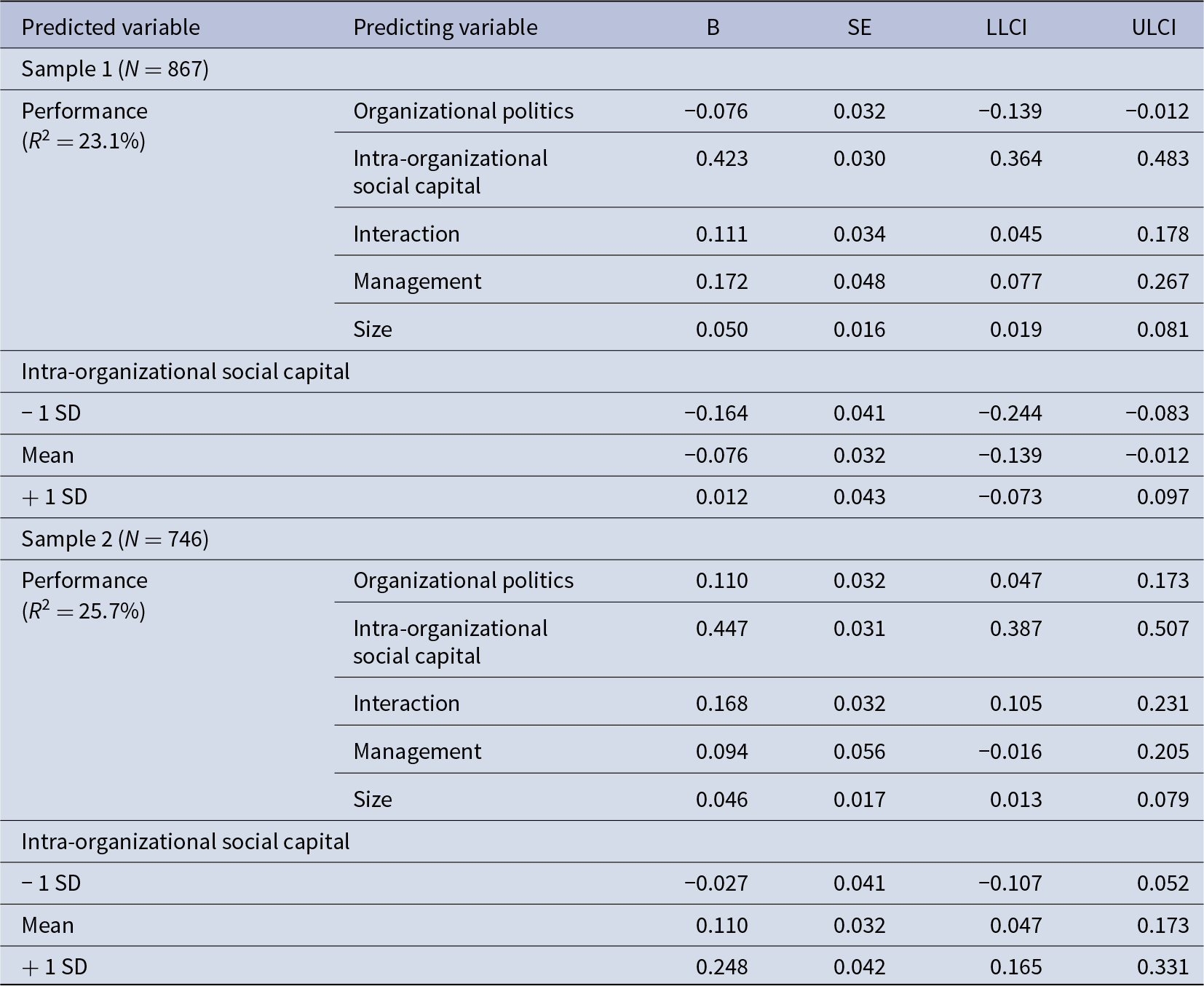
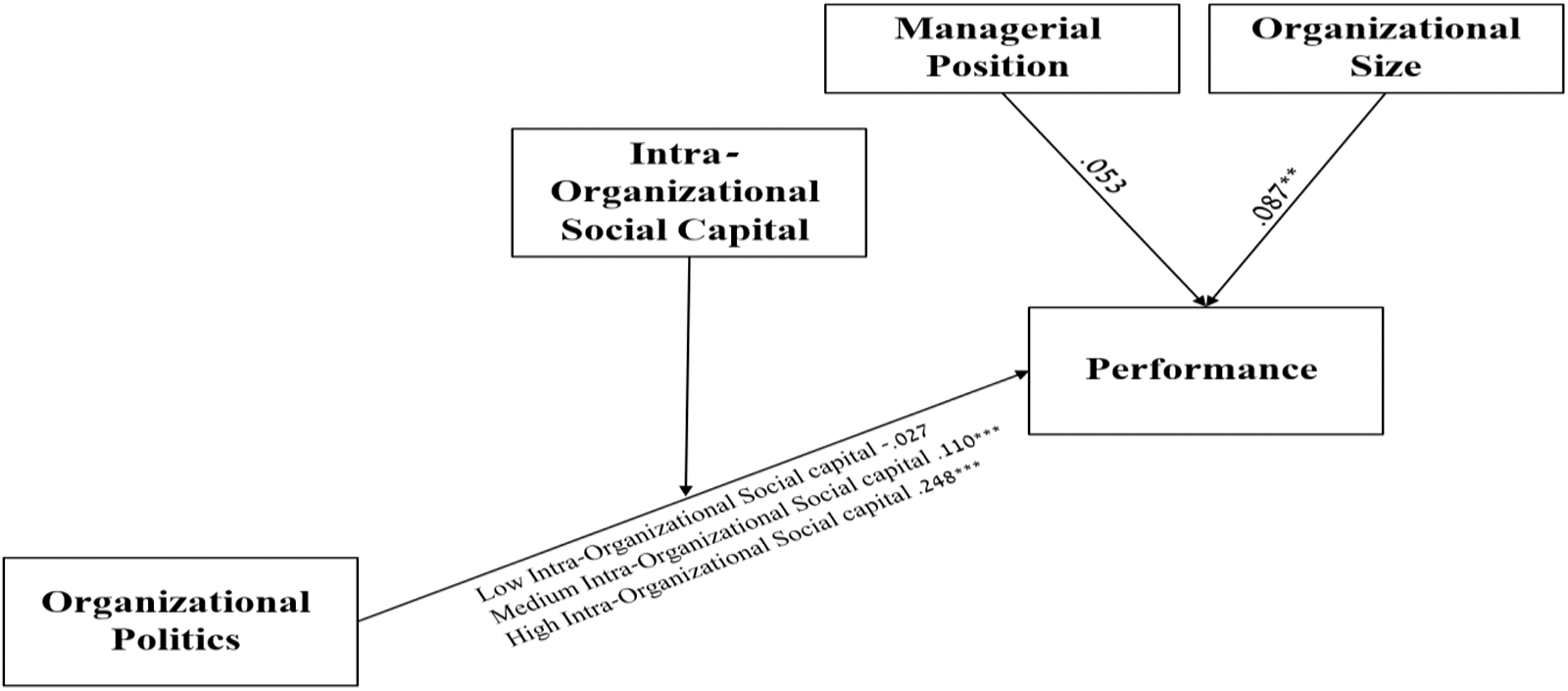
For both samples, the analysis indicates that the interaction between intra-organizational social capital and organizational politics was significant. For sample 1, when intra-organizational social capital is about the mean and lower, there is a negative association between organizational politics and performance (50.52% of the sample). However, as intra-organizational social capital increases above the mean, there is no significant association between organizational politics and performance.
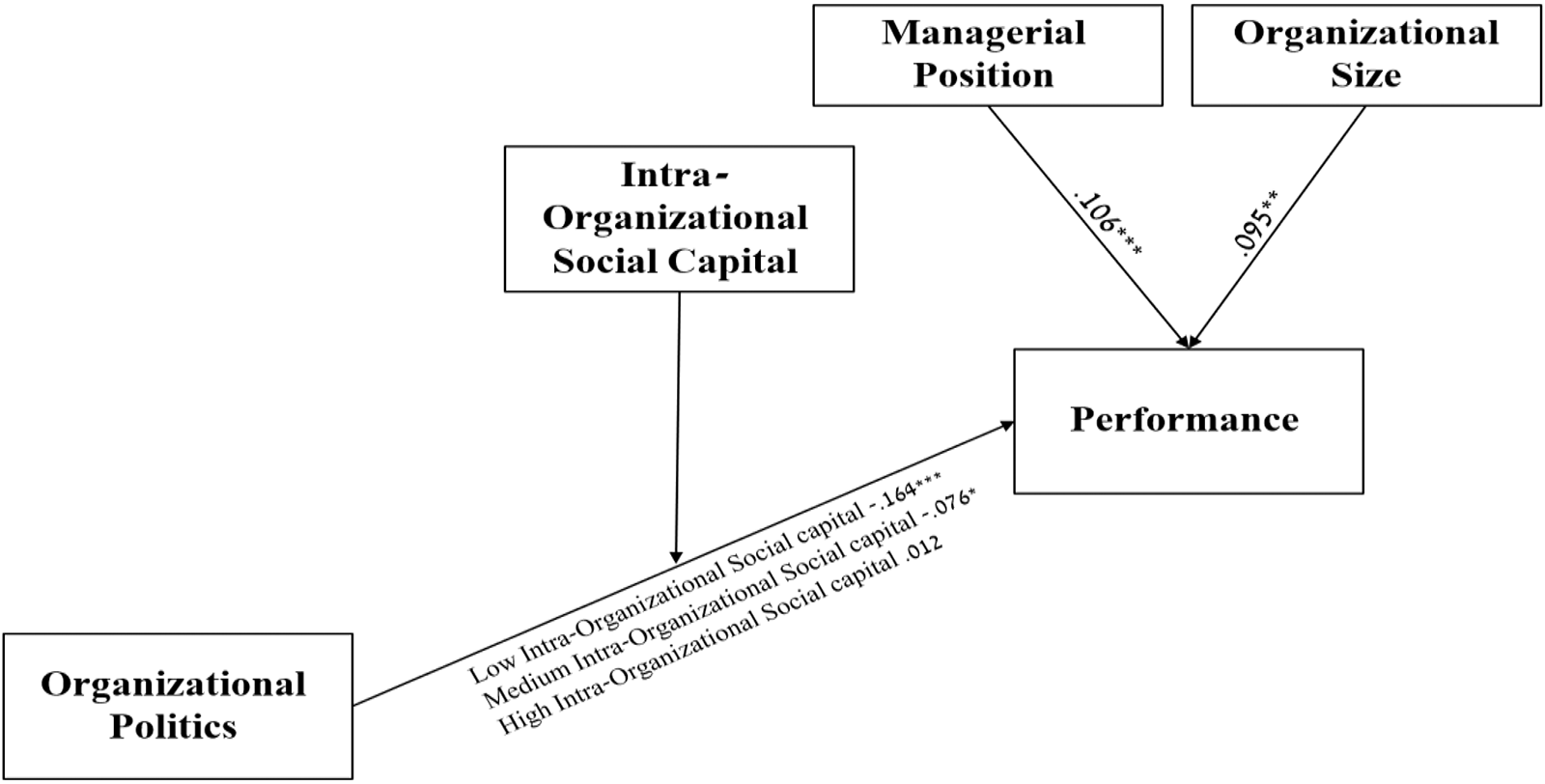
For sample 2, when intra-organizational social capital is low, there is a negative association between organizational politics and performance (9.11% of the sample). When intra-organizational social capital is about the mean, there is no significant association between organizational politics and performance (57.38% of the sample). However, when intra-organizational social capital is higher than the mean, there is a positive association between organizational politics and performance (33.51% of the sample).
Table 5 and Figs. 3 and 4 present the moderation effect of intra-organizational social capital on the relationship between organizational politics and performance.
Moderating effect of intra-organizational social capital on the relationship between organizational politics and performance for sample 1.

Moderating effect of intra-organizational social capital on the relationship between organizational politics and performance for sample 2.

Moderation relationships for sample 1 and sample 2
To test whether intra-organizational social capital mediates the relationship between personal social capital and performance while moderating the relationship between perceived organizational politics and performance, moderated mediation analysis was performed via Process (Hayes, 2022), Model 14, and R (lavaan package). The bootstrapping technique, which uses 5,000 resamples, was employed to generate 95% confidence intervals for testing the significance of the indirect effects in the analysis.
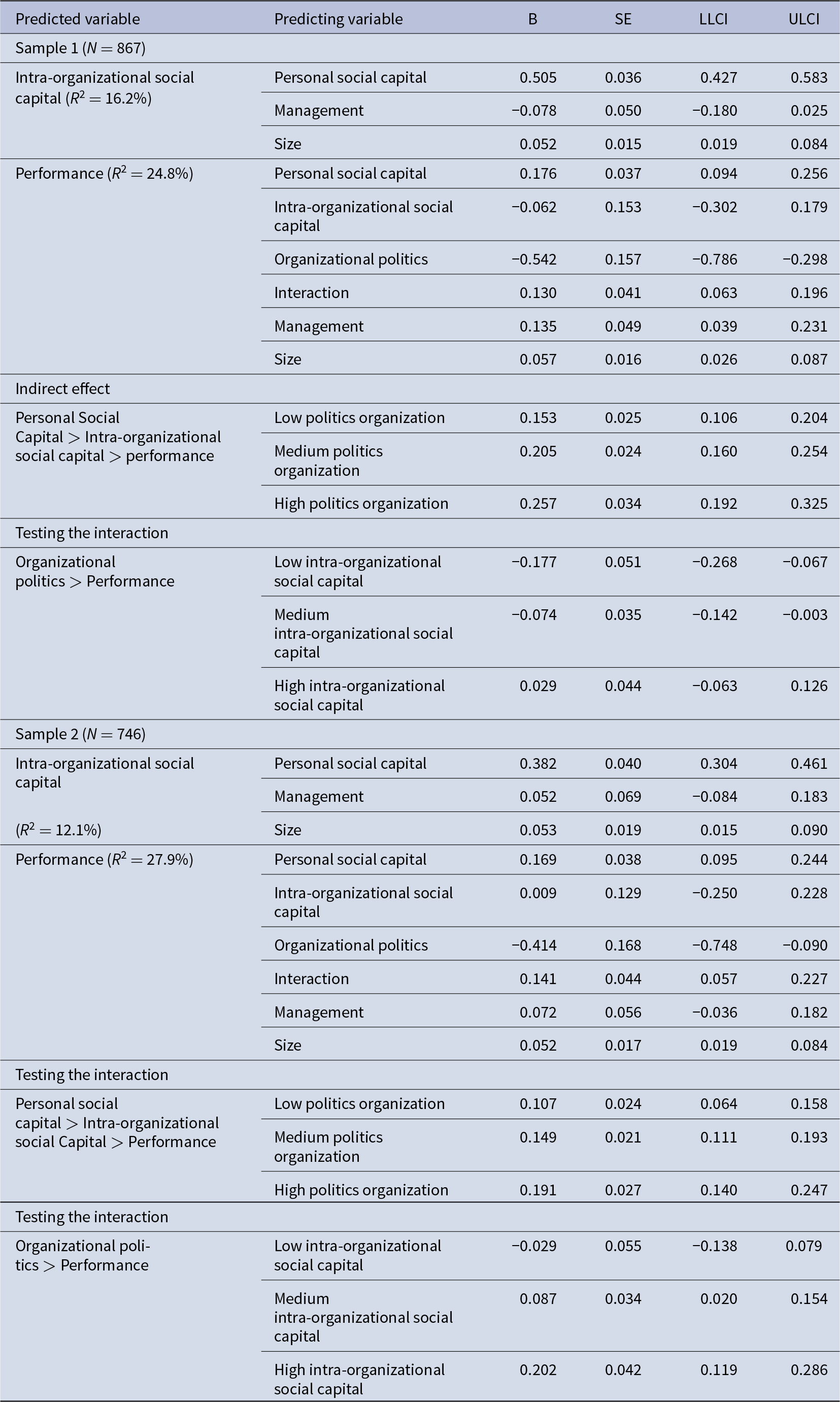
For both samples, the analysis indicates that personal social capital positively and significantly predicts intra-organizational social capital. Personal social capital and the interaction between intra-organizational social capital and perceived organizational politics positively and significantly predict performance.
The mediation between personal social capital and performance through intra-organizational social capital was found to be statistically significant for employees with low perceived organizational politics, and as the perceived organizational politics is strengthened, the relationship between social capital and performance through intra-organizational social capital is also strengthened.
The relationship between personal social capital and performance is moderated by intra-organizational social capital. For sample 1, when intra-organizational social capital is about the mean and lower, there is a negative association between organizational politics and performance. However, as intra-organizational social capital increases above the mean, there is no significant association between organizational politics and performance.
For sample 2, when intra-organizational social capital is one standard deviation lower than the mean, there is no association between organizational politics and performance. When intra-organizational social capital is about the mean and higher, there is a positive association between organizational politics and performance.
Thus, for both samples, the higher the degree of perceived organizational politics, the stronger the relationship between personal social capital and performance through intra-organizational social capital (the indirect relationship).
Table 6 and Figs. 5 and 6 present the mediation of the relationship between personal social capital and performance by intra-organizational social capital and the moderation of the relationship between perceived organizational politics and performance by intra-organizational social capital.
Mediation–moderation for sample 1 and sample 2
Interaction; interaction between intra-organizational social capital and organizational politics.
Mediation–moderation model for sample 1.

Mediation‒moderation model for sample 2.

Finally, the moderated mediation model is supported by the significance of the index of moderation mediation, B = 0.066, SE.B. = 0.023, CI; 0.020–0.111, for sample 1, and B = 0.054, SE.B. = 0.018, CI; 0.020–0.090, for sample 2. In Fig. 6, the mediation of the relationship between personal social capital and performance by intra-organizational social capital and the moderation of the relationship between perceived organizational politics and performance by intra-organizational social capital are displayed.
In summary, in the two samples, the first two hypotheses, that intra-organizational social capital is positively connected to employee performance and that it mediates the connection between personal social capital and employee performance, were confirmed. The third hypothesis that perceived organizational politics is negatively connected to employee performance was refuted. The fourth hypothesis, that intra-organizational social capital moderates the connection between perceived organizational politics and employee performance, was confirmed. In the context of this hypothesis, the second sample adds to the first sample, since, in the first sample, when intra-organizational social capital is the same or below the mean, perceived organizational politics has a negative relationship with performance, and when social capital is higher than the mean, there is no significant relationship between perceived organizational politics and performance. In the second sample, when intra-organizational social capital is below the mean, there is a negative relationship between perceived organizational politics and performance; when intra-organizational social capital is the same as the mean, there is no relationship. However, when intra-organizational social capital is above the mean, there is a positive relationship between perceived organizational politics and performance, which indicates the important role of intra-organizational social capital in moderating the relationship.
Furthermore, the mediation–moderation model connects all the variables and indicates that personal social capital may also play a role in moderating the negative relationship between organizational politics and performance.
Discussion
The purpose of this study was to examine how the relationship between perceived organizational politics and employee performance is mitigated by employees’ personal and intra-organizational social capital.
Four hypotheses were examined in this study. The first two hypotheses were that intra-organizational social capital is positively connected to employee performance and mediates the connection between personal social capital and employee performance. These hypotheses, which are derived from early research (Ben-Hador, Reference Ben-Hador2016), were confirmed, as intra-organizational social capital is based on personal social capital and leads to enhanced employee performance (Yu & Junshu, Reference Yu and Junshu2013). The third hypothesis was that perceived organizational politics is negatively connected to employee performance. This hypothesis, which reflects employee aversion to organizational politics (Randev et al., Reference Randev, Jha and Shukla2025), was refuted, as no significant direct connection was found; nevertheless, the lack of correlation “hides” within it an element of moderation in which the relationship between perceived organizational politics and performance can be negative or positive, depending on the intra-organizational social capital. Therefore, the last hypothesis that intra-organizational social capital moderates the connection between perceived organizational politics and employee performance was confirmed, so that at low levels of intra-organizational social capital, there is a negative relationship between politics and performance, and as intra-organizational social capital increases and becomes more positive, the relationship weakens, disappears, and can even be positive at high levels of intra-organizational social capital. Thus, intra-organizational social capital acts both as a mediator and as a moderator.
Implications
This study verified that perceived organizational politics and intra-organizational social capital may be considered a job demand and job resource, respectively, according to the JD-R theory (Demerouti et al., Reference Demerouti, Bakker, Nachreiner and Schaufeli2001). The findings indicate that the negative effects of organizational politics can be mitigated, i.e., job demand can be reduced through job resources. Moreover, demonstrating that intra-organizational social capital contributes to performance even in highly perceived political situations, expands and refines organizational politics theory (Ferris & Kacmar, Reference Ferris and Kacmar1992), and helps individuals cope with the negative consequences of perceived organizational politics.
Furthermore, as far as coping with organizational politics is concerned, the two social capital levels, i.e., personal and intra-organizational social capital, have different contents and influences. The two social capital levels contribute to employee performance, but personal social capital contributes only to the mediation of intra-organizational social capital. This confirms the importance of the intra-organizational level. Therefore, this study adds to social capital theory (Adler & Kwon, Reference Adler and Kwon2002), its levels (Ben-Hador, Reference Ben-Hador2017), and its effect on employee performance.
An additional implication is methodological in nature; an initial qualitative phase was conducted to gather information from interviews to determine the study’s variables and hence ensure the trustworthiness of the study by serving as a pilot (Malmqvist et al., Reference Malmqvist, Hellberg, Möllås, Rose and Shevlin2019). Researchers often use a pilot as part of the research data and thus contaminate the results; using a pilot with a completely different methodology ensures data integrity and credibility (Williams-mcbean, Reference Williams-mcbean2019).
The study also has practical applications for managers. Given that organizational politics are very common and can lead to negative outcomes, strengthening intra-organizational social capital can buffer these influences. Therefore, maximizing intra-organizational social capital within an organization and actively fostering trust, collaboration, and mutual support across teams are critical. This can be achieved through cross-functional projects, shared goals, mentoring programs, and open communication channels. Leadership interventions should be sensitive to the existing levels of social capital in a unit. For teams with low social capital, interventions should first aim to build trust and cohesion. For high-social capital teams, leaders can channel political behavior toward productive outcomes. Additionally, manager behavior affects both perceptions of politics and social capital. Therefore, managers should be trained and encouraged to model behaviors that contribute to strong intra-organizational social capital, demonstrating these behaviors can also dispel fears related to perceived organizational politics.
Limitations and suggestions for further research
Despite the advantages of quantitative research combined with the qualitative pilot, there are still several limitations that need to be addressed. First, because this study is non-causal, follow-up research should be conducted, with either an experimental design that is causal or a longitudinal design that tracks the evolution of social capital and perceived politics over time. Moreover, through a longitudinal design, it is possible to examine the effects of interventions aimed at reducing political behavior and to measure changes in individual and team performance metrics. As a result of this design, the temporal sequence of social capital’s utility might be clarified, as well as the potential causal mechanisms identified.
Moreover, it should be noted that a range of personal and organizational variables may also affect outcome variables; if more potential confounding variables beyond demographic controls were managed, it would be valuable. Therefore, in the future, other variables, such as management processes, market conditions, and ecosystem factors, which may provide valuable information and allow a larger picture to be seen, should be measured.
Conclusion
Various studies (Nyathi, Reference Nyathi2024) have shown that organizational politics is perceived negatively by employees, which results in adverse outcomes and low employee performance. The current study attempted to determine what leads to these perceptions and how to cope with the negative outcomes, and this is addressed and answered using social capital theory. The two social capital levels, personal social capital and intra-organizational social capital, serve as a means of coping with organizational politics and strengthening employee performance. In the qualitative pilot, it was found that social capital contributes to better coping with organizational politics. The quantitative phase highlights the role of intra-organizational social capital, which has a positive effect on employee performance and can mitigate the adverse effects of perceived organizational politics. Therefore, this study narrows the research gap on how to cope with negative consequences that occur as a result of perceived organizational perceptions, such as poor employee performance. Hence, this study expands the organizational research literature and provides practical solutions for organizations and managers.
Supplementary material
The supplementary material for this article can be found at https://doi.org/10.1017/jmo.2025.10046.
Declaration of conflicting interest
We have no conflicts of interest to disclose.
Funding statement
This study has not received any funding.
Ethical approval
Ariel University’s ethics committee approved the research no. AU-SOC-BBH-20,201,029; informed consent was received by all participants.
Data availability statement
The data that support the findings of this study are available on request from the corresponding author. The data are not publicly available due to their content.




 Open access

