


Introduction
Whether requested as a tool to change the path of European integration or as a remedy to the crisis of representation, participatory democracy is a critical element in the European political debate nowadays.Footnote 1 Few events have marked the course of the integration process more than the Brexit referendum in 2016, and several other national referenda in the recent history of the continent have produced spill-over effects in other countries. If the literature on popular support for participatory democracy has reached a good level of complexity (Gherghina and Geissel Reference Gherghina and Geissel2020; Gherghina and Pilet Reference Gherghina and Pilet2021a), the supply side of this issue is much less explored (Gherghina and Pilet Reference Gherghina and Pilet2021b). Against this backdrop, we investigate whether appeals for participatory democracy are rooted in the ideologic tenets of parties.
Our central argument is that participatory democracy may be endorsed in at least two distinct ways. On the one hand, it may be advocated in an essentially ultra-majoritarian fashion, emphasising the role of the majority of citizens in directly determining the course of political action. This approach is thus much more in tune with direct rather than deliberative democracy. What makes this approach distinctive is that the role assigned to the majority in determining the course of political action is interpreted without constraints and superimposed on the liberal guarantees of liberal democracy. We label this approach a monist declination of participatory democracy.
On the other hand, a pluralist understanding of participatory democracy stresses the promotion of the active participation of citizens. This stream thus sees participatory democracy as a tool that brings out societal diversity and interests better than representation, improving the advancement and spread of democracy. This element contains an explicit critique of representative democracy. However, it does not clash with its guarantees, which are protected by its emphasis on the individual—rather than the majority—as the central actor in the process.
While these two streams may interpenetrate one another to a certain degree, they nevertheless maintain a conceptual distinction (Rosanvallon Reference Rosanvallon2011, p. 127). Populism marries better with the former, bearing a vision of a society where the will of an aggregate entity—the people—prevails over any other guarantees, and it may clash with political and societal pluralism (Stanley Reference Stanley2008), while the post-materialist parties, focusing on individuals, their self-realisation and the promotion of social diversity (Dalton et al. Reference Dalton, Burklin and Drummond2001, p. 146), should espouse the latter.
This paper is structured as follows. Sections 2 and 3 discuss the ideological links between populist and post-materialist-centred parties and the support for participatory democracy. Section 4 introduces our hypotheses regarding the ideological drivers of participatory democracy. Section 5 presents our data and methods, while in the sixth section we discuss our results.
A monist interpretation: populism and participatory democracy
Populism and democracy share an inextricable relationship. This phenomenon has been variously interpreted as a style, a discourse or a (thin) ideology, with the latter interpretation prevailing in the literature on Europe (Piccolino and Soare Reference Piccolino and Soare2021). Two essential features attributed to populism seem to be shared across the different approaches, namely people-centrism and anti-elitism. In the populist imaginary, a homogeneous and unitarian people is the exclusive depositary of unconstrained popular sovereignty. The last say on the most important political decisions is thus owed to the virtuous people rather than the vicious political elite, whose separation from societal reality leads to betraying and manipulating the popular will.
As Mény and Surel (Reference Mény and Surel2000) have suggested, the centrality given by populists to the notion of popular sovereignty does not greatly differ from the democratic ideal and its emphasis on the notion of a government based on the will of the people. What makes their approach distinctive is the ‘continual dissatisfaction with the effective practice of popular sovereignty and, as a corollary, the definition of the people/elite dichotomy as perpetually structuring’ (Mény and Surel Reference Mény and Surel2000, p. 191; translated by the authors).
Scepticism towards the liberal guarantees of modern democracies is thus inherent to populism and its interpretation of democracy as a ‘politics of will and decision rather than accommodation and compromise’ (Canovan Reference Canovan, Mény and Surel2002, p. 34). In the crucial debate on the relationship between populism, technocracy and representation, Caramani (Reference Caramani2017) interpreted populism as an alternative form of representation compared to the liberal tradition of representative government. In particular, populism embodies a non-pluralistic declination of representation, where the aggregation of societal preferences is based on a plebiscitary logic and legitimacy is based on an unmediated ‘will of the people’ that may be expressed through instruments of direct democracy, even though in practice it ‘is often determined by the leaders themselves or, at least, interpreted by them on behalf of the people’ (Caramani Reference Caramani2017, p. 62).
The role of leadership is also particularly relevant in the work of Barr (Reference Barr2009). In their connection with the electorate, populist actors would indeed leverage a plebiscitary rather than a participatory linkage. The latter refers to the involvement of people in the decision-making process through inputs (and controls), and thus, its declination of direct democracy emphasises the ability of the citizenry to deliberate by itself. On the other hand, a plebiscitary linkage makes central the accountability of the political elites in implementing the demands of the citizens (Barr Reference Barr2009, p. 44). As a result, it ‘may be associated with a form of “direct democracy”, albeit a highly majoritarian, Rousseauian version, where any intermediation or distribution of the responsibility of representation leads to inefficiency and ineffectiveness’ (Barr Reference Barr2009, p. 36). Citizens’ initiatives are thus associated with a participatory linkage, whereas a plebiscitary linkage makes the direct participation of the citizenry only occasional and limited to ‘a “take it or leave it” choice’ (Barr Reference Barr2009, p. 36).
Even though populist actors undoubtedly emphasise the role of the leader in eliminating the ‘stickiness’ and lengthiness of representation, with a blatant disregard for the typical checks and balances of liberal democracies, at the same time they may well endorse a wide range of instruments of direct democracy (Mudde Reference Mudde2007, p 151–153). An example of this tension inherent in populism comes to us from left-wing populism in Latin America. These actors have often been crucial in experimenting with non-negligible spaces of participatory democracy in order to include masses considered excluded and neglected by the political system. However, these participatory instruments were often strategically motivated and applied in a general framework of not easy coexistence with strong leaderships and plebiscitarian dynamics (de la Torre 2013; Rhodes-Purdy Reference Rhodes-Purdy2015).
The populist approach to democracy can be thus found in an uneasy combination of a maieutic role of the leadership in interpreting the will of the people and the request for a greater centrality of popular sovereignty. Such a feature should lead populism to support the extension of several tools of direct democracy, such mechanisms being the most suitable to make the will of the majority prevail without further intermediation. The relationship between populism and direct democracy thus does not seem to reside (only) in the mere ratification of the decisions of populist leadership. Not coincidentally, populism is today ‘sometimes portrayed as almost synonymous with direct democracy’ (De Blasio and Sorice Reference De Blasio and Sorice2018, p. 1).
At the same time, populism should entertain an opaque relationship with deliberative democracy (Sharon Reference Sharon2019; Ruth-Lovell and Grahn 2022). Its almost monolithic conception of the people and resistance to compromise should lead populism to view it with scepticism (De Blasio and Sorice Reference De Blasio and Sorice2018, p. 3). We can also outline that a central tenet of participation—the educative function through which citizens foster their democratic skills (Pateman Reference Pateman1970, p. 42–43)—that is exalted in the tools of deliberative democracy, contrasts with the vision of the people as a positive entity per se and the populist appeal to ‘the common man and his allegedly superior common sense’ (Betz Reference Betz1994, p. 4).
A pluralist interpretation: post-materialism and participatory democracy
The debate on the rethinking of liberal democratic polities in favour of more horizontal and participatory democratic institutions is marked by the post-materialist turn of the 1970s. In Inglehart’s (Reference Inglehart1977) famous theorisation, the entrance of new cohorts of voters—who grew up in affluent societies characterised by the absence of war—boosted an intergenerational value change, emphasising the importance of environmentalism, equality, new rights, participation and pacifism (i.e. post-materialist issues) over materialist issues referring mainly to the economy, welfare and labour affairs. Moreover, one of the outcomes of this silent revolution has been the development of general distrust towards the principles of hierarchy and paternalism in favour of a more individualistic understanding of political (and collective) action (Dalton et al. Reference Dalton, Burklin and Drummond2001). In this respect, political parties mobilizing post-materialist issues are also supportive of forms of participatory democracy to widen the space of citizen participation in politics and they may well also endorse instruments of deliberative democracy, being ideal tools for a decision-making process based on bottom-up participation of an engaged citizenry.
Thomas Poguntke (Reference Poguntke1987, p. 81) lumped together parties mobilizing post-materialist issues with the label ‘new politics parties’. More than 30 years later, the political parties advocating the primacy of post-materialist (i.e. new politics) issues have dramatically increased and, crucially, overcame the classic set of the green party family. New (proto-) party families, such as animalist and pirate parties, have built their political profiles around advocacy for animal welfare and the promotion of a cyber-libertarian agenda, respectively. Post-materialist issues represent—both for pirate and animalist parties—their ideological core values. In this respect, building on Poguntke (Reference Poguntke1987), we propose employing the label of post-materialist-centred (PMC) parties.
We avoid the term ‘new politics’ because today post-materialist issues can hardly be considered ‘new’, constituting a stable feature of contemporary party competition. Furthermore, the diffusion of several post-materialist values requires the term ‘centred’ to distinguish PMC parties from those—mainly liberal—parties that politicise post-materialist issues such as civil rights, equality and environmental protection as complementary issues in a broader political supply mixed with more classical ideologies. Our PMC category includes green, animalist and pirate parties.
Green parties
The green parties’ profile cannot be reduced to demands for environmental protection (Müller-Rommel Reference Müller-Rommel1989; Poguntke Reference Poguntke1993). Their grievance against the classic mood of representative democracy and their support for unmediated forms of political participation has always represented one of their ideological tenets.
Looking at green parties from a comparative perspective, their ideological similarities go beyond the defence of the environment and include also radical democracy and egalitarianism (Poguntke Reference Poguntke1987; Price-Thomas 2016). The green preference for bottom-up forms of participation can be traced since their emergence, reflected in their internal organisational structures (e.g. grass-roots democracy). In this respect, the origins of the greens, located within the ‘new social movements’, played a main role in their critique of the hierarchy principle (Doherty and de Geus 1996; Hay Reference Hay2002; Rüdig and Sajuria Reference Rüdig and Sajuria2020).
Focusing on the greens’ conceptualisation of democracy, Pogunkte (Reference Poguntke1987, p 78) argues that ‘[their] demand for participatory, decentralised democracy challenges the prevalent institutionalised forms of representative decision-making’ (see also Kitschelt Reference Kitschelt1988). In a more recent analysis of green party manifestos, Price-Thomas (2016) suggests that even if green parties have partially moderated their radical demands, advocacy for more participatory and direct forms of democracy still constitutes a core ideological feature of their platforms.
Pirate parties
Despite their cross-national heterogeneity, pirate parties can still be treated as a party family (Zulianello Reference Zulianello2018). Comparative research exploring pirate party political programs (Jääsaari and Hildén Reference Jääsaari and Hildén2015) and their ideological cores (Burkart Reference Burkart2014; Cammaerts Reference Cammaerts2015) suggests that the concern for the state of representative democracy and the willingness to introduce new tools and mechanisms for participatory democracy represents a crucial feature of pirate parties (Cammaerts Reference Cammaerts2015; Zulianello Reference Zulianello2018).
Pirate parties exploit this resentment against liberal democracy, suggesting the development of new online institutional infrastructure and platforms aiming to provide transparency to decision-making and boost citizen participation through the implementation of direct democracy (Burkart Reference Burkart2014, p. 128). In a sense, it has been argued that pirate politics represents the ‘subterranean’ outcome of the crisis of liberal democracy (Kaldor and Selchow Reference Kaldor and Selchow2013). In a nutshell, the ideological core of pirate parties can be synthesised in their advocacy for (new) digital and civic rights, complemented by a vibrant critique of the contemporary sclerotised liberal democratic polities (Cammaerts Reference Cammaerts2015).
Animalist parties
Animalist parties contextualise their claims for the protection of animal welfare as an emancipation process, ‘based on the enlightenment principles of justice, freedom and equality of rights’ (Lucardie Reference Lucardie2020, p. 215). In this respect, animalist parties defend the idea that rights and freedom should also be extended to non-human animals. Similar to human society, where the expansion of political (and later social) rights moved from male landowners to women, the egalitarian principle inspires animal parties to push for an expansion of rights from human animals to non-human animals.
Animalist parties show a preference for equality that is translated into advocacy for a welfare state in economic terms and claims for universal social rights for LGBTQI + people (Morini Reference Morini2018, p. 11). Most importantly, the animalist stance on bottom-up citizen participation mutated several topoi from the greens’ tradition. Indeed, animalists propose supporting citizen involvement through direct democratic instruments and referenda (Lucardie Reference Lucardie2020, p. 217).
Hypotheses
The current research expects that populist and PMC parties—in light of their ideological core—support participative democracy more than other party families. In distinguishing between populist and PMC parties, we treat the two categories as mutually exclusive. Even if it has been argued that in terms of discourse articulation and communication strategy populism and environmentalism might share some overlaps (Buzogány and Mohamad-Klotzbach Reference Buzogány, Mohamad-Klotzbach and Oswald2022), we have shown how populist and PMC parties provide a quite distinct theoretical justification in supporting participatory democracy. The different emphasis assigned to the people and the individuals creates a fault line in the general vision of society. In this respect, seminal contributions by leading scholars of populist and post-materialist parties have diffusively discussed that these parties address quite different—and to a larger extent opposed—challenges against contemporary liberal democratic polities (Müller-Rommel Reference Müller-Rommel1998; Taggart 1996). Additionally, in terms of parties and party families, they largely differ regarding ideology, policies, voters’ profile, and therefore, the most authoritative contributions listing the parties belonging to the populist and PMC categories do not present overlaps (see the next section for more details). In our theoretical assessment, we argue that these groups show a very different appraisal of participatory democracy. Consequently, our first hypothesis is formulated as follows:
H1: Populist parties will more likely endorse a monist vision of participatory democracy, while post-materialist-centred parties will more likely support a pluralist interpretation of it.
Our second hypothesis is, instead, connected to the relationship between our two groups of interest and the other political actors. We expect that both populist and post-materialist-centred parties are more likely to emphasise the request for participatory democracy compared to other parties.
This expectation by no means excludes that a request for participatory democracy may be advocated by other political parties as well. Although mainstream parties should prima facie support representative democracy, they are not immune to party competition. For example, in analysing trends in the German political system, Scarrow (Reference Scarrow1999) demonstrated how they supported direct participation as a reaction to the growth of unconventional forms of political mobilization and the parallel decline of conventional ones. However, these parties’ support for participatory democracy should be more episodic and strategically motivated, and thus not linked to their wider interpretation of democracy.
The same applies to secessionist and Eurosceptic parties. Some of these are neither populist nor PMC parties but have been pivotal in advocating some of the most hotly debated referenda in Europe in recent years. However, their emphasis on such instruments is specifically targeted to a specific goal rather than as tools to govern a (possibly new) polity. Consequently, our second hypothesis is formulated as:
H2: Populist and post-materialist-centred parties are more likely to support participatory democracy compared to other parties, all other things being equal.
Data and operationalisation
To test our hypotheses, we rely on the Manifesto Research on Political Representation dataset (MARPOR; Volkens et al. 2022). More specifically, we employ MARPOR’s variable indicating a positive stance towards direct democracy (202.4 Direct Democracy: Positive) in an electoral manifesto (Volkens et al. 2020).Footnote 2 We analysed 29 countries belonging to the European Union or the European Free Trade Agreement. Manifesto data present the advantage of being easily comparable across countries and time. Additionally, manifestos are scarcely influenced by some context-specific circumstances that can bias the style of other data sources (e.g. speeches, interviews).
In order to identify populist and PMC parties, we rely on the existing literature. More precisely, to identify populist parties we employ the PopuList classification (Rooduijn et al. 2019),Footnote 3 excluding all cases labelled as borderline populist. Regarding PMC parties, for the greens we rely on van Haute (Reference van Haute2016) and Grant and Tilley (Reference Grant and Tilley2019). For parties never mentioned in these studies we rely on other criteria, namely a score equal to or above 9 on the environmental emphasis measured by the Chapel Hill Expert Survey (CHES, Jolly et al. 2022) or, for those belonging to the ‘Ecologist’ party family in the MARPOR’s classification, consulting additional references in the literature.Footnote 4 For parties classified as pirates, we rely on Otjes (Reference Otjes2020), while for animalist parties our source is Lucardie (Reference Lucardie2020).
To test our first hypothesis,Footnote 5 we consider all statements coded in the Direct Democracy: Positive category in the manifestos of PMC and populist parties and subject them to a more in-depth coding in order to capture differences in the argumentation (see Appendix 2).Footnote 6 More specifically, we looked for the general principles underlying participatory democracy. Two of these principles are connected to a monist understanding of participatory democracy. More specifically, the majoritarian principle refers to all statements that exalt the power given to the citizenry to directly decide on political matters and conflict with representation identifies statements that position participatory democracy in contrast with representative democracy and its alleged distortions. The two other principles are instead more in line with the pluralist declination of participatory democracy. They are related to the participative function of participatory democracy and the overall democratic enhancement—beyond the increase in participation—expected from these tools.
In line with the MARPOR's coding scheme, we assign only one category to each quasi-sentence; thus, we split the original quasi-sentences that presented more than one category. We also employ a residual category for statements that are too technical or generic to be included in a meaningful category. We test our first expectation descriptively by comparing the percentages of monist and pluralist quasi-sentences in the manifestos of populist and PMC parties.
To test our second hypothesis, we run logistic regression models. Our dependent variable is a dichotomous indicator distinguishing between party manifestos with positive references to participatory democracy from those without mention of it. We focus on the presence of our category of interest, rather than on salience. This choice is motivated by our focus on the drivers of this issue and the desire to explore which parties employ it in their public discourse and which do not.
The main explanans is represented by the populist or PMC nature of parties. Thus, we construct a categorical variable distinguishing populist and PMC parties from the rest of their competitors. We include other independent, party-level variables in order to account for ideological position and governing status. We measure parties’ ideological position on the left–right dimension by using the CHES (Jolly et al. 2022) that locates political parties on a 0–10 scale. We construct a dummy variable measuring party incumbency status in the national government for each election, obtained from ParlGov (Döring and Manow 2021). Another binary variable allows us to identify the secessionist parties, with classifications obtained from Szöcsik and Zuber (Reference Szöcsik and Zuber2021). We then used a country-level variable, indicating the presence of national referenda held in a given country in the election year, obtained from the Varieties of Democracies dataset (Coppedge et al. 2022).
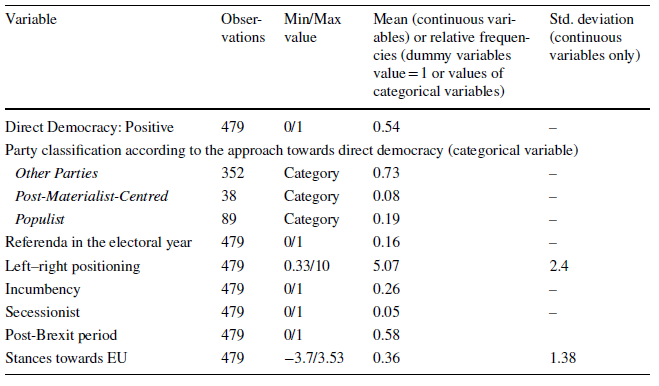
Finally, we include two variables related to the European Union, a key battleground for the use of direct democracy in Europe. The first variable divides the elections between those that took place before the Brexit referendum and those that took place afterwards. The second variable is, instead, related to the positioning of parties with regard to Europe, using data from MARPOR. More precisely, we combine positive and negative references to EU integration using Lowe et al.’s (Reference Lowe, Benoit, Mikhaylov and Laver2011) logit scaling measurement. Table 1 shows the synthetic descriptive statistics for each variable employed in our study.Footnote 7
Descriptive statistics of the variables employed in the study
Source: Authors’ elaboration based on Volkens et al. (2022)

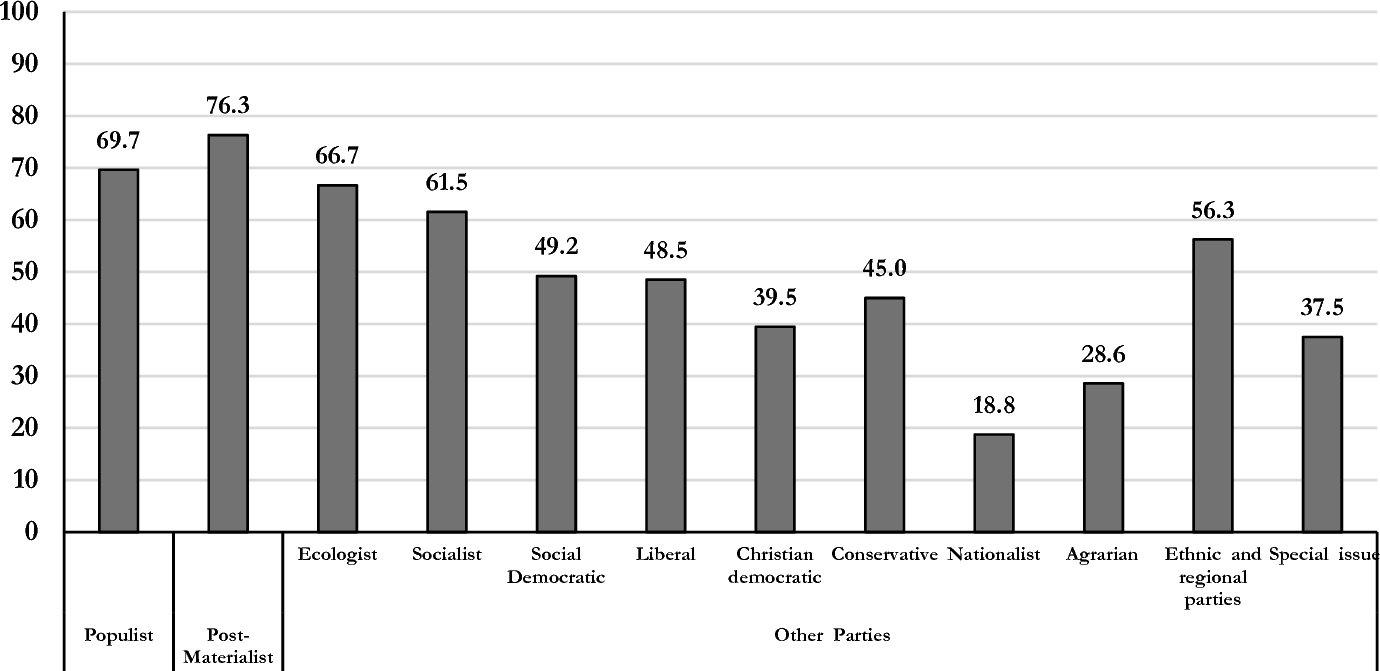
In Fig. 1, we present the percentage of manifestos by populist, PMC and other parties containing positive references to participatory democracy. ‘Other parties’ are divided according to their party family using the classification provided by MARPOR. Although we consider populist and PMC as meaningful categories in the approach towards participatory democracy more than proper party families, these data nevertheless show how these two groups place more emphasis on participatory democracy. The scores of PMC (76.3%) and populist parties (69.7%) are close to that of the ‘Ecologist parties’, which after having been emptied of PMC parties by our classification, amount to just three observations (manifestos of Peter Pilz List and Left-Green Movement). Then we have the ‘Socialist’ family, where there are many borderline cases of populism that were excluded from our first category (such as Sinn Féin in the UK or Podemos after 2019). All other groups, apart for the category of ethnic and regional parties, scored below 50%.
Percentage of manifestos with presence of positive references to direct democracy, by party group. Source: authors’ elaboration based on Volkens et al. (2022). Category (N): Populist (89), Post-Materialist (38), Ecologist (3), Socialist (52), Social Democratic (65), Liberal (68), Christian democratic (38), Conservative (40), Nationalist (16), Agrarian (14), Ethnic and regional (48), Special issue (8)

Results
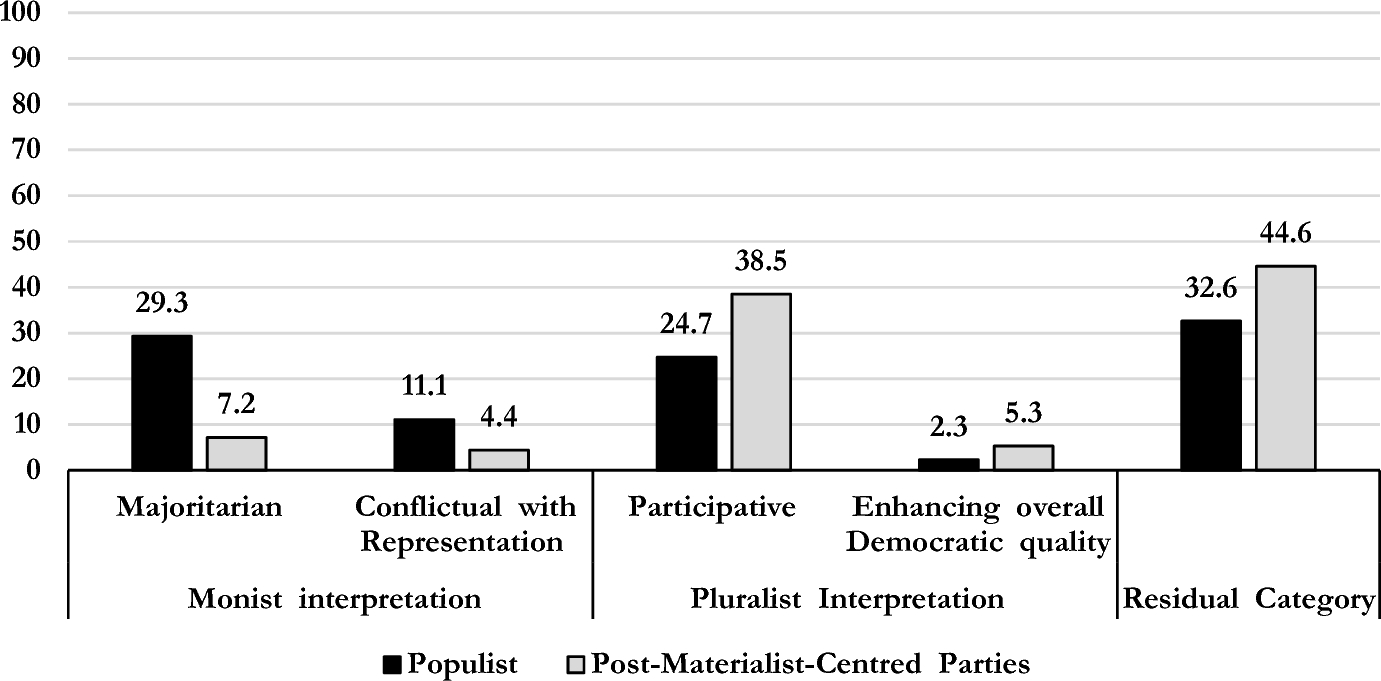
Figure 2 shows the results of our coding for the first dimension. For each manifesto, we calculated the proportion, in percentage terms, of the quasi-sentences of each category out of the total quasi-sentences analysed. For both PMC and populist parties, we report the average percentages across manifestos foreach principle. At first inspection, our hypothesis appears to be supported. On aggregate, populist parties show preference for the monist interpretation of participatory democracy, rather than the pluralist one, with 40.4% (29.3% for the majoritarian principle and 11.1% for conflict with representation) against 27% (24.7% for the participative principle and 2.3% for the enhancement of democratic quality). In contrast, among PMC parties we see a strong prevalence of the pluralist categories: 43.8% versus 11.6%.
Average percentages of principles associated with direct democracy in manifestos of populist and PMC parties. Source: authors' dataset based on original coding of data from Volkens et al. (2022). Category (N): Populist (62), Post-Materialist-Centred (29) Parties

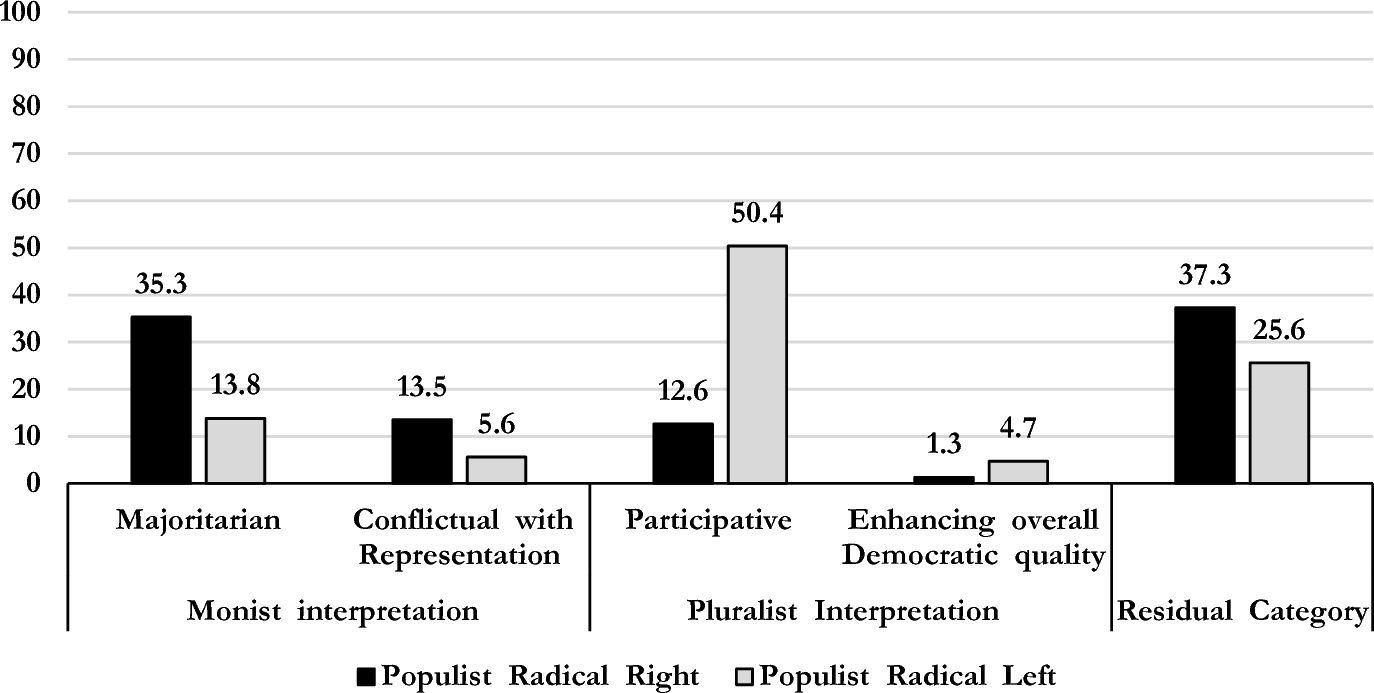
In order to further dig into the internal coherence of the populist category, in Fig. 3 we differentiate between populist radical right (PRR) and populist radical left (PRL) parties, leaving aside the manifestos of some parties non-classifiable within these two groups. The picture that emerges shows a contrasting declination of participatory democracy between these groups. PRR parties show a distribution even more in line with the monist interpretation of participatory democracy, with close to 50% of all statements falling into the monist categories. In contrast, among PRL parties the general picture is much closer to the post-materialist-centred parties than the general distribution of populist ones. Pluralist principles are present in over 50% of statements, a percentage higher than that recorded for PMC parties. Moreover, the share of statements emphasising monist principles among PRL parties is just 13.7%.
Average percentages of principles associated with direct democracy in manifestos of PRR and PRL parties. Source: authors' dataset based on original coding of data from Volkens et al. (2022). Category (N): Populist Radical Right (36), Populist Radical Left (18) Parties

Looking at individual manifestos, two-thirds of those of PRR parties show a prevalence of the monist interpretation and only one-quarter exhibit a prevalence of the pluralist interpretation, while 8.3% remain neutral. Among PRL parties the situation is reversed. Of the PRL manifestos considered, 79% show a prevalence of the pluralist understanding of participatory democracy, and only 15.8% show a monist one. This picture is closer to that of PMC parties, where 69% adhere to the pluralist interpretation and just 10.3% to the monist one.
To sum up, our data show mixed support for our first hypothesis. On aggregate, populist and PMC parties adhere to different declinations of participatory democracy. However, we find profound differences between PRR and PRL parties, with the former emphasising monist characteristics and the latter instead being linked to a pluralist understanding.
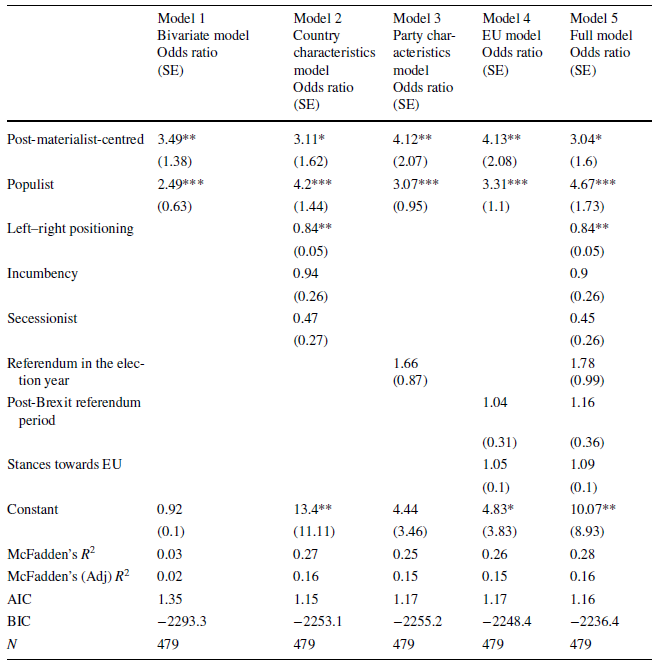
Table 2 shows the results of the logistic models testing our second hypothesis. In the first model, we investigate the relationship between our dependent variable of participatory democracy and our main explanans, namely the populist and PMC categories. In this first analysis, we can see that both populist and post-materialist parties are more likely to emphasise this issue compared to the other parties. In particular, their odds of emphasising this issue are 3.49 (PMC parties) and 2.49 (populist parties) times greater than other parties, and for both groups the odds ratios are significant. We then add variables related to party characteristics (model 2) and the presence of referenda in the election year (model 3). Again, no other variable is significant except that on the left and right positioning. More precisely, we find that leftist parties are more likely to support participatory democracy. This has an impact also on our classification: with the introduction of left–right positioning, the coefficients of both PMC and populist parties remain significant, but now the latter have a higher coefficient than the former. This may suggest a mediating role of the left–right variable in the relationship between our classification and the dependent variable. The picture is not altered in the fourth model, where we add the variables related to the EU. As a result, in our fifth and full model, PMC parties have an odds ratio of 3.04, while populist parties have an odds ratio of 4.67, and both are statistically significant.
Logistic models on the support for direct democracy in party manifestos from EU/EFTA countries
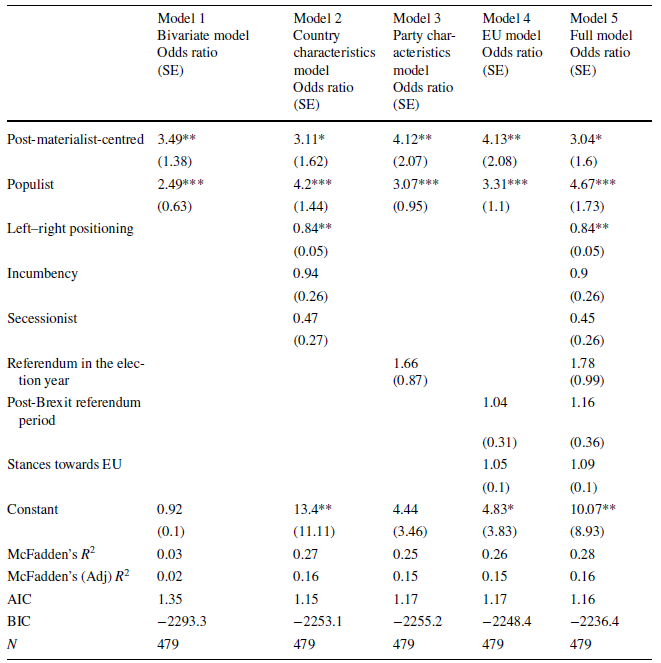
Models 2–5 incorporate also a categorical predictor of the party manifesto’s country. *p < 0.05, **p < 0.01, *** p < 0.001
Conclusions
In this paper, we explored the ideological drivers of support for participatory democracy in contemporary Europe. Our central argument is that two political streams (populist and post-materialist-centred parties) have a deeper ideological connection to the request for greater participatory democracy compared to other parties, and they are thus the main drivers of this issue in Europe. Furthermore, we expected internal differentiation in participatory democracy preferences between these two types of parties. Populists, in light of their understanding of popular sovereignty and their support for an unmediated style of political participation, are expected to show a monist understanding of participatory democracy. In contrast, PMC parties, with their individualistic emphasis on personal freedoms, are expected to reveal a pluralistic understanding of participatory democracy.
Our results confirm that populist and PMC parties emphasise participatory democracy more than any other party family, in the light of their deeper and more stable ideological connections. Additionally, in line with the proposed theoretical framework, we confirm that PMC parties hold mainly a pluralist understanding of participatory democracy.
Once we move the analysis to populist parties, we find important differences distinguishing PRR and PRL parties. In this respect, PRR parties adhere neatly to a monist understanding of participatory democracy, while PRL parties seem closer to the pluralist polarity. In other words, our article reveals that—running partially counter to our expectations—the populist monism vis-à-vis participatory democracy holds only when we account for the radical right, which shares a vertical and plebiscitarian view of participatory democracy. The same does not hold for radical left populism. Should this element lead us to exclude the latter from the populist genus? Not necessarily, even though our analysis seems to suggest that populism per se is not sufficient to address the positioning of these parties towards participatory democracy. In this regard, we can address an interpretation that needs to consider the role of the host ideology and how programmatic stances—addressed in this article—and the effective practice of participatory democracy interact.
Left-wing populism may be pushed to support more bottom-up instruments of participatory democracy being based on leftist ideologies that consider grassroots mobilisation one of the central modes of political action. The rise—and strengthening—of several radical left parties in the 1970s and 1980s has been intertwined with new politics and has been precisely oriented towards building a space for activist self-expression, creating a distance from the old-fashioned soviet-inspired communism (Gomez et al. Reference Gomez, Morales and Ramiro2016). This legacy seems to be rooted—perhaps more than we could have expected—in these parties, to the point of inspiring their programmatic platform towards participatory democracy. At the same time—and it is an element that could separate them from the PMC parties—these parties appear to still assign to the leadership a strong role in directing goals and the applicability of participatory democracy. An element that involves the actual practice rather than programmatic stances and it is more in line with a populist view. This is what happened in the case of Podemos, where the implementation of mechanisms of deliberative democracy has been often mixed with plebiscitarian distortions and aggregative rather than deliberative logics (Kioupkiolis and Katsambekis Reference Kioupkiolis, Katsambekis, García Agustín and Briziarelli2018; Motos Reference Motos2019). This does not imply that the approach of left-wing populism towards participatory democracy is insincere, but rather that a programmatic pluralism may be balanced by an effective practice that limits its boundaries.
Above all, our study suggests that the approach of populist parties towards participatory democracy—and, possibly, towards democracy in general—must be reconnected to the interaction between populism and other ideologies, not only to the characteristics of the former. Further research should test these theoretical implications in a more articulated way than the descriptive analysis that we have been able to offer, due to the limited number of observations available. Moreover, an analysis of the internal differences between populist, PMC-centred, and other parties in terms of the content and framing of participatory democracy should be implemented, as well as a more comprehensive analysis of their actual practice.
Acknowledgements
The authors would like to thank David Talukder, Marie-Isabel Theuwis and Davide Vittori for their invaluable comments at the workshops where this paper was presented; Francesco Olmastroni and Sorina Soare for their kind support; Laura Berlingozzi, Elisabetta De Giorgi and Mattia Collini for their help with the second-order coding; the two anonymous referees of the article for their insightful suggestions; and the editors of EPS for their constant support.
Funding
Open access funding provided by Scuola Superiore Sant'Anna within the CRUI-CARE Agreement.


 Open access

