

During the last decade of the Cold War, human rights concerns were interwoven in the fabric of US foreign policy to an unprecedented degree, fueled by the ongoing contestation between the Reagan administration and members of Congress. The increased salience of human rights concerns and their institutionalization in US foreign policy in the 1970s had forced any new administration to consider its approach to human rights issues as an element in its foreign policy. In the 1980 election, where foreign policy featured more prominently than usual, Ronald Reagan attacked Jimmy Carter’s human rights–based foreign policy and appealed to yearnings for a more assertive foreign policy amid perceptions of American decline. The election put a president in the White House who was inclined to dismiss human rights concerns as a core element of US foreign policy and who profoundly changed the composition of Congress. The outcome pitted a Republican president and Senate against a Democratic House that grew increasingly assertive about foreign policy including human rights issues. Throughout the decade, members of Congress used existing and new institutions to draw attention to human rights issues, with liberals predominantly concerned with rightwing dictatorships and conservatives mostly preoccupied with communist countries. These different priorities between institutions, party lines, and ideology, along with strong personal motivations, combined to shape American attention to human rights issues during the 1980s. Finally, human rights concerns became intertwined with other expressions of morality in foreign policy, such as peace movements, opposition to nuclear weapons, and the anti-apartheid movement.
The Breakthrough of Human Rights and Its Legacies
Over the course of a few years in the mid-1970s, human rights went from being a virtually unknown concept on the fringes of foreign policy debates to being a celebrated catchphrase trumpeted by a growing number of NGOs, political activists, members of Congress, and eventually the president.Footnote 1 Although ideas about individual freedom and rights had been at the heart of America’s political culture since the nation’s founding and the United States participated in the codification of universal human rights in the 1940s, it was not until the 1970s that human rights gained a firm foothold in US foreign policy. Although human rights did play a role in US foreign policy in some cases in the 1960s, such as the Johnson administration’s policy toward Greece and Southern Rhodesia (now Zimbabwe), the United States was not a frontrunner on international human rights during the 1950s and the 1960s, with other countries taking the lead on human rights at the United Nations.Footnote 2
When President Jimmy Carter declared in his inauguration speech on January 20, 1977, “Our commitment to human rights must be absolute,” he became the first US president to make the promotion of human rights a top foreign policy priority.Footnote 3 Later that same year, the London-based human rights NGO Amnesty International won the Nobel Peace Prize. The arrival of human rights was evident by the dramatic increase in the use of the term in the American press, with the New York Times using the term five times more often in 1977 than in any previous year.Footnote 4 The point to which the concept of human rights had arrived in American popular culture by 1977 was further underscored by its inclusion as a subject in the immensely popular Pulitzer Prize–winning comic strip Doonesbury, which ran in almost all major American newspapers.Footnote 5 Noting these dramatic changes, Samuel Moyn argues that 1977 was the breakthrough year for human rights.Footnote 6
The breakthrough, however, began in Congress. During the second Nixon administration, human rights had become part of a congressional assertiveness on foreign policy that generated substantial conflict between the executive and legislative branches of government.Footnote 7 Rising in opposition to the imperial presidency of Richard Nixon and reflecting the breakdown of the Cold War foreign policy consensus over the Vietnam War, members of Congress passed a number of measures to restrict the presidency’s prerogatives on foreign policy, including legislation tying elements of US foreign relations to other countries’ respect for human rights.Footnote 8 Both the Nixon administration and later the Ford administration resisted this congressional intrusion into foreign policy, with Secretary of State Henry Kissinger particularly reluctant to cooperate with Congress on human rights policy. This resistance, however, only provoked members of Congress to push human rights legislation even further.Footnote 9 As a result, the executive branch found itself largely on the sidelines, as Congress became the dominant branch of government concerned with human rights issues.
The drivers of this congressional activism on human rights were a few individuals who held hearings and passed legislation, introducing human rights concerns into US foreign policy. Representative Donald M. Fraser (D-MN) initiated the first hearings on international human rights issues in 1973 in his House Foreign Affairs Subcommittee on International Organizations and Social Movements. Over the course of five years, Fraser’s subcommittee held a series of hearings, as Congress reduced foreign aid to some countries deemed to be committing gross human rights violations and linked US trade relations to the respect for human rights.Footnote 10 In addition to such general legislation, Congress passed several country-specific measures that cut off or reduced assistance to specific countries, including Argentina, Chile, El Salvador, the Philippines, South Korea, and Uruguay.Footnote 11 In March 1974, Fraser’s subcommittee published a report calling for the United States to take the lead on international human rights and detailing twenty-nine recommendations for integrating human rights concerns in US foreign policymaking.Footnote 12 Under growing congressional pressure, the executive branch accommodated several of these recommendations, including the establishment of a Human Rights Bureau in the State Department in 1976 and the assignment of human rights officers to all its regional bureaus. Congress also mandated that the executive branch deliver annual reports to Congress on the human rights situation in countries receiving US aid.Footnote 13
The members of Congress who introduced human rights concerns into US foreign policy differed in their background, ideology, and motivations. Fraser and other liberal Democrats wanted to stop US support for repressive regimes, such as the Dominican Republic, Chile, and Greece.Footnote 14 Fraser came to see hearings on human rights issues as a way to call attention to such issues and possibly develop a more bipartisan approach to human rights grounded on objective measures.Footnote 15 Other liberal Democrats, such as Edward (Ted) Kennedy (D-MA), James Abourezk (D-SD), and Alan Cranston (D-CA) in the Senate and Tom Harkin (D-IA) in the House, had similar motives.
Yet members of Congress targeting the Soviet Union and other communist countries also embraced human rights concerns. These anti-communists were generally much less willing than their liberal counterparts to criticize human rights violations by American allies. The most significant proponent of this position was the conservative Democratic Senator Henry M. “Scoop” Jackson (D-WA), who introduced the Jackson–Vanik Amendment, which prohibited the granting of most-favored-nation status and trade credit to communist countries that denied or restricted the right to emigration. Aside from his deep-felt anti-communism and opposition to détente, Jackson believed that his human rights stand against the Soviet Union could help him in a future presidential run by raising support from American Jews and others critical of Soviet emigration restrictions.Footnote 16 Moderate figures in both parties, such as Republican Senator Jacob Javits (R-NY) and the Democratic Representative Dante Fascell (D-FL), also supported anti-communist human rights efforts, while being at least somewhat more restrained in their criticism of American allies.Footnote 17
Despite their different agendas, members of Congress were often able to find common ground on human rights issues. An important reason for this was that conservatives who wanted to cut foreign aid would join liberals in their quests to cut assistance for human rights-violating dictators. In turn, most liberals were willing to support measures against the Soviet Union, despite their principal focus on repressive regimes allied with the United States. Finally, those advocating for human rights were able to take advantage of a broad-based desire to constrain the executive branch and wider opposition to détente.Footnote 18
The legacy of congressional human rights activism in the 1970s tells us three important lessons about congressional involvement with human rights that would continue into the 1980s. First, they testify to the diversity of the motivations behind members of Congress engaged in promoting human rights. Second, they demonstrate the selective adoption of human rights concerns, as members would apply the language of universal human rights to particular agendas of their concern and often stay passive on other issues. Finally, they show the importance of individual members of Congress as foreign policy entrepreneurs who wielded influence beyond their formal powers when they succeeded in forging coalitions behind their human rights positions.Footnote 19
Human rights reached unprecedented heights as a US foreign policy when Carter embraced human rights as the moral language to restore the country’s sense of virtue and the guideline for its role in the world in the aftermath of the Vietnam War.Footnote 20 Moreover, Carter’s human rights based-foreign policy was aimed at resetting America’s relations with the world by transcending Cold War contestation and improving relations with specific regions, such as Latin America.Footnote 21 In US–Soviet relations, human rights concerns were pursed in combination with détente. In relations with the so-called Third World, a human rights-based policy meant criticism of authoritarian regimes including American allies but also nonintervention.Footnote 22 In other words, Carter’s human rights-based foreign policy sought to implement the liberal critique of right-wing dictatorships in practice. As Barbara J. Keys points out, Carter’s religious beliefs and his interpretation of the civil rights movement made him predisposed to a moralistic foreign policy, but he was slow to adopt human rights language and only did so because he found that it resonated with the public.Footnote 23 Although he experienced significant difficulties implementing human rights into foreign policy, Carter played a pivotal role in elevating human rights in the national political debate. Throughout the Carter years, NGOs and members of Congress remained important actors on human rights policy, passing legislation that reduced economic assistance to the Philippines and pushing for sanctions against Uganda due to human rights violations.Footnote 24 However, by the end of Carter’s presidency, the perceived failure of his foreign policy as well as his presidency overall left American commitment to human rights in the balance.Footnote 25
Human Rights and the 1980 Election
Although domestic economic problems such as high inflation and unemployment rates dominated the 1980 presidential election, foreign policy, including human rights issues, also received considerable attention.Footnote 26 In particular, the ongoing Iran hostage crisis after Iranian students took fifty-two Americans hostage at the American embassy in Tehran on November 4, 1979, drew attention to foreign affairs. This crisis was set in the wider context of the heating up of the Cold War, following the Soviet invasion of Afghanistan in December 1979 and a number of advances by Soviet-supported guerrillas throughout the Third World.Footnote 27 Moreover, the United States lost a strong ally in Nicaragua, where the left-wing Sandinistas had taken power after the toppling of Anastasio Somoza in July 1979. Political opponents and several contemporary observers blamed Carter’s human rights policy for contributing to these developments by allegedly undermining American allies and demonstrating a weakness that emboldened the Soviets.Footnote 28 Combined with the economic crisis, the country’s foreign policy woes fed a growing sense among many Americans that American power was in decline.
Each candidate believed that foreign policy was a weakness for his opponent. Beset by economic problems at home, Carter sought to move the focus away from being a referendum on his own record to focus instead on the shortcomings of his opponent. The Carter campaign believed that Reagan’s inexperience in international affairs and his reputation as a Cold War hardliner made him vulnerable in the area of foreign policy. During the campaign, Carter repeatedly painted a picture of Reagan as a dangerous warmonger who would cause war with the Soviet Union, framing the election as a choice that would determine “whether we have war or peace.”Footnote 29 Essentially, the Carter campaign ran a strategy designed to frighten the electorate about Reagan rather than seeking to vindicate the president’s record.
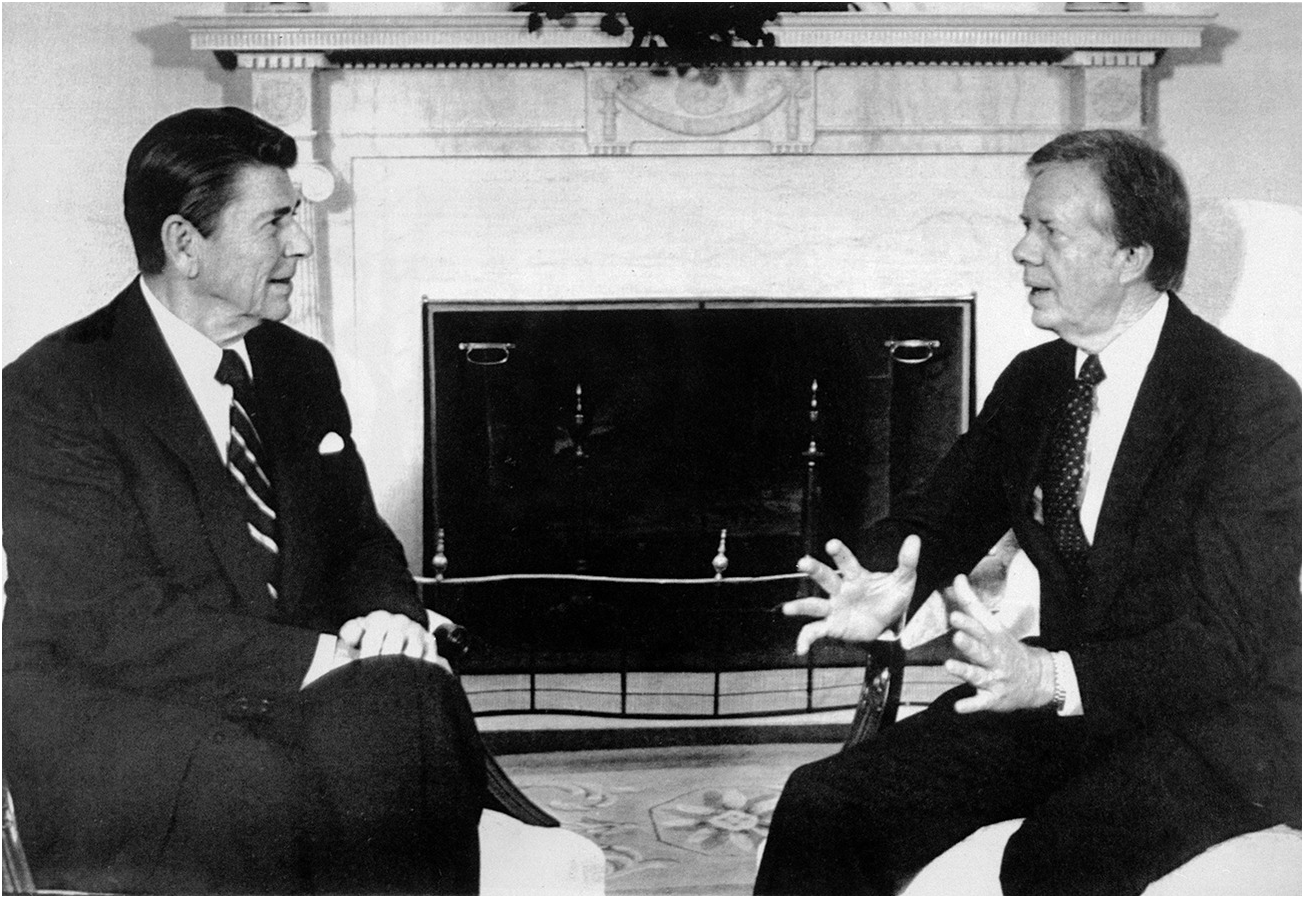
The Reagan campaign conversely believed that it could exploit the growing perception that Carter was weak on foreign policy and that the international standing of the United States was on the decline. Criticizing Carter’s human rights policy figured prominently in this strategy. In 1978, Reagan had described Carter’s human rights-based foreign policy as “well-meaning intentions” mixed with a “false sense of guilt” after Vietnam, but by 1980 he struck an even harder line.Footnote 30 During the only presidential debate between the two major candidates on October 28, 1980, only a week before the election, Reagan attacked Carter for criticizing the human rights abuses of allies while at the same time seeking détente with the Soviet Union. Reagan lamented that Carter’s policy toward allied authoritarian regimes had “in a number of instances, aided a revolutionary overthrow which results in complete totalitarianism.”Footnote 31 Arguing that Carter’s human rights policy had “undercut our friends,” Reagan blamed Carter for the fall of American allies such as Somoza in Nicaragua and Mohammad Reza Pahlavi, the Shah of Iran.Footnote 32 Along with the Iran hostage crisis and the Soviet invasion of Afghanistan, Reagan’s attack on Carter’s human rights policy painted a picture of Carter as a weak leader who was unable to withstand communist aggression and Islamic fundamentalism and who failed to support America’s allies (Figure 1).

While the Soviet invasion of Afghanistan in 1979 had caused Carter to moderate his foreign policy by stressing a tougher approach to the Cold War, he did not completely abandon his support for human rights concerns in US foreign policy. Carter’s human rights policy had focused on détente with the Soviet Union and the promotion of human rights with authoritarian allies in the Third World. The Soviet invasion of Afghanistan effectively destroyed détente, and the overthrow of repressive but US-friendly regimes in Teheran and Managua by forces hostile to the United States demonstrated the risks of criticizing authoritarian allies. Carter responded by hardening his rhetoric toward the Soviet Union, withdrawing from the Strategic Arms Limitations Treaty II (SALT II) negotiations, and boycotting the 1980 Moscow Olympics. Yet the Carter administration continued to view human rights concerns as an important element of US policy toward the Soviet Union as well as US-friendly regimes, such as Chile, South Korea, and the Philippines.Footnote 33
Despite Carter’s alterations to his human rights policy, the Reagan campaign maintained that the Carter administration was too soft on the Soviet Union and too hard on American allies. A Reagan administration, they claimed, would transform the human rights theme into an instrument to counter Soviet propaganda.Footnote 34 Reagan also sought to link America’s foreign policy tribulations with domestic economic problems. In his final statement during the presidential debate, Reagan addressed the sense of decline by urging the American people to ask themselves, “Are you better off than you were four years ago? Is it easier for you to go and buy things in the stores than it was four years ago? Is there more or less unemployment in the country than there was four years ago? Is America as respected throughout the world as it was? Do you feel that our security is as safe, that we’re as strong as we were four years ago?”Footnote 35 With Carter’s so-called misery index (the combination of inflation and unemployment numbers) peaking at 20.76 in 1980 and the foreign policy embarrassments of Afghanistan and Iran fresh in mind, many Americans decided they could not answer Reagan’s questions affirmatively.Footnote 36
The party platforms from the Republican and Democratic National Conventions also testified to the increased attention to human rights. While party platforms do not dictate an administration’s foreign policy, they do represent a party’s attempt to compromise on a shared set of policy positions. As such, party platforms represent an interesting document attesting to what the different factions of a party can agree on among themselves. Comparing their attention to issues over time offers a glimpse into a party’s shifting priorities and positions beyond the scope of the party’s presidential candidates. In 1976, both the Republican and Democratic platforms only sparsely mentioned human rights, with three and six mentions, respectively.Footnote 37 In both cases, human rights were used to express criticism of détente and the realpolitik of the Nixon administration. In the Republican platform, the appearance of human rights language was also a reflection of the internal power struggle in the party, where a faction supporting Reagan’s candidacy used human rights to attack the détente policy associated with President Gerald R. Ford.
In 1980, the Democratic platform hailed the merits of Carter’s human rights policy, making no less than thirty-six mentions of human rights, while the Republican platform attacked this policy, making a total of nine references to human rights.Footnote 38 The Democratic platform proclaimed the party’s continued commitment to work to “foster the principles set out in the Universal Declaration of Human Rights.”Footnote 39 The platform stressed the need to be vigilant on human rights violations among allies as well as among enemies. The day after the release of the party platform, Carter defeated Senator Edward Kennedy to win the Democratic nomination for president. In spite of the setbacks to Carter’s foreign policy in the preceding years, the 1980 Democratic National Convention thus signaled a continued commitment to Carter’s human rights policy within the Democratic Party. The 1980 Republican platform launched a full-scale attack on Carter’s human rights policy, arguing that Carter had been too tough on America’s allies while failing to crack down on communist human rights offenders, such as the Soviet Union, Vietnam, and Cuba. “The nations of South and Central America,” the platform declared, “have been battered by the Carter Administration’s economic and diplomatic sanctions linked to its undifferentiated charges of human rights violations.”Footnote 40 Specifically, the platform lamented Carter’s failure to prevent the Sandinista coup against Anastasio Somoza in Nicaragua. The platform promised that a Republican president would rectify Carter’s policy on Nicaragua by countering Soviet influence in the country and supporting “a free and independent government” in Nicaragua.Footnote 41
The 1980 election had a higher percentage of newspaper editorials devoted to foreign affairs than had the previous four elections.Footnote 42 According to a contemporary study, foreign policy received more newspaper coverage than did domestic and economic issues combined.Footnote 43 Moreover, the study found that four foreign policy issues dominated the coverage: the Iran hostage crisis, the development of stealth aircraft, the SALT II negotiations with the Soviet Union, and the question of war and peace. The Iran hostage crisis, in particular, dominated the news cycle and was the favored topic for newspaper front pages.Footnote 44 It also dominated evening news reports, which continually reminded viewers of the number of days the American hostages had been held captive.Footnote 45 The coverage was further amplified just before the election, as Election Day fell on the one-year anniversary of the taking of the hostages.
Moreover, contemporary polls and studies indicate that while the economy was the most important issue for voters, foreign policy mattered a great deal to a large part of the electorate. In one study, 56 percent of voters sad the economy was the most important issue, but 32 percent answered foreign policy – a marked increase from a mere 4 percent in the previous election.Footnote 46 Foreign policy was decisive for the election because of the large differences between the candidates’ foreign policies and the high salience of certain foreign policy issues.Footnote 47 First and foremost, it was the Iran hostage crisis that haunted Carter. Initially, the crisis benefitted Carter’s popularity as the American people rallied behind their leader, but the continued failure to secure the release of the hostages and Reagan’s critique of this turned the issue against Carter.Footnote 48 Foreign policy mattered in the 1980 election and international developments worked in Reagan’s favor, most clearly illustrated by the release of all hostages the day after Reagan’s inauguration, despite hectic efforts by the Carter administration to secure release before stepping down.Footnote 49
Reagan won the election in an unexpected landslide, taking 51 percent of the popular vote against Carter’s 41 percent, and the independent candidate John Anderson picking up close to 7 percent. The victory was even more comfortable measured in electoral votes, where Reagan secured 489 electoral votes against Carter’s forty-nine. The Republican Party also took control over the Senate for the first time since 1955 and decreased the Democratic majority in the House by thirty-four seats. In the months leading up to the election, however, a Reagan victory did not appear to be a foregone conclusion. Polls generally indicated a closer race, and only one week before the election a Gallup poll among registered voters even gave Carter 47 percent of the votes and Reagan only 39 percent.Footnote 50 Contemporary observers described the election result a massive shift to the right, and Republicans and conservatives were understandably ecstatic about their electoral victory.Footnote 51
However, the landslide was less resounding than it appeared and, despite the contemporary interpretations, Reagan’s victory was not an indication of the American electorate enthusiastically embracing conservatism.Footnote 52 In the year of conservatism’s biggest triumph, only 32 percent of Americans self-identified as conservative.Footnote 53 Americans were clearly disgruntled with the malaise of the Carter years and desperate to try something new, but the election result was as much a rejection of Carter as it was an embrace of Reagan.Footnote 54 Reagan offered a refreshing optimism and a promise of restoring Americans’ confidence in themselves and their country. Still, Reagan’s victory came during an election that had the lowest voter turnout since 1924 – only a little above 52 percent, reflecting the general lack of enthusiasm among the population.Footnote 55 As Reagan would soon learn, there were limits to how far the American people were willing to “turn right.” In a similar vein, Americans might have been ready for a restoration of America’s image abroad, but this did not mean they were ready to abandon human rights.
While there were limits to the conservative turn, the 1980 election did signify a rightward move with regards to foreign policy, which had important implication for US human rights policy. Amid concerns over American decline, an increasing number of American’s rejected the policy of détente for a more interventionist and assertive foreign policy. This trend had been developing throughout the 1970s. The Soviet invasion of Afghanistan in 1979 ended the search for a centrist consensus on national security among Democrats and moderate Republicans that had stretched from the détente of Nixon and Ford to Carter’s human rights policy. The breakdown of this search for a consensus in 1979 deepened divisions over foreign policy among Democrats and fostered a new unity in the Republican Party.Footnote 56 This breakdown coincided with a resurgence of a foreign policy of conservative internationalism fuelled by the rise of the New Right and the migration of neoconservatives from the Democratic Party to the Republican Party.Footnote 57 This shift in party alignments and a general shift toward a more interventionist foreign policy was to have significant implications for the role of human rights concerns in US foreign policy.
Congress and Human Rights in the 1980s
While the 1980 election brought a new approach to human rights into the White House, it also profoundly altered the composition of the legislative branch of government. The election further shifted the internal power balance within Congress from the Senate to the House.Footnote 58 The 1978 congressional elections had already turned the Senate more conservative, less active on foreign affairs, and less ideologically consistent.Footnote 59 When Republicans won control of the Senate in 1980, in an election that also brought a Republican into the White House, it became apparent that the Senate would be reluctant to criticize the administration too vigorously. While individual Republicans would occasionally defy the administration, the Senate leadership generally backed Reagan’s foreign policy. Senate Majority Leader from 1981 to 1985, Howard Baker Jr. (R-TN) went on to serve as Reagan’s White House Chief of Staff from 1987 to 1988. His replacement, the conservative Robert Dole (R-KS), also supported Reagan and enjoyed the president’s trust, despite having unsuccessfully challenged him for the Republican nomination.Footnote 60 Strongly partisan and influential in the Republican Party, Dole became an immensely powerful presence in the Senate throughout the 1980s. Moreover, prominent liberal Democrats such as Frank Church (D-ID) and George McGovern (D-SD), who had been strong human rights advocates, lost their seats.
The hitherto powerful Senate Foreign Relations Committee lost most of its influence in the 1980s as it suffered from ideological divisions and legislative disarray.Footnote 61 It had no subcommittee devoted to human rights and the full committee devoted as little as one staff member to human rights issues. Human rights action in the Senate thus relied on the personal commitment of individuals, without any significant institutional support.Footnote 62 From 1981 to 1987, moderate Republicans, who were disinclined to confront a popular Republican president, chaired the Senate Foreign Relations Committee. The first of these, Charles H. Percy (R-IL), demonstrated an interest in human rights issues especially in the Eastern Bloc. His successor, Richard Lugar (R-IN), became an important link between the administration and its critics in Congress, when he became involved with human rights issues in US foreign policy toward the Philippines and South Africa from the mid-1980s onward.Footnote 63 When the Democrats regained the Senate majority in 1987, the chairmanship passed to the liberal Claiborne Pell (D-RI), who was in diametric opposition to Reagan in terms of ideology. A strong opponent of the Vietnam War and an idealist committed to world peace, Pell always carried a copy of the UN Charter in his suit pocket, but he was also nonconfrontational by nature and, thus, often moderated his criticism of the administration.Footnote 64 Therefore, it mostly befell other liberal Democrats, such as Edward Kennedy and Christopher Dodd (D-CT), to contest Reagan’s human rights policy in the Senate.Footnote 65 These liberals were met by strong opposition from conservative senators, such as Jesse Helms (R-NC) and Malcolm Wallop (R-WY), who believed the United States should reserve human rights criticism for the Soviet Union and other communist countries. On some issues, such as economic sanctions against South Africa, moderate Republicans such as Lugar and Nancy Kassebaum (R-KS) eventually broke the party ranks to side with their liberal colleagues.Footnote 66
With a Republican majority in the Senate, House Democrats formed the natural vanguard of congressional opposition to the Reagan administration, and the Democratic leadership showed great willingness to challenge the president on foreign policy, including on human rights issues.Footnote 67 As Speaker of the House from 1977 to 1987, “Tip” O’Neill (D-MA) was at the forefront of this opposition.Footnote 68 A liberal Democrat and a critic of American militarism since the early days of the Vietnam War, O’Neill often clashed with Reagan’s foreign policy, especially on Central America and human rights issues. The House Majority Leader from 1977 to 1987 and later Speaker of the House from 1987 to 1989, Jim Wright (D-TX) was a less outspoken critic of Reagan’s human rights policy, but he challenged the administration on Nicaragua when he took the initiative to mediate in the conflict in 1987.Footnote 69 Republican members of the House generally supported Reagan’s foreign policy, but given the comfortable Democratic majority, they had limited influence. Throughout Reagan’s tenure, Minority Leader Robert H. Michel (R-IL) formally led House Republicans, but on several issues, the increasingly powerful newcomer Newt Gingrich (R-GA) was the GOP’s dominant figure in the House. Strongly conservative and willing to use aggressive tactics, Gingrich formed the Conservative Opportunity Society to challenge the Republican establishment and push the party to the right.Footnote 70
Human rights enjoyed a much stronger institutional footing in the House than in the Senate. As its counterpart in the Senate diminished in influence, the House Foreign Affairs Committee took on a more prominent role, with an expanding staff of which several were dedicated to human rights issues.Footnote 71 In 1983, Fascell, a long-term human rights advocate, began what would become a ten-year reign as chair of the House Foreign Affairs Committee. Replacing the deceased Clement Zablocki (D-WI), Fascell greatly increased the committee’s attention to human rights issues. The Subcommittee on Human Rights continued to be the logical forum for human rights issues in the House. Its chair from 1979 to 1982, Don Bonker (D-WA) was particularly outspoken in his criticism of the Reagan administration’s initial attempts to downgrade concerns for human rights. Although his replacement, the more conservative Gus Yatron (D-PA), was less assertive in challenging the administration, Yatron expanded the subcommittee’s jurisdiction to include international law in 1985.Footnote 72 Unlike the subcommittee’s broader examinations of human rights in the 1970s, its hearings in the 1980s were more focused on specific types of human rights violations, such as political killings, religious intolerance, and torture.Footnote 73 The activities of the subcommittee and the substantial interest in human rights issues in the full committee also had what political scientist David Forsythe calls a socializing effect, as it led other subcommittees to pay attention to human rights. This effect was evident in the Subcommittee on Africa under the chairmanship of first Stephen Solarz (D-NY) and subsequently Howard Wolpe (D-MI) – both liberal Jewish Democrats with a keen interest in human rights issues in Africa and beyond. It also extended to the Subcommittee on Asia, of which Solarz became the chair in 1981, and the Subcommittee on the Western Hemisphere under the chairmanship of the liberal Democrat Michael Barnes (D-MD).Footnote 74
Activity on human rights in the House, however, was not limited to the Foreign Affairs Committee and its subcommittees. In 1983, Representatives John E. Porter (R-IL) and Tom Lantos (D-CA) formed the Congressional Human Rights Caucus (CHRC) to promote bipartisan support for human rights concerns in US foreign policy.Footnote 75 Another key human rights institution was the Commission on Security and Cooperation in Europe established in 1976 to monitor compliance with the Helsinki Final Act, and therefore also known as the US Helsinki Commission. While it was formed as a bi-branch agency with members from both the executive and legislative branches of government, the commission was effectively controlled in Congress, with a strong dominance of the House. Having established itself as an influential actor on human rights in East–West relations in the Carter years, the commission continued to play an important role under Reagan. This was in part due to the bipartisan nature of the commission and the fact that it operated on human rights issues that enjoyed broad consensus across the ideological spectrum. As the commission’s instigator and chair until 1984, Fascell was particularly dominant on the commission, but representatives and senators from both parties played important roles.Footnote 76
Resembling the ideological positions of the 1970s, liberals, most of whom were Democrats, tended to be particularly concerned with human rights violations in rightwing dictatorships and critical of US support for these countries. Conservatives, most of whom were Republicans, tended to focus more on human rights violations in communist countries and to see conflicts elsewhere through the prism of the Cold War. Between these two positions, there were several members of Congress of a more moderate bend. Belonging to both parties, these members would sometimes support human rights cases triumphed by either liberals or conservatives. Often these members of Congress were crucial for tipping the scale in Congress on more contentious issues. Finally, a small minority of members, mostly among conservative Republicans, preferred that human rights played no role in US foreign policy at all, favoring either isolationism or realpolitik devout of moral principles.
The members of Congress who sought to promote human rights concerns in US foreign policy used several measures, spanning formal congressional powers and more informal ways of exerting influence. House Democrats, especially, held numerous hearings to draw attention to human rights issues and to keep oversight of the administration’s foreign policy. When they found the administration lacking, they used the “power of the purse” through the appropriations process to constrain the administration’s actions. Through the passing of legislation, members of Congress concerned with human rights regulated economic and military assistance, trade relations, and voting in international institutions, and in other ways limited Reagan’s room for maneuver in foreign affairs.
Whereas congressional legislation on human rights in the 1970s primarily focused on restrictions on foreign assistance, in the 1980s the focus shifted to defense appropriations measures. In the increasingly polarized political climate, foreign assistance bills became harder to pass and the funding for foreign assistance decreased.Footnote 77 On the contrary, defense spending rose significantly under Reagan and thus defense appropriations emerged as a better option for human rights legislation to have a significant impact.Footnote 78 Another legislative strategy was the imposition of procedural legislation such as certification requirements, compelling the Reagan administration to certify human rights improvements in countries such as Argentina and El Salvador in order to secure the release of foreign aid. Often, however, members of Congress influenced US human rights policy more indirectly by abetting or restricting the executive branch. As political scientist Stanley Heginbotham notes, “Congressional victory is achieved when restrictive legislation loses, but Congress extracts some policy compromises reflecting congressional concerns.”Footnote 79 This, for instance, was the case when Reagan imposed moderate economic sanctions against South Africa in 1985 in an attempt to prevent harsher congressional sanctions. Besides, members of Congress adopted an extensive number of nonbinding resolutions on human rights issues around the world. Most often these were not directed against the administration, but rather targeted foreign government, expressing Congress’ support for human rights activists or condemnation of a country’s human rights violations. Finally, senators used their power to withhold advice and consent on presidential appointments to express their disapproval of the nomination of Ernest Lefever to head of the Human Rights Bureau.
Members of Congress also relied on a range of more informal powers. They sometimes participated directly in diplomatic relations with foreign countries, to varying degrees of acceptance from the Reagan administration. In 1985, Representative Dick Cheney (R-WY) grumbled that Reagan had to “put up with every member of Congress with a Xerox machine and a credit card running around the world cutting deals with heads of state.”Footnote 80 By the invitation of the administration, members of Congress participated in the CSCE follow-up meetings at Madrid and Vienna through the US Helsinki Commission, as they had done under the Carter administration.Footnote 81 Moreover, members of Congress sought to advance human rights concerns through personal meetings and correspondence with foreign governments. Such interactions increased significantly during the 1980s. As Representative Lee Hamilton (D-IN) noted in 1988, “Visiting heads of government used to come to Washington and visit the President; the Chairman of the World Bank; the Secretary of Defense; the Secretary of State, and go home. Now they insist on coming to Capitol Hill.”Footnote 82 Members of Congress also participated in fact-finding and consultative delegations abroad. Sometimes they went as far as to conduct their own foreign policy through what political scientist James Lindsay terms “Lone Ranger diplomacy,” often attracting considerable criticism.Footnote 83 This was the case when certain legislators, such as Speaker Jim Wright (D-TX), held unofficial diplomatic negotiations with the Nicaraguan government without Reagan’s approval. More often, however, members of Congress preferred to influence the executive branch rather than going behind its back. Democrats and Republicans alike sought frequent consultations with the administration in their attempt to shape American attention to human rights abroad.
Finally, and possibly most significantly, Congress attempted to influence public and elite opinion by framing foreign policy issues in human rights terms. Similar to their predecessors in the 1970s, members of Congress used congressional hearings, floor speeches, reports, opinion pieces, and media performances to draw attention to human rights issues. Advances in media technology helped expand the reach of those who mastered these platforms. Members of Congress also expanded their engagement in extra-institutional activities, such as protests and orchestrated media events, to shape the political debate and mobilize support for their agendas. The staged arrests in front of the South African embassy by the Free South Africa Movement in 1984 represented a successful example of such an event. As this book demonstrates, when members of Congress successfully managed to frame an issue in human rights terms and benefit from public opinion, they could be powerful opponents to the administration’s policy.Footnote 84
American Attention to Human Rights in the 1980s
The 1980s witnessed an unprecedented density of human rights politics as an ever-growing number of actors inside and outside of government invoked human rights concerns for their political agendas. Just as it had been the case in the 1980 election, human rights issues figured prominently in debates over US foreign policy throughout the decade. The range of these debates and the policymakers and NGOs that invoked human rights concerns reflected the widespread appeal of human rights language as well as the degree to which its flexibility made it adaptable for different agendas. Human rights also intersected with other expressions of morality in American foreign relations, such as the nuclear freeze movement, the Central America peace movement, and country-specific movements, such as the anti-apartheid movement and the movement for Soviet Jewry. The following pages survey American attention to human rights in foreign policy beyond the cases studies selected for this book.
While personal experiences were often important motivations for individual American policymakers’ advocacy for human rights issues, ideology and party affiliation also strongly shaped attention to human rights. Conservatives, most of whom were Republicans, tended to focus more on human rights violations in communist countries and to see conflicts elsewhere through the prism of the Cold War. Liberals, most of whom were Democrats, tended to be particularly concerned with human rights violations in right-wing dictatorships and critical of US support for these countries. With a conservative Republican administration in the White House, Republicans in Congress were generally inclined to support official US foreign policy positions on human rights, which congressional Democrats, on the contrary, were more likely to contest.
The relationship between the Reagan administration and members of Congress concerned with human rights issues was crucial for the role of human rights in US foreign policy during the 1980s. The administration put a high emphasis on human rights concerns in East–West relations, where it generally viewed human rights criticism as a useful component of its foreign policy. Overall, this approach enjoyed bipartisan support from members of Congress. In other regions, such as Central America, the administration mostly sought to downplay human rights concerns, which it viewed as harmful to its agenda of combatting communism. This position led to heated collisions with liberal Democrats in Congress and the peace movement, which opposed US interventionism and saw human rights violations by US-supported regimes as a key cause for instability in the region. Elsewhere, local developments, internal power shifts in the administration, and pressure from members of Congress made the administration increasingly willing to prioritize human rights concerns and support democratic reforms as the decade wore on. In some Latin American countries, such as Argentina, Brazil, and Bolivia, local developments toward democracy made this shift easier as the administration lend its support to a trend favorable to American interests. Yet in other countries, such as Chile, the Philippines, South Korea, and South Africa, changes in US policy occurred as a reaction to deteriorating human rights situations. In all of these cases, members of Congress, especially liberal Democrats sometimes supported by moderate Republicans, added pressure to prioritize human rights concerns. Not all countries with dismal human rights records received equal attention from Americans, however. Several countries, particularly in Africa and Asia, either flew under the radar because they were of lesser importance to the United States or were deemed too important to warrant considerable criticism. Human rights violations in China, for instance, received remarkably little American attention as strategic and economic interests dominated the relatively positive and low-key US–Chinese relations.Footnote 85
American attention to human rights issues abroad spanned a range of human rights abuses, from the most blatant violations of the integrity of the person through physical violence such as killings and torture to the denial of a number of civil and political rights. Americans expressed their support for human rights activists and dissidents denied their freedom of religion, freedom of speech, freedom of assembly, and the right to due process. They also protested discrimination against ethnic, religious, and racial minorities. Often, these violations were committed by repressive regimes that deprived their population of political participation by denying them the opportunity of representative government through democratic elections. For most Americans, such actions delegitimized these regimes as they conflicted with the most basic American values and principles. Furthermore, this led several Americans to question the United States’ relationship with these regimes, as alliances with oppressors conflicted with the image of the United States as a promoter of freedom. By contrast, American attention to human rights abroad rarely concerned economic and social rights, such as food, housing, education, and health. The Reagan administration, members of Congress, as well as most human rights NGOs generally did not pay much attention to these often less visible human rights, but rather focused on individual victims of more discernable assaults rights.Footnote 86 Thus, just as American attention to human rights was unevenly distributed between countries and regions, so it was selectively applied to different types of human rights.
Liberal Democrats in Congress interpreted human rights issues through a broader view of US foreign policy in the 1980s that took issue with the Reagan administration’s attempt to roll back communism in the Third World through support for anti-communist guerrilla movements and US-friendly dictatorships. Liberal Democrats were also critical of Reagan’s hardline approach toward the Soviet Union and opposed the arms race, which they feared might escalate into war. While sharing conservatives’ concern with communism, liberals wanted the United States to break with some of its most repressive authoritarian allies and instead encourage liberalization through democratic reforms. Liberal concerns for human rights in the 1980s thus resembled that of liberals in the 1970s, and several members of Congress who had been at the forefront, such as senators Edward Kennedy and Alan Cranston (D-CA), continued to be so during the Reagan era. These veterans were joined by new liberals with a particular interest in human rights issues, such as Representatives Lantos, Barnes, and Solarz. As the Reagan administration developed its conservative human rights policy, liberals increasingly clashed with the administration over the appropriate role for human rights concerns in American foreign relations.
Nowhere was the clash between liberals in Congress and the administration more passionate and intense than over US policy toward Central America. Throughout the decade, the region was marred by civil wars and bloody conflicts as repressive regimes struggled against uprisings often employing the military against their own populations. Guatemala, Nicaragua, El Salvador, and Honduras were particularly hard hit as conflicts in one country often spilled over into another, with the United States and communist bloc countries propping up various regimes and their adversaries. Aside from such Cold War interventions, the region was plagued by poverty, ethnic strife, extreme economic inequality, and military interference in politics, which led to social conflict and instability. The Reagan administration assigned the region high strategic importance, with Jeane Kirkpatrick calling it “the most important place in the world for the United States today.”Footnote 87 US support for friendly dictators and anti-communist guerillas, most notably the Nicaraguan Contras, aimed at preventing the advance of communism and securing American national interests.Footnote 88 Liberal Democrats criticized the administration’s support for right-wing dictators and sought to force changes in US policy toward the region.
In the early 1980s, El Salvador was arguably the country in the region that drew the most American attention to human rights issues. Throughout the decade, El Salvador was engulfed in a brutal civil war between its military dictatorship under the leadership of José Napoleón Duarte backed by the United States and leftwing insurgents backed by the Soviet Union, Cuba, and Nicaragua.Footnote 89 The Reagan administration viewed El Salvador as a test case for its attempt to stop the expansion of communism in Central America.Footnote 90 To that end, the administration pursued massive economic and military assistance and support for political and economic reform.Footnote 91 Liberal Democrats, such as Barnes and Senators Christopher Dodd and Edward Kennedy, strongly opposed US support for Duarte. In 1981, they managed to impose restrictions on US military assistance to the country, requiring the Reagan administration to certify that El Salvador’s human rights situation was improving in order to secure continued assistance.Footnote 92 Liberals found support among the Central America peace movement, NGOs, church groups, and the majority of Americans, who grew increasingly uncomfortable with US involvement in the conflict. The certification requirement led the administration to encourage the Salvadorian regime to improve its record to prevent an interruption of aid. In practice, however, such pressure was rendered unconvincing and ineffective as Congress accepted Reagan’s certifications that the human rights situation was improving, despite facts to the contrary.Footnote 93 El Salvador thus reflected liberal Democrats’ dissatisfaction with American support for repressive regimes, but it also demonstrated that most members of Congress were reluctant to push the administration too far, out of fear of undermining US-friendly regimes and the risk of paving the way for communism. Liberals managed to force the administration to address the human rights abuses of an American ally but they failed to force a significant change in US policy. Human rights concerns were hard to ignore, but they were easy to manipulate.
Liberals were equally concerned with US support for repressive regimes further south in Latin America, and here they found the administration more susceptible to their views. Although the administration was initially hesitant to criticize allied regimes in South America, it became increasingly willing to support democratic transitions underway in countries such as a Brazil, Argentina, Bolivia, and Uruguay.Footnote 94 This change was brought about by the growing influence of moderates inside the administration, combined with pressure from liberal Democrats in Congress and human rights NGOs.Footnote 95 While they were quick to point out the inconsistency in the administration’s support for democracy in South America and its policy elsewhere, liberals in Congress generally supported this push for democratization. As a consequence, American attention to human rights in most South American countries was relatively noncontentious, with Augusto Pinochet’s Chile as the exception confirming the rule.Footnote 96
In other parts of the world, however, the increasing repressiveness of US-backed regimes led congressional liberals to confront the administration. Liberals argued that US support for repressive regimes in countries such as the Philippines, South Korea, South Africa, and Chile was both immoral and counterproductive to American interests.Footnote 97 Rather than unconditionally supporting these regimes based on their anti-communism, liberals believed that the United States ought to distance itself from their human rights violations and pressure them to liberalize. In several of these cases, liberal Democrats would eventually receive support from more moderate Democrats and moderate Republicans. It was alliances like these that occasionally helped Congress force changes in US foreign policy during the 1980s.
Liberals Democrats became particularly angered by the administration’s stubborn support for Ferdinand Marcos’s repressive regime in the Philippines. Home to large US air and naval bases and committed to fighting communism, the Philippines was an important strategic ally to the United States. Moreover, Reagan’s personal friendship and admiration for Marcos, whom he had known since 1969, made him reluctant to withdraw support for the regime.Footnote 98 Liberal Democrats, however, became increasingly determined that the United States ought to push for regime change and a transition to democracy, not least after Marcos was linked to the assassination of his longtime political opponent Benigno “Ninoy” Aquino Jr. in 1983. The event sparked anti-Marcos protest in the Philippines and led some State Department officials to contemplate a strategy to remove Marcos. It also catalyzed Solarz into a very personal campaign to end US support for Marcos. Chair of the House Subcommittee on Asian and Pacific Affairs, Solarz had met Aquino in June 1983 and happened to have met with Marcos in Manila the day before Aquino’s assassination.Footnote 99 A great admirer of Aquino, Solarz decided to attend Aquino’s funeral, where he met with the anti-Marcos opposition. In his memoirs, Solarz recalls how this deeply emotional experience made him determined to help bring democracy to the Philippines.Footnote 100 In the following years, his subcommittee held several hearings exposing the corruption and human rights violations of the Marcos regime. In October 1983, Congress passed a resolution calling for an independent investigation of the Aquino assassination and urging free and fair elections in the Philippines.Footnote 101 Congress also made symbolic cuts in US aid to the Philippines in 1984 and 1985 to demonstrate dissatisfaction with the human rights situation. In reality, however, the cuts were simply a modification from military to economic assistance, since a genuine cut was deemed too risky as it might jeopardize American military bases.Footnote 102 By 1986, moderate Republicans such as Lugar and conservative Democrats such as Senator Samuel Nunn (D-GA) joined in calling for the administration to end US support for Marcos.Footnote 103 Eventually, Secretary of State George P. Shultz, who had come to see Marcos as a liability, succeeded in persuading Reagan to drop support for Marcos and push for democracy, and by February 1986 the withdrawal of US support contributed to Marcos’s downfall.Footnote 104
Liberals were thus uncomfortable with US support for repressive regimes and at times willing to withdraw their support for these over human rights violations. However, their opposition to these regimes was always tempered by concerns about regime changes leading to communist takeovers. Conservatives, on the contrary, were not troubled by this dilemma of balancing concern for human rights issues with fear of communism. Rather, they perceived supporting human rights and fighting communism as essentially the same thing. Much like the Reagan administration, conservatives viewed foreign policy issues almost exclusively through the lens of the Cold War and generally supported the administration’s positions. According to conservatives, the United States ought to focus on opposing the influence of communism by taking a strong stance toward Moscow and supporting American allies around the world. This led them to criticize human rights violations in the Soviet Bloc, such as the crackdown on the Solidarity movement in Poland, while downplaying abuses committed by regimes friendly to the United States, such as the Philippines, South Korea, South Africa, and Chile.
While moderate Republicans would sometimes side with liberals in opposing US support for repressive regimes, conservatives were relentless in their commitment to fighting communism by confronting the Soviet Union and supporting anti-communist regimes regardless of their human rights records. The most important proponent of this anti-communist worldview was Senator Helms, who was one of the most entrepreneurial lawmakers in the realm of foreign affairs. In 1977, Helms openly declared his strong support of Jimmy Carter’s human rights policy: “Mr. Carter and I belong to different political parties. We may disagree from time to time. But not on human rights.”Footnote 105 Yet this support was confined strictly to attacking the human rights record of communist countries and conservatives such as Helms vehemently protested what they viewed as Carter’s misguided criticism of human rights abuses in American allies. Much more in tune with Reagan’s anti-communist human rights policy, Helms strongly supported the administration’s attempt to roll back communism in Central America.Footnote 106 As chair of the Senate Foreign Relations Committee’s subcommittee on the Western Hemisphere, he took a special interest in Latin America and fiercely defended the administration’s policy in the region against its liberal critics.
However, Helms was quick to attack the administration whenever it moderated its support to US-friendly regimes. When the administration and a bipartisan coalition in Congress united behind a policy aimed at fostering a democratic transition in Chile in 1986, Helms remained steadfast in his support for Pinochet.Footnote 107 Helms also took issue with the administration, whenever it prioritized strategic and economic interests in relations with communist countries at the expense of a more ideological stand. In 1982, he protested the administration’s decision to set a ceiling for arms sales to Taiwan to not antagonize China and he criticized the lacking restrictions on US-Chinese trade, despite the country’s human rights abuses.Footnote 108 Like other anti-communist conservatives, Helms mistrusted the international human rights system. His strong suspicion of the United Nations and any secession of American sovereignty to international institutions, for instance, led him to oppose US ratification of the UN Genocide Convention even after the Reagan administration came to favor it in 1984.Footnote 109 Conservatives in Congress, such as Helms, thus both supported the Reagan administration and defended it against its liberal critics, but whenever they found the administration to be too moderate, they were quick to confront.
American attention to human rights concerns was not the only expression of morality in debates over US foreign policy in the 1980s. Americans, concerned with the heightened tensions of the Cold War and US involvement overseas, mobilized large social movements around moral languages. The most prominent of these were the nuclear freeze campaign seeking to pressure the United States and the Soviet Union to freeze testing, production, and deployment of nuclear weapons, and the peace movement opposing US involvement in Central America. Fear of nuclear war rose significantly in both the United States and Western Europe amid the escalating tensions between Moscow and Washington in the late 1970s and early 1980s. Fear of nuclear war led to several protests, including the largest peace rally in American history in New York City on June 12, 1982, with an estimated one million participants.Footnote 110 The protest also spawned legislative efforts, with a nuclear freeze resolution passing the House in May 1983 before being rejected by the Senate in June the same year.Footnote 111 The nuclear freeze campaign did not make substantial use of human rights language, but rather represented another moral framework for thinking about East–West relations.
The Central America peace movement represented a series of other moral objections to US foreign policy. Throughout the 1980s, more than 1,500 national, regional, and local groups in the United States worked to prevent US intervention in Central America. While an outgrowth of the broader peace movements of the 1960s and 1970s, the Central America peace movement also had a strong religious component with Catholics, Protestants, Quakers, and Jews all playing important roles. Another essential aspect of the movement was its extensive transnational network based on personal connections between Americans and their allies in Central America. These different elements of the movement meant that it invoked multiple moral languages, including Christian ideas about social justice such as liberation theology, anti-war sentiments extensively framed around concerns about “another Vietnam,” and concern for human rights. While human rights was not the dominant language of the movement, it was part of its vocabulary and the movement often intersected with human rights NGOs and members of Congress concerned with human rights.Footnote 112
The 1980s also witnessed the growth in several country-specific movements framed around moral concerns. The transnational Soviet Jewry movement, advocating for the right of Jews to leave the Soviet Union, became one of the decade’s leading human rights movements. The American Jewish community was particularly dominant and Gal Beckerman suggests that the issue even became more important to American Jews than were relations with Israel.Footnote 113 The movement had been active since the 1960s but gathered unprecedented levels of support in the 1980s with large demonstrations and significant lobbying of policymakers. While American Jews heavily dominated the movement, it also enjoyed considerable support from non-Jewish Americans. The Soviet Jewry movement repeatedly used human rights language, while also making use of other moral frameworks such as references to the Holocaust. The movement had significant clout in Washington, where it garnered the support of both the Reagan administration and members of Congress from across the ideological spectrum.Footnote 114
The growing transnational movement to end South African apartheid was another major moral issue that mobilized Americans in the 1980s. Although Western Europeans were long at the forefront of the anti-apartheid movement, mobilized American opposition to apartheid grew significantly in the 1980s, spreading from college campuses and churches to the national stage. At its peak, the movement consisted of hundreds of coalitions, committees, and campaigns. Not surprisingly, America’s own experience with racial segregation had a significant influence on its anti-apartheid movement. The movement relied heavily on activists and tactics from the civil rights movement as well as ideas of Pan-Africanism. Several of its proponents also incorporated human rights language in their critique of the apartheid regime. The movement received legislative support from the Congressional Black Caucus (CBC) and liberal Democrats throughout the years, and by the mid-1980s it eventually gained enough support to force a change in US policy toward the Soviet Union through the imposition of economic sanctions.Footnote 115
Morality-based movements such as the nuclear freeze campaign, the Central America peace movement, the Soviet Jewry movement, and the anti-apartheid movement constituted an important context for the human rights activism of the 1980s. Just like human rights activists, the movements challenged the Reagan administration’s foreign policy by mobilizing grassroots and seeking to influence public opinion. They also secured the active support from members of Congress and a range of celebrities, intellectuals, and religious leaders. In doing so, they forced the administration to defend the morality of its foreign policy to the American public. Sometimes these movements would form alliances with members of Congress concerned with human rights, as the case studies in this book demonstrates. Rather than competing with human rights activism, these different expressions of morality supplemented and reinforced American attention to human rights.
Conclusion
In some ways, everything had changed for human rights concerns in US foreign policy from the early days of the human rights breakthrough in the 1970s to the Reagan era. Whereas human rights had been a seldom-cited concept on the fringes of foreign policy debates up until the mid-1970s, less than a decade later it was an established moral language invoked by a substantial number of policymakers across the political spectrum. Human rights were more deeply institutionalized in the foreign policy bureaucracy and, despite its initial resistance, the Reagan administration had crafted a proactive approach to human rights and included human rights concerns in its policies toward several countries. In Congress, human rights concerns were likewise further institutionalized. Fraser’s former subcommittee was renamed the Subcommittee on Human Rights and International Organizations to reflect its focus on human rights issues. The US Helsinki Commission expanded its role on human rights concerns in East–West relations. New institutions, such as the CHRC, called attention to human rights issues around the world and sought to mobilize and systematize congressional efforts. Outside of government, an increasing number of evermore-influential NGOs championed human rights, while ethnic and religious groups frequently invoked human rights concerns for their particular agendas. In short, human rights were interwoven into the fabric of American foreign relations to an unprecedented degree.
In other ways, however, much remained the same. Attention to human rights in US foreign policy continued to be intertwined with strategic interests, in particular within the context of the Cold War. While human rights concerns were much more firmly established in American foreign policy, disagreements about their appropriate role continued. Inside the Reagan administration, moderates and hardliners often clashed on the relative importance ascribed to human rights concerns and whether promoting human rights was in America’s best interest. Moreover, the executive and legislative branches of government continued to contest their appropriate role. Liberal Democrats in Congress locked heads with the Republican administration in ways that echoed the struggle between the Nixon and Ford administrations and members of Congress in the 1970s. At the same time, some officials in the executive branch and some members of Congress continued to oppose human rights concerns in US foreign policy, although their numbers and influence dwindled. Those members of Congress that championed human rights concerns in US foreign policy continued to do so for very different reasons. Liberals, moderates, and conservatives would pursue different human rights issues at different times for different reasons, sometimes finding common ground and sometimes not. Ideological background, partisanship, and other concerns informed attention to human rights. Often, personal relationships and experiences were decisive as evident in the case of the Philippines, where Reagan’s relationship with Marcos and Solarz’s relationship with Aquino were crucial for their positions. Thus, while human rights enjoyed popularity as a moral language in the 1980s that would have been almost unimaginable in the early 1970s, the flexibility of human rights as a concept and the varied motivations driving those who invoked them meant that the content of US human rights policy continued to be as contested as ever before.