

INTRODUCTION
The history and strategies for achieving permanent human colonization on the Tibetan Plateau, the highest plateau on the earth, have been intensively studied in recent years (Madsen et al. Reference Madsen, Jingzen, Elston, Cheng, Bettinger, Kan, Brantingham and Kan1998, Reference Madsen, Haizhou, Brantingham, Xing, Rhode, Haiying and Olsen2006; Zhang and Li Reference Zhang and Li2002; Brantingham et al. Reference Brantingham, Ma, Olsen, Gao, Madsen and Rhode2003, Reference Brantingham, Gao, Olsen, Ma, Rhode, Zhang and Madsen2007; Aldenderfer Reference Aldenderfer2006, Reference Aldenderfer2011; Brantingham and Gao Reference Brantingham and Gao2006; Rhode et al. Reference Rhode, Haiying, Madsen, Xing, Brantingham, Haizhou and Olsen2007; Yuan et al. Reference Yuan, Huang and Zhang2007; Sun et al. Reference Sun, Lai, Madsen and Hou2012; Tang et al. Reference Tang, Zhou, Li and Liang2013; Guedes Reference Guedes2015; Guedes et al. Reference Guedes, Lu, Li, Spengler, Wu and Aldenderfer2014, Reference Guedes, Lu, Hein and Schmidt2015; Chen et al. Reference Chen, Dong, Zhang, Liu, Jia, An, Ma, Xie, Barton, Ren and Zhao2015). Archaeological investigation and optical dating indicate that foragers possibly reached 4200 m above sea level (asl) around 20,000 BP (Zhang and Li Reference Zhang and Li2002), and definitely occupied areas above 3200 m asl after 15,000 BP (Brantingham and Gao Reference Brantingham and Gao2006; Madsen et al. Reference Madsen, Haizhou, Brantingham, Xing, Rhode, Haiying and Olsen2006; Brantingham et al. Reference Brantingham, Gao, Olsen, Ma, Rhode, Zhang and Madsen2007; Rhode et al. Reference Rhode, Haiying, Madsen, Xing, Brantingham, Haizhou and Olsen2007, Reference Rhode, Brantingham, Perreault and Madsen2014; Meyer et al. Reference Meyer, Aldenderfer, Wang, Hoffmann, Dahl, Degering, Haas and Schlütz2017). Both archaeological and genetic research reveals that people began to inhabit the Tibetan Plateau on a large scale during the late Neolithic and Bronze Age periods (Bureau of National Cultural Relics 1996, 2010; Brantingham et al. Reference Brantingham, Gao, Olsen, Ma, Rhode, Zhang and Madsen2007; Zhao et al. Reference Zhao, Kong, Wang, Peng, Xie, Wang, Duan, Cai, Zhao, Tu and Wu2009; Dong et al. Reference Dong, Wang, Ren, Matuzeviciute, Wang, Ren and Chen2014; Qiu et al. Reference Qiu, Wang, Wang, Yang, Ma, Wang, Zhang, Ni, Hou, Long and Abbott2015; Barton Reference Barton2016). Recent study further demonstrates that the development of millet agriculture in the western Loess Plateau promoted human expansion into the northeastern margin of the Tibetan Plateau, and that the millet farming communities mainly settled below 2500 m asl between 5200 and 3600 BP, at relatively low elevations because of the cold-sensitivity of millet crops. The introduction and cultivation of cold-resistant barley and wheat facilitated more permanent human settlement up to 3400 m asl on the northeast Tibetan Plateau after 3600 BP (Chen et al. Reference Chen, Dong, Zhang, Liu, Jia, An, Ma, Xie, Barton, Ren and Zhao2015), although Guedes et al. (Reference Guedes, Lu, Hein and Schmidt2015) questioned the mechanism by which barley and wheat arrived at the high altitudes. When and how humans intensively colonized areas above 3400 m asl, where pastoral production practice is the primary subsistence strategy nowadays (Miller Reference Miller1999), still remain unclear.
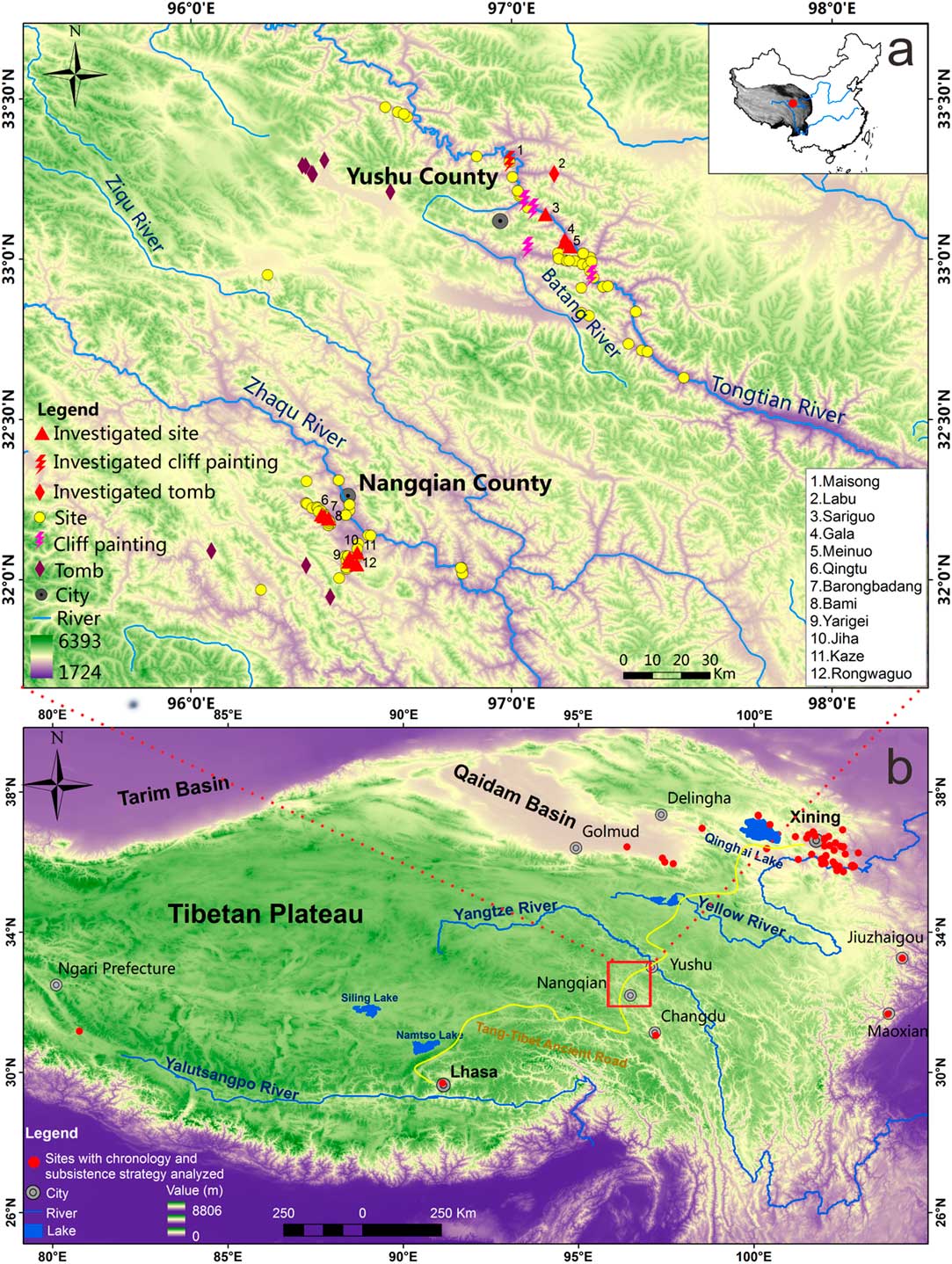
Archaeobotanical and zooarchaeological analyses have shed light on human subsistence strategies during prehistoric times on the Tibetan Plateau (Huang Reference Huang1980; IA, CASS & CRBTAR 1999; Schlütz and Lehmkuhl Reference Schlütz and Lehmkuhl2009; Zhao Reference Zhao2009; Guedes et al. Reference Guedes, Jiang, He, Wu and Jiang2013, Reference Guedes, Lu, Li, Spengler, Wu and Aldenderfer2014, Reference Guedes, Lu, Hein and Schmidt2015; Miehe et al. Reference Miehe, Miehe, Böhner, Kaiser, Hensen, Madsen, Liu and Opgenoorth2014; Chen et al. Reference Chen, Dong, Zhang, Liu, Jia, An, Ma, Xie, Barton, Ren and Zhao2015; Guedes Reference Guedes2015; Dong et al. Reference Dong, Ren, Jia, Liu, Dong, Li, Wang, Xiao and Chen2016a, Reference Dong, An, Fan, Li and Zhao2016b), and promoted our understanding of how prehistoric humans adapted to this harsh environment. However, the prehistoric sites so far examined are mostly located in the northeastern Tibetan Plateau, and in a few scattered places on the southern Tibetan Plateau, roughly along the ancient Tang-Tibet road (Figure 1b; Chen Reference Chen1989), which historically was the most important passageway for interregional interaction between the Yellow River valley and Lhasa. The Yushu area of the east-central Tibetan Plateau, with average elevation above 4200 m asl, is situated at a key position of the Tang-Tibet ancient road, but the chronology and biological remains from archaeological sites in this area have been rarely reported.
Overview of the study area: (a) location of the study area and the investigated sites; (b) archaeological sites with chronology and subsistence strategy analyzed on the Tibetan Plateau.
A total of 17 late prehistoric sites above 3600 m asl were found during the second national archaeological survey in Yushu prefecture (Bureau of National Cultural Relics 1996), and were classified as Bronze Age sites mainly based on archaeological remains such as sand-tempered brown ceramics and stone-constructed tombs. The chronological data, especially absolute dating, to the human settlement history of the high altitude regions of the Tibetan Plateau is extremely important to understanding the prehistoric and historical process of peopling on the Tibetan Plateau. However, no reliable dates of those sites have been published. Although dating according to archaeological features is the basis of archaeological research, they are not as objective as absolute dates. For example, if people in one region continued to use a pottery style later than another, archaeologists may date them to the same period because of their style.
Only absolute dates can clarify the actual situation. So estimating the ages of sites on the Tibetan Plateau based on typological archaeological remains alone must be used with caution (Sun 2012; Hudson et al. Reference Hudson, Olsen and Quade2014; Liu et al. Reference Liu, Cui, Zuo, Li, Wang, Zhang, Zhang and Dong2016). Radiocarbon (14C) dating of animal and plant remains samples is relatively reliable for the past ~50,000 years (Geyh et al. Reference Geyh, Schotterer and Grosjean1997), and has been widely used to establish the chronology of archaeological sites (Guo et al. Reference Guo, Liu, Lu, Ma, Li, Yuan, Yuan, Wu and Liu2001, Reference Guo, Liu, Yuan, Wu, Li, Lu, Wang, Ma, Gao and Xu2005; Liu et al. Reference Liu, Han, Guo, Wu, Yuan, Kutschera, Ma, Priller, Steier, Wild and Zhao2005; Cherkinsky and Quezada Reference Cherkinsky and Quezada2014; Salazar-García et al. Reference Salazar-García, García-Puchol, de Miguel-Ibáñez and Talamo2016). In this paper, we study the chronology and subsistence strategy of ancient human colonization in the Yushu area, with the application of archaeological investigation, 14C dating, identification of animal bones, and the comparison between written documents, to further explore when and how ancient human colonized and adapted to high altitudes in the Yushu area. Our results show that humans occasionally inhabited the Yushu area around 900 BC, and more permanently occupied the area between AD 540 and 1620, likely engaging in a kind of subsistence practice consistent with pastoralism.
STUDY AREA
The Yushu Tibetan Autonomous Prefecture (31°45′–36°10′N, 89°27′–97°39′E) is located in southern Qinghai Province, the east-central Tibetan Plateau (Figure 1). It stretches 738 km from west to east and 405 km from south to north, with the mean altitude above 4200 m asl and the minimum altitude 3610 m asl. The area of Yushu autonomous prefecture is 267,000 km2, accounting for 32.7% of the total area of Qinghai Province (Zhang Reference Zhang2009). The mean annual temperature is –0.8°C and the mean annual precipitation is 463.7 mm. More specifically, the mean annual temperature and precipitation in Nangqian and Yushu counties of Yushu autonomous prefecture (the focal areas of the data reported here) are 4.59°C and 3.75°C, and 451 mm and 402 mm, respectively (http://data.cma.cn/en). Vast meadowlands in the region have supported a livelihood based on pastoral livestock production and supplemented by agriculture mainly based on barley (Hu Reference Hu1995). Huge numbers of sheep, goats, yaks, and horses thrive in wide alpine meadows. The pastoral Zang (Tibetan) peoples account for 95.3% of the total population in the Yushu autonomous prefecture (Shi Reference Shi1988).
Six counties are administered by the Yushu autonomous prefecture, including Yushu, Nangqian, Zaduo, Chengduo, Qumalai, and Zhiduo. According to the second national archaeological survey, all 17 Bronze period sites reported in the Yushu autonomous prefecture are located in the Yushu and Nangqian counties (Bureau of National Cultural Relics 1996).
MATERIALS AND METHODS
Based on the consultation and guidance from local archaeologists who participated in the second archaeological survey in the Yushu region, we investigated 12 archaeological sites where exposed archaeological deposits or sand-tempered brown ceramics were found during field work in 2012 (Figure 1a), including 10 settlement sites, one tomb, and one rock painting site. Half of these 12 sites were reported as Bronze period sites in the second archaeological survey in Qinghai Province (Bureau of National Cultural Relics 1996). The remaining six sites were not among the 17 sites listed in the second archaeological survey but instead were newly found as part of this investigation. The investigation processes at all sites were carried out according to the latest field protocol enacted by Bureau of National Cultural Relics (2009). The specific methods used during the survey including observing stratigraphic section and collecting surface remains. Based on the background information about known sites, especially the specific latitude and longitude, we could find them readily with handheld GPS, and then collected cultural remains including pottery sherds, animal bones, lithics and charcoal from the surface or exposed sections. All information including the location, elevation, and archaeological remains observed on feature or depositional contexts was recorded and photographed in detail for every site we investigated (most information is shown in Figure 2, Figure 4, and Table 1).
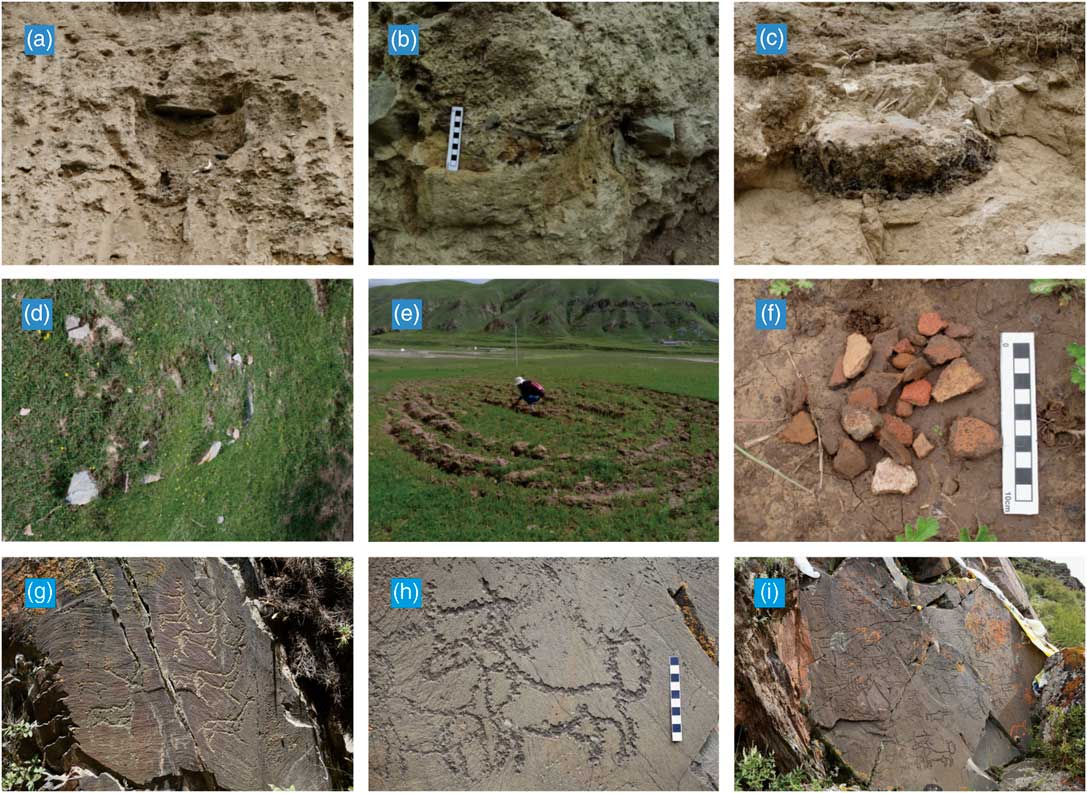
Field investigation in archaeological sites in the Yushu and Nangqian counties: (a) and (b) stone-constructed tomb and cultural layer in the Gala site; (c) stone-constructed tomb in the Labu site; (d) exposed stone-constructed tomb on the ground of the Sariguo site; (e) sampling location in the Barongbadang site; (f) sand-tempered brown ceramics of the Bami site; (g), (h), and (i) cliff painting in Maisong site.
Calibrated 14C dates of investigated sites in the Yushu area.

There are six bone samples and three charcoal samples collected for 14C dating from five sites, including Labu, Yarigei, Barongbadong, Gala, and Rongwaguo (Table 1). Three of these bone samples were obtained from the Barongbadong and Gala sites, where they were associated with sand-tempered brown ceramics in surface exposures. All other samples were obtained from cultural deposits or tombs at other archaeological sites. Specifically, one bone and one charred sheep dropping were sampled for 14C dating from beneath one slabstone of Labu tomb where there were no obvious disturbance signals after burial. The two remaining charcoal samples were all acquired from undisturbed strata, one of which was found in a thin cultural layer at the Rongwaguo site and the other one in the burned layer of exposed section at the Gala site. Four bone samples and two charcoal samples were dated by accelerator mass spectrometry (AMS) at Peking University, China, and the other two bone samples and one charred sheep dropping sample were dated by AMS at Beta Analytic, Miami, USA. The IntCal13 curve (Reimer et al. Reference Reimer, Bard, Bayliss, Beck, Blackwell, Bronk Ramsey, Buck, Cheng, Edwards, Friedrich and Grootes2013) and the Libby half-life of 5568 yr were used in the tree-ring calculation of all dates, with the calibration performed using the OxCal 4.2.3 program (Bronk Ramsey and Lee Reference Bronk Ramsey and Lee2013). All ages are reported as “Cal BC or AD.”
We also sampled well-preserved animal bones from exposed tombs or cultural deposits at Gala, Yarigei, and Labu sites during archaeological investigations. Taxon identification was made in the Key Laboratory of Western China’s Environmental Systems (Ministry of Education) in Lanzhou University based on the morphological characters of the bones. For further confirmation, we compared the animal bones from the Yushu region with the modern and ancient zoological specimens held in the Zooarchaeology Laboratory, Institute of Archaeology, Chinese Academy of Social Sciences.
RESULTS
Archaeological Remains and Radiocarbon Dates
In Yushu County, five sites were investigated along the Tongtian River, including Gala, Labu, Meinuo, Sariguo, and Maisong (Figure 1a). At the Gala site (3650 m asl), a stone-constructed tomb, a cultural layer (Figure 2a and b) and a pit tomb were found. The stone-constructed tomb was about 80 cm high and 50 cm wide, sealed by two slabstones on top and bottom (Figure 2a). A few human and animal bones were exposed in the tomb, and one human bone was dated to cal AD 1320–1440 (Figure 3; Table 1). Another fragment of bone identified as human from the pit tomb in the site was dated to 1000–850 cal BC (Figure 3; Table 1). One burned sediment and charcoal layer was also found (Figure 2b). This layer was about 3 cm thick and 3 m wide in the exposed section and, possibly is the remains of a house floor. One fragment of sand-tempered brown ceramic and an animal bone were found in the sedment above the possible floor. A charcoal sample from the burned layer was dated to cal AD 1440–1620 (Figure 2b; Table 1).
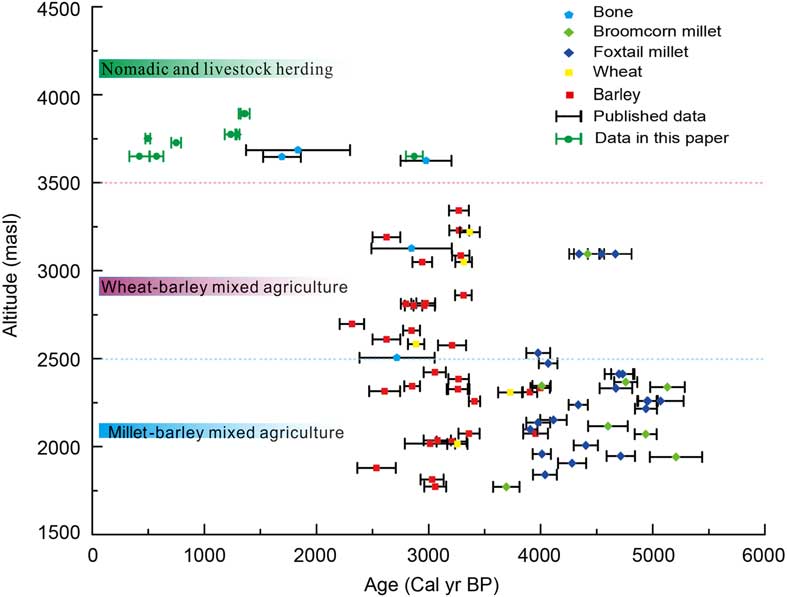
14C dates of investigated sites in Yushu area and their comparison with 14C dates of domesticated plants and animals from other prehistoric sites on the Tibetan Plateau. Blue and red dotted lines indicate the current upper limit altitude of millet cultivation and intensive barley cultivation on the Tibetan Plateau. (Colors refer to online version.)
At the Labu site (3893 m asl), four partially buried slabstones were found, beneath one of which was a nearly intact animal skeleton and abundant charred materials including charcoal and carbonized sheep droppings (Figure 2c). A sample of charred sheep dropping and a piece of bone yielded dates of cal AD 550–650 and cal AD 540–630, respectively (Figure 3; Table 1).
At the Meinuo (3740 m asl) and Sariguo (3630 m asl) sites, plentiful sand-tempered brown ceramics were found on the ground surface, and a stone-constructed tomb was found exposed at the Sariguo site (Figure 2d). However, no exposed cultural layer or reliable dating material was found at those two sites. Likewise, no datable samples were recovered from the Maisong site (3730 m asl), while rock paintings of animals including dogs and deer were found on a stone cliff (Figure 2g and h).
In Nangqian County, seven sites including Qingtu, Barongbadang, Bami, Rongwaguo, Kaze, Jiha, and Yarigei were investigated (Figure 1a). The Qingtu (3740 m asl), Barongbadang (3728 m asl) and Bami (3750 m asl) sites are adjacent to each other on a grassy slope. Abundant sand-tempered brown ceramics were found on the ground surface at each site (Figure 2f), but no ceramic sherds were in an exposed buried context from any of those three sites. At the Barongbadang site, ploughed fields yielded a mass of exposed sand-tempered brown ceramics and weathered bones. One piece of bone was dated to cal AD 1160–1250 (Figure 3; Table 1). At the Rongwaguo (3751 m asl), Kaze (4070 m asl), Jiha (3764 m asl), and Yarigei (3774 m asl) sites, abundant sand-tempered brown ceramics were found on the surface, but only a thin (4 cm thick) cultural layer was found at the Rongwaguo site, from which a piece of charcoal was dated to cal AD 1430–1480 (Figure 3; Table 1). Buried stone walls were discovered at the Rongwaguo and Yarigei sites. At the Yarigei site, many weathered animal bones in conjunction with sand-tempered brown ceramics were found exposed in a construction area. Two pieces of bones were dated respectively to cal AD 630–680 and cal AD 660–770 (Figure 3; Table 1). We did not obtain reliable dating materials from the Kaze and Jiha sites.
Faunal Remains
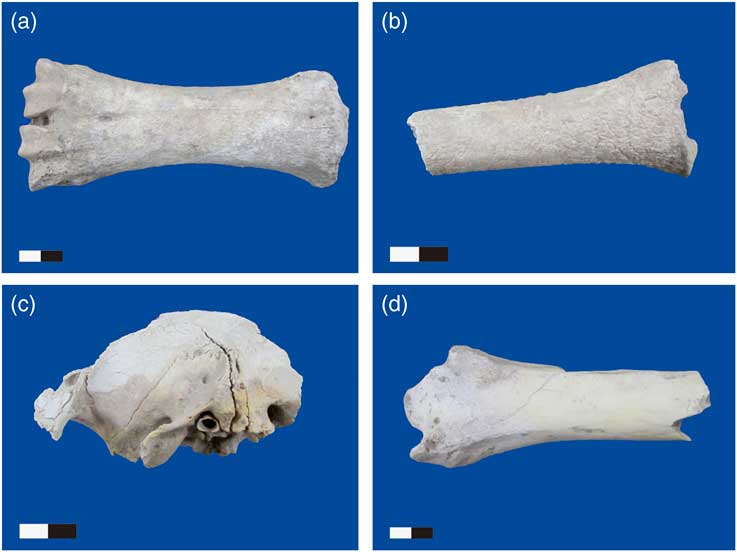
The analysis of animal remains collected during the archaeological survey in Yushu prefecture indicated that sheep (Ovis aries), yak (Bos grunniens), and horse (Equus ferus caballus) were present at the Gala, Labu, and Yarigei sites (photographs in Figure 4; Table 2). At Gala, two pieces of sheep bones (Figure 4c) (from at least one individual), and two yak bones (Figure 4a and d) from two separate individuals, were identified. A rib from an unidentified medium-sized mammal was found in the stone-constructed tomb at Labu. In addition, two foal skeletons (Figure 4b) were identified based on two pieces of unfused distal radius from the cultural strata at Yarigei in Nangqian County. Given the late date of investigated sites and morphological characteristics of bones, all animals discovered in the Yushu region are thought to be domesticated herd species.
Photographs of animal remains from the investigated sites in Yushu areas: (a) and (d) are identified as yak, (b) is identified as horse, and (c) is identified as sheep.
Animal remains from investigated sites in the Yushu area.Footnote *
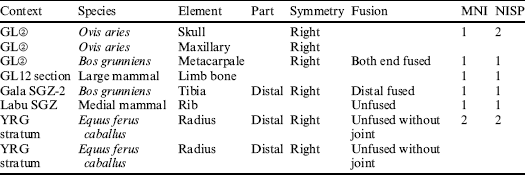
* MNI=minimum number of individuals; NISP=number of identified specimens.
DISCUSSION
When Did Humans Colonize the Yushu Area?
According to the third national archaeological survey, dozens of archaeological sites above 3600 m asl in Yushu and Nangqian counties (Figure 1a, unpublished data) were classified to the Bronze Age on the basis of the scattered sand-tempered brown ceramics found at these sites. In eastern Qinghai Province, sand-tempered brown ceramics are the typical pottery found at Bronze Age sites; for example, abundant sand-tempered brown ceramics were found in Kayue and Xindian Bronze Age sites in the upper Yellow River valley, the ages of which range approximately between 1600 and 300 BC (3600–2300 cal yr BP) (Dong et al. Reference Dong, Jia, Elston, Chen, Li, Wang, Cai and An2013). However, of the 12 investigated sites in the Yushu area, only one sample of human bone from the Gala site was 14C dated to the Bronze Age, while the other eight dates correspond to historic periods (From Wei Jin Southern and Northern Dynasties to Ming Dynasty) in central China (Table 1; Figure 3). These dates suggest that people perhaps occupied the Yushu area sporadically between 1000–850 cal BC; they also suggest that determining a Bronze Age chronology for archaeological sites in the area solely based on the presence of sand-tempered brown ceramics cannot be warranted.
The mitochondrial genome evidences have showed that the initial Paleolithic inhabitants settled on the Tibetan Plateau successfully (Zhao et al. Reference Zhao, Kong, Wang, Peng, Xie, Wang, Duan, Cai, Zhao, Tu and Wu2009; Qi et al. Reference Qi, Cui, Peng, Zhang, Yang, Zhong, Zhang, Xiang, Cao, Wang and Wu2013), and two early human population expansions occurred on the Tibetan Plateau during the early-Neolithic age and the late-Holocene that coincided with the establishment of farming and yak pastoralism (Qiu et al. Reference Qiu, Wang, Wang, Yang, Ma, Wang, Zhang, Ni, Hou, Long and Abbott2015). In the northeastern Tibetan Plateau, Kayue and Nuomuhong societies had successfully settled above 3400 m asl since 1600 BC (3600 BP) (Chen et al. Reference Chen, Dong, Zhang, Liu, Jia, An, Ma, Xie, Barton, Ren and Zhao2015), and some of these Bronze-Age culture groups probably expanded further toward higher elevation areas, perhaps reaching Yushu around 1000 BC. There is also another possibility that the population in the Yushu during this period was hunter-gatherers or pastoralists (Guedes Reference Guedes2015). According to the records in the Hou Han Shu-Xi Qiang Zhuan, Yushu was occupied by nomadic tribes called Xi Qiang peoples during the Shang (1600–1046 BC) to Han Dynasties (220 BC–AD 202). No date between 850 cal BC and cal AD 540 was obtained in this study, suggesting that human inhabitation in the area was probably very sparse.
Humans inhabited the Yushu area before the establishment of the Tubo empire in the Tibetan Plateau (AD 618–842). Two 14C dates from Labu range between 540 and 650 cal AD, corresponding to the transition period between the Wei Jin Southern and Northern Dynasties period (AD 220–581) and the Sui-Tang Dynasties (AD 581–907) in central China. Two other dates from Yarigei in Nangqian county range between cal AD 630 and cal AD 770, within the era of the Tubo empire. According to written records (Wang and Chen Reference Wang and Chen1992), by the middle to late-6th century the Sumpa (= Supi or Sunpo) peoples had already occupied the northern Tibetan Plateau, as far west as southern Xinjiang Province. Then the Tubo Empire became powerful and prosperous, conquering the Sumpa people and controlling the Yushu area until it collapsed in the middle-9th century (Yushu autonomous prefecture annals Codification Committee 2005). The Labu and Yarigei sites were likely occupied during the rule of the Sumpa tribe and the Tubo empire, as suggested by the archaeo dates (Figure 3; Table 1).
Humans occupied Barongbadang in Nangqian county between cal AD 1160 and 1250, corresponding to the Southern Song Dynasty (AD 1127–1279) of central China. As recorded in historical literature, during the middle-12th century AD a Tibetan tribe migrated to south Yushu area and established the Nangqian kingdom, which was highly autonomous but became affiliated with the Southern Song Dynasty in AD 1175, after which time the region began to be controlled by the central government in China (Yushu Autonomous Prefecture Annals Codification Committee 2005). According to these records and 14C dates, Barongbadang was likely a village of the Nangqian kingdom. Three 14C dates from Gala and Rongwaguo sites indicate that humans colonized the area between cal AD 1320 and 1620, corresponding to the Yuan (AD 1271–1368) and Ming (AD 1368–1644) dynasties in central China, which also accord well with historical documents. The central authority administered the Yushu autonomous prefecture during the Yuan Dynasty and strengthened its rule of the area during the Ming Dynasty.
How Did Humans Adapt to High-Altitude Environments in Yushu Area during the Late Holocene?
To permanently colonize the Tibetan Plateau, humans needed to adapt physiologically to the hypoxic environment and obtain sufficient food resources from the Plateau’s harsh high-cold environments. During the late Paleolithic period, humans seasonally occupied the Tibetan Plateau (Madsen et al. Reference Madsen, Jingzen, Elston, Cheng, Bettinger, Kan, Brantingham and Kan1998, Reference Madsen, Haizhou, Brantingham, Xing, Rhode, Haiying and Olsen2006; Brantingham et al. Reference Brantingham, Ma, Olsen, Gao, Madsen and Rhode2003, Reference Brantingham, Gao, Olsen, Ma, Rhode, Zhang and Madsen2007; Brantingham and Gao Reference Brantingham and Gao2006; Rhode et al. Reference Rhode, Haiying, Madsen, Xing, Brantingham, Haizhou and Olsen2007, Reference Rhode, Brantingham, Perreault and Madsen2014). Limited wild animal resources of the alpine environment cannot alone sustain intensive and permanent human settlement. Humans began to settle extensively in the upper Yellow River valley headwaters at the margins of the northeast Tibetan Plateau between 5200 and 3600 BP (Figure 3), after the technology of millet cultivation was introduced to the area from the nearby Loess Plateau, which provided sufficient foods for intensive human settlement during that period (Chen et al. Reference Chen, Dong, Zhang, Liu, Jia, An, Ma, Xie, Barton, Ren and Zhao2015). Millet growth is limited by cold temperature and growing degree days (Guedes et al. Reference Guedes, Lu, Li, Spengler, Wu and Aldenderfer2014), and these late Neolithic sites are mainly distributed below 2500 m asl (Figures 1b and 3), except for a very few Neolithic sites such as the Karuo site (3100 m asl) in the southern Tibetan Plateau. After the introduction of barley and wheat to the northern margin of the Tibetan Plateau around 3600 BP (Dodson et al. 2013; Chen et al. Reference Chen, Dong, Zhang, Liu, Jia, An, Ma, Xie, Barton, Ren and Zhao2015), humans gradually adopted these cold-tolerant exotic crops, and the combination of barley and wheat cultivation and sheep-herding facilitated human permanent settlement of areas up to 3400 m asl after 3600 BP (Figure 3; Chen et al. Reference Chen, Dong, Zhang, Liu, Jia, An, Ma, Xie, Barton, Ren and Zhao2015).
The cultivation of barley and wheat is still limited by cold temperature in higher areas of the Tibetan Plateau (Guedes Reference Guedes2015; Guedes et al. Reference Guedes, Lu, Li, Spengler, Wu and Aldenderfer2014, Reference Guedes, Lu, Hein and Schmidt2015), and barley and wheat farming as a primary subsistence strategy is usually restricted to below 3500 m asl (Hu Reference Hu1995). The lowest elevation of Yushu area is above 3500 m asl and the average elevation is above 4200 m asl, therefore barley cultivation is difficult and it is only auxiliary to the primary livelihood of pastoral nomadic livestock nowadays (Nori Reference Nori2004). According to historical documents, pastoral nomadic tribes occupied Yushu before the unification of the Tibetan Plateau by the Tubo empire, and nomadic pastoralism continued to be the main subsistence strategy during the region of Tubo empire and Nangqian Kingdom (Gazangcaidan and Gesangmu Reference Gazangcaidan2000), even extending to later periods when the area was administered by the central authority (Ren Reference Ren1985; Yushu Autonomous Prefecture Annals Codification Committee 2005; Qinghai Province Agricultural And Pastoral Office 2012; Wei Reference Wei2013).
Our work provides archaeological evidence consistent with pastoral livelihoods being the primary subsistence strategy in the Yushu area during the late Holocene. Previous studies from Bronze age settlement sites of nomadic cultures in Hexi Corridor and east Xinjiang Province adjacent to northern margin of the Tibetan Plateau, suggest that raising of herding animals (such as horse, sheep, cattle, etc.), utilization of stone-constructed tombs, and rock painting, all may be used to trace the emergence of pastoral nomadic tribes (Xi Reference Xi2007; Wang and Xi Reference Wang and Xi2009). These suppositions were further examined in settlement sites between the Han Dynasty with Tang Dynasty in the Chang Tang Region of the Tibetan Plateau (Huo Reference Huo2013).
Remains of domesticated animals including yak, sheep and horse were identified from Gala, Labu and Yarigei dated between AD 540 and 1620. Stone-constructed tombs were found at the Sariguo and Gala sites. Rock paintings were found at Maisong. Moreover, 10 other sites with stone-constructed structures and five sites with rock paintings were found in Yushu and Nangqian counties during the third national archaeological survey (unpublished data, personal communication with Mr. Linhai Cai). Based on this evidence and 14C dating, we deduce that pastoral livelihoods were prevalent during the late Holocene in the high altitude areas of Yushu, corresponding to historical documents. Similarly, archaeological materials show that nomadic tribes had already built large-scale fortified settlements under the rule of pre-Buddhist kingdom of Zhang Zhung in the western Tibetan Plateau (Aldenderfer and Moyes Reference Aldenderfer and Moyes2005; Huo Reference Huo2008).
Though recent studies indicate that agriculture innovation promoted permanent settlement above 3400 m asl (Guedes et al. Reference Guedes, Lu, Li, Spengler, Wu and Aldenderfer2014; Chen et al. Reference Chen, Dong, Zhang, Liu, Jia, An, Ma, Xie, Barton, Ren and Zhao2015), the question of when pastoral livelihoods emerged in the high Plateau and their impact on human colonization of higher altitude areas, has not been well documented. According to currently published datasets, humans raised a variety of livestock including yak and sheep at the Qugong Bronze Age site (3690 m asl) near Lhasa (Aldenderfer et al. Reference Aldenderfer and Zhang2004), suggesting humans engaged in nomadic production above 3600 m asl since 3400 BP, after migrating into high altitude areas after 3600 BP (Figure 3). Our preliminary study in the Yushu area further implies that the emergence of pastoral livelihoods in that area facilitated human colonization above 3600 m asl in the late Holocene (Figure 3). The development and diversification of human subsistence strategies since the Neolithic period very likely promoted the stepwise expansion of human settlements upwards to the high altitudes of the central Tibetan Plateau (Figure 3).
CONCLUSIONS
Archaeological investigations and 14C dating in the Yushu area of the Tibetan Plateau suggest that humans colonized the area during the late Holocene. Humans probably occasionally occupied the area during the Bronze Age period and inhabited the area more intensively from AD 540 to 1620. Humans adopted pastoral livelihoods for adapting to the high-cold environment above 3600 m asl in Yushu since the Bronze Age, as indicated by the identification of yak, sheep and horse remains, stone-constructed tombs, and rock paintings.
Our work also suggests that sandy brown potteries and stone-constructed tombs were used in the Yushu area until the Ming dynasty at least, which make them unreliable for attributing archaeological sites containing them to be Bronze Age in the east-central Tibetan Plateau. Buried cultural deposits and ash pits cannot be readily found by archaeological survey in the Yushu area, and our preliminary study cannot provide a sufficient dataset for reconstructing detailed chronology and subsistence strategies for past human settlement in the area. More multidisciplinary studies from excavated sites in the Yushu area are needed to explore when and how humans colonized and adapted to the high elevation environments of the east-central Tibetan Plateau.
ACKNOWLEDGMENTS
This research was supported by the National Natural Science Foundation of China (Grant Nos. 41620104007 and 41671077), Fundamental Research Funds for the Central Universities (lzujbky-2015-k09, lzujbky-2016-159, and lzujbky-2016-251), as well as the 111 Program (#B06026) of Chinese State Administration of Foreign Experts Affairs. We are really grateful to the editor and the two anonymous reviewers for their constructive suggestions and revisions.


 Open access

