


Introduction
When leaders make explicit and implicit claims of their strong moral convictions and values they engage in a form of self-presentation known as exemplification. Tedeschi and Norman (Reference Tedeschi, Norman and Schlenker1985, p. 301) defined exemplification as, ‘behavior which presents the actor as morally worthy and may also have the goal of eliciting imitation by others’. Hence, exemplification, which is often described as ‘leading by example’, is viewed by practitioners and scholars alike as a noble form of leadership. Within the academic literature, theories of authentic leadership (Gardner, Avolio, Luthans, May, & Walumbwa, Reference Gardner, Avolio, Luthans, May and Walumbwa2005), socialized charismatic leadership (Conger & Kanungo, Reference Conger and Kanungo1987; Gardner & Avolio, Reference Gardner and Avolio1998), and ethical leadership (Brown & Treviño, Reference Brown and Treviño2006) identify the modeling of exemplary conduct as contributing to effective leadership. But what happens when leaders fail to keep their promises of doing the best for stakeholders? Will what’s known as a ‘boomerang effect’ (Gilbert & Jones, Reference Gilbert and Jones1986) occur, such that the perceived authenticity of the leader, along with follower trust and advocacy, quickly erode or become completely lost?
Drawing from the literatures on authentic leadership (Avolio & Gardner, Reference Avolio and Gardner2005; Avolio & Mhatre, Reference Avolio, Mhatre, Cameron and Spreitzer2012; Gardner, Cogliser, Davis, & Dickens, Reference Gardner, Cogliser, Davis and Dickens2011) and impression management (Peck & Hogue, Reference Peck and Hogue2018), we explore the risks and rewards that can accrue to leaders who rely on exemplification as a self-presentation strategy (Jones & Pittman, Reference Jones, Pittman and Suls1982). We define leader exemplification as implicit (e.g., stories illustrating leader trustworthiness) and explicit (e.g., promises from the leader to protect employees’ interests) claims by leaders that they possess high moral values. Mahatma Gandhi and Martin Luther King are often offered as prototypical examples of exemplary leaders because they espoused and modeled high levels of ethical leadership (Jones & Pittman, Reference Jones, Pittman and Suls1982). However, prior research also suggests that leaders who adopt exemplification to foster impressions of moral worthiness, but then fail to uphold the moral standards they espouse are deemed to be inauthentic and untrustworthy (Gardner, Reference Gardner2003; Zachary, Connelly, Payne, & Tribble, Reference Zachary, Connelly, Payne and Tribble2023).
The purpose of this research is to explore the effects of leader exemplification and subsequent ethical conduct on perceived leader authenticity, trust in the leader, and organizational advocacy. Specifically, we are interested in the extent to which a hypothetical CEO, who portrays himself as exemplary, and subsequently responds to a failed product launch with self-sacrificial behavior (drastically reducing his salary and perks), self-serving behavior (laying off workers while divesting himself of company stock), or a concern for both self and others (reducing employee perks and delaying a personal bonus), is perceived as authentic, trustworthy, and deserving of organizational advocacy. We also explore if the ‘boomerang effect’ found in prior studies of violations of moral expectations (Burgoon, Reference Burgoon, Wilson, Dillard, Caughlin and Solomon2015; Gilbert & Jones, Reference Gilbert and Jones1986) can be replicated in this leadership setting. This effect occurs when an individual who uses exemplification to claim an identity of moral worthiness and virtue, engages in conduct that contradicts espoused values, and results in negative perceptions such attributions of hypocrisy (Gilbert & Jones, Reference Gilbert and Jones1986).
We contribute to the authentic leadership and impression management literatures in four ways. First, we respond to calls to further explore the antecedents for authentic leadership (Gardner et al., Reference Gardner, Cogliser, Davis and Dickens2011). Second, we integrate authentic leadership theory with impression management theory to identify some of the risks and benefits that accrue to leaders who use exemplification tactics. Third, we respond to calls to better explicate the process of exemplification, which to date is among the least researched impression management strategies (Bolino, Kacmar, Turnley, & Gilstrap, Reference Bolino, Kacmar, Turnley and Gilstrap2008). Fourth, we contribute to understanding how leaders are perceived when their actions regarding their virtues and ethics violate their professed values.
Literature review
Authentic leadership
In the opening editoral for this special issue, Lux and Lowe (Reference Lux and Lowe2025) define ‘authentic leadership as concordant, values-based leader signaling of self-awareness, internalized moral perspective, balanced processing, and relational transparency’ (p. xx). To this definition, we also add that authentic leadership should be viewed as representing the virtue ethics associated and demonstrated through such leadership. In combination, the focus of this revised definition on leader signaling of authenticity is consistent with the focus of this study on the processes whereby leaders use the impression management strategy of exemplification along with their active ethical conduct to signal (or not) authenticity, and the degree to which doing so fosters perceptions of authenticity by the recipients of these signals. Moreover, the literature on authentic leadership (Avolio & Gardner, Reference Avolio and Gardner2005; Gardner et al., Reference Gardner, Cogliser, Davis and Dickens2011; Gardner, Karam, Alvesson, & Einola, Reference Gardner, Karam, Alvesson and Einola2021) places special attention on leader role modeling the virtue ethics associated with honesty, integrity, and high ethical standards. Indeed, authentic leaders are described as being open, transparent, and achieving congruence between their words and deeds (Lemoine, Hartnell, & Leroy, Reference Lemoine, Hartnell and Leroy2019). This focus on virtue ethics helps to distinguish authentic leadership theory from other leadership theories focusing on ethical leadership behavior and intergrity. Through the enactment of virtue ethics, authentic leaders convice followers they can count on them to display their true selves and follow through on promises and commitments. As a result, authentic leaders are posited to elicit higher levels of follower trust and commitment (Clapp-Smith, Vogelgesang, & Avey, Reference Clapp-Smith, Vogelgesang and Avey2009; Leroy, Palanski, & Simons, Reference Leroy, Palanski and Simons2012).
More versus less authentic leaders work towards learning how they (and their followers), process information about themselves, to positively influence employee affect, cognition and motivation (Gardner et al., Reference Gardner, Avolio, Luthans, May and Walumbwa2005). Doing so signals a psychologically safe context, where employees can share their views transparently on how to improve their work performance (London, Sessa, & Shelley, Reference London, Sessa and Shelley2023). Self-aware followers are more likely to share critical information when they are being listened to by their leaders, resulting in upward learning spirals that can benefit innovation and in turn, sustainability (London et al., Reference London, Sessa and Shelley2023).
Authentic leaders also connect followers to their work by transparently promoting followers’ contributions to their respective unit’s performance (Avolio, Wernsing, & Gardner, Reference Avolio, Wernsing and Gardner2018). Along with higher levels of transparent exchanges (which facilitate a better understanding of what the organization and unit stands for and what is expected of followers), followers’ agency to achieve more challenging goals is enhanced (Smidts, Pruyn, & van Riel, Reference Smidts, Pruyn and van Riel2001). Specifically, authentic leadership encourages responsibility based on one’s awareness of personal values, and organizational values, regardless of social pressure from competing stakeholders or the risk of potential losses (Freeman, Dmytriyev, & Phillips, Reference Freeman, Dmytriyev and Phillips2021). Subsequent research on authentic leadership has produced a number of positive relationships including with a leader’s level of behavioral integrity (Leroy et al., Reference Leroy, Palanski and Simons2012), whereby the leader’s actions are deemed to be consistent with their words. Also, in a recent article examining the ‘hierarchical leader-leader fit’ for senior and junior leader dyads, Hannah, Bluhm, and Avolio (Reference Hannah, Bluhm and Avolio2024) reported based on two field study samples (military and business), using polynomial regression response surface analysis, that when there was a ‘misfit’ between a leader and follower in terms of their authenticity, the leadership displayed by the junior leader was negatively associated with that leader’s peformance and positively with higher deviance (e.g., such as saying something harmful to a follower). These findings support Cha et al.’s (Reference Cha, Hewlin, Roberts, Buckman, Leroy, Steckler and Cooper2019) suggestions that a higher alignment with authentic leadership across leadership levels, can help each leader to achieve higher levels of performance and potential.
Exemplification
Impression management can be defined as ‘conscious or unconscious, authentic or inauthentic, goal-directed behavior individuals engage in to influence the impression others form of them in social interactions’ (Peck & Hogue, Reference Peck and Hogue2018, p. 123). This definition reflects the three dimensions that Peck and Hogue discuss in their typology of leader impression management including (1) controlled versus automatic information processing, (2) authentic versus inauthentic communication, and (3) pro-self versus prosocial goals. As a self-presentation strategy (Jones & Pittman, Reference Jones, Pittman and Suls1982), exemplification varies across all of these dimensions. That is, managing impressions may be consciously or unconsciously employed, authentic or inauthentic, and directed toward pro-self or prosocial goals. Of particular interest to us are the (in)authentic and the pro-self versus prosocial dimensions. Leader exemplification that is authentic and prosocial can elicit high levels of trust and commitment from followers. However, although there are obvious benefits of leader exemplification, there are also notable risks. When leaders who claim to have the welfare of others at heart are subsequently revealed to have instead acted in a self-serving fashion, a backlash from angry followers is likely to ensue.
An experiment by Gilbert and Jones (Reference Gilbert and Jones1986) showed that the boomerang effect can arise when an exemplifier’s actions contradict prior claims of integrity. In this study, participants viewed a videotaped interview with an actor who professed to be either honest (exemplifier) or morally flexible (pragmatist). Next, they watched a video depicting the actor as either cheating or not cheating when exposed to temptation. The exemplifier who cheated was seen as more self-deluding and hypocritical, but less manipulative, than the cheating pragmatist.
In a replication and extension of the Gilbert and Jones (Reference Gilbert and Jones1986) study, Gardner (Reference Gardner2003) investigated the extent to which a leader (a business school dean interviewing for a deanship at another university), who claimed to be highly principled (exemplifier) as opposed to morally flexible (pragmatist), and then subsequently was shown to have a reputation for either ethical or unethical conduct, was perceived by participants to be charismatic, effective, and morally worthy. The leader’s non-verbal and expressive behavior was also manipulated. Results revealed that (a) the strong versus weak delivery produced higher ratings of leader charisma and effectiveness; (b) the exemplary versus pragmatic self-presentations yielded higher ratings of leader charisma and integrity; and (c) the strong delivery and ethical reputation treatment produced higher ratings of leader charisma and integrity versus any other delivery by reputation combination. Contrary to expectations, however, the boomerang effect observed by Gilbert and Jones (Reference Gilbert and Jones1986) failed to emerge for leaders who claimed to be highly ethical but were subsequently shown to have reputations for deception.
In addition to this experimental research, field studies also provide insight into the utility and risks associated with leader exemplification. Consider, for example, Cha and Edmondson’s (Reference Cha and Edmondson2006) longitudinal qualitative study of the charismatic founding CEO of a small advertising firm. The CEO displayed exemplification through the expressions of strong values for employee growth (‘[I started this] company, for me – and I hope other people – [to have] a venue to be as good as you can be. To use … all of your God-given potential, to take a professional track as far as you can’) and diversity (‘[a]s we’ve gotten bigger, I’ve been very protective of this concept of, let’s get different types of people in here … I think the work at the end of the process is more three-dimensional if many different capabilities and set of gifts are brought to bear’ (Reference Cha and Edmondson2006, p. 64, p. 64). Despite initially favorable impressions, subsequent employee disenchantment ensued because of attributions of leader hypocrisy arising from a perceived a shift in the CEO’s values to prioritize financial growth over previously expressed commitments to employee development and diversity.
Ethical conduct
Consistent with the pro-self versus pro-social dimension of leader impression management (Peck & Hogue, Reference Peck and Hogue2018), our study builds on prior research by further explicating the ethical responses (self-sacrifice, self-serving behavior, and a self-other focus) available to leaders following adverse events, and their potential interactive effects with prior leader exemplification. The ethical responses are derived from core ethical theories of leadership, which can be divided into two broad categories: theories that focus on leader character and theories that focus on leader conduct (Trevino & Nelson, Reference Trevino and Nelson2022). Those theories that focus on leader conduct can be further divided into two subtypes: (1) teleological theories that emphasize the consequences of the leaders’ actions and (2) deontological theories that stress the duties or rules governing leaders’ ethical choices. Teleological theories can be further differentiated based on the relative emphasis they place on concern for self-interest and concern for the interests of others, and hence correspond to pro-self versus pro-social goals, respectively. At one extreme is ethical egoism, which reflects a high degree of concern for self-interests (high pro-self) and low concern for the interests of others (low pro-social). At the other extreme is altruism, which reflects a high degree of concern for others’ interests (high pro-social), and low concern for self-interests (low pro-self). A third teleological theory, utilitarianism, reflects moderate levels of concern for both self and others’ interests; here, the leader seeks to do the greatest good for the greatest number of people.
One possible component of exemplification that reflects altruistic, pro-social motives is self-sacrificial behavior. Choi and Mai-Dalton (Reference Choi and Mai-Dalton1998, p. 397) noted, several charismatic leadership theories (e.g., Conger & Kanungo, Reference Conger and Kanungo1987) ‘have suggested that charismatic leaders might exhibit self-sacrificial behaviors to build trust, to earn the acceptance of followers to be role models, to demonstrate loyalty and dedication to the company, and so on’. Other researchers have found that self-sacrificial leadership is associated with leadership effectiveness, favorable attitudes, and trust in the leader (De Cremer & van Knippenberg, Reference De Cremer and van Knippenberg2004, Reference De Cremer and van Knippenberg2005; Lanaj, Gabriel, & Chawla, Reference Lanaj, Gabriel and Chawla2021).
To spearhead research in this area, Choi and Mai-Dalton (Reference Choi and Mai-Dalton1998) advanced a conceptual model of self-sacrificial leadership. In a laboratory experiment testing their model, Choi and Mai-Dalton (Reference Choi and Mai-Dalton1999) provided support for the model’s predictions by showing that followers attributed higher levels of charisma and legitimacy, and greater intentions to reciprocate, when a leader exhibited self-sacrificial behaviors. The scenario they used is extensively adapted as a part of the self-sacrificial leadership manipulation in this research and contrasted with a scenario that illustrates self-serving leader behavior (ethical egoism), as well as a scenario that depicts the leader pursuing a collaborative, utilitarian solution to fulfill both self and others’ interests.
Perceptual and behavioral outcomes
Audience reactions to a leader’s ethical self-presentations and conduct include important perceptual and behavioral outcomes. In this research, we focus on perceptions of leader authenticity, trust in the leader, and organizational advocacy.
Perceived leader authenticity
Authenticity can be defined as ‘owning one’s personal experiences, be they thoughts, emotions, needs, wants, preferences, or beliefs, processes captured by the injunction to know “oneself”’ (Harter, Reference Harter, Snyder and Lopez2002). In simple terms, authenticity points to that which is genuine, real, or true (Lehman, O’Connor, Kovács, & Newman, Reference Lehman, O’Connor, Kovács and Newman2019). As Gardner and colleagues (Reference Gardner, Karam, Alvesson and Einola2021) noted, authenticity is not an either/or condition (i.e., people are neither completely authentic nor inauthentic). Instead, they can best be described as more or less authentic. One component of authenticity identified by Kernis (Reference Kernis2003, p. 15) ‘is relational in nature, inasmuch as it involves valuing and achieving openness and truthfulness in one’s close relationships’. Specifically, it involves a commitment to help close others see both positive and negative aspects of one’s self. Thus, relational transparency involves presenting one’s genuine self, rather than a selective, but incomplete presentation of what one wants another to see.
Implied in this relational component is an assumption that authenticity has manifest behavioral components that include signals that others can reliably discern (Lux & Lowe, Reference Lux and Lowe2025). This reliability of transmission is further enhanced by the developmental nature of authenticity. Authenticity involves being true to oneself. It is an aspirational state that one strives to achieve in terms of how one perceives oneself (Gardner et al., Reference Gardner, Karam, Alvesson and Einola2021). Authenticity is a developed capacity manifest in self-coherence, along with the cognitive capabilities to maintain this coherence across situations, coupled with an awareness that one is indeed staying true to oneself (Harter, Reference Harter, Snyder and Lopez2002). Thus, not only is one able to reliably report being authentic, this state of being can also be reliably ascertained by others, as it is often displayed across different contexts. While a skilled actor may be able to manage perceived authenticity in the short run (Kim, David, Chen, & Liang, Reference Kim, David, Chen and Liang2023), as audiences ascertain cross-situational consistency for the actor’s words and deeds, the correspondence between perceived and actual authenticity will rise (Lehman et al., Reference Lehman, O’Connor, Kovács and Newman2019).
Trust in leader
McAllister (Reference McAllister1995, p. 25) defines dyadic or interpersonal trust as the ‘extent to which a person is confident in, and willing to act on the basis of, the words, actions, and decisions of another’. Followers’ trust in their leaders is determined by the extent to which they are judged to possess competence, honesty, and integrity. Unless a leader is seen as trustworthy, it is difficult to retain followers’ loyalty or secure the support of superiors and peers (Burke, Sims, Lazzara, & Salas, Reference Burke, Sims, Lazzara and Salas2007). Dirks and Ferrin (Reference Dirks and Ferrin2002) suggested that there is a need to examine the behavioral cues that followers use to draw conclusions about the leader’s character or put simply, how leaders develop trust in followers. The current study represents a step in this direction.
Organizational advocacy
Cialdini (Reference Cialdini1971) explored the effects of advocacy showing that the self-perception of overt advocacy behavior is a determining condition for the production of attitudinal shifts in the direction of the advocated position. He concluded that the intention to advocate, by itself, is not a sufficient condition for such shifts. Seiling (Reference Seiling2001) argues that organizational advocacy can enhance organizational phenomena, such as engagement, while asserting that it also involves offering recommendations to others. For example, employee advocates of their organization typically endorse and provide favorable recommendations for products and services of their organization to others (e.g., friends, family, & acquaintances), despite not getting rewards for doing so (Fullerton, Reference Fullerton2011). We operationally define organizational advocacy as the degree of favorability reflected in the recommendations of a firm by study participants to third parties as being a viable workplace and investment opportunity.
Research model and hypotheses
A schematic diagram of the research model is provided in Figure 1. As the diagram indicates, leader exemplification serves as the independent variable, while perceived leader authenticity, trust in leader, and organizational advocacy are the dependent variables. Leader ethical conduct is posited to moderate the relationships between leader exemplification and the three dependent variables.
Research model of the hypothesized interactive relationships of leader exemplification and ethical conduct on perceived leader authenticity, trust in leader, and organizational advocacy.

Before we introduce our hypotheses, we first describe the context within which the posited relationships are examined – a failed produch launch. Our decision to focus on a significant organizational event was inspired by event system theory (Morgeson, Mitchell, & Liu, Reference Morgeson, Mitchell and Liu2015). Event system theory is focused on one of the least explicated aspects of context: how discrete events affect organizations and organizational behavior (e.g., Cohen & Duberley, Reference Cohen and Duberley2015). An event system is portrayed as the interaction of event strength (novelty, disruption, criticality), event space (location, spread), and event time (initiation, temporal evolution of impact). In this study, we examine how leader prior usage of exemplification interacts with the leader’s ethical response to the missed product launch (a novel, disruptive, and critical event) to influence perceived leader authenticity, trust in leader, and organizational advocacy.
Our first set of hypotheses predict that persons who observe leader exemplification as opposed to no exemplification will perceive the leader to be more authentic and report higher levels of trust and organizational advocacy, when the leader’s response is morally consistent with pro-social goals (i.e., the leader exhibits self-sacrificial behavior or self-other focused behavior following a failed product launch). However, based on expectancy violations theory (Burgoon, Reference Burgoon, Wilson, Dillard, Caughlin and Solomon2015), if instead the leader exhibits morally inconsistent behavior (i.e., exhibiting self-serving behavior after having made exemplification claims), the boomerang effect observed by Gilbert and Jones (Reference Gilbert and Jones1986) is expected to occur. In such a case, a leader that has made exemplification claims will produce lower levels of perceived authenticity, trust, and organizational advocacy compared to a leader who has refrained from making any prior exemplification claims.
Hypothesis 1. Participants who observe leader exemplification as opposed to no exemplification and subsequently witness the leader respond to a significant emergent event with self-sacrificial behavior perceive the leader as (a) more authentic and exhibit higher levels of (b) trust and (c) organizational advocacy.
Hypothesis 2. Participants who observe leader exemplification as opposed to no exemplification and subsequently witness the leader respond to a significant emergent event with a self-other focus perceive the leader as (a) more authentic and exhibit higher levels of (b) trust and (c) organizational advocacy.
Hypothesis 3. Participants who observe leader exemplification as opposed to no exemplification and subsequently observe the leader respond to a significant emergent event with self-serving behavior perceive the leader as (a) less authentic and exhibit lower levels of (b) trust and (c) organizational advocacy.
Our second set of hypotheses pertains to the effects of leader ethical conduct in response to the failure to meet a product launch deadline. While we posit main effects of leader ethical conduct across exemplification treatments, we expect the order of effects to vary by dependent variable. For all three dependent variables, we expect the prosocial goals inherent in the self-sacrificial and self-other conditions to produce higher ratings than self-serving (pro-self) responses. However, our expectations with respect to the self-sacrificial versus self-other focus treatments are more complex. Specifically, we expect the self-sacrificial leader to be seen as more authentic than the leader with a self-other focus because altruistic behavior is associated with higher levels of moral integrity (Choi & Mai-Dalton, Reference Choi and Mai-Dalton1998, Reference Choi and Mai-Dalton1999). We also posit that a self-sacrificial leader may be viewed as less competent than a leader who appears to balance personal interests with those of others since the former leader may be seen as unable to find a solution without making personal sacrifices. Given that competence is a key determinant of trust (Schoorman, Mayer, & Davis, Reference Schoorman, Mayer and Davis2007), which in turn is likely to impact one’s willingness to recommend a leader’s organization to others, we anticipate higher levels of trust and organizational advocacy for a leader with a self-other focus.
Hypothesis 4. Participants who observe a leader respond to a significant emergent event with self-sacrificial behavior perceive the leader as (a) more authentic and worthy of (b) trust and (c) organizational advocacy than those who witness a self-serving leader response.
Hypothesis 5. Participants who observe a leader respond to a significant emergent event with a self-other focus perceive the leader as (a) more authentic and worthy of (b) trust and (c) organizational advocacy than those who witness a self-serving leader response.
Hypothesis 6. Participants who observe a leader respond to a significant emergent event with self-sacrificial behavior perceive the leader (a) as more authentic and worthy of (b) trust and (c) organizational advocacy than those who witness a self-other focused leader response.
Study 1
Methods
Research design
To test our hypotheses, we used a 2 × 3 experimental design, with leader exemplification (exemplification vs. no exemplification) and ethical conduct (self-sacrificial behavior, self-serving behavior, and self-other focus) as the treatment variables. The no exemplification treatment was included to provide a baseline comparison for the effects of leader exemplification. Dependent variables include perceived leader authenticity, trust in the leader, and organizational advocacy.
Sample
Two hundred and sixty-five business students from two large universities located in the mid-western and southwestern United States participated in the study. Of the 243 participants who reported their gender, 33.1% were females. The mean age of the participants was 22.7 years (SD = 2.9). A majority reported no full-time work experience (35.7%), followed by less than 1 year (21.7%), 1–2 years (18.6%), 3–5 years (15.6%), 6–10 years (6.8%) and over 10 years (1.5%). Forty-three percent of the participants reported part-time work experience of 3–5 years, followed by 27.7% (6–10 years), 15.8% (1–2 years), 5.4% (<1 year), 4.2% (no experience), and 3.1% (>10 years). Most (74.9%) of the participants were seniors, followed by juniors (12.5%), graduate/other students (11.8%), and sophomores (.8%).
Procedure
Participants were directed to a web portal where they logged in with an assigned username and password. Once online, they received a consent form and an overview of the study. They were then presented with a brief written profile of the fictitious CEO, George Brezen, a 48-year old CEO of a software development firm named Brezen Technologies (BrezTech). Next, participants in the exemplification treatment were shown a series of four written scenarios (a stockholders’ meeting, interview with the CEO, product launch meeting, and follower reactions) coupled with storyboards depicting leader exemplification and followers’ responses. Participants in the no exemplification treatment were not exposed to the written scenarios and storyboards; instead, they proceeded directly to the ethical conduct manipulation. For the ethical conduct treatment, all participants were randomly assigned to read one of three news reports depicting the self-sacrificial, self-other focus, and self-serving behavior by the CEO of BrezTech. Finally, the dependent measures and manipulation checks were administered.
Manipulations
Recall that we defined leader exemplification as implicit and explicit claims by a leader that he or she possesses high moral values. To operationalize this definition, the leader was described as making implicit (e.g., stories illustrating leader trustworthiness) and explicit (e.g., promises to protect employees’ interests) claims of moral worthiness. As part of the exemplification manipulation, a mission statement for BrezTech was included in the leadership profile for the exemplification treatment (and omitted for the no exemplification treatment) that described aspirations for the highest levels of honesty, integrity, and transparency.
Next, three written descriptions of leader behavior and one of follower reactions were presented. The descriptions were coupled with storyboards created by an artist to depict the associated scenes. The specific settings included the CEO’s speech at an annual shareholders’ meeting, an interview with the CEO, a meeting with employees to discuss problems with product/service initiatives, and followers’ comments on the meeting. Across these settings the leader was portrayed as emphasizing the importance of high ethical standards, insisting on his firm’s conviction to honest and trustworthy relationships with employees, and displaying a concern for a high quality of work life and employee welfare.
The ethical conduct treatments consisted of a set of news reports developed to depict alternative CEO responses to a failed product launch. The content of the news stories was based on theoretical foundations pertaining to leadership behavior that reflect a self-sacrificial, self-other, or self-serving focus (Choi & Mai-Dalton, Reference Choi and Mai-Dalton1998, Reference Choi and Mai-Dalton1999). Specifically, the self-sacrificial, self-serving, and self-other focus treatments were operationalized to reflect the underlying assumptions associated with the ethical perspectives of altruism, ethical egoism, and utilitarianism. The self-sacrificial treatment builds upon a written scenario used by Choi and Mai-Dalton (Reference Choi and Mai-Dalton1999), while the self-serving and self-other focus stories are original to this study. A description of the ethical conduct treatments appears in the Appendix.
Dependent measures
Perceived leader authenticity was measured using the Authentic Leadership Questionnaire (ALQ-Version 1), which originally contained 22 items; in subsequent validation research the ALQ was pared down to 16 items. To be consistent with the most current and widely used ALQ version (Avolio et al., Reference Avolio, Wernsing and Gardner2018), we used the 16-item version in both studies reported here. Sample items include the following: ‘Says exactly what he or she means’ and ‘Demonstrates beliefs that are consistent with actions’. A 5-point Likert Scale with anchors of ‘Not at all’, ‘Once in a while’, ‘Sometimes’, ‘Fairly Often’, and ‘Frequently, if not always’ was used. A Cronbach’s α coefficient of .96 was obtained.
According to the original authentic leadership theory (Walumbwa, Avolio, Gardner, Wernsing, & Peterson, Reference Walumbwa, Avolio, Gardner, Wernsing and Peterson2008), the ALQ is comprised of four dimensions – self-awareness, relational transparency, internalized moral perspective, and balanced processing – which in combination represents a higher-order construct. Therefore, we followed the five types and steps of evidence suggested by Credé and Harms (Reference Crede and Harms2015) to test the higher-order model of the ALQ. Table 1 presents the results of Steps 1 and 2, where we compared more (i.e., single-factor model and orthogonal first-order model) and less parsimonious (i.e., oblique first-order model and bi-factor model) alternative models to the hypothesized higher-order factor model. Our analyses of the higher-order model model demonstrated moderately good fit (χ2 = 313.091, df = 100, RMSEA = .093, CFI = .930, SRMR = .040, TLI = .916) and each factor loaded onto the hypothesized dimension (γSA = .99, p < .001, γRT = .98, p < .001, γMP = .97, p < .001, γBP = .99, p< .001).
CFA goodness-of-fit indices and model comparisons for the ALQ (Study 1)

Note: Total n = 265. We used the nested chi-square change comparisons described by Crede and Harms (Reference Crede and Harms2015) to test the model fit difference between higher-factor model and other models. RMSEA = root mean square error of approximate; CFI = comparative fit index; SRMR = standardized root mean square residual; TLI = Tucker-Lewis index.
Although some of the fit indices are slightly below suggested cut-off points for an ‘acceptable fit’, the model comparisons and correlations among the dimensions (r ranges from .76 to .86) indicate that they can be represented by a single overall construction of the ALQ. Moreover, the proposed model fit the data significantly better than more parsimonious models (see Table 1). This provides further support for the higher-order factor model.
Follower trust was measured using an adaptation of the 12-item Short Form of the Organizational Trust Inventory (Cummings & Bromiley, Reference Cummings, Bromiley, Roderick and Tyler1996) in which references to the organization are changed to refer to the leader. Sample items include the following: ‘I feel the leader will keep his word’ and ‘I think the leader tells the truth’. A Cronbach’s α of .94 was obtained. In addition to these attitudinal measures, we included two behavioral organizational advocacy tasks. Specifically, participants’ overall recommendations of the firm as a place of employment and an investment opportunity were measured using single items. For both recommendations, participants rated the likelihood of recommending BrezTech using the following 3-point scale: (1) not recommend, (2) recommend, and (3) recommend with no reservation whatsoever.
Manipulation checks
Using the item stem, ‘Compared to most people, to what extent does the CEO …’ three 3-item scales were created to assess the extent to which the leader’s conduct was perceived as reflecting self-sacrifice (sample item: ‘show a willingness to make personal sacrifices?’), self-interests (sample item: ‘look out for his own interests?’), or others’ interest (sample item: ‘focus on taking care of the interests of others?’). A 10-point scale was adopted, with anchors of 1 = ‘Significantly less than most people’, 5 = ‘Not any more or less than most people’, and 10 = ‘Significantly more than most people’. Cronbach’s αs for the self-sacrifice, self-interests and others’ interests’ scales were .86, .92, and .92, respectively.
Results and discussion
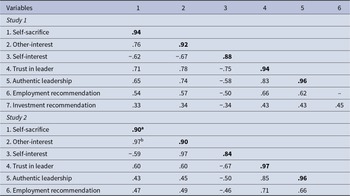
Descriptive statistics for the Study 1 dependent variables are presented in Table 2. Table 3 presents the variable intercorrelations for Study 1 along with reliability coefficients.
Descriptive statistics for study 1 dependent variables nested across treatment conditions
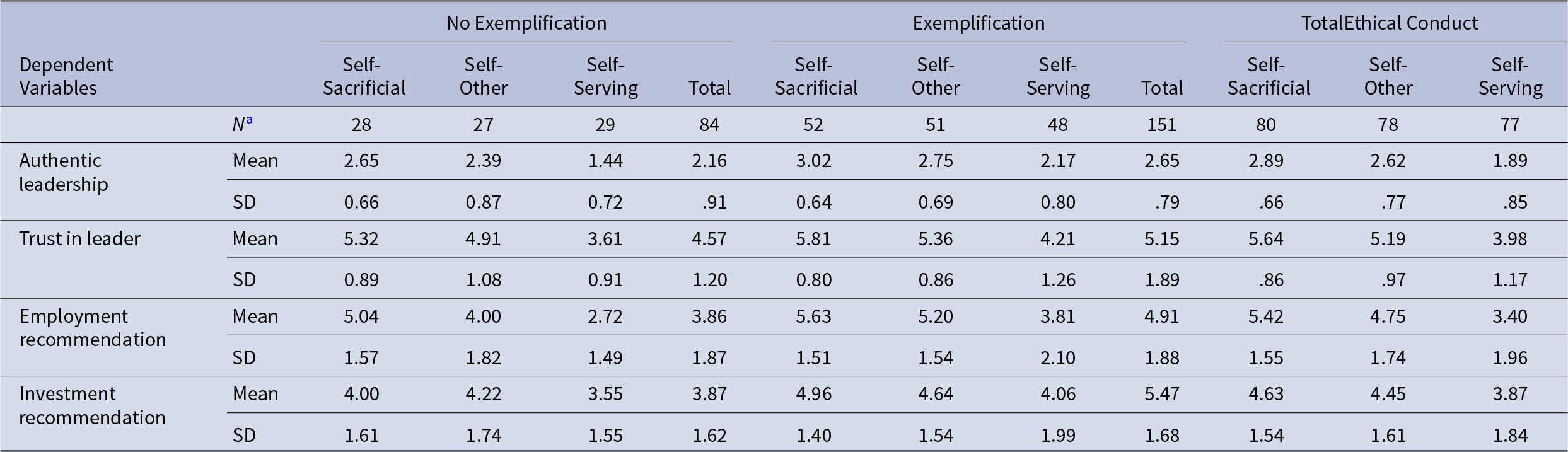
a Note: Because the no exemplification group treatment was introduced as a refinement to the experimental design following the initial wave of data collection, fewer participants (n = 84) were assigned to the no exemplification treatments than was the case for the exemplification treatments (n= 151).
Study 1 and study 2 variable inter-correlations and reliability coefficients

All correlations significant at the 0.01 level (2-tailed). Cronbach Alpha coefficients for the perceptual measures appear on the diagonal.
Manipulation check results
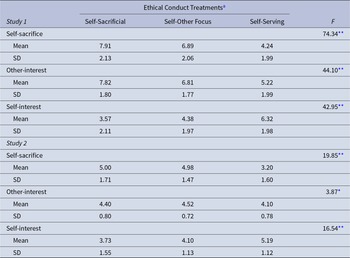
Univariate ANOVAs conducted for the ethical conduct treatments revealed significant differences in the measures across treatments (see Table 4). Pair-wise comparisons with Bonferroni corrections revealed significant differences in the means consistent with the intended manipulations. That is, the mean for self-interest was significantly higher in the self-serving versus the self-sacrifice or self-other focus treatments; the mean for self-sacrifice was significantly higher in the self-sacrifice versus the self-serving and self-other focus conditions.
Study 1 and study 2 manipulation check results for ethical conduct

* p < .05; **p < .01.
a Post-hoc Bonferroni analysis revealed significant mean differences for all measures across each ethical conduct treatment at the .05 level.
Hypothesis testing
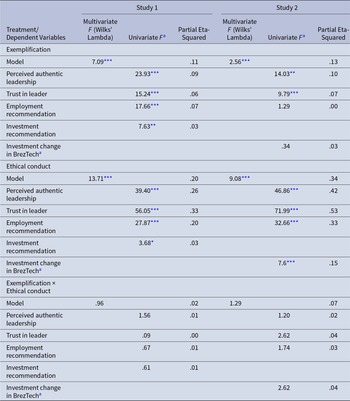
The MANOVAresults summarized in Table 5 revealed a significant main effect for exemplification such that exemplification as opposed to no exemplifaction produced higher levels of perceived authenticity, trust, and organizational advocacy. Moreover, persons exposed to leader exemplification versus no exemplification were more positively influenced by self-sacrificial behavior and a self-other focus and responded less negatively to self-serving behavior. However, pair-wise comparisons (see Table 6) yielded only partial support for Hypotheses 1, 2, and 3, as described below.
Study 1 and study 2 MANOVA results: Main effects and interactions

* p < .05; **p < .01; ***p < .001.
a A log transformation of the change in investment measure was performed to correct for skewed means and SDs.
Study 1 and study 2 Post-hoc comparisons for exemplification

* p < .05; **p< .01; ***p< .001; significance between treatment groups computed using Tukey HSD post hoc test.
As posited by Hypothesis 1a, leader self-sacrifice produced significantly higher levels of perceived leader authenticity when it was preceded by exemplification versus no exemplification. Limited support was also obtained for Hypothesis 1c, in that self-sacrifice elicited significantly higher levels of advocacy for investment, but not employment, recommendations when it was preceded by exemplification. Finally, the prediction of Hypothesis 1b that trust in the leader would be higher when self-sacrifice was combined with exemplification was not supported.
The mean differences in perceived leader authenticity and trust predicted by Hypotheses 2a and 2b for the combination of exemplification and a self-other focus did not achieve statistical significance. For organizational advocacy, partial support was obtained for Hypothesis 2c. Specifically, significantly more favorable employment recommendations (but not investment) were made for the exemplification versus no exemplification treatments when combined with a self-other focus.
Contrary to Hypothesis 3, the posited ethical conduct by exemplification interaction, or ‘boomerang effect’, did not emerge. Instead, exemplification as opposed to no exemplification produced higher levels of perceived authenticity, trust in the leader, and organizational advocacy in the form of an employment recommendation (but not the investment recommendation), even when the leader engaged in a self-serving response to the failed product launch.
To summarize, the main effects for exemplification and the elevated means reflected in Table 6 suggest that impressions of the leader were more favorable when preceded by exemplification. However, our subsequent analyses also indicated that the strength of these effects varied across the ethical conduct treatments. Contrary to our expectations, these effects were strongest for self-serving conduct. One explanation for these unexpected results may be that prior exemplification exposed participants to evidence that contradicted the news story portrayal of the leader as a purely self-interested person. In contrast, the fact that prior exposure to leader exemplification was consistent with the pro-social goals reflected in the self-sacrifice and self-other conductions, may explain why the effects for these conditions were less pronounced.
As the MANOVA results summarized in Table 5 indicate, a significant main effect was obtained for ethical conduct for all dependent variables. Consistent with Hypotheses 4a, 4b, 5a, and 5b, the post hoc pairwise comparisons (see Table 7) revealed that the self-sacrificial and self-other focus treatments elicited higher levels of perceived authenticity and trust in the leader than the self-serving treatment. Support was also obtained for Hypothesis 4c in that leader self-sacrifice as opposed to self-serving conduct produced higher ratings of organizational advocacy. However, only partial support was obtained for the organizational advocacy effects specified by Hypothesis 5c. While the self-other focus yielded higher employment recommendations versus the self-serving treatment, as expected, no significant differences were obtained for the investment recommendation. Finally, no support was obtained for Hypothesis 6. Contrary to Hypothesis 6a, participants did not rate the leader as being more authentic under the self-sacrificial versus the self-other condition. Results for Hypotheses 6b and 6c were in the opposite direction than predicted, as the self-sacrificial versus self-other treatment yielded higher levels of trust in the leader and advocacy for employment (but not investment) recommendations.
Study 1 and study 2 post-hoc pairwise comparisons for ethical conduct

* p < .05; **p < .01; ***p < .001; significance between treatment groups computed using Tukey HSD post hoc test.
Study 2
To explore the extent to which the Study 1 findings obtained with the student sample generalize to the workplace and to further explicate some of the inconsistent findings, we conducted Study 2 using a sample of working adults from diverse occupations. The measures and manipulations were identical to those of Study 1, with two exceptions. First, exemplification was operationalized through a video and text with photos (as opposed to text and storyboards) in which an actor portrayed CEO George Brezen delivered a speech at BrezTech’s annual stockholders’ meeting, appeared in a television interview, and meet with the firm’s R&Dteam. Second, a new investment decision measure of organizational advocacy was introduced whereby respondents specified the percentage of funds from an investment portfolio to be allocated to BrezTech and an S&P500 mutual index fund, both before and after exposure to the experimental treatments. Changes in respondents’ allocations indicated the extent to which they appeared to gain or lose confidence in BrezTech as a financial investment.
Methods
Sample
An online sample of 142 working adults was selected for Study 2 with the assistance of Study Response (http://studyresponse.net/index.htm). Study Response is an online social science resource that ‘facilitates online research for behavioral, social, and organizational science researchers by distributing email participation requests to adult research participants’. A two-stage process was used to select the sample. In Stage 1, a pre-screening e-mail message was sent to 4,000 working adults who had registered with Study Response to determine their willingness to participate in a 30-min online study. To ensure participants possessed relevant work experience, the sample was pre-screened according to age, work status, and occupation specifications. We received 448 responses from persons who expressed an interest in participating. In Stage 2, an e-mail message with a link to the experimental web page was sent to 416 respondents who expressed interest in the study and remained active in the Study Response database. Respondents were informed that in exchange for their participation, they would be entered into a lottery with a 15% chance of winning a $50 gift certificate to Amazon.com. The final sample included 142 working adults who chose to fully participate in the study.
Of the respondents who reported their gender, 31.7% were males. The mean age of respondents was 39.7 years, with a standard deviation of 10.2 years. In terms of reported ethnicity, participants were 86.6% white, followed by 2.8% Hispanic, 5.6% Asian-American, 2.8% African-American, 0.7% Asian, and 1.5% other. Of the sample respondents, 93.7% were currently employed full-time. The majority had full time work experience of over 10 years (77.5% of participants), followed by 13.4% who reported 6–10 years, 7% reported 3–5 years, 1.4% reporting 1–2 years, and 0.7% reporting less than 1 year of work experience. Finally, 4.2% reported full-time student status, and 4.2% as part-time student status.
Procedure
Participants were directed to a web portal where they logged in with an assigned username and password. Once online, they were presented with a consent form, study overview, and the profile of CEO George Brezen used in Study 1. Next, the video, photo, and text materials used to operationalize exemplification were provided to the participants who were randomly assigned to this treatment. All participants were then presented with an investment decision in which they were asked to indicate the amount they were willing to invest in BrezTech, as well as an S&P 500 index fund. This step was introduced to enhance participant involvement with the investment decision over that provided in Study 1. The ethical conduct treatment was presented next by providing participants with one of the three news reports depicting the self-sacrificial, self-other, and self-serving conditions used in Study 1. After reading these stories, participants were again asked to indicate the amount of an investment portfolio they would allocate to BrezTech as opposed to an S&P 500 index fund. Finally, the remaining dependent variables were measured and the manipulation checks administered.
Manipulations
The ethical conduct manipulation was identical to that of Study 1. For the exemplification treatment, a professional actor played the role of George Brezen, the CEO of BrezTech. The video included an excerpt from the CEO’s address at an annual shareholders’ meeting, followed by a brief interview of the CEO in a newsroom setting. The content of the CEO’s address as well as his interview was identical to that used in Study 1. Next, participants viewed a video of the CEO’s meeting with R&D employees, during which he discussed the problems with a new product/service initiative. As in Study 1, the leader stressed the importance of high ethical standards, his firm’s conviction to honest and trustworthy relationships with employees, and concern for a high quality of work life and employee welfare. In the no exemplification control group, participants were presented with the leader profile only.
Dependent measures
As in Study 1, the 16-item ALQ (Avolio et al., Reference Avolio, Wernsing and Gardner2018) and the adapted 12-item Organizational Trust Inventory (Cummings & Bromiley, Reference Cummings, Bromiley, Roderick and Tyler1996) were again used to measure perceived leader authenticity and trust in the leader, respectively. Cronbach’s αs coefficients .96 and .97, respectively, were obtained for these scales.Footnote 1
Two tasks were included to assess organizational advocacy. Participants were asked to indicate the percentage of their annual investment dollars that they were willing to invest in BrezTech, as opposed to an S&P 500 index fund. They were asked to make this allocation both before and after the ethical conduct manipulation. Participants were also asked to indicate if they would recommend BrezTech as a place of employment to a friend who was interested in applying for a job at BrezTech. A 5-point Likert Scale with anchors of ‘Do not Recommend’, ‘May not Recommend’, ‘Can’t Say’, ‘May Recommend’, and ‘Recommend’ was used. Finally, open-ended questions captured respondents’ rationale for their recommendations.
Results and discussion
Descriptive statistics for Study 2 variables are summarized in Table 8. Table 2 provides the variable intercorrelations along with their reliability coefficients.
Study 2. Descriptive statistics for the dependent variables nested across treatment conditions

Manipulation check results
The Study 1 manipulation checks for ethical conduct were again used in Study 2. Overall, the exemplification manipulation was successful. A significant difference between the two groups was found for the manipulation check item ‘George Brezen portrays himself as a highly ethical leader’ (t = 4.20, p < .001). In addition, the manipulations were perceived by participants to be realistic (M = 3.49, SD = .91). Nearly half (48%) rated the study as ‘high’ or ‘very high’ in realism, while 87% rated realism as ‘moderate’ to ‘very high’.
Cronbach’s αs for the self-focus (five items) and other-focus (three items) interest scales were .84 and .94, respectively. Univariate ANOVA tests revealed significant differences in the measures of self-interest, other-interest, and self-sacrifice across the treatment conditions (see Table 3). Pairwise Bonferroni comparisons revealed significant differences in the means across treatments consistent with the intended manipulations, except for the self-sacrifice means, across the self-sacrificial and self-other focus treatments. The lack of discrimination across these cells suggests that respondents did not perceive the self-sacrificial treatment as involving higher levels of sacrifice than the self-other treatment. In hindsight, this finding is not completely surprising given that both treatments involve sacrificial leader behavior.
Hypothesis testing
The MANOVA results in Table 5 also revealed a significant overall main effect for the exemplification treatment (F = 2.56, p < .001) and for perceived leader authenticity (F = 14.03, p < .01) and trust (F = 9.79, p < .001). Unlike Study 1, however, no significant differences were observed for either measure of organizational advocacy. Furthermore, pair-wise comparisons (see Table 6) yielded only partial support for Hypotheses 1, 2, and 3, as described below.
For the combination of leader self-sacrifice and exemplification, only Hypothesis 1a was supported. Participants in the exemplification versus no exemplification condition perceived the leader to be more authentic. However, the tests of Hypotheses 1b and 1c were not supported, as mean differences for trust and advocacy were not significant. Results are in line with Study 1, providing further evidence that leaders who combine exemplification with self-sacrifice are rated as more authentic, but not necessarily more trustworthy, than self-sacrificing leaders who do not.
As for the posited enhancement effects of preceding self-other focused behavior with exemplification, Hypotheses 2a (authenticity) and 2b (trust) were supported, whereas 2c (advocacy) was not. These results contrast with those of Study 1, where enhanced effects were obtained for the employment recommendation only. Comments revealed some participants declined to invest more in BrezTech because they have a policy of not investing unless they have substantial knowledge of the firm, or because they favor mutual funds over direct investments in stock. However, the fact that participants in Study 2 were also no more likely to recommend BrezTech as an employer following exemplification, suggests that their reluctance to advocate for the firm was probably not an artifact of the revised investment decision measure.
In contrast to Study 1 where exemplification appeared to have stronger enhancement effects for the self-serving treatment than the other treatments, no effects of exemplification were observed when it was followed by self-serving conduct. That is, although self-serving conduct was shown to undermine followers’ trust, advocacy, and perceived authenticity, they were not swayed by exemplifiers’ advance claims of moral worthiness. Moreover, because preliminary analyses yielded no interaction effects between the exemplification and ethical conduct treatments (see Table 5), evidence for the hypothesized ‘boomerang effect’ failed to emerge.
The MANOVA results in Table 5 indicate a significant main effect for ethical conduct for all dependent variables, except for the investment decision related to organizational advocacy. Specifically, main effects were observed for perceived authentic leadership (F = 46.86, p < .001), trust in the leader (F = 71.99, p < .001), and organizational advocacy (F = 32.66, p < .001). Upon further scrutiny, we observed that the means and SDs for the investment decision were skewed. Subsequent log transformations were carried out and the main effect of ethical conduct on the investment decision was reassessed. This analysis revealed a significant main effect for the transformed investment measure (F = 7.6, p < .001).
Consistent with Hypotheses 4a, 4b, 5a, and 5b, pair-wise comparisons (see Table 7) revealed that the self-sacrificial and self-other focused behavior treatments elicited higher levels of perceived authenticity and trust in the leader than the self-serving treatment. However, only partial support was found for the advocacy effects posited by Hypotheses 4c and 5c. Self-sacrifice and self-other focused behavior yielded significantly higher employment recommendations than the self-serving treatment; however, no significant differences were obtained for the investment decision. These results are consistent with the findings of Study 1.
Consistent with Hypothesis 6a, the self-sacrifice versus self-other focus treatment produced higher ratings of perceived authenticity. The predictions of Hypotheses 6b and 6c were not supported; the self-sacrifice versus self-other focus treatment did not yield higher levels of trust in the leader or organizational advocacy in the form of employment recommendations. There were no differences across these treatments for trust, employment recommendation or investment decision. These results differed from those of Study 1 where the self-sacrifice versus self-other treatment yielded higher levels of trust and employment recommendations.
General discussion
Our results from both studies indicated relatively consistent support for the predicted effects of exemplification and ethical conduct on participants’ ratings of leader authenticity, trust, and advocacy. Both studies revealed positive effects of exemplification on perceived authenticity and trust in the leader. Yet, the organizational advocacy results were mixed, with partial support obtained in Study 1, but no support in Study 2. Moreover, post hoc analyses revealed that the nature of these exemplification effects varied across ethical conduct treatments and studies. Finally, the results did not provide evidence of the boomerang effect, potentially because of range and/or other restrictions. We discuss these findings and their research and practice implications in more detail below.
Exemplification findings
Our results revealed main effects of exemplification such that perceived leader authenticity, trust in the leader, and organizational advocacy (Study 1 only) was higher when preceded by leader claims of moral worthiness. However, these effects were not consistent across studies or ethical conduct treatments. Study 1 indicated that exemplification produced the strongest effects – in the opposite direction than posited – for the self-serving condition under which exemplification appeared to serve as a buffer against the adverse effects of self-serving conduct. In contrast, Study 2 revealed mixed results of exemplification for self-serving leaders.
Mixed evidence of the predicted benefits of exemplification also emerged under the self-sacrificial and self-other focus conditions. Study 1 revealed that exemplification produced the predicted elevations in (1) perceived leader authenticity and investment recommendations when followed by leader self-sacrifice and (2) employment recommendations when followed by conduct reflecting a self-other focus. In contrast, Study 2 showed that, as expected, exemplification enhanced follower perceptions of leader authenticity under both conditions, but trust was only elevated when exemplification was combined with a self-other focused behavior.
Overall, despite exceptions across combinations of our dependent variables, ethical conduct treatments, and the two studies and samples, participants formed more positive impressions of the leader when they previously viewed exemplification claims; under no circumstances did they form more negative impressions. Moreover, results of both studies revealed the highest levels of perceived leader authenticity were obtained when participants were exposed to an exemplifying leader who demonstrated word-deed alignment by using self-sacrificial behavior in response to a failed product launch to protect employee interests. Thus, leaders who achieve behavioral integrity are deemed to be more authentic as has been predicted in testing prior theoretical frameworks (Effron, O’Connor, Leroy, & Lucas, Reference Effron, O’Connor, Leroy and Lucas2018; Gardner et al., Reference Gardner, Avolio, Luthans, May and Walumbwa2005; Simons, Reference Simons2002, Reference Simons2008). Our results also suggest that even though self-serving leaders may benefit from exemplification (as suggested by Study 1), they run the risk of a backlash from followers (as shown in Study 2). In contrast, those who go beyond talking the talk, by walking the walk, elicit the highest levels of follower trust and advocacy.
Ethical conduct findings
Our findings lend support for the assertions of Choi and Mai-Dalton (Reference Choi and Mai-Dalton1998, Reference Choi and Mai-Dalton1999) that altruistic, pro-social leaders who are willing to sacrifice their own interests for the good of others gain higher levels of trust and advocacy from followers. They are also consistent with studies that showed leader self-sacrifice as opposed to pro-self behavior yielded more positive ratings of leadership and effectiveness (De Cremer & van Knippenberg, Reference De Cremer and van Knippenberg2004; Lanaj, Hollenbeck, Ilgen, Barnes, & Harmon, Reference Lanaj, Hollenbeck, Ilgen, Barnes and Harmon2013) and trust in the leader (De Cremer & van Knippenberg, Reference De Cremer and van Knippenberg2005).
As an extension to prior research, we explored the effects of a third form of leader ethical conduct (self-other focused behavior) that reflected concern for fulfilling both the interests of the leader and followers. We posited that such an approach whereby leaders strive to protect the interests of followers without necessarily sacrificing their own interests, might yield perceptions of a more competent, and hence trustworthy, leader. However, our results indicate that the opposite may be true. Higher ratings of trust and advocacy for self-sacrificial versus self-other focused leader behavior emerged in Study 1, but not Study 2. Moreover, leader self-sacrifice produced higher ratings of leader authenticity in Study 2 only. Together, these findings suggest that no benefits, and some risks, may accrue for leaders who attempt to balance their own and others’ interests. Contrary to expectations, it appears that a willingness to make personal sacrifices to protect others’ interests, as opposed to protecting one’s own interests, is the key to securing followers’ trust and advocacy, at least with respect to the samples and organizational conditions portrayed in the current studies. Thus, leaders must be willing to give of themselves when times get unexpectedly tough before they can expect followers to trust and support them.
Limitations and future research directions
There are several limitations to our research worth noting. First, although exemplification was contrasted with a no exemplification/control group, participants in the latter treatment had less information available to rate the leader. Future studies that contrast exemplification with other forms of leader self-presentation, such as the pragmatic displays explored by Gilbert and Jones (Reference Gilbert and Jones1986) and Gardner (Reference Gardner2003), are merited to balance the amount of information presented.
A second limitation is that Study 1 participants were largely emerging adults, while Study 2 comprised working adults. Being older and possessing greater work experience, respondents in Study 2 may have had different expectations for plausible or acceptable behavior by the target leader. For example, students may be more enamored with idealized leadership behaviors such as self-sacrifice. Conversely, working adults may perceive the usefulness of leader self-sacrifice differently, may expect some self-serving behavior to be normal at work, or may have a different threshold for ‘acceptable’ workplace self-serving behavior versus the student sample. Either way, these differences in participants between Study 1 and 2 likely introduced unaccounted for variance in their responses that may have interfered with the treatment interventions. Future research into the effect of respondent characteristics such as attribution styles, financial experience, and work expectations of leaders would be useful.
Third, as with any laboratory or field study, the participants who are recruited and participate may not be an unbiased sample and therefore our results must be viewed with that limitation in mind. Also, participants did not work for the leader or the organization, thus their reactions may have been different if they had experience and history working with the leader/organization, as well instrumental benefits and/or costs.
A fourth and related limitation pertains to the ecological validity of the manipulations. Although we worked hard to enhance the realism of the exemplification video and ethical conduct news stories by using a professional actor and basing the stories on real world events, the use of vignettes has been criticized because the participants do not have ‘skin in the game’ (Lonati, Quiroga, Zehnder, & Antonakis, Reference Lonati, Quiroga, Zehnder and Antonakis2018). Future experimental research for which the outcomes were more consequential for participants are recommended.
A fifth limitation arose from the difficulties we encountered in differentiating the self-sacrifice and self-other focus treatments. Indeed, our manipulation checks revealed that the Study 2 participants failed to report higher levels of self-interest and lower levels of self-sacrifice for the self-other focus and self-sacrificial treatments. Hence, the lack of support for Hypotheses 6b and 6c may be partially attributable to problems with our operationalization of the self-other treatment. For example, we may not have created with our scripts the necessary balance between self-centered and other-oriented interests. Thus, further work on designing and implementing operationalizations of these constructs in future research on leadership and exemplification is needed. Additionally, some of the correlations shown in Table 2 exceed .80, which suggests that respondents were unable to differentiate semantically between these variables, highlighting the need for furture research to pursue alternatives to the perceptual measures we employed.
A sixth and related limitation of perceptual measures is that they may be influenced by respondents’ implicit leadership theories (Lord, Epitropaki, Foti, & Hansbrough, Reference Lord, Epitropaki, Foti and Hansbrough2020) and affective reactions to the leader (Martinko et al., Reference Martinko, Mackey, Moss, Harvey, McAllister and Brees2018). Hence, our results are susceptible to endogeneity bias and must be interpreted with caution (Antonakis, Bendahan, Jacquart, & Lalive, Reference Antonakis, Bendahan, Jacquart and Lalive2010). In recognition of this limitation, we consistently indicate that we are focused on perceived leader authenticity throughout the manuscript. Nonetheless, as Lux and Lowe (Reference Lux and Lowe2025) indicate in their Editorial for this Special Issue, there is also value in studying how leaders signal authenticity (e.g., through exemplification) and the extent to which recipients of such signals view the leader as authentic.
Seventh, recognition of the limitations of our perceptual measures is the reason why we included behavioral measures of organizational advocacy in the form of employment and investment recommendations and decisions. Nevertheless, because these behavioral measures lack the ecological validity of actual employeement and investment recommendations/decisions, we again advocate for future experiments with more consequential outcomes of leader exemplification and ethical conduct for participants. Further, the inclusion of measures of participants’ implicit leadership theories (Lord et al., Reference Lord, Epitropaki, Foti and Hansbrough2020) and affect toward the leader (Martinko et al., Reference Martinko, Mackey, Moss, Harvey, McAllister and Brees2018) as control variables is warranted.
Finally, future research is warranted that uses alternatives to our experimental methodology. For instance, ethnographic investigations of leaders who adhere to and violate moral expectations, such as Cha and Edmondson’s (Reference Cha and Edmondson2006) case study, are merited. Studies that adopt different dependent measures (e.g., organizational cynicism, perceptions of politics, workplace deviance, incivility) in assessing exemplification and violations of moral expectations are also needed.
Conclusion
The current research provides practical insights into the consequences that occur when followers perceive their leaders to be authentic, as well as when they learn that their leaders’ words don’t match their deeds. It is also true that when the exemplifying leader responded to a failed product launch by protecting employees through self-sacrificial behavior (or, to a lesser extent, with efforts to protect both his own and employees’ interests), the leader was perceived to be more authentic and gained higher levels of support for his firm than was the case when he responded with self-serving behavior.
In sum, our results suggest that leaders who display consistency between their words and deeds, will be seen as more authentic and produce higher trust for their organizations. Thus, our findings confirm the wisdom of personal sacrifices CEOs have made as they struggle to protect their employees, despite difficult economic times. While any leader may enjoy spikes in perceived authenticity, trust, and support by making claims of moral worthiness, the highest levels are earned by those who follow through on their promises and are willing to sacrifice their own self-interests for the greater good of the group, organization, and society.
Financial support
Support for this research was provided by the Global Leadership Institute, University of Nebraska-Lincoln, and the Institute for Leadership Research, Texas Tech University. Parts of this research were presented at the 2006 Academy of Management meetings.
NOTE: Because Bruce Avolio and William Gardner are coauthors of the Authentic Leadership Questionnaire (ALQ), which is a survey instrument marketed by Mind Garden for which they receive royalties, they have a potential conflict of interest in using the ALQ to measure perceived authentic leadership. However, the manuscript does not advocate use of the ALQ. As such, we do not think their authorship constitutes a conflict of interest.
Appendix: Leader Ethical Conduct Manipulations




 Open access

