




Introduction
In an era of global migration, societies are increasingly defined by diversity. While in traditional migration destinations this diversity arises largely through new immigration, in Central and Eastern Europe (CEE) it is tied closely to the presence of significant, autochthonous national and ethnic minorities. In these regions, resurgent ethno-nationalisms (Fox and Vermeersch Reference Fox and Vermeersch2010) and historical geopolitical conflicts, such as the Yugoslav wars of the 1990s, have often driven policies of ethnic homogenization that threaten ethno-cultural diversity, particularly in borderlands with substantial minority populations. This phenomenon is documented extensively in research that quantifies diversity across regions and countries (Alesina et al. Reference Alesina, Devleeschauwer, Easterly, Kurlat and Wacziarg2003; Fearon Reference Fearon2003; Hysa Reference Hysa2020). However, while such diversity metrics offer insights into a country’s macro-level demographic structure (Fearon Reference Fearon2003), they often overlook the social dynamics of cohesion, social distance, and ethnic relations. Intermarriages provide a critical lens through which to explore these dynamics, particularly the interaction between ethnic diversity and societal attributes. The phenomenon of interracial and interethnic marriages, often termed “mixedness,” embodies the blending of diverse national, racial, cultural, and religious identities within societal frameworks (Rodriguez-Garcia Reference Rodríguez-García2015; Twine Reference Twine2010). These unions serve as markers of societal integration, assimilation, and acceptance (Kalmijn Reference Kalmijn1998; Kiss Reference Kiss, Kiss, Székely, Toró, Bárdi and Horváth2018), contributing to social cohesion by bridging cultural divides and challenging entrenched social barriers (Cerchiaro Reference Cerchiaro2023; Gordon Reference Gordon1964; Osanami Törngren Reference Osanami Törngren2016; Song Reference Song2009).
The macro-structural concept developed by Blau (Blau Reference Blau1977; Blau et al. Reference Blau, Blum and Schwartz1982) has profoundly influenced studies on the link between ethnic diversity and intermarriage (Hwang et al. Reference Hwang, Saenz and Aguirre1994; Fitzpatrick and Hwang Reference Fitzpatrick and Hwang1992; Lievens Reference Lievens1998; Muttarak and Heath Reference Muttarak and Heath2010). Nevertheless, most research to date centers on Western societies, where diversity is usually a product of recent immigration, and minority groups are often racially distinct from the majority population (Lendák-Kabók and Örkény Reference Lendák-Kabók and Örkény2024). Regions with a long history of rich cultural intersections have received considerably less attention. To our knowledge, there is limited research addressing the relationship between diversity and intermarriage within nation-states featuring autochthonous minorities, where societal divisions are more often based on ethnic and linguistic differences than on racial distinctions, aside from the Roma population.
This article addresses this gap by quantitatively examining the relationship between ethnic diversity and interethnic marriage among national minority groups, with Vojvodina, Serbia’s northern autonomous province, historically one of Europe’s most ethnically diverse regions, as a focal case. By analyzing diversity not only as a structural factor but also as a dynamic variable, we examine how these phenomena interact across different geopolitical periods and conflicts, as well as in response to shifts in ethnic group sizes and spatial distributions. Additionally, the study highlights inequalities in interethnic marriage across ethnicities and sub-regions, drawing insights into contemporary Vojvodinian (and Serbian) society regarding group closure, social distance, and ethnic hierarchies.
Vojvodina offers an ideal setting for understanding the interplay between ethnic diversity and intermarriage. Despite geopolitical events, wars, and border changes, it remains one of the few regions that still reflects the diversity of the former Yugoslavia. Among its 17 autochthonous minority groups, more than 1,000 people belong to each, while nine groups exceed 10,000 inhabitants. However, despite this enduring diversity, Vojvodina also serves as an excellent case study of how nationalizing policies attempt to homogenize a region. In this regard, Vojvodina is not unique but rather representative of broader trends among nation-states in Central and Eastern Europe (CEE).
The history of Vojvodina further underscores this CEE character. Over the centuries, the territory that constitutes present-day Vojvodina has been ruled by the Kingdom of Hungary, the Ottoman Empire, and later the Habsburg Empire. The 20th century brought several border changes: after World War I, Vojvodina became part of the Kingdom of Serbs, Croats, and Slovenes; during World War II, it was partitioned. Since 1945, it has been part of Serbia (within Yugoslavia), enjoying autonomy between 1974 and 1988. Although the Yugoslav Wars did not directly affect Vojvodina, the region was impacted by the 1999 NATO bombings. Since 2010, the province has once again held autonomous status.
This paper contributes significantly to understanding the impact of ethnic diversity on interethnic relations, especially through marriage patterns, in a multiethnic region with turbulent history like Vojvodina. By focusing on autochthonous minority context, it broadens academic discourse on interethnic marriages and its interconnections with ethnic diversity.
Theoretical Background and Previous Research
Mixed marriages connect not only two individuals but also the broader communities to which they belong, making intermarriage a powerful symbol of societal progress toward embracing integration and diversity (Kalmijn Reference Kalmijn1998). The prevalence of mixed marriages in a society is widely believed to reduce the risk of violent conflicts between groups and to strengthen social cohesion overall (Smits Reference Smits2010). Interethnic marriages often reflect broader societal attitudes toward race, ethnicity, and cultural differences (Song Reference Song2009), as well as the institutional and discursive frameworks that either support or discourage ethnic exogamy (Kiss Reference Kiss, Kiss, Székely, Toró, Bárdi and Horváth2018). These influences, along with individual preferences, are frequently referred to as cultural factors (Kalmijn Reference Kalmijn1998). However, marriage preferences are not shaped by cultural factors alone; structural constraints also play a critical role in shaping the marriage market and can, in some cases, counter cultural influences to increase the likelihood of ethnic exogamy.
Structural constraints primarily limit opportunities for outgroup associations. Demographic factors, such as the relative size of ethnic groups, are particularly significant (Blau et al. Reference Blau, Blum and Schwartz1982; Hwang et al. Reference Hwang, Saenz and Aguirre1997; Kalmijn Reference Kalmijn1998; Kiss Reference Kiss, Kiss, Székely, Toró, Bárdi and Horváth2018; Lievens Reference Lievens1998; Mrdjen and Bahnik Reference Mrdjen and Bahnik2018). Members of larger groups, for instance, generally have lower chances of meeting potential partners from other ethnicities compared to members of smaller groups (Blau Reference Blau1977; Mrdjen Reference Mrdjen1996). Additionally, territorial concentration, geographical distance, physical barriers, and high levels of segregation can reduce the likelihood of interethnic contact. Segregation may occur not only geographically but also within institutions, such as schools and workplaces, leading to segmented local marriage markets (Kalmijn Reference Kalmijn1998, 403). The role of heterogenity in promoting intermarriage rates is examined, with the argument that greater diversity within a population increases the likelihood of interethnic marriages (Blau et al. Reference Blau, Blum and Schwartz1982, 45). It is important to note that “heterogeneity” in this context does not refer solely to ethnic diversity at a regional level but encompasses diversity across multiple dimensions, including country of origin, language, race, and labor market status.
Building on Blau’s concept, several studies have explored and nuanced the relationship between diversity and intermarriage. While the impact of group size on intermarriage rates is well-established in the literature (Kalmijn Reference Kalmijn1998), the connection between ethnic diversity and intermarriage remains more contentious. Although many studies support the validity of Blau’s thesis (Blum Reference Blum1985; Muttarak and Heath Reference Muttarak and Heath2010), Fitzpatrick and Hwang (Reference Fitzpatrick and Hwang1992, 57) found that their results “modestly support Blau’s opportunity for contact assumption” within a similar context. Furthermore, Hwang observed either an insignificant or negative effect of ethnic heterogeneity on the prevalence of ethnically mixed marriages (Hwang et al. Reference Hwang, Saenz and Aguirre1994, 407). Consequently, Hwang et al. (Reference Hwang, Saenz and Aguirre1997, 760) opted not to include heterogeneity as a variable in their analysis, citing its strong correlation with the size of minority groups.
Addressing the limitations of these earlier studies, Lievens (Reference Lievens1998) focused specifically on intermarriages between majority group members and ethnic minority groups, effectively operationalizing Blau’s thesis. This approach led to a reversed hypothesis, supported by the findings: “For all subpopulations studied, negative effects are found for the relative size of the ethnic group studied and for the degree of ethnic heterogeneity” (Lievens Reference Lievens1998, 150). As interpretations and operationalizations of heterogeneity have evolved, this variable has increasingly been viewed not just in terms of specific areas but also in terms of in-group heterogeneity (Spörlein et al. Reference Spörlein, Schlueter and van Tubergen2014).
It is evident that major structural factors such as diversity, group size, and spatial distribution are closely interconnected. This suggests that, when studying diversity and intermarriage, it is essential to consider not only the ethnic diversity (heterogeneity) of a given area but also these other variables. In our view, group size and spatial distribution are integral components of diversity, making it advisable to analyze them collectively. The literature also investigates various other structural factors, such as age and sex ratios, and education levels. However, in the context of Vojvodina, we particularly emphasize the significance of the duration of coexistence (or residence) of different groups in a specific area as a key factor influencing interethnic marriages (Mrdjen and Bahnik Reference Mrdjen and Bahnik2018, 153). Furtado and Trejo (Reference Furtado and Trejo2012) found that newly arrived immigrants tend to prioritize a shared ethnic background when choosing a spouse, compared to those whose families have been in the host country for generations. This distinction is particularly relevant because most studies focus on immigrant societies rather than autochthonous minorities. In these cases, the duration of coexistence, local attachment, and the urban-rural dichotomy reveal entirely different patterns. Thus, examining Vojvodina offers a unique perspective in this regard.
The former Yugoslavia, including Vojvodina, is a well-studied region regarding both ethnic diversity (Léphaft et al. Reference Léphaft, Németh and Reményi2014; Stojšin Reference Stojšin2015; Hysa Reference Hysa2020) and interethnic marriages (Botev Reference Botev1994; Burić Reference Burić, Edgar and Frommer2020; Le Goff and Giudici Reference Le Goff, Giudici, Spini, Elcheroth and Biruski2014; Lendák-Kabók Reference Lendák-Kabók2024; Petrović Reference Petrović1985; Smits Reference Smits2010). However, the relationship between these two topics has not yet been thoroughly explored. Most quantitative studies on interethnic marriages in Yugoslavia have relied on census data (Botev Reference Botev1994; Lazar and Aćimov Reference Lazar and Aćimov2017; Petrović Reference Petrović1985), highlighting regional and ethnic group differences. These studies reveal that Islamic religious groups tend to be the least open to mixed marriages (Mrdjen Reference Mrdjen1996). Moreover, the “openness” of a group is often gender-specific and closely linked to the status of women within each group (Morokvasic-Müller Reference Morokvasic-Müller, Breckner, Kalekin-Fishman and Miethe2000, 202).
The violent conflicts and eventual disintegration of Yugoslavia have impacted intermarriage patterns, drawing research interest primarily from the perspective of social cohesion (Smits Reference Smits2010). Despite the varied effects of the war, recent studies indicate that Vojvodina maintains the highest rate of ethnically mixed marriages among the former Yugoslav regions. This trend is attributed to the province’s ethnic heterogeneity and its rich cultural traditions, which date back to the Austro-Hungarian Monarchy (Lazar and Aćimov Reference Lazar and Aćimov2017).
Data and Methods
This study employs quantitative methods to examine the relationship between ethnic diversity and intermarriages. Given that a direct link between these two phenomena is not feasible, an indirect approach is adopted, with each phenomenon measured using separate methods. The article begins by briefly presenting the transformation of the ethnic structure in Vojvodina over the past 150 years and its impact on diversity values. It then analyses historical trends in the proportion of intermarriages by ethnic group to uncover ethnic inequalities and the socio-political factors that may have influenced these patterns. Particular emphasis is placed on the issue of scale, with data analysed at both provincial and municipal levels. Finally, the article elucidates the interplay between ethnic diversity and mixed marriages.
The study relies on two distinct data sources. The examination of ethnic composition and diversity trends in Vojvodina, along with the degree of segregation between ethnic groups, is based on census data. This includes Hungarian censuses from the period of 1880–1910 (and partially in 1941), Yugoslav censuses from 1921–1991, and Serbian censuses from 2001 onward. The analysis of intermarriages is based on annual incidence (flow) data of marriages by ethnicity, which has been published in detail since 1960, except for the periods 1966–1969 and 2001. Marriage statistics on the Roma population has only been available since 1970, and for some smaller groups, only since 2002. The advantage of flow data, compared to prevalence (stock) data primarily obtained from censuses, is their ability to provide better temporal tracking of dynamics. However, flow data do have limitations: they pertain solely to contracted marriages, and while the growing significance of cohabitation is acknowledged, this study is unable to address it.
While a significant portion of the international quantitative literature effectively identifies factors influencing ethnically mixed marriages through logistic regression models, this approach was not feasible in our study due to the marriage data being available only by ethnicity and gender, without additional details such as age, education, or occupation. However, a notable advantage of our database is the availability of municipal-level data since 2002, which offers a unique opportunity for spatial analysis. Accordingly, we conducted a general overview of intermarriages for the period from 1960 to 2022, while spatial analyses focused on the years 2002 to 2022. The incidence of mixed marriages was examined only for ethnic groups with published data prior to 2000 and with a population of at least 10,000 in Vojvodina, according to the most recent census.
Although our study is based on statistical data, we acknowledge the limitations associated with ethnic statistics. First, ethnicity and ethnic groups are not clearly defined concepts (Brubaker Reference Brubaker2004), making the measurement of ethnicity challenging due to its often fluid and blurred boundaries at the micro level (Barth Reference Barth1998). Nevertheless, these boundaries may remain persistent at the macro level (Wimmer Reference Wimmer2013). Second, we are aware that ethnic data collection, especially through censuses, is a political act, through which the power categorizes people to legitimate the privileged position of the titular ethnic group and maintain ethnic hierarchy and asymmetry (Kertzer and Arel Reference Kertzer, Arel, Kertzer and Arel2002). Despite all this, we believe that statistical data provide a solid foundation for understanding macro-level trends and outlining major ethnic dynamics, and we rely on this data in our study with the necessary caution. Third, the issue of unknown ethnic identities within the datasets poses a significant barrier to analysis, affecting both census and intermarriage flow data. Increasing non-response rates and missing ethnicity data in recent decades can significantly impact the results. Consequently, we have excluded non-respondents and individuals with unknown ethnicity from our analysis, ensuring that the ethnicity ratios and the endogamy/exogamy rates are expressed as percentages of the known population and marriages.
While numerous methods for measuring ethnic diversity are increasingly available (Németh et al. Reference Németh, Sümeghy, Trócsányi and Pirisi2022), this study employs, in addition to simple percentage indicators, the (ethnic) fragmentation index (EFI) to assess ethnic diversity in Vojvodina. The EFI measures the probability that two randomly selected residents from a given area belong to different ethnic groups. The index ranges from 0 to 1, where 0 indicates a completely homogeneous population and 1 indicates that each resident belongs to a different group. The added value of EFI is that it encompasses the characteristics of the ethnic structure, while providing information not on individual groups but on diversity itself. This allows diversity to be compared quantitatively with other regions and with mixed marriage rates.
To examine the territorial distribution and segregation of the population, we utilize the commonly used dissimilarity index (D) (for calculation and applicability, see Massey and Denton Reference Massey and Denton1988). The D value ranges from 0 to 1, indicating the extent of population redistribution required to achieve an equal distribution of each group across subareas. High values signify significant segregation, while low values indicate minimal segregation.
Similar to diversity, there are various methods for measuring the incidence of interethnic marriages, two of which are applied in this study. One of the simplest approaches is to analyse the ratio of exogamous to endogamous marriages, focusing on marriages rather than individuals, both within the general population and among specific ethnic groups. However, these ratios are significantly influenced by the size and composition of the groups (for instance, in terms of age and gender). Consequently, much of the literature employs odds ratios (OR) to measure ethnic endogamy (for calculation and applicability, see Kalmijn Reference Kalmijn1998). The odds ratio indicates the tendency toward endogamy compared to random partner selection. Specifically, “odds ratios greater than one indicate that there is more endogamy than one would expect, and the larger the ratio, the greater the degree of endogamy” (Kalmijn Reference Kalmijn1998, 405). The main advantage of OR is that it is independent of group size, thus we can directly measure the propensity to intermarry. This facilitates comparisons of endogamy and exogamy across different groups and countries and helps to infer characteristics like social distance, interethnic relation and ethnic boundary making.
Results
Ethnic Diversity in Vojvodina
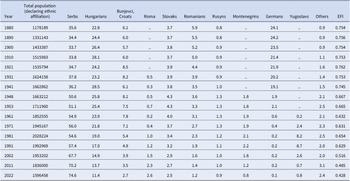
The Vojvodina region has historically been one of Europe’s most ethnically diverse areas, a characteristic primarily attributed to the repopulation efforts during the Habsburg rule in the 18th century, following significant depopulation due to the Ottoman conquest (Gábrity Molnár et al. Reference Gábrity-Molnár, Kocsis, Takács and Tátrai2013). According to late 19th-century Hungarian censuses, even the largest ethnic group, the Serbs, comprised only about one-third of the total population, while Germans and Hungarians each accounted for around 20% (Table 1). Reflecting this fragmented ethnic structure, the ethnic fragmentation index (EFI) consistently exhibited relatively high values, hovering around 0.75 throughout the period. Notably, neither the upheavals of World War I nor the subsequent changes in state authority led to substantial alterations in the region’s ethnic composition. While there were minor shifts in ethnic proportions favouring the emerging titular ethnic groups, overall changes remained moderate. This stability was further supported by the relatively low presence of outlier groups such as the Roma and Jews, whose ethnic identification tends to be highly sensitive to (geo)political shifts and who were not heavily concentrated in this region. As a result, the EFI remained consistently high until the end of World War II.
Changes in the Ethnic Structure (%) and Ethnic Fragmentation Index (EFI) in Vojvodina between 1880 and 2022

Table 1. Long description
From top to bottom, each row lists a census year, total population declaring ethnic affiliation, and percentages for Serbs, Hungarians, Bunjevci/Croats, Roma, Slovaks, Romanians, Rusyns, Montenegrins, Germans, Yugoslavs, Others, and the Ethnic Fragmentation Index (EFI). In 1880, Serbs were 35.6 percent, Hungarians 22.8 percent, Germans 24.1 percent, EFI 0.754. By 1948, Serbs rose to 50.6 percent, Hungarians 25.8 percent, Germans 1.9 percent, EFI 0.667. In 2022, Serbs reached 74.6 percent, Hungarians 11.4 percent, EFI 0.428. EFI values decrease over time, indicating declining ethnic diversity. Some groups, such as Germans and Yugoslavs, disappear from later censuses. Data gaps are marked with two dots. The table shows a steady increase in the Serb share and a decline in most other groups, especially Hungarians and Germans, with the EFI dropping from 0.754 to 0.428.
Source: Authors’ calculation based on Hungarian, Yugoslavian and Serbian census data. 1880–1941: Native language data; 1948–2022: Ethnicity data; ..=no data
The first significant disruption to the ethnic fragmentation index (EFI) values occurred during World War II. In 1941, Germany and Hungary invaded the Kingdom of Yugoslavia, and Vojvodina was then partitioned between Hungary, Croatia and Serbia (latter under de facto German administration), leading to severe tensions between these states and respective ethnic groups. Mutual pogroms throughout the war and its aftermath, coupled with the expulsion of 90% of Germans who were accused of collective guilt on the grounds of German occupation, led to a dramatic decrease in the minority populations that had resided in the region since the 18th century. However, this decline was largely counteracted by extensive post-war agrarian colonization, which brought in substantial numbers of settlers from across all the republics of Yugoslavia. Consequently, new ethnic groups, including Montenegrins, Macedonians, Slovenes, Muslims, and Albanians, began to populate the region. As a result of these demographic shifts, the fragmentation index dropped to approximately 0.65 and remained within this range throughout the Yugoslav period.
From the 1950s onward, with the consolidation of Tito’s Yugoslavia, migration waves subsided, leading to a stabilization of the ethnic structure. The slogan “Brotherhood and Unity” was the official policy for interethnic relations to overcome the national/ethnic conflicts, however unequal ethnic relations persisted. As part of this policy, the supranational ethnic category “Yugoslav” was introduced during the 1961 census, which was particularly appealing to the urban population and the descendants of mixed marriages. As a result, the EFI increased for the first time between 1971 and 1981, not due to a shift in state power. However, the popularity of the Yugoslav ethnic category primarily offset the gradual decline observed among autochthonous minority groups, such as Hungarians, Bunjevci, Romanians, Slovaks, and Rusyns, while the Serb population continued to grow steadily. By the end of the Yugoslav era in 1991, the ethnic fragmentation index had only slightly decreased to 0.63.
However, the past three decades have been marked by significant upheavals. When Milošević came to power, Yugoslavia embarked on the path of national communism, leading to violence and the breakup of the country. The Yugoslav Wars, NATO bombings, and associated migration waves – including a massive exodus of minorities from Vojvodina alongside an influx of Serb refugees from Bosnia and Croatia – have radically altered the region’s ethnic structure. During the 1990s, the decline in the ethnic fragmentation index (EFI) surpassed even that observed after World War II, dropping to 0.52 by 2002. In the last twenty years, the pace of change has slowed, yet the EFI continues to decrease. Due to the economic decline of the country (and the province) and political uncertainties, the high living standards before 1990 have declined significantly and emigration is persistently high. Within the rapidly shrinking population of Vojvodina, the proportion of the titular group, the Serbs, has risen significantly (from 57% in 1991 to 75% in 2022), despite a decline in their absolute numbers due to emigration abroad since the turn of the millennium. The demographic situation for minorities is even more challenging: in the context of nationalizing policies of Serbia, economic difficulties and migration policies of the kin-states, ongoing emigration, coupled with unfavourable fertility rates and age structures, has resulted in a significant natural decrease. Additionally, assimilation, though to a lesser extent, contributes to this decline. Consequently, the populations of Hungarians, Slovaks, and Rusyns have halved over the past 50 years, while the number of Croatians/Bunjevci and Romanians has decreased to one-third, and Germans have nearly vanished from the province. As a result of these processes, the EFI fell to 0.43 in 2022. Nevertheless, this figure remains considerably higher than the Serbian average of 0.25.
Besides the overarching picture, it is essential to examine (sub)regional processes, as these may exhibit entirely different patterns, given that scale fundamentally influences the ethnic fragmentation index (EFI) value (Léphaft et al. Reference Léphaft, Németh and Reményi2014). Data recalculated to reflect the current territorial jurisdiction of Vojvodina’s municipalities reveal that the patterns of diversity indices have significantly transformed over the past century and a half. Prior to World War I, the Banat region (eastern part of Vojvodina) and certain western municipalities, particularly urban areas, were among the most diverse in the province. In contrast, the most homogeneous areas were located in parts of the Srem region (southwestern Vojvodina), predominantly inhabited by Serbs, as well as in the northern and central areas, which were mainly populated by ethnic Hungarians. Following World War II, these patterns shifted somewhat by the time of the 1953 census, with the highest EFI values recorded in the southeastern and western municipalities.
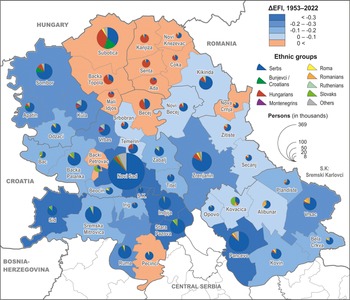
Today, high EFI values correspond closely with the distribution of the Hungarian population, primarily concentrated in the north. Other areas with elevated EFI values are scattered throughout the province, particularly where Slovaks, Croats, Hungarians, and Serbs coexist. Conversely, municipalities with the lowest EFI values are unequivocally located in the southern territories of Vojvodina, especially in Srem. The changes in EFI are pronounced even over the medium term, particularly since the 1950s. As illustrated in Figure 1, the areas experiencing the greatest decline in EFI values are primarily the economic centres of Vojvodina (around the Belgrade–Novi Sad axis and larger cities, excluding Subotica), while growth in diversity is entirely aligned with the ethnic Hungarian settlement area in northern Vojvodina. Consequently, Serbian-majority areas have become increasingly homogeneous, particularly due to the influx of Serbian refugees into the economically prosperous regions during the 1990s. Even in diversifying regions with rising EFI values, a similar trend is observed, albeit interpreted as an increase in fragmentation due to the growing proportion of Serbs, which can be understood as homogenization at the provincial level. Therefore, while changes in EFI values may vary at the provincial and municipal levels, they collectively signify a trend of ethnic homogenization.
Changes in the EFI between 1953 and 2022 and Ethnic Structure of Municipalities in 2022
Source: Created by the authors, based on Yugoslavian and Serbian census data

Figure 1. Long description
Starting from the northwest, municipalities are outlined and labeled, each with a background color ranging from light orange to dark blue, representing E F I change intervals: less than minus 0.3, minus 0.2 to minus 0.3, minus 0.1 to minus 0.2, minus 0.0 to minus 0.1, and greater than 0. Pie charts within each municipality show ethnic group proportions using distinct colors: blue for Serbs, yellow for Roma, green for Bunjevci/Croatians, red for Hungarians, purple for Montenegrins, orange for Romanians, light green for Ruthenians, light blue for Slovaks, and gray for Others. The size of each pie chart corresponds to population, with Novi Sad, Pančevo, and Zrenjanin displaying the largest charts. The legend at the right clarifies color codes for ethnic groups and E F I intervals, and a population scale shows circles for 8, 20, 50, 100, and 369 thousand persons. Municipalities with orange backgrounds, such as Subotica, Kanjiža, and Ruma, indicate higher E F I values, while blue backgrounds, including Sombor, Novi Sad, and Vršac, indicate lower values. Ethnic diversity is visually concentrated in northern municipalities, with Hungarians and Bunjevci/Croatians more prominent in Subotica and Kanjiža, while Serbs dominate southern and central areas.
Overall, the value of the ethnic fragmentation index (EFI) at both the provincial and municipal levels accurately reflects the general ethno-demographic processes. However, it does not illuminate how the transformation of diversity in Vojvodina has been accompanied by qualitative changes in the coexistence of various ethnic groups. Specifically, what ethnic hierarchy does this diversity embody, and how can we capture or assess the quality of coexistence using quantitative methods? In the following sections, we will seek to answer these questions by examining statistics and trends in interethnic marriages.
Interethnic Marriage in Vojvodina from a Longitudinal Perspective
After World War II, the rate of interethnic marriages in Yugoslavia saw a rapid increase, rising from 8.6% in the late 1940s to over 12% in the 1960s, peaking at 13.5% in 1990. This surge was propelled by various political, social, and economic factors, including urbanization, education, geographical mobility, the ideology of equality, and the establishment of civil marriage as the only legal form (Morokvasic-Müller Reference Morokvasic-Müller, Breckner, Kalekin-Fishman and Miethe2000, 201). However, despite the apparent unity among ethnicities, it is essential to recognize that intermarriages were not uniformly distributed; significant regional disparities emerged, profoundly influenced by local culture and historical contexts. For instance, Kosovo exhibited the lowest rates, while Vojvodina had the highest.
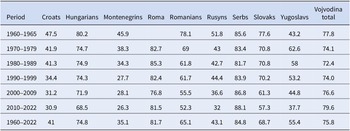
In Vojvodina, despite a slight decrease in ethnic diversity, the rate of interethnic marriages steadily increased during the socialist period, from around 18% in the mid-1950s to approximately 25% in 1970, peaking at 28.4% in 1988 (Table 2). This trend mirrored the national level, although Vojvodina’s rates were approximately twice the national average. However, the rise of ethno-nationalistic political ideologies after 1987 marked a regression, exacerbating divisions and ultimately leading to the Yugoslav Wars and the dissolution of Yugoslavia. Following 1990, a notable decline in interethnic marriages was observed (Morokvasic-Müller Reference Morokvasic-Müller, Breckner, Kalekin-Fishman and Miethe2000), except in Vojvodina, where the rate stabilized around 25% after a slight decrease. This stability may be attributed to the region’s diverse population and cultural traditions, which foster a higher inclination toward interethnic marriages compared to other parts of the former Yugoslavia (Botev Reference Botev1994; Lazar and Aćimov Reference Lazar and Aćimov2017), particularly since Vojvodina experienced no armed conflicts. Over the past 20 years, the rate of intermarriages in Vojvodina has continued to decline, now aligning with the ethnic structure transformation of the region, indicative of ethnic homogenization. Since 2005, the incidence of mixed marriages has fallen to around 20%, most likely due to the influx of hundreds of thousands of Serbian refugees, who were less open to local minorities and mixed marriages. While this figure dipped below 20% in the first half of the 2010s, it has recently stabilized just above 20%.
Percentage of Endogamous Marriages by Ethnic Groups in Vojvodina, 1960–2022 (%)
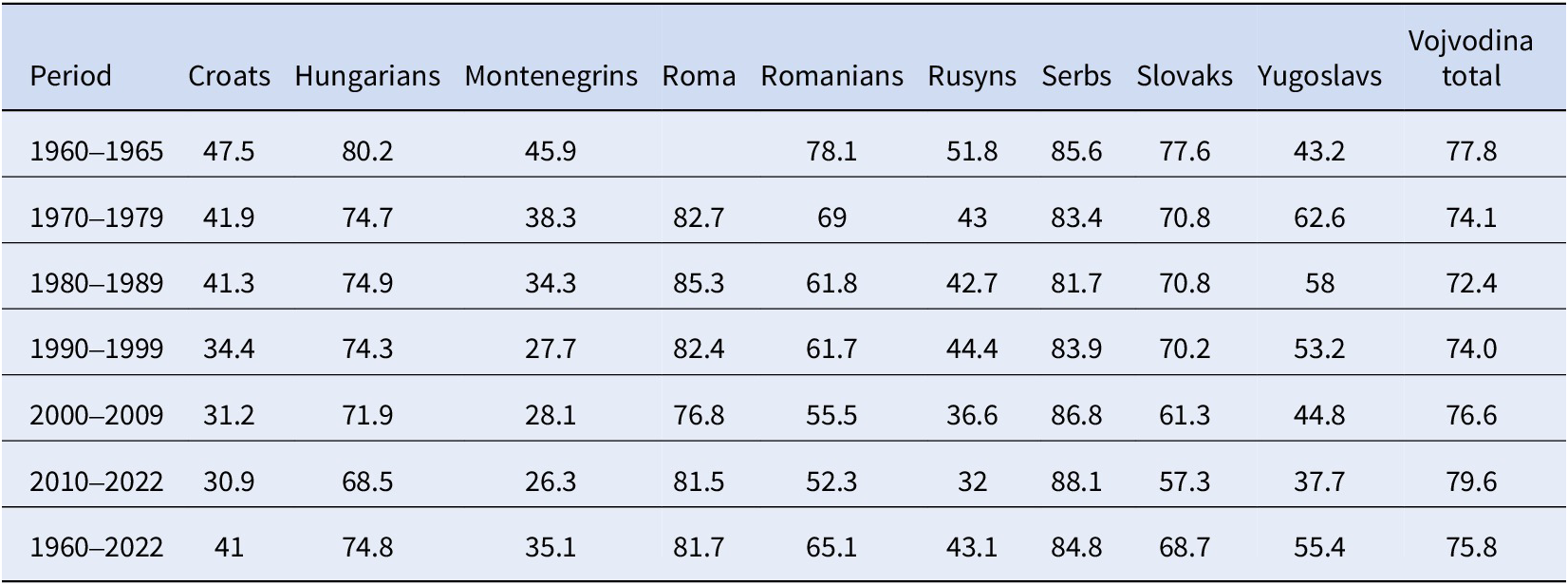
Table 2. Long description
The table has eleven columns: Period, Croats, Hungarians, Montenegrins, Roma, Romanians, Rusyns, Serbs, Slovaks, Yugoslavs, and Vojvodina total. For each period, values are as follows. 1960–1965: Croats 47.5, Hungarians 80.2, Montenegrins 45.9, Roma blank, Romanians 78.1, Rusyns 51.8, Serbs 85.6, Slovaks 77.6, Yugoslavs 43.2, Vojvodina total 77.8. 1970–1979: Croats 41.9, Hungarians 74.7, Montenegrins 38.3, Roma 82.7, Romanians 69, Rusyns 43, Serbs 83.4, Slovaks 70.8, Yugoslavs 62.6, Vojvodina total 74.1. 1980–1989: Croats 41.3, Hungarians 74.9, Montenegrins 34.3, Roma 85.3, Romanians 61.8, Rusyns 42.7, Serbs 81.7, Slovaks 70.8, Yugoslavs 58, Vojvodina total 72.4. 1990–1999: Croats 34.4, Hungarians 74.3, Montenegrins 27.7, Roma 82.4, Romanians 61.7, Rusyns 44.4, Serbs 83.9, Slovaks 70.2, Yugoslavs 53.2, Vojvodina total 74.0. 2000–2009: Croats 31.2, Hungarians 71.9, Montenegrins 28.1, Roma 76.8, Romanians 55.5, Rusyns 36.6, Serbs 86.8, Slovaks 61.3, Yugoslavs 44.8, Vojvodina total 76.6. 2010–2022: Croats 30.9, Hungarians 68.5, Montenegrins 26.3, Roma 81.5, Romanians 52.3, Rusyns 32, Serbs 88.1, Slovaks 57.3, Yugoslavs 37.7, Vojvodina total 79.6. The final row, 1960–2022, gives overall averages: Croats 41, Hungarians 74.8, Montenegrins 35.1, Roma 81.7, Romanians 65.1, Rusyns 43.1, Serbs 84.8, Slovaks 68.7, Yugoslavs 55.4, Vojvodina total 75.8. The highest values are consistently among Serbs, Hungarians, and Roma, while Croats, Montenegrins, and Rusyns show lower percentages. The Vojvodina total remains above 70 percent throughout.
Source: Authors’ calculation based on yearly marriage statistics by Statistical Office of the Republic of Serbia
This brief review of intermarriages in Vojvodina indicates that the rate of such unions has not fully aligned with the EFI over the past 70 years. However, this overview may obscure significant differences by ethnicity and sub-region, which are examined below.
Endogamy by Ethnic Groups
Major ethnic groups in Vojvodina can be categorized into at least three types based on the incidence of endogamous and exogamous marriages. The Serbs, due to their population size and privileged status, are considered a distinct group, exhibiting a notably high rate of endogamous marriages, approximately 88% today. Endogamy among Serbs declined until 1989 (80.6%) but then experienced a rapid increase in two waves, during the early 1990s and the mid-2000s, followed by a stabilization since then (Table 2).
The second category encompasses larger minority groups with relatively geographically concentrated settlement areas: Hungarians, Slovaks, and Romanians. In the 1960s, their endogamy rates were comparable to those of the Serbs. Although their endogamy rates, like those of the Serbs, declined until the breakup of Yugoslavia, this trend was more likely a consequence of their declining numbers rather than policies favoring intermarriages. From 1990 onward, the trends for these groups diverged from those of the Serbs. While the decline in endogamy halted during the Yugoslav Wars and the Milošević era, it resumed significantly in the mid to late 1990s. This resurgence can be attributed to their shrinking populations and a narrowing ethnic marriage market, exacerbated by the aging of these minority groups.Footnote 1
Smaller groups in the third category, including Croats, Montenegrins, Yugoslavs, and Rusyns, were characterized by a predominance of exogamous marriages at the beginning of the study period. Although the Yugoslavs followed a somewhat unique trajectory, the groups in this category consistently exhibited declining endogamy. This trend can be attributed mainly to their relatively low and decreasing populations, as well as the lack of linguistic barriers among Croats, Montenegrins, and, to some extent, Yugoslavs. The case of the Yugoslavs is particularly intriguing: the Yugoslav identity was a supra-national, top-down construct that masked multiple ethnic identities and, in many cases, facilitated resistance to assimilation into the titular group (Sekulic et al., Reference Sekulic, Massey and Hodson1994). Despite not constituting a classical ethnic group, they had a relatively high endogamy rate before 1990.
In addition to the aforementioned categories, the Roma should be recognized as an outlier group. Similar to trends observed in other countries in the region (Mrdjen and Bahnik Reference Mrdjen and Bahnik2018; Szabó Reference Szabó2021), the Roma, despite their relatively low numbers, exhibit high endogamy rates, albeit with significant fluctuations. Their marriage patterns cannot be adequately explained by the same framework used for other minorities, as the structural factors highlighted in the literature (such as population size, territorial concentration) are not the primary determinants. Instead, the characteristics of Roma marriages are more closely linked to ethnic categorization, stigmatization, and exclusionary practices directed at this racialized minority (Szabó Reference Szabó2021).
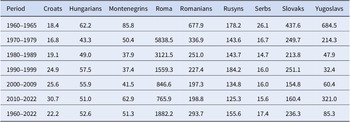
Overall, the data suggest that larger, more compactly settled ethnic minorities tend to maintain higher endogamy rates. However, population size plays a crucial role in influencing these rates. To control for this effect, odds ratios (OR) are employed to facilitate a more accurate comparison of the propensity for endogamy versus exogamy across different ethnic groups. While the dynamics of ORs align with endogamous marriage ratios, the results reveal significant differences (Table 3).
Odds Ratios (OR) for Endogamy by Ethnic Groups, 1960–2022

Table 3. Long description
The table lists periods in the leftmost column: 1960–1965, 1970–1979, 1980–1989, 1990–1999, 2000–2009, 2010–2022, and 1960–2022. Each row provides odds ratios for Croats, Hungarians, Montenegrins, Roma, Romanians, Rusyns, Serbs, Slovaks, and Yugoslavs. For 1960–1965, values are Croats 18.4, Hungarians 62.2, Montenegrins 85.8, Roma missing, Romanians 677.9, Rusyns 178.2, Serbs 26.1, Slovaks 437.6, Yugoslavs 684.5. For 1970–1979, Croats 16.8, Hungarians 43.3, Montenegrins 50.4, Roma 5838.5, Romanians 336.9, Rusyns 143.6, Serbs 16.7, Slovaks 249.7, Yugoslavs 214.3. For 1980–1989, Croats 19.1, Hungarians 49.0, Montenegrins 37.9, Roma 3121.5, Romanians 251.0, Rusyns 143.7, Serbs 14.7, Slovaks 213.8, Yugoslavs 47.9. For 1990–1999, Croats 24.9, Hungarians 57.5, Montenegrins 37.4, Roma 1559.3, Romanians 227.4, Rusyns 184.2, Serbs 16.0, Slovaks 251.1, Yugoslavs 32.4. For 2000–2009, Croats 25.6, Hungarians 55.9, Montenegrins 41.5, Roma 846.6, Romanians 197.3, Rusyns 134.8, Serbs 16.0, Slovaks 154.8, Yugoslavs 60.4. For 2010–2022, Croats 30.7, Hungarians 51.0, Montenegrins 62.9, Roma 765.9, Romanians 198.8, Rusyns 125.3, Serbs 15.6, Slovaks 160.4, Yugoslavs 321.0. The final row, 1960–2022, gives Croats 22.2, Hungarians 52.6, Montenegrins 51.3, Roma 1882.2, Romanians 293.7, Rusyns 155.6, Serbs 17.4, Slovaks 236.3, Yugoslavs 85.3. Roma consistently show the highest odds ratios, peaking at 5838.5 in 1970–1979, while Serbs have the lowest values throughout. Other groups fluctuate, with Romanians, Slovaks, and Yugoslavs also showing high odds ratios in several periods.
Source: Authors’ calculation based on yearly marriage statistics by Statistical Office of the Republic of Serbia
Despite having the highest endogamous marriage ratio among Serbs, their ORs are the lowest. An overall OR of 17.4 indicates that a Serb man is 17.4 times more likely to marry a Serb woman than a non-Serb woman. A higher OR indicates a greater propensity for endogamy within a group. Similarly, Croats demonstrate a low but increasing endogamy rate, while Montenegrins and Hungarians exhibit slightly higher ORs, approximately around 50. Notably, the lowest ORs – excluding those of Hungarians – are found among groups without linguistic barriers. Conversely, significantly higher ORs are observed among smaller, more geographically concentrated minorities, such as Rusyns, Slovaks, and Romanians, with current ORs ranging between 120–200 and 150–300 for the entire period. The ORs for Yugoslavs fluctuate widely, reflecting their status as a non-classical ethnic group. In contrast, the Roma exhibit ORs that are an order of magnitude higher, underscoring their marginalization and the social and cultural distance from other ethnicities.
The question arises: are these values considered low or high? Given that these are autochthonous groups, international comparisons should be drawn with similar groups in comparable historical contexts, although available data are limited. For instance, in Croatia, aside from Croats and Serbs, other ethnic groups typically exhibit higher odds ratios (ORs), often exceeding 150 (Mrdjen and Bahnik Reference Mrdjen and Bahnik2018: 157). In Romania, most minorities also have ORs above 100, while the ORs for Hungarians in Slovakia are essentially equivalent to those of Vojvodina Hungarians (Kiss Reference Kiss, Kiss, Székely, Toró, Bárdi and Horváth2018: 476). In contrast, Baltic Russians display significantly lower ORs, approximately 100 or less (Monden and Smits Reference Monden and Smits2005; van Ham and Tammaru Reference van Ham and Tammaru2011). Moreover, Roma populations in most countries tend to exhibit ORs that are an order of magnitude higher than those of other groups, typically ranging from 5,000 to 10,000 (in Croatia, Romania, and Slovakia) (Kiss Reference Kiss, Kiss, Székely, Toró, Bárdi and Horváth2018; Szabó Reference Szabó2021). In this context, the ORs for the Roma in Vojvodina are surprisingly low, resembling the levels observed among Hungarian Roma. This indicates that the ORs – and consequently the endogamy levels – within Vojvodina are somewhat lower than those recorded in neighbouring countries.
Spatial Characteristics of Intermarriages
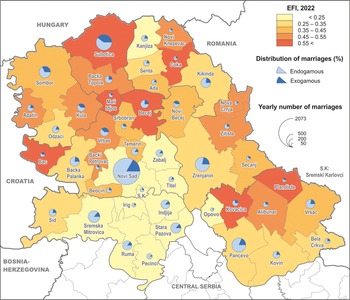
The rate of endogamous marriages within Vojvodina is unevenly distributed, with the highest values – exceeding 80% – typically found in the central and southern regions of the province. These areas have a Serb population that surpasses 80%, resulting in correspondingly low ethnic fragmentation index (EFI) values, below 0.25. Interestingly, although predominantly Hungarian areas (where the Hungarian population exceeds 75%) also show a relatively high incidence of endogamous marriages (ranging from 79% to 82%), these rates do not match those found in predominantly Serb areas (Figure 2). There are notable exceptions; for instance, in Temerin, located near the provincial capital of Novi Sad, the proportion of endogamous marriages is surprisingly high compared to what one would expect based on the ethnic structure. This anomaly can largely be attributed to local factors: in Temerin, Serbs and Hungarians coexist in only one settlement, whose ethnic composition has undergone significant changes due to the refugee influx during the Yugoslav Wars. Conflicts between the newcomers and the autochthonous population have escalated into violence and ethnic tensions, leading to considerable residential segregation that persists today. The elevated rates of endogamous marriages, combined with the highest odds ratio (OR) value among Hungarians in Temerin (90.8), further illustrate that mixed marriages serve as a crucial indicator of interethnic relations.
Ethnic Fragmentation Index (2022) and Percentage of Endogamous/Exogamous Marriages (2012–2022) by Districts in Vojvodina.
Source: Created by the authors based on the data by Statistical Office of the Republic of Serbia

Figure 2. Long description
Starting in the northwest, districts such as Subotica, Sombor, and Backa Topola are shaded dark orange, indicating high ethnic fragmentation index above 0.55. Moving east, Kanjiža and Novi Kneževac are lighter, with indices between 0.35 and 0.45. The central region, including Novi Sad, Ruma, and Sremska Mitrovica, is pale yellow, showing low fragmentation below 0.25. Each district contains a pie chart: blue segments represent exogamous marriages, and light blue segments represent endogamous marriages. Novi Sad and Pančevo have large pie charts, indicating high yearly marriage numbers, with exogamous marriages dominating. In contrast, districts like Mali Iđoš and Čoka show higher proportions of endogamous marriages. The legend at the top right explains the color scale for the ethnic fragmentation index and the pie chart color coding. The bottom right shows a scale for yearly marriage numbers, with the largest circle representing 2073 marriages. District names are labeled throughout, and international borders with Hungary, Romania, Croatia, and Bosnia-Herzegovina are marked.
Conversely, the situation regarding endogamous marriages is more complex, as the lowest rates do not necessarily correspond to areas of highest diversity. In these instances, various influencing factors must be taken into account, including the proportion of Roma and local dynamics similar to those observed in Temerin. Although it is difficult to quantify, available data suggest that in the administrative units of larger cities (such as Subotica, Sombor, Novi Sad), the proportion of intermarriages is slightly higher than what would be inferred from the ethnic fragmentation index (EFI).
Nonetheless, it is not surprising to find an overall positive correlation between diversity and the rate of interethnic marriages. For instance, when comparing the incidence of exogamous marriages between 2002 and 2011 with ethnic diversity as calculated from the 2011 census, the linear correlation coefficient is 0.715. This correlation increases to 0.796 when examining the exogamous marriages from 2012 to 2022 alongside the diversity figures from the 2022 census. Thus, diversity and the rate of intermarriages are closely linked phenomena at the municipal level.
This picture becomes even more nuanced when we focus on ethnic groups with significant settlement concentrations – namely Serbs, Hungarians, Slovaks, and Romanians – to analyse the impact of local demographics (considered as part of diversity) on the rate of exogamy. A clear – and unsurprising – pattern emerges when comparing the ethnic proportions of these groups within municipalities to their rates of endogamous and exogamous marriages: the higher the demographic weight of an ethnic group in a municipality, the greater the likelihood of endogamous marriages among that group. From 2011 to 2022, this correlation is strongest among Serbs (0.93) and Hungarians (0.83), somewhat weaker among Slovaks (0.71), and moderate among Romanians (0.41).Footnote 2
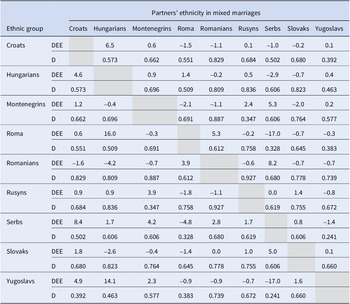
The concentrated or deconcentrated territorial distribution of individual ethnic groups can influence the rate of exogamous marriages not only through the local demographic majority-minority dynamics but also by determining which groups are present in the local marriage market. More broadly, it also affects the extent to which the settlement areas of different ethnic groups overlap or remain distinct. In Vojvodina, most of the studied ethnic groups are concentrated in relatively well-defined regions. Only the Roma population and Yugoslavs exhibit a deconcentrated distribution, with the latter primarily found in urban areas. If territorial separation were not a factor, we would expect that unions between individuals would reflect the overall ethnic structure of Vojvodina. In Table 4, we compare the distribution of intermarriages among ethnic groups to their respective proportions within Vojvodina, highlighting the deviations from the expected number of exogamous marriages.Footnote 3 If only structural factors governed the marriage market, we would anticipate that territorial separation would adequately explain these deviations: more ethnically mixed marriages would occur where the index of dissimilarity is low, while fewer would arise in areas of high segregation. However, this hypothetical model applies only partially; for instance, it effectively explains the intermarriages between Rusyns and Montenegrins, while in other cases, it offers little explanatory power.
Deviation from Expected Exogamous Marriage and Index of Dissimilarity among Ethnic Groups in Vojvodina, 2012–2022

Table 4. Long description
The table consists of nine ethnic groups listed vertically: Croats, Hungarians, Montenegrins, Roma, Romanians, Rusyns, Serbs, Slovaks, and Yugoslavs. For each group, two rows are provided: DEE (Deviation from Expected Exogamous marriage) and D (Index of Dissimilarity). Columns represent partner ethnicities in mixed marriages: Croats, Hungarians, Montenegrins, Roma, Romanians, Rusyns, Serbs, Slovaks, and Yugoslavs. For Croats, DEE values with partners are: Hungarians 6.5, Montenegrins 0.6, Roma minus 1.5, Romanians minus 1.1, Rusyns 0.1, Serbs minus 1.0, Slovaks minus 0.2, Yugoslavs 0.1. D values for Croats: Hungarians 0.573, Montenegrins 0.662, Roma 0.551, Romanians 0.829, Rusyns 0.684, Serbs 0.502, Slovaks 0.680, Yugoslavs 0.392. For Hungarians, DEE: Croats 4.6, Montenegrins 0.9, Roma 1.4, Romanians minus 0.2, Rusyns 0.5, Serbs minus 2.9, Slovaks minus 0.7, Yugoslavs 0.4. D: Croats 0.573, Montenegrins 0.696, Roma 0.509, Romanians 0.809, Rusyns 0.836, Serbs 0.606, Slovaks 0.823, Yugoslavs 0.463. For Montenegrins, DEE: Croats 1.2, Hungarians minus 0.4, Roma minus 2.1, Romanians minus 1.1, Rusyns 2.4, Serbs 5.3, Slovaks minus 2.0, Yugoslavs 0.2. D: Croats 0.662, Hungarians 0.696, Roma 0.691, Romanians 0.887, Rusyns 0.347, Serbs 0.606, Slovaks 0.764, Yugoslavs 0.577. For Roma, DEE: Croats 0.6, Hungarians 16.0, Montenegrins minus 0.3, Romanians 5.3, Rusyns minus 0.2, Serbs minus 17.0, Slovaks minus 0.7, Yugoslavs minus 0.3. D: Croats 0.551, Hungarians 0.509, Montenegrins 0.691, Romanians 0.612, Rusyns 0.758, Serbs 0.328, Slovaks 0.645, Yugoslavs 0.383. For Romanians, DEE: Croats minus 1.6, Hungarians minus 4.2, Montenegrins minus 0.7, Roma 3.9, Rusyns minus 0.6, Serbs 8.2, Slovaks minus 0.7, Yugoslavs minus 0.7. D: Croats 0.829, Hungarians 0.809, Montenegrins 0.887, Roma 0.612, Rusyns 0.927, Serbs 0.680, Slovaks 0.778, Yugoslavs 0.739. For Rusyns, DEE: Croats 0.9, Hungarians 0.9, Montenegrins 3.9, Roma minus 1.8, Romanians minus 1.1, Serbs 0.0, Slovaks 1.4, Yugoslavs minus 0.8. D: Croats 0.684, Hungarians 0.836, Montenegrins 0.347, Roma 0.758, Romanians 0.927, Serbs 0.619, Slovaks 0.755, Yugoslavs 0.672. For Serbs, DEE: Croats 8.4, Hungarians 1.7, Montenegrins 4.2, Roma minus 4.8, Romanians 2.8, Rusyns 1.7, Slovaks 0.8, Yugoslavs minus 1.4. D: Croats 0.502, Hungarians 0.606, Montenegrins 0.606, Roma 0.328, Romanians 0.680, Rusyns 0.619, Slovaks 0.606, Yugoslavs 0.241. For Slovaks, DEE: Croats 1.8, Hungarians minus 2.6, Montenegrins minus 0.4, Roma minus 1.4, Romanians 0.0, Rusyns 1.0, Serbs 5.0, Yugoslavs 0.1. D: Croats 0.680, Hungarians 0.823, Montenegrins 0.764, Roma 0.645, Romanians 0.778, Rusyns 0.755, Serbs 0.606, Yugoslavs 0.660. For Yugoslavs, DEE: Croats 4.9, Hungarians 14.1, Montenegrins 2.3, Roma minus 0.9, Romanians minus 0.9, Rusyns minus 0.7, Serbs minus 17.0, Slovaks 1.6. D: Croats 0.392, Hungarians 0.463, Montenegrins 0.577, Roma 0.383, Romanians 0.739, Rusyns 0.672, Serbs 0.241, Slovaks 0.660. Positive DEE values indicate more mixed marriages than expected, negative values indicate fewer. D values show the index of dissimilarity for each pairing.
DEE: Deviation from expected exogamous marriage: See footnote 1. Positive values: more mixed marriages than expected; negative: fewer mixed marriages than expected. D: Index of dissimilarity. Source: Authors’ calculation based on marriage statistics and the 2022 Census data by Statistical Office of the Republic of Serbia
A more effective explanation for the higher-than-expected rates of exogamous marriages appears to be cultural distance. For instance, the Serbian-Montenegrin relationship and the strong Hungarian-Croatian ties illustrate this phenomenon, as both groups share the Roman Catholic faith, have a moderate degree of territorial separation, and possess a long history of coexistence. Interestingly, within Serbian intermarriages, Croats are overrepresented, while the reverse trend is observed for Croats marrying Serbs. This discrepancy may result from opposing factors: the absence of language barriers on one hand, and interethnic distrust stemming from the Yugoslav War on the other.
The most extreme values, however, are associated with the Roma and those identifying as Yugoslav. In these cases, territorial distribution seems less significant than issues of identification. Data indicate that many individuals in these groups, akin to Serb-Montenegrin mixed marriages, may not consider their unions culturally mixed. A substantial portion of the Roma population in the region does not self-identify as Roma, which could create a situation where “official” Roma-Hungarian and Roma-Romanian mixed marriages might be viewed as endogamous based on hetero-identification. Similarly, many individuals identifying as Yugoslavs are descendants of mixed marriages and prefer not to choose between their parents’ ethnicities (Sekulic et al. Reference Sekulic, Massey and Hodson1994). Consequently, it is unsurprising that Yugoslavs tend to marry Hungarian and Croatian partners, unions that may not culturally be considered mixed marriages. Conversely, there are examples of lower-than-expected rates of intermarriages. The most notable is the underrepresentation of Serb partners in Roma exogamous marriages, likely due to an ethnic hierarchy where unions between the titular nationality and a group with lower social prestige are less frequent. The same reasoning applies to the underrepresentation of Serb partners in Yugoslav intermarriages. A significant portion of Yugoslavs, having minority or mixed heritage, renders some of their unions endogamous, statistically underrepresenting genuine exogamous marriages. Additionally, the underrepresentation of Romanian-Hungarian marriages can also be attributed to high residential segregation, which appears to be a decisive factor.
Discussion and Conclusions
This paper investigates the relationship between ethnic diversity and intermarriage patterns in Vojvodina, Serbia. Using quantitative methods, the study assesses how changing demographics and historical events, particularly post-1989 nationalist policies and the Yugoslav wars, have influenced intermarriage trends. Although previous research has often focused on migrant contexts, this paper contributes to the discussions on how ethnic diversity and intermarriage interact in a national minority setting, where ethnic diversity is longstanding.
Despite Vojvodina’s status as one of the most ethnically diverse regions in Europe, its diversity has notably declined since World War II, primarily due to geopolitical shifts and subsequent refugee flows. Furthermore, nationalist policies post-1989 have intensified demographic trends favoring the titular ethnic group, contributing to a gradual homogenization of the province’s population. However, diversity dynamics are highly scale-dependent. At the municipal level, both decreases and increases in diversity can be observed, with diversity generally increasing in areas where minorities maintain a demographic majority. This localized diversification reflects broader macro-scale homogenization trends.
Similarly, the incidence of mixed marriages in Vojvodina is strongly influenced by political power dynamics. The rise of ethno-nationalism in Serbia and Yugoslavia – culminating in the Yugoslav wars of the 1990s – significantly disrupted marriage patterns in Vojvodina, as in other former Yugoslav republics and provinces (see Mrdjen and Bahnik Reference Mrdjen and Bahnik2018). Since the late 1990s, marriage trends between the majority and minority groups have diverged: endogamy strengthened among the majority but weakened among minority groups. This highlights the importance of structural factors: despite the group closure and reinforcement of ethnic boundaries of the 1990s, endogamy among minorities continued to decline. Vojvodina’s shifting ethnic landscape, marked by the demographic dominance of the titular nation, has significantly narrowed the ethnic marriage market, resulting in an increase in intermarriages among minorities and a decrease among Serbs. Despite the reinforcement of ethnic boundaries, the rate of mixed marriages and odds ratios across different groups suggest that Vojvodina remains more exogamous than neighboring, less diverse regions.
In line with Blau’s macro-structural theory (Blau et al., Reference Blau, Blum and Schwartz1982), the proportion of interethnic marriages indicates that larger, more compactly settled ethnic minorities tend to maintain higher endogamy rates. However, odds ratio analyses partially contradict this, showing that cultural differences and local factors can sometimes override structural effects. A clear example is the Roma, who, despite their relatively small numbers, exhibit high endogamy rates due primarily to socio-economic marginalization, exclusion, and stigmatization by the non-Roma population. In contrast, low endogamy rates among groups like the Montenegrins can be explained by the absence of linguistic barriers and their closer social and cultural alignment with the majority. Additionally, local factors, including ethnic conflicts, can counteract structural influences on marriage patterns.
How do diversity and interethnic marriages relate to one another in a setting with autochthonous ethnic groups? Our findings can be summarized in three major points:
-
1. Positive Correlation: Our results indicate a clear positive correlation: the higher the ethnic diversity, the greater the proportion of exogamous marriages within a given municipality. In this context, ethnic diversity serves as a structural determinant of intermarriage.
-
2. Divergent Trends: However, changes in the two indicators are not necessarily correlated. The longitudinal study revealed that pro-intermarriage policies during the socialist period, alongside spatial reconfigurations (for instance, urbanization) and social mobility, led to intermarriage becoming an accepted phenomenon, only partly influenced by structural factors. In contrast, since the 1990s, the rise of ethnonationalism and segregationist policies has resulted in increasing group closure, causing a decline in intermarriage rates, which now align with shifts in ethnic structure and declining diversity.
-
3. Causal Relationships: Regarding causal relationships between the two, it appears that declining ethnic diversity, resulting in a more homogeneous marriage market, impacts the incidence of ethnically mixed marriages. Conversely, the occurrence of intermarriages – and the ethnic identification of their offspring – does not significantly influence macro-level diversity patterns. The only exception occurred in the two decades leading up to the break-up of Yugoslavia, when a growing number of individuals, predominantly descendants of intermarriages, began self-identifying as Yugoslavs, leading to a slight increase in the diversity index between 1971 and 1981. Thus, while diversity and mixed marriages can mutually influence each other, the official categorization practices often fail to accommodate multiethnic identities or reflect the situational and fluid nature of ethnicity. As a result, we typically observe only one directional influence: how diversity as a structural factor shapes intermarriage.
We believe that examining mixed marriages and diversity provides valuable insights into the broader social context. In Vojvodina, despite slight changes in structural factors and more pronounced shifts in (geo)political circumstances, the proportion of individuals entering mixed marriages has remained high. Overall, this suggests relatively small social distances and permeable ethnic boundaries among the ethnic groups in the region. Therefore, the declining diversity coupled with the persistently high rate of mixed marriages indicates strong social cohesion, making ethnic-based conflict – still prevalent in the Balkans – unlikely in Vojvodina. However, this does not necessarily imply balanced interethnic relations. The demographic inequalities between the majority and minority populations, along with differing endogamy trends, suggest that social cohesion is primarily rooted in the dominant position of ethnic Serbs, indicating that ethnic asymmetries remain significant.
Financial support
The research was created within the Marie Sklodowska-Curie 2022–2024 project. Project number: 101068320 – IMEI – HORIZON-MSCA-2021-PF-01.
Disclosure
None.

 Open access

