


Introduction
As I discussed in Chapters 1 and 2, British Black and Asian poets and artists working in the 1970s, 1980s, and early 1990s renovated cultural forms in their writing and performances to resist and dispute, if not transform, social realities of anti-Black violence, policing, and systemic discrimination due to racial, gender, and class divisions. Previously, the term “Black” could serve as a unifying bridge for articulating shared (but unequal and divided) African, Caribbean, and Asian experiences of racialization through counter-hegemonic political activities and cultural practices. Resistant and dissenting political stances have been, to a degree, shaped by virtue of writers working with grassroots political organizations, independent presses, and arts collectives and occupying a relatively marginal, semiautonomous position in the cultural field.
This chapter occupies a transitional conjuncture in the arc of my discussion as the field undergoes historical transformation in the 1990s and early 2000s. It is not that fundamental problems over race, migration, diaspora, Black and Asian feminism, and belonging went away – far from it. Rather, these abiding questions became transformed under pressures of 1990s globalization, devolution, and state-sanctioned multiculturalism, as advanced by the Parekh Report on the Future of Multi-Ethnic Britain (2000) and supported by the Runnymede Trust, British Council, the Corporation of London, the Arts Council England, and the Welsh and Scottish governments. This period also saw the beginning processes in which Black and Asian theorists, artists, and writers began to shift discourses from struggles over political subordination to the politics of representation and recognition in the cultural sphere, which requires a different set of aesthetic strategies and repertoires. Postures of outright resistance and dissent became increasingly untenable by virtue of what Kobena Mercer called “the normalization of difference” as (certain) Black and Asian artists such as Yinka Shonibare, Steve McQueen, Chris Ofili, and Anish Kapoor were prominently featured in London art galleries such as Tate Modern (“Iconography after Identity,” Reference McKie50). Or, as Stuart Hall theorized in his discussion of Black British film in his essay “The New Ethnicities” (1988), the “shift is best thought of in terms of a change from a struggle over the relations of representation to a politics of representation itself,” one that furnishes “the scenarios of representation – subjectivity, identity, politics – a formative, not merely an expressive place in the constitution of social and political life” (444).
We can see similar debates over the politics of representation in Paul Gilroy’s essay “Art of Darkness” (1990). Gilroy discusses the burgeoning of Black artistic production in the 1980s and early 1990s, especially in reference to Rasheed Araeen’s watershed exhibit The Other Story at the Hayward Gallery in London (1989–1990). Gilroy appreciates Araeen’s project of including an expansive array of artists across several generations in a single gallery space (48). The Other Story, for Gilroy, showcases the sweeping contribution of Black artists in refashioning conceptions of national identity, reformulating canons of taste, and “filling in the spaces that racism has left blank in the history of art,” from modernism to postmodernism and postcolonialism (48).
Crediting the necessity of Araeen’s additive-and-inclusive project, Gilroy argues that it nonetheless remains insufficient. For one, it leaves dominant notions of Western art, creativity, and aesthetic principles intact, principles that are inseparable from, for instance, the legacy of slavery or Eurocentric conceptions of beauty or philosophical arguments regarding primitivism and so forth. Most significantly for Gilroy, Araeen’s approach “seems to accept the idea that ‘race’ is something that enters English culture from the outside during the post-war period” rather than having been constitutive of Englishness as itself already marked by, defined through, and enmeshed in difference (48). “Black artists are now,” Gilroy argues in the early 1990s regarding the visual arts, “already working to re-compose understanding of English culture and their creativity needs to be complemented by a re-reading of that culture’s history which places the idea of ‘race’ at the centre rather than the margin” (48).
At the conjuncture between the 1970s and 1980s and transitioning into the 1990s and early 2000s, the politics of representation and recognition takes on multifaceted complexity as artists of color create cultural productions not only as objects but also as workers and subjects of aesthetic representation; and as some artists and writers begin to gain greater access to cultural institutions seeking to advance precepts of multiculturalism in “representing” minority artists, who are now placed in the position of carrying the burden of representation; and as Black and Asian artists produce artworks with the full awareness that crises of racial violence, gender discrimination, and social inequality persist and are deepening, especially under Thatcher in the 1980s and John Major through the mid 1990s. So even when speaking from an apparently marginal position, Black and Asian artists and thinkers often do so strategically, deliberately seeking to reconstitute Britishness through its internal difference and otherness. In the domain of poetry, we can look to the writings of John Agard, Grace Nichols, Moniza Alvi, Jackie Kay, and Fred D’Aguiar, whose work directly questions the contested meanings of Britishness through the politics of representation and recognition. For instance, the very title of D’Aguiar’s collection British Subjects (1993) overtly reconfigures British belonging through a redoubled insider–outsider subjectivity and cultural politics.
This chapter examines the intersection of poetry, visual art, and race from the 1990s through the early 2000s in the work of two prominent British Black and Asian writers, Maud Sulter (1960–2008), born in Glasgow and of Scottish Ghanaian heritage, and David Dabydeen (b. 1955), who was born in Guyana and migrated with his family to London in 1969. Both of these writers and thinkers began at the relative margins of the poetry and art worlds in the 1980s and by the 1990s and early 2000s had gained significant recognition by cultural and literary institutions, such as the Victoria and Albert Museum, Tate, National Portrait Gallery, and National Galleries of Scotland (Sulter) and by BBC Radio, Oxford University Press, the University of Warwick, and UNESCO (Dabydeen). This chapter takes as its focus the ways in which Sulter and Dabydeen emphasize figures of Blackness in canonical Western aesthetic forms and art histories. In doing so, they sharpen and complicate Gilroy’s arguments concerning how their cultural productions make race central to the reconstitution of national cultural histories and diasporic subjectivities through their respective politics of recognition.
Sulter and Dabydeen experiment in forms of ekphrasis: from the Greek ek+phrazein, “to speak out,” here understood as the diverse strategies poets and poems deploy in playing upon the tension between word and image, or verbal discourse and visual discourse. In his essay “Ekphrasis and the Other,” W. J. T. Mitchell theorizes the subgenre of ekphrasis through the “image–text” relationship, or the prevailing tension between the visual and the verbal, the silent and the spoken, the spatial and the temporal, the other (“a seen and silent object”) and the self (“as a speaking and seeing subject”) (161–62). To explain briefly, Mitchell describes three different modalities of ekphrasis. The first he describes as “ekphrastic indifference,” or the position that the verbal cannot match the visual because they are two different modes of representation (152). The second he calls “ekphrastic hope,” or the ways in which figurative language carries an imaginative capacity to conjure the visual and make it appear before our eyes, as if an object were fully present (153). And the third he calls “ekphrastic fear,” or the realization that if the verbal were to become the visual, it would unveil the ekphrastic text as a delusion because it depends upon the fetishistic division between text and image and requires an absent visual object as the basis of verbal conjuring (154, 156). Ultimately, Mitchell challenges the image–text dichotomy by maintaining that “from the semantic point of view, from the standpoint of referring, expressing intentions and producing effects in a viewer/listener, there is no essential difference between texts and images” (160). Both text and image function as “speech acts”: Images can and do function as forms of narration and description just as texts can invoke or conjure forms of stillness and spatial fixity.
For Mitchell, the “‘otherness’ we attribute to the image–text relationship” has significant consequences for thinking about broader social structures, particularly concerning race and visibility. The ideological bearings of race, racial formation, and racial otherness are also, he says, “open to precisely this sort of visual/verbal coding” (162). From the perspective of whiteness and all its presumptions of naturalness, invisibility, and “normative subjectivity” of a thinking, speaking personhood endowed with full humanity, Blackness functions as the visual other (162). Under the totalizing forces and discourses of whiteness and the world of racialized capital, Blackness is a “transparently readable sign of racial identity, a perfectly sutured imagetext” made visible and marked through Black embodiment and Black being. That is, racial ideology functions by eliding the otherness distinguishing the image–text tension into “imagetext,” where “Blackness” becomes externally coded through stereotype (162). As a formal structure, then, ekphrasis has everything to do with the hopes (“a potential same-to-be”), fears (“a threat to be reduced”), or indifferences (“a yet-not-same”) regarding racial others “as subjects and objects in the field of verbal and visual representation” (163).
In what follows, I extend Mitchell’s insights by examining the ways in which Sulter and Dabydeen put into crisis the image–text relationship as it relates to racial visibility and recognition. My approach to interpreting Black and Asian forms of ekphrasis also follows Joseph Jonghyun Jeon’s study of Asian American avant-garde poetry, where he argues that “the formal questions raised in ekphrasis are useful to thinking about racial visuality because ekphrasis directly engages the question of how one visualizes and gives form to otherness” (110). Typically, ekphrasis functions as a speaking subject addressing a visual object. The formal structure of ekphrasis becomes further complicated, though, when racial subjects, who recognize their own object-status as visual others in the white world, speak to and for other racial others objectified in canonical works of art. Sulter’s and Dabydeen’s aesthetic representations of racial otherness in visual art heighten the doubleness of subject-as-object and object-as-subject structuring the image–text relationship.
I propose here that Sulter and Dabydeen, in contrasting but related approaches, aesthetically invent a politics of recognition: of making visible, legible, and audible otherwise occluded, marginalized, or erased Black figures in Western visual culture. If stereotypical representations of Blackness in Western art collapse into “imagetext,” the artists studied here reinsert the boundary of “image–text.” In doing so, they call attention to the internal differences distinguishing ekphrastic writing and, consequently, bring to the fore the nonidentical gaps marking poetry and art, race and art, and poetry and race. In different ways, both artists challenge naturalized, reified models of Blackness in visual art. Through strategies of ekphrasis, they furthermore experiment in their art with forms of race whose otherness often remains inscrutable and beyond recognition even as they labor towards forms of kinship and affiliation between artists and artworks across geographic, temporal, and racial boundaries.
My discussion of Maud Sulter’s work focuses on her career-long interest in Jeanne Duval (c. 1820–c. 1871), the actress and performer, “Black Venus,” muse, and common-law wife to Charles Baudelaire. Duval figures across Sulter’s oeuvre, including poetry, essays, collage, and photography. I begin by situating Sulter in relation to the radicalism of the Black British Arts Movement in the early to mid 1980s. From there, I examine the significance of the image–text of “Duval” as it transforms in Sulter’s work, especially as her own position shifts from the periphery to the center of the art world. In my reading, Sulter’s project is one of “queer reframing.” Her aesthetics of lesbian and queer eroticism bring to the center an otherwise invisible, anonymous, and silenced Black woman, a project that Sulter knows is riddled with contradiction in “speaking for” and “re-presenting” the other. This requires, for Sulter, a different set of aesthetic strategies that highlight the layers of mediation through which Duval appears in Sulter’s work as a figure of sexual and racial alterity, one that acquires recognition in and through difference, to the point of becoming almost unrecognizable and unknown. At the same time, however, “Duval” becomes an agent for propelling Sulter’s career from the margins of independent Black galleries to prominent recognition by major British artistic institutions.
The Black presence in British culture has inspired Dabydeen’s entire career, from his first book of art history on Hogarth’s Blacks (1987), through his work as a scholar of eighteenth-century British culture and as an editor such as in Black Writers in Britain 1760–1890 (with Paul Edwards, 1991), to novels such as A Harlot’s Progress (2000). Here, I focus on his poem sequence Turner (1995), which enters into conversation with J. M. W. Turner’s perhaps most famous painting, Slavers Throwing Overboard the Dead and the Dying, Typhon Coming On, commonly known as The Slave Ship (1840) and currently held by the Museum of Fine Art, Boston. After situating my discussion in relation to critical debates over the painting’s reception regarding slavery, race, and the sublime, I turn to Dabydeen’s poem sequence, which takes on the persona of a submerged Black head jettisoned from the ship and suspended in water in the painting. In many ways, Dabydeen overturns Turner, seeking to displace the artist by reimagining him as a slave trader, ship’s captain, and sexual predator. In giving subjective expression to the submerged Black figure suspended in water, Dabydeen also reckons with an impossible ethical question concerning aesthetic portrayals of jettisoned Blackness: namely, how his poem imaginatively compels readers and viewers to float with the dead in the name of endless mourning for commodified and discarded Black life. In the process, Dabydeen and Turner connect in approaching a nonidentical relation, a gap, between their artistic portrayals and historical realities of race that signifies a limit their art cannot cross: the very real historical instances of jettison that ultimately remain wholly other and incommensurable to any form of discursive representation, even as they are suspended in the still movements of paint and language.
The cases of Sulter and Dabydeen are exemplary of a nodal point in the history of British Black and Asian cultural production, especially in the 1990s and early 2000s. As state funding declined for independent, often radical publishing houses, presses, and gallery spaces, certain Black and Asian British artists came to be recognized, absorbed, and lauded by prominent presses and cultural institutions under the pressures of official multiculturalism. Like those of several of their contemporaries, such as Nichols, Agard, Aguiar, Alvi, Kay, and Imtiaz Dharker, their cultural works contribute to the refashioning of Britishness as increasingly defined through disjunctures and differences, irreducible movements and mixtures, even as they make visible the ongoing forms of gender, sexual, and racial violence and inequality shaping their art and writing. In turning to Sulter and Dabydeen, this chapter examines the ways in which their cultural productions – including visual art, scholarship, and poetry – directly foreground the centrality of race in canonical European visual culture, at once asserting the “recognition” of Blackness as constitutive of Western art and insisting on forms of alterity that extend the distinctions of racial difference “beyond recognition” in the name of a truly democratic, anti-racist politics.
Queer Reframings: Maud Sulter and Jeanne Duval
Maud Sulter belongs to a generation of artists educated in Britain in the 1950s and 1960s who came to prominence in the late 1970s and 1980s with formal training in fine arts and art history. In 1977, Sulter attended the London College of Fashion, and her early work – including poetry, collages, and visual art – was associated with and contributed to the Black Arts Movement during the 1980s. This group includes Eddie Chambers, Keith Piper, Donald Rodney, Marlene Smith, Claudette Johnson, Sonia Boyce, Ingrid Pollard, and Lubaina Himid, among numerous others. Sparked by the 1981 exhibit Black Art An’ Done at Wolverhampton Art Gallery, the Black Arts Movement spawned a flourishing of artistic production in the 1980s and early 1990s. For instance, this period saw the First National Black Arts Convention organized by the Blk Art Group at Wolverhampton (1982) and the opening – and eventual closing – of independent Black art galleries such as The Black-Art Gallery in Finsbury Park and the Horizon Gallery (Chambers, Reference Chambers114). Though working in a variety of media (spanning painting, collage, sculpture, literature, film, and visual art) and with quite different aims and objectives, the “movement” cohered through its emphasis on iconoclasm: its outright challenge to the racial and gendered exclusions endemic to Britain’s mainstream cultural institutions and attendant narratives of art history, and its fusing of radical aesthetic experimentations with anti-colonial, anti-racist, and (for some) anti-sexist politics.
In his 2006 essay, “Black Diaspora Artists in Britain: Three ‘Moments’ in Post-War History,” Stuart Hall distinguishes between three related but distinct historical waves in the formation and development of Black and Asian art, the first being the last colonials who migrated to the UK in the 1950s and 1960s (4), the second being the generation of the Black Arts Movement (5), and the third (which he references only in passing) being those now associated with the Young British Artists, such as Steve McQueen, Chris Ofili, and Yinka Shonibare (22). Hall’s emphasis, though, falls primarily on the points of connection and disconnection between the first two waves. For Hall, the wave of last colonials who migrated to Britain in the Windrush era, such as Ronald Moody, Aubrey Williams, Frank Bowling, Anwar Shemza, and Francis Newton Souza, among many others, came with a sense of arrival and a confidence in transnational modernism and its precepts of innovation, aesthetic autonomy, and cosmopolitanism (5). Hall cites Frank Bowling’s late comment that “I believe the Black soul, if there is such a thing, belongs in Modernism” (quoted in Hall, Reference Hall and Bailey6). Uniting this first wave of artists was, Hall says, a conviction “to look forward, expecting [decolonial] independence to issue in a new era of progress and freedom which would be the basis for a new, post-colonial culture as well as enhancing the individual’s capacity for creative innovation” (15).
The second generation of artists, however, bear an entirely different relation to modernism and aesthetic experimentation. For Hall, the polemical politics of this second generation or “wave” has everything to do with the disruptive social and political contexts stemming from the transformations of race, racial formation, and racial violence punctuating the 1960s and 1970s: Enoch Powell’s “Rivers of Blood” speech, the “sus” laws and overpolicing, and the spate of uprisings during these decades and into the 1980s. One key problem confronting this group of artists became, according to Hall, how to match in aesthetic form the “speed and depth of the racializing process” with “the anger it provoked … across Britain’s black communities” (17).
These different contexts, then, require different aesthetic repertoires, which themselves bear upon the crisis of representation, especially concerning a crisis of representing the Black body and the politics therein. On the one hand, the participants of the Black Arts Movement have a keen awareness that they are extending a “tradition,” however unrecognized at the time, of prior colonial artists who produced significant bodies of work, which were in fact curated in the archives but nonetheless left out and rendered invisible by mainstream cultural institutions (Chambers, Reference Chambers10–39). The Black Arts Movement was one of many influences behind Rasheed Araeen’s exhibit The Other Story (1989–1990) at the Hayward Gallery London, which was instrumental in shining a light on the unacknowledged history of British Black and Asian artistic production, even as it garnered criticism for including only four women among the twenty-four artists (Chambers, Reference Chambers137). On the other hand, the second-generation artists also remain deeply critical and suspicious of the prior generation’s veneration of modernism and its precepts of aesthetic autonomy and metropolitan cosmopolitanism – as well as modernism’s overwhelming preoccupation with primitivism.
Consider, for instance, Sulter’s short, irreverent poem “An A–Z of Picasso”:
Sulter’s dangling last line is either an ironic commentary on the preceding content, as if Picasso’s “inventive” artistic practice becomes nothing more than the violent consumption of vulnerable creatures; or, it is an imperative, directing the reader/viewer to forget Picasso and take the time to actually “First look at African Art” in the actual histories and practices that precede him and modernist primitivism. At least in the mid to late 1980s, the experimentations of the British Black Arts Movement align with the anarchic energies of the avant-garde by seeking to fuse art and politics in the name of a radical intervention in the political, social, and aesthetic spheres alike.
In addition to Sulter’s relation to the Black Arts Movement, her work also contributed to, and was shaped by, the radical Black feminist politics informing the artistic creations among her milieu in the 1980s and thereafter. Indeed, Sulter was a key player in the creation, promotion, curation, and theorization of Black women’s artistic production in these years. Sulter’s anthology, Passion: Discourses on Blackwomen’s Creativity (1990) – partly funded through the Arts Council, the Greater London Arts Association, and the Women’s Solidarity Fund but mostly from, she says, “the tremendous amount of unpaid labor by Blackwomen themselves” and published with her own independent, radical feminist Urban Fox Press – remains to date the only collection documenting the exhibits, publications, meetings, posters, and activism of Black women’s artistic productions in the 1980s (Passion, Reference Sulter11). Sulter’s central role in art activism, in part, grew out of a key moment at the 1982 First National Black Arts Convention, when Claudette Johnson invited several women artists, including Lubaina Himid and Sonia Boyce, to an informal session to discuss issues pertaining to gender, race, and embodiment – and the largely male-dominated emphasis of the movement, which relegated Black women’s art to a position of double exclusion (Himid, “Inside the Invisible,” Reference Himid and Bailey43). In the aftermath of the convention, Himid would organize several foundational exhibits showcasing Black women’s art, including Five Black Women Artists at the Africa Centre, London, in 1983, followed in the same year by Black Woman Time Now at the Battersea Arts Centre, London.
Though she did not attend the 1981 Wolverhampton Convention herself, Sulter read a report on it written by documentary photographer Ingrid Pollard, which led Sulter to reach out to Pollard and begin several collaborations through publications in Artrage, Spare Rib, and FAN (Feminist Arts News) (Sulter, Passion, Reference Cherry15). During this time and at only twenty-two years old, Sulter was already working as the first Black woman with Sheba Feminist Press. What’s more, she was instrumental in Sheba’s publication of poetry anthologies featuring Black British women such as A Dangerous Knowing: Four Black Women Poets, edited by Barbara Buford (1984), and Charting the Journey: Writing by Black and Third World Women, edited by Shabnam Grewal et al. (1988). As she explains in her short essay and introduction, “Blackwomen’s Creativity: An Overview,” she was skeptical of anthologies because they “have the dangerous appearance of a Press having published a lot of Blackwomen writers” (Passion, Reference Cherry15). Sulter’s strategic use of “Blackwomen” in her work was meant to signify a coalitional politics fusing race and gender in solidarity and sisterhood.
Determined in the conviction that “if writers existed, then artists did too, so all I had to do was take the trouble to find them,” Sulter founded and organized the Blackwomen’s Creativity Project with Pollard in 1982 (Passion, Reference Cherry15). Together, they looked for and showcased Black women’s art across the UK through their travels to Cardiff, Bristol, and Belfast. Later that year, Sulter left Sheba and brought the Blackwomen’s Creativity Project to the Women’s Education Resource Centre in London, offering workshops, education, networking, and arts activism among women artists and writers (Passion, Reference Cherry16). It was Pollard who invited Sulter to Himid’s exhibit Black Woman Time Now (1983). This introduction led to Sulter and Himid’s lifelong professional and personal involvements (15), beginning when Himid included Sulter’s triptych, Poetry in Motion, in the most significant exhibit of Black women’s artworks in that decade, The Thin Black Line at the ICA in 1985 (Chambers, Reference Chambers128–31). During these years, Sulter also gained recognition through her 1984 poem “As a Blackwoman,” which won the Vera Bell Prize (London) and the Black Penmanship Award under the Afro-Caribbean Resource Centre (Arana, “Maud Sulter,” Reference Arana302).
In a relatively short period of time, Sulter carried her cultural activism from independent, radical, Black feminist, and lesbian projects to large cultural institutions in the art world, as when Mark Haworth-Booth, Senior Curator at the Victoria and Albert Museum London (V&A), featured her work in the exhibit Photography Now (1989). The pivotal moment occurred when her photographic series Zabat (1989) was commissioned by the Rochdale Art Gallery in Manchester to commemorate the 150th anniversary of the birth of photography. Sulter’s renovations of the image–text relation in Zabat will be the focus of my discussion here. As Haworth-Booth explains in an interview with Sulter, he had intended Photography Now to showcase “the range, variety, and contradictions” of photography in the late twentieth century but “had overlooked” the burgeoning “reframing of race by emerging artists” such as Sulter (quoted in Cherry, Maud Sulter Passion, 111). Haworth-Booth decided to attend Sulter’s exhibit in Manchester, and upon meeting her and seeing her work, he recommended that the V&A purchase Zabat, where it is currently held (111). From this point onwards, Sulter continued to garner increasing prestige in the art world. After earning a master’s degree in photographic studies from the University of Derby (1990), she was awarded a Momart Fellowship and residency at the Tate Liverpool (1990–1991), taught at Manchester Metropolitan University (1993), and had numerous international exhibits in Europe, Australia, New Zealand, and the US, continuing up through her multimedia exhibition of Jeanne Duval at the Scottish National Portrait Gallery in Edinburgh (2003) (Arana, “Maud Sulter,” Reference Arana and Arana305–08).
In certain ways, the development and transformation of Sulter’s career distills a period of transition for British Black and Asian cultural production. In the 1970s and 1980s, Black British art occupied a position of political radicalism and a resolute stance as “an oppositional discourse” (Araeen, Reference Araeen and Bailey26) through both self-funded autonomy and assistance from the Greater London Council and Arts Council (Araeen, Reference Araeen and Bailey30–31; Himid, Reference Himid and Bailey42). In the late 1980s and 1990s, the field shifted to its eventual incorporation and recognition by larger cultural institutions and museums. While Sulter was and is internationally recognized, to a degree she remains an unsung hero of the art world, likely due to her untimely death in 2008, especially when compared with her collaborator and intimate partner, Lubaina Himid, who became the first Black British woman to win the Turner Prize in 2017.
As I see it, there is a dual impulse in Sulter’s work. One impulse is that of excavation and retrieval, in so far as her artistic projects seek to center Black women subjects who have been historically excluded. As Sulter says concerning her project:
This whole notion of the disappeared, I think, is something that runs through my work. I’m very interested in absence and presence in the way that particularly black women’s experience and black women’s contribution to culture is so often erased and marginalised. [It is] important for me as an individual, and obviously as a black woman artist, to put black women back in the centre of the frame – both literally within the photographic image, but also within the cultural institutions where our work operates.
In making visible and audible previously erased or silenced Black women’s subjectivities, her cultural productions participate in, and enact, a politics of recognition.
At the same time, however, there is another impulse in her work, which I call “queer reframings.” Sulter’s works foreground layers of mediation through the interplay between image and text, through quotation and recontextualization, the cutting and mixing of collage by way of the stark juxtaposition of European and African artifacts, and through reframings and superimposition, which renders Black women’s subjectivities “beyond recognition,” occupying a nonidentical space of unassimilable difference and alterity. It is through her career-long preoccupation with Jeanne Duval – the common-law wife of Charles Baudelaire and his so-called Black Venus and muse, especially in Les Fleur du Mal (1857) – that Sulter experiments with the image–text tension, bringing to the fore the unresolved problem of visualizing racial and gendered otherness, especially when the subjects of her work have been thoroughly objectified and silenced in European artistic discourses.1
What we know of Jeanne Duval’s life mostly appears through Baudelaire’s letters to his mother, Caroline Aupick. As Robin Mitchell explains in Vénus Noire, the extant information on Duval was largely the “product of hearsay” and hence highly contradictory and inconsistent (42). Duval may have been born in Haiti or perhaps in Nantes, France, around 1820. Her grandmother, Marie Duval, who may have been born in Guinea, was sold into slavery and lived and labored in Saint-Domingue (42). Duval’s mother, who was known by several names (Jeanne-Marie-Marthe-Duval, Jeanne Lemaire, or Jeanne Lemer), seems to have migrated to Nantes to work in a brothel, and Duval’s father and grandfather were both white and French.2
Before Sulter’s early death, she was at work on a critical biography of Duval. In Jeanne Duval: A Melodrama, Sulter provides a brief sketch of Duval’s life, describing her performing as an actress in the Latin Quarter, Paris, where she was seen in 1838 by the French portrait photographer Gaspard-Félix Tournachon, commonly known as Félix Nadar (9). She met Baudelaire in 1842 and they had a tumultuous on-again, off-again relationship until they split in 1861 but may have seen one another before Baudelaire’s death in 1867 due to syphilis and alcoholism. In addition to being the common-law wife of the poet, she had sexual relations with Nadar, who last saw her walking with crutches in 1870 after she had suffered a stroke (Mitchell, Reference Merriman, Grafe and Stephens48). Duval likely died at the time of the Paris Commune around 1871–1872, and her place of burial remains unmarked and unknown (Sulter, Maud Sulter–Jeanne Duval, Reference Cherry, Meskimmon and Rowe9; Mitchell, Reference Mirza49).
Historians and scholars in French studies and postcolonial studies have returned to Duval in the last two decades, reassessing her roles in Baudelaire’s life, writing, and reputation. As Mitchell argues, Duval’s various representations – at times idealized as a Black Venus, at others demonized as “a destructive female body” by Baudelaire, his contemporaries such as Nadar and Edouard Manet, and the poet’s subsequent biographers – “became a medium [for them] to express their anxieties about what it meant to be French in a postslavery nation with increasing numbers of nonwhite bodies threatening the public presentation of an exclusively white country” (109). For Mireille Rosello, Duval has been mobilized in a variety of ways in French studies, which may speak less to her real-world status than to the kinds of interpretations and approaches “she” both authorizes and disallows within critical discourses. “Traveling back and forth between invisibility and hyper-visibility, legibility and opacity, at times relegated to the margins of Baudelaire’s poetry, and sometimes moving to the forefront of feminist and postcolonial literature,” Rosello says, “Jeanne Duval is an elusive subject and object” (45). For Rosello, the question becomes one of examining the ways in which the discursive category of “Jeanne Duval” becomes deployed – and in whose interests – as “an interpreting machine” carrying multiple and often conflicting ideologies.3
According to Sulter, she first encountered Duval’s image in 1988 when she saw Nadar’s photograph entitled Jeune Modèle, hereafter referred to as Unknown Woman (1856–1859). “There she stared at me,” Sulter says, “willing me to give her a name, an identity, a voice” (Maud Sulter–Jeanne Duval, Reference Scarman11). As Sulter is aware, it is uncertain whether Duval was, in truth, the actual subject in Nadar’s photograph. There is, however, no question for Sulter that Duval was and remains central to the formation of European culture and art by men, such as through Duval’s role in Nadar’s innovations in portrait photography, in supporting Baudelaire’s life and enabling his experimentations in poetry, and in her appearance in Manet’s impressionistic watercolor, Baudelaire’s Mistress, Reclining (1862).
Sulter’s focus, however, has less to do with Duval’s relationship to the masculine domain of high art and art history. Combining Mitchell’s emphasis on Duval as a figure of racial and gendered alterity with Rosello’s focus on Duval as an interpreting machine, my reading of “Jeanne Duval” (here momentarily placed in quotes) in Sulter tracks the ways in which “she” furnishes a mechanism for the Scottish Ghanaian lesbian artist to examine the problem and the question of Black women’s creativity as a conflicted and contested space of visibility and invisibility, of presence and absence. “Duval” also signifies a charged eroticism between women, particularly given Duval’s reputed bisexuality (Aldrich and Wotherspoon, Reference Aldrich and Wotherspoon158). Across Sulter’s oeuvre, her presence marks a space of contradiction, ambivalence, and uncertainty that shifts from an optimistic, emancipatory project of transforming an image and object of racial, gendered, and sexual alterity into human subjectivity to, in the latter part of her career, a recognition of the impossibility of doing so, precisely because “Jeanne Duval” occupies a space of nonidentity, of radical unknowability, a category of alterity beyond recognition to the artist and artwork. As an image–text relation, Duval nonetheless acquires aesthetic power through Sulter’s queer politics, which bend, subvert, and disrupt white, heteronormative ideologies of art history and practice, carving out spaces of unruly desire and intimate affiliations between Black women and queer artists.
Beginning with Sulter’s multimedia, multigeneric project Zabat (1989), she aspires to give a name, face, voice, and form to an otherwise disavowed figure of African descent. She takes the title, “Zabat,” from The Women’s Encyclopedia of Myths and Secrets (Walker). Sulter glosses the word as “1. Sacred dance performed by groups of thirteen. 2. ‘An occasion of power’ ~~ possible orig. of witches sabbat. 3. Blackwomen’s rite of passage [f.Egy. 18th dyn]” (Sulter, Jeanne Duval, 49). As an artistic project, Zabat took on several different versions, including her poetry collection, Zabat: Poetics of a Family Tree–Poems 1986–1989, published with her own Urban Fox Press (1989); the photography exhibit at Rochdale Art Gallery in Manchester, which won the New Contemporaries Award (1989); and the collection of prose pieces, Zabat: Narratives (Urban Fox, 1989).
Each of Sulter’s versions of Zabat reframes Duval. In Sulter’s poetry collection, she appears in the poem “Historical Objects,” which begins:
Duval here appears as one of a long line of Black women who have been objectified in art, looted under colonial conquest, and (for the speaker) imprisoned within the walls of European museums. Indeed, the poem seems to connect the nineteenth-century Black Venus to a prehistoric artifact by alluding to the Venus of Willendorf from the Paleolithic age (c. 29,500 years old), a robust female figure with wavy hair and large breasts carved from limestone and held at the Natural History Museum in Vienna. The speaker here downplays Duval’s European ancestry, instead foregrounding her female, African ancestry and aligning her with the legacy of slavery. The subordination of “Blackwomen” in European history is further underscored and performed on the level of syntax through the repetition of the possessive preposition, “of”: “of our form Blackwoman her soul,” “of culture,” “of us Blackwomen in Europe,” “of African Jeanne Duval.”
The remainder of the poem functions as an incantation and rite of passage, laboring to transform Black women’s initial position “of” subordination and derivativeness to another modality of “of,” namely one of origins and new beginnings:
In contrast to the longer lineation in the beginning, which seems to frame and encase Black women under the freight “of” European history, the poem here adopts short, clipped lines to create, perform, and “name” a renewed relation between women, invoked and reanimated through “The Spirit of Ka,” or the Egyptian conception that the soul or spirit survives the body after death. Central to Sulter’s womanist politics in “Historical Objects” is a charged female eroticism, as evident in her juxtaposition of “black / woman / zami,” Jamaican slang for lesbian. Likely referring to Duval’s bisexuality, the poem reframes her as forming part of an unbroken queer lineage reaching back to ancient Egypt, one that carries radical potential for forging new forms of Black women’s creativity through the “the pen, the brush, / explosive, gun.” In this way, Sulter transforms “Duval” from a historical object to become an agent of “herstory,” at least at this early point in her career and in the medium of verse.
Her art exhibit, Zabat, consists of nine large, five-by-four-foot Cibachrome photographs in heavy Victorian gold-gilded frames. Each photograph features a renowned Black British or Black American woman artist as the portrait’s subject, elegantly dressed and taking the title of one of the Greek muses. In the collection Different, Stuart Hall remarks that “portraiture” is one key practice in which Black and Asian artists intervene in the politics of representation (Hall and Sealy, Reference Hall and Sealy57–58). Foundational to classical art and inseparable from performance of wealth and taste, portraiture and self-portraiture by artists of color occupy spaces often deemed off-limits for non-Western peoples widely regarded as nonpersons and, in the tradition of Western portraiture figuring enslaved Black bodies and servants, as status symbols of whiteness. In his discussion of the work of Maxine Walker and Joy Gregory, Hall remarks that it is not only a matter of Black portraitists laying claim to previously denied self-possessed personhood and the right to self-representation but rather of staging the problem of “exposure” itself. Hall uses “exposure” in the double sense of at once the instant of immediate recognition and revelation of personhood – by centering Blackness in the frame – and the slow, eventual process through which the subject emerges as a process-of-becoming in its multiplicity (58). The double exposure of Black portrait art – as an instant of immediate recognition and as a slow process of emergence – requires aesthetic strategies that foreground subjectivities caught in between multiple locations and temporalities, forging new attachments through experiences of migration and displacement (58).
We can see Hall’s notion of double exposure and multiple temporalities and spatialities in Sulter’s Zabat. For instance, in Terpsichore, named for the muse of dance, Sulter photographs performance artist Delta Streete. Streete designed her own costume, wearing a long white dress and a white wig while holding fool’s gold in her hand, as if she were a member of the landholding aristocracy. For Sulter, the fool’s gold comments on the ways in which Black women were depicted as status symbols in eighteenth-century portraits when seated beneath aristocratic white women whose wealth was accrued through the slave trade. Terpsichore irreverently subverts the roles of master and slave and calls into question how presumptions of the autonomy of “high art” depend upon its own commodification – and the commodification of human beings. Other portraits feature Black American writer Alice Walker as Phalia, the muse of comedy, Black British poet Dorothea Smartt as Clio, the muse of history, and Lubaina Himid as Urania, the muse of astronomy. Each photograph is also accompanied by a narrative text, further highlighting Sulter’s image–text experimentations.
Sulter’s self-portrait as Calliope, the muse of epic poetry, furnishes another instance in which Duval appears in her oeuvre (see Figure 3).
Maud Sulter, Calliope, 1989 © 2025 Estate of Maud Sulter. All rights reserved, DACS Images.
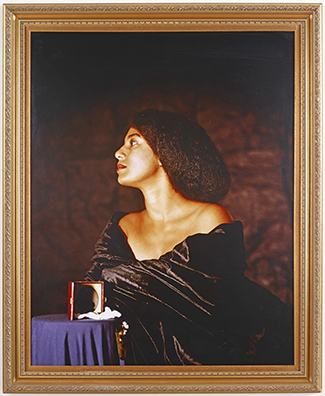
Figure 3 Long description
Maud Sulter’s Calliope (1989), part of her Zabat series, reclaims the figure of the muse through a powerful photographic self-portrait. Sulter appears in Victorian dress, embodying Calliope, the Greek muse of epic poetry, while simultaneously referencing Jeanne Duval, the Haitian-born muse of Charles Baudelaire. Through this layered portrayal, Sulter critiques the historical erasure of Black women from Western art and literature, using the visual language of 19th-century portraiture to assert their rightful place in cultural memory.
In the photograph itself, Sulter appears in profile, draped in black velvet with a soft light falling upon her cheek, neck, and shoulders as she looks towards the top left corner of the frame, as if deep in thought and caught in a moment of inspiration. In front of Sulter there is a small, semi-open daguerreotype – significantly, a frame-within-a-frame – as well as a white flower lying on a small circular table covered in a purple sheet. The portrait within the daguerreotype remains obscured in darkness but it is possible, even likely, that Sulter prompts the reader to conjecture that it is Nadar’s Unknown Woman, or Jeanne Duval, who appears within the frame, albeit hidden from view.
The image of Calliope is accompanied by two text pieces. First, Sulter juxtaposes the photograph with an untitled prose dramatic monologue, in which she takes on the voice of Duval in old age as she talks with a friend about how the French male artists around her have made her invisible. In this first textual piece, Duval casts herself as the true but unacknowledged poet and wordsmith behind Baudelaire. “Of course,” she says, “the shit about being a heroic poet, as opposed to an heroic poet, is that if you’re black and female the chances of one’s poetry attributed to one in later life is slim” (quoted in Cherry, Maud Sulter Passion, Reference Cherry39a). Duval excoriates Baudelaire for having “wooed her” for her “beauty,” her “jewels,” and her “ethnicity” only for the poet to steal her creativity. “That casual request for help with a rhythm or a rhyme,” she says, “soon after appears in print under some fuckers nom de plume and you’re done for.”
She proceeds to recount to her friend a memory of strolling through Père Lachaise cemetery in Paris where she comes across the “Nadar family plot.” There, sitting between two tombstones, she notes “a sorrowful little gap” that is “awaiting the carving of the great man’s name.” Duval scathingly critiques the ways in which certain (elite, white male) artist figures are remembered and memorialized with their names prominently marked on tombstones while she remains an Unknown Woman without any attribution whatsoever, even as her image ensures Nadar’s fame and legacy. “See me,” she proclaims, “I’m a heroic poet and I don’t care who knows it.” In the end, Duval adopts a posture of adamant refusal and defiant self-possession, declaring: “I chose my own kind and in doing so apparently consigned myself to a footnote in history. And so you know, if that is the choice I would do it again. Frankly, I couldn’t give a damn.” Read within the context of her relation to Baudelaire and Nadar in this narrative text, it seems as though Duval’s “own kind” would be the bohemian art world of nineteenth-century France, and given the choice, she would do it all over again.
There are, however, other “kinds” to which the figure of Duval belongs. Sulter also pairs the image with a short, unattributed caption that reads: “I drink champagne early in the morning instead of leaving my home with an M16 and nowhere to go.” The quote is from the opening of a poem titled “Cordon Negro” by the gay Black American poet Essex Hemphill (1957–1995). “Cordon Negro” first appeared in his self-published Earth Life (1985) and again in his collection Ceremonies: Prose and Poetry (Plume, 1992). Taking his title from the brut Spanish cava, Freixenet Cordon Negro [“black cord”], Hemphill adopts an autobiographical confessional voice through the poem’s gay Black speaker. At the beginning of the poem, the speaker stays in the safety of his home, sipping sparkling wine even as he recognizes “I’m dying twice as fast / as any other American / between eighteen and thirty-five” (Ceremonies, Reference Hemphill124). Tragically, Hemphill himself succumbed to complications of AIDS in 1995.
In the poem, though, the speaker bears a brutal recognition of his vulnerability as a young, gay Black man surrounded by anti-Black police violence and gang violence on one side, and the HIV/AIDS epidemic on the other:
Caught between public and intimate violence nearly to the point of his own self-annihilation, the speaker finishes his Cordon Negro as “my private celebration / for being alive this morning” and leaves his home to confront the day (125). “I guard my life with no apologies,” he says. “My concerns are small / and personal.” Hemphill’s persona of understated, stoic reserve functions as a protective shield for guarding himself from the depth of his concerns and feelings, which are anything but “small” and “personal.” Indeed, the loneliness, isolation, and decadence distinguishing Hemphill’s speaker make public his deep desire for new forms of attachment by virtue of shared conditions of invisibility, nonrecognition, and vulnerability to bodily harm due to his race and sexuality. In my reading, then, Hemphill’s “Cordon Negro” self-reflects upon the black cord constraining and connecting queer Black life as it is subsumed by violence within and without, even as it seeks release through intimacy in all its perils.
Duval’s “I couldn’t give a damn” and Hemphill’s “I don’t give a damn”: these declarations of abject refusal, as I see it, serve as the Black cord (Cordon Negro) of affective affiliation linking Duval to her “own kind,” the chosen family of Black queer artists who figure through Sulter’s myriad reframings. So it is not only that Sulter reframes Calliope as the Black muse of Greek epic poetry, imaginatively retrieving a lost, unacknowledged African feminine “origin” of the great white male tradition. Nor is it enough to read Calliope through the frame-within-the-frame in the photographic image and the accompanying narrative text taking on Duval’s voice, as Sulter makes seen and heard a figure who has otherwise been anonymous and unknown. In this reading, it is as if Duval becomes the muse to Calliope, channeling a lesbian eroticism that bends time and space whereby the dead seriousness and gravitas of Sulter’s pose as Calliope itself becomes reframed, in campy tongue-in-cheek playfulness, by the artist’s anachronistic scrambling of artistic histories, inserting an obscured nineteenth-century Duval at the beginning of “Western” artistic and poetic traditions as she flows through Calliope and up through the present Sulter-as-artist.
By quoting Hemphill’s “Cordon Negro,” Sulter’s reframings extend the Black queer politics of her art even further. That is, even as Sulter roasts the straight white male art world for rendering “Duval” invisible and unknown even as her image proliferates to secure “Baudelaire” and “Nadar” as icons, she further toasts the Black cords crossing ancient Egypt (Zabat), ancient Greece (Calliope), nineteenth-century France (Duval), and the late twentieth-century US (Hemphill) and UK (Sulter) to create new “kinds” of kinship through queer art. If, for Sulter, the dominant narrative of art history has suffered from a willful cultural amnesia of the centrality of Black women and queer peoples to artistic production and reception, it is as if she challenges her viewers and readers to momentarily forget and refuse the white, heteronormative Western discursive formations of aesthetics – “I don’t give a damn” – and to take seriously the notion that the domains of art and poetry have always been about and between women, racialized others, and sexual minorities as the invisible but ever present “heroes” of the art world. It is, of course, a fantasy, but at least at this point in her career it is one through which she sought to give voice and subjectivity to figures who have been historically relegated to object status through and through – and whose presence remains central to Black, queer artistic creativity.
Duval figures too in the artist’s later work, which plays less upon the image–text tension evident in Zabat and more on image experimentations. For instance, in her photomontage Jeanne: A Melodrama (1993), Sulter creates four collages where she cuts out the head of Nadar’s Unknown Woman and arranges her in juxtaposition with European artworks and African artifacts, all mounted upon crimson mattes. Kobena Mercer links the cut-and-mix strategies of collage – “signifying materials appropriated out of their original contexts are put into combinations that create something new” – to the formation and innovation of diasporic subjectivities, often through conditions of dislocation and violence, which, in turn, “highlight the transnational migration of aesthetic elements” (“The Longest Journey,” 502–03). For Mercer, the composite materiality of collage foregrounds the partiality of the artwork through its refusal of wholeness and autonomy and, and by extension, self-reflects upon the composite, partial composition of diasporic subjectivity in its irreducible difference and heterogeneity, such that the parts never add up and are held in dynamic friction and frisson in ways that are left deliberately open-ended and in process (503).
To give one example from Sulter’s series, Jeanne: A Melodrama, IV features a reproduction of Gustave Courbet’s The Painter’s Studio: A Real Allegory Determining Seven Years of My Life as an Artist (1854–1855, Paris, Musée d’Orsay), in which Baudelaire sits reading in the far right of the painting. An earlier version of Courbet’s painting also included Duval beside Baudelaire but, after their break-up, the poet was reputed to demand that Courbet remove Duval from the painting (Robin Mitchell, Reference Mitchell47; Reference Mitchell106). In Sulter’s photographic print, however, she inserts Nadar’s enlarged head of the Unknown Woman in the far right corner, as if Duval looms over the poet. In the bottom right corner of the print, Sulter also includes a cutout of Eugene Delaplanche’s sculpture L’Afrique, which was commissioned for the Exposition Universalle (World’s Fair) in 1878. Delaplanche’s statue depicts an African woman half-dressed with open legs, a bare breast, and holding a basket of fruit and vegetables, perpetuating colonial stereotypes of Africa as a hypersexualized figure of bounty and amenable to conquest (Robin Mitchell, Reference McCoubrey2). Sandwiched in between Duval’s enlarged head and Delaplanche’s L’Afrique, Sulter also includes a snippet from an image of an Ẹ̀sán man working in Ibadan, Nigeria, who performs a traditional acrobatic dance, Ikhien-ani-mhin (Willett, Reference Wilderson203). The stark juxtaposition of these disparate elements, drawn from different continents and disjunctive temporalities, invites the viewer to collaborate with the collage and, in the words of Deborah Cherry, “to see the grounding presence of African art, culture and peoples in Western modernity, to acknowledge the close and recurrent proximities of contact and exchange” (“Image-Making,” Reference Cherry, Meskimmon and Rowe154).
In her final major work, Sulter produced a series of nine polaroid self-portraits, where she impersonates Duval in La Chevelure and Les Bijoux (2003), whose titles reference Baudelaire’s poems in Les Fleurs du Mal. These images were exhibited and collected under the title Jeanne Duval: A Melodrama at the Scottish National Portrait Gallery in Edinburgh between May 30 and August 31, 2003. In Les Bijoux, Sulter appears set against a black background, wearing elegant black dresses, her hair often braided and plaited in rich knots, and adorned in jewels, feathers, and elaborate skeins. In some instances, she looks directly at the camera with a range of expressions from confidence to defiance to muted eroticism. In the final image, Les Bijoux IX, Sulter appears in profile draped in pearls and gazing stoically to the left of the frame, perhaps hearkening back to her pose as Calliope. Absent from these images, however, is any explicit textual reference to Duval other than as a name and through indirect, silent allusion to Baudelaire’s poems. “Performance runs through her image-making with Jeanne Duval in mind as she summons Duval,” Cherry notes, such that these images are “spectral performances in which the ghost of Duval, embodied by Sulter, haunts the frame” (“Image-Making,” Reference Cherry, Meskimmon and Rowe163). Likewise, Mark Sealy observes how Sulter’s confident appearance “in the guise of Duval” creates “a strong undercurrent of sexual power,” especially in Les Bijoux VII, where she looks sternly at the camera and powerfully tugs at the skein around her neck. It is as if Sulter and Duval coincide with one another in a powerplay of lesbian eroticism, “breaking with the conventions of desire” (Sealy, no page). In contrast to her earlier work, Sulter here “exposes” Duval’s absence. Or, seen another way, Sulter exposes herself as “Duval,” thereby displacing her and restoring her to radical unknowability, a textual remnant beyond recognition and, therefore, freed from representation as wholly other.
Sulter’s work eventually struggles towards its own recognition that while the figure widely known as “Jeanne Duval” was a flesh and blood human being whose racial, gendered, and sexual identities were marked as other to French culture in the nineteenth century, “she” has been received as a series of overdetermined and irreconcilable images and texts, marshaled by the desires, motives, and ideologies of those who frame and reframe her, thereby putting into question what purposes and whose interests “Jeanne Duval” serves. In the case of Sulter, this means dislodging her from the white male canon of art history, excavating the significance of her African ancestry to the formation of European culture, and unleashing the lesbian eroticism and passion of Sulter’s artistic productions as they draw new affiliations between Black women and queer artists. That said, if “Duval” remains beyond recognition as an obscured figure of alterity, densely woven through layers of mediation and images in Sulter’s work, “she” has also become a mechanism through which “Maud Sulter” has come to recognition in the art world, altering its terrain through her Black British queer reframings.
Floating with the Dead: David Dabydeen’s Turner
Over the course of his career, David Dabydeen has been preoccupied with the presence of Black peoples in the making of Britishness from the eighteenth century onwards, especially through the domain of visual art. In his first book of art criticism, Hogarth’s Blacks: Images of Blacks in Eighteenth Century Art (Manchester UP, 1987), Dabydeen already anticipated Simon Gikandi’s claim in 2001 that “race was at the center of debates about the order of art and aesthetic judgements in the modern period [of eighteenth-century Enlightenment]; that if you remove the figure of the black from theories of modernity in general, and the aesthetic in particular, you would deprive Eurocentrism of one of its constitutive elements” (331). From the start of his career in the 1980s, Dabydeen took this insight as a given.
For Dabydeen, Hogarth’s impoverished upbringing and his scathing critique of aristocratic society, which privileged above all else “the cash nexus replacing human relationships,” led him to portray Black figures, to a degree, sympathetically and in more complex ways than his contemporaries (Hogarth’s Blacks, Reference Dabydeen11). In some instances, Dabydeen argues that Hogarth portrays Black figures as alienated and lonely by virtue of their roles as status symbols among the upper classes, such as in Wollastan Family (1730), where the servant in the background appears as little more than “a blob of black paint” (21–22). Elsewhere, though, Black figures are fully formed and humanized, often laughing, commenting, and critiquing the savagery of aristocratic life, such as in Marriage à la Mode (1745) and A Rake’s Progress (1735) (132). Dabydeen further perceives Hogarth’s Black figures as sharing forms of communality, suffering, and pleasure with and among the lower classes, such as in A Harlot’s Progress (1732) (131). For instance, he interprets the “black woman beating hemp in the prison scene of the Harlot’s Progress [as] the earliest example of anti-slavery sentiment in English painting, if not English art, anticipating the more detailed images of Blake, Morland, Gillray, Cruickshank and Turner by several decades” (131). At least at this early point in his career, the art historian would credit Hogarth with using metaphors of slavery to comment upon the degraded labor conditions of artists such as himself who are “entitled to the Fruits of their own Labours,” a phrase familiar at the time as explicitly about slavery and, therefore for Dabydeen, “further evidence of his sympathy for blacks” (132).4
A decade later, Dabydeen takes a much different approach towards depictions of Blackness in Turner (1995), which addresses the English artist’s perhaps most famous painting, Slavers Throwing Overboard the Dead and the Dying, Typhon Coming On, or The Slave Ship (1840). Turner is a narrative sequence composed of twenty-five individual poems spoken through the persona of the jettisoned African body in the painting’s bottom right corner. As much as Turner explicitly engages with the ongoing legacy of slavery, it is also, for Dabydeen, about how the violence of that history continues through the upheavals of migration and displacement: “how it leads to separation and irreparable losses in terms of not being able to go back home” (Dabydeen, “Interviewing,” 133). Part of this impulse is due to Dabydeen’s own personal background. His family migrated to London in 1969 when he was thirteen years old, leaving behind politically divided Guyana due to attacks on Indo-Guyanese peoples as the country slid into political dictatorship under Forbes Burnham. Surrounded by the entrenched racism of 1970s London and experiencing his parents’ separation at home, Dabydeen was raised in the bleak conditions of the local authorities’ care system for children (Dabydeen, “David Dabydeen,” Reference Dabydeen70–71). What’s more, Turner’s language and style – written in “standard” English and often approximating blank verse – also departs from Dabydeen’s first two collections, such as the creolized Slave Song (Dangaroo, 1984), for which he won the Commonwealth Poetry Prize, and Coolie Odyssey (Hansib, 1988), which is composed mostly in standard English but is infused with Caribbean rhythms to reflect upon the migrant experience from the Caribbean to Britain. In Turner, however, it was necessary for Dabydeen to take on a deeply English poetic form and language to address one of England’s most celebrated artists and figures (Dabydeen, “Interviewing,” Reference Dabydeen and Macedo138).
The collection’s “Preface” takes to task John Ruskin’s now famous adulation of The Slave Ship in Modern Painters I (1848), which lauded Turner’s sublime aesthetics and was instrumental in the artists’ eventual canonization in the history of English art. As Dabydeen notes, Ruskin exalts Turner’s sublime depiction of the sea, praising the English artist for representing “the noblest sea that Turner ever painted … the noblest painted by any man” (Ruskin, Reference Marriott383). At the same time, Ruskin subordinates to a footnote the “guilty ship” (382): “she is a slaver, throwing her slaves overboard. The near sea is encumbered with corpses” (383). Ruskin’s language removes human responsibility for the act of jettison, displacing it upon the feminized “slaver.” For Dabydeen and others, the sea of Black corpses itself remains irrelevant to – indeed, wholly absent from – Ruskin’s primary focus, where Turner’s sublime power only appears through the “shadow of death upon the guilty ship,” the “fearful hue” of the “sky with horror,” and, in an echo of Macbeth, the “sepulchral waves, incarnadines of the multitudinous sea” (382–83).
It is precisely the systematic elision of jettison in Ruskin’s language that imaginatively inspires Dabydeen to take on the persona of “the submerged black head of the African in the foreground of Turner’s painting” (Turner, Reference Dabydeen7).5 In interviews and in the poem’s “Preface,” Dabydeen has emphasized that while his poem directly addresses Turner and uses the painting’s submerged African body as the basis for the poem’s narrative as that figure comes to consciousness, Turner is not a conventional ekphrastic poem. It is not a “verbal representation of a visual representation,” in John Heffernan’s oft-quoted definition of ekphrasis (3). As Dabydeen says, “there was no attempt to match the use of words with the use of paint” (Dabydeen, “An Interview,” Reference Dabydeen and Macedo185). Rather, he says the painting prompts the poem into “verbal interpretation,” into “trying to re-create, in words, something of the ambiguity of the painting” as a way of opening onto a series of problematics regarding “memory and the loss of memory and the recovery of memory … and how one re-creates the past, how one re-creates a sense of family” (186). Elsewhere, he describes the interrelation between the painting and the poem as “an artistic correspondence rather than a technical parallel between the work of art as poem and the work of art as a painting” (Dabydeen, “Getting Back to the Idea of Art as Art,” Reference Dabydeen28).
Dabydeen’s preoccupation with Blackness in visual art carries further contradictions confronting postcolonial artists in their emphasis on sight and seeing, as Mary Lou Emery has examined in Modernism, the Visual, and Caribbean Literature (2007). The history of slavery and colonialism positions Black artists as “lacking the capacity to see and, thus, to create or judge art; yet this position presumably grants the potential of sensory development that culminates in acquiring the full capacity of sight,” and therefore the recognition of the status of “the human” (15). The problem becomes, however, that the entry into the realm of art on the part of postcolonial artists also carries the risk of mere imitation and thus slipping from subject back to object of “visual contemplation and aesthetic judgment” (16). The “ideology of the aesthetic,” for Emery, “does not just mask its complicity with commerce; it also creates an imaginative, utopian space where people of Africa or African descent may imagine themselves as participants, freed from the economic and political conditions which define themselves as less than fully human” (16). For her, the visual in Caribbean literature carries with it the potential of transfiguration and “countervisions” (19), or what she calls “an aesthetics of resurrection” through the sensory body (23).
Dabydeen’s way of confronting this paradox is, precisely, by pursuing it and emphasizing the layers of mediation both within Turner’s canvas and through recursive doublings, echoes, and fluid transformations in the poem itself, with Turner becoming yet another “imitation” of an imitation and composed as a sequence or series. What’s more, Turner is organized around the prevailing conflict between the speaker’s contradictory position as both aspiring to gain subjectivity and humanity and remaining forever foreclosed as jettisoned cargo, further circumscribed within Turner’s racialized mode of aesthetic representation and, further, as a textual element in Dabydeen’s pages. As we will see, the poem is deeply skeptical about, if not altogether opposed to, proffering an aesthetics of resurrection.
I need to emphasize that, in my reading, Dabydeen’s model of Blackness aligns with Afropessimist conceptions of Blackness-as-seen-by-whiteness, which consigns Blackness to annihilation by whiteness and by the white world of social death. In so far as Turner takes anti-Blackness as a given, Dabydeen’s poem anticipates in advance Christina Sharpe’s project of “wake work.” “What does it mean to defend the dead,” she asks, “to tend to the Black person, to Black people, always living in the push toward death?” (10). My reading of Turner labors towards the kind of wake work that Sharpe has called for in a “vigilant attendance to the needs of the dying, to ease their way, and also to the needs of the living.” Here, I read the poem as working in the wake, calling upon its readers to float with the dead to mourn an event as it repeats itself without end.
Considering Dabydeen’s statements about the poem as a “verbal interpretation” and “artistic correspondence,” I first situate my reading of Turner in relation to critical discussions of The Slave Ship to see the ways in which Dabydeen contributes to and departs from other verbal interpretations of the painting in scholarly discourse. From there, I turn to the poem and consider the ways in which Turner experiments with – overturns, extends, and reimagines – the conventions of ekphrasis. Like the African head submerged at sea and caught between crests of waves in the painting of The Slave Ship, the poetic vision of Dabydeen’s Turner is one of partial delusions, half-rememberings, and an ultimate recognition of the limits of any discursive representation to confront the history of jettisoned Black life held in perpetual suspension and without release.
In the voluminous body of scholarship on Turner’s painting (see Figure 4), there is significant critical debate over the ways in which Turner’s painting, subject matter, style, relation to other depictions of slavery, historical context, and reception contributed to or impeded the anti-slavery and Abolitionist movements.
Joseph Mallord William Turner (1775–1851), Slave Ship (Slavers Throwing Overboard the Dead and Dying, Typhon Coming On), 1840. Museum of Fine Arts, Boston.
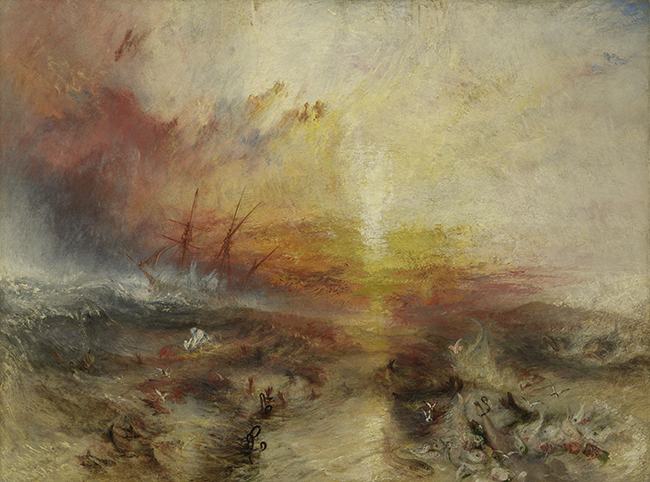
Figure 4 Long description
J.M.W. Turner’s The Slave Ship 1840, originally titled Slavers Throwing Overboard the Dead and Dying Typhon coming on, is a Romantic-era painting that depicts a slave ship sailing into a fiery, apocalyptic sunset as a typhoon looms. In the churning waters of the foreground, shackled human limbs emerge from the sea, victims of the transatlantic slave trade, thrown overboard to drown for insurance compensation, likely referencing the 1781 Zong massacre. Turner’s expressive brushwork, intense color palette, and dramatic composition evoke both awe and horror, using the vastness of nature to reflect the moral catastrophe of slavery. Exhibited at the Royal Academy the same year Britain passed legislation to suppress the slave trade, the painting stands as a radical fusion of Romantic aesthetics and political protest.
When the painting was exhibited in 1840 at the Royal Academy as part of the world anti-slavery convention, Parliament had already passed the Slavery Abolition Act in 1833, which, in stages, abolished the trade in the British colonies in 1843. Turner would have been aware of Thomas Clarkson’s History of the Rise, Progress, & Accomplishments of the Abolition of the African Slave-Trade by the British Parliament, initially published in 1808 and republished in 1839. There, Clarkson discusses the infamous Zong Massacre in 1781, when the slave ship was lost at sea on the way to Jamaica, leading crew members and Africans to suffer malnutrition and sickness due to lack of water (95–99). Fearful of loss of profits, Captain Luke Collingwood ordered the jettison of over 150 living Africans to claim insurance monies for the Zong’s owners. As is well known, the Zong Massacre fueled the anti-slavery and Abolitionist movements in Britain between the late eighteenth and mid nineteenth century through the work of Granville Sharpe, Olaudah Equiano, Ottobah Cuguano, Clarkson, William Wilberforce, and Thomas Fowell Buxton, among countless others.6
For art historian Alfred Boime, however, it seems anomalous that Turner would choose the 1781 Zong Massacre as the historical backdrop to his painting of 1840. On a biographical level, The Slave Ship, Boime notes, belongs to a phase in the artist’s career when he is increasingly preoccupied with the rapid rise of industrialization and its devastating effects upon the natural environment, urbanization, and the working classes, such as in Snow Storm – Steamboat off the Harbour’s Mouth (1842) and Rain, Steam, and Speed – The Great Western Railway (1844) (Boime, Reference Boime40). It is also at this point in his career, says Boime, when Turner’s patronage was shifting from “the landed nobility to the manufacturing elite” (41). From Boime’s perspective, The Slave Ship’s “blazing sunset … is a metaphor for the passing of an outmoded institution in the context of the new industrialised state” (40). Caught between two conflicting economic orders, The Slave Ship, he says, “reduced to melodrama the tragic circumstances of the Zong and allowed the theme to be almost totally submerged beneath the artifices of pigment” (40). Boime critiques the painting as an iconic cultural artifact “aestheticising white supremacy”: subsuming very real traumatic histories of jettison within Turner’s ambition to innovate the sublime-as-high-art “precisely at the moment when the captains of industry (who were only nominally against slavery) replaced the captains of slavers” (42).
Whereas Boime situates Turner’s Slave Ship in reference to the Zong Massacre and the rise of industrial capital, as well as the neglect of the laboring classes, John McCoubrey interprets the painting within the contexts of the height of abolition in the 1830s and 1840s and with ongoing instances of jettison by countries still engaging in the slave trade, especially Spain, Portugal, Brazil, and other South American colonial states. Drawing upon historical maritime records and scholarship, McCoubrey argues that a more accurate and pressing context would be the Royal Navy’s African Squadron, which would patrol the African coast, “seize slave ships as prizes,” and further receive “‘head money’ based on the number of slaves set free” (324). By the 1830s, the Abolitionist movements increasingly claimed that the Royal Navy’s pursuit of foreign slavers was not for the mitigation but for the actual cause of jettison. Once pursued, these ships would throw Africans overboard to evade capture while the Royal Navy would profit from the “head money” acquired by “liberating” slaves jettisoned at sea (325–26). McCoubrey maintains that Turner would have known of the Royal Navy’s imbrication in head money through pursuit and jettison, such as through prevalent debates among the Abolitionist movements, speeches in Parliament, and in the writings of Clarkson and Buxton. In the painting, McCoubrey points to the ship’s design (“its low, lean lines and clipper bow which resemble those of the new, fast slavers”), a ship’s flag that appears to be a Spanish or Portuguese ensign, and dogs in the water, or “spaniels,” which pun on “Spain” (324). The glaring white sunset, the tumultuous red waves, the mythic sea creatures, the floating fetters, and the suspended incomplete Black bodies: all these elements combine, for McCoubrey, in allegorizing nature’s vengeance against the sublime terror of jettison (328–29), imbuing the entire scene with what he calls disorientation, “discontinuity,” and the immediacy of “chaos” (334). Turner here becomes a figure of defiance – “anti-government, anti-navy” – who “painted The Slave Ship in good faith as an act of protest in a cause he supported” (332).
For others, however, the painting’s depiction of the slave trade and jettison puts into crisis the longstanding tension between aesthetics and politics. Marcus Wood argues that Turner’s Romantic sublime instantiates an irreconcilable contradiction between the pleasures of formal experimentation in artistic creation and, conversely, the recognition that such creations are based in historical instances of terror and disaster, such that art forms risk perpetuating the very dehumanizing violence that they purport to represent (68). For Wood, Turner refuses to resolve this contradiction. In particular, the sea functions as a potent and multivalent site for inaugurating mourning and testing the limits of memorialization. “In concentrating upon the physical processes of drowning and dismemberment,” Wood writes, “Turner shows that the slaves are to be dissolved in the waters of the ocean, forever inextricably mixed with the elements of their destruction” (45). While Turner’s “monument to the slave trade is a monument without names” (for how could there be any?), it also teeters between “the sublime and the ridiculous,” where the Black figures of mourning are surrounded by fish and mythic sea creatures (46). For Wood, it is, however, the incompleteness of the body-as-fragment suspended in the repository of the sea – which functions all at once as perpetrator, victim, witness, sarcophagus, and natural element radically indifferent to human affairs – through which Turner challenges his viewers, in his own time and today, to apprehend the brutality of political and economic structures that render human beings anonymous and disposable (63).
Others bring to bear the artist’s skeptical attitude towards the linear progression of history and increasing emphasis on heterogeneous, fractured times of cyclicality and recursivity. Leo Costello draws upon Ian Baucom’s landmark essay, “Specters of the Atlantic,” in which Baucom proposes the notion of “heterochronicity.” The “heterochronicity” of the Zong induces a vertiginous sense of déjà vu, of an event that remains irreducible, singular, unto itself and without exchange, and that which lives on in spectral form as an after-image and keeps happening all over again (Baucom, Reference Baucom78). “Heterochronicity,” Baucom says, “is that which inhabits the uneasy interregnum between the time of melancholy and the time of mourning, the time of singularity and the time of exchange, the moment of the exceptional and the reiterative instant of the recurrently and paradigmatically modern” (78–79). The event of the Zong itself becomes repeated through the ensuing court cases, the ways it becomes taken up as representative of jettison by the Abolitionist movements, and of course by cultural works such as Turner’s The Slave Ship, Michelle Cliff’s Free Enterprise (1993), Fred D’Aguiar’s Feeding the Ghosts (1997), M. NourbeSe Philip’s Zong! (2008), and Dabydeen’s poem.
With Baucom in mind, Costello sees Turner’s canvas as placing in the same pictorial space a multiplicity of temporalities that exist simultaneously and cannot be resolved: the 1781 Zong incident, continuing instances of jettison in 1840 and the British Navy’s role therein, and – through the heaving waves dividing the left background corner of the painting from the drowning African woman in the right foreground, who is clearly a long distance from the ship – the singularity of suffering and death, which, for Costello, ultimately resists full incorporation into the canvas and is therefore without redemption (208–09). It is crucial for Costello that Turner represents the African woman in parts: the protruding leg, floating breasts, and her head cut off by the bottom right corner of the canvas. Turner’s decision to portray this figure as a woman was also part of a larger pattern concerning the ways in which the African woman was mobilized and sensationalized by both Abolitionist and pro-slavery movements at the time (222). Dabydeen, for his part, purposefully figures the poem’s central persona of the submerged African speaker as male to counter what he describes as the “eighteenth-century pornography” of Black women in pain (“An Interview,” Reference Dabydeen and Macedo195).
What’s more, Turner himself benefited from slavery through his 1805 (failed) speculative investment in a cattle pen in Jamaica that was run entirely on slave labor, as Sam Smiles has documented (47). According to Smiles and Costello, Turner would have known that his early patrons accrued their wealth either directly through the slave trade or through business that depended upon slave labor (Smiles, Reference Sivanandan47; Costello, Reference Costello222). This biographical backdrop may explain the artist’s decision to paint the African woman in the way he does, to provoke guilt and horror over the slave trade’s saturation of every part of the nation – its politics, economy, and social life. The fragmentary status of the drowning woman, for Costello, “repeats the crime of slave torture” while she, as a fragment, resists incorporation because “she cannot be possessed completely” (227). Costello’s argument in part depends upon Derrida’s notion of the supplement, such that the fragmentary woman exists both inside and outside the canvas, signifying the persistence of Black terror within and beyond the painting and marking Turner’s ultimate failure to redeem history or compensate for the radical injustice of her death, as well as the deaths of countless others (228).
The critique of Turner’s sublime as an aesthetics of white supremacy (Boime), The Slave Ship as an act of defiance and protest against the terror of jettisoned Black life (McCoubrey), the irresolvable tension between aesthetics and politics through “the sea” as an overdetermined repository of endless mourning (Wood), the interweaving of multiple temporalities and spatialities in the same discursive frame so as to challenge any form of redistributive justice for the singularity of Black death as it repeats itself again and again (Baucom), and the submerged, fragmented Black body held in perpetual suspension and without redemption (Costello): Dabydeen’s Turner works through these divergent and contradictory positions, which we can see through the poem’s experimentations in ekphrasis.
Initially it seems that Dabydeen seeks to overturn Turner, especially through the poem’s antagonistic relation to the artist and the artwork, which is a hallmark feature of ekphrastic writing. This is what W. J. T. Mitchell has called the paragonal contest between the arts and the rivalry between poet and painter (156–57).7 As the submerged African speaker floats in the water surrounded by other bodies “year after year, / From different sunken ships,” he calls “Turner” all those who represent patriarchal whiteness in its totalizing power:
Across the poem, Dabydeen casts “Turner” as a slave trader, a slave ship’s captain, and a sexual violator of children whom he captures and holds in his quarters. At the same time, however, “Turner” also psychically figures for the speaker as a fantasy of wholeness and self-possession that might compensate for the speaker’s sundering from his family, his elders, and his communal past. It is worth mentioning that the speaker’s imagined homelands – located in both African and South Asian cultural geographies – appear split, redoubled, and at times indistinct from one another. In the mythic absence of any pre-slavery or precolonial communality, the speaker internalizes “Turner,” forming a trauma bond with him, which leads the speaker to vacillate between an irrepressible desire for solace and protection from Turner and a traumatic reckoning that, to Turner, the speaker is nothing more than a jettisoned commodity.
The speaker’s psychic ambivalence recurs across the poem, but one such example appears when the speaker, while floating at sea, has a memory of jumping head first into his village pond, injuring his head on a rock, bleeding profusely, and seeking solace from his mother (22). This memory – jumping into water and seeking the maternal – then metaphorically bleeds into Turner’s presence as a slave trader, who keeps his books and “checks that we are parcelled / In equal lots, men divided from women, / Chained in fours and children subtracted / From mothers” (23). The scene culminates as Turner looks up after “multiplying percentages” and “beholds / A boy dishevelled on his bed.” If Turner has become sanitized in the institutions of English art and culture, Dabydeen reimagines him in decadent degradation.
For instance, towards the end of the poem, as the speaker recalls how Turner “crammed our boys’ mouths too with riches”:
Portraying the artist figure as a pseudomaternal figure of intellectual nourishment, Dabydeen further exposes how the elevated category of the sublime serves as a vehicle for expressing – and effacing – its relation to colonial conquest, racial exploitation, and sexual perversion, as the speaker becomes indoctrinated within the contradictions of Turner’s aesthetics of white supremacy. As Sarah Fulford has observed, Dabydeen’s language here encodes Turner’s aesthetic education of the enslaved boys through forced oral sex “as words are uttered at the moment of ejaculation only to be swallowed by the slaves” such that the poem’s “high lyricism” exposes its complicity with “colonial horror” (7–8). Similarly, Heike Härting notes how “the poem dramatizes the ways in which the sublime eroticizes violence and sublimates the repressed sexual anxieties and desires that fuel the pornographic fantasies of empire” (54). “Turner,” then, becomes a placeholder for the irreparable violence of racialized capitalism, colonialism, and sexual violation that has saturated every aspect of the speaker’s subjectivity. Indeed, the speaker repeatedly fails to distinguish between his past, present, and future as he drifts in water, fantasizing about his village prior to captivity and idealizing the possibility of attaining a fully formed subjectivity in which he would be recognized as “human.”
Readers familiar with Turner will recall that the poem’s central strategy for patterning the speaker’s crisis as both subject and object is to introduce a jettisoned infant who floats towards the speaker. “Stillborn from all the signs,” we read in the opening line (Turner, 9). It is as if Turner, the collection itself, is dead on arrival to self-reflect upon the ways in which artistic portrayals of Black life are already jettisoned to death from the start. The poem proceeds to metaphorically compare the birthing mother’s body to the hold of the ship through her “belly / Blown and flapping loose and torn like sails,” her “ropes of veins” and “Blood vessels / Burst asunder, all below – deck are drowned” (9). As Tobias Döring has observed, Dabydeen here unites the topoi of the “womb” and the “ship” through the common current of “the sea,” which, for Döring, “on the one hand, signifies the amniotic fluids of the motherly womb while, on the other, representing the medium of the Middle Passage, the agent of terror and trade” (42).
The womb, the hold, and Dabydeen’s stanzas themselves become carriers of life-giving death and death-giving life. And like the fragmented Black body in the bottom right corner of The Slave Ship, the speaker similarly casts the stillborn as “The part – born, sometimes with its mother, / Tossed overboard” (9). And yet, immediately after apprehending the stillborn as a discarded “part,” the speaker proceeds to describe it as “my bounty,” a “miracle of fate / This longed-for gift of motherhood,” and that which would have become “mere food for sharks will become / My fable. I named it Turner” (9). And so even as the poem begins with a stark recognition of the ways in which Black life is circumscribed by death in the hold of the ship, the speaker nonetheless transmutes the stillborn into a source of subjective meaning through the logic of possession (my bounty), narration (my fable), and renaming (Turner).
From its very opening, Turner establishes a central crisis in which the speaker – and the poem itself – fully recognize that, from the perspective of whiteness, the only meaning and value pertaining to Black life under slavery is that which accrues under the regime of racialized capital and its attendant logic of substitution (Turner-for-Turner). At the same time, however, the speaker – and the poem itself – also aspire to create forms of meaning and intersubjective attachment (a miracle of fate, the gift of motherhood) that might escape Blackness-as-commodity-form but, in the drive towards possession, narration, and naming, only reinscribe and reinforce jettisoned Blackness and its condition of living death through perpetual submergence. In my reading, Turner circles around an irresolvable ethical question: If artistic representations of jettison are necessary in giving sublime expression to the terror of historical atrocity, in what ways do these representations also come to the recognition of their own inevitable failure and futility, which themselves must necessarily be discarded in the name of impossible, endless mourning whereby readers and viewers might imaginatively float with the dead?
To approach this question, the stillborn “Turner” figures as a key mechanism – and double – through which we can read the speaker’s submerged subjectivity, vacillating between subject and object, a part tossed overboard and a death that lives on. As Dabydeen explains in the poem’s “Preface,” the stillborn Turner functions as the “agent of self-recognition,” particularly as it hails the speaker as “nigger”: in ekphrastic terms, the “imagetext” par excellence of stereotypical Blackness as seen from the perspective of whiteness. The stillborn Turner hails the speaker with this epithet in three distinct episodes in the poem’s narrative (7). In my remaining discussion, I would like to track these three occurrences as indicative of the poem’s process of working through the vicissitudes of the speaker’s self-recognition, which ultimately remains fragmented, partial, and incomplete.
In the first movement, the speaker engages in fantasies attached to his severed family and lost homeland. Having floated at sea for centuries, the speaker’s Black skin has become “bleached” and newly “painted” in an “arabesque of blues and vermilions” (19). Bereft and alienated, the speaker concocts “dreams of family,” even undergoing a gender transformation by acquiring women’s breasts, “which I surrender / To my child-mouth, feeding my own hurt” (21). Given the speaker’s gender fluidity, henceforth, I will refer to the speaker by the pronouns they/them. Becoming mother-to-themself, the speaker imagines the stillborn “kick[ing] alive in my stomach,” whose first word pierces the speaker’s subjectivity:
Dabydeen here likely invokes the opening of Frantz Fanon’s chapter “The Lived Experience of the Black Man” from Black Skin, White Masks (1952), where Fanon is hailed by a young white child: “‘Dirty Nigger!’ or simply ‘Look! A Negro!’ I came into this world anxious to uncover the meaning of things, my soul desirous to be at the origin of the world, and here I am an object among other objects” (109). For Fanon the object status of Blackness appears through the violent process of epidermalization, which splits the subject in two, caught between a subjective desire to be at the origin of itself and the traumatic knowledge of its abject object status through the visual marking of Blackness. In the previous passage, the stillborn, by contrast, enters the world already knowing, naming, and proclaiming its degraded racialization. Out of the mouths of babes, the stillborn delivers the dark knowledge that, regardless of whether the sea has given a new arabesque and vermilion skin to the speaker in their fluid gender identity, they nonetheless remain consigned to the “plague” of Blackness that Turner’s white world has created for them.
Immediately following this passage, the speaker reflects upon how the “sea has brought me tribute from many lands, / Chests of silver, barrels of tobacco, sugar-loaves / … cheap and counterfeit goods” (22). Here, it is as if the speaker momentarily sees their reflection in the commodity forms circulating among them as “tribute.” And yet this moment of self-recognition remains partial and held at a remove. The speaker instead deludes themselves into fantasies of maternal solace:
Imagining the stillborn as delivered to them from the “belly of the moon” (or emblem of their mother’s womb), the speaker figures the stillborn as “this grain” and “this morsel,” as if to register the utter deprivation of any physical nourishment and mental instruction of “Turner.” In this first movement, the speaker’s newly acquired gender identity and maternal role carries the false promise of consolation, insinuating the ways in which the drive for new names and new knowledge must itself become jettisoned before the realities of their objectified racialized being.
If in the first movement the speaker perseverates in fantasies of the maternal, in the second movement the stillborn’s epithet activates in the speaker a deep historical consciousness of slavery extending back to ancient Egypt and fictive imaginings of collectivity:
Transforming into the slave ship itself, the speaker becomes the carrier – and discursive creator – of history, having prophetic visions of “the ancient formulae of Empire” through the cyclical ebb and flow of subjugation and insurrection. Staring into the stillborn’s eyes, the speaker sees “shapes of death” through “Bullwhips that play upon the backs of slaves” while “Pharoah sleeps in clothes / scented in the flow of female sacrifice” and the enslaved call for “Revolt,” “emancipation,” and “blood” (31–32). In this second movement, the speaker queries whether they might “call to it [the stillborn] even as the dead / survive catastrophe to speak in one / Redemptive and prophetic voice” or if they might “suckle / It on tales of resurrected folk” (34). But even as the speaker entertains the possibility of restoring the stillborn to the possibilities of communality and transhistorical memory, they cannot overcome the ways in which the traumatic event of slavery has sundered any access to a usable past through “Rape, pregnancy, beatings, men, all men: / Turner” (38). Indeed, at this point in the poem the words “Nigger” and “Turner” become synonymous – and interchangeable – with one another, signaling the ways in which the sublime totality of white supremacy under “Turner” historically invents, repeatedly names, and violently reinforces abject forms of Blackness under the regime of whiteness.
In the final movement, the stillborn once again hails the speaker, but now leading them into a space of vertiginous emptiness:
In the end, the speaker and the stillborn are held in suspension, neither fully living nor released to death. Even the freedom of death remains foreclosed, as “it tries to die” and yet cannot. For Dabydeen, the speaker’s enthrallment to the nothingness of whiteness signifies a form of Black being held forever in the wake, caught in the whirlpool of negation by virtue of the subsuming power of whiteness, as “Turner” chokes the speaker through the artist’s racialized style and language extending from the cosmos (“The earth and its globe of stars”) all the way down to the very core, or “yolk,” of his being.
The speaker’s condition of dynamic arrest is yet another hallmark of ekphrastic writing, what Murray Krieger has memorably described as ekphrastic “still movement” (268). We can see Turner achieve “still movement” in the final lines of the poem, as the speaker vacillates between a recognition of his total abandonment and an unquenchable desire for fulfillment, but now without possibility:
As we can see, the series of “no”s in this final passage evacuate the speaker, stripping away all they have desired and idealized into a still moment of barrenness. At the same time, though, the “no”s also proffer muted forms of community and intersubjective attachment (through the consoling motifs of stars, land, words, community, mother), albeit held under radical negation. In the end, the speaker arrives to a hollow space without subjectivity, in which they have become still and silent. That is, Dabydeen’s fictive persona – created from out of its verbal conversation with the floating body in Turner’s Slave Ship – reveals itself as akin to the mute art object in ekphrastic writing (Keats’s Grecian urn, for instance), in so far as “it can never be present, but must be conjured up as a potent absence or a fictive, figural present” (Mitchell, Picture Theory, 158). In the end, Turner reveals its own ekphrastic indifference. That is, if the narrative poem began by giving voice to the commodity form of the submerged African body in The Slave Ship, it ends by bringing the fictive persona to the recognition of its status as a racialized object through which Dabydeen’s Turner authorizes itself, patterning forms of Blackness that can only be conjured in absence. Indeed, the speaker’s negated condition of submergence – at once still and moving, living and dead, jettisoned commodity and floating human subjectivity, caught in a history that is long past and yet is persisting and all too present – comprises Dabydeen’s way of patterning negated Blackness without redemption.
It is worth briefly noting that Dabydeen’s more formalist approach for mediating jettisoned Blackness stands in stark contrast to, for instance, M. NourbeSe Philip’s more experimental, avant-garde poetics in Zong! (2008), which furnishes a different model of linguistic subversion and poetic submersion. Readers familiar with Zong! will recall that Philip used the only extant historical document, the legal decision Gregson v. Gilbert (1783), as a textual constraint or, in her words, a “word store” to “lock myself in this text in the same way men, women, and children were locked in the holds of the slave ship Zong” (Zong!, Reference Philip191). As Philip explains in an interview with Patricia Saunders, the dried out, “desiccated” language of Gregson v. Gilbert “squeezed out the lives that were at the heart of this case,” with exactly no mention of the repeated acts of the murder of 151 human beings (Philip, “Defending the Dead,” Reference Philip66). Her task, in turn, was to wrest, wrangle, distort, dis-member, and re-member the death sentence of the legal document as it is scattered into dried-out fragments and then resubmerged by Philip into her submarine poetic discourse so as to “reintroduce those emotions and feelings that were removed” (66). The “sea,” for her, occupies a highly contradictory space as both “the water” that “took the lives of those Africans” and the oceanic potentiality of ritual, “now perform[ing] the task of reconstituting those dried facts” (66). Across the collection, Zong! moves from the ossification (“Os”), salinity (“Sal”), wind (“Ventus”), rain (“Ratio”), and iron (“Ferrum”) drowning Blackness under the sea to an eventual, ritualized communality with Yoruba underwater spirits (“Ebora”), through a ghostly chorus as the dead begin to speak in ways that remain cacophonous, polyphonic, indecipherable, and untranslatable. Philip sets herself an impossible task of occupying the silences within Gregson v. Gilbert and, in remaining locked in the hold and submerged underwater with the dead, telling “the story that can only be told by not telling” (Zong!, Reference Philip191).
Looking at Zong! and Turner on the page – in form, style, procedure, voice, and graphic patterning – they could not seem further apart. They connect, however, in what I would call two contrasting “negative approaches” for ritualizing the sea as a potent symbolic repository of African diasporic memory, negations that appear through the “no”s of Dabydeen and the “not telling” of Philip. For both poets, in the words of Kamau Brathwaite, “the unity is submarine” (Brathwaite, Reference Brathwaite64). Their poetry attunes readers and listeners to the submerged negated lives who ultimately remain beyond the text but who gain spectral presences as residues and remainders through their writing’s ritualized communion with the transatlantic African dead.8
Ultimately, as much as Dabydeen’s project may have begun through a purported desire to “overturn Turner,” The Slave Ship and Turner nonetheless connect through forms of kindred affiliation. As Elizabeth Loizeaux has argued, the framework of ekphrastic rivalry, antagonism, and contest cannot sufficiently account for forms of “familiarity,” “companionship,” and “relations across difference” (15–16). Dabydeen’s aesthetic conversation bridges relations across differences between The Slave Ship and Turner in several ways. For one, both Turner’s painting and Dabydeen’s poem remain circumscribed by an aesthetics of white supremacy, in which Blackness can only be figured and apprehended through its negation: disposable “human cargo” caught in the wake. On another level, Dabydeen’s poem compels his readers to look back upon Turner’s Slave Ship now from the perspective of the submerged African body, which Turner could only figure as a suspended human fragment. In Dabydeen’s own words, the painting and the poem relate to one another through “texture,” whether the texture of color or of rhythm. Texture for him conveys “the expression of grief” that can only appear, he says, as “a surface” (“An Interview,” Reference Dabydeen and Macedo194). In this way, both artists relate to one another in using the surfaces of texture to commemorate ineffable forms of grief that, ultimately, cannot be commemorated “in words or images, but can only be commemorated in a movement of elements.” The superficial, for Dabydeen as for Turner, is the pathway to the sublime in aesthetically patterning Black being held in dynamic arrest, gasping for release, and caught in the swirling violence of textual elements.
On yet another level, by reading Turner and Dabydeen side by side, I have also sought to carve out a space in which their artworks collaborate in self-critically opening onto an ethical domain beyond art itself, one in which we are invited to float with the dead. This is, of course, impossible. Neither Turner’s paint nor Dabydeen’s language can ever wholly represent jettisoned Black life as it is figuratively held in a sublime moment of perpetual submergence: They remain nonidentical to one another. Instead, Dabydeen brings into stark relief the incommensurable, nonidentical relation between his poetry’s aesthetic material and its historical subject matter. If Blackness figures in J. M. W. Turner as a floating torso and leg enveloped in streams of red, purple, gold, and white, or in David Dabydeen through the linguistic textures, motifs, and rhythms of poetry, these aesthetic modes of representation carry the potential to activate in the reader’s imagination that which exceeds any form of discursive representation. Their artistic forms ethically envision what it would mean to float with those who have been thrown overboard in the name of ongoing, endless mourning for Black death whose history continues unabated. In doing so, their artworks gesture towards – but cannot touch – the very real historical realities of jettisoned Black life under the sea in ways that remain, in truth, unfathomable.
Conclusion
Across this chapter, I have brought Sulter and Dabydeen into comparison with one another through their related engagements with canonical European artistic forms to give voice and visibility to otherwise obscured or effaced forms of Blackness and racialized being. While their ekphrastic writings share a politics of recognition, there are important differences between their respective projects, especially concerning their choice of subject matter, gender politics, and political outlooks regarding artistic production. For the Scottish Ghanaian lesbian artist, it was imperative to bring to the center of the frame a relatively unknown Black European woman, using image–text experimentations to invent a subjectivity for “Jeanne Duval.” Sulter’s Black queer feminist project is recuperative and, for her, potentially emancipatory, especially given the ways in which Duval has been objectified, spoken over, and silenced in European cultural forms and institutions of art history. In doing so, Sulter “exposes” the ways in which her works performatively impersonate Duval, reframed as an absent presence who, in part, lives on through Sulter’s passionate portrayals.
Dabydeen, by contrast, takes on arguably the most well-known and well-revered white English artist, to a degree defacing his reputation and transforming him into a figure of radical evil. Beyond displacing Turner and exposing how the sublime operates as an aesthetics of white supremacy in The Slave Ship, Dabydeen furthermore gives voice to submerged Black figures who were otherwise consigned to “human cargo.” At the same time, however, we have seen how Dabydeen self-critically and self-consciously marks the limits of his ekphrastic project. Just as the Black figure in the painting appears as a disembodied fragment, so too does the speaker in the poem come to recognition of their object status as a racialized commodity, forever trapped within the limits of aesthetic representation, whether in Turner’s paint or in Dabydeen’s English pentameters. Still, Dabydeen refashions and updates Turner, imagining the impossible experience of what it might mean to float with jettisoned Blackness. Through their emphasis on forms of Blackness in images and texts, Sulter and Dabydeen connect in extending one of the most enduring powers of ekphrasis, as artworks, poems, and readers commune with the dead.
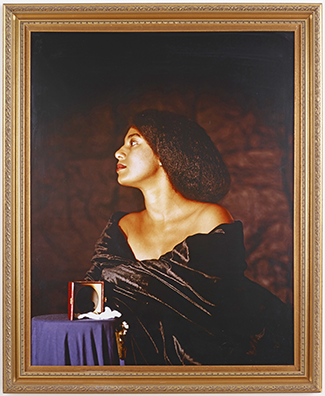
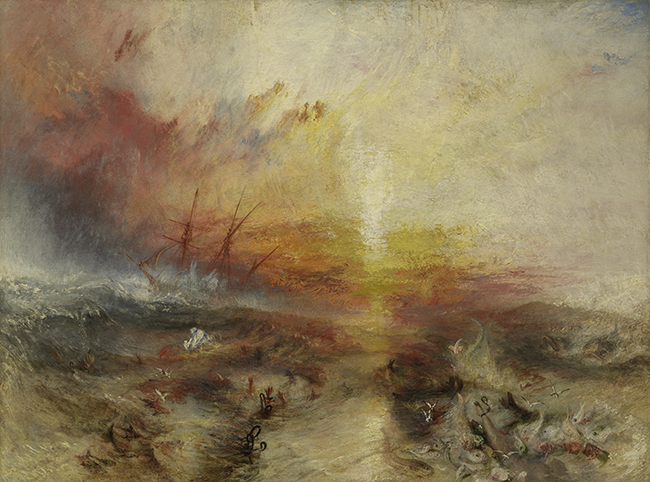

 Open access