


Mapping the Mundus Ludibundus
In 1717, John Gay, assisted by fellow Scriblerians Alexander Pope and John Arbuthnot, wrote the satirical stage comedy Three Hours After Marriage. This lively if merciless play has attracted critical attention for its depiction of Doctor Fossile, an aging natural philosopher and collector who has married a beautiful young woman and frets, rightly, about her sexual fidelity to him, despite the fact that his own passion is for his cabinet of exotic curiosities. I wish to call attention to the play’s equally energetic attack on Fossile’s niece, Phoebe Clinket, an aspiring playwright who has drafted a tragedy on “the Universal Deluge.” Clinket is a marvelously terrible poet. “I took her into my House to regulate my Economy,” Fossile grumbles, “but instead of Puddings, she makes Pastorals; or when she should be raising Paste, is raising some Ghost in a new Tragedy.”Footnote 1 Clinket’s failure to “raise Paste” to feed the household, preferring instead to conjure imaginary spirits, is aligned with her failure to bear and raise children. “What are the Labours of the Back to those of the Brain?” she chides her maid, who carries Clinket’s writing-desk upon her back and complains of the weight, initiating a running joke about the authoress’s indifference to sex and obsession instead with the spawn of her head. Clinket’s deranged desires have rendered Fossile’s house dreadfully inhospitable, at least to those able of body and “sound” of mind whom he imagines belong under his roof: “my House is haunted by all the underling Players, broken Booksellers, half-voic’d Singing-Masters, and disabled Dancing-Masters in Town,” he laments. “In a former Will I had left her my Estate; but I now resolve that Heirs of my own Begetting shall inherit” (4).
The wreckage of Fossile’s household under the force of Clinket’s Deluge belongs firmly to the genre of domestic farce. Yet in its anxious association of wayward spirits, nonnormative embodiment, disordered houses, and crises of descent and inheritance, Three Hours After Marriage proves a surprising antecedent to the genre of the gothic that emerges later in the century in the writings of Horace Walpole. This genealogy, I argue in this section, can be traced along a common thread of domestic disorientation, carried by figures of flooding, sinking, confusion, detritus, remnants, and other topologies of ruin. Both Clinket’s obsessive scribbling and Walpole’s fill their houses with an unruly energy that cannot be organized as part of a domestic order. They transform the English household, itself in a precarious state of transition from aristocratic to bourgeois hegemony, into a site of neither noble status markers nor gendered self-management but rather what Sara Ahmed calls queer phenomenology: a sense of disorientation in relation to the space and objects in proximity to us, or of being lost in place in ways that make reorientation possible. While migration and physical displacement commonly generate the experiences of queer phenomenology, Ahmed insists that one does not necessarily have “to leave home for things to be disoriented or reoriented: homes too can be ‘giddy’ places where things are not always held in place, and homes can move, as we do.”Footnote 2
This part of the book, “The Ludic,” traces connections between, on one hand, the giddiness of English sites in which systems of patrilineal reproduction and inheritance (both old and new) are upended, and, on the other, the movements of material migration and global unsettlement that reverberate through British culture of the eighteenth century. The broad question I pose is: How does the condition of the world under the pressure of intensifying British imperialism arrive, phenomenologically, in English spaces? Many scholars have written on how people, animals, plants, and objects arrived in Britain along the currents of mercantilism and colonialism, transforming the material landscape of everyday life; these currents and arrivants are part of the story of England’s domestic giddiness in the early phases of empire. Yet my attention is directed more toward the emergence of new “lifelines,” in Ahmed’s words, when the forms of ideological alignment, or “ways of being in line with others,” become disorganized. A crisis of reproduction and inheritance, Ahmed argues, is an opportunity for one’s life in general to become what Halberstam calls a “queer art of failure”:
Following lines … involves forms of social investment. Such investments “promise” return (if we follow this line, the “this” or “that” will follow), which might sustain the very will to keep going. Through such investments in the promise of return, subjects reproduce the lines that they follow. In a way, thinking about the politics of “lifelines” helps us to rethink the relationship between inheritance (the lines that we are given as our point of arrival into familial and social space) and reproduction (the demand that we return the gift of the line by extending that line). It is not automatic that we reproduce what we inherit, or that we always convert our inheritance into possessions. We must pay attention to the pressure to make such conversions.… For a life to count as a good life, then it must return the debt of its life by taking on the direction promised as a social good, which means imagining one’s futurity in terms of reaching certain points along a life course. A queer life might be one that fails to make such gestures of return.Footnote 3
It is important, here, that the queer life is defined by this “failure” to “toe the line” rather than by something more deliberate or directional, such as replotting the course. The lines of hegemony are constantly reinventing themselves as a mode of reproduction; the epistemic shift from aristocratic to bourgeois social order, for example, is a radical reinvention of cultural logic, but one that reinvigorates social hierarchies by rearranging them, not one that dismantles structures of power in general. In contrast, queer encounters with what is entirely “off course” – “that which is off the line we have taken” – have the capacity to “redirect us and open up new worlds.” The queer promise of yet unimagined relational formations is potent because it is contingent: “Sometimes, such encounters might come as the gift of a lifeline, and sometimes they might not; they can be lived purely as loss. Such sideways moments might generate new possibilities, or they might not.”Footnote 4 It is in the midst of wreckage, where the ground fails to hold and “promise” as guarantee gives way to “promise” as possibility with no guarantee, that queer desire lines become potential lifelines. “We don’t know,” Ahmed writes, “what happens when we reach such a line and let ourselves live by holding on. If we are pulled out, we don’t know where the force of the pull might take us. We don’t know what it means to follow the gift of the unexpected line that gives us the chance for a new direction and even a chance to live again.”Footnote 5
The giddiness of such uncertainty is at the heart of the ludic – the mode I find at work in the texts I read in this section. Anna K. Bardo has shown how seventeenth-century English literature wedded emergent notions of play to selfhood, generating a “ludic self that allowed them to stand, without retreating, in the midst of difficult dilemmas.”Footnote 6 By the Restoration period, not only had new forms and understandings of “play” been activated in English culture, but there was a general understanding that life was something that kept you on your toes and demanded a certain moment-to-moment agility in navigating one’s situation. More recently, Brian Massumi has identified ludic play between animals as a way of being, or doing, two things at once – for example, playing and fighting.Footnote 7 The ludic, for Massumi, is distinct from mockery or mimicry in the way the two states are cooperative rather than one being subordinate to the other; there is no primary or secondary function, only two seemingly incompatible lines of engagement operating simultaneously. Ludic play between animals is the opposite, we might say, of what we call “boot camp.” A training ground for military combat, boot camp trains soldiers to take orders from higher authorities, in order to serve as instruments of top-down organized force; ludic play, on the other hand, trains individuals to be minutely responsive to an unpredictable peer in a space where authority is suspended altogether. The condition of ludic play is that the participants must believe that harm is simultaneously possible and impossible, in order to practice being attuned to one another exactly as if the stakes are life-and-death. The ludic is a technique, in other words, for creating safe conditions to think about, and prepare to encounter, real violence – a technique that relies on the queer choreography of what Massumi calls the “combatesque.”Footnote 8 It is in this capacity that the ludic in literature and art can be read as a form of play that asks us to believe in the real possibility of reaching the “end of the line,” or the ruination of all known and prospective worlds, and invites us “to be ready to not be ready” for what comes next.Footnote 9
The Art of Sinking
We come now to prove, that there is an Art of Sinking in Poetry. Is there not an Architecture of Vaults and Cellars, as well as of lofty Domes and Pyramids? Is there not as much skill and labour in making Dikes, as in raising Mounts? Is there not an Art of Diving as well as of Flying? And will any sober practitioner affirm, that a diving Engine is not of singular use in making him long-winded, assisting his sight, and furnishing him with other ingenious means of keeping under water?… It is with the Bathos as with small Beer, which is indeed vapid and insipid, if left at large, and let abroad; but being by our Rules confined and well stopt, nothing grows so frothy, pert, and bouncing.
Roughly a decade after the appearance of Three Hours After Marriage, Alexander Pope, on behalf of the Scriblerians, codified Phoebe Clinket’s style in a satiric manual for writing terrible verse, Peri Bathous, or Of the Art of Sinking in Poetry. “Wherefore considering with no small grief, how many promising Genius’s of this age are wandering (as I may say) in the dark without a guide,” declares Martin Scriblerus, “I have taken this arduous but necessary task, to lead them as it were by the hand, and step by step, the gentle down-hill way to the Bathos; the bottom, the end, the central point, the non plus ultra, of true Modern Poesy!”Footnote 10 To this day, the term bathos continues to refer to a particular kind of literary failure: when a text aims for some lofty, serious affect – awe, pathos, veneration – and moves the reader instead to laughter and ridicule. Scriblerus details the myriad formal devices by which a writer may sink, many of which will be familiar to present-day writers who have been advised to avoid common pitfalls: mixed metaphors, prolixity, vulgarity, colloquialisms, and “jargon,” to name only a few. A magnanimous mentor to those authors who wish, in the perverse “modern” vein, to descend far beneath the standards of mere mediocrity, Scriblerus presents a system of “good and wholesome Laws” for plummeting into “the Abysses of this Great Deep.”Footnote 11
The objective of this method is to cultivate a kind of writing that positively bubbles with giddy energy. “It is with the Bathos as with small Beer,” writes Scriblerus, “which is indeed vapid and insipid, if left at large, and let abroad; but being by our Rules confined and well stopt, nothing grows so frothy, pert, and bouncing.” The metaphor of “small Beer” allowed to properly ferment lends to the bathetic a sense of effervescence and levity seemingly at odds with the trajectory of descending into the abyss; in this context, “sinking” is the result not of succumbing to gravity but of defying gravitas. Despite Pope’s assignation of sunk verse to modern trends, the “frothy” effect of bathos connects it to an older tradition of humours that are equally anathema to neoclassical standards of taste. Gail Kern Paster observes that in Ben Jonson’s Bartholomew Fair, fermentation plays a key role in imagining “vapors” as a particular form of agency akin to the humors. “Humors and vapors are alike in being fluids,” she writes; “humors denote anything liquid but especially the living fluids of plant and animal bodies. Vapor is liquid involved with heat and air.”Footnote 12 In Jonson’s play, the vapors emanating from the street fair’s food stalls help ground the play, and the human beings it depicts, in a world of interconnected organic animacies: “The transformation of pigs from animal to food to human self aligns with the fermentation of the ale to suggest dynamism, causality, and endless transformability of the physical world and human beings within it.”Footnote 13 Peri Bathous, too, connects the froth of bathos to a version of “the vapours”:
I draw an argument from what seems to me an undoubted physical Maxim, That Poetry is a natural or morbid Secretion from the Brain. As I would not suddenly stop a cold in the head, or dry up my neighbour’s Issue, I would as little hinder him from necessary writing. It may be affirmed with great truth, that there is hardly any human creature past childhood, but at one time or other has had some Poetical Evacuation, and, no question, was much the better for it in his health: so true is the saying, Nascimur Poetae.Footnote 14
In contrast to Bartholomew Fair, which conjures the mouth-watering aromas of the fair to imagine an embodied collectivity along the lines of the Bakhtinian grotesque,Footnote 15 Pope associates the “morbid Secretions” of the body and brain alike with an infirm or infantile human body – both figures of a “human creature” whose mental faculties are not (yet) capable of dominating the impulsive, instinctual, and disgusting expressions – or “evacuations” – of the animal body. “Nature,” when equated with humors and vapors, can only be associated with poetry under the heaviest irony: “The Taste of the Bathos is implanted by Nature itself in the soul of man,” Scriblerus declaims; “Accordingly, we see the unprejudiced minds of Children delight only in such productions, and in such images, as our true modern writers set before them.”Footnote 16 To remove the cultural constraints on the “necessary writing” of the natural poet is analogous to allowing the ale to flow freely through the drunkard, whether by belch, piss, or puke; to encouraging the oozing of a snotty nose; to allowing children to delight in shit, both figurative and literal.
The humoral quality of bathos thus activates a second meaning of the term “sink”: a sewer that catches the organic dregs and wastes of polite society. The Augustan sink was famously immortalized in Jonathan Swift’s revolting description of Celia’s private chamber in The Lady’s Dressing Room (1732):
The attack on Clinket and the unnatural “offspring” (or “morbid Secretion”) of her brain in Three Hours After Marriage is carried through Peri Bathous into Swift’s scatological satires of fashionable women and sex workers. The common thread is that certain human creatures – including infants, the infirm, and women – are too beholden to the humoral body to achieve the dignified contours of a polite, well-formed individual, or to express themselves in ways that meet the standards of civility. “The Physician, by the study and inspection of urine and ordure, approves himself in the science; and in like sort should our author accustom and exercise his imagination upon the dregs of nature,” insists Scriblerous. “This will render his thoughts truly and fundamentally low, and carry him many fathoms beyond Mediocrity.”Footnote 18 Bathetic verse, according to the Scriblerians, is less a matter of literature than of disease.
The various qualities, devices, and styles that promise to “sink” a piece of writing constitute a catalog of literary and cultural phenomena that the Augustan poets see as in dire need of containment and discipline to preserve the dignity of English letters. In addition to the “frothy, pert, and bouncing” – elaborated later as “the Pert Style,” alongside “the Florid Style,” among othersFootnote 19 – Scriblerus calls our attention to a number of other creative modes I read as “funny” in this study, including
1. the grotesque, which is associated with the labyrinthine:
He [the “Genius of the Profund] is to consider himself as a Grotesque painter, whose works would be spoiled by an imitation of nature, or uniformity of design. He is to mingle bits of the most various, or discordant kinds, landscape, history, portraits, animals, and connect them all with a great deal of flourishing, by heads or tails, as it shall please his imagination, and contribute to his principle end, which is to glare by strong oppositions of colours, and surprize by contrariety of images, / Serpentes avibus geminentur, tigribus agni. Hor.
His design ought to be like a labyrinth, out of which no body can get clear but himself.Footnote 20
Many painters who could never hit a nose or an eye, have with felicity copied a small-pox, or been admirable at a toad or red-herring. And seldom are we without genius’s for Still-life, which they can work up and stiffen with incredible accuracy.
3. collectors, players, and animal-breeders:
I doubt not but an active catcher of butterflies, a careful and fanciful pattern-drawer, an industrious collector of shells, a laborious and tuneful bag-piper, or a diligent breeder of tame rabbits, might severally excel in their respective parts of the Bathos.Footnote 21
4. and formal distortions akin to the anamorphic:
They ought to lay is down as a principle, to say nothing in the usual way, but (if possible) in the direct contrary. Therefore the Figures must be so turned, as to manifest that intricate and wonderful Cast of Head which distinguishes all writers of this kind; or (as I may say) to refer exactly the Mold in which they were formed, in all its inequalities, cavities, obliquities, odd crannies, and distortions.Footnote 22
While this is far from an exhaustive list of the breaches of literary decorum identified in Peri Bathous, these are some of the essay’s most prominent and sustained sites of ridicule. In light of the aggressive repudiation of such materials by Augustan poetics, the way they continue to drift, surge, and resurface throughout the eighteenth century can be understood as a kind of giddy cultural impertinence to neoclassical order.
One of the most prominent forms of eighteenth-century literary discipline, Scriblerian satire constitutes a more significant part of our cultural inheritance than is commonly recognized. While the particular stylistic preferences and norms of this group of writers no longer dominate literary conventions in the twenty-first century, the urge to discipline that they codified in their “rules” remains strong as part of professional writing practices. As Terry Eagleton has shown, part of what we inherit from the period is the practice of criticism itself, which adopts various modes and methods for wrangling “the literary” into desired shapes, on the premise that those shapes are the most legible and therefore the most meaningful.Footnote 23 The same urge infuses the professional field of academic literary studies, in which a wide variety of literacies has by now been cultivated to elucidate an equally wide variety of textual forms – to render them legible, to interpret their meaning. Yet while the category of “the literary” has been allowed to expand and diversify under scholars’ watch, the modes of discipline practiced within the scholarly field – the ones that lend shape to the “discipline” of literary studies – have remained strictly limited. This is not to say, of course, that all of the arguments that have emerged from within these disciplinary bounds are wrong or without value; the disciplines of literary and cultural studies have, in my humble and biased opinion, generated more than their fair share of brilliance. Yet I believe it worth considering, as we generate our arguments, what happens to the flotsam and jetsam of our reading and writing and thinking practices as we keep the ship of our scholarly discipline steadfast. I refer to the bits and pieces that do not survive revision, that are removed for being merely “descriptive” or “associative” and therefore not tethered fast enough to the argument to be carried forth, or the “digressions” or “misreadings” or even, perhaps especially, the moments when one writes oneself into a spiral and begins to make claims that counteract rather than support the argument. It may be the job of the discipline to sort out these messes and maelstroms. But whose job is it to salvage the wreckage, to dwell with what the discipline casts away?
Three Hours After Marriage follows a satirical pattern in identifying the virtuoso – the batty collector – as a ludicrous salvage artist. The early modern collection was itself a mode of discipline, but a contested one, and the intensified contest of its value in eighteenth-century writing invites us to look to its contents as a kind of cultural detritus whose meaning is disavowed by techniques of scorn and ridicule. It is the poet Phoebe Clinket, however, who, as the object of the play’s most heavy-handed disciplinary execution, paradoxically serves as the site of the satire’s greatest vulnerability. To some extent, this vulnerability takes the form of a loss of direction, as the group of male critics who subject Clinket’s play to their criticism are made out to be as absurd as the playwright herself. The theater critic Sir Tremendous, after an initial flirtation with Clinket that sends up the erotics of literary ego-stroking – “I am so charm’d with your manly Penetration!” Clinket exclaims, to which Sir Tremendous answers, “I with your profound Capacity!” (20) – leads an unsparing review of her play manuscript in which he and two players decry the piece’s absurdities and infelicities. When Clinket reads the first speech, “Tho’ Heav’n wrings all the Sponges of the Sky, / And pours down Clouds, at once each Cloud a Sea. / Not the Spring-Tides,” Sir Tremendous interrupts with the observation, “There were no Spring-Tides in the Mediterranean, and consequently Deucalion could not make that Simile” (22). When she recites, “Why do the stays / Taper my Waste, but for thy circling Arms?” he interjects, “Ah! Anachronisms! Stays are a modern Habit, and the whole Scene is monstrous, and against the Rules of Tragedy” (22). The Scriblerians are clearly holding Clinket and her verse up for contempt, but Sir Tremendous and his critical pedantry do not themselves elude satiric scrutiny. In ridiculing the bombastic professional critic tearing the authoress’s work to pieces, the Scriblerians risk their satire becoming overly reflexive, calling into question their own methods of humiliating other writers – particularly women.
Yet the point of the satire’s greatest vulnerability lies not in the caricature of the literary critic but in the simultaneous depiction of how his disciplining of her work is received by Clinket herself. The authoress has taken active measures to protect her writing from what she knows to be a professional culture hostile to women, by asking the rake Plotwell to pose as its author. Yet when Sir Tremendous and the players begin to make ruthless edits to the manuscript, which bothers Plotwell not in the least, Clinket is compelled to put herself between the play and its critics, like a mother protecting her young:
Sir Trem. Absurd to the last Degree [strikes out.] palpable Nonsense! [strikes out.]
Clink. What all those lines! spare them for a Lady’s Sake, for those indeed, I gave him.
Sir Trem. Such Stuff! [strikes out.] abominable! [strikes out.] most execrable!
1st Play. This Thought must out.
2d. Play. Madam, with Submission, this Metaphor.
1st Play. This whole Speech.
Sir Term. The Fable!
Clink. To you I answer –
1st Play. The Characters!
Clink. To you I answer –
Sir Trem. The Diction!
Clink. And to you – Ah, hold, hold – I’m butcher’d, I’m massacred. For Mercy’s Sake! murder, murder! ah! [faints.] (23–24)
Clinket experiences the brutal editing of her play to fit the male critic’s unforgiving specifications as nothing less than physical torture. Her embodied attachment to her writing, later the premise of the joke about her illegitimate offspring, is here the basis of a grisly mock-tragedy: “you should gash my Flesh, mangle my Face, any thing sooner than scratch my Play,” she insists (22). The original bathetic writer, Clinket is meant to illustrate how formal missteps in literary writing send the affect into a tailspin, turning the profound ludicrous. Yet here, Clinket inverts the mechanism of the bathetic: She is meant to appear ludicrous, but her suffering at the hands of overbearing and entitled professional “authorities” is, to me, poignant.
Phoebe Clinket is a moving example of Halberstam’s “queer art of failure,” and part of my aim in this chapter is to vindicate her as such – not by making a case for the unrecognized “dignity” of her poetry, but by arguing that the world needs to hold space for bad poetry born of love and people’s “unreasonable” attachments to it. And not just bad poetry, of course, but all the formal oddities, castoffs, and failures that are too much or too little – too silly, too weird, too earnest, not sophisticated enough, not polished enough, not rigorous enough – to be accepted into the canon of tradition, deemed worthy of cultural care. The Scriblerians, in service to the dignity of tradition, satirize both Clinket and Fossile for their queer attachments to things – Clinket to her writing, and Fossile to his collected curiosities. In both cases, these attachments are comically at odds with the individual’s potential to reproduce via heteronormative domestic arrangements: Clinket has fully cathected all her affections onto her literary creations, to the point that she feels the pain of men’s intrusive hands on them, and shows little interest in sex; Fossile frets that he won’t be able to get it up for his young bride because he is erotically in thrall to his collection. Such attachments were strictly gendered: Unlike men, women were expected to develop irrational attachments to particular kinds of objects – feminine commodities like headdresses, fans, and necklaces – as part of a heteronormative emotional economy.Footnote 24 The play’s treatment of Fossile fits an established pattern in Restoration comedy of mocking the virtuoso for his feminine attachment to trinkets and trifles – exotic oddities whose value is generated by the overactive imagination of the collector.Footnote 25 His undignified way of dwelling with the materials of the world transforms the house of the collector into what Frances Armstrong calls the “ludic space” of the dollhouse or (as it was called in the eighteenth century) “baby-house” – an infantilized and feminized space designed for child’s play, not adult business.Footnote 26
Clinket, in turn, is ridiculed for not being feminine enough. Fossile himself participates in the play’s punitive response to his niece’s wayward desires. Following the brutal episode of external review that leaves her unconscious, he inflicts further violence in the name of treating her “illness”:
Fossile. Niece, you have got the poetical Itch, and are possess’d with nine Devils, your Nine Muses; and thus I commit them and their Works to the Flames. [Takes up a Heap of Papers, and flings them into the Fire.]
Clink. Ah! I am an undone woman. (24)
In contrast to the male collector, the woman writer is not chastised for attachment to objects per se. As the other men in the room struggle to make sense of her agony, they catalog the kinds of objects over which a woman might be expected to fall apart:
Plotwell: Has he burnt any Bank-Bills, or a new Mechlen Head-Dress?
Clink: My Works! my Works!
1st Play: Has he destroy’d the Writing of an Estate, or your Billet-doux?
Clink: A Pindarick Ode! five Similes! and half an Epilogue!
2nd Player: Has he thrown a new Fan, or your Pearl Necklace into the Flames?
Clink: Worse, worse! The tag of the Acts of a new Comedy! A Prologue sent by a Person of Quality! three Copies of recommendatory Verses! And two Greek Mottos! (25)
Women’s devotion to fashionable accoutrements and love letters – equivalent in the feminine imagination to such substantial examples of property as “Bank-Bills” and estate papers – is not considered reasonable in early eighteenth-century culture but is certainly considered normal. Its normality, in fact, underscores the fundamental lack of reason assigned to the feminine in Britain’s emergent economy of heteronormative gender. Clinket’s preoccupation with her own writing, on the other hand, is presented as alarmingly (if hilariously) abnormal. And her embodied conviction that what the men consider “trifles” are actually the foundations of humanity itself is depicted as a form of madness: a distinctly queer “poetical Itch” that must be killed with fire.
In salvaging the absurdities, the monstrosities, and the formal infelicities of works like Clinket’s play, we honor the “poetical Itch” that draws us away from normative arrangements and attaches us to the world, and each other, differently. I turn to the ludic in an effort to sink with the Phoebe Clinkets of literary history rather than exercise conventional forms of discipline upon them. To that end, I practice in this section of A Funny Thing a method of reading that allows itself to “become attached” to dubious objects of analysis – a haunted feather, a mangled corpse, and a dolphin-riding cat, to name only a few – prioritizing a somewhat open-ended intellectual pursuit of them over the mandate to subordinate them, first and foremost, to a linear, mounting argument: the direction, to reprise Sara Ahmed, promised as an epistemological good in the reproductive economy of literary studies. In doing so, the section itself is not entirely without discipline. It aims to be legible within a particular intersection of academic disciplines, including literary studies. Yet it also strategically fails to make certain “gestures of return” to a prescripted argumentative lifeline, in an effort to allow both the objects of analysis and the reader more autonomy, whether phenomenological or interpretive, than our disciplinary practices generally endorse. The book aspires through this method to honor the sites of disorganization, misdirection, dubiously substantiated association, and affective chaos that are conventionally either forced into critical usefulness through vigorous argumentation or cast aside altogether from serious critical engagement. In a culture increasingly shaped, on the one hand, by techniques of policing communications in service of clarity and straightforwardness, and, on the other, by large-scale manufactured confusion designed to stymie critical engagement and collective theory-work altogether,Footnote 27 I ask instead: What ways of knowing find refuge in the ludicrous, the unfathomable, the grotesque? What epistemological reorientations become possible when we allow the ludic to overtake the lucid as a principle of engagement? And what would an ethical approach to such sites of knowledge-gathering entail?
This Giddy Bark
The contours of the ludic are both difficult to define and unmistakable when one encounters them. As a mode, it charges the space around and among subjects with the quality of stimulating uncertainty that has also, since the nineteenth century, been called funny,Footnote 28 and for much longer – since the sixteenth century – queer.Footnote 29 Phoebe Clinket’s outrageous preference for writing over sex, and poetry over procreation, provides an important antecedent to a range of queer cultures that present themselves over the course of the eighteenth century. In “Queering Horace Walpole,” his pivotal article on the culture of Strawberry Hill, George Haggerty attends to the dynamics of queerness that are evident in the archives of Walpoliana, arguing that they reveal Walpole to be “a rich, complex eighteenth-century figure,” unmistakably queer despite – or perhaps because of – the fact that “he does not fit into the neatly structured categories we have for defining sexual identity.”Footnote 30 The intimacies that shaped Walpole’s world, Haggerty shows, were grounded in practices of writing, collecting, drawing, and conversation – social and aesthetic practices exercised in particular tones, registers, and postures shared and enjoyed among the circle of friends that cultivated them. These creative practices were neither covers for nor extensions of private homosexual relations, but primary sites of queer relationality. They generated the conditions under which nonheteronormative sex was possible, certainly, but not a foregone conclusion.
One of Walpole’s closest friends and lifelong correspondents was Horace Mann, who served as the British diplomat to Florence from 1738 until his death in 1786. Mann, whom Walpole met while traveling through Florence with Thomas Gray in 1740, played the crucial role of supplying Walpole with a steady stream of objects, books, and news from the Mediterranean, weaving the Twickenham microcosm at Strawberry Hill into a cosmopolitan network of British men who dwelled in the ostensibly temporary world of the Grand Tour as a lifelong occupation. The archive that provides Haggerty glimpses of this intimate network combines the work and writings of the queer community with texts that are, at least in part, hostile to that community. For example:
Thomas Patch’s caricatures of Mann and other members of the British Florentine world open the possibility of a queer reading that assumes an easy familiarity among these giddy transplanted British and German gentlemen. Patch (1708–82) is ruthless in his depiction of the quirkiness of his subjects, and the whole effect is comic, ludicrous, and bizarre. Anyone who has seen these works, at the Lewis Walpole Library in the Treasure House in Farmington or elsewhere, knows what a fascinating view into eighteenth-century society they offer.Footnote 31
Patch is working within a tradition of graphic satire descended from the Scriblerians and other early eighteenth-century satirists; the men of Mann’s and Walpole’s circles, as they appear in his caricatures, are thus descendants of Phoebe Clinket and other figures of queer creativity who emerged in ludic fullness from texts designed to flatten them. The “ludicrous” of caricature is an invitation to discipline through humiliation – to laugh satirically as a refusal of the “quirky” and “bizarre.” But the vibrancy of the ludic extends a counter-invitation, to enter into the animating dynamic of giddiness. Haggerty maps the way into this counter-relation to the queer worlds depicted by satire via two postures: an initial captivation by the “fascinating view,” and, potentially, an eventual softening into the “easy familiarity” that binds this world together. The “easiness” of these relations is distinct from the disciplinary relief offered by satire, of abjecting the odd, the unfathomable, and the incomprehensible in a perpetual smoothing of the social fabric. It is a way of being in the world with others that commits instead to sustaining the steady hum of stimulation and anticipation that attends allowing others to become close in all their strangeness, to become queer familiars.
Where satires like Patch’s aim to reduce queer cultures to monotonous comedy, Haggerty’s queer reading allows the polymorphous possibilities of the ludic to overwhelm the satire. Queer reading, Haggerty makes clear, is different from literary “recovery” projects; as he says, anyone who has spent time immersed in the collections of Walpoliana at the Lewis Walpole Library in Farmington, Connecticut, can tell you that the queerness of the archive feels more like a great deluge than a trail of ghostly traces. The challenge to the researcher is not how to find something disappeared, but how to navigate the flood of what has always been present. Walpole’s voluminous correspondence – itself an overwhelming archive of interpersonal experience and expression – depicts the modes of thought and feeling that characterized his relationships with others in terms that range from boredom to delight, from hilarity to profundity. Haggerty’s queer reading of the Walpole archives attends to the myriad affects that animate queer community in eighteenth-century Europe, in a method akin to my ludic reading of Phoebe Clinket, which takes her commitment to her play seriously at the same time that it enjoys the “quirkiness” of this commitment. The ludic, in contrast to the satiric, allows the earnestness of such attachments to coexist with their funniness. Queer reading and ludic reading share an attunement to the particular energy of giddiness, whether it emerges in humor, in earnestness, or in both simultaneously. This energy is particularly evident in Walpole’s relationship with Mann. Discussing Walpole’s letter to Mann thanking him for a bust of Caligula Mann had sent from Herculaneum, Haggarty observes that Walpole’s “giddy enthusiasm for the masculine form [of the bust] is an aesthetic response, to be sure. But it is also a physical response.”Footnote 32 To learn to read in a way that sees the cohabitation of the aesthetic and the physical, the funny and the serious, the fascinating and the routine, the momentary and the sustained, is one way to practice a way of being that allows such hybrid phenomena to flourish within and among us as subjects.
Walpole committed himself to the ludic not only in his letters and friendships but also in his literary work, particularly in his cultivation of what he called “the gothic.” The affects of fear and terror with which the gothic has long been associated are but one facet of a range of moods and postures that Walpole gathers and sets into confused, and confusing, motion in his “Gothic tale,” The Castle of Otranto. The criticism on this work has rehearsed the question of whether Walpole intended readers to take the story “seriously” or not, of whether it is “funny” on purpose or not; a ludic reading allows us to bypass such distinctions to focus instead on how the text inherits and amplifies giddiness as a way of being in the world. If we simply accept The Castle of Otranto being funny and being serious simultaneously, we can see that the story is animated by precisely the kind of energy described by Massumi in his analysis of animal play: a heightened, hyper-alert state of playfulness, where play is not a form of mimicry but a particular mutual attunement to the possibilities of real danger that are being rehearsed. For dogs at play in Massumi’s reading, the ludic is a mode of interacting together suspended in the “life” part of life-or-death combat; death is not impossible in the world generated by such play, but held in a state of perpetual imminence. Walpole’s gothic introduces a similar mode of ludic play as a human method for approaching real and unfathomable violence: It invites the reader into a mode of full-bodied engagement with the prospect of atrocity that relies on carrying oneself as if one will not come to the kind of harm one simultaneously knows is always possible.
***
Walpole’s ludic play draws on the neoclassical vocabulary for order and chaos rehearsed by the Scriblerians and other early eighteenth-century satirists, who themselves inherited this vocabulary from Restoration writers who applied themselves to reinventing post–Civil War England as a neoclassical empire. A particular set of Restoration texts show why Pope and his colleagues fixated on metaphors of flooding, sinking, and uncontrollable froth to describe phenomena that threatened the dignity, coherence, and future prospects of British letters. Though the objectives of neoclassical writers may be disciplinary, their vocabularies travel in ludic flow; just as an animal may invite another into serious play with a giddy bark, so does the Restoration archive issue its own giddy bark to the eighteenth century.
The Scriblerians’ attempt to humiliate Phoebe Clinket’s obsession with the Great Deluge springs from their own inheritance of a neoclassical mandate to discipline an intertwined set of fluid, organic, and self-generating figures gathered since Roman antiquity under the sign of the grotesque. The ancient Roman architect and military engineer Vitruvius articulated the specifications of the grotesque in his influential Ten Books on Architecture, dedicated to the emperor Augustus. In his discussion of “Correctness in Painting,” Vitruvius bemoans the current trends in wall painting:
These paintings, which had [previously] taken their models from real things, now fall foul of depraved taste. For monsters are now painted in frescoes rather than reliable images of definite things. Reeds are set up in place of columns, as pediments, little scrolls, striped with curly leaves and volutes; candelabra hold up the figures of aediculae, and above the pediments of these, several tender shoots, sprouting in coils from roots, have little statues nestled in them for no reason, or shoots split in half, some holding little statues with human heads, some with the heads of beasts.Footnote 33
The architect’s contempt for the aesthetic of curling, tender, splitting, and nestled lines and forms is clear, but his objection to such “monsters” is ultimately expressed as an ontological one. “Now these things,” he declares, “do not exist nor can they exist nor have they ever existed.” The field of reality in which such an assertion can be made is specifically architectural, a dimension of organized spatial relations rather than an indeterminate field of perceptible phenomena – reeds, leaves, shoots, and roots can and do exist, of course, in nature, and the painted figures Vitruvius describes do exist in the built environments he is describing. The ontological violation is in the suggestion that such things could perform the structural tasks such images assign to them: “How, pray tell, can a reed really sustain a roof, or a candelabrum the decorations of a pediment, or an acanthus shoot, so soft and slender, loft a tiny statue perched upon it, or can flowers be produced from roots and shoots on the one hand and figurines on the other?”Footnote 34 Bad taste, which leads people to take pleasure in such images, must not be tolerated because it abets lack of judgment, both intellectual and moral. “Minds beclouded by feeble standards of judgment,” Vitruvius insists, “are unable to recognize what exists in accordance with authority and the principles of correctness. Neither should pictures be approved that are not likenesses of the truth.”Footnote 35
There is something undeniably funny about Vitruvius’s definition of monstrosity in these passages – not the dreadful, ghastly, or terrifying, but the curly and coiled, the “soft and slender,” are his measures of “depravity.” Equally funny, perhaps, is the level of spleen inspired in him by the fashion for decorative tendrils and leaves. What is more significant here than the exact images that set Vitruvius off, though, is the way his outrage is focused on the problem of ontology over time: what does exist, what has existed, and, crucially, what can exist in a conceivable future. The even, driving syntax of the statement that “these things do not exist nor can they exist nor have they ever existed” implies a seamless relationship and identical status of past, present, and future ontological possibility, leveling the grammatical distinction between the indicative declarations of what “is” and “has been,” on the one hand, and the subjunctive speculation of what “can” or “could be” that is couched between them, on the other hand. As David Alff has shown, this rhetorical flattening of the present and future was the hallmark of the Restoration genre of the “project,” where it served to persuade readers that specific futures proceed naturally from present realities. “Given its capacity to make a specific speculative future feel like an inevitable extension of the present,” Alff writes, “passive syntax appears frequently in project writing.” Projection specializes in sentences “in the conditional mode, but [in which] no one is responsible for satisfying any conditions – things simply will ‘be.’”Footnote 36
For Vitruvius, the problem of implausible spatial arrangements, which comprised aesthetics, ontology, and morality, was fundamentally political, and, as scholars of British neoclassicism have shown, it is in this vein that the preference for “reliable images of definite things” was promoted in the rhetorics, designs, and philosophies of Britain’s early eighteenth-century neoclassical revival. Howard Erskine-Hill, for example, points out that “Vitruvius did not insist that the architect should be skilled in polity, but his opening paragraphs show that for him architecture was expressive of a political order” – specifically “the majesty of the empire and the grandeur of Roman history” for both “the present and future.”Footnote 37 The straight lines, even proportions, and symmetrical layouts of Vitruvian design evoke an ethos of propriety and prosperity under robust yet just political leadership. The classical architect’s insistence that such regularity is akin to the “reliable” and “definite,” and stands in stark contrast to the irregular, emergent, and dynamic forms of young shoots and hybrid creatures, sketches an ideological distinction between the natural and the organic, where the former is a metaphysical principle of soundness and permanence, one expressed through schemes of planned progress, and the latter is a site of unpredictable developments and confusing relationalities, self-generating grotesqueries that must be managed and disciplined lest they disrupt the natural order.
It is not difficult to imagine the appeal of an “Augustan Age” for Britons emerging from the civil wars of the seventeenth century.Footnote 38 While material circumstances were not promising of a British Golden Age in the 1660s, the arts of projection, as Alff demonstrates, made it possible to assert national glory and prosperity through rhetorics combining “stirring prophecy and an implementable plan”Footnote 39 – a future conditional nationalism held aloft, on the principle of classical order, as a foregone conclusion. The Augustan ethos was fundamentally an imperial one, and the art and architecture that embodied it relied on imperial influxes of wealth. The neoclassical revival thus mandated a vigorous reinvention of England in the image of empire despite the fact that, at the time of Charles’s return to court, the English lagged conspicuously in the European contest for global expansion, particularly in relation to the Dutch. Confident assertions of maritime ascendance performed a double rhetorical duty: They consolidated the project of establishing England as an overseas power, and, at the same time, they metaphorically identified the monarch as a navigator steadying the vessel of the nation and guiding her bravely forward, even through the roughest waters.
The confluence of neoclassical and maritime self-fashioning in Restoration projects is particularly evident in the dedications to John Evelyn’s 1664 translation of Roland Fréart’s A Parallel of the Antient Architecture with the Modern. In the first, to Charles II, Evelyn declares:
I would provoke the whole World to produce me an Example parallel with Your Majesty, for your exact Judgment, and marvelous Ability in all that belongs to the Naval Architecture, both as to its proper Terms, and more solid Use; in which Your Majesty is Master of one of the most noble and profitable Arts that can be wished in a Prince, to whom God has designed the Dominion of the Ocean, which renders Your Majesty’s Empire Universal; when by exercising Your Royal Talents and Knowledge that Way, You can bring even the Antipodes to meet, and the Poles to kiss each other; for so likewise (not in a metaphorical, but a natural Sense) Your equal and prudent Government of this Nation has made it good, whilst Your Majesty has so prosperously guided this giddy Bark through such a Storm, as no Hand, save Your Majesty’s, could touch the Helm, but at the Price of their Temerity.Footnote 40
By focusing his praise on the monarch’s combined virtues of “Judgment,” “Ability,” “Talents,” and “Knowledge,” Evelyn aligns majesty with a remarkably practical range of skills. Though divine right is lightly invoked to assert Charles’s “dominion of the ocean,” the emphasis here is on the king’s capacity to “exercise” his talents, knowledge, and abilities, to perform his “mastery” of particular “arts” to profit and national advantage. Altogether, Evelyn’s lofty compliments assign a somewhat striking amount of work to the monarch; the fact that God has “designed” the world’s oceans for Charles’s rule indicates, for Evelyn, that it is crucial the sovereign possess a cultivated expertise in “naval architecture.” In the assertion that “Your Majesty’s Empire” has already been rendered “universal” yet remains to be consolidated by the sovereign’s dedicated efforts, we find the odd temporality of projection, in which the future is both guaranteed and must be met through practical exertion.
This loopy temporality makes a particular convolution when Charles’s future oceanic endeavors pivot to confirm, and be confirmed by, his already having “so prosperously guided this giddy Bark through such a Storm” – namely, having survived the Interregnum. Evelyn’s insistence that this figure is offered “not in a metaphorical, but a natural sense” further smooths the categorical distinction between literal and figurative forms of nautical capability, laying the logical groundwork for the launch of an actual fleet of English ships to signify sound political leadership, and for lack of civil war at home to signify the readiness of English ships to rule the seas. In Evelyn’s deliberate rhetorical obfuscation of real and virtual architectures, waters, weathers, and navigational skills, the “giddy Bark” of the nation is assigned to the king’s eminently capable hands – though, as England looks ahead, it remains unclear whether those capabilities are projected or proven, actual or metaphorical, or what they enable to king to do one way or the other.
Evelyn’s second dedication, to Sir John Denham, Surveyor of the King’s Works, provides more concrete descriptions of the kinds of improvements architectural treatises like Fréart’s – and Vitruvius’s – make possible. In the early years of the Restoration, England is actually, it turns out, in somewhat sorry architectural shape. “You well know,” Evelyn intimates, “that all the Mischiefs and Absurdities in the modern Structures proceed chiefly from our busie and Gothick Triflings in the Compositions of the Five Orders.”Footnote 41 Where Evelyn evokes the nation’s giddiness in his address to Charles in order to emphasize the calming effect of the king’s touch, in his address to Denham this unsettled energy looms as more of a threat. “There is nothing costs dearer, and displeasures more, than our undigested Contrivances, and those intolerable Defects which we have enumerated,” he insists. “It is from the Asymmetry of our Buildings, want of Decorum and Proportion in our Houses, that the Irregularity of our Humours and Affections may be shrewdly discerned.”Footnote 42 For political steadiness to truly be restored, the “Encroachments and Deformities of the public Edifices and Ways” – all the “Gothick Triflings” of the nation’s built environments – must be thoroughly “reformed.” Denham, Evelyn maintains, is just the man for the job:
neither here must I forget what is alone due to you, Sir, for the Reformation of a Thousand Deformities in the Streets; as by your introducing that incomparable Form of Paving, to an incredible Advantage of the Public; when that which is begun in Holborn shall become universal, for the saving of Wheels and Carriages, the Cure of noysome Gutters, the Destruction of Encounters, the Dispatch of Business, the Cleanness of the Way, the Beauty of the Object, the Ease of the Infirm, and the preserving of both the Mother and the Babe; so many of the Fair Sex and their Off-spring having perished by Mischances (as I am credibly inform’d) from the Ruggedness of the unequal streets, &c.Footnote 43
Evelyn may be pushing the bounds of panegyric in ascribing such spectacular transformations to Denham’s modest accomplishment of paving the streets of Holborn. Yet this passage is consistent with the style and grammar Alff identifies in the genre of the project, particularly its obscuring of agential subject and sprawling integration of myriad future benefits springing from one finite venture. There is, in Evelyn’s hyperbolic projection, the distinct sense of infrastructural logic: an understanding that incremental material changes and redesigns can have expansive, regenerative practical effects on shared social worlds. Such projective thinking allows Evelyn to move with striking fluidity from the improvement of a few city streets to a much broader array of public reforms spanning practical design, aesthetics, hygiene and public health, and gendered morality. The logical connection between paved roads and public health, clean alleys and appropriate social interactions, even walkways and thriving children, is established by Evelyn’s equating of asymmetry in design, indecorum and intemperance in the home, and “irregularity” of the physiological humors. This equation takes its cue from Vitruvius’s own slippage from bad taste to poor judgment to corrupt morals, which gathers under the principle of unity all aspects of civic life – aesthetic, social, and political.
Evelyn’s conviction that “the promoting of such public and useful Works (and especially that of Building) [is] a certain Indication of a prudent Government, of a flourishing and happy People” is a central tenet of British neoclassicism, a movement that relied heavily on architectural metaphors to articulate the particular merits of a wide range of British arts and artists. Writers like Dryden and Pope defined a generation of English “heirs to Vitruvius,” as Erskine-Hill has dubbed them, who devoted themselves to elaborating the various points of resonance between classical aesthetic principles and English arts and letters.Footnote 44 Like Evelyn’s prefaces to Fréart, early eighteenth-century neoclassicism remains fundamentally future-oriented, vigilantly assessing both the strengths and weaknesses of British taste in order to guide the giddy bark along the best and most prosperous path. Even at its most confident, this body of writing emphasizes the myriad risks and obstacles to the cultural project – there is always something in the landscape in need of avoidance or improvement. It is in this spirit that Dryden complains of the “wholly Gothic” quality of “English Tragi-Comedy,” prescribing the purging of the gothic’s “barbarous Ornaments” from all poetry as well as painting.Footnote 45 In An Essay on Criticism (1711), Pope distinguishes this general vigilance against bad taste from pedantic nitpicking:
But such lucid critical judgment can only be fostered in a culture that adheres strictly to the clean lines, open perspectives, and balanced proportions of Augustan design. The critic must learn to read with the same eye Vitruvius trained to see:
In this context, the gothic’s “barbarous Ornaments” amount to more than occasional “trivial faults”; they mark areas in the national culture and character that have resisted integration into the newly unified nation and its bright future. “Gothick Triflings” remain, as Evelyn described them, “Mischiefs and Absurdities” in the material and conceptual worlds Britons had to navigate – obtrusive hazards and patches of bad weather that made it imperative that someone’s steady hand remain firm at the helm of the giddy craft.
Animal Spirits
My reading here perhaps makes too much of the pun on Evelyn’s “giddy bark,” which pivots us conveniently from the unsettled movements of a ship on rough waters to the unpredictable choreography of dogs at play. Such fortuitous turns in the act of reading, however, are fundamental to a ludic interpretive method, which stays afloat on the inadvertent lines of relation cast out by accidents of coincidence and semantic slippage. The giddy leaps of association entertained by this method of reading are supported, in this instance, by the more deliberate and sustained efforts of writers from Evelyn’s time to the Scriblerians to Walpole to connect formal regularity and irregularity to theories of organic lived experience, both bodily and intellectual. The visceral logics of the ludic as it manifests in Walpole’s writing can be traced back to Evelyn’s association of “Gothick Triflings” to “the Asymmetry of our Buildings,” which express the “want of Decorum and Proportion in our Houses” and “Irregularity of our Humours and Affections” persistent in English life. Evelyn’s concern is channeled to Walpole via the Augustan poetics of embodiment and the kinds of wayward spirits they set in motion.
These “spirits” were not, for the Scriblerians, ghosts, but a component of new theories of the animate matter of human beings. Al Coppola, in his study of the role of eighteenth-century theater in negotiating and establishing modern science in British public life, places Three Hours After Marriage at a turning point in the history of human physiology sciences. He identifies the Scriblerians’ play as a kind of swan song, the last gasp of Restoration-era satires of natural philosophy as Whig sentimentalism rises in collusion with Lockean epistemology to domesticate emergent sciences as part of an ethos of commerce and politeness.Footnote 48 This ethos is captured in Susanna Centlivre’s 1718 Bold Stroke for a Wife, a “careful response to Three Hours After Marriage” that redeems the figure of the virtuoso at the same time that it refuses Galenic humoral theory and the forms of stage comedy that relied on it to identify and correct antisocial behaviors. “Performed at a transitional moment in the rise of a new physiology that increasingly located the springs of character, as well as the causes of aberrant behaviour, in the circulation of animal spirits across the nerves,” Coppola writes, “these plays delineate the very uncertainty of identity in the commercial culture Centlivre’s play celebrates, in which persons are no longer definable by a unique humoral temperament, however much the Scriblerians, in their reactionary satire, might wish them to be.”Footnote 49 Replacing early modern humoral typologies, “the new physiology of nerves and animal spirits naturalized not only a new politeness but also a new susceptibility to spectacles of all kinds.”Footnote 50 Within this new understanding of the human creature, hard satire was no longer an adequate technique for maintaining a functional social order; new modes of discipline sensitive to the dynamics of nerves and spirits running through every individual were required to manage the “susceptibilities” of the modern human organism.
In the genealogy from the Scriblerians to Strawberry Hill, the satire of Three Hours After Marriage does not survive. What does survive into the mid-eighteenth century, albeit through cultural displacement, is the world of humors that the satirical apparatus was designed to manage – a realm of fluid, dynamic, and expansive phenomena that outlasted the British cultural belief in that realm as a real and fundamental part of human experience, cognition, and day-to-day life. “The idea,” Coppola writes, “that a person might have a rational faculty bathed in a roiling sea of humors and constrained by a unique humoral profile – a profile determined by a complex interaction of geography, genealogy, and personal physiognomy – was utterly foreign to Locke’s notion of human understanding.”Footnote 51 Abjected from theories of human reason and social order, the “roiling sea” of broad earthly and cosmic forces that had conditioned understandings of the human for millennia took hold in other corners of the British cultural imaginary, seemingly disconnected from the sites of empirical exchange that defined modern human experience.
The Scriblerians theorized bathetic writing, with its formal infelicities, belaboured artifice, and incongruous affects making an embarrassing spectacle of earnest feeling, as a sink for wayward humors, and it continues to serve this purpose well after the humors themselves are considered a matter of medical, social, or literary concern. A subset of the broad category of eighteenth-century “funny” writing, the bathetic belongs to the odd company of silly, implausible, outlandishly fanciful, and generically confused texts that persist through the so-called Age of Reason. Yet the unreasonable ways of imagining the world that such writings harbored were not entirely quarantined from “serious” writing; in the case of the new physiology, animal spirits proved a carrier of funny ideas about the human organism as empirical object. Jess Keiser argues that the animal spirits represent the most sustained lapse in “Enlightenment neurology’s embrace of plain observation and its corresponding antipathy toward ‘poetical’ accounts of the psyche,” the site where the science of neurophysiology “rests … on a metaphorical fiction”:Footnote 52
The figuring of the brain becomes particularly evident when writers of the long eighteenth century describe the actions of the “animal spirits”: small bits of lively matter that ostensibly coursed through the nervous system in order to actuate movement, sense, and thought. Although in most accounts these entities are only particles of matter in motion (and therefore in their unmoving and isolated state no more thoughtful or conscious than a billiard ball), early neurologists frequently turn to their favourite trope – personification or prosopopoeia – in order to enliven the spirits with fully thinking minds. In their writing, the animal spirits become citizens and soldiers living, working, and dying in a (figurative) body politic. They possess desires, thoughts, and emotions. They fall in love, go mad, suffer from depression, even dance. In short, thanks to the resources of personification, the animal spirits behave almost exactly like the person they inhabit and in a certain sense create – even though, properly speaking, these spirits are nothing more than thoughtless bits of matter.Footnote 53
The operations of metaphor, Keiser shows, are crucial to reconciling the material brain to the Lockean mind. Imaginative figuration is required because Enlightenment materialism struggles to theorize how physical matter yields consciousness: As Jonathan Kramnick puts it, the turn to a secular materialism in the late seventeenth-century Lucretian revival “left ambiguous the way in which material sounds could have the kinds of properties (desires, intentions, and the like) that lead to discernible actions,” and also “left unstated who or what is having these desires or intentions in the first place.”Footnote 54 The characterization of animal spirits is a creative solution to this philosophical problem. It animates the physical matter of the human creature into person and mind, at the cost of allowing the agency of personhood to harbor an originary fantasy taken for reality.
Rather than enter the conversation about theories of consciousness, I wish to stay within the fictional space held within the human for modes of activity imagined as fundamental to phenomenological experience, namely, animality and spiritedness. Harnessed to reconcile eighteenth-century medicine to Enlightenment epistemology, animal spirits nevertheless exercise their fanciful and lively energies in ways that belie their domestication to an emergent culture of empirical reason. Early neurology asks us to believe in the work animal spirits do without fully believing in “animal spirits” as real creatures. I ask us to approach animal spirits instead as if they are real creatures, to observe what they do when they aren’t put to work within the structures of Enlightenment logic. Phoebe Clinket provides a model for such an approach; accounting for her “Absence of Mind” when her uncle asks her to set the tea-table for a guest, she explains, “my animal Spirits had deserted the Avenues of my Senses, and retired to the Recesses of the Brain, to contemplate a beautiful Idea. I could not force the vagrant Creatures back again into their Posts, to move those Parts of the Body that express Civility” (6).
Designed by the Scriblerian authors to sound ludicrous, Clinket’s self-diagnosis contains a theory of the ludic agency of animal spirits, understood as “vagrant creatures” moving willfully in unexpected directions and to little-frequented recesses of the human organism. Their deviation from the channels of “civil” behavior, while whimsical, presages one of the foundational problems of eighteenth-century social and legal disciplinary systems. As Sal Nicolazzo has shown, the category of vagrancy was cultivated in Anglo-American culture of this period as a justification for police – both the institution of organized state and municipal force, and a “mode of perception” based on perpetual vigilance against forms of deviance from accepted norms of social arrangement and practice.Footnote 55 In its study of disciplinarity, Nicolazzo’s work calls attention not to the formation of subjects but to the dissolution of the subject in imaginative efforts to make the police “thinkable.”Footnote 56 “The category of vagrancy has very little to do with subjectivity or legal personhood,” Nicolazzo writes; in fact, “its imaginative elaborations often resisted interiority or subjectivity in favor of figurations of opacity, multitude, or inanimacy.” The plasticity of vagrancy was crucial to the conception of an equally malleable and expansive police force: “Police could remain widely discretionary precisely because ‘the vagrant’ was not ever defined as one specific kind of subject.”Footnote 57 The vague contours and unpredictable movements assigned to vagrancy compelled the development of a nimble, improvisational, and speculative system of enforcement that could be applied to a wide and growing range of “manageable” aspects of collective human life: “police operates in this context not to produce disciplined subjects, but rather to produce a flexible, open-ended, discretionary optic for articulating populations’ differentiated relationships to labor, resources, and subsistence.”Footnote 58
To imagine animal spirits as a part of organic human life is thus, as the eighteenth century unfolds, increasingly a way to imagine the human capacity for deviance, lawlessness, and criminality. As Nicolazzo demonstrates, a wide range of writings in English collaborated with emergent law and policy to establish structures of social order designed to contain and manage the imagined threat of such capacities, particularly threats to property and profit generated by the intertwined dynamics of colonization, racial capitalism, and heteronormative cultural reproduction. Yet the literary record also contains a haphazard and often unwitting tradition of unsettling and refusing police optics: texts that recast the “deviant” and “lawless” as forms of disorientation and reorientation that range, affectively, from frightening to ludicrous, silly to inscrutable, but consistently fail to generate or uphold the cultural norms by which such phenomena can be read as violations of law and order. I locate Clinket’s celebration of the “beautiful Idea” contemplated by the gleefully vagrant creatures in the recesses of her brain within this tradition, as well as Horace Walpole’s gothic.
It makes sense to approach The Castle of Otranto as itself a kind of animal spirit because Walpole seemed to conceive the gothic experiment along these lines, less an endeavor to create a new genre of writing than an attempt to conjure and nurture a species of literary creature – one not quite “at home” in the prevailing literary tastes of the time. Walpole’s famous description of the story’s origins in a letter to his friend William Cole deliberately suspends his own agency as author, weaving the mythos of a kind of story that insists on telling itself through the instrument of a human scribe:
Shall I even confess to you what was the origin of this romance? I waked one morning in the beginning of last June from a dream, of which all I could remember was, that I had thought myself in an ancient castle (a very natural dream for a head filled like mine with Gothic story) and that on the uppermost bannister of a great staircase I saw a gigantic hand in armour. In the evening I sat down and began to write, without knowing in the least what I intended to say or relate. The work grew on my hands, and I grew fond of it – add that I was very glad to think of anything but politics – In short I was so engrossed with my tale, which I completed in less than two months, that one evening I wrote from the time I had drunk my tea, about six o’clock, till half an hour after one in the morning, when my hand and fingers were so weary, that I could not hold the pen to finish the sentence, but left Matilda and Isabella talking, in the middle of a paragraph. You will laugh at my earnestness.Footnote 59
While this account displaces the agency of invention from the writer to the tale itself, it gathers another kind of agency into the person of the author: that of active, selfless hospitality. Downplaying the writer’s own “knowledge” and “intention,” the passage focuses instead on hands – from the “gigantic hand in armour” that mandates Walpole’s attention to the task of writing, to the text that “grew on my hands” through the practice of writing, to the “hand and fingers … so weary” from their labors that their mechanical powers are completely exhausted. This emphasis on manual labor posits the authoring of Otranto as an act of caretaking, of physically as well as mentally tending to the needs and demands of another entity. Walpole describes himself as “engrossed with my tale” – held in thrall in a manner akin to fascination – but he also notes that he “grew fond of it.” The tale exercises power over him, but he is not diminished by its manipulation of him; he actively nurtures it, motivated by a bond of care.
This narrative of Walpole’s writing practice resonates with an earlier description he offers in one essay in his Fugitive Pieces (1758) of the act of collecting, in which he defines “a Museum” as a “hospital for every thing that is singular; whether the thing have acquired singularity, from having escaped the rage of Time; from any natural oddness in itself, or from being so insignificant, that nobody ever thought it worth their while to produce any more of the same sort.”Footnote 60 While the gothic genre is conventionally identified by the motif of inhospitality – anchored by the trope of the haunted house – in these passages Walpole frames the condition of inhospitality as a way of presenting hospice, hospitality, and ethics and practices of care as problems requiring creative, intellectual, and practical attention. As Emily West has shown, Walpole cultivated Strawberry Hill from the outset as a kind of ludic space more appropriate to childish play than adult responsibility, describing the house in a 1747 letter to Henry Seymore Conway as “a little play-thing-house that I got out of Mrs Chenevix’s shop … the prettiest bauble you ever saw.”Footnote 61 Noting that, decades later, “Walpole, then in his 70s, writes self-deprecatingly to George Nicol that ‘my best wisdom has consisted in forming a baby-house [dollhouse] full of playthings for my second childhood,’” West argues that this figuration of Strawberry Hill as a child’s toy “disorients straight futurity”: “This is a space for childishness,” West writes, “but not children … not the normative forms of social and sexual reproduction organized through the figure of the child.”Footnote 62 The ludic is a lifelong practice for Walpole. His “childish” commitment to making space for the “singular” and “odd,” his fondness for the inscrutable dream and the culturally “insignificant,” and his laughable earnestness in committing himself to such feelings and practices are all ways of making Strawberry Hill, and gothic fiction, hospitable sites for a variety of “vagrant creatures” to find refuge and perhaps inspire a rogue “beautiful Idea.”
Reading The Castle of Otranto for signs of fondness is a funny exercise. It is also a way of remembering that reading, like writing, is itself an exercise in fondness and a practice of care. In the tradition of literary criticism carried by the Scriblerians, the many varieties of ludicrous writing designate texts that sink below the level of critical dignity, and are therefore unworthy of serious attention. The Castle of Otranto intervenes in that tradition as a performance of careful engagement with an odd literary artifact. The first edition frames the story as a translation, by one William Marshal, of an Italian manuscript by “Onuphrio Muralto, Canon of the Church of St. Nicholas at Otranto,” “printed at Naples, in the black letter, in the year 1529.”Footnote 63 In the preface to the first edition, the persona of Marshal prepares readers to recognize the merits of the story, despite its oddities. “Some apology for it is necessary,” he writes. “Miracles, visions, necromancy, dreams, and other preternatural events, are exploded now even from romances. That was not the case when our author wrote; much less when the story itself is supposed to have happened.… If the air of the miraculous is excused, the reader will find nothing else unworthy of his perusal” (60). The remainder of the preface demonstrates a serious critical assessment of the tale, pointing out both its merits and its flaws, modeling what it looks like to engage with a story like this as if it is worthy of perusal. The whole apparatus is fictional, of course, and fanciful, but the way Marshal relates to the manuscript he describes resonates with Walpole’s first-person description of his writing of the tale. “It is natural,” Marshal observes, “for a translator to be prejudiced in favour of his adopted work. More impartial readers may not be so much struck with the beauties of this piece as I was” (60). The purpose of the preface is to create the conditions for readers to be similarly “struck with the beauties” of the text – to orient them to the story according to the translator’s own fondness for it, which makes allowance for details and qualities that might normally lead readers to dismiss it.
The second edition of The Castle of Otranto revealed the fiction of Marshal, Muralto, and the narrative of a medieval Italian manuscript. It identified Walpole as the author, and included a new preface detailing the literary experiment, namely, “to blend the two kinds of romance, the ancient and the modern” in a way that demonstrated it was “possible to reconcile the two kinds” of fiction (65). The second edition was also the first to label the tale “A Gothic Story,” initiating the possibility of recognizing the gothic as a rule-based genre, whose oddities and infelicities are deliberate, and therefore worthy of critical attention, or at least forgivable as part of a literary entertainment.
In the second edition, Walpole replaces Marshal as an apparatus of care with another strange framing device that conditions a particular way of approaching the story. The title page to the second edition presents as its epigraph a curious misquotation of Horace’s Ars poetica:
The actual lines from Horace read,
Horace’s lines, referring to “vain and fictitious images, where neither head nor foot belong to a single form,” appear in the Ars poetica’s opening injunction against the grotesque, establishing formal unity as the foundation of classical aesthetics, visual and and literary alike. In Leon Golden’s prose translation, the passage reads:
If a painter were willing to join a horse’s neck to a human head and spread on multicolored feathers, with different parts of the body brought in from anywhere and everywhere, so that what starts out above as a beautiful woman ends up horribly as a black fish, could you my friends, if you had been admitted to the spectacle, hold back your laughter? Believe me, dear Pisos, that very similar to such a painting would be a literary work in which meaningless images are fashioned, like the dreams of someone who is mentally ill, so that neither the foot nor the head can be attributed to a single form.Footnote 65
The Ars poetica introduces the problem of form – specifically the argument for unity as fundamental to form itself – through the figure of animal beings: human, nonhuman, and combined. The spectacle of embodied hybridity is meant to provoke a series of negative responses – disgust, disbelief, horror – to the organic unviability of such a being, and to understand by the force of metaphor that works of art, though not alive, are also prone to a version of unviability determined by aesthetic standards. Horace’s answer to the problem of the grotesque is laughter, which neutralizes the darker feelings such monstrosities call forth. This invocation of disciplinary laughter is consistent with Aristotle’s definition of the ridiculous or “laughable” as “a species of what is disgraceful” that consists in “an error or disgrace that does not involve pain or destruction.”Footnote 66 But Horace’s rhetorical question – “could you … hold back your laughter?” – reframes the disciplinary injunction to laugh at what is ridiculous as an assertion that what is ridiculous simply makes us laugh. Positing the laugh as if it comes forth of its own accord naturalizes the satirical attack as a form of embodied instinct: Though this laughter is in fact calculated to humiliate unsanctioned forms of life and art (not distinct categories here), it is understood and experienced as a spontaneous physiological reaction.
From the outset, then, the Ars poetica imagines the aesthetic encounter as a meeting of animal beings. In order to recognize how Walpole diverts this encounter from disciplinary to ludic, it is worth parsing the way that animality is figured into the classical understanding of sensory response and rational intelligence. The Ars poetica’s opening passage animates the human creature as aesthetic judge at the site where rational understanding meets the spontaneously quickening mechanisms of the body: in laughter. Aristotle had famously defined “man” as “the only animal that laughs,” situating the capacity for laughter at the threshold between animal and human – not only metaphysically, but physically, in
the midriff, which is a kind of outgrowth from the sides of the thorax, [that] acts as a screen to prevent heat mounting up from below, [which] is shown by what happens should it, owing to its proximity to the stomach, attract thence the hot and residual fluid. For when this occurs there ensues forthwith a marked disturbance of intellect and of sensation. It is indeed because of this that the midriff is called Phrenes, as though it had some share in the process of thinking (Phronein). In reality, however, it has no part whatsoever in the matter, but, lying in close proximity to the organs that have, it brings about the manifest changes of intelligence in question by acting on them.Footnote 67
A membrane separating the “thinking” parts of the human creature from its more brute functions, the φρήν (phren) “has no part” in the intellect, and is yet designed to remain more sensitive to intellectual signals than the organs it contains below. “Its central part is thin,” Aristotle insists, “to give it as small a proportion of humour as possible; for, had it been made of flesh throughout, it would have been more likely to attract and hold a large amount of this.” The organ that separates mind from unthinking matter in human physiology must be imagined to be unbreachable yet as insubstantial as possible; it must be made of flesh, as we are, but it must not be too fleshy lest it be overtaken by the hot and unruly fluids it is tasked with holding at bay.
Today, the ancient Greek concept of phren – the intimacy of mind and body in their creaturely cohabitation – is retained most recognizably in the colonial discipline of phrenology, developed in the late eighteenth century to extrapolate taxonomies of intellect from the physical examination of the skull. Aristotle’s description of the midriff as phrenes figures a theory of bodymind less conducive to imperial sciences of subordination and control. In contrast to the skull’s rigidity, imagined to supply a concrete map of the capacities and tendencies of the mind it encases, the diaphragm of the midriff is supple and jumpy, lithe and elastic. Testifying to a more dynamic, less predictable relationship between thought and flesh, it is only capable of managing the economy of humors in a rational creature because of its plasticity, which allows it to resonate with the force with which the animal part of us sometimes lurches into the human. For Aristotle, laughter is evidence of such surges and how they are physiologically contained:
That heating of [the midriff] affects sensation rapidly and in a notable manner is shown by the phenomena [sic] of laughing. For when men are tickled they are quickly set alaughing, because the motion quickly reaches this part, and heating it though but slightly nevertheless manifestly so disturbs the mental action as to occasion movements that are independent of the will. That man alone is affected by tickling is due firstly to the delicacy of his skin, and secondly to his being the only animal that laughs. For to be tickled is to be set in laughter, the laughter being produced such a motion as mentioned of the region of the armpit.Footnote 68
Laughter, here, confirms the physiological order of man, but also shows that order at its most vulnerable, as the phrenes resonate with the startling phenomenon of “mental action” disrupted by the body’s “independent” animal movements. That the viscera of man can be quickened into such an outburst by something as trivial as a poke to the armpit is a reminder of human animality. Laughter also marks less trivial challenges to human creaturely autonomy: Aristotle notes that “it is said also that when men in battle are wounded anywhere near the midriff, they are seen to laugh, owing to the heat produced by the wound. This may possibly be the case.”Footnote 69 The affect of laughter frames these reminders of creaturely vulnerability as a source of joy and amusement as well as confusion and perplexity for the human subject, but the lesson he extrapolates from laughter is meant to be taken seriously: that managing the distinction between human and animal in the course of one’s creaturely life requires the kind of nimble vigilance performed by the midriff itself.
Man is the “only animal that laughs” because it is the only animal perpetually surprised by its own animality. Where, for Aristotle, laughter emerges from the human animal’s internal system of humoral self-regulation, Horace locates it in an outwardly oriented disciplinary economy between human subjects and disorderly objects. The vulnerability of the Aristotelian laughing subject – the tickled man – is displaced in Horatian satire from the person who laughs to the absurdity that is laughed at. For the satirist, being “tickled” by something is not to succumb to it but to exercise a power of judgment over it, to pounce on its vulnerability as a way of disavowing one’s own. The laughter Horace encourages against “mad” fantasies lays the groundwork for Thomas Hobbes’s theory of laughter as an expression of the passion of “Sudden Glory … caused either by some sudden action of their own, that pleaseth them; or by the apprehension of some deformed thing in another, by comparison whereof they suddenly applaud themselves.”Footnote 70 Neoclassical satire revives the classical instrumentalization of laughter as a way of policing artificial hierarchies of form, embodiment, and intelligence premised not on the inherent animality of all human beings, but on the assertion that some human beings are less human, more animal, than others. As phren is thus organized into neoclassicism’s disciplinary regime, which guards against appearances of the grotesque, the hybrid, the deformed, the mad, the irregular, and the unaccountable, it is ushered even further away from Aristotle’s acknowledgment of the intimacy of animal and intellect in the phenomenon of being human, and toward the violent logics of formal standardization, measurement, assessment, regulation, and incarceration codified in phrenology, eugenics, and other imperial techniques of policing the boundaries of the human.
The Castle of Otranto is an important interlude in the British march from neoclassical satire to imperial world making. There is no substantial evidence that Walpole ever imagined himself a radical or even a politically resistant writer, but his resolutely playful approach to aesthetic standards dissipates some of the mounting cultural pressure against vagrant ways of being. Walpole’s distorted citation of Horace in Otranto’s epigraph invokes the spirit of the grotesque while reconditioning the terms of the encounter:
These lines conjure a fictional creature whose disparate “foot and head” are nevertheless “of one form.”Footnote 71 Under this banner, the “gothic story” is presented as a strikingly modern version of “hospital”: a space where “mad” fantasies are considered on their own terms, according to their own odd formal logics, rather than being subjected to disciplinary humiliation. James D. Lilley has explored in detail the connotations of the hospital in Walpole’s “economy of uniquity,” arguing that in both his writing and his collecting Walpole develops techniques for imagining the seemingly paradoxical “community of the singular.”Footnote 72 Otranto’s epigraph places the tale as part of this project. It initiates a sanctuary for grotesqueries and other vagrant creatures of the mind, eliminating the classical justification for laughter by insisting that implausible visions may still be considered formally viable, albeit in mysterious and perplexing ways.
As the satiric impulse is suspended, laughter is reconditioned by the gothic encounter from a mode of discipline back to its Aristotelian “animal” manifestation. It is in this reconditioning that Walpole’s gothic experiment becomes politically significant in the broad history of imperial disciplinary regimes. In 1779, philosopher James Beattie explicitly distinguished “animal laughter” – “the laughter occasioned by tickling or gladness” – from “sentimental” laughter, or the kind that “arises on reading the Tale of a Tub.” Whereas sentimental laughter proceeds from feelings attached to ideas (including those impressed by satire), animal laughter arises from “some bodily feeling, or sudden impulse, on what is called the animal spirits, proceeding … from the operation of causes purely material.”Footnote 73 Beattie’s theory of a “sudden impulse” on “the animal spirits” is echoed in Brian Massumi’s recent elaboration of animals’ “ludic play,” which is all impulse toward indeterminate ends. The “ludic gesture” by which animals engage each other in play has political potential, Massumi argues, in how it distorts the “normalized gestures” by which a cultural order reproduces itself. Horace’s disciplinary laughter is an example of a normalized gesture: “a gesture whose form is modeled as a function of a recognizable instrumental end,” characterized by its predictability, by which existing cultural form is defended and reproduced.Footnote 74 In contrast, ludic play is characterized by its “stylistic excess,” or “-esqueness”: “The ludic gesture is performed with a mischievous air, with an impish exaggeration or misdirection, or on the more nuanced end of the spectrum, a flourish, or even an understated grace modestly calling attention to the spirit in which the gesture is offered.… It is not so much ‘like’ a combat move as it is combatesque.”Footnote 75 This stylized technique corresponds to “power of variation”: “The form of the gesture is deformed, more or less subtly, under pressure from the enthusiasm of the body. In the deformation, the analog form takes new form.”Footnote 76
Animal play, in other words, is a mode of interaction in which animal spirits override cogitation and go through the motions of cultural logic in a slantwise or “not-quite” way that makes room for new modes of improvisation and invention. Style here is not only a mode of presentation but a reconditioning of social relations. The arena of play, Massumi writes, is “a veritable laboratory of forms of live action.” Like the gothic story, animal play is not a site where “anything goes,” but is a site where participants enlarge the boundaries of what kinds of actions – and what kind of enlivenments – are possible.
Visceral Quickenings
Walpole, by initiating the reader into a version of ludic play with the grotesque, invites us to think that a severed head and foot might find new life, capable of doing surprising things, when unexpectedly reunited. Where Horatian satire cuts the grotesque to pieces, Walpole’s gothic knits it back together. In doing so, it gestures to an alternative genealogy for English letters that doesn’t bypass neoclassicism but distorts it in ways that unsettle its assertions.
The tradition that Walpole plays with was mapped by Dryden in his Reference Dryden1693 “Discourse Concerning the Original and Progress of Satire,” in which he argues that Horatian satire (and its descendant, English satire) is a purely Roman invention with no roots in the less refined Greek tradition. Citing Isaac Casaubon’s 1605 De satyrica graecorum poesi et romanorum satira (Greek Satyr Poetry and Roman Satire), Dryden seconds Casaubon’s claim that the term “satire” is not etymologically linked to “satyr” at all. Those who confuse satire with satyr, Dryden insists, erroneously invoke the mythological Greek “Satyrus,”
that mixt kind of Animal, or, as the Ancients thought him, Rural God, made up betwixt a Man and a Goat; with a Humane Head, Hook’d Nose, Powting Lips, a Bunch, or Struma under the Chin, prick’d Ears, and upright Horns; the Body shagg’d with hair, especially from the waste, and ending in a Goat, with the legs and feet of that Creature.Footnote 77
He maintains that the Horatian tradition derives solely from the Roman “Satira,” which “is not properly a Substantive, but an Adjective; to which, the word Lanx, in English a Charger, or large Platter, is understood.”Footnote 78 Dryden’s argument relies heavily on a distinction between two different images of a “mixt kind of animal”: the hybrid grotesqueries imagined to compel the “rude” and “rustick” heathen entertainments of antiquity, on one hand, and dead animals in pieces, on the other, carefully combined into tableaus signifying civilized prosperity. By attaching satura to the lanx, Dryden wrests the concept of plenitude away from the over-filled, uncontrolled “saturation” of animalistic Dionysian festivity and restricts it to the distinct order of modern displays of taste, where the spoils of the hunt and harvest are broken down, dressed, and transformed into objects of the feast. “Satura,” he writes, “signifies Full, and Abundant; and full also of Variety, in which nothing is wanting to its due Perfection.”Footnote 79 This is the same concept of variety Pope invokes in Windsor-Forest when he describes the English landscape as
For Pope, too, the principle of “order in variety” is understood in contrast to lawless animal disruption: in “ages past,” the land was “A dreary Desart and a gloomy Waste, / To Savage Beasts and Savage Laws a Prey.”Footnote 81 Tyranny manifests in creaturely intrusions into the ruins of classical architectural structures:
Both Dryden and Pope emphasize that nature’s plenty is connected to nature’s potential wildness, and must therefore be approached and managed with aesthetic vigilance lest bounty devolve into chaos. The figure of the lanx is instrumental in Dryden’s version of “harmoniously confus’d” abundance. “This Lanx,” he writes, “in English a Charger, or large Platter, was yearly fill’d [by Romans] with all sorts of Fruits, which were offer’d to the Gods at their Festivals, as the Premices, or First Gatherings.”Footnote 83 And not only fruits, but also grains and meats: Dryden quotes Virgil’s Georgics, which refer to “Lancibus & pandis, fumantia reddimus Exta” – “we offer the smoaking Entrails in great Platters.”Footnote 84 The lanx keeps the satyric at bay by consigning wild animals to the plate as objects for consumption.
But as plenty of seventeenth-century depictions of feast scenes make clear, the grotesque aesthetic – both the stylistic embrace of hybridity, confusion, and formal fluidity, and the thematic emphasis on viscera – is hardly sublimated even under the pressure of genres committed to the “stilling” of life into aesthetic objects, despite Dryden’s arguments to the contrary. The image of the mixed platter that Dryden associates with neoclassical satire finds visual expression in the ancient Roman category of painting called xenia, Greek for “hospitality.” Norman Bryson, writing about xenia as a precursor to still life, observes how a particular pair of these scenes of hospitality described by Philostratus establishes a representational “gamut ranging, in literary terms, from pastoral to satire, across a complex set of thresholds or transitions from nature to culture.”Footnote 85 While one scene presents the bounty of nature through the “suppression of signs of cultural work,”Footnote 86 the companion scene focuses on objects undergoing processes of cultural work. The violence of such work is emphasized by the image’s use of animals: hares trapped, skinned, and gutted; half-plucked fowl; dogs displaying their prey. “What is isolated,” according to Bryson, “is the volatile zone between nature and culture, where each borders on its opposite – the dog reverting to beast in the kill he performs alone, the hare caught between the categories of animate and inanimate.”Footnote 87 The violence made visible through animal bodies is inherent to the pleasures of the table, which include, in addition to the creatures of the hunt, desserts such as “Zeus’ acorns, which the smoothest of trees bear in a prickly husk that is horrid to peel off,” and the sweet palathè, a confection made of figs, presented “wrapped in its own leaves, which lend beauty to the palathè.”Footnote 88 The trapped hare “cowering with fear” as he tries to glimpse the second hare “that hangs on the withered oak tree, his belly laid open and his skin stripped off over the hind feet”Footnote 89 lends a frisson of horror to the fate even of the fruit, whose defensive “prickly husk” has been stripped by callous human hands trained to withstand the “horrid” process, as well as of the figs removed from their branches, mashed and mixed beyond recognition, and ritually repackaged in their “own leaves” to generate a beauty predicated on the contrast between the raw and the cooked. These are the aesthetic delights of the horrid work of culture.
In Windsor-Forest, Pope opposes the “harmonious confusion” of nature to the “crush’d and bruis’d” contents of chaos. But many still life images, descended from xenia, specialize in showing how crushing, bruising, and otherwise mangling flesh, whether animal or vegetable, is precisely how we bring nature’s bounty to the feast table. Generating tableaux designed to emphasize the abundant variety Dryden assigns to Roman satura, seventeenth-century Dutch and Flemish painters such as Joachim Beuckalaer, Frans Snyders, and Jan Weenix show how precarious are our orders of variety, precisely because this order is rendered through fleshly bodies that host forms of life in competition with the order of the well-set table. The masters of hunting and feast table still lifes must conjure the life that aesthetic form counteracts.Footnote 90 The contents of these tables are therefore not “still” so much as “stilled,” and just barely: Presenting the moment that biological, or “natural,” life is extinguished in service of cultural life, these images dramatize the tension between the creaturely and the aesthetic. The array of stilled creatures, in the process of being rendered into the tableau of the feast, resembles in the captured moment the very thing the table is supposed to foreclose: the satyric, that “mixt kind of animal” whose parts won’t add up to anything we would admit to the cultural order, which invokes the visceral thrill of violently pursued, irrational pleasures.
Snyder’s 1614 Still Life with Dead Game (Figure 2.1), for example, invites the viewer to behold the bounty of the hunt before it has been fully prepared for the platter. The human figure’s upraised hand encourages the viewer to appreciate the amount and variety of game while simultaneously forming a delicate curve that resonates with the swooping lines made by the splayed limbs, wings, teeth, and torsos of the animal bodies. The energy of images like this one verges on the ludic in the way they bring the visceral violence of cultural rendering into highly stylized aesthetic arrangements, without allowing one to dominate the other. The elegant linear continuity among the human hand, the buck’s legs, and the swan’s wing and neck traces a vision of “harmonious confusion” that flirts with the grotesque, both in how it blurs the distinction between human and nonhuman creatures, hunter and game, the living and the dead, and in how it asks us to perceive beauty in the sheer, unprocessed spectacle of death. The effect is much closer to the satyric vision of disparate heads and feet unexpectedly united than to the portioned order of the well-appointed feast.
Frans Snyders, Still Life with Dead Game, 1614.
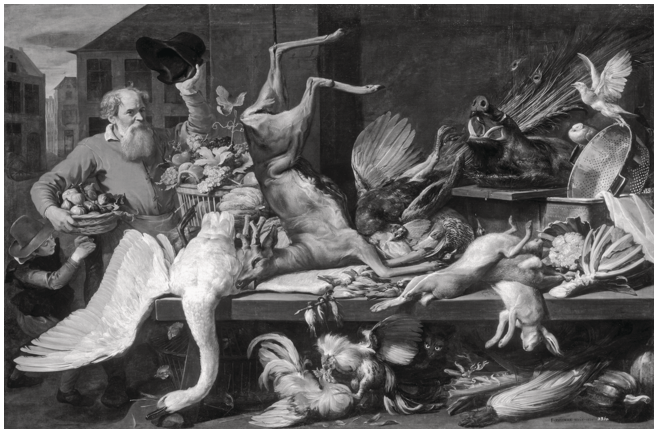
In contrast to a contemporaneous piece like Jacob van Hulsdonck’s Breakfast Piece (1614) (Figure 2.2), Snyders’s still life invites us not to the feast but into the process by which the lanx is prepared. This is a liminal site of cultural instability, in which the things that will ultimately “differ,” as Pope imagines it, have not yet been fully differentiated, and where the formal relations that make them “agree” have not yet been imposed. The pile of game indicates plenitude but also potential chaos, abundance in the form of grotesque bodily distortion. The combination of dead and undead creatures compels us to see the life that has been stilled by death, while the dynamics of the composition keep the image of stillness in aesthetic motion, bringing the liveliness of the viewer’s eye to bear restlessly on the (di)splayed bodies. The double meaning of “game” in this context brings rituals of play into tense proximity to rituals of violence: This is how an emergent imperial consumer culture practices death as a way of life.
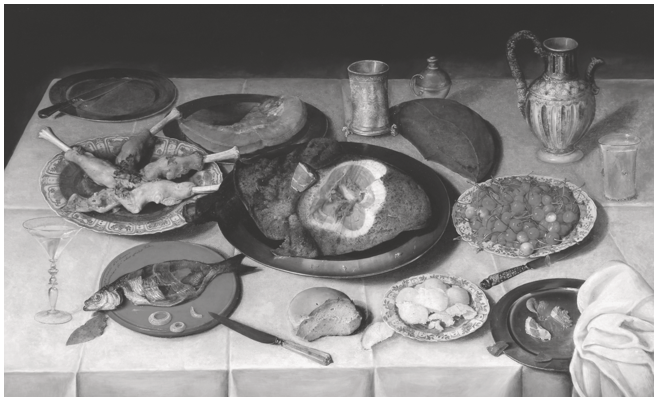
Many influential readings of still life’s relationship to literature of the long eighteenth century have focused on the way these early modern tableaux drain objects of prior meaning, wresting them from earlier regimes of allegory and installing them within a modern, empirical order of things. Thus, the argument goes, icons are systematically reduced to aesthetic and commercial specimens, a process consistent with various literary efforts to disenchant the material world through logics of empiricism.Footnote 91 Jonathan Lamb, for example, argues that seventeenth- and eighteenth-century still life artists “experiment with iconoclasm – stripping images of their coatings of liturgical or allegorical meanings until they are hollow, like their churches – in order to fashion idols whose sole content is the material and visible creature of which they are made.”Footnote 92 Bill Brown also identifies Dutch still life as “a genre devoted to exquisite surfaces. It establishes an aura that depends on distance, achieved by a finish that gives the objects a surface glow, eliciting wonder at the luxurious display … these objects are magnificently illegible, significant not because of what they mean but because of what they are.”Footnote 93 The “cultural thing[s]” that the still life offers “summon us,” Brown writes, “to a perpetual present”; “the material object is now frozen in the synchrony of cultural coherence.”Footnote 94 Stripped of secrets, such readings argue, still life objects become wholly available for visual consumption.Footnote 95
Bryson’s study of still life departs from such readings in order to emphasize the techniques by which still life counterintuitively sustains a dynamic of restlessness amid its offering, both figuratively and literally, of stillness. Crucial to this dynamic is the image’s preoccupation with the viscerality of cultural bounty – the furriness, fleshiness, slick or stiff or sensually pliant qualities of the organic materials that also yield the “glow” of luxury. The shiny surface of the painting indicates aesthetic polish, yes, but also evokes the viscous feel of wet scales, bursting fruit, exposed entrails. This haptic resonance, which breaches the visual distance Brown associates with finished surfaces, is closer to the painter’s own experience of the image as they create it through various messy efforts of the hand, crushing seeds and pigments together into paste, attending closely to the ever-changing balance of fluidity and fixity in the paints as they are applied, blended, layered, and coaxed into recognizable images. The resulting painting might be read as disavowing the processes of its own making, but that does not negate the fact that it is also simultaneously a record of those processes, a form of remembering them.
The cultural, in other words, is necessarily haunted by the creaturely. The visceral things of still life are a version of Walter Benjamin’s “ruins,” material things that reveal that human history and its meanings are themselves vulnerable to decay.Footnote 96 In the ruin’s decay, we witness the objects of human history being recalled into an alien order of things to which all beings belong, including human beings. Building on Benjamin, Eric Santner defines creaturely life as “a dimension of human existence called into being at … natural historical fissures or caesuras in the space of meaning.”Footnote 97 The creaturely is “ex-cited” by hollowed-out signifiers like ruins that continue to “signify to” us though they contain no message we could possibly understand. The flicker of creaturely life that remains animate in the still life image has an uncanny effect on the images described by Brown as “magnificently illegible, significant not because of what they mean but because of what they are,” by making it suddenly uncertain what they are. The creaturely marks the phrenes-like vibration between the visceral and the intellectual, the satyric and the satiric, in the phenomenological experience of illegibility. Reading the only surviving Greek satyr play, Euripides’s Cyclops, David Konstan shows how the satyrs represent a form of collectivity in tension with human sociability: Where human rituals of hospitality negotiate meaningful relations among men through the presentation of xenia, the satyrs introduce the drunken kōmos, which “dissolves the self into the group,” generating not “a truly social company, but the pre-social identification of the horde.”Footnote 98 Caught on the cusp of symbolization, the visceral contents of still life point in two directions simultaneously: to the possibility of formal arrangement, social order, and cultural plenty, on the one hand, and to the “undifferentiated community of the satyrs,” on the other,Footnote 99 the revelry that collapses social plurality into the grotesque horde or collective creature. These paintings find, in the crossing from nature to culture, what Derrida calls l’animot: “an irreducible living multiplicity of mortals … a sort of monstrous hybrid, a chimera waiting to be put to death by its Bellerophon.”Footnote 100
Walpole’s gothic similarly grapples for a form that registers the disruptive, unpredictable trace of animal life or spirit in the “still” or predesignated forms of cultural objects. The most familiar results of this experiment are the various tropes of “undeadness” that constitute the genres of horror descended from the eighteenth-century gothic: the mysteriously animated “inanimate” object, the flicker of life in the eyes of a portrait, and so on. But I am less interested in the gothic’s theory of haunting, about which much has already been written, than I am with its theory of visceral quickening, or satyr-ic play: Its understanding that the ludic gestures that invite a fellow being into a space of “unserious” engagement is an opportunity to exercise the animal being’s visceral intelligence, which, in the mode of play, is not oriented toward “how things are” or “must be,” but rather “how things aren’t,” which opens onto a gut feeling for “how things could be.”
When Massumi theorizes the ludic gesture to understand animals at play, he is attempting to think with literal nonhuman animals, or at least with writing about literal animals; he is interested in what animals do with each other. In comparison to human beings, he argues, animals have more routine access to “the force of the supernormal” – they don’t have to devise cognitive tricks to “suspend reality” as we say, but regularly inhabit a mode where visceral intelligence is mutually understood to be put toward inventive engagement where the normal life-or-death stakes of survival, and mandates of reproduction, at the flick of a gesture simply do not apply in the same way. “Far from being a mechanistic impulsion,” Massumi writes, the supernormal “is a passionate propulsion.”Footnote 101 Walpole is less concerned with the passions and propulsions of actual animals, human or otherwise, than with the material and atmospheric conditions that render “normal” desires and actions strange, or what Freudian theory calls uncanny. What happens, the gothic mode asks, when play is not something people initiate but what they unexpectedly find themselves participating in? What happens when life itself is exposed as ludic, and reality as ludicrous?
This is a different thought experiment than the carnivalesque fantasy of A Midsummer Night’s Dream or the paranoid postulate of The Truman Show, both scenarios in which what one took for reality is exposed to be a site of fiction in which reality is actively suspended. In The Castle of Otranto, there is no “waking up” or “snapping out” of an illusion in order to reenter the state of “things as they are.” The Walpolian gothic is much more like what happens to students studying critical theories of ideology for the first time, when the first flicker of ludic energy around a particular given reality – Roland Barthes’s take on professional wrestling or margarine, for example – agitates the entire cultural apparatus, and suddenly, often overwhelmingly, all “things as they are” are animated with the surplus energy of the supernormal.Footnote 102 Everything remains what it is, yet everything also means something – in fact, means too much, meaning whatever it is wrestling or margarine means in the newly exposed symbolic order and simultaneously meaning whatever it is it means that wrestling or margarine means that meaning in the confounding field of play that is our reality.
Instead of margarine, The Castle of Otranto famously confronts readers with a giant, homicidal helmet. In the opening scene, this mysterious disembodied head, making good immediately on the foreshadowing of the epigraph more literally that we might reasonably have expected, falls out of the air and crushes the young prince Conrad to death on his wedding day:
The first thing that struck Manfred’s eyes was a group of his servants endeavoring to raise something that appeared to him a mountain of sable plumes. He gazed without believing his sight. What are ye doing? cried Manfred, wrathfully: Where is my son? A volley of voices replied, Oh, my lord! the prince! the prince! the helmet! the helmet! Shocked with these lamentable sounds, and dreading he knew not what, he advanced hastily – But what a sight for a father’s eyes! – He beheld his child dashed to pieces, and almost buried under an enormous helmet, an hundred times more large than any casque ever made for a human being, and shaded with a proportionable quantity of black feathers.
The suit of armor is a conventional antiquity; yet, in this inflated and animated form, the helmet exceeds the formal parameters of a recognizable “historical object.” Ruth Mack suggests that “the problems of historical understanding posed by the helmet” manifest in a kind of critical embarrassment at the unseriousness of the story’s “novelties”: “by and large,” she writes, “The Castle of Otranto has been interpreted as a historical allegory because the tale’s absurdity has suggested to readers that if the story is to be taken seriously, its meaning must lie elsewhere, outside Otranto.”Footnote 103 More recent studies of Walpole and Otranto have significantly revised this long-standing assessment. Scholars including Louisa Calè, Sarah Tindal Kareem, Sean Silver, James Lilley, Crystal Lake, and Freya Gowrley, among many others, have provided invaluable nuance to our understanding of Walpole’s engagement with material culture, historiography, and epistemology,Footnote 104 while scholars including but far from limited to George Haggerty, Jill Campbell, Caroline Gonda, Matthew M. Reeve, and Emily West have drawn on various versions of queer theory and method to shift critical approaches to Walpole and Strawberry Hill away from heteronormative standards of the “serious” and “absurd.”Footnote 105
I think it worth revisiting the charge of Otranto’s unseriousness, however, in light of the politics of animal play. This well-known passage is the tale’s inaugural ludic gesture, the textual equivalent of the puppy’s bite that says, effectively, “Let’s put our energy into rehearsing what we are … and see what happens.” Of all the critical responses I have read, Cynthia Wall takes up this particular invitation most directly. Focusing her attention on “the proportionable quantity of black feathers,” she points out that these “less inherently dignified objects than helmets and swords … dominate much of Manfred’s relationship with the [novel’s] things in general.”Footnote 106 If there is serious drama or horror in this text, it is shot through with the comic energy of these recurring feathers on the helmet, which continue to wave and nod, “tempestuously agitated,” every time the enchanted helmet appears. Their refusal to be still, Wall argues, signals that the text intends us to recognize its distorted object-world as a series of “deliberately, satirically inflated grotesqueries.”Footnote 107
Much has been written about this helmet but not enough, I would argue, has yet been written about these feathers. As Dutch and Flemish still lifes remind us again and again, feathers are captivating for their liminal status between organic matter and aesthetic object, detritus of the kill and symbol of cultural order. As Manfred stands fascinated by the sight of “his child dashed to pieces, and almost buried under an enormous helmet, an hundred times more large than any casque ever made for a human being, and shaded with a proportionable quantity of black feathers,” he takes in a hybrid vision akin to these compilations, which lead the eye to circulate from organic remains to cultural icons to objects like shells and feathers that are both in one. Viewing these tableaus feels, in my experience, much as I imagine Manfred feels in the tale’s opening moment, the mind straining as the eye moves in its restless circuit among the disparate details to arrive at the conceptual unity that will make the sight make sense.
This is precisely the game Sarah Tindal Kareem identifies in Otranto. Kareem’s reading provides a detailed account of how the tale presents “information gaps that stimulate suspense [in order to] activate the reader to imaginatively unify the aesthetic object.”Footnote 108 This experiment in epistemologies of wonder relies precisely on what Massumi calls the ludic’s “logic … of mutual inclusion,” by which “two different logics [in the case of puppies, combat and play] are packed into the situation. Both remain present in their difference and cross-participate in their performative zone of indiscernability.”Footnote 109 In Kareem’s analysis, Otranto strategically generates experiences of uncertainty and captivation in order to hold them in mandatory relation with the seemingly incongruous mechanisms of critical assessment. It “solicits suspense at the level of plot,” Kareem writes, “but also suspense between engrossment and reflection.”Footnote 110 The point of the experiment is to generate fictionality itself as a field of meaning whose epistemological contradictions are not culturally disruptive – in other words, to establish the conditions under which we can experience things as both “really happening” and “not really happening” simultaneously. In its version of the logic of mutual inclusion, the Walpolian gothic addresses itself to an epistemologically “split subject”: “a reader who both literally believes and merely ‘imagines the possibility’ of literary representations.”Footnote 111
One of Walpole’s main strategies for addressing this “split subject,” Kareem shows, is “his use of an offbeat aesthetic that critics have variously described as ‘the odd’ or the ‘off’” – and that I am now calling the “funny.”Footnote 112 Noting that “the Critical Review singles out for its ‘absurdity’ the moment when Manfred ‘beheld his child dashed to pieces, and almost buried under an enormous helmet,’” Kareem observes that “the whiff of the absurd likewise attends many other instances, such as the notion that Theodore should be ‘kept prisoner under the helmet itself’; the supposedly ominous twitching of the feathers on the helmet; or the image of ‘A hundred gentlemen bearing an enormous sword, and seeming to faint under the weight of it.’”Footnote 113 Walpole “deliberately courts” a form of animal laughter – what Fielding calls the “horse-laugh” – with this “abundance of moments teetering awkwardly between pathos and bathos.”Footnote 114 Kareem’s reading emphasizes the way laughter serves to break the spell cast by fictional suspense, generating a reading experience in which belief can be indulged, and enjoyed, because a safety net of disbelief has been activated. Yet part of the reason eighteenth-century fiction devoted so much energy to such epistemological arrangements is because the subject animated by various theories of the understanding, the imagination, and the sensibilities contains “animal spirits” that only generate rational subjectivity within systems of disciplinary calibration and management. The “horse-laugh” may function, by Horatian logic, to disenchant the spell cast by gothic grotesqueries; but Walpole’s distorted invocation of Horace on laughter reminds us that, by the logic of mutual inclusion, the grotesque may simultaneously undermine the security of a satirical perspective. The ambivalence of the animal component of the human means that Otranto provokes a laughter at once reassuring and unsettling.
As an emblem of this recurrent ambivalence of both meaning and affect, the feathers on the helmet embody the tale’s commitment to presenting familiar objects in unexpected relation to one another. It is, in this way, as much an experiment in form as it is in epistemology. The preface to the first edition of Otranto asserts that the story contains “no bombast, no similes, flowers, digressions, or unnecessary descriptions. Everything tends directly to the catastrophe. Never is the reader’s attention relaxed” (60). As Susan Bernstein points out, “Anyone who has read The Castle of Otranto would be hard pressed to ratify this description. In fact it is largely an exercise in digression and interruption. The whole story might be read as a digression from what Walpole asserts is the story’s ‘moral.’”Footnote 115 But the ludic mode helps us understand the form of “directness” Walpole has in mind, not by resolving the contradiction between the direct and the digression, but through the logic of mutual inclusion. How might narrative “digression” and “directness” both “remain present in their difference and cross-participate in their performative zone of indiscernability”? Walpole attempts it by rendering a tale in which flourishes like bombast, similes, flowers, digressions, and unnecessary descriptions – all elements that may “sink” a text, the Scriblerians warned, if not expertly managed – are presented as something other than ornaments, the only status under which classical form permits them. Ornamentation is, as Frances S. Connelly has shown, the designated site in classical and neoclassical aesthetics for the grotesque, which was included strictly in a formally subservient role to primary structures and arguments that must conform to rules of logic and proportion. Walpole’s claim that there are no “digressions” may be interpreted as an assurance that there are no ornaments in the gothic story, no supplements to the path to “catastrophe”; that every object, every oddity is directly relevant to “what is really happening.” Each absurdity presents itself less as a form of comic relief in this arrangement than as a puzzling and disorienting prompt – a demand that the reader’s attention gather itself unexpectedly and make whatever dizzying turn comes next in the movement to conclusion.
Walpole thus imagines the relationship between his story and its reader in quite the same terms in which Massumi describes two animals at play. Puppies in ludic combat, too, enter into this exercise under the agreement never to relax one’s attention, because the whole point of the exercise is to learn what every minute gesture, what every unexpected movement means. The point is to become fluent in the unexpected – not in the sense of mastery, of already knowing what everything is and what is about to happen, but in the more visceral sense of fluidity of posture while the attention stays unrelaxed. The objective of such fluency also adheres to a logic of mutual inclusion: It is both to be able to defend oneself against actual assaults and survive violent conditions that one is likely to encounter, and to be able to exercise these life-or-death skills in a way that does not vanquish the other, and does not reproduce in the present moment the conditions of violence that one nevertheless prepares for. In the ludic mode, the other is simultaneously enemy and partner, stranger and kin. Read as a ludic genre, the gothic can be understood as a training ground for the kind of radical hospitality toward the unknown and unfamiliar described by Derrida: “To be hospitable is to let oneself be overtaken, to be ready to not be ready, if such is possible.”Footnote 116 Otranto models one embodiment of such a state in the “tempestuously agitated feathers,” which, in their state of perpetual unstillness, demonstrate how one remains sensitive to the tiniest shifts in the air in the room, the atmospheric currents that can alert us to what is present, what is imminent, and what is possible.
Intermission
One of my anonymous peer reviewers helpfully suggested that this long Part 2 might include some “breathing space,” perhaps in the form of a “halftime” in the ludic play, to keep the reader’s attention fresh for whatever is yet to come. I encourage you to put the book down now if you could use a break, and to come back whenever you feel like it.
Flesh and Blood at Sea
Walpole dedicated the second edition of The Castle of Otranto to his friend Lady Mary Coke, with the “Sonnet to the Right Honourable Lady Mary Coke”:
Whereas the prefaces frame the “gothic story” through masculine discourses of antiquarianism and literary criticism, this dedication appeals instead to feminine sentiment and sensibility. Lady Mary’s tears, pitying breast, and smiles are all called upon to endorse the “marvels” of Otranto, protecting them from “reason’s peevish blame” through unconditional sympathy and tenderness. This appeal is as overtly performative as any of the text’s other gestures; one can hear the droll equation of her generous sympathies with her smile’s capacity to bestow “fame.” Yet even read as a specimen of mock-gallantry, this sonnet activates a vocabulary of gendered, sensible embodiment that participates in Otranto’s ludic representation of human experience. It also encourages the reader to envision the gothic literary experiment as a flirtation with sinking: the ominous rhyme of “tale”/“fail” in the first stanza is met, in the third, by “dauntless sail”/“Fancy’s gale,” a pairing that enhances the risk Walpole takes as author of this strange story, raising the stakes of that risk to those of ships embarking on stormy seas.
Otranto’s juxtaposition of ludic gestures and conventional forms of gendered sensibility stages an encounter between different modes of human frailty. Eighteenth-century literature’s association of fragility with feminine forms is well documented, particularly in scholarship on tropes of porcelain, glass, and other fashionable frangible materials to depict femininity – ambivalent metaphors for both the aesthetic value of delicacy and whiteness in women and the vulnerability of white women to ruination, whether moral, physical, or social. Feminine “brittleness” consolidates a particular set of vulnerabilities experienced across vastly different social stations by unifying them under the sign of gender: From Pope’s high-society Belinda to Swift’s intrepid sex workers, all white women are assigned a certain aesthetic value that is defined by material precarity. These logics posit fragility and the kind of care-taking it mandates as modern conditions at a particular intersection of race and gender – one that, as Laura Brown, Felicity Nussbaum, Lynn Festa, Tricia Matthew, and others have shown, structures the nascent domestic household in which heteronormative modes of self-fashioning transform the material spoils of empire into the tasteful materials of a respectable English life, by requiring women to take responsibility for shielding themselves and their households from the ever-present threat of damage.Footnote 118
The “pitying breast … tender, tho’ firm” of Walpole’s dedicatory sonnet presents an alternative mode of feminine embodiment consistent with emergent discourses of sensibility: instead of a brittle body on display like fine china, a pliable cushion offering comfort to those who suffer, one capable of melting in sympathy without compromising her physical or subjective composure. In contrast, it is the body of the young prince that proves susceptible to physical destruction. As Manfred “beh[olds] his child dashed to pieces,” he responds with fascination rather than distress, a reaction flagged for its oddity by the narrator through the gory detail of Conrad’s corpse:
The horror of the spectacle, the ignorance of all around how this misfortune had happened, and above all, the tremendous phaenomenon before him, took away the prince’s speech. Yet his silence lasted longer than even grief could occasion. He fixed his eyes on what he wished in vain to believe a vision; and seemed less attentive to his loss, than buried in meditation on the stupendous object that had occasioned it. He touched, he examined the fatal casque; nor could even the bleeding mangled remains of the young prince divert the eyes of Manfred from the portent before him. All who had known his partial fondness for young Conrad, were as much surprised at their prince’s insensibility, as thunderstruck themselves at the miracle of the helmet. They conveyed the disfigured corpse into the hall, without receiving the least direction from Manfred.
Augustan poetics of feminine fragility, vacillating by design between material referents and allegory, cultivate a semiotic intimacy between white women’s selfhood and their material accoutrements: The ominous “tottering” of Belinda’s china in The Rape of the Lock, for example, emphasizes that for either the porcelain or its mistress to be physically compromised would be metaphysically disastrous.Footnote 119 Conrad’s problem, by contrast, is not that he is too much like the objects affiliated with him, but that he is ludicrously incongruous to them, the massive weight of the outsized helmet that represents his patriarchal inheritance pulverizing him upon first contact. The unraveling of the period’s painstaking poetics of subject-object relations, by which things and persons become meaningful to and in relation with one another, places Manfred in the tale’s opening posture of hermeneutic suspense, which shifts the literary text from a disciplinary mode bent on preservation to a more disorganized mode of melancholic fantasy preoccupied with what cannot be saved. What kind of a future is possible, Otranto asks, when the patriarchal body is revealed to be as vulnerable as any other to being “dashed to pieces”?
Narratively, Otranto is far more interested in what comes apart than in what comes together, and, in contrast to contemporaneous moral fables, it wastes little energy considering the question of disgrace, reveling instead in the topoi of material ruins and remains. What was the status of beings “dashed to pieces” in the literary imagination of eighteenth-century British readers? A survey in Eighteenth-Century Collections Online of things “dashed to” or “dashed in pieces” during the eighteenth century reveals some interesting trends.Footnote 120 People are “dashed to pieces” by being thrown off cliffs onto rocks, as in the murders of Aesop by the DelphiansFootnote 121 and Theseus by Lycomedes,Footnote 122 and Oliver Goldsmith observes that Beachyhead, “the highest cliff of all the fourth coast of England,” is the grim site where “hares closely pursued, have tumbled over the edge of this precipice, with a hound or two after them, and have been dashed to pieces.”Footnote 123 The beloved pet squirrel belonging to Haywood’s Miss Betsy Thoughtless is “dashed to pieces” against the marble fireplace by the vile Mr. Munden,Footnote 124 and Dacier’s footnotes to the Iliad, translated in Pope’s version, reminds us of biblical reports of infants being “dashed in pieces” during sieges by “barbarians.”Footnote 125
Each of these examples invokes Eric Santner’s notion of the creaturely as that which is called into being by sovereign jouissance, or “an outlaw dimension internal to the law,” where absolute power, whether of nature, tyrants, or conquerors, is confirmed by an ability to dictate the life and death of subjects in uninterpretable terms.Footnote 126 Collectively, this archive of references serves to remind readers that living bodies, both human and nonhuman, having been made by some greater power, can always be unmade. That which is created is inherently vulnerable to being destroyed. Moreover, the creaturely points to material realms beyond cultural order. The blasting of a creature does not result in a corpse that may receive its own set of rites establishing its place in the order of things.Footnote 127 Instead, it generates less legible ruins, materials that culture cannot readily digest. In Pope’s Iliad, Priam imagines that after his city has been sacked and burned, his daughters raped, and his “bleeding infants dash’d against the floor,” he himself, “The last sad relick of my ruin’d state, / (Dire pomp of sov’reign wretchedness!) must fall, / And Stain the pavement of my regal hall; / Where famish’d dogs, late guardians of my door, / Shall lick their mangled master’s spattered gore.”Footnote 128 The living body’s vulnerability to being “dashed to pieces” is a reminder that we are made of more than we can know or even claim as “us” – that what is meaningful in us dwells in the same material that is mere carrion. On the one hand, this insight opens onto the horrifying possibility that, when we fall by the sword, we end up, in the words of the King James Bible (and indie band Rilo Kiley), “portions for foxes.”Footnote 129 On the other, it opens equally onto the more hopeful possibility that, as Walt Whitman sings from the Americas in the following century, the so-called individual actually “contains multitudes.”Footnote 130 The fatal distortion of patrilineal reproduction – the spectacular thwarting of its particular future beheld in Conrad’s “bleeding mangled remains” – renders possible multiple other futures, as well as the future viability of untold multitudes. Our viscera hosts our own pleasure and pain, our laughter and disgust, for a time, but it also belongs to a larger material economy beyond our control or comprehension.
In the survey of things “dashed to pieces” in the eighteenth century, the overwhelming majority of instances occur at sea. Ships and their contents appear to the be most vulnerable to this particular fate, routinely reduced to rubble by violent waves, unavoidable rocks, and deadly whirlpools. The threat is ever-present where sea meets shore, whether off the coast of England, in the Caribbean, the Pacific, the Mediterranean. A 1750s translation of Jacques Savary’s Universal Dictionary of Trade and Commerce describes the famous “Maelstrom” off the coast of Norway, also known as Umbilicus Maris, the Navel of the Sea:
Several authors give the following description of it: it is, they say, fatal to ships that come too nigh in the time of flood, when the sea, for two leagues round, forms such a terrible vortex, that it swallows up everything that comes near it; and during the six hours of ebb, it throws out the water with such violence, that the heaviest bodies cannot sink if thrown into it, but are cast back again by the impetuous streams. Vessels swallowed up by this whirlpool are cast up again shattered to-pieces, being dashed against the rocks within it.Footnote 131
When it dashes things, people, plans, and hopes to pieces, the sea reveals itself to be the embodiment of grotesque energy itself: the relentless topsy-turvy of it, the way it perpetually overturns the distinctions and boundaries that keep things where, and what, they are. What once stood falls; what should sink is cast up. Expected to carry a craft of sailors, the sea turns vortex and swallows it, then purges it, instead. The navel of the sea goes through all the embodied gestures of birth, but in order to take life back rather than bring it forth. The fluidity of waves collaborates with the rigidity of rocks to reduce bodies to wreckage. If “to dash” is to send something – even yourself – hurtling off suddenly at great speed, to be dashed is to find oneself hurtling by an alien force in unfathomable directions, toward unimaginable destinations, where you arrive, more often than not, in a form that is no longer you at all.Footnote 132
There is more to say about the symbolism of oceanic uncertainty than I can accommodate in this piece; my purpose here is to show how Walpole’s gothic literary experiment taps into an oceanic imaginary more than is generally recognized. In reimagining the castle as a site of genealogical suspense, infested with agitated spirits intervening in the lived trajectories of the present occupants, Walpole deliberately disorganizes the landed space of patrilineal reproduction by drawing on the sea’s capacity to seize the reins of mortal possibility. Daniel Pell’s Reference Pell1659 religious treatise to mariners, Pelagos, signaled in its subtitle the biblical notion of the sea as a liminal space between life and death: Nec Inter Vivos, New Inter Mortuos, Neither Amongst the Living, nor Amongst the Dead (a reference to the nautical verses of Psalm 107). The sea, Pell reminds his readers, demands both unceasing vigilance and capitulation to mortality:
Bee ever and anon looking for some sublunary and temporary accidents of other befalling of your ships, they are out in the Sea, where there is a million of dangers, and not in the Harbour. I would have you of the like resolution that Anaxagoras was of, of whom it was said, when news came to him that his son was dead, that he told the messenger, he knew full well that he had begot him mortal. Conclude you in the like manner, that your ships, the very best, and strongest of them, are but made up of wasting, and frangible materials.Footnote 133
At sea, the distinction between life and death itself become fragile, as it is flexed into strange orientations and temporalities that open sites of being that are neither “here” nor “there.” Psalm 107 echoes the reputed quip of the Greek philosopher Anacharsis, who, “When someone inquired which were more in number, the living or the dead, … rejoined, ‘In which category, then, do you place those who are on the seas?’”Footnote 134 The frangibility of both the visceral materials that carry life and the cultural materials that memorialize death opens onto some unfathomable elsewhere where the rules of possibility are uncharted.
The classical versions of this oceanic imaginary had been centered on the Mediterranean, but by the time Walpole was writing, British contemplations of the perils and promises of sea voyage, both material and metaphysical, moved fluidly between Mediterranean figurations and transatlantic ones. Such endeavors to think with the sea are therefore inextricable from efforts to generate the grammars of race that, as Hortense Spillers influentially argues, cut across the grammars of gender that organize colonial domesticity and, by extension, imperialist conceptions of the human. In In the Wake: On Blackness and Being, Christina Sharpe reclaims these bodies of water – bodies both physical and conceptual, both historical and theoretical – for the vital practice of “wake work,” a “method of encountering a past that is not past … along the lines of a sitting with, a gathering, a tracking of phenomena that disproportionately and devastatingly affect Black peoples any and everywhere we are.”Footnote 135 The myriad and unrelenting violences that have conditioned Black being since the institution of the transatlantic trade in enslaved African people in the long eighteenth century have rendered Blackness, as a mode of being within colonial conditions, a version of being perpetually at sea, neither amongst the living, nor amongst the dead. For Sharpe, this is undeniably a state of peril and extreme vulnerability, but it is also a state of hope in its indeterminacy. “In the midst of so much death and the fact of Black life as proximate to death,” Sharpe writes, “how do we attend to the physical, social, and figurative death and also to the largeness that is Black life, Black life insisted from death?”Footnote 136 Wake work, as a method for “insist[ing] Black life from death,” entails versions of training the imagination along the lines of the gothic experiment initiated by Walpole. “How does one, in the words so often used by [national] institutions, ‘come to terms with’ … ongoing and quotidian atrocity?” Sharpe asks. “I’m interested,” she continues,
in ways of seeing and imagining responses to terror in the varied and various ways that our Black lives are lived under occupation; ways that attest to the modalities of Black life lived in, as, under, and despite Black death. And I want to think about what this imagining calls forth, to think about what it calls on “us” to do, think, feel in the wake of slavery – which is to say in an ongoing present of subjection and resistance; which is to say wake work, wake theory.… In what ways do we remember the dead, those lost in the Middle Passage, those who arrived reluctantly, and those still arriving? To quote Gaston Bachelard, whom I arrived at through Elizabeth DeLoughrey’s “Heavy Waters,” “water is an element ‘which remembers the dead.’”Footnote 137
The connections between the Atlantic Middle Passage and the Mediterranean are more than symbolic; as Sharpe observes, “The Mediterranean has a long history in relation to slavery.”Footnote 138 This history is ongoing and unrelenting. Over the past decade, in particular, Sharpe observes, “the ongoing crisis of capital in the form of migrants fleeing lives made unlivable is becoming more and more visible, or, perhaps, less and less able to be ignored.”Footnote 139 In their analysis of the racial capitalist logics of Mediterranean policing, P. Khalil Saucier and Tryon P. Woods point out that
Antiblack violence in the Mediterranean basin has its roots in the earliest racial slave trade in which Italian merchants funded Portuguese raiders across the Mediterranean Sea and down the Atlantic coast of Africa. The wealth built by the Italians from the early slave trade in Africans bankrolled the subsequent “voyages of discovery” that further established Portuguese and Spanish dominance of the Mediterranean and Atlantic coasts.Footnote 140
Every death in the course of migration across these waters is both an individual tragedy, raw and immediate, and an iteration of this deep history of the racial capitalist colonial world-system.
Gothic writing’s commitment to disordered temporalities, heterotopic spaces, and liminal states of being suits it to projects like wake work that address “ongoing and quotidian atrocity,” the compounded and overdetermined dynamics of systemic violence, and the urgent necessity of insisting life from death. Its ludic spirit is not a disavowal of the horrors of violence; it is a way of conditioning the encounter with horror to make it survivable. The gothic’s lively way of considering death, in other words, is a method for remembering that even in the face of atrocity, life – and better ways of living – remains possible. Dionne Brand’s Ossuaries (2010) offers a theory in verse of how a gothic imagination performs wake work by insisting on the reality, including the lived reality, of the culturally unimaginable: “they ask sometimes, who could have lived, / each day, / who could have lived each day knowing // some massacre was underway, some repression, / why, anyone, anyone could live this way, / I do, I do.”Footnote 141 Yet the question of how anyone can “live each day knowing” is a more difficult one to answer. Arguably, every breath of Brand’s poetry is an answer to the question of how: In her book Inventory (2006) she describes the attentions of her poet as “a vigil for broken things,” one that sustains incantations of the energies that surge, irreverent and animate, through empire’s detritus.Footnote 142 Earlier in Ossuaries, I find another answer to the question of how – a formulation of hope: “gravity must give up its hold on us,” the poet insists, “surely, gravity the jail guard, the commandante / of surfaces, / might relent someday, unpin us.”Footnote 143 Brand’s belief in the possibility of gravity relenting resonates with Walpole’s retooling of bathos into gothic ludicism, suggesting that the “art of sinking” offers, paradoxically, a method for defying the “jail guard” of imperialist gravity.
The Castle of Otranto’s opening provocation – the confrontation of its reader with the “bleeding mangled remains” of atrocity that Manfred is incapable of attending to – remains, in this sense, a crucial invitation to focus, anamorphically, on the “broken things” and cultural ruins generated by the narratives and operations of imperial world-making. It is an invitation to refuse to disregard empire’s “broken things,” that which has been dashed to pieces, that which has survived in unrecognizable form. In a 2015 article, “The Gothic Mediterranean: Haunting Migrations and Critical Melancholia,” Laura Sarnelli shows how the melancholic formulations of the gothic genre – hauntings that insist in their own way on Sharpe’s “past that is not past” – are crucial to contemporary efforts to grapple with the violence of “Fortress-Europe”: the
system of border patrol and controls … which solidifies the Mediterranean Sea by creating invisible administrative walls and frontiers, all while preaching the “free market.” In doing so it discards that which it cannot host and assimilate, relegating immigrants, the ones who survive, to the so-called “Centres for Identification and Expulsion.” There, they become even more vulnerable as they are disowned and have no rights, and can be legally detained for an indefinite amount of time.Footnote 144
What the international news cycle calls the “migrant crisis” is actually a representational crisis for liberal humanism premised on racial capitalism: The Mediterranean has become a site where the dead, the systemically killed, refuse to disappear. Sarnelli argues for the gothic’s melancholic rehearsals of loss as a form of political commitment to honor lives framed as ungrievable, but also to acknowledge the conditions that so framed them. Focusing especially on work by African Italian women, she posits the Mediterranean as a distinctly gothic site of unerasure, where the quotidian violences of empire refuse to be washed away and, in so doing, demand to be acknowledged and accounted for.
Walpole, of course, had none of this in mind when he penned The Castle of Otranto. In a 1788 letter to his friend Sir William Hamilton, British ambassador to the Court of Naples, Walpole claimed that he selected the town of Otranto as the setting for his tale arbitrarily, consulting a map of Naples and liking the sound of it.Footnote 145 A friend had written, decades after Otranto’s publication, to inform him that there actually was a castle of Otranto, enclosing a washed drawing by Willey Reveley (Figure 2.3); Walpole asked Hamilton to confirm, which he did: “You may be very sure that the Castle of Otranto does exist,” he replied, “and is not a castle in the air.”Footnote 146 Reveley’s drawing does capture the solid reality of the castle, but retains a sense of its being “in the air” or, more accurately, suspended between sky and sea. The same might be said of the early sixteenth-century depiction of Otranto by Ottoman cartographer Piri Reis (Figure 2.4).Footnote 147
Willey Reveley, S W View of the Castle of Otranto, Italy, 1785.
Piri Reis, map of Otranto, in the Kitab-ı Bahriye (Book of Navigation), 1526.
The historical site of Otranto may have hovered in the margin of a British imagination centred in Twickenham, but it was itself located at the center of the Mediterranean world, on the easternmost tip of Italy, the famous site where Greece almost touches Rome but for a ribbon of water, and the site of a citywide massacre by advancing Ottoman forces in 1480, the 800 martyrs of Otranto reputedly preventing the Turkish colonization of Italy by their sacrifice. The Mediterranean world – where East doesn’t meet West so much as they wash into one another, whether at a crash or a lull – is, as its name indicates, a world in which land and sea are not easily distinguishable from one another. At its heart, the city of Otranto hovers, indeed, between fiction and history, water and earth, mortal wreckage and enduring mythology. The ancient Greeks named this place Hydros – a place to land, yet a creature of water.
The technique Walpole describes for how he came to locate his tale in Otranto is consistent with his broader ludic method of collection and creation. Yet his letter to Hamilton is also consistent with Walpole’s lifelong technique of representing himself as a devotee of such methods, which might be interpreted as its own kind of ludic gesture, a habitual disavowal of the labors of individual endeavor in favor of a mythos of dream-worlds, serendipity, and funny coincidences. Southern Italy was of much more sustained interest to him than his anecdote indicates, as Hamilton himself would have known as Walpole’s longtime correspondent and informant on all things Neapolitan. Whether by design or by accident, the actual Otranto is a perfect site for thinking, as Walpole’s gothic story attempts to do, at the edges of the Roman classicism revived in Augustan England, where it gives way to some of the noisier, messier, wilder styles associated with ancient Greece. And it is also a remarkably apt setting for the gothic work of “cultural exhumation” – a phrase used by Sarnelli to describe Brand’s work in OssuariesFootnote 148 – considering its reliquary of the Otranto Martyrs, which preserves in plain sight the remains of the hundreds of corpses that performed, and absorbed, the grim work of sustaining a boundary between Eastern and Western, Muslim and Catholic, worlds.Footnote 149
That Walpole dreamt so brazenly of an impossible castle on this site only to find his vision returned to him as a solid reality two decades later is a suitably uncanny epilogue to his gothic story. In contrast to neoclassical satire’s disciplining of the possible, gothic storytelling upturns the orientations of narrative possibility. The Castle of Otranto dwells deliberately in the pelagic space of fiction, which, like the sea, contains beings who are “neither amongst the living, nor amongst the dead,” yet are undeniably here, though where here is remains indeterminate. The arrival of the “real castle of Otranto” at Strawberry Hill reveals the fluid enfolding of fictional worlds and material ones – the way they take each other in and deliver each other forth in waves of mutual transformation that defy linear measures of cause and effect. Unlike the strictly organized, mutually sustaining intimacies of subject and object, text and context, signifiers and signifieds in other modes of writing, the gothic risks the suspensions of logic that bring things to transformative ruin – The Tempest’s “sea change” of the body of the father, “full fathom five,” “into something rich and strange.”Footnote 150 By taking this serendipitous cue to attend more carefully to the story’s Mediterranean imagination, we position ourselves to better understand how gothic topoi are conditioned by pelagic erosions and transformations of cultural forms, by the forms and scales of violence that have always attended imperial world-making, and by the question of how we frangible, mortal beings might understand ourselves not as disasters waiting to happen, but as arrangements of pieces of something much vaster than a self, pieces that continually flex themselves into new and astonishing shapes.
The ludic dynamic of the gothic experiment is crucial to gothic fiction’s capacity to narrate the “unimaginable” in ways that refuse, or fail, to disavow the potential reality of such fantastic – and horrific – events. The pelagic space of fiction, as Spillers reminds us, corresponds to literal lived realities that cannot be accommodated by the colonial grammars of identity and history:
Those African persons in the “Middle Passage” were literally suspended in the “oceanic,” if we think of the latter in its Freudian orientation as an analogy for undifferentiated identity: removed from indigenous land and culture, and not-yet “American” either, these captive persons, without names that their captors would recognize, were in movement across the Atlantic, but they were also nowhere at all.Footnote 151
In her foundational theorization of how gendered selfhood disintegrates within the racialized conditions of enslavement in early America, Spillers calls attention to a passage from Olaudah Equiano’s Interesting Narrative (1789) that clearly draws upon the gothic lexicon Walpole introduced into English writing:
[The sea, the slave ship] filled me with astonishment, which was soon converted into terror, when I was carried on board. I was immediately handled, and tossed up to see if I were sound, by some of the crew; and I was now persuaded that I had gotten into a world of bad spirits, and that they were going to kill me. Their complexions, too, differing so much from ours, their long hair, and the language they spoke (which was different from any I had ever heard), united to confirm me in this belief.Footnote 152
Equiano’s “astonishment” is distinct from the posture of fascination in its explicit immersion in terror. In Otranto, Manfred is not “astonished” by the “tremendous phenomenon” of the helmet that kills his son, merely “buried in meditation,” “insensible” to Conrad’s “disfigured corpse,” which must be removed by the servants (75). Isabella, however, is astonished when Manfred approaches her with the inconceivable sexual proposition that she marry him in place of his son:
Dry your tears, young lady – you have lost your bridegroom: yes, cruel fate, and I have lost the hopes of my race! – but Conrad was not worthy of your beauty. – How! my lord, said Isabella; sure you do not suspect me of not feeling the concern I ought? My duty and affection would have always – Think no more of him, interrupted Manfred; he was a sickly, puny child, and heaven has perhaps taken him away that I might not trust the honours of my house on so frail a foundation. The line of Manfred calls for numerous supports. My foolish fondness for that boy blinded the eyes of my prudence – but it is better as it is. I hope, in a few years, to have reason to rejoice at the death of Conrad. Words cannot paint the astonishment of Isabella.
It takes a few more lines of dialogue before Isabella catches on to Manfred’s plan to wed her himself; her astonishment lands, like Equiano’s, in a moment of profound disorientation. Where he stands astonished at the breadth of the sea and the unfathomable proportions of the slave ship, she stands astonished at the incomprehensible expressions of a man she understands as a father. Both scenes invoke astonishment as a response to the dissolution of recognizable forms of familial relation and kinship. As Spillers argues, Equiano’s Narrative makes it “stunningly evident … that Africans [in the mid-eighteenth century] were not only capable of the concept and practice of ‘family,’ including ‘slaves,’ but in modes of elaboration and naming that were at least as complex as those of the ‘nuclear family’ ‘in the West.’”Footnote 153 His introduction to the “world of bad spirits” on the slave ship marks his entrance into the “patterns of dispersal” that violently render “‘kinlessness’ as a condition of enslavement.”Footnote 154 For Isabella, Manfred’s cruel disregard for his dead son literally disrupts the syntax of sensibility by which she makes sense of her own place in the family: her “concern,” sense of “duty,” and “affection” that would have bound her to the family as Conrad’s wife are obliterated in Manfred’s new plot to preserve “his race.” And in both cases, astonishment gives way to “terror” as the incomprehensible world, in which fundamental human relationships are in disarray, descends as a material reality in the form of physical, embodied captivity: for Equiano, his being “handled, and tossed up to see if I were sound, by some of the crew,” and then seeing “a multitude of black people of every description chained together, every one of their countenances expressing dejection and sorrow,” a sight that leaves him “quite overpowered with horror and anguish”;Footnote 155 for Isabella, when Manfred seizes her, exclaiming that “my fate depends on having sons, – and this night I trust will give a new date to my hopes” – words that leave her “half-dead with fright and horror” (80).
I make this comparison not to claim that the violences visited upon Isabella and Equiano in these scenes are identical or even equivalent, but rather to argue that Equiano, in order to represent the experience of enslavement to a British readership, draws on a gothic vocabulary initially designed to imagine an emergent form of sexual violence in the eighteenth century, one that disregards the particular sensibilities and desires assigned to gendered bodies. In doing so, Equiano’s Narrative makes legible that the racism instituted by the transatlantic trade in enslaved African people is an assault not only on the humanity of individual persons but on the integrity of the kinship networks in which humanity is exercised, confirmed, and experienced – the problem addressed by Walpole’s gothic as well as many other genres of eighteenth-century British fiction. Conversely, the Narrative also reveals that the sexual threat posed by Manfred and other patriarchal villains of eighteenth-century fiction is informed by emergent systems of racial difference. When Manfred appeals to “the hopes of my race,” he uses the term in the older sense of “a group of people belonging to the same family and descended from a common ancestor; a house, family, kindred,”Footnote 156 but by placing it in tension with Isabella’s feminine sensibility, the text allows the term to pivot into a new economy of subjectivity and social relations organized around the problem of reproducing whiteness.
Gothic terror, in other words, has always been intersectional. It is registered in bodies that find themselves severed, in Spillers’s terms, from their “motive will,” their “active desire,”Footnote 157 under symbolic and material orders in which they have no place from which to exercise personhood. As race and gender emerge in concert to reorganize a culture whose existing arrangements of property and descent are insufficient to the demands of colonial expansion, they furnish literature with the forms that must be grappled with in the effort to regain the semiotic bearings that make social order and selfhood possible. Such literary grappling, for all that it may occasionally reinforce new hegemonic formations, also generates the myriad departures, failures, and oddities that appear as forms of deviance within an emergent cultural order. Jason Farr has shown how Otranto’s oblique focus on the figure of Conrad – a male heir whose incapacity to reproduce patrilineage is overscripted in his “sickly” constitution, the implied queerness of his inability to “value” the “beauties” of Isabella, and his being dead (and possibly, as the domestic servant Bianca believes, a ghost) – ultimately reveals “the inherent problem of compulsory heterosexuality and health that undergirds the system of primogeniture.” Though he is “dashed to pieces” at the outset, “Conrad’s presence is never eradicated from the plot,” Farr writes, “and in this we observe his crip haunting of heteronormativity.”Footnote 158 As a result of this haunting, Manfred’s desperate efforts to consolidate, in himself, both a traditional form of aristocratic masculinity based on patrimony and an emergent form of masculinity based on physical vigor and competitive virility fail precisely because of their desperation, which Walpole writes in a tone of bombastic hysteria that compromises both kinds of patriarchal authority.
Manfred’s own heterosexuality is rendered unnatural by its being a political strategy, rather than a manifestation of personal feeling. It is, from the outset, fated to be a failed project. Otranto presents Manfred’s disregard for the gendered economies of feeling that bind people meaningfully to one another through sympathy, obligation, and desire as evidence of his inhumanity; the tale thus pits the stirrings and softenings of sensible human bodies against the strictures of patriarchal tyranny in a contest for authority over cultural reproduction. Yet unlike the domestic or courtship novel, the gothic doesn’t expend much energy yearning for straight plots; heterosexual feeling never rises to the level of a solution to problems of violence and suffering in the gothic tale, because the gothic dwells in violence rather than trying to resolve it. In fact, in Walpole’s follow-up drama, the 1768 play The Mysterious Mother, heterosexual desire becomes ground zero for gothic derangements of the family in a plot that hinges on mother-son incest – it is the problem. In both of Walpole’s gothic fantasies, as George Haggerty observes, “terror is almost always sexual terror, and fear, flight, incarceration, and escape are almost always coloured by the exoticism of transgressive sexual aggression.”Footnote 159 Sexuality, for Walpole, is not a solution to patriarchal failures but a site of differently grotesque possibilities in emergent cultural arrangements of flesh and blood.
The Walpolian gothic asks us to consider what happens to blood as British culture invests increasingly in flesh. As Equiano later clarifies, this question is as much about race as it is about sex and gender, whether Walpole realizes it or not. Flesh, according to Spillers, is “that zero degree of social conceptualization that does not escape concealment under the brush of discourse, or the reflexes of iconography.”Footnote 160 To think critically of the flesh as, in Spillers words, “a primary narrative … in its seared, divided, ripped-apartness, riveted to the ship’s hole, fallen, or ‘escaped’ overboard,” must be to think critically against anti-Black racism, both its origins and its continuance. Thus care must be taken to ask how we understand the relationship between Walpole’s writing and the contemporaneous, if geographically distant, emergence of what Spillers calls an “American grammar” founded on violations of racialized, ungendered flesh. While I would not argue that The Castle of Otranto rises to the status of a theory, meditation, or even a take on racial capitalism, I am arguing that its playful violence with regard to noble blood and embodied patriarchal authority participates in an epistemic shift in how the political potential of human bodies is imagined in British culture, a shift that makes possible the emergence of not only the liberal, individuated, gendered subject, but also the racialized particularities of Blackness and whiteness. Walpole’s gothic is therefore as accountable as anything else to the ongoing project of Black studies to, in Alexander Weheliye’s words, “reclaim the atrocity of flesh as a pivotal arena for the politics emanating from different traditions of the oppressed.”Footnote 161
The crisis of patrilineal inheritance in Otranto is neither identical with nor analogous to transatlantic slavery’s assault on kinship as delineated by Spillers and others, but they are historically contiguous and must therefore be thought together.Footnote 162 The gothic’s pelagic ways of knowing insist on it. Spillers’s influential account of the establishment of colonial forms of property in the Americas, and the bourgeois domestic arrangements that consolidated it as specifically British property by wedding it to reproductive posterity – all of this casts the older logics of noble, landed patrilineal descent back in Britain in a very strange light. In particular, the traditional privileging of blood as the physiological vehicle of metaphysical traits like social and political status sits uneasily in the colonial domestic economy in which the patriarchal authority of the enslaver’s blood is dashed violently to pieces against the enfleshed boundaries of racial difference.
Noble blood is in fact the “mangled remain” in the domestic romance’s redirected focus to the body’s surface, the site of newly significant social expressions. Otranto’s prefatory verse to Lady Mary Coke provides an index to this mode of embodiment and the feelings it makes legible: the cheek wet with tears; the pliable breast, “tender, tho’ firm”; the smile that bestows blessings. Just as Manfred introduces the language of “race” associated with aristocratic family lines in a way that makes it available to an emergent fantasy of white supremacy, the figure of Lady Mary introduces the embodied traits attributed to her under the sign of nobility so that the tale can transfer them into the expressive “body language” of sensible and sexual individuals. Lady Mary’s blood, like the tale’s ghosts, only matters here to the extent that it once mattered. Blood cannot materialize in this context as a sign of status; instead, it is the sensible fluid that gauges the social temperature, running hot or cold as prompted. It belongs not to a noble line but to the sensitive instrument of the living individual; the horror of its being spilled from flesh is in the spectacle of this newly animate sensible body being torn apart. The body’s surface – its hues, textures, and contours – becomes the site where the discerning reader can identify persons with the potential to participate in relationships of attraction. This ability underwrites the possibility of family units bound internally by personal desire – units that guarantee, as the inherited castles crumble, a future for patronymic entitlements anywhere, including the property of the home on colonized land. “Human” (as opposed to aristocratic) feeling is advanced as the foundation of not only an “enlightened” social order but an exportable one.
Though The Castle of Otranto places us in a world where bodies speak this new language of mobile sympathy and desire, it never naturalizes the embodied vocabularies of sensibility and sexual desire. As a result, the romance of humanity it offers remains, frankly, weird. Take the tale’s deployment of the blush, for example, a phenomenon codified by the nineteenth century as a privileged sign of what Mary Ann O’Farrell calls “telling complexions.”Footnote 163 In Otranto, while Manfred makes an embarrassing spectacle of desperate patriarchal flailing about, blushes are assigned to characters who are viable candidates for a more acceptable future line: Matilda, Isabella, Theodore, and Jerome. This distribution is consistent with the domestic novel’s use of the blush as a reliable index to personal integrity, dignity, and respectability – even if it goes unrecognized by other characters as such. Yet the blushes of Otranto’s next generation, as earnest as they are, do not shield the young lovers from the awkwardness of affectation, or what Massumi calls the “supernormal” quality of ludic play. True to the -esqueness of the gothic, the bodies of these characters lack fluency in the body language they exercise:
Matilda reflected that Isabella had been twice delivered by Theodore in very critical situations, which she could not believe accidental. His eyes, it was true, had been fixed on her in Frederic’s chamber; but that might have been to disguise his passion for Isabella from the fathers of both.
Isabella, not less restless, had better foundation for her suspicions. Both Theodore’s tongue and eyes had told her his heart was engaged, it was true – yet perhaps Matilda might not correspond to his passion – She had ever appeared insensible to love; all her thoughts were set on heaven.
They blushed at meeting, and were too much novices to disguise their sensations with address.
The tale’s attempt to render these young, passionate bodies legible as sites of not patrilineal but human desire is an overtly ludic exercise. As animate creatures, Otranto’s lovers are both “natural” and “unnatural”; they amalgamate the postures of “humanness” in ways that are experimental and not entirely coherent. The fragmentation of Theodore, for example, into a set of expressive “tongue” and “eyes” flirts with the kind of visceral dismemberment with which the whole story began – these ostensible organs of sexual communication are precisely the kinds of body parts that end up on a lanx. The resulting tenor offers none of the comforts of romantic resolution, resembling instead Daniel M. Lavery’s more recent ludic take on romance’s sexual imaginary, the online series “Erotica Written by an Alien Pretending Not to Be Horrified by the Human Body.”Footnote 164
Such experiments matter politically because they expose both the horrific and the ludicrous aspects of the kinds of “humanness” we have inherited from the colonialist establishment of racialized patrimony in place of noble bloodlines. In Otranto, the bodily assemblages that will eventually come to be organized as reproducible forms of whiteness are still in a clumsy form of ludic play, an animal experiment in what the visceral wreckage of traditional nobility might yield. While the genre of the domestic novel gradually trains readers to interpret expressions of the body’s surface as communications from the person within the body, Spillers reminds us that this embodied reproductive vocabulary is rendered legible by the violent grammars of racial difference. There is no telling blush without whiteness, and there is no whiteness without Blackness. Bodies in this domestic economy become capable of carrying meaning, and of housing personhood, as a result of systemic violations of the flesh. Otranto’s playful counter-rendering of white heteronormativity as “supernormal” may therefore contribute to Weheliye’s political shift from corpus to viscus, to “go about thinking and living enfleshment otherwise” in the ongoing project to generate the alternative models of being that are curtailed by white domesticity.Footnote 165
The Cat-Arion
“A trifle!” cried Mrs. Selwyn, “good Heaven! and have you made this astonishing riot about a trifle?”
The gothic was not Horace Walpole’s only ludic project. Arguably, every aspect of his engagement with letters, objects, architecture, and friends was characterized by the -esqueness of ludic postures – a quality that has generated a recent plethora of efforts to read Walpole through frameworks of camp and queer theory, which provide critical sites for reflecting on the distinct intersections of archness and earnestness, of flippancy and devotion, that characterize Walpole’s life and work at Strawberry Hill. My own effort to elucidate the “funniness” of Walpole’s projects proceeds in the same vein. By expanding the category of “the funny” to accommodate not only the humorous and risible but also the odd, the silly, the grotesque, and the queerly captivating, I find it a useful paradigm for reading the various ways Walpole’s work consistently straddles the serious and the not-serious. Identifying the ludic as his preferred mode releases us from the interminable debates over “how serious” anything he did, made, or said was, and allows us to consider the techniques, and effects, of his being perpetually serious and not-serious simultaneously – of his making a serious career of eschewing recognizably serious ways of being.
In its hospitality to “every thing that is singular,” Strawberry Hill made space for all kinds of giddy barks and animal spirits, literally as well as figuratively. Walpole was famously fond of his pets, doting on a series of spaniels who made their way into his letters, fiction, and portraits.Footnote 167 He also owned several cats, the most famous of which continues to haunt the culture of Walpoliana in one of the most frequently recited anecdotes of Walpole’s curious life. In February 1747, Horace Walpole’s tabby cat Selima, who lived with him at No. 5 Arlington Street in London (where he lived prior to Strawberry Hill), slipped into a large porcelain tub of goldfish and drowned. The tub, dating from around 1730, had once been part of the renowned china collection belonging to Walpole’s mother (see Figure 2.5). The blue and white pattern on this large piece of export ware is a common motif in Chinese art known as suihan sanyou (岁寒三友), or “the Three Friends of Winter.” It depicts three trees – pine, plum, and bamboo – whose shared resilience enables them to persevere through the cold, representing the scholar-gentlemanly virtues of elegant steadfastness and longevity. It is a tribute to intellectual intimacy among men, which sees them through even the harshest of weather together, into shared posterity.
Illustration of the china tub, in A Description of the Villa of Horace Walpole, 1774.
Coincidentally, the tub played a significant role in the relationship between Walpole, Thomas Gray, and Richard Bentley, three friends whose mutually inspiring intimacy found creative momentum in the episode of Selima’s death. The outpouring of work from these collaborations offers another example of how the ludic mode retrieves that which neoclassical satire aims to sink – and, in the process, salvages sinking itself as a method of creative expression. In this section, I consider, first, how a poem written by Gray for Walpole sacrifices the cat to the consolidation of a neoclassical homosocial order, and, second, how Bentley’s illustrations for the poem, also made for Walpole, explode that cultural order by allowing different registers, both aesthetic and affective, to reenter the depiction of the cat’s death. Both the poem and the illustrations are bids for Walpole’s affection – competing bids, in fact, that generate tension between the poem and the images, and between Gray and Bentley, at the same time that Walpole produces a book that formally unites them.
In the course of this competition, Bentley amplifies the chinoiserie Gray incorporated into his poem in reference to the china tub, inflating it beyond neoclassical proportions and destabilizing the comic idiom Gray’s poem devotes itself to organizing. Bentley also courts the undisciplined energy of rococo design, linking it to unruly, pre-classical senses of humor through a visual comedy of exotified, anthropomorphized cats. The loosening of the mock-heroic idiom allows various streams of disavowed meaning to come back into semiotic play; Bentley seizes upon “China’s gayest art,” which formed the ground of Gray’s experiment, as an opportunity to test the bounds of Walpolian taste and the kinds of pleasure it underwrote.
What new desire lines, I ask, do Bentley’s playful, irreverent formal experiments forge at Strawberry Hill?
After Selima’s death, Walpole asked Gray to write an epitaph for her. Gray sent him an ode, “On the Death of a Favourite Cat, Drowned in a Tub of Gold Fishes,” adding, “There’s a poem for you, it is rather too long for an epitaph.”Footnote 168 Walpole nevertheless affixed the first stanza to the pedestal on which the china tub stood, transforming the tub into a memorial to the dead cat. When, in 1749, Walpole moved from London to Strawberry Hill, the tub was singled out from the rest of his mother’s china collection. Placed initially in the Great Cloister, it was later relocated to the Little Cloyster at the house’s entrance. Walpole’s guide to the house and its contents, A Description of the Villa of Horace Walpole, identifies it as “the tub … in which Mr. Walpole’s cat was drowned; on a label of the pedestal is written the first stanza of Mr. Gray’s beautiful ode on that occasion,” followed by the text of that stanza.Footnote 169
Walpole’s earnest affection for his pets was well known, so there is every reason to believe that Selima’s fatal accident was upsetting to him. Yet, in their correspondence, Walpole and Gray clearly appropriate the cat’s death as an occasion to exercise the light-hearted masculine wit that, as George Haggerty has argued, constitutes their queer intimacy.Footnote 170 In his initial response to Walpole’s request for an epitaph, Gray adopts a mock-gravity that sets the tone of all his references to Selima: “As one ought to be particularly careful to avoid blunders in a compliment of condolence, it would be a sensible satisfaction to me (before I testify my sorrow, and the sincere part I take in your misfortune) to know for certain, who it is I lament. Zara I know and Selima I know (Selima, was it, or Fatima?) or rather I knew them both together; for I cannot justly say which was which.” Walpole’s description of the dead cat as his “handsome” cat is no help, Gray insists, for “if one [cat] be alive and the other dead, it is usually the latter that is the handsomest.”Footnote 171 The levity with which Gray treats the cat’s death, and the humor he perceives in Walpole’s conceit of having the poet write an epitaph for an animal he cannot even distinguish from others of the species, is capped by Gray’s mock appeal to Dido’s lines from the Aeneid: “Till this affair is a little better determined, you will excuse me if I do not begin to cry: Tempus inane peto, requiem, spatiumque doloris [I need a moment of rest and space for the pain].”Footnote 172
Gray’s subsequent letter, in which he supplies the requested verses, opens, “HEIGH HO! I feel (as you to be sure have done long since) that I have very little to say, at least in prose. Somebody will be the better for it; I do not mean you, but your cat, feue Mademoiselle Selime, whom I am about to immortalize for one week or fortnight as follows.”Footnote 173 For a poem presented from its inception as a trifle, the ode not only has lasted well beyond a fortnight, but has also sustained a striking variety of interpretations. It brings together two popular and overlapping genres of eighteenth-century verse – epitaphs for pets and satires of women – that have both been read as literary forms in transition in the eighteenth century, and thus sites of ideological remixing. Ingrid Tague, for instance, finds in the “Ode” a combination of wit, satire, and sympathy that captures a historical shift in the genre of pet epitaphs from neoclassical humor to more sentimental considerations of mortality and interspecies emotional bonds.Footnote 174 As animals are rewritten from satiric symbols of human folly to objects of human feeling, Selima is caught in the transition, simultaneously a comic foil punished for women’s moral lapses and the innocent victim of a mundane yet tragic mishap. Moreover, the poem’s flirtation with orientalism – inspired by both Walpole’s naming Selima after the heroine in an oriental taleFootnote 175 and the chinoiserie aesthetic of both the porcelain tub and the goldfish it contained – metonymically attaches the miniature sea that engulfs the cat to the oceans that connect England to expanding global economies. Suvir Kaul reads the poem in the context of overseas empire, focusing on how the “fallen woman” allegory serves to feminize and domesticate imperial desires. In his reading, “the fable of morally and personally destructive female-feline desire at once encodes, displaces, and retells a historical allegory of trade, mercantile hunger, and violence.”Footnote 176 The comedy of the mock-heroic sublimates the violence of this historical narrative, but just barely. “Gray’s Tyrian goldfish,” Kaul writes, “swim in overdetermined seas.”Footnote 177
In their shared insistence on treating Gray’s trifle as literature and subjecting it to interpretation, critics aim at the surfeit of cultural connotations sublimated by the overtly “trivial” subject matter. Read this way, even before it is illustrated, the “Ode” appears to speak in what Roland Barthes calls the “rhetoric of the image.” Barthes argues that all images, even those that seem the most aesthetically vacant (his example is a pasta advertisement), are “polysemous,” that is, “they imply, underlying their signifiers, a ‘floating chain’ of signifieds, the reader able to choose some and ignore others.”Footnote 178 In response to the profound instability of meaning in the cultural seas whence all expressions derive, societies develop “various techniques … intended to fix the floating chain of signifieds in such a way as to counter the terror of uncertain signs.” “The linguistic message,” Barthes concludes, “is one of these techniques. At the level of the literal message, the text replies – in a more or less direct, more or less partial manner – to the question: what is it?”Footnote 179 In other words, the least sophisticated “messages” transmitted by images may be read as quite serious attempts to survive our immersion in overdetermined semiotic seas.
Whether it is read as a comic pet epitaph or a misogynist satire, the neoclassical machinery of the “Ode” urges the reader to extract pleasure from a female creature’s misfortune: Its dominant gesture of mock-heroic humor is unmistakable. In Kaul’s words, “There is no denying (indeed most critics have celebrated) the postured charm of this poem, its ‘gentlemanly’ archness, its hyperbolic humor, its desire to be read as an elaborate literary joke, a witty jeu d’esprit.”Footnote 180 The poem descends from the previous generation’s neoclassical archness, but its studied flippancy – in contrast to the aggression with which the Scriblerians went after their female targets – reveals a sense of indifference that sets Gray’s work apart from the earlier satires. Gray’s “Ode” thinks little of its object, whereas the energetic attacks that animate Three Hours After Marriage and Peri Bathous imply a cultural threat of some significance. Like a joke, “Ode on the Death of a Favourite Cat” supplies a clear “message” that arranges its disparate elements and eddies of implication into a single meaning that aims to foreclose all other meanings. In answer to the question, “What is it?” this poem asserts, “It’s just a joke.”
The thrust of the joke is that it behooves a gentleman to mourn a cat as one might mourn the fictional heroine of an oriental romance, like the one for whom the cat is named: extravagantly and ironically. The actual death of the cat is equated to a fictional death: a loss that is no loss at all, but rather an occasion for the exercise of taste and indulgence in the pleasures of wit. In this sense, the poem’s message is that the death of a cat only matters to the extent that it does not matter. The extended life of this particular joke suggests that Selima’s death is exceedingly meaningless, even meaningfully meaningless – the smallness of her impact on the world looms large not only in the friendship of Walpole and Gray but in the mythology of Strawberry Hill. Luisa Calè has shown how the marriage of Gray’s poem and Walpole’s tub, through repeated citations of their connection, exemplifies what she calls the “paper lives” of Strawberry Hill and its objects. For Calè, Strawberry Hill was largely an experiment in self-documentation that presents the estate, the collection, and the relationships fostered through collaboration as effects of an excessive paper trail. The first stanza of Gray’s poem commemorating Selima’s fateful encounter with the china tub appears in numerous letters, in two different poetry collections printed at Strawberry Hill (each in multiple editions), carved on the pedestal displaying the vase, and in Walpole’s description of that pedestal in Description of the Villa (also in multiple editions). Calè argues that the same patterns of repetition and replication that gave such recognizable “life” to Strawberry Hill’s objects and occupants and fixed them for posterity prove, as a result of their profusion, “unstable repositories in a dynamic order of things.”Footnote 181 The density of Strawberry Hill’s archive of itself paradoxically loses the things it records in the accumulation of references to them. In this vein, as the paper lives of the tub, the “Ode,” and the bonds of Walpole and Gray’s friendship are engendered by the cat’s death, Selima is absorbed into the object-world of Strawberry Hill as the quintessential ghost, everywhere and nowhere. She never lived there, but she is fundamental to the estate’s self-mythologization, haunting the china tub in which she drowned, surfacing in letters and print, and inspiring inquiries, one must imagine, by visitors to the house. A posthumous entity, she is both less present and more significant to Strawberry Hill than any living cat could be.
Through these ritual repetitions, the poetic revelry generated around the death of Walpole’s cat takes the form of what Freud later called melancholia. According to Freud, the melancholic endlessly repeats oblique gestures of grief because he believes he has lost something but “cannot consciously perceive what he has lost.” In some cases, Freud writes, “the patient is aware of the loss that has given rise to his melancholia, but only in the sense that he knows whom he has lost but not what he has lost in him.”Footnote 182 Gray and Walpole’s mock-elegaic treatment of Selima rehearses the notion that in losing a cat one loses nothing. The paradox of Selima’s status – she is “whom has been lost” when “nothing” has been lost – thus compels a melancholic running joke in place of rites of mourning. The pleasures afforded by the joke’s humour subvert the bonds of affection that would have found expression in an earnest mourning of the cat, rechanneling them to form the foundations of Strawberry Hill’s culture of witty homosocial intimacy.
Several years after the first publication of Gray’s “Ode,” Walpole asked his friend Richard Bentley, who had assisted in the design of Strawberry Hill, to produce illustrations for six of Gray’s poems, including the “Ode” (see Figure 2.6). In its repeated iterations, the anecdote of Selima’s death was already taking on the quality of an inside joke among friends. The placement of the tub at the front door of Strawberry Hill turns “getting” the joke into a rite of initiation, where recognition of the tub, poem, and incident that binds them serves as a point of entry into the manufactured lore of Walpoliana just as the cloister marks the point of entry to the house. Bentley’s illustrations amplify this dynamic. As Loftus Jestin explains, the designs were quite explicitly an “inside joke” intended for Walpole and his innermost circle: “An appreciation of Bentley’s pictorial satire requires a detailed knowledge … of the particular aesthetic that was evolving at Strawberry Hill. Bentley had one specific reader in mind, his patron, with the result that many pictorial witticisms are now lost. Private in nature, they were expressly meant for the amusement of Walpole and his friends.”Footnote 183 Those of us encountering the text from outside this circle, lacking the contextual knowledge to “make sense” of the joke (if there was ever a sense to be made), confront a different form of funniness, one loosened from the closed logic of a joke and untethered from the objectives of neoclassical satire. From this perspective, Bentley’s overwrought designs speak to us in the manner of a bad retelling of the joke, wherein the punchline – that is, the wit, the charm, the gentlemanly archness, the homosocial pleasure – gets lost or at least confused. As a result, all of the things a joke must disavow to be “just a joke” surge back into the text.
In addition to arranging its production, Walpole wrote the “Explanation of the Prints” that serves as a preface to Designs by Mr. R. Bentley for Six Poems by Mr. T. Gray (1753).Footnote 184 His explanation of the frontispiece to “Ode on the Death of a Favourite Cat” calls attention to the “mandarin-cat … angling for gold fish into a china jar” and “another cat drawing up a net” who perch in Chinese pagodas in the top corners. In the center of the page, a theatrical space is delineated by two caryatids: on the left a river god stopping his ears and on the right a nereid, described as “Destiny cutting the nine threads of life,” blithely observing the scene revealed by the lifted curtain. The “play” is the event of the cat drowning in the goldfish tub in a room of Walpole’s Arlington Street house. The design draws on theatrical architecture to invert the theater’s relation of fictional to real space: Here, the fantastic characters in the framework, occupying the same space an audience would, observe an actual historical event, the drowning of a “real” cat, playing out in the space typically reserved for art. In this image, Selima’s death is framed rather than sublimated by comedy; compared with the poem, creaturely suffering is more apparent, the life that is taken by death more exposed, as the ornamental details pile up around the scene but fail to mediate it the way Gray’s mock-heroic idiom does.
This dynamic is repeated in the headpiece, which shows the cat – the very cat-like cat – in the agony of drowning (Figure 2.7). The sodden creature, still alive as she struggles to hold her head above the water’s surface to cry, resists the comedy put forth by the anthropomorphic cats in the wings of the design. “Two cats as mourners with hatbands and staves” stand serenely by as Selima struggles, one in the shadows, one peeking around the column of the design’s edge, as if waiting out the drowning cat’s last movements. Rather than be made ridiculous by the images that surround her, the image of the dying cat disrupts their comedy by presenting a final trace of the actual animal whose horrific end occasions the mock-elegaic humour. Compare the effect of the illustration with the poem’s description of the same event:
In Kaul’s reading of these lines, Gray’s ode is able to elaborate Selima’s drowning humorously by “containing … the violence of that event in a series of stylized references”:
This conversion of the pathetic into the bathetic is a standard feature of the mock-heroic, but here it serves an even more important, ideological purpose. The social text that shapes, and is encoded in, this allegory includes an unavoidable perception of the violence that accompanied contemporary mercantile and imperial expansion.Footnote 186
In its arch deployment of bathos, the mock-heroic both relieves the sadness we might feel at the spectacle of death and sublimates any potential consideration of pain or violence. The whimsical spirit of the mock-elegy is closely, even cruelly, calculated: If, as Kaul argues, “the whimsy works to divert any serious engagement with the poem,” then by extension it also urges disengagement from both the death the poem describes and the violence it implies. Bentley’s illustrations reproduce this “conversion of the pathetic into the bathetic” in a way that seems, at least by the measure of neoclassical comedy, miscalculated. The “mandarin-cats” (a feline iteration of rococo singerie as well as a riff on the chinoiserie detail of the porcelain tub) are too heavy-handed a “diversion,” pushing whimsy into the realm of the absurd; at the same time, the central image of the cat emerging from the water of the tub, mewing pathetically, uncouched in the poem’s mock-heroic machinery of “floods” and “gods,” is too horrible for bathos. By placing the scene of Selima drowning in a different architectural space than the mock-heroic devices that render the scene for humor in the poem, the illustrations frame her death in a way that reveals the violent mechanism of the mock-heroic sense of humor.
The headpiece’s vacillation between registers can also be perceived by contrast with the tailpiece, which depicts a now-deceased Selima raising her hackles in response to Cerberus as Charon ferries her across the Styx (Figure 2.8). This closing image works more conventionally as graphic humor; the combination of realistic feline details with the overtly fantastic context delivers the comedy of imagining how a “real cat” would respond to the mythological journey to the afterlife. The joke carries in this case because the cat, being fully dead, is allowed to “live” completely within the imaginary world of the design and the fiction it presents. She interacts fully with the hellhound and the ferryman; she is harried, but no longer in mortal danger. In this image of crossing over, she has indeed already crossed over into the order of imaginary cats who, invulnerable to creaturely distress, are fully recruitable by comedy.
Tailpiece, from Designs by Mr. R. Bentley, for Six Poems by Mr. T. Gray, 1753.
The dying cat pictured in the headpiece has not completed this transition. Not yet stilled for cultural metabolization, she interrupts the humor of the mock-elegy the way an undead corpse might disrupt the solemnity of its own funeral. Formal rites give way to the unruly energy of a rococo gothic.Footnote 187 The mock-heroic remains active in these images but strains to bear the weight of the accumulated references with which Bentley burdens it. Certain significant figures, such as the china jar, are deployed in a way that distorts the comedic syntax they evoke. The china jar was a well-established trope in neoclassical satire, understood as a privileged object of women’s consumer desires as well as a metonym for a range of feminine qualities including beauty, whiteness, preciousness, frivolity, and fragility. Here, the china jar consumes the female creature; gargantuan in relation to the feline body, it enhances Selima’s vulnerability but does not share it. A monstrous iteration of more familiar diminutive forms of china, the tub refuses to extend its conventional poetic sympathy as a metaphor for the female subject – it refuses to signify her, instead destroying her. The proverbial tempest in a teapot, in this instance, is an actual matter of life and death. The trope does not quite turn from comic to tragic, but takes on the tenor of gothic uncertainty of which Walpole was so fond: Incorporated as the unlikely agent of real death, the china jar sends mixed messages, rattling the comedic apparatus in a way that allows a “terror of uncertain signs” to creep in. Taking Gray’s mock-elegy to its logical, yet formally unexpected, conclusion, Bentley’s illustrations remind us that this comedy is a rite of mourning – that they’ve decided that Selima is a funny ghost.
Although Walpole’s friendship with Bentley was relatively short-lived, their correspondence reveals a spirited intimacy between them during their years of collaboration. One of the things Walpole appears to enjoy keenly is his friend’s penchant for rearranging cultural idioms to push the formal bounds of neoclassical design and discourse; where Gray’s “Ode” draws expertly on classical poetics to make fun of Selima’s drowning, Bentley’s graphic architecture restores a measure of dignity to Selima, redirecting the energy of mockery to neoclassical tropes themselves.
Perhaps the funniest detail of Bentley’s illustrations is the figure of the “cat-Arion” that appears in the frontispiece introducing the entire illustrated collection (see Figure 2.9). Walpole describes this detail, the herald to the “Ode” in the collection, as “a cat-Arion, or a cat with a lyre sitting on a dolphin’s back, to that line on the death of a cat, / No dolphin came, no Nereid stirr’d.”Footnote 188 In this image, Bentley’s cat-Arion takes the mock-heroic joke further than the poem does, imagining an alternate ending in which the cat is taken up by the Greek gods to become a classical hero. This gesture pushes the formal bounds of mockery: The image of the lyre-playing, dolphin-riding cat is ludicrous, but in granting form to the possibility of Selima’s being worthy of divine intervention, it also challenges the poem’s argument that female/feline life is beneath the notice of the powers that be, that her distress is without meaning, that in losing her we lose nothing. It mocks Selima to a point beyond mockery, in other words, showing how the ironic attentions of satire nevertheless register their object in the cultural pantheon. This humorous figure meant to represent what the cat is not – the hero and author of her own tale – is also a representative of latent meanings lurking beneath the surface of the ode: potential forms of life, meaning, and agency evoked but not sanctioned by the mock-heroic register.
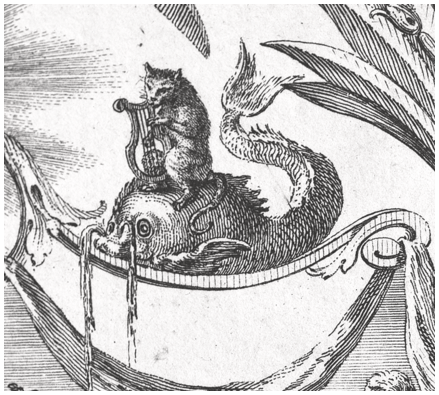
Arguably, all mock-heroic figures play this semiotic game: By referring lightly to the protagonists of the culture’s most profound myths, even to transmit the message, “This is not serious like that is,” they bring the very reserves of meaning they disavow into play. Every mock utterance is teeming with what it is not. By giving shape to the “cat-Arion” that expressly does not exist in Gray’s ode, Bentley’s illustration provides a character who shuttles between the mock-elegy’s avowed and disavowed orders of meaning. What happens when we imagine this alternate afterlife for Selima, the one the poem makes possible by saying it doesn’t happen, in which the cat is reincarnated as the Greek poet Arion? What meanings surface when, through a lacuna in the poem’s irony, the cat is claimed in earnest for culture?
According to Herodotus, Arion was a celebrated Dionysiac poet-musician of ancient Greece who was saved by a dolphin from drowning after being robbed at sea. Aristotle identifies Arion as the inventor of the dithyramb, a dramatic hymn sung by a chorus of satyrs, or possibly by a chorus of men riding animals such as dolphins, which Aristotle associates with the origins of tragedy. But the dithyramb and the chorus of dolphin-riders have also been linked to the origins of comedy – largely owing, according to Jeffrey Ruston, to “the inherent silliness of an animal-riding chorus.” Ruston suggests that we think of dithyramb as a “versatile genre of performance” that predates the classical distinction between comedy and tragedy, but had “its occasionally comic perversion.” He identifies dithyramb as one of multiple genres of “pre-comedy” that flourished until the end of the fifth century BCE, when an officially authorized form of comedy replaces them all.Footnote 189
Much of what we “know” about dithyramb as a genre and style derives from how this first wave of official comedy represented it in order to dismiss it. Andrew Ford points out that “from the classical period to late antiquity, dithyramb is singled out of all Greek poetic genres for its striking, extravagant style. This tradition first becomes legible in Old Comedy, which portrays dithyrambic poets as frauds and their songs as pretentious claptrap.”Footnote 190 Plato likened dithyramb to nonsense, coining the adjective “dithyrambic” to refer to “wild, vehement, and boisterous” language; he also, Ford notes, “fastened irrationality onto dithyramb as its defining characteristic: conceding that the genre affords great pleasure, he associated its production with loss of control and being seized by the nymphs.” Aristotle, following suit, denounced dithyramb as “noisy.”Footnote 191 Gregory W. Dobrov describes an odd “firewall” between dithyrambic satyr-plays and Old Comedy, observing that “comedy’s avoidance of intertextual contact with the satyr-play is remarkable, especially in light of all that the two genres might be said to have in common: lampoon of myth, light-hearted thematics, obscenity, dionysism, a distinct relationship with tragedy, etc.”Footnote 192 He suggests that despite these similarities, comedy is simply unable to accommodate the figure of the satyr itself: “Charged with primal dionysiac joy, he is innocent of the psychic and social fragmentation of the polis.”Footnote 193 The satyr is a creature that resists being reduced to a signifier in a dramatic order of meaning, and, in doing so, acquires the paradoxical quality of meaning too little because it means too much. Thus, under analysis, satyrs come across as embodiments of frenzy, fluidity, and the frustration of natural taxonomy. Dana F. Sutton describes them, in her study of satyr-plays, as “grotesque, elemental, not quite human,” sometimes compared to “beasts” such as hedgehogs and monkeys, defined by their appetite for food, drink, sex, and dancing. “Paradoxically,” Sutton concludes, “while they are elemental and thus less than human, they are also somewhat magical and thus also more than human,” even attributed “superhuman knowledge.”Footnote 194
Neoclassical poetics inherits the classical suspicion of “wild,” creaturely, pre-comedic humors. The problem with dithyramb is that, like the figure of the satyr who sings it, since the advent of classical comedy it has been recognized as not of the cultural moment, too formally uncertain, an ill fit with modern categories of meaning. The creatural quality of this excess of signifying energy finds formal representation in the forthright “silliness” of satyric motifs such as dolphin-riders. Bentley’s cat-Arion can be seen as a reincarnation of the satyr in the midst of neoclassical satire, a culmination of satiric momentum that erupts as an aberration in the mock-heroic order. While satire brings its objects under aesthetic control, the creatures of satyr-choruses celebrate that which is beyond human control, that which refuses to be fixed as either comic or tragic, that which generates feeling and transport without yielding stable interpretations of their social or political significance. As Gray’s poem ferries Selima from the living world to a literary afterlife, it unwittingly registers the depths of unfixed meanings that the living animal navigates to become mythologized object. Bentley’s designs, by echoing the figure of the cat in multiple imagined states – mandarin, mourner, drowner, reluctant passenger of Charon, and cat-Arion – wring comedy out of this cultural passage in a way that refuses to let the creature dissipate. Its unfathomable presence haunts the poem’s comedic “message,” allowing the funniness of the text to take on deviant tenors.
Where the mock-heroic invites us to laugh the cat away, the dithyrambic laughs the creature back in again. Delight is not extinguished but must occupy the same space as other feelings – confusion, sadness, terror – with which it is not meant to coexist. Arion, the rider of overdetermined seas, provokes a laughter that responds not to the meaninglessness of the object, but to the prospect of the object meaning more than we could possibly know. Bentley’s images amplify the polysemic potential of Gray’s poem, exploding the message: It’s just a joke, they insist, just a joke about cats, about memorializing cats, about women, about cats and women and commerce, about death, about art, about Dionysian joy, about the global scope of our silliest desires, about Walpole and his friends and the bonding of men through disavowed desire, through disavowed sorrow, through jokes about cats, through jokes about the memorialization of cats – and so on. The designs are funny not in the controlled way of a well-told joke but in the way of things that are giddy and perplexing, like an unreadable or inappropriate gesture.
By losing the gist of the joke, Bentley’s version also loses the disciplinary insistence that “nothing has been lost.” The illustrations return the violent death of the animal to the surface of the text: The loss of a living creature is explicitly connected to, rather than disavowed by, the funniness of the mock-elegy. What such a death means, and how we are meant to feel in response to it, are questions these images raise but refuse to answer in any definitive way. By mobilizing around Gray’s poem an array of symbols, objects, and references that fail to cohere into an account of the status of Selima’s death, Bentley’s illustrations rouse the wayward semiotic life of a creature in the throes of transformation into cultural object. Rather than allow the text to sublimate her to an easy masculine wit that forges untroubled social bonds, these designs allow the messy, noisy, indecipherable satyr’s song to haunt the creative intimacies pursued at Strawberry Hill. Bentley allows Selima to teach him the art of sinking.
Dreaming Together
Much has been written about Walpole’s long friendship with Gray, of which the production of Designs … for Six Poems is just one of many episodes spanning nearly four decades. Less has been written on Walpole’s much shorter relationship with Bentley, which appears to have blazed brightly for several years around the production of this volume and the early design of Strawberry Hill before ending abruptly and permanently around 1761.Footnote 195 The existing archive of Walpole and Bentley’s friendship consists of their correspondence (predominantly Walpole’s side of it) from 1752 to 1756, with a few later notes, mostly missing; Walpole’s mentions of Bentley in his correspondence with others; and Bentley’s drawings and designs, especially those made specifically for Walpole and Strawberry Hill, including the ones Walpole preserved in his personal copy of the Designs … for Six Poems.Footnote 196
These fragmental traces of a friendship do not support much of a historical narrative of intimacy. In the context of suihan sanyou, Bentley appears to be the friend who didn’t make it through the winter after all, joining Selima as a spectral presence at Strawberry Hill, remembered loosely. Yet Bentley’s own ludic style provides another model for approaching the question of Strawberry Hill as an archive of intimacy, one oriented not toward historical certainty but rather queer possibility. In his work on Walpole’s friendships, George Haggerty has urged us away from trying to “read between the lines” of Walpole’s correspondence for a “lurid ‘truth’ behind the letters” that might confirm contemporary notions of how feeling – particularly queer feeling – manifests between men.Footnote 197 Heeding this advice, I ask how we might extend the idea of reading intimacy in just what is there on the page not only to a collection of fragments but also to nonlinguistic forms of correspondence, including sketches, drawings, and graphic designs. How do we read these kinds of lines as evidence of interpersonal attachment – lines that drift and meander, extend unfinished ideas, play with possibility, and do not use words to say what they say?
We might begin with a note from Bentley (probably) to Walpole (see Figure 2.10). Lacking date, addressee, and any other contextual information, it presents a sketch of two Chinese temples in lieu of words. “Dear Sir,” it opens; it closes, “and am vastly sorry I cannot have the pleasure of attending you tomorrow; I am / Your most obedient servant / R. Bentley. / It was impossible for me to give you earlier notice.”Footnote 198 The syntax of this letter integrates the descending temples into the line of the sentence that follows them – they are the initial utterance. The clarity of the tone of assertion in the figures combined with the unreadability of the images in the context of the letter constitutes a ludic epistolary gesture.
Letter by Richard Bentley.
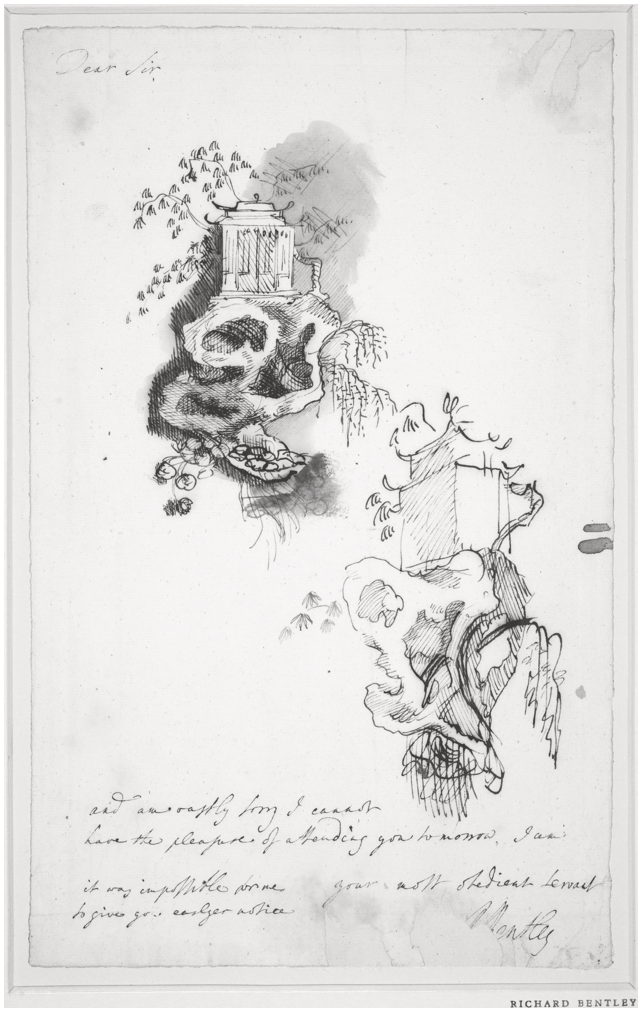
The editors of the Yale Correspondence speculate that this note was addressed to Walpole around 1752 because the designs resemble Bentley’s drawings for Gray’s “Ode on the Death of a Favourite Cat.”Footnote 199 They also resemble other chinoiserie designs by Bentley, including some proposed for Strawberry Hill that were rejected by Walpole. The text of the letter expresses regret for Bentley’s inability to visit his addressee the next day; the sketch of two temples, linked gracefully by the flow of the Bentleian line, thus stands as substitute for an actual social encounter, as well as for any explicit information about either the occasion for the note or the relationship of the author to the addressee. As a historical utterance, potential evidence of a relationship between two people, the sketch is all suggestion and potential meaning. It is framed as a message, but rather than disclosing information, it literally houses it in a way that signals – through the idiom of chinoiserie – fantasy, whimsy, and unexpected turns.
Walpole’s relationship to Bentley is inextricable from Walpole’s relationship to the Chinese taste, of which he grew increasingly intolerant during this period of his life, associating it with the kinds of undignified home improvement schemes he witnessed in his neighbors. In a 1747 letter to George Montagu, Walpole quips, “My Lord Radnor’s baby houses lay eggs every day, and promise new swarms”;Footnote 200 in a 1753 letter to Horace Mann, in which he provides a detailed description of Strawberry Hill at the end of the first stage of renovations, including a drawing by Richard Bentley of the view, Walpole takes care to disavow the chinoiserie next door for its frivolousness: “The Chinese summer house which you may distinguish in the landscape, belongs to my Lord Radnor. We pique ourselves upon nothing but simplicity, and have no carvings, gildings, paintings, inlaying or tawdry businesses.”Footnote 201 Despite Walpole’s growing distaste for chinoiserie, Bentley remained enthusiastic for it, and Walpole remained enthusiastic for Bentley. In a letter to Bentley describing Sir George Lyttleton’s Hagley Hall, Walpole compliments Sanderson Miller’s gothic ruins by declaring that “in [this] castle, [Miller] is almost a Bentley.”Footnote 202 In a later letter, he declares, “I can’t help thinking that the grace and simplicity of your taste, in whichever you undertake, is real taste. I go farther: I wish you would know in what you excel.”Footnote 203 And while Walpole declined to incorporate Bentley’s Chinese house (Figure 2.11) into Strawberry Hill, the letters indicate that he took pleasure in letting it be known among the class of men improving their properties – particularly those keen to include Chinese houses – that in Bentley’s designs, he possessed “the prettiest plan in the world for one.”Footnote 204
Richard Bentley, “Elevation of a Chinese Tea House, Close-Up” (design for Strawberry Hill).
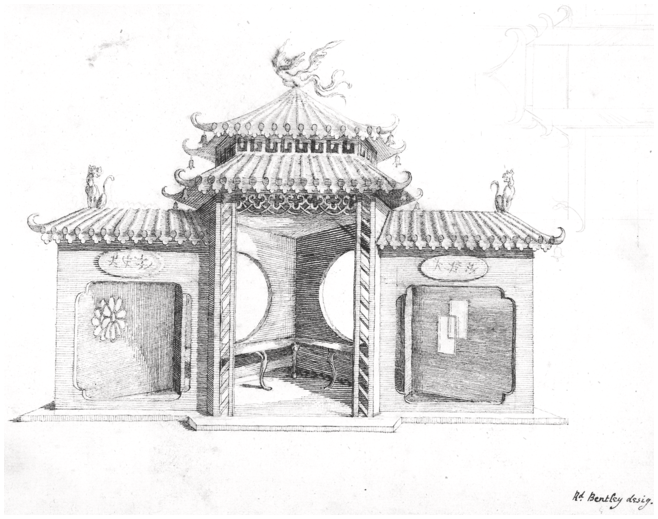
In the context of Walpole’s own repeated disavowals of chinoiserie, Bentley’s adherence to it takes on a sense of mischief, as if he is teasing Walpole by seizing an occasion to erect Chinese houses under his watch. Bentley’s teasing consists not in refusing to take Walpole’s gothic vision seriously, but in refusing not to take the Chinese taste just as seriously. By the mid-eighteenth century, chinoiserie had become sufficiently fashionable that it could function as shorthand for the questionable taste of the newly wealthy, those whose material means exceeded their ability to be rich with dignity. Such dignity relied on the kinds of aesthetic judgment Pierre Bourdieu elucidates in Distinction: acts of perception that generate class difference as an effect of aesthetic discernment.Footnote 205 In this emergent economy of taste, the faddish “Chinese” comes to signify modes of consumption that fail to make categorical distinctions, resulting in hybrid monstrosities that expose the phenomenon of wealth landing in the wrong hands. Walpole, in order to preserve the dignity of his own gothic project, makes a concerted effort to separate the gothic from the Chinese, at one point referring to their combination as an “unnatural copulation.”Footnote 206
Samuel Hooper’s 1771 print A Common Council Man of Candlestick Ward (Figure 2.12) satirizes precisely this kind of hybrid aesthetic: A council man and his wife are thrown out of their hansom cab in front of Mr. Deputy’s “modern built villa” – a house featuring Greek, Chinese, and gothic architectural details, of which the most prominent is a pagoda tower topped with a giant dragon. The aesthetic disarray of the house is linked visually to the spectacle of merchant-class clumsiness by the form of the dragon, which, though meant to be a symbol of whimsical elegance, here mirrors the ungainly form of the council man being thrown unceremoniously onto his horse, who, as a result, now wears the man’s wig. The same fashions with which Walpole and his neighbor Lord Radnor experimented in Twickenham are used here to represent the questionable taste of the upwardly mobile middle class – the wealthy tradesmen building houses in Clapham – and to connect these “unnatural” aesthetic preferences to a general social and political incompetence. One might as well elect a horse to oversee law and order as a tasteless cit.
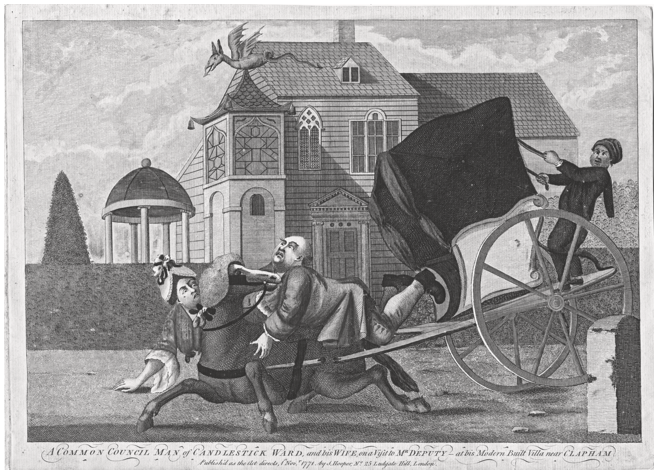
Despite Walpole’s prohibitions of chinoiserie at Strawberry Hill, Bentley refuses to let it go; his designs ensure that the rocaille and gothic details to which Walpole remained committed could not be entirely purified of their association with the Chinese taste. For Bentley, all these styles flowed together organically. Walpole’s gothic style may have overtly welcomed one kind of ghost from England’s past, but Strawberry Hill is formally haunted by a different entity: Bentley’s spectral Chinese house, which intrudes not from the past but from the disavowed present – the gauche outskirts of fashionable architecture.
Despite Walpole’s avowed distaste for chinoiserie, his “little Gothic castle”Footnote 207 incorporated many of the same ideas and design principles,Footnote 208 especially the diminutive quality of the space coupled with its effusion of ornamental details. Just before the line deriding Lord Radnor’s summer house, Walpole writes to Mann: “I have described so much [of Strawberry Hill], that you will begin to think that all the accounts I used to give you of the diminutiveness of our habitation were fabulous; but it really is incredible how small most of the rooms are.… I could send [the house] to you in this letter as easily as the drawing, only that I should have nowhere to live till the return of the post.”Footnote 209 The smallness of the house’s dimensions is fundamentally connected, for Walpole, to the house’s textual quality – the way it is both a material environment and an idea he generated in collaboration with friends, through descriptions both linguistic and graphic.Footnote 210 It is something that contains him, and something that he, and his friendships, contain. Like The Castle of Otranto, it is a thing he has made by dreaming it and by writing it down. Even now that the house has materialized as a house, it remains, in part, something he can imagine folding up and sending in a letter to a friend. Though Walpole insists in another letter to Mann that “Gothic is merely architecture,”Footnote 211 the textual quality of this architecture renders the dimensionality of the space ambivalent. Strawberry Hill is intimately close as a material space, small enough to fit on a page as a conceit, yet designed to provoke the imagination and therefore vast in connotation, and designed as well for mythologization – to be a phenomenon in English cultural history – and in this sense, always meant to loom larger than its material dimensions would imply.
Walpole’s attempt to explain the gothic experiment to Mann reveals that, as much as it played with dynamics of fear, it was always as much about fun. The gothic, for Walpole, was a mode of taking pleasure in things that were designed for different orders of feeling – of appropriating them for irreverent kinds of pleasure by radically decontextualizing them. “I perceive you have no idea what Gothic is,” he writes to his friend; “you have lived too long amidst true taste, to understand venerable barbarism.… Gothic is merely architecture … one has a satisfaction in imprinting the gloomth of abbeys and cathedrals on one’s house.”Footnote 212 The humor of Walpole’s importation of historical Gothic forms into the eighteenth-century suburb of Twickenham – an endeavor he imagines as a textual one, an “imprinting” of a feeling from the past on the space in the present – is captured in his famous coinage of “gloomth,” a term whose neologistic silliness transforms the melancholy affect to which it refers into something as “satisfying” as it is, well, gloomy.Footnote 213 By collapsing the past’s affect of religious reverie into the present’s quotidian aesthetic satisfactions, “gloomth” performs a version of Bourdieu’s critique of taste: Its formal transgression is an instance of the “barbarous reintegration of aesthetic consumption into the world of ordinary consumption” that
abolishes the opposition, which has been the basis of high aesthetics since Kant, between the “taste of sense” and the “taste of reflection,” and between facile pleasure, pleasure reduced to the pleasure of the senses, and pure pleasure, pleasure purified of pleasure, which is predisposed to become a symbol of moral excellence and a measure of the capacity for sublimation which defines the truly human man. The culture which results from this magical division is sacred.Footnote 214
The idea and aesthetic of “gloomth” is funny because it is impious, without being unserious; it rewrites the sepulchral as a source of domestic, which is to say vulgar, pleasure, but it also transforms the commitment to facile pleasure, a departure from “true taste” into what was, for Walpole, a lifelong exercise of perversely profound devotion.
In this context, Bentley’s adherence to the Chinese taste might be read as a way of keeping Walpole true to his own project of refusing to allow cultural authority to settle in a single, bland aesthetic order that symbolizes “moral excellence.” As Walpole’s letters themselves acknowledge, Bentley’s penchant for the Chinese taste keeps the vision of Strawberry Hill open beyond the bounds of Walpole’s own taste. At the level of collaborative design, the Strawberry Hill project constitutes a certain practice of intimacy that accommodates difference of taste through assertions of affection – often in the ludic register of teasing. Walpole, for example, belittles Lord Radnor’s property by calling it, in his letters to Bentley, “Mabland”;Footnote 215 yet in several instances, he also refers to Bentley’s collection of designs as “Mabland,” perhaps to emphasize that Bentley’s drawings comprised the kind of mixed aesthetics Walpole didn’t tolerate from anyone else. Far from refuting Bentley’s Mabland, in one instance Walpole overtly declares a distracting desire for it: “As I have not yet received Mabland, which I suppose travels at its leisure,” he complains, “I have nothing to soften a little stock of peevishness, which is very ready to break out.” He continues: “In the first place, my chairs! if you had taken a quarter of the time to draw what they might be, that you have employed to describe what they must not be, I might possibly have had some begun by this time. Would not one think that it was I who make charming drawings and designs and not you? I shall have very little satisfaction in them, if I am to invent them!”Footnote 216
In reading moments like this one as evidence of ludic intimacy, I wish to emphasize rather than downplay the ordinariness of Walpole’s mode of collaboration with Bentley, the pragmatic quality of it. The idea is not that these acts of cooperation in the gradual making of Strawberry Hill are metonyms for some unspoken romance, or that Walpole’s “peevishness” derives from a desire for something more from his friend than his design for chairs. Rather, it is that the “charm” of Bentley’s drawings and designs is a palpable and significant mode of feeling in its own right, that operates as part of the broader field of feeling Walpole cultivated through the combined attention he devoted to his friends and to his house. As part of the shared work of designing the house, the trading of visions and drawings belongs to a set of queer homemaking practices that generate the kinds of feelings that attend pragmatic, day-to-day cohabitation: peevishness, satisfaction, dissatisfaction, enjoyment. What renders this homemaking queer is the fact that the labors Walpole and Bentley share around the house are not domestic labors, and do not resolve into a relationship of cohabitation: They are making a house together, for the pleasure of making a house together, rather than to dwell in it, or to inhabit it into posterity. This is a restless relationship, generative and heavy on schemes, that never settles into what it creates. It accommodates proposals, like the Chinese house, that will never become material reality. And yet, as Walpole says, there is a “satisfaction” in the practice of dreaming together across difference that cannot be found in processes of solitary “invention.”
In the Strawberry Hill project, Walpole contrived a way to dream together with his friends as a matter of quotidian practice. W. S. Lewis described Bentley as Strawberry Hill’s “draughtsman,”Footnote 217 and despite the connotation that his contribution was therefore merely mechanical, Walpole’s own letters to Bentley testify that it was by the skill of his hand that Bentley raised pragmatic drawing to the level of an experiment in intersubjectivity. Writing to Bentley while traveling through England in 1752 and 1753, Walpole repeatedly calls upon Bentley’s drawing skills as a component, both imaginatively and materially, of how he is taking in the aesthetic forms he witnesses as a tourist: “I have drawn the front of [the house] to show you, which you are to draw over again to show me”; “By the way, we bring you a thousand sketches, that you may show us what we have seen”; “You might draw, but I can’t describe the enchanting scenes of the park.”Footnote 218 Walpole’s requests for and allusions to Bentley’s drawings show two subjects cultivating aesthetic knowledge through embodied forms of shared vision: translating descriptions into sketches, sketches into images, tracing and embellishing each other’s lines.
Nor was this closeness of vision contained between just the two of them; Walpole similarly relied on Bentley’s hand to incorporate the work of his closer friends such as John Chute and Thomas Gray into the material culture of Strawberry Hill. “There is a vote of the Strawberry committee,” Walpole writes to Bentley in 1754, referring to himself and Chute, “for great embellishments to the chapel” at Chute’s house, the Vyne; “it will not be long before you hear something … In the meantime, to rest your impatience, I have enclosed a scratch of mine, which you are to draw out better, and try and see if you can give yourself an idea of the place. All I can say is, that my sketch is at least more intelligible than Gray’s was of Stoke, from which you made so like a picture.”Footnote 219 In these moments of collaboration, what is precious to Walpole is not merely the end product but the process by which he and his friends apply themselves to one another on paper; this is evident in the fact that he preserved Gray’s sketch alongside Bentley’s drawing in his personal, extra-illustrated edition of the Designs by Mr. R. Bentley for Six Poems by Mr. T. Gray, adding his own hand into the artifact in the annotation that draws the names of his friends together in a chiastic echo of the book’s title: “Mr Gray’s original sketch from which Mr Bentley made the Drawing that is engraved”Footnote 220 (Figures 2.13 and 2.14).
Gray’s sketch of Stoke, in Walpole’s extra-illustrated copy of Designs by Mr. R. Bentley, for Six Poems by Mr. T. Gray.
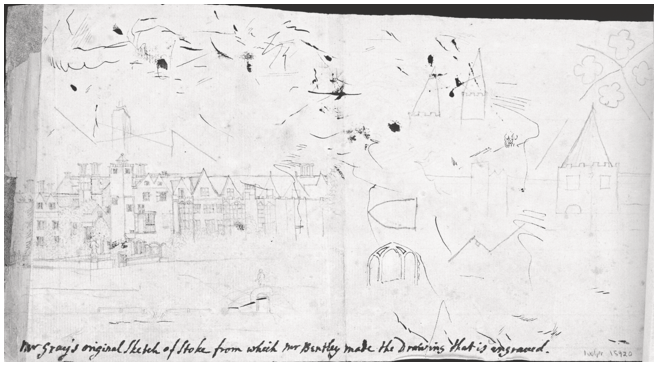
Bentley’s drawing of Stoke based on Gray’s sketch.
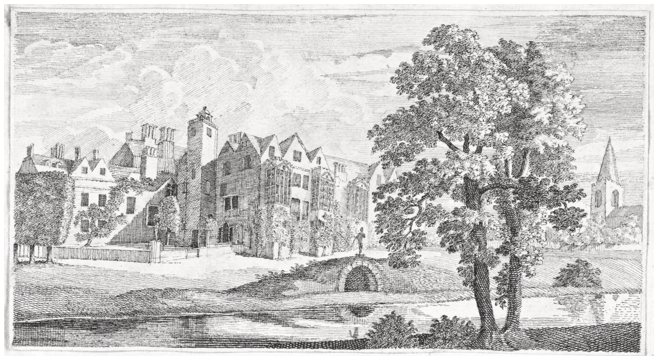
If the twin houses offered in Bentley’s letter issue a kind of call, the response from Walpole appears, to me, in the line from his letter describing the grounds at Sir Lyttleton’s house: “You might draw, but I can’t describe the enchanting scenes of the park.”Footnote 221 In context, this claim is amusingly ironic, appearing as it does at the head of a lengthy and detailed description of the scene Walpole claims not to be able to describe. Yet this irony adds to the poignancy of the affection in his address to Bentley: Walpole might seem to want nothing when it comes to the production of words, but his capacity to capture the world in language when it appears to him at its most beautiful is incomplete, in his own experience of it, without Bentley’s capacity to draw the same vision in different form.
Bentley’s Chinese designs for Strawberry Hill represent something between a fantasy and a plan: proposals that are received and entertained; that meet, defy, or tease expectation; but that never materialize into enduring edifices. From this realm of contingent existence, they host ephemeral, but deeply felt, shared experience. “I prefer your drawings to everything in the world,” Walpole writes to him in 1755.Footnote 222 This paper-based intimacy is queer in that it is everywhere and nowhere; part workmanship, part apparition, it is literally in the drafts of the house. Like all the sketches exchanged at Strawberry Hill, Bentley’s designs are formal responses to and expressions of desire – ideas extended in response to invitation, and that wait for another eye, another hand to enter into the practice of envisioning things that might be. This quality of anticipation is evident in Bentley’s sketch of the two temples, in which the second is distinctly less finished or filled in than the first, giving the drawing the grammatical inflection of a question. There is no secret encoded in the image. It shows us precisely what we, who search this archive for evidence of feeling between men, have seen: that images rendered by bodies in collaboration do not represent but enact intimacy by housing ideas, which are also feelings, in shapes sketched provisionally, awaiting recognition or revision over completion.
Twickenham’s Depths
Although Bentley’s Chinese Summer House remained a “castle in the air” at Strawberry Hill, the neighborhood of Twickenham continued to be dreamed into material reality over the course of Walpole’s lifetime. “By the eighteenth century,” write the authors of Orleans House: A History, “the ‘classic’ village of Twickenham had become a fashionable place to build country retreats.… The river, Twickenham’s proximity to London, and the court and royal palaces at Kew and Hampton, also made Twickenham an ideal place for courtiers and the wealthy aristocracy to reside.”Footnote 223 Walpole’s peevish observations of his neighbor Lord Radnor’s ongoing improvements to his property reflect a time of general, intense property development along the stretch of the Thames known as Cross Deep. The politician James Johnson built Orleans House there in 1710; in 1719, Alexander Pope moved into a nearby property, demolishing two cottages in order to build the Palladian house that came to be known as Pope’s Villa.Footnote 224 John Robartes, later the 4th Earl of Radnor, leased a seventeenth-century house next to Pope’s property. “The title was accompanied by an inheritance,” according to the Twickenham Museum’s profile, “and Radnor embarked on various extensions to the house and the land. He acquired 7 acres across the road and built a tunnel to connect them to his house.”Footnote 225 Horace Walpole belonged to the next generation of aspirational developers. By the time he purchased “Chopp’d Straw Hall” in 1747 and began to transform it into his gothic villa, the property that would become Strawberry Hill was “one of the last remaining sites available of the banks of the Thames in fashionable Twickenham.”Footnote 226
In 1762, William Cole, a friend of Horace Walpole’s since their time together at Eton, described the views “as you come from the town of Twickenham to Mr Walpole’s house of Strawberry Hill.”Footnote 227 After passing “Mr Pope’s house on the banks of the Thames,” a house by then occupied by Sir William Stanhope, the visitor comes to “the house belonging to the late Earl of Radnor, which is the last house on the Thames bank next to Strawberry Hill.” The potential morbidity of this virtual tour of properties identified by their deceased owners is tempered by the picturesque view facilitated by the ever-present Thames: “Mr Walpole’s … own meadows go quite down to the banks of it,” Cole writes, “and nothing to obstruct the view of that most beautifying fluid, which makes everything beautiful that is within its influence.” From Walpole’s property, the detail that this view brings into focus is a “Chinese Temple,” which Cole takes the time to situate as part of a pleasing landscape marked by modern improvements:
From the garden you discover the elegant Chinese Temple, being the last building on the bank of the Thames, and close to my Lord Radnor’s house or garden wall – though the house belonging to it is on the other side of the road, and is the last house on that side next to Strawberry Hill, and is a handsome new square building.Footnote 228
The Chinese Temple in Cole’s description belonged to Cross Deep House, a three-story edifice built in the late seventeenth century next to the property later developed by Radnor. Over the course of the eighteenth century, numerous drawings and paintings of the “prospects” of these emergent Twickenham landscapes were produced, and the Chinese Temple served as an important visual landmark in depictions of the area. In Augustin Heckel’s oft-reprinted View of the Earl of Radnor House, the cylindrical building that was renovated into the Chinese Temple is centered, standing between Radnor House on the right and Cross Deep House on the left.Footnote 229 Other views situate the Temple explicitly in relation to Strawberry Hill, including J. H. Müntz’s View of Twickenham (1756), which shows the view from Walpole’s property described by Cole, where the Chinese Temple marks the point at which other properties, beginning with Radnor House, unfold along the riverbank (Figure 2.15). Despite Walpole’s distaste for the temple, the general consensus seemed to align with Cole’s judgment that it was “elegant.” In A Short Account, of the Principle Seats and Gardens, in and About Twickenham (1760), Henrietta Pye describes “a beautiful Chinese Tower, which stands near the Water” in the garden of Radnor House.Footnote 230
James Green (after J. H. Müntz), A View of Twickenham, 1756.
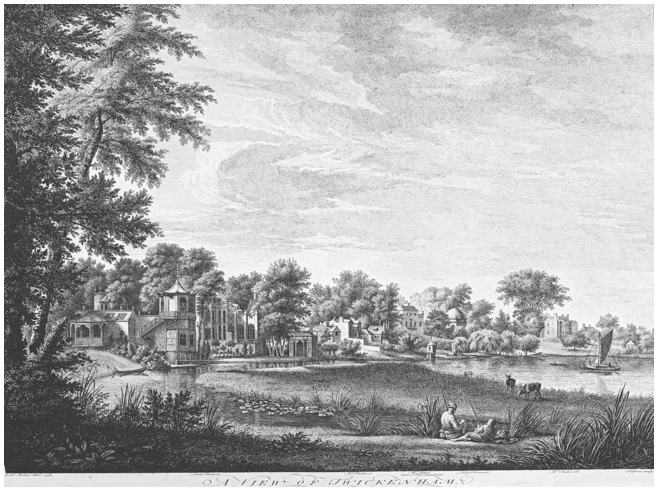
Immediately after introducing it as a focal point of this familiar picturesque view, however, Cole allows the chinoiserie detail to make an abrupt turn to the macabre:
I say, from this garden of Mr Walpole you discover the Chinese summer house in which, about last August, Mr Isaac Fernandez Nunez, a Jew, shot himself through the head, on the loss of the Hermione, a rich French ship which he had insured, and by that means ruined his fortune and family. His house and furniture were sold by auction while I was at Strawberry Hill, and I was at the sale for a few minutes. From Walpole’s garden and house you have the most beautiful and charming prospect of Richmond, with variety of fine villas and gardens on the banks of the Thames, which river alone would sufficiently recommend any situation.Footnote 231
The startling, graphic detail of Nunez’s suicide drops into the placid landscape of Twickenham with the force of Otranto’s giant helmet. Cole responds much as Manfred does to the gory intrusion, seeming not to notice the “mangled remains” of a human being that now belong to the scene as he focuses instead on the material objects the violent event has made available for consideration – the house and furniture – before resuming the rhythm of his virtual tour of “the most beautiful and charming prospect of Richmond.” In the visual syntax of this odd description, the Chinese Temple acts as a profoundly ambivalent detail, vacillating between its role as a focal point that consolidates the “charming prospect” and its function as placeholder for the material horrors associated with the economy that generates such “prospects.” The life-or-death stakes of the kinds of investments that yield the abundance Twickenham represents come home to roost in the scene’s chinoiserie set-piece. The “elegant Chinese Temple” thus doubles as a gothic disturbance of the “beauty” that naturalizes mounting imperial wealth: While announcing the British claim to cosmopolitan preeminence, the structure houses both a history and allegory of the extreme cost of such investments, measured in human lives.
Isaac Fernandez Nunez occupied Cross Deep House from 1756 until his death in 1762.Footnote 232 His suicide registers a disturbance in both the picturesque aesthetic and the narrative of national progress generated by eighteenth-century tableaus of the “variety of fine villas and gardens on the banks of the Thames.” The Hermione was a Spanish (not French) ship famously captured by English frigates in May 1762; while this seizure constituted an inconceivable loss for Nunez, who had insured the Hermione, it was celebrated in the English press as a national boon, fortuitously coinciding with Queen Charlotte’s safe delivery of a prince, the future George IV. The Annual Register for 1762 reported that on August 12, “Just after her majesty was safely in her bed [following the delivery], the waggons with the treasure of the Hermione entered St. James’s street: on which his majesty and the nobility went to the windows over the palace-gate to see them, and joined their acclamations on two such joyful occasions.”Footnote 233 The parade included “a company of light horse attended with kettle drums, French horns, trumpets, and hautboys”; a covered wagon decorated with the Union Jack, dragging a Spanish flag in the manner of Achilles dragging the corpse of Hector; and “in the whole twenty waggons” carrying “marines, with their bayonets fixed.” The procession culminates in the “opening [of] some of the chests at the Bank,” which reveals them to contain gold instead of only silver as well as “a vast deal of private property.” “In short,” the report asserts, “this is, probably, the richest prize ever brought into England.” The Register’s lengthy account of the procession is inserted into the middle of its coverage of the birth of the prince, such that the parading of the Hermione’s captured wealth doubles as a celebration of the fruitful continuation of the Hanover line. “The whole cavalcade was saluted by the people,” the Register reports, “with acclamations of joy.”Footnote 234
The profits of the mercantilist ventures that occasionally delivered such windfallsFootnote 235 were routinely channeled into the development of fashionable estates like those in Twickenham. Aesthetic regimes of elegance and charm in British architecture and design translated the returns of conflict, toil, and appropriation in overseas ventures into scenes of refined taste. The Hermione’s cargo included cocoa, tin, gold and silver coin, and alpaca and Virginia wool – all items that were generating wealth as part of the ongoing Spanish colonization of South America.Footnote 236 Britain’s competitions with Spanish, Dutch, Portuguese, and French trading vessels, when victorious, appropriated the material spoils of other colonial efforts while symbolically reinforcing the British claim to “rule the waves,” in the refrain of James Thomson’s “Rule, Britannia” (1940). Thomson’s rhyming of “Rule, Britannia, rule the waves” to “Britons never will be slaves” achieved the status of an anthem when Thomas Arne set the poem to music the same year it was published. Though it remains a recognizable earworm of British military patriotism, Suvir Kaul has argued that “this negative definition of the national self, coming as it does at a time when Britain was fully engaged in slavery and the slave trade, reads oddly.”Footnote 237 Kaul continues,
It is, in spite of the blithe and spirited tone of the couplet, an uncomfortable moment, an intimation that the product, and one of the bases, of Britain’s power overseas was slavery and the slave trade. The refrain both represses or disavows that knowledge, while serving as a reminder that, in the political and moral economy of mid-eighteenth-century Britain, the obverse of national power is the condition of slaves.Footnote 238
As I have argued elsewhere, the Chinese taste was particularly recruited to reformulate mounting wealth into a British national culture; chinoiserie’s distinct capacity to refer to a global world of objects made it an expedient signifier of a broad range of imported and appropriated things incorporated as British property.Footnote 239 Cole’s placement of the Chinese Temple in the center of his described landscape not only echoes the view from Walpole’s garden, but reproduces an established visual syntax in which the chinoiserie detail sublimates a broad range of imperial enterprises and lends them to a sense of aesthetic order. Yet his blithe identification of the Chinese summer house with Nunez’s suicide strikes the same “odd” tone Kaul hears in Thomson’s reiteration of the term “slaves” at the heart of his verse. The seemingly gratuitous identification of Nunez as “a Jew” collaborates with his Spanish name and the Chinese architecture to make the summer house flicker momentarily as a site of overdetermined foreignness. The momentary failure of English “charm” to sublimate the exotic influences of British material wealth coincides with the horrific spectacle of Nunez shooting himself in the head. From this moment on, the reader’s ability to appreciate the charms of the Twickenham landscape is an explicit exercise in sublimating the imperial violence that has been registered at its heart.
As an inadvertent memorial to financial ruin and grisly death, the Chinese summer house introduces a gothic tenor that potentially amplifies the morbid aura of the other houses Cole names. They are, after all, named in common parlance after deceased owners, and they too are material monuments to the growth of an economy that, despite the rhetoric of taste, is quite manifestly premised on the death and ruin of vast numbers of people – not only the sudden changes of fortune among the ranks of the newly wealthy, like Nunez, but more importantly the systematic conscription of concentrated supplies of exploited and enslaved labor, and the genocidal appropriation of colonized territory, in order to generate that wealth.Footnote 240 Just a few years before Nunez moved into Cross Deep House, it was occupied by Robert Cramond, who made his fortune in the trade in enslaved people. He was one of four residents of this fashionable strip of the Thames who, according to Orleans House: A History, “had direct financial links with the slave trade”; the others include Alexander Pope and his neighbors Philip, Duke of Wharton, and James Craggs the Younger, all three of whom were invested in the South Sea Company.Footnote 241 Sir George Pocock K.B., a retired naval officer who acquired Orleans House in 1764, made a career of defending British imperial trade interests including the transatlantic slave trade, culminating in a particularly profitable undertaking in the Caribbean: “As commander in chief of a dramatic and ultimately successful mission to capture Havana in 1762, Pocock was entitled to a share of substantial prize money, and it was probably this windfall which allowed him to retire from active service and purchase Orleans House.”Footnote 242 And while Horace Walpole himself described the transatlantic slave trade as a “horrid traffic” in a 1750 letter to Horace Mann, declaring that the scale of it “chills one’s blood”Footnote 243 – his wealth was of course inherited from his father, Sir Robert Walpole, who not only made a good part of his fortune by an early investment in the South Sea Company but also played a crucial role in wedding the British economy to imperial ventures such that, in the eighteenth century, the public discourse on the ethics of empire hinged on the question of how best to “rule the waves,” not whether one should or not.
My point here is not to trace individual persons to specific strains of blood money from these various colonial enterprises. It is, rather, to argue that Twickenham, precisely because it was a site of cultural laundering of eighteenth-century windfalls, was broadly haunted by what Ian Baucom calls “specters of the Atlantic.” London, Baucom writes, was one of the port cities that in the eighteenth century achieved the status of a “space-of-flows,” a term used by Giovanni Arrighi to identify emergent sites that “exist to serve the sovereign principles of exchange they embody, the financial flows they regulate, the capital imperative which they incarnate and whose chief purpose is the conversion of endless variety into a single, general equivalent: money.”Footnote 244 All money in the age of “slave trading” is blood money, and all the wealth that has been gathered, reorganized, and reproduced in its wake is blood money as well. “Investing in slave trading companies such as the South Sea Company,” the authors of Orleans House write, “which supplied slaves from British colonies in the Caribbean and North America to Spanish colonies in the Americas, was seen as a sound investment for people from all walks of life.”Footnote 245 British freedom from an archaic hierarchical past – the emergent dream of equal opportunity to prosperity, of new homes and new prospects – was a concept premised on perpetual fluidity: of fortunes, of expanding national borders, of racialized enfleshment, of blood as it rushes through sensible bodies, of blood as it is washed from “sovereign principles of exchange.”
Literary techniques of satire and mockery are simply insufficient to the project of addressing the scale of such violence. Horror, too, falters in its focus on the suffering of individual persons, as illustrated by Cole’s description, which flows easily away from Nunez’s bloody death, buoyed by the “beautifying fluid” of the Thames, to regain “the most beautiful and charming prospect of Richmond.” The violences of empire, washed into the forms of finance and domestic prosperity, are everywhere and nowhere in Walpole’s world and in our own. Any attempt to frame them as comprehensible is bound to fail. In order to attune ourselves to the ongoing reality of empire’s systemic atrocities, we would do better to become literate in the incomprehensible. Kaul’s way of reading eighteenth-century poetry provides one model in its sensitivity to the “odd” cadences in which disavowed atrocities surface momentarily in texts committed, earnestly, not to recognize them. Walpole’s gothic and the other ludic experiments hosted at Strawberry Hill are significant in their own commitment to sustaining these disorienting notes of oddity, of dwelling with and within them. It is a commitment to not fully living in the world that stabilizes itself in accordance with the forms violently furnished by imperial order. It is a method of sinking into the disavowed dynamics of that world rather than coasting along their surface and fantasizing that experience as a form of mastery.
Such fantasies – of the integrity of “good taste” in a world made of colonial spoils, of the dignity of “prosperity” based on such vast violations and dispossessions of others – are the true absurdity. Even Cole’s Thames refuses, ultimately, to participate in his bizarre aesthetic exercise. As he moves on from Nunez’s mangled remains in the Chinese Temple, conscripting the Thames to buoy Twickenham’s fine prospects, the river makes a distinctly ludic turn:
From Walpole’s garden and house you have the most beautiful and charming prospect of Richmond, with variety of fine villas and gardens on the banks of the Thames, which river alone would sufficiently recommend any situation; though when I was there last, viz., in October and the beginning of November, 1762, the excessive rains which had lately fell had so swelled the river that it caused such inundations as were never known in the memory of man; insomuch that during my stay there, two islands just before the garden were totally covered by the waters and could not be seen. The floods did infinite mischief all over England, and particularly in Essex. At Cambridge it was within six inches of the highest flood ever known or recorded there, of which a mark is cut in the wall of King’s College Senior Fellows Garden, on the river’s bank: and the waters came into the cellars of Queen’s College in such a torrent that the butler had not time to go in and stop up the vessels, they having just newly filled their cellars for the year; by which means the water got in, and spoiled all their beer.Footnote 246
This is the end of Cole’s description of Twickenham. The swollen Thames, in its gargantuan form, turns trickster and mischief-maker: Though as powerful, presumably, as Phoebe Clinket’s Great Deluge, it limits itself to pranks. The flooded river’s “infinite mischief” returns us to Peri Bathos’s metaphor of “small beer”: “It is with the Bathos as with small Beer, which is indeed vapid and insipid, if left at large, and let abroad; but being by our Rules confined and well stopt, nothing grows so frothy, pert, and bouncing.”Footnote 247 The point of the Scriblerians’ “Rules” for bathos are similar to the standards of taste that Cole exercises in the first half of his description. Both are methods for generating and reinforcing the cultural distinction Bourdieu identifies between what we now call “high” and “low” culture – a distinction that presents disparities of power as aesthetic hierarchies, or matters of taste. The Thames’s mischievous wreckage of gardens and beer cellars at Cambridge might be read as a refusal of charming prospects and neoclassical mockery, respectively. “Frothy, pert, and bouncing” means, for the Scriblerians, silly and dismissible. In its ludic form, the Thames demonstrates that frothy, pert, and bouncing can be the register in which the highest imperial aspirations are sunk.
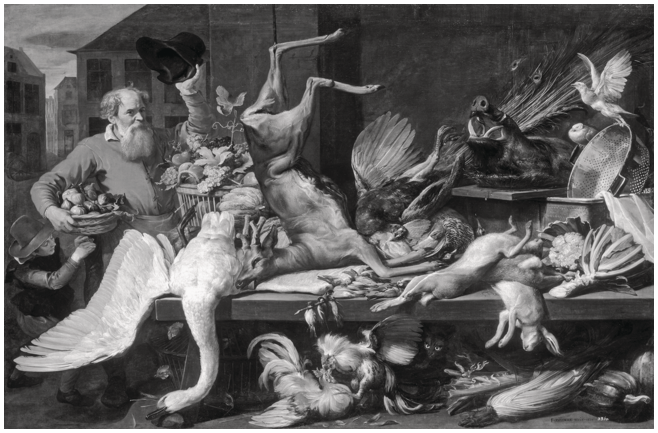
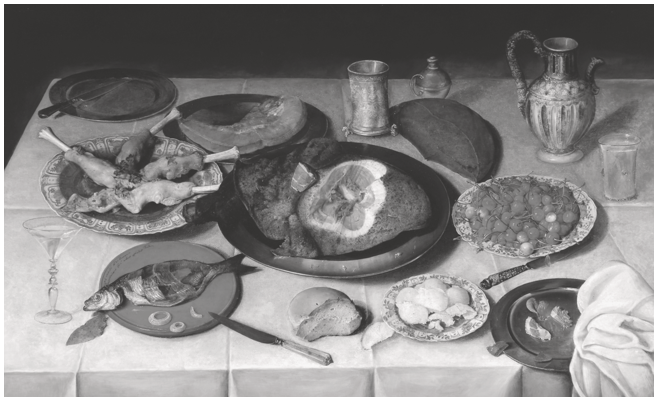
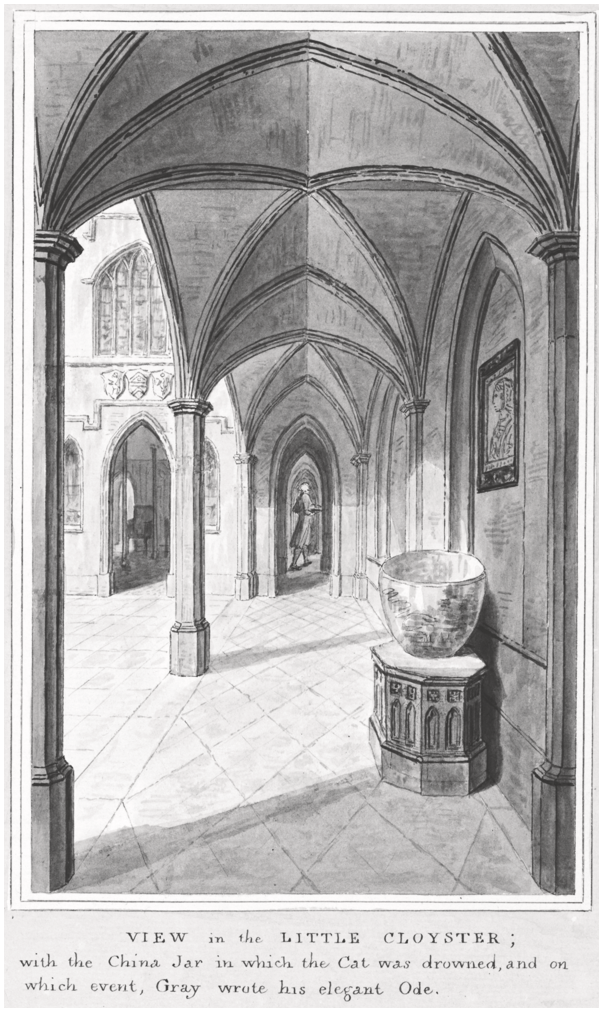
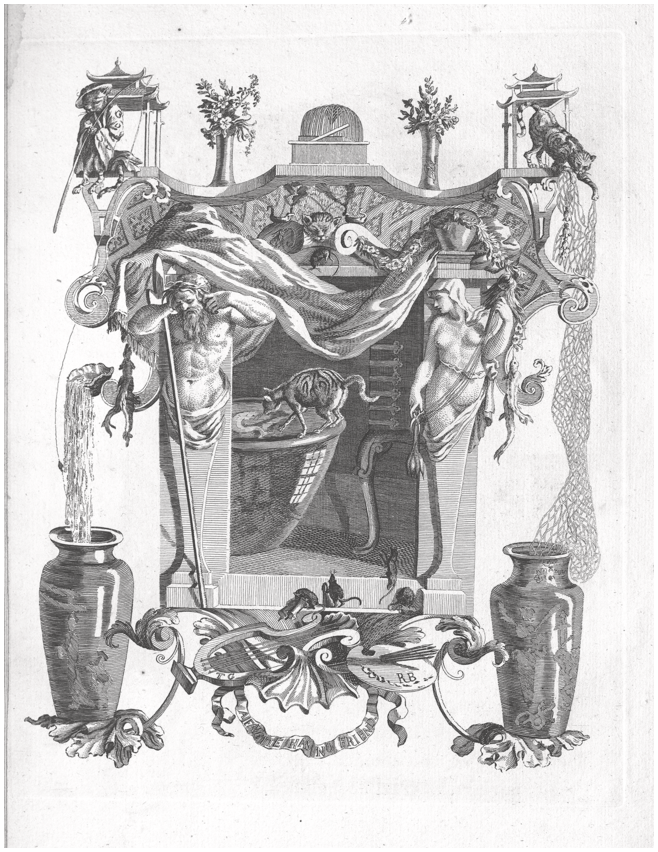
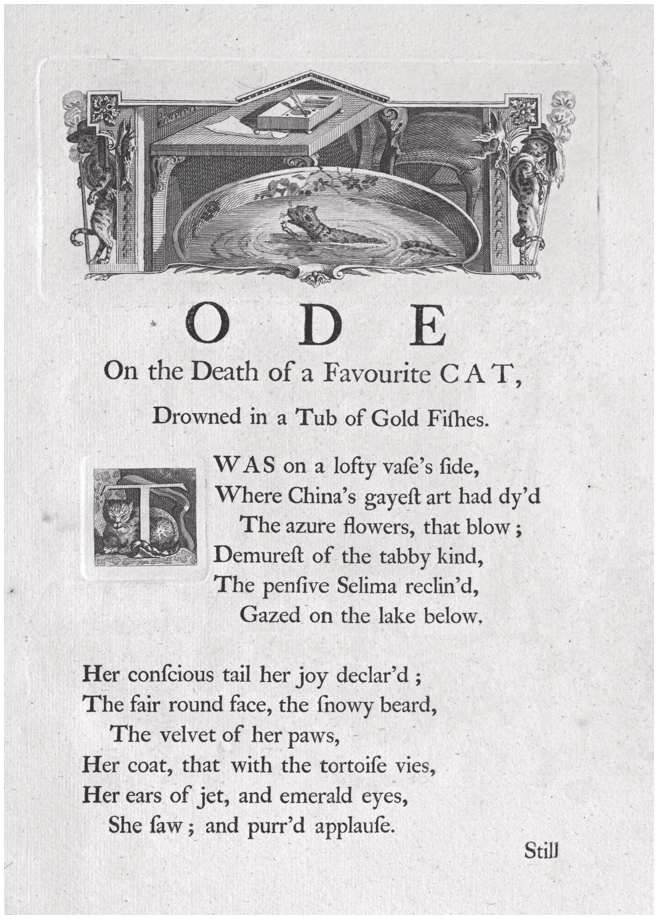
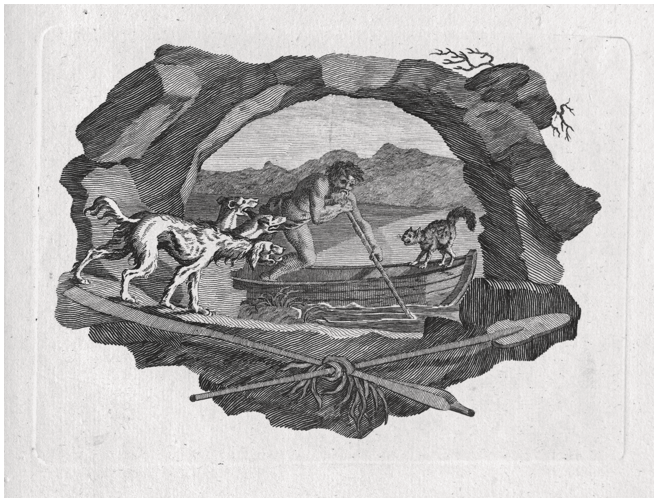
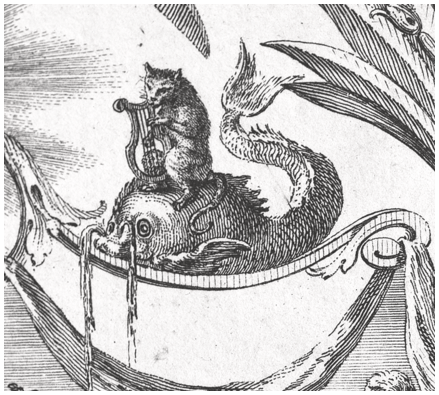
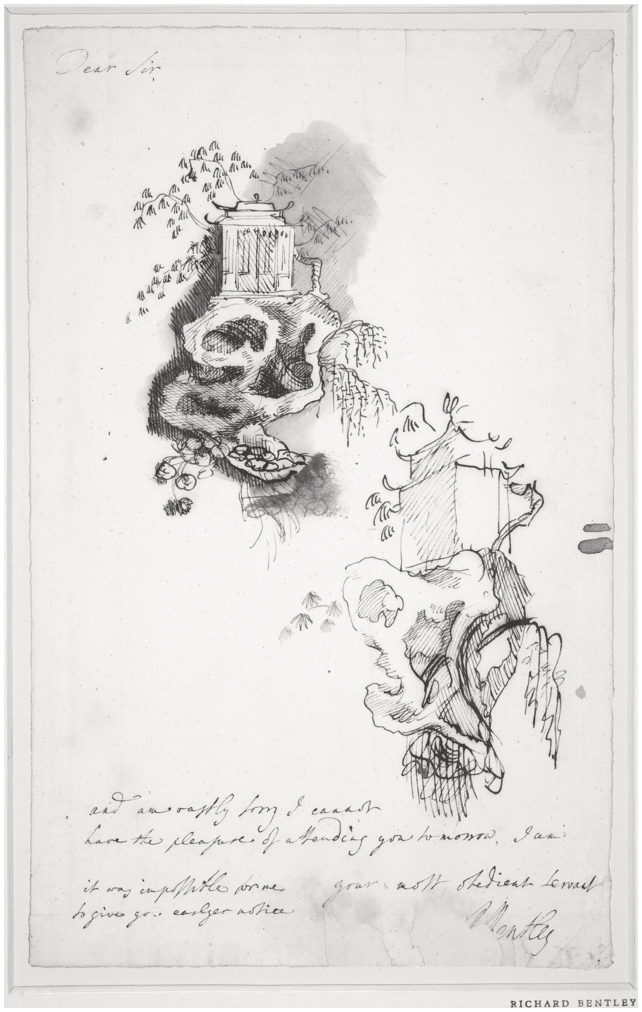
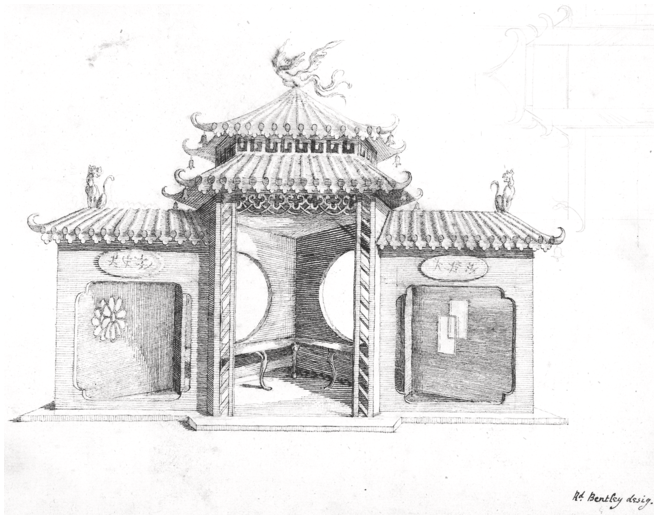
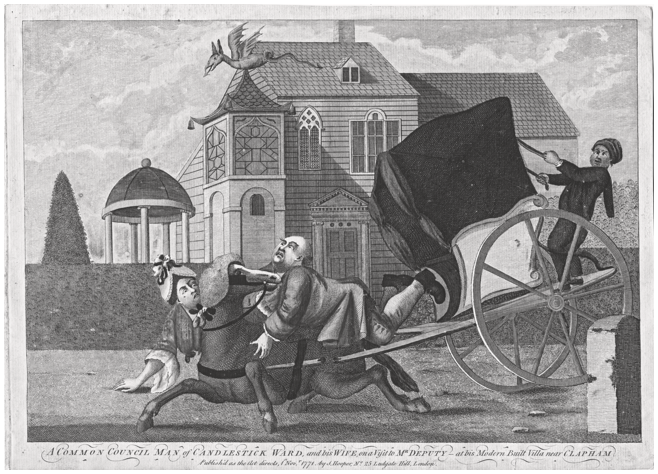
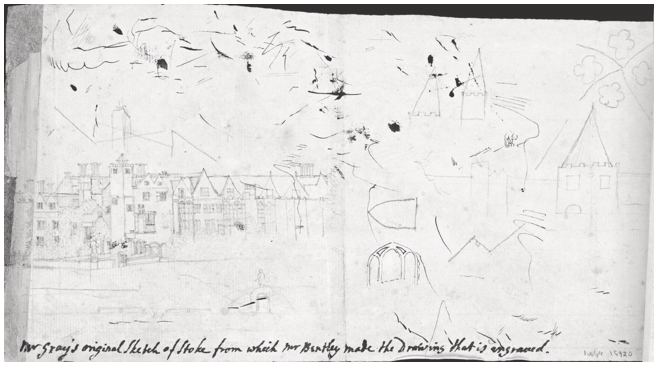
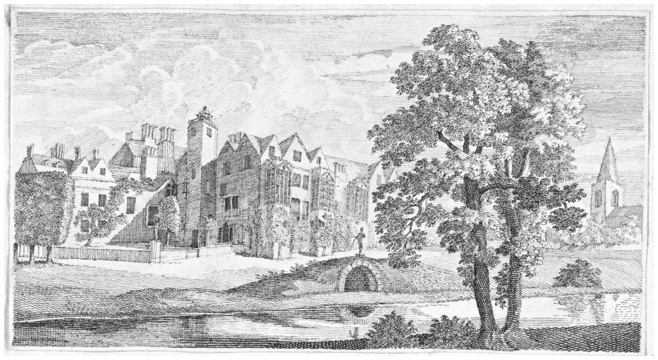
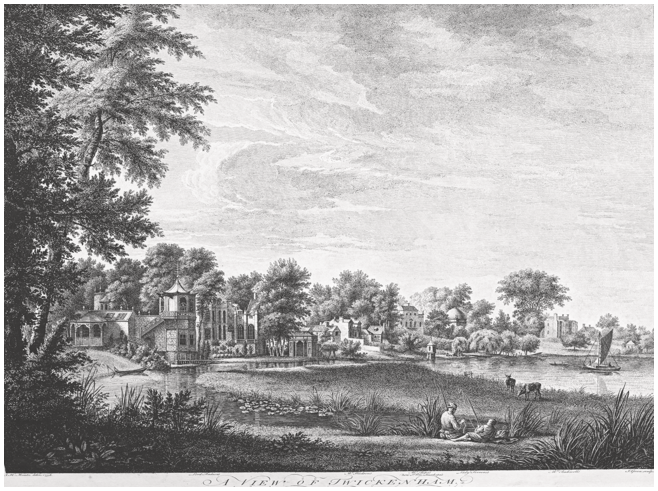

 Open access
