


Introduction
Family physicians (FPs) and other primary health care (PHC) professionals face growing numbers of patients presenting with symptoms of dementia as the population ages. Globally, 35.6 million people currently live with dementia; this figure is expected to reach 65.7 million people by 2030 (Alzheimer Disease International, 2012). The benefits of early diagnosis have been well documented (Alzheimer Disease International, 2011), including improved access to treatment and support for both patients and caregivers, increased time for future planning, and improved clinical outcomes.
In Canada, FPs are responsible for diagnosing and managing the majority of individuals with dementia (Feldman et al., Reference Feldman, Jacova, Robillanrd, Garcia, Chow, Borrie, Schipper, Blair, Kertesz and Chertkow2008). However, FPs face numerous obstacles in their efforts to provide quality dementia care: lack of support (for provider, patient, and caregiver), time barriers, financial barriers, stigma, diagnostic uncertainty, and difficulties in disclosing a diagnosis to patients and caregivers (Bradford et al., Reference Bradford, Kunik, Schulz, Williams and Singh2009; Koch and Iliffe, Reference Koch and Iliffe2010). In rural communities, a shortage of health care, specialist, and support services further hampers FPs (Morgan et al., Reference Morgan, Innes and Kosteniuk2011). A distance decay effect of geography is evident in health care service use by rural dwellers (ie, greater travel distance is associated with lower service use; Arcury et al., Reference Arcury, Gesler, Preisser, Sherman, Spencer and Perin2005) and may be more acute in vulnerable older, less healthy, and less mobile populations.
The current primary care model for individuals with dementia in Canada is primarily that of the traditional office-based FP model. The majority of Canadian FPs practice in either group settings with other FPs (48%) or in solo practice (22%), with only one in five (21%) Canadian FPs practising in interprofessional teams where each member has their own caseload (College of Family Physicians of Canada, 2010). Furthermore, the proportion of Canadian FPs who report making house calls has declined from 48% in 2007 to 42% in 2010, even as the population ages and care for older adults shifts from institution based to community based (Walkinshaw, Reference Walkinshaw2011).
Pimlott et al. (Reference Pimlott, Persaud, Drummond, Cohen, Silvius, Seigel, Hollingworth and Dalziel2009) conclude that the current model of family practice in Canada requires reform to improve the quality of care received by individuals with dementia. Evidence indicates that team-based dementia care provided in a collaborative model, in contrast to the traditional model of a ‘doc in a box’ (Pimlott et al., Reference Pimlott, Persaud, Drummond, Cohen, Silvius, Seigel, Hollingworth and Dalziel2009), improves patient/family satisfaction as well as care quality (Lee et al., Reference Lee, Hillier, Stolee, Heckman, Gagnon, McAiney and Harvey2010; Callahan et al., Reference Callahan, Boustani, Weiner, Beck, Livin, Kellams, Willis and Hendrie2011).
Where collaborative dementia care models have been introduced, no single type of model prevails; however, two or more PHC professionals from different disciplines typically share patient care, a case manager assumes the role of care coordination, and one or more specialists (eg, geriatrician) provides consultation where necessary. Case managers in collaborative care intervention studies vary in terms of professional training, from nurses with specialized geriatric or dementia training (Austrom et al., Reference Austrom, Hartwell, Moore, Perkins, Damush, Unverzagt, Boustani, Hendrie and Callahan2006; Callahan et al., Reference Callahan, Boustani, Unverzagt, Austrom, Damush, Perkinds, Fultz, Hui, Counsell and Hendrie2006), to social workers (Cherry et al., Reference Cherry, Vickrey, Schwankovsky, Heck, Plauchè and Yep2004; Clark et al., Reference Clark, Bass, Looman, McCarthy and Eckert2004; Connor et al., Reference Connor, McNeese-Smith, Vickrey, van Servellen, Chang, Lee, Vassar and Chodosh2008; Fortinsky et al., Reference Fortinsky, Kulldorff, Kleppinger and Kenyon-Pesce2009), family doctor–nurse duos (Perry et al., Reference Perry, Draskovic, van Achterberg, Borm, van Eijken, Lucassen, Vernooij-Dassen and Olde Rikkert2008), and FPs (Lee et al., Reference Lee, Hillier, Stolee, Heckman, Gagnon, McAiney and Harvey2010). Case managers do not necessarily execute the service plan; furthermore, the case management function may be performed by one member of the interdisciplinary team, the full team (Somme et al., Reference Somme, Trouve, Drame, Gagnon, Couturier and Saint-Jean2012), or by an individual who does not collaborate with the primary care team (Koch et al., Reference Koch, Iliffe, Manthorpe, Stephens, Fox, Robinson, Livingston, Coulton, Knapp, Chew-Graham and Katona2012). In a recent review of dementia case management studies, Koch et al. (Reference Koch, Iliffe, Manthorpe, Stephens, Fox, Robinson, Livingston, Coulton, Knapp, Chew-Graham and Katona2012) concluded that evidence to date is insufficient to link intervention outcomes with the training of the professional in a case manager role. Regarding GPs’ views towards case managers, Iliffe et al. (Reference Iliffe, Drennan, Manthorpe, Gage, Davies, Massey, Scott, Brearley and Goodman2011) found UK GPs to be generally skeptical and possibly influenced by the fact that community matrons (ie, nurse case managers) worked outside of care teams.
In light of the growing numbers of individuals with dementia and the increased pressure on PHC professionals to provide quality care, the purpose of this exploratory study was to investigate dementia care in the practice of rural FPs. We explored the topics of specialist referral, confidence in recognition, diagnosis and management of dementia, and continuing education. The present analysis explores rural FPs’ perceptions of their roles in providing care to patients with dementia, their preferred models of collaborative dementia care, and the implications of their rural setting for caring for patients with dementia.
Methods
Study participants were drawn from all health care professionals who had referred at least one patient to the Rural and Remote Memory Clinic between March 2004 and September 2010. The Rural and Remote Memory Clinic is described elsewhere (Morgan et al., Reference Morgan, Crossley, Kirk, D'Arcy, Stewart, Biem, Forbes, Harder, Basran, Dal Bello-Haas and McBain2009; Morgan et al., Reference Morgan, Crossley, Kirk, McBain, Stewart, D'Arcy, Forbes, Harder, Dal Bello-Haas and Basran2011). Eligible participants for the current study were FPs in full-time or part-time practice in Saskatchewan; ineligible persons were nurse practitioners (NPs), specialists, other health care professionals, and FPs who had retired or were practicing outside of the province.
Data were collected October 2010–March 2011. In an initial mail invitation, participants were offered an honorarium of $50 and informed that they could claim one Continuing Professional Development credit for each hour of educational activity such as research participation. Telephone interviews were conducted by the first author.
This study employed an exploratory qualitative design. The first and second authors reviewed each transcript and refined the interview guide to explore themes arising in subsequent interviews. The transcripts were coded by identifying themes within each of the broad questions explored in the presented study.
Results
Of 150 FPs and other health care professionals contacted, 20 were ineligible (specialist, NP, or other health care professional) and 31 had moved, resulting in 99 deemed eligible to participate. Of the 99 eligible persons, 27 refused (27%), 57 did not respond (58%), and 15 FPs (15%) completed telephone interviews. Participants’ characteristics are outlined in Table 1.
Characteristics of participating family physicians (n = 15)
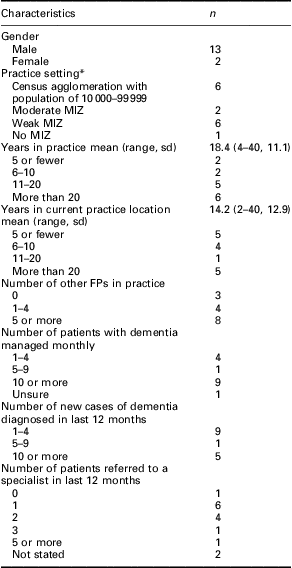
MIZ = metropolitan influence zone; FP = family physician; CMI = census metropolitan area.
*In moderate MIZ communities, 5–29% of the population commute to a CMA; weak MIZ, <5% commute to a CMA; and no MIZ, none of the workforce commutes to a CMA.
Preferred collaborative models
All of the FPs (n = 15) indicated that they would like to see more collaborative models in dementia care. FPs most frequently suggested collaborative models that involve a nurse or other health care professional with specialty training (n = 8), which would allow FPs more time to provide patient care. Other suggested models included specialty clinics (n = 4) and case management (n = 2):
I personally believe there should be more people involved. Especially with more advanced stages of the disease… It doesn't really matter. Anyone with geriatric skills or background in geriatric training, it can be a nurse practitioner, it can be someone in the community that's trained. It doesn't really matter. As long as it's someone that's trained in that field.
(FP121)
The roles currently occupied by nurses in other chronic care models (eg, psychiatry, diabetic management, and ulcer treatment) informed FPs’ understanding of possible collaborative dementia care models. FPs suggested that specialist nurses could carry out home visits that FPs currently do not provide, offer specialized care based on the latest evidence particularly to patients in advanced stages of the disease, and facilitate urgent referrals to medical specialists. It was also speculated that a dementia care nurse would be able to spend a greater length of time with each patient than FPs could currently spend. FPs noted that a nurse or other health care professional offering dementia care would work to advance their knowledge and skills in this area and subsequently share their knowledge with FPs.
FPs noted the particular value of specialty clinics for rural patients, who benefit from time and travel over long distances saved by coordinated assessments by multiple clinic health care professionals. Also noted was the value of expertise of many professionals who can meet patients’ medical and non-medical needs that FPs may not have the expertise to provide, such as physical therapy and power of attorney. A specialist such as a neurologist also has the necessary expertise to perform advanced testing and distinguish among dementia subtypes:
I can ascertain that somebody doesn't know who the prime minister is, doesn't know what today is, and can't remember what they had for breakfast. I don't really need a neurologist to tell me that. I need a neurologist to help me with the subtleties and I think a team would be much better.
(FP30)
FPs described the case manager role within a collaborative model as responsible for overseeing the care provided by both health care professionals and the families. Ideally, a case manager ‘steers the ship’ to ensure appropriate care and patient safety. For rural patients, case management can be provided both in person and by telephone.
Role in dementia care
FPs emphasized their role in providing family support and education to a greater extent than any other role (n = 11). FPs offered emotional support to ease families’ anxiety and uncertainty, and decision support to help families when considering their loved one's care and daily activities, particularly in later stages of dementia. Decision support was rooted in dementia education, to ensure that families had up-to-date information and understood the disease progression, implications of dementia, and management strategies:
It's often acting as a bridge between the family and the patient to try and explain what's the dynamics of the disease, explaining the changes in the patient's personality and what the family needs to be aware of. Explaining the progression of the disease, how to manage it.
(FP12)
As expected, FPs also reported that their role involved managing treatment and monitoring patients (n = 8). Most participants responded positively when asked if they were satisfied with their described role (n = 10). Satisfaction was expressed in terms of role familiarity and role acceptance, in that FPs believed they did as much as they could. Dissatisfied FPs (n = 3) wanted to learn the best treatments for patients in the early disease stages, and to have more time to provide patient care and see patients in follow-up.
Implications of rural versus urban practice
The primary disadvantages of practicing rural were accessing urban-based health care and related services and a shortage of local health care resources (n = 6). In some regions, services such as day respite programs were non-existent, whereas other services were poorly staffed. Consequently, services were offered sporadically and reduced in scope. Patients faced a choice of waiting several months for the services that were available locally, or travelling to the city for the same services. A lack of physically proximate services caused inequities in patient care between rural and urban regions, and placed a burden on FPs to fill in the gaps for their patients:
We don't have day respite programs or whatever you have in the city, you know where someone who is working can have their elderly parent spend the day, those programs don't exist in the north.
(FP10)
FPs suggested that patients in the closest major city, where specialists are concentrated, were able to access specialists more quickly than their rural patients (n = 4). One participant offered a definition of ‘rural’ as the absence of specialists. FPs acknowledged that their perception of access inequity was a suspicion on their part, and that they could not substantiate their claims.
A particular advantage of practicing rural was the high degree of social proximity between FPs, their patients, families, and health care workers (n = 4). FPs felt that it was beneficial to the care of their patients to have open lines of communication between themselves and families, and in some cases, with their patients’ employers. One FP contrasted their personal knowledge of family dynamics in small communities with that of physicians in city practice, which translated into a better understanding of how families might access resources:
And we know the caregivers and our seniors don't see 30 different home care workers a month … our nurses in the hospital, physios, all the ancillary folks on the team often know these patients and may be related to them, which can be a real asset.
(FP30)
Here, the limited number of health care workers, and the dual relationships of these workers as both relatives and health care professionals, were characterized as advantages in continuity of care from a small number of familiar workers.
Discussion
This study suggests that most FPs considered it part of their role to provide emotional and practical support to the families of their patients. Consistent with this finding, a recent literature review concerning FPs’ attitudes towards caregivers found diagnosis disclosure and education of caregivers to be especially important (Schoenmakers et al., Reference Schoenmakers, Buntinx and Delepeleire2009). Nevertheless, FPs found these responsibilities to be time-consuming and had difficulty communicating information to caregivers. In contrast, a Canadian study found that FPs were generally not aware of community resources for caregivers, did not keep up-to-date lists of such resources, did not feel that it was their responsibility to refer caregivers to community resources, and ‘did not see themselves as the answer to most caregivers’ needs’ (Yaffe et al., Reference Yaffe, Orzeck and Barylak2008: 1012). These conflicting findings may indicate that while FPs recognize and acknowledge caregivers’ significant needs for education and emotional support, they nevertheless find it quite challenging to meet those needs.
All FPs in the present study expressed interest in more collaborative models in practice, particularly models that include a nurse or another health care professional trained specifically in dementia care. Given that leading Canadian dementia experts call for incorporating additional health care professionals into dementia care and promoting new models of care (Bergman et al., Reference Bergman, Arcand, Bureau, Chertkow, Ducharme, Joaneete, Lebel, Lecoeur, Page, Poirier, Trudel and Voyer2009; Dudgeon, Reference Dudgeon2010; Massoud et al., Reference Massoud, Lysy and Bergman2010), it is important to investigate how FPs view their role in such collaborative models.
Our findings draw attention to the incongruities of dementia care provided by FPs in rural settings. On the one hand, practicing rural was considered an advantage in terms of the close relationships fostered among physicians, patients, families, and other health care workers. These sentiments reflect a ‘rural idyll’ view (Parr et al., Reference Parr, Philo and Burns2004; Boyd and Parr, Reference Boyd and Parr2008) that rural FPs have more personal knowledge of their patients than their urban counterparts. FPs also believed that rural patients benefit more from home care provided by a small number of home care workers (who may be relatives) than from many different home care workers (as may be the case for urban patients). These findings are consistent with previous research that described the importance of community spirit and continuity of care provided by professionals familiar to patients (McCann et al., Reference McCann, Ryan and McKenna2005).
On the other hand, FPs in our study described significant disadvantages of rural practice, such as insufficient local services, difficulty accessing specialists, non-existent and inadequately staffed programs, and long wait times for local services. These findings echo previous research that found health care professionals face many barriers to providing care to persons with complex needs in rural areas (McCann et al., Reference McCann, Ryan and McKenna2005). Our findings are consistent with a recent systematic review that found key advantages of rural dementia care included the high level and value of informal support that members of small communities provide to one another, yet rural GPs are challenged to offer the best possible care when they face barriers related to transportation, specialist access, and stigma (Szymczynska et al., Reference Szymczynska, Innes, Mason and Stark2011).
Limitations
This study may be limited by the sample of FPs purposively selected from physicians who had referred to a memory clinic. Thus, the participants were likely familiar with an interdisciplinary team approach to dementia care and had a known interest in patients with dementia. Second, the study overrepresented male FPs and those who had been in practice a longer period of time. This limitation restricts our ability to generalize our findings. However, the study provides insights into potential openness to alternate models among rural FPs and their perceptions of their role in providing care to patients with dementia.
Conclusions
There is a significant opportunity to improve service delivery and care quality for rural patients with dementia and their caregivers. Interdisciplinary team-based care is considered an essential component of PHC models that offer health and social services beyond medical care (Levesque et al., Reference Levesque, Haggerty, Burge, Beaulieu, Gass, Pineault and Santor2011) and viewed as essential to ‘high-performing’ PHC delivered within a coordinated, comprehensive, and person-centred care framework (Aggarwal and Hutchinson, Reference Aggarwal and Hutchinson2012). Greater care coordination and higher quality care have been reported among Canadians with multiple chronic conditions receiving collaborative care from a PHC team (Khan et al., Reference Khan, McIntosh, Sanmartin, Watson and Leeb2008).
Future research in rural dementia care should focus on implementation of collaborative care models, successful strategies to overcome implementation challenges, and outcomes in care quality for patients and caregivers participating in such models versus usual FP-based care. Interventions to improve dementia care provided by rural FPs should encourage the inclusion of family caregivers in the care regimen. Collaborative dementia care that reaches out to rural patients and caregivers to improve their access to diagnosis, management, support, and health system navigation is one possible solution to overcome the challenges of physical distance, transportation, health care staff shortages, and dearth of services posed by rural living.
Acknowledgements
Funding
This research was supported by an Applied Chair in Health Services and Policy Research from the Canadian Institutes of Health Research (CIHR) and the Saskatchewan Health Research Foundation (SHRF), and a postdoctoral fellowship from the CIHR Strategic Training Program in Public Health and the Agricultural Rural Ecosystem.
Ethical Approval
This study received ethics approval from the University of Saskatchewan Behavioral Research Ethics Board (BEH 09-277).



