

Introduction
In June 2008 Tim Willing, while exploring rock art on the north-western coast of the Kimberley, found and recorded the image of a large striped quadruped painted in a shelter near the western shore of the Admiralty Gulf. Unfortunately conditions permitted the taking of only three digital images. Reviewing these, Akerman considered that they depicted a marsupial lion (Thylacoleo carnifex) rather than a thylacine or Tasmanian tiger (Thylacinus cynocephalus).
In an earlier paper Reference AkermanAkerman (1998) had described another painting of a large quadruped, also from the north Kimberley, and suggested, after reviewing the palaeontological literature and literature dealing with representations of ancient fauna in Aboriginal rock art (Reference CalabyCalaby & Lewis 1977; Reference MurrayMurray & Chaloupka 1984; Reference LewisLewis 1986; Reference ChaloupkaChaloupka & Murray 1986), that it possibly represented a Thylacoleo. The 2008 image however clearly shows a number of features, absent in the image previously described and which tend to confirm that it represents a Thylacoleo.
The images of the painting were forwarded to palaeontologists Peter Murray (formerly of the Central Australian Museum, Alice Springs, Northern Territory), John Long (Museum of Victoria in Melbourne) and Rod Wells (School of Biological Sciences, Flinders University, South Australia), who have all worked intensively on Thylacoleo material. All three had no hesitation in accepting the identification of the animal as a Thylacoleo. Clay Bryce (Aquatic Division, Western Australian Museum in Welshpool) generously provided a DVD of the The Bone Diggers (Reference BryceBryce & Searle 2006), a documentary about a complete Thylacoleo skeleton which proved relevant to this discussion.
At the time of discovery, the three images were taken under adverse conditions at the end of the day. Due to the tight voyage itinerary there was no opportunity to re-visit the site and systematically record the painting in greater detail.
The image
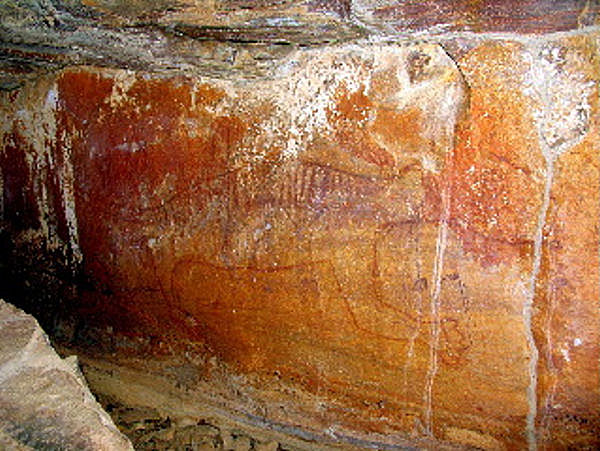
The animal is depicted outlined in red ochre (Figure 1). There has been some bleeding of the ochre, particularly about the head but this does not obscure it. Mineral deposits run in a thin trail down the wall of the shelter and divide the muzzle of the beast and a second trail obscures one ear. Some deposit intrudes upon the dorsal line and a larger deposit covers areas of the end of the tail. A number of other paintings, but of a dark mulberry colour, appear to have been superimposed upon the main painting at some later date.
Photo taken at a slightly oblique angle showing the entire painting of a Thylacoleo.

These include:
-
i. a small painting, possibly a 'Clothes Peg' Bradshaw (Gwion) depicting a female figure with raised arms which is placed over the thorax of the animal but does not obscure it;
-
ii. an enigmatic figure, possibly the remains of a Tassel Bradshaw (Gwion) that lies across and below the cervical area and impinges upon the forearm of the animal;.
-
iii. fern-like structures over the stomach and in front of the forepaw;
-
iv. a tail, with tufted tail-tip is located in front of the head of the main figure and painted in the same manner. Unfortunately other details of this figure, because of its proximity to the entrance of the shelter, have been obliterated. However this tail-tip and that of the main figure are very alike, and both are strikingly similar to an image thought to represent a Thylacoleo illustrated in Murray & Chaloupka (1984: 111, Figure 6d).
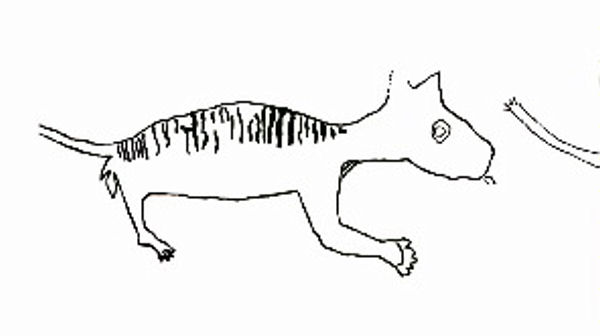
The figure (Figure 2) is exceptionally clear and without any overpainting that obscures major features or could lead to the suggestion that the figure is a 'construct' serendipitously made from elements of otherwise unrelated paintings (Reference LewisLewis 1986). though no scale was available at the time it was estimated that the overall length of the rock painting was about 2m.
Detail of the Thylacoleo showing the tail of another animal in front of the primary image, drawn from a digitally enhanced image. The head is broad and deep with a blunt muzzle, rather than elongated, as are thylacine heads. The striping on the dorsal region is also more extensive than that recorded for thylacines, where striping is usually restricted to the lumbar and upper tail region.

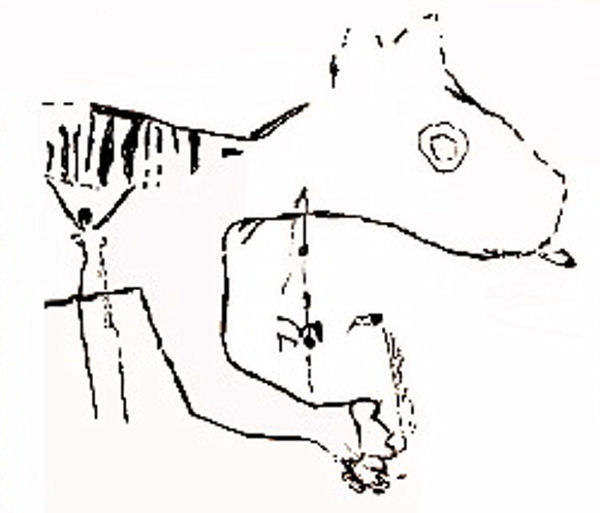
The head is large and rectangular with prominent triangular ears. The large round eye is clearly shown. Although there is some running of the ochre since it was originally painted, a pupil may have been indicated. Possibly a small eye was painted initially and then re-painted at a larger scale to encompass the original eye and make it appear to have a pupil. In front of the lower muzzle there appears to be a protruding rhomboidal feature. A mineral deposit makes it difficult to determine if this feature is connected to the muzzle, but it is of a similar pigment to the main figure and may represent a protruding lower incisor.
The front leg is carefully drawn as if to emphasise the robust musculature of both upper and lower limb, while the paw is shown in plan-view with pads and claws extended. The artist has depicted the paw in great detail, as clearly in fact as a person today would draw the tracks of a dingo or kangaroo (Figure 3).
Detail of the head and forepaw of the Thylacoleo, also showing the superimposition of other art, drawn from a digitally enhanced image. The broad paw with extended claws is quite different from the dog-like pads depicted on images of thylacines.

Short stripes run along the dorsal region, from the shoulders to the base of the tail, but they are not present on the tail. The stripes penetrate a little more than a third of the way across the body. There appears to be a darker area connecting the lower ends of the stripes - but this also may be due to bleeding of the ochre subsequent to application.
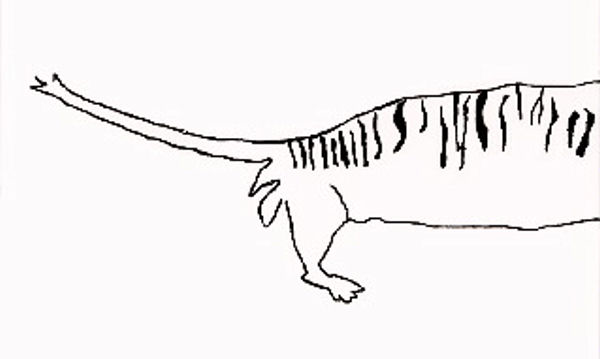
A long thin tail, gently arching upwards from the base, accounts for about a third of the total length of the animal. The tail appears to be tufted, but, as noted above, mineral deposits obscure parts of the tip. The animal is clearly male: immediately below the base of the tail a downwardly curving, pointed penis projects from the cloacal region and below this there is a more rounded sac-like scrotum (Figure 4). This marsupial arrangement of cloaca, which conceals the reproductive apertures as well as those of the alimentary and urinary systems, is placed in the case of the male animal behind the scrotum.
Details of the hindquarters of the Thylacoleo, showing hind foot, genitalia and tail, drawn from a digitally enhanced image. Compared with the powerful forequarters, the hindquarters appear underdeveloped. This apparent asymmetry is not seen in rock art images of thylacines, where both hind and fore limbs are usually of similar dimensions. However thylacoleos were equipped with powerful claws on the hind limbs and these appear to be depicted in this image.

The short, solid, hind leg is shown with the whole foot in an almost horizontal position, and with the heel clearly indicated. The hind paw appears to be slightly splayed as if gripping the ground and supporting the weight of the animal, which is reaching out and swiping with the forepaw.
Discussion
The figure is 'cat-like' rather than 'dog-like'. The head is large with a bluff profile and does not have the drawn-out muzzle found in rock art images of other striped animals - particularly thylacines. Thylacoleos were animals equipped with huge shearing premolars and the shape of the head reflects the massive jaw muscles used to operate them. It has been suggested that the highly developed incisors are used for both grabbing and stabbing when killing prey (Wells et al. 1982; Bryce & Searle 2006) and it is possible that the lozenge-shaped figure shown in front of, or possibly part of, the lower jaw, represents the diprotodontid, pointed, lower incisors characteristic of these animals.
As the animal is definitely male and the penis is erect, it can be presumed to be in breeding mode. The possible presence of the tufted tail of a second animal in front of its muzzle suggests that it is pursuing a similar animal; perhaps the panel originally depicted two beasts in courting mode. If this were the case, then it is also possible that the feature in front of the muzzle may in fact be a protruding tongue.
The artist appears to place a degree of emphasis on the massive clawed paws. As well as other digits, the carefully painted forepaw appears also to show one enlarged digit and claw. Thylacoleo had large, retractable claws on both fore and hind limbs and the thumbs were particularly large in relation to the other digits. Reconstructions (Reference WellsWells & Nichol 1976; Reference WellsWells et al. 1982; Reference WellsWells 1985; Reference BryceBryce & Searle 2006) suggest that the animal supported itself by rocking back on the hind feet using the tail as a prop, and delivered powerful smashing blows with the fearsomely clawed, front paws. The paws were probably also used to grasp prey before killing by biting with the large incisors.
On the hind paw, one toe has also been depicted larger than the others. In life, the structure of the Thylacoleo hind foot included an enlarged and opposable big toe, which suggests that the animal could also climb extremely well. The hind legs are however much less robust in relation to the forelimbs, a feature confirmed by the actual anatomy of these limbs in a skeleton recovered at Nullarbor (see below). The artist's understanding and appreciation of the particularly dangerous nature of the forelimbs and paws may possibly be inferred by the apparent differentiation in emphasis between the fore and hind limbs.
The discovery of the complete skeleton of a Thylacoleo carnifex in a cave on the Nullarbor Plain in the recent past has allowed palaeontologists to reconstruct accurately the animal and investigate and answer a number of questions about its bio-mechanics. The DVD The Bone Diggers: mystery of a lost predator (Reference BryceBryce & Searle 2006), covering the discovery, retrieval, reconstruction and some of the initial findings of the bio-mechanical and other anatomical investigations carried out to date has been most valuable in relation to the understanding of the rock art image.
In many ways the 2008 Kimberley painting of Thylacoleo also adds to our knowledge of the animal's appearance that, without the discovery of a mummified animal, would have remained conjecture. The artist has depicted a tail with tufted tip. The ears are pointed rather than rounded. The animal is striped, rather than spotted, or spotted and striped as shown in some reconstructions. The stripes are shown to run the length of the body between the shoulders and the base of the tail, but do not cross over the body into the belly and flanks.
The presence of the eye - a feature rarely shown in other early animal images of the region - suggests that it was a significant element of the animal's identity, for the artist at least. The eye is huge, and raises the possibility that the creature was a nocturnal hunter - even if the 'pupil' was not deliberately intended.
The fern-like figure referred to earlier that is painted in front of the forepaw and perhaps intruding on to it, may or may not be part of the larger image (Figure 3). It may be that either the original artist incorporated an existing figure to suggest the scratches left by an animal marking its territory, or a later artist has added the fern-like figure for the same purpose.
Finally it appears that the image was part of a larger panel, incorporating at least one other individual and possibly representing the animals involved in courtship.
The painting itself, falls into the stylistic regime described by Reference WalshWalsh (1994: 76), as the Irregular Infill Animal Period, Zoomorphic Group, Large Naturalistic Macropod Sub-Group - and which lies within Walsh's Archaic Epoch of the Kimberley Rock Art Sequence. Perceiving similarities in the Kimberley with elements in the Arnhem Land Rock Art Sequence created by Chaloupka (Reference ChaloupkaChaloupka 1993: 94), we believe this sub-group would possibly be better called 'the Large Naturalistic Animals Period', as 'irregular infill' may not necessarily be present.
Conclusions
In the discussion of a seminar on Kimberley rock art, Reference WelchWelch (2007: 155) suggests that the only confirmed figure of any Australian megafauna found in the rock art of the continent is the picture of the Marsupial Tapir, Palorchestes described by Reference MurrayMurray & Chaloupka (1984: 111; Reference ChaloupkaChaloupka 1993: 100). These authors did suggest that other 'cat-like' animals that appear in Arnhem Land rock art may also represent the Marsupial Lion, Thylacoleo carnifex. Reference AkermanAkerman (1998) has suggested that a painting found in the King George River region of the Kimberley may also possibly represent this animal. With the finding of the 2008 figure however we have indisputable evidence that some early Aboriginal people were not only familiar with megafauna, in this case, Thylacoleo carnifex, but also recorded the salient features of this, now long extinct, animal in a manner that resonates across the millennia.
Acknowledgements
Kim Akerman wishes to thank Pearl Sea Coastal Cruises and the Australian Geographic Society for providing the opportunity to participate in two memorable voyages exploring the rock art of the northwest Kimberley coast. Captains Ben Bonnett and Neil Harding and the crew of the Kimberley Quest II are thanked for the generous provision of dinghy access - as well as for sharing our passionate enthusiasm for Kimberley rock art. Our thanks also go to Clay Bryce who provided copies of the DVD The Bone Diggers: mystery of a lost predator, and to John Long, Peter Murray and Rod Wells who confirmed our initial identification of the painting as a Thylacoleo. Rod Wells also commented on our original manuscript. The generous assistance of Gunnar Syren in producing the black and white tracings of the digital images is most gratefully acknowledged. Finally we wish to thank the Wunambal Gaambera Aboriginal Corporation at Kalumburu, for allowing us to work in their country and in particular Sylvester Mangalomara, as 'countryman' and teacher, for both his friendship and knowledge during the rock art voyages.