 HTc
HTc HTc
HTc HTc
HTc T
T





1 Introduction
Many real-world applications have a heterogeneous nature that can only be effectively handled by combining different types of constraints. This is commonly addressed by hybrid solving technology, most successfully in the area of Satisfiability modulo Theories (SMT; Nieuwenhuis et al. Reference Nieuwenhuis, Oliveras and Tinelli2006) with neighboring areas such as Answer Set Programming (ASP; Lifschitz Reference Lifschitz2008) following suit. However, this increased expressiveness introduces a critical challenge: How can we determine whether modifications to a heterogeneous specification preserve its semantic meaning, in view of the intricate interplay of different constraint types? This is even more severe in ASP since two logic programs may be equivalent (in the sense of having the same answer sets) and yet, replacing one by the other in a larger context may produce different effects, due to the nonmonotonic nature of ASP semantics. For this, one generally needs a stronger concept of equivalence that guarantees that, informally speaking, two expressions have the same meaning in any context. Formally, this is referred to as strong equivalence (Lifschitz et al. Reference Lifschitz, Pearce and Valverde2001). Such properties are important because they can help us simplify parts of a logic program in a modular way, without examining its other parts.
This paper delves into the question of strong equivalence within the extended framework of Constraint Answer Set Programming (CASP; Lierler Reference Lierler2023), where the integration of linear arithmetic constraints over integers introduces new difficulties. To address this challenge, we harness the logic of Here-and-There with constraints ( $\textrm {HT}_{\!c}$
; Cabalar et al. Reference Cabalar, Kaminski, Ostrowski and Schaub2016, Reference Cabalar, Fandinno, Schaub and Wanko2020a, Reference Cabalar, Fandinno, Schaub and Wanko2020b), a powerful formalism that allows us to precisely characterize extensions of ASP with external theories over arbitrary domains. By employing
$\textrm {HT}_{\!c}$
; Cabalar et al. Reference Cabalar, Kaminski, Ostrowski and Schaub2016, Reference Cabalar, Fandinno, Schaub and Wanko2020a, Reference Cabalar, Fandinno, Schaub and Wanko2020b), a powerful formalism that allows us to precisely characterize extensions of ASP with external theories over arbitrary domains. By employing $\textrm {HT}_{\!c}$
, we aim to develop a formal method for analyzing strong equivalence in CASP, contributing to a deeper understanding of program optimization in this increasingly important paradigm.
$\textrm {HT}_{\!c}$
, we aim to develop a formal method for analyzing strong equivalence in CASP, contributing to a deeper understanding of program optimization in this increasingly important paradigm.
As an example, consider the following very simple ASP program with constraints in the language of the hybrid solver clingcon (Banbara et al. Reference Banbara, Kaufmann, Ostrowski and Schaub2017):
 \begin{align*} &\texttt{:- not a,} \quad \&\texttt{sum\{s\}} \gt \texttt{= 120}. \\ &\texttt {a :-}\quad \&\texttt{sum\{s\}} \gt \texttt{100.} \end{align*}
The Boolean atom $\texttt {a}$
is true when an alarm is set in the car and
$\texttt {a}$
is true when an alarm is set in the car and $\texttt {s}$
is an integer variable representing the speed of the car. The general form of a linear constraint in clingcon allows adding multiple arguments in the theory atom
$\texttt {s}$
is an integer variable representing the speed of the car. The general form of a linear constraint in clingcon allows adding multiple arguments in the theory atom $\&\texttt {sum}\{\dots \}$
but, in this case, we just use it to check the value of the integer variable
$\&\texttt {sum}\{\dots \}$
but, in this case, we just use it to check the value of the integer variable $\texttt {s}$
. The first rule tells us that if the alarm is not set, we cannot choose speeds exceeding 120 km/h. The second one states that if the speed is greater than 100 km/h, then the alarm must be set. We are interested in answering the question of whether the first rule is redundant in the presence of the second rule. In terms of strong equivalence, we want to know if the pair of rules together are strongly equivalent to the second rule alone. As we discuss in Section 3, this is indeed the case.
$\texttt {s}$
. The first rule tells us that if the alarm is not set, we cannot choose speeds exceeding 120 km/h. The second one states that if the speed is greater than 100 km/h, then the alarm must be set. We are interested in answering the question of whether the first rule is redundant in the presence of the second rule. In terms of strong equivalence, we want to know if the pair of rules together are strongly equivalent to the second rule alone. As we discuss in Section 3, this is indeed the case.
Our main result is a characterization of strong equivalence in the context of ASP with constraints, given in Section 8. The proof of this result is based on two intermediate results that are of independent interest: A characterization of strong equivalence in the context of $\textrm {HT}_{\!c}$
developed in Section 3 and an answer set preserving transformation of logic programs with constraints into
$\textrm {HT}_{\!c}$
developed in Section 3 and an answer set preserving transformation of logic programs with constraints into $\textrm {HT}_{\!c}$
-theories given in Section 4. We also study the computational complexity of deciding strong equivalence in this context in Section 9. Finally, Section 10 concludes the paper. Regarding the preliminary material, we split it into three separate sections closer to where the material is needed: Section 2 introduces
$\textrm {HT}_{\!c}$
-theories given in Section 4. We also study the computational complexity of deciding strong equivalence in this context in Section 9. Finally, Section 10 concludes the paper. Regarding the preliminary material, we split it into three separate sections closer to where the material is needed: Section 2 introduces $\textrm {HT}_{\!c}$
, which is used throughout the paper. Section 4 introduces the syntax and semantics of ASP with constraint, which is used in Section 5 to introduce a new, simplified definition of theory stable model that is equivalent to the original definition under widely accepted assumptions that are inherent to most hybrid solvers. The simplified definition is used in the remainder of the paper. Section 6 reviews structured and compositional theories that are used in the transformation of logic programs with constraints into
$\textrm {HT}_{\!c}$
, which is used throughout the paper. Section 4 introduces the syntax and semantics of ASP with constraint, which is used in Section 5 to introduce a new, simplified definition of theory stable model that is equivalent to the original definition under widely accepted assumptions that are inherent to most hybrid solvers. The simplified definition is used in the remainder of the paper. Section 6 reviews structured and compositional theories that are used in the transformation of logic programs with constraints into $\textrm {HT}_{\!c}$
-theories in Section 7.
$\textrm {HT}_{\!c}$
-theories in Section 7.
2 Review: The logic of here-and-there with constraints
The logic of Here-and-There with constraints ( $\textrm {HT}_{\!c}$
) along with its equilibrium models provides logical foundations for constraint satisfaction problems (CSPs) in the setting of ASP. Its approach follows the one of the traditional Boolean Logic of Here-and-There (Heyting Reference Heyting1930) and its nonmonotonic extension of Equilibrium Logic (Pearce Reference Pearce1997, Reference Pearce2006). In
$\textrm {HT}_{\!c}$
) along with its equilibrium models provides logical foundations for constraint satisfaction problems (CSPs) in the setting of ASP. Its approach follows the one of the traditional Boolean Logic of Here-and-There (Heyting Reference Heyting1930) and its nonmonotonic extension of Equilibrium Logic (Pearce Reference Pearce1997, Reference Pearce2006). In $\textrm {HT}_{\!c}$
, a CSP is expressed as a triple
$\textrm {HT}_{\!c}$
, a CSP is expressed as a triple $\langle \mathcal{X},{\mathcal{D}},{\mathcal{C}} \rangle$
, also called signature, where
$\langle \mathcal{X},{\mathcal{D}},{\mathcal{C}} \rangle$
, also called signature, where $\mathcal{X}$
is a set of variables over some non-empty domain
$\mathcal{X}$
is a set of variables over some non-empty domain $\mathcal{D}$
and
$\mathcal{D}$
and $\mathcal{C}$
is a set of constraint atoms. A constraint atom provides an abstract way to relate values of variables and constants according to the atom’s semantics. Most useful constraint atoms have a structured syntax, but in the general case, we may simply consider them as strings.Footnote
1
For instance, linear equations are expressions of the form “
$\mathcal{C}$
is a set of constraint atoms. A constraint atom provides an abstract way to relate values of variables and constants according to the atom’s semantics. Most useful constraint atoms have a structured syntax, but in the general case, we may simply consider them as strings.Footnote
1
For instance, linear equations are expressions of the form “ $x+y=4$
”, where
$x+y=4$
”, where $x$
and
$x$
and $y$
are variables from
$y$
are variables from $\mathcal{X}$
and
$\mathcal{X}$
and $4$
is a constant representing some element from
$4$
is a constant representing some element from $\mathcal{D}$
.
$\mathcal{D}$
.
Variables can be assigned some value from $\mathcal{D}$
or left undefined. For the latter, we use the special symbol
$\mathcal{D}$
or left undefined. For the latter, we use the special symbol $\mathbf{u} \notin {\mathcal{D}}$
and the extended domain
$\mathbf{u} \notin {\mathcal{D}}$
and the extended domain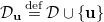 $\mathcal{D}_{\mathbf{u}} \stackrel {\mathrm{def}}{=} {\mathcal{D}} \cup \{\mathbf{u}\}$
. The set
$\mathcal{D}_{\mathbf{u}} \stackrel {\mathrm{def}}{=} {\mathcal{D}} \cup \{\mathbf{u}\}$
. The set $\mathit{vars}(c) \subseteq \mathcal{X}$
collects all variables occurring in constraint atom
$\mathit{vars}(c) \subseteq \mathcal{X}$
collects all variables occurring in constraint atom $c$
.
$c$
.
A valuation $v$
over
$v$
over $\mathcal{X},{\mathcal{D}}$
is a set of pairs
$\mathcal{X},{\mathcal{D}}$
is a set of pairs $x \mapsto d$
where
$x \mapsto d$
where $x \in \mathcal{X}$
and
$x \in \mathcal{X}$
and $d \in {\mathcal{D}}$
such that for each
$d \in {\mathcal{D}}$
such that for each $x \in \mathcal{X}$
there is at most one pair
$x \in \mathcal{X}$
there is at most one pair $x \mapsto d$
in
$x \mapsto d$
in $v$
. The restriction of
$v$
. The restriction of $v$
to a set of variables
$v$
to a set of variables $Z \subseteq \mathcal{X}$
, denoted
$Z \subseteq \mathcal{X}$
, denoted ${v|}_{\hspace {-1pt}Z}$
, is the set of pairs
${v|}_{\hspace {-1pt}Z}$
, is the set of pairs $x \mapsto d$
in
$x \mapsto d$
in $v$
such that
$v$
such that $x \in Z$
. We define the domain of a valuation
$x \in Z$
. We define the domain of a valuation $v$
as the set of variables that have a defined value, namely,
$v$
as the set of variables that have a defined value, namely,
 \begin{equation*}\mathit{dom}(v) \stackrel {\mathrm{def}}{=} \{x \in \mathcal{X} \mid x \mapsto d \in v \text{ for some } d \in {\mathcal{D}}\}.\end{equation*}
We sometimes use function notation for writing valuations and write $v(x)=d$
to denote that
$v(x)=d$
to denote that $x \mapsto d$
is in
$x \mapsto d$
is in $v$
, and
$v$
, and $v(x)=\mathbf{u}$
to denote that there is no pair
$v(x)=\mathbf{u}$
to denote that there is no pair $x \mapsto d$
in
$x \mapsto d$
in $v$
for any
$v$
for any $d \in {\mathcal{D}}$
. Using this notation,
$d \in {\mathcal{D}}$
. Using this notation, $v\subseteq v'$
means that
$v\subseteq v'$
means that $v(x) \in {\mathcal{D}}$
implies
$v(x) \in {\mathcal{D}}$
implies $v'(x)=v(x)$
for all
$v'(x)=v(x)$
for all $x \in \mathcal{X}$
. We also allow for applying a valuation
$x \in \mathcal{X}$
. We also allow for applying a valuation $v$
to fixed domain values, and so extend their type to
$v$
to fixed domain values, and so extend their type to $v:\mathcal{X}\cup \mathcal{D}_{\mathbf{u}}\rightarrow \mathcal{D}_{\mathbf{u}}$
by fixing
$v:\mathcal{X}\cup \mathcal{D}_{\mathbf{u}}\rightarrow \mathcal{D}_{\mathbf{u}}$
by fixing $v(d) = d$
for any
$v(d) = d$
for any $d \in {\mathcal{D}}_{\mathbf{u}}$
. The semantics of constraint atoms is defined in
$d \in {\mathcal{D}}_{\mathbf{u}}$
. The semantics of constraint atoms is defined in $\textrm {HT}_{\!c}$
via denotations, which are functions of form
$\textrm {HT}_{\!c}$
via denotations, which are functions of form $[\![ \, \cdot \, ]\!]:{\mathcal{C}}\rightarrow 2^{\mathcal{V}}$
, mapping each constraint atom to a set of valuations. Following Cabalar et al. (Reference Cabalar, Fandinno, Schaub and Wanko2020a), we assume in the sequel that they satisfy the following properties for all
$[\![ \, \cdot \, ]\!]:{\mathcal{C}}\rightarrow 2^{\mathcal{V}}$
, mapping each constraint atom to a set of valuations. Following Cabalar et al. (Reference Cabalar, Fandinno, Schaub and Wanko2020a), we assume in the sequel that they satisfy the following properties for all $c\in {\mathcal{C}}$
,
$c\in {\mathcal{C}}$
, $x\in \mathcal{X}$
, and
$x\in \mathcal{X}$
, and $v,v' \in \mathcal{V}$
:
$v,v' \in \mathcal{V}$
:
-
1. $v \in [\![ \, c \, ]\!]$
and
$v \subseteq v'$
imply
$v' \in [\![ \, c \, ]\!]$
,
$v \in [\![ \, c \, ]\!]$
and
$v \subseteq v'$
imply
$v' \in [\![ \, c \, ]\!]$
, -
2.
$v \in [\![ \, c \, ]\!]$
implies
$v \in [\![ \, c[x/v(x)] \, ]\!]$
, -
3. if
$v(x)=v'(x)$
for all
$x \in \mathit{vars}(c)$
then
$v \in [\![ \, c \, ]\!]$
iff
$v' \in [\![ \, c \, ]\!]$
.





where $c[s/s']$
is the syntactic replacement in
$c[s/s']$
is the syntactic replacement in $c$
of subexpression
$c$
of subexpression $s$
by
$s$
by $s'$
. We also assume that
$s'$
. We also assume that $c[x/d] \in {\mathcal{C}}$
for any constraint atom
$c[x/d] \in {\mathcal{C}}$
for any constraint atom $c \in {\mathcal{C}}$
containing
$c \in {\mathcal{C}}$
containing $x$
, for variable
$x$
, for variable $x \in \mathcal{X}$
and
$x \in \mathcal{X}$
and $d \in \mathcal{D}_{\mathbf{u}}$
. That is, replacing a variable by any element of the extended domain results in a syntactically valid constraint atom. Intuitively, Condition 1 makes constraint atoms behave monotonically with respect to definedness. Condition 2 stipulates that denotations respect the role of variables as placeholders for values, that is, replacing variables by their assigned values does not change how an expression is evaluated. Condition 3 asserts that the denotation of
$d \in \mathcal{D}_{\mathbf{u}}$
. That is, replacing a variable by any element of the extended domain results in a syntactically valid constraint atom. Intuitively, Condition 1 makes constraint atoms behave monotonically with respect to definedness. Condition 2 stipulates that denotations respect the role of variables as placeholders for values, that is, replacing variables by their assigned values does not change how an expression is evaluated. Condition 3 asserts that the denotation of $c$
is fixed by combinations of values for
$c$
is fixed by combinations of values for $\mathit{vars}(c)$
; other variables may freely vary.
$\mathit{vars}(c)$
; other variables may freely vary.
A formula $\varphi$
over signature
$\varphi$
over signature $\langle \mathcal{X},{\mathcal{D}},{\mathcal{C}} \rangle$
is defined as
$\langle \mathcal{X},{\mathcal{D}},{\mathcal{C}} \rangle$
is defined as
 \begin{align*} \varphi ::= \bot \mid c\mid \varphi \land \varphi \mid \varphi \lor \varphi \mid \varphi \rightarrow \varphi \quad \text{ where }c\in {\mathcal{C}}. \end{align*}
We define $\top$
as
$\top$
as $\bot \rightarrow \bot$
and
$\bot \rightarrow \bot$
and $\neg \varphi$
as
$\neg \varphi$
as $\varphi \rightarrow \bot$
for any formula
$\varphi \rightarrow \bot$
for any formula $\varphi$
. We let
$\varphi$
. We let $\mathit{vars}(\varphi )$
stand for the set of variables in
$\mathit{vars}(\varphi )$
stand for the set of variables in $\mathcal{X}$
occurring in all constraint atoms in formula
$\mathcal{X}$
occurring in all constraint atoms in formula $\varphi$
. An HT_c-theory is a set of formulas.
$\varphi$
. An HT_c-theory is a set of formulas.
In $\textrm {HT}_{\!c}$
, an interpretation over
$\textrm {HT}_{\!c}$
, an interpretation over $\mathcal{X},{\mathcal{D}}$
is a pair
$\mathcal{X},{\mathcal{D}}$
is a pair $\langle h,t \rangle$
of valuations over
$\langle h,t \rangle$
of valuations over $\mathcal{X},{\mathcal{D}}$
such that
$\mathcal{X},{\mathcal{D}}$
such that $h\subseteq t$
. The interpretation is total if
$h\subseteq t$
. The interpretation is total if $h=t$
. Given a denotation
$h=t$
. Given a denotation $[\![ \, \cdot \, ]\!]$
, an interpretation
$[\![ \, \cdot \, ]\!]$
, an interpretation $\langle h,t \rangle$
satisfies a formula
$\langle h,t \rangle$
satisfies a formula $\varphi$
, written
$\varphi$
, written $\langle h,t \rangle \models \varphi$
, if
$\langle h,t \rangle \models \varphi$
, if
-
1.
$\langle h,t \rangle \models c \text{ if } h\in [\![ \, c \, ]\!]$
-
2.
$\langle h,t\rangle \models \varphi \land \psi \text{ if } \langle h,t\rangle \models \varphi \text{ and } \langle h,t\rangle \models \psi$
-
3.
$\langle h,t\rangle \models \varphi \lor \psi \text{ if } \langle h,t\rangle \models \varphi \text{ or } \langle h,t\rangle \models \psi$
-
4.
$\langle h,t\rangle \models \varphi \rightarrow \psi \text{ if }\langle w,t\rangle \not \models \varphi \text{ or }\langle w,t\rangle \models \psi \text{ for every }w\in \{h,t\}$




We say that an interpretation $\langle h,t \rangle$
is a model of a theory
$\langle h,t \rangle$
is a model of a theory $\Gamma$
, written
$\Gamma$
, written $\langle h,t \rangle \models \Gamma$
, when
$\langle h,t \rangle \models \Gamma$
, when $\langle h,t \rangle \models \varphi$
for every
$\langle h,t \rangle \models \varphi$
for every $\varphi \in \Gamma$
. We write
$\varphi \in \Gamma$
. We write $\Gamma \models \Gamma '$
when every model of
$\Gamma \models \Gamma '$
when every model of $\Gamma$
is also a model of
$\Gamma$
is also a model of $\Gamma '$
. We write
$\Gamma '$
. We write $\Gamma \equiv \Gamma '$
if
$\Gamma \equiv \Gamma '$
if $\Gamma$
and
$\Gamma$
and $\Gamma '$
have the same models. We omit braces whenever a theory is a singleton.
$\Gamma '$
have the same models. We omit braces whenever a theory is a singleton.
Proposition 1 (Cabalar et al. Reference Cabalar, Kaminski, Ostrowski and Schaub2016, Proposition 3). For any formula $\varphi$
, we have
$\varphi$
, we have
-
1.
$\langle h,t \rangle \models \varphi$
implies
$\langle t,t \rangle \models \varphi$
, -
2.
$\langle h,t \rangle \models \neg \varphi$
iff
$\langle t,t \rangle \not \models \varphi$
, and
-
3. any tautology in Here-and-There (Heyting Reference Heyting1930) is also a tautology in
$\textrm {HT}_{\!c}$
.


The first item reflects the well-known persistence property in constructive logics. The second one tells us that negation is only evaluated in the there world. The third item allows us to derive the strong equivalence of two expressions in $\textrm {HT}_{\!c}$
from their equivalence in
$\textrm {HT}_{\!c}$
from their equivalence in $\textrm {HT}$
when treating constraint atoms monolithically, though more equivalences can usually be derived using
$\textrm {HT}$
when treating constraint atoms monolithically, though more equivalences can usually be derived using $\textrm {HT}_{\!c}$
.
$\textrm {HT}_{\!c}$
. $\textrm {HT}_{\!c}$
makes few assumptions about the syntactic form or the semantics of constraint atoms. In the current paper, however, we introduce a specific kind of constraint atom that is useful later on for some of the formal results. Given a subset
$\textrm {HT}_{\!c}$
makes few assumptions about the syntactic form or the semantics of constraint atoms. In the current paper, however, we introduce a specific kind of constraint atom that is useful later on for some of the formal results. Given a subset ${\mathcal{D}}'\subseteq {\mathcal{D}}$
, we define the associatedFootnote
2
constraint atom
${\mathcal{D}}'\subseteq {\mathcal{D}}$
, we define the associatedFootnote
2
constraint atom $x:{\mathcal{D}}'$
with denotation:
$x:{\mathcal{D}}'$
with denotation:
 \begin{eqnarray*} [\![ \, x:{\mathcal{D}}' \, ]\!] \ \stackrel {\mathrm{def}}{=} \ \{ v \in \mathcal{V}^{\mathcal{X}, {\mathcal{D}}} \mid v(x) \in {\mathcal{D}}'\} \end{eqnarray*}
and $\mathit{vars}(x:{\mathcal{D}}')=\{x\}$
, that is,
$\mathit{vars}(x:{\mathcal{D}}')=\{x\}$
, that is, $x:{\mathcal{D}}'$
asserts that
$x:{\mathcal{D}}'$
asserts that $x$
has some value in subdomain
$x$
has some value in subdomain ${\mathcal{D}}'$
. Note that
${\mathcal{D}}'$
. Note that $v(x) \in {\mathcal{D}}'$
implies that
$v(x) \in {\mathcal{D}}'$
implies that $x$
is defined in
$x$
is defined in $v$
, since
$v$
, since $\mathbf{u} \not \in {\mathcal{D}} \supseteq {\mathcal{D}}'$
. We use the abbreviation
$\mathbf{u} \not \in {\mathcal{D}} \supseteq {\mathcal{D}}'$
. We use the abbreviation $\mathit{def}(x)$
to stand for
$\mathit{def}(x)$
to stand for $x:{\mathcal{D}}$
, so that this atom holds iff
$x:{\mathcal{D}}$
, so that this atom holds iff $x$
has some value, that is it is not undefined, or
$x$
has some value, that is it is not undefined, or $v(x) \neq \mathbf{u}$
.
$v(x) \neq \mathbf{u}$
.
The nonmonotonic extension of $\textrm {HT}_{\!c}$
is defined in terms of equilibrium models, being minimal models in
$\textrm {HT}_{\!c}$
is defined in terms of equilibrium models, being minimal models in $\textrm {HT}_{\!c}$
in the following sense.
$\textrm {HT}_{\!c}$
in the following sense.
Definition 1 (Equilibrium/Stable model). A (total) interpretation $\langle t,t\rangle$
is an
$\langle t,t\rangle$
is an $\textit{equilibrium model}$
of a theory
$\textit{equilibrium model}$
of a theory $\Gamma$
, if
$\Gamma$
, if $\langle t,t\rangle \models \Gamma$
and there is no
$\langle t,t\rangle \models \Gamma$
and there is no $h\subset t$
such that
$h\subset t$
such that $\langle h,t\rangle \models \Gamma$
. If
$\langle h,t\rangle \models \Gamma$
. If $\langle t,t \rangle$
is an equilibrium model of
$\langle t,t \rangle$
is an equilibrium model of $\Gamma$
, then we say that
$\Gamma$
, then we say that $t$
is a
$t$
is a $\textit{stable model}$
of
$\textit{stable model}$
of $\Gamma$
.
$\Gamma$
.
As detailed by Cabalar et al. (Reference Cabalar, Kaminski, Ostrowski and Schaub2016), the original logic of Here-and-There can be obtained as a special case of $\textrm {HT}_{\!c}$
with a signature
$\textrm {HT}_{\!c}$
with a signature $\langle \mathcal{X},{\mathcal{D}},{\mathcal{C}} \rangle$
, where
$\langle \mathcal{X},{\mathcal{D}},{\mathcal{C}} \rangle$
, where $\mathcal{X}=\mathcal{A}$
represents logical propositions, the domain
$\mathcal{X}=\mathcal{A}$
represents logical propositions, the domain ${\mathcal{D}}=\{\mathbf{t}\}$
contains a unique value (standing for “true”) and the set of constraint atoms
${\mathcal{D}}=\{\mathbf{t}\}$
contains a unique value (standing for “true”) and the set of constraint atoms ${\mathcal{C}}=\mathcal{A}$
coincides with the set of propositions. In this way, each logical proposition
${\mathcal{C}}=\mathcal{A}$
coincides with the set of propositions. In this way, each logical proposition $\mathtt {a}$
becomes both a constraint atom
$\mathtt {a}$
becomes both a constraint atom $\mathtt {a} \in {\mathcal{C}}$
and a homonymous variable
$\mathtt {a} \in {\mathcal{C}}$
and a homonymous variable $a \in \mathcal{X}$
so that
$a \in \mathcal{X}$
so that $\mathit{vars}(\mathtt {a})=\{a\}$
(we use different fonts for the same name to stress the different role). The denotation of a propositional atom is fixed to
$\mathit{vars}(\mathtt {a})=\{a\}$
(we use different fonts for the same name to stress the different role). The denotation of a propositional atom is fixed to
 \begin{gather*} [\![ \, \mathtt {a} \, ]\!] \stackrel {\mathrm{def}}{=} [\![ \, a:\{\mathbf{t}\} \, ]\!] = \{v \in \mathcal{V}^{\mathcal{X},{\mathcal{D}}} \mid v(a)=\mathbf{t} \} \end{gather*}
In the following, we refer to constraint atoms with this denotation as propositional atoms. Moreover, we can establish a one-to-one correspondence between any propositional interpretation, represented as a set $X$
of propositional atoms, and the valuation
$X$
of propositional atoms, and the valuation $v$
that assigns
$v$
that assigns $\mathbf{t}$
to all members of
$\mathbf{t}$
to all members of $X$
, that is,
$X$
, that is, $X=\{\mathtt {a} \mid v(a)=\mathbf{t} \}$
. Note that a false atom, viz.
$X=\{\mathtt {a} \mid v(a)=\mathbf{t} \}$
. Note that a false atom, viz. $\mathtt {a} \not \in X$
, is actually undefined in the valuation, viz.
$\mathtt {a} \not \in X$
, is actually undefined in the valuation, viz. $v(a)=\mathbf{u}$
, since having no value is the default situation.Footnote
3
Once this correspondence is established, it is easy to see that the definition of equilibrium and stable models in Definition1 collapses to their standard definition for propositional theories (and also, logic programs in ASP).
$v(a)=\mathbf{u}$
, since having no value is the default situation.Footnote
3
Once this correspondence is established, it is easy to see that the definition of equilibrium and stable models in Definition1 collapses to their standard definition for propositional theories (and also, logic programs in ASP).
Treating logical propositions as constraint atoms allows us not only to capture standard ASP but also to combine propositional atoms with other constraint atoms in a homogeneous way, even when we deal with a larger domain ${\mathcal{D}} \supset \{\mathbf{t}\}$
such as, for instance,
${\mathcal{D}} \supset \{\mathbf{t}\}$
such as, for instance, ${\mathcal{D}} = \mathbb{Z} \cup \{\mathbf{t}\}$
. In this setting, we may observe that while
${\mathcal{D}} = \mathbb{Z} \cup \{\mathbf{t}\}$
. In this setting, we may observe that while $[\![ \, \mathtt {a} \, ]\!] \subseteq [\![ \, \mathit{def}(a) \, ]\!]$
(i.e., if the atom has value
$[\![ \, \mathtt {a} \, ]\!] \subseteq [\![ \, \mathit{def}(a) \, ]\!]$
(i.e., if the atom has value $\mathbf{t}$
, it is obviously defined), the opposite
$\mathbf{t}$
, it is obviously defined), the opposite $[\![ \, \mathit{def}(a) \, ]\!] \subseteq [\![ \, \mathtt {a} \, ]\!]$
does not necessarily hold. For instance, we may have now some valuation
$[\![ \, \mathit{def}(a) \, ]\!] \subseteq [\![ \, \mathtt {a} \, ]\!]$
does not necessarily hold. For instance, we may have now some valuation $v(a)=7$
, and so
$v(a)=7$
, and so $v \in [\![ \, \mathit{def}(a) \, ]\!]$
, but
$v \in [\![ \, \mathit{def}(a) \, ]\!]$
, but $v \not \in [\![ \, \mathtt {a} \, ]\!]$
. For this reason, we assume the inclusion of the following axiom
$v \not \in [\![ \, \mathtt {a} \, ]\!]$
. For this reason, we assume the inclusion of the following axiom
 \begin{eqnarray} \mathit{def}(a) \to \mathtt {a} \end{eqnarray}
to enforce $[\![ \, \mathit{def}(a) \, ]\!]=[\![ \, \mathtt {a}\, ]\!]$
for each propositional atom
$[\![ \, \mathit{def}(a) \, ]\!]=[\![ \, \mathtt {a}\, ]\!]$
for each propositional atom $\mathtt {a}$
. This forces propositional atoms to be either true or undefined. It does not constrain non-propositional atoms from taking any value in the domain.
$\mathtt {a}$
. This forces propositional atoms to be either true or undefined. It does not constrain non-propositional atoms from taking any value in the domain.
Finally, one more possibility we may consider in $\textrm {HT}_{\!c}$
is treating all constraint atoms as propositional atoms, so that we do not inspect their meaning in terms of an external theory but only consider their truth as propositions.
$\textrm {HT}_{\!c}$
is treating all constraint atoms as propositional atoms, so that we do not inspect their meaning in terms of an external theory but only consider their truth as propositions.
Definition 2 (Regular stable model). Let $\Gamma$
be an
$\Gamma$
be an $\textrm {HT}_{\!c}$
theory over signature
$\textrm {HT}_{\!c}$
theory over signature $\langle \mathcal{X},{\mathcal{D}},{\mathcal{C}} \rangle$
. A set of atoms
$\langle \mathcal{X},{\mathcal{D}},{\mathcal{C}} \rangle$
. A set of atoms $X \subseteq {\mathcal{C}}$
is a
$X \subseteq {\mathcal{C}}$
is a $\textit{regular stable model}$
of
$\textit{regular stable model}$
of $\Gamma$
if the valuation
$\Gamma$
if the valuation $t=\{\mathtt {a} \mapsto \mathbf{t} \mid \mathtt {a} \in X\}$
is a stable model of
$t=\{\mathtt {a} \mapsto \mathbf{t} \mid \mathtt {a} \in X\}$
is a stable model of $\Gamma$
over signature
$\Gamma$
over signature $\langle {\mathcal{C}},\{\mathbf{t}\},{\mathcal{C}} \rangle$
while fixing the denotation
$\langle {\mathcal{C}},\{\mathbf{t}\},{\mathcal{C}} \rangle$
while fixing the denotation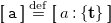 $[\![ \, \mathtt {a} \, ]\!] \stackrel {\mathrm{def}}{=} [\![ \, a:\{\mathbf{t}\} \, ]\!]$
for every
$[\![ \, \mathtt {a} \, ]\!] \stackrel {\mathrm{def}}{=} [\![ \, a:\{\mathbf{t}\} \, ]\!]$
for every $\mathtt {a} \in {\mathcal{C}}$
.
$\mathtt {a} \in {\mathcal{C}}$
.
In other words, regular stable models are the result of considering an $\textrm {HT}_{\!c}$
-theory
$\textrm {HT}_{\!c}$
-theory $\Gamma$
as a propositional
$\Gamma$
as a propositional $\textrm {HT}$
-theory where constraint atoms are treated as logical propositions. This definition is useful in defining the semantics of logic programs with constraints according to clingo (see Section 4).
$\textrm {HT}$
-theory where constraint atoms are treated as logical propositions. This definition is useful in defining the semantics of logic programs with constraints according to clingo (see Section 4).
3 Strong equivalence in
${\textrm{HT}}_{c}$

One of the most important applications of $\textrm {HT}$
is its use in ASP for equivalent transformations among different programs or fragments of programs. In general, if we want to safely replace program
$\textrm {HT}$
is its use in ASP for equivalent transformations among different programs or fragments of programs. In general, if we want to safely replace program $P$
by
$P$
by $Q$
, it does not suffice to check that their sets of stable models coincide, because the semantics of ASP programs cannot be figured out by looking at single rules (or groups of rules) in isolation. We can easily extrapolate this concept to
$Q$
, it does not suffice to check that their sets of stable models coincide, because the semantics of ASP programs cannot be figured out by looking at single rules (or groups of rules) in isolation. We can easily extrapolate this concept to $\textrm {HT}_{\!c}$
as follows:
$\textrm {HT}_{\!c}$
as follows:
Definition 3 (Strong equivalence). $\textrm {HT}_{\!c}$
-Theories
$\textrm {HT}_{\!c}$
-Theories $\Gamma$
and
$\Gamma$
and $\Gamma '$
are
$\Gamma '$
are ${\textit strongly\,equivalent}$
when
${\textit strongly\,equivalent}$
when $\Gamma \cup \Delta$
and
$\Gamma \cup \Delta$
and $\Gamma ' \cup \Delta$
have the same stable models for any arbitrary
$\Gamma ' \cup \Delta$
have the same stable models for any arbitrary $\textrm {HT}_{\!c}$
-theory
$\textrm {HT}_{\!c}$
-theory $\Delta$
.
$\Delta$
.
Theory $\Delta$
is sometimes called a context, so that strong equivalence guarantees that
$\Delta$
is sometimes called a context, so that strong equivalence guarantees that $\Gamma$
can be replaced by
$\Gamma$
can be replaced by $\Gamma '$
(and vice versa) in any context. An important property of
$\Gamma '$
(and vice versa) in any context. An important property of $\textrm {HT}$
proved by Lifschitz et al. (Reference Lifschitz, Pearce and Valverde2001) is that two logic programs
$\textrm {HT}$
proved by Lifschitz et al. (Reference Lifschitz, Pearce and Valverde2001) is that two logic programs $P$
and
$P$
and $Q$
are strongly equivalent if and only if they are equivalent in
$Q$
are strongly equivalent if and only if they are equivalent in $\textrm {HT}$
.
$\textrm {HT}$
.
Accordingly, we may wonder whether a similar result holds for $\textrm {HT}_{\!c}$
. The following theorem is an immediate result: the equivalence
$\textrm {HT}_{\!c}$
. The following theorem is an immediate result: the equivalence $\Gamma \equiv \Gamma '$
in
$\Gamma \equiv \Gamma '$
in $\textrm {HT}_{\!c}$
implies that
$\textrm {HT}_{\!c}$
implies that $\textrm {HT}_{\!c}$
-theories
$\textrm {HT}_{\!c}$
-theories $\Gamma$
and
$\Gamma$
and $\Gamma '$
are strongly equivalent.
$\Gamma '$
are strongly equivalent.
Theorem 1. If $\textrm {HT}_{\!c}$
-theories
$\textrm {HT}_{\!c}$
-theories $\Gamma$
and
$\Gamma$
and $\Gamma '$
are equivalent in
$\Gamma '$
are equivalent in $\textrm {HT}_{\!c}$
, that is,
$\textrm {HT}_{\!c}$
, that is, $\Gamma \equiv \Gamma '$
, then
$\Gamma \equiv \Gamma '$
, then $\Gamma$
and
$\Gamma$
and $\Gamma '$
are strongly equivalent.
$\Gamma '$
are strongly equivalent.
Proof.
Assume $\Gamma \equiv \Gamma '$
and take any arbitrary theory
$\Gamma \equiv \Gamma '$
and take any arbitrary theory $\Delta$
. Then,
$\Delta$
. Then, $\Gamma$
and
$\Gamma$
and $\Gamma '$
have the same models and, as a result,
$\Gamma '$
have the same models and, as a result, $\Gamma \cup \Delta$
and
$\Gamma \cup \Delta$
and $\Gamma ' \cup \Delta$
have also the same models. Since equilibrium models are a selection among
$\Gamma ' \cup \Delta$
have also the same models. Since equilibrium models are a selection among $\textrm {HT}_{\!c}$
models, their equilibrium and stable models also coincide.
$\textrm {HT}_{\!c}$
models, their equilibrium and stable models also coincide.
For illustration, let us use Theorem1 to prove the strong equivalence of two simple $\textrm {HT}_{\!c}$
-theories. Consider the following two formulas, similar to the ones from the introductory section:
$\textrm {HT}_{\!c}$
-theories. Consider the following two formulas, similar to the ones from the introductory section:
 \begin{align} &\bot \leftarrow \neg \mathtt {a} \wedge s \geq 120 \\[-10pt] \nonumber \end{align}
 \begin{align} &\mathtt {a} \leftarrow s \gt 100 \\[8pt] \nonumber \end{align}
In fact, we show in Section 7 that these two formulas are an essential part of the $\textrm {HT}_{\!c}$
-based translation of the logic program mentioned in the introduction. Let us show that
$\textrm {HT}_{\!c}$
-based translation of the logic program mentioned in the introduction. Let us show that $\Gamma = \{ (2), (3)\}$
is strongly equivalent to
$\Gamma = \{ (2), (3)\}$
is strongly equivalent to $\Gamma ' = \{ (3)\}$
. By Theorem1, a sufficient condition is showing that
$\Gamma ' = \{ (3)\}$
. By Theorem1, a sufficient condition is showing that $\Gamma \equiv \Gamma '$
and, since
$\Gamma \equiv \Gamma '$
and, since $\Gamma ' \subseteq \Gamma$
, it suffices to show that (3)
$\Gamma ' \subseteq \Gamma$
, it suffices to show that (3) $\to$
(2) is an
$\to$
(2) is an $\textrm {HT}_{\!c}$
-tautology. The following property is useful to prove this result.
$\textrm {HT}_{\!c}$
-tautology. The following property is useful to prove this result.
Let $\varphi [c/\psi ]$
be the uniform replacement of a constraint atom
$\varphi [c/\psi ]$
be the uniform replacement of a constraint atom $c$
occurring in formula
$c$
occurring in formula $\varphi$
by a formula
$\varphi$
by a formula $\psi$
, and
$\psi$
, and $\varphi [c]$
be the formula
$\varphi [c]$
be the formula $\varphi$
with a distinguished occurrence of constraint atom
$\varphi$
with a distinguished occurrence of constraint atom $c$
. We show below that
$c$
. We show below that $\textrm {HT}_{\!c}$
satisfies the rule of uniform substitution.
$\textrm {HT}_{\!c}$
satisfies the rule of uniform substitution.
Proposition 2.
If $\varphi [c]$
is an
$\varphi [c]$
is an $\textrm {HT}_{\!c}$
tautology then
$\textrm {HT}_{\!c}$
tautology then $\varphi [c/\psi ]$
is an
$\varphi [c/\psi ]$
is an $\textrm {HT}_{\!c}$
-tautology.
$\textrm {HT}_{\!c}$
-tautology.
Proof.
As a proof sketch, simply observe that if the original formula $\varphi [c]$
is a tautology, it is satisfied for any possible combination of satisfactions for
$\varphi [c]$
is a tautology, it is satisfied for any possible combination of satisfactions for $c$
in
$c$
in $h$
and in
$h$
and in $t$
. Each time we replace
$t$
. Each time we replace $c$
by some formula
$c$
by some formula $\psi$
in a uniform way for some interpretation
$\psi$
in a uniform way for some interpretation $\langle h,t \rangle$
, this corresponds to one of these possible truth combinations for atom
$\langle h,t \rangle$
, this corresponds to one of these possible truth combinations for atom $c$
, and so
$c$
, and so $\varphi [c/\psi ]$
is also satisfied.
$\varphi [c/\psi ]$
is also satisfied.
Let us now resume our example. The $\textrm {HT}$
-tautology
$\textrm {HT}$
-tautology
 \begin{gather*} (\alpha \to \beta ) \to ((\beta \to \gamma ) \to \neg (\neg \gamma \wedge \alpha )) \end{gather*}
is also an $\textrm {HT}_{\!c}$
-tautology by Proposition1. By applying Proposition2 to this
$\textrm {HT}_{\!c}$
-tautology by Proposition1. By applying Proposition2 to this $\textrm {HT}_{\!c}$
-tautology with substitution
$\textrm {HT}_{\!c}$
-tautology with substitution $\alpha \mapsto s\geq 120$
,
$\alpha \mapsto s\geq 120$
, $\beta \mapsto s \gt 100$
, and
$\beta \mapsto s \gt 100$
, and $\gamma \mapsto \mathtt {a}$
, we obtain the following
$\gamma \mapsto \mathtt {a}$
, we obtain the following $\textrm {HT}_{\!c}$
-tautology:
$\textrm {HT}_{\!c}$
-tautology:
 \begin{align*} (s\geq 120 \to s\gt 100) \to ((3) \to (2)) \end{align*}
To show that $(3)\to (2)$
is an
$(3)\to (2)$
is an $\textrm {HT}_{\!c}$
-tautology and, thus,
$\textrm {HT}_{\!c}$
-tautology and, thus, $\Gamma$
and
$\Gamma$
and $\Gamma '$
are strongly equivalent, it suffices to show that the antecedent of this implication is an
$\Gamma '$
are strongly equivalent, it suffices to show that the antecedent of this implication is an $\textrm {HT}_{\!c}$
-tautology. This immediately follows once we assume the usual semantics of linear inequalities and, thus, that our denotation satisfies
$\textrm {HT}_{\!c}$
-tautology. This immediately follows once we assume the usual semantics of linear inequalities and, thus, that our denotation satisfies
 \begin{align*} [\![ \, s \geq 120 \, ]\!] \subseteq [\![ \, s\gt 100 \, ]\!] . \end{align*}
As expected, the result may not hold if we assume that these two constraint atoms have a different meaning than the one they have for linear inequalities.
This illustrates how we can use Theorem1 to prove the strong equivalence of two $\textrm {HT}_{\!c}$
-theories. To prove that
$\textrm {HT}_{\!c}$
-theories. To prove that $\textrm {HT}_{\!c}$
-equivalence is also a necessary condition for strong equivalence, we depend on the form of the context theory
$\textrm {HT}_{\!c}$
-equivalence is also a necessary condition for strong equivalence, we depend on the form of the context theory $\Delta$
. For instance, in the case in which
$\Delta$
. For instance, in the case in which $\Gamma$
and
$\Gamma$
and $\Gamma '$
are regular ASP programs, it is well-known that if we restrict the form of
$\Gamma '$
are regular ASP programs, it is well-known that if we restrict the form of $\Delta$
to sets of facts, we obtain a weaker concept called uniform equivalence, that may hold even if
$\Delta$
to sets of facts, we obtain a weaker concept called uniform equivalence, that may hold even if $\Gamma$
and
$\Gamma$
and $\Gamma '$
do not have the same
$\Gamma '$
do not have the same $\textrm {HT}$
models. In the case of
$\textrm {HT}$
models. In the case of $\textrm {HT}_{\!c}$
, the variability in the possible context theory
$\textrm {HT}_{\!c}$
, the variability in the possible context theory $\Delta$
is much higher since the syntax and semantics of constraint atoms are very general, and few assumptions can be made on them. Yet, if our theory accepts at least a constraint atom
$\Delta$
is much higher since the syntax and semantics of constraint atoms are very general, and few assumptions can be made on them. Yet, if our theory accepts at least a constraint atom $\mathit{def}(x)$
in
$\mathit{def}(x)$
in $\mathcal{C}$
for each
$\mathcal{C}$
for each $x \in \mathcal{X}$
, then we can use this construct (in the context theory
$x \in \mathcal{X}$
, then we can use this construct (in the context theory $\Delta$
) to prove the other direction of the strong equivalence characterization.
$\Delta$
) to prove the other direction of the strong equivalence characterization.
Theorem 2. If $\textrm {HT}_{\!c}$
-theories
$\textrm {HT}_{\!c}$
-theories $\Gamma$
and
$\Gamma$
and $\Gamma '$
are strongly equivalent, then they are equivalent in
$\Gamma '$
are strongly equivalent, then they are equivalent in $\textrm {HT}_{\!c}$
, that is,
$\textrm {HT}_{\!c}$
, that is, $\Gamma \equiv \Gamma '$
.
$\Gamma \equiv \Gamma '$
.
Proof.
We proceed by contraposition, that is, proving that $\Gamma \not \equiv \Gamma '$
implies that
$\Gamma \not \equiv \Gamma '$
implies that $\Gamma$
and
$\Gamma$
and $\Gamma '$
are not strongly equivalent. To this aim, we build some theory
$\Gamma '$
are not strongly equivalent. To this aim, we build some theory $\Delta$
such that
$\Delta$
such that $\Gamma \cup \Delta$
and
$\Gamma \cup \Delta$
and $\Gamma ' \cup \Delta$
have different stable models. Without loss of generality, suppose there exists some model
$\Gamma ' \cup \Delta$
have different stable models. Without loss of generality, suppose there exists some model $\langle h,t \rangle \models \Gamma$
but
$\langle h,t \rangle \models \Gamma$
but $\langle h,t \rangle \not \models \Gamma '$
. Note that, by persistence,
$\langle h,t \rangle \not \models \Gamma '$
. Note that, by persistence, $\langle t,t \rangle \models \Gamma$
, but we do not know whether
$\langle t,t \rangle \models \Gamma$
, but we do not know whether $\langle t,t \rangle \models \Gamma '$
or not, so we separate the proof in two cases.
$\langle t,t \rangle \models \Gamma '$
or not, so we separate the proof in two cases.
Case 1. Suppose first that $\langle t,t \rangle \not \models \Gamma '$
. Let us build the theory
$\langle t,t \rangle \not \models \Gamma '$
. Let us build the theory
 \begin{eqnarray*} \Delta =\{\mathit{def}(x) \mid x \in \mathcal{X}, t(x)\neq \mathbf{u}\} \end{eqnarray*}
that exclusively consists of constraint atoms. We can easily see that $\langle t,t \rangle \models \Delta$
because
$\langle t,t \rangle \models \Delta$
because $\Delta$
collects precisely those
$\Delta$
collects precisely those $\mathit{def}(x)$
for which
$\mathit{def}(x)$
for which $t(x) \neq \mathbf{u}$
and so,
$t(x) \neq \mathbf{u}$
and so, $t \in [\![ \, \mathit{def}(x) \, ]\!]$
trivially. As a result,
$t \in [\![ \, \mathit{def}(x) \, ]\!]$
trivially. As a result, $\langle t,t \rangle \models \Gamma \cup \Delta$
and, to prove that
$\langle t,t \rangle \models \Gamma \cup \Delta$
and, to prove that $\langle t,t \rangle$
is in equilibrium, suppose we have a smaller
$\langle t,t \rangle$
is in equilibrium, suppose we have a smaller $v \subset t$
satisfying
$v \subset t$
satisfying $\Gamma \cup \Delta$
. Then there is some variable
$\Gamma \cup \Delta$
. Then there is some variable $x \in \mathcal{X}$
for which
$x \in \mathcal{X}$
for which $v(x)=\mathbf{u}$
whereas
$v(x)=\mathbf{u}$
whereas $t(x) \neq \mathbf{u}$
. The former implies
$t(x) \neq \mathbf{u}$
. The former implies $\langle v,t \rangle \not \models \mathit{def}(x)$
while the latter implies
$\langle v,t \rangle \not \models \mathit{def}(x)$
while the latter implies $\mathit{def}(x) \in \Delta$
, so we conclude
$\mathit{def}(x) \in \Delta$
, so we conclude $\langle v,t \rangle \not \models \Delta$
reaching a contradiction.
$\langle v,t \rangle \not \models \Delta$
reaching a contradiction.
Case 2. Suppose that $\langle t,t \rangle \models \Gamma '$
. Take the theory
$\langle t,t \rangle \models \Gamma '$
. Take the theory $\Delta = \Delta _1 \cup \Delta _2$
with:
$\Delta = \Delta _1 \cup \Delta _2$
with:
 \begin{eqnarray*} \Delta _1 & = & \{\mathit{def}(x) \mid x \in \mathcal{X}, \, h(x) \neq \mathbf{u} \} \end{eqnarray*}
and $\Delta _2$
consisting of all rules
$\Delta _2$
consisting of all rules $\mathit{def}(x) \leftarrow \mathit{def}(y)$
for all pair variables
$\mathit{def}(x) \leftarrow \mathit{def}(y)$
for all pair variables $x,y$
in the set:
$x,y$
in the set:
 \begin{equation*} \{z \in \mathcal{X} \mid h(z)= \mathbf{u}, t(z)\neq \mathbf{u} \} \end{equation*}
We prove first that $\langle t,t \rangle $
is not an equilibrium model for
$\langle t,t \rangle $
is not an equilibrium model for $\Gamma \cup \Delta$
because
$\Gamma \cup \Delta$
because $\langle h,t \rangle$
is, indeed, a model of this theory. To show this, it suffices to see that
$\langle h,t \rangle$
is, indeed, a model of this theory. To show this, it suffices to see that $\langle h,t \rangle \models \Delta$
. First, it follows that
$\langle h,t \rangle \models \Delta$
. First, it follows that $\langle h,t \rangle \models \Delta _1$
because
$\langle h,t \rangle \models \Delta _1$
because $\Delta _1$
only contains facts of the form
$\Delta _1$
only contains facts of the form $\mathit{def}(x)$
per each variable
$\mathit{def}(x)$
per each variable $x$
satisfying
$x$
satisfying $h(x) \neq \mathbf{u}$
. Second,
$h(x) \neq \mathbf{u}$
. Second, $\langle h,t \rangle \models \Delta _2$
also follows because for all the implications of the form of
$\langle h,t \rangle \models \Delta _2$
also follows because for all the implications of the form of $\mathit{def}(x) \leftarrow \mathit{def}(y)$
in
$\mathit{def}(x) \leftarrow \mathit{def}(y)$
in $\Delta _2$
, both
$\Delta _2$
, both $\langle h,t \rangle \not \models \mathit{def}(y)$
– because
$\langle h,t \rangle \not \models \mathit{def}(y)$
– because $h(y)=\mathbf{u}$
– and
$h(y)=\mathbf{u}$
– and $\langle t,t \rangle \models \mathit{def}(x)$
– because
$\langle t,t \rangle \models \mathit{def}(x)$
– because $t(x) \neq \mathbf{u}$
. It remains to be proven that
$t(x) \neq \mathbf{u}$
. It remains to be proven that $\langle t,t \rangle$
is an equilibrium model of
$\langle t,t \rangle$
is an equilibrium model of $\Gamma ' \cup \Delta$
. We can see that
$\Gamma ' \cup \Delta$
. We can see that $\langle t,t \rangle \models \Delta$
follows by persistence because
$\langle t,t \rangle \models \Delta$
follows by persistence because $\langle h,t \rangle \models \Delta$
, and thus,
$\langle h,t \rangle \models \Delta$
, and thus, $\langle t,t \rangle \models \Gamma ' \cup \Delta$
. Suppose, for the sake of contradiction, that there existed some
$\langle t,t \rangle \models \Gamma ' \cup \Delta$
. Suppose, for the sake of contradiction, that there existed some $v \subset t$
such that
$v \subset t$
such that $\langle v,t \rangle \models \Gamma ' \cup \Delta$
. Since
$\langle v,t \rangle \models \Gamma ' \cup \Delta$
. Since $\langle v,t \rangle \models \Delta _1$
, any variable
$\langle v,t \rangle \models \Delta _1$
, any variable $x$
defined in
$x$
defined in $h$
must be defined in
$h$
must be defined in $v$
as well, but as
$v$
as well, but as $v \subset t$
,
$v \subset t$
, $v(x)=t(x)=h(x)$
and so, we conclude
$v(x)=t(x)=h(x)$
and so, we conclude $h \subseteq v$
. However, we also know
$h \subseteq v$
. However, we also know $\langle h,t \rangle \not \models \Gamma ' \subseteq \Gamma ' \cup \Delta$
, and so
$\langle h,t \rangle \not \models \Gamma ' \subseteq \Gamma ' \cup \Delta$
, and so $v \neq h$
, that is,
$v \neq h$
, that is, $h \subset v \subset t$
. Consider any variable
$h \subset v \subset t$
. Consider any variable $y$
defined in
$y$
defined in $v$
but not in
$v$
but not in $h$
, that is,
$h$
, that is, $h(y)=\mathbf{u}$
and
$h(y)=\mathbf{u}$
and $\mathbf{u} \neq v(y) = t(y)$
by persistence. Now,
$\mathbf{u} \neq v(y) = t(y)$
by persistence. Now, $y$
is undefined in
$y$
is undefined in $h$
and defined in
$h$
and defined in $t$
, and suppose we take any other variable
$t$
, and suppose we take any other variable $x$
in the same situation. Then, we have an implication
$x$
in the same situation. Then, we have an implication $\mathit{def}(x) \leftarrow \mathit{def}(y)$
in
$\mathit{def}(x) \leftarrow \mathit{def}(y)$
in $\Delta _2$
that must be satisfied by
$\Delta _2$
that must be satisfied by $\langle v,t \rangle$
whereas, on the other hand,
$\langle v,t \rangle$
whereas, on the other hand, $\langle v,t \rangle \models \mathit{def}(y)$
because
$\langle v,t \rangle \models \mathit{def}(y)$
because $v(y) \neq \mathbf{u}$
. As a result,
$v(y) \neq \mathbf{u}$
. As a result, $\langle v,t \rangle \models \mathit{def}(x)$
for all variables
$\langle v,t \rangle \models \mathit{def}(x)$
for all variables $x$
undefined in
$x$
undefined in $h$
but not in
$h$
but not in $t$
. But as
$t$
. But as $\langle v,t \rangle \models \Delta _1$
the same happens for variables defined in
$\langle v,t \rangle \models \Delta _1$
the same happens for variables defined in $h$
. As a result,
$h$
. As a result, $\langle v,t \rangle \models \mathit{def}(x)$
iff
$\langle v,t \rangle \models \mathit{def}(x)$
iff $\langle t,t \rangle \models \mathit{def}(x)$
and this implies
$\langle t,t \rangle \models \mathit{def}(x)$
and this implies $v(x)=t(x)$
for all variables, namely,
$v(x)=t(x)$
for all variables, namely, $v=t$
reaching a contradiction. Therefore,
$v=t$
reaching a contradiction. Therefore, $\langle t,t \rangle$
is an equilibrium model of
$\langle t,t \rangle$
is an equilibrium model of $\Gamma ' \cup \Delta$
.
$\Gamma ' \cup \Delta$
.
This proof is analogous to the original one for $\textrm {HT}$
by Lifschitz et al. (Reference Lifschitz, Pearce and Valverde2001), using here constraint atoms
$\textrm {HT}$
by Lifschitz et al. (Reference Lifschitz, Pearce and Valverde2001), using here constraint atoms $\mathit{def}(x)$
to play the role of propositional atoms in the original proof.
$\mathit{def}(x)$
to play the role of propositional atoms in the original proof.
4 Review: Logic programs with abstract theories as
$\textrm {HT}_{c}$
-theories

The main distinctive feature of clingo 5 is the introduction of theory atoms in its syntax (Gebser et al. Reference Gebser, Kaminski, Kaufmann, Ostrowski, Schaub and Wanko2016). We review its most recent semantic characterization based on the concept of abstract theories (Cabalar et al. Reference Cabalar, Fandinno, Schaub and Wanko2023). We consider an alphabet consisting of two disjoint sets, namely, a set $\mathcal{A}$
of propositional (or regular) atoms and a set
$\mathcal{A}$
of propositional (or regular) atoms and a set $\mathcal{T}$
of theory atoms, whose truth is governed by some external theory. We use letters
$\mathcal{T}$
of theory atoms, whose truth is governed by some external theory. We use letters $\mathtt {a}$
,
$\mathtt {a}$
, $\mathtt {s}$
, and
$\mathtt {s}$
, and $b$
and variants of them for atoms in
$b$
and variants of them for atoms in $\mathcal{A}$
,
$\mathcal{A}$
, $\mathcal{T}$
, and
$\mathcal{T}$
, and $\mathcal{A} \cup \mathcal{T}$
, respectively. In clingo 5, theory atoms are expressions preceded by ‘
$\mathcal{A} \cup \mathcal{T}$
, respectively. In clingo 5, theory atoms are expressions preceded by ‘ $\mathtt {\&}$
’, but their internal syntax is not predetermined: it can be defined by the user to build new extensions. As an example, the system clingcon extends the input language of clingo with linear equations, represented as theory atoms of the form
$\mathtt {\&}$
’, but their internal syntax is not predetermined: it can be defined by the user to build new extensions. As an example, the system clingcon extends the input language of clingo with linear equations, represented as theory atoms of the form
 \begin{align} \mathtt {\&sum\{} \mathit{k_1*x_1};\dots ;\mathit{k_n*x_n} \mathtt {\}} \prec k_0 \end{align}
where each $x_i$
is an integer variable and each
$x_i$
is an integer variable and each $k_i\in \mathbb{Z}$
an integer constant for
$k_i\in \mathbb{Z}$
an integer constant for $0\leq i\leq n$
, whereas
$0\leq i\leq n$
, whereas $\prec$
is a comparison symbol such as
$\prec$
is a comparison symbol such as ${\mathtt{ \lt} =}, \texttt { = }, \texttt { !=}, \mathtt{ \lt }, \mathtt{ \gt }, \mathtt{ \gt =}$
. Several theory atoms may represent the same theory entity. For instance,
${\mathtt{ \lt} =}, \texttt { = }, \texttt { !=}, \mathtt{ \lt }, \mathtt{ \gt }, \mathtt{ \gt =}$
. Several theory atoms may represent the same theory entity. For instance, $\mathtt {\&sum\{} x \mathtt {\}} \mathtt { \gt } 0$
and
$\mathtt {\&sum\{} x \mathtt {\}} \mathtt { \gt } 0$
and $\mathtt {\&sum\{x\}}{ \gt =} 1$
actually represent the same condition (as linear equations).
$\mathtt {\&sum\{x\}}{ \gt =} 1$
actually represent the same condition (as linear equations).
A literal is any atom $b \in \mathcal{A} \cup \mathcal{T}$
or its default negation
$b \in \mathcal{A} \cup \mathcal{T}$
or its default negation $\neg b$
. A
$\neg b$
. A $\mathcal{T}$
-program over
$\mathcal{T}$
-program over $\langle \mathcal{A}$
,
$\langle \mathcal{A}$
, $\mathcal{T}\rangle$
is a set of rules of the form
$\mathcal{T}\rangle$
is a set of rules of the form
 \begin{align} b_0 \leftarrow b_1,\dots ,b_n,\neg b_{n+1},\dots ,\neg b_m \end{align}
where $b_i\in \mathcal{A}\cup \mathcal{T}$
for
$b_i\in \mathcal{A}\cup \mathcal{T}$
for $1 \leq i \leq m$
and
$1 \leq i \leq m$
and $b_0\in \mathcal{A}\cup \mathcal{T} \cup \{ \bot \}$
with
$b_0\in \mathcal{A}\cup \mathcal{T} \cup \{ \bot \}$
with $\bot \not \in \mathcal{A} \cup \mathcal{T}$
denoting the falsum constant. We sometimes identify (5) with the formula
$\bot \not \in \mathcal{A} \cup \mathcal{T}$
denoting the falsum constant. We sometimes identify (5) with the formula
 \begin{equation*}b_1 \wedge \dots \wedge b_n \wedge \neg b_{n+1} \wedge \dots \wedge \neg b_m \to b_0.\end{equation*}
We let notations $\mathit{h}(r)\stackrel {\mathrm{def}}{=} b_0$
,
$\mathit{h}(r)\stackrel {\mathrm{def}}{=} b_0$
, ${\mathit{B}(r)}^+\stackrel {\mathrm{def}}{=} \{b_1,\dots ,b_n\}$
and
${\mathit{B}(r)}^+\stackrel {\mathrm{def}}{=} \{b_1,\dots ,b_n\}$
and ${\mathit{B}(r)}^-\stackrel {\mathrm{def}}{=}\{b_{n+1},\dots ,b_m\}$
stand for the head, the positive and the negative body atoms of a rule
${\mathit{B}(r)}^-\stackrel {\mathrm{def}}{=}\{b_{n+1},\dots ,b_m\}$
stand for the head, the positive and the negative body atoms of a rule $r$
as in (5). The set of body atoms of
$r$
as in (5). The set of body atoms of $r$
is just
$r$
is just $\mathit{B}(r) \stackrel {\mathrm{def}}{=} {\mathit{B}(r)}^+ \cup {\mathit{B}(r)}^-$
. Finally, the sets of body and head atoms of a program
$\mathit{B}(r) \stackrel {\mathrm{def}}{=} {\mathit{B}(r)}^+ \cup {\mathit{B}(r)}^-$
. Finally, the sets of body and head atoms of a program $P$
are defined as
$P$
are defined as $\mathit{B}(P) \stackrel {\mathrm{def}}{=} \bigcup _{r \in P} \mathit{B}(r)$
and
$\mathit{B}(P) \stackrel {\mathrm{def}}{=} \bigcup _{r \in P} \mathit{B}(r)$
and $\mathit{H}(P)\stackrel {\mathrm{def}}{=} \{\mathit{h}(r)\mid r\in P\}\setminus \{\bot \}$
, respectively.
$\mathit{H}(P)\stackrel {\mathrm{def}}{=} \{\mathit{h}(r)\mid r\in P\}\setminus \{\bot \}$
, respectively.
The semantics of $\mathcal{T}$
-programs in clingo (Gebser et al. Reference Gebser, Kaminski, Kaufmann, Ostrowski, Schaub and Wanko2016), relies on a two-step process: (1) generate regular stable models (as in Definition2) and (2) select the ones passing a theory certification. We present next this semantics following the formalization recently introduced by Cabalar et al. (Reference Cabalar, Fandinno, Schaub and Wanko2023).
$\mathcal{T}$
-programs in clingo (Gebser et al. Reference Gebser, Kaminski, Kaufmann, Ostrowski, Schaub and Wanko2016), relies on a two-step process: (1) generate regular stable models (as in Definition2) and (2) select the ones passing a theory certification. We present next this semantics following the formalization recently introduced by Cabalar et al. (Reference Cabalar, Fandinno, Schaub and Wanko2023).
An abstract theory $\mathfrak{T}$
is a triple
$\mathfrak{T}$
is a triple $ \langle \mathcal{T}, \mathit{Sat}, \overparen{\cdot } \,\rangle$
where
$ \langle \mathcal{T}, \mathit{Sat}, \overparen{\cdot } \,\rangle$
where $\mathcal{T}$
is the set of theory atoms constituting the language of the abstract theory. The set
$\mathcal{T}$
is the set of theory atoms constituting the language of the abstract theory. The set $\mathit{Sat} \subseteq 2^{\mathcal{T}}$
contains all possible sets of theory atoms that are considered satisfiable by the theory: each one of these sets
$\mathit{Sat} \subseteq 2^{\mathcal{T}}$
contains all possible sets of theory atoms that are considered satisfiable by the theory: each one of these sets $S \in \mathit{Sat}$
is said to be
$S \in \mathit{Sat}$
is said to be $\mathfrak{T}$
-satisfiable. Finally,
$\mathfrak{T}$
-satisfiable. Finally, $\overparen{\cdot }:\mathcal{T} \rightarrow \mathcal{T}$
is a function mapping theory atoms to their complement such that
$\overparen{\cdot }:\mathcal{T} \rightarrow \mathcal{T}$
is a function mapping theory atoms to their complement such that $\overparen{\overparen{ \mathtt{s}}}= \mathtt {s}$
for any
$\overparen{\overparen{ \mathtt{s}}}= \mathtt {s}$
for any $\mathtt {s} \in \mathcal{T}$
. We define
$\mathtt {s} \in \mathcal{T}$
. We define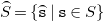 $\overparen{{S}} = \{ \overparen{ \mathtt{s}} \mid \mathtt {s} \in S\}$
for any set
$\overparen{{S}} = \{ \overparen{ \mathtt{s}} \mid \mathtt {s} \in S\}$
for any set $S\subseteq \mathcal{T}$
.
$S\subseteq \mathcal{T}$
.
We partition the set of theory atoms into two disjoint sets, namely, a set $\mathcal{E}$
of external theory atoms and a set
$\mathcal{E}$
of external theory atoms and a set $\mathcal{F}$
of founded theory atoms. Intuitively, the truth of each external atom in
$\mathcal{F}$
of founded theory atoms. Intuitively, the truth of each external atom in $\mathcal{E}$
requires no justification. Founded atoms on the other hand must be derived by the
$\mathcal{E}$
requires no justification. Founded atoms on the other hand must be derived by the $\mathcal{T}$
-program. We assume that founded atoms do not occur in the body of rules. We refer to the work by Janhunen et al. (Reference Janhunen, Kaminski, Ostrowski, Schellhorn, Wanko and Schaub2017) for a justification for this assumption.
$\mathcal{T}$
-program. We assume that founded atoms do not occur in the body of rules. We refer to the work by Janhunen et al. (Reference Janhunen, Kaminski, Ostrowski, Schellhorn, Wanko and Schaub2017) for a justification for this assumption.
Given any set $S$
of theory atoms, we define its (complemented) completion with respect to external atoms
$S$
of theory atoms, we define its (complemented) completion with respect to external atoms $\mathcal{E}$
, denoted by
$\mathcal{E}$
, denoted by $\mathit{Comp}_{\mathcal{E}}(S)$
, as:
$\mathit{Comp}_{\mathcal{E}}(S)$
, as:
 \begin{eqnarray*} \mathit{Comp}_{\mathcal{E}}(S) \stackrel {\mathrm{def}}{=} S \ \cup \ (\overparen{ \mathcal{E}\setminus S}) \end{eqnarray*}
In other words, we add the complement atom $\overparen{ \mathtt{s}}$
for every external atom
$\overparen{ \mathtt{s}}$
for every external atom $\mathtt {s}$
that does not occur explicitly in
$\mathtt {s}$
that does not occur explicitly in $S$
.
$S$
.
Definition 4 (Solution; Cabalar et al. Reference Cabalar, Fandinno, Schaub and Wanko2023). Given a theory $\mathfrak{T}=\langle \mathcal{T}$
,
$\mathfrak{T}=\langle \mathcal{T}$
, $\mathit{Sat}, \overparen{\cdot } \,\rangle$
and a set
$\mathit{Sat}, \overparen{\cdot } \,\rangle$
and a set $\mathcal{E} \subseteq \mathcal{T}$
of external theory atoms, a set
$\mathcal{E} \subseteq \mathcal{T}$
of external theory atoms, a set $S \subseteq \mathcal{T}$
of theory atoms is a
$S \subseteq \mathcal{T}$
of theory atoms is a $\langle \mathfrak{T}, \mathcal{E}\rangle$
-
$\langle \mathfrak{T}, \mathcal{E}\rangle$
- $\textit{solution}$
, if
$\textit{solution}$
, if $S\in \mathit{Sat}$
and
$S\in \mathit{Sat}$
and $\mathit{Comp}_{\mathcal{E}}(S)\in \mathit{Sat}$
.
$\mathit{Comp}_{\mathcal{E}}(S)\in \mathit{Sat}$
.
That is, $S$
is a
$S$
is a $\langle \mathfrak{T},\mathcal{E}\rangle$
-solution whenever both
$\langle \mathfrak{T},\mathcal{E}\rangle$
-solution whenever both $S$
and
$S$
and $\mathit{Comp}_{\mathcal{E}}(S)$
are
$\mathit{Comp}_{\mathcal{E}}(S)$
are $\mathfrak{T}$
-satisfiable.
$\mathfrak{T}$
-satisfiable.
Definition 5 (Theory stable modelFootnote 4; Cabalar et al. Reference Cabalar, Fandinno, Schaub and Wanko2023). Given a theory $\mathfrak{T}=\langle \mathcal{T}, \mathit{Sat}, \overparen{\cdot } \,\rangle$
and a set
$\mathfrak{T}=\langle \mathcal{T}, \mathit{Sat}, \overparen{\cdot } \,\rangle$
and a set $\mathcal{E} \subseteq \mathcal{T}$
of external theory atoms, a set
$\mathcal{E} \subseteq \mathcal{T}$
of external theory atoms, a set $X\subseteq \mathcal{A}\cup \mathcal{T}$
of atoms is a
$X\subseteq \mathcal{A}\cup \mathcal{T}$
of atoms is a $\langle \mathfrak{T}, \mathcal{E} \rangle$
-
$\langle \mathfrak{T}, \mathcal{E} \rangle$
- $\textit{stable model}$
of a
$\textit{stable model}$
of a $\mathcal{T}$
-program
$\mathcal{T}$
-program $P$
, if there is some
$P$
, if there is some $\langle \mathfrak{T},\mathcal{E}\rangle$
-solution
$\langle \mathfrak{T},\mathcal{E}\rangle$
-solution $S$
such that
$S$
such that $X$
is a regular stable model of the program
$X$
is a regular stable model of the program
 \begin{align} P \cup \{ {\mathtt {s}\leftarrow } \mid \mathtt {s}\in (S\cap \mathcal{E}) \} \cup \{ {\bot \leftarrow \mathtt {s}} \mid \mathtt {s}\in ((\mathcal{T}\cap \mathit{H}(P)) \setminus S) \} \ . \end{align}
As an example of an abstract theory, consider the case of linear equations $\mathfrak{L}$
which can be used to capture clingcon-programs. This theory is formally defined as
$\mathfrak{L}$
which can be used to capture clingcon-programs. This theory is formally defined as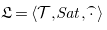 $\mathfrak{L}=\langle \mathcal{T}, \mathit{Sat},\overparen{\cdot} \, \rangle$
, where
$\mathfrak{L}=\langle \mathcal{T}, \mathit{Sat},\overparen{\cdot} \, \rangle$
, where
-
•
$\mathcal{T}$
is the set of all expressions of form (4), -
•
$\mathit{Sat}$
is the set of all subsets
$S\subseteq \mathcal{T}$
of expressions of form (4) for which there exists an assignment of integer values to their variables that satisfies all linear equations in
$S$
according to their usual meaning, and -
• the complement function
$\overparen{\mathtt {\&sum\{\cdot \}} \prec c} $
is defined as
$\mathtt {\&sum\{\cdot \}}\mathrel {\overparen{\prec }}c$
with
${\overparen{\prec }}$
defined according to the following table:


 $\prec$
| $\mathtt {\lt =}$
| $\mathtt {=}$
| $\mathtt {!=}$
| $\mathtt {\lt }$
| $\mathtt {\gt }$
| $\mathtt {\gt =}$
|
|---|---|---|---|---|---|---| ${\overparen{\prec }}$
| $\mathtt {\gt }$
| $\mathtt {!=}$
| $\mathtt {=}$
| $\mathtt {\gt =}$
| $\mathtt {\lt =}$
| $\mathtt {\lt }$
|

Using the theory atoms of theory $\mathfrak{L}$
, we can write the running example from the introduction as the
$\mathfrak{L}$
, we can write the running example from the introduction as the $\mathcal{T}$
-program:
$\mathcal{T}$
-program:
 \begin{align} \bot & \leftarrow \neg \mathtt {a},\, \mathtt {\&sum\{} s \mathtt {\}}\!\gt =\!120 \\[-10pt] \nonumber \end{align}
 \begin{align} \mathtt {a} & \leftarrow \mathtt {\&sum\{} s \mathtt {\}}\!\gt \!100 \\[10pt] \nonumber \end{align}
5 A new and simpler definition of theory stable model
In this section, we introduce a new, simplified version of the definition of $\langle \mathfrak{T}, \mathcal{E} \rangle$
-stable model that, under certain conditions introduced below, is equivalent to Definition5. This streamlined definition not only enhances the clarity of the technical development presented in the subsequent sections but also holds the potential to facilitate future advancements in hybrid solver design.
$\langle \mathfrak{T}, \mathcal{E} \rangle$
-stable model that, under certain conditions introduced below, is equivalent to Definition5. This streamlined definition not only enhances the clarity of the technical development presented in the subsequent sections but also holds the potential to facilitate future advancements in hybrid solver design.
Definition 6 (Theory stable model simplified). Given a theory $\mathfrak{T}=\langle \mathcal{T}, \mathit{Sat}, \overparen{\cdot } \,\rangle$
and a set
$\mathfrak{T}=\langle \mathcal{T}, \mathit{Sat}, \overparen{\cdot } \,\rangle$
and a set $\mathcal{E} \subseteq \mathcal{T}$
of external theory atoms, a set
$\mathcal{E} \subseteq \mathcal{T}$
of external theory atoms, a set $X\subseteq \mathcal{A} \cup \mathcal{T}$
of atoms is a
$X\subseteq \mathcal{A} \cup \mathcal{T}$
of atoms is a $\langle \mathfrak{T}, \mathcal{E} \rangle$
-
$\langle \mathfrak{T}, \mathcal{E} \rangle$
- ${\textit stable\,model}$
of a
${\textit stable\,model}$
of a $\mathcal{T}$
-program
$\mathcal{T}$
-program $P$
, if
$P$
, if $(X \cap \mathcal{T}) \in \mathit{Sat}$
and
$(X \cap \mathcal{T}) \in \mathit{Sat}$
and $X$
is a regular stable model of the theory
$X$
is a regular stable model of the theory
 \begin{align} P \cup \{ \mathtt {s} \vee \overparen{\mathtt {s}}\, \mid \mathtt {s} \in \mathcal{E}\} . \end{align}
This definition drops the existential quantifier used in Definition5 for identifying a $\langle \mathfrak{T}, \mathcal{E} \rangle$
-solution
$\langle \mathfrak{T}, \mathcal{E} \rangle$
-solution $S$
.
$S$
.
To state the conditions under which Definitions5 and 6 are equivalent, we need the following concepts (Cabalar et al. Reference Cabalar, Fandinno, Schaub and Wanko2023). An abstract theory $\mathfrak{T} = \langle \mathcal{T}, \mathit{Sat}, \overparen{\cdot } \,\rangle$
is consistent if none of its satisfiable sets contains complementary theory atoms, that is, there is no
$\mathfrak{T} = \langle \mathcal{T}, \mathit{Sat}, \overparen{\cdot } \,\rangle$
is consistent if none of its satisfiable sets contains complementary theory atoms, that is, there is no $S \in \mathit{Sat}$
such that
$S \in \mathit{Sat}$
such that $\mathtt {s} \in S$
and
$\mathtt {s} \in S$
and $\overparen{ \mathtt{s}}\in S$
for some atom
$\overparen{ \mathtt{s}}\in S$
for some atom $\mathtt {s}\in \mathcal{T}$
. A set
$\mathtt {s}\in \mathcal{T}$
. A set $S$
of theory atoms is closed if
$S$
of theory atoms is closed if $\mathtt {s} \in S$
implies
$\mathtt {s} \in S$
implies $\overparen{ \mathtt{s}} \in S$
. A set
$\overparen{ \mathtt{s}} \in S$
. A set $S$
of theory atoms is called
$S$
of theory atoms is called $\mathcal{E}$
-complete, if for all
$\mathcal{E}$
-complete, if for all $\mathtt {s} \in \mathcal{E}$
, either
$\mathtt {s} \in \mathcal{E}$
, either $\mathtt {s}\in S$
or
$\mathtt {s}\in S$
or $\overparen{ \mathtt{s}}\in S$
. A theory
$\overparen{ \mathtt{s}}\in S$
. A theory $\mathfrak{T}=\langle \mathcal{T}, \mathit{Sat}, \overparen{\cdot } \,\rangle$
is monotonic if
$\mathfrak{T}=\langle \mathcal{T}, \mathit{Sat}, \overparen{\cdot } \,\rangle$
is monotonic if $S \subseteq S'$
and
$S \subseteq S'$
and $S' \in \mathit{Sat}$
implies
$S' \in \mathit{Sat}$
implies $S \in \mathit{Sat}$
. Programs over a consistent theory with a closed set of external theory atoms have the following interesting properties:
$S \in \mathit{Sat}$
. Programs over a consistent theory with a closed set of external theory atoms have the following interesting properties:
Proposition 3 (Cabalar et al. Reference Cabalar, Fandinno, Schaub and Wanko2023, Proposition 2). For a consistent abstract theory $\mathfrak{T} = \langle \mathcal{T}, \mathit{Sat}, \overparen{\cdot } \,\rangle$
and a closed set
$\mathfrak{T} = \langle \mathcal{T}, \mathit{Sat}, \overparen{\cdot } \,\rangle$
and a closed set $\mathcal{E}\subseteq \mathcal{T}$
of external theory atoms, all
$\mathcal{E}\subseteq \mathcal{T}$
of external theory atoms, all $\langle \mathfrak{T},\mathcal{E}\rangle$
-solution s
$\langle \mathfrak{T},\mathcal{E}\rangle$
-solution s $S\subseteq \mathcal{T}$
are
$S\subseteq \mathcal{T}$
are $\mathcal{E}$
-complete.
$\mathcal{E}$
-complete.
Theorem 3. Given a theory $\mathfrak{T}=\langle \mathcal{T}, \mathit{Sat}, \overparen{\cdot } \,\rangle$
and a set
$\mathfrak{T}=\langle \mathcal{T}, \mathit{Sat}, \overparen{\cdot } \,\rangle$
and a set $\mathcal{E} \subseteq \mathcal{T}$
of external theory atoms, if
$\mathcal{E} \subseteq \mathcal{T}$
of external theory atoms, if $\mathfrak{T}$
is consistent and monotonic, and
$\mathfrak{T}$
is consistent and monotonic, and $\mathcal{E}$
is closed, then Definitions 5 and 6 are equivalent.
$\mathcal{E}$
is closed, then Definitions 5 and 6 are equivalent.
The preconditions of Theorem3 cover many hybrid extensions of clingo such as clingcon, clingo[dl], and clingo[lp]. Therefore, in the rest of the paper, we assume these conditions hold and use Definition6 as the definition of a $\langle \mathfrak{T},\mathcal{E}\rangle$
-stable model.
$\langle \mathfrak{T},\mathcal{E}\rangle$
-stable model.
6 Review: Structured and compositional theories
The approach presented in Sections 4 and 5 is intentionally generic in its formal definitions. No assumption is made on the syntax or inner structure of theory atoms. An abstract theory is only required to specify when a set of theory atoms is satisfiable and provide a complement function for each theory atom. Definition6 is a bit more specific, and further assumes consistent and monotonic theories (with a closed set of external atoms), something we may expect in most cases while still being very generic. The advantage of this generality is that it allows us to accommodate external theories without requiring much knowledge about their behavior. However, this generality comes at a price: ignoring the structure of the external theory may prevent in depth formal elaborations, such as, for instance, the study of strong equivalence for logic programs with constraint atoms.
Also, in many practical applications of hybrid systems, we are interested in the assignment of values to variables rather than the theory atoms that are satisfied, something not reflected in Definitions5 or 6. This is what happens, for instance, in most hybrid extensions of answer set solvers including the hybrid versions of clingo, namely, clingcon, clingo[dl], and clingo[lp]. Since the presence of variables in theory atoms can be exploited to describe their semantics in more detail, we resort to refined types of theories that are enriched with a specific structure.
An assignment over $\mathcal{X},{\mathcal{D}}$
is a valuation over
$\mathcal{X},{\mathcal{D}}$
is a valuation over $\mathcal{X},{\mathcal{D}}$
such that
$\mathcal{X},{\mathcal{D}}$
such that $v(x)\in {\mathcal{D}}$
for all
$v(x)\in {\mathcal{D}}$
for all $x \in \mathcal{X}$
.
$x \in \mathcal{X}$
.
Definition 7 (Structured theory; Cabalar et al. Reference Cabalar, Fandinno, Schaub and Wanko2023). Given an abstract theory $\mathfrak{T}=\langle \mathcal{T}, \mathit{Sat}, \overparen{\cdot } \,\rangle$
, we define its
$\mathfrak{T}=\langle \mathcal{T}, \mathit{Sat}, \overparen{\cdot } \,\rangle$
, we define its $\textit{structure}$
as a tuple
$\textit{structure}$
as a tuple $(\mathcal{X}_{\mathfrak{T}}, {\mathcal{D}}_{\mathfrak{T}}, \mathit{vars}_{\mathfrak{T}}, [\![ \, \cdot \, ]\!]_{\mathfrak{T}}),$
where
$(\mathcal{X}_{\mathfrak{T}}, {\mathcal{D}}_{\mathfrak{T}}, \mathit{vars}_{\mathfrak{T}}, [\![ \, \cdot \, ]\!]_{\mathfrak{T}}),$
where
-
1.
$\mathcal{X}_{\mathfrak{T}}$
is a set of variables, -
2.
${\mathcal{D}}_{\mathfrak{T}}$
is a set of domain elements, -
3.
$\mathit{vars}_{\mathfrak{T}}: \mathcal{T} \rightarrow 2^{\mathcal{X}_{\mathfrak{T}}}$
is a function returning the set of variables contained in a theory atom such that
$\mathit{vars}_{\mathfrak{T}}(\mathtt {s}) = \mathit{vars}_{\mathfrak{T}}(\overparen{ \mathtt{s}})$
for all theory atoms
$\mathtt {s}\in \mathcal{T}$
, -
4.
$[\![ \, \cdot \, ]\!]_{\mathfrak{T}}: \mathcal{T} \rightarrow 2^{\mathcal{V}_{\mathfrak{T}}}$
is a function mapping theory atoms to sets of assignments, where
$\mathcal{V}_{\mathfrak{T}}$
denotes the set of all assignments over
$\mathcal{X}_{\mathfrak{T}}$
and
${\mathcal{D}}_{\mathfrak{T}}$
, and satisfyingfor all theory atoms
\begin{equation*} v \in [\![ \, \mathtt {s} \, ]\!]_{\mathfrak{T}} \text{ iff } w \in [\![ \, \mathtt {s} \, ]\!]_{\mathfrak{T}} \end{equation*}
$\mathtt {s}\in \mathcal{T}$
and every pair of valuations
$v,w$
agreeing on the value of all variables
$\mathit{vars}_{\mathfrak{T}}(\mathtt {s})$
occurring in
$\mathtt {s}$
.








Whenever an abstract theory $\mathfrak{T}$
is associated with such a structure, we call it structured (rather than abstract). Observe that structured theories are based on the same concepts as
$\mathfrak{T}$
is associated with such a structure, we call it structured (rather than abstract). Observe that structured theories are based on the same concepts as $\textrm {HT}_{\!c}$
, viz. a domain, a set of variables, valuation functions, and denotations for atoms. In fact, we assume that the previously introduced definitions and notation for these concepts still apply here. This similarity is intended, since
$\textrm {HT}_{\!c}$
, viz. a domain, a set of variables, valuation functions, and denotations for atoms. In fact, we assume that the previously introduced definitions and notation for these concepts still apply here. This similarity is intended, since $\textrm {HT}_{\!c}$
was originally thought of as a generalization of logic programs with theory atoms. One important difference between an
$\textrm {HT}_{\!c}$
was originally thought of as a generalization of logic programs with theory atoms. One important difference between an $\textrm {HT}_{\!c}$
valuation and a structured theory valuation
$\textrm {HT}_{\!c}$
valuation and a structured theory valuation $v \in \mathcal{V}_{\mathfrak{T}}$
is that the latter cannot leave a variable undefined in
$v \in \mathcal{V}_{\mathfrak{T}}$
is that the latter cannot leave a variable undefined in $\textrm {HT}_{\!c}$
terms, that is, for a structured theory, we assume that the “undefined” value is not included in the domain
$\textrm {HT}_{\!c}$
terms, that is, for a structured theory, we assume that the “undefined” value is not included in the domain $\mathbf{u} \not \in {\mathcal{D}}_{\mathfrak{T}}$
, and so,
$\mathbf{u} \not \in {\mathcal{D}}_{\mathfrak{T}}$
, and so, $v(x) \neq \mathbf{u}$
for all
$v(x) \neq \mathbf{u}$
for all $x \in \mathcal{X}_{\mathfrak{T}}$
and
$x \in \mathcal{X}_{\mathfrak{T}}$
and $v \in \mathcal{V}_{\mathfrak{T}}$
. We also emphasize the use of the theory name
$v \in \mathcal{V}_{\mathfrak{T}}$
. We also emphasize the use of the theory name $\mathfrak{T}$
subindex in all the components of a structure because, as we see below, an
$\mathfrak{T}$
subindex in all the components of a structure because, as we see below, an $\textrm {HT}_{\!c}$
characterization allows us to accommodate multiple theories in the same formalization.
$\textrm {HT}_{\!c}$
characterization allows us to accommodate multiple theories in the same formalization.
Given a set $S$
of theory atoms, we define its denotation as
$S$
of theory atoms, we define its denotation as $[\![ \, S \, ]\!]_{\mathfrak{T}} \stackrel {\mathrm{def}}{=} \bigcap _{\mathtt {s}\in S}[\![ \, \mathtt {s} \, ]\!]_{\mathfrak{T}}$
. For any structured theory
$[\![ \, S \, ]\!]_{\mathfrak{T}} \stackrel {\mathrm{def}}{=} \bigcap _{\mathtt {s}\in S}[\![ \, \mathtt {s} \, ]\!]_{\mathfrak{T}}$
. For any structured theory $\mathfrak{T} = \langle \mathcal{T}, \mathit{Sat}, \overparen{\cdot } \,\rangle$
with structure
$\mathfrak{T} = \langle \mathcal{T}, \mathit{Sat}, \overparen{\cdot } \,\rangle$
with structure $(\mathcal{X}_{\mathfrak{T}}, {\mathcal{D}}_{\mathfrak{T}}, \mathit{vars}_{\mathfrak{T}}, [\![ \, \cdot \, ]\!]_{\mathfrak{T}})$
, if
$(\mathcal{X}_{\mathfrak{T}}, {\mathcal{D}}_{\mathfrak{T}}, \mathit{vars}_{\mathfrak{T}}, [\![ \, \cdot \, ]\!]_{\mathfrak{T}})$
, if $X \subseteq \mathcal{A} \cup \mathcal{T}$
is a set of atoms, we define
$X \subseteq \mathcal{A} \cup \mathcal{T}$
is a set of atoms, we define $\mathit{ans}(X)$
as the set
$\mathit{ans}(X)$
as the set
 \begin{equation*} \{ (Y,{v|}_{\hspace {-1pt}\Sigma }) \mid v \in [\![ \, X \cap \mathcal{T} \, ]\!]_{\mathfrak{T}} \} \quad \text{ with } Y = X \cap \mathcal{A} \text{ and } \Sigma = \mathit{vars}_{\mathfrak{T}}(X\cap \mathcal{T}) . \end{equation*}
Intuitively, $\mathit{ans}(X)$
collects all pairs
$\mathit{ans}(X)$
collects all pairs $(Y,v')$
where
$(Y,v')$
where $Y$
is fixed to the propositional atoms in
$Y$
is fixed to the propositional atoms in $X$
and
$X$
and $v'$
varies among all valuations in
$v'$
varies among all valuations in $[\![ \, X \cap \mathcal{T} \, ]\!]_{\mathfrak{T}}$
restricted to the variables occurring in the theory atoms in
$[\![ \, X \cap \mathcal{T} \, ]\!]_{\mathfrak{T}}$
restricted to the variables occurring in the theory atoms in $X$
. Note that
$X$
. Note that $v$
is only defined for a subset of variables, namely,
$v$
is only defined for a subset of variables, namely, $\Sigma =\mathit{vars}_{\mathfrak{T}}(X\cap \mathcal{T})\subseteq \mathcal{X}$
.
$\Sigma =\mathit{vars}_{\mathfrak{T}}(X\cap \mathcal{T})\subseteq \mathcal{X}$
.
Definition 8 (Answer set; Cabalar et al. Reference Cabalar, Fandinno, Schaub and Wanko2023). If $X$
is a
$X$
is a $\langle \mathfrak{T},\mathcal{E}\rangle$
-stable model of program
$\langle \mathfrak{T},\mathcal{E}\rangle$
-stable model of program $P$
and
$P$
and $(Y,v)\in \mathit{ans}(X)$
, then
$(Y,v)\in \mathit{ans}(X)$
, then $(Y,v)$
is a
$(Y,v)$
is a $\langle \mathfrak{T},\mathcal{E}\rangle$
-
$\langle \mathfrak{T},\mathcal{E}\rangle$
- $\textit{answer set}$
of
$\textit{answer set}$
of $P$
.
$P$
.
Let $\mathfrak{T} = \langle \mathcal{T}, \mathit{Sat}, \overparen{\cdot } \rangle$
be a theory with structure
$\mathfrak{T} = \langle \mathcal{T}, \mathit{Sat}, \overparen{\cdot } \rangle$
be a theory with structure $(\mathcal{X}_{\mathfrak{T}}, {\mathcal{D}}_{\mathfrak{T}}, \mathit{vars}_{\mathfrak{T}}, [\![ \, \cdot \, ]\!]_{\mathfrak{T}})$
. We say that
$(\mathcal{X}_{\mathfrak{T}}, {\mathcal{D}}_{\mathfrak{T}}, \mathit{vars}_{\mathfrak{T}}, [\![ \, \cdot \, ]\!]_{\mathfrak{T}})$
. We say that $\mathfrak{T}$
has an absolute complement whenever the denotation of
$\mathfrak{T}$
has an absolute complement whenever the denotation of $\overparen{ \mathtt{s}}$
is precisely the set complement of
$\overparen{ \mathtt{s}}$
is precisely the set complement of $[\![ \, \mathtt {s} \, ]\!]_{\mathfrak{T}}$
, that is,
$[\![ \, \mathtt {s} \, ]\!]_{\mathfrak{T}}$
, that is, $[\![ \, \overparen{ \mathtt{s}} \, ]\!]_{\mathfrak{T}} = \mathcal{V}_{\mathfrak{T}} \setminus [\![ \, \mathtt {s} \, ]\!]_{\mathfrak{T}}$
. We also say that
$[\![ \, \overparen{ \mathtt{s}} \, ]\!]_{\mathfrak{T}} = \mathcal{V}_{\mathfrak{T}} \setminus [\![ \, \mathtt {s} \, ]\!]_{\mathfrak{T}}$
. We also say that $\mathfrak{T} $
is compositional, if it satisfies
$\mathfrak{T} $
is compositional, if it satisfies $\mathit{Sat} = \{S \subseteq \mathcal{T} \mid [\![ \, S \, ]\!]_{\mathfrak{T}} \neq \emptyset \}$
, that is, a set
$\mathit{Sat} = \{S \subseteq \mathcal{T} \mid [\![ \, S \, ]\!]_{\mathfrak{T}} \neq \emptyset \}$
, that is, a set $S$
is
$S$
is $\mathfrak{T}$
-satisfiable iff its denotation is not empty. This means that, for compositional theories, the set
$\mathfrak{T}$
-satisfiable iff its denotation is not empty. This means that, for compositional theories, the set $\mathit{Sat}$
of
$\mathit{Sat}$
of $\mathfrak{T}$
-satisfiable sets does not need to be explicitly stated as it can be derived from the denotation. Hence, we can write
$\mathfrak{T}$
-satisfiable sets does not need to be explicitly stated as it can be derived from the denotation. Hence, we can write $\mathfrak{T}=\langle \mathcal{T}, \overparen{\cdot } \,, \mathcal{X}_{\mathfrak{T}},{\mathcal{D}}_{\mathfrak{T}}, \mathit{vars}_{\mathfrak{T}}, [\![ \, \cdot \, ]\!]_{\mathfrak{T}}\rangle$
to denote a compositional theory.
$\mathfrak{T}=\langle \mathcal{T}, \overparen{\cdot } \,, \mathcal{X}_{\mathfrak{T}},{\mathcal{D}}_{\mathfrak{T}}, \mathit{vars}_{\mathfrak{T}}, [\![ \, \cdot \, ]\!]_{\mathfrak{T}}\rangle$
to denote a compositional theory.
As an example for a compositional, structured theory with an absolute complement, let us associate the theory of linear equations $\mathfrak{L}$
with the structure
$\mathfrak{L}$
with the structure $(\mathcal{X}_{\mathfrak{L}},{\mathcal{D}}_{\mathfrak{L}},\mathit{vars}_{\mathfrak{L}},[\![ \, \cdot \, ]\!]_{\mathfrak{L}})$
, where
$(\mathcal{X}_{\mathfrak{L}},{\mathcal{D}}_{\mathfrak{L}},\mathit{vars}_{\mathfrak{L}},[\![ \, \cdot \, ]\!]_{\mathfrak{L}})$
, where
-
•
$\mathcal{X}_{\mathfrak{L}}$
is an infinite set of integer variables, -
•
${\mathcal{D}}_{\mathfrak{L}}=\mathbb{Z}$
, -
•
$\mathit{vars}_{\mathfrak{L}}(\mathtt {\&sum\{} k_1\!*\!x_1;\!{\small \dots }\!;k_n\!*\!x_n \mathtt {\}} \prec k_0)=\{x_1,\!{\small \dots }\!,x_n\}$
, and -
•
$[\![ \, \mathtt {\&sum\{} k_1*x_1;\dots ;k_n*x_n \mathtt {\}} \prec k_0 \, ]\!]_{\mathfrak{L}} =$
\begin{equation*}\big \{ v\in \mathcal{V}_{\mathfrak{L}} \mid \{k_1,v(x_1),\dots k_n,v(x_n)\}\subseteq \mathbb{Z} \text{ and } \sum\nolimits_{1\leq i \leq n}k_i*v(x_i)\prec k_0 \big \} \ . \end{equation*}





With $\mathfrak{L}$
, a set
$\mathfrak{L}$
, a set $S$
of theory atoms capturing linear equations is
$S$
of theory atoms capturing linear equations is $\mathfrak{L}$
-satisfiable whenever
$\mathfrak{L}$
-satisfiable whenever $[\![ \, S \, ]\!]_{\mathfrak{L}}$
is non-empty.
$[\![ \, S \, ]\!]_{\mathfrak{L}}$
is non-empty.
In general, we have a one-to-many correspondence between $\langle \mathfrak{T},\mathcal{E}\rangle$
-stable models and their associated
$\langle \mathfrak{T},\mathcal{E}\rangle$
-stable models and their associated $\langle \mathfrak{T},\mathcal{E}\rangle$
-answer sets. That is, the cardinality of
$\langle \mathfrak{T},\mathcal{E}\rangle$
-answer sets. That is, the cardinality of $\mathit{ans}(X)$
is generally greater than one for a single stable model
$\mathit{ans}(X)$
is generally greater than one for a single stable model $X$
. However, if we focus on consistent, compositional theories that have an absolute complement, then we can establish a one-to-one correspondence between any
$X$
. However, if we focus on consistent, compositional theories that have an absolute complement, then we can establish a one-to-one correspondence between any $\langle \mathfrak{T},\mathcal{E}\rangle$
-stable model of a program and a kind of equivalence classes among its associated
$\langle \mathfrak{T},\mathcal{E}\rangle$
-stable model of a program and a kind of equivalence classes among its associated $\langle \mathfrak{T},\mathcal{E}\rangle$
-answer sets. Each of the equivalence classes may contain many
$\langle \mathfrak{T},\mathcal{E}\rangle$
-answer sets. Each of the equivalence classes may contain many $\langle \mathfrak{T},\mathcal{E}\rangle$
-answer sets, but any of them has enough information to reconstruct the corresponding
$\langle \mathfrak{T},\mathcal{E}\rangle$
-answer sets, but any of them has enough information to reconstruct the corresponding $\langle \mathfrak{T},\mathcal{E}\rangle$
-stable model. An answer set
$\langle \mathfrak{T},\mathcal{E}\rangle$
-stable model. An answer set $(Y,v)$
satisfies an atom
$(Y,v)$
satisfies an atom $b \in \mathcal{A} \cup \mathcal{T}$
, written
$b \in \mathcal{A} \cup \mathcal{T}$
, written $(Y,v) \models b$
, if
$(Y,v) \models b$
, if
-
•
$b\in Y$
for propositional atoms
$b \in \mathcal{A}$
and -
•
$v\mathbin {\hat {\in }}[\![ \, b \, ]\!]_{\mathfrak{T}}$
for theory atoms
$b\in \mathcal{T}$
,


where $v \mathbin {\hat {\in }} [\![ \, b \, ]\!]_{\mathfrak{T}}$
holds iff there exists some valuation
$v \mathbin {\hat {\in }} [\![ \, b \, ]\!]_{\mathfrak{T}}$
holds iff there exists some valuation $w \in [\![ \, b \, ]\!]_{\mathfrak{T}}$
such that
$w \in [\![ \, b \, ]\!]_{\mathfrak{T}}$
such that $v$
and
$v$
and $w$
agree on the variables in
$w$
agree on the variables in $\mathit{dom}(v)$
. Note that we use
$\mathit{dom}(v)$
. Note that we use $v\mathbin {\hat {\in }} [\![ \, b \, ]\!]_{\mathfrak{T}}$
instead of
$v\mathbin {\hat {\in }} [\![ \, b \, ]\!]_{\mathfrak{T}}$
instead of $v \in [\![ \, b \, ]\!]_{\mathfrak{T}}$
because
$v \in [\![ \, b \, ]\!]_{\mathfrak{T}}$
because $v$
can be partial and, if so, we just require that there exists some complete valuation in
$v$
can be partial and, if so, we just require that there exists some complete valuation in $[\![ \, b \, ]\!]_{\mathfrak{T}}$
that agrees with the values assigned by
$[\![ \, b \, ]\!]_{\mathfrak{T}}$
that agrees with the values assigned by $v$
to its defined variables
$v$
to its defined variables $\mathit{dom}(v)$
. For any negative literal
$\mathit{dom}(v)$
. For any negative literal $\neg b$
, we say that
$\neg b$
, we say that $(Y,v) \models \neg b$
simply when
$(Y,v) \models \neg b$
simply when $(Y,v) \not \models b$
. If
$(Y,v) \not \models b$
. If $B$
is a rule body, we write
$B$
is a rule body, we write $(Y,v) \models B$
to stand for
$(Y,v) \models B$
to stand for $(Y,v) \models \ell$
for every literal
$(Y,v) \models \ell$
for every literal $\ell$
in
$\ell$
in $B$
. For a program
$B$
. For a program $P$
and an
$P$
and an $\langle \mathfrak{T},\mathcal{E}\rangle$
-answer set
$\langle \mathfrak{T},\mathcal{E}\rangle$
-answer set $(Y,v)$
, we define
$(Y,v)$
, we define
 \begin{align*} \mathit{stb}_{P}(Y,v) & = Y \cup \big \{ \mathtt {s} \in \mathcal{E} \mid v \mathbin {\hat {\in }} [\![ \, \mathtt {s} \, ]\!]_{\mathfrak{T}} \big \} \cup \big \{ \mathtt {s} \in \mathcal{F} \mid (\mathtt {s} \leftarrow B) \in P, (Y,v) \models B \big \} \\[-15pt] \end{align*}
We also write $(Y_1,v_1) \sim (Y_2,v_2)$
if
$(Y_1,v_1) \sim (Y_2,v_2)$
if $\mathit{stb}_{P}(Y_1,v_1) = \mathit{stb}_{P}(Y_2,v_2)$
and say that
$\mathit{stb}_{P}(Y_1,v_1) = \mathit{stb}_{P}(Y_2,v_2)$
and say that $(Y_1,v_1)$
and
$(Y_1,v_1)$
and $(Y_2,v_2)$
belong to the same equivalence class with respect to
$(Y_2,v_2)$
belong to the same equivalence class with respect to $P$
.
$P$
.
Proposition 4 (Cabalar et al. Reference Cabalar, Fandinno, Schaub and Wanko2023, Proposition 8). Let $\mathfrak{T}=\langle \mathcal{T}, \overparen{ \cdot } \,, \mathcal{X}_{\mathfrak{T}},{\mathcal{D}}_{\mathfrak{T}}, \mathit{vars}_{\mathfrak{T}}, [\![ \, \cdot \, ]\!]_{\mathfrak{T}}\rangle$
be a compositional theory with an absolute complement and let
$\mathfrak{T}=\langle \mathcal{T}, \overparen{ \cdot } \,, \mathcal{X}_{\mathfrak{T}},{\mathcal{D}}_{\mathfrak{T}}, \mathit{vars}_{\mathfrak{T}}, [\![ \, \cdot \, ]\!]_{\mathfrak{T}}\rangle$
be a compositional theory with an absolute complement and let $\mathcal{E}\subseteq \mathcal{T}$
be a closed set of external atoms. There is a one-to-one correspondence between the
$\mathcal{E}\subseteq \mathcal{T}$
be a closed set of external atoms. There is a one-to-one correspondence between the $\langle \mathfrak{T},\mathcal{E}\rangle$
-stable models of a program
$\langle \mathfrak{T},\mathcal{E}\rangle$
-stable models of a program $P$
and the equivalence classes with respect to
$P$
and the equivalence classes with respect to $P$
of its
$P$
of its $\langle \mathfrak{T},\mathcal{E}\rangle$
-answer sets.
$\langle \mathfrak{T},\mathcal{E}\rangle$
-answer sets.
Furthermore, if $(Y,v)$
is a
$(Y,v)$
is a $\langle \mathfrak{T},\mathcal{E}\rangle$
-answer set, then
$\langle \mathfrak{T},\mathcal{E}\rangle$
-answer set, then $\mathit{stb}_{P}(Y,v)$
is a
$\mathit{stb}_{P}(Y,v)$
is a $\langle \mathfrak{T},\mathcal{E}\rangle$
-stable model of
$\langle \mathfrak{T},\mathcal{E}\rangle$
-stable model of $P$
and
$P$
and $(Y,v)$
belongs to
$(Y,v)$
belongs to $\mathit{ans}(\mathit{stb}_{P}(Y,v))$
.
$\mathit{ans}(\mathit{stb}_{P}(Y,v))$
.
7
$\textrm {HT}_{\!c}$
-characterization of logic programs with structured and compositional theories

We now present a direct encoding of $\mathcal{T}$
-programs as
$\mathcal{T}$
-programs as $\textrm {HT}_{\!c}$
theories. This encoding is “direct” in the sense that it preserves the structure of each program rule by rule and atom by atom, only requiring the addition of a fixed set of axioms.
$\textrm {HT}_{\!c}$
theories. This encoding is “direct” in the sense that it preserves the structure of each program rule by rule and atom by atom, only requiring the addition of a fixed set of axioms.
In the following, we restrict ourselves to consistent compositional theories with an absolute complement and refer to them just as theories.
We start embodying compositional theories in $\textrm {HT}_{\!c}$
by mapping their respective structures (domain, variables, valuations, and denotations), while having in mind that
$\textrm {HT}_{\!c}$
by mapping their respective structures (domain, variables, valuations, and denotations), while having in mind that $\textrm {HT}_{\!c}$
may tolerate multiple abstract theories in the same formalization. For this reason, when we encode a theory
$\textrm {HT}_{\!c}$
may tolerate multiple abstract theories in the same formalization. For this reason, when we encode a theory $\mathfrak{T}= \langle \mathcal{T}_{\mathfrak{T}}, \overparen{\cdot }\, , \mathcal{X}_{\mathfrak{T}},{\mathcal{D}}_{\mathfrak{T}},\mathit{vars}_{\mathfrak{T}}, [\![ \, \cdot \, ]\!]_{\mathfrak{T}} \rangle$
into an
$\mathfrak{T}= \langle \mathcal{T}_{\mathfrak{T}}, \overparen{\cdot }\, , \mathcal{X}_{\mathfrak{T}},{\mathcal{D}}_{\mathfrak{T}},\mathit{vars}_{\mathfrak{T}}, [\![ \, \cdot \, ]\!]_{\mathfrak{T}} \rangle$
into an $\textrm {HT}_{\!c}$
theory over a signature
$\textrm {HT}_{\!c}$
theory over a signature $\langle \mathcal{X},{\mathcal{D}},{\mathcal{C}} \rangle$
, we only require
$\langle \mathcal{X},{\mathcal{D}},{\mathcal{C}} \rangle$
, we only require $\mathcal{X}_{\mathfrak{T}} \subseteq \mathcal{X}$
and
$\mathcal{X}_{\mathfrak{T}} \subseteq \mathcal{X}$
and ${\mathcal{D}}_{\mathfrak{T}} \subseteq {\mathcal{D}}$
, so that the
${\mathcal{D}}_{\mathfrak{T}} \subseteq {\mathcal{D}}$
, so that the $\textrm {HT}_{\!c}$
signature may also include variables and domain values other than the ones in
$\textrm {HT}_{\!c}$
signature may also include variables and domain values other than the ones in $\mathfrak{T}$
. We then map each abstract theory atom
$\mathfrak{T}$
. We then map each abstract theory atom $\mathtt {s} \in \mathcal{T}$
into a corresponding
$\mathtt {s} \in \mathcal{T}$
into a corresponding $\textrm {HT}_{\!c}$
-constraint atom
$\textrm {HT}_{\!c}$
-constraint atom $\tau(\mathtt {s}) \in {\mathcal{C}}$
with the same variables
$\tau(\mathtt {s}) \in {\mathcal{C}}$
with the same variables $\mathit{vars}(\tau(\mathtt {s})) = \mathit{vars}_{\mathfrak{T}}(\mathtt {s})$
. We also require the following relation between the theory denotation of a theory atom and the
$\mathit{vars}(\tau(\mathtt {s})) = \mathit{vars}_{\mathfrak{T}}(\mathtt {s})$
. We also require the following relation between the theory denotation of a theory atom and the $\textrm {HT}_{\!c}$
denotation of its corresponding constraint atom:
$\textrm {HT}_{\!c}$
denotation of its corresponding constraint atom:
 \begin{align} [\![ \, \tau(\mathtt {s}) \, ]\!] & \ \stackrel {\mathrm{def}}{=} \ \{v\in \mathcal{V}^{\mathcal{X},{\mathcal{D}}} \mid \exists w\in [\![ \, \mathtt {s} \, ]\!]_{\mathfrak{T}}, \ {v|}_{\hspace {-1pt}\mathcal{X}_{\mathfrak{T}}}=w \} \end{align}
Note that $\textrm {HT}_{\!c}$
valuations
$\textrm {HT}_{\!c}$
valuations $v\in \mathcal{V}^{\mathcal{X},{\mathcal{D}}}$
apply to a (possibly) larger set of variables
$v\in \mathcal{V}^{\mathcal{X},{\mathcal{D}}}$
apply to a (possibly) larger set of variables $\mathcal{X} \supseteq \mathcal{X}_{\mathfrak{T}}$
and on larger domains
$\mathcal{X} \supseteq \mathcal{X}_{\mathfrak{T}}$
and on larger domains $\mathcal{D}_{\mathbf{u}} \supset {\mathcal{D}}_{\mathfrak{T}}$
, which include the element
$\mathcal{D}_{\mathbf{u}} \supset {\mathcal{D}}_{\mathfrak{T}}$
, which include the element $\mathbf{u} \not \in {\mathcal{D}}_{\mathfrak{T}}$
to represent undefined variables in
$\mathbf{u} \not \in {\mathcal{D}}_{\mathfrak{T}}$
to represent undefined variables in $\textrm {HT}_{\!c}$
. The denotation
$\textrm {HT}_{\!c}$
. The denotation $[\![ \, \tau(\mathtt {s}) \, ]\!]$
collects all possible
$[\![ \, \tau(\mathtt {s}) \, ]\!]$
collects all possible $\textrm {HT}_{\!c}$
-valuations that coincide with some
$\textrm {HT}_{\!c}$
-valuations that coincide with some $\mathfrak{T}$
-valuation
$\mathfrak{T}$
-valuation $w \in [\![ \, \mathtt {s} \, ]\!]_{\mathfrak{T}}$
on the variables of theory
$w \in [\![ \, \mathtt {s} \, ]\!]_{\mathfrak{T}}$
on the variables of theory $\mathfrak{T}$
, letting everything else vary vary freely.
$\mathfrak{T}$
, letting everything else vary vary freely.
We write $\tau(S)$
for
$\tau(S)$
for $\{\tau(\mathtt {s}) \mid \mathtt {s} \in S \}$
and
$\{\tau(\mathtt {s}) \mid \mathtt {s} \in S \}$
and $S \subseteq \mathcal{T}$
. The following result shows that this mapping of denotations preserves
$S \subseteq \mathcal{T}$
. The following result shows that this mapping of denotations preserves $\mathfrak{T}$
-satisfiability:
$\mathfrak{T}$
-satisfiability:
Proposition 5.
Given a theory $\mathfrak{T}= \langle \mathcal{T}_{\mathfrak{T}}, \overparen{\cdot }\, , \mathcal{X}_{\mathfrak{T}}, {\mathcal{D}}_{\mathfrak{T}}, \mathit{vars}_{\mathfrak{T}}, [\![ \, \cdot \, ]\!]_{\mathfrak{T}} \rangle$
, a set
$\mathfrak{T}= \langle \mathcal{T}_{\mathfrak{T}}, \overparen{\cdot }\, , \mathcal{X}_{\mathfrak{T}}, {\mathcal{D}}_{\mathfrak{T}}, \mathit{vars}_{\mathfrak{T}}, [\![ \, \cdot \, ]\!]_{\mathfrak{T}} \rangle$
, a set $S \subseteq \mathcal{T}$
of theory atoms is
$S \subseteq \mathcal{T}$
of theory atoms is $\mathfrak{T}$
-satisfiable iff
$\mathfrak{T}$
-satisfiable iff $\tau(S)$
is satisfiable in
$\tau(S)$
is satisfiable in $\textrm {HT}_{\!c}$
.
$\textrm {HT}_{\!c}$
.
Let us now consider $\mathcal{T}$
-programs
$\mathcal{T}$
-programs $P$
over
$P$
over $\langle \mathcal{A},\mathcal{T}\rangle$
, that are associated with a structured theory
$\langle \mathcal{A},\mathcal{T}\rangle$
, that are associated with a structured theory $\mathfrak{T}= \langle \mathcal{T}_{\mathfrak{T}}, \overparen{\cdot }\, , \mathcal{X}_{\mathfrak{T}},{\mathcal{D}}_{\mathfrak{T}},\mathit{vars}_{\mathfrak{T}}, [\![ \, \cdot \, ]\!]_{\mathfrak{T}} \rangle$
. As explained in Section 2, we can capture regular programs by identifying propositional atoms
$\mathfrak{T}= \langle \mathcal{T}_{\mathfrak{T}}, \overparen{\cdot }\, , \mathcal{X}_{\mathfrak{T}},{\mathcal{D}}_{\mathfrak{T}},\mathit{vars}_{\mathfrak{T}}, [\![ \, \cdot \, ]\!]_{\mathfrak{T}} \rangle$
. As explained in Section 2, we can capture regular programs by identifying propositional atoms $\mathcal{A}$
with both variables and constraint atoms and having the truth constant
$\mathcal{A}$
with both variables and constraint atoms and having the truth constant $\mathbf{t}$
in the domain. We can capture this by adding propositional atoms both as variables and as constraint atoms to the signature of the
$\mathbf{t}$
in the domain. We can capture this by adding propositional atoms both as variables and as constraint atoms to the signature of the $\textrm {HT}_{\!c}$
theory, so we have
$\textrm {HT}_{\!c}$
theory, so we have
 \begin{align} \mathcal{A} \cup \mathcal{X}_{\mathfrak{T}} &\subseteq \mathcal{X}\\[-10pt] \nonumber \end{align}
 \begin{align} \mathcal{A} \cup \{ \tau (\mathtt {s}) \mid \mathtt {s} \in \mathcal{T}_{\mathfrak{T}} \} &\subseteq {\mathcal{C}} \\[10pt] \nonumber \end{align}
and the truth constant $\mathbf{t}$
in the domain, so we have
$\mathbf{t}$
in the domain, so we have ${\mathcal{D}}_{\mathfrak{T}} \cup \{ \mathbf{t} \} \subseteq {\mathcal{D}}$
. For each propositional atom
${\mathcal{D}}_{\mathfrak{T}} \cup \{ \mathbf{t} \} \subseteq {\mathcal{D}}$
. For each propositional atom $\mathtt {a} \in \mathcal{A}$
, its variables and denotation are defined as follows:
$\mathtt {a} \in \mathcal{A}$
, its variables and denotation are defined as follows:
-
•
$\mathit{vars}(\mathtt {a})=\{a\}$
, and -
•
$[\![ \, \mathtt {a} \, ]\!] = [\![ \, a:\{\mathbf{t}\} \, ]\!] = \{v \in \mathcal{V}^{\mathcal{X},{\mathcal{D}}} \mid v(a)=\mathbf{t}\}$
.


With this encoding, each propositional atom $\mathtt {a} \in \mathcal{A}$
is mapped into itself in the
$\mathtt {a} \in \mathcal{A}$
is mapped into itself in the $\textrm {HT}_{\!c}$
-theory, viz.
$\textrm {HT}_{\!c}$
-theory, viz. $\tau(\mathtt {a}) \stackrel {\mathrm{def}}{=} \mathtt {a}$
.
$\tau(\mathtt {a}) \stackrel {\mathrm{def}}{=} \mathtt {a}$
.
Since the resulting $\textrm {HT}_{\!c}$
-theory contains variables from the abstract theory and the propositional atoms, we are interested in forcing variables to range only over their corresponding subdomain, one from the external theory and one for Boolean values. This is achieved by including an axiom of form
$\textrm {HT}_{\!c}$
-theory contains variables from the abstract theory and the propositional atoms, we are interested in forcing variables to range only over their corresponding subdomain, one from the external theory and one for Boolean values. This is achieved by including an axiom of form
 \begin{eqnarray} \mathit{def}(x) \to x:{\mathcal{D}}_{\mathfrak{T}} \end{eqnarray}
for each $x \in \mathcal{X}_{\mathfrak{T}}$
and each abstract theory
$x \in \mathcal{X}_{\mathfrak{T}}$
and each abstract theory $\mathfrak{T}$
encoded in our
$\mathfrak{T}$
encoded in our $\textrm {HT}_{\!c}$
formalization. The application of any valuation
$\textrm {HT}_{\!c}$
formalization. The application of any valuation $v \in \mathcal{V}^{\mathcal{X}_{\mathfrak{T}},{\mathcal{D}}}$
satisfying (13) to a variable
$v \in \mathcal{V}^{\mathcal{X}_{\mathfrak{T}},{\mathcal{D}}}$
satisfying (13) to a variable $x \in \mathcal{X}_{\mathfrak{T}}$
from the abstract theory returns some element from the theory domain
$x \in \mathcal{X}_{\mathfrak{T}}$
from the abstract theory returns some element from the theory domain $v(x) \in {\mathcal{D}}_{\mathfrak{T}}$
or is undefined, viz.
$v(x) \in {\mathcal{D}}_{\mathfrak{T}}$
or is undefined, viz. $v(x) = \mathbf{u}$
. Let us denote by
$v(x) = \mathbf{u}$
. Let us denote by $\delta (\mathfrak{T},\mathcal{A})$
the set of all the axioms of the form of (13) for each
$\delta (\mathfrak{T},\mathcal{A})$
the set of all the axioms of the form of (13) for each $x \in \mathcal{X}_{\mathfrak{T}}$
plus all the axioms of the form (1) for every
$x \in \mathcal{X}_{\mathfrak{T}}$
plus all the axioms of the form (1) for every $\mathtt {a} \in \mathcal{A}$
.
$\mathtt {a} \in \mathcal{A}$
.
We are now ready to introduce the direct translation of a $\mathcal{T}$
-program
$\mathcal{T}$
-program $P$
over
$P$
over $\langle \mathcal{A},\mathcal{T} \rangle$
with external theory
$\langle \mathcal{A},\mathcal{T} \rangle$
with external theory $\mathfrak{T}$
into an
$\mathfrak{T}$
into an $\textrm {HT}_{\!c}$
-theory
$\textrm {HT}_{\!c}$
-theory $\tau(P,\mathfrak{T},\mathcal{E})$
where
$\tau(P,\mathfrak{T},\mathcal{E})$
where $\mathcal{E}$
is a set of theory atoms considered external in
$\mathcal{E}$
is a set of theory atoms considered external in $P$
. Given any rule
$P$
. Given any rule $r$
of the form of (5), we let
$r$
of the form of (5), we let $\tau^B(r)$
stand for the formula
$\tau^B(r)$
stand for the formula
 \begin{align} \tau(b_1)\land \dots \land \tau(b_n)\land \neg \tau(b_{n+1})\land \dots \land \neg \tau(b_{m}) \end{align}
representing the body of $r$
, where each occurrence of an atom
$r$
, where each occurrence of an atom $b_i$
in the program is replaced by
$b_i$
in the program is replaced by $\tau(b_i)$
. We extend the application of
$\tau(b_i)$
. We extend the application of $\tau$
to the whole rule
$\tau$
to the whole rule $r$
and let
$r$
and let $\tau(r)$
stand for
$\tau(r)$
stand for
 \begin{align} \tau^B(r) \rightarrow \tau(b_0) \end{align}
assuming that, when the head is $b_0=\bot$
, its translation is simply
$b_0=\bot$
, its translation is simply $\tau(\bot ) \stackrel {\mathrm{def}}{=} \bot$
. We further write
$\tau(\bot ) \stackrel {\mathrm{def}}{=} \bot$
. We further write $\tau(P) \stackrel {\mathrm{def}}{=} \{\tau(r) \mid r \in P \}$
, applying our transformation to all rules in program
$\tau(P) \stackrel {\mathrm{def}}{=} \{\tau(r) \mid r \in P \}$
, applying our transformation to all rules in program $P$
. The complete translation of
$P$
. The complete translation of $\mathcal{T}$
-program
$\mathcal{T}$
-program $P$
is defined as
$P$
is defined as
 \begin{align} \tau(P,\mathfrak{T},\mathcal{E}) \stackrel {\mathrm{def}}{=} \tau(P) \cup \sigma (\mathfrak{T},\mathcal{E}) \cup \delta (\mathfrak{T},\mathcal{A}) \end{align}
where $\sigma (\mathfrak{T},\mathcal{E})$
consists of
$\sigma (\mathfrak{T},\mathcal{E})$
consists of
 \begin{align} \mathit{def}(x) \ \text{ for every } x \in \mathit{vars}(\mathtt {s}) \text{ and }\mathtt {s} \in \mathcal{E}. \end{align}
Formula (17) asserts that each variable in any external atom can be arbitrarily assigned some (defined) value.
Proposition 6.
Let $P$
be a
$P$
be a $\mathcal{T}$
-program over
$\mathcal{T}$
-program over $\langle \mathcal{A},\mathcal{T} \rangle$
with external theory
$\langle \mathcal{A},\mathcal{T} \rangle$
with external theory $\mathfrak{T}$
and external atoms
$\mathfrak{T}$
and external atoms $\mathcal{E}$
. For every
$\mathcal{E}$
. For every $\mathtt {s} \in \mathcal{E}$
,
$\mathtt {s} \in \mathcal{E}$
,
 \begin{gather*} \tau(P,\mathfrak{T},\mathcal{E}) \models \tau(\mathtt {s}) \vee \tau(\overparen{ \mathtt{s}}). \end{gather*}
This proposition means that either $\mathtt {s}$
or its complement
$\mathtt {s}$
or its complement $\overparen{ \mathtt{s}}$
must hold. In other words, axioms of form (17) entail a kind of strong excluded middle for external atoms similarly to the simplified definition of a
$\overparen{ \mathtt{s}}$
must hold. In other words, axioms of form (17) entail a kind of strong excluded middle for external atoms similarly to the simplified definition of a $\langle \mathfrak{T},\mathcal{E}\rangle$
-stable model (in Definition6). This is a stronger version of the usual choice construct
$\langle \mathfrak{T},\mathcal{E}\rangle$
-stable model (in Definition6). This is a stronger version of the usual choice construct $\tau(\mathtt {s})\vee \neg \tau(\mathtt {s})$
in
$\tau(\mathtt {s})\vee \neg \tau(\mathtt {s})$
in $\textrm {HT}$
: we can freely add
$\textrm {HT}$
: we can freely add $\tau(\mathtt {s})$
or not but, when the latter happens, we further provide evidence for the complement
$\tau(\mathtt {s})$
or not but, when the latter happens, we further provide evidence for the complement $\tau(\overparen{ \mathtt{s}})$
.
$\tau(\overparen{ \mathtt{s}})$
.
Following our running example, consider program $P_0$
consisting of rules (7) and (8), plus the fact
$P_0$
consisting of rules (7) and (8), plus the fact
 \begin{align} \mathtt {\&sum\{} s \mathtt {\}} = 130. \end{align}
This program has a unique answer set where $\mathtt {a}$
is true and
$\mathtt {a}$
is true and $s$
is assigned the value
$s$
is assigned the value $130$
.
$130$
.
We assume the following translation of constraint atoms:
 \begin{align*} \tau(\mathtt {\&sum\{} s \mathtt {\}} \gt =120) \ &\stackrel {\mathrm{def}}{=} \ s\geq 120 \\ \tau(\mathtt {\&sum\{} s \mathtt {\}} \gt 100) \ &\stackrel {\mathrm{def}}{=} \ s\gt 100 \\ \tau(\mathtt {\&sum\{} s \mathtt {\}} = 130) \ &\stackrel {\mathrm{def}}{=} \ s=130 \end{align*}
Hence, $\tau(P_0)$
is the
$\tau(P_0)$
is the $\textrm {HT}_{\!c}$
theory
$\textrm {HT}_{\!c}$
theory $\{(2),\,(3),\, {s=130}\}$
. Given that constraint atoms
$\{(2),\,(3),\, {s=130}\}$
. Given that constraint atoms $\mathtt {\&sum\{} s \mathtt {\}}\geq 120$
and
$\mathtt {\&sum\{} s \mathtt {\}}\geq 120$
and $\mathtt {\&sum\{} s \mathtt {\}}\gt 100$
occur in the body, they must be external. We assume that constraint atom (18) is not external (see discussion below). Thus,
$\mathtt {\&sum\{} s \mathtt {\}}\gt 100$
occur in the body, they must be external. We assume that constraint atom (18) is not external (see discussion below). Thus, $\tau(P_0,\mathfrak{L},\mathcal{E})$
is the result of adding to
$\tau(P_0,\mathfrak{L},\mathcal{E})$
is the result of adding to $\tau(P_0)$
the following axioms:
$\tau(P_0)$
the following axioms:
 \begin{align*} \qquad \qquad \qquad \qquad\qquad \qquad \qquad \qquad &\mathit{def}(a) \rightarrow \mathtt {a}\qquad \qquad \qquad \qquad\qquad \qquad \qquad \qquad \text{(1)} \\[-30pt] \nonumber \end{align*}
 \begin{align} &\mathit{def}(s) \rightarrow s:{\mathcal{D}}_{\mathfrak{L}} \\[-10pt] \nonumber \end{align}
 \begin{align} &\mathit{def}(s)\\[8pt] \nonumber \end{align}
We can replace the last two axioms simply by $s:{\mathcal{D}}_{\mathfrak{L}}$
, which ensures that the variable
$s:{\mathcal{D}}_{\mathfrak{L}}$
, which ensures that the variable $s$
is assigned a value from the domain
$s$
is assigned a value from the domain ${\mathcal{D}}_{\mathfrak{L}}$
of linear constraints, namely, an integer. Recall that (1) ensures that
${\mathcal{D}}_{\mathfrak{L}}$
of linear constraints, namely, an integer. Recall that (1) ensures that $a$
is assigned a Boolean value, either
$a$
is assigned a Boolean value, either $\mathtt{t}$
or
$\mathtt{t}$
or $\mathbf{u}$
. This
$\mathbf{u}$
. This $\textrm {HT}_{\!c}$
-theory has a unique stable model
$\textrm {HT}_{\!c}$
-theory has a unique stable model
 \begin{equation*}\{ a \mapsto \mathbf{t}, \, s \mapsto 130 \}.\end{equation*}
This stable model corresponds to the unique answer set of program $P_0$
.
$P_0$
.
The following theorem states the relation between the answer sets of a $\mathcal{T}$
-program
$\mathcal{T}$
-program $P$
and the equilibrium models of its translation
$P$
and the equilibrium models of its translation $\tau(P,\mathfrak{T},\mathcal{E})$
, generalizing the correspondence illustrated in the previous example.
$\tau(P,\mathfrak{T},\mathcal{E})$
, generalizing the correspondence illustrated in the previous example.
Theorem 4. Let $P$
be a
$P$
be a $\mathcal{T}$
-program over
$\mathcal{T}$
-program over $\langle \mathcal{A},\mathcal{T}\rangle$
with
$\langle \mathcal{A},\mathcal{T}\rangle$
with $\mathcal{E}$
being a closed set of external atoms, and let
$\mathcal{E}$
being a closed set of external atoms, and let $\mathfrak{T}=\langle \mathcal{T}, \mathcal{S}, \overparen{\cdot } \,\rangle$
be a consistent, compositional theory. Then, there is a one-to-one correspondence between the
$\mathfrak{T}=\langle \mathcal{T}, \mathcal{S}, \overparen{\cdot } \,\rangle$
be a consistent, compositional theory. Then, there is a one-to-one correspondence between the $\langle \mathfrak{T},\mathcal{E}\rangle$
-answer sets of
$\langle \mathfrak{T},\mathcal{E}\rangle$
-answer sets of $P$
and the equilibrium models of
$P$
and the equilibrium models of $\tau(P,\mathfrak{T},\mathcal{E})$
such that
$\tau(P,\mathfrak{T},\mathcal{E})$
such that $(Y,v)$
is a
$(Y,v)$
is a $\langle \mathfrak{T},\mathcal{E}\rangle$
-answer set of
$\langle \mathfrak{T},\mathcal{E}\rangle$
-answer set of $P$
iff
$P$
iff $\langle t,t \rangle$
is an equilibrium model of theory
$\langle t,t \rangle$
is an equilibrium model of theory $\tau(P,\mathfrak{T},\mathcal{E})$
with
$\tau(P,\mathfrak{T},\mathcal{E})$
with $t = v \cup \{ p \mapsto \mathbf{t} \mid p \in Y \}$
.
$t = v \cup \{ p \mapsto \mathbf{t} \mid p \in Y \}$
.
This result shows that the semantics of a $\mathcal{T}$
-program
$\mathcal{T}$
-program $P$
can alternatively be described as the equilibrium models of the
$P$
can alternatively be described as the equilibrium models of the $\textrm {HT}_{\!c}$
-theory
$\textrm {HT}_{\!c}$
-theory $\tau(P,\mathfrak{T},\mathcal{E})$
. Intuitively, formulas of form (15) capture the rules in the
$\tau(P,\mathfrak{T},\mathcal{E})$
. Intuitively, formulas of form (15) capture the rules in the $\mathcal{T}$
-program and are used for the same purpose, that is, to decide which founded atoms from
$\mathcal{T}$
-program and are used for the same purpose, that is, to decide which founded atoms from $\mathcal{T} \setminus \mathcal{E}$
can be eventually derived. Furthermore, due to the minimization imposed to obtain an equilibrium model
$\mathcal{T} \setminus \mathcal{E}$
can be eventually derived. Furthermore, due to the minimization imposed to obtain an equilibrium model $\langle t,t \rangle$
, if a founded atom
$\langle t,t \rangle$
, if a founded atom $\mathtt {s}$
is not derived (i.e.,
$\mathtt {s}$
is not derived (i.e., $\langle t,t \rangle \not \models \tau(\mathtt {s})$
), then all its variables
$\langle t,t \rangle \not \models \tau(\mathtt {s})$
), then all its variables $x \in \mathit{vars}_{\mathfrak{T}}(\mathtt {s})$
not occurring in external atoms or other derived atoms are left undefined, viz.
$x \in \mathit{vars}_{\mathfrak{T}}(\mathtt {s})$
not occurring in external atoms or other derived atoms are left undefined, viz. $t(x)=\mathbf{u}$
.
$t(x)=\mathbf{u}$
.
An interesting consequence of the characterization provided by Theorem4 is that all atoms whose variables occur in external atoms are implicitly external, even if we do not declare them as that. This result is trivial when looked at the definition of $\tau(P,\mathfrak{T},\mathcal{E})$
, but it is far from obvious when considering the definition of
$\tau(P,\mathfrak{T},\mathcal{E})$
, but it is far from obvious when considering the definition of $\langle \mathfrak{T},\mathcal{E}\rangle$
-answer sets based on Definitions5 or 6.
$\langle \mathfrak{T},\mathcal{E}\rangle$
-answer sets based on Definitions5 or 6.
Corollary 1.
Let $P$
be
$P$
be $\mathcal{T}$
-programs over
$\mathcal{T}$
-programs over $\langle \mathcal{A},\mathcal{T}\rangle$
where
$\langle \mathcal{A},\mathcal{T}\rangle$
where $\mathcal{E}$
and
$\mathcal{E}$
and $\mathcal{E}'$
are sets of external theory atoms such that
$\mathcal{E}'$
are sets of external theory atoms such that $\mathcal{E} \subseteq \mathcal{E}'$
, and let
$\mathcal{E} \subseteq \mathcal{E}'$
, and let $\mathfrak{T}$
be a consistent, compositional theory. If every
$\mathfrak{T}$
be a consistent, compositional theory. If every $\mathtt {s} \in \mathcal{E}'$
satisfies
$\mathtt {s} \in \mathcal{E}'$
satisfies $\mathit{vars}(\mathtt {s}) \subseteq \mathit{vars}(\mathcal{E})$
, then the
$\mathit{vars}(\mathtt {s}) \subseteq \mathit{vars}(\mathcal{E})$
, then the $\langle \mathfrak{T},\mathcal{E}\rangle$
-answer sets of
$\langle \mathfrak{T},\mathcal{E}\rangle$
-answer sets of $P$
and the
$P$
and the $\langle \mathfrak{T},\mathcal{E}'\rangle$
-answer sets of
$\langle \mathfrak{T},\mathcal{E}'\rangle$
-answer sets of $P$
coincide.
$P$
coincide.
In other words, extending the set of external atoms by adding new ones whose variables are already occurring in other external atoms does not change the answer sets of the program. For instance, continuing with our running example, we have assumed that constraint atom (18) is not external, but because its only variable $s$
occurs in external atoms, it is implicitly external. As stated above, assuming that it is external instead, does not change the answer sets of the program.
$s$
occurs in external atoms, it is implicitly external. As stated above, assuming that it is external instead, does not change the answer sets of the program.
8 Strong equivalence of
$\mathcal{T}$
-programs

So far, the notion of strong equivalence applies to $\textrm {HT}_{\!c}$
-theories, but not to
$\textrm {HT}_{\!c}$
-theories, but not to $\mathcal{T}$
-programs. We now leverage the translation introduced in Section 7 to lift strong equivalence to
$\mathcal{T}$
-programs. We now leverage the translation introduced in Section 7 to lift strong equivalence to $\mathcal{T}$
-programs.
$\mathcal{T}$
-programs.
Definition 9 (Strong equivalence of $\mathcal{T}$
-programs).
$\mathcal{T}$
-programs). $\mathcal{T}$
-programs
$\mathcal{T}$
-programs $P$
and
$P$
and $Q$
are
$Q$
are ${\textit strongly equivalent}$
with respect to an external theory
${\textit strongly equivalent}$
with respect to an external theory $\mathfrak{T}$
and a set
$\mathfrak{T}$
and a set $\mathcal{E}$
of theory atoms considered external, whenever
$\mathcal{E}$
of theory atoms considered external, whenever $\textrm {HT}_{\!c}$
-theories
$\textrm {HT}_{\!c}$
-theories $\tau(P,\mathfrak{T},\mathcal{E})$
and
$\tau(P,\mathfrak{T},\mathcal{E})$
and $\tau(Q,\mathfrak{T},\mathcal{E})$
are strongly equivalent.
$\tau(Q,\mathfrak{T},\mathcal{E})$
are strongly equivalent.
We can easily observe that, if $\mathcal{T}$
-programs
$\mathcal{T}$
-programs $P$
and
$P$
and $Q$
are strongly equivalent, then
$Q$
are strongly equivalent, then $P \cup R$
and
$P \cup R$
and $Q \cup R$
have the same answer sets for any program
$Q \cup R$
have the same answer sets for any program $R$
. Our main result is an immediate consequence of Theorems1 and 2 and lifts the characterization of strong equivalence from
$R$
. Our main result is an immediate consequence of Theorems1 and 2 and lifts the characterization of strong equivalence from $\textrm {HT}_{\!c}$
to
$\textrm {HT}_{\!c}$
to $\mathcal{T}$
-programs.
$\mathcal{T}$
-programs.
Theorem 5 (Main Result). Two $\mathcal{T}$
-programs are strongly equivalent with respect to an external theory and a set of theory atoms considered external iff their translations are equivalent in
$\mathcal{T}$
-programs are strongly equivalent with respect to an external theory and a set of theory atoms considered external iff their translations are equivalent in $\textrm {HT}_{\!c}$
.
$\textrm {HT}_{\!c}$
.
We now revisit the question posed in the introduction: can we remove rule (7) from any program containing rules (7) and (8) without changing its semantics? Continuing with our running example, recall that
 \begin{align} \tau(P_1,\mathfrak{L},\mathcal{E}) \ = \ \{{(1), (2), (3), (19), (20)}\} \end{align}
where $P_1 = \{(7),(8)\}$
. We saw in Section 3 that
$P_1 = \{(7),(8)\}$
. We saw in Section 3 that $\{(2),(3)\}$
and (3) are equivalent in
$\{(2),(3)\}$
and (3) are equivalent in $\textrm {HT}_{\!c}$
. Therefore, (21) is equivalent in
$\textrm {HT}_{\!c}$
. Therefore, (21) is equivalent in $\textrm {HT}_{\!c}$
to
$\textrm {HT}_{\!c}$
to
 \begin{equation*} \tau(P_2,\mathfrak{L},\mathcal{E}) = \{{(1), (3), (19), (20)}\} \end{equation*}
where $P_2 = \{ (8) \}$
. By Theorem5, this means that programs
$P_2 = \{ (8) \}$
. By Theorem5, this means that programs $P_1$
and
$P_1$
and $P_2$
are strongly equivalent, and, consequently, rule (7) can be safely removed from any program containing both rules without changing its semantics.
$P_2$
are strongly equivalent, and, consequently, rule (7) can be safely removed from any program containing both rules without changing its semantics.
Summary of complexity results

Table 1. Long description
The table has three columns and two rows. The columns are labeled Unrestricted, Oracle, and Polynomial. The rows are labeled Satisfiability and Strong equivalence. Row 1: Unrestricted, Undecidable; Oracle, N P superscript 0; Polynomial, N P. Row 2: Unrestricted, Undecidable; Oracle, co N P superscript 0; Polynomial, co N P.
This table summarizes the complexity results for $\mathcal{T}$
-programs. The first column considers unrestricted
$\mathcal{T}$
-programs. The first column considers unrestricted $\mathcal{T}$
-programs, the second column considers
$\mathcal{T}$
-programs, the second column considers $\mathcal{T}$
-programs where the complexity of the satisfiability problem of the external theory is in some complexity class
$\mathcal{T}$
-programs where the complexity of the satisfiability problem of the external theory is in some complexity class $\textsf{O}$
, and the third column considers
$\textsf{O}$
, and the third column considers $\mathcal{T}$
-programs where the satisfiability problem of the external theory is decidable in polynomial time.
$\mathcal{T}$
-programs where the satisfiability problem of the external theory is decidable in polynomial time.
9 Complexity
In this section, we address the computational complexity of the satisfiability and strong equivalence problems for $\mathcal{T}$
-programs. Table 1 summarizes our results, which we discuss in detail below. The complexity of
$\mathcal{T}$
-programs. Table 1 summarizes our results, which we discuss in detail below. The complexity of $\mathcal{T}$
-programs highly depends on the associated external theory
$\mathcal{T}$
-programs highly depends on the associated external theory $\mathfrak{T}$
, and is in general undecidable as illustrated by the following example.
$\mathfrak{T}$
, and is in general undecidable as illustrated by the following example.
Example 1. Let $\mathfrak{DE}= \langle \mathcal{T}, \overparen{\cdot }, \mathcal{X}_{\mathfrak{T}},{\mathcal{D}}_{\mathfrak{T}}, \mathit{vars}_{\mathfrak{T}}, [\![ \, \cdot \, ]\!]_{\mathfrak{T}} \rangle$
be a structured theory with variables
$\mathfrak{DE}= \langle \mathcal{T}, \overparen{\cdot }, \mathcal{X}_{\mathfrak{T}},{\mathcal{D}}_{\mathfrak{T}}, \mathit{vars}_{\mathfrak{T}}, [\![ \, \cdot \, ]\!]_{\mathfrak{T}} \rangle$
be a structured theory with variables $\mathcal{X}_{\mathfrak{T}} = \{ x_1, x_2, \dotsc \}$
, whose domain is the integers and whose atoms are of the form
$\mathcal{X}_{\mathfrak{T}} = \{ x_1, x_2, \dotsc \}$
, whose domain is the integers and whose atoms are of the form
 \begin{align*} \mathtt {\&sum\{} c_1 \cdot x_1^{e_1},\dots ,c_n \cdot x_n^{e_n} \mathtt {\}} = 0 \end{align*}
where each $c_i\in \mathbb{Z}$
,
$c_i\in \mathbb{Z}$
, $e_i\in \mathbb{N}$
and
$e_i\in \mathbb{N}$
and $x_i$
is a variable. The denotation
$x_i$
is a variable. The denotation $[\![ \, \cdot \, ]\!]_{\mathfrak{T}}$
of these atoms is the set of all assignments of integer values to the variables that satisfy the corresponding Diophantine equation.
$[\![ \, \cdot \, ]\!]_{\mathfrak{T}}$
of these atoms is the set of all assignments of integer values to the variables that satisfy the corresponding Diophantine equation.
Since the satisfiability problem for Diophantine equations is undecidable (Matiyasevich Reference Matiyasevich1972), the satisfiability problem for $\mathcal{T}$
-programs with theory
$\mathcal{T}$
-programs with theory $\mathfrak{DE}$
is also undecidable. The satisfiability problem for
$\mathfrak{DE}$
is also undecidable. The satisfiability problem for $\mathcal{T}$
-program s consists of deciding whether there is a set of atoms that is a
$\mathcal{T}$
-program s consists of deciding whether there is a set of atoms that is a $\langle \mathfrak{T},\mathcal{E} \rangle$
-stable model of some program.
$\langle \mathfrak{T},\mathcal{E} \rangle$
-stable model of some program.
Theorem 6. The satisfiability problem for $\mathcal{T}$
-programs with theory
$\mathcal{T}$
-programs with theory $\mathfrak{DE}$
is undecidable, even if the program is restricted to be a single fact.
$\mathfrak{DE}$
is undecidable, even if the program is restricted to be a single fact.
We can provide a more detailed analysis of the complexity in terms of oracles that can solve the satisfiability problem for the external theory $\mathfrak{T}$
. In what follows, we assume that the reader is familiar with the basic concepts of complexity theory.Footnote
5
For convenience, we briefly recapitulate the definitions and some elementary properties of the complexity classes considered in our analysis. The class
$\mathfrak{T}$
. In what follows, we assume that the reader is familiar with the basic concepts of complexity theory.Footnote
5
For convenience, we briefly recapitulate the definitions and some elementary properties of the complexity classes considered in our analysis. The class $\textsf{NP}$
consists of all decision problems that can be solved by a non-deterministic Turing machine in polynomial time. As usual, for any complexity class
$\textsf{NP}$
consists of all decision problems that can be solved by a non-deterministic Turing machine in polynomial time. As usual, for any complexity class $\textsf{C}$
, by
$\textsf{C}$
, by $\textsf{co-C}$
we understand the class of all problems which are complementary to the problems in
$\textsf{co-C}$
we understand the class of all problems which are complementary to the problems in $\textsf{C}$
. Thus,
$\textsf{C}$
. Thus, $\textsf{co-NP}$
is the class of all problems whose complements are in
$\textsf{co-NP}$
is the class of all problems whose complements are in $\textsf{NP}$
. A non-deterministic Turing machine with an oracle is a non-deterministic Turing machine that has a special query tape and three special states: query, yes, and no. The computations of a Turing machine with oracle
$\textsf{NP}$
. A non-deterministic Turing machine with an oracle is a non-deterministic Turing machine that has a special query tape and three special states: query, yes, and no. The computations of a Turing machine with oracle $\textsf{O}$
proceed as usual, except when the machine enters the query state. In such case, the next state is either the yes state or the no state, depending on whether the string written on the query tape is in the language decided by the oracle
$\textsf{O}$
proceed as usual, except when the machine enters the query state. In such case, the next state is either the yes state or the no state, depending on whether the string written on the query tape is in the language decided by the oracle $\textsf{O}$
. For complexity classes
$\textsf{O}$
. For complexity classes $\textsf{C}$
and
$\textsf{C}$
and $\textsf{O}$
, we denote by
$\textsf{O}$
, we denote by $\textsf{C}^{\textsf{O}}$
the class of languages which can be decided by a Turing machine with oracle
$\textsf{C}^{\textsf{O}}$
the class of languages which can be decided by a Turing machine with oracle $\textsf{O}$
of the same sort and time bound as
$\textsf{O}$
of the same sort and time bound as $\textsf{C}$
(Papadimitriou Reference Papadimitriou1994, pp. 339–340). For example,
$\textsf{C}$
(Papadimitriou Reference Papadimitriou1994, pp. 339–340). For example, $\textsf{NP}^{\textsf{O}}$
is the class of all decision problems that can be solved by a non-deterministic Turing machine with oracle
$\textsf{NP}^{\textsf{O}}$
is the class of all decision problems that can be solved by a non-deterministic Turing machine with oracle $\textsf{O}$
in polynomial time.
$\textsf{O}$
in polynomial time.
Theorem 7. The satisfiability problem for $\mathcal{T}$
-program s with a theory
$\mathcal{T}$
-program s with a theory $\mathfrak{T}$
is decidable in
$\mathfrak{T}$
is decidable in $\textsf{NP}^{\textsf{O}}$
where
$\textsf{NP}^{\textsf{O}}$
where $\textsf{O}$
is an oracle that solves the satisfiability problem for the external theory
$\textsf{O}$
is an oracle that solves the satisfiability problem for the external theory $\mathfrak{T}$
.
$\mathfrak{T}$
.
Since regular ASP programs are a particular case of $\mathcal{T}$
-programs, the following result immediately follows from the
$\mathcal{T}$
-programs, the following result immediately follows from the $\textsf{NP}$
-completeness of the satisfiability problem for programs without disjunctions in ASP (Dantsin et al. Reference Dantsin, Eiter, Gottlob and Voronkov2001). All completeness results in this section hold under logarithmic space reductions. Recall that a logarithmic space reduction from a language
$\textsf{NP}$
-completeness of the satisfiability problem for programs without disjunctions in ASP (Dantsin et al. Reference Dantsin, Eiter, Gottlob and Voronkov2001). All completeness results in this section hold under logarithmic space reductions. Recall that a logarithmic space reduction from a language $A$
to a language
$A$
to a language $B$
is a function
$B$
is a function $f$
that can be computed by a Turing machine using logarithmic space such that every string
$f$
that can be computed by a Turing machine using logarithmic space such that every string $x$
satisfies
$x$
satisfies $x\in A$
if and only if
$x\in A$
if and only if $f(x)\in B$
. A problem
$f(x)\in B$
. A problem $A$
is hard for a complexity class
$A$
is hard for a complexity class $\textsf{C}$
if every problem in
$\textsf{C}$
if every problem in $\textsf{C}$
can be reduced to
$\textsf{C}$
can be reduced to $A$
by a logarithmic space reduction. A problem
$A$
by a logarithmic space reduction. A problem $A$
is complete for a complexity class
$A$
is complete for a complexity class $\textsf{C}$
if it is hard for
$\textsf{C}$
if it is hard for $\textsf{C}$
and it is in
$\textsf{C}$
and it is in $\textsf{C}$
.
$\textsf{C}$
.
Corollary 2.
Let $\mathfrak{T}$
be a theory that is decidable in polynomial time. Then, the satisfiability problem for
$\mathfrak{T}$
be a theory that is decidable in polynomial time. Then, the satisfiability problem for $\mathcal{T}$
-program s with theory
$\mathcal{T}$
-program s with theory $\mathfrak{T}$
is
$\mathfrak{T}$
is $\textsf{NP}$
-complete.
$\textsf{NP}$
-complete.
Finally, we obtain the following results for the complexity of checking whether two $\mathcal{T}$
-program s are strongly equivalent.
$\mathcal{T}$
-program s are strongly equivalent.
Theorem 8. Deciding whether two $\mathcal{T}$
-programs are strongly equivalent is undecidable, even if both programs are restricted to be single facts.
$\mathcal{T}$
-programs are strongly equivalent is undecidable, even if both programs are restricted to be single facts.
Theorem 9. Deciding whether two $\mathcal{T}$
-programs with a theory
$\mathcal{T}$
-programs with a theory $\mathfrak{T}$
are strongly equivalent is decidable in
$\mathfrak{T}$
are strongly equivalent is decidable in $\textsf{coNP}^{\textsf{O}}$
, where
$\textsf{coNP}^{\textsf{O}}$
, where $\textsf{O}$
is an oracle that solves the satisfiability problem for the external theory
$\textsf{O}$
is an oracle that solves the satisfiability problem for the external theory $\mathfrak{T}$
.
$\mathfrak{T}$
.
Since regular ASP programs are a particular case of $\mathcal{T}$
-programs, the following result immediately follows from the
$\mathcal{T}$
-programs, the following result immediately follows from the $\textsf{co-NP}$
-completeness of the strongly equivalence problem for ASP problems (Lin Reference Lin2002, Corollary 2.1).Footnote
6
$\textsf{co-NP}$
-completeness of the strongly equivalence problem for ASP problems (Lin Reference Lin2002, Corollary 2.1).Footnote
6
Corollary 3.
Let $\mathfrak{T}$
be a theory that is decidable in polynomial time. Then, deciding whether two
$\mathfrak{T}$
be a theory that is decidable in polynomial time. Then, deciding whether two $\mathcal{T}$
-program s are strongly equivalent is
$\mathcal{T}$
-program s are strongly equivalent is $\textsf{coNP}$
-complete.
$\textsf{coNP}$
-complete.
10 Conclusion
We have introduced a method to establish whether two logic programs with constraints are strongly equivalent. This method is based on a translation of logic programs with constraints into $\textrm {HT}_{\!c}$
-theories and the characterization of strong equivalence in the context of
$\textrm {HT}_{\!c}$
-theories and the characterization of strong equivalence in the context of $\textrm {HT}_{\!c}$
. In particular, we have shown that two logic programs with constraints are strongly equivalent if and only if their translations are equivalent in
$\textrm {HT}_{\!c}$
. In particular, we have shown that two logic programs with constraints are strongly equivalent if and only if their translations are equivalent in $\textrm {HT}_{\!c}$
and study the computational complexity of this problem.
$\textrm {HT}_{\!c}$
and study the computational complexity of this problem.
The translation from logic programs with constraints into $\textrm {HT}_{\!c}$
-theories is of independent interest as it can serve as a tool to study strong equivalence of other extensions of logic program with constraints. It is worth recalling that
$\textrm {HT}_{\!c}$
-theories is of independent interest as it can serve as a tool to study strong equivalence of other extensions of logic program with constraints. It is worth recalling that $\textrm {HT}_{\!c}$
was introduced as a generalization of
$\textrm {HT}_{\!c}$
was introduced as a generalization of $\textrm {HT}$
to deal with CSPs involving defaults over the variables of the external theory (Cabalar et al. Reference Cabalar, Kaminski, Ostrowski and Schaub2016). Since then,
$\textrm {HT}$
to deal with CSPs involving defaults over the variables of the external theory (Cabalar et al. Reference Cabalar, Kaminski, Ostrowski and Schaub2016). Since then, $\textrm {HT}_{\!c}$
has been extended to also formalize the semantics of aggregates over those same variables (Cabalar et al. Reference Cabalar, Fandinno, Schaub and Wanko2020a, Reference Cabalar, Fandinno, Schaub and Wanko2020b). As a future work, we are planning to leverage this translation to implement a new hybrid solver that can handle these two features (constraints with defaults and aggregates) and uses clingo 5 as a back-end solver.
$\textrm {HT}_{\!c}$
has been extended to also formalize the semantics of aggregates over those same variables (Cabalar et al. Reference Cabalar, Fandinno, Schaub and Wanko2020a, Reference Cabalar, Fandinno, Schaub and Wanko2020b). As a future work, we are planning to leverage this translation to implement a new hybrid solver that can handle these two features (constraints with defaults and aggregates) and uses clingo 5 as a back-end solver.




 Open access

