


“Corporate attorneys can do one of two things,” Bart Cobert said. “They can go to management and tell them, ‘You can’t do that.’” Or they can go to management and say, “Tell me what you want and I’ll figure out a way to do it.”
—Empire of Pain, Patrick Radden Keefe (Reference Keefe2021, 157)The revolving door is a constant in the policymaking world, as lawyers and other professionals move from the public to the private sector.Footnote 1 By moving from government work to representing business interests, former public sector officials have important effects on the regulatory compliance record of businesses. They can bring expertise from government into the private sector (Che Reference Che1995; de Haan et al. Reference de Haan, Kedia, Koh and Rajgopal2015; LaPira and Thomas Reference LaPira and Thomas2017; Salisbury et al. Reference Salisbury, Johnson, Heinz, Laumann and Nelson1989; Shive and Forster Reference Shive and Forster2017), but they may also bring unique connections to public sector officials, which they intend to exploit (Cornaggia et al. Reference Cornaggia, Cornaggia and Xia2016; Vidal et al. Reference Vidal, Draca and Fons-Rosen2012). Bringing expertise and knowledge from government to the private sector can improve a company’s record of regulatory compliance, an outcome known as the Regulatory Schooling Hypothesis. However, reliance on connections to government officials can represent a form of regulatory capture (Carpenter and Moss Reference Carpenter, Moss, Carpenter and Moss2013; Stigler Reference Stigler1971), whereby the public interest is subverted, and companies can succeed in weakening regulations or getting investigations quashed. This is known as the Quid Pro Quo Hypothesis.
I examine how revolving doors affect regulatory compliance in the context of US state attorneys general (state AGs) and multi-state litigation. State AGs have broad powers to enforce state and federal antitrust and consumer protection laws, alone and through multi-state lawsuits (Davids Reference Davids2005; Lynch Reference Lynch2001; Myers and Ross Reference Myers and Ross2008; Nolette Reference Nolette2015). Multi-state lawsuits allow states to pool resources and pursue cases that might be too ambitious for just one state (Cox, Widman and Totten Reference Cox, Widman and Totten2016; Dishman Reference Dishman2019, Reference Dishman2021; Lemos Reference Lemos2011, Reference Lemos2012; Lynch Reference Lynch2001; Nolette Reference Nolette2015; Provost Reference Provost2003, Reference Provost2006, Reference Provost2010a; Widman and Cox Reference Widman and Cox2011). The resulting settlements include significant monetary penalties and impose various reforms upon defendant companies (Dishman Reference Dishman2021; Nolette Reference Nolette2015; Provost, Dishman and Nolette Reference Provost, Dishman and Nolette2022). In response, many “State AG Practices” have arisen within prominent law firms, often staffed by former AGs, as well as deputy and assistant state AGs (Jackson Reference Jackson2020; Thomas Reference Thomas2020; Tincher-Numbers Reference Tincher-Numbers2023).
In this paper, I examine whether this revolving door of state politics has produced a dynamic that is consistent with the Regulatory Schooling Hypothesis or with the Quid Pro Quo Hypothesis. As of 2026, there are 56 State AG Practices across American large law firms, many of which have been created within the past ten years, as the scope and scale of multi-state litigation continues to increase. This is an important development that reflects how both companies and law firms in the private sector have responded to this increase in state regulatory enforcement. In order to better understand the significance of this change in the legal market, it is important to understand what legal services are provided to the clients of State AG Practices. Do the lawyers in these practices seek special favors from state AG offices for their clients? This treatment is consistent with the Quid Pro Quo Hypothesis and reflects a dynamic of regulatory capture in which public interest is, to some extent, corrupted in favor of private interest. It is also consistent with some mainstream media accounts, which have portrayed some former AGs as using their connections to pressure incumbent AGs into dropping investigations (Lipton Reference Lipton2014a, Reference Lipton2014b, Reference Lipton2014c). Or do they utilize their public sector expertise to improve the regulatory compliance record of their clients?
In order to understand whether moving through the revolving door into the private sector may help or hinder private sector regulatory compliance, it is also important to understand the impetus for having more capacity in private law firms to deal with the regulatory threats posed by state AGs. Public sector officials may enforce the law with intensity because they wish to signal to the private sector their high levels of expertise (de Haan et al. Reference de Haan, Kedia, Koh and Rajgopal2015; Salisbury et al. Reference Salisbury, Johnson, Heinz, Laumann and Nelson1989) or because higher levels of enforcement may in turn expand private sector opportunities (Nelson et al. Reference Nelson, Dinovitzer, Garth, Sterling, Wilkins, Dawe and Michelson2023; Ribstein Reference Ribstein2011; Zheng Reference Zheng2015). On the other hand, some public sector officials may regulate with a gentler touch towards particular actors with whom they seek to work in the future (Cornaggia et al. Reference Cornaggia, Cornaggia and Xia2016). Understanding the motivations of AGs to move into the private sector, as well as the motivations of private companies to utilize AG expertise for regulatory compliance, can help us to understand what occurs when former AGs are hired to represent private sector companies.
Revolving doors have developed in the regulatory space of state AGs, but no scholarly work has addressed their causes or effects. To understand how this revolving door dynamic affects private sector compliance, I use a mixed methods approach. First, I use semi-structured interviews of current and former AGs to examine how and why State AG Practices have been created, as well as the nature of the legal services they provide. This involves not only understanding why state AGs have moved to the private sector, but also whether their services align with the Regulatory Schooling Hypothesis or the Quid Pro Quo Hypothesis. Second, I collect career data on 194 state AGs to understand the decision to enter the private sector. I estimate a logit model that examines the choice of state AGs to leave office and serve in large law firmsFootnote 2 as a function of state and state AG characteristics. This analysis helps us understand not only how the revolving door works in the world of state-level law enforcement in the USA, but it also sheds light on the development of the State AG Practice over time.
State AGs and their use of multi-state litigation to enforce consumer protection and antitrust law provide an ideal context through which we can study the effect of regulatory enforcement on the market for lawyers. This paper makes two contributions to the scholarly literature. First, scholarly evidence is mixed on whether revolving doors bring public sector expertise to the private sector or government connections to be exploited for the purposes of rent seeking. In this scholarly gap, there has been less research in which scholars attempt to explain the reasons for these outcomes systematically. In this paper, the evidence shows that companies and their lawyers failed to understand the nature of multi-state litigation in its early days, which often had the result of making legal compliance more expensive. The qualitative evidence helps to shed light on this dynamic and demonstrate how new modes of regulatory enforcement can lead to the creation of specific new legal services. The quantitative evidence then provides an explanation for AG decisions to enter the private sector.
Second, this paper helps us to understand the far-reaching implications of multi-state litigation. Numerous studies have described and analyzed multi-state litigation, as well as some of its short-term impacts on regulation and business (Cox, Widman and Totten Reference Cox, Widman and Totten2016; Dishman Reference Dishman2019, Reference Dishman2021; Lemos Reference Lemos2011; Lynch Reference Lynch2001; Nolette Reference Nolette2015) but there has been no scholarly work documenting the response of the private legal bar to this gradual, but significant increase in state and federal regulatory enforcement. The advent of State AG Practices has been discussed only in the legal news and mainstream news media (Coe Reference Coe2024; Dong Reference Dong2021; Kutner Reference Kutner2023). This study is one of the first to examine how the revolving door works in this new regulatory world of multi-state litigation and State AG Practices. As the visibility and presence of money and lobbying only increase in the world of state AGs (Lipton Reference Lipton2014a; Abou-Ghazala et al. Reference Abou-Ghazala, Devine and Lah2025), understanding the role of the revolving door is paramount.
The paper proceeds as follows. First, I discuss literature around the revolving door and its impact on potential capture and regulatory compliance. Second, I expand this discussion to the realm of state AGs, multi-state litigation, and State AG Practices. Third, I discuss the research design in detail before presenting the full results. Finally, I discuss the implications of these findings and conclude.
Revolving Doors and Regulator Behavior
The revolving door is a common method of staffing the private sector with professionals who can navigate for businesses the minefields of regulatory compliance. The public sector is a natural recruiting ground as government lawyers have unique expertise that can be beneficial to companies needing assistance in navigating the regulatory process. Government lawyers also come to the private sector with connections to people in government, which might be exploited for private gain. If public sector prosecutors carry their knowledge into the private sector and then produce beneficial outcomes for their private sector clients that may appear to go against the public interest, there is a question of whether this represents regulatory capture.
Regulatory capture was originally conceived by George Stigler (Reference Stigler1971) as a process by which regulation is effectively operated for the benefit of regulated interests. Subsequent scholars argued that capture was rarely complete, or it occurred under particular circumstances (Wilson Reference Wilson1980), and therefore, the public interest was still served to some extent. Carpenter and Moss add further nuance, distinguishing between strong and weak capture. While strong capture is closer to what Stigler discussed, regulation under weak capture still serves the public, but is also influenced and diluted by special interests. “…Weak capture prevails when the net social benefits of regulation are diminished as a result of special interest influence, but remain positive overall” (Reference Carpenter, Moss, Carpenter and Moss2013, 12).
Through the Quid Pro Quo Hypothesis, former regulators in the private sector may be able to obtain for their clients, regulations with weak standards or watered-down enforcement actions. Scholarly studies have provided some evidence of the Quid Pro Quo Hypothesis at work. Analysts at credit rating agencies often inflate the ratings of firms for whom they anticipate working (Cornaggia et al. Reference Cornaggia, Cornaggia and Xia2016). Vidal et al. also discovered that personal connections are important, but lobbyists experience a significant decline in revenue when US senators with whom they were closely associated leave Congress (Reference Vidal, Draca and Fons-Rosen2012). Strickland reaches similar conclusions in studying the state level—that the value lobbyists provide declines when their connections in state legislatures move on (Reference Strickland2020, Reference Strickland2023). Thus, connections matter, but their value is not permanent.
Some studies demonstrate the benefits of connections, but it is not always clear if personal connections or expertise are more important. Companies with former regulators on their board are more likely to have success in mergers than firms without former regulators, although the authors acknowledge that their findings cannot address whether the success is due to former regulator expertise, strong connections in government, or both (Ferris et al. Reference Ferris, Houston and Javakhadze2016). Similarly, Katic and Kim find that politically connected agribusiness firms face shorter regulatory approval times for new products, but again, it is not clear whether this is due to the expertise, the connections of the former regulators, or both (Reference Katic and Kim2013).
Revolving doors may benefit industry actors in ways that serve the public interest, through the Regulatory Schooling Hypothesis.Footnote 3 In addition to having potential connections to people in government, former regulators are also likely to have more expertise and more knowledge of the regulatory process than those without government experience. In this way, revolving doors can enhance the legal compliance of industry actors through their expertise and knowledge and revolving doors work in the public interest, rather than in the spirit of regulatory capture. Indeed, LaPira and Thomas argue that this is the primary benefit to private sector actors of revolving doors: “Knowing how the process really works provides far more productive advocacy and political risk-reducing benefits to lobbying clients than having those close insider connections does” (Reference LaPira and Thomas2017, 7). Salisbury et al. make the point even more succinctly: “‘What you know’ outweighs ‘who you know’” (Reference Salisbury, Johnson, Heinz, Laumann and Nelson1989, 194).
A number of studies reveal that regulators tend to enforce the law more stringently when they aspire to join the private sector. Contrary to what Cornaggia et al. (Reference Cornaggia, Cornaggia and Xia2016) find, other studies show that regulators enforce the law more vigorously in order to signal their expertise to the private sector (de Haan et al. Reference de Haan, Kedia, Koh and Rajgopal2015; Zaring Reference Zaring2013). In their analysis of nursing home inspectors, Makkai and Braithwaite find that inspectors with private sector aspirations do not enforce the law more lightly than those without such aspirations, even though they may be sympathetic to the concerns of industry officials (Reference Makkai and Braithwaite1992). Additionally, longer government service can raise the human capital of regulators (Che Reference Che1995), or what Brezis and Cariolle refer to as “bureaucratic capital” (Reference Brezis and Cariolle2019, 596). When they complete their government service, regulators often enter the private sector during intense periods of regulatory enforcement (Lucca et al. Reference Lucca, Seru and Trebbi2014). And once they are working in the private sector, ex-regulators reduce risk and stock volatility in the companies they join, compared with companies that do not hire ex-regulators (Shive and Forster Reference Shive and Forster2017).
Other scholars argue that signalling expertise through tough enforcement in fact represents a form of “market expansion.” That is, while in office, regulators ratchet up their enforcement and create new regulations, so that additional demand for legal services will be generated (Ribstein Reference Ribstein2011; Zheng Reference Zheng2015). Nelson et al. echo this idea, arguing that,
Symbiosis between legislation and the legal field was not coincidental…lawyers in government built the modern regulatory state…creating a need for skilled business lawyers with ample personal connections to regulators to help companies steer through (and often circumvent) the legal and regulatory regimes (Reference Nelson, Dinovitzer, Garth, Sterling, Wilkins, Dawe and Michelson2023, 30).
The idea that a need is created for “skilled business lawyers with ample personal connections” suggests that both Regulatory Schooling and Quid Pro Quo Hypotheses may be at work simultaneously.
Thus, there is extant literature pointing towards the regulatory capture role of the revolving doors, via the Quid Pro Quo Hypothesis, but more of the evidence suggests that former regulators are recruited to the private sector due to their expertise and knowledge—the Regulatory Schooling Hypothesis. Whether they intentionally engage in market expansion is empirically difficult to verify, although a number of studies have documented how the growth of the legal profession has occurred alongside the creation of new rules and regulations (Bardach and Kagan Reference Bardach and Kagan1982; Clark Reference Clark1992; Galanter Reference Galanter1986; Nelson et al. Reference Nelson, Dinovitzer, Garth, Sterling, Wilkins, Dawe and Michelson2023; Sander and Williams Reference Sander and Douglass Williams1989). It is also possible that the hypotheses may not be mutually exclusive if former regulators bring both expertise and connections to the private sector.
State-Level Enforcement and the Revolving Door
To understand how regulatory enforcement and the revolving door work in the states, it is important to understand the role of multi-state litigation. In the early 1980s, the increasing prevalence of multi-national companies made it difficult for state AGs to bring enforcement actions on their own, a challenge exacerbated by a perceived lack of federal enforcement (Lynch Reference Lynch2001; Nolette Reference Nolette2015; Provost Reference Provost2003). States pooled resources and brought lawsuits against companies initially for deceptive advertising and antitrust law violations (Lynch Reference Lynch2001; Nolette Reference Nolette2015; Provost Reference Provost2003, Reference Provost2006, Reference Provost2010a), but the scope of multi-state lawsuits expanded considerably with the Tobacco Master Settlement Agreement (MSA). The largest tobacco companies agreed to pay $206 billion to all 50 states, tobacco advertising was severely restricted in the USA, and the market for tobacco was forever altered (Derthick Reference Derthick2002). If American businesses had not been paying attention to state AGs, they almost certainly did after the MSA was finalised.
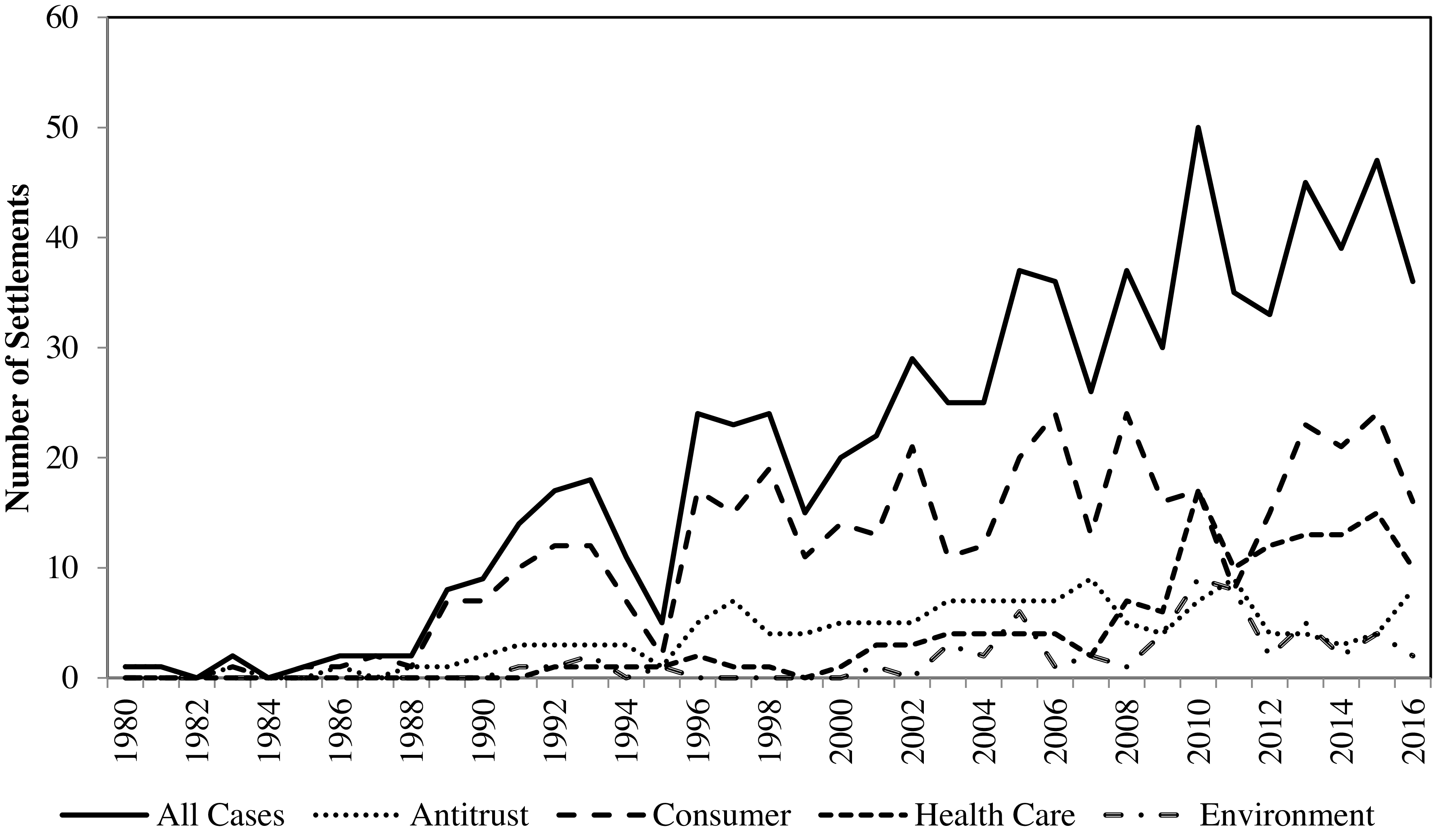
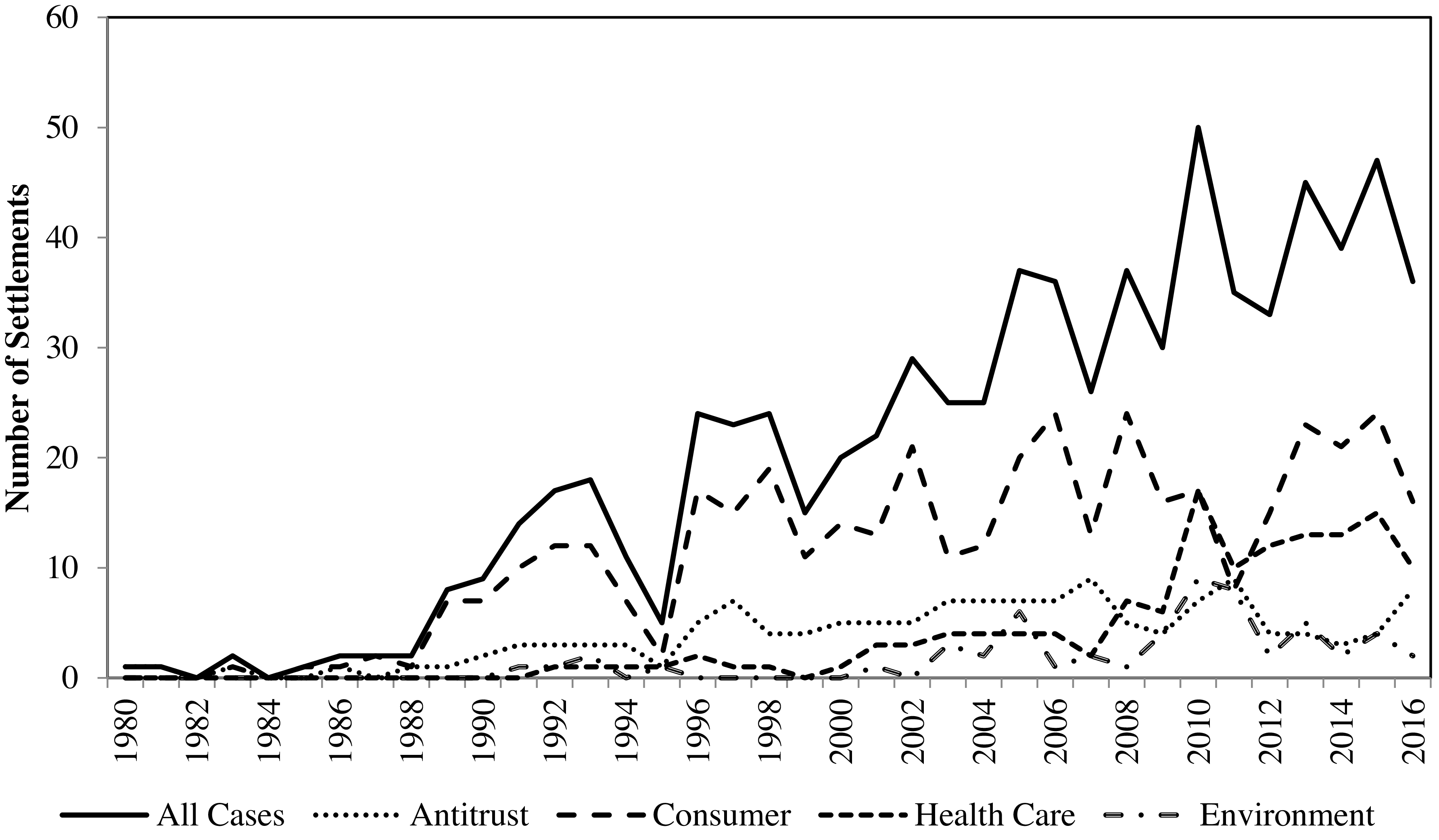
Since the 1990s, state AGs have continued to tackle some of the most disastrous regulatory crises in recent memory. State AGs targeted Bank of America and other banks for their post-Financial Crisis foreclosure practices (U.S. Department of Justice 2012) as well as pharmaceutical companies for their aggressive marketing and distribution of opioid medications (Nolette Reference Nolette2017; Nolette and Provost Reference Nolette and Provost2018). More recently, state AGs have clashed with Facebook and Google. Beyond these outsized lawsuits, cases have increased in both frequency and scope (Nolette Reference Nolette2015; Nolette and Provost Reference Nolette and Provost2018) and have expanded into new areas of public policy, such as health care (Nolette Reference Nolette2015), privacy and cyber security (Citron Reference Citron2016; Dishman Reference Dishman2021), and finance (Cox, Widman and Totten Reference Cox, Widman and Totten2016; Totten 2015). Figure 1 displays the number of multi-state settlements that have been reached with companies between 1980 and 2017.Footnote 4 The data reveal a clear pattern of expanding enforcement in a number of different regulatory policy areas.
Number of Multi-State Lawsuits Brought Against Businesses, 1980–2017
As the scope of multi-state lawsuits has grown, so too has the role played by more centralised trade associations around state AGs. The bipartisan National Association of Attorneys General (NAAG) provides information and communication mechanisms through which AGs can pursue lawsuits. Lobbying organisations have also arisen in order to advance the policy agenda of Democratic and Republican AGs, while recruiting candidates and raising money for AG elections. In 1999, Republican AGs created the Republican Attorneys General Association (RAGA) while Democratic AGs created the Democratic Attorneys General Association (DAGA) in 2002.
The number of law firms representing companies targeted by state AGs has also grown. Many of these firms have specific State AG Practices, which consist, although not exclusively, of former state, assistant, and deputy AGs (Coe Reference Coe2024; Dong Reference Dong2021). This revolving door of former state AGs moving into the private sector has been documented anecdotally by the legal media, with some observers claiming that we are in a “Golden Age of AGs,” referring both to the burgeoning litigation of state AGs and the flourishing defense bar increasingly filled with former state AGs and their staff attorneys (Tincher-Numbers Reference Tincher-Numbers2023).
Do lawyers in State AG Practices perform their work in a manner consistent with the Regulatory Schooling Hypothesis or the Quid Pro Quo Hypothesis? There is little scholarly literature specifically documenting the case of AGs in the context of revolving doors, although scholarship on progressive career ambition may provide a guide. Provost finds that many state AGs run for higher office, such as governor or senator (Reference Provost2010b), while a number of other studies anecdotally refer to this desire to run for higher office (for example, Devins and Prakash Reference Devins and Bangalore Prakash2015; Lemos and Young Reference Lemos and Young2018). More importantly, Provost finds that the likelihood of running for higher office is stronger for those AGs who are frequent initiators of or participants in multi-state litigation (Reference Provost2010b). Although the extant literature does not address AG aspirations to work in the private sector, Provost’s findings suggest that state AGs do rely on strong enforcement signals when moving to higher office, consistent with a Regulatory Schooling dynamic.
It is also important to ask what motivates AG office staff, such as deputy and assistant AGs, to move into the private sector. It is beyond the scope of this paper to examine deputy and assistant AGs systematically, but they serve longer tenures and have greater institutional memory and knowledge regarding the specifics, dynamics, and negotiations of multi-state litigation, making them potentially even more attractive to the private sector than AGs themselves. As AG office staff are career prosecutors and not elected politicians like 43 state AGs, they are considerably less likely to run for higher office. The literature demonstrates that a number of federal career prosecutors do, in fact, move into the private sector, and furthermore, these career officials are likely to signal their expertise through stronger enforcement (de Haan et al. Reference de Haan, Kedia, Koh and Rajgopal2015; Zaring Reference Zaring2013). Again, this trend is more consistent with a Regulatory Schooling dynamic, rather than a Quid Pro Quo or regulatory capture dynamic. Thus, we might expect AG office staff to also move into State AG Practices, particularly as demand for such skilled attorneys rises.
The legal media and law firm blogs can yield additional insights regarding the behavior of former AGs in the private sector. In addition to representing companies in litigation, many former AGs in the private sector emphasise the “eyes and ears” role they play, in that they serve to keep companies aware of regulatory issues and help them to stay ahead of the curve. For example, State AG Practices maintain blog posts on their websites, designed to keep clients up to date on the latest enforcement actions and what such actions portend for the future. Additionally, each firm with a State AG Practice also emphasizes the collective knowledge their group possesses with regard to the functions and processes of state AG offices and how this knowledge can be utilised to keep companies out of legal trouble. “You need to know and understand these AG offices, how they operate, before that CID (Civil Investigative Demand) comes across your desk,” says Jerry Kilgore, former Virginia AG and (as of this writing) Co-Chair of Cozen O’Connor’s State AG Practice (Kutner Reference Kutner2023).
While the “eyes and ears” dimension of State AG practices may be consistent with the “Regulatory Schooling” Hypothesis, insider connections and the risk of regulatory capture are also present. Mainstream media accounts have produced accusations of undue influence and a “pay to play” culture as a result of the revolving door. Starting in late 2014, Eric Lipton of the New York Times wrote of former AGs approaching incumbent AGs (Republican and Democrat) on behalf of particular clients, with the goal of influencing or dropping particular investigations, raising questions of whether justice was for sale (Reference Lipton2014a, Reference Lipton2014b, Reference Lipton2014c). One prominent example involved the Missouri AG, Chris Koster, pulling the state’s involvement from the investigation of the company Five Hour Energy, after Koster was approached by lawyers for the company (Reference Lipton2014a). This was an episode that clearly appeared to represent the world of regulatory capture and the Quid Pro Quo Hypothesis.
After the publication of Lipton’s articles, some former state AGs publicly pushed back, arguing that Lipton’s reporting was not representative of most AG activities. In a January 2016 Stanford Law School Roundtable that featured Lipton, former Maine AG Jim Tierney argued that the focus of the articles represented “at most five percent of what state attorneys general do” (Reference Tierney, Lipton, Goddard and Engstrom2016). Lipton countered that the five percent was crucial and it often represented state AGs overruling previous decisions made by the assistant and deputy AGs. Such debate has only heightened the importance of understanding how the revolving door fills the need for new legal services—whether attorneys in State AG Practices are looking to exploit connections, improve compliance or some combination of both?
Research Design
I employ a mixed methods approach, in which I use semi-structured interviews, quantitative AG career data, as well as legal media sources. I conducted semi-structured interviews with current and former state AGs for three key reasons. First, the behavior and motivations of lawyers may involve complex processes that do not necessarily lend themselves to quantitative measurement. Interviews are useful for capturing the detail and nuance of such processes. Second, the semi-structured element allows the interviewer to deviate briefly from the script to interrogate concepts that arise in the process of the interview. Finally, the detailed and semi-structured nature of the interview data means that I am not testing hypotheses as such, even though hypotheses are referred to (Regulatory Schooling and Quid Pro Quo), among the theoretical concepts. The interview data allow for the possibility that the key ideas under examination may not be mutually exclusive.
The interview data consist of sixteen semi-structured interviews with current and former AGs, as well as current and former deputy and assistant AGs. The interviewees’ professional status broke down as follows at the time each interview was conducted: five were assistant or deputy AGs, two were attorneys working for NAAG, six were former AGs, all of whom had private practice experience and finally, three were former assistant or deputy AGs, working in private practice. The interviewees thus presented a good mix of those currently working in AG offices vs. those working in private practice who formerly worked in AG offices. The mix also featured those who led the AG office (both appointed and elected) and those civil servants who did the day-to-day legal work across multiple AGs. Some interviewees were chosen from existing contacts and I used snowball sampling to contact and speak with the remaining interviewees. The sampling was conducted in a way to maximize variation across current and former AGs, while also ensuring that the interviewees were expert in the relevant areas—multi-state litigation and state AG practice law firms. Interviews were conducted in 2018 and 2019, were conducted over the phone and typically lasted on average one hour. Each interviewee was asked questions regarding the origins of state AG practices, the effects of multi-state litigation on the private practice market, as well as the professional behaviour of former AGs working for state AG practices or other corporate law firms. Each interview was recorded and then transcribed by either the author or a research assistant.
In order to assess the career movements of lawyers in the state AG space, I utilise quantitative data that sheds light on the expanding world of state AG practices, at the firm level and individual level. The purpose of these data was to observe potential trends in movement into the private sector and to conduct preliminary analysis of AG career decisions. For these data, I performed two steps. First, I counted the number of law firms with State AG Practices by searching through the legal media outlets National Law Journal and Law360 Pulse, using the terms “State Attorney General” and “State AG” with “practice” separately. Additionally, I performed a basic Google search for “State Attorney General Practice” or “State AG Practice.” The purpose of these searches was to locate as many law firms as possible that have contained State AG Practices. While I was not able to examine trends over time,Footnote 5 I triangulate with the interview data to make inferences about how state AG practices have evolved, with respect to size.
Second, in order to gauge the extent to which State AGs are moving into the private sector, I collected data on post AG-service career choices for all AGs serving between 1991 and 2020, in order to observe the number of state AGs leaving public service to pursue posts in large law firms, and specifically, State AG Practices. These data were collected in the spring of 2020. Google, LinkedIn and legal directory searches were done for each AG to determine if they ever worked in private practice after their AG service. For all AGs serving in 1991 and onward, careers were mapped out from their AG service until 2020, the year of the data collection, so that no work in the private sector went unobserved. 1991 was chosen as the starting year, as it was recent enough to enable complete internet searches for each AG, while also allowing a thirty-year window to be observed. Additionally, multi-state litigation began to increase notably in the early 1990s, providing the enforcement impetus in this study.
AGs from all fifty states were examined during the time period, but AGs who served fewer than two years were excluded from the data, as their comparatively short service puts them at a disadvantage in the post-public service job market. In total, this produced a sample of 194 state AGs whose post AG career choices I could observe. I present descriptive statistics of AG movement into the private sector and estimate a logit model of the determinants of AGs moving into the private sector.
Results: The Origins of the State AG Revolving Door
Although the central focus here is the effect of the revolving door on regulatory compliance in the private sector, this behavior is better understood if we know about the motivations of AGs to move into the private sector and to create State AG Practices. Thus, I first present results from the interviews regarding the origins of State AG Practices. Interviewees unanimously agreed that multi-state litigation generated demand for new services from the private legal sector. Most interviewees indicated that companies did not, and often still do not, understand what is expected of them under state law and what state AGs are capable of under state and federal law. A former assistant attorney general from a large state, who moved to a large law firm state AG practice, put it this way:
…these corporate clients all have tons of federal lobbyists and government affairs types in Washington D.C. looking at the vast federal bureaucracy…but very few of them have any sense of what the powers and duties are of state attorneys general…so usually the conversations start with their jaw dropping saying, ‘They can do that? They can subpoena us?’ Well, yes, they can do that.
The failure to understand the nature of multi-state litigation applied not just to companies, but also to the outside counsel they retained, who frequently misunderstood the problem or underestimated its scope and severity. Consequently, outside counsel would often aggressively downplay the legal capabilities of the state AG and would simply fail to take the regulatory threat seriously. There was an implicit belief that state AGs could not make credible regulatory threats or that it was going to be easy for defense counsel to overwhelm them. One former AG from a large state spoke of a telecommunications company that was determined to proceed with an illegal promotion:
… (we said) ‘You don’t want to do this, this is violating (unnamed state) law, you are gambling under (unnamed state) law and we cannot let you do this.’ And the lawyers were huffing and puffing, you know, we’re just state lawyers, what do we know, we’re just second-class citizens…I finally picked up the phone and called the president of the company and I said…your lawyers are arguing like they’re above the law. You don’t want us to sue you and we don’t want you to be sued, we just want you to be compliant. That is our job.
The failure of defense counsel to understand state AG capabilities frequently led them to engage in tactics that would earn them the moniker of “litigation counsel.” Interviewees spoke of how litigation counsel tended to lengthen the settlement process, without actually solving the underlying problems in question. Rather than trying to solve the offending problem the company had, litigation counsel were more interested in adopting delay tactics, disputing the claims and motions presented by AGs, filing frequent motions, and fighting discovery or information requests. One current assistant AG in a mid-size state that is active in multi-state litigation summarised the issue and its effects this way:
…it does them (client companies) a huge disservice, but they hire traditional litigation counsel who enter into a very litigation posture which I think, if their client does want to settle and change, is sort of the worst thing they can do…I think it runs up the bill tremendously on them and gets them nothing and probably puts them in a worse position…
Interviewees emphasised that it is simpler and more efficient if defense counsel adopt the attitude of “settlement counsel” more readily, which is characterised as finding solutions to the underlying regulatory problems, rather than fighting the AGs each step of the way. To the extent that private sector lawyers and in-house counsel did not understand state law or the mechanisms behind it, the demand from the private sector is for greater expertise and therefore reflects the Regulatory Schooling Hypothesis to a greater degree than the Quid Pro Quo Hypothesis.
Results: State AGs and the Revolving Door Entrance
If there was greater demand for competent counsel that could assist with the threat of multi-state litigation, how did the market respond? Some former AGs or assistant AGs with long experience in private practice said that when they began their work in the early to mid-2000s, this sort of private work still represented a fledgling field in the early stages of development. However, all interviewees, whether they were former or current AGs/assistant AGs, agreed that over time, there had been a significant increase in the number of private law firm attorneys who were representing companies dealing with state AG matters.
I performed a count of contemporary law firms with state AG practices (methods described in the Research Design section), and as of 2026, there are at least fifty-six law firms that contain State AG practices. Many of these are large law firms with an international presence. Some of the practices contain dozens of attorneys, while a few are small law firms that contain fewer than ten. It is worth remembering that this number does not capture large law firms that do state AG work, but have not given themselves the label or marketing of a state AG practice. It is also possible that some state AG practices were started, failed, and then disappeared from the public record. Such firms are unlikely to appear in the final total. Of these fifty-six firms for which I was able to locate data, it is more difficult to ascertain when each practice started. Twenty firms have a precise starting date, and among these, nearly all of them were created since 2015. Indeed, it appears that the more recently created each practice is, the more likely it is to be announced publicly, possibly as an attempt to stand out and announce a presence in an increasingly crowded field.
While this industry space has grown and firms have made new hires to bolster their AG practices, it is also possible that law firms have marshalled and redirected existing resources to grow their State AG Practices and sections devoted to state AG work. Legal media sources have observed “what appears to be a race by large law firms to formalize, market and grow their state attorney general practices” (Coe Reference Coe2024). Regardless, the number of State AG Practices has grown over time. To determine whether more AGs are entering the private sector over time, I turn to the quantitative AG careers data.
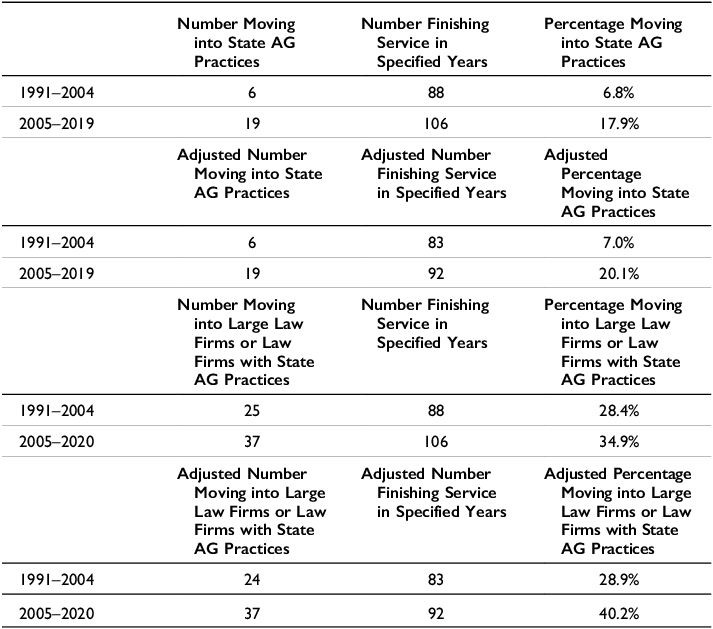
In Table 1, I examine individual-level data over time and present data on which state AGs left public service to work for State AG Practices (the data collection and sampling are described in the Research Design section). The first two rows of Table 1 group this decision according to when state AGs left public office—those that left between 1991 and 2004 and those that left between 2005 and 2020. Of the 194 former state AGs analysed in this dataset, 25 of them have gone to work in law firms with state AG practices.Footnote 6 While this fraction constitutes only 13 percent of the total, there is some increase over time. Among state AGs finishing their service before 2005, 6.8 percent progressed to work in a firm with a State AG Practice, but after 2005, 17.9 percent moved to State AG Practices.
State AGs Moving into Private Practice
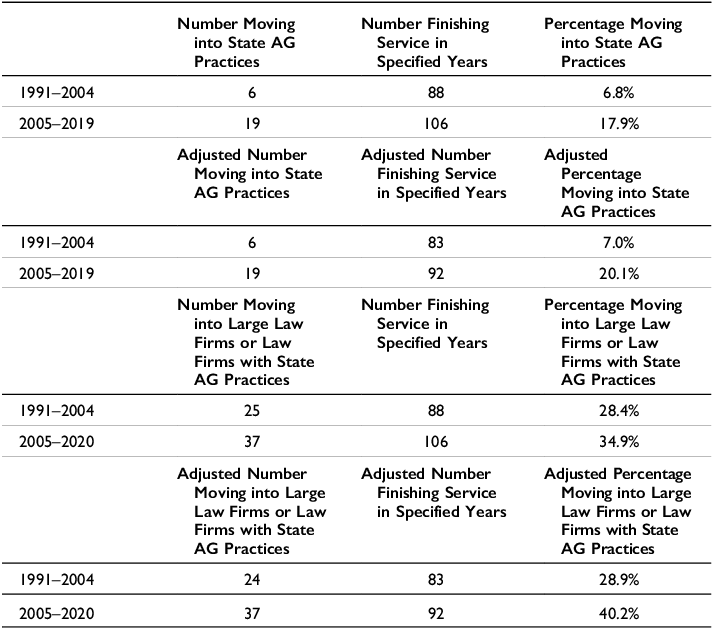
—Adjusted numbers represent totals without AGs that are still serving in higher office as of 2020 or have been through a scandal, in either their AG service or during higher office service.
In the next two rows, I adjust the number of AGs in order to consider an alternative sample. Many AGs are attracted to positions of higher office, such as governor or senator, when their AG service ends (Provost Reference Provost2010b). A number of AGs in the sample have run for higher office and still hold the new position as of 2020, thus limiting their opportunities to move into the private sector. I thus exclude from the adjusted total of AGs these eight AGs who have successfully run for higher office and still hold those positions as of 2020. Additionally, state AGs who become embroiled in scandal during their tenure or in subsequent higher office become less employable in the eyes of the private sector. Thus, I also exclude the eleven AGs whose futures have been tainted by scandal. The adjusted number of state AGs, therefore, decreases by 19 from 194 to 175. With this smaller total, there is a slightly larger increase in the number of state AGs moving into state AG practices, as the number increases from seven to 20 percent over time (in the third and fourth rows of Table 1).
If we expand the number of choices under examination, we can also look at whether AGs have worked in large law firms, as many firms do similar, state AG-relevant work, even if those firms do not have formal state AG practices. These data are in the fifth and sixth rows of Table 1, with the adjusted sample numbers appearing in the seventh and eighth rows. The fifth row of Table 1 reveals that between 1991 and 2004, there was a significantly higher number of former AGs working for large law firms and/or for firms with state AG practices (28.4 percent) than there were just working for state AG practices (6.8 percent, first row). Over time, this percentage increases to 34.9 percent (sixth row). Relying on the adjusted sample of AGs produces a bigger increase in the revolving door over time, moving from 29.1 percent between 1991 and 2004 to 40.2 percent between 2005 and 2020.
The data, therefore, reveal some evidence of a pattern over time in which more former AGs are going to work in private law firms after their AG service. These data alone likely underestimate the true extent of movement from AG offices to the private sector, as they only account for the AGs themselves. Legal media sources have reported a number of high-profile shifts of AG staff from the public to the private sector, most notably of formerly high-ranking deputy AGs, some of whom have also helped to create new state AG practices (Dong Reference Dong2021; Tincher-Numbers Reference Tincher-Numbers2023). Moreover, in 2023, it was reported that there were “numerous state AG hires in Big Law, as firms anticipate a rise in demand in the state AG space,” specifically mentioning high-profile former deputy and assistant AGs (Tincher Numbers Reference Tincher-Numbers2023). Finally, upon moving to the private sector, former AGs often bring deputy or assistant AGs with them (Henry Reference Henry2023). Thus, the anecdotal evidence suggests that a number of AG office staff are also moving into the private sector.
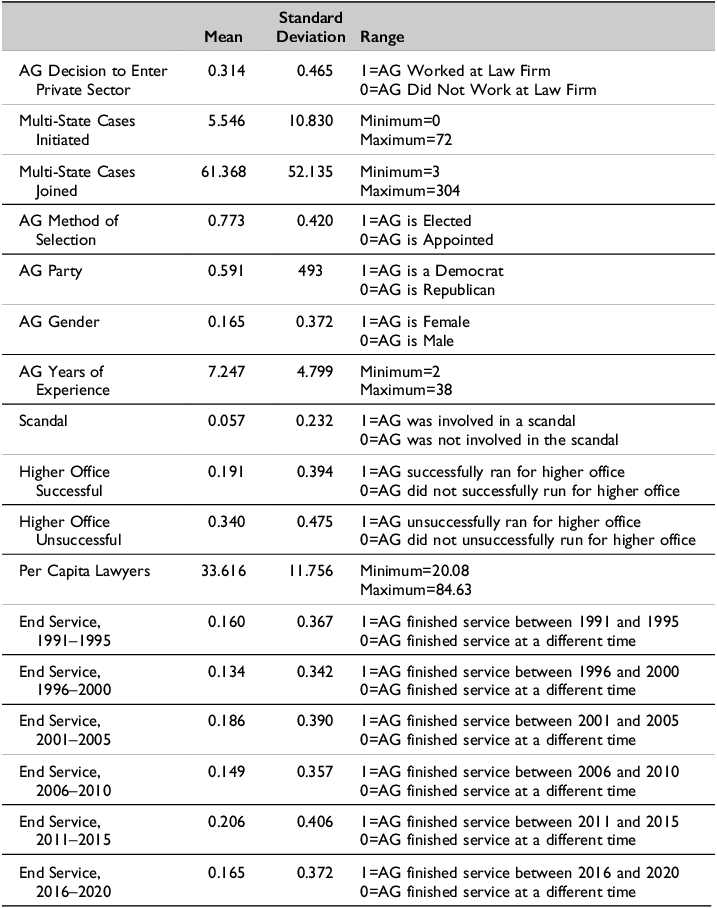
In order to examine more systematically which state AGs go to work in private law firms, I analyse the decision as a function of AG and state-level factors. Thus far, the interview data have indicated that in the early days of multi-state litigation, private counsel did not understand the nature of the regulatory threat, which generated demand for new legal skills in the private sector. One possible test of the Regulatory Schooling Hypothesis is to see if those AGs who engage in higher levels of regulatory enforcement enter into the private sector. To test this, I divide the total number of multi-state lawsuits that each AG initiated during their service by the total number of multi-state lawsuits initiated during their service. This measures each AG’s relative activity with respect to multi-state lawsuits.Footnote 7 I also examine the proportion of multi-state lawsuits in which each AG participates, although fewer resources are typically required to participate in a lawsuit than to initiate one.
In addition to the measure of law enforcement activity, the model also examines several other AG characteristics: whether the AG is elected or appointed; whether the AG is Democrat or Republican; whether the AG is female or male; and the number of years of AG experience. Additionally, the model examines both whether the AG has successfully or unsuccessfully run for higher office (governor or senator) before, as well as whether the AG was involved in a scandal. Scandals should serve to make an AG less appealing to the private sector, while unsuccessfully running for higher office might serve to make the private sector a clearer option. The model also includes five different variables representing the five-year window during which the AG completed his/her service (1991–1995 is the baseline time window that does not appear in the model; the remaining variables are 1996–2000, 2001–2005, 2006–2010, 2011–2015, and 2016–2020). These variables are present in the model to capture whether AGs are more likely to enter the private sector later in the period of observation. Finally, to account for the legal market of each state, I include the ABA measure of the number of lawyers per state.Footnote 8
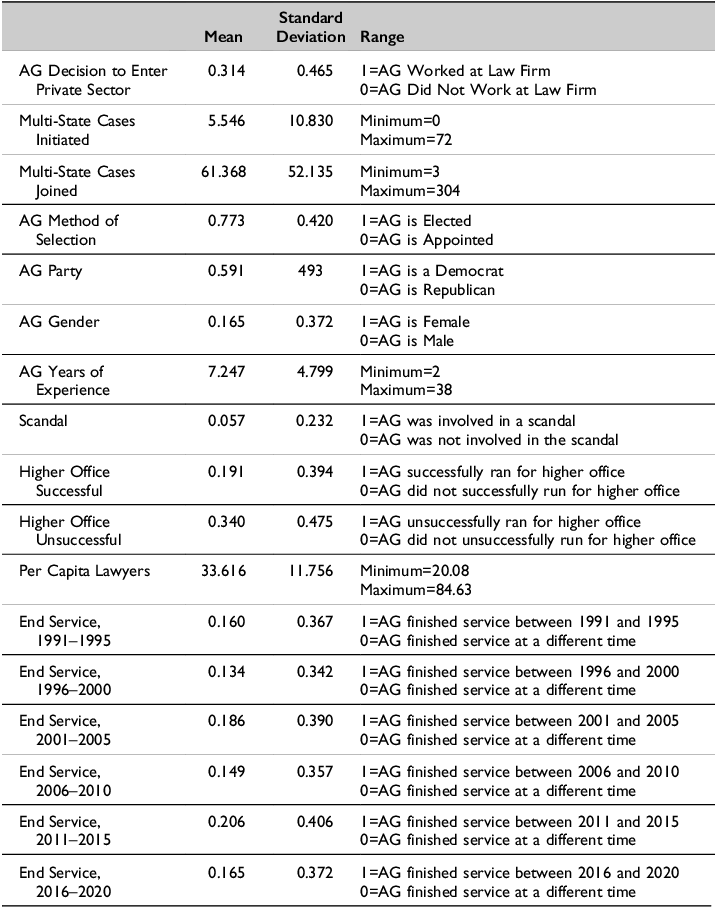
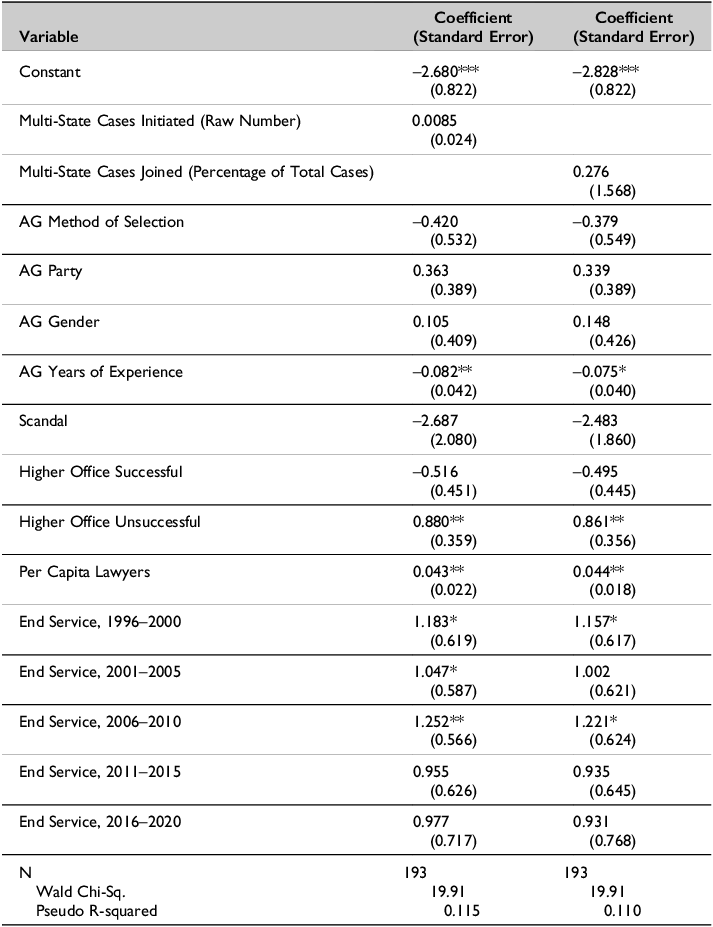
Table 2 contains descriptive statistics for each of the variables described above. As the variable representing the AG decision to enter the private sector is dichotomous, I use a logit model, with standard errors clustered on the states in order to control for unobserved, state-level effects. The results of the analysis appear in Table 3. The effect of multi-state lawsuit initiation is insignificant, indicating that, while AGs who initiate many of these lawsuits do enter the private sector, so do the less active AGs. Similarly, the model does not show a difference for method of selection, political party, AG gender, or the presence of a scandal, although this may be due to the very small number of AGs involved in a scandal.
Descriptive Statistics
Logit Model of AG Decision to Enter the Private Sector
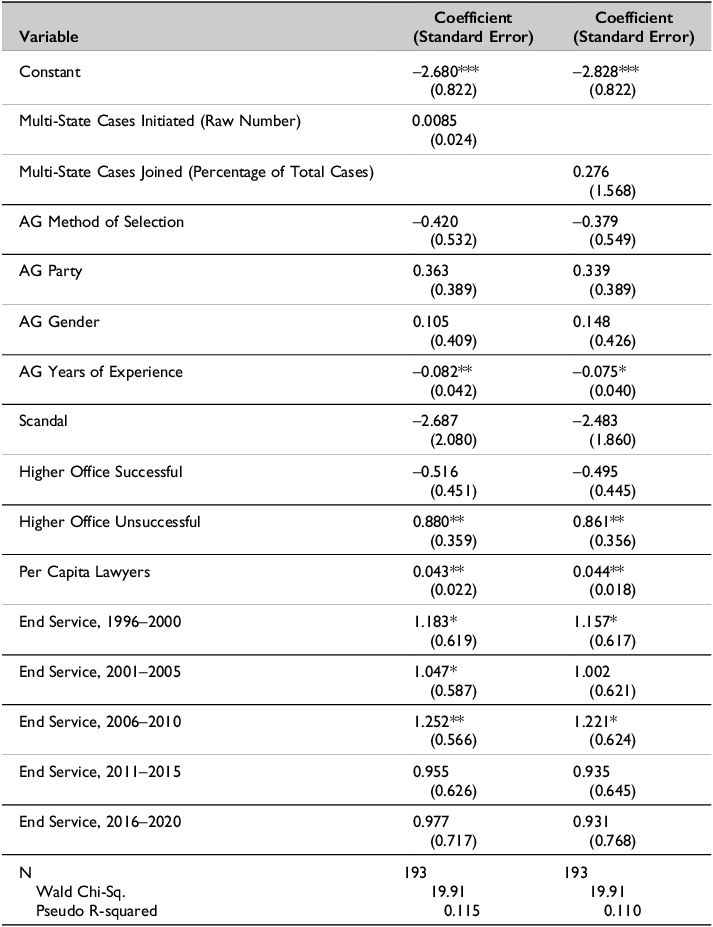
*** p<0.001, ** p<0.01, * p<0.05; Coefficients are logit coefficients with standard errors in parentheses.
The model does show that AGs who have unsuccessfully run for higher office are more likely to go to work in law firms, indicating that AGs still most likely prefer moving to higher public office than working in the private sector. Additionally, the number of per capita lawyers in each state is also significant, revealing that a large number of lawyers signifies a more robust legal market and therefore more opportunities for former AGs in the private sector. Finally, relative to the period of 1991–1995, AGs were more likely to enter the private sector in the late 1990s and in the 2000s, but not in the 2010s. This reveals somewhat of an increase, but perhaps a non-linear one, in the trajectory of AGs into the private sector over time. Table 3 also presents results for the same model, but replacing cases initiated with cases joined, which is more common among the AGs and typically requires fewer office resources. The results are virtually identical to those of the case initiation model, except that in the participation model, AGs leaving service between 2001 and 2005 are not significantly more likely to enter the private sector than those leaving between 1991 and 1995.
There is an important caveat regarding the multi-state case initiation model. Case initiation and per capita number of lawyers per state correlate fairly highly (0.59), and when per capita lawyers are removed from the model, the effect of multi-state case initiation becomes significant (p < 0.04). Thus, the collinearity between the two predictors makes it difficult to decide whether strong enforcement or a robust market for lawyers leads to more AGs joining the private sector. Additionally, the time-invariant nature of the ABA Per Capita Lawyers variable (2013 data) means that the measure cannot adequately capture temporal variation in the relationship. What this reveals is that there is not enough evidence in this model to support the Regulatory Schooling Hypothesis outright, but neither should we be quick to reject it. Future studies that contain more observations and additional measures of regulatory enforcement may be able to reveal more precise findings.
Results: Regulatory Schooling or Quid Pro Quo?
What sort of services are offered by former AGs who have rotated from the public to the private sector, and how do these services help us to understand whether regulatory schooling or quid pro quo dynamics are at work? All of the interviewees agreed with the general idea that public sector lawyers could bring expertise to the private sector. In this case, they also believed more specifically that former AGs were useful because they understood how multi-state investigations worked, and they understood what state AGs wanted to accomplish in such investigations.
Recall that lawyers representing companies targeted by multi-state litigation often failed to understand the nature of the regulatory problem. Compounding this problem, they often came into negotiations acting as “litigation counsel” rather than problem-solving “settlement counsel.” Most interviewees indicated that former AGs and former assistant AGs were far more likely to understand what current AGs wanted to achieve through settlement negotiations than attorneys who did not come from AG offices. An assistant AG in a small state that is active in multi-state litigation described how complex negotiations in one case improved when a former assistant AG was brought in as a legal representative of the defendant—a national financial company:
For about 6-9 months, I was dealing with the same counsel…We weren’t getting very far, we were talking past each other…They didn’t understand why we were asking the questions we were. They didn’t accept that we had a role in investigating. The company saw some of that frustration as well. They hired two attorneys from AG practices…I knew it was going to improve communication. We wouldn’t have to explain to them why we had a role…we never would have gotten it done in the time frame we did without the involvement of those guys.
While like-minded lawyers working together can improve negotiations, connections between former and current AGs play a multi-faceted role in the revolving door. While Eric Lipton’s reporting painted a picture of connections being used to influence or drop investigations, they can also be used as a means to prevent legal problems.
Many of the interviewees discussed the important “eyes and ears” role they play in keeping clients informed of legal risks and how best to steer clear of them. In order to stay informed of legal developments, former AGs attend many AG conferences every year.
While RAGA and DAGA have raised the profile of campaign spending and the role of money in AG elections (Lipton Reference Lipton2014a), the broadening scope of participants at NAAG meetings has revealed in multiple ways the increasing demand for state AG legal services from relevant business interests. NAAG meetings of the 1990s and 2000s were populated by state AGs and staff, but over time, participation diversified, as business people and law firm representatives attended. Multiple former AG interviewees said they routinely attended NAAG, RAGA, and DAGA meetings to monitor the issues that AGs consider salient and report back to their clients. Given the many annual meetings held by each organization, this means that private sector attorneys are frequently attending more than ten state AG meetings a year, earning them the nickname “AG whisperers” by current AG staff members.
Additionally, it has become common for business representatives to attend the conferences, while this was much less common fifteen to twenty years ago. One former AG of a mid-size state put it this way:
When I used to be in office, I joked that we know who we are going to be suing next and it’s whoever is going to be at the next NAAG meeting…You could be pretty sure that there was an open investigation of them by one of the states or there would be. It was almost an admission of guilt. I think that has changed. Now, they (businesses) realise that this is a group of folks (state AGs) that they need to keep in touch with. They need to know what they are thinking and they need to know what the next area of litigation is likely to be.
Businesses that do attend AG meetings are, of course, more likely to send their counsel to such meetings once they have utilised their services. From that point on, their outside counsel essentially acts as their eyes and ears in the world of state regulatory enforcement.
It is at these RAGA, DAGA, and NAAG meetings that private attorneys can make connections with current AGs or AG staff members that may prove useful. Interviewees spoke of situations at conferences, whereby private counsel approaches current AGs or assistant AGs and wants to talk with the aim of arranging a later meeting to have a more specific conversation about their client. In these situations, it is not always clear what counsel ultimately wants from such a relationship, but by establishing such a relationship, counsel creates access that could prove useful later. Arranging introductions between serving AGs and business clients is one such benefit of access. At least one former AG discussed the importance of introductions and how a client’s explanation of a new product to an AG can better help the AG understand the value of the product. However, other interviewees framed this dynamic slightly differently. At least one assistant AG talked about companies that want to “get ahead” of an issue because they anticipate more scrutiny from the AG, or they want to reassure the AG that they are not doing anything illegal.
The revolving door may produce other outcomes that do not clearly fit into either the “Regulatory Schooling” camp or the “Quid Pro Quo” camp. With respect to connections, most interviewees indicated that the behaviour documented in the Lipton articles is not that common. In other words, it is fairly unusual for former AGs to ask directly for an investigation into their client to be dropped or to ask for a competitor to be investigated. However, former AGs may combine their expertise with their knowledge of the case or office in question to obtain better settlement terms for the client. An assistant AG in a mid-sized state, active in multi-state litigation, described the situation as follows:
It’s never that we’re donating money to RAGA or DAGA and therefore you should drop (the investigation). I’ve never had that type of conversation. I will say the more effective conversations are probably pushing settlement at certain points in negotiations. It’s always difficult for AG offices which are always under-resourced; knowledgeable pushes from people you are friendly with, that’s where I’ve seen (it).
This dynamic could also be described as using more hardball tactics, according to another assistant AG from a mid-sized state. If a former AG is confident that an existing case is weak, he/she may push harder in negotiations.
(Former) State AGs might end up driving more antagonistic negotiations or at least more hardball negotiations because they know how much the states are willing to pull. So I’m not sure you can always predict with certainty that a former state AG is going to result in a more conciliatory negotiation than a private counsel who does not have that background.
In both these instances, former AGs are zealously trying to obtain the best possible outcome for their clients, and their unique knowledge of state AG offices or of particular case areas helps them to do this more effectively. Thus, former AG knowledge and expertise cut both ways: familiar relations can help move settlement negotiations along quickly, which tends to please current AGs, but at the same time, former AG expertise may also make settlement negotiations more challenging for current AGs.
Discussion and Conclusion
The results of this study point towards a revolving door in US state politics, borne out of a failure to understand new types of regulatory enforcement, which in turn led to the creation of new divisions within large law firms, known as State AG Practices. The type of law practiced within State AG Practices is more consistent with bringing expertise than connections to business clients. In other words, the evidence provides more support for the Regulatory Schooling Hypothesis than it does for regulatory capture or the Quid Pro Quo Hypothesis. Interestingly, connections may be relevant in this set of revolving doors, but more in a way that recognizes shared expertise and procedural knowledge between public and private sectors. The analysis reveals three main findings.
First, the evidence pointing towards the Regulatory Schooling Hypothesis has its origins in how multi-state litigation was originally understood by defendant companies and their counsel. Companies were often prepared and scanning the horizon for federal regulatory threats, but were less well-equipped with respect to state regulatory issues. Remarkably, this often pertained to the outside counsel hired by such companies as well. Consequently, both companies and law firms often failed to understand the consequences of not taking multi-state investigations seriously. This lack of comprehension meant that outside counsel often conducted a sort of trench warfare, digging in and resisting AG demands (litigation counsel), rather than attempting to resolve the underlying problems (settlement counsel). This paved the way for a new type of legal practice in which lawyers could give more practical advice when it came to the spectre of multi-state investigations.
Extant literature examining the impact of revolving doors often finds evidence in favor of the Regulatory Schooling Hypothesis, but the mechanism is often overlooked. In this case, we see in the early days a mismatch between the needs of defendant companies and the legal services provided. Some companies did not take the threat of state litigation seriously. Additionally, interview evidence frequently painted a picture of companies that wanted to comply and be rid of their legal problems, but were dogged by litigation counsel that were determined to fight trench warfare. This suggests that companies retained former AGs as counsel for their expertise, rather than just their connections, which provides support for the Regulatory Schooling Hypothesis rather than the Quid Pro Quo Hypothesis.
Second, in order to fill this demand, state AG practices have sprung up in a number of large law firms, often staffed with attorneys coming from AG offices. Additionally, many law firms have hired former AGs to do similar work, even if they lack formal state AG practices. Most of these state AG practices were created after 2010, and as of this writing, there are at least fifty-six large law firms with such practices. The careers data reveal a modest increase in the number of state AGs pursuing employment in large law firms after their service, but the legal media evidence also indicates that it is possible that some law firms have been reorganizing and reorienting internal human resources to focus on State AG Practices (Coe Reference Coe2024). The evidence for the Regulatory Schooling Hypothesis is a bit less clear from the logit analysis. The model shows that AGs entering large law firms are not necessarily more active in initiating multi-state lawsuits, but rather a robust state legal market and failure to win higher office are better predictors of entering the private sector.
Third, the interview data did reveal that AGs would rely more on expertise than on connections in their private sector work. Nearly all interviewees indicated that former AGs had greater knowledge of and appreciation for the process of multi-state litigation, and this often made for a more efficient settlement negotiation. This process was a result of like-minded lawyers operating across the table from each other, as former AGs were more likely to understand the regulatory problems in question and were able to move settlement negotiations along more quickly. In this manner, the process did not necessarily benefit from connections in a regulatory capture sense, but from the connections shared by lawyers who hailed from the same world of AG institutions and norms. However, expertise cut both ways, as former AGs with expertise and knowledge of particular offices were in a position to negotiate better settlements for their clients.
The finding that prosecutors prefer to work with similarly-minded former prosecutors when negotiating settlements echoes the work of other scholars who find that business personnel tend to be more receptive to inspectors when they come from within the company, rather than the government. A more receptive audience is also more likely to be found when regulators hail from the same profession (Ayres and Braithwaite Reference Ayres and Braithwaite1992; Rees Reference Rees1988). Rees puts it succinctly, quoting a worker, in his study of occupational health and safety:
When I’m sitting there, doing something stupid…something that I know damn good and well is wrong, but I’m doing it anyway, and the safety man comes up to me and corrects me on it, well, it’ll upset me. I might not say anything, or I’ll say, ‘Ok fine, you’re right.’ But I will lose my temper over it, it will aggravate me, because he’s just not one of us (1988, 147).
Those working in state AG offices did not exactly make the same identity-based expressions, but the fact that they were often more easily able to work with former state AGs because they understood the objectives of multi-state settlements indicates a similar dynamic in which a shared understanding of the process produces a more fruitful negotiation.
Ultimately, what this evidence reveals is that the ability of private counsel to achieve compliance objectives plays an important role in the overall market for legal services. Former AGs can benefit their clients by bringing expertise, knowledge of AG office structure and function, and sometimes connections with the current AGs. Rarely are connections used on their own to influence investigations, as the Lipton articles suggest, although interviewees said they knew it sometimes occurred. These findings show more support for the Regulatory Schooling Hypothesis than for regulatory capture or the Quid Pro Quo Hypothesis.
There are limitations to the data in this study, of which readers should be aware. First, the sample of sixteen interviewees is somewhat small, but this would have been more problematic if the findings did not converge reasonably clearly. However, more interview data would have generated the capacity for further nuanced inference. Second, the quantitative data only pertain to the elected and appointed state AGs and not the deputy and assistant AGs who work in the offices. Searches through the National Law Journal and through LinkedIn profiles reveal that many of these career prosecutors are also highly sought after by large law firms, which means the findings in this study are probably underestimating the full extent of movement from within AG offices to the private sector. Future research that examines the career paths of those in state AG offices systematically can shed light on this trend. Third, the high multicollinearity in the logit model suggests that future studies should incorporate more data and include other measures of regulatory enforcement.
Finally, readers should be cautioned against generalising too widely about the findings in this study. Perhaps the most important point here is that not all revolving door actors are lawyers; some of these actors may enter jobs in the private sector that are more explicitly about lobbying, and for them, the importance of the job is less about legal compliance. Additionally, lawyers play a uniquely important policymaking role in the USA, the land of “adversarial legalism” (Kagan Reference Kagan2001). Not every other nation in the world holds lawyers in the same esteem, necessarily, which in turn can affect the demand for public lawyers in the private marketplace. However, as US law firms expand their global growth, this dynamic could change.
Future revolving door research may benefit from a mixed approach that combines qualitative and quantitative methods. Many studies in this area rely exclusively upon quantitative methods, and while this research has made highly valuable contributions to the literature, these studies are often able to tell us less about the broader context behind the revolving door. Mixed methods may be able to yield insights into the creation of the revolving door in addition to its effects, once in place. Additionally, future research should also concentrate on the expanding regulatory ecosystem of American state politics. First, state AGs continue to expand their business targets, including businesses that utilize sustainable investment targets (Shanor and Light Reference Shanor and Light2023), among other groups. As long as the scope and intensity of multi-state litigation continue gathering steam, we can expect robust responses from large law firms that represent businesses in these lawsuits. Second, this study found evidence in favor of the Regulatory Schooling Hypothesis, but given the expanding role of political money and lobbying in the state AG space, future studies should continue to monitor for regulatory capture dynamics.
Acknowledgments
The author wishes to acknowledge the helpful comments of the three anonymous reviewers, as well as comments from anonymous reviewers on previous versions of the manuscript rejected elsewhere. The manuscript benefited from helpful comments from Caelesta Braun, Elysa Dishman, Greg Distelhorst, Yuval Feldman, Alexander Fitzpatrick, Cristie Ford, Claire Hill, Christel Koop, Alice Moore, Roula Nezi, Paul Nolette, Justin Rex, Jodi Short, Susan Silbey, Judith van Erp, and Benjamin van Rooij. The author is grateful for the invaluable research assistance provided by Rodolfos Maslias, Simran Singh, and Charlotte Willis.
Competing interests
There are no funding sources to declare for this project, nor are there any conflicts of interest.

 Open access

