


1. Introduction
Personality is important for labor market performance (e.g., Borghans et al., Reference Borghans and Golsteyn2016; Heckman et al., Reference Heckman and Stixrud2006) and other outcomes related to love, creativity, curiosity, and intellect (Schwaba et al., Reference Schwaba, Bleidor, Hopwood, Gebauer, Rentfrow, Potter and Gosling2021). Belfield et al. (Reference Belfield, Bowden, Klapp, Levin, Shand and Zander2015) sought to develop economic analysis of interventions to improve social and emotional skills, following Karoly (Reference Karoly2012), but economists and other analysts have rarely sought to link personality or social and emotional skills to in utero or early childhood environments. In the first large-scale analysis (that we are aware of) regarding the effects of early life exposure to air pollution on subclinical adult personality traits, Schwaba et al. (Reference Schwaba, Bleidor, Hopwood, Gebauer, Rentfrow, Potter and Gosling2021) report that childhood exposure to atmospheric lead concentrations common in the early 1970s predicts adulthood levels of several of the “big five” personality traits – extraversion, agreeableness, conscientiousness, neuroticism, and openness to new experiences. Exploiting a natural experiment driven by the Clean Air Act (CAA), study participants “born after atmospheric lead levels began to decline in their county had more mature, psychologically healthy adult personalities (higher agreeableness and conscientiousness and lower neuroticism), but these findings were not discriminable from pure cohort effects” (Schwaba et al., Reference Schwaba, Bleidor, Hopwood, Gebauer, Rentfrow, Potter and Gosling2021).Footnote 1
This work has attracted significant attention. In 2023, USA Today published a news article titled “Lead can alter personalities,” which relied on Schwaba et al. (Rodriguez, Reference Adrianna2023). McFarland et al. (Reference McFarland, Reuben and Hauer2024) modeled a collection of effects of lead, including mental health symptoms and changes in personality traits. Regarding the latter, they concluded “Population-level neuroticism increased by 0.14 standard deviations and conscientiousness decreased by 0.20 standard deviations,” from exposure to lead, based on nationwide modeling of lead effects on personality reported by Schwaba et al. (Reference Schwaba, Bleidor, Hopwood, Gebauer, Rentfrow, Potter and Gosling2021). Amplifying this research, Popular Science recently published a story about lead and mental health stating, “Due to childhood lead poisoning, the research of McFarland et al. suggests that Americans, overall, are less conscientious and more neurotic“ (Leffer, Reference Leffer2024). In this article, we reconsider the effects of early childhood lead exposures on adult personalities and examine county and birth cohort effects.
Lead is of special interest because childhood lead exposure is linked to a variety of neurological and behavioral concerns. Examples of this include aggression and destructive behavior, delinquency, attention deficit hyperactivity disorder, and criminal conduct (Centers for Disease Control and Prevention (CDC), 2019; Gibson et al Reference Gibson, MacDonald, Fisher, Chen, Pawlick and Cook2022; Landrigan et al. Reference Landrigan, Fuller, Acosta, Adeyi, Arnold, Balde and Bertolini2018; Reyes, Reference Reyes2007; Reyes, Reference Reyes2015; and Grönqvist et al. Reference Grönqvist, Nilsson and Robling2014). It is also associated with a loss of self-control and shortened attention span, dullness, irritability, loss of memory (CDC, 2019). Using data on 849 children, and geolocation data for the children’s residences for the first 36 months of life, Gatze-Kopp et al. (Reference Gatzke-Kopp, Warkentien, Willoughby, Fowler, Folch and Blair2021) employed an instrumental variable strategy to show that lead exposure had small negative effects for both child IQ and executive function. Using data on 1476 children younger than 8 years, Gatze-Kopp et al. (Reference Gatzke-Kopp, Willoughby, Kress, McArthur, Wychgram, Folch, Brunswasser, Dabelea, Elliott, Hartert, Karagas, McEvoy, VanDerslice, Wright and Wright2024) found a nonlinear association between lead and executive function, with lead lowering mean inhibitory control, but not cognitive flexibility. Banzhaf and Banzhaf (Reference Banzhaf and Banzhaf2023), using confidential Social Security data on date of birth, find that greater in utero exposure to lead is associated with worsening disabilities in adulthood, greater reliance on public assistance, and more limited opportunities for adult employment. Environmental Protection Agency (EPA) has discussed effects of lead on personality qualitatively and has acknowledged that “some studies found that noncognitive personality traits are at least as predictive of life outcomes as IQ,” (EPA 2020), citing Borghans et al. (Reference Borghans and Golsteyn2016) and Heckman et al. (Reference Heckman and Stixrud2006). The EPA’s estimates of the gains in lifetime income that may result from reductions in childhood exposure to lead dominate its benefits analysis (EPA, 2020; EPA, 2024b).
Because of these effects, lead exposure is of ongoing interest to policymakers. In a reconsideration of its 2021 hazard standards and clearance levels for dust-lead, the EPA recently issued significantly more stringent dust-lead action levels and dust-lead reportable levels that affect 31 million pre-1978 residences and day care facilities (EPA, 2024a). Supported by new benefit–cost analysis (e.g., Levin & Schwartz, Reference Levin and Schwartz2023), it recently set new requirements to replace lead and certain galvanized service lines, reduce the lead action level to 0.01 mg/L, and tighten tap sampling procedures (EPA, 2024b). EPA is also taking steps to limit lead in civil aviation fuel (EPA, 2023). An outbreak of elevated blood lead levels in young children in 2023 led the Food and Drug Administration to issue a consumer advisory and announce a recall of applesauce products contaminated with lead (FDA, 2023a; FDA, 2023b).
EPA regulates lead based on its causal effect on cognitive function (reduced IQ, decreased academic function), although lead-related conditions include diminished attention, increased impulsivity, hyperactivity, and developmental effects (e.g., delayed pubertal onset).Footnote 2
Nedellec and Rabl (Reference Nedellec and Rable2016) show lead controls offer reduced mortality benefits that are likely larger than benefits related to cognitive function, and note that there is apparently no exposure level with no effects.
We explore relationships among the big five personality traits and measures of exposure to airborne lead. Using data on airborne lead and personality and other data described by Schwaba et al. and courteously provided to us by Schwaba, we find that introducing birth year fixed effects (FE) significantly changes the associations between atmospheric lead and the big five personality traits that Schwaba et al. reported. Effects common to all infants born in a given year may occur because of changes unrelated to airborne lead – for example, federal law (e.g., pertaining to abortion), or demographic, cultural, or technological changes (e.g., regarding contraception or child rearing), or new employment or educational opportunities for women of childbearing age.
Including such effects also changes the estimated causal effects of changes in atmospheric lead levels on personalities. When we introduce birth year FE into Schwaba et al.’s models, the estimated effects of the lead phaseout on personality traits largely disappear, becoming indistinguishable from zero while remaining precise. More broadly, these results serve as a reminder of the risks associated with estimating causal effects without controlling for period or cohort effects. They do not imply an overstatement in the EPA’s estimates of the quantifiable benefits of reducing childhood exposure to lead, which are based on the economic value of gains to IQ.
The rest of this article is organized as follows. First, we show how the use of birth year FE in the preregistered model presented by Schwaba et al. changes the sign and statistical significance for three of the personality traits (agreeableness, conscientiousness, and neuroticism) and alters the estimated associations for the other two traits. Second, we modify the model that Schwaba et al. used to identify the casual effects of lead and show that introducing birth year FE again upends the estimated effects of lead on personality. We conclude with a discussion of our results and conclusions.
2. Analysis
Building on Reuben et al. (Reference Reuben, Schaefer, Moffitt, Broadbent, Harrington, Houts and Caspi2019), Schwaba et al. report associations between atmospheric concentrations of lead during the first 18 years of life and self-reported personality traits during adulthood collected through a web-based survey. Schwaba et al. used EPA’s data on atmospheric lead concentrations, and modified it via interpolations and extrapolations to address missing observations. They also used a big data convenience sample of personality traits and parent’s years of schooling from the Gosling–Potter Internet Personality Project (GPIPP; https://www.thebigfiveproject.com/). The GPIPP data used by Schwaba et al. were collected from 2003 to 2015 through an online survey using the “Big Five Inventory, a widely used 44-item index of the Big Five personality domains,” according to Schwaba et al. They explain that for each of the 44 items, “participants reported the degree to which they agreed with a short phrase (e.g., “I am someone who tends to be lazy”), using a 5-point rating scale.” Schwaba et al. provide descriptive statistics for the big five personality traits and related data in their Table S1.Footnote 3 Using preregistered covariates controlling for the respondent’s age, parental college schooling, and median county income, Schwaba et al. find that both extraversion and openness to new ideas increase with increased lead exposure, while agreeableness and conscientiousness decline with increased lead exposure. These relationships are all significantly different from zero at the 99.9 % level while a fifth trait, neuroticism, has no statistically significant relationship with lead.
While Schwaba et al. explore these associations in a variety of models, they do not estimate models with FE for the year of birth. Birth year and age correlate imperfectly because the data were collected over 12 years, ending in 2015. Some of those born in 1970 (say) completed the survey in 2004 at age 34, while others born in the same year may have completed it as late as 2015 at age 45. Indeed, respondents of various ages completed the survey at quite different times. The sum of birth year and age, a proxy for the year a respondent completed the survey, accounted for 10.7% of the responses for 2003, 2004, and 2005 and for 31.5% of the responses for 2003, 2004, and 2005. Thus, roughly a decade separates the time of completion for about 42% of responses.Footnote 4 Reviewers of an earlier draft of this article recommended we use cohort effects by birth year.Footnote 5 In principle, it should be possible to separate the effects of the regulation-induced lead phaseout from pure cohort effects as lead declined in some counties much more than in others and the timing of the lead phaseout varied across counties.
2.1. Associations
Although the causal analysis by Schwaba et al. of the effects of the lead phasedown provides their most convincing results, their work first focuses on evidence of associations following a preregistered analysis plan. Here, we show that introduction of birth year FE into their models, which include only age, parental education, and median county income, reverses the estimated relationships between lead and four of the big five personality traits, confirming the importance of cohort effects in a wider range of models.
Schwaba et al. report that reduced lead exposure is associated with healthier and more mature personalities (more agreeableness, conscientiousness, and less neuroticism), but with the addition of birth year FE, we find different results – lead is associated with more agreeable and more conscientious and less neurotic personalities. Table 1a and 1b shows the contents of Table S6 of Schwaba et al. and the results of modifications to include birth year FE.Footnote 6 With the introduction of birth year FE, the associations involving
-
• lead and extraversion drops by half
-
• lead and agreeableness changes from negative (and statistically significant at the 99.9% level), to positive (and statistically significant at the 95% level),
-
• lead and conscientiousness changes from negative (and statistically significant at the 99.9% level) to positive (but is only significant at the 90% level),
-
• lead and neuroticism becomes negative and significant at the 99% level rather than insignificant (but positive).
Associations between atmospheric lead concentrations during childhood and big five personality traits

Parentheses denote 99% confidence intervals. We use * for estimates with p < 0.1, while ** and *** denote p < 0.05 and p<0.01, respectively. Data represent 1,104,455 respondents nested in 269 U.S. counties.
Associations between atmospheric lead concentrations during childhood and big five personality traits
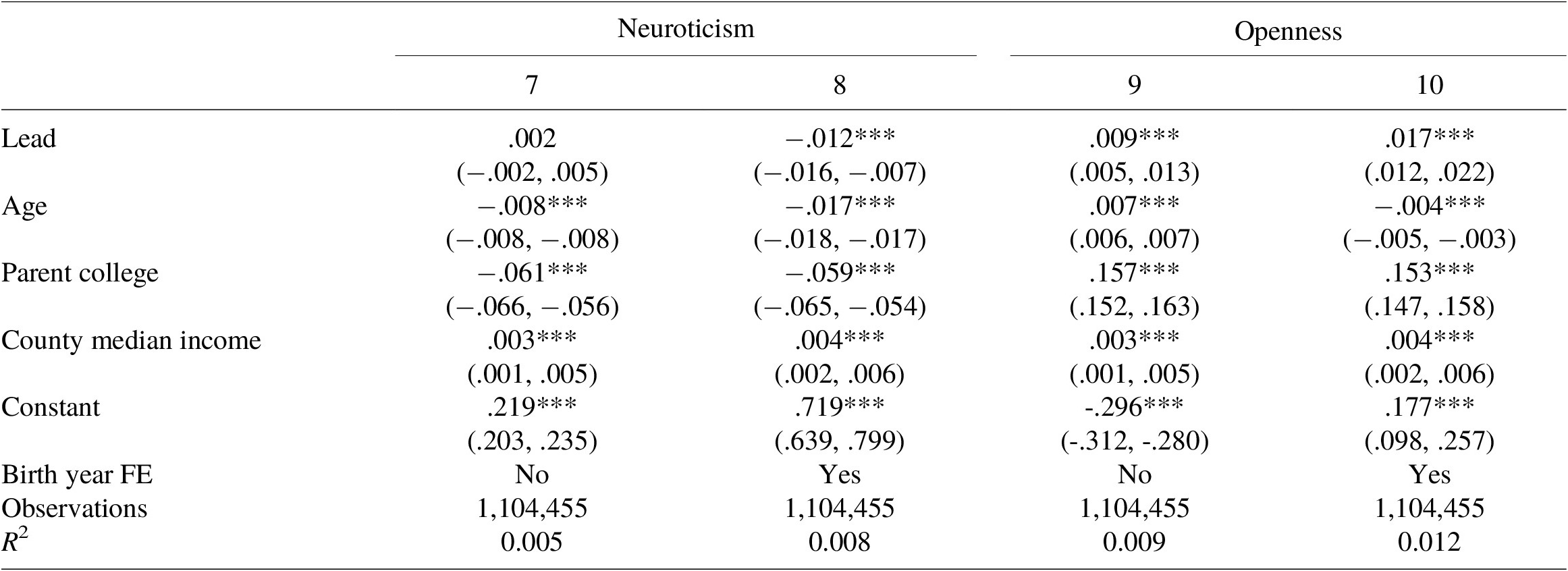
Parentheses denote 99% confidence intervals. We use * for estimates with p < 0.1, while ** and *** denote p < 0.05 and denotes p<0.01. Data represent 1,104,455 respondents nested in 269 U.S. counties.
While the association between lead and the fifth trait – openness to new ideas – is qualitatively unaffected by the introduction of birth year FE, the estimated coefficient nearly doubles, jumping from 0.009 to 0.017. F-statistics for each of these five models indicate the joint significance of birth year FE exceeds the 99.9% level.
2.2. Effects of early life exposure to airborne lead
Schwaba et al. also examine the causal effects of lead reductions on the big five personality traits by using a differences-in-differences identification strategy. For each county, they select the year with the greatest atmospheric lead concentration as the beginning of (local) lead emissions controls, noting that this peak year varies among the counties in their sample, with a mean of 1973 and a standard deviation of 4.27 years. Schwaba et al. then compare the personality traits of people born after the peak years with those born earlier, attributing the difference to the shift caused by the lead phasedown.
We reproduce their results from Table S25 in Tables 2a and 2b.Footnote 7 They show statistically significant (p<0.001) effects of lead phaseout on reducing extraversion and neuroticism and increasing agreeableness, conscientiousness, and openness. While these models include age (which is correlated with birth year), entered linearly, they do not include birth year as an explanatory variable.
Shifts in personality traits after each county’s lead phaseout: estimates and 99% confidence intervals in ()

Source for the Schwaba columns: Table S25. Shifts in traits are interpretable as a standardized Z score. We use *** for p<0.01. The sample represents 1,219,290 participants from 269 counties.
Shifts in personality traits after each county’s lead phaseout: estimates and 99% confidence intervals in ()
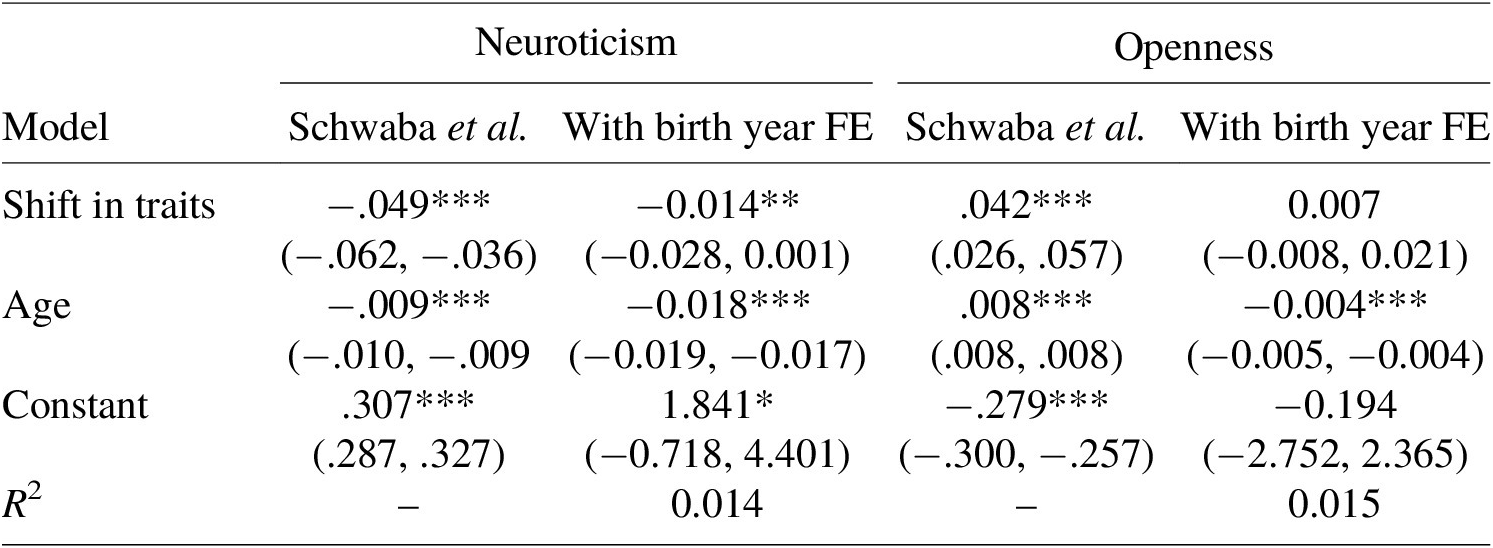
Source for the Schwaba columns: Table S25. Shifts in traits are interpretable as a standardized Z score. We use *** for p<0.01. The sample represents 1,219,290 participants from 269 counties.
After replicating these results using the code courteously provided by Schwaba, we test robustness in two ways. First, we modify the random effects model used by Schwaba et al. so that the randomness is exclusively county-specific, and not both by county and for the emission controls. Then, we switch from random county effects to FE by county. We find that for each of the five personality traits, these changes have no material effect on the estimated coefficients, suggesting substantial robustness.Footnote 8
Adding FE for birth years, however, yields quite different estimates of the effects of atmospheric lead on personality traits. As shown in Tables 2a and 2b, the introduction of birth year FE renders statistically insignificant the estimates of the effects of lead exposure on all traits except neuroticism. The lead phaseout still reduces neuroticism, but the estimated effect is less than one-third the magnitude reported by Schwaba et al. and is now statistically significant at (only) the 95% level. These new results are not the result of less precise estimates; the standard errors are essentially unchanged with the introduction of birth year FE, as shown in Figure 1.Footnote 9
Effects of lead phaseout on big five personality traits

For all personality traits, the 99% confidence intervals for the effects of lead phaseout using birth year FE shown in Tables 2a and 2b exclude the point estimates of Schwaba et al. For all traits but extraversion, the 99% confidence intervals do not overlap those of Schwaba et al. Importantly, for each trait, the birth year FEs were jointly statistically significant at much better than the 99.9% level.
These results are insensitive to treating counties as having random effects – as in Tables 2a and 2b – or FE. With the latter assumption, the confidence intervals for lead phaseout effects on the personality traits are identical to two significant digits.
Importantly, as shown in Figure 2, coefficients for the birth year effects for each personality trait are nonlinear, with changes in slope around 1980 for extraversion and neuroticism and around 1983 for openness.Footnote 11 These patterns indicate that an assumption that birth year affects the big five personality traits linearly, as in Schwaba et al. is not warranted.
Birth year coefficients and standard errors in models of personality traits and the phaseout of airborne lead, with county random effectsFootnote 10

Following Banzhaf and Banzhaf’s use of county FE, we also explore models with both county FE and the birth year FE described in Tables 1a and 1b, but no variable for the lead phaseout. These models represent an alternative approach to generating estimates of the effect of lead phaseout on the big five personality traits; they reflect entirely within-county variations in lead and personality and control for cohort-wide effects unrelated to atmospheric lead.
In models with both county FE and birth year FE, the estimated associations of lead exposure with extraversion, agreeableness, conscientiousness, and neuroticism all have the same sign as compared with the models in Table 1 with only birth year FE (see Appendix Footnote 12). Focusing on the (even numbered) models with both county and birth year FE, the estimated associations of lead exposure with agreeableness, conscientiousness, and neuroticism are inconsistent with the preregistered hypotheses of Schwaba et al.
3. Discussion and conclusions
Our results suggest that Schwaba et al.’s findings on the relationships between atmospheric lead and personality traits are sensitive to their modeling decisions. In particular, as discussed above, the introduction of birth year FE changes the signs of associations between lead and more mature, psychologically healthy personality traits.Footnote 13 Lead, instead of being associated with less agreeableness, conscientiousness, and more neuroticism, is associated with more extraversion, agreeableness, conscientiousness, and less neuroticism after birth year FE are introduced. These same results hold in models with both birth year and county FE. For the fifth trait, openness to new ideas, the association with lead is positive with birth year FE but becomes negative when county FE are also included.
We introduce FE for birth years while retaining random effects for counties in the model of the effects of lead air pollution controls on personality traits and find the lead phaseout of lead has no effect on four of the big five personality traits. Neuroticism, the exception, declines with the lead phaseout (as in the Schwaba et al. results), but the magnitude of the effect becomes smaller and less significant in models with birth year FE. These results indicate that the data used by Schwaba et al. do not clearly support unambiguous causal relationships from childhood exposure to atmospheric lead to more mature, psychologically healthy adult personality traits.
The pioneering work by Almond and Currie (Reference Almond and Currie2011) showed that the early life environment may affect a variety of adulthood outcomes. More recent work – for example, Isen et al. (Reference Isen, Rossin-Slater and Walker2017) studying total suspended particulates, and Banzhaf and Banzhaf (Reference Banzhaf and Banzhaf2023) studying airborne lead – report in utero and early life exposure to air pollutants adversely affects adulthood outcomes like labor market performance, although efforts to disentangle effects of different air pollutants on child cognitive development are ongoing (Wodtke et al., Reference Wodtke, Ard, Bullock, White and Priem2022). Our results do not mean that EPA’s estimates of the benefits of reducing lead exposure are too high and do not imply that early childhood atmospheric lead exposures experienced immediately prior to the CAA implementation had no effect on big five personality traits in adulthood. However, they do mean that any such effects are not consistently observable in the data used by Schwaba et al. More broadly, these results caution against making causal inferences without controlling for cohort or time period effects.
Acknowledgments
The authors gratefully acknowledge help from Ted Schwaba, who graciously answered questions about his data and code and from Dick Morgenstern. Fraas, Lutter, and Xiahou acknowledge financial support from the Smith Richardson Foundation which had no role in the design or execution of the study.
Appendix
Exposure to Atmospheric Lead During Childhood and Adult Personality Traits with County Fixed Effects: Without and With Birth Year Fixed Effects.
Associations between atmospheric lead during childhood and adult personality in the United States: county and birth year fixed effects

Note: We use * to mean p<0.1, ** to denote p<0.05, and *** for p<0.01. The data have 1,104,455 observations from 269 counties.
Associations between atmospheric lead during childhood and adult personality in the United States with county fixed effects: without and with birth year fixed effects
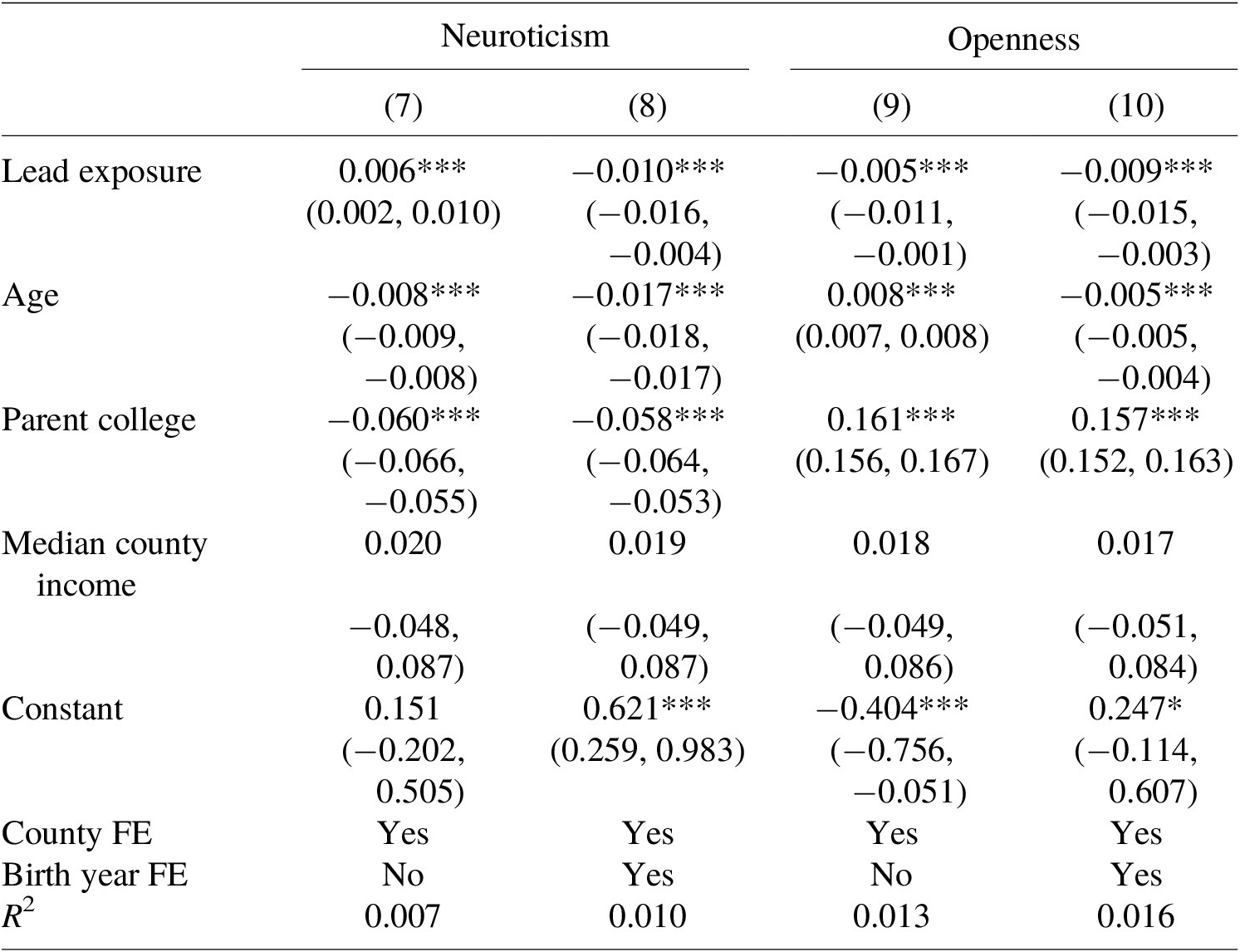
Note: We use * to mean p<0.1, ** to denote p<0.05, and *** for p<0.01. The data have 1,104,455 observations from 269 counties.


 Open access

