

This essay reconstructs the historical recollections and experiences of the Sandoval family, who describe themselves as “respectable” Cuban artisans. The Sandovals’ actions over the last century include several border-crossing marriages as well as multiple migrations between Spain, the United States, and other circum-Caribbean nations. At first glance, mining the Sandoval family’s past provides a wonderful opportunity to write an intimate history that answers recent scholarly calls to reject the nation-state and an assumed North-South hierarchy as appropriate conceptual frameworks (Reference Shukla and TinsmanShukla and Tinsman 2005). Indeed, the Sandoval family archive of stories, photos, and home movies opens a door into a history that illuminates the Americas as deeply connected and challenges the limits of national borders.
The Sandoval family narratives, however, do not simply confirm the power of transnational connections or the centuries-long history of Caribbean migration across national boundaries (Reference Scott and HébrardScott and Hébrard 2012; Reference Giovanetti-TorresGiovanetti-Torres 2018; Reference Hoffnung-GarskofHoffnung-Garskof 2019). They also present a compelling picture of the ways in which national identities assert themselves in the “private spaces” of migratory life in ways distinct from political acts of solidarity, economic remittances, or public ceremonies—the migrant affirmations of homeland connections most explored by scholars (Reference Ramos-ZayasRamos-Zayas 2003; Reference Chamberlain and LeydesdorffChamberlain and Leydesdorff 2004; Reference PedersonPederson 2013). As the Sandovals curate their collective history, they constantly validate and define both their powerful sense of Cubanness and their own familial relationships. “Story-telling becomes a form for constituting a collective subject, in whom the ancestors live on renewed” (Reference JamesJames 2000, 154). For the diasporic Sandovals who shared their stories with me as they lived without a broader sociopolitical and cultural matrix of Cubanness, Cuba and family mutually defined each other. This equation of distant, yet ever present nation with the family was accomplished primarily through the stories the Sandovals told about their family’s past. These narratives constituted a continual search for a collective coherence of intergenerational diasporic meaning, an ongoing attempt to resolve the internal contradictions, ambiguities, and tensions of intertwined national and family histories.
Lo nacional remains powerful, even as we widen our historical lens beyond its borders. Indeed, the Sandovals’ core narratives about their own history continually reassert the primacy of a revolutionary Cuban identity, even as they acknowledge that many of the family’s members have married into and even permanently resided within other nations. This working-class Cuban family history forcibly assimilates, scorns, or erases family members and resources rooted in “weaker” nations, particularly (for the purposes of this essay) those from Puerto Rico. Puerto Ricans and their still-colonial homeland have provided crucial members and resources to the Sandoval family, but their importance remains unacknowledged, even denigrated, subsumed under the more powerful national identity of revolutionary Cubanness. The historical creation of a “cien por ciento Cubano” identity, then, in this family of diverse national origins and locations, has been built upon a persistent refusal of its potential pan-American hybridity.
Gender has been key to these dynamics. The Sandovals’ successful reinvention of themselves as Cuban in the face of frequent physical migrations and international marital choices depended on Cuban men marrying and assimilating into Cubanness women from “weaker,” “backward” places like Puerto Rico and El Salvador. In addition, the Sandovals’ enduring sense of working-class respectability has relied on sharply gendered social spheres and divisions of labor reproduced by family members, both male and female. Finally, the way family histories are reconstructed works in profoundly gendered ways, often protecting male privilege even when they center on women’s voices, perspectives, or experiences.
Race, too, plays an important role in the Sandovals’ stories about their family’s history, but it does not appear overtly as consistently as does gender. When discussing early twentieth-century Cuba or the process of returning to Cuba from the United States in 1961, references to racial difference and denunciations of racism surface in Sandoval narratives. Such moments serve to mark the Sandovals’ struggle for justice and to denounce outsider groups and nations that have attempted to thwart this stalwart fight. Otherwise, the Sandovals refer to their own racial identity implicitly in their assertions of hard-won, gendered, working-class respectability (Reference FindlayFindlay 1999; Reference BaergaBarcia 2003; Reference Hoffnung-GarskofHoffnung-Garskof 2011).
The Sandovals’ oft-repeated stories constitute a master narrative of history, replete with claims to total truth (Reference TrouillotTrouillot 1995; Reference PalmiéPalmié 2013). This Sandoval familial master narrative excludes, disciplines, subordinates, and silences as it fashions a unified, empowered sense of nationally linked collectivity. Thus, both Cubanness and the concept of familial solidarity—so crucial to the Sandovals’ tales of successful migratory strategizing and triumphant survival—are themselves “cultural, social, and narrative construction[s] within which relations of equality and hierarchy exist” (Reference MallonMallon 2005, 231).
The Sandovals are in many senses exceptional working-class Caribbeans. Key familial decisions that they have made challenged the broad historical patterns so familiar to historians of the Spanish-speaking Caribbean. Family stories insist that, in the early twentieth century, a central member of the family chose to identify with blackness, even when offered the chance of “passing” into white social status. In 1961, at a moment when tens of thousands of Cubans were fleeing the island’s radical social reforms, many of the Sandovals returned to Cuba to take up the utopian dreams of its revolution, despite having successfully made their way in New York City for almost a decade. Finally, after re-migrating to the United States at the commencement of the Cuban “Special Period” in the early 1990s, core members of the Sandoval family also moved north to the Washington, DC–Baltimore area, leaving behind the cultural familiarity of the sprawling Cuban exile community in Miami.
Certainly, the Sandovals’ actions and self-perceptions illuminate alternative experiences that remind us of the diversity of Cuban working people’s experiences during the twentieth century. However, I am not reconstructing the Sandovals’ narratives about their family’s past primarily to expand our empirical knowledge of Cuba’s history. Rather, I am centrally concerned with how this family (and, by extension, many other migrants) has created a powerful sense of a particularly defined, nationally linked collective identity, even as it has incorporated—even depended on—non-Cuban people and resources. This ironic process is expressed and consolidated through the metaphorically rich stories its members tell about their intertwined family/nation.Footnote 1
It was after their relocation from Miami in the mid-1990s that I came to know the Sandovals. I collected the Sandoval family narratives analyzed in this article between 1996 and 2016 in the Washington, DC, metropolitan area. This context powerfully shaped the intentions of the storytellers, the stories produced, and the way they functioned for this branch of the Sandoval family. The Sandovals struggled with the “failure” of the Cuban Revolution in which they had believed. By the time they moved to Miami (1992) and then to Washington, DC (1995), Cuba’s Special Period,” a time of great deprivation and disillusionment, was in full swing. The Sandovals’ grief at the shredding of the revolutionary transformations that they had proudly helped to build has been simultaneously ameliorated and intensified by their physical and social distance from a broader Cuban social and cultural milieu.
In Washington, DC, the largest Latin American immigrant community is Central American, predominantly from El Salvador. Recent Cuban immigrants were few and far between in the 1990s and the first decade of the twenty-first century. No Cuban community existed for the Sandovals beyond a small network of biological and fictive kin that slowly grew over the years. Literally, the Sandoval family was the sole site of Cubanness for its members. In this context, stories about the family’s past constituted the primary method of re-creating the Sandovals’ national identity; they took on an intensified power for the Sandovals. These tales worked in several different ways. They united the three generations of adult family members born in Cuba around their politicized national identity. The family history stories also distinguished the Sandovals from Central Americans and African Americans, the two large working-class groups in the Washington, DC, area. Finally, the family tales instructed the latest generation of Sandoval children, those born in the United States, in their family’s proud past, in the authority and dignity of their elders, in “proper” ways of comportment, and into identification with a never-visited place of origin (Reference OlwigOlwig 2007; Reference Glick-Schiller and FouronGlick-Schiller and Fouron 2001).
The compelling power of the Sandoval family’s recounted past demonstrates master narratives’ enduring allure for intimate communities as well as for nations. The Sandovals’ stories also remind us of grand historical narratives’ inability to capture the fullness of human experience. Indeed, my immersion in the Sandovals’ oral and object-filled family archive has forced me into a profound reencounter with this basic insight. Their historical stories are so powerfully multivalent that they do not allow me to tell a single story, however multilayered. Consequently, this article moves from an initial reconstruction and critique of the Sandoval family history to an attempt to grapple explicitly in a variety of ways with the messy partialness of history (Reference JamesJames 2000; Reference MallonMallon 2005; Reference OlwigOlwig 2007).
After laying out the broad brushstrokes of the family’s master historical narrative, I engage a few of the poignant stories whispered by Sandoval women in private interviews with me. These unsolicited narratives, shared only after years of measuring my position as a sympathetic female outsider, demonstrate the centrality of unspoken pain and shame in some of the family’s key collective decisions and social practices. This is a different sort of silencing than that generated by a powerful Cuban nationalism as it marginalizes Puerto Rico and those associated with it or as it dampens discussions of racial discrimination. These anguished female stories remind us that silences, as well as stories, have their multiple layers—and their gendered patterns.
I began to do research with members of the Sandoval family more than twenty years ago. I have recorded many informal family storytelling sessions. Not infrequently, parents or grandparents shared a memory or story from the family cache of tales. Often, junior family members asked their elders to repeat beloved stories. Here, I was primarily an observer and transcriber of family members’ storytelling for each other, although my presence certainly shaped the tales told. Second, I recorded narratives that family members shared directly with me in collective family settings; others could hear the stories as they moved in and out of earshot. Stories told in this way frequently became communal creations, as various people participated in the telling. Third, I have conducted more formal individual life-history interviews with twelve adult family members. These were recorded in sessions that involved only myself and the interviewee. Finally, as I became a trusted outsider over the years, family members began to request individual recorded sessions with me. In the course of my many recorded conversations and interviews, I have also reviewed and discussed family documents, photos, and home movies with Sandoval family members. This documentary and visual archive remains in the possession of the Sandovals. They allowed me to make and keep digital reproductions of some of their family photographs; several appear in this article.Footnote 2
My reconstruction of the Sandoval master narrative is based on the stories told most frequently in family settings, repeated on scores of different occasions by at least five different members and often by ten or more. There are, however, specific stories within the grand family narrative that “belong” to certain members of the family, who remain their sole narrators. I have indicated these stories with citations in each case to just a few of the dates I recorded them. All the tales discussed as part of the master narrative, whether collectively or individually related, appeared many times in Sandoval oral accounts over the years of my research with the family.
My own retelling and interpretation of the Sandovals’ stories here, although launched into a space quite distinct from the intimate venues of family history telling, binds me into the politicized creation of historical narratives as well. I am deeply conscious that what I have included in this essay, as well as how I tell it, is no more definitive than the family’s stories themselves. My account is of necessity condensed and partial. It, too, hides unspoken tales in its folds.
The Sandoval Master Narrative
The foundational stories of the Sandoval family invariably begin with a primordial interracial, international couple, formed shortly after Cuba’s War for Independence, during which Spaniards and Cubans fought each other bitterly across the island (Reference FerrerFerrer 1999). Otilia Sandoval, the dark-skinned Cuban daughter of a liberta (freedwoman), built a marital relationship and family life with David García, a red-headed Spaniard many years her senior, who was a prosperous colono (cane farmer) in the great sugar lands of Matanzas Province.
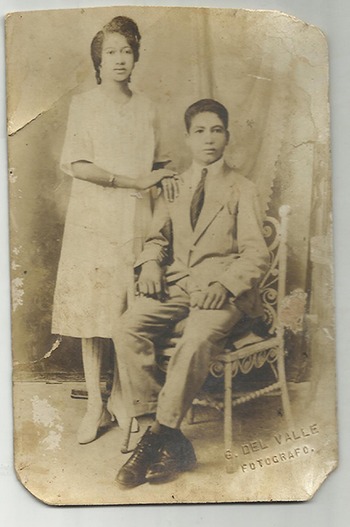
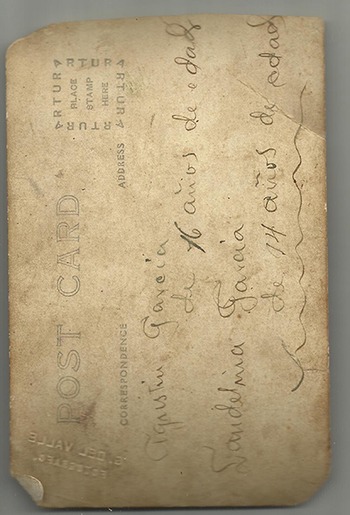
In family lore, the relationship between David García and Otilia Sandoval was most decidedly a lifelong, publicly recognized marriage, despite the couple not being legally married. Sandoval and García’s eight children were known by the entire town and its surrounding rural barrios as their father’s children. David lived openly with Otilia and had no other wife, just as Otilia had no children with any other man. This originating interracial family, the genesis of the Sandoval “core,” was established on a firm foundation of economic prosperity and its concomitant public respectability, something few rural black women or mulatto children could claim during the early twentieth century. Sandoval family members often repeat the story of how all the García-Sandoval children used to promenade with other “gente decente” (respectable people) on Sunday afternoons around the central square of their small Matanzas town carrying parasols and wearing formal clothing, accompanied by both their mother and father. Such a display of interracial family unity was also a public performance of respectability, an assertion of their right to be included among the town’s “better classes.”Footnote 3 Indeed, the family converted into a postcard a formal photographic portrait of Otilia and David’s two oldest children, at the ages of sixteen and fourteen (Figure 1). They were identified on the back of the postcard as Agustín and Laudelina García, proof positive of their public standing as openly acknowledged children of their Spanish father (Figure 2).
Laudelina and Agustín García (Sandoval) in 1920, aged fourteen and sixteen.

The other side of the postcard of Laudelina and Agustín García.

In 1910, so the story goes, David García sent Agustín, the oldest of his children, then just six years old, to be educated by a Spanish uncle in the northern Spanish province of Asturias. Agustín traveled back and forth to Cuba over the subsequent years, but by his later teens, not long after the postcard portrait was taken, family members recount, he was living permanently in Asturias. As his grandson has told me: “He was male and the lightest-skinned of all the children. He was being transformed into a Spaniard!”Footnote 4 Through international relocation, Agustín was on his way to full whiteness. Family lore does not mention this change of national status and concomitant racial identity being offered to any other of his siblings.
Agustín’s international ascent to freedom from the racially saturated, sweat-drenched sugar fields of Cuba ended abruptly at the age of twenty-one, when his father died.Footnote 5 Agustín’s mother Otilia sent word across the Atlantic that she had been thrown into the street by some of García’s relatives who also resided in Cuba. Without marriage papers, Otilia had no right to inherit David García’s property. David García had also never legally recognized his children with Otilia. Overnight, it seemed, Otilia’s eight children were reduced to abject poverty and stripped of the last sign of their respectable social standing—the García surname. Sandoval they would all be, from this moment forward. Otilia Sandoval found herself homeless, struggling to keep alive those children who still lived with her. The youngest, Rubén, was only two years old.
According to family stories, Agustín faced a wrenching choice: to stay in Spain as the apple of his uncle’s eye and become securely white/Spanish, or to return to Cuba to live a life of impoverished blackness in solidarity with his mother and siblings. He returned to Cuba. In a tragic ironic twist, Agustín was now reduced to cutting cane at a sugar plantation whose mill had ground his father’s sugarcane.
Family storytellers reassure their audiences, however, that Agustín rose rapidly in the ranks of sugar laborers—he was a hard worker, smart, and very skilled in working with machines. Soon, he became the head mechanic of the sugar mill. Agustín also met and fell in love with a Cuban woman of African descent, Julia Velez, who was working in the kitchen of the sugar mill’s owner. They recorded their marriage in both church and town hall registries, careful to avoid Otilia’s social vulnerability.
Agustín was a respectable, “whitened” artisan who had chosen solidarity and familial ties with black women. Julia’s respectability, while consolidated by her formal marriage, was not dependent on it. She was well versed in the ways of the white and wealthy, too. Julia, as she often told her children and grandchildren, had been “practically a slave” since the age of ten, working in privileged people’s homes. Exploited and abused by the rich, she became an astute student of their ways. They made genteel music on the pianos that graced their parlors, owned chandeliers, and decorously ate abundant meals on polished tables, even as they ruthlessly exploited the black people who served them. Julia came to know the wealthy whites from the inside out and vowed that someday she would not live under their thumb. She learned to cook, speak, and comport herself as they did—if she so chose. However, Julia and her descendants frequently recounted with pride, she did not abandon her Afro-Cuban roots in shame.Footnote 6 Rather, she observed and strategized as an outsider in the intimate spaces of privilege.
After Julia and Agustín married, Julia left behind her work in domestic service and dedicated herself to managing the family’s affairs. They had two sons, Isidro and Ramón. They also took in Otilia and her youngest child, Rubén, whom Julia raised as one of her own. Julia raised many of her six sisters’ female children over the years as well. Several of them accompanied their aunt to New York City in the 1950s, and later returned to Cuba with Julia in 1961 to “build the revolution.”
Agustín was an inventive genius as well as a lover of technology and science. Long before neighbors could have imagined such luxuries, he built special cisterns and plumbing systems to provide running water, indoor bathrooms, and hot-water showers to his family’s home. He generated electricity for his family’s apartments and used magnets, electrical current, and pulleys to create machines to ease Julia’s domestic drudgery, including a dumbwaiter system to effortlessly bring the groceries up long flights of steps, a small refrigerator before they were available for sale in stores, and an electric cooktop when other women neighbors sweated over wood-burning stoves.Footnote 7
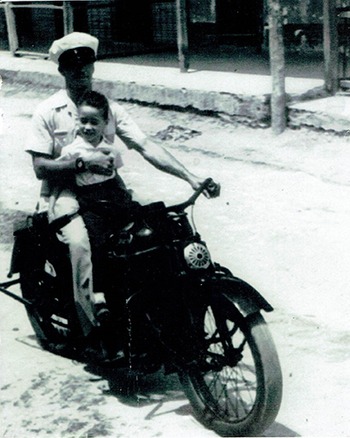
Above all else, Agustín adored all things motorized. His son and grandson rapturously tell how, inspired by a magazine photo of the first Harley-Davidson motorcycle, Agustín built a motorcycle for himself in the family’s second-floor apartment by making all the body and mechanical parts from scrap metal that he scavenged in the town streets. By the time he finished, the tale goes, Agustín’s motorcycle was a perfect, functioning replica of the original Harley-Davidson; he rode it triumphantly for many years afterward (Figure 3).Footnote 8
Agustín and his nephew Ravito on his legendary motorcycle, 1944.

Agustín’s brothers, his nephews, his son Ramón, and his grandson Rafael were all fascinated by automobiles, their creation, and their repair. Ramón began work as an auto mechanic at the age of sixteen but soon became a chapistero—a specialist in the art of auto body reconstruction. For the men of the Sandoval-Velez family, machines and motors were works of art, enchanting in their metal sleekness and mysterious powers. Understanding how they functioned and repairing them constituted a scientific endeavor of unraveling physical mysteries. It also created a deep solidarity of shared male labor; no one did this work alone. The “manual arts,” to the Sandoval men, were intellectual and aesthetic, as well as physical, labor.Footnote 9
It was Julia who envisioned and actualized the familial strategies of economic stability and prosperity. Her extraordinary thrift allowed her to send her two sons to Catholic school, as Ramón frequently remembered with pride: “We were the only black children in that school!”Footnote 10 Julia also managed the family’s numerous migrations in search of economic opportunity. She sent her husband to Panama and back during the 1930s. She moved her family within Cuba from small town to countryside, to Havana, and back, splitting the family members between the city, where wages were higher, and rural areas, where food was more plentiful in poor people’s garden plots. She also organized two family treks to the United States, separated by four decades. Julia, then, was the family’s master strategist, directing quotidian, local and long-term, transnational distributions of labor, economic resources, and physical residences.Footnote 11
The family’s first move to the United States landed them in the Bronx, New York, in 1953. Fulgencio Batista’s policemen’s demands for bribes threatened economic ruin and physical beatings for Agustín and his brother, who had finally managed to achieve a modicum of economic stability with a little car repair shop in Havana, founded at Julia’s urging. Julia and her eldest son, Isidro, went first to New York City. Seeing that the booming postwar economy offered plentiful jobs, they sent for the rest, and the entire extended family moved to the Bronx, where they reconstructed their lives for the next eight years.Footnote 12
In 1956, Ramón met and fell in love with Carmen, a Puerto Rican woman who had emigrated to New York City three years earlier at the age of seventeen. Carmen had also survived great adversity. The youngest of three, Carmen lived a precarious childhood, as her widowed mother proved unable to support herself and her children. Carmen swore, as a young girl, to follow the hundreds of thousands of Puerto Ricans leaving the island for New York in the postwar years. “I couldn’t stand the thought of living my sister’s life,” she remembered. Carmen’s sister, married at sixteen, had four children by the age of twenty and received nothing but drunken insults and beatings from her husband. “She was so young and lived nothing but suffering. My mother lived in a shack behind the house of a man who insisted that she ‘take care of him.’ She lived on his crumbs, barely an existence at all. I had to make a different life for myself. So I went to New York and when I met Ramón, that kind negrito Cubano, who never drank a drop of alcohol and who worked hard—so hard! He loved to work! I said to myself, ‘yes, with this man, I can settle down and build a family.’”Footnote 13
In the Sandoval family core, Carmen, Julia, Teresa, and Rafael proudly recounted, men respected their wives; no woman feared male violence; and everyone enjoyed the security of a spotless, aesthetically pleasing, well-stocked home. Men and women kept to their respective spheres of labor: men were expected to spend long hours earning income, but when they walked through the door of their home never engaged in domestic labor of any kind whatsoever. The women, on the other hand, could expect physical peace, secure incomes, and—for the female elders—the right to direct family affairs.
For the next forty years, Carmen’s access to this peaceful, prosperous plebeian domesticity was premised on her acceptance of Julia’s authority. Julia was unquestionably the head of the household and the supervisor of all other women and children. Despite her resentment of Julia’s often harsh disciplinary methods with her children, Carmen never challenged Julia’s position within the family nor her right to direct the family’s affairs. Tellingly, Carmen commented to me once, years after Julia’s death, that “we were a very harmonious family in Cuba because there was nowhere to move. If there hadn’t been such a housing shortage, perhaps Ramón and I could have set up our own home. But that was never an option. Harmony by submission was my only option.”Footnote 14 Family stories about Julia and Carmen, in many ways, created a compelling feminine counterpoint of unassailable respectability for the Sandovals. Julia exercised authority and strategic vision; Carmen supported, obeyed, and sustained through unconditional, gentle love.Footnote 15
Carmen was welcomed into this Cuban family on the implicit condition that she assimilate to them in many ways (see Figure 4). Ramón “fixed” Carmen’s physical movements, training her how to walk “like a real lady,” without swinging her arms freely as she did when they first met.Footnote 16 Ramón and Julia also persistently reformulated Carmen’s Puerto Rican accent into Cuban cadences. Fifty years later, Ramón still recounted how “it took us several years to erase the way Carmen swallowed her r’s, but we finally did it. See—now she speaks properly—not in that backward, Puerto Rican way!”Footnote 17 They also disregarded her past life in Puerto Rico. Cuban tales, Cuban history, Cuban music, recipes, and ways of dancing were to be Carmen’s now. Stories of Puerto Rico were unnecessary. Indeed, they may have been actively unwelcome or denigrated.
In 1961, after eight years of rebuilding a life in New York City and two years after the Cuban revolution drove Fulgencio Batista from power, Julia organized the family to return to Cuba, arguing that their country’s recent revolution had “proved itself.” “She gathered everyone together and we talked. We agreed that this was for real, it was going to last. And it was made for people like us.”Footnote 18
Respectability on display at a Long Island beach: Julia, Agustín, Carmen’s Aunt Juana, Otilia, and Carmen, 1958.

Most of the Sandoval clan made plans to return to Cuba, but not before Julia purchased with her savings from the men’s New York earnings a piano, a crystal chandelier, and a mahogany dining room table and china cabinet from a wealthy Cuban woman living on the island who was preparing to flee the revolution. No one in the family knows how Julia contacted this woman, nor how she ensured that the burguesa’s luxurious belongings would be stored for the return of the exiled migrant Sandovals. The fact of these international economic negotiations remain one of the central stories of the family—a symbol of the fruits of their years of collective struggle and of the merging of the family’s hard work with the utopian promises of the Cuban revolution that now was busy redistributing the property of the rich to “the honorable humble ones.” Julia also purchased one of the new apartments that the revolutionary government was building in Havana. Julia’s first act upon moving into her new home was to install the furnishings she had purchased from the revolution-fleeing woman. Her grandchildren grew up playing that piano and eating all their meals at the grand, shining table that Julia and Carmen lovingly polished each day. Julia and much of her extended family thus returned to Cuba riding the redemptive promise of the revolution. She was now a homeowner, having appropriated the material trappings of the Cuban bourgeoisie, with a new daughter-in-law as her subordinate apprentice in domestic labor.Footnote 19
The Sandovals’ automobile journey from New York City through the segregated US South to catch one of the last ferries to leave Miami for Havana in 1961 also has become an iconic family tale. Memories of this pilgrimage to a new Cuba-in-the making remain very vivid for Ramón, Carmen, and Erena, who now continue the tradition of recounting them since the deaths of Julia and Agustín. Everyone except Agustín was barred from receiving service at roadside diners and restrooms. When the Sandovals parked on the side of the highway to sleep, a friendly African American man woke them and insisted that they keep driving to avoid being “shot or burned” by white men roving the countryside at night. Ultimately, Julia “gave those racists at the last restaurant a piece of her mind in her broken English” as the whole family marched out of a segregated establishment in rural Florida, their dignity intact and their sights set on their revolutionary homeland. The United States, these stories insist, was the site of roiling, violent racism, not a land of plenty. The new Cuba, on the other hand, providing housing, jobs, and education, would offer redemption.
These stories continue to fascinate even the youngest of the Sandovals, born and raised in Washington, DC. The tales confirm the superiority of Cuba’s historic revolutionary commitments to the United States’ false promise of prosperity. They offer the US-born family members their own compelling connection to the history of racial segregation and the US civil rights movement, which all of them studied growing up, in local DC public schools. These memories also affirm the Sandovals’ familial narratives about both Julia’s resistance to society’s dehumanizing racism and Agustín’s solidarity with his darker-skinned relatives. (In the stories, Agustín refuses to use “whites only” restrooms and purchases food for distribution to the rest of the family, allowing them to survive the trip).
Not everyone returned to Cuba, however. One female cousin married a Dominican man and moved to the Dominican Republic; another male cousin moved with his parents to Miami, where he married a Salvadoran woman who assimilated with him into the decidedly counterrevolutionary Cuban community there. Isidro, Julia and Agustín’s oldest son, stayed in New York and later moved to Puerto Rico, where he opened a small imported clothing boutique.
Although he never lived permanently in Cuba again, Isidro visited his family there every few years. Isidro always brought US dollars and gifts—the most impressive of which was a Soviet-made car, which he purchased in Cuba and bestowed upon his father. Even though Isidro’s economic offerings made his family into the most resource-rich of their neighborhood, they could never redeem him for not having returned to throw in his lot with the revolution and his family. His brother Ramón scoffed at Isidro’s “lack of real work.” Other family members called him a “revolucionario postizo” (false revolutionary) and commented sardonically, “that one—you could never really trust him. He kept in touch, but he was just in love with the idea of the Revolution. He wasn’t truly committed to it—or to us. He chased after dollars and wanted us to bow down to him because he arrived with his pockets full of money. We gave up our lives for the Revolution. He just watched from the sidelines.”Footnote 20 No surprise that Isidro had chosen Puerto Rico, the colonized, failed nation, as his permanent home.
In contrast, Ramón’s Puerto Rican wife, Carmen, made the revolution fully her own, leaving behind the memories of unrelenting poverty and lack of education that she associated with her childhood in Puerto Rico.Footnote 21 “The revolution was my university!” she often proclaimed.Footnote 22 Throughout her three decades in Cuba, Carmen participated in the erasure of Puerto Rico from her family’s life. She shared no stories of her childhood with her own children, Teresa and Rafael. The two of them grew up “cien por ciento cubanos” (100 percent Cuban). Occasionally teased as “instrumentos del imperio” (tools of the empire) when their schoolmates discovered that their mother was from Puerto Rico, “a colony of the Americans—not even a real nation!,” Teresa and Rafael distanced themselves from any connection to their mother’s homeland. They never asked for the stories of Puerto Rico that their mother failed to offer. Puerto Rico, for the Sandovals, remained invisible, silenced, shameful, mistrusted, despite its centrality to their family.Footnote 23
Through the 1960s, seventies, and much of the eighties, as the children grew up and consolidated their careers as computer technicians, dentists, scientists, teachers, and musicians, the Sandovals built a secure life for themselves as a revolutionary, monolithically Cuban family. All the men, impassioned by their skilled professions and firmly cemented into the fraternal web of artisanal male labor, spent long hours—generally upward of ten to twelve hours each day—working.
As for the women, Julia and Carmen both remained outside the formal workforce, dividing up the interminable responsibilities of standing in line for rations, cooking, cleaning, washing, caring for the children, and generally “resolviendo” for their family. Carmen did accept paid employment briefly when her second child, Rafael, was almost a year old, but she remained at this job for only a few weeks. “I wanted to help the revolution by working—so many of the young mothers were doing it. But I just couldn’t bear it! I just couldn’t stand to hear him cry when I left him at the day care center. It made my heart break, seeing his little face, all wet with tears. I didn’t have to work and so I decided not to. Standing in line for rations, working at home, doing volunteer labor, I could take Rafael with me and feel his sweetness all the time. I was so happy to give him and Teresa what I never had—their mother’s loving presence.”Footnote 24 Thus, Carmen and Julia resisted the revolutionary government’s exhortations for women to enter the waged labor force (Reference Núñez Sarmiento, Lebon and MaierNúñez Sarmiento 2006; Reference ChaseChase 2015). Instead, they exclusively embraced the state’s emphasis on supporting the heterosexual family and carved out their own practice of “revolutionary domesticity.”
Julia, Carmen, and Otilia (until her death in the late 1960s) participated in all sorts of volunteer work in their neighborhood and city, organizing events for their local branch of the Federation of Cuban Women, mobilizing neighbors in public health campaigns, and helping to establish an international children’s summer camp that brought young people from “all over the socialist world to Cuba.”Footnote 25 Above all, however, they engineered the sustenance of their family and exercised their creativity through domesticity. They developed delicious recipes that won them fame in their neighborhood, sewed fashionable clothes from their own patterns, and formed a beautiful, peaceful home space. Like the men whom they married and raised, they considered themselves artisans, of survival and of the domestic arts—women who were able to choose where and how they labored and who excelled at their work. For them, domesticity was a luxurious choice and an artistic accomplishment, produced by hard but satisfying labor.Footnote 26
The Sandoval-Velez elder women were very proud of having been able to choose this life of domesticity, however challenging the struggle to procure daily survival goods might have been during the 1960s and seventies in Cuba. Through hard work, visionary strategizing, collaboration with each other and with the revolution, they had transcended their impoverished beginnings. Their domestic triumph, of course, also depended on their husbands’ sexual fidelity, restraint in both alcohol consumption and physical aggression against women, respect for elder women as family strategists and economic managers, and willingness to work long hours outside of the home.Footnote 27 This family had attained balance in its “patriarchal pact” (Reference SternStern 1995), parsing out sharply gendered arenas of authority as well as of labor. Ultimately, the Sandoval women may not have produced income, but they decided how it was to be distributed, just as they decided where the family would live and how its private life would be structured.
In the mid-1980s, however, Cuba’s revolutionary project began to fray around the edges, with young Cuban men drafted into the war in Angola amid continued scarcity. The breakup of the Soviet Union in 1989 and the concomitant economic collapse in Cuba sent all Cubans living on the island into a crisis. The sufferings of the Special Period began in earnest by 1990. The Cuban economy ground to a virtual halt. Cubans struggled to find the most basic items for daily survival. They were banned from their own national tourist spots. Hospitals and schools quickly deteriorated into empty shells of their previously bustling selves, devoid of medicines and the most basic materials necessary for daily functioning. The 1991 death of Erena’s brother, a health care worker, because of the local hospital’s lack of supplies and functioning machinery, was the last straw.
Julia, then almost ninety years old, began to plan another migratory move. Carmen was a US citizen because of her Puerto Rican birth; she and her children Teresa and Rafael, as US citizens born abroad, and Ramón, as the spouse of a US citizen, would be able to freely travel to the United States. Julia first sent her son Ramón and her grandson Rafael to find jobs in the United States; Carmen accompanied them to keep house. This initial migratory foray accomplished, the rest of the core family followed to set up residence in Miami over the course of the next three years, “reclamado” (politically recognized) as close family members of the recently arrived US citizens (Reference PedrazaPedraza 2007).
The Sandovals initially sought a landing place in Miami but found quickly that they were scorned and taunted as “dirty communists” by family members who had moved to South Florida in the 1960s. The Sandovals were forced to live in their cousins’ garage while Carmen cleaned the main house in exchange for rent. History seemed to repeat itself; Sandoval women were reduced to servants of others rather than reigning proudly over their own domestic spaces. Once again, they had been brought to the brink of desperation, and once again, bitterly mistreated by “narrow-minded” relatives. The racial degradation and vulnerability of the 1920s seemed on the verge of repeating itself, with the differences now cloaked in the language of politics. In addition, the Sandovals were shocked to see how many “white” recent immigrants from Cuba who initially rejected the outspoken racism of the long-standing Cuban exiles quickly began to express distrust and scorn toward Afro-Cubans, as well as African-Americans, Haitians, and dark-skinned Dominicans.Footnote 28
After several years in Miami, the Sandovals whose stories I have focused on here collectively moved north to the Washington, DC, area, where a deaf child of the Miami cousin had moved with her deaf Cuban husband to be near Gallaudet University in the 1960s. Here, the core of the Sandoval family rebuilt their lives through the 1990s and beyond as skilled artisans, thrifty economizers, and loving constructors of domesticity—those respectable, gendered working-class practices and values that had sustained them and given their lives meaning for almost a century.
Having established their economic independence in the DC-Baltimore area in the mid-1990s, the Sandovals began to host a trickle of other disaffected Cuban friends and family who also “could not stand the closed minds of Miami” (nor its ever-tightening job market). Together, they recreated a new network of Cubans who continued to deny their debt to Puerto Rican–generated resources and citizenship access and who now began to define their Cubanness also by distinguishing themselves from both African Americans (“who do not understand the plight of the immigrant”) and the Salvadorans (“illiterate, backwards Indians”) who formed the majority of the Latin American immigrant population in and around Washington, DC. The 1990s and the next decade saw the birth and raising of yet another generation of children. These youngest Sandovals would grow up as a particular type of US Latinos—Cuban-Americans whose only connection to Cuba would reside in the music, food, Caribbean-accented Spanish, and most importantly, vivid family stories, that allowed them to carve out a proud Cuban identity.
The Sandovals and their broadening network of family and friends in Washington, DC, also carefully distinguished between themselves and the politically conservative Cuban community of South Florida. Most of the DC-based Cubans continued to insist that they had remained loyal to the ideals of the Cuban Revolution, proving their capacity to take risks and think critically by leaving behind the cultural familiarity of Miami and its allegedly monolithic hatred of the revolution. This recent period of Washington, DC, residence marks the beginning of an entirely new epoch in the Sandoval family’s history, into which I stepped as a new audience to record their stories.
Strategic Silences
Women in the Sandoval core family also carry their own secret stories, ones that they have sought to bury in a territory far beyond the reach of the collective familial historical narrative. I have been privy to some of them only because of my position as a trusted outsider. Their disclosures constituted acts of female solidarity, warnings about men’s capacity for betrayal, and in one instance, an exhortation to effective intervention on behalf of others.
Six months before Julia died at the age of ninety-five, talking quietly to me about the recent birth of her latest great-grandchild—the first girl baby of this newest generation of Sandovals—Julia shared that as a child she had been repeatedly sexually abused by her step-father, “a drunken, violent Spaniard” who beat her mother continually. “I knew that I had to escape that horror. The only way that I could save myself and my sisters was to get away, to earn an income for myself.” This, Julia told me, was why she had left her mother’s home to work in domestic service at such a young age. “I was only a child, but I knew more than many women. I took charge of my own life at the age of ten—or I tried to.” Suffering frequent sexual advances from the sons of her employers, Julia fled job after job, searching for an economic base where she might be safe and from where she might be able to save her six sisters from a fate like hers. Over the years, she did manage to bring several sisters to work alongside her in an employer’s home where they were not abused.
“I am proud of what I have accomplished in my life,” she told me. “I built a peaceful home. I cared for my family, carrying them back and forth across the ocean, if necessary. I chose a man who I could trust would never lift a finger against me or anyone else, who worked hard and gave of himself for the good of all. In my own way, I helped build a revolution that changed the face of my country and the fate of people like me. I have never told anyone [about the sexual abuse],” she continued. “It would have caused Carmen and Teresa too much pain. But it is why I had to take the children in. I had to make sure that none of the girls would suffer what I experienced. I must tell this now, though. I will leave the family soon—I am so old—and others’ eyes are not so sharp for roving men. The girls still need protection. Watch carefully! Warn them!”Footnote 29
Another layer of Sandoval solidarity, this one particularly feminine in its struggles against rape and in defense of bodily integrity, emerged from the silenced corners of women’s storytelling. Amid its whispered urgency and denunciation of male violence, Julia’s tale of sexual abuse and her survival of it ultimately maintained key elements of the Sandoval master narrative. While admitting her gendered victimization, it confirmed both Julia’s position as the family’s strategist and the Sandovals’ capacity for collective triumph over adversity.
Teresa, Julia’s granddaughter, now a mother of two sons in their twenties, has also shared with me stories of men’s violation of female trust. Hers were tales of marital infidelity.Footnote 30 Teresa divorced her first husband, whom she met at the University of Havana, when she discovered him with another woman. Her second husband, Luis, the father of her two children, also had an affair with a young Cuban woman after they settled in Miami. Teresa eventually reconciled with him, but on the condition that they leave Miami for good. She contacted her deaf relatives in Washington, DC, explaining that they desired better economic prospects than those they had encountered in Miami. The entire extended Sandoval family then moved north to start again, although they had by this time all obtained steady jobs and had moved into their own apartments in Miami, gaining distance from their politically hostile relatives there.
Living in suburban Maryland, isolated from Latinas who might tempt her monolingual Spanish-speaking husband again, and attending a Baptist church with her family, where the minister forcefully promoted marital fidelity of both men and women through “marriage circles” and “family strength” retreats, Teresa felt more secure in her marriage. For her, the flight north from Miami had little to do with politics or economics and everything to do with her marital vulnerability. Told from a secret female perspective, then, the motives for this final Sandoval migration appear quite distinct from those recounted in the public family narratives. Teresa’s tale of marital betrayal, unlike Julia’s haunting memories of sexual abuse, is well known among all the adult members of the Sandoval family. None of them, however, speaks about this impetus for the move north, with Teresa intervening strategically and forcefully to save her family through migration, as her grandmother had done so many times before her. Instead, the adult Sandovals recount time and again how they left South Florida in search of a space where they could carve out a better economic existence and think for themselves: “We needed to breathe in freedom from all that closed-minded Miami Cubanness.”Footnote 31 Undeniably, members of the family had multiple motivations for their move from Miami, including political and economic considerations. But women’s shameful experiences, however powerful they may have been in creating the collective will and the geographical focus for the family’s “third great migration,” had to be buried for the sake of familial unity and in the interest of maintaining the integrity of the Sandoval familial identity of social respectability, lifelong marriages, and disciplined restraint.
Teresa’s story, then, more than Julia’s, “inhabits the genuinely unresolved tension between an official [family] discourse concerning gender relations and one that is far less palatable and legitimate” (Reference JamesJames 2000, 242). Teresa’s memories of spousal betrayal challenged the script of responsible, faithful Sandoval men and hinted at other “dark patterns” of male behavior that she could not share with me as a researcher. Further explorations of such memories remained literally unspeakable in our exchanges. “Secrets were a strategy of defense and protection. … What had to be concealed was as integral a part of the family bond as the open pleasures of hearth and home” (Reference CohenCohen 2013, xiv (source of quote); Reference JamesJames 2000, 164; Reference OlwigOlwig 2007, 283). It seems that masculine assaults on or betrayals of women intimates cannot be woven into the fabric of the family’s acknowledged history, just as they are often excised from–or deemed marginal to—our broader historical narratives. Julia’s and Teresa’s choices to suppress discussions of these painful topics also show us that women themselves often help create such silences.
If we turn the prism again, we glimpse yet another incidence of intimate male betrayal of women lurking at the heart of an oft-told family tale. This one, however, is avoided not by overt silencing but by the way the story is remembered. The currently living Sandovals do not question the form of Otilia Sandoval and David García’s long-ago foundational sexual relationship. In the scores of times that I have heard the story of Otilia and David recounted, I have never heard any criticism of García’s choice not to marry Otilia and not to recognize her and their children in his will. Rather, the racist remainders of Spanish imperialism, embodied in David García’s greedy relatives, receive the blame for the Sandovals’ collective descent into poverty and social dislocation. If we shift the telling of this tale, however, we could hold David García equally responsible for his life partner’s and children’s suffering. As Puerto Rican historian María del Carmen Baerga (Reference Baerga2015) points out, the respectability and prosperity of women of African descent who established relationships like Otilia’s were fragile indeed. They literally “depended on the word of a white man.” David García failed to provide that word. Unlike Julia’s and Teresa’s tales of sexual violation and failure of marital trust, Otilia’s “fall from grace” is not a silenced experience. Rather, the event lies at the epicenter of the Sandovals’ historical narratives. But even as this story denounces the racist injustice wreaked upon a hard-working, upwardly aspiring black mother and her children, the way the Sandovals tell it ultimately protects the legitimacy of their Spanish patriarch.
The relationship between David and Otilia of course also brings us to the workings of race in the Sandoval family stories. Family members’ tales of prerevolutionary Cuba contained various references to hierarchical racial distinctions, aspirations to respectability’s implicit transcendence of a debased racial status, and to the Sandoval-Velez elders’ struggles to escape the racialized legacy of poverty and exploitative labor. I have highlighted some of these key tales and themes in my reconstruction of the family’s master narrative.
However, it was when discussing their three great migratory moves—presented as crucial turning points in the family’s history—that the themes of racial difference and racism erupted most sharply in Sandoval historical narratives: the collapse of the García-Sandoval family’s promise of interracial economic prosperity and Agustín’s return to Cuba from Spain in the early twentieth century; the family’s harrowing return to Cuba in 1961 through the racially segregated South; and their relocation to a racially divided Miami in the early 1990s. These angry memories of violative racialization underscored the family’s assertions of enduring solidarity with other “core” Sandovals, their ability to survive adversity, and their distinctive revolutionary Cubanness, which prevented them from being reduced to degraded blackness.
Indeed, in the Sandovals’ master narrative, all tales of racial exclusion ultimately point to the Cuban Revolution and its alleged peaceful stability, within which a humble Afro-Cuban family could legitimately lay claim to the domestic trappings of bourgeois life, safe from the threat of racially based suffering. The Sandovals’ master narrative implicitly asserts that finally, in their 1961 return to a now-revolutionary Cuba, the family was able to achieve the promise of a Cuba “beyond black or white, a Cuba for all” (Reference FerrerFerrer 1999; Reference Hoffnung-GarskofHoffnung-Garskof 2019), one where the racial wounds of earlier historical periods could be healed, the vicious racism of the United States surpassed, and a racially transcendent respectability achieved.
Perhaps not surprisingly, when remembering their “golden age” decades living in revolutionary Cuba, the Sandovals consistently dropped all direct references to race. Overt discussions of racial discrimination did not surface in the Sandovals’ recollections of life during the revolution. On the one hand, this narrative strategy reproduced the dominant revolutionary post-1961 discourse on race, when officials announced that the contradictions of racism had “been resolved” in Cuba (Reference De la Fuentede la Fuente 2001; Reference GuerraGuerra 2012; Reference BensonBenson 2016). Thus, the Sandovals’ silence on racial matters during their decades of revolutionary life confirms that “any view from the present is already profoundly imbricated with influences from the past” (Reference JamesJames 2000, 223). The strategic selectivity of the Sandovals’ silence on racial matters, however, also constituted an implicit insistence that their departure from Cuba in 1992, however necessary for familial survival, did not constitute an embrace of either the United States or the Miami exile community, where racism continued to thrive. The Sandovals’ strategic speaking and silencing of race continually reasserted their dedication to the ideals, if not the present reality, of the revolution.Footnote 32
Closing Ruminations
Family structures, values, and comportment have long been understood as the building blocks of nations; the family roots the nation, or so politicians and intellectuals alike have long claimed as they weave their own historical master narratives about nation building. The Sandovals’ narratives create a new twist on this long-standing practice. Sandoval family stories about the past continually reinvent the nation. In the absence of a current lived experience in either the island of Cuba or in a broader diasporic Cuban community, the role of familial storytelling as sole repository of national identity intensifies greatly.
The Sandoval family’s oral and artifactual archives offer several insights into history and its production. Master narratives of all kinds—whether created by nations, social movements, or families—simultaneously instruct, illuminate, and silence. They can lead us to important insights, but in their claim to sole ownership of the truth, they deny the legitimacy of other perspectives. The Sandoval family’s master narrative persistently asserts the primacy of a “pure,” revolutionary Cubanness. A hybridity-denying, revolutionary nationalism weighs heavily in this family’s reconstruction of its own history, even as its “cien por ciento cubano” nature is belied by the details of the Sandovals’ migratory lives and marital choices. This constant re-creation of a particular form of being Cuban denies the importance of other resources, people, and legal statuses that have indelibly shaped the family’s options and historical choices. As the family narrative asserts a racially conscious while transcendent Cubanness, it feminizes, subordinates, and denigrates all things—and people—Puerto Rican to which it is joined and upon which it depends. This master narrative can also literally erase those people—and stories—that do not fit within its terms.
The intimate Sandoval histories that lie unacknowledged within and behind the family’s core account invite us to understand history neither as a single master narrative, nor as a proliferation of tiny micro histories, but as a braid of entangled narratives that all tell compelling, partial stories, teaching us about both the past and the unfolding present. Can we build historical narratives that create convincing interpretations without claiming completeness? It seems to me that this should remain our elusive goal. Perhaps we need to build histories that end with questions rather than with certainties.
In this spirit, I close this essay with two alternative historical queries. Neither is fully answerable. The first of these questions concerns Agustín Sandoval’s anguished but honorable return to Cuba during the 1920s to reenter blackness, struggle with poverty, and stand in solidarity with the suffering of others. The Sandovals have no documents independently verifying Agustín’s process in reaching the decision to return to Cuba. What if Agustín did not choose this fate himself? What if his Spanish uncle rejected Agustín and sent him home against his will, now that his father was dead and unable to send money for his support? What if Agustín had never gained acceptance into his father’s Spanish family but had always remained racially and socially tainted as the illegitimate fruit of a degraded relationship with the daughter of a slave in the resented ex-colony? We will probably never know the answer to these questions, but we can consider what this might do to the foundational narratives of the Sandoval family. Would they remain essentially the same, since Agustín did care for his mother and siblings for the rest of his life? Or would a coerced reentry into a racially tarnished, fatherless Cuban experience rather than “freely” choosing it create an inescapable debasement of the proud respectability and capacity for sacrificial commitment that the Sandovals have consolidated as two of the cores of their collective identity over the generations?
Rafael, the grandson of Julia and Agustín, ruminated on a very different narrative-altering historical question. After visiting the Puerto Rican–dominated Bronx, where his parents had met and married over sixty years earlier, Rafael mused, “if my family had not returned to Cuba after the revolution, I probably would have been a Nuyorican! Unbelievable! Who would I have been? I can’t conceive of myself as not Cuban. But so easily, everything could have been different.”Footnote 33


 Open access

