

Introduction
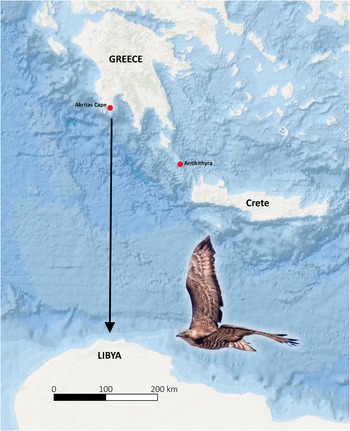
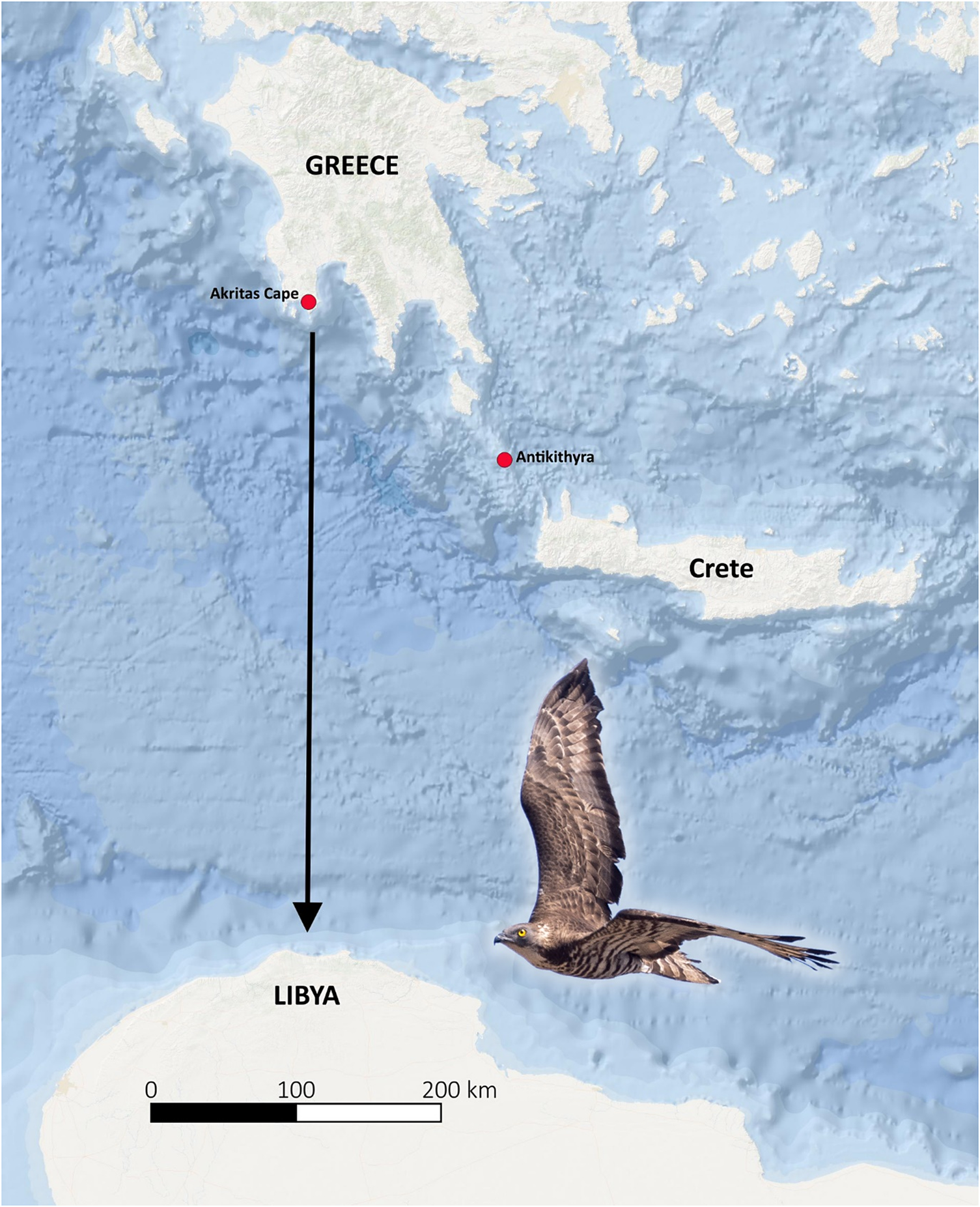
Several bird species, including mostly diurnal raptors, take advantage of the uplift generated by thermal currents to fly more efficiently. As such thermals develop mainly over land, during migrations these species follow flyways that minimise the crossing of large water-bodies (Newton Reference Newton2023). Europe is a hot spot of raptor diversity, including many long-distance full migratory species (Negro et al. Reference Negro, Rodríguez-Rodríguez, Rodríguez and Bildstein2022). During their migrations towards and from Africa, they must cross the Mediterranean Sea twice, the shape of which promotes the existence of different migratory hot spots, where raptors concentrate to cross the sea at its narrowest points. Some of these have been known for several decades, such as the Strait of Gibraltar, the Strait of Messina, and the Bosphorus (Panuccio et al. Reference Panuccio, Mellone and Agostini2021). However, the complex geography of the Mediterranean, shaped by prominent geographical features (i.e. the three large peninsulas), promotes a strong interspecific (Mellone Reference Mellone2020) and even intraspecific (Vansteelant and Agostini Reference Vansteelant, Agostini, Panuccio, Mellone and Agostini2021) variability. Over the last three decades, secondary migration hot spots have been discovered, including, for example, the islands between Sicily and Tunisia (Agostini et al. Reference Agostini, Premuda, Mellone, Panuccio, Logozzo and Bassi2004) and the island of Antikythira in Greece (Lucia et al. Reference Lucia, Agostini, Panuccio, Mellone, Chiatante and Tarini2011) (see Figure 1). Our aim was to verify the existence of another hot spot in the Balkan Peninsula used during the post-breeding migration by raptors crossing the Mediterranean on their way to Africa.
Location of Akritas Cape and route followed by European Honey Buzzards towards Libya.
Methods
Observations, aided by binoculars and a telescope, were conducted in the regional unit of Messenia (Peloponnese, Greece), on the peninsula extending to Akritas Cape, approximately 8 km inland from the southernmost tip, at 440 m a.s.l. (Figure 1; 36.788699N, 21.875669E). This peninsula forms the westernmost “toe” of the Peloponnese and features a hilly landscape, reaching a maximum altitude of 950 m a.s.l., predominantly covered by olive groves and Mediterranean shrubland, with small towns and villages sparsely distributed, but more concentrated on the eastern coast. During August/September, prevailing winds blow from the north and west, with southerly winds being infrequent. Data were collected from 20 August to 3 September 2024, between 08h00 and 16h00. Individual birds and flocks were tracked until they disappeared from view. To maintain a conservative approach, only birds heading south were included in the counts, excluding those showing different headings, as well as local birds.
Results
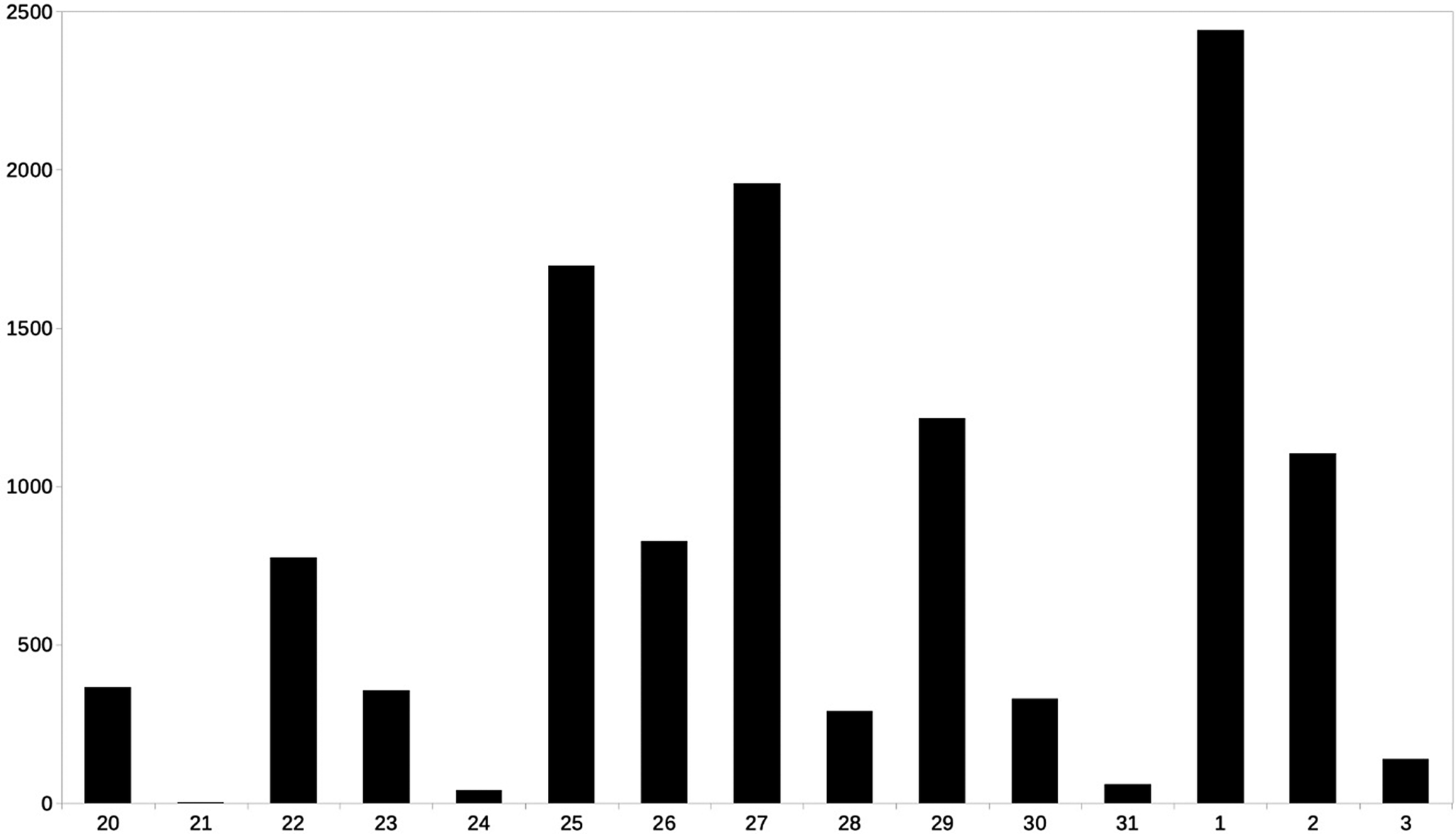
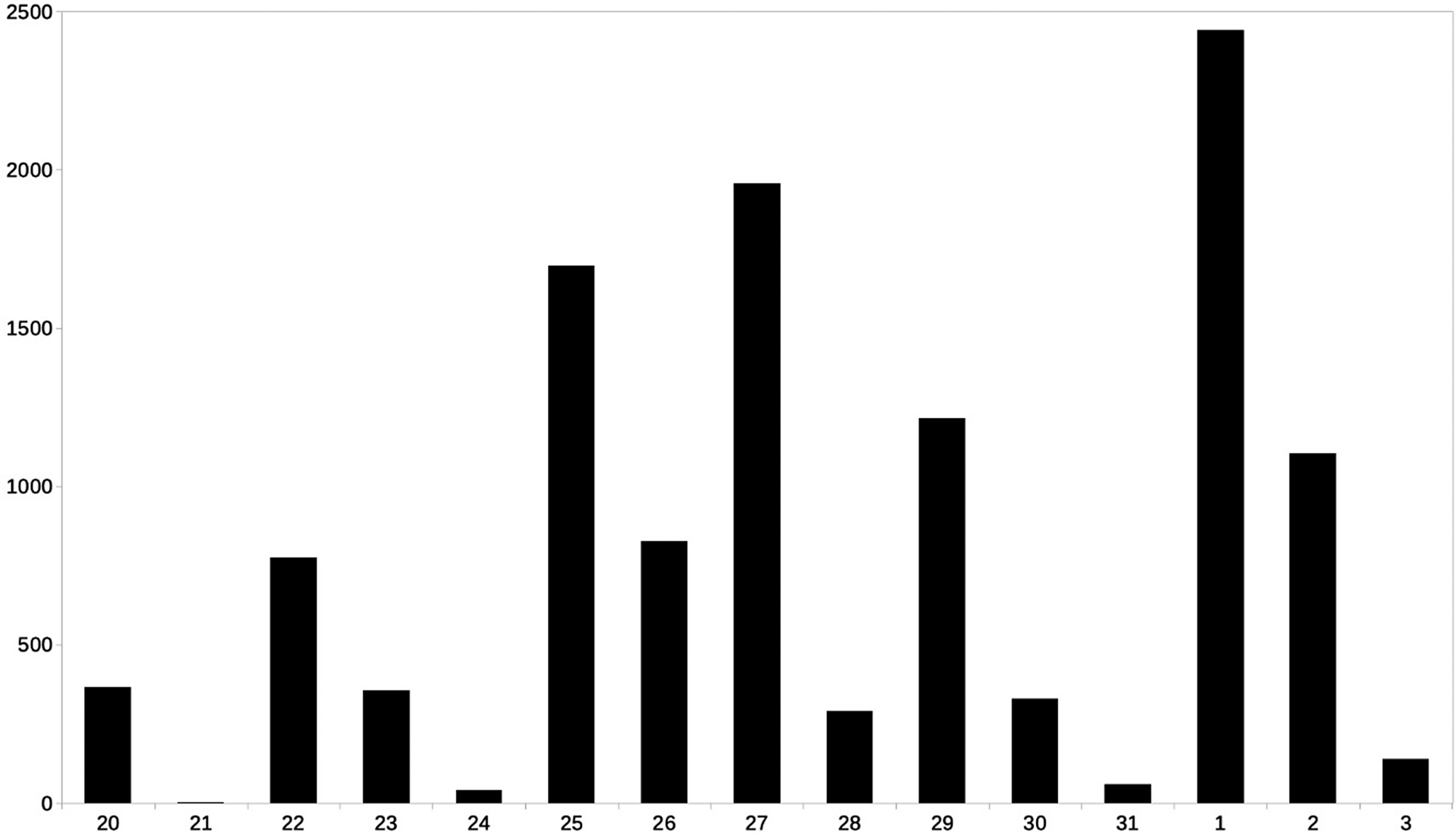
A total of 11,790 migrating raptors were observed, with the vast majority (11,606) being European Honey Buzzards Pernis apivorus. This was followed by 143 Black Kites Milvus migrans, 33 Western Marsh Harriers Circus aeruginosus, three Montagu’s Harriers Circus pygargus, and five Eurasian Sparrowhawks Accipiter nisus. The highest count of European Honey Buzzards was recorded on 1 September, with 2,441 individuals (Figure 2). Throughout the observation period, 93.3% of the counted European Honey Buzzards were recorded between 09h00 and 12h00.
Daily variation of European Honey Buzzards observed at Akritas Cape from 20 August to 3 September 2024.
Discussion
Our data revealed that Akritas Cape is located on one of the most important raptor flyways crossing the Mediterranean Sea, especially for European Honey Buzzards: during the post-breeding migration, an average of 57,259 individuals was counted in the Strait of Gibraltar between 2009 and 2012, and 17,232 individuals in the Strait of Messina between 2011 and 2015 (Vansteelant and Agostini Reference Vansteelant, Agostini, Panuccio, Mellone and Agostini2021 and references therein). Therefore, Akritas becomes, to the best of our knowledge, the third hot spot for the species in the Mediterranean basin, and the most important one in the Balkan region: fewer than 6,000 European Honey Buzzards per season have been reported in the Bosphorus (Panuccio et al. Reference Panuccio, Duchi, Lucia and Agostini2017), and on the island of Antikythira (Greece), located on a secondary, parallel flyway, an average of 2,796 European Honey Buzzards was counted between 2013 and 2024, with 3,055 individuals during the year of the present study (Hellenic Ornithological Society, unpublished data). These data suggest that Akritas should be considered as an Important Bird and Biodiversity Area (IBA) as it meets criteria B1.iv, being a soaring birds’ migration hot spot with more than 3,000 raptors (BirdLife International 2024). Therefore, despite our data being limited to a single field season, the observed numbers may remain significant, even when accounting for the typical yearly fluctuations recorded at raptor migration hot spots. Given the substantial increase in knowledge about raptor migration in Europe over the past 25 years (Panuccio et al. Reference Panuccio, Mellone and Agostini2021), it is remarkable that such an important site has remained unknown until now. Moreover, our study period did not include the peak of juvenile European Honey Buzzards, which should take place around mid-September, and also an important passage of Western Marsh Harriers may be expected in the same period (Bounas et al. Reference Bounas, Tsiopelas, Evangelidis and Barboutis2025): therefore, a longer study period, possibly entailing the use of other observation posts to ensure a better coverage of the migratory front, may increase the seasonal totals up to more than 15,000 individuals. Satellite tracking data from European Honey Buzzards breeding in Finland and Hungary (Vansteelant and Agostini Reference Vansteelant, Agostini, Panuccio, Mellone and Agostini2021; Agostini et al. Reference Agostini, Mellone, Tamas, Kalocsa, Váczi and dell’Omo2023) shed light on the breeding origin of the observed birds, spanning Eastern Europe to Finland, and confirm that they jump directly to Libya, in a sea-crossing of at least 420 km. Such a distance is possibly the longest one covered over water on a regular basis by adult European Honey Buzzards during their migrations.
Given the high numbers of raptors recorded at this site, the planned construction of a wind farm consisting of six wind turbines of 4MW capacity and a total height of c.180 m for each wind turbine (RAE 2025), is cause of concern, not only for the direct fatalities, but also because it could lead to the loss of functional habitat (Marques et al. Reference Marques, Santos, Hanssen, Muñoz, Onrubia and Wikelski2020). Such habitat is essential for gaining sufficient uplift to reach optimal altitudes, which are crucial for successful sea crossings (Santos et al. Reference Santos, Silva, Muñoz, Onrubia and Wikelski2020). Greece is currently experiencing a strong increase in the construction of wind farms (Kati et al. Reference Kati, Kassara, Vrontisi and Moustakas2021). The collision risk in a coastal area may be even higher than in other locations, as raptors may hesitate when approaching the water barrier, circling in the same area for a prolonged time, also within the altitude range of the turbines, before beginning their sea crossing. In some cases, we even observed European Honey Buzzards and Black Kites roosting in the shrublands around the planned wind farm. Cases like this highlight the need for the planning of wind farms to be carried out at a transnational level, as such projects may affect migratory bird populations breeding in multiple countries.
Acknowledgements
This research was funded by the GREEN FUND in the framework of the funding programme Natural Environment and Innovative Actions with the citizens 2023. This is contribution No. 44 from the Antikythira Bird Observatory, Hellenic Ornithological Society/BirdLife Greece.