

Indigenous people face significant barriers when they use state legal systems to pursue their rights and other forms of reparation. Litigation is nonetheless a “strategic anchorage” of the global Indigenous-rights movement (Sapignoli Reference Sapignoli2018, 247). A win in court can force compliance from a state and is a symbolic victory at the very heart of state institutional power. Indigenous people in Canada have used the courts to push the common law on Aboriginal title incrementally forward since the Nisga’a Tribal Council took their claim of un-surrendered title to the Supreme Court of Canada in 1973. However, as Canadian courts have elaborated on the presence and content of Aboriginal title, Indigenous litigants face a growing evidentiary burden when trying to prove it. The Nuchatlaht First Nation recently tried to meet this burden in a case they brought to the Supreme Court of British Columbia. Their case presents unique features in the use of evidence and arguments concerning Aboriginal title, partly because the Nuchatlaht brought no oral history evidence, they advanced a territorial approach to title and they relied heavily on one anthropological text based on research conducted in the 1930s. This case is also significant because it resulted in two reasons for judgment and the first partial finding of Aboriginal title by a British Columbia Court.
In this paper, I will examine the nature of the anthropological evidence presented in The Nuchatlaht v British Columbia and why it did not provide the court with what it needed to make a full declaration of title. In the process, I critique the requirements of the test for Aboriginal title in Canadian law. In Aboriginal rights and title litigation, ethnographic work written decades before a trial is sometimes brought into evidence and contemporary anthropologists are involved as expert witnesses to contextualize these sources for the court. Anthropology is well placed to bring culturally relative understandings of occupation and ownership to trial settings, but it is also burdened, with limitations linked to the conditions of its production and epistemological foundations. As a discipline, anthropology is more accustomed to ambiguity than law, which prioritizes facts and more certain truths. Scholars have argued that this epistemological incompatibility poses ethical challenges and weakens the overall value of anthropological evidence (Burke Reference Burke, Foblets, Goodale, Sapignoli and Zenker2020; Good Reference Good2008). Early ethnographies describing Indigenous peoples in North America are also the product of methodologies, classificatory schemes and theoretical frameworks, then current, but now outdated. While these are limitations, my argument below is not that anthropology as a form of knowledge fails as evidence because it is inevitably at odds with law or biased (Eltringham Reference Eltringham2013; Wilson Reference Wilson2005). There is no evidence that speaks for itself and all of what counts as evidence must be contextualized on the way to interpretation (Clarke Reference Clarke2020; Ray Reference Ray2011). While one of the challenges of this case was that there was not enough evidence of Nuchatlaht law in relation to their territory, I argue that much of the evidentiary challenge came from the test for Aboriginal title itself. The Supreme Court of Canada has stated that Aboriginal title is a unique legal concept that comprises both common law and Indigenous perspectives. Canadian courts’ continuing emphasis on a site-specific use and occupancy approach shows, however, that the test for Aboriginal title reflects common law concepts of property more than it reflects Indigenous law (McNeil Reference McNeil2012; Sanderson and Singh Reference Sanderson, Binashii and Singh2021).
Meeting the test: maps, exclusivity and inland areas
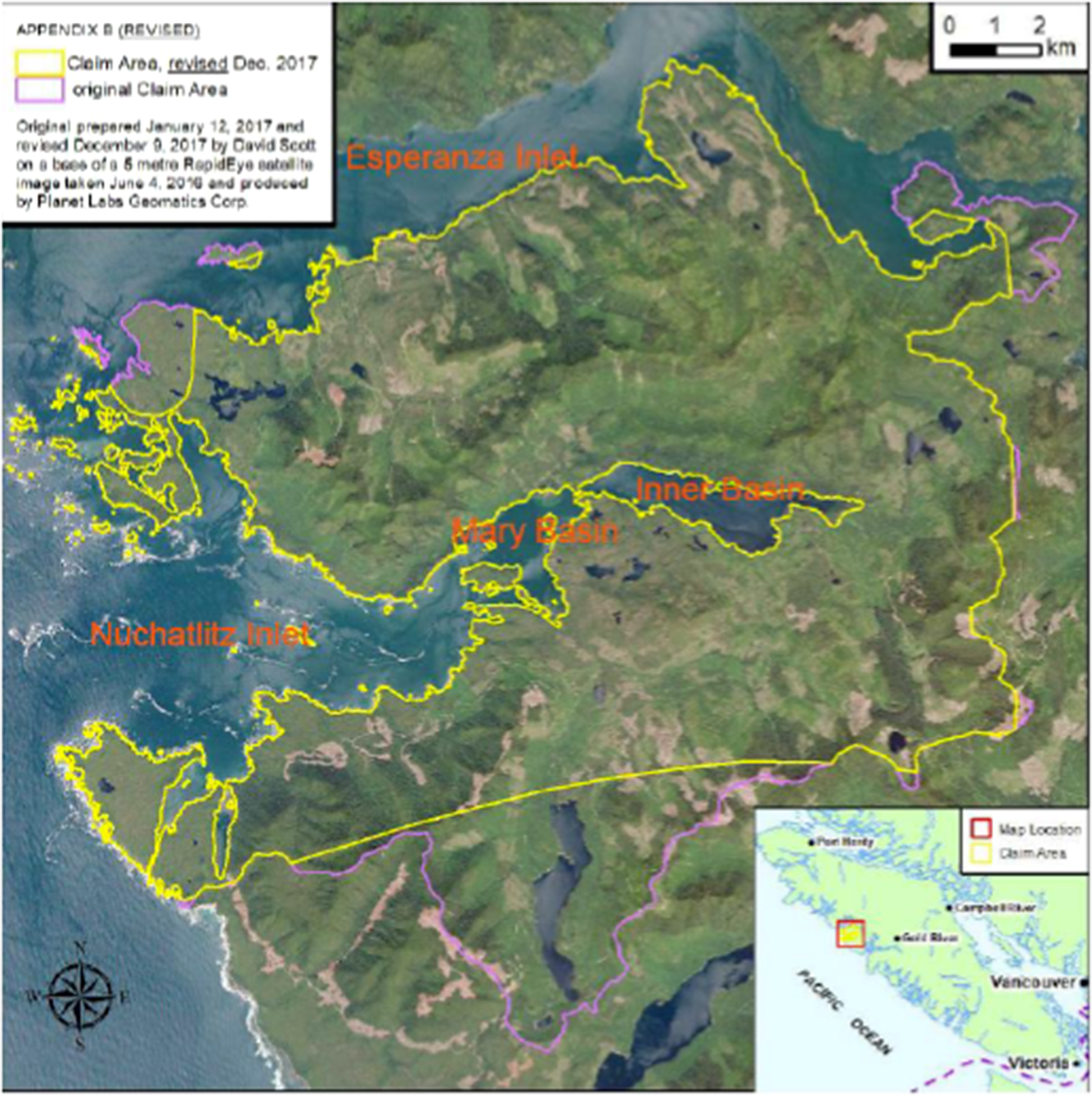
The Nuchatlaht claimed Aboriginal title to approximately 201 square kilometres of territory on the northern half of Nootka Island (Figure 1). The Nuchatlaht are part of the larger Nuu-chah-nulth Tribal Council and have lived on the west coast of Vancouver Island for thousands of years (Pegg Reference Pegg2000). They moved to Nootka Island from their historic village in Tahsis Inlet, to the north-east, in 1780. The defendant was the provincial government of British Columbia. The federal government was not involved as a defendant. When Justice Myers issued his ruling on May 11, 2023, the Nuchatlaht, their legal team and observers such as myself were disappointed to hear no declaration of title.Footnote 1 Myers ruled that there was insufficient proof of use and occupancy of the entire Claim Area by the plaintiff to meet the test for Aboriginal title in Canadian law. He also wrote that he could make a finding of title for smaller coastal sites but this would require further discussion with the plaintiff and defendant. The court reconvened for three days in March 2024 to hear arguments for specific, limited claim areas. On April 17, 2024, Myers issued a shorter ruling in which he found Aboriginal title for eleven square kilometres on the north-west tip of Nootka Island. I will refer to these as the 2023 and 2024 reasons for judgment.
Nuchatlaht Claim Area. Map from The Nuchatlaht v British Columbia, para 17.

Canadian courts have deliberated on the presence, content and evidentiary test for Aboriginal title for decades (Morse Reference Morse2017). This test was most recently articulated by Justice Henry Vickers in Tsilhqot’in 2007 and upheld unanimously by the Supreme Court of Canada in Tsilhqot’in 2014. Tsilhqot’in 2014 was a landmark ruling because it was the first time the Supreme Court of Canada issued a declaration of Aboriginal title covering specific territory—in this case, approximately 2,000 square kilometres in the interior of British Columbia. In his opening remarks on the first day of the Nuchatlaht trial, counsel Jack Woodward said the case at bar was an application of the Tsilhqot’in precedent.Footnote 2 Woodward was co-counsel for the Tsilhqot’in Nation and so had direct experience in the first successful Aboriginal title claim in Canada to date. He argued that his Nuchatlaht clients could meet the Tsilhqot’in test with enough evidence for the judge to make a declaration of title over the full Claim Area. In Canadian law, Aboriginal title is a sui generis form of property right (Sanderson and Singh Reference Sanderson, Binashii and Singh2021). It is sui generis because it is distinct from anything in the common law. Aboriginal title signifies the relationship between Crown title and preexisting Indigenous ownership, and is said to have crystallized—as a legal construct—at the moment the Crown asserted sovereignty in different parts of what is now Canada.Footnote 3 In Canadian law, Aboriginal title is distinguished from Aboriginal rights, which are more limited rights to harvest resources from specific lands or waters.
The test for Aboriginal title has three parts. The first requires the Aboriginal claimant to prove that they occupied the claimed area on and before 1846. As this is the year in which Britain and the United States made the Oregon Boundary Treaty establishing the 49th parallel boundary, it is the accepted date of asserted Crown sovereignty in BC. The second component of the test is that if present occupation is relied on as proof of occupation before 1846, then there must be continuity between present and pre-sovereignty occupation. For the third component, a plaintiff must prove that, in 1846, their occupation of the area was exclusive. For the second component, it is not necessary to prove continuity of occupation if exclusive occupation can be shown in 1846. This was important because the Nuchatlaht have not lived on Nootka Island since the late 1980s and Nootka Island has been heavily logged. Most of their members live in the village of Oclucje at the head of Espinosa Inlet.Footnote 4 Their written and oral arguments and evidence did not address continuity of occupation. Justice Myers acknowledged that the Nuchatlaht were seeking “to prove their occupation at the time of assertion of sovereignty from the historical record, as opposed to relying on continuity of occupation” (Nuchatlaht 2023, para 423). This meant that they had to meet a two-part test for Aboriginal title. They had to prove exclusivity of occupation and sufficiency of occupation.
The plaintiff’s evidence on exclusive and sufficient use and occupation relied extensively on the ethnographic work of Philip Drucker. They also used historical sources, including records from traders and explorers, and archaeological evidence of culturally modified trees and other occupation sites. They did not present oral history evidence. The Province also referred to Drucker in written and oral arguments, and their expert witnesses referred to Drucker along with historical sources to make an alternative opinion about the sufficiency of use and occupation. Philip Drucker was completing his PhD in anthropology at Berkeley in the 1930s when he conducted fieldwork with ten of the northern and central Nuu-chah-nulth First Nations.Footnote 5 His book, The Northern and Central Nootkan Tribes, was published in 1951 after his service in WW2. Sitting in the audience gallery in Courtroom 53, I was struck by my view of so many copies of Drucker’s ethnography in the hands of counsel on all sides, into which they would occasionally dip during the trial or breaks. In his introduction, Drucker explains that his goal was “an interpretation of social life and the functions of the social structure” of the Nuu-chah-nulth tribes (Reference Drucker1951, 2). He also settled on “the periods from 1870 to about 1900” as his ethnographic time horizon (Drucker Reference Drucker1951, 2–3). In the 1930s, the elders he spoke with could recall that far back and would have had parents whose cultural knowledge predated those years. This reference to his time horizon was important during the trial given the importance of the date of 1846. In over 450 pages, Drucker described material culture, subsistence practices, supernatural beliefs, social organization and kinship for the northern and central Nuu-chah-nulth as a whole. He also described their political organization in local groups that then formed tribal units and confederacies, and provided maps of their respective territories and village sites.Footnote 6 These maps varied in detail and Drucker commented that because of population decline—noticeable to him in the 1930s—it was sometimes difficult to “the trace the holdings of former days” (Reference Drucker1951, 248).
By any measure, Drucker’s work provided very strong support for the requirement of exclusivity. The test for Aboriginal title requires a First Nation to show that they had the intention and capacity to exclude others from their territory before and at the time of the assertion of Crown sovereignty in 1846.Footnote 7 Drucker wrote that the Nuu-chah-nulth
carried the concept of ownership to an incredible extreme. Not only rivers and fishing places close at hand, but the waters of the sea for miles offshore, the land, houses, carvings on a house post, the right to marry in a certain way or the right to omit parts of an ordinary marriage ceremony, names, songs, dances, medicines, and rituals, all were privately owned property. (Reference Drucker1951, 247)
Salmon streams were the most important property of chiefs, but also “inlets, bays, important fishing areas, houses, entire villages sites of the local group, or village sites of a tribe, or of a confederacy, would belong to the highest-ranking chief” (Drucker Reference Drucker1951, 251). The primary units of Nuu-chah-nulth political organization were patrilineally related local groups under the leadership of chiefs. Members of a local group could use resources in their chief’s territory under conditions that included waiting for the latter to open the season and sharing a portion of any harvests with the chief or whole community through a feast. People were allowed to use the chief’s territory only in ways that showed “public acknowledgement of the legitimacy of ownership” (Drucker Reference Drucker1951, 251). Drucker’s description of the Nuchatlaht system of territorial rights was presented as strong evidence to the court for the concept of property and exclusivity. However, while Drucker characterized property rights as economic and ceremonial, he did not characterize them as legal (Reference Drucker1951). This was not unusual for the time in which Drucker was writing. If he had, then the plaintiff may have had more material to support their argument for a territorial approach to title, to which I return below.
Traders and explorers also remarked on exclusive property rights and their enforcement among the Nuu-chah-nulth. The historical record and Drucker’s descriptions supported each other on this point. In 1778, Captain James Cook sailed into Nootka Sound near the Mowachaht village of Yuqout while he was searching for the Northwest Passage (Berg Reference Berg2023). Nootka Sound is on the south-west corner of Nootka Island and the Mowachaht are the southern neighbours of the Nuchatlaht. Cook wrote that he had nowhere “met with Indians who had such high notions of everything the Country produced being their exclusive property as these” (Written Argument of the Plaintiff, para 936). One of Cook’s officers observed that “no people had higher Ideas of exclusive property” and described how Mowachaht individuals made Captain Cook pay for the grass that his men had cut for their livestock (Written Argument of the Plaintiff, para 937). Eight years later, the trader Alexander Walker visited Nootka Sound and wrote that the Mowachaht prevented them from touching shells on the beach, saying that “their jealousy of the rights of property was excessive and extended to every object” (Written Argument of the Plaintiff, para 938). The Province’s main expert witness, Dr Lovesik, did not highlight these comments from Drucker or the historical record. Instead, she drew on other historical sources to argue that the Nuchatlaht were small and weak, and in a tributary relationship with the stronger Mowachaht Nation to their south. Because of this, she argued, they did not have the capacity to exclude others from their territory even if they wanted to. Justice Myers accepted that the Nuchatlaht had a concept of property ownership that was equal to or greater than in the common law and that this included an expectation of exclusivity (Nuchatlaht 2023, paras 487, 488). Myers also accepted the Nuchatlaht as a whole were the proper collective to whom the communal right of Aboriginal title should belong.
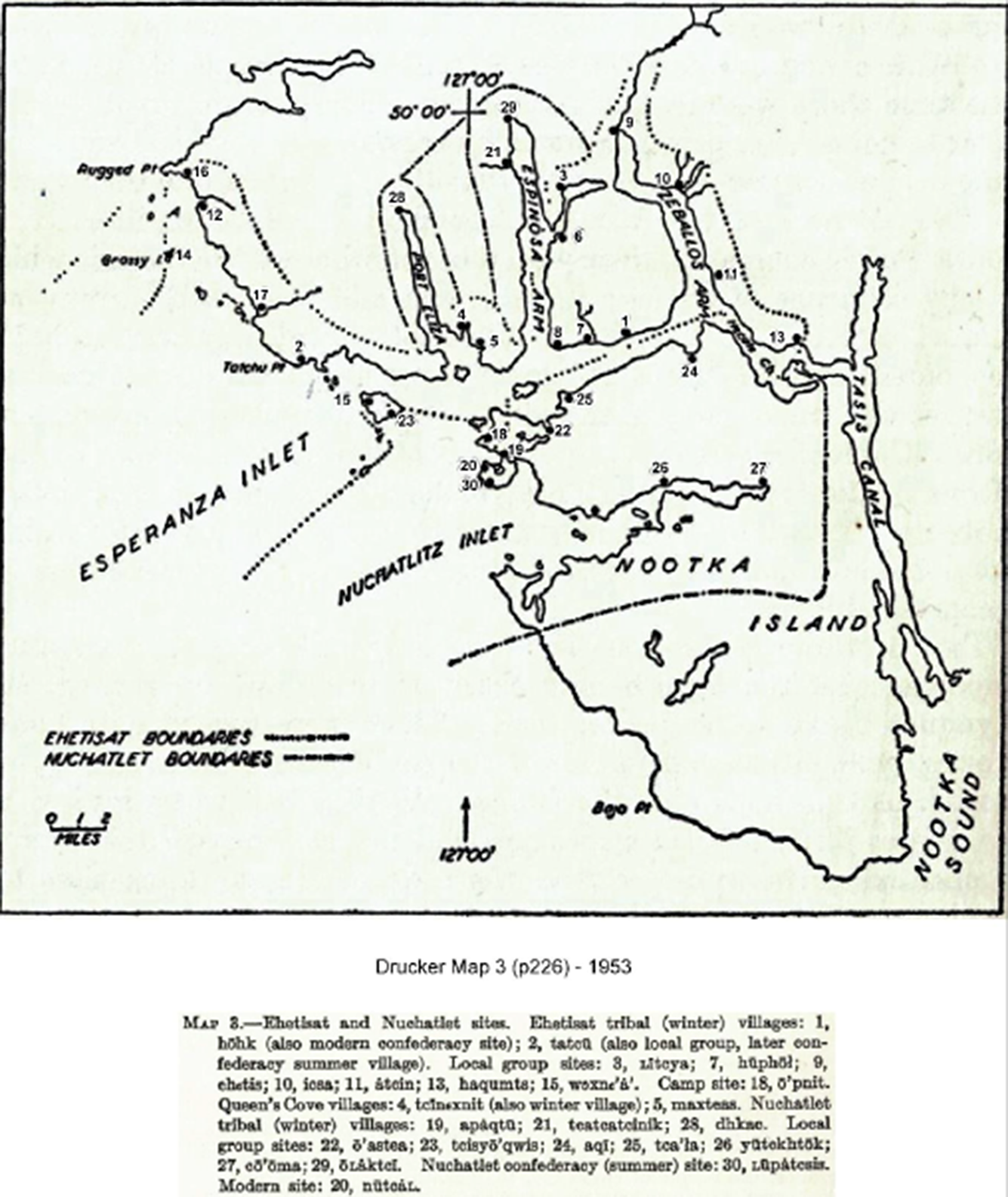
The plaintiff’s lawyers also relied on Drucker for the map of the Claim Area. On the first day of the trial, I watched as Map 3 of Drucker’s ethnography was introduced as evidence to the court (Figure 2). Counsel Jack Woodward explained that the Nuchatlaht Claim Area followed the basic outline of Drucker’s Map 3 with some exceptions. For legal simplicity, their claim did not include submerged areas, existing fee simple sites or existing Indian reserves.Footnote 8 The Nuchatlaht also shrunk their claim to avoid any territorial overlaps with their neighbouring nations on Nootka Island or adjacent parts of Vancouver Island. The accuracy of Drucker’s Map, with the dot–dash line across Nootka Island, became a major issue in this trial. The Province seized on where Drucker drew the line. They argued that his line was a rough estimate and not an accurate depiction of territorial boundaries. Their expert witness suggested that Drucker used the northern boundary line that he had acquired from the Mowachaht—where he spent more time and gathered more information—to serve as the southern boundary for the Nuchatlaht. The Province’s lawyers argued that the northern boundary of the Mowachaht cannot be assumed to be the southern boundary of the Nuchatlaht and that Drucker did not get information from any actual Nuchatlaht people about it. They said that, if there was a gap between these boundaries, then this meant an area potentially not part of Nuchatlaht territory and not subject to Aboriginal title. This was key to the Province’s argument that there may have been unoccupied tracts of land where Crown title is not encumbered with Aboriginal title.
Drucker’s Map 3. The dot–dash line can be seen across the island and upwards. Map from The Nuchatlaht v British Columbia, para 144.
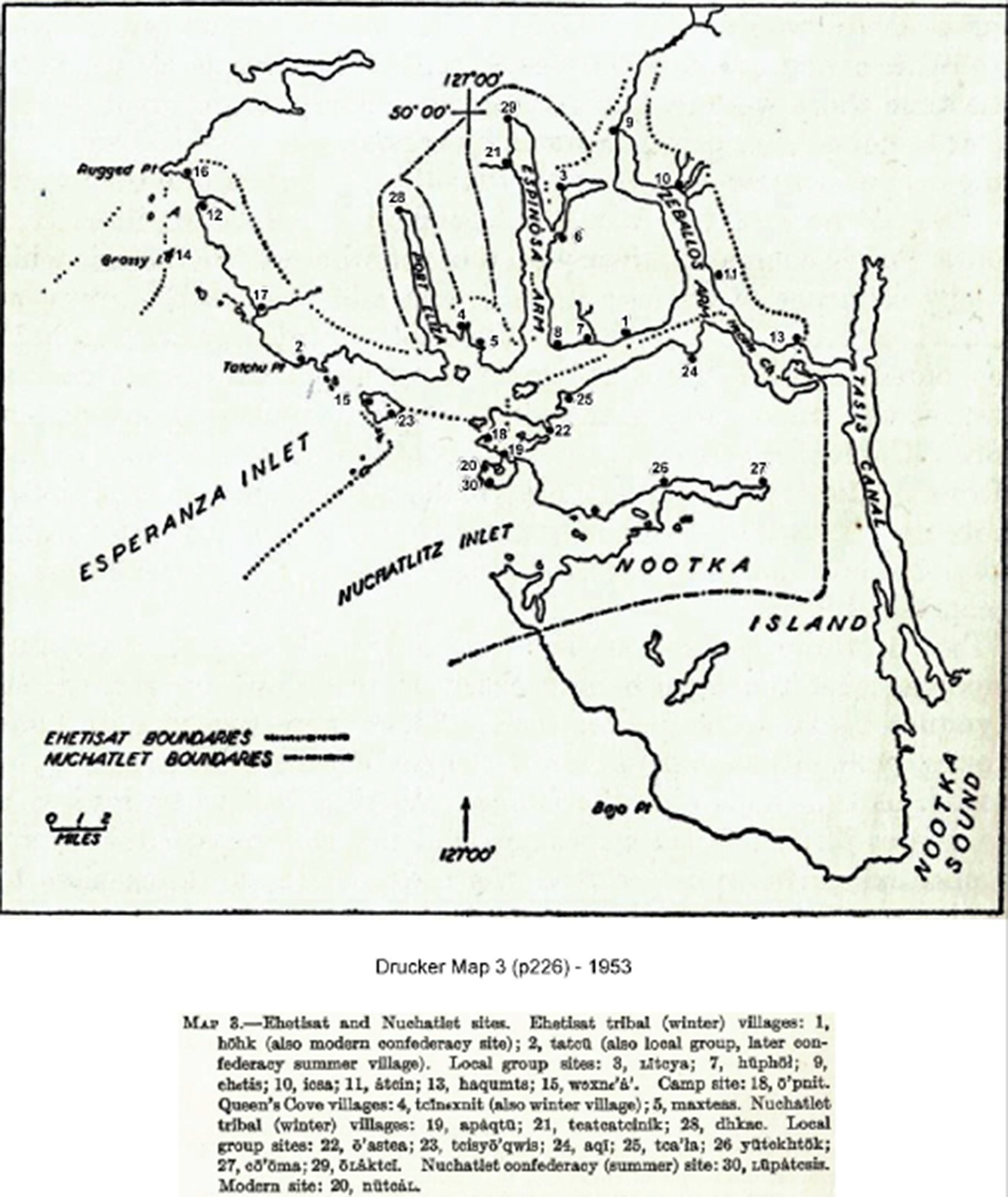
Drucker did do more research with the Mowachaht. He spent more time in his book on the territorial holdings of Mowachaht chiefs and included maps and descriptions of territories of these chiefs along the coast. He did not provide this kind of detail for the Nuchatlaht. He wrote that the first chiefs of the Mowachaht
owned the waters along the outer coast of (except where cut by smaller claims) the southeast tip of Nootka Island and adjacent waters, and inland to the watershed of Nuchatlitz Inlet. This inland boundary, charted by a zigzag line, was rather vaguely defined, but those along the beaches were precise, located by natural landmarks. (Drucker Reference Drucker1951, 248)
At trial, the plaintiff’s lawyers explained that Drucker’s field notes include a draft map of Nootka Island on which he had drawn the boundary separating Nuchatlaht and Mowachaht territory with a zigzag line. This line represented the range of mountains across the island separating the north and south drainages. On Map 3 in Drucker’s final text, he replaces this zigzag line with a dot–dash line that was meant to show the “boundary as the height of land along the southern edge of the Nuchatlaht Inlet watershed” (Written Argument of the Plaintiff, para 850). The plaintiff argued that the “somewhat vague straightness of the line” can be explained by Drucker not knowing precisely where the height of land was (Written Argument of the Plaintiff, para 850).
Making maps of tribal boundaries was standard ethnographic practice for most of the twentieth century (Thom Reference Thom2009). Mapmaking reflects time periods, purpose, worldviews and available technology. Drucker was constrained by availability of information and time. In the 1930s, he found that information about specific territories was not readily available because, with “the decline of population during historic times many of the property rights have been merged, so that it becomes difficult to trace the various holdings of former days” (Drucker Reference Drucker1951, 248). Map 3 in Drucker’s book is not topographic and his line is an approximation of the height of land on a flat map of Nootka Island. Drucker was not necessarily wrong to find that the inland boundary was not forefront in the minds of his Nuchatlaht and Mowachaht informants as much as the coastal boundaries but this does not mean that it did not exist. In courts and land-claims negotiations, First Nations are often expected to demonstrate and attest to precise boundaries around a territory that can be reproduced on a map. This is an externally imposed expectation that is not always reflective of Indigenous territorial practice and management (Anker Reference Anker2018). Boundaries may be well defined but also have permeability in the case of kinship relationships and tribal alliances that permit travel and resource sharing across a social and political landscape (Thom Reference Thom2009). These landscapes overlay physical landscapes in ways that are not easy to reproduce on two-dimensional maps or explain in languages of exclusivity.
With Drucker’s Map as a territorial outline, the plaintiff tried to prove sufficient use and occupation of the claimed area at 1846. For this, they turned to archaeological evidence and particularly evidence of culturally modified trees. Drucker’s work was less central to these arguments and at times detrimental, as I show below. The test of sufficient use and occupancy is plagued with interpretive difficulties around the meaning of “sufficient,” not to mention “use.” In Tsilhqot’in 2014, the Supreme Court of Canada clarified that “regular” use was enough and that this did not require permanent village sites or agriculture. Justice McLachlin, writing for the majority, stated that
there is no suggestion in the jurisprudence or scholarship that Aboriginal title is confined to specific village sites or farms, as the Court of Appeal held. Rather, a culturally sensitive approach suggests that the regular use of territories for hunting, fishing, trapping and foraging is ‘sufficient’ use to ground Aboriginal title. (Tsilhqot’in 2014, para 42)
This meant that Indigenous people who lived by hunting, gathering and fishing over large territories should not be at a disadvantage when asserting Aboriginal title.
The Nuu-chah-nulth are a marine-oriented people but their material culture and technology depended almost entirely on wood. Their reliance on red and yellow cedar cannot be overstated. Drucker was eloquent on this point, writing that
Products of red cedar bark and yellow cedar bark were used in almost all aspects of Nootkan life. One could almost describe the culture in terms of them. From the time the newborn infant’s body was dried with wisps of shredded cedar bark, and he was laid in a cradle padded with the same material and his head was flattened by a roll of it, he used articles of these materials every day of his life, until he was finally rolled up in an old cedar-bark mat for burial. (Reference Drucker1951, 93)
Every material object, such as utensils, clothing, fishing nets and building materials for large houses, would have a corresponding bark scar in the forest. The plaintiff argued that the culturally modified tree record in the Claim Area showed exactly this sort of “‘regular use’ for resource exploitation that the Court in Tsilhqot’in alluded to” (Written Argument of the Plaintiff, para 872). They argued that
forest resources, especially cedar bark, were vital resources that formed the material basis for Nuu-chah-nulth culture. Trees and tree bark were harvested in enormous quantities throughout Nuu-chah-nulth territories, including the Claim Area. A unique record of this intensive resource exploitation can be seen today in the forest of the Claim Area on Nootka Island—culturally modified trees, or CMTS, bearing the marks of centuries of Nuchatlaht forestry practices. (Written Argument of the Plaintiff, para 872)
CMTs are any tree that shows the marks of cultural use, including bark-stripping scars, planking and canoe blanks.Footnote 9 These marks can be dated by using dendrochronology methods (Earnshaw Reference Earnshaw2017). The plaintiff had two expert witnesses who submitted reports and gave testimony on the presence and significance of CMT sites. These were John Dewhirst, who also wrote the main cultural and historical report for the Nuchatlaht, and Jacob Earnshaw. The Province had their own expert archaeologist who made different arguments about the evidentiary usefulness of CMTs in the Claim Area. During the trial, Jack Woodward asked Mr Dewhirst who had most likely made the CMTs on Nootka Island. This is a significant question because there is nothing specific about these modifications to show harvesting by one group or another. Dewhirst answered this question by saying that the CMT sites in the Claim Area showed multiple harvesting dates on separate trees as well as harvesting of different resources at the same site. He argued that this showed long-term use and repeat visits over many years. Dewhirst emphasized that this required a long-term resident population with knowledge of the sites and the only population known to inhabit this part of Nootka Island is the Nuchatlaht.
Jacob Earnshaw’s evidence focused on the locations, dates and numbers of CMTs. Earnshaw is a consulting archaeologist and has previously published on CMTs on the west coast of Vancouver Island (Earnshaw Reference Earnshaw2017; Reference Earnshaw2019). He told the court that the archaeological record in the Claim Area is incomplete and much of what would be evidence has been destroyed by logging. In fact, only about 5 percent of Nootka Island has been archaeologically surveyed. Mr Earnshaw’s reports were based on a reconnaissance survey (he did not have a permit to take samples) including one inland survey. He reported on ninety-three CMT sites in the Claim Area and argued that, in already-recorded sites, the tapered bark scars had been undercounted. He dated harvesting at these sites from 1541 to 1969. Because it was accepted by all parties that the Nuchatlaht had moved to Nootka Island in the 1780s, any dates before this were not relevant. All but one of the sites discussed by Earnshaw were near or in coastal areas. The furthest inland site was 2.95 kilometres from the shoreline. Earnshaw’s inland survey was approximately five kilometres inland but it did not produce any CMT findings. He argued, however, based on predictive modelling, that the un-surveyed portions of the Claim Area would have more CMTs and that the entire Claim Area would have been extensively used.
The Province argued that Earnshaw’s modelling about inland areas was speculative and could not be used to prove actual CMTs inland or provide anything conclusive about the possible dates. They noted that his examination of the Claim Area was not random, but focused on existing sites and one survey. Their expert—Morley Eldridge—was also a Northwest Coast specialist with expertise in CMTs. He argued that anyone could have made the CMTs in the Claim Area, suggesting the neighbouring Ehattisaht or Mowachaht could have done so. The plaintiff rebutted this suggestion and Myers dismissed the possibility in his ruling. Justice Myers was not satisfied, however, with Earnshaw’s opinion that there would be CMTs throughout the inland Claim Area. He said it was based on a predictive model that was speculative and could not be used to prove the existence of CMTs, much less their dates. Myers wrote that Earnshaw “has not provided evidence that allows for the inferences to be drawn and his opinion is speculative” (Nuchatlaht 2023, para 334). He said that, even if the court accepted the modelling, there is no way to know whether the dates would fall in the relevant date range of between the 1780s and 1846 (Nuchatlaht 2023, para 332). He noted that Earnshaw’s report showed only one site inland at 2.95 kilometres from the coast and that, at this site, only six of seventy-one CMTs predated 1846 (Nuchatlaht 2023, para 463).
The CMT evidence foundered on numbers, probabilities and Myers’s dissatisfaction with Earnshaw’s predictive model. Myers said that six pre-1846 CMTs in a site of seventy-one was not enough but it is not clear in his reasons what number, proportionately, would have been. The Claim Area is significantly under-surveyed. Evidence that might have been useful was not available because it had either not been counted or was destroyed by logging. This diminished record is part and parcel of the Nuchatlaht’s displacement and made it harder for them to provide evidence to supplement a larger conceptual model of Nuchatlaht land tenure. The provincial government also weakened the CMT evidence by combining their criticisms of the plaintiff’s archaeological evidence with particular statements from Drucker. At the beginning of his book, Drucker described the geography, climate, flora and fauna of the northern and central coast of Vancouver Island. He said that, viewed from the water, the forest is “an impenetrable mantle over the irregular surface of the land” (Drucker Reference Drucker1951, 8). On shore, after one
finally breaks through the luxurious growth along the margin, he finds himself in a dark, gloomy moss-covered world. Huge trunks rise straight and branchless, the crowns forming a high canopy almost impervious to sunlight. […] Fallen timber—ranging from saplings that gave up the struggle to forest giants six and more feet through—hinder one’s passage, for much of the wood, particularly the red and yellow cedar, rots but slowly. (Drucker Reference Drucker1951, 8)
He described crawling over and under windfalls, and compared travel through the woods to the obstacle courses used in military training. Given this, he wrote that “it is scarcely to be wondered at” that the Indigenous population “frequented the woods but little” (Drucker Reference Drucker1951, 9). This is a mischaracterization that likely tells us more about Drucker’s preconceptions than the forest use of the Nuu-chah-nulth. He also described the difference between peoples’ knowledge of the coastal areas versus inland areas, writing that the Nuu-chah-nulth had a “minute knowledge of the alongshore and foreshore, and unfamiliarity of the interior” (Drucker Reference Drucker1951, 151). He described their subsistence and economic activities as almost entirely marine-oriented and the men, he said, “did not learn to be good woodsmen and land hunters” (Drucker Reference Drucker1951, 60).
Drucker’s comment about infrequent use of the woods ricocheted around this trial with a negative effect. The Province linked it with a comment Drucker made about inland areas, when he wrote that “all the territory, except for remote inland areas, was regarded as the property of certain chiefs” (Reference Drucker1951, 248). The plaintiff’s lawyers and experts argued that this comment should not be given weight. Here, as in much of this trial, the opposing sides referred to much of the same material but highlighted or diminished different aspects of it. This is an interpretative task on the way to drawing out facts, confirming that evidence does not “speak for itself” (Clarke Reference Clarke2020, 585). Expert witness John Dewhirst argued that Drucker’s comments about remote inland areas did not apply to Nootka Island, but rather to the deeper and higher land masses of Vancouver Island. This is a fair point because Drucker’s description was not of Nootka Island specifically, but of the west coast of Vancouver Island generally. Nootka Island is small and has much less interior area. The plaintiff argued appropriately that the term “remote” is relative and the majority of evidence points to the ownership of everything in Nuu-chah-nulth society. As they said, “given that the Nuu-chah-nulth regarded nearly all property as exclusively owned by chiefs, it is difficult to conclude that the inland areas of Nootka Sound were not owned or claimed, as the presence of CMTs attest to inland use of resources” (Written Argument of the Plaintiff, para 854). Dewhirst also suggested that people on Nootka Island accessed inland areas alongside stream beds because that would be easier than clambering through the forest.Footnote 10
Drucker’s methodological and theoretical lens and his cultural location as an early to mid-twentieth-century resident of Chicago and then California need to be taken into consideration in any assessment of his ethnography. For Drucker, the forests of the west coast of Vancouver Island likely did seem impenetrable, but Drucker was writing this as a first impression and without long-term research and observation (Earnshaw Reference Earnshaw2017). Drucker interviewed key informants who represented different tribal units of the Nuu-chah-nulth, moving from place to place along the coast as he did so. He obtained technical information on the practice of cedar-bark stripping and the uses of cedar but did not do participant fieldwork that would have involved going with people into the forest to harvest bark and other products. When the coastal forest is viewed from an approaching ship, which is how Drucker travelled, the trees appear to stretch from shore to mountain but patchier and less dense areas often lie behind (Eldridge Reference Eldridge2017). Importantly, Drucker’s training would not have included what we now know about forests as intensively used and culturally shaped by Indigenous people. The challenge of using historical ethnography, or any ethnography, is that Drucker’s methods produced knowledge about some topics but foreclosed other insights. Facts are not easily drawn from this material in absolute terms. Drucker’s impressions of the dark and impenetrable forest echo long-standing Euro-American descriptions of forests as wild places that are unused and lying waste (Earnshaw Reference Earnshaw2017). We have only recently begun to understand how managed the coastal forests have been. The forests along the west coast of Vancouver Island were cultural forests that “were carefully managed to maximize harvesting” for large Indigenous populations (Earnshaw Reference Earnshaw2017, 6).
It is here with these difficulties of proving use and occupancy that the territorial approach to Aboriginal title becomes so important. A territorial approach begins with a territory to which the First Nation asserts rights and title. This is one reason why the plaintiff began the trial with a map. A territorial approach to Aboriginal title is based on Indigenous law. It expresses Indigenous legal authority over a territory and has governmental dimensions beyond what is contained in the common law notion of property (McNeil Reference McNeil2012). The Supreme Court has stated that Aboriginal title should be a combination of the common law and Indigenous perspectives (Sanderson and Singh Reference Sanderson, Binashii and Singh2021). The test for Aboriginal title, however, reflects features of the common law of property more than Indigenous law—requiring proof of occupation and a Lockean emphasis linking property rights with investment of labour on the land. Indigenous people do not just use isolated bits of land; they have governmental authority over the entirety of a territory that includes rights to different kinds of resources (McNeil Reference McNeil2012). This is why, at the end of the trial, Jack Woodward said that “it’s about a people who have a territory” (author’s notes, March 16, 2023).
A site-specific approach to Aboriginal title, in comparison, requires a First Nation to prove regular use of specific areas within a territory. It is based on the premise that Aboriginal title involves a group of people filling up and occupying a bounded space (Anker Reference Anker2018, 9). The site-specific approach is reflected in traditional use and occupancy maps in which sites are “plotted as dots, lines, and polygons” (McIlwraith and Cormier Reference McIlwraith and Cormier2015, 37). These maps are often produced for land-claims negotiations or impact-assessment studies. A misleading effect of such maps is that the empty spaces in between the dots look unused (McIlwraith and Cormier Reference McIlwraith and Cormier2015). To move away from the site-specific approach is to appreciate that Indigenous landscapes are not made up of isolated pieces, but that all sites are connected to a “larger, culturally meaningful territory” (McIlwraith and Cormier Reference McIlwraith and Cormier2015, 49). The use-and-occupation approach also focuses on things like village sites and harvesting locations but pays less attention to spirituality or the cultural meaning of landscapes (Booth and Skelton Reference Booth and Norm2011).
Reading between the lines of maps, historical documents and ethnographic texts is critical for fleshing out these wider spaces. At the beginning of a section on the supernatural, Drucker (Reference Drucker1951, 151) described the Nuu-chah-nulth’s “pilot knowledge” of the coast. He also wrote that for
most of them, mountains were objects to be lined up in ranges to locate offshore points rather than localities to be traversed and known intimately. It is consistent that the woods and mountains were thought to be populated by vast numbers of dangerous and horrendous supernatural beings, where the sea contained fewer and less malignant spirits. (Drucker Reference Drucker1951, 151)
The Province used this statement in their written argument about lack of use and occupation of the inland areas, and this part of Drucker’s work also came up in oral arguments.Footnote 11 This statement could be read differently, however. Drucker’s description tells us that inland areas were inhabited by beings within Nuu-chah-nulth cosmology. Drucker himself describes supernatural entities living in the mountains, including Thunderbird—one of the most important figures in Nuu-chah-nulth cosmology—who lived “up amid the remote snow-covered peaks” (Reference Drucker1951, 151). Nuu-chah-nulth author and hereditary chief Richard Atleo also tells the tale of Aulth-ma-quus, who was a giant woman who stole children. She is described as having a “great house in the mountains” (Atleo Reference Atleo2005, 24). The Nuu-chah-nulth culture hero Aint-tin-mit followed her into the mountains and rescued the stolen children.Footnote 12 Atleo explains that “supernatural experiences are necessary for effective management of reality” (Reference Atleo2005, 72). These are just two examples, but the point is that mythological relationships make Indigenous territory as much as fishing and CMT sites (Thom Reference Thom2009). They create culturally understood and culturally inhabited space. The mountains were not empty, but were the dwelling space of supernatural beings.
The site-specific approach reflects a common law notion of property in which use and occupation confer possession. This approach has dominated Canadian jurisprudence on Aboriginal title for years, although recent cases have moved the discussion slightly forward on what counts as sufficient use and occupation. In Tsilhqot’in 2007, Justice Vickers accepted that sufficiency of occupation did not require “intensive” use, but rather “regular” use. When Tsilhqot’in went to the BC Court of Appeal, the Appeal Court turned this around and reinforced a strict site-specific approach to title requiring intensive use of specific places like fishing sites (Rosenberg and Woodward Reference Rosenberg and Woodward2015). This is known as the postage-stamp approach. In Tsilhqot’in 2014, the Supreme Court of Canada in turn reevaluated what “sufficient” use and occupation meant, and accepted that they did not have to be intensive. The court wrote some flexibility into the definition of sufficiency, saying: “Occupation sufficient to ground Aboriginal title is not confined to specific sites of settlement but extends to tracts of land that were regularly used for hunting, fishing or otherwise exploiting resources and over which the group exercised effective control at the time of assertion of European sovereignty” (Tsilhqot’in 2014, para 50).
This, however, is what Myers said he could not find in the evidence. In his 2023 ruling, he wrote “the problem here is that evidence of this type of use and control and concept of ownership is absent for most of the Claim Area” (Nuchatlaht 2023, para 482). He commented that use and occupation may be difficult to show for a coastal First Nation that has a strong orientation toward marine resources, but nonetheless wanted more evidence in order to support a finding of title for the areas beyond coastal sites. He wrote that “the only direct evidence of specific area usage or occupation identifiable to the Nuchatlaht” were the village sites:
What little evidence there was indicated that the Nuchatlaht travelled between their villages by canoe. As I said earlier, the creators of CMTs and archaeological sites could only be inferred from occupation of the adjacent areas. Further, there was no evidence before me of fishing sites separate from the settlement sites or, for that matter, how the Nuchatlaht or Nuu-chah-nulth fished. (Nuchatlaht 2023, para 436)
About the coastal areas, he said “there are too many gaps” to conclude
that the whole coastal area was sufficiently occupied or used in a manner to constitute occupation. Other than the villages and camps, I have no evidence of specific coastal use. Nor do I have any evidence of Nuchatlaht (or Nuu-chah-nulth) fishing practices, other than the coastal round which involved moving from one established settlement or camp to another. (Nuchatlaht 2023, para 482b)
Continuing, he wrote that there was
no evidence of the territory of any local chief’s hahoulthle beyond the village sites which may be inferred as being in the relevant local Chief’s hahoulthle. While I have concluded that the Nuchatlaht is the rights holder to the territories of the former Nuchatlaht local groups, that cannot expand the title to include lands which were not sufficiently occupied to meet the current test of Aboriginal title. (Nuchatlaht 2023, para 483)
Myers acknowledged that the plaintiff was submitting a territorial claim and that they
approached this case in a ‘top down’ fashion i.e., beginning with the ‘tract of land’, the area that was mutually understood by Nuchatlaht and its neighbours to be Nuchatlaht-owned territory in 1846, and then turning to other evidence to fill in the picture of what was going on within that area at the time. (Nuchatlaht 2023, para 439)
As he said, the purpose of this evidence “is not to map out the specific areas that the Nuchatlaht used, but to show that the Nuchatlaht’s territorial assertions to the area in 1846 were not ‘purely subjective or internal’”; rather, the plaintiff’s evidence was intended to support “the inference on a balance of probabilities that in 1846 the Claim Area taken as a whole was ‘regularly used’ and was under the ‘effective control’ of the Nuchatlaht” (Nuchatlaht 2023, para 439).
Still, his view was that evidence of a boundary by itself was insufficient. He did not think “that a territorial boundary, even if recognized by others, is enough to show sufficient occupation on its own” (Nuchatlaht 2023, para 443). Myers wanted more evidence of use and occupation particularly because he was unsatisfied with Drucker’s work. He wrote:
Dr. Drucker’s evidence of the boundaries only goes so far. It does not assist in distinguishing between uses of the land which are amenable to Aboriginal rights as opposed to title […]. I do not think Dr. Drucker’s notation of the boundary can by itself establish sufficient use of or occupation of the total Claim Area as is required in the test for Aboriginal Title. (Nuchatlaht 2023, para 444)
He added that “whether this be called a territorial claim or not, I do not think that Dr. Drucker’s boundary can fill the evidentiary gap” (Nuchatlaht 2023, para 485).
Meeting the test: oral history
It may come as a surprise that the plaintiff did not bring forward oral history evidence. The legal team argued this was not necessary because they had enough evidence from other sources to meet the Aboriginal title test. On day one of the trial, Jack Woodward said that the Tsilhqot’in 2014 ruling clarified this test and that the necessary evidence could be met by drawing on historical, anthropological and archaeological sources. He contrasted the approach they took during Tsilhqot’in 2007, in which many elders testified about their lived practices of land use and gave oral history evidence, with the approach that he would take in this trial. He said that “when the Tsilhqot’in case was at trial, the test for Aboriginal title was not yet clear. We didn’t have the Supreme Court of Canada’s decision of 2014” (Unofficial Trial Transcript, March 21, 2022). The “legal test is now settled, and proof of repetitive use of the land by living people is not part of the test” (Unofficial Trial Transcript, March 21, 2022). Second, he said:
in the Tsilhqot’in case, the plaintiff called oral history evidence to prove facts beyond the memory of living persons. In the Tsilhqot’in case, as in the case at bar, there is nobody alive who can testify as to exclusive possession in 1846; however, one method of proof is a form of reputation evidence known as oral history (Unofficial Trial Transcript, March 21, 2022).
He said that, while, in Tsilhqot’in, witnesses gave oral history evidence, “the plaintiff in the case at bar does not intend to lead oral history evidence to prove facts beyond living memory” (Unofficial Trial Transcript, March 21, 2022). He explained that the community was not able to provide people to do this. The plaintiff instead relied on the two expert witnesses that I have previously mentioned, both of whom were consulting archaeologists with training in anthropology.
In 1997, the Supreme Court of Canada ruled in Delgamuukw that oral history evidence was admissible in court “on an equal footing with the types of historical evidence that courts are familiar with” (Delgamuukw 1997, para 87). The Delgamuukw decision broke new ground by removing oral histories from the category of hearsay. In doing this, the Supreme Court signalled an understanding that Indigenous people are disadvantaged in the legal system if their main form of knowledge cannot be given equal consideration with other evidence (Miller Reference Miller2011). The presentation and reception of oral history in courts remain challenging, however (Miller Reference Miller2011; Napoleon Reference Napoleon2005). Oral history evidence and the people who give it are subject to cross-examination that can fragment their histories and be emotionally draining (Napoleon Reference Napoleon2005). Bringing oral history evidence also takes a lot of time, which generates a more expensive trial that is also a barrier to litigation. The Nuchatlaht legal team was very conscious of the strain of putting elders on the stand and expressed frustration over why this was expected. Tsilhqot’in 2007 took 339 trial days over five years and is estimated to have cost close to 30 million dollars, and this was before the appeal (Morse Reference Morse2017).
The Nuchatlaht had to prove exclusive use and occupation at 1846. This is an ever-receding timeline for First Nations. The Nuchatlaht have not lived on Nootka Island for more than forty years. They have a small population and the impacts of colonization have weakened the generational transmission of knowledge. During the process of discovery before the trial, the current chief of the Nuchatlaht Nation said in a sworn affidavit to the Province that he had consulted with community members, elders and his staff, but no one had the oral history knowledge needed to address the questions relevant to the trial (Written Argument of the Plaintiff, para 78). These would be questions concerning historic use and occupation in and around 1846. The Nuchatlaht use a hereditary system of government and the current Tyee Ha’with, Jordan Michael, is a descendant of the Michael family of hereditary chiefs. During cross-examination, the Province asked Mr Dewhirst about existing Nuchatlaht oral narratives and he replied that they exist in fragmented form only. This is a considerable loss, but the provincial government argued that the plaintiff’s decision not to use oral history evidence should be given an adverse inference. Citing Delgamuukw 1997 and other Supreme Court decisions, they argued that the courts have ruled that the “Aboriginal perspective” is a necessary component of the test for Aboriginal title (Written Argument of the Defendant, para 197). They argued that the Indigenous perspective was missing in this case and that the opinions of the plaintiff’s experts were not enough to fill the gap. They also implied that there could be information in the community and that the plaintiff showed a lack of rigour by not bringing it forward (Written Argument of the Defendant, para 173).
In their oral and written arguments, the plaintiff’s lawyers pointed out that the Nuchatlaht community has suffered from population decline, displacement and losses of cultural knowledge and language resulting from residential schools and the federal potlatch ban. They also said that it was offensive for the Province to argue that the Nuchatlaht should be judged adversely now—for not being able to deliver testimony that reflects an unbroken chain of knowledge transmission—when so many actions of provincial and federal governments caused the erosion of this knowledge. As they said, it “would be perverse” for the Crown to benefit from this damage if the court “were to draw an adverse inference against Indigenous litigants who no longer have reliable contemporary oral history evidence to provide” (Written Argument of the Plaintiff, para 95). In courts, Indigenous people often have to defend themselves against arguments that they have lost their cultures or languages and, as such, are no longer entitled to the rights that they are claiming. In this case, the provincial lawyers turned loss into a liability in a new but equally punishing way.
To return to the test for Aboriginal title, the plaintiff emphasized that the evidentiary requirements of this test do not make oral history evidence obligatory. In their written argument, they pointed out that
an Indigenous group seeking to prove Aboriginal title must show, on a balance of probabilities, that its ancestors exclusively and sufficiently occupied the claimed area at the date of sovereignty. That is the test for Aboriginal title. While previous Aboriginal title claimants such as the Tsilhqot’in have in fact adduced oral history evidence through live witness testimony, the jurisprudence does not establish that the evidence led by an Indigenous claimant must take any particular form, so long as it is adequate to satisfy the test. (Written Argument of the Plaintiff, para 31)
They argued that the Province was conflating the “Aboriginal perspective” with oral history evidence and nothing else (Written Argument of the Plaintiff, para 43). In many ways, their legal strategy was a test of the test for Aboriginal title—holding the court to the point that Aboriginal title does not require continuity of occupation, but only proof of exclusive use and occupation in 1846, nor does it require upwards of 300 days of evidence. Legal realists argue that it is only when we see law in action that we see its content; here, I suggest, the plaintiff’s lawyers tried to push the court to a more literal reading of its own legal test (von Benda-Beckmann and Turner Reference Von Benda-Beckmann and Turner2018).
Justice Myers’s 2023 ruling did not turn on the absence of oral history evidence. He noted “that continuity of occupation is only required where the plaintiff chooses to use present occupation as a proxy for historic evidence of occupation at the time of the assertion of sovereignty” and that, in this case, “the Nuchatlaht seek to prove their occupation at the time of assertion of sovereignty from the historical record, hence the lack of oral history evidence” (Nuchatlaht 2023, para 14). While not penalizing the plaintiff, strictly speaking, Myers also said that his only evidence “of the Aboriginal/Nuchatlaht perspective is through anthropological evidence, primarily that of Dr. Drucker’s work” (Nuchatlaht 2023, para 54). The challenges in this case around the availability of oral history evidence inhibited the plaintiff’s ability to get more evidence of use and occupation, but also a larger, territorial concept of title, before the court. At the end of the trial, Myers said “it all comes down to Drucker” (author’s notes, March 16, 2023) and, for Myers, Drucker’s text did not give him the evidence that he needed for inland use and occupation.
In his 2024 ruling, Justice Myers made a finding of Aboriginal title for smaller areas adjacent to reserves and along the coast, including CMT sites. He acknowledged again that the Nuchatlaht were making a territorial claim, writing that the
Nuchatlaht emphasized throughout the trial that their claim was made on a territorial basis and that they were not obligated to show specific tracts of intensive use, for example, villages, farming or specific fishing sites. Recognizing that as correct, the issue was whether the Nuchatlaht demonstrated sufficient occupation over the total Claim Area. (Nuchatlaht 2024, para 5)
He repeated that Drucker’s boundary was insufficient and that any post-Drucker maps referred to by the Nuchatlaht were all based on Drucker and also not reliable. He added that “the historic maps are not accurate enough or sufficiently probative to fill the evidentiary gap related to sufficient occupation. As I said at para 444, ‘I do not think Dr. Drucker’s notation of the boundary can by itself establish sufficient use or occupation of the total Claim Area’” (Nuchatlaht 2024, para 29). The finding for eleven square kilometres is significant because it is the first finding of Aboriginal title by any court in British Columbia. The Nuchatlaht are appealing for the entire Claim Area.
Conclusion
This case illustrates the evidentiary burden faced by litigants in Aboriginal title cases. It also raises important questions about the content of the test for Aboriginal title in Canadian law and how anthropological and archaeological evidence may or may not be sufficient to address it. In this paper, I have dealt primarily with the anthropological evidence drawn from the ethnography of Philip Drucker. As a discipline and form of knowledge, anthropology has an uneasy relationship with law (Clarke Reference Clarke2020). While anthropological evidence is commonly used in Indigenous rights cases, anthropological knowledge can appear inadequate and leave important questions unanswered. Conversely, when anthropologists appear as expert witnesses, this can situate anthropologists as the ones with legitimate knowledge over and above Indigenous litigants (Loperena et al. Reference Loperena, Mora and Hernandez-Castillo2020). Paul Burke (Reference Burke, Foblets, Goodale, Sapignoli and Zenker2020, 101) argues that, when anthropology interacts with law, the latter “swallows” anthropology. In his view, law “converts anthropology into what it needs for its own functioning. Thus, anthropological knowledge is converted into a legal fact which sits alongside other facts, which are then assembled by the judge into findings of fact, eventually reproducing law’s unique binary code: native title/not native title” (Burke Reference Burke, Foblets, Goodale, Sapignoli and Zenker2020, 101). In the Nuchatlaht case, the anthropological and archaeological evidence could not be transformed into facts that were sufficient to support Aboriginal title on a balance of probabilities. However, while the evidence may have been lacking here or there, it is the court that makes decisions about what areas of uncertainty really matter.
Drucker’s monograph is a historical and anthropological artefact that is neither completely supportive nor contrary to the Nuchatlaht claims, depending on its reading and other contextual information. When Drucker described the territorial holdings and other rights of chiefs, he did not classify these as parts of a legal system. He described property rights as economic and ceremonial, and linked them to kinship, religion and social organization. These were the bedrocks of early twentieth-century anthropology in North America. When one reads between the lines of his text, it appears that he is describing elements of legal tenure, but he does not classify these as such. Phenomena are observed and made meaningful through ideological structures, ontological frameworks and institutional settings (Clarke Reference Clarke2020, 585). In this case, the gap in Drucker’s work was not made up for with other evidence that could have helped the court to conceptualize Nuchatlaht territory more broadly. Canadian law is only recently coming to acknowledge Indigenous legal orders. The courts have a long way to go towards being able to recognize and incorporate Indigenous law into Aboriginal title. The arguments in this trial around what the evidence from Drucker could and could not support show us that a site-specific approach, while revised in Tsilhqot’in 2014, still has a powerful presence in legal deliberations of Aboriginal title in Canada. By emphasizing use and occupation in the test for Aboriginal title, courts do not recognize Indigenous territorial claims as expressions of Indigenous law.

 Open access

