





1. Introduction
Les anaphoriques dits « sans antécédent » (en première mention, donc) apparaissent sous au moins deux visages indexicaux : d’abord les cas d’exophore, où le référent visé est directement disponible à partir de la situation d’énonciation (cf. § 2 infra) ; et ensuite, ceux d’ « anaphore indirecte » (cf. § 3). Les premiers se présentent habituellement comme dans (1) :

Cet exemple appelle plusieurs remarques. D’abord, le référent du pronom ils est perçu ou fortement présupposé pragmatiquement (selon le cas, en prenant la perspective tantôt de la coiffeuse, tantôt du client) et saillant, via l’activité sur le point de se faire, au sein de ce contexte. Ensuite, la forme au masculin pluriel du pronom reflète la conceptualisation de l’objet de discours ainsi évoqué faite par le système de la langue à l’œuvre (cheveu(x), nom comptable). Dans une autre langue, l’anglais par exemple, le renvoi à un tel objet via un pronom se fera au singulier : It’s grown a lot since last time, hasn’t it?, dû au fait que l’anglais le conceptualise à l’aide d’un nom massif (hair), au singulier.
Ce qui caractérise donc l’occurrence et le mode d’interprétation du pronom ils en emploi exophorique dans (1), c’est d’abord qu’il n’y a pas d’expression textuelle co-occurrente qui pourrait lui servir d’antécédent. Ce n’est donc pas par ce biais qu’il aura pu recevoir son interprétation. Ensuite, c’est que son référent (‘les cheveux du client au début de la coupe’) est présent dans le contexte situationnel de l’énonciation : en effet, les cheveux du client sont l’objet même de l’activité en perspective.
Le pronom anaphorique apparaît dans le langage oral sans aucune proéminence prosodique ni geste l’accompagnant en simultané, comme dans (1) : son référent est de ce fait supposé jouir du statut de « focus » dans la conscience du destinataire et de l’énonciateur.
Néanmoins, des réserves sur l’emploi de pronoms « sans antécédent » se font parfois jour : celle de Dik (Reference Dik1978 : 20), par exemple, qui pose que “Anaphoric reference to implicit referents is the exception rather than the rule”.Footnote 1 Dik doit selon nous avoir à l’esprit ici le genre de texte le plus socialement valorisé, à savoir l’écrit normé : en effet, en dehors du dispositif conventionnel « in medias res », l’emploi de pronoms anaphoriques en première mention y constituerait sans doute une « déviation » par rapport à la norme.
Car malgré l’existence reconnue de ce type d’exemples dans l’oral spontané, la publicité, la presse locale etc. (voir infra), l’approche antécédentiste est encore largement dominante dans les travaux sur l’anaphore (cf. Cornish Reference Cornish2021), comme on le voit dans la définition proposée dans Huang (Reference Huang2019 : 73) :
anaphora can be defined as a relation between two linguistic elements, in which the interpretation of one (called an anaphoric expression) is in some way determined by the interpretation of the other (called an antecedent)…
Il s’agit ici, on le voit, d’une relation intra-textuelle s’établissant entre deux éléments d’un co-texte, l’antécédent et l’anaphorique, qui en est dépendant pour son interprétation. Dans cette conception, pour qu’il y ait anaphore, il faudra que l’élément assurant cette relation (l’anaphorique) puisse être mis en relation avec un autre élément du co-texte, donc un antécédent lexicalement explicite.
Mais en réalité, comme nous le verrons plus loin, hormis les situations de « liage » au sens strict, les anaphoriques possèdent un certain degré d’indépendance référentielle (cf. aussi Kleiber, Reference Kleiber1994b : 51–52 pour le français, Audring, Reference Audring2013 sur les pronoms du néerlandais, Wiese, Reference Wiese1983 sur ceux de l’allemand), même lors de la co-présence dans un texte d’un antécédent potentiel : ce qui fait qu’ils ont, dans certains contextes, la capacité de renvoyer à un objet de discours saillant sans l’appui d’un autre élément co-textuel plus autonome. Cette hypothèse sera développée et étayée dans ce qui suit.
Selon le genre ou le sous-genre auquel on a affaire, on remarque des degrés différentiels d’emploi de telles formes en première mention, sans la co-présence textuelle d’un possible antécédent. Certes, dans les textes d’exposition ou littéraires écrits, on en trouve une fréquence d’emploi peu élevée – mis à part l’emploi du dispositif littéraire « in medias res », afin de créer souvent au préalable une atmosphère de suspense. On en observe d’ailleurs un usage fréquent dans les articles de presse écrite et les résumés de films. Par ailleurs, dans les conversations orales spontanées, la publicité, les lettres personnelles, les autobiographies, les titres et intertitres d’articles de journaux, les brèves de faits divers de presse, etc., l’emploi des anaphoriques en première mention est beaucoup plus important.Footnote 2
Un mot sur la notion d’ « anaphoriques en première mention ». Dans ce travail, nous la limitons pour l’essentiel à l’exophore pronominale et l’anaphore indirecte. Or, la « cataphore » implique également cette configuration. Toutefois, nous distinguons entre les véritables manifestations de la cataphore, à savoir, celles où l’antécédent se trouve à l’intérieur d’une même structure phrastique (l’anaphorique apparaissant typiquement dans une proposition modificatrice antéposée, et l’antécédent dans la principale qui la suit : voir par ex. les deux dernières lignes de l’exemple (14) au § 4.2.1), et a contrario, les configurations où l’anaphorique en première mention apparait dans une structure clausale autonome, son antécédent, le cas échéant, figurant dans une structure clausale également autonome, ultérieure. Suivant Haselow (Reference Haselow2017), le premier cas de figure constituerait une configuration « micro-grammaticale », relevant du système linguistique, et le second une manifestation « macro-grammaticale », relevant de la pragmatique discursive. Ce sera donc uniquement le second qui tomberait dans la catégorie stricto sensu des « anaphoriques en première mention ».
Le phénomène d’anaphore suppose une interaction complexe entre les dimensions du texte, du contexte, et du discours,Footnote 3 ainsi, le texte en lui-même n’est pas l’unique facteur en jeu. En bref, cette interaction implique un « déclencheur d’antécédent » (un fragment verbal, un signal non-verbal, ou l’objet d’une perception),Footnote 4 qui, conjointement avec son contexte énonciatif et co-textuel immédiat, donnera lieu à un « antécédent discursif » associé au nouvel objet de discours construit. Celui-là est conçu, non comme un segment du co-texte de l’anaphorique, mais comme une représentation discursive associée au référent évoqué.
Cette représentation fournira donc une sorte de synthèse continuellement remise à jour de ce qui aura été prédiqué et/ou inféré de l’objet de discours auquel renvoie l’anaphorique en question. Elle est de nature dynamique et en évolution, au fur et à mesure que le discours progresse ; ce qui implique que lorsqu’un anaphorique avec sa prédication hôte la reprendra ultérieurement, son statut sera nécessairement différent par rapport à celui en vigueur lors de sa construction et son installation initiales (cf. aussi Kleiber Reference Kleiber1994b : 55).
Dans ce qui suit, nous verrons d’abord comment l’exophore pronominale (§ 2) diffère de l’anaphore indirecte (§ 3), lorsque celle-ci est réalisée également pour la plupart par un pronom, ainsi que ce qui est commun à ces deux procédures référentielles indexicales. La sous-section 4.1 est consacrée au rôle de la prédication « hôte », le § 4.2 portant sur celui du genre des pronoms en première mention. L’objectif principal sera de démontrer que ces manifestations de l’anaphore dite « sans antécédent » révèlent plus clairement la véritable nature de l’anaphore que le type endophorique (intra-textuel), qui est traditionnellement présenté comme son instanciation paradigmatique.
2. L’exophore Pronominale
L’exophore pronominale diffère de l’anaphore indirecte en ceci que son interprétation se fait directement à partir de la situation d’énonciation, ce qui ne veut pas dire que cet acte de référence renvoie nécessairement à la conceptualisation d’un objet ou à un procès physiquement disponible dans cet espace.Footnote 5 Le point essentiel est que l’entité visée soit suffisamment saillante au moment du renvoi pour ne pas faire l’objet d’une inférence (cf. l’exemple (1) supra), à la différence d’un acte impliquant l’anaphore indirecte (voir § 3).
Kleiber (Reference Kleiber1994b : 125–139) fait valoir qu’il n’existe pas de pronom clitique de 3e personne il ‘ostensif’ en français – autrement dit, employé en concomitance avec un geste afin d’attirer l’attention de l’interlocuteur à un référent en principe présent dans le contexte d’énonciation. Car en fait l’emploi du pronom lui-même présuppose pragmatiquement que son référent agit comme ‘figure’ au sein d’une situation saillante qui est déjà représentée dans le modèle de discours de l’interlocuteur. Là où un geste accompagne l’énonciation du pronom clitique de 3e personne, ce n’est évidemment pas le pronom clitique qui amène le référent visé dans le focus d’attention, mais le geste. Car un geste peut bien servir à orienter l’attention de l’interlocuteur vers un objet présent dans la situation d’énonciation auquel celui-ci ne prêterait pas encore attention, selon le locuteur : cf. le pointage direct dans (2a,b), la direction du regard dans (3) (infra) et les rires dans (11) (§ 3)Footnote 6 . C’est là en fait la quintessence d’un acte de référence déictique, mais non anaphorique.
Voici deux exemples de Kleiber (Reference Kleiber1994b : 125) :

Le geste représente donc l’emploi de la procédure déictique : celle-ci exploite la situation d’énonciation en circonscrivant une portion particulière de la représentation discursive qu’elle évoque, puis en la détachant de son contexte environnant. De ce fait, ce procédé rend saillant l’élément ainsi délimité pour l’interlocuteur.
Voici un exemple attesté illustrant la fonction anaphorique d’un pronom clitique en emploi exophorique :

Cette situation comporte plusieurs présuppositions pragmatiques : de la part de la caissière, qu’elle était consciente que l’homme avait oublié sa canne devant sa caisse, car elle l’avait vue suspendue à la caisse juste devant elle, et voulait, par son énoncé et son regard, la lui indiquer ; puis bien évidemment que l’homme en question devait se douter qu’il avait laissé sa canne à cet endroit-là, et allait certainement revenir pour la récupérer. Ces deux présuppositions pragmatiques motiveraient donc le choix par la caissière d’un pronom féminin au singulier pour y renvoyer.
La catégorisation en tant que « canne » (f.), plutôt que comme « bâton » (m.) va de soi ici. La signification des deux noms est distinguée par le dictionnaire Lexis ainsi : « ‘canne’ (f.) : bâton terminé par une poignée, une crosse, ou un pommeau, et dont on se sert pour marcher » ; ‘bâton’ (m.) : branche d’arbre, tige d’arbuste, taillée et ajustée pour servir à la marche, pour être utilisée comme arme ou comme outil ou pour servir à diriger ou conduire ».
De plus, on voit par là également que la caractérisation de Kleiber est de mise, selon laquelle c’est la situation à l’œuvre dans son ensemble qui fonde l’interprétation de l’anaphorique.
Voici à présent un exemple d’exophore écrit provenant d’une publicité, avec cette fois un pronom en première mention ayant un référent humain.
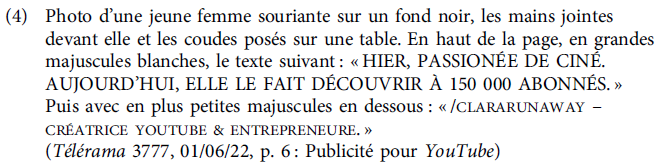
Avec la présence d’une photo du référent de ELLE dans le texte principal, cet exemple écrit peut être caractérisé comme un emploi « exophorique », malgré la mention de son nom complet en petites majuscules suivant le texte. Mais cette précision n’est en aucune manière indispensable pour interpréter cette publicité. Elle ne figure pas dans le texte central, mais en dehors, en petites majuscules en dessous. Le lecteur lambda se contentera certainement de lire le texte en haut de cette publicité et (bien sûr) de remarquer la photo, qu’il identifiera quasi automatiquement comme manifestant le référent visé par elle dans la principale sans même se donner la peine de lire la mention de son nom. Au cas où le lecteur le fera, l’exemple tombera dans la catégorie de la « cataphore macro-grammaticale » (cf. la distinction opérée au § 1).
Voici à présent un exemple correspondant à un résumé de film, avec cette fois un référent macro-topical humain sans photo l’accompagnant :

Ce court texte est parfaitement compréhensible en tant que tel, même si le référent des trois occurrences du pronom elle n’y est pas identifié. On comprend ainsi qu’il s’agit d’une femme qui travaille dans une entreprise, mais qui est mise en cause par ses collègues. Les trois occurrences du pronom elle renvoient bien évidemment à un personnage central du scénario du film, scénario qui est évoqué en filigrane ici. C’est en effet le genre de texte à l’œuvre ici (un résumé de film) que le lecteur reconnaîtra immédiatement dans cette page de Télérama : de ce fait, il y aura une attente de sa part qu’il s’agira d’une description d’une intrigue quelconque, qui fondera en grande partie l’emploi des pronoms en première mention ici.
3. L’anaphore Indirecte
Dans la réalisation d’un acte d’anaphore directe, l’émetteur fait en sorte que l’anaphorique cible un objet supposé avoir déjà été placé sur la « table cognitive » de manière saillante, soit par une introduction textuelle explicite, soit en cherchant à viser un objet visible (ou présupposé autrement présent) dans la situation d’énonciation. Un acte d’anaphore indirecte, par contre, implique que le récepteur doive saisir le sens ou le référent voulu en tirant une ou des inférence(s) à partir du co-texte et du contexte. Comme le propose Cornish (Reference Cornish2019 : 26),
(…) l’interprétation d’une anaphore indirecte exige une inférence semi-automatique de « pontage », afin de passer de ce qui est explicitement mentionné ou focalisé à un référent qui y est associé d’une façon ou d’une autre – via l’invocation d’une relation de partie-à-tout, d’occurrence à type, ou métonymique, par exemple.
Voir [Reichler-]Béguelin (Reference [Reichler-]Béguelin and Rubattel1989, Reference [Reichler-]Béguelin1997) pour plus de précisions et d’exemples.
L’un des concepts clés proposé par la Grammaire Cognitive (GC) de Langacker est celui de « domaine », défini comme « un réseau cohérent de connaissances qui fournit le fond nécessaire pour comprendre un concept » (Taylor, Reference Taylor and Schmid2012 : 158 ; je traduis). Dans (1), le domaine serait la coupe de cheveux dans un salon de coiffure ; dans (3), la canne et sa fonction première, puis la raison d’être d’une supérette. Une autre notion invoquée par ce modèle est celle de « zone active » : typiquement, une entité évoquée dans un discours présentera un ensemble de facettes distinctes, dont seulement une serait normalement active dans la conscience des interlocuteurs à tel ou tel moment de l’interaction (cf. Taylor, Reference Taylor and Schmid2012 : 155). Or, c’est précisément cette notion-là qui, conjointement au choix d’une zone ou d’une facette relativement inactive au moment de la réception, permet le phénomène de l’anaphore indirecte, comme on le verra plus loin.
En voici un premier exemple, impliquant ce qu’on pourrait appeler un « objet-jalon » (l’emplacement de parking vide ciblé par le regard du locuteur : voir la note 7 infra) :

Cet énoncé a été produit par le personnage central JT, qui vient de s’échapper d’un ascenseur bloqué dans l’immeuble où il travaille, et dans lequel il a dû passer la nuit – le gardien ayant arrêté l’ascenseur avant de partir la veille au soir, alors que JT s’y trouvait déjà. En essayant de sortir de la cabine, celui-ci a remarqué l’arrivée de policiers dans le hall de l’immeuble. Il se doute donc qu’ils sont à ses basques, car il a, la veille, assassiné dans cet immeuble le mari de la femme qu’il aime.
C’est bien entendu l’accord du participe prise avec le pronom objet l’ (la) précédent qui rend manifeste le genre féminin de ce pronom et qui, conjointement à ce qui est prédiqué de ce référent et au regard tourné vers la place de stationnement vide, permet d’inférer par métonymie le référent voulu. C’est le regard du locuteur vers cet emplacement vide qui constitue le déclencheur ici, pointant « l’objet-jalon »Footnote 7 , donc. L’énoncé est à l’évidence la manifestation d’une pensée intérieure, une sorte d’ « auto-dialogue » – sans doute pour s’expliquer pourquoi il ne peut pas utiliser sa voiture pour s’échapper : d’où la saillance de sa représentation de celle-ci. Cet exemple correspond à une anaphore indirecte, une inférence étant requise pour accéder au référent visé.
Certains types de cas bien familiers, dans lesquels l’antécédent apparent (si tant est qu’il existe) n’est pas ce qui fournit directement le moyen pour l’interprétation d’un anaphorique - bien qu’il impose les paramètres en termes desquels celle-ci peut être réalisée - suivent :


Ici, les référents visés par les anaphoriques le virus, les, en et la star sont déterminés en fonction d’une (ou de plusieurs, selon le cas) inférence(s) quasi automatique(s) à partir d’un élément du co-texte, impliquant l’invocation du contexte culturel ou encyclopédique à l’œuvre.Footnote 8
Les « domaines » impliqués, au sens de la GC, sont ‘la contamination par le virus VIH’ ((7)), ‘les sports d’hiver, et en particulier, l’activité de skier’ ((8a)), ‘la préparation d’un réchaud pour faire cuire une fondue’ ((8b)), et ‘L’obsession médiatique autour de l’actrice vedette Brigitte Bardot vers la fin des années 1950/ début des années 1960’ ((9)). Les moyens linguistiques co-textuels permettant d’interpréter les anaphoriques dans ces exemples ne sont pas des « antécédents », au sens habituel du terme, mais plutôt, plus largement, des « déclencheurs d’antécédent » (voir §1 pour une brève présentation).
Une anaphore indirecte peut avoir été motivée via un aspect de la situation d’énonciation en vigueur, comme dans (10) :

Le « domaine » au sens de la GC est évidemment l’activité commerciale caractéristique d’un opticien. L’élément nul objet direct de trouvez renvoie à ‘des lunettes’, objets relevant de la raison d’être même du magasin en question – la « zone active » de ce domaine ici, donc. Il s’agirait dans ce cas-ci d’une anaphore exophorique, et non « indirecte », comme cela est bien le cas pour l’interprétation du pronom les visant en premier lieu ‘les prix des lunettes’ (voir la note 5 supra).
Le pronom les survient donc, conjointement à son prédicateur « hôte » ‘casser’Footnote 9 , dans le contexte d’une référence indirecte aux prix (de lunettes), pour ce qui concerne le propos principal. Ainsi, la prédication « hôte » ici fait allusion inter-textuellement à l’expression figurée idiomatique casser les prix, signifiant « les réduire de manière importante ». De ce fait, les serait censé dénoter ‘les prix (de lunettes) pratiqués par d’autres opticiens’ ; mais il y a de plus ici un sous-texte humoristique, jouant sur le sens littéral de casser : « je casserai les lunettes que vous trouveriez moins cher ailleurs ! » ; voir la note 9.
Il est important de rappeler que les pronoms clitiques, comme dans (1)-(6), (8a,b) et (10), ne sont pas accentuables, ce qui fait qu’ils sont contraints de fonctionner non pas déictiquement, mais anaphoriquement - même quand ils sont en emploi exophorique ou bien d’anaphore indirecte. Le degré de non-proéminence prosodique qu’ils revêtent est une caractéristique formelle importante des pronoms clitiques de 3e personne, susceptible d’influencer leur type de référence. Ainsi, ces emplois-là ne peuvent être qualifiés de « déictiques », comme le posent certains auteurs (notamment Reboul, Reference Reboul, Moeschler, Reboul, Luscher and Jayez1994 : 109, 136 pour le français, ou Mitkov, Reference Mitkov2002 : 10 pour l’anglais).Footnote 10 Voir aussi la présentation au début du § 2 de l’hypothèse de Kleiber (Reference Kleiber1994b) de la non-existence d’un pronom il « ostensif » en français, de même qu’Audring (Reference Audring2013: 39–40) au sujet des pronoms clitiques néerlandais en emploi de première mention.
Si nous comparons le fonctionnement anaphorique des pronoms clitiques en (1)-(6), (8a,b) et (10) avec l’emploi anadéictique de LUI, traduisant l’anglais HIM, en (11) infra, la différence essentielle est que l’existence du référent visé, de même que sa saillance psychologique, est présupposée pragmatiquement dans les premiers cas, mais affirmée comme telle (du moins au niveau du discours hôte à l’œuvre) dans le second. Voir Blanche-Benveniste (Reference Blanche-Benveniste and McA’Nulty1978) et Zribi-Hertz (Reference Zribi-Hertz, Coene, De Mulder, Dendale and D’Hulst2000) pour les différences d’interprétation associées aux pronoms disjoints et clitiques.
Voici donc un exemple oral attesté, où le référent d’un pronom n’est ni accessible en situation, ni explicitement introduit via un « antécédent » textuel au sens classique :

Ici, le pronom HIM/LUI est aussi bien déictique qu’anaphorique (donc, « anadéictique »). Il y a un effet de contraste qui joue dans la réalisation proéminente de ce pronom : à savoir, celui entre les candidats probables à cette fonction, d’une part, et ‘Guy Fawkes’,Footnote 11 de l’autre. Si le pronom « anadéictique » avait été prosodiquement atténué, et par conséquent l’accent tonique porté par le verbe de la prédication hôte, le discours ainsi créé aurait été incohérent. Car dans ce cas, son référent aurait dû être déjà présent, de même que saillant, dans la mémoire discursive en amont. Mais aucune de ces conditions ne serait remplie dans ce cas-là. La composante déictique du pronom en question est ainsi motivée par-là.
L’exemple illustre le degré auquel la référence dépendante du contexte suppose une coopération et interaction entre locuteur et allocutaire(s) (cf. Portes et al., Reference Portes, Beyssade, Michelas, Marandin and Champagne-Lavau2014 pour ce qui concerne l’intonation) : l’inférence par l’orateur du référent du pronom proéminent était provoquée par les rires de la salle en réaction à la date qu’il venait d’annoncer comme limite des nominations, médiatisée bien sûr par la connaissance culturelle partagée chez les auditeurs de la nature symbolique de celle-ci. Et lui, à son tour, avait employé un pronom accentué pour renvoyer au protagoniste central au sein de la situation évoquée métonymiquement par la mention de cette date, donc le catholique radical, ‘Guy Fawkes’. Ce personnage est présenté, en plaisantant, comme faisant potentiellement partie du groupe saillant de candidats éligibles à la fonction en question, puis en est singularisé de par l’emploi du pronom accentué (disjoint en français) comme ne pas avoir été « consulté » par l’équipe du V-C (cf. Kleiber, Reference Kleiber1994b : 135–138).
Concernant la compréhension des anaphores pronominales indirectes, deux expérimentations parallèles en français et en anglais sont rapportées dans Cornish et al. (Reference Cornish, Garnham, Cowles, Fossard and André2005), impliquant une tâche de lecture auto-segmentée de plusieurs séries de petits dialogues : 24 dialogues expérimentaux, avec 24 textes de remplissage (distracteurs). Les deux facteurs principaux étaient ceux de Centralité (référent nucléaire vs. périphériqueFootnote 12 ) et d’Explicitude (référent implicite vs. explicite). Ces facteurs furent croisés afin de donner quatre conditions pour chaque texte.
Des dialogues (comme ceux dans (8a,b) supra) furent choisis parce qu’en principe, l’anaphore indirecte se trouve plus fréquemment dans l’emploi oral que dans les textes écrits (voir § 1). Des dialogues comprenant chacun deux parties, du type Affirmation-Réaction ou Question-Réponse, furent donc préparés. Le second tour de chacun d’eux, qui contenait un pronom objet, correspondait à l’énoncé cible, dont les temps de lecture avaient été enregistrés et mesurés. Le premier énoncé, produit par le locuteur 1, servant à introduire le prédicat qui évoquait le référent ciblé, était le même dans les quatre conditions. Dans les conditions explicites, un second énoncé de ce premier tour mentionnait explicitement l’argument critique du prédicat. Le second tour, pris en charge par le locuteur 2, comprenait un énoncé qui renvoyait via un pronom non-sujet à l’argument cible du tour du locuteur 1. Le contenu de cet énoncé orientait la référence soit vers le référent nucléaire, soit vers le périphérique, selon le cas.
Or, les résultats ont montré que dans l’une et l’autre langue, quand on distingue référents implicites « centraux » et « périphériques », la compréhension par les sujets des pronoms censés reprendre un référent central plutôt que périphérique se fait d’une manière presque aussi rapide dans la condition implicite que dans l’explicite, et ce sans différence significative.
Une confirmation plus récente de ces résultats a été obtenue par une autre série d’expérimentations utilisant l’allemand cette fois (cf. Järvikivi et al., Reference Järvikivi, Schimke and Pyykkönen-Klauck2019). Les auteurs montrent que les pronoms objet « sans antécédent » sont sensibles au statut conceptuel et non purement linguistique de leur contexte discursif (cf. aussi la conception « figurale » de l’anaphore pronominale chez Kleiber, Reference Kleiber1994b, rapportée au § 2 supra).
Du côté des corpus oraux également (voir surtout Gerrig et al., Reference Gerrig, Horton and Stent2011 et Kitzinger et al., Reference Kitzinger, Shaw and Toerien2012), l’on voit qu’il est fort possible ainsi que naturel d’attester l’emploi en continu des pronoms de 3e personne sans « antécédent » textuel co-occurrent, sans que la continuité ou la cohérence du discours concerné en soient affectées pour autant. Un reflet « en miniature » de ce procédé se voit dans l’exemple français (5) supra. Footnote 13
4. La Prédication « Hôte » et L’heuristique du Genre
4.1 Facteurs pertinents de la prédication hôte
L’importance du contexte prédicatif et énonciatif immédiat de l’anaphorique dans l’attribution d’une interprétation à celui-ci a déjà été soulignée. En effet, le rôle orientant de la prédication hôte (PH) est indispensable pour le fonctionnement de l’anaphore, et d’autant plus dans les cas d’exophore et d’anaphore indirecte. La combinaison de certains facteurs relevant de la PH fournit déjà des indices permettant au destinataire de représenter en creux le référent visé : notamment, sa catégorie ontologique, puis la supposition qu’il a déjà été ‘nommé’, donc catégorisé, ou non : ce dernier aspect relève de la valeur en genre dont un anaphorique pourra être doté, qui y agit comme « badge » du nom caractéristique couramment employé pour nommer l’entité en question (voir § 4.2.1).
Passons en revue un certain nombre des exemples déjà présentés.
Commençons par le (3) (Elle est là). Ici, le prédicateur ‘être là’, à la fois existentiel et localisateur, suppose que le référent d’elle est un objet physique, capable donc d’assumer une position spatiale. Dans (6) (Les flics l’ont prise), le sens du prédicateur ‘prendre’ assume celui d’« enlever », étant donné que l’agent de cette action est, dans l’esprit du locuteur, ‘les policiers’. Comme il n’est pas possible d’enlever une place de parking, l’entité impliquée dans cette action doit être, par métonymie, ‘la voiture de JT’ – objet susceptible d’être « enlevé » – dont le spectateur du film en question se rappellera qu’elle avait été garée à cet endroit la veille de la remarque par le protagoniste, dans le scénario du film.
Dans (8a), le verbe hôte rayer dans la PH mais tu finis toujours par les rayer sérieusement !, attribue au référent potentiel du pronom les dans ce contexte le type ontologique ‘objets physiques rigides dans certaines de leurs dimensions, présentant au moins une surface plane’ (l’autre sens possible, « éliminer », n’aurait pas de justification ici). Pour établir un lien de cohérence avec ce que le premier tour du dialogue vient d’affirmer, à savoir que Marthe est une pratiquante des sports d’hiver, et par inférence, de façon prototypique, du ski, le pronom les de la PH au second tour renverrait quasi certainement aux ‘skis’ qu’elle possède ou a possédés par le passé : car ces objets physiques satisfont bien à la condition imposée par le prédicateur.
Ensuite, dans la PH de la version française de (11), … nous ne l’avions pas consulté, LUI !, le prédicateur hôte ‘consulter’ forme le fond commun qui va permettre le contraste (enjoué) entre les individus pressentis pour être candidats potentiels à la fonction de chancelier de l’université et ‘Guy Fawkes’. Le verbe consulter renvoie ici à une activité qui est fortement présupposée pragmatiquement dans le contexte à l’œuvre, le sens contextuellement ajusté de ce prédicateur étant ‘consulter les candidats éligibles pour être nommés à l’office de chancelier’.
D’autres types ontologiques attribués via le prédicateur hôte au pronom qu’il héberge sont illustrés par (12a,b) :

En (12a), le prédicateur ‘s’être préparé’ induit pour la référence du pronom clitique y la valeur ontologique « éventualité ». En revanche, le pronom l’ (le/la) en (12b) est potentiellement ambigu : il pourra être contraint par son verbe régissant ignorer, au sens de « ne pas savoir », à dénoter une proposition logique (dans ce cas, c’est du pronom neutre le qu’il s’agit) ; ou bien au sens « refuser de reconnaître » de supposer une entité physique, animée ou non (l’ sera donc l’un des pronoms le ou la référentiels) − ce avec un sens « volontaire » du prédicateur qui est absent du premier.Footnote 14 À cet égard, il est pertinent de rappeler la distinction que nous avons vue en (10) entre le sens figuré du prédicateur ‘casser’ dans l’expression idiomatique casser les prix, d’une part, et son sens littéral, de l’autre : ce qui rend disponibles, respectivement, les sens contextuels « réduire significativement les prix (de lunettes) » et « rendre les lunettes dysfonctionnelles ».
Ainsi, c’est le sémantisme du prédicateur hôte dans son contexte qui l’emporte dans l’attribution d’un type de dénotation au pronom anaphorique avec lequel il est en construction. Il est à noter que ce sémantisme n’est pas tant celui déjà associé à tel ou tel lexème en langue, mais le sens soit étendu soit enrichi (rendu plus spécifique) par des facteurs liés au contexte d’énonciation en jeu, ainsi que modulé par les influences sémantiques réciproques qu’exercent les autres lexèmes figurant dans son co-texte (cf. Taylor Reference Taylor and Schmid2012 : 155). Ces modulations correspondent à ce que la théorie de la Pertinence appelle des « explicatures » : à savoir, des apports contextuels permettant d’établir la proposition complète exprimée par un énoncé donné. Une fois établies, les explicatures pourront servir de prémisses pour la création d’implicatures.Footnote 15
L’autre composante essentielle des prédications hôtes est évidemment le référent du pronom de 3e personne (ou un autre sous-type de marqueur indexical). Les propriétés indexicales intrinsèques variées des marqueurs indexicaux font qu’ils sont loin d’être de simples « coquilles vides », comme cela est souvent prétendu.Footnote 16 Voir à ce sujet les exemples (14)-(19) dans [Reichler-]Béguelin (Reference [Reichler-]Béguelin1997 : 108-109), où des pronoms en première mention remplissent des fonctions euphémique,Footnote 17 dévalorisante ou d’évitement d’une compromission, valeurs qu’une évocation lexicalement explicite ne pourrait évidemment jamais assurer.
Regardons certains des pronoms des exemples repris supra : le pronom sujet elle dans (3) tire sa valeur ‘féminin’ de par la catégorisation de l’objet de référence au moyen du nom-prédicat canne (f.). Cet objet aurait pu également être catégorisé via le nom commun bâton (m.). Mais comme le support en question était terminé par une crosse, et avait été à l’évidence fabriqué soit artisanalement, soit en usine, et non « taillé à partir d’une branche d’arbre ou d’une tige d’arbuste », c’est le nom canne, qui est effectivement un nom-prédicat « de base » (cf. § 4.2.2), qui s’était imposé comme moyen de catégorisation ici.
Ensuite, le pronom elle dans l’exemple (4) serait déjà supposé renvoyer à un être humain de sexe féminin, de par ce qui est prédiqué directement de son référent, à savoir le fait d’avoir fait partager sa passion de cinéma à 150 000 abonnés de YouTube ; et bien sûr aussi (surtout) par la photo en dessous du texte. Des considérations analogues permettront de caractériser le référent visé par les trois pronoms elle dans (5) comme étant une femme employée dans une entreprise.
Les en (8a) et (10) porte une marque de nombre en plus de celle de la définitude. Ce pronom est restreint à dénoter des entités comptables, ensemblistes, comme c’est le cas ici. Berrendonner et [Reichler-]Béguelin (Reference Berrendonner and [Reichler-]Béguelin1995 : 31) qualifient la marque de pluriel dans les pointeurs pronominaux comme signalant le type logique « classe ».
Le pronom accentué LUI dans (11) est au masculin singulier, et est surtout disjoint. À ce titre, il est prédisposé à dénoter un être humain masculin, ce qui est le cas ici (voir également le pronom eux dans (5)) : cf. aussi Kleiber, (Reference Kleiber1994b : 140) ; mais voir Zribi-Hertz (Reference Zribi-Hertz, Coene, De Mulder, Dendale and D’Hulst2000) pour une analyse plus nuancée à cet égard : son renvoi à des objets physiques est également attesté. Blanche-Benveniste (Reference Blanche-Benveniste and McA’Nulty1978), elle, qualifie la valeur contextuelle de tels emplois d’« individuée ».
Il s’avère donc que plusieurs catégories de pronoms ne sont pas marqués intrinsèquement uniquement pour tel ou tel type de référence (leur potentiel de référence est souvent plus étendu), mais que leur valeur référentielle en contexte d’usage est déterminée plus précisément par la nature du prédicateur avec lequel ils se combinent, et par d’autres éléments l’accompagnant, le cas échéant. Tous ces sous-types de pronoms partagent la propriété selon laquelle leur emploi en discours présuppose non seulement l’existence discursive du référent ciblé, mais aussi (sauf bien sûr HIM/LUI dans (11)) sa saillance au moment de l’énonciation. Voir aussi Conte (Reference Conte, Charolles, Fischer and Jayez1990 : 216–218) sur le rôle clé de la prédication « hôte ».
4.2 La pertinence du genre des noms de niveau « de base »
4.2.1 Le rôle du genre dans le fonctionnement des pronoms anaphoriques
D’abord, la valeur de genre grammatical est principalement une caractéristique du nom qui le porte, s’agissant des dénotations d’inanimés. Il s’agit donc d’une catégorisation faite par la langue des noms de cette sous-classe, qui se révélera pertinente pour le fonctionnement de l’anaphore pronominale. Le nombre, par contre, relève du SN entier, en tant qu’expression à même de référer. Le choix de nombre est donc le propre du locuteur, qui décide selon le contexte à l’œuvre de la valeur du nombre à attribuer à ces marqueurs référentiels. Mais le genre peut bien avoir une fonctionnalité sémantique et référentielle, comme on le voit aujourd’hui avec le phénomène du choix de genre des SN dont le nom tête dénote un rôle social ou professionnel. Quand ceux-ci renvoient à une femme, c’est le genre féminin qui, par convention, l’emporte sur le genre lexical du nom tête lorsque celui-ci est masculin.Footnote 18
Audring (Reference Audring2013) présente et analyse un certain nombre de pronoms en néerlandais portant une marque de genre indépendante par rapport à celle de leur antécédent (là où celui-ci est co-présent), d’après un corpus oral et écrit : presse et publicités. Le choix de ce genre différencié (masculin, féminin, genre « commun », et neutre) est dans certains cas fonction de la conceptualisation par l’usager de l’entité visée au moment où le pronom en question apparaît dans le texte. Une particularité par rapport au français est que, là où un SN antécédent dénote une entité qui peut être conceptualisée comme une masse indistincte, le pronom de reprise porte la valeur de genre neutre ;Footnote 19 en revanche, si la conceptualisation est celle d’une collection d’éléments discrets, alors le pronom est marqué du genre « commun » (genre indistinctement masculin ou féminin). En voici un exemple :

Voici un type de circonstance bien connu, où un individu humain est (re)catégorisé via un SN à valeur de genre opposée à la catégorie de sexe de son référent, et où un pronom anaphorique maintenant cette référence est momentanément marqué pour la valeur de genre appropriée à la première désignation, plutôt qu’à la seconde :

Cette brève de fait divers raconte un drame survenu en Irlande du nord, peu de temps après l’accord du vendredi saint (conclu la même année que cette édition du Monde) entre unionistes et nationalistes pour le partage du pouvoir en Ulster.
À partir de la 3e phrase du texte, l’homme (m.) ayant subi cette attaque se voit endosser de ce fait le statut de « victime » (f.), statut maintenu par l’emploi du pronom féminin elle en y co-référant dans la proposition adverbiale temporelle qui évoque les circonstances de cette attaque, et qui complète la principale précédente. Ce modificateur phrastique précise les parties du corps affectées par la fusillade, description qui traduit donc le statut de victime de l’individu en question, à ce moment du déroulement de l’évocation. Le choix du pronom féminin serait donc conforme à cette re-catégorisation discursive provisoire (voir aussi la marque d’accord au féminin singulier portée par le participe passé atteint e). Dans la dernière phrase, par contre, il s’agit de nouveau de la personne en question en tant qu’homme à part entière, et non plus en tant que ‘victime’ : le participe passé adjectival Conduit en tête de cette phrase, ainsi que le participe passé verbal mort qui suit, portent les valeurs ‘masculin singulier’, accordées donc avec l’homme, sujet de la principale. Dans ce cas, le maintien de l’emploi de marques au féminin dans ce nouveau cadre n’aurait toutefois pas été possible, du fait qu’il s’agit là d’une cataphore canonique, dont le statut est « micro-grammatical » (syntaxique, donc) et non « macro-grammatical » (voir § 1).Footnote 20 . L’élément anaphorique est représenté ici par les marques d’accord portées par Conduit.
Voici un exemple de type en partie opposé, relevant d’une époque antérieure, impliquant un référent humain féminin :

(15) montre clairement que le pronom fait référence via une représentation mentale induite par son déclencheur, plutôt que de faire directement la liaison avec cette expression en tant que telle (cf. aussi Bosch Reference Bosch1988 : 223). La catégorisation de l’individu concerné comme « ministre des universités » dans la phrase initiale (appellation répétée quatre fois dans le paragraphe précédent, mais sans aucun renvoi pronominal) est conforme à la nature de l’unité de discours à l’œuvre – l’annonce en question ayant été faite en sa qualité de « ministre » et présentée de façon objective, neutre ; en revanche, les deux propositions subjectives et critiques qui suivent remettent en cause l’individu ayant fait cette annonce : l’emploi du pronom féminin elle est de ce fait motivé. La variation en genre, puis la distribution des renvois nominaux et pronominaux, servent ici, donc, un but argumentatif.
Voici encore un autre exemple, cette fois impliquant un objet inanimé, qui s’est produit dans le scénario d’un film (Rosenberg, Reference Rosenberg1970 : 58) :

Ici c’est le nom-prédicat de niveau de base (voir § 4.2.2 infra) ‘tableau’ (m.) qui détermine la valeur de genre du pronom il dans l’énoncé du visiteur, plutôt que celui de son déclencheur d’antécédent, ma dernière acquisition (f.). L’exemple constitue d’ailleurs une preuve de plus du besoin de distinguer les concepts de ‘déclencheur d’antécédent’ et d’‘antécédent’ dans sa caractérisation.
Le lexème ‘tableau’ sous-entendu par l’emploi de il dans (16) dénote un objet plus précis que le nom acquisition (qui, lui, a une dénotation bien plus large et plus abstraite). Or, le fait de se référer à cette entité dans ce contexte en fonction de la conceptualisation correspondant à l’énoncé du premier interlocuteur serait moins cohérent que l’emploi du pronom masculin il renvoyant au tableau que le premier locuteur vient d’acquérir : l’interlocuteur l’a entre les mains et en est manifestement impressionné au moment de la parole. L’exemple illustre la situation (rare toutefois : mais voir aussi l’ex. (101) dans [Reichler-]Béguelin, Reference [Reichler-]Béguelin and Rubattel1989 : 374), où une relation « endophorique » anticipée est transformée en emploi purement exophorique, l’objet désigné par le pronom il ici recevant un degré de saillance élevé du fait de son examen attentif et affectif par le locuteur.
On voit ici, ainsi que dans les exemples (13)-(15), que même en présence d’un antécédent textuel potentiel, un pronom renvoyant à son référent est néanmoins libre de le faire d’une façon indépendante, suivant les intentions du locuteur et le contexte à l’œuvre. Nous pouvons en conclure que ce phénomène relève comme cas limite de l’anaphore indirecte : car bien qu’il n’y ait pas renvoi à telle ou telle facette, conçue comme associable à un référent indirectement ciblé (comme dans les exemples canoniques (6)–(10) supra), c’est le même référent déjà introduit en tant que tel qui est concerné, mais conceptualisé toutefois sous une nouvelle perspective (sa « zone active » temporaire).
4.2.2 Les « noms de base » impliqués dans l’emploi et l’interprétation des pronoms variables en genre
Concernant la pertinence des noms dits « de base » pour le fonctionnement des pronoms de 3e personne (surtout ceux renvoyant aux objets inanimés), c’est à ce niveau de catégorisation que les usagers conceptualisent les phénomènes en tant que ‘formes perceptuelles et fonctionnelles’, selon Rosch (Reference Rosch, Rosch and Lloyd1978), ce niveau étant cognitivement plus saillant que les autres.Footnote 22 Brièvement, le terme le plus élevé dans la taxinomie, le niveau super-ordonné (dénotant le genus), recouvre une gamme hétérogène de catégories. Exemples : ‘meuble’, ‘animal’, véhicule’. Le niveau moyen (termes dits « de base » donc), représente l’espèce (pour ‘meuble’ : ‘chaise’, ‘lit’, ‘table’ etc. ; pour ‘animal’ : ‘chien’, ‘chat’, ‘oiseau’ etc.) ; et enfin (mais la hiérarchie peut être étendue, dans les deux sens) le niveau subordonné, donc les instances particulières de l’espèce : ‘teckel’ pour ‘chien’, ‘siamois’ pour ‘chat’, ‘rouge-gorge’ pour ‘oiseau’, etc. Le terme inférieur dans la hiérarchie hérite les attributs associés au(x) terme(s) supérieur(s) dont il relève.
Or, les termes du niveau moyen, « de base », s’avèrent les plus utiles pour l’identification et la classification : car ils possèdent un nombre élevé d’attributs permettant d’identifier aisément le référent du SN qui contiendrait ce terme comme nom tête (termes différenciés en cela par rapport aux termes super-ordonnés) ; mais en même temps ils partagent relativement peu d’attributs avec les autres catégories (à la différence des termes subordonnés). Ils sont de ce fait ni trop informatifs, ni trop peu informatifs pour la classification et l’identification du référent à l’œuvre.
Il n’est donc pas surprenant que, en l’absence d’un contexte textuel convenable, les pronoms variables en genre réfèrent en fonction du schéma prototype incorporé dans la mémoire à long terme qui caractérise le référent visé. Une telle évocation est, après tout, d’un caractère anaphorique par excellence. Dans les exemples que nous avons déjà vus, les pronoms variables renvoyant à des inanimés se conforment en genre (cf. Wiese Reference Wiese1983 pour cette conception) aux noms de base suivants : ‘cheveux’ (m. pl.) dans (1), ‘vélo’ (m.) en (2a), ‘voiture’ (f.) en (2b), ‘canne’ (f.) en (3), encore ‘voiture’ en (6), ‘lunettes’ (f. pl.)/ ‘prix’ (m. pl.) dans (10) et ‘tableau’ (m.) en (16).
L’hypothèse proposée par Zubin et Köpcke (Reference Zubin, Köpcke and Craig1986) de la structuration interne du système de genre grammatical en allemand est révélatrice à cet égard : selon ces linguistes, le genre neutre dans cette langue tend à être associé à des noms super-ordonnés, les genres masculin et féminin étant attribués de façon prépondérante à des noms de base ou subordonnés. En français, les noms de marque de certains produits (noms de niveau subordonné, donc) tendent à assumer le genre du nom de base dont ils dénotent des instances particulières : un Bordeaux, un Beaujolais… pour vin (m.), une Renault, une Citroën… pour voiture (f.), le France, le Torrey Canyon… pour navire (m.), titres de films et reprises pronominales de ceux-ci au masculin, suivant le genre du nom de base film (m.) (cf. l’exemple (9) au § 3), et ainsi de suite : voir aussi le SN un Corot dans (16) supra. Le rôle classificateur du genre est clairement mis en évidence par ces cas de figure.
Taylor (Reference Taylor2003 : 75–77) invoque une distinction pertinente entre « catégories expertes » et « catégories ‘lambdas’ » (“expert” vs. “folk categories”Footnote 23 ). Les premières correspondraient aux catégories aristotéliciennes classiques construites en termes d’attributs nécessaires et suffisants, relevant donc de distinctions techniques ou scientifiques connues primordialement par les savants du domaine concerné ; alors que les secondes seraient composées en fonction des connaissances empiriques que les usagers ordinaires tireraient de leur expérience concrète avec les objets ainsi ciblés.Footnote 24
Cette distinction peut s’avérer décisive dans certains cas précis d’emploi de pronoms en première mention : comme le fait observer Kleiber (Reference Kleiber1994c), dans un contexte particulier, où un professionnel du domaine concerné a des connaissances spécialisées du référent en jeu et présume que son interlocuteur les partage, celui-là peut alors employer un pronom sous-entendant un nom de rang subordonné plutôt que « de base ».Footnote 25 Son exemple (p. 261) se produirait dans un magasin de meubles antiques, où le vendeur chercherait à rassurer un client potentiel s’intéressant à un guéridon (m.), mais qui est défectueux : « Il est facile à réparer », plutôt que « Elle (‘la table’ (f.)) est facile à réparer ». Un autre exemple relèverait de la « catégorie lambda », où le référent visé serait une instance peu centrale de la catégorie de base concernée (ici ‘oiseau’ (m.)). Devant une poule affamée : « Donne-lui à manger, car elle/#il a faim » (Kleiber, Reference Kleiber1994c : 258).
5. Conclusion
Dans tous les cas d’anaphore, c’est donc une représentation discursive saillante au moment de l’emploi qui est ciblée par le marqueur dans la prédication hôte (cf. aussi Bosch, Reference Bosch1988 ; Recanati, Reference Recanati2005 : 292). Cette représentation, qui évolue avec le discours qui se déroule, peut avoir été initialement installée en mémoire de travail via une expression co-textuelle explicite, par un geste (le pointage par l’index comme dans (2a, b), la direction du regard comme en (3) et (6), les rires de la salle en (11)), par inférence à partir d’un énoncé (le cas de (7)–(10)), ou bien de par la co-présence des participants dans un lieu affecté à tel ou tel type d’activité conventionnelle (le « domaine » de référence, au sens de la Grammaire Cognitive) : le salon de coiffure dans (1) ou magasin d’opticien dans (10).
C’est le concept plus large de « déclencheur d’antécédent » qui serait pertinent pour recouvrir tous ces cas hétérogènes de modes d’installation d’une représentation en mémoire de travail. Il remplit un rôle indispensable surtout dans les cas d’anaphore indirecte (§ 3), comme nous l’avons vu, mais aussi dans ceux d’exophore (§ 2).
Plus généralement, l’emploi d’anaphoriques « sans antécédent » peut être envisagé comme un moyen de respecter le principe de « minimisation » à l’œuvre dans l’emploi de la langue dans la communication. Voir à cet égard la seconde maxime de Quantité de Grice (Reference Grice, Cole and Morgan1975) : « Faites en sorte que votre contribution ne soit pas plus informative qu’il n’est nécessaire ».
En conclusion, donc, nous proposons que ce qui se passe dans le fonctionnement de l’anaphore dite « sans antécédent » est, paradoxalement, une indication plus sûre de la nature réelle de la référence anaphorique que ne l’est le type endophorique standard, dans lequel un « antécédent » conventionnel (textuel) est co-présent (cf. aussi Kibrik, Reference Kibrik2011 : 512–513 ; Kleiber, Reference Kleiber1994b : 52). Car il s’agit là d’une réalisation de l’anaphore épurée à sa plus simple expression, ce qui permet de saisir plus nettement son véritable fonctionnement. Comme le dit Bach (Reference Bach1994 : 223–224), “…anaphoric uses [de pronoms, au sens de l’ « endophore »] can be assimilated to indexical uses [sc. l’« exophore »]”. Berrendonner et [Reichler-]Béguelin (Reference Berrendonner and [Reichler-]Béguelin1995 : 33) ne disent pas autre chose en soutenant que les « anaphores pronominales dites ‘coréférentielles’ (…) ne sont qu’un cas particulier d’anaphore inférentielle ».
Declaration
I hereby declare that there are no competing interests involved in the submission of this manuscript, and that there is no funding to be acknowledged.
Remerciements
Je voudrais remercier les personnes suivantes pour leur aide précieuse dans la préparation de cet article, et pour la mise au point du manuscrit soumis à la revue : Anne Grobet, Marie-José Béguelin, Béatrice Akissi Boutin, Walter De Mulder, Georges Kleiber, Patrick Dendale et les relecteurs anonymes de la revue.

 Open access

