

Introduction
The World Federation for Medical Education (WFME), an international organisation linked to the World Health Organisation includes psychiatry as a core undergraduate speciality (WFME, 2003). The Medical Council (2008–2013) undergraduate standards are based on these guidelines. Mental health disorders are common among patients reviewed by doctors working in all branches of medicine, with approximately 15% of patients attending non-mental health specialist services diagnosed with a mental health disorder, with an even higher prevalence (approximately 20–30%) noted in patients attending general practitioners (Walton & Gelder, Reference Walton and Gelder1999). Consequently, it is evident that the specialty of psychiatry should form an important component of any medical undergraduate syllabus.
Certain key skills especially acquired whilst studying or working in psychiatry are important for all doctors, such as understanding the concept of unity of body and mind and forming a therapeutic relationship with a patient (Walton & Gelder, Reference Walton and Gelder1999). As only 4–7% of graduating medical students pursue a career in psychiatry (Choudry & Farooq, Reference Choudry and Farooq2017), it is optimal that medical students are provided with adequate training in psychiatry at an undergraduate level to equip them with the appropriate knowledge, skills and attitudes that they will require as they continue in their careers in whatever branch of medicine they choose (Salmon & Tombs, Reference Salmon and Tombs2018).
There is some understanding from research to date, of the factors which influence a medical student’s decision to pursue a career in psychiatry. A positive undergraduate attachment with an emphasis in the syllabus of holistic management strategies is one such factor (Walton & Gelder, Reference Walton and Gelder1999; Ahmed, Reference Ahmed2012). Research to date has also highlighted the potential barriers to choosing psychiatry as a career choice including a perceived lack of scientific basis, a perceived poor public image of psychiatry and lack of respect for the discipline from other specialties (Walton & Gelder, Reference Walton and Gelder1999; Murphy et al. Reference Murphy, Viani-Walsh, Evans, Murphy, Guerandel, Hallahan and Lally2024).
A previous study led by the University of Galway (Byrne et al. Reference Byrne, Murphy, O’Rourke, Cotter, Murphy, Guerandel, Meagher, Sweeney, Gill, Campbell, McDonald and Hallahan2020), detailed the delivery and assessment of psychiatry at undergraduate level in the six medical schools in Ireland. This study highlighted the significant level of similarity across various medical schools in terms of both teaching and assessment methods employed. Despite this broad-based understanding of the undergraduate psychiatry programme, there remains a gap in our understanding the specific components of the taught psychiatry syllabus. While there is no consistent agreement on what would constitute a gold standard psychiatry curriculum for medical students (Thomas et al. Reference Thomas, Pai, Dawes, Wilson and Williams2013; Karim et al. Reference Karim, Edwards, Dogra, Anderson, Davies, Lindsay, Ring and Cavendish2009), it should be one that is dynamic, and adaptable to developments in learning and changing demands of society (Ng et al. Reference Ng, Vara, Datt, Menkes, Hoeh, Prentice and Sundram2024). We aim to address this research deficit in this study- by consulting the clinicians directly involved in the teaching and assessment of undergraduate medical students in psychiatry. We set out to specifically determine which aspects of the current taught undergraduate psychiatry syllabus are deemed most important to clinicians of varying experience and ascertain if there are topics currently taught that are deemed not required for current medical students or topics that are not taught that should be included.
Method
Participants
All doctors working in psychiatry attached to both the University of Galway and associated teaching hospitals were invited to participate (n = 94). Clinicians ranged from those recently qualified to those of consultant grade and academic specialists. Data was attained pertaining to (1) clinical role (non-consultant hospital doctor or consultant), (2) years of experience (< 5 years, 5–10 years, > 10 years), (3) clinical area of work (general adult psychiatry, child and adolescent psychiatry, other speciality), and (4) age range (24–35 years, 36–45 years, >46 years). Ethical approval was attained prior to study commencement from the Galway University Hospitals Research Ethics Committee.
Procedure
Six members of the academic team providing small and large group-based teaching sessions to medical students at University of Galway (AL, PH, EL, EMcG, KM, BH) provided items on specific areas of the syllabus for inclusion in this study. These items covered 8 themes (mood disorders, psychosis, anxiety disorders, addictions, child and adolescent mental health, psychiatry of later life, psychiatry of intellectual disability, other aspects of psychiatry) encapsulating the entire undergraduate syllabus in psychiatry (see Table 2). These items were subsequently discussed over three meetings of approximately 90 minutes to ensure that (i) all themes were sufficiently covered, (ii) items were representative of these eight themes and (iii) that items were not replicated in other themes. These meetings were chaired by the Principal Investigator (BH) and any disputes regarding specific items were resolved via consensus.
Likert scales (0–10) were utilised to measure clinicians’ perspective of the importance for undergraduate students to be knowledgeable about 216 items pertaining across the syllabus with a score of 0 meaning not at all relevant to 10 meaning very relevant. All items related to 8 themes (mood disorders, psychosis, anxiety disorders, addictions, child and adolescent mental health, psychiatry of later life, psychiatry of intellectual disability, other aspects of psychiatry): A questionnaire detailing these 216 items was disseminated online via the Survey Monkey platform. The questionnaire was developed based on the current syllabus and several meetings amongst the authors prior to study commencement.
Participants were also invited to make free-text comments at the end of the questionnaire which included some open-ended questions to capture additional information ascertaining knowledge components perceived as important or unimportant for medical students.
Statistical analysis
Statistical analysis was performed using the Statistical Package for Social Sciences (SPSS) 27.0 for Windows (SPSS Inc., IBM, New York, USA). Descriptive analyses (frequencies, percentages, means and standard deviations) on key demographic and syllabus data were performed for both categorical and continuous variables, as appropriate. We utilised independent t-tests, or analysis of variance for continuous data. Syllabus data was examined to determine if normally distributed by visual inspection utilising histograms and by Q-Q plots and non-parametric testing were additionally undertaken as appropriate, with the Wilcoxon ranked test utilised (with median and interquartile ranges also attained) to compare data between groups (i.e. years of experience, age range). Chi Square (χ2) test or Fisher’s Exact test were additionally utilised as appropriate for some non-parametric data as appropriate.
Free-text data were examined and were open-coded based on the framework of the questionnaire and on any other themes unrelated to these questions that emerged. This data attained from free-texts was then grouped into themes by consensus of the researchers (AL, PH, BH), with three meetings held (of approximately 60 minutes duration) to discuss the individual free-text data and emergent themes.
Results
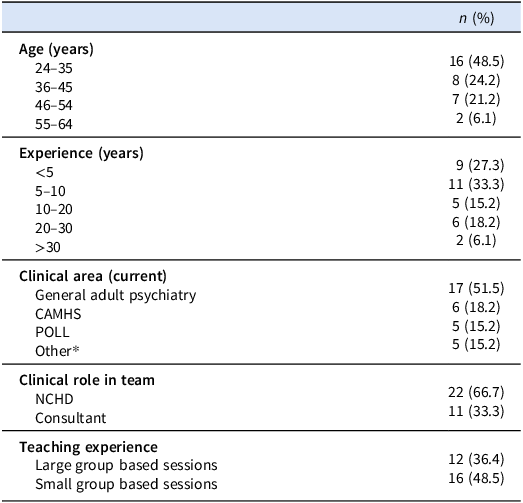
Demographic data pertaining to study participants are provided in Table 1. A total of 94 doctors were invited to participate and there were 33 respondents (35.1%). Of note 16 (48.5%) respondents were between 24 and 35 years of age, with 5–10 years of experience most common (n = 11, 33.3%). Twenty-two respondents were NCHDs (66.7%) and 17 individuals (51.5%) working in general adult psychiatry at the time of questioning. Twenty-two individuals (66.7%) had experience of teaching medical students, with greater experience in delivering small group-based teaching sessions evident (n = 16, 48.5%).
Demographic data

* Includes rehabilitation, intellectual disability and liaison psychiatry.
CAMHS, Child and Adolescent Mental Health Services; NCHD, Non-Consultant Hospital Consultant; POLL, Psychiatry of Later Life.
Table 2 provides data (score out of 10) pertaining to the importance respondents believed each of the 216 items was for medical students to be taught as part of their under-graduate syllabus. Knowledge of diagnostic criteria attained high scores across all disorders with particularly high scores evident for a number of disorders including major depressive disorder (mean = 9.64 (SD = 0.86)), schizophrenia (mean = 9.55 (SD = 0.95)) and attention deficit hyperactivity disorder (Attention Deficit Hyperactivity Disorder (ADHD); mean = 9.26 (SD = 1.40)). The importance of differentiating between different disorders was also noted. This included differentiating between an adjustment disorder and major depressive disorder (mean = 9.11 (SD = 1.16)), dementia and pseudo-dementia (mean = 9.07 (SD = 1.17)), dementia and delirium (mean = 9.78 (SD = 0.70)), and ‘baby-blues’ and post-natal depression (mean = 9.20 (SD = 1.30)).
Ratings of different aspects of the psychiatry syllabus

AUDIT; BAI, Beck’s Anxiety Inventory; BDI, Beck Depression Inventory; CATIE ; CBT, Cognitive Behaviour Therapy; DBT, Dialectical Behaviour Therapy; DSM, Diagnostic and Statistical Manual; EMDR, Eye Movement Desensitisation Reprocessing; GAD, Generalised Anxiety Disorder; HCR, Historical Clinical Risk; HDRS, Hamilton Depression Rating Scale; ICD, International Classification of Diseases; MAOI, Monoamine Oxidase Inhibitor; MADRS, Montgomery and Asberg Depression Rating Scale; MAST; MHA, Mental Health Act; OCD, Obsessive Compulsive Disorder; PTSD, Post-Traumatic Stress Disorder; SNRI, Serotonin and Noradrenaline Reuptake Inhibitor; SSRI, Selective Serotonin Reuptake Inhibitor; STAR-D; TCA, Tricyclic Antidepressant; YBOCS, Yale Brown Obsessive Compulsive Scale; YMRS, Young Mania Rating Scale,.
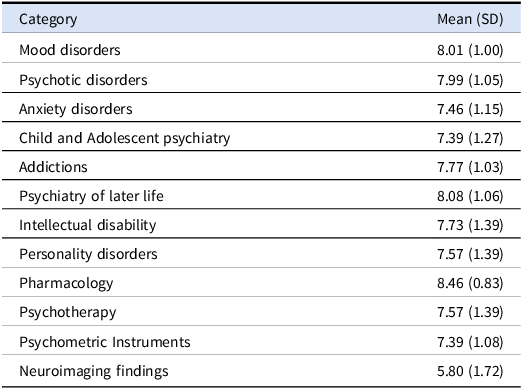
Knowledge of pharmacological interventions attained higher scores (mean = 8.46 (SD = 0.83)), than other aspects of the syllabus (see Table 3). Of note, risk items within pharmacology were associated with particularly high scores (see Table 2), including clinical signs of lithium toxicity (mean = 9.52 (SD = 0.97)) teratogenic effects of sodium valproate (mean = 9.50 (SD = 0.97)), the role of antipsychotics in metabolic syndrome (mean = 9.55 (SD = 0.83)), extra-pyramidal side effects (mean = 9.55 (SD = 0.74)), and neuroleptic malignant syndrome (mean = 9.52 (SD = 0.83)). Several pharmacological strategies were associated with lower scores including augmentation strategies for clozapine (mean = 6.71 (SD = 2.19)) and the use of clomipramine for treating obsessive compulsive disorder (OCD) (mean = 6.44 (SD = 1.99)). Other aspects associated with high scores from respondents included knowledge of the risk of psychosis secondary to cannabis misuse (mean = 9.69 (SD = 0.66)), behavioural strategies for managing delirium (mean = 9.56 (SD = 0.97)), the mini-mental state examination (mean = 9.63 (SD = 0.88)), physical sequelae of eating disorders (mean = 9.50 (SD = 1.14)) and criteria for detention under the Mental Health Act (MHA) 2001 (mean = 9.27 (SD = 1.46)).
Categories of the syllabus

Several items were associated with lower scores from respondents including some less frequently utilised management strategies (transcranial magnetic stimulation (mean = 4.97 (SD = 2.60)) and an awareness of the difference in criteria for use disorder and dependence from psychoactive substances (mean = 5.56 (SD = 2.26)). Theories pertaining to psychotherapy (i.e. Freud’s drive theory (mean = 4.59 (SD = 2.42)), Erikson’s psychosocial theory (mean = 4.81 (SD = 2.43)) and Piaget’s cognitive theory of development (mean = 5.33 (SD = 2.54)) and the utilisation of some psychometric instruments (i.e. the HCR-20 – mean 5.81 (SD = 2.02)) were associated with particularly low scores. Of note neuroimaging findings across all categories were deemed to have a low level of requirement for medical students (Mean = 5.80, SD = 1.72)) (Tables 2 and 3).
The only topic where consultant psychiatrists differed to NCHDs was the monoamine theory of depression, with consultant psychiatrists placing more emphasis on the importance of this item (Mean = 8.50 (1.84) v 6.10 (2.74), t = 2.88, p = 0.008).
Nineteen participants provided 44 comments for the qualitative analysis. Four themes emerged from same (see Box 1). The first pertained to knowledge of service provision including referral pathways, national clinical programmes, multidisciplinary team working and other organisations involved in social protection (i.e. TUSLA). The second theme described clinical areas that students should have a greater knowledge, particularly if they practice in a non-psychiatry discipline post-qualification and included the physical management of anorexia nervosa, the application of the Mental Health Act 2001, knowledge on how to conduct a capacity assessment and the acquisition of knowledge pertaining to traumatic experiences when taking a clinical history and how this might relate to a patients clinical presentation. The third theme described areas of knowledge currently taught to medical students that were viewed either as outdated or beyond the scope of medical students (some psychometric rating scales (i.e. AUDIT), medications that are now rarely employed (Monoamine Oxidase Inhibitors (MAOIs)) and some aspects of psychotherapy (Freud’s theories of psychoanalysis). The final theme related to the importance of empathy with a patient and awareness of skills such as listening, ability to be open-minded when interviewing a patient and awareness of recovery principles.
Discussion
This is the first study to date to examine in detail, clinicians’ views on the taught psychiatry syllabus at an undergraduate medical school. This study is timely as it coincides with an undergraduate curriculum review process at University of Galway. The undergraduate psychiatry curriculum has varied across Universities in Ireland to date, but it is likely that we will follow the United Kingdom in standardising a core curriculum across universities (General Medical Council, 2009).
The results of this study highlight a number of key findings. Respondents consider diagnostic criteria of mental disorders as very important- major depressive disorder, schizophrenia and attention deficit hyperactivity disorder were rated particularly highly. Of note, respondents in free-text data highlighted that if students practice in a non-psychiatry discipline post-qualification, they should have a good knowledge of key clinical areas, such as the identification of common mental health disorders. This is in keeping with findings internationally across the literature (Kallivayalil, Reference Kallivayalil2012; Chappel, Reference Chappel1993).
The overall category of the syllabus which obtained the highest score was pharmacology (mean = 8.46). Within this category, respondents placed an emphasis on the importance of developing competency in the management of certain risk categories within pharmacology e.g. lithium toxicity, teratogenicity associated with sodium valproate, metabolic effects of antipsychotics, extrapyramidal side effects and neuroleptic malignant syndrome. This again links with the aforementioned theme from the qualitative analysis (areas to attain greater knowledge). Patients will not always present to psychiatry, and it is important to be able to identify and manage medical emergencies, irrespective of a student’s ultimate area of clinical practice (Chen et al. Reference Chen, Chaou, Ng and Chang2024).
Respondents highlighted several key clinical areas which commonly present at the medical-psychiatry interface (i.e. strategies for managing delirium and knowledge of the physical sequelae of anorexia nervosa) that require greater knowledge at an under-graduate level. These points were additionally highlighted in the qualitative data as areas requiring greater knowledge. These areas should be considered in any future syllabus planning-this study’s findings highlight the importance that future doctors are competent in the identification and management of these.
Respondents emphasised the importance of being able to differentiate between various disorders (i.e. adjustment disorder vs. major depressive disorder, dementia vs. pseudo-dementia, dementia vs. delirium and ‘baby blues’ vs. post-natal depression). Perinatal psychiatry was highlighted in the above theme from the qualitative analysis (areas to attain greater knowledge). Perinatal psychiatry is a sub-speciality in psychiatry of growing importance with all level 3 hospitals in Ireland having this speciality available (HSE Mental Health Services, 2017).
Not all mental disorders were considered important to differentiate between however- the differentiation between psychoactive substance harmful use disorders vs. dependence obtained a much lower score in terms of importance for undergraduate medical students (mean = 5.56). Of note, the Diagnostics and Statistics Manual (DSM) 5 does not differentiate between harmful use and dependence unlike the International Classification of Diseases (ICD) 11 (Grant & Chamberlain, Reference Grant and Chamberlain2016). Respondents overall rated knowledge of addictions as an important part of the syllabus (mean = 7.77). However, psychometric rating scales such as AUDIT and CAGE emerged in the qualitative data as areas of syllabus not viewed as imperative for undergraduate medical students. Consequently, whilst knowledge of addictions was noted to be important, consideration is required to the detail necessary for undergraduate medical students.
Two further themes emerged from the qualitative data analysis. Firstly, the importance of service provision in psychiatry and that students gain an understanding of how the multidisciplinary team functions and how psychiatry is aligned with other services. For example, one respondent highlighted the four national clinical programmes (self-harm/suicide, eating disorders, early intervention in psychosis and ADHD in adults) (Health Service Executive, 2024). While the taught medical syllabus addresses key learning points in these areas, these findings reinforce the importance of the psychiatry clinical attachment, where a lot of this learning and understanding occurs. The importance of early clinical exposure in Psychiatry for medical students has been well articulated in the literature (Brown et al., Reference Brown, Barnes, Silver, Williams and Newton2016; Pokrzywko et al. Reference Pokrzywko, Torres-Platas, Abdool, Nassim, Semeniuk, Moussa, Moussaoui, Leon, Baici, Wilkins-Ho, Blackburn, Friedland, Nair, Looper, Segal, Woo, Bruneau, Rajji and Rej2019), and our study findings demonstrate how much our clinical colleagues value this. The second theme focused on empathy and the holistic management of patents. An understanding of confidentiality, boundary setting and issues such as stigma were particularly highlighted as areas which a medical student should encounter and consider during their undergraduate training.
There were several key areas of the syllabus which respondents considered less important in medical student education. Management strategies not utilised in routine clinical practice such as transcranial magnetic stimulation was not considered important. Similarly, some areas of pharmacology utilised in routine clinical practice in psychiatry but not in a general practice setting were considered less important at undergraduate level, e.g. augmentation strategies for clozapine. One respondent also considered knowledge of older medications less important, citing MAOIs, which again would only be undertaken in a mental health setting. Neuroimaging findings across all categories were considered of less importance also for students and attained the lowest category of all categories in the psychiatry syllabus (mean = 5.80). These findings suggest that clinicians working in psychiatry believe that medical students should be educated in practical aspects of psychiatry with the aim of ensuring basic competency, rather than theoretical foundations or uncommonly used treatments which academics might consider useful for identifying high performing students.
Psychotherapy overall was considered important (mean = 7.57) however certain components were deemed less important- e.g. Freud’s drive theory, Erikson’s psychosocial theory and Piaget’s cognitive theory of development. This is supported by one of the themes emerging from the qualitative analysis where the above aspects of psychotherapy were deemed out-dated or (as with neuroimaging findings or augmentation strategies in psychosis), beyond the scope of undergraduate medical students. Interestingly, one respondent outlined how students should understand how adverse child experiences can impact future mental health, but we could infer from this data that the detail of certain theories of development is potentially less relevant in gaining this understanding. Frank et al. Reference Frank, Propst and Goldhamer1987 explored the benefits of psychotherapy skills training for medical students- not just in terms of enhancing their experience of Psychiatry, but the generalisation of such skills to future non-psychiatric patient interaction. Any future curriculum planning must therefore appreciate the benefits of psychotherapy teaching, but be cognisant of how to integrate this, in keeping with the student’s overall level of knowledge and understanding.
This study is associated with a number of limitations. Firstly, this study only evaluated doctors’ views who worked in psychiatry. It has been argued that non-specialists may be better placed to advise on what should be included in an undergraduate medical syllabus (Salmon & Tombs, Reference Salmon and Tombs2018). Consequently, future studies will seek the views of medical students on completion of their psychiatry training and doctors working in primary care. Secondly, although there was a range of doctors with different levels of experience working in different areas of psychiatry, future studies might wish to include more participants in psychiatry sub-specialities. While a total of 94 doctors were invited to participate in this study, 33 doctors responded. It is possible that those who responded had a pre-existing level of interest in medical education. As such, it is not possible to rule out the potential for selection bias within this subject sample. Finally, whilst 216 items of the psychiatry syllabus were examined, some aspects were not included. However, a free-text section was included which allowed for the inclusion of other potential topics.
In conclusion, respondents believed that many components of the current psychiatry syllabus should remain in place, with a particular emphasis on diagnostic criteria and pharmacological and psychotherapeutic management of common mental health disorders, and risk management both in terms of risk of harm to patients and risks related to pharmacological management of patients. This study highlights the importance of an undergraduate programme that is broad based, practical and relevant to each student’s future medical practice with an emphasis suggested on the medical-psychiatry interface and knowledge of the interface between mental health services and other support services such as Tusla.
Acknowledgements
The authors would like to acknowledge all participants who completed the study questionnaire.
Author contribution
All authors participated in the design of the study, data attainment and critical review of the manuscript.
Financial support
This research received no specific grant from any funding agency, commercial or not-for-profit sectors.
Competing interests
None for all authors.
Ethical standard
Ethical approval was obtained from the Galway University Hospitals Research Ethics Committee (C.A. 2417). The authors assert that all procedures contributing to this work comply with the ethical standards of the relevant national and institutional committee on human experimentation with the Helsinki Declaration of 1975, as revised in 2008.


 Open access

