
Hostname: page-component-89b8bd64d-x2lbr Total loading time: 0 Render date: 2026-05-05T12:53:08.902Z Has data issue: false hasContentIssue false

Chicago Police Torture and the Limits of Human Rights Enforcement in Liberal Democracies

Published online by Cambridge University Press:  30 October 2024

Abstract

From 1972 to 1991, a network of Chicago Police detectives used torture to force confessions from over 100 criminal suspects. Almost all were Black men, and many were wrongly convicted, some for capital offenses. I synthesize insights from comparative research on human rights, state abuse, and police violence in democracies to explain why, for nearly two decades, liberal institutions in Chicago failed to stop the torture. I argue that the nature of state violence in this case—targeting marginalized individuals uninvolved in political activity—intensified the practical, affective, and informational obstacles that are inherent to activating liberal institutions—courts, elected officials, media, and civil society—to fulfill their roles as rights enforcers. Applying these literatures to a type of case they typically overlook—a wealthy liberal democracy—contributes to understanding why state violence persists in such states and why it tends to concentrate on marginalized populations.

Information

Type
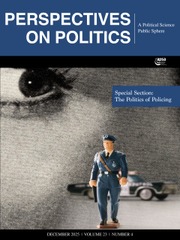
Special Section: The Politics of Policing
Copyright
© The Author(s), 2024. Published by Cambridge University Press on behalf of American Political Science Association

Access options

Get access to the full version of this content by using one of the access options below. (Log in options will check for institutional or personal access. Content may require purchase if you do not have access.)

Article purchase

Temporarily unavailable