

It has been said that for two decades beginning in the early 1970s, Chicago was “the police torture capital of the United States” (Taylor Reference Taylor2019, 225). During that time, a network of Chicago Police detectives used beatings, suffocation, electroshock, and other methods to force confessions from over 100 criminal suspects, almost all Black men. Many were convicted of crimes they did not commit, including some who would sit for years on death row. Eventually, in 1993, activists succeeded in getting the most prominent perpetrator, Chicago Police Commander Jon Burge, fired. It was the first in what, over the next thirty years, would be a series of limited yet extraordinary victories for survivors, culminating in a landmark 2015 city ordinance providing financial and social reparations to 57 torture survivors and their families (Baer Reference Baer2020).
Why was a systematic pattern of police torture in Chicago able to persist for nearly twenty years, and what changed to eventually allow survivors to win unprecedented forms of redress? To answer these questions, I draw on well-established findings in the quantitative human rights and state violence literatures to construct an analytic framework that focuses on the roles of liberal institutions—namely competitive elections, independent courts, a free press, and an active civil society—in enforcing prohibitions against physical integrity rights violations. In autocracies, the lack of such institutions reinforces patterns of state violence, but in liberal democracies, the problem often lies not in these institutions’ absence, but their functioning. I thus supplement this institutional framework with insights from case-based studies to highlight the obstacles to exercising liberal institutions and explain why, when it comes to the types of abuses likely to occur in democracies, those obstacles are especially difficult to overcome.
I argue that the nature of state violence in Chicago—that is, abuses directed against members of a marginalized group uninvolved in political activity—helps explains why liberal institutions there failed to stem the torture. My argument builds on recent research that finds that in liberal democracies, physical integrity rights violations—like torture, extrajudicial killing, and arbitrary imprisonment—are more likely to take the form of non-political oppression, rather than politically-motivated repression. Oppressive state violence is driven by non-political motives, such as the personal biases of frontline coercive agents, so it tends to target individuals with low social and political power (Beger and Hill Reference Beger and Hill2019; Haschke Reference Haschke2018). I examine the performance of courts, elected institutions, media, and civil society in Chicago and show how the tendencies of oppressive violence made the obstacles inherent to activating these institutions especially difficult to overcome. I then examine what changed after almost 20 years that helped advocates surmount those obstacles and eventually win unprecedented forms of redress. Finally, I provide a brief comparative case study of the 1969 Black Panther killings by Chicago Police to illustrate how survivors of politically motivated repression face more favorable prospects for activating liberal institutions on their behalf.
This article advances understandings of the challenges of enforcing physical integrity rights in liberal democracies. Recent cross-national quantitative studies show that the determinants and dynamics of physical integrity rights violations in democracies differ from those in non-democracies (Beger and Hill Reference Beger and Hill2019; Berlin Reference Berlin2023; Franklin Reference Franklin2020; Haschke Reference Haschke2018; Rains and Hill Reference Rains and Hill2024). I build on that research by using a novel case to delve more deeply into the specific obstacles to enforcement in liberal democracies. By highlighting the relative disadvantages of survivors of non-political state violence, my findings contribute to understanding why state violence persists in liberal democracies, and why it tends to concentrate on marginalized populations. Meanwhile, case-based comparative research has explored the legal and political dynamics that sustain police violence alongside liberal institutions (Bonner et al. Reference Bonner, Seri, Kubal and Kempa2018; Brinks Reference Brinks2008; González Reference González2021; Rejali Reference Rejali2007; Wahl Reference Wahl2017). But that research has mostly focused on states with developing economies or recent democratic transitions. In contrast, this article contributes to research on police violence in democracies by examining a wealthy established democracy, which allows me to analyze the performance of enforcement institutions without the confounding effects of low state capacity or authoritarian legacies. Studies examining the United States through the lens of comparative research on human rights or state violence are especially rare. This article counters the tendency to paint the United States as exceptional by demonstrating the commonalities between it and younger, less wealthy democracies in the dynamics that sustain police violence.
Physical Integrity Rights in Liberal Democracies
Cross-national quantitative research on human rights, state abuse, and torture has consistently found that the core institutions of liberal democraciesFootnote 1—namely competitive elections (e.g., Davenport Reference Davenport2007; Hill and Jones Reference Hill and Jones2014; Poe, Tate, and Keith Reference Poe, Tate and Keith1999), independent courts (e.g., Crabtree and Fariss Reference Crabtree and Fariss2015; Keith Reference Keith2012; Powell and Staton Reference Powell and Staton2009), a free press (e.g., Apodaca Reference Apodaca2007; Conrad and Moore Reference Conrad and Moore2010; Whitten-Woodring Reference Whitten-Woodring2009), and an active civil society (e.g., Hafner-Burton and Tsutsui Reference Hafner-Burton and Tsutsui2005; Murdie and Davis Reference Murdie and Davis2012; Neumayer Reference Neumayer2005)—are associated with lower rates of physical integrity rights violations. Taking these findings together, these institutions can be thought of as constituting a dynamic and interactive system for enforcing prohibitions against physical integrity violations—a system that explains why liberal democracies tend to have fewer violations than hybrid or autocratic states. Straightforwardly, courts act as enforcers by ruling on claims about violations and providing redress. Less obviously, elected officials act as enforcers by enacting policies, laws, and administrative actions to effect the prevention of and accountability for violations. These formal institutions are supported by informal social institutions—a free press and civil society—which perform enforcement roles by providing information to and facilitating public pressure on courts and elected officials through documenting abuses, generating public attention, and catalyzing mobilization. I refer to this system as the “standard model of enforcement” for physical integrity rights violations.Footnote 2
Tempering the findings from quantitative cross-national research, single-country and small-n case-based studies have shown that persistent patterns of state violence can still exist alongside liberal institutions. These studies identify various factors to explain this apparent contradiction, including popular support for abusive policies (Ahnen Reference Ahnen2007; Rejali Reference Rejali2007, 55–60; Tusalem Reference Tusalem2019); electoral competition that impedes or discourages reform (Flom Reference Flom2020; González Reference González2021); organizational cultures or incentives in coercive state agencies that encourage or legitimize abuse (Acemoglu et al. Reference Acemoglu, Fergusson, Robinson, Romero and Vargas2020; Celermajer Reference Celermajer2018; Rejali Reference Rejali, Barela, Fallon, Gaggioli and Ohlin2020, 78–79; Wahl Reference Wahl2017); permissive legal institutions (Magaloni and Rodriguez Reference Magaloni and Rodriguez2020; Rejali Reference Rejali2007, 49–55); and institutional and cultural legacies of authoritarian rule (Glanc Reference Glanc2014; Pereira and Ungar Reference Pereira, Ungar, Hite and Cesarini2004).
One feature common to most of these studies is the nature of the violence in question. Though researchers may not use the terms, most case studies of police violence in democracies focus on what some scholars label oppression, as opposed to repression. I follow other scholars in recognizing that the distinguishing characteristic of oppressive state violence is that it is motivated by reasons other than political gain, such as the personal bias of state agents (Beger and Hill Reference Beger and Hill2019, 627; Crabtree and Davenport Reference Crabtree and Davenport2018, 18; Rains and Hill Reference Rains and Hill2024, 796n2). Several tendencies follow from this distinction. Since oppression typically targets actors who do not consciously challenge political power, victims tend to be individuals marginalized in society, like criminal suspects, migrants, and members of disadvantaged minority groups. Oppression is also often committed on the initiative of frontline agents themselves, not directives from political leaders, and so is typically made possible by agency slack inherent in delegation from leaders to coercive state agents (Crabtree and Davenport Reference Crabtree and Davenport2018; Haschke Reference Haschke2018). A typical example of oppression is the torture of ordinary criminal suspects by police. Such abuse is normally motivated by non-political reasons, such as the professional rewards from securing confessions and closing cases, and it is often facilitated by the structural autonomy officers enjoy from their principals (Beger and Hill Reference Beger and Hill2019; Rejali Reference Rejali, Barela, Fallon, Gaggioli and Ohlin2020).
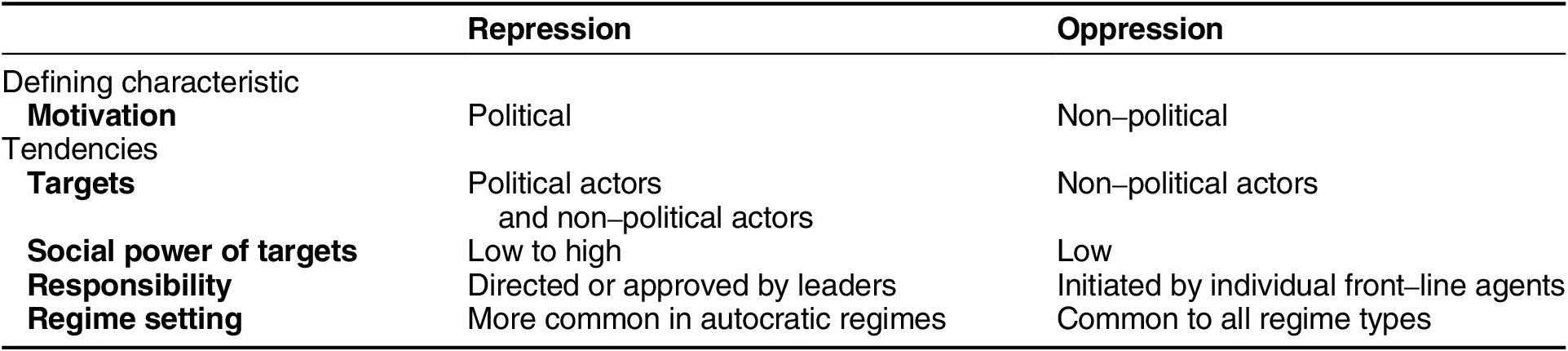
In contrast, research undergirding the standard model tends to assume that political leaders use violence to target challengers to their political power. Scholars term such abuse repression (Crabtree and Davenport Reference Crabtree and Davenport2018, 18; Goldstein Reference Goldstein1978, xxvii). In addition to ordinary civilians, repression targets political dissidents or other actors, such as journalists, lawyers, or opposition politicians, who overtly criticize or challenge state power. It is also often committed at the direction or with the approval of political leaders (Haschke Reference Haschke2018, 5). Table 1 summarizes the differences between repression and oppression.Footnote 3
Table 1 Characteristics of repression and oppression

Recent quantitative studies operationalizing these forms of violence systematically confirm what the case-based literature has long found: liberal institutions are more effective at preventing and combating repression than oppression. Cross-national analyses find that, while repressive violence is more common in autocratic states, oppressive violence is common to all regime types (Berlin Reference Berlin2023; Franklin Reference Franklin2020; Haschke Reference Haschke2018; Jackson, Hall, and Hill Reference Jackson, Hall and Hill2018).Footnote 4 Yet research has focused little on why liberal institutions are less effective against oppression than repression, and relatedly, what explains variation in oppressive violence across liberal democracies. In the most comprehensive analysis of the determinants of repressive and oppressive violence, Haschke (Reference Haschke2018) finds that the strongest predictor of higher oppressive violence is low economic development, which hinders the state’s capacity to monitor and control its agents. Likewise, most case-based comparative studies of police violence focus on states with developing economies or recent democratic transitions.
The Chicago Police torture scandal is thus a useful case to advance understanding of why oppression persists in democracies. For one, it presents an opportunity to apply, synthesize, and evaluate findings from these literatures on a type of case—a wealthy, established democracy—they have traditionally overlooked. It also allows me to examine the persistence of police violence while setting aside alternative explanations that emphasize low economic development or authoritarian legacies.
Why Liberal Institutions Are Less Effective against Oppressive Violence
Social Status of Typical Victims
Regardless of regime type, repression aims to weaken political challenges, so victims often include individuals who, if not societal elites, possess above-average power to influence the ideas and actions of others. These include journalists, lawyers, activists, or opposition politicians. The most violent governments do cast their repressive nets widely and indiscriminately, targeting ordinary people with low social power to instill terror and discourage political action. But such broad repression is typically accompanied by more targeted violence against those with greater social power.
In contrast, as individuals who are targeted for non-political reasons, victims of oppressive violence are often members of marginalized social groups, like ordinary criminal suspects, migrants and refugees, and members of disadvantaged minorities (Beger and Hill Reference Beger and Hill2019, 630; Brinks Reference Brinks2008). While victims of repression may represent the full spectrum of social power in their societies, victims of oppression tend to be concentrated at the lower end.
Obstacles to Liberal Institutions
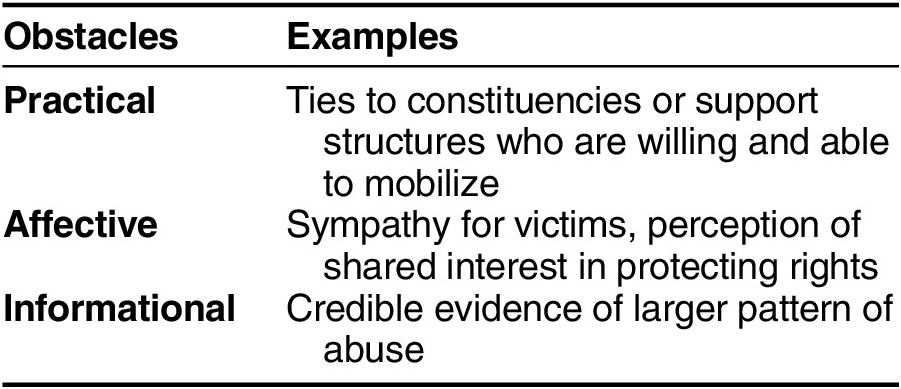
Regardless of the nature of abuse, there are obstacles to compelling liberal institutions to enforce physical integrity rights. These are summarized in table 2. I argue that, compared to typical victims of repression, the social status of the typical oppression victim makes it more difficult to overcome those obstacles.
Table 2 Obstacles to activating liberal institutions to enforce physical integrity rights

The first obstacle concerns the practical necessity of social ties. Efforts to challenge patterns of state wrongdoing face the collective action problem of “coordinating unorganized, autonomous, and dispersed populations into common and sustained action” to, say, make state abuse a voting issue or direct public scrutiny to judicial decisions (Tarrow Reference Tarrow1994, 9; see also Fuentes Reference Fuentes2005). Catalyzing such action requires ties to constituencies, groups, or networks who are willing and able to engage in political or legal mobilization. Almost by definition, the types of individuals targeted by repressive violence represent constituencies who are sizable, such as politicians representing parties or organized political interests, or who have mobilizing structures already in place, such as professional associations willing to defend persecuted journalists. In contrast, because of their marginalization, victims of oppressive violence typically lack such ready-made constituencies or links to networks that are willing and able to mobilize on their behalf, making it harder to provoke attention from media or elected officials. They are also less likely to be able to access legal “support structures” (Epp Reference Epp2003) for help with expertise and funding in litigation (Brinks Reference Brinks2008).
Even when there exist civil society groups that advocate for marginalized groups, victims of oppression still face affective obstacles in cultivating broader societal interest necessary to exert political pressure. As Simmons (Reference Simmons2009, 137) writes: “One of the most important resources for a [social] movement’s success has been found to be support from actors who are not direct beneficiaries of the movement’s goals.” But it is difficult for marginalized individuals to cultivate sympathy when large segments of society instinctively view their plight as, in the least, unimportant, and at most, deserved. For the median voter, the torture of an activist for their political activity is more likely to raise alarms than the torture of an ordinary criminal suspect in an interrogation. The median voter is likely to perceive a shared interest in protecting all persons’ rights to engage in political activity, while they are less likely to identify with the experience—and may even support the victimization—of someone targeted by the criminal process (Beger and Hill Reference Beger and Hill2019, 629–31; Caldeira Reference Caldeira2002). Given the narrower distributional implications of oppressive violence, it is more difficult to inspire ordinary citizens to engage in collective action, like voting, on behalf of such victims.
A final obstacle is informational. Credible information about abuses is necessary to activate the institutions in the standard enforcement model (Brinks Reference Brinks2008; Keck and Sikkink Reference Keck and Sikkink1998; Lupu Reference Lupu2013; Welch Reference Welch2017). For example, evidence that can challenge official versions of events is necessary to persuade judges to believe victims’ claims (Brinks Reference Brinks2008). And the ability of NGOs to compile and disseminate data on abuses is key to the practices of “information politics” through which they wield political and legal influence (Fuentes Reference Fuentes2005; Gallagher Reference Gallagher2017; Keck and Sikkink Reference Keck and Sikkink1998). Yet the barriers I just discussed combine to decrease the likelihood that such information is available. For example, lack of societal sympathy for criminal defendants discourages reporters from prioritizing investigations into allegations of abuse against them.Footnote 5 In turn, a lack of aggregated reports makes it harder for survivors or their advocates to discover or substantiate claims about broader patterns of abuse, which may be necessary to prevail in court. If judges, lacking countervailing information, repeatedly dismiss survivors’ claims as not credible, then journalists have little reason to suspect a broader pattern that merits investigation.
The Chicago Police Torture Cases
The Chicago Police torture cases represent merely one chapter of an over century-long history of endemic corruption, racism, and extrajudicial violence in the Chicago Police Department (CPD) and the criminal justice system of Cook County, Illinois (where Chicago is located) (Balto Reference Balto2019; Dale Reference Dale2016; Gonzalez Van Cleve Reference Gonzalez Van Cleve2017; Lindberg Reference Lindberg1991). The “Chicago Police torture cases” refers to what is now known as a pattern, from 1972 to 1991, in which a network of detectives used beatings, suffocation, electroshock, and other methods against more than 100 criminal suspects, usually to force them to confess to homicides or other major felonies. Almost all victims were Black men, and many were convicted of crimes they did not commit—often their tortured confessions were the only evidence against them. At least twelve would be sentenced to death (Baer Reference Baer2020; Taylor Reference Taylor2019).
The scandal is most associated with Detective and eventual Commander Jon Burge and a network of detectives associated with him, known as the “Midnight Crew.” We know from still growing evidence that CPD torture was not limited to Burge and his associates, nor did it end when Burge was fired in 1993 (e.g., Ackerman Reference Ackerman2015; Segura Reference Segura2017). Nevertheless, since most reporting and litigation around CPD torture has focused on Burge and the Midnight Crew, most of what we know about its patterns relates to these officers. Burge is thought to have first tortured suspects in 1972, shortly after starting as a detective in the Area 2 Chicago Police precinct on the city’s predominantly Black south side. Through the 1970s, he and his associates used torture selectively, apparently reserving it for suspects whom they were confident were guilty. Over the years, their abuses became less selective, frequently torturing suspects for whom there was little or no evidence of guilt (Baer Reference Baer2020, 55–77). By the 1980s, “torture was entrenched at Area 2,” an apparent open secret even among personnel who did not participate in it (Baer Reference Baer2020, 69, 88).
I analyze the long-term use of torture by Burge and his associates as a case of oppressive state violence, since there is no evidence that they used torture to aid political leaders. Indeed, the frequency of torture appeared to increase during the mayoral administration of Harold Washington (Baer Reference Baer2020, 127), who was generally derided by Chicago Police officers (Pihos Reference Pihos2015, 358–59), and there is no evidence that victims were targeted for political activity. Instead, profiles of Burge and trial testimonies suggest he was primarily motivated by a combination of racism and overzealous commitment to combatting crime and closing cases (he even named his boat Vigilante), which earned him numerous commendations and promotions, eventually making commander in 1986 (Baer Reference Baer2020; Conroy Reference Conroy1990; Ralph Reference Ralph2013).
Developments that would lead to Burge’s downfall began with the 1982 double murder of two Chicago Police officers by Andrew Wilson, a 29-year-old parolee with a history of violent crime. Following a tip, Burge and members of the Midnight Crew arrested Wilson and, after an interrogation that included beatings, burns, and electroshocks to his ears, lips, and genitals, he signed a confession. Andrew and his brother Jackie, who had also been tortured, were convicted of the murders (Baer Reference Baer2020, 78-96). But unlike most prior instances by these detectives, Andrew Wilson’s torture led to several rounds of litigation challenging the admissibility of his confession and suing Burge for civil rights violations. In turn, those proceedings triggered developments (detailed later) that helped Wilson’s lawyers uncover a broader pattern of torture and finally catalyzed activism to hold Burge accountable, leading to his 1993 firing.
Over the thirty years since Burge’s firing, activists have won a series of partial yet extraordinary victories, including civil settlements, exonerations, the federal conviction of Burge, and an unprecedented reparations package. Though institutions in the standard model all eventually contributed to these forms of justice and accountability, they only did so after nearly twenty years of failing to live up to their roles as rights enforcers.
Research Design and Data
I examine why, for almost twenty years, courts, elected officials, media, and civil society in Chicago failed to stop the torture, and how the oppressive character of the abuses contributed to those failures. My goal is not to test new or existing theories. Instead, I use this case to illustrate the obstacles inherent to activating liberal institutions to enforce physical integrity rights, and how the dynamics of oppressive violence intensify those obstacles. My findings are meant to contribute to the development of new theory to help explain variation in physical integrity rights violations in and across liberal democracies.
First, I examine the period from Burge’s first allegations to Andrew Wilson’s federal civil trial (1972–1989). I analyze, in turn, the performance of courts and elected institutions in light of what prior research predicts, and how the oppressive character of the abuses shaped that behavior. Since research envisions media and civil society playing supporting roles for these formal institutions, I assess their behavior during my analyses of courts and elected institutions. Then, I examine what eventually changed (1989–present) and thus activated these institutions to fulfil their roles as rights enforcers, and I assess the implications for my argument. Finally, I present a brief comparison with an episode of repressive violence in Chicago—the 1969 Black Panther killings—to further support my argument about the different prospects for survivors of these types of violence. My analysis draws on court records, archival documents, and contemporaneous media, along with secondary sources, including recent memoirs, journalism, and scholarship on the Chicago Police torture cases.
Analysis: Liberal Institutions and Chicago Police Torture
Trial Courts and Suppression Motions in Chicago
Courts are central mechanisms for upholding human rights (Keith Reference Keith2012; Simmons Reference Simmons2009). Courts act as enforcers by, for instance, enjoining abusive policies, upholding procedural protections, and imposing remedies for violations. When it comes to torture, one important enforcement role in which judges enjoy a high amount of discretion is the authority to throw out (or “suppress”) confessions gained through torture, which are inadmissible under U.S. law (Mapp v. Ohio 1961). Therefore, I focus on the record of criminal trial judges in Chicago ruling on defendants’ pre-trial motions to suppress allegedly tortured confessions.
Judges’ ability to throw out illegally obtained evidence plays a crucial deterrent role in preventing violations of suspects’ rights (Mapp v. Ohio 1961). If judges in Chicago had regularly suppressed tortured confessions, it would have likely reduced detectives’ incentives to torture. Over the nearly twenty years of allegations against Burge and his associates, many torture survivors filed pre-trial motions to suppress their confessions (Baer Reference Baer2018). Yet prior to Andrew Wilson’s 1989 civil trial, “every Cook County judge who heard allegations of torture on motions to suppress rejected them” (Taylor Reference Taylor2012, 182). Years later, many of those claims would be deemed by official bodies to have been credible (Taylor Reference Taylor2019).Footnote 6
How can we explain this consistent denial of suppression motions? One factor inherent to litigating allegations of torture is the credibility deficit—that is, the inherent imbalance in perceived trustworthiness between a criminal defendant and police. Since there are rarely third-party witnesses to custodial abuse, a suppression hearing is largely a credibility contest between a defendant and interrogators. Overcoming the credibility deficit depends on the availability of information, like evidence of physical injury. But Burge and the Midnight Crew often used so-called “clean” torture methods (Rejali Reference Rejali2007), such as suffocation or Russian roulette, that leave little visible evidence. It is also well established that police officers, especially in Chicago, sometimes lie in suppression hearings to cover up misconduct (Moran Reference Moran2023; Orfield Reference Orfield1992). Even when suspects’ injuries are documented, officers may fabricate exculpatory stories to explain them (e.g., Possley Reference Possley2019). Overcoming the credibility deficit also depends on judges’ affective attitudes, and Cook County judges’ perceptions of defendants’ credibility were almost certainly shaped by race. Virtually all the Midnight Crew’s alleged victims were Black, and CPD and the Cook County criminal justice system have long, well-documented histories of anti-Black bias and racialized patterns of misconduct (Balto Reference Balto2019; Gonzalez Van Cleve Reference Gonzalez Van Cleve2017; Hagan, McCarthy, and Herda Reference Hagan, McCarthy and Herda2022). Against this backdrop, torture survivors in suppression hearings carried the burden of not only substantiating their specific allegations, but also overcoming the baggage of taken-for-granted, racialized narratives in Cook County courts that painted them as constitutionally criminal and seeking to cynically instrumentalize their rights (Gonzalez Van Cleve Reference Gonzalez Van Cleve2017).
Beyond the credibility deficit, the standard model highlights the importance of judicial independence for rights enforcement. Cross-national quantitative research consistently finds that where courts enjoy greater formal (de jure) and informal (de facto) independence, lower rates of physical integrity violations follow (Crabtree and Fariss Reference Crabtree and Fariss2015; Keith Reference Keith2012). Cross-national datasets generally place the United States high on rankings for both forms of independence (e.g., LaPorta et al. Reference LaPorta, López-de-Silanes, Pop-Eleches and Shleifer2004; Linzer and Staton Reference Linzer and Staton2015), suggesting that Chicago trial judges should have been willing and able to suppress tortured confessions. Nevertheless, a closer look at trial courts in Chicago reveals a more complicated picture of their independence not captured in national level measures.
Trial judges in Chicago are formally independent in many ways the literature envisions, such as being appointed to fixed terms and having their decisions only be reviewable through legal appeals procedures.Footnote 7 Yet two related factors traditionally made Chicago judges susceptible to extralegal influence, compromising their de facto independence: judicial elections and machine culture. The United States is virtually unique in the world in that most American states appoint at least some of their judges through elections (Liptak Reference Liptak2008). Scholars and legal professionals have long been concerned that judicial elections compromise judges’ de facto independence by incentivizing them to align their rulings more with public opinion than the law (Hanssen Reference Hanssen2004). Research finds that requiring criminal judges to stand for reelection—as in Illinois—is associated with trial decisions, like sentencing, that are tougher on defendants, suggesting that “judges facing reelection are attuned to the risks of being labeled soft on crime, and to limit that risk they often choose to demonstrate their toughness” (Kritzer Reference Kritzer2016, 358). In Cook County criminal courts, it is generally believed that judges are more reluctant to suppress evidence in cases, like homicides, that provoke more public attention (Orfield Reference Orfield1992, 117–18). In a 1988 survey, 73% of Cook County felony trial judges polled (8 of 11) agreed that if “judges were appointed for life or insulated from public pressure in some way, [they would] suppress evidence more frequently” (Orfield Reference Orfield1992, 123).
Another factor that compromises the independence of Cook County judges is the traditional machine culture of patronage and political loyalty that has defined Chicago politics for over a century (Rakove Reference Rakove1976; Simpson and Kelly Reference Simpson and Kelly2008). Since, in Cook County, Democratic candidates traditionally almost always win, being officially slated by the county Democratic Central Committee “is a huge advantage” (Gradel and Simpson Reference Gradel and Simpson2015, 161). Earning that endorsement traditionally requires candidates to have proven their loyalty to the party, and once endorsed, they must rely on party fundraisers to finance their campaigns (Gradel and Simpson Reference Gradel and Simpson2015, 161–62; Bogira Reference Bogira2005, 322–23). In short, similarly to conventional political appointees in Cook County, judges there traditionally secured their positions through patronage relations (Dukmasova Reference Dukmasova2024).
Just as machine culture encourages members to prioritize the interests of fellow members over those of the public (Trounstine Reference Trounstine2008), machine culture in Chicago likely conditioned the (un)willingness of judges to rule against prosecutors. Some analysts have noted that a large proportion of trial judges in Cook Country criminal courts worked previously as police officers or prosecutors in the State’s Attorney’s office (Conroy Reference Conroy2006). According to data compiled in 2002, 67% of the 61 judges in Cook County felony courts worked previously as Assistant States Attorneys, and 18 judges “had material involvement in torture cases” through their previous work as detectives or prosecutors (Taylor Reference Taylor2019, 288). These personal ties, combined with machine-style political loyalties may, in the least, have conditioned judges to believe the claims of detectives and prosecutors, and at most, motivated them to deliberately ignore claims of torture. For example, in 1987, Judge John Mannion denied the suppression motion for torture survivor Stanley Howard, who was convicted of murder and sentenced to death. (Years later, Howard would be pardoned and receive a nearly $2 million wrongful conviction settlement.) Previously, Mannion served as a Cook County prosecutor and homicide detective in Area 2, where he worked with one of Howard’s alleged torturers. Nevertheless, he did not recuse himself from the case. (Mannion would also testify as a character witness on behalf of Jon Burge during his 1993 Police Board disciplinary hearing) (Conroy Reference Conroy2001, Reference Conroy2003; Warden Reference Warden2012b).
Oppressive Violence and Denial of Suppression Motions
Though the credibility deficit and lack of de facto judicial independence in Chicago would exacerbate the barriers to activating courts for any survivor of state violence—oppressive or repressive—I argue that those factors are insufficient to explain the pattern of denial by Cook County judges. As I show later in the post-1989 period, it is possible to overcome the credibility deficit and effects of low independence if survivors and their advocates can surmount practical, affective, and informational obstacles. Instead, I argue that the oppressive character of the torture—specifically the social status of the typical survivor—intensified those obstacles.
First, the practical and informational barriers faced by Chicago torture survivors in overcoming their credibility deficits with judges were compounded by their marginalized social status and non-political offenses. Put into Bayesian terms, to overcome judges’ priors about the improbability of detectives using techniques like electroshock on suspects requires either irrefutable evidence or information about a larger pattern of torture that can alter those priors. When elite and other overtly political actors’ rights are violated, they can rely on links to or interest from civil society groups, who have the resources and expertise that individual defendants lack to compile claims from disparate cases and substantiate larger patterns, giving more credibility to defendants’ individual claims. But when survivors lack social capital to link them to civil society groups or the political status to bring them public attention, it is up to individual defendants and their attorneys—oftentimes overworked public defenders—to uncover and synthesize that information (see Brinks Reference Brinks2008, 25–33).
Second, it was especially hard for Chicago torture survivors to garner sympathy as victims from judges and the public, which was necessary to overcome racially prejudicial attitudes and outweigh the electoral and patronage pressures on judges. Doing so would have been easier if more information was available to substantiate the claims of a larger pattern that, in some cases, produced wrongful convictions. But local media did not connect the dots. The media landscape in 1970s Chicago was vigorous and competitive, and Chicago media organizations had shown themselves willing and able to uncover patterns of public corruption and police misconduct (Kroeger Reference Kroeger2012, 172; Time 1973). Yet this eagerness tended to apply only to abuses, like police brutality against otherwise upstanding citizens, that implicated greater distributional concerns (e.g., Pihos Reference Pihos2021, 140–42). Over the 17 years from Burge’s start as a detective to Andrew Wilson’s civil trial, the two major Chicago newspapers—the Chicago Tribune and Chicago Sun-Times—mentioned allegations of torture by the Midnight Crew in only two cases (out of over 100), one being Andrew Wilson’s (due to his high-profile offense and subsequent litigation).
Cross-national human rights research tends to assume that journalists who enjoy media freedoms have a natural preference for uncovering rights violations (e.g., Apodaca Reference Apodaca2007; Whitten-Woodring Reference Whitten-Woodring2009), but this case shows that journalists’ motivations cannot be taken for granted. The scant attention to CPD torture is revealing of the affective barriers that prevented Chicago journalists from perceiving a public interest in reporting on such allegations, and in turn, investigating potential broader patterns. After an exceptionally violent manhunt leading to the Wilson arrests (Baer Reference Baer2020, 90, 99), legendary columnist Mike Royko, known as a searing critic of the Chicago machine, wrote that there was “no reason to complain” about allegations that officers “were too heavy-handed.” The officers’ methods were “not pretty or nice, but that’s the way this kind of case is broken … I have some difficulty in working up sympathy for the wounded ego of a member of the Insane Idiots or any other street gang” (Royko Reference Royko1982). Royko’s fellow Sun-Times columnist, Roger Simon, bemoaned that attitude but conceded it prevailed among the public and policymakers: “No Chicago Police Superintendent is ever going to get in trouble because a few blacks get roughed up. But he will get in trouble if he doesn’t catch cop killers and catch them quickly” (Simon Reference Simon1982). The populist calculus Simon articulates also likely applied to judges ruling on suppression motions for “cop killers.”
The challenge of sympathy for torture victims also interacted with economic and professional dynamics of local media that further stifled attention to the issue. First, the abuse of marginalized people is less likely to arouse national-level public concern than the abuse of political actors. Therefore, covering oppressive violence is more likely to fall to local media, which have especially limited resources, making it difficult to conduct in-depth reporting necessary to uncover larger patterns of misconduct. The Tribune and Sun-Times traditionally assigned only a single reporter each to cover the city’s main criminal court building, historically the busiest criminal courthouse in the country (Conroy Reference Conroy2003). Second, journalists covering the courts and police beats are highly dependent on police and prosecutors as sources, which discourages them from investigating stories that implicate them in abuse for fear of jeopardizing valuable relationships (Baer Reference Baer2020, 52; Lawrence Reference Lawrence2000, 56).
Journalists’ failures to explore the possibility of a widespread pattern further contributed to the information deficit. That deficit, in turn, precluded collective action that could have made up for defendants’ credibility deficits and provoked public scrutiny of the broader patterns of judicial decisions around suppression motions. By the 1980s, “police accountability movements were a fixture of Chicago politics” (Baer Reference Baer2020, 114). The most effective group was Citizens Alert, a local police accountability group, formed in 1967, with a long record of building community coalitions to win police reforms (Hounmenou Reference Hounmenou2012). As their later actions show, Citizens Alert would have been willing and able to direct public attention to the high rate of allegations and judges’ consistent dismissals of them. But without information about the scope of the torture, they had no basis to do so. As a result, lack of public scrutiny, in the least, allowed judges to remain incredulous about detectives’ propensity for torture and fall back on racialized assumptions about poor, Black defendants with little fear of backlash over potentially erroneous decisions. At most, it facilitated corruption in the form of willful disregard for torture claims in the service of aiding prosecutors.
In sum, the consistent unwillingness of Cook Country trial judges to suppress tortured confessions was made possible by the fact that most survivors of CPD torture were poor Black men accused of non-political crimes. These characteristics hindered the types of collective action necessary to compile credible pattern information and provoke public sympathy to outweigh the electoral and machine pressures judges faced to side with prosecutors.
Competitive Elections in Chicago
Along with independent courts, one of the strongest cross-national predictors of lower rates of physical integrity rights violations is the existence of competitive elections (Davenport Reference Davenport2007; Hill and Jones Reference Hill and Jones2014; Poe, Tate, and Keith Reference Poe, Tate and Keith1999). The threat of removal through elections increases the costs and decreases the benefits for leaders to use or tolerate state violence. And when patterns of abuse are revealed, leaders facing competitive elections have incentives to fulfil their enforcement role by enacting laws and policies to redress past abuses and prevent future ones (Conrad and Moore Reference Conrad and Moore2010).
In contrast to the general relationships found in cross-national quantitative studies, case-based studies show how competitive elections can reinforce or even encourage patterns of police violence, especially against marginalized individuals. Much of this research problematizes the assumption in cross-national studies that voters have built-in preferences against human rights violations, especially when they target marginalized groups. For example, when voters perceive high levels of insecurity due to crime, they may prefer leaders who pledge harsh measures in response (Holland Reference Holland2013). Such measures may involve extrajudicial police violence, which is likely to disproportionately affect members of already marginalized groups. Paradoxically, even members of those groups may favor such policies, since they also are likely disproportionately victimized by crime (Caldeira Reference Caldeira2002). This point underscores the distributional implications of repression versus oppression; whereas repressive violence seemingly implicates the shared interests of all citizens to enjoy political rights, members of groups who are disproportionately targeted by non-political state violence may perceive little shared interest with fellow members whom they may see as “criminals” who “deserve it” (Beger and Hill Reference Beger and Hill2019, 629–31; Caldeira Reference Caldeira2002, 251).
Even when a groundswell for police reform emerges, such as following a scandal, electoral incentives can still sink its prospects. Police reforms vary by the degree to which they represent a threat to the bureaucratic autonomy of police agencies: from “marginal” and “operational” reforms that carry the lowest threat, to “external oversight” reforms that carry the highest (González Reference González2023). According to González (Reference González2023), reforms at the higher end of the threat spectrum are necessary to effectively combat patterns of police impunity. But police can leverage their unique “structural power”—that is, their control over the distribution of state coercion, including threats to withdraw police protection—to block or weaken proposed reforms. Strong reforms are especially unlikely when political turnover is high and power is fragmented, which offer police more opportunities to organize resistance to reform (Flom Reference Flom2020). Thus, unless a strong majority of voters support reforms and leaders face a genuine electoral threat, they will likely seek accommodation with police by agreeing, if at all, to more superficial reforms that are unlikely to reduce impunity (González Reference González2021).
Were elections in Chicago during the 1970s and 80s competitive? Some may say no, pointing to the infamous patronage-fueled political machine that, reaching its apex under Mayor Richard J. Daley (1955–1976), which made Chicago into a one-party (Democratic) city. Others may point to the well-documented history of pro-machine vote rigging in Cook County elections (Gradel and Simpson Reference Gradel and Simpson2015). Nevertheless, though the mayor’s office and Chicago City Council have been almost entirely captured by the Democratic Party since the Great Depression, that dominance belies some real competition within the Democratic mayoral primaries and city council elections, especially in the post-Daley era (Kleppner Reference Kleppner1985; Simpson Reference Simpson2001). In this article, I also discuss two high-profile, grassroots-fueled election upsets for the machine that attest to the existence of real competition during this period.
To examine the enforcement dynamics of electoral institutions in Chicago, I focus on the election and mayoral administration of Harold Washington (1983–1987). Jon Burge’s career spanned six Chicago mayors, but given limited space, it is most useful to focus on Washington, since his tenure represented the most competitive electoral context, and thus the most favorable political opportunity structure to end CPD torture. Washington was elected the first Black mayor of Chicago on an emphatically pro-reform campaign that was propelled by Black mobilization, partly in response to perceptions of widespread police impunity. His upset election would appear to conform to the expectations of the standard model: voters imposed electoral costs on leaders who oversaw human rights violations, incentivizing new leaders to enact reforms to reduce future abuses. Yet while Washington did enact some meaningful reforms to police management and operations, he ultimately pulled back from his most far-reaching pledge to restructure the system of civilian oversight, a system that in the words of its own chief administrator, “operate[d] to immunize police from internal discipline” (Fogel Reference Fogel1987, 3).
Harold Washington and the Office of Professional Standards
Throughout much of the twentieth century, policing in Chicago was characterized by “extreme racial selectivity.” Black Chicagoans were both “overpatrolled and underprotected;” they “lived in constant fear of police harassment, infringement on their civil liberties and bodily security, and ultimately violence,” while also “continuously at risk within their neighborhoods” (Balto Reference Balto2019, 1–2). These patterns escalated after World War II and reached a peak in the 1960s and 1970s, when “deeply punitive and heavily racialized policing became fully and explicitly institutionalized” (Balto Reference Balto2019, 157).
Washington’s 1983 mayoral campaign seized on simmering discontent over this state of affairs, and his platform promised far-reaching change. As an Illinois state legislator (1965–1980) and then U.S. Congressional Representative from Chicago (1981–1983), Washington had first gradually and then fully positioned himself outside the political machine that captured Chicago politics (Losier Reference Losier2020, 1052–53). During his mayoral campaign, Washington repeatedly attacked the machine and pledged to abolish the patronage system that sustained it. In the Democratic primary, Black voters helped Washington defeat two machine politicians: the incumbent mayor Jane Byrne and Cook County State’s Attorney Richard M. Daley, son of late mayor Richard J. Daley. But the machine was not resigned; instead of coalescing around their party nominee, many Democratic voters and some high-profile Democratic machine politicians, explicitly making racialized appeals, supported the Republican in the general election (Rivlin Reference Rivlin1992, 145–97). Ultimately, Washington won with 51.7%, including an estimated 98% of Black voters (Sánchez Reference Sánchez2021, 280–81).
One of Washington’s main targets in his calls for reform was CPD. Washington criticized CPD on many points, but his only proposal that entailed new external oversight—and thus a high threat to police autonomy—was to replace CPD’s Office of Professional Standards (OPS). OPS was Chicago’s first agency of civilians tasked with investigating complaints about police misconduct, and it was created in 1974 in response to public demands—partly led by Citizens Alert—for greater police oversight (Bauer Reference Bauer1976, 6–11; Hounmenou Reference Hounmenou2012, 31). Yet OPS quickly gained a reputation as hopelessly ineffective. Investigations into citizen complaints against officers regularly dragged on for months or longer, while few were ultimately sustained (Emmerman Reference Emmerman1981; WMAQ-TV 1983). Andrew Wilson’s complaint, for example, had the unusual distinction of being initiated by the CPD Superintendent himself following a letter from Cook County Jail’s medical director raising concerns over Wilson’s injuries. Nevertheless, his complaint remained open for three years without investigation before being closed with a “not sustained” finding (i.e., insufficient evidence for a determination) (Taylor Reference Taylor2019, 70). Presumably, if OPS had a stronger record of sustaining complaints and imposing disciplinary costs on detectives, it would have disincentivized them from using torture. Likewise, such findings would have provided grounds for media reporting and litigation that would have further deterred torture.
The causes of OPS’s disfunction were manifold, but one fundamental flaw Washington seized on was that it was not formally independent of the force it was supposed to oversee. Despite being staffed by civilians, OPS was organizationally an arm of CPD; its chief administrator was appointed by and reported to the police superintendent. Apparently, officers knew they had little to fear from OPS. In a 1987 memo to Mayor Washington, its reformist Chief Administrator, David Fogel, wrote that “[t]he troops love OPS,” because its process gave the appearance of procedural justice while reliably exonerating officers (Fogel Reference Fogel1987). Washington, with support from groups like Citizens Alert, promised during his campaign to replace OPS with a new, independent agency (Washington for Chicago 1983b).
But before the campaign ended, Washington pulled back from his pledge. Though he was publicly unafraid to criticize CPD, privately his campaign was concerned about how he was viewed by rank-and-file officers. After a press conference in which Washington called for replacing OPS, his campaign was put on the defense by public concerns over what form a replacement would take and how much disciplinary power it would reallocate away from CPD (Howard Reference Howard1983; White and Locin Reference White and Locin1983). Much of the rank-and-file force were suspicious of Washington’s plans (White and Locin Reference White and Locin1983), and many were reportedly mobilizing, both internally and publicly, to defeat Washington (Pihos Reference Pihos2015, 358–59). The police union president, implicitly invoking CPD’s structural power, warned that Washington’s plan for OPS would worsen police service: “If any individual who espouses a [independent] civilian review board is elected mayor, then morale would go down” (White and Locin Reference White and Locin1983, 5). Then just five days after his press conference and two days before the primary, Washington gave a speech detailing 23 points for reforming CPD, but his call to replace OPS was absent. His proposals instead consisted of operational and personnel reforms mostly meant to increase CPD’s crime-fighting effectiveness and which did not threaten CPD’s disciplinary autonomy (Washington for Chicago 1983a).
Once Washington was in office, he did not revive his call to replace OPS. His administration did enact a range of managerial reforms to CPD, including to OPS, but eschewed attempts at structural change to impose greater oversight. Washington would go on to earn praise for improving some aspects of CPD administration, yet we now know that the frequency of torture by the Midnight Crew also increased during this period. Meanwhile, OPS failed to sustain complaints about it (Baer Reference Baer2020; Losier Reference Losier2020, 1059–60). During Washington’s 1987 reelection campaign, he made no further mention of replacing OPS (Losier Reference Losier2020, 1060).
Oppressive Violence and Washington’s Failure to Overhaul OPS
Political conditions during Washington’s administration stacked the odds against structural police reform. In contrast to the City Council’s rubber stamp role during the Daley years, the distribution of factional power across the Mayor and Council had become more fragmented. After Washington’s election, machine-aligned aldermen in the Council still held a majority, and they openly conspired to block any of his legislative initiatives (Rivlin Reference Rivlin1992, 207–27). Seeing policing as an issue to weaken Washington, the opposition seized on his proposal to reduce force levels by 4% to paint him as soft on crime. For white voters, this line of attack played into fears that Washington would let crime fester in their neighborhoods. But crime was also a top issue for Black voters, who were disproportionately victimized by crime. Washington could not afford to alienate his most important voters, so he relented on his force reduction plan. Given the veto barriers Washington faced, there was little point in proposing a structural overhaul of police oversight, so he dropped his most ambitious police reform plans in favor of less controversial public safety initiatives with greater distributional impacts, like anti-gang programs (Lentz Reference Lentz1984). Instead of attempting to replace OPS, Washington sought to improve it from the inside by selecting criminologist and penal reformer David Fogel as its chief administrator (Losier Reference Losier2020).
Informational and affective barriers to mobilization around OPS reform also reduced pressure on Washington to stick to his pledge. On the most basic level, lack of public knowledge about the ongoing pattern of torture prevented popular mobilization to pressure the mayor on the issue. As mentioned earlier, police reform groups in Chicago had proven themselves an influential political force, but without information revealing a larger pattern by detectives, those groups focused on more publicly salient issues, like brutality in the field by patrol officers.
But while the public lacked information about CPD torture, the failures of OPS were well known. In 1981, an internal CPD audit of OPS that found gross mismanagement and routine procedural failures was leaked to the Tribune in a front-page story (Emmerman Reference Emmerman1981). In February 1983, two weeks before the mayoral primary that Washington would win, NBC Chicago aired a five-part investigation analyzing all 13,000 brutality complaints submitted to OPS over the previous five years. It found that only 6% were sustained in favor of the victim, while 62% of complaints that were filed in federal court were decided in their favor (WMAQ-TV 1983).
The affective barriers to OPS reform are revealed by a quasi-experimental study on public and policymakers’ attitudes towards police brutality conducted before and after the NBC investigation aired (Leff, Protess, and Brooks Reference Leff, Protess and Brooks1986).Footnote 8 While respondents from the public who watched or were aware of the series attributed higher importance to “police brutality” than before the airing, respondents still prioritized it lower than all other “urban problems” researchers raised. The most important were “violent crime” and “unemployment,” and the importance respondents assigned to them were unchanged after the series. Respondents also reported no change in their view of the “quality of service” from CPD.
One way to interpret the findings that revelations about police impunity did not detract from overall perceptions of CPD is that most Chicagoans viewed police performance through the lens of how they anticipated interacting with police, that is, more likely as crime victims than suspects, making them more concerned with the plight of the former than the latter. The same researchers also surveyed 35 local policymakers about what they believed about public attitudes. Policymakers thought the series likely caused citizens to view police brutality as more important, but those policymakers still attributed lower importance to police brutality in the public mind than violent crime, underreporting of crime, or unemployment, illuminating policymakers’ calculus in neglecting OPS reform. These findings suggest that distributional concerns undergirded the affective barriers that precluded mobilization to hold Washington to his pledge to replace OPS. Combatting crime and other social problems implicated broader collective interests than combatting police misconduct against people of color from disadvantaged communities suspected of committing ordinary, non-political crimes.
Ultimately, observable improvements helped further dissolve political pressure on Washington to restructure the police oversight system. Over his tenure, police brutality complaints and police shootings of civilians decreased, and commentators attributed these trends, in part, to administration reforms to police hiring and training protocols (Merriner et al. Reference Merriner, Newman, Schultz, Sweet and Williams1986). OPS Chief Administrator David Fogel welcomed dialog with Citizens Alert and implemented most of the operational reforms the group had long advocated. “There is 100 percent improvement [in OPS],” said Mary Powers, the group’s longtime leader (Gibbons Reference Gibbons1986, 14). Encouraged by Fogel’s reforms, Citizens Alert stopped pushing to replace OPS, which effectively took the issue off the public agenda. Meanwhile, Washington did not face an electoral challenger who was more progressive on police reform. During a post-reelection meeting with advisers to evaluate his first-term accomplishments, Washington reportedly told Fogel, “As a result of your work, the police are no longer a problem to me” (Czajkowski vs. City of Chicago et al. 1991, 45). By the time he won reelection in 1987, (Washington enjoyed a 67% city-wide approval rating (Davis Reference Davis1987). (Washington died of a heart attack seven months into his second term.)
But, as González argues (Reference González2023, 5), while it may alleviate political pressure, “substituting operational reforms for structural or external oversight measures may leave pervasive abuses unaddressed.” While Fogel’s OPS reforms did lead to a modest increase in rates of sustained complaints, by 1987 he concluded OPS was irredeemably defective and sought to persuade the mayor to replace it. In a memo proposing a replacement agency, he wrote, “OPS gives the appearance of formal justice but actually helps to institutionalize subterfuge and injustice” (Fogel Reference Fogel1987, 4–5). But by then, with little public knowledge of CPD torture or OPS’ deeper failures, Washington had little political incentive to pursue a complete overhaul.
In sum, despite a competitive electoral context, Washington faced little pressure to follow through with his campaign pledge to replace OPS. This lack of pressure reflected informational and affective barriers to the types of collective action necessary to focus public attention on the problems of torture and police oversight and make them into voting issues. As Losier (Reference Losier2020) notes, this lack of electoral incentive created a self-fulfilling prophecy of inaction: “Washington’s decision to accede to calls to retain OPS helped to keep police impunity out of the public eye, stifling the development of any political will to change it” (261).
What Changed?
In contrast to their performance during the 1970s and 80s, trial courts, elected officials, local media, and activist groups in Chicago would each go on to play crucial roles in later achievements for survivors of CPD torture. Here I show how these changes were made possible by developments that lowered the practical, affective, and informational obstacles to activating those institutions. The fact that some crucial developments were the result of exogenous events outside the control of survivors and their advocates helps underscore my argument about the challenges for survivors of oppressive violence to compel liberal institutions to act on their behalf.
The first major development was the availability of new information about the scale of CPD torture. But that information did not come from activists or journalists who connected the dots, but an anonymous whistleblower. During Andrew Wilson’s 1989 federal civil rights trial, his lawyers received a series of anonymous letters, apparently from a source inside Area 2. The letters revealed the name of another man tortured by Burge, Melvin Jones, and alleged a conspiracy inside the precinct to cover up widespread torture. Wilson’s attorneys used the Jones lead to track down several other alleged victims, whom they moved to call as witnesses to substantiate a larger pattern by Burge. Federal judge Brian Duff denied most of their requests, and Wilson lost the trial (Taylor Reference Taylor2019, 72–147). But by lowering the informational barriers to collective action, the revelations uncovered by Wilson’s lawyers triggered cascading developments that would lead to Burge’s firing.
First, the Wilson civil trial had attracted the attention of Citizens Alert and other local groups, who were galvanized into action by the information uncovered by Wilson’s lawyers—the first publicly available evidence about a wider pattern of torture. Citizens Alert tapped its connections fostered through decades of organizing to bring 35 community groups into a new Coalition to End Police Torture and Brutality. The Coalition organized demonstrations outside the federal courthouse during the Wilson trial and began regularly using the public comment portion of the monthly Chicago Police Board meetings to call for Burge’s firing (Baer Reference Baer2020, 148–52).
Second, in January 1990, journalist John Conroy published a 20,000-word article in the alternative weekly Chicago Reader on the trial and the cases uncovered by Wilson’s lawyers (Conroy Reference Conroy1990). The major local dailies mostly ignored Wilson’s lawsuit, but Conroy attended almost every day of the six-week trial (which ended in a hung jury) and eight-week retrial. Conroy’s resulting article, “House of Screams,” was the first major piece of investigative reporting that detailed a larger pattern of torture against suspects at Area 2. Though it received little public attention at the time, the article provided further ammunition to the Coalition’s campaign (Bogira Reference Bogira2011). The group distributed hundreds of copies of Conroy’s article, including to members of the Chicago Police Board. During Wilson’s civil trial months earlier, Citizens Alert had met with OPS head David Fogel, and he agreed to revisit some past not-sustained complaints, like Wilson’s (Baer Reference Baer2020, 150). After the trial, Fogel assigned his two best investigators to re-examine the Wilson complaint and the larger pattern of Area 2 allegations, and they used “House of Screams” as their starting point (Fallon vs. Dillon et al., 648; Goldston Reference Goldston1990, 1; Plys Reference Plys2000). The resulting reports, completed in October 1990 and known as the Goldston and Sanders reports, concluded that Burge had tortured Wilson and there was a “systematic” pattern of torture at Area 2, identifying 50 potential victims over 13 years (Goldston Reference Goldston1990; Sanders Reference Sanders1990). Police Superintendent Leroy Martin initially tried to discredit the reports, but faced with growing public pressure, he recommended Burge’s termination to the Police Board (Baer Reference Baer2020, 155–57).
In the wake of the Wilson civil trial, courts now operated in a different informational environment and under the microscope of activist groups, making it harder for judges to evade their enforcement roles. For example, in September 1991, 13-year-old Marcus Wiggins was arrested on suspicion of a gang murder. Detectives from Area 3, some previously part of Area 2’s Midnight Crew, allegedly beat and electroshocked Wiggins until he signed a confession (Taylor Reference Taylor2019, 172). After his mother contacted Citizens Alert, the group put her and her public defender, Julie Hull, in touch with Wilson’s attorneys. They provided Hull with the Goldston and Sanders reports (then still under seal), which she referenced in her written motion to suppress Wiggins’ confession. In contrast to dozens of torture survivors in the 1970s and 80s who had their suppression motions denied, Judge Walter Williams granted Wiggins’ motion and prosecutors dropped the case against him (Taylor Reference Taylor2019, 188–89). In 1999, after a series of lawsuits and unsealing of the Goldston and Sanders reports, a federal judge declared: “It is now common knowledge that in the early to mid-1980s Chicago Police Commander Jon Burge and many officers working under him regularly engaged in the physical abuse and torture of prisoners to extract confessions” (U.S. Ex Rel. Maxwell v. Gilmore 1999, 1094). As more information emerged over the following decades, a string of survivors would cite the now established pattern and practice of Burge and the Midnight Crew to convince judges in post-conviction appeals to retroactively suppress their confessions, vacating their convictions (e.g., Possley Reference Possley2019, Reference Possley2020).
Once courts were provided with credible pattern information, they facilitated the production of more information. In 2002, the Chief Cook County Criminal Judge, unable to deny the now overwhelming evidence of Burge’s abuses, granted a petition from a coalition led by Citizens Alert to appoint a special prosecutor to investigate criminal charges against Burge and his associates. After a four-year investigation, two Special Prosecutors concluded that there was enough evidence to indict Burge for the torture of Andrew Wilson and two other men, but the statutes of limitations for relevant offenses under Illinois law had expired (Egan and Boyle Reference Egan and Boyle2006). Though community groups blasted the investigation as a cover-up (Abraham et al. Reference Abraham2007), the 292-page report produced by the Special Prosecutors created an authoritative factual record that informed a subsequent federal criminal investigation, leading to Burge’s 2010 prosecution for perjury and obstruction of justice.Footnote 9
Meanwhile, two separate but related developments during the 1990s helped lower the affective barriers to public sympathy on the issue of police torture. First, the advent of DNA analysis and a series of high-profile post-conviction exonerations directed national attention to the issue of wrongful convictions, which until then had largely been seen as rare aberrations. Second, this “innocence movement” helped change the framing of the long-running national debate around capital punishment, which increasingly came to be defined by the “innocence frame,” as opposed to more traditional frames, like the morality or constitutionality of executions (Baumgartner, De Boef, and Boydstun Reference Baumgartner, De Boef and Boydstun2008). Illinois was at the forefront of both developments. By 2003, 20 death row inmates would be exonerated there, many with DNA evidence (Warden Reference Warden2012a, 248). Empowered by this new informational and affective environment, a group of Tribune journalists published two landmark, multi-part investigations into the related issues of prosecutorial misconduct and wrongful death penalty convictions, which included profiles of some Midnight Crew torture victims (Armstrong and Mills Reference Armstrong and Mills1999; Armstrong and Possley Reference Armstrong and Possley1999).
The convergence of these national and local developments helped activists redefine the archetypal victim of Chicago Police torture in more sympathetic terms. Previously, the poster child for Chicago Police torture was Andrew Wilson, a man whom no one doubted was guilty of murdering two police officers. But mirroring the changing terms of the death penalty debate, Chicago activists shifted the frame around the torture issue from one about the justness of protecting even violent criminals’ rights to one about the unjustness of condemning innocent people to decades in prison or even death (Baer Reference Baer2020, 173). By 1999, then Mayor Richard M. Daley, who as a tough law-and-order Cook County State’s Attorney in the 1980s oversaw many of the now disputed capital convictions, was “feeling some pressure in the midst of a re-election campaign,” leading him to reverse his stance and support a temporary moratorium on executions (Pearson and Grumman Reference Pearson and Grumman1999). Three years later, citing the Tribune’s reporting on wrongful convictions, Illinois Governor George Ryan, a Republican, commuted the sentences of all 167 prisoners on death row, including pardoning four torture survivors (Ryan Reference Ryan2003).
The fate of OPS also demonstrates the changed practical, affective, and informational environment compared to the Washington administration. In 2006, information about OPS’s failures revealed in the Special Prosecutors’ report reignited public scrutiny of the agency. Then, Police Superintendent Phil Cline was forced to resign after public revelations of two separate incidents in which drunk off-duty officers brutality assaulted civilians, yet appeared to face little discipline. The victims of these beatings were not criminal suspects from marginalized communities, but “ordinary” citizens going about their lives, so the incidents highlighted the distributional consequences of police impunity for the broader public. Citizens Alert seized on the attention to police impunity to organize a coalition of “60 stakeholders, including lawyers, researchers, police leaders, students, and leaders of religious and community organizations” to draft an ordinance to replace OPS with a new oversight agency that was independent of CPD, just as Washington had called for during his 1983 campaign (Hounmenou Reference Hounmenou2012, 33). Mayor Daley sought to undercut activists’ leverage by pushing his own weaker replacement plan, though in a unanimous City Council vote, the coalition convinced aldermen to make some modifications (Hounmenou Reference Hounmenou2012, 34; Washburn and Heinzmann Reference Washburn and Heinzmann2007). Ultimately, activists were disappointed that the new ordinance did not go further, but even Daley’s plan contained some provisions, like removing the new oversight agency from CPD control and granting it subpoena power, that activists had long sought, reflecting the existence of new information, mobilization, and public concern on the issue.
Finally, in 2015, a coalition of grassroots organizations, now joined by Amnesty International and bolstered by national mobilization over recent police killings of unarmed Black men, successfully leveraged the tenuous reelection prospects of then Mayor Rahm Emanuel to win his support for an unprecedented $5.5 million financial and social reparations package for torture survivors and their families (Baer Reference Baer2020, 202–3). Combining the reparations package with a still-growing list of civil judgments and settlements, as of 2022 the City of Chicago had paid out over $100 million for claims relating to Chicago Police torture (Taylor Reference Taylor2022).
The eventual trajectory of the Chicago Police torture scandal shows that marginalized populations can use liberal institutions to challenge patterns of state violence and win unprecedented—if partial and delayed—forms of justice. Nevertheless, doing so requires overcoming obstacles to activating those institutions, which is especially difficult when evidence, sympathy, and links to support structures are lacking. It is revealing that in a case that produced such extraordinary victories, it took actions outside the control of survivors and their advocates—a whistleblower—to strike the first blow. But it is also revealing that by lowering informational obstacles, that development, in turn, helped lower the practical and affective obstacles to compelling courts and elected officials to recognize CPD torture and fulfil their enforcement roles.
Comparison: The 1969 Black Panther Killings
In this final section, I use the 1969 killings of two Illinois Black Panthers by Chicago Police to demonstrate the divergent prospects for survivors of repressive and oppressive violence to overcome obstacles to activating liberal institutions. The Panther case is an imperfect “most-similar” comparison for the torture scandal, given differences in the types of abuse and their temporal patterns. Nevertheless, given its similar (or even less favorable) political context, it does help illustrate the relative advantages of victims of repressive violence compared to those of oppressive violence.
In the predawn hours of December 4, 1969, 14 Chicago Police officers raided a house where members of the Illinois Black Panther Party were sleeping, killing two Panthers, including the group’s 21-year-old chairman, Fred Hampton. Cook County State’s Attorney Edward Hanrahan, who had ordered the raid, claimed the Panthers fired on officers executing a search warrant, who then responded in self-defense, and he charged the surviving Panthers in the house with attempted murder. Most local media initially echoed Hanrahan’s narrative, though a federal grand jury would later conclude that all except one of nearly 100 rounds fired came from police in what the Panthers and their allies called a political assassination (United States District Court Northern District of Illinois Eastern Division, 1970; Haas Reference Haas2010, 103–5).
The Panthers and their attorneys were able to use their high public profile and mobilizing capacity to produce and disseminate information that quickly changed the public narrative. In the immediate wake of the raid, the Panthers and their lawyers conducted their own investigation and fed their findings to reporters (Haas Reference Haas2010, 83–107). Though the Tribune and local television media were initially uncritical of Hanrahan’s narrative, eight days after the raid, the Sun-Times published its own analysis of the scene and concluded Hanrahan’s version didn’t add up (Reilly Reference Reilly1969). The Panthers also used their links to civil society to galvanize public outrage and cultivate legal support. A parade of local and national civil rights leaders and political officials, including Jesse Jackson, former U.S. Supreme Court justice Arthur Goldberg, the NAACP, and a group of Black Congressional representatives, aldermen, and state senators all called for an independent investigation, helping to keep public attention on the story (Haas Reference Haas2010, 99). Meanwhile, a who’s who of Chicago’s top criminal defense lawyers offered to represent the survivors (Haas Reference Haas2010, 102). By May 1970, a federal grand jury was investigating the officers’ actions, and Hanrahan was forced to drop the attempted murder charges against the surviving Panthers.
The flow of information from the Panthers, with aid from legal support networks, also triggered unprecedented local law enforcement action. In June 1970, following the release of the critical federal grand jury report, a coalition of organizations, including the ACLU, NAACP, and Chicago Bar Association, convinced Cook County Criminal Court Chief Judge Joseph Power to appoint a special state prosecutor to investigate criminal charges against Hanrahan and the police raiders. The Chief Judge was a position secured through the Democratic machine, and Judge Power was a friend and former law partner of then Mayor Richard J. Daley, so it was extraordinary that he ruled the State’s Attorney was too conflicted to investigate impartially, only the second time in Cook County such a petition had been granted (Haas Reference Haas2010, 131). The Special Prosecutor, despite extraordinary efforts by Judge Power to obstruct him, eventually brought charges against Hanrahan and thirteen others involved in the raid to the grand jury. (The grand jury split 10–10 on murder charges, returning only indictments for conspiracy to obstruct justice) (Biles Reference Biles1995, 179; Taylor Reference Taylor2019, 6). In a 1972 bench trial, Judge Philip Romiti, also a personal friend of Mayor Daley, acquitted Hanrahan and the other defendants (Heise Reference Heise1985).
But Hanrahan would still suffer costs for the killings. The decision by the Cook County Democratic Party to endorse Hanrahan for reelection despite his role in the raid incensed the Black community. Community activists and prominent Black leaders, like Jesse Jackson and Chicago Congressman Ralph Metcalfe, launched a voter mobilization effort to defeat him (Kifner Reference Kifner1972; Thornton Reference Thornton1972). Two weeks after his 1972 acquittal, Hanrahan lost his reelection bid to Bernard Carey, the only Republican and only nonincumbent to win a county race that election. Despite disproportionately suffering CPD violence, Black voters had long been reliable machine supporters. But as a Tribune reporter wrote, “the black vote finally flexed its political muscle,” as Carey won most of the Black-majority wards (Jones Reference Jones1972, 2).
The justice produced by the system in the Black Panther killings was, at best, partial. Nevertheless, owing to their political character and greater social power, the Panthers were able to exercise liberal institutions on their behalf more quickly and effectively than later survivors of the Midnight Crew’s torture. Crucial was the availability of credible information about the raid, which the Panthers were able to collect and disseminate using their organizational structures and network ties. Their high public profile and links to civil rights organizations also helped them access financial and legal resources to mobilize inside and outside the courtroom. The political basis for targeting the Panthers also helped make the raid an issue of interest for the public and elected officials, and helped garner sympathy for the group, despite having been labeled “the greatest threat to the internal security of the country” by FBI director J. Edgar Hoover (Washington Post 1969, A3). Despite their controversial public image, concerns over the distributional implications of apparent political assassinations by CPD helped the Panthers overcome affective obstacles to gaining support of high-profile government and community leaders. As Reverend Ralph Abernathy put it at Fred Hampton’s funeral: “If they can succeed in repressing the Black Panthers, it won’t be long before they crush any party in sight—maybe your party, maybe my party” (Moore Reference Moore1969, 5).
Conclusion
I have shown that one reason liberal institutions in Chicago failed for so long to stem the torture was the oppressive nature of the abuses. Compared to the survivors of repression against the Black Panthers, it was especially difficult for socially marginalized torture survivors to overcome the practical, affective, and informational barriers to activating liberal institutions on their behalf. But when exogenous developments increased the supply of information and public concern, survivors and their advocates could leverage those new conditions to catalyze media and civil society action and to apply pressure on courts and elected officials to act on their behalf.
This article contributes to growing bodies of research into the distinct dynamics of oppressive violence (e.g., Beger and Hill Reference Beger and Hill2019; Berlin Reference Berlin2023; Franklin Reference Franklin2020; Haschke Reference Haschke2018; Jackson, Hall, and Hill Reference Jackson, Hall and Hill2018) and the limits of liberal institutions for enforcing human rights standards (e.g., Bonner et al. Reference Bonner, Seri, Kubal and Kempa2018; Brinks Reference Brinks2008; Conrad, Hill, and Moore Reference Conrad, Hill and Moore2018; González Reference González2023). The findings suggest that one reason persistent patterns of state violence in liberal democracies tend to concentrate on marginalized populations is because such populations are most disadvantaged when it comes to activating formal and informal enforcement institutions on their behalf. Marginalized populations are in a weaker position to catalyze mobilization, produce credible pattern information, and provoke public sympathy than the types of actors who tend to be targeted for political activity. Even when targets of repressive violence may themselves be members of marginalized populations—such as the Illinois Black Panthers—their mistreatment is likely to provoke more public and elite mobilization than the mistreatment of criminal suspects, because it implicates broader distributional concerns over the treatment of political actors.
This article also contributes to research on the persistence of police violence in democracies. First, it offers an institutional framework that synthesizes insights from literatures on human rights, state abuse, and police violence in democracies and demonstrates its value for analyzing efforts to redress patterns of police violence in democracies and changes in their effectiveness over time. Second, the findings affirm that the dynamics of sustaining patterns of police violence in a wealthy established democracy like the United States resemble those found in studies of less wealthy or younger democracies. For example, case-based studies of police violence in newer democracies highlight a key contradiction that was also present in Chicago: societal demand and credible information are prerequisites for liberal institutions to fulfil their roles as rights enforcers (e.g., Brinks Reference Brinks2008; González Reference González2021), yet when it comes to the forms of state violence more likely to occur in liberal democracies, such prerequisites are less likely to be fulfilled. Likewise, this study lends support to the argument that, despite their theoretical roles as rights enforcers, liberal institutions can also serve to reinforce persistent patterns of police violence (e.g., Beardall Reference Beardall2022; Bonner and Dammert Reference Bonner and Dammert2022; Flom Reference Flom2020; González Reference González2021). For example, while electoral accountability can be a mechanism for rights enforcement, it can also produce countervailing incentives for leaders and elected judges to refrain from taking steps to remedy violations. At the same time, this study shows that the more survivors can tap practical support structures, disseminate information, and alter voters’ distributional calculus, the more they can harness those dynamics for their own benefit.
Future research should build on these findings and apply the framework developed here to examine the dynamics of pursuing justice for other forms of oppression, such as extrajudicial killings of criminal suspects by police and mistreatment of migrants by immigration agents, that are common in the United States and other wealthy liberal democracies. Doing so will help advance the development and testing of generalizable theories to explain variation in patterns of state violence in and across these types of states.
Acknowledgments
For their valuable comments and suggestions on earlier drafts of this article, the author would like to thank Kristine Eck, Christopher Fariss, Sophia Hatz, Amanda Lanigan, Amanda Murdie, participants in the speaker series of the Uppsala University Department of Peace and Conflict Research, and three anonymous reviewers.