





Morphological awareness, defined as “conscious awareness of morphemic structures of words and the ability to reflect on and manipulate that structure” (Carlisle, Reference Carlisle and Feldman1995, p. 194), has been found to play an important role in reading and spelling across languages (e.g., Apel et al., Reference Apel, Diehm and Apel2013; Desrochers et al., Reference Desrochers, Manolitsis, Gaudreau and Georgiou2018; Levesque et al., Reference Levesque, Kieffer and Deacon2017; James et al., Reference James, Currie, Tong and Cain2021; Kirby et al., Reference Kirby, Deacon, Bowers, Izenberg, Wade-Woolley and Parrila2012; Manolitsis et al., Reference Manolitsis, Grigorakis and Georgiou2017; see also Ke et al., Reference Ke, Miller, Zhang and Koda2020; Lee et al., Reference Lee, Wolters and Kim2022; Ruan et al., Reference Ruan, Georgiou, Song, Li and Shu2018, for evidence from meta-analytic studies). Studies in both alphabetic (e.g., Deacon et al., Reference Deacon, Benere and Pasquarella2013; Manolitsis et al., Reference Manolitsis, Georgiou, Inoue and Parrila2019) and nonalphabetic (e.g., Dulay et al., Reference Dulay, Law, McBride and Ho2021; Hulme et al., Reference Hulme, Zhou, Tong, Lervåg and Burgoyne2019; Inoue et al., Reference Inoue, Georgiou, Hosokawa, Muroya, Kitamura, Tanji, Imanaka, Oshiro and Parrila2022) orthographies have also shown that morphological awareness and literacy skills are reciprocally related. Despite the acknowledged importance of morphological awareness in literacy development, little is known about the growth patterns of morphological awareness and what cognitive skills may predict its growth parameters (e.g., initial status, growth rate). In fact, only a handful of longitudinal studies have examined the predictors of the growth of morphological awareness (Berninger et al., Reference Berninger, Abbott, Nagy and Carlisle2010; Kieffer & Lesaux, Reference Kieffer and Lesaux2012), and most of them were conducted in Chinese (Cheng et al., Reference Cheng, Zhang, Li, Wu, Liu, Dong, Li, Nguyen, Zheng, Zhao and Sun2017; Hulme et al., Reference Hulme, Zhou, Tong, Lervåg and Burgoyne2019; Pan et al., Reference Pan, Song, Su, McBride, Liu, Zhang, Li and Shu2016). Thus, we examined the growth of morphological awareness and its cognitive predictors in a sample of English-speaking children followed from Grade 1 to Grade 3. Given that morphological awareness is an important predictor of literacy development in English (e.g., Carlisle, Reference Carlisle2010; Kirby et al., Reference Kirby, Deacon, Bowers, Izenberg, Wade-Woolley and Parrila2012; Levesque et al., Reference Levesque, Kieffer and Deacon2017), it is important to examine what contributes to its development.
Several theoretical models have postulated that morphological awareness plays a key role in reading and spelling through integrating lexical information across different forms of representation (phonology, orthography, and semantics). Kirby and Bowers (Reference Kirby, Bowers, Cain, Compton and Parrila2017), for example, proposed the binding agent hypothesis, according to which morphology is a binding agent within the framework of the triangle model of reading (Harm & Seidenberg, Reference Harm and Seidenberg2004) as it relates to all three components in the model: Morphology provides clues to semantics (how to infer meaning) from both orthography and phonology, clues to orthography (how to write words) from both semantics and phonology, and clues to phonology (how to say a word) from both orthography and semantics (Kirby & Bowers, Reference Kirby, Bowers, Cain, Compton and Parrila2017). All of these processes work together to strengthen the mental representations of words (see also Perfetti, Reference Perfetti2007). Similarly, Levesque et al. (Reference Levesque, Breadmore and Deacon2021) proposed the morphological pathways framework, according to which morphological awareness contributes to reading comprehension directly by integrating semantic, phonological, and syntactic processes and indirectly through morphological decoding and morphological analysis during word reading (see also Stafura & Perfetti, Reference Stafura, Perfetti, Cain, Compton and Parrila2017, for a similar theoretical framework). Therefore, morphology can be viewed as a “binding representation” that contributes to reading and spelling through making connections to secure coherence among phonological, orthographic, and semantic representations of words.
In support of these theoretical connections, empirical studies over the last two decades have provided ample evidence for the association of morphological awareness with reading and spelling across languages (Ke et al., Reference Ke, Miller, Zhang and Koda2020; Lee et al., Reference Lee, Wolters and Kim2022; Ruan et al., Reference Ruan, Georgiou, Song, Li and Shu2018; see also Borleffs et al., Reference Borleffs, Maassen, Lyytinen and Zwarts2017, for a discussion on differences in morphology across orthographies), including English (for reviews, see Apel, Reference Apel2017; Duncan, Reference Duncan2018; Levesque et al., Reference Levesque, Breadmore and Deacon2021; Rastle, Reference Rastle2019; Sénéchal & Kearnan, Reference Sénéchal and Kearnan2007). Previous longitudinal studies have shown that morphological awareness continues to predict later reading and spelling over and above the effects of other established predictors of literacy skills, such as phonological awareness, orthographic knowledge, and vocabulary (e.g., Carlisle, Reference Carlisle2010; Deacon & Kirby, Reference Deacon and Kirby2004; James et al., Reference James, Currie, Tong and Cain2021; Kirby et al., Reference Kirby, Deacon, Bowers, Izenberg, Wade-Woolley and Parrila2012; Levesque & Deacon, Reference Levesque and Deacon2022; Manolitsis et al., Reference Manolitsis, Grigorakis and Georgiou2017; McBride-Chang et al., Reference McBride-Chang, Cho, Liu, Wagner, Shu, Zhou, Cheuk and Muse2005; Muroya et al., Reference Muroya, Inoue, Hosokawa, Georgiou, Maekawa and Parrila2017; Wei et al., Reference Wei, Bi, Chen, Liu, Weng and Wydell2014). For example, Levesque and Deacon (Reference Levesque and Deacon2022) showed that morphological awareness in Grade 3 predicted morphological decoding in Grade 4 after controlling for phonological awareness, vocabulary, and the autoregressive effect of morphological decoding in Grade 3. Similarly, Desrochers et al. (Reference Desrochers, Manolitsis, Gaudreau and Georgiou2018) showed that morphological awareness at the beginning of Grade 2 was a unique predictor of reading comprehension and spelling at the end of Grade 2 across three alphabetic orthographies (English, French, and Greek). Intervention studies have also demonstrated that teaching morphological awareness can improve word reading, spelling, vocabulary, and reading comprehension (e.g., Collins et al., Reference Collins, Wolter, Meaux and Alonzo2020; Gellert et al., Reference Gellert, Arnbak, Wischmann and Elbro2021; Tsesmeli & Seymour, Reference Tsesmeli and Seymour2007; see also Bowers et al., Reference Bowers, Kirby and Deacon2010; Carlisle, Reference Carlisle2010, Goodwin & Ahn, Reference Goodwin and Ahn2013, for evidence from meta-analyses). Overall, the existing evidence has consistently provided support for the close link between morphological awareness and literacy development across languages and writing systems.
The development of morphological awareness
Researchers have used different tasks to operationalize morphological awareness that have either included inflectional and/or derivational morphology (Deacon et al., Reference Deacon, Parrila, Kirby, Manis, Fawcett, Reid and Siegel2008; Fejzo et al., Reference Fejzo, Desrochers, Deacon, Berthiaume, Daigle and Desrochers2018; Maynard et al., Reference Maynard, Brissaud, Armand, Berthiaume, Daigle and Desrochers2018). Inflectional morphology provides information about time or quantity by attaching suffixes to a word without changing the meaning or class of the word (e.g., cat, cat-s; walk-ing, walk-s, walk-ed). In turn, derivational morphology produces new derivations of words by attaching prefixes or suffixes and changing the meaning and/or class of the base word (e.g., farm-er; un-fair, de-rail). Berninger et al. (Reference Berninger, Abbott, Nagy and Carlisle2010) assessed derivational morphological awareness among first- through sixth-grade students using several different tasks that required the students to judge whether one word “came from” another (e.g., Does corner come from corn? Does builder come from build?) or to complete sentences with derived forms of a base word (e.g., farm – The ___ is plowing his fields). It is important to note that while the former task required deciding whether a word is derived from a base word, the latter required generating a derived (affixed) word from a base word to fit the sentence context. Interestingly, Berninger et al. found that vocabulary knowledge predicted growth in the former task but not in the latter. Deacon et al. (Reference Deacon, Wade-Woolley and Kirby2007) assessed inflectional morphological awareness among English-speaking French immersion children using a Sentence Analogy task in which the children were required to manipulate past tense and present tense verbs to fit the grammatical context of a sentence (e.g., Tom fed the fish. – Tom feeds the fish.; see also Nunes et al., Reference Nunes, Bryant and Bindman1997). They showed that inflectional morphological awareness in English in Grades 1–3 was weakly correlated with vocabulary (rs = .09 to .36) and phonological awareness (rs = .14 to .29) in Grade 1. Finally, in a longitudinal study with children followed from kindergarten to Grade 3, Kirby et al. (Reference Kirby, Deacon, Bowers, Izenberg, Wade-Woolley and Parrila2012) assessed both derivational (e.g., teach – teacher: work – ___) and inflectional (e.g., run – ran: walk – ___) morphological awareness using a Word Analogy task. The task required the children to generate a derived or inflected word based on the morphological relationship between two words in the immediately preceding pair. Kirby et al. found that the associations of vocabulary (assessed in kindergarten) and phonological awareness (assessed in Grade 1) with morphological awareness increased with their grade level. This result is particularly interesting because predictors are generally more effective when they are assessed closer in time to the outcome measures. Taken together, the findings of the existing studies suggest that the skills and processes involved in different morphological awareness measures may vary depending on a range of factors, including, but not limited to, the age of participants, the aspects of morphological awareness (e.g., derivational, inflectional), and the task format (e.g., target words presented with and without a sentence context; Deacon et al., Reference Deacon, Parrila, Kirby, Manis, Fawcett, Reid and Siegel2008; Fejzo et al., Reference Fejzo, Desrochers, Deacon, Berthiaume, Daigle and Desrochers2018; Maynard et al., Reference Maynard, Brissaud, Armand, Berthiaume, Daigle and Desrochers2018).
Several cross-sectional studies have also examined the developmental processes of both inflectional and derivational morphological awareness (e.g., Apel et al., Reference Apel, Diehm and Apel2013, Reference Apel, Henbest and Petscher2022; Berko, Reference Berko1958; Diamanti et al., Reference Diamanti, Benaki, Mouzaki, Ralli, Antoniou, Papaioannou and Protopapas2018; Ku & Anderson, Reference Ku and Anderson2003). In an early study with children aged from 4 to 7, Berko (Reference Berko1958) found that children in preschool had already developed some knowledge of inflectional morphology and that such knowledge improved significantly from preschool to first grade. Ku and Anderson (Reference Ku and Anderson2003) examined the development of derivational morphological awareness among children in Grades 2, 4, and 6. They found that Grade 2 children performed above the chance level on at least some of the tasks and that their derivational morphological awareness increased with grade level. Finally, Apel et al. (Reference Apel, Diehm and Apel2013) used a variety of morphological awareness tasks and found that conscious knowledge of the written form of inflectional and derivational affixes (i.e., an ability to recognize the printed forms of prefixes and suffixes) developed from kindergarten through second grade (see also Apel et al., Reference Apel, Henbest and Petscher2022).
A few longitudinal studies have also examined the growth trajectories of morphological awareness (Cheng et al., Reference Cheng, Zhang, Li, Wu, Liu, Dong, Li, Nguyen, Zheng, Zhao and Sun2017; Hulme et al., Reference Hulme, Zhou, Tong, Lervåg and Burgoyne2019), and two of them were conducted in English (Berninger et al., Reference Berninger, Abbott, Nagy and Carlisle2010; Kieffer & Lesaux, Reference Kieffer and Lesaux2012). Berninger et al. (Reference Berninger, Abbott, Nagy and Carlisle2010) followed two cohorts of American children (one group was followed from Grade 1 to Grade 4 and the other from Grade 3 to Grade 6). They found that the growth of both inflectional and derivational morphological awareness was steeper in the younger group. In addition, derivational morphological awareness showed substantial growth in the older group. Kieffer and Lesaux (Reference Kieffer and Lesaux2012) also showed that derivational morphological awareness in English developed from Grade 4 to Grade 7 among Spanish-speaking language minority learners. To summarize, although children appear to possess some knowledge about inflectional morphology prior to formal literacy instruction (e.g., Berko, Reference Berko1958; Carlisle & Fleming, Reference Carlisle and Fleming2003), a substantial shift in children’s morphological awareness likely occurs during the first few years of formal literacy instruction (Apel et al., Reference Apel, Diehm and Apel2013, Reference Apel, Henbest and Petscher2022; Ku & Anderson, Reference Ku and Anderson2003). More specifically, whereas inflectional morphological awareness may reach a functional level relatively earlier, usually by around middle grades (Berninger et al., Reference Berninger, Abbott, Nagy and Carlisle2010; Kuo & Anderson, Reference Kuo and Anderson2006), derivational morphological awareness may continue to develop throughout the primary grades and beyond (Kieffer & Lesaux, Reference Kieffer and Lesaux2012; Mahony, Reference Mahony1994; Nagy et al., Reference Nagy, Diakidoy and Anderson1993, Reference Nagy, Berninger and Abbott2006).
Predictors of morphological awareness
Another area that has received limited attention is the predictor of growth in morphological awareness (Carlisle & Nomanbhoy, Reference Carlisle and Nomanbhoy1993; Chiat, Reference Chiat2001; Cunningham & Carroll, Reference Cunningham and Carroll2015; Kieffer & Lesaux, Reference Kieffer and Lesaux2012). Two broadly distinct theoretical accounts have been put forward concerning the early predictors of morphological awareness (see Joanisse et al., Reference Joanisse, Manis, Keating and Seidenberg2000, for a relevant discussion). According to some researchers, morphological awareness arises from oral language skills (i.e., broader knowledge of spoken language; Storch & Whitehurst, Reference Storch and Whitehurst2002), including semantic and conceptual knowledge (e.g., word knowledge, expressive and receptive vocabulary). Carlisle and Nomanbhoy (Reference Carlisle and Nomanbhoy1993), for example, reported that word knowledge in kindergarten predicted inflectional and derivational morphological awareness in Grade 1. Kieffer and Lesaux (Reference Kieffer and Lesaux2012) also showed a significant longitudinal correlation between vocabulary and derivational morphological awareness. An alternative view implicates early code-related skills (i.e., skill base of emergent literacy; Storch & Whitehurst, Reference Storch and Whitehurst2002), particularly letter knowledge and phonological awareness. Chiat (Reference Chiat2001) suggested that phonological awareness underlies the development of semantic and syntactic aspects of language (children acquire semantic and syntactic skills through the ability to recognize phonological information in words), both of which are constituents of morphological awareness. However, evidence in support of this view is mixed. For example, Kirby et al. (Reference Kirby, Deacon, Bowers, Izenberg, Wade-Woolley and Parrila2012) found that Grade 1 phonological awareness correlated with inflectional and derivational morphological awareness in Grades 2 and 3. Joanisse et al. (Reference Joanisse, Manis, Keating and Seidenberg2000) also reported that dyslexic children with a phonological deficit showed inflectional morphological difficulties, suggesting the potential association between the two skills (see also Law & Ghesquière, Reference Law and Ghesquière2017; Law et al., Reference Law, Wouters and Ghesquière2017). In contrast, Kieffer and Lesaux (Reference Kieffer and Lesaux2012) showed that phonological awareness in Grade 4 did not predict the intercept or slope of the growth of derivational morphological awareness from Grade 4 to Grade 7. However, this discrepancy might be due to the differences in the age of the participants, the aspects of morphological awareness being studied, or both (Deacon et al., Reference Deacon, Parrila, Kirby, Manis, Fawcett, Reid and Siegel2008). It should also be noted that among these studies, only one (Kieffer & Lesaux, Reference Kieffer and Lesaux2012) examined the predictors of the growth rate in the development of morphological awareness, and it was conducted with a sample of language minority adolescents. Thus, more research is needed to examine what cognitive skills influence the individual differences in the growth parameters (e.g., initial status, growth rate) of morphological awareness by using different measures that may tap into both inflectional and derivational morphological awareness (see Apel et al., Reference Apel, Henbest and Petscher2022). This is important because morphological awareness is a critical underlying skill in literacy development (e.g., Carlisle, Reference Carlisle2010; Levesque et al., Reference Levesque, Kieffer and Deacon2017; Kirby et al., Reference Kirby, Deacon, Bowers, Izenberg, Wade-Woolley and Parrila2012; Manolitsis et al., Reference Manolitsis, Georgiou, Inoue and Parrila2019) and uncovering its developmental patterns and the contributing factors can provide insights to enhance morphological skills early on, which, in turn, can facilitate later literacy development.
The present study
The purpose of the present study was to examine the growth of morphological awareness and the predictors of growth patterns over the first three years of formal literacy instruction. Specifically, we examined (a) the developmental trajectories of morphological awareness during this period and (b) whether oral language (vocabulary) and code-related skills (phonological awareness and letter knowledge) contribute to the growth of morphological awareness in a study that followed children from the beginning of Grade 1 to the beginning of Grade 3. In this study, we used two morphological awareness measures, namely Word Analogy (involves both derivational and inflectional morphological awareness; Kirby et al., Reference Kirby, Deacon, Bowers, Izenberg, Wade-Woolley and Parrila2012) and Sentence Analogy (involves only inflectional morphological awareness; Deacon et al., Reference Deacon, Wade-Woolley and Kirby2007), to assess both aspects of morphological awareness. These tasks have been commonly used in several studies in English that examined the role of morphological awareness in reading development (e.g., Deacon et al., Reference Deacon, Kieffer and Laroche2014; Desrochers et al., Reference Desrochers, Manolitsis, Gaudreau and Georgiou2018; Manolitsis et al., Reference Manolitsis, Grigorakis and Georgiou2017, Reference Manolitsis, Georgiou, Inoue and Parrila2019). Nonverbal IQ and phonological short-term memory were also assessed and used as control variables because the morphological awareness tasks used in the study were analogy tasks that required children to retain and understand the morphological relationship of the original pair of words (e.g., “doctors – doctor”) in phonological memory in order to apply it to the target pair of words (e.g., “wolves – wolf”; Deacon & Kirby, Reference Deacon and Kirby2004; Deacon et al., Reference Deacon, Parrila, Kirby, Manis, Fawcett, Reid and Siegel2008). Previous studies have reported a significant correlation of morphological awareness with both nonverbal IQ and phonological short-term memory (e.g., Deacon et al., Reference Deacon, Kieffer and Laroche2014; Law & Ghesquière, Reference Law and Ghesquière2017; Singson et al., Reference Singson, Mahony and Mann2000).
Based on the theoretical frameworks of morphological awareness (including the binding agent hypothesis and the morphological pathways framework; Kirby & Bowers, Reference Kirby, Bowers, Cain, Compton and Parrila2017; Levesque et al., Reference Levesque, Breadmore and Deacon2021) and the empirical findings reviewed above, we first hypothesized that the development of derivational morphological awareness would continue over the three years and, thus, the growth in Word Analogy would show continuous growth over the period; in contrast, the growth in Sentence Analogy would be curvilinear because inflectional morphological awareness develops relatively earlier, and the growth rate can decelerate in many children by Grade 3 (e.g., Berninger et al., Reference Berninger, Abbott, Nagy and Carlisle2010). Second, we hypothesized that vocabulary (i.e., oral language) would be more associated with the initial status of morphological awareness, and of Word Analogy in particular, because derivational morphology is particularly relevant to producing and accessing the meaning of novel words (e.g., Kieffer & Lesaux, Reference Kieffer and Lesaux2012). We did not formulate a specific hypothesis about the predictors of the growth rate in morphological awareness because of the paucity of previous empirical studies.
The findings of this study are expected to make three important contributions to the literature. First, to our knowledge, this is among the first to examine the growth trajectories of the morphological awareness measures among native English-speaking children. Second, by estimating conditional latent growth curve models (LGCMs), we examined what cognitive skills can predict the growth parameters (initial status and growth rate) of the development. Finally, we assessed both inflectional and derivational morphological awareness simultaneously in the study, which allowed us to examine the development of morphological awareness more comprehensively.
Method
Participants
The data used in this study are part of a larger project on early literacy development (Georgiou et al., Reference Georgiou, Torppa, Landerl, Desrochers, Manolitsis, Jong and Parrila2020; Inoue et al., Reference Inoue, Manolitsis, de Jong, Landerl, Parrila and Georgiou2020; Landerl et al., Reference Landerl, Freudenthaler, Heene, de Jong, Desrochers, Manolitsis, Parrila and Georgiou2019). Letters of information describing our study were sent to the parents/guardians of 209 children attending six public elementary schools in Edmonton, Canada. One hundred and seventy-two (82 girls, 90 boys; M age = 75.56 months, SD = 4.52, at the first assessment point) who received parental consent were subsequently invited to participate in our study. The participants were native speakers of English (93% White, 1% Indigenous, 3% East Asian, and 3% Middle Eastern heritage) and came mostly from families of middle socioeconomic background (based on the location of the schools and on parents’ education; see Inoue et al., Reference Inoue, Manolitsis, de Jong, Landerl, Parrila and Georgiou2020). None of these children were identified as having learning, behavioral, emotional, or sensory disabilities (based on teachers’ reports). To estimate an LGCM for morphological awareness with fixed time effects, the children were assessed five times with approximately 6-month intervals from Grade 1 to Grade 3: at the beginning (Time 1) and end (Time 2) of Grade 1, at the beginning (Time 3) and end (Time 4) of Grade 2, and at the beginning of Grade 3 (Time 5). By Grade 3, our sample consisted of 150 children (70 girls, 80 boys; M age = 99.21 months, SD = 4.43). The children who withdrew from the study did not differ significantly from those who were tested at all measurement points on any measures described below (all ps > .10). Parental and school consent was obtained prior to testing. Ethics permission for the project was obtained from the Research Board of the University of Alberta.
Measures
We selected the measures described below for each construct based on the following three criteria: (a) they had been designed to assess the targeted skills, (b) they had been commonly and successfully used in previous studies with children of the same age as ours (e.g., Deacon et al., Reference Deacon, Benere and Pasquarella2013, Reference Deacon, Kieffer and Laroche2014; Desrochers et al., Reference Desrochers, Manolitsis, Gaudreau and Georgiou2018), and (c) their reliability and validity were acceptable.
Control measures (Time 1)
Nonverbal IQ
Block Design from the Wechsler Intelligence Scale for Children (WISC; Wechsler, Reference Wechsler2003) was used to assess nonverbal IQ. Children were asked to reproduce with red and white square blocks a design of increasing difficulty shown in a colored picture within a specified time limit. Their response in each item was scored (from 0 to 7) according to the test’s guidelines (max = 68). Cronbach’s alpha reliability in our sample was .88.
Phonological short-term memory
Forward Digit Span from the WISC (Wechsler, Reference Wechsler2003) was used. Children were orally presented with strings of digits with a time interval of about 1 s in between each digit and were asked to repeat the digits in each string in the correct order. The strings started with only two digits, and one digit was added for each new digit string. The task was discontinued when the child failed both trials of a given length. A child’s score was the total number of correct responses (max = 16). Cronbach’s alpha reliability in our sample was .91.
Predictor measures (Time 1)
Vocabulary
Vocabulary from the WISC (Wechsler, Reference Wechsler2003) was used to assess the children’s vocabulary depth. Children were asked to define 36 words of increasing difficulty, and their answer in each item was scored with 0 (incorrect), 1 (partly correct), or 2 (fully correct). The test was discontinued after four consecutive errors, and a child’s score was the sum of scores aggregated across all responded items (max = 72). Cronbach’s alpha reliability in our sample was .86.
Phonological awareness
Elision with real words (Landerl et al., Reference Landerl, Freudenthaler, Heene, de Jong, Desrochers, Manolitsis, Parrila and Georgiou2019) was used. The task included four practice items and 24 test items. Children were presented with one item at a time, asked to repeat it, and then asked to remove a designated sound from it and say what was left (e.g., Say cat. Now say cat without saying the /k/ sound). The items were presented in four blocks of six items. The blocks were ordered in terms of increasing difficulty (deleting syllables, onsets, and phonemes in initial, ending, and medial positions in a word). The task was discontinued after four consecutive errors in a given block. A child’s score was the total number of correct responses. Cronbach’s alpha reliability in our sample was .91.
Letter knowledge
Letter-Sound Knowledge (Inoue et al., Reference Inoue, Manolitsis, de Jong, Landerl, Parrila and Georgiou2020) was used. Children were shown each of the uppercase letters on an A4 paper and were asked to say what sound each made; short vowel sounds were accepted for vowel letters, and consonant sounds with the following vowel for consonants. The score was the number of correct letter sounds produced (max = 24). Cronbach’s alpha reliability in our sample was .90.
Outcome measures (Time 2 to Time 5)
Morphological awareness
Two morphological awareness tasks were used to assess both inflectional and derivational morphological awareness: Word Analogy and Sentence Analogy. Word Analogy was modeled after the task developed by Kirby et al. (Reference Kirby, Deacon, Bowers, Izenberg, Wade-Woolley and Parrila2012) and consisted of 14 items until Grade 2 (Times 2–4) and 18 items in Grade 3 (Time 5). The same 14 items were used across time points, and four difficult items were added at Time 5 to avoid a ceiling effect. Children were given a pair of morphologically related words (e.g., teach – teacher) and then given a new word (e.g., work) and asked to transform it to match the model of the first word pair (e.g., worker). Half of the items required children to find inflected word types (suffixes: -ed, -s, -er, -ing), and the other half required children to find derived word types (suffixes: -y, -er, -th, -ion, -ist, -ian) based on the target word analogy (see Kirby et al., Reference Kirby, Deacon, Bowers, Izenberg, Wade-Woolley and Parrila2012, for a list of the items). On average, target words were acquired by age 6 (M = 4.76, SD = 1.00, range = 3.42–6.42; based on the age-of-acquisition norms reported by Kuperman et al., Reference Kuperman, Stadthagen-Gonzalez and Brysbaert2012) and occurred frequently in spoken language. Seven (10 items for the task version in Grade 3) of the items required children to complete a word analogy with morphological manipulation (e.g., shake – shook: walk – walked), and seven (eight in Grade 3) items could be completed with a phonological and/or morphological manipulation (e.g., sleep – sleepy: cloud – cloudy).
Sentence Analogy was modeled after the task developed by Deacon et al. (Reference Deacon, Wade-Woolley and Kirby2007) and consisted of 10 items. Children heard a sentence pair (e.g., Tom held the puppy: Tom holds the puppy), then were given a third sentence (e.g., Tom fed the fish), and were asked to produce a fourth sentence that matched the model of the first two (e.g., Tom feeds the fish). For all items, children had to make inflected transformations to the target verbs of each sentence from one tense to another (e.g., from present to past tense; suffixes: -s, -ed, -ing), while sentences’ length ranged from four to six words (see Deacon et al., Reference Deacon, Wade-Woolley and Kirby2007, for a list of the items). Seven items required children to complete a word analogy with morphological manipulation, and three items could be completed with a phonological and/or morphological manipulation. It should be noted that since the two morphological awareness tasks were developed for different studies, they included different sets of morphological suffixes, and the former contained a wider range of morphological suffixes (-s, -ed, -ing, -er, -y, -er, -th, -ion, -ist, -ian) than the latter (-s, -ed, -ing; for details; see Deacon et al., Reference Deacon, Wade-Woolley and Kirby2007; Kirby et al., Reference Kirby, Deacon, Bowers, Izenberg, Wade-Woolley and Parrila2012). The items were ordered in terms of increasing difficulty in both tasks, and each task was discontinued after four consecutive incorrect responses. A child’s score in each task was the total number of correct responses. Cronbach’s alpha reliability in each task across the four assessment points ranged from .80 to .90.
Procedure
All tasks were administered in a quiet room in the children’s school by trained research assistants. Nonverbal IQ, phonological short-term memory, vocabulary, phonological awareness, and letter knowledge were assessed at the beginning of Grade 1 (Time 1), and morphological awareness was assessed four times from the end of Grade 1 to the beginning of Grade 3 (Time 2 to Time 5). The beginning of each grade corresponds to October and November of the respective year, and the end corresponds to April and May of each year of the study. The tasks were administered in one session lasting approximately 30 min at Time 1 and 10 min at Time 2 to Time 5.
Statistical analysis
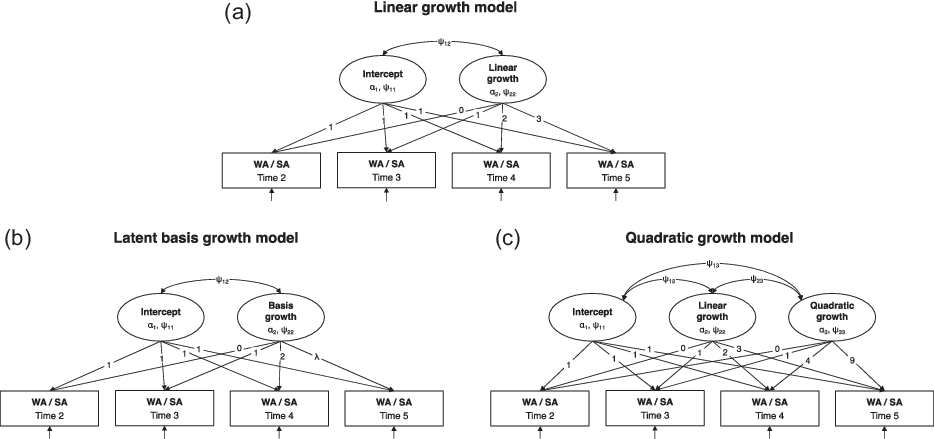
The analyses were performed in two steps. First, to capture the growth trajectories of each morphological awareness task, three types of unconditional LGCMs, namely a linear growth model, a latent basis growth model, and a quadratic growth model, were estimated separately for Word Analogy and Sentence Analogy (see Figure 1). In the linear growth models, the factor loadings of the linear term were set to 0, 1, 2, and 3 for Times 2–5, respectively. In the latent basis growth models (Ram & Grimm, Reference Ram, Grimm, Overton, Molenaar and Lerner2015), to capture the score improvement due to the item addition in Word Analogy at Time 5, the factor loadings were set to 0, 1, and 2 for Times 2–4, respectively, while that of Time 5 was allowed to change freely. The same factor loadings were applied to Sentence Analogy for consistency and comparison. Finally, in the quadratic growth models, the factor loadings of the linear term were set to 0, 1, 2, and 3, while those of the quadratic term were set to 0, 1, 4, and 9, respectively. In all models, the intercept term represents each child’s estimated score at the end of Grade 1 when the growth terms are zero; both the linear growth term and the latent basis term represent each child’s estimated rate of change; the quadratic term allowed each child’s growth trajectory to be curvilinear (i.e., acceleration or deceleration; Ram & Grimm, Reference Ram, Grimm, Overton, Molenaar and Lerner2015). Second, conditional LGCMs predicting the initial status and the growth terms of the morphological awareness tasks by the cognitive skills (vocabulary, phonological awareness, and letter knowledge) were estimated (see Figures 2 and 3). Nonverbal IQ and phonological short-term memory were included in the models as control variables.
Unconditional Growth Curve Models. WA = Word Analogy; SA = Sentence Analogy. α1–α3 = estimated mean values of the growth factors; ψ11–ψ33 = variances of the growth factors; ψ12–ψ23 = covariances between the growth factors; λ = factor loading at Time 5 (for details, see Statistical Analysis).
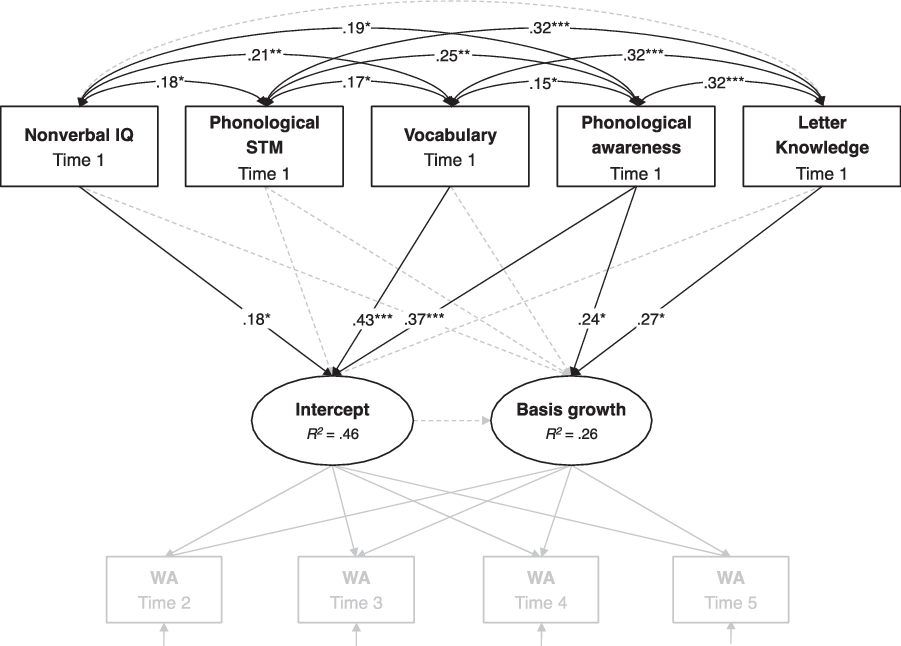
Conditional Growth Curve Model for Word Analogy. Standard solutions are shown. Solid lines indicate significant paths, and dashed lines indicate nonsignificant paths. Phonological STM = phonological short-term memory; WA = Word Analogy.
*p < .05. **p < .01. ***p < .001.
Conditional Growth Curve Model for Sentence Analogy. Standard solutions are shown. Solid lines indicate significant paths, and dashed lines indicate nonsignificant paths. Phonological STM = phonological short-term memory; SA = Sentence Analogy. The residual variance of the quadratic growth factor was fixed to zero.
*p < .05. **p < .01. ***p < .001.

All analyses were conducted using Mplus 8 (Muthén & Muthén, Reference Muthén and Muthén1998–2017), and missing data were handled by the full information maximum likelihood estimation (Graham, Reference Graham2009; Jeličić et al., Reference Jeličić, Phelps and Lerner2009). Model fits were examined using chi-square values and four fit indices: the comparative fit index (CFI), the Tucker–Lewis index (TLI), the root-mean-square error of approximation (RMSEA), and the standardized root-mean-square residual (SRMR). A nonsignificant chi-square value, CFI and TLI values above .95, an RMSEA value below or at .06, and an SRMR value below .08 indicate a good model fit (Kline, Reference Kline2015). All data and analysis codes are available online at https://osf.io/f7kg2/.
Results
Descriptive statistics and correlations
Descriptive statistics for the variables in the study are shown in Table 1. Prior to conducting further analyses, we examined the distributional properties of the measures. The skewness and kurtosis values were in the acceptable range (absolute values of skewness < 3.0, absolute values of kurtosis < 10.0; Kline, Reference Kline2015). The zero-order correlations among the variables are shown in Table 2. The correlations between the predictor variables and the morphological awareness measures ranged from .13 to .42 for Word Analogy and from .13 to .50 for Sentence Analogy. Among the predictor variables, phonological awareness showed the strongest correlations with both morphological awareness measures (rs = .33 to .50). In addition, vocabulary correlated moderately with Word Analogy (rs = .35 to .41), while letter knowledge (rs = .22 to .34) and phonological short-term memory (rs = .16 to .42) correlated weakly to moderately with Sentence Analogy.
Descriptive statistics for the measures used in the study
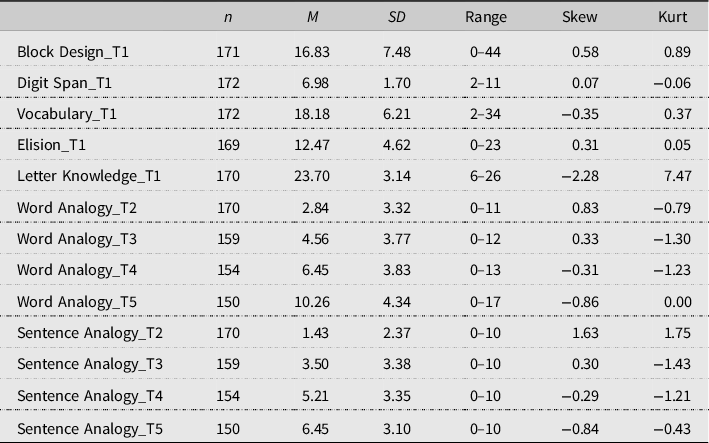
Note. Skew = skewness; Kurt = kurtosis; T1 = Time 1; T2 = Time 2; T3 = Time 3; T4 = Time 4; T5 = Time 5.
Zero-order correlations between the variables
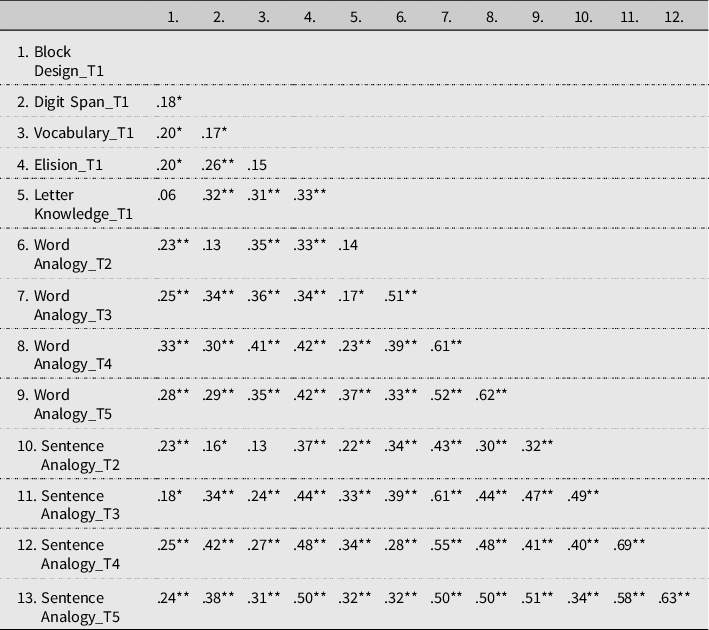
Note. T1 = Time 1; T2 = Time 2; T3 = Time 3; T4 = Time 4; T5 = Time 5.
*p < .05; **p < .01.
Growth curve models
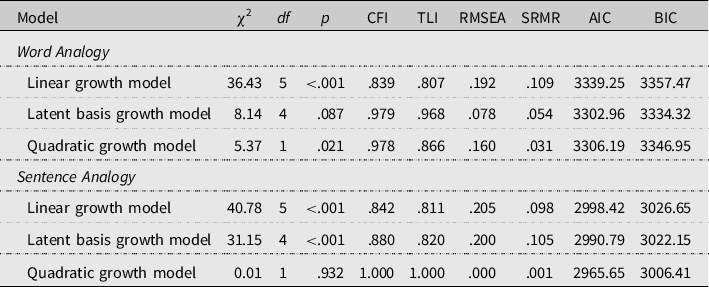
Next, unconditional LGCMs were estimated for the two morphological awareness measures (see Figure 1). The results are shown in Table 3. For Word Analogy, the latent basis growth model fit the data well, and the likelihood-ratio tests showed that its model fit was significantly better than the linear growth model (Δχ2 = 28.29, df = 1, p < .001) and comparable to the quadratic growth model (Δχ2 = 2.77, df = 3, p = .428). In addition, both the Akaike information criterion and the Bayesian information criterion indicated that the model fit was better for the latent basis growth model than for the other models. For Sentence Analogy, the quadratic growth model fit the data significantly better than the linear growth (Δχ2 = 40.77, df = 4, p < .001) and latent basis growth models (Δχ2 = 9.63, df = 1, p = .002). Therefore, the latent basis growth model for Word Analogy and the quadratic growth model for Sentence Analogy were used in further analysis. The parameter estimates for the two models are shown in Table 4. The variances of all latent growth factors (ψ11, ψ22, ψ33) were statistically significant in both models, indicating substantial individual differences in the growth trajectories in both tasks. It should be noted that the covariance between linear growth and quadratic growth (ψ23) in Sentence Analogy was significant and negative (estimate = −1.68, p < .01), suggesting that the growth rate decelerated more among children who initially improved their performance faster than their peers.
Model fit indices for the unconditional growth curve models
Parameter estimates for the unconditional growth curve models
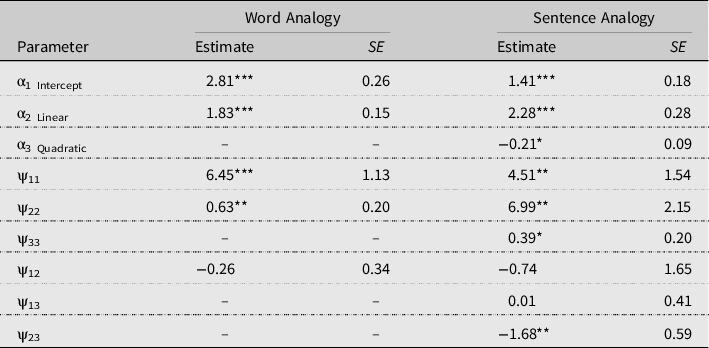
Note. Unstandardized estimates in the latent basis model for Word Analogy and the quadratic growth model for Sentence Analogy are shown. Dashes indicate parameters that were not estimated. α1–α3 = estimated mean values of the growth factors; ψ11–ψ33 = variances of the growth factors; ψ12–ψ23 = covariances between the growth factors.
*p < .05; **p < .01; ***p < .001.
Finally, the conditional LGCMs were estimated (see Figures 2 and 3). The residual variance of the quadratic growth factor in Sentence Analogy was negative, and it was fixed to zero. Both models fit the data very well (Word Analogy: χ2 = 21.48, df = 14, p = .09, CFI = .98, TLI = .95, RMSEA = .06, 90% CI [.00, .10], SRMR = .04; Sentence Analogy: χ2 = 1.85, df = 7, p = .97, CFI = 1.00, TLI = 1.00, RMSEA = .00, 90% CI [.00, .00], SRMR = .01). The results showed that for Word Analogy, vocabulary (β = .43, p < .001) and phonological awareness (β = .37, p < .001) were significantly associated with the initial status after controlling for the effects of nonverbal IQ and phonological short-term memory. Additionally, phonological awareness (β = .24, p < .05) and letter knowledge (β = .27, p < .05) predicted the growth factor of Word Analogy. The effect of the initial status on the growth factor was not statistically significant. In turn, phonological awareness predicted the initial status (β = .33, p < .001), linear growth (β = .28, p < .05), and quadratic growth (β = .10, p < .05) of Sentence Analogy after controlling for the effects of the other variables. Phonological short-term memory predicted the linear growth (β = .27, p < .05), which, in turn, negatively predicted the quadratic growth (β = –1.07, p < .001) after controlling for the initial status. The initial status also negatively predicted the quadratic growth of Sentence Analogy (β = –.19, p < .001).
Post-hoc analysis
Given the fact that we operationalized the construct of morphological awareness with the two different tasks (Word Analogy and Sentence Analogy), we performed post-hoc exploratory analyses to examine the association between the skills being measured by them as well as their growth components. First, we estimated a longitudinal scalar invariance model for morphological awareness as a single factor. The model showed a poor fit (χ2 = 188.72, df = 22, p < .001, CFI = .69, TLI = .60, RMSEA = .21, 90% CI [.18, .24], SRMR = .29), suggesting that the two tasks measured at least partly different skills across time points. Second, we estimated a parallel process growth model that combined the unconditional LGCMs for the two tasks. The model showed an acceptable fit (χ2 = 25.30, df = 11, p = .008, CFI = .97, TLI = .93, RMSEA = .09, 90% CI [.04, .13], SRMR = .06), and the correlation between the growth components of the two tasks was weak and nonsignificant (r = .20, p = .34). This result suggests that the growth rates in the two morphological awareness measures may not be associated in individual children. These results are in line with our assumption that the two tasks would tap into partly different aspects of morphological awareness (i.e., derivational and inflectional morphological awareness). Therefore, in what follows we discuss the growth trajectories of the two morphological awareness measures rather than the development of morphological awareness as a unitary construct. Full results of the models are available at https://osf.io/f7kg2/.
Discussion
The present study examined the early growth of morphological awareness (assessed with Word Analogy and Sentence Analogy) and its cognitive predictors among English-speaking children followed from Grade 1 to Grade 3. The results showed that the growth in Word Analogy (involving both inflectional and derivational morphological awareness) continued over the three years, while the growth in Sentence Analogy (involving only inflectional morphological awareness) decelerated during the same period. Vocabulary and phonological awareness were associated with the initial status of Word Analogy, and phonological awareness and letter knowledge predicted its growth rate. In contrast, phonological awareness alone predicted both the initial status and the two growth components of Sentence Analogy. Our findings, together with those of previous studies (e.g., Apel et al., Reference Apel, Diehm and Apel2013, Reference Apel, Henbest and Petscher2022; Berninger et al., Reference Berninger, Abbott, Nagy and Carlisle2010; Carlisle & Nomanbhoy, Reference Carlisle and Nomanbhoy1993; Chiat, Reference Chiat2001; Kieffer & Lesaux, Reference Kieffer and Lesaux2012; Ku & Anderson, Reference Ku and Anderson2003), reveal several important growth patterns that we discuss below.
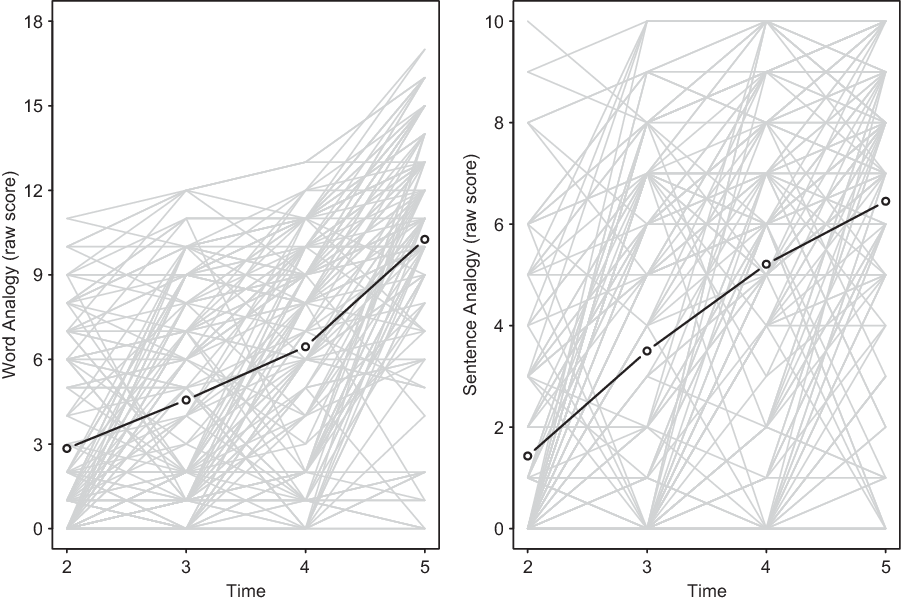
Regarding the growth trajectories, we found different patterns for the two morphological awareness tasks: a continued growth in Word Analogy and a curvilinear decelerating growth in Sentence Analogy. There are at least two explanations for these results. First, the results may reflect the fact that whereas Sentence Analogy tapped only into inflectional morphological awareness, Word Analogy involved both inflectional and derivational morphological awareness. Previous studies have shown that most children can develop the knowledge of inflectional morphology (e.g., cat, cat-s; walk-ing, walk-s, walk-ed) relatively early, usually by middle grades, while their understanding of derivational morphology (e.g., farm-er; un-fair, de-rail) continues to develop throughout the primary grades (e.g., Berninger et al., Reference Berninger, Abbott, Nagy and Carlisle2010; Kuo & Anderson, Reference Kuo and Anderson2006; Nagy et al., Reference Nagy, Diakidoy and Anderson1993; see also Diamanti et al., Reference Diamanti, Benaki, Mouzaki, Ralli, Antoniou, Papaioannou and Protopapas2018). In particular, the curvilinear growth of Sentence Analogy suggests that the growth of inflectional morphological awareness was decelerating in many children by Grade 3. The initial status and the linear growth negatively predicted the quadratic growth of Sentence Analogy (see Figure 3), indicating that the growth rate decelerated faster among children who had a higher initial skill and improved their performance faster than their peers. Second, the different growth patterns might have been due to the difference in task difficulty. That is, some of the items in Word Analogy may have been more challenging for children than those in Sentence Analogy because the former contained a wider range of morphological suffixes (e.g., -y, -s, -er, -th, -ion) than the latter (e.g., -s, -ed, -ing; see Deacon et al., Reference Deacon, Wade-Woolley and Kirby2007; Kirby et al., Reference Kirby, Deacon, Bowers, Izenberg, Wade-Woolley and Parrila2012). In fact, whereas 9.7% and 15.3% of our participants reached a ceiling on Sentence Analogy at the end of Grade 2 and the beginning of Grade 3, respectively, none of the participants reached a ceiling on Word Analogy by Grade 3 (Figure 4). This may have resulted in the continued growth of the children’s performance on Word Analogy over the period.
Observed Score Trajectories for the Morphological Awareness Measures. Each of the gray lines connects the data points of a single child over the four time points, and the black lines connect the average scores at each time point. The maximum scores for Word Analogy were 14 at Times 2–4 and 18 at Time 5; the maximum score for Sentence Analogy was 10 across time points.
As hypothesized, vocabulary was associated with the initial status of Word Analogy, but not of Sentence Analogy. This result suggests that early vocabulary knowledge provides a basis for morphological awareness, particularly for derivational morphological awareness (e.g., Carlisle & Nomanbhoy, Reference Carlisle and Nomanbhoy1993; Cunningham & Carroll, Reference Cunningham and Carroll2015; Fowler et al., Reference Fowler, Feldman, Andjelkovic, Oney, Assink and Santa2003; Kieffer & Lesaux, Reference Kieffer and Lesaux2012). Arguably, the more words children know the meaning of, the more likely they are to be able to make links between words that share morphemic units and therefore become aware of morphemes. This would be particularly relevant to derivational morphology because it can produce new derivations of known words by attaching morphemes (e.g., fun – funny; bake – baker; act – action). On the other hand, vocabulary did not predict the growth rate of either Word Analogy or Sentence Analogy after controlling for the effects of the other variables, including the initial status. This result was surprising given the previous findings showing the close association between vocabulary and morphological awareness (e.g., Kieffer & Lesaux, Reference Kieffer and Lesaux2012; Li & Kirby, Reference Li and Kirby2014). One possible explanation for these results is that the growth rate of morphological awareness may be more associated with the speed of growth rather than the performance level at a certain time point in vocabulary development (see Kieffer & Lesaux, Reference Kieffer and Lesaux2012). In fact, Kieffer and Lesaux (Reference Kieffer and Lesaux2012) showed that neither intercept of derivational morphological awareness nor that of vocabulary knowledge predicted the slope of derivational morphological awareness, while there was a strong relationship between the slopes of derivational morphological awareness and vocabulary knowledge (i.e., children with rapid growth in derivational morphological awareness also demonstrated rapid growth in vocabulary). However, it is also possible that our Word Analogy and Sentence Analogy tasks used relatively simple words (see Deacon et al., Reference Deacon, Wade-Woolley and Kirby2007; Kirby et al., Reference Kirby, Deacon, Bowers, Izenberg, Wade-Woolley and Parrila2012), which may have led to the lack of effect of vocabulary on the growth rate of the two tasks.
Our results further showed that phonological awareness was associated with the initial status of Word Analogy. This was not surprising given the fact that our Word Analogy task required children to manipulate morphemes in orally presented words by applying the morphological relationship of the original word pair to the target pair (Kirby et al., Reference Kirby, Deacon, Bowers, Izenberg, Wade-Woolley and Parrila2012). However, it should be noted that phonological awareness was also associated with the initial status of Sentence Analogy even after controlling for the other variables, including nonverbal IQ and phonological short-term memory. These results suggest that children’s morphological awareness, whether it is derivational or inflectional, is significantly supported by children’s awareness and manipulation of phonological units in words. This interpretation is in line with the previous findings by Carlisle and Nomanbhoy (Reference Carlisle and Nomanbhoy1993) showing that children with deficient phoneme manipulation had severe difficulties in becoming aware of the productive morphemes in words (see also Joanisse et al., Reference Joanisse, Manis, Keating and Seidenberg2000). Phonological awareness and letter knowledge predicted the growth rate of Word Analogy, and phonological awareness also predicted the two growth components of Sentence Analogy after controlling for the effect of the intercept (see Figures 2 and 3). The latter result indicates that children with higher phonological awareness skills initially improve their inflectional morphological awareness more quickly, resulting in a quicker deceleration later. These results provide further evidence for the close relationship between early morphological awareness and phonological awareness (Casalis & Luis-Alexandre, Reference Casalis and Louis-Alexandre2000; Cunningham & Carroll, Reference Cunningham and Carroll2015; Deacon & Kirby, Reference Deacon and Kirby2004; Law & Ghesquière, Reference Law and Ghesquière2017).
Our findings, together with those of previous longitudinal studies showing the reciprocal relationship between morphological awareness and literacy development (Deacon et al., Reference Deacon, Benere and Pasquarella2013; Hulme et al., Reference Hulme, Zhou, Tong, Lervåg and Burgoyne2019; Manolitsis et al., Reference Manolitsis, Georgiou, Inoue and Parrila2019), suggest that it may be code-related skills (phonological awareness and letter knowledge) rather than oral language (vocabulary knowledge) that drive the early development of morphological awareness during the first years of formal literacy instruction, possibly through making children independent readers (e.g., Chiat, Reference Chiat2001; Manolitsis et al., Reference Manolitsis, Georgiou, Inoue and Parrila2019). With sufficient exposure to print and literacy instruction, children may begin to recognize how certain words contain common and specific visual elements in addition to common elements of sound and meaning (Apel et al., Reference Apel, Diehm and Apel2013; Nunes et al., Reference Nunes, Bryant and Bindman2006). Children can then merge these three types of elements, allowing for more complex morphemic analysis and decomposition of multimorphemic words. This, in turn, allows children to read and spell more complex material, further increasing their exposure to novel words. This interpretation is consistent with the morphological pathways framework (Levesque et al., Reference Levesque, Breadmore and Deacon2021), which posits a reciprocal relationship between the orthographic (graphemes and morphemes) and linguistic (phonology, syntax, and morphology) systems. However, another possible interpretation is that the measures of phonological awareness and morphological awareness used in the study had similar task requirements that may have inflated the observed association between them due to method covariance (Deacon & Kirby, Reference Deacon and Kirby2004; Deacon et al., Reference Deacon, Parrila, Kirby, Manis, Fawcett, Reid and Siegel2008). Indeed, both Word Analogy and Sentence Analogy could at least partly be performed with a simple phonological strategy (Kirby et al., Reference Kirby, Deacon, Bowers, Izenberg, Wade-Woolley and Parrila2012). It should also be noted that the lack of impact of vocabulary on the growth rates of the morphological awareness tasks might have been due to the relatively simple words used in the morphological awareness tasks, as mentioned above. The predictors we included left a significant amount of variance in the growth components unaccounted for, and further studies are clearly needed to verify the mechanisms responsible for the predictive role of letter knowledge and phonological awareness in the growth of morphological awareness.
Overall, the findings of this study add a developmental perspective to the existing theoretical models of the role of morphology in reading, such as the binding agent hypothesis (Kirby & Bowers, Reference Kirby, Bowers, Cain, Compton and Parrila2017) and the morphological pathways framework (Levesque et al., Reference Levesque, Breadmore and Deacon2021), by revealing the growth trajectories of the two morphological awareness tasks and the predictors over the first three years of formal literacy instruction. Different aspects of morphological awareness likely follow different growth trajectories (Berninger et al., Reference Berninger, Abbott, Nagy and Carlisle2010), and the cognitive skills involved in each growth may vary across the aspects and developmental phases. We argue that the current theories on the role of morphology in reading may need to be reconsidered to treat children’s morphological awareness as a developmentally dynamic, multidimensional construct rather than a static, unitary construct. An important educational implication of our findings is that early morphological instruction is likely to be more effective when combined with instruction in phonological awareness and letter knowledge. This can provide a push for the early development of derivational and inflectional morphological awareness, which, in turn, would facilitate later word reading, spelling, and reading comprehension (e.g., Carlisle, Reference Carlisle2010).
Some limitations of the present study should be mentioned. First, our findings may not generalize to the languages with different morphological structures than English or to different ages of participants we had in our sample. A future study should examine the growth trajectories of morphological awareness across a wider range of languages and ages. Second, we assessed each cognitive skill with a single measure. In addition, our participants were nearing a ceiling in letter knowledge, which might have led to a potential underestimation of its impact. Further studies are needed to replicate the current findings using a broader assessment of each construct. Third, since we assessed the cognitive skills only at the first assessment point, we could not examine the reciprocal relationship between those skills and morphological awareness (see Pan et al., Reference Pan, Song, Su, McBride, Liu, Zhang, Li and Shu2016; Sparks & Deacon, Reference Sparks and Deacon2015, for preliminary evidence on this). Finally, the two morphological awareness tasks used in the study were adopted from different studies (Deacon et al., Reference Deacon, Wade-Woolley and Kirby2007; Kirby et al., Reference Kirby, Deacon, Bowers, Izenberg, Wade-Woolley and Parrila2012) and thus were not strictly comparable. Thus, we should note that the observed differences in the growth trajectories and the predictors might be partly due to task-specific characteristics (e.g., the number of items, presenting words individually or within a sentence context) rather than the aspects of morphology involved. The findings need to be replicated with possibly more comparable measures that can tap specifically into each aspect of morphology. Additionally, we only examined the growth of inflectional and derivational morphological awareness in our study and did not include compounding morphological awareness, another important aspect of morphology in English (see Lee et al., Reference Lee, Wolters and Kim2022; Marks et al., Reference Marks, Labotka, Sun, Nickerson, Zhang, Eggleston, Yu, Uchikoshi, Hoeft and Kovelman2023). A future study should examine the development of all three aspects of morphological awareness and the cognitive predictors in the same study.
In conclusion, the present study examined the growth trajectories of morphological awareness (assessed with Word Analogy and Sentence Analogy) and its predictors among English-speaking children followed from Grade 1 to Grade 3. Our results indicate that children’s performance on Word Analogy (involving both inflectional and derivational morphological awareness) continued to grow over the three years of our study, while the growth of Sentence Analogy (involving only inflectional morphological awareness) slowed down during the same period. Vocabulary was more closely associated with the initial status of Word Analogy, while phonological awareness predicted the growth in both morphological awareness tasks after controlling for the initial status. Moreover, letter knowledge predicted the growth of Word Analogy. These findings suggest that while oral language skills may provide a basis for initial morphological awareness, early code-related skills drive the further development of morphological awareness during the first three years of formal literacy instruction.
Replication package
All data and analysis code that support the findings of this study are available online at https://osf.io/f7kg2/.
Financial support
This study was funded by a Social Sciences and Humanities Research Council of Canada grant to the second author (RES0002344) to George Georgiou.
Conflict of interest
On behalf of all authors, the corresponding author states that there is no conflict of interest.


 Open access

