

In the late nineteenth and early twentieth centuries, Aymara communities at the western edges of Bolivia’s Cordillera Real saw a series of foreign mountaineers arrive to climb the range’s sacred peaks. They watched these men and one woman move through their communities en route to the range’s glaciated summits that Aymara community members revered as gods. Men from communities and haciendas at the base of the highest mountains served as porters for these expeditions, earning wages that mountaineers offered them. But these porters time and again refused to follow these intruders onto the ice, out of respect and out of fear. For Aymara communities, glaciers were deities, animate beings who demanded and deserved reverence and deference. When treated with respect, mountain deities whom the Aymara called achachilas provided for communities. But when neglected or trampled upon, they might well unleash their wrath. From an Aymara perspective, foreign mountaineers who trod on glaciers not only risked their own safety; they also threatened Aymara communities who lived beneath these magnificent gods.
Perhaps the most irreverent of all the foreign mountaineers who climbed in the Cordillera Real during the heyday of mountaineering in the late nineteenth and early twentieth centuries was the British mountaineer William Martin Conway. After having spent more than two decades climbing in the Alps and the Himalayas, Conway came to Bolivia in 1898 planning to summit Illimani and Illampu, the Cordillera Real’s highest mountains. During each of these expeditions, Conway and the Aymara porters he hired came into conflict about how and whether to proceed onto glaciers due to their diametrically opposed beliefs about mountains and glaciers, which were in turn deeply connected to differing ideas about race, gender, nature, and the sublime.
This article considers how European mountaineers, Bolivian elites, and Aymara communities perceived mountains, glaciers, and one another in the final years of the nineteenth century at the height of a campaign to dispossess Indigenous communities of collective landholdings. To do so, it takes a microhistorical approach, focusing on the interactions among Aymara community members, members of the Sociedad Geográfica de La Paz, and the British mountaineer Martin Conway and his Swiss guides during Conway’s Reference Conway1898 climbs in the Cordillera Real. Drawing on the accounts of Conway and others, it reconstructs these expeditions to consider how mountains and glaciers figured into these groups’ worldviews and daily activities, and how differing ideas about mountains and glaciers both reflected and shaped ideas about race, gender, and nature.
I argue that Aymara villagers, Bolivian geographers, and foreign mountaineers were all devoted to glaciated mountains, but in different ways and for diverging purposes. Aymara communities revered glaciated mountains as gods and protectors and therefore usually stayed off the ice. Illimani was a defining symbol of their capital city, but paceño elites and state builders’ plans to link the capital with the lush Yungas on the range’s eastern flank led them around rather than onto glaciers. For foreign mountaineers like Conway, mountains and glaciers were sites of adventure, sport, masculine conquest, and potential profit. These divergent approaches to mountains and glaciers, which were influenced by imperial power, racial and gender ideologies, ethnic and class oppression, and spirituality, led to conflicts between European mountaineers and Aymara community members who saw one another’s actions as threatening to their security.
Studies of mountaineering history have ably traced British, European, and US American mountaineers’ approaches to mountain climbing in the Andes in this period (Carey Reference Carey2012; Debarbieux and Rudaz Reference Debarbieux and Rudaz2015; Reidy Reference Reidy2015; Schaumann Reference Schaumann2020). The first histories of the so-called age of mountaineering in the Andes (from around 1890 to 1930) were celebratory accounts written by mountain climbers themselves. Scholars have critiqued these sexist, racist, and neo-imperial narratives (Ellis Reference Ellis2001; Logan Reference Logan, Vivanco and Gordon2006; Poole Reference Poole, Joseph, LeGrand and Salvatore1998) and shown how local groups participated in, as the historian Mark Carey (Reference Carey2012, 110, 112) writes, “the production and consumption of commodities, natural resources, and landscapes” and “used the European activities to further their own agendas.” But we know little about Andean Indigenous perspectives on mountains, glaciers, and foreign mountaineers, or about how differing ideas influenced Indigenous-mountaineer interactions. This article contributes to mountaineering history by considering how European mountaineers and Indigenous communities thought about and related to mountains and glaciers and how differing approaches shaped mountaineers and local Indigenous people’s relationships with one another.
Over the past several decades, flourishing scholarship has explored how Indigenous identities, politics, and cultures have changed since independence (Condarco Morales Reference Condarco Morales1965; Rivera Cusicanqui Reference Rivera Cusicanqui1984; Choque Canqui Reference Choque Canqui1998; Larson Reference Larson2004; Gotkowitz Reference Gotkowitz2008; Ari Reference Ari2014; Mendieta Reference Mendieta2010; Soliz Reference Soliz2021). Environmental historians have shown how Andean Indigenous peoples have shaped nonhuman nature and how nature has mediated relationships among different groups (Carey Reference Carey2010; Klubock Reference Klubock2014; Hines Reference Hines2022; Puente Reference Puente2023). Anthropologists have documented Andean Indigenous communities’ long-standing material and spiritual relationships with mountains and glaciers (De la Cadena Reference De la Cadena2015; Rasmussen Reference Rasmussen2015; Paerregaard Reference Paerregaard2023). But little has been written about Andean Indigenous people’s ecological knowledge, politics, and experiences in relation to the Andes’ mountainous environment over the long term. This article contributes to Andean Indigenous history by centering Aymara perspectives on mountains, glaciers, and foreign mountaineers during a period of intense social, political, and economic change in the Bolivian Andes. To this end, this article adopts a montología framework that “includes the ontological perspectives of mountain peoples in an analysis that takes into account both material and spiritual concerns” (Haller and Branca Reference Haller and Branca2020, 318).
It is necessary to tread carefully when using travel narratives produced by outsiders, especially during this time of British imperial expansion, when men like Martin Conway took scientific-racist ideas for granted. As the Maori scholar of Indigenous education Linda Tuhiwai Smith (Reference Tuhiwai Smith2012, 8) writes, “Travellers’ tales … represented the Other to a general audience back in Europe…. [S]tories which told of savagery and primitivism generated further interest.” Conway’s accounts of his climbs in the Cordillera Real were typical of late nineteenth-century British mountaineers’ “ascent narratives” that grandiosely documented attempts to summit previously unconquered peaks for fellow mountaineers and popular audiences (Debarbieux and Rudaz Reference Debarbieux and Rudaz2015, 109). Like other European and US American mountaineers, Conway treated the Aymara porters he hired as beasts of burden and derided their “superstitious” fears of stepping on glaciers (Wiener [Reference Wiener1880] 1993; Peck Reference Peck1911; Reidy Reference Reidy2015; Schaumann Reference Schaumann2020). This is no surprise, given that European, US American, and Bolivian elites at the time believed that Andean Indigenous people were intrinsically backward and bound to be subsumed into dominant creole culture as a subordinated laboring class (Irurozqui Reference Irurozqui1993, 11).
Nevertheless, expedition accounts like Conway’s not only offer an opportunity to understand and critique European perspectives but also provide windows into the experiences and perspectives of Indigenous people, especially when read alongside other sources. Recognizing that travel narratives like Conway’s were products and tools of imperialism, and internal colonialism in the case of paceño geographers, I read them “against the grain” and alongside other sources to consider outsiders’ as well as Indigenous people’s experiences, knowledge, and ideas (Qayum Reference Qayum and Dunkerley2002; Pratt Reference Pratt2007; Stoler Reference Stoler2010). The following account of Conway’s attempts to summit Illimani and Illampu illuminates the ways that divergent racialized and gendered ideas about mountains and glaciers shaped foreign mountaineers, paceño geographers, and Aymara community members’ perceptions and experiences of a mountainous environment and one another in this moment of social and economic shifts and racial strife.
Achachilas, resources, and adversaries
Bolivia’s Cordillera Real stretches from the mountain Illampu off the shores of Lake Titicaca northwest of the city of La Paz to Illimani, the majestic ice-capped mountain southeast of the capital city. To the west lies the Altiplano (high plains). To the east stretch the lush foothills and valleys of the Yungas and the Amazon basin beyond (See Figure 1). The glaciers that cap the range’s peaks have long supplied drinking and irrigation water to Altiplano and mountainside farming communities and towns. In the rainy season during the austral summer, from November to April, snowmelt and avalanches are more frequent. During dry winter months, in contrast, glaciers grow, and snow and ice fields harden. These cold, dry months, from June to September, have historically been the safest and easiest times to climb snow- and ice-covered mountains.
In the late nineteenth century, Aymara people revered glaciated mountain peaks as achachilas, protective ancestral spirits, and usually did not climb them. The Aymara word achachila means “grandfather” or “ancestor.” Whereas in previous centuries, Aymaras had worshipped ancestors who had emerged from and been buried in the mountains, by the nineteenth century, mountains and ancestors—and their worship—had fused (Gose Reference Gose2008). As Manuel Rigoberto Paredes, an Aymara- and Spanish-speaking author and politician of Aymara origin, explained in 1920, “when over time [corpses] crumbled into dust and disappeared, [Aymaras] began worshipping the hill or place where they had been accustomed to worship them, believing that they had been transformed into that hill, stone, or river, which became achachilas” (263). Every Aymara community had its own specific achachila, a guardian mountain that it depended on and worshipped with the same sacrifices and music as before.
Aymara names for glaciated mountains reflected their reverence and respect for these achachilas as well as their roles as male providers of water to the Pachamama, Mother Earth. The achachila of communities southeast of La Paz was Illimani, from the Aymara hila umani, meaning “he who gives water,” although they sometimes called the mountain Uyu-iri, meaning “feeder or provider for our homes.” Illampu was named for Illapa, the Aymara god of thunder and rain, and the Aymara word illampa, meaning “lightning.” The name of its twin peak, Ancohuma, comes from the Aymara words for “white” and “water,” hanko and uma (Bandelier Reference Bandelier and Ballivián1900, 8–9). Mountains’ virile glacial water provided for the Pachamama’s soil.
For Aymaras, mountains served as refuges from preying authorities and hacendados, places to graze their animals, and sources of protection, water, and, hopefully, favorable weather in this period. Before tilling the soil, Aymara farmers asked their achachilas for protection against drought and frost, pouring corn beer (chicha) and spitting coca on the damp ground. Throughout the growing season they requested rain and abundant crops from them. When farmers spotted signs that hail or frost were imminent, they called on spiritual leaders called yatiris to perform ceremonies at mountainside temples and altars appealing to the achachilas and Pachamama for good weather. When drought hit, farmers prayed to mountain lakes, rivers, and clouds; brought cups of water from the mountain lakes and rivers to their fields; and placed figurines of frogs and other aquatic animals on hilltops as offerings. Children bearing crosses and lit candles would climb mountainsides and hills, singing, “Have mercy, Lord. Give us water for God’s sake” (Paredes Reference Paredes1920, 106).
Travelers prayed to achachilas for protection before departure and along the way. Upon reaching a hill or mountaintop, the traveler would approach its apacheta, a pile of rocks left by other voyagers that served as an altar. Bowing to the mountain on hands and knees, the traveler would pray, “I make this offering to you so that you give me strength, take the weariness from my body, and protect me from misfortune.” He would then add a rock to the pile along with other items he had with him: some chewed coca, a bit of toasted corn, a sandal, perhaps a feather. He would then stand, pull out an eyebrow or eyelash, and blow it toward the mountain as a final offering (Forbes Reference Forbes1870, 237–238; Paredes Reference Paredes1920, 34, 135).
Aymaras generally viewed their achachilas as benevolent protectors. According to Paredes (Reference Paredes1920, 32–33), who was born in 1870 and grew up in a small Aymara community along Lake Titicaca, Aymaras believed that mountain ancestors “never forget to watch over the wellbeing of their descendants.” When ignored or abused, however, achachilas might send damaging hail, frost, or winds. Maintaining deferential and reciprocal relations of respect and reverence with animate mountains was thus crucial to individual and community well-being.
Whereas in other parts of the world, people retreat to mountains to escape the state (Scott Reference Scott2009, 39, 129), in the Bolivian Andes, where the capital city is nestled in the heart of the mountains, Indigenous people have had no choice but to engage with imperial and national states, whether Inca, Spanish, or Bolivian, and foreign travelers like Conway. Indeed, they have played a major role in fashioning these states and have engaged with them for their own purposes. The decade of the 1890s was a key instance of this. After the national government passed and began to enforce laws aimed at dispossessing communities of their collective landholdings, starting in earnest in the 1870s, Aymara communities rebelled, worked through the legal system, and formed a wartime alliance with the Liberal Party to defend communal lands (Condarco Morales Reference Condarco Morales1965; Larson Reference Larson2004; Gotkowitz Reference Gotkowitz2008; Hylton Reference Hylton2010; Mendieta Reference Mendieta2010; Larson Reference Larson2024). Conway’s Reference Conway1898 expedition occurred just before the 1899 Federal War, which pitted the Liberal Party–Aymara alliance against the reigning Conservative Party. This was a moment of possibility, both for paceño Liberals who aimed to consolidate and expand their economic and political power and for Aymara leaders and community members intending to use the Liberal-Conservative conflict to regain community land and establish shared political power with creole Liberals. At the time of Conway’s arrival in 1898, the Aymara movement did not know that this moment of possibility would soon abruptly and violently close.
Like their counterparts around Latin America in these years, paceño elites wanted to attract European investment and immigrants to develop the country and region’s economy and whiten its population. They saw the rich lands and resources surrounding the Cordillera Real, as well as Indigenous laborers, as key to attracting foreign investment and immigrants and fueling regional economic growth. In the 1880s, the paceño geographers Carlos Bravo and Eduardo Idiaquez conducted a study of possible routes through the Cordillera Real to the Yungas and of potential marketable goods there. In their 1886 report, Bravo and Idiaquez gendered Yungas land as feminine and virginal and men like themselves as virile agents who would penetrate it to make it bloom. “The land is virgin,” they wrote. “It encloses the most precious things that nature has deposited there, and the traveler who penetrates this secluded mansion to surprise those treasures has to admire” its “colossal” riches (Bravo and Idiaquez Reference Bravo and Idiaquez1886, 23). They portrayed the region’s Indigenous people as a natural feature of this virgin land, though a “disobedient,” “rebellious,” and less desirable one (Bravo and Idiaquez Reference Bravo and Idiaquez1886, 35). They concluded that there was potential for gold mining as well as expanded cultivation of coca, quinine, coffee, sugarcane, medicinal plants, dyes, and hardwoods, and they proposed potential routes through the mountains that would circumvent the formidable glaciated mountains that divided the capital city from its Yungas bride.
Bravo and Idiaquez helped found the Sociedad Geográfica de La Paz in 1889 and became its secretary and treasurer, respectively. In the decades that followed, the society spearheaded efforts to gather information about the region’s land, resources, and Aymara people that could help the region become more productive. Paceño elites looked to Illimani and Illampu as sources of strength and pride in the decades after independence, writing poems and invoking them in border conflicts with Peru (e.g., Felipe y Santiago Reference Felipe y Santiago1852). But by the late nineteenth century they were more interested in mountains’ resources than in their beauty. The society’s members were not interested in summiting glaciated peaks themselves, but they welcomed foreign mountaineers who offered connections with Europe, from where, they hoped, immigrants and investment would flow. Foreign mountaineers also created maps and conducted studies of natural resources useful for paceño geographers and state officials’ state- and economy-building agendas. While European geographical associations bolstered imperial projects, geographical societies in Latin America like the Sociedad Geográfica de La Paz (SGLP) promoted national projects that aimed to extend state and creole control over rural Indigenous hinterlands (Qayum Reference Qayum and Dunkerley2002, 278–279). Many SGLP members served in leading government positions from the 1980s to the 1920s (Mendieta Reference Mendieta2025, 133–136).
Scientists and other travelers from Europe had long been interested in the people and geography of the Andes. Most famously, the Prussian naturalist Alexander von Humboldt had traveled the region from 1799 to 1804, developing theories about human-generated climate change and biodistribution that often drew on local creoles’ ideas even as he disparaged their contributions (Cañizares-Esguerra Reference Cañizares-Esguerra2006, 112–128; Cushman Reference Cushman2011, 19–44). After Bolivia became an independent nation in 1825, a foreigner traveled the range almost every decade: Joseph Pentland (Ireland) in the 1820s, Alcide d’Orbigny (France) in the 1840s, Pedro José Amadeo Pissis (France) in the 1850s, David Forbes (England) in the 1860s, Charles Wiener (Austrian French) in the 1870s, Martin Conway (England) in the 1890s, and Annie Peck (United States) in the early 1900s.
By the 1890s, foreign mountaineers were more interested in adventure and profit than in scientific or spiritual discovery. Equipped with an array of instruments, early nineteenth-century mountaineers like Humboldt had measured mountains’ geometrical position, altitude, atmospheric pressure, temperature, plant and animal distribution, and a range of other phenomena (Debarbieux and Rudaz Reference Debarbieux and Rudaz2015, 24). While some of Conway’s contemporaries, like Edward Whymper, had scientific interests—Whymper’s obsession while climbing Ecuador’s Chimborazo was with high-altitude physiology (Reidy Reference Reidy2015, 175)—Conway was one of a growing number of mountaineers engaged in what the literary scholar Caroline Schaumann (Reference Schaumann2020, 175) has called “competitive-masculin[e]” “summit-driven quest[s] for first ascent.” These mountaineers’ primary aims were to summit the world’s highest peaks before others, to measure their altitude, to narrate their ascents for audiences at home, and to profit from exploration.
Born in Kent, England, in 1856, William Martin Conway was a Cambridge-educated art historian who began his climbing career in the Alps in the 1870s. In the early 1890s, Conway mapped the Karakorum Range of the Himalayas, leading Queen Victoria to knight him in 1895. He then traversed the Alps, led an expedition to the Arctic archipelago Svalbard, and published vivid travelogues of his expeditions (Conway Reference Conway1894; Jones Reference Jones2013; Ryall Reference Ryall2015). Climbing and writing about his adventures became Conway’s primary means of making a name, career, and place for himself in British society as his efforts to win a post in art history at Cambridge and a seat in Parliament floundered (Evans Reference Evans1966).
Conway was influenced by older views of mountains as awe-inspiring sites for contemplation and scientific discovery. He wove natural history into his nearly four-hundred-page 1901 book The Bolivian Andes: Climbing and Exploration in the Cordillera Real in which he expressed awe at the “glorious” sight of Illimani that “produced an indescribable effect” and at the “glorious view” of Illampu (74, 178). But Conway’s Andes expedition accounts were dramatic travel and ascent narratives aimed at winning a popular audience, not works of serious science.
Conway was a classic example of what geographer Felix Driver (Reference Driver2001) has called a “geography militant.” Like his contemporaries, Conway aggressively named peaks and glaciers, cataloged the resources he found, created detailed maps, and used “extravagant military metaphors” (Cruikshank Reference Cruikshank2005, 19). Like Charles Weiner ([Reference Wiener1880] 1993) and Edward Whymper, Conway described ascents of mountains as “attacks,” as if the peaks were adversaries (Schaumann Reference Schaumann2020, 192). As Driver (Reference Driver2001, 40) explains, Royal Geographic Society members like Conway saw geographic knowledge as crucial to Great Britain’s imperial interests. Conway’s expeditions were financed by various combinations of the Royal Geographic Society, the Royal Society, the British Association, the Daily Chronicle, and his father-in-law (Evans Reference Evans1966, 152; Jones Reference Jones2013, 319, 323–324). In Bolivia, Conway (Reference Conway1908) mapped and surveyed the Cordillera Real, tried to turn mountaineering into a means for his own commercial success, and, as Tyndall and Whymper had for railroads in the Alps (Schaumann Reference Schaumann2020, 207), drew on his experience to offer advice for developing rubber and gold-mining industries there.
In July 1898, Conway (Reference Conway1901, 3) set off for the Andes with two alpine guides. Soon after arriving in La Paz in late winter, Conway prepared to scale Illimani, the snowcapped mountain to the city’s east. After securing the services of a police officer, Conway hired an arriero, Avelino Villanova, whom Conway (Reference Conway1901, 83) deemed “honest, rather stupid, but of right merry countenance.” Yet it was Conway who could not understand almost anything the man said due to Conway’s inability to speak or understand Spanish, let alone Aymara. With two European mountaineering guides, the police officer, and the muleteer by his side, Conway set off for Illimani on September 1, 1898. He hoped to hire Indigenous porters along the way.
Revering, conquering, and naming Illimani’s Pico del Indio
Illimani, the Cordillera Real’s tallest mountain, is the Cordillera Real’s most sacred achachila. Aymara community members and estate workers (colonos) at its base looked to the mountain for protection, water, and favorable weather, and communities across La Paz’s Altiplano and valleys worshipped it as their own (Bandelier Reference Bandelier and Ballivián1900, 8–9).
Like ethnographers of his day, Conway noticed Aymara people’s care and respect for mountains. Creoles were uninterested, he wrote. “It is only the Indians who care about the mountains” (Conway Reference Conway1901, 85). Yet Conway’s ignorance and racism made him an unreliable narrator. He consistently conflated and confused Incas, Quechua-speaking conquerors from Cuzco, and their kinsmen and descendants with the region’s Aymara kingdoms that the Incas had conquered in the late 1400s and their successors. At a meeting of the Royal Geographic Society upon his return to London, Conway (Reference Conway1899, 105–106) described the Aymara as “an exceedingly bigoted folk” who were difficult to control. He expressed admiration for the ability of the “small white population” to keep “millions of Indians … in order,” especially given their fear of the Indians, which was “by no means unnatural.” Like paceño elites, Conway aimed to tap and control Indigenous labor, first to carry his supplies and later in his rubber-tapping and gold-mining ventures.
On his way to Illimani, Conway stayed at the Cotaña hacienda, where he hired hacienda colonos as porters. Despite the chance to make a little money, only four Aymara colonos agreed to accompany him. While we cannot know for sure, it is possible these men were aware of and even connected to the network of Indigenous leaders and legal representatives from Aymara and Quechua communities throughout the La Paz, Oruro, and Potosí departments who were working to defend communal land rights in these years (Ari Reference Ari2014; Mamani Condori Reference Mamani Condori1991; Gotkowitz Reference Gotkowitz2008; Larson Reference Larson2024, 75–77).
The divergence in priorities between Conway and the Aymara porters was clear from the outset. On their first day on the expedition, the porters suggested making camp after an hour and a half, considering their day’s work complete. Conway rejected their proposal, which he took as evidence of their laziness. While at first mules assisted the porters, the terrain soon became too rough for the mules to continue. After the mules were sent back, the four porters had to make “double journeys” to carry the climbers’ loads. When they tried to rest, Conway urged them on by offering them coins while the Cotaña estate manager’s son, Ezekiel Guillen, directed them forward in Aymara. When they reached a steep pass, the porters refused to go on, forcing the party to turn back and make camp (Conway Reference Conway1901, 113–117).
Over the next few days, as they moved up the mountain, the porters became ill with the headaches, dizziness, nausea, and fatigue associated with altitude sickness. The unforgiving nighttime cold left their feet numb and nearly frostbitten. The higher they climbed, the harder it became to carry Conway’s heavy packs. To lighten their loads, the porters reorganized Conway’s things into smaller bundles and made triple journeys to move them up the mountain, with the unburdened Conway barking at them all the while. On the day of a local festival, the porters left the expedition party, promising to send replacements. That evening an old man and a boy arrived. While they said that additional porters would arrive the next morning, none did (Conway Reference Conway1901, 117, 143, 119–121). To Conway’s great dismay, and in contrast to his experience in the Himalayas, the porters set the terms of their labor, resting, breaking for the day, reorganizing loads, and taking holidays when they chose. Conway repeatedly referred to “troubles with the Indian porters” and “troublesome Indians.” For the porters, the trouble lay with Conway’s abusive treatment and his dangerous plans to summit glaciated peaks.
As the party approached the cliff that had deterred the previous group of porters, the new porters—the old man and the boy—grew wary. When they tried to turn back, Conway and his guides tied them to the rest of the climbing party with a rope. As the historian Peter H. Hansen (Reference Hansen2013, 2) explains, “By the end of the nineteenth century, climbers on steep cliffs tied together and looked for ‘belaying pins,’ rock spikes or knobs, over which the rope could be passed to provide protection in case of a fall.” In this case, however, the porters seem to have been bound to the rope against their will. But binding the porters only succeeded in compelling them to continue for a short while. At the next steep scramble, they freed themselves and sat down. They reluctantly agreed to go on while Conway waved silver coins at them and the guides “hauled them on the rope.” Soon they spied four new porters coming up the mountain. But when the men spotted the climbing party’s location, they shouted out, “turned tail, and disappeared.” It didn’t take long for the old man and the boy to follow. At the next steep spot, an “almost perpendicular chimney,” they “dropped their loads, cast off the rope, and fled.” Upon reaching camp two hours later, Conway (Reference Conway1901, 123–124) claimed to hear them shout for joy.
Three groups of porters—the original four, the old man and the boy, and the four replacements—had fled the mountain. Their refusals to carry Conway’s loads onto ice fields probably owed to their respect for glaciated mountain peaks. By fleeing, they were likely trying to protect themselves from an irreverent and abusive employer, unstable ice and snow fields, and angry achachilas. While they were willing to carry European mountaineers’ loads up to a certain height, the porters resisted Conway’s efforts to lead them onto the ice out of cultural and spiritual concern. Charles Wiener ([Reference Wiener1880] 1993) and Annie Peck (Reference Peck1911) also complained about Aymara porters abandoning their parties during their Illimani expeditions in the 1870s and 1900s, respectively.
Even Ezequiel Guillén, the Cotaña estate manager’s son, presumably creole or mestizo, eventually turned back. At first, Conway (Reference Conway1901, 123) was pleased that “Señor Guillen faithfully adhered to us and shouldered his burden like a man.” Upon reaching the Caimbaya glacier, Conway observed that Guillén was elated about the “newly opened world of snow.” But Guillén soon declared his curiosity satisfied and the pain in his foot too great for him to continue, eliciting Conway’s reproach (131, 134). Michael S. Reidy (Reference Reidy2015, 159, 174) contends that “golden-age mountaineers attempted to codify gender, like flora and fauna, by altitude” and conceived of masculinity as defined by “courage, bodily exertion, and physical strength.” Similarly, Conway attempted to measure the degree of a man’s masculinity and civilization by altitude, in particular by his willingness to ascend onto glaciers. In Conway’s mind, all three were closely correlated to race. The whiter the man, the greater his courage, ambition, and willingness to attempt an ascent. The more Indigenous a man was, the more superstitious and fearful he was of climbing snowy peaks.
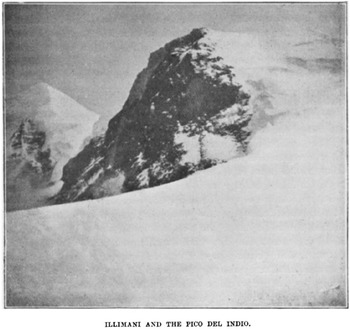
At the summit, an extraordinary thing occurred, or at least Conway said it did. As he “cast one last look back upon our conquered giant,” his hand touched something soft on the rock beside him, a “rotten piece of Indian woolen cord, swollen to the thickness of one’s wrist.” Finding the old cord brought to Conway’s mind a tale he said he had heard back in the Aymara village Caimbaya (Figure 2). Legend had it that many years before, an Indigenous man had, as Conway (Reference Conway1901, 138–139) put it, “desperately dared to invade the secret places of the great god Illimani. He was last seen from below, seated on this point where now we sat. He never came back to the abodes of men, for the god turned him into stone.” Deciding that the cord proved the story true, Conway named the peak “Pico del Indio.” Conway photographed the peak and included the name he gave it.
Martin Conway, Map of the Cordillera Real, London: Royal Geographic Society, 1898.

Figure 1. Long description
The map illustrates the highest part of the Cordillera Real in Bolivia, detailing the topography, provinces, and key geographic features. It includes labeled provinces such as Larecaja and Las Yungas, as well as significant rivers and mountain ranges. The map is a product of a triangulation and plane table survey conducted by Sir Martin Conway and features various unpassable dams. The map also highlights Lake Titicaca to the west and provides a detailed representation of the region’s elevation and terrain.
“Illimani and the Pico de Indio.” Photograph by Martin Conway, from The Bolivian Andes, p. 27.

Figure 2. Long description
A black and white photograph captures the majestic peaks of Illimani and Pico del Indio mountains. The image showcases the rugged, snow-capped summits against a cloudy sky, highlighting the natural beauty and grandeur of these Andean landmarks.
On their way back to La Paz, Conway and his party visited the Swiss-American anthropologist Adolph Francis Alphonse Bandelier and his wife, Fanny Ritter Bandelier, who were excavating the remains of ancient Indigenous villages and burial places on the slopes of Illimani at the edge of a small glacier. Whether the Bandeliers had permission from community leaders for these activities at another site of animate spirits, neither Conway nor Bandelier said. Conway (Reference Conway1901, 147–148) wrote that Bandelier told him that “the Indians here worship Illimani as a god; but they would not acknowledge to you that they did so.” If they did not tell him, how did Bandelier know? In Bandelier’s version of the Caimbaya legend, a group of Indigenous men, rather than an individual, attempted to climb Illimani. It was only once Conway claimed to have found physical evidence that Bandelier (Reference Bandelier and Ballivián1900, 64–65) began to believe the story. Like Conway, Bandelier commended these men who bucked traditional reverence and fear of glaciers to satisfy their curiosity.
Upon his return to the capital, the Sociedad Geográfica de La Paz honored Conway and interviewed him about his expedition. Conway told the gathered society members about the discovery of the cord that led him to name the peak Pico del Indio. He also told them that he had planted a flag on the peak he named, presumably a British flag, although he did not specify (Sociedad Geográfica de La Paz 1898, 184–186). Indeed, a photograph in his 1901 expedition account shows two men on top of Illimani with an unidentifiable flag between them (Figure 3). Planting flags was in keeping with growing heroic, masculine, nationalist, and imperialist approaches to mountain climbing (Schaumann Reference Schaumann2020, 194; Debarbieux and Rudaz Reference Debarbieux and Rudaz2015, 69). Whereas for Aymara communities glaciated peaks were virile masculine phalli and powerful protectors, for European climbers, they were receptacles for their phallic ascents and flags.
“On the Top of Illimani.” Photograph by Martin Conway, The Bolivian Andes, between pp. 128 and 129.

Figure 3. Long description
Two individuals dressed in heavy mountaineering gear stand on a snow-covered mountain peak. They are equipped with ice axes and appear to be taking a moment to rest or observe their surroundings. The background is obscured by a cloudy, misty atmosphere, emphasizing the harsh and cold conditions of the high-altitude environment.
When the floor opened to discussion, Eduardo Idiaquez objected that the peak should be named Pico Conway, not Pico del Indio. Conway demurred, citing Royal Geographical Society of London statutes “that prohibited such appellations,” as well as his own character that “opposed all vanity.” In the end, the Sociedad Geográfica (1898, 187–190) decided to give the peak both names.
At first glance, unlike his paceño hosts, Conway seemed to be honoring this Indigenous man who presumably perished on the mountain, leaving only a piece of rope behind. But what might at first seem like a tribute was in fact a rebuke. By lauding an Aymara man who may have defied his community’s approach to glaciers, Conway disparaged all the other Aymaras who stayed off glaciers. Like Bandelier, he could relate to an ancient Indian who overcame tradition and “superstition” to brave the ice. He could not, however, sympathize with real-life Aymara porters who held fast to their beliefs and put them ahead of Conway’s desires and orders.
Back in London, Conway’s scorn was more apparent. He mocked Aymaras’ “superstitions,” acknowledging that his “researches” offended them. “Like all semi-civilized mountain folk,” he told a gathering of the Royal Geographic Society, “they regard the mountains above the level of habitation as a part of the other world, the world of divine and diabolic beings, and the haunt, I believe, of the departed” (Conway Reference Conway1899, 21). Here Conway revealed a geographic determinist view common to British mountaineers of “mountain folk” as healthy and strong but ignorant and backward (Debarbieux and Rudaz Reference Debarbieux and Rudaz2015, 29–34), all the more so if they were nonwhite.
As the anthropologist Michael Taussig (Reference Taussig1987) reminds us, people express their understandings and beliefs through stories, which impart lessons and reveal values. Aymaras likely told the story of the brave Indian to remember and warn one another of the dangers of ascending onto glaciers after generations of observation and experience. Conway and Bandelier retold the stories of others—Aymara stories about angry glaciers and a brave Indian—and their own stories of cowardly and lazy Indians to highlight their own prowess and bravery and to disparage purportedly lazy and superstitious Aymaras. The folklorist and ethnographer Manuel Rigoberto Paredes, the proud grandson of an important mallku (Aymara community leader), collected Aymara “myths and superstitions” so that they would not be forgotten. Together, these stories suggest that it was rare for Aymaras to climb glaciers and that they feared doing so. The brave Indian had never come down, just as the porters who abandoned Conway (and other climbers before and after him) feared for their fate if they followed him onto the ice.
The photo of Conway and one of his alpine guides (see Figure 3) and another of Aymara porters sitting off the ice (Figure 4) from Conway’s book are revealing. While Conway celebrates his conquest of Illimani by planting a flag, the Aymara porters are far below the achachila, where they insisted they belonged and would remain.
“Indian Porters.” Photograph by Martin Conway, The Bolivian Andes, between pp. 121 and 122.

Figure 4. Long description
Three men are seated on a rocky terrain, each wearing hats and traditional clothing. The man on the left is dressed in a dark outfit and a hat, holding an object in his lap. The middle man is wearing a headscarf and a dark jacket, holding a white cloth. The man on the right is also wearing a headscarf and a dark jacket, with a white cloth draped over his shoulder. The background consists of a rocky, uneven surface with scattered stones.
Attacking glaciers and mountaineers at Illampu
Aymara villagers and colonos in Umapusa, northeast of the town of Achacachi at the foot of the great snow peaks Illampu and Ancohuma, soon found Conway in their midst. After summiting Illimani, Conway was eager to “attack the other and probably higher great mountain” of the Cordillera Real, the range’s northern-most peak that Conway (Reference Conway1901, 154) called Mount Sorata. Conway assigned this name to a group of peaks that includes its highest, Ancohuma, and Illampu, the runner-up. While Conway thought the Incas had named it Illampu, it was the Aymara and not their temporary Inca overlords who had first named and revered the mountain (Janusek Reference Janusek2006, Reference Janusek, Kosiba, Janusek and Cummins2019).
At Illampu, Conway engaged in quasi-scientific observation of glaciers. In addition to conquering them, Conway also tried to understand their behavior and history. He posited that “in ancient times the glaciers enveloped a large part of the slopes and reached down many miles further than they now do,” as many as four or five miles below the 1898 limits of ice. As he had during an expedition in Svalbard two years earlier (Jones Reference Jones2013), he speculated that glaciers “eat back at their heads, just as rivers do,” attributing the ever-changing configuration of mountain ranges to “the agency of glaciers” (Conway Reference Conway1899, 17). He further remarked that Mount Sorata’s glaciers had melted into large lakes, leaving lines of rocky debris above the lakes’ edges and grassy fields in their wake, far below where glaciers now resided (Conway Reference Conway1901, 177–179). As a Royal Geographic Society member, Conway was no doubt aware of debates in Europe about how and why glaciers moved (Dry Reference Dry2019, 23–25). Despite these observations, Conway’s scientific remarks were minor points in a long, detailed narrative largely focused on his efforts to summit peaks. Conway was most of all an adventurer and a would-be businessman. Like in Svalbard, as Mary Katherine Jones (Reference Jones2013, 321) puts it, “Conway trod a fine line between writing a factual account of a serious expedition and writing in the style of a humorous travel narrative.”
On his way to Illampu, Conway stayed in Umapusa, where Indigenous communities and haciendas employing Indigenous workers existed side by side. In this area northeast of Achacachi, the capital of the Omasuyos province, many Indigenous communities had successfully resisted the implementation of liberal land laws aimed at breaking up communities’ collective landholdings, even as haciendas had long encroached on their lands (Rivera Cusicanqui Reference Rivera Cusicanqui1978). Many were part of a growing Aymara movement to defend and regain communal lands (Hylton Reference Hylton2010; Gotkowitz Reference Gotkowitz2008; Larson Reference Larson2024). Here Conway looked for a hacienda owner to “supply [him] with Indian porters.” This time, Conway wanted to hire Aymara men not only to carry his things but also to protect his party from possible “Indian raids” of their belongings. He also contracted a carpenter to make him a sleigh to help his party carry their things once the porters inevitably deserted them (Conway Reference Conway1901, 156–158).
Conway anticipated that the structure of “Mount Sorata” would make it even more difficult to keep the porters with him than on Illimani. Given that the mountain’s glaciers stretched farther down its sides than Illimani’s, reaching the peak would require traversing them for a longer distance. Because “the Umapusa Indians were no more likely than those of Caimbaya to be willing to enter the world of snow,” Conway (Reference Conway1901, 157–158) wrote, it was likely that he and his party would “be obliged to transport our camp and provisions without their assistance for at least one day, and possibly for more.” This time Conway knew it was unlikely that the porters would ascend onto the ice; hence the sleigh.
Like the communities at the base of Illimani, Aymara people who lived below Illampu and Ancohuma revered these majestic peaks as achachilas. Indigenous community members and colonos, particularly women, arranged apachetas, rock-pile altars, in the mountain’s sacred spaces and prayed to the mountain spirits (Conway Reference Conway1901, 172). In the village of Fraskiya, up the path from Umapusa, Conway sat down by the side of a hole and dangled his legs over the side before realizing that it was a freshly dug grave, also hallowed ground (Conway Reference Conway1901, 175). That the villagers let Conway continue on his way is a testament to their great patience with this at best bumbling outsider.
Five Aymara men agreed to serve as Conway’s porters: Ilario Huanca, José and Manuel Mamani, Jerónimo Cabrera, and Manuel Lucán. In stark contrast with Conway and his guides’ loads, the porters’ personal provisions consisted only of coca, dried mutton (chalonas), and “baked grains of sweet maize” (likely cancha) (Conway Reference Conway1901, 176). As at Illimani, the porters suggested the best route and showed the way forward, to Conway’s (Reference Conway1901, 179) surprise. Even as they revealed themselves to be mountaineering experts, Conway continued to disparage them. Watching the men “flitting about like demons” around a campfire by an old English gold mine the first night, Conway remarked that “it was hard to believe that they were men” (183), managing to deny their humanity, masculinity, and maturity in one breath. For the porters, in contrast, being men meant honoring and obeying glacier fathers, not succumbing to the whims of European men unwilling and perhaps unable to carry their own packs.
Despite leading the way forward at first, the Umapusa porters had no intention of taking Conway and his party onto glaciated peaks. As they approached Illampu’s ice fields, two of the porters attempted to leave. Conway and his guides restrained them and forced them on, but the porters slipped away during the night. The remaining porters apparently crossed the Haukaña and Ancohuma glaciers with Conway. But when stones fell down the slopes near them, the porters shrank back and, according to Conway (Reference Conway1901, 185), said “that the devil was walking across the slope and that the stones were disturbed by the tread of his feet.” When Conway’s alpine guides “roared with laughter at this explanation,” the porters began to mask their dread, but they soon refused to proceed. They returned to base camp, leaving Conway and his Swiss guide to camp on snowfields and attempt to summit glaciers on their own.
This time it was not only porters who were concerned about Conway’s plans to profane the gods. While Conway and his guide were camped on a snowfield above, villagers from Chaira-huyo, a neighbor of Umapusa, invaded the party’s base camp, according to Conway, with plans to kill him and his companions in their sleep. Whether or not their intentions were truly murderous, Conway (Reference Conway1901, 187) was likely right that “the men believed that we had come to profane the sanctuaries of the mountain gods.” Manuel Rigoberto Paredes, the Aymara-speaking ethnographer cited earlier, confirmed this account. In his discussion of Aymara communities’ ongoing devotion to achachilas, Paredes (Reference Paredes1920, 34) referred to the attempted attack on Conway: “When Sir Martin Conway tried to ascend Illampu in 1898, the Indians wanted to revolt and attack him, because they feared that this foreigner would desecrate their deity, who would then send punishments. As a result, Conway was only able to carry out his attempt halfway, and without any Indians.” For these Aymara villagers, Conway’s irreverent treatment of achachilas endangered not only Conway and his climbing party but also all the people who lived below these powerful mountain spirits.
Not only the absence of porters but also harsh weather forced Conway’s party to descend before they reached the peak. They climbed down to their camp, packed their belongings onto the sleigh, and dragged the load to a place where the porters could later retrieve it. After reaching safety, the arriero confessed that back on Illimani, he had “seen two devils kicking the stones down, and that they had long horns like a deer.” The alpine guide Maquignaz told him “that that was nothing, for up at the top camp he had seen a black devil of extraordinary dimensions,” clearly taunting and poking fun at the arriero (Conway Reference Conway1901, 193). For Conway and Maquignaz, the presumably Aymara or cholo (acculturated Indigenous) arriero was little more civilized, intelligent, or manly than the superstitious Aymara porters, raiders, and villagers.
When Conway and his guides reached Umapusa, the Aymara villagers were surprised that his party had survived. While Conway was on the mountain, they had seen “heavy clouds tearing overhead,” heard strong winds, and watched with astonishment as it began to snow (Conway Reference Conway1901, 193). The villagers were sure that the mountain achachilas had sent the unusual September snowstorm to drive out these outsiders who had “profaned the[ir] abode” (193). While for Conway uncharacteristic climatic behavior was bad luck, for Aymara villagers it was a display of the achachilas’ disapproval.
Once again Conway reported on his expedition at a meeting of La Paz’s Sociedad Geográfica. Perhaps because he had not summited the mountain, Conway was brief. He focused almost entirely on technical matters like steep cliffs, snow-covered crevasses, and barometer readings, assuring his audience that in different conditions reaching the top of the mountain would be “easy” (Conway Reference Conway1898, 193). Or maybe Conway’s speech was short because he had not found evidence of a brave Indian at Illampu. Without having summited a peak or discovered evidence of Indigenous people renouncing tradition to attempt such a feat, there was no new peak to name and thus no name to discuss. Besides, Conway had already renamed these peaks Mount Sorata. Bandelier (Reference Bandelier and Ballivián1900, 65), however, wondered whether “Indians had ever attempted, accidentally of course, to climb Illampu, and with what success.” It is of course absurd to imagine that an Aymara villager, familiar with mountain paths and glaciers, would “accidentally” try to climb one of the highest peaks in the world.
Conway tried to leverage his Bolivia expeditions for personal gain. According to his biographer, Conway had decided to go to Bolivia after discussions with the directors of the Yani Gold Mine, located in the La Paz department (Evans Reference Evans1966, 175). He visited several mines during his travels and included extensive discussions of rubber and mining in his account (Conway Reference Conway1901, 180–181, 203–218, 257–273). Before he departed, the Bolivian government awarded Conway a large concession in the rubber-rich Arce Department (Evans Reference Evans1966, 179). Conway returned to Bolivia in 1901 to try to exploit this concession, apply for a larger one, and venture into railroads and gold mining, but his enterprises quickly dissolved (Evans Reference Evans1966, 182–184). Instead, Conway’s last escapade served as the basis for his final climbing narrative (Conway Reference Conway1901), reports for mining and rubber companies (e.g., Conway Reference Conway1908), and his successful candidacies for president of the British Alpine Club in 1902 and inaugural president of the British Alpine Ski Club in 1908.
Conclusion
The conflicts between European mountaineers and Aymara porters were revealing features of these expeditions that offer insight into how European mountaineers, paceño elites, and Aymara community members related to a shared mountainous environment and to one another in the late nineteenth century during a period marked by aggressive dispossession of Indigenous land and determined Aymara resistance. All these groups valued snowy peaks, but for different reasons and in different ways that brought European mountaineers into conflict with Aymara porters and community members.
For Conway, glaciated mountains were to some degree inspiring majestic sights and objects of study but most of all personal challenges and adversaries to be conquered and sites of profitable commodities to be hewn from the earth. His account makes clear that by 1898, aesthetic and scientific approaches to mountaineering had given way to a focus on adventure, conquest, altitude, and profit. From Conway’s perspective, a man’s willingness to climb a glaciated peak was a test of his masculinity, intelligence, and degree of civilization. Foreign adventurer-mountaineers like him and his alpine guides passed with the flying colors of their imperial flags. Conway admonished Bolivian men like the Cotaña administrator’s son who did not complete the climb up Illimani and the mule driver who later revealed his apprehensions. But he reserved his greatest rebuke for Aymara porters who refused to aid his efforts to summit glaciated peaks. Aymaras’ belief that mountains were sacred, animate beings who deserved to be left alone and their refusal to summit them was evidence for Conway that Aymara men were superstitious, backward, cowardly, childlike, and unmanly—in short, less than human. He wanted their labor and felt entitled to it. Without it his safety was at greater risk. Their unwillingness to accompany him onto glaciers only hardened his resolve and racism.
However dismissive and disdainful, Conway’s account provides insight into Aymara experiences and views. Aymara porters did not refuse to join these expeditions outright. As hacienda colonos they likely felt compelled to join these groups, and the wages mountaineers offered may have been a draw. But when they realized that Conway meant for them to climb onto glaciers, they refused and turned around. We know from Aymara stories, Conway’s account, and contemporary ethnographies that Aymara communities revered glaciated mountains as achachilas, protective ancestral deities, and usually avoided profaning these gods by invading their sacred dwellings. They had spent generations cultivating favorable relationships with achachilas who provided water for their crops and protected them from off-season hail, snow, frost, and other crop-damaging weather. Conway and other foreign mountaineers’ irreverent attempts to summit these peaks threatened their relationships with achachilas and therefore put their communities’ livelihoods at risk. In the face of this threat, Aymara colonos serving as porters refused to support or accompany him, and at least one group of community members tried to stop him. Aymara masculinity did not involve conquering glaciated peaks; rather, it required revering them and protecting them from the likes of Conway. While Aymara interactions with mountains and glaciers had changed over previous centuries (Gose Reference Gose2008), the reciprocal relationships at their core persisted.
Members of the Sociedad Geográfica de La Paz surveyed and studied the mountainous region for practical purposes in these years. While foreign mountaineers were focused on conquering the world’s last supposedly unexplored places, Latin American governments were still engaged in internal colonial projects to gain knowledge and control over the territory and people that they claimed (Qayum Reference Qayum and Dunkerley2002). The Sociedad Geográfica de La Paz served as the research arm of these efforts. After passing and implementing land dispossession laws from the 1870s to the 1890s, paceño elites fought a war to make their city the national capital. The next step was to transform their mountainous region into the nation’s economic engine during a time of increasing world economic integration. To do so, they needed transport routes across the Altiplano and through the mountains that divided the capital city from the resource-rich Yungas region on the eastern flanks of the Cordillera Real. For SGLP members and the Bolivian government, mountainsides were sites of profitable resources, and foreign mountaineers were colleagues who provided surveys, maps, and investment that aided their efforts.
After the 1899 Federal War, the victorious Liberal Party leaders turned on their Aymara allies. The new Liberal government tried, imprisoned, and executed the Aymara Indigenous leader Pablo Zárate Willka and 288 other Indigenous men and betrayed the party’s promise to halt haciendas’ onslaught and restore land to Aymara communities. After assuming power, the Liberals oversaw a period of hacienda expansion from 1900 to 1920 that was even more aggressive than that of the previous two decades. During these years, the Aymara movement that had opposed and impeded land dispossession in the 1880s and 1890s had to rebuild itself from the devastation wrought by ongoing land dispossession and the Liberals’ betrayal.
In 1904, six years after Conway had attempted to summit Illampu, the US mountaineer Annie Peck tried her luck. Putting aside the challenges she faced as a woman, her experience was remarkably similar to Conway’s—bad weather, porters who jumped ship—except in one crucial way: Aymara villagers did not try to stop her. Why didn’t they? It’s hard to know, but it’s likely that the Federal War and its aftermath made the difference. Whereas in 1898, Aymara villagers in Chaira-huyo and Umapusa were connected to an alliance that was winning a civil war and promising to halt and reverse land dispossession, by 1904 their leaders had been executed, and land theft had resumed with a vengeance. Aymara porters still refused to profane the achachilas themselves, but their neighbors did not try to stop Peck and her companions from doing so.
All the men and the few women we encounter in these stories cared deeply about glaciated mountains but valued them for very different reasons. For foreign mountaineers they were challengers to be admired, studied, and most of all conquered. For paceño elites they were beautiful symbols of their city’s promise but most of all sites of marketable resources. For Aymaras they were animate beings who demanded and deserved reverence and respect. For Conway, the story of “el Indio” was a lesson in bravery and the need to leave old superstitions behind. For the Sociedad Geográfica it was a distraction. For Aymara communities, it was a cautionary tale based on longstanding relations of reciprocity with animate mountain fathers.



 Open access

