





Introduction
The study of the acid-base physiology of insects holds significant potential for enhancing our understanding of various physiological processes. This includes respiratory, digestive, excretory, and metabolic functions, as well as symbiotic relationships (Dillon and Dillon, Reference Dillon and Dillon2004; Harrison, Reference Harrison2001). It may also shed light on dsRNA delivery mechanisms and optimise RNA interference (RNAi) techniques.
The insect gut pH has been reported to vary rheostatically within and between species (Mrosovsky, Reference Mrosovsky1990). The larvae of endopterygote insects, for example, tend to have highly alkaline midgut regions while exopterygote midguts tend to be nearly neutral or slightly acidic (Clark, Reference Clark1999). Variation in pH in different regions of an insect gut has also been widely reported (Harrison, Reference Harrison2001). In most insects, the general pattern is usually an acidic crop, neutral to alkaline midgut and a neutral to acidic hindgut (Harrison, Reference Harrison2001). This variation is suggested to be an evolutionary adaptation to permit maximum efficiency in enzymatic reactions (Applebaum, Reference Applebaum1985; Clark, Reference Clark1999).
One such enzyme activity concerns ribonucleases (dsRNases), responsible for breaking down double-stranded RNA (dsRNA). The activity of these enzymes is believed to contribute to the variability in RNAi efficiency among insects (Peng et al., Reference Peng, Wang, Zhu, Han, Chen, Elzaki, Sheng, Zhao, Palli and Han2020), greatly reducing the efficacy of RNAi in some species (Cooper et al., Reference Cooper, Silver, Zhang, Park and Zhu2019). Evidence suggests that RNA is most stable at pH levels between 4.0 and 5.0 (Jarvinen et al., Reference Jarvinen, Oivanen and Lonnberg1991) and is most susceptible to hydrolysis at pH levels above 6.0 (Bernhardt and Tate, Reference Bernhardt and Tate2012). Furthermore, dsRNases exhibit their greatest enzymatic activity in alkaline conditions. For example, Lepidopteran insects have relatively high alkaline midgut pH levels (>8.0) (Dow, Reference Dow1992) that de-stabilises unprotected RNA (Swevers et al., Reference Swevers, Vanden Broeck and Smagghe2013). It is conceivable that the gut pH of many insect species plays a critical role in RNA internalisation. Therefore, understanding the gut environment is crucial for developing highly efficient RNAi-based management strategies for insect pests.
Over the past three decades, the Western flower thrips Frankliniella occidentalis (WFT) has rapidly spread from North America, invading most countries across all continents (Reitz et al., Reference Reitz, Gao, Kirk, Hoddle, Leiss and Funderburk2020) except Antarctica (Kirk and Terry, Reference Kirk and Terry2003). This insect is notably significant as the most economically damaging thysanopteran agronomic pest, causing direct crop damage through its feeding behaviour. Additionally, it serves as an efficient vector for the tomato spotted wilt virus (TSWV), a tospovirus that infects a wide range of food, fibre, and ornamental crops, leading to widespread crop disease epidemics with significant global economic and social impacts (Paliwal, Reference Paliwal1976; Reitz, Reference Reitz2009; Reitz et al., Reference Reitz, Gao, Kirk, Hoddle, Leiss and Funderburk2020; Stumpf and Kennedy, Reference Stumpf and Kennedy2007; Wells et al., Reference Wells, Culbreath, Todd, Csinos, Mandal and McPherson2002).
The genomic and proteomic tools made available for WFT through the ‘i5K’ project (http://i5k.github.io/) present extensive opportunities for understanding gene function and developing alternative pest management strategies based on molecular interactions (Badillo-Vargas et al., Reference Badillo-Vargas, Rotenberg, Schneweis, Hiromasa, Tomich and Whitfield2012; Mouden et al., Reference Mouden, Sarmiento, Klinkhamer and Leiss2017; Stafford-Banks et al., Reference Stafford-Banks, Rotenberg, Johnson, Whitfield and Ullman2014). An RNAi tool targeting the VATPase gene has been developed using microinjection for delivery of dsRNA into adult thrips (Badillo-Vargas et al., Reference Badillo-Vargas, Rotenberg, Schneweis and Whitfield2015). However, delivery by micro-injection is not feasible in large scale applications for use in the field. We have shown that feeding naked dsRNA to thrips results in RNA breakdown greatly reducing the efficiency of RNAi (Andongma et al., Reference Andongma, Greig, Dyson, Flynn and Whitten2020). We have also demonstrated that symbiont-mediated RNAi (SMR) is possible and is a scalable method of delivery dsRNA (Whitten and Dyson, Reference Whitten and Dyson2017; Whitten et al., Reference Whitten, Facey, Del Sol, Fernández-Martínez, Evans, Mitchell, Bodger and Dyson2016); in WFTs. This is achieved by exploiting the symbiotic bacterium BFo2 (Bacteria of F. occidentalis 2) (Facey et al., Reference Facey, Méric, Hitchings, Pachebat, Hegarty, Chen, Morgan, Hoeppner, Whitten and Kirk2015). However, this technology still requires further optimisation.
The bacterium BFo2 has been isolated from numerous geographically isolated populations of WFT (Chanbusarakum and Ullman, Reference Chanbusarakum and Ullman2008) and fails to colonise the gut of beneficial insects (Whitten et al., Reference Whitten, Xue, Taning, James, Smagghe, Del Sol, Hitchings and Dyson2023), indicating its potential for SMR in this pest species. In addition, large numbers of these bacteria are usually isolated from the hind gut of WFTs (De Vries et al., Reference De Vries, Breeuwer, Jacobs and Mollema2001). Although this bacterium has frequently been isolated from WFT and easily colonises its gut (Andongma et al., Reference Andongma, Whitten, Sol, Hitchings and Dyson2022; Miranda MA Whitten et al., Reference Whitten, Facey, Del Sol, Fernández-Martínez, Evans, Mitchell, Bodger and Dyson2016), its precise role in the relationship with thrips remains unknown. Symbiotic bacteria of insects contribute beneficial effects to nutrition, reproduction, priming the insect immune system and overall fitness (Douglas, Reference Douglas2015). More recently, research has further shown that symbionts do not only impact linear systems but could also serve as mediators for ecological interactions. For example, symbionts can modulate virus effects on insect-plant interactions (Hussain et al., Reference Hussain, Farooq, Kamran, Basit, Wang, Smagghe and Chen2025; Sanches et al., Reference Sanches, De Moraes and Mescher2023). Whilst this might not be true for thrips (De Vries et al., Reference De Vries, Van De Wetering, Van Der Hoek, Jacobs and Breeuwer2012), it has been widely accepted that the relationship between insects and their gut bacteria is not fully understood.
Therefore, this study aimed to shed more light on the gut environment of the WFT and the relationship it shares with its symbiotic bacteria BFo2. Furthermore, we explored the implications this may have on SMR technology. We hypothesised that BFo2 plays a role in pH modulation, which could potentially impact dsRNAi delivery.
Methods
Experimental thrips
Frankliniella occidentalis used for this experiment were collected from a strawberry farm in Hereford, United Kingdom (grid ref: 51.952409, -2.652005) in the summer of 2018. They were subsequently reared in an insectary at Swansea University, where they were provided with non-organic chrysanthemum plants and runner beans as food sources. The insect colony was carefully maintained under specific conditions, including a temperature range of 23°C ± 2°C, relative humidity between 60% and 80%, and a light–dark cycle of 14 h light to 10 h dark.
Colour pH indicator preparation
Colour pH indicators were chosen based on their transition range (Erban and Hubert, Reference Erban and Hubert2010). Group 1 consisted of dyes that determine pH values near neutrality. This group included Phenol red (Fusion Scientific) with a pH range of 6.8–8.2 and Bromothymol blue (Sigma-Aldrich) with a pH range of 6–7. Group 2 comprised dyes that determined the acidic limit of the gut pH, such as Bromophenol blue (Sigma) with a pH range of 3.0–4.6, Congo red (Sigma) with a pH range of 3.0–5.0, and bromocresol purple (BDH) with a pH range of 5.2–6.8. The inclusion of a universal pH indicator (Fisher Scientific) with a pH range of 4–11 in the study resulted in insect mortality, likely due to the presence of alcohol. Therefore, as the results from group 1 indicated that the pH was not alkaline, further studies were not conducted with dyes in the alkaline range.
Feeding pH indicators and colour observations
Dyes were introduced to insects by membrane feeding (Whitten et al., Reference Whitten, Facey, Del Sol, Fernández-Martínez, Evans, Mitchell, Bodger and Dyson2016). The feeding mixture consisted of a 2% dye, 0.4% NaCl and 3% sugar in solution. Feeding solutions were placed in the lids of 1.5 ml Eppendorf tube, covered with stretched sterile Parafilm® and placed in glass bijoux bottles with insects (10 adults and 10 larva) for 2 to 3 days. This allowed enough time for the dye to pass completely through the gut. Non-feeding pre-pupal and pupal stages were not included in this experiment. Prior to observation under a stereomicroscope, insects were anaesthetised with carbon dioxide on an Ultimate Flypad (Genesee Scientific) or, where the colour change was not obvious, their guts were dissected on a chilled 4% agarose gel. In the larvae, most dyes could be seen through the thin cuticle. Technical limitation coupled with a minute insect size (<1.5 mm) limited dissection of the whole gut. Confirmation of dye colour was made after sampling at least 10 insects for each dye and each life stage.
Effect of BFo2 on pH in vitro
Further experiments were conducted to investigate whether BFo2, like many bacteria, can alter the pH of its environment and potentially modulate the local gut pH of the WFT host. The bacterium used for this study was isolated from WFT, as reported by (Whitten et al., Reference Whitten, Facey, Del Sol, Fernández-Martínez, Evans, Mitchell, Bodger and Dyson2016).
In these experiments, the initial pH of LB broth medium was adjusted to a range of pH values (pH 5, 6, 7, and 8) using NaOH and HCl. BFo2 was inoculated into the medium to a final concentration of 2x10^6 cells/ml. The bacterial suspensions were then cultured aerobically at 30°C with shaking at 200 rpm. LB broth without BFo2 served as the control.
After 24 h, the pH of the culture medium was measured using a handheld ISFET pH meter (Model IQ120). Additionally, in a separate experiment, the growth of BFo2 in LB broth with different pH levels was determined in 96-well plates. The plates were cultured for 36 h to generate growth curves.
Results
Indicators determining pH more accurately within the neutral-to-acid range
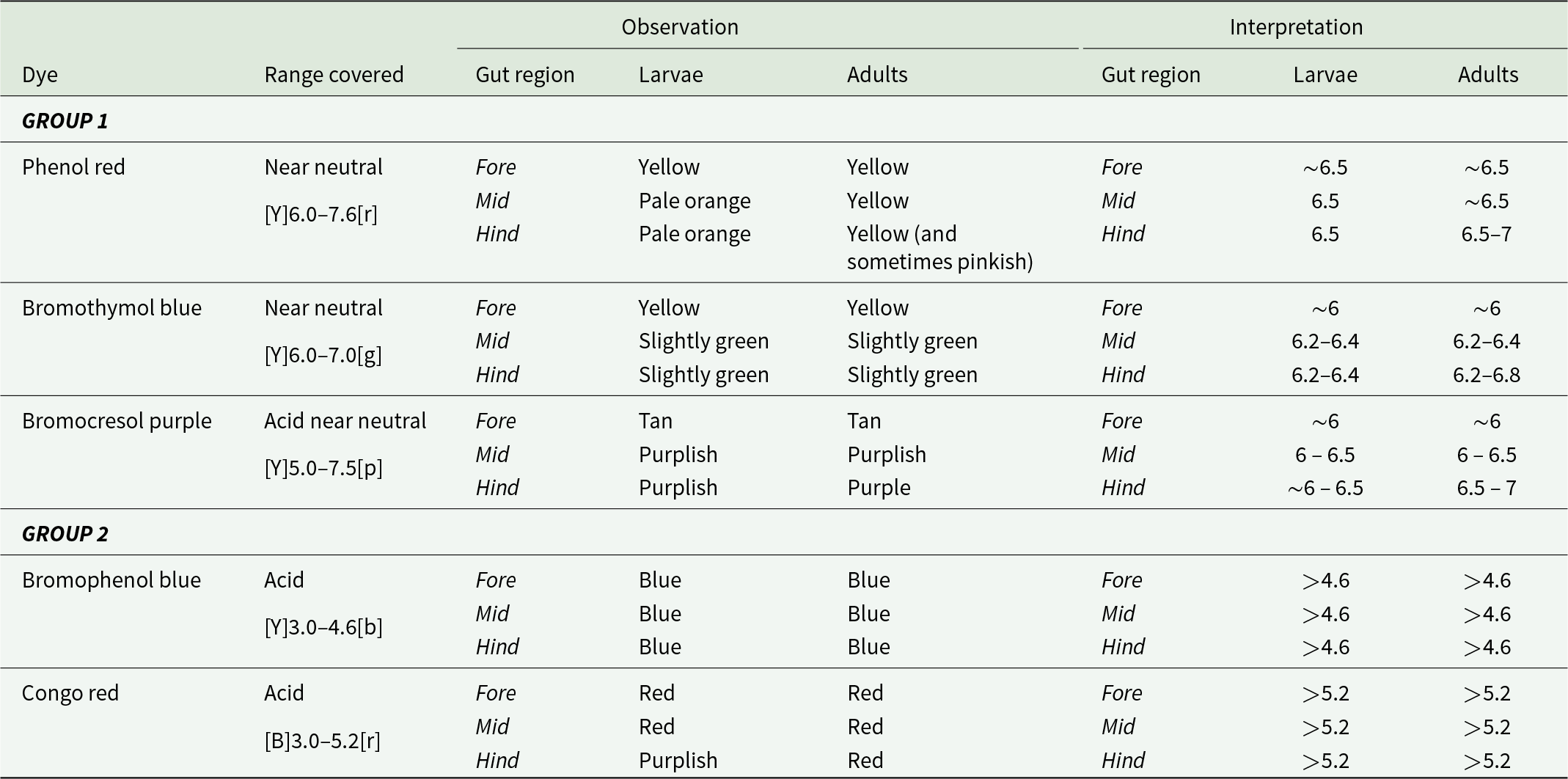
Phenol red consistently appeared yellow throughout the entire larval gut and dissected adult gut, indicating a pH of approximately 6 (Table 1). Interestingly, a small percentage (2%) of adults exhibited a faint pink colour in the hindgut (Fig. 1B), suggesting that the pH in some cases can approach 7.
A summary of pH colour changes in different regions of the WFT gut

Notes: Color dyes were fed to thrips and the colour of their fore gut, mid gut and hind gut recorded.
Bromocresol purple displayed a faint purplish-yellowish colour, indicating a gut pH above 5.2. Notably, in adults, the purple colour was more pronounced in the hindgut compared to the midgut (Fig. 1C).
Adults fed with bromothymol blue exhibited a yellow-green colour, with a subtle shift towards green in the posterior region. This suggests that the gut pH falls between 6 and 7.6 (Fig. 1D).
Representative WFTs fed with indicators determining pH more accurately within the acid and base limits. (A) Insects with no dye. (B) Adults exposed to phenol red with all had a yellow foregut and some had a slightly pink hind gut. (C) Larvae exposed to bromocresol purple with a slightly purple gut, and adults had a yellow-purple fore gut and purplish hind gut. (D) Larva exposed to bromothymol blue with greenish regions in anterior gut.

Indicators determining the acidic limit of gut pH
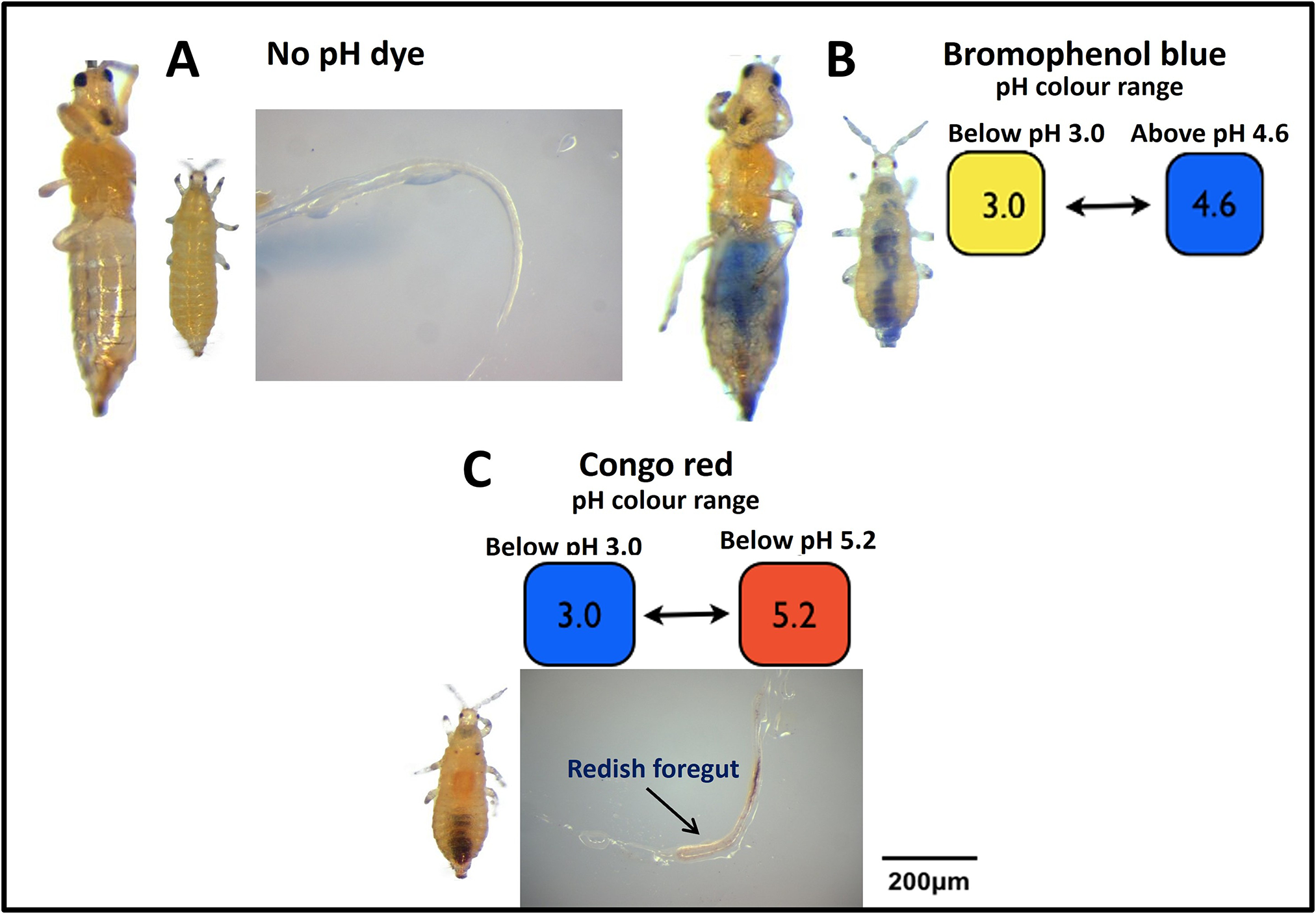
The color changes observed in insects ingesting group 2 dyes indicate that the pH throughout the entire WFT gut is higher than 5.2 (Table 1). All examined WFT guts exhibited a blue coloration (Fig. 2B), suggesting a pH above 5.2. Similarly, Congo red transitions from red below pH 5.2 to blue at pH less than 3. When fed to WFT, Congo red remained red throughout the gut of all insects, confirming that the gut pH is indeed above 5.2 (Fig. 2C).
Indicators determining the acidic limit of thrips gut pH: (A) Representative insects with no dye, (B) larva and adult exposed to bromophenol blue with blue gut, (C) larva and gut exposed to Congo red with red gut.

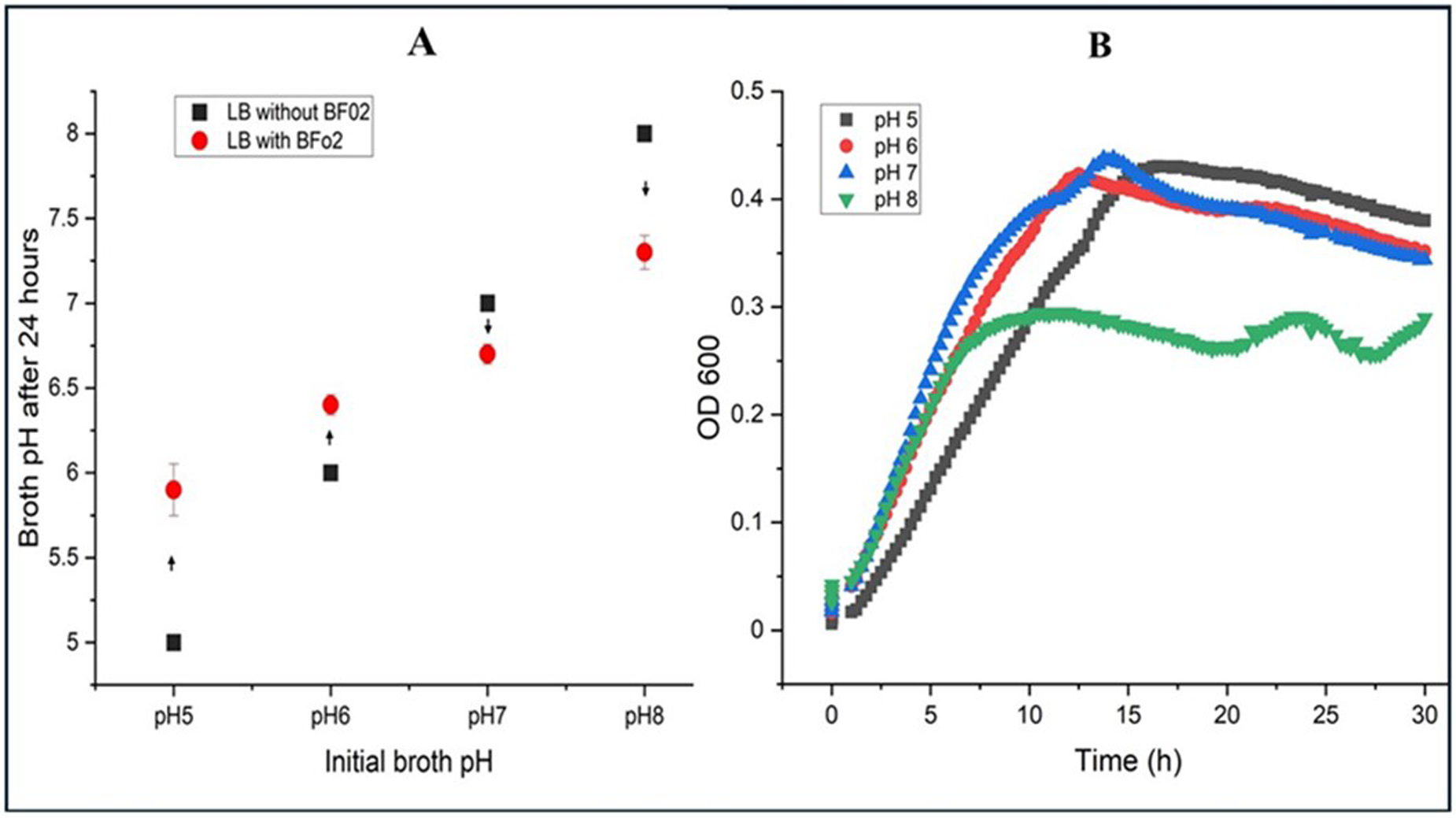
The pH studies with the gut bacteria of the western flower thrip bacteria of Frankliniella occidentalis 2 (BFo2): (A) Changes in the pH of LB broth growth medium following 24 h incubation with BFo2. The LB pH was adjusted to four different initial pH values prior to bacterial culture. The medium was incubated with BFo2 on a bench top shaker at 200 rpm at 30oC. Each point represents the mean and SE (n = 3). (B) Growth characteristics of BFo2 at different pH levels over time when aerobically cultured with shaking at 30oC. The box and colours indicate the initial pH of the LB medium.

In vitro growth rates of BFo2 at different pHs
BFo2 grew faster in broth at pH values of 5, 6, and 7 when compared to pH 8. When cultured at pH8, BFo2 quickly and prematurely reached stationary phase at an OD600 of below 0.3. Contrarily at pH5, 6 and 7 BFo2 attained an OD of above 0.4 before reaching the stationary phase. A pH of 6–7 appears optimal for BFo2 growth, as the exponential phase at pH 5 required an additional 2.5 h before reaching the stationary phase (Fig. 3).
Buffering activity of BFo2 at different pH levels
BFo2 exhibited some pH buffering capacity during in vitro culture whereby the initial broth pH of 5 increased over 48 hrs to at least 5.6, and conversely an initial broth pH of 8 decreased to 7.3 or less (Fig. 3). When the initial pH was closer to that of the WFT gut, the final pH altered very little over time. As expected, there was no pH change in the control media incubated without bacteria (Fig. 3).
Discussion
In this study, color dyes were utilised to measure the gut pH of the WFT, a globally significant agricultural pest species. While microelectrodes offer precise pH measurements in vitro, they are not feasible for smaller insects like F. occidentalis. In contrast, the use of pH dyes has been favoured as a method for small arthropods, where the change in dye color indicates the gut pH (Bandani et al., Reference Bandani, Kazzazi and Allahyari2010; Erban and Hubert, Reference Erban and Hubert2010).
The family Thripidae comprises over 2000 species, with several reported as pest species. However, knowledge regarding the gut pH of these species is generally lacking, except for Thrips imagines and T. tabaci which have a gut pH of between 5.0 and 5.6 (Day and Irzykiewicz, Reference Day and Irzykiewicz1954). Compared to these species, we observed that the Western flower thrips (WFT) has a slightly more alkaline gut pH with values ranging from 6.2 to 6.5, with some adults exhibiting gut pH levels of up to 7 in the hindgut where BFo2 colonises (Andongma et al., Reference Andongma, Whitten, Sol, Hitchings and Dyson2022; Whitten et al., Reference Whitten, Facey, Del Sol, Fernández-Martínez, Evans, Mitchell, Bodger and Dyson2016). It has been reported that only larval WFT can contract TSWV, and adults derived from such larvae transmit the virus (de Assis Filho et al., Reference de Assis Filho, Deom and Sherwood2004; Nilon et al., Reference Nilon, Robinson, Pappu and Mitter2021). In addition, variations in pH may influence the distribution of TSWV in various tissues (Best, Reference Best1939). This may explain the inability of adult WFT to acquire TSWV as the transmission of these viruses is pH-dependent: The infection pathway of enveloped bunyaviruses (which include TSWV) involves endocytosis during which exposure to an acidic pH facilitates cleavage of a spike glycoprotein followed by membrane fusion (Gonzalez-Scarano, Reference Gonzalez-Scarano1985; Gu and Lozach, Reference Gu and Lozach2024; Hacker and Hardy, Reference Hacker and Hardy1997; Pekosz and González-Scarano, Reference Pekosz and González-Scarano1996). The TSWV spike glycoproteins Gn and Gc are believed to function as attachment proteins and membrane fusion proteins, respectively (Barker et al., Reference Barker, daSilva and Crump2023). (Whitfield et al., Reference Whitfield, Ullman and German2005) propose that Gn acts in initial attachment to the WFT midgut epithelial cell and Gc is enzymatically cleaved under the acidic conditions of the endosome, which enables a conformational change and subsequent membrane fusion. The cleaved form of Gc is predominant at pH 5.8 but not at pH 6.1 (Gu and Lozach, Reference Gu and Lozach2024; Whitfield et al., Reference Whitfield, Ullman and German2005).
Functional in vitro studies with model bacterial and fungal cells have identified multiple genes that can modify the pH of the growth medium (Kasper et al., Reference Kasper, Seider, Gerwien, Allert, Brunke, Schwarzmüller, Ames, Zubiria-Barrera, Mansour and Becken2014). Our study indicates that the most favourable pH range for the growth of BFo2 is in the slightly acidic to neutral range (Fig. 3), which matches that of the WFT gut. BFo2 also demonstrates some limited capability to buffer more extreme pH values in its environment, albeit at the expense of normal growth characteristics. Understanding these mechanisms will be a fertile area for future research that will enhance the exploitation and deployment of SMR technology (Whitten and Dyson, Reference Whitten and Dyson2017).
Implications of the thrips gut environment for SMR
The study of the gut pH of the Western flower thrips is a crucial step towards understanding how the SMR technology could be efficiently deployed in large-scale pest management programs. Previous reports have demonstrated the efficiency of this technique for managing thrips on a large scale (Whitten et al., Reference Whitten, Facey, Del Sol, Fernández-Martínez, Evans, Mitchell, Bodger and Dyson2016). Enclosing RNA in a carrier is vital because WFT degrades ingested naked dsRNA (Andongma et al., Reference Andongma, Greig, Dyson, Flynn and Whitten2020). However, RNA is most susceptible to hydrolysis at pH levels above 6.0 (Bernhardt and Tate, Reference Bernhardt and Tate2012). The results from the current study indicate that the gut pH of the WFT is above 6, and that BFo2 can modulate the pH of its environment towards neutrality. In addition, we observed a trend towards a neutral pH value in the hindgut, the region colonised by both species of symbiotic bacteria, BFo1 and BFo2 (Andongma et al., Reference Andongma, Whitten, Sol, Hitchings and Dyson2022; Miranda MA Whitten et al., Reference Whitten, Facey, Del Sol, Fernández-Martínez, Evans, Mitchell, Bodger and Dyson2016).
An important area where knowledge of pest insect gut pH could be exploited is in the development of nanoparticles (NPs) which offer huge potential for the targeted delivery of encapsulated bioactive molecules to insects (Mackowiak et al., Reference Mackowiak, Schmidt, Weiss, Argyo, von Schirnding, Bein and Bräuchle2013). NPs applied to plant foliage encounter a pH gradient as they transit from the plant surface to the insect gut system (Khandelwal et al., Reference Khandelwal, Barbole, Banerjee, Chate, Biradar, Khandare and Giri2016). Fortunately, NPs have been formulated for pH-dependent drug release through the utilisation of polymers that alter their physicochemical properties in response to local pH levels (Deirram et al., Reference Deirram, Zhang, Kermaniyan, Johnston and Such2019; Gao et al., Reference Gao, Chan and Farokhzad2010; Wu et al., Reference Wu, Luo, Wang, Wu, Dai, Li, Durkan, Wang and Wang2018; Yan and Ding, Reference Yan and Ding2020) (Deirram et al., Reference Deirram, Zhang, Kermaniyan, Johnston and Such2019; Gao et al., Reference Gao, Chan and Farokhzad2010; Wu et al., Reference Wu, Luo, Wang, Wu, Dai, Li, Durkan, Wang and Wang2018; Yan and Ding, Reference Yan and Ding2020). These alterations include acid-responsive swelling, changes in acid-responsive solubility, modifications in acid-mediated charge, and the acid-triggered cleavage of covalent bonds (Shinn et al., Reference Shinn, Kwon, Lee and Lee2022). pH sensitive nano formulations have been reported to improve RNAi sensitivity in various insect species (Christiaens et al., Reference Christiaens, Tardajos, Martinez Reyna, Dash, Dubruel and Smagghe2018). However, while formulations for foliage sprays to target insects that feed on external plant parts may be effective, they are not ideal for sucking insects like thrips. In the case of thrips, BFo2 provides an additional advantage through its ability to colonise the thrips gut and continuously produce interfering RNA in this environment, avoiding the activity of RNases in the upper digestive tract. However, for this system to be fully exploited, consideration must be given to the role of the gut environment and the pH modulation effect of BFo2.
Conclusion
This study investigates for the first time the gut pH of Western flower thrips and highlights the possible role of the symbiotic bacterium BFo2 in gut pH modulation. The slightly acidic gut pH complements the optimal pH for BFo2 growth, and we show that the bacterium modulates the pH of its in vitro environment towards just below neutral. Understanding the insect gut environment is crucial in the development of efficient biopesticides for insect pest management.
Acknowledgements
This work was funded by TechAccel LLC and by a grant from UKRI (BBSRC grant ref. BB/R006148/1) to PD.
Author contributions
AA and MW: experimental analyses, AA, MW and GC drafting manuscript, and figures. PD: project management and preparing manuscript. All authors contributed to the article and approved the submitted version.
Competing interests
All authors declare that they have no conflict of interest.


 Open access

