




Introduction
Bakhtin’s (Reference Bakhtin, Holquist, Emerson and Holquist1981) concept of the chronotope has lately received renewed attention in interactional sociolinguistics and linguistic anthropology, particularly as scholars have explored how communicative practices are situated within and help constitute ideologically laden spatiotemporal frames. Chronotopes have thus become central to theorizing how identities, ideologies, and actions are anchored in time–space configurations, functioning as what Blommaert (Reference Blommaert2015, 111) calls “invocable chunks of history.” A key development in this strand of inquiry is the linkage between spatiotemporal configurations and types of personhood, as articulated in the influential work of Agha (Reference Agha2007, Reference Agha2015). Agha shows how chronotopes operate within broader processes of enregisterment, where linguistic and semiotic forms become associated with recognizable social types. Agha’s work provides a blueprint for understanding how time and space are semiotically managed in interaction and, in turn, linked to evaluative, normative frameworks of personhood.
Subsequent studies have extended this perspective by applying chronotopes productively to narrative practices (e.g., Perrino Reference Perrino2011; Blommaert and De Fina Reference Blommaert, De Fina, Fina, Ikizoglu and Wegner2017; Karimzad and Catedral Reference Karimzad and Catedral2018). These studies have shown that chronotopes operate across different levels and scales, bringing together the micro-level organization of interaction and the macro-level circulation of ideological norms, for example, in narratives of migration, mobility, and translocal belonging. This work has led to an enriched understanding of how chronotopes both reflect and shape speaker positionalities, particularly in relation to power and inequality. Other work (e.g., Lempert Reference Lempert2014; Ennis Reference Ennis2019; Goebel Reference Goebel2020; Goebel and Dewi Reference Goebel and Dewi2025) has demonstrated that chronotopes are not merely background structures but are often strategically invoked and materialized across diverse semiotic modes and communicative ecologies. Scholars have specifically recognized that chronotopes are not only linguistic but also multimodal phenomena (Perrino Reference Perrino, Fina and Georgakopoulou2015; Ennis Reference Ennis2019; Kunming and Blommaert Reference Li, Blommaert, Kroon and Swanenberg2019). This is especially salient in digital communication, where chronotopes present semiotic layering (e.g., captions, photos, videos) and are recycled and remixed across platforms (e.g., Goebel Reference Goebel2020; De Fina Reference De Fina2022). Social media with their affordances, algorithms, and user interface norms arguably facilitate chroonotopic engineering, which refers to the strategic, deliberate crafting of time-space-person configurations that become typified in specific contexts (Blommaert and De Fina Reference Blommaert, De Fina, Fina, Ikizoglu and Wegner2017).
Clearly, then, a focus on chronotopes offers a productive point of entry into the study of identities in storytelling and increasingly in digital storytelling too. But there is still much scope for further analytical refinement to track how chronotopic configurations are locally constructed, multimodally realized, and engineered in situated acts of storytelling online to produce widely shared, recognizable identities.
In this article, we build on and extend the growing line of inquiry into chronotopes within sociolinguistics and discourse analysis by integrating chronotopes with small stories research and positioning analysis (Bamberg and Georgakopoulou Reference Bamberg and Georgakopoulou2008). This pairing allows us to integrate chronotopic relations into a micro-analytic model that captures how time and space function as resources within interaction, alongside other linguistic and multimodal choices. Positioning analysis is reimagined here as a dynamic framework for studying identities in social media environments, where stories are viewed as socio-technical activities, shaped by platform directives and affordances (Bucher Reference Bucher2018; Georgakopoulou Reference Georgakopoulou2024).
We take as our starting point that time and space are engineered, iterable, and recyclable resources—from the duration and spatialized (within the same site or across sites) distribution of tellings to the platformed design, affordances, and embedded assumptions about when and where stories should unfold. Chronotopic configurations, in this sense, present unique challenges for positioning analysis, particularly in calibrating user agency versus platformed affordances. In our framework, Level 1 positioning (focused on characterization within the taleworld) is enriched by recognizing time and space as world-making modalities, on a par with other verbal, visual, and embodied resources. Crucially, the interplay of Levels 1 and 2 (focused on the here-and-now of storytelling) gives rise to specific types of personhood (Level 3), selves that are mediated by normative scripts and expectations.
By synergizing chronotopic analysis with positioning analysis, we refine the analytical granularity of Level 1 and extend our understanding of how different semiotic modes contribute to the constitution of micro-chronotopic formations. Our approach allows for tracing chronotopic configurations across levels and scales: from narrative details that position the teller as character interacting with other characters in time and space (Level 1), to a story’s interactional dynamics (Level 2), and to broader macro-chronotopic configurations (Level 3) that embed narrative identities within sociocultural ideologies and widely shared storylines. In particular, we show how platform-specific affordances become enregistered as micro-chronotopes, that is, as templatized temporal and spatial configurations that index specific gendered selves. These selves are algorithmically conditioned, designed, and culturally recognizable personas. Through this synthesis, we advance a cross-scalar, multimodal, and interactionally grounded framework for the analysis of chronotopic identity positioning in social media storytelling.
We put forward our integrative approach through the case of the “pretty girl,” as a gendered chronotopic positioning in social media storytelling. Drawing on makeup tutorial notes from the Chinese lifestyle platform Xiaohongshu, we examine how time and space function as semiotic resources, both in the taleworld and in the performative act of telling, to construct a platformed, gendered micro-celebrity practice among Gen Z users. We analyze how this positioning builds on and reconfigures cross-platform genres such as selfies and the narrative practice of sharing-life-in-the-moment. We trace how their practice mobilizes co-temporal storytelling and the semi-professionalization of domestic spaces. In doing so, we offer a micro-analytical, multimodal framework for studying the “visible girl” of post-feminist discourses (McRobbie Reference McRobbie2009), situating them within global genealogies of “girls making media” (Dosekun Reference Dosekun2015) while also challenging Western-centric narratives of digital identities.
Pairing chronotopes with small stories and positioning analysis
Bringing together chronotopes, small stories, and positioning analysis allows for a nuanced exploration of how types of personhood are constructed through affective and characterization work—both within narrated worlds and in relation to circulating evaluative scripts. Chronotopes can be productively integrated into the small stories heuristic (Georgakopoulou Reference Georgakopoulou2007), which attends to three interrelated layers of a narrative practice: (1) ways of telling (semiotic resources), (2) sites (social worlds of telling and tale), and (3) tellers (communicators broadly conceived). This approach expands narrative analysis beyond the identification of abstract story structures, as for example in Labov’s (Reference Labov1972) canonical model, which identifies the components of abstract, orientation, complicating action, evaluation, and coda. Within small stories research, stories are viewed as situated practices, enmeshed in everyday life, with local and sociocultural consequentiality, and tied to identity work. Stories can be non-linear, fragmented, densely intertextual, ongoing, co-constructed, and multimodal. This analytical reorientation is well-placed for researching social media communication, where platform logics are designed around user connectivity, content portability, multi-semiosis, and a prioritization of the here-and-now over the past (Georgakopoulou Reference Georgakopoulou2017).
Within small stories research, we study identities through the aforementioned three-level positioning analysis (Bamberg and Georgakopoulou Reference Bamberg and Georgakopoulou2008; Giaxoglou and Georgakopoulou Reference Giaxoglou, Georgakopoulou, Bamberg, Demuth and Watzlawik2021):
• Level 1 focuses on the taleworld: character relations, spatial-temporal placements, and affective/visual design.
• Level 2 tracks how stories are occasioned, distributed, and co-authored with audiences.
• Level 3 uncovers how the self is presented with continuity, beyond this storytelling, and how tellers align with or resist normative storylines.
Chronotopes are primarily anchored in Level 1, where time and space operate as world-making resources. But their effects span Level 2 (interactional co-construction) and connect to macro-chronotopes, not as static backdrops, but as circulating, embodied, and potentially contested positions in identity dilemmas (Bamberg Reference Bamberg, Cooper, Camic, Long, Panter, Rindskopf and Sher2012). This synergy allows us to track how localized acts of storytelling draw on, reshape, and sometimes resist broader ideological scripts.
Integrating multimodality and technographic tracking on social media
Small stories research and positioning analysis have incorporated theoretical insights and analytical tools to analyze storytelling on social media as multimodal, socio-technical activities. First, social semiotic multimodal theories and methods are adapted into narrative analysis (e.g., Georgakopoulou Reference Georgakopoulou2016; Jewitt Reference Jewitt, Georgakopoulou and Spilioti2017; Page Reference Page2018), which details patterns of representational, interpersonal, and compositional meaning-making (Kress and van Leeuwen Reference Kress and van Leeuwen2020) in acts of storytelling, across three levels of positioning. This synthesis allows us to trace (dis)alignments across verbal, visual, video, and embodied modes in the ways in which they contribute to a story’s plot (Georgakopoulou Reference Georgakopoulou2025).
Second, technography (cf. Bucher Reference Bucher2018), a version of digital ethnography, is adapted to enable a reverse-engineering perspective on how platform affordances—both possibilities and constraints—shape communication (Georgakopoulou Reference Georgakopoulou2024). Technography provides a thick description of context (Geertz Reference Geertz1973) by systematically tracking the interplay of discourses (ideologies and norms evident in platform design, influencer promotions, and user reflexivity) about stories, affordances (e.g., algorithms and amplification mechanisms) for them, and users’ practices (e.g., multimodal choices, Georgakopoulou et al. Reference Georgakopoulou, Iversen and Stage2020). Technographic tracking has documented specific story-formats, which, expanding on Blommaert et al. (Reference Blommaert, Laura, Yacoubi, Fina and Georgakopoulou2020), are defined as normative, replicable, and recognizable storytelling activities shaped by affordances and rapid user socialization (Georgakopoulou Reference Georgakopoulou2019). These brief, multimodal stories rely on templates and curated tools designed to promote sharing-life-in-the-moment as a preferred storytelling mode. They also serve as discursive vehicles for platformed performances of authenticity (Georgakopoulou Reference Georgakopoulou2021, Reference Georgakopoulou2022). The understanding of authenticity in chronotopic identity work as multimodally designed is also discussed in Li and Blommaert’s (Reference Li, Blommaert, Kroon and Swanenberg2019) analysis of the ludic online performance of the “baifumei” (white, rich, and beautiful) as a recognizable “type” of Chinese woman.
The attested development of formatted stories shows the close links of social media affordances and platformed engineering with both the types of stories told and the kinds of positions done through stories. These links extend to the chronotopic configurations of stories, as per Level 1 of positioning analysis. One prominent case is the “pretty girl” positioning, shaped by specific temporal and spatial semiotic resources in the taleworld, specific platform affordances for the here-and-now telling, audience norms and expectations about who the (popular) tellers should be in these environments (Level 2), and, finally, specific gendered discourses about young women doing immaterial work on platforms—forms of digital labor that focus on content creation, affective engagement, and self-expression rather than production of physical goods (Level 3). Small stories research and positioning on social media have been thus systematized to factor in the multimodality of stories and their platformed design, which leads to formatting. This helps us shed light on how chronotopic engineering takes place on social media storytelling, as we will show with the case of the “pretty girl.”
The “pretty girl” as a gendered chronotopic positioning
The rise of postfeminist media culture (Gill Reference Gill2007), alongside late-modern socioeconomic shifts, has amplified interest in young womanhood—the figure of the “girl”—as a worker, consumer, and agent of social change across academia, media, and policy. Harris (Reference Harris2004) contrasts the “can-do” girl, career-driven and consumer-savvy, with the “at-risk” girl, portrayed as lacking ambition and vulnerable to social pitfalls. McRobbie (Reference McRobbie2009) expands on these archetypes, identifying figures like the “well-educated working girl,” the sexually liberated “phallic girl,” and the “global girl.” Yet, the “pretty girl” and her positioning within the beauty and fashion system remain underexplored.
Feminist scholarship has long critiqued the connection between beauty and femininity, framing beauty not as a universal aesthetic but as a patriarchal construct. This perspective was popularized in the 1990s through Naomi Wolf’s (Reference Wolf1991) bestseller The Beauty Myth. Bartky (Reference Bartky1990) conceptualizes the “fashion-beauty complex,” wherein internalized beauty norms discipline women’s bodies. Postfeminist media culture, however, reframes beauty consumption as a site of agency, pleasure, and social capital (McRobbie Reference McRobbie2009; Lazar Reference Lazar, Clair Gill and Scharff2011). Colebrook (Reference Colebrook2006) warns against moral binaries in beauty discourse, while Ingram (Reference Ingram2022) emphasizes the relational emergence of beauty, considering its affective and embodied dimensions. Overall, transnational feminist critiques (Dosekun Reference Dosekun2015) problematize the monolithic “empowered girl” trope in the Global South, underscoring the need for culturally specific analyses of gendered subjectivities. A chronotopic positioning approach supports this inquiry.
Social media amplify the politics of female beauty, with practices such as selfie culture and beauty filters critiqued for reinforcing gendered power dynamics (Burns Reference Burns2015; Elias and Gill Reference Elias and Gill2018; Peng Reference Peng2020). Similarly, influencers have commercialized beauty through curated aesthetics and parasocial ties (Abidin Reference Abidin2016), promoting an entrepreneurial femininity that promises “having it all” but hinges on aesthetic labor and conformity to beauty norms (Duffy and Hund Reference Duffy and Hund2019). Their rise highlights how social media intensify the postfeminist culture by heightening young women’s visibility, linking empowerment to self-surveillance and neoliberal ideals.
Among these practices, makeup tutorials function as both mundane self-care and professionalized pedagogy within beauty vlogging (Banet-Weiser Reference Banet-Weiser, Elias, Gill and Scharff2017; Bhatia Reference Bhatia2023). Beauty remains a dominant content category on social media, especially YouTube, Instagram, and TikTok, and particularly among Gen Z women (Ehsaei Reference Ehsaei2024). In our study of the narrative construction of the “pretty girl” in makeup tutorials on Xiaohongshu, we conceptualize the “pretty girl” as an amalgam of girlhoods, which comprise evolving and variable beauty aesthetics and are hashtagged and trending within and beyond Xiaohongshu (e.g., #bm girl, #clean girl, #ABG/Asian Baby Girl). The aesthetic fluidity of the “pretty girl” reflects how the beauty industry sustains sales by valuing newness and accommodating difference with norms: this aligns with post-feminist notions of beauty as individual expression.
Data-set: makeup video tutorials on Xiaohongshu (RedNote)
The data for this article are drawn from a digital ethnographic project exploring the storytelling practices of beauty and fashion influencers on the Chinese social media platform Xiaohongshu (RedNote) (Wei Reference Wei, Mori, Asahi, Coman, Vasilache and Rauterberg2023, Reference WeiIn preparation). The project investigates the use of multimodal resources and gender identity work among nine young female influencers within specific media-afforded storytelling practices. Xiaohongshu, also known as RedNote in Western media, was founded in 2013 in Shanghai, China. Branded as a lifestyle platform featuring beauty product reviews, fashion tips, and travel and restaurant recommendations, Xiaohongshu has become one of China’s most popular social media platforms, with 300 million monthly active users and a predominantly young, feminine user base (Qian-gua 2024). It is also gaining global prominence as a TikTok alternative. The posts on Xiaohongshu are called “notes” (笔记), and come in two formats: photo-text (图文笔记), similar to Instagram posts, and video (视频笔记), akin to short-form videos, popularized by TikTok.
The project’s data-set comprises 602 Xiaohongshu notes (20 most-liked and 50 most recent for each influencer, plus the top 10 comment threads per note), their Xiaohongshu profiles, and fieldnotes. The notes cover various types of beauty and fashion content, such as OOTD (Outfit of the Day), vlogs, unboxings, product reviews, lip swatches, and makeup tutorials. To examine how beauty intersects with femininity in specific formatted storytelling practices, this article focuses on a subset of 78 video notes from four beauty influencers, which fall under the category of “makeup tutorials” (i.e., videos on how to achieve specific makeup looks). At the time of data collection, the influencers were aged 20–22 and lived in Beijing, Zhejiang, and Guangdong. They began posting at different times between 2020 and 2022, with follower counts ranging from over 63,000 to 270,000. Each video note includes a title, main text, video thumbnail (cover image), and a short-form video. Video lengths in this subset range from 1 to 4 minutes. Our discussion here is based on a qualitative, micro-level positioning analysis focused on micro-chronotopic resources at Level 1, incorporating findings from one year of participant observations as well as ethnographic interviews with two of the influencers. For our interpretation, we also consider the top ten publicly visible comment threads and metadata such as likes, saves (called “collects” on Xiaohongshu), comments, and posting dates.
Our positioning analysis, focusing on time and space, followed an inductive process. This involved repeatedly viewing the notes to identify relevant multimodal resources, coding their patterns of use, and checking their frequency and co-occurrence in MAXQDA. Table 1 presents our coding framework.
Coded multimodal resources

Analysis: chronotopes in small stories of beauty transformation
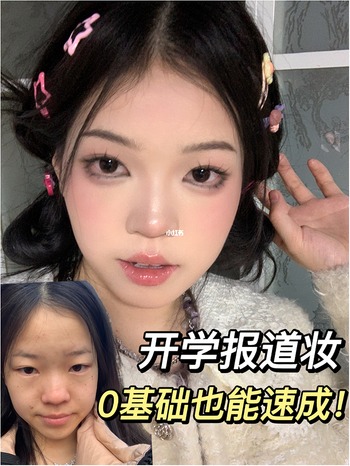
Our analysis showed that an overarching storytelling practice of positioning the self as a “pretty girl” revolves around small stories of beauty transformation, showing how an influencer moves from a “before” state (unfiltered, unadorned) to an “after” state (polished, with various makeup products applied). The note’s cover image functions as a story abstract (Labov Reference Labov1972), foregrounding either the change or the action of applying makeup. Among the 78 notes, the most common choices for cover images include: collages of before-and-after makeup selfies (33.3%), talking-head portraits showing the influencer applying makeup (25.6%), and collages combining celebrity portraits with before-makeup selfies (19.2%). The collages could be arranged in symmetrical grids or overlapping.
For example, Figure 1 shows a cover image by the influencer Jiban. By placing the after-makeup selfie in the center, she signals the made-up version of the self as desirable and aspirational. The gaze draws the viewer’s eye immediately. The bottom left corner is associated with the “Given,” “Real,” and “Margin” (Kress and van Leeuwen Reference Kress and van Leeuwen2020), which signals the self without makeup as in a prior or initial state to be moved away from or improved upon. The cover image signposts a before-and-after story. The contrast between the two looks and their different placements contributes to a gendered positioning of the “pretty girl” that promotes makeup application as the key process for transforming herself into an ideal version of femininity. The text overlay situates the makeup look within a specific scenario—开学报道妆 “Back-to-school registration makeup”—claiming a student identity for the character, a point we will return to later. It also includes a promotional message—0基础也能速成 ! “Even beginners can master it quickly!”—suggesting accessibility and positioning the audience as beginners and learners.
Collage of before-and-after makeup selfies.

The tutorial videos follow a patterned beginning-middle-end structure within a specific chronotopic framework. In particular, an influencer first orients the audience to why she is going to do a specific makeup look “today” by describing a setting, which could be more personally relevant (e.g., returning to school after the winter break; attending a morning class) or socioculturally relevant (e.g., referencing a recently popular celebrity on a TV show; the coming of Halloween). An inserted, preview clip of the finished look foreshadows the result. The narrativization of step-by-step technical instruction is supported by the video recording. In all notes, the influencer maintains a talking-head camera position when introducing and applying makeup, with evaluative commentary throughout. The transformation is signaled by changes in the multimodal arrangements. In showcasing the finished look, videos at the end can shift from one background music to a different one (61.5% of the notes), and/or from a talking-head position (applying makeup) to a selfie position (appreciating the completed look, 47.4%), and occasionally from the use of ring light to natural light (28%). A coda (Labov Reference Labov1972)—showing the outcome of the event on the narrator—is sometimes present, with the influencer in the makeup look appearing in another setting, such as walking outdoors or attending class (24.3%).
At positioning Level 3, the “pretty girl” narrative aligns with the “makeover paradigm” in postfeminist media culture (Gill Reference Gill2007). Since the 1980s–1990s, makeover reality shows such as What Not to Wear and Extreme Makeover have foregrounded women’s transformation from “ugly ducklings” to “beautiful swans”: this format has been globalized, as seen in China’s You Are So Beautiful, a gendered adaptation of Queer Eye (Gallagher and Pecot-Hebert Reference Gallagher and Pecot-Hebert2007; Peng Reference Peng2022). Such makeover formats typically frame a woman as being in need of improvement, guiding her through a style overhaul that culminates in a “big reveal.” The transformation is framed not only as aesthetic but also as a route to confidence, relationship success, and self-actualization. As Gallagher and Pecot-Hebert (Reference Gallagher and Pecot-Hebert2007, 65) note, such shows exploit the fraught link between appearance and identity by promising beauty and thus empowerment through the right consumer choices. The narrative of transformation is intensified by visual storytelling that dramatizes individual change and confers visibility on the woman (McRobbie Reference McRobbie2009).
Small stories of beauty transformation in makeup tutorials diverge from the earlier “makeover paradigm” in specific media-afforded ways, and chronotopic resources play a key role. In particular, they reconfigure and repurpose the social media storytelling practice of sharing-life-in-the-moment, so as to construct the positioning of the “pretty girl.” As we will discuss later, this positioning hinges on two micro-chronotopic features (Level 1): (1) present-tense co-temporalization and (2) the semi-professionalization of bedrooms as media spaces.
Temporal resources: present-tense co-temporalization
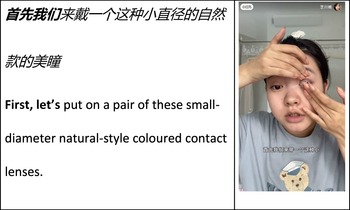
Present-tense co-temporalization describes how influencers story beauty transformation as unfolding in real time, using present-tense markers and inclusive pronouns to align the moment of telling with the moment of doing, thereby fostering a sense of shared, everyday immediacy with the audience. In a makeup tutorial, an influencer simultaneously adopts the two visually displayed positions of the “makeover paradigm”: the “girl to be improved,” who undergoes the transformation through makeup application, and the “expert,” who guides the process while explaining its technical details. The audience is, in turn, positioned as both participants in this transformation and as story recipients. Notably, these visual and visible selves are temporalized not only within the tale but also in the telling, in the “here and now,” the present. Rather than depicting a one-time, life-altering event or a media spectacle, makeup tutorials weave the before-and-after story into the influencer’s ordinary routine, presenting it as a real-time, shared practice. This dynamic is evidenced in the patterned use of time references and pronouns, connecting positioning at Levels 1 and 2.
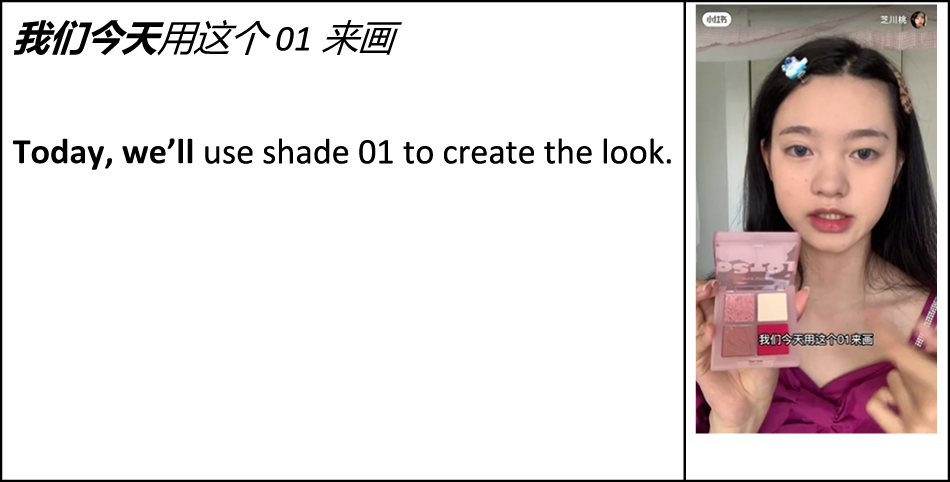
Transcripts 1 and 2 feature the influencer Zhichuantao, who, in a talking-head position, engages the audience by using the inclusive pronoun 我们 “we, let’s.” By incorporating the present-time reference 今天 “today” and the processual reference 首先 “first,” she positions the audience within the makeup process, as it unfolds. In the data-set, the most frequently used time references relate to sequence (488 instances, appearing in 98.7% of the notes, e.g., 首先 “first,” 然后 “then”) and the present (137 instances, 76.9%, e.g., 今天 “today,” 现在 “now”). The most common pairings involve sequenced and present-time references with first-person plural pronouns, with 81 and 34 instances, respectively.
Pihlaja (Reference Pihlaja, Page, Busse and Nørgaard2018) observes that in daily vlogging on YouTube, vloggers tend to address their audience as “you,” positioning them both as viewers of the video and, at times, as characters within it. He argues that this form of address is primarily a stylistic choice, as an instance of synthetic personalization commonly found in broadcast talk, intended to foster a sense of performed intimacy. A similar dynamic may be at play in makeup tutorials, where the influencer is the sole visible participant with actions and monologues. The gaze directed at the camera, along with gestures such as holding up a makeup product before applying it (as seen in Transcript 1), indicates the mediated nature of the telling and the physical distance between the influencer and audience. However, the frequent use of the inclusive pronoun “we” rather than the generalized “you” remains consequential, as it constructs a positioning of the “pretty girl” as intersubjective and communal. This extends the “makeover paradigm” beyond an individual, aspirational experience, conveying the message “I have done it, and you can too,” to a co-temporalized, shared practice, framed around the idea that “we are doing it together.”
A makeup tutorial, as a mediated story, unfolds across multiple layers of time. The act of telling is temporally complex. The moment when an influencer applies makeup and records the tutorial—part of both the telling and the taleworld—remains unseen, while the posting time (or subsequent edits after posting) is explicitly marked with a platform-generated timestamp. Once uploaded, the video circulates and reaches actual viewers at different moments via algorithmic recommendations, appearing on their “For You” page, in search results, or among the updates of their following. Being “in-the-moment” is less about mediatized ephemerality (as in Instagram Stories, where content consumption follows a time-bound logic) or about the absolute present (as in livestreaming). The four beauty influencers in the data-set tend to post a note every two to three days, some being makeup tutorials. The repeated use of “today” and “now” within a video and across multiple videos, coupled with the inclusive “we,” showcases how influencers actively use time as a resource to flatten the gaps between these different timeframes and the distinction between themselves and the viewers. This is aimed at reinforcing a shared positioning that is immediately relevant and anchored to everyday life. This choice also aligns with the fast-paced, trend-driven beauty culture and the prioritization of recency in social media storytelling (Georgakopoulou Reference Georgakopoulou2021).
In her analysis of “mummy vlogs” on YouTube, Pers (Reference Pers, Georgakopoulou, Giaxoglou and Patron2024) introduces the term “telling-by-doing” to describe a mode of narration in which the time and space of doing and narrating overlap. “Telling-by-doing” is facilitated through visual resources, including recorded enactments of events and strategic camera angles that position the audience as if they were the vlogger or alongside them. In makeup tutorials, where influencers primarily maintain a talking-head position throughout the makeup process, sequential references serve a dual function: they align with the instructional, technical communication style characteristic of “how-to” tutorials, coupling telling with doing and enhancing a sense of unfoldingness of the story. The embodied actions, visually presented in the video and verbally marked in sequence (as in Transcript 2), offer a seemingly “real-time” view of the makeover.
Present-tense reference with inclusive pronoun

Processual reference with inclusive pronoun

Spatial resources: the semi-professionalization of bedrooms as media spaces
Beauty transformation frequently unfolds in the bedroom. We categorized the sites in our analysis based on visible props in the background that evoke associations with specific spaces, such as beds, shelves, and wardrobes. We acknowledge, however, that it is impossible to assess with certainty the type of room where an influencer actually recorded a video. Based on our coding, the majority (82.05%) of the analyzed tutorials take place in home bedrooms, followed by university dorm rooms (14.1%) and living rooms (3.85%). This pattern aligns with a re-gendering of the bedrooms in digital practices, as observed in previous research. Patouras and Tanner’s (Reference Patouras and Tanner2024) study on women’s representation on TikTok notes a celebratory retreat into private domestic spaces, where “girlfriendship” is enacted through the “getting ready” process, as they apply makeup and select outfits before going out. These rituals are framed as an empowering form of self-care. Similarly, Ruberg and Lark (Reference Ruberg and Lark2020) find that on the livestreaming platform Twitch.tv, bedrooms are prevalent in content defined by sociality and affective performance, particularly among female streamers, while largely absent from gaming streams and male streamers. Dorm rooms feature culturally distinctive or locally relevant items, most notably bunk beds. In Chinese universities, where space is limited and costs are kept low, four to eight students typically share dormitories with bunk beds.
The bedrooms in our data are symbolically intimate, personal, yet functionally professional. The blurred boundaries between being in the private and public and encompassing affectivity and know-how in the influencers’ placemaking contribute to a chronotopic positioning of the “pretty girl” as a persona that traverses ordinariness and professionalization. In earlier vlogging, bedrooms, especially among teenagers, are common publicized private spaces for self-representation, with props such as posters, photographs, souvenirs, and other interior decorations as markers of identification and distinction (Burgess and Green Reference Burgess, Green, Snickars and Vonderau2009; Hillrichs Reference Hillrichs2016). However, the tutorials here display few background props. In home bedrooms, wardrobes (84.4%) and beds (45.3%) are most commonly shown. This can be considered a media-afforded, functionally related feature: in the format of vertically framed short-form video, the talking-head occupies the majority of the screen, which supports the focus on the influencer’s talk and the visual detailing of makeup application. Showing part of a wardrobe or bed becomes a subtle resource, carrying the qualities of the bedroom (i.e., intimacy), rather than showcasing personal taste.
Yet, these bedrooms are not fixed, generic, or abstractly curated spaces but lived and historicized. They subtly reveal the influencers’ social identities, career development, or personal change over time, which lends authenticity to their everyday beauty storytelling and enriches the characterization of the “pretty girl” in each story. As illustrated in Transcripts 1 and 2, Zhichuantao appears to be in her own bedroom. Transcript 1 features a wardrobe and a pink mosquito net draped over the bed, while Transcript 2 highlights an air-conditioner and a white, floral-patterned mosquito net. The presence of mosquito nets suggests that she may be located in southern or rural regions of China, where such items are more commonly used. The differences between the two examples also indicate changes over time, reflecting different periods when the tutorials were posted, during which she may have rearranged her bedroom.
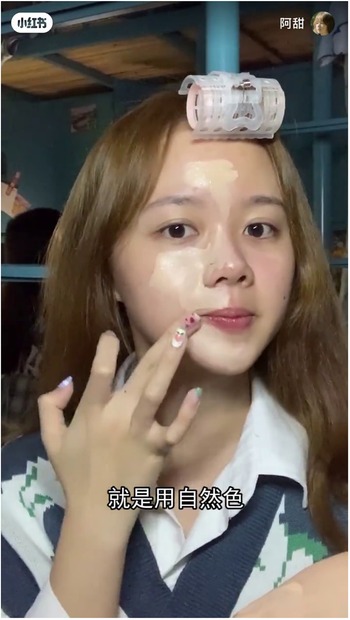
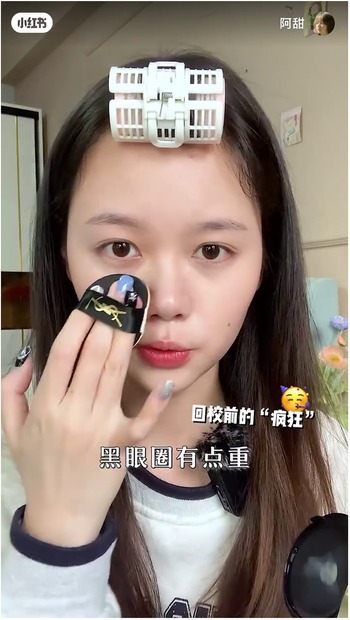
Figures 2 and 3 reveal a more striking transformation for the influencer A’tian. In Figure 2, a university dorm room, complete with a bunk bed and even her roommate in the background, positions her as a peer college student and amateur content creator in a humble, accessible environment. In Figure 3, she appears in a refined, aesthetically pleasing bedroom in her brother’s rented apartment, where she moved two years later, having by then become a more prominent influencer with a sizable following.
In a university dorm room.
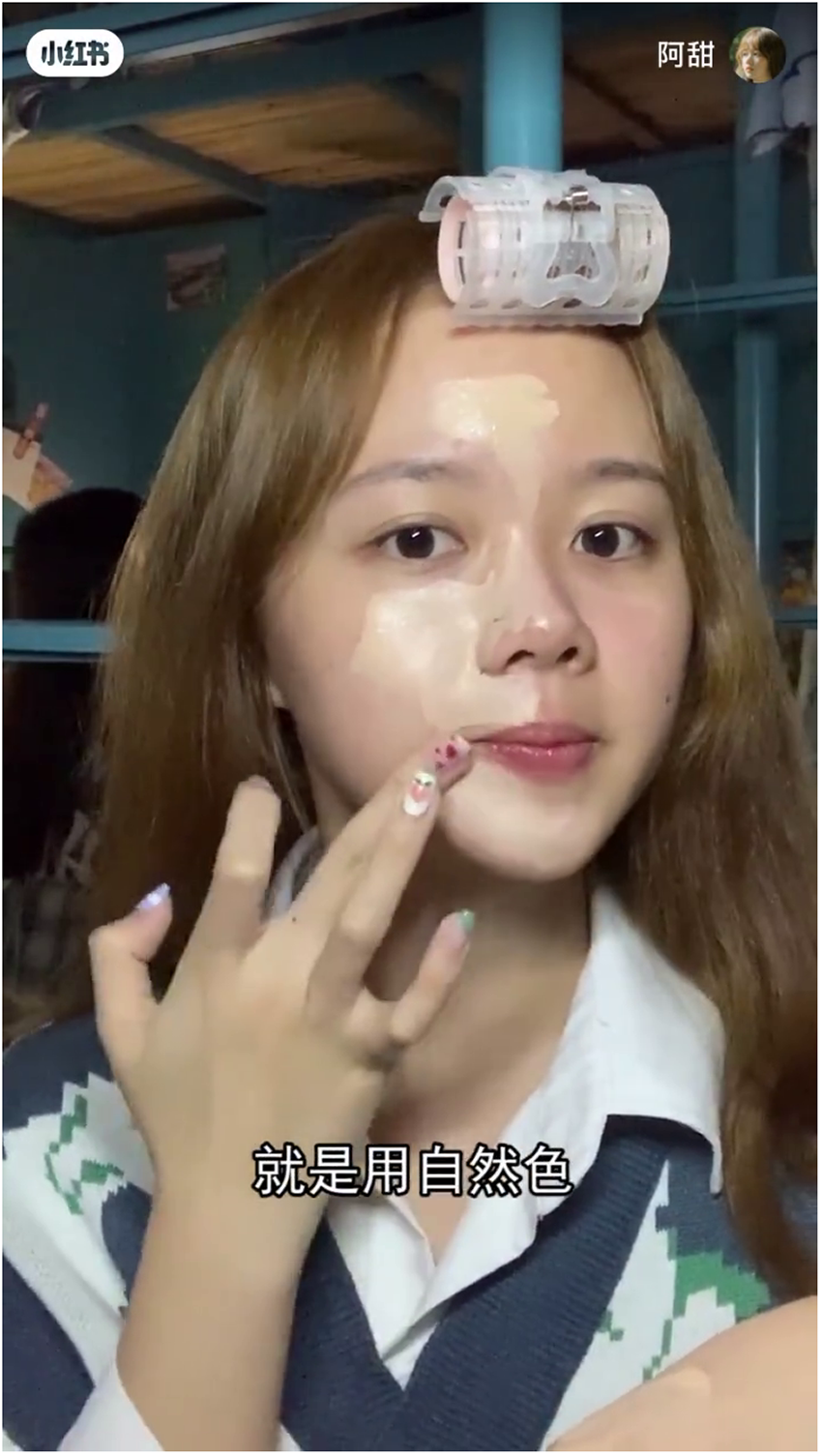
In a home bedroom.

The (semi)-professionalization of the bedrooms is evident in the prevalent use of ring lights (93.6%). Though not explicitly visible on screen, the ring light evenly illuminates an influencer’s face (e.g., see Figure 2), reducing harsh shadows and allowing the beautification process with detailed changes from bare skin to the finished look to take center stage in the mediated space. This extends beyond gendered self-beautification (e.g., girls experimenting with makeup and chatting in their bedrooms) as part of a “home or peer-centered girls’ ‘culture’” (McRobbie and Garber Reference McRobbie, Garber, Gray, Campbell, Erickson, Hanson and Wood2007, 222). Ashton and Patel (Reference Ashton, Patel, Taylor and Luckman2018) argue that while bedrooms are often perceived as authentic settings for (female) influencers’ everyday sociality, this perception is nuanced and, at times, challenged by the use of sophisticated production equipment, such as microphones and cameras. Moreover, the talking-head camera position, in combination with the ring light in character visual representation, sustains the troubled linkage between femininity and the body (as an object requiring improvement work). The “before-and-after” progression focuses primarily on facial changes. These small stories, grounded in a gendered chronotope of domestic familiarity, undermine the media spectacularization and celebritization of feminine subjectivity brought about by the “makeover paradigm” of TV shows (McRobbie Reference McRobbie2009). At the same time, their professionalization repurposes the practice of sharing-life-in-the-moment, where the influencer’s beauty expertise is aestheticized, possibly commercialized, and made highly visible for public consumption.
From “iron girl” to “pretty girl”
A question that arises from the above-mentioned micro-chronotopic findings at positioning Level 1 is how and why makeup tutorials, coupled with the storyline of beauty transformation, take root on the Chinese social media platform Xiaohongshu and to whom the positioning of the “pretty girl” (Level 3) speaks; who it is recognized by and normative for.
Between the establishment of the People’s Republic of China in 1949 and the Cultural Revolution in the 1960s—the Mao era—beauty for women was neither regulating nor agentive, but silenced. A dominant discourse portrayed beauty and fashion as decadent capitalist practices. Women were expected to participate in state-allocated labor, just as men did, to help the nation through economic hardship: 妇女能顶半边天 “Women hold up half the sky” (Wang Reference Wang, Elizabeth and Selden2003). The uncoupling between beauty and Chinese female identity generated a socialist ideal: the “iron girl” (Wang Reference Wang2016), who wore military-style uniforms and was productive in physical labor. Since the reform and opening-up in 1978, and with the expansion of the market economy and its digitalization, beauty has been revitalized as a means of reconstructing Chinese femininity linked to consumption, counteracting the de-feminizing approach of the Mao era. This shift has been reinforced by the rise of wanghong (网红), social media influencers who shape consumer culture and redefine ideals of Chinese femininity (Wei Reference Wei, Mori, Asahi, Coman, Vasilache and Rauterberg2023). As Yang (Reference Yang2020) argues, a consumerist, post-socialist (pseudo-)feminist discourse took shape in China before liberal feminism had established any significant presence.
Our analysis reveals that, in such historical conditions, storying “pretty girl” is generalizable yet not reducible to the figure of the “global girl.” The “global girl” envisages young women in the Global South aspiring or belonging to a kind of “global femininity” that blends difference and homogeneity, as a form of corporate multiculturalism in the fashion and beauty system (McRobbie Reference McRobbie2009, 88). In contrast, the “pretty girl” positioning is tied to broader macro-chronotopic configurations that carry both globally sharable routines and locally, trans-culturally specific beauty imaginaries (Level 3). Rather than being an East-West divide, the divergence from the “makeover paradigm” reflects a broader shift: from linear, expert-led telling in legacy media to fragmented, self-authored telling on social media. Media-afforded semiotic resources are globally available, but their patterned use places chronotopes within both global and socio-culturally specific networks. In particular, naming makeup looks, in the title, text overlay (Figure 1), and/or hashtags, creates relatable, reusable scenarios that enrich the before-and-after plot in circulation and showcase the complexity. These can be globally resonant, such as doing a 早八妆容 “Morning 8 O’clock Class Makeup” as a student’s daily life routine and doing a 火龙果妆 “Dragonfruit Makeup,” 万圣节妆容 “Halloween Makeup,” or 约会心动妆容 “Heart-Fluttering Date Look” for special, festive, or affective occasions. At the same time, influencers draw on locally circulating beauty trends, such as 欧阳娜娜千金仿妆 “Nana Ouyang’s Millionaire Daughter Look,” as an emulation of a popular Chinese celebrity, or 透明感日杂妆 “Translucent Japanese Magazine Makeup” or 美式甜心妆 “American Sweetheart Makeup,” in realizing specific trans-cultural ideals. Patterns in background music, including English pop (34.6%), K-pop (16.6%), and Japanese pop (11.5%), further reflect the localized trans-cultural aesthetics.
Conclusion
In this article, we have put forward the gendered chronotopic positioning of the “pretty girl” in makeup tutorial video notes among four influencers on the Chinese social media platform Xiaohongshu. We have demonstrated how time and space function as crucial semiotic resources in self-presentation and in reconfiguring the cross-platform storytelling practice of sharing-life-in-the-moment to construct stories of beauty transformation. Through our analysis, we have explored how this practice—particularly its construction of the before-and-after storyline—both aligns with and diverges from earlier media practices associated with the “makeover paradigm” in postfeminist media culture of visibilizing the female selves (Gill Reference Gill2007).
We have highlighted two key features through which the stories’ chronotopes are instrumental for the construction of the “pretty girl” positioning: (1) present-tense co-temporalization, which fosters a sense of real-time, communal engagement with the audience, and (2) the semi-professionalization of the bedrooms, which serve as spaces for both personalized, performed intimacy and professionalized expertise display, historically embedded in gendered media production. These chronotopic choices support the identity project of presenting the “pretty girl” as the outcome of emotional labor on the part of the tellers, while creating a sense of authenticity, ordinariness, and relatability. For influencers specifically, emotional labor points to the effort to manage their emotional expressions to sustain audience engagement, algorithmically shaped visibility, and self-branding (e.g., see Grandey et al. Reference Grandey, Diefendorff and Deborah2013). We therefore see chronotopic choices functioning as versatile resources for self-positioning. In addition, we have showed how the pretty girl positioning invokes in the here-and-now historical, material, and cultural conditions that specifically anchor it to the Chinese context.
By integrating chronotopes into small stories and positioning analysis, we move beyond the ethnocentric, from “West to rest” narrative (Dosekun Reference Dosekun2015, 972) that presumes theory and post-feminist media practices flow unilaterally from Western to non-Western contexts. Instead, we situate young womanhood within widely circulating, media-afforded yet agentively mobilized storytelling practices anchored in layered constructions of time and space. Our findings contribute to a nuanced understanding of how postfeminist media culture intersects with evolving digital affordances, illustrating how self-beautification operates simultaneously as a mundane, recurrent event and as a performative, entrepreneurial endeavor.
Finally, our study advances discussions on how chronotopes function across different scales by foregrounding their formatted, multi-semiotic configurations in specific storytelling practices. The synthesis of chronotopes with positioning analysis thus offers a refined methodological approach that captures the affective, performative, and spatiotemporal dimensions of digital identity work. This approach is well-placed to provide insights into how young women engage with, reproduce or equally reclaim, and challenge sociocultural expectations of femininity and beauty through digital practices.


 Open access

