

Introduction
The 2018 election cycle was significant for a number of reasons, not least of which was the fact that many young people ran for political office. At the state level, more than 800 young people (those under the age of 40) ran for state legislative seats, and about 275 won elections (Vyse Reference Vyse2019). Among those were Bride Rose Sweeney, a 26-year-old legislative staffer who became the youngest state lawmaker in Ohio (Stewart Reference Stewart2018); Casey Snider, a 33-year-old farmer and firefighter who, at the time, was the youngest state legislator in Utah (Rodgers Reference Rodgers2018); and 25-year-old Chris Chyung, the first Asian American elected to the Indiana House (Davich Reference Davich2018).
These first-time legislators are all Millennials, the generation born between 1981 and 1996.Footnote 1 As the youngest, largest, and most diverse fully adult generation, Millennials are transforming the political landscape – not only as part of the electorate, but as political leaders at the local, state, and national levels. Many of these Millennial leaders have skillfully utilized social media to bring attention to issues such as climate change and college affordability.Footnote 2 Furthermore, Millennial state legislators are gaining influence and power in chambers across the country. For example, the California State Assembly and the Maryland House of Delegates had Millennials serving as Majority Leaders at the beginning of their respective legislative sessions in 2020.
The increased presence and influence of Millennials in representative bodies raises questions about whether and how interests disproportionately important to this generation are advanced in the legislative arena. The prevailing literature on representation notes the influence of identities and experience on legislative behavior. Concepts of representation have taken different forms. Work on descriptive and substantive representation finds that descriptive representatives – those who most closely mirror the characteristics and experiences of a group – are often best qualified to represent that group (Dovi Reference Dovi2002). Arguments in favor of greater descriptive representation are based on the expectation that representatives with similar characteristics and experiences will provide better substantive representation, which is the ability and greater willingness of these representatives to advance the policy interests of their group (Pitkin Reference Pitkin1967; Swers and Rouse Reference Swers, Rouse, Schickler and Lee2011).
Scholars have also distinguished between dyadic and collective representation. In one form – dyadic representation – constituents share a common trait with the specific legislators who represent them, and in the other – collective representation – constituents are represented by all legislators with that similar trait (Harden and Clark Reference Harden and Clark2016; Weissberg Reference Weissberg1978). An abundance of literature notes the importance of descriptive and dyadic representation for the advancement of group interests, such as those important to women, African Americans, and Latinos (Casellas Reference Casellas2011; Haynie Reference Haynie2001; Rouse Reference Rouse2013; Smooth Reference Smooth2011; Swers Reference Swers2001; Thomas Reference Thomas1991). Research has also found that descriptive representatives acting collectively can have an important influence on a group’s attitudes toward government responsiveness (Atkeson and Carrillo Reference Atkeson and Carrillo2007). An extension of work on identity and representation has also looked at how age (Curry and Haydon Reference Curry and Haydon2018) and life experiences (e.g., having a relevant professional background) (Makse Reference Makse2022) can influence legislative behavior.
In this paper, we argue that questions about how identities affect representation should be extended to include the role of generation. Drawing upon research that shows the importance of the Millennial Generation identity for understanding the political attitudes and policy preferences of this cohort (Rouse and Ross Reference Rouse and Ross2018; Reference Ross and Rouse2020), we examine whether state legislators who are part of the Millennial generation (generational descriptive representatives) are more likely to provide substantive representation when placing policies on the legislative agenda. We look at bill sponsorship activity across 31 state legislatures for the 2017 and 2018 legislative sessions.Footnote 3 We expect that Millennial legislators will be more likely than non-Millennial legislators to sponsor legislation that advances the policy interests of this generation. This expectation is based on previous work that has shown the effects of the Millennial generation identity on the shared experiences of this cohort during their formative years (Rouse and Ross (Reference Rouse and Ross2018). Results of our analysis generally support the assertion that the descriptive representation of Millennials is linked to the substantive representation of group interests at the agenda-setting stage of the legislative process. Millennial legislators in both parties are more active sponsors of Millennial-interest legislation than their non-Millennial counterparts. Additionally, this effect is moderated by party affiliation: Republican Millennials are more responsive than Republican non-Millennials on issues relating to gun safety and climate change. Furthermore, Democratic Millennials sponsor more bills than Democratic non-Millennials on issues related to drug legalization and student loan debt. Overall, while Millennials receive greater collective representation (via the Democratic Party), there are particular issues where their generational identity complements sponsorship activity and challenges the overarching effect of partisanship at this stage of the legislative process. These findings expand our understanding of descriptive and substantive representation beyond traditional definitions of identity.
Group identity and representation
It is well-established in the representation literature that the descriptive identity of legislators shapes their behavior in office. At a symbolic and collective level, descriptive representation based on shared experience makes advocacy on a group’s behalf more effective and authentic in the eyes of constituents, and results in increased legitimacy and trust in government (Atkeson and Carrillo Reference Atkeson and Carrillo2007; Mansbridge Reference Mansbridge1999). The abundance of work that examines the effect of identities on representation has focused on Congress (cf. Curry and Haydon Reference Curry and Haydon2018; Swers Reference Swers2002; Tate Reference Tate2003; Wilson Reference Wilson2017), with less attention given to these concepts at the state level. However, much like Congress, research on descriptive representation in state legislatures is mostly focused on gender, race, and ethnic identities.
Most research on gender and representation has found that women legislators behave differently than their male counterparts. This work shows that women are generally much more likely than men to support women’s interests like abortion, childcare, sex discrimination, and domestic violence (Carey, Niemi, and Powell Reference Carey, Niemi, Powell, Thomas and Wilcox1998; Hogan Reference Hogan2008; Swers Reference Swers2001). However, other research has demonstrated that gender does not have an independent or linear effect on the substantive representation of women’s interests; rather, gender interacts with party and/or ideology, and therefore complicates the legislative behavior of women in the pursuit of women’s policies (Jenkins Reference Jenkins2012; Osborn Reference Osborn2012).
Research has also found racial differences in representation. African American legislators have been shown to have distinct policy interests, such as civil rights, poverty, and discrimination (Haynie Reference Haynie2001; Orey, et al. Reference Orey, Smooth, Adams and Harris-Clark2006) and they are more likely than non-descriptive representatives to advocate for those interests (Haynie Reference Haynie2001). Ethnicity also plays a meaningful role in representation, although findings have been a bit more mixed than those for gender and race. Research has shown that ethnicity matters for the substantive representation of Latinos depending on what stage of the legislative process is being examined and how issues important to this group are defined (Casellas Reference Casellas2011; Rouse Reference Rouse2013).
Despite the body of research on the link between varying identities and representation in American legislatures, generational identity has received little consideration. Although historical accounts have noted the ways younger generations have brought reforms to state legislative bodies, such as during the post-World War II “GI Revolts” that expressed themselves in a number of states (Ramsey Reference Ramsey2000), little systematic attention has been paid to this identity by scholars of representation. Scholars have considered how age influences legislative behavior. Curry and Haydon (Reference Curry and Haydon2018) find that there is an age bias in Congress and that older lawmakers are more likely to introduce lower salient bills that are disproportionately important to seniors. However, age and generation are not the same thing, and our argument here speaks to the specific characteristics and experiences of a particular cohort.Footnote 4
Given Millennials’ ideological distinctiveness expressed on a range of issues, its size, and diversity, the rise of this generation makes this line of inquiry – applying frameworks that have been employed to examine other group identities – particularly timely and important. Millennials are now the largest fully adult generational cohort in the United States, and make up the largest segment of the electorate, surpassing Baby Boomers (Fry Reference Fry2016). They will soon be the dominant generation in legislatures, much as the Baby Boomer generation is today.Footnote 5 It is reasonable to expect that this cohort is making inroads into legislative bodies across the country, thus warranting exploration of their influence on policymaking.
The Millennial generation identity and representation
Since the work of Jennings and Niemi (Reference Jennings and Niemi1981), we have known the potential power of generational dynamics to shape attitudes at the mass level. In their panel survey analysis of young voters starting in the 1960s, Jennings and Niemi found that there were generational forces that countered typical family socialization and were somewhat impervious to life-cycle effects. During moments of dramatic political change in the United States, generational undercurrents can result in lasting shifts in political attitudes, as those of a particular generation become more politically engaged (Jennings, Bowers, and Stoker Reference Jennings, Bowers and Stoker1999).
The proliferation of technology, the unprecedented diversification of the country, the national trauma of the 9/11 attacks, and the Great Recession individually have influenced the Millennial Generation, those born between 1981 and 1996. Rouse and Ross (Reference Rouse and Ross2018) show that these and other factors, such as the rapid pace of globalization and a greater sense of cosmopolitanism (identifying as a citizen of the world), come together to form an identity grounded in a unique set of values and experiences that broadly frame the political beliefs and policy priorities of this cohort. This identity leads to this cohort’s preferences for championing diversity, shared governance, and greater overall liberalism (Pew Research Center 2018). They also favor a strong governmental response to tackle the challenges facing their communities – local, national, and global – such as making higher education more affordable (if not free) and heightening regulations to respond to climate change (Ross and Rouse Reference Ross and Rouse2022; Ross, Rouse, and Mobley Reference Ross, Rouse and Mobley2019; Rouse and Ross Reference Rouse and Ross2018). While showing some intragenerational divergence, as a generational cohort, Millennials are starkly more liberal on many issues that have been at the center of political debates in the United States in recent decades. Despite a distrust of the political institutions and structures, they are also more likely to support Democratic candidates because of these issue stances. Survey data show evidence that Millennial liberalism and progressivism continue to persist as this cohort ages (Pew Research Center 2018), reinforcing the fact that these aspects of their identity are generation-specific, rather than a consequence of life cycle effects.
Millennials are now reaching the age when they are seeking – and gaining – political office, including state legislative seats. As previously noted, the 2018 election cycle, in which many challengers won, was particularly favorable to the hundreds of Millennials who ran for office, with approximately 275 of them being elected to state legislatures (Vyse Reference Vyse2019). Although the proportions vary across respective state legislative chambers, most now include members of the Millennial Generation and these numbers will only continue to grow.Footnote 6
The increase in the number of state legislators who are part of the Millennial Generation leads us to explore whether the descriptive Millennial generation identity is important for the substantive representation of Millennial interests. We argue that Millennial generation identity, based on shared values and experiences, provides the catalyst for descriptive representation to lead to this cohort’s substantive representation. As has been shown with other groups, the degree to which legislators reflect the population they represent is important, if not crucial, for democratic governance (Pitkin Reference Pitkin1967).
Expectations about the behavior of Millennials on agenda-setting
Agenda setting is an important part of representation because it provides a broad opportunity to define choices early in the legislative process (Thomas Reference Thomas1991). Agenda setting via bill sponsorship is a substantive institutional tool; as an activity subject to fewer institutional and party pressures and constraints, bill sponsorship accrues to individual members crucial benefits, including the ability to advocate for group interests with less repercussion (Bratton and Rouse Reference Bratton and Rouse2011; Osborn Reference Osborn2012). Bill sponsorship also affords legislators opportunities to shape legislation that may not exist at other stages of the legislative process (Rouse Reference Rouse2013). Furthermore, the proposals lawmakers care about are often a product of their life experiences, and agenda setting provides a better window into individual legislators’ actual issue priorities. Therefore, agenda setting is a meaningful stage of the legislative process for descriptive representatives to advance group interests (Bratton Reference Bratton2005; Swers Reference Swers2002). As demonstrated by the gender, race, and ethnic politics literature, it is important to explore how group membership affects the representation of group interests. This work has mainly focused on minority groups, but more recently research has expanded to include how occupation (Matter and Stutzer Reference Matter and Stutzer2015), economic status (Miler Reference Miler2018), and religion (Guth Reference Guth2014) influence legislative behavior – identities that extend our understanding of the importance of group membership. In this paper, we further expand group boundaries to include generational identity.
Given the unique persona of Millennials and the importance of that persona to their political attitudes and policy preferences (Rouse and Ross Reference Rouse and Ross2018), we argue that this cohort’s issue priorities will be more strongly advocated in legislatures by members of their own generation, compared to non-Millennials.Footnote 7 In other words, there is an important link between the descriptive representation of Millennials and the substantive representation of their group’s interests. As previously mentioned, this link is primarily based on group values and experiences. As such, we do not expect that other group-based identities like race, ethnicity, or gender will negate the effect of the Millennial Generation identity. Furthermore, we argue that the persistence and impressionable years hypotheses – the idea that adolescent or young adult learning is fairly enduring and that these early orientations structure political beliefs (Neundorf, Smets, and Garcia-Albacete Reference Neundorf, Smets and Garcia-Albacete2013; Searing, Schwartz, and Lind Reference Searing, Schwarz and Lind1973) – helps explain why collective descriptive representation matters for Millennials, in the absence of more homogenous group characteristics. The representational link that leads to substantive action on Millennial group interests is due to the shared collective experiences of this particular generation – experiences developed during politically formative years, which leads to the prioritization of crucial issues like gun safety, drug legalization, climate change, and college affordability.Footnote 8
We expect that Millennial legislators are more likely to sponsor legislation important to their generation than non-Millennial legislators. However, the link between descriptive and substantive representation of Millennials does not take place in a vacuum. Rather, like other group interests, the representation of Millennial issues is likely affected by a legislator’s partisan identity (Osborn Reference Osborn2012). Given all of these factors, we expect that party affiliation will influence sponsorship activity on Millennial-interest bills, but these effects may depend on particular issues important to the Millennial generation. As a generalized result of these expectations, we posit the following hypothesis:
Millennial legislators are more likely to sponsor legislation important to the Millennial generation than non-Millennial legislators.
Data and methodology
To properly assess our hypothesis, we need a legislative venue that provides a robust variety of legislator types, substantive legislation, and party influence. Therefore, we examine sponsorship activity in state legislatures. First, state legislatures provide a more diverse set of district and legislator types. Most crucially, state legislatures have a younger set of officeholders than Congress, and as a result, offer a broader cross-section of Millennial legislators (Kurtz Reference Kurtz2015). More broadly, state legislatures contain a higher number of observations (both Millennial and non-Millennial legislators) in any given year, offering a strong methodological advantage. Second, state legislatures overall tend to cover a more diverse set of issue areas, including those issues which we categorize as being of particular importance and relevance to the Millennial Generation. Third, state legislatures provide ample variance for assessing the impact of partisanship on how legislators engage in the process of representation (Osborn Reference Osborn2012). Given all of these factors, the state level affords a fruitful venue for studying the effects of generational identity on legislative behavior.
In this paper, we utilize a dataset of state legislators who were serving in their respective states as of late 2018. The original data coded most demographic, institutional, and other characteristics of every legislator serving in 31 states. The data were obtained through KnowWho, a commercial data analytics firm that collects and sells information on federal, state, and local lawmakers. The states in the dataset represent a diverse cross-section based on geographic region, partisanship, race, and other important political factors. One drawback with this dataset was that the age variable was not coded in full for all legislators in these 31 states. However, we were able to manually code most of the missing age data points by relying on candidate websites and social media pages, third-party media accounts, and public records. In the end, we account for the age of about 97% of all currently serving (as of 2018) legislators in these states. In total, our final analysis includes 4,233 legislators across the 31 states. About 12% of these state legislators are Millennials. As previously noted, we define the Millennial Generation as those born between the years 1981 and 1996. Therefore, the binary measure of Millennial–non-Millennial legislator serves as the primary independent variable in our analysis.
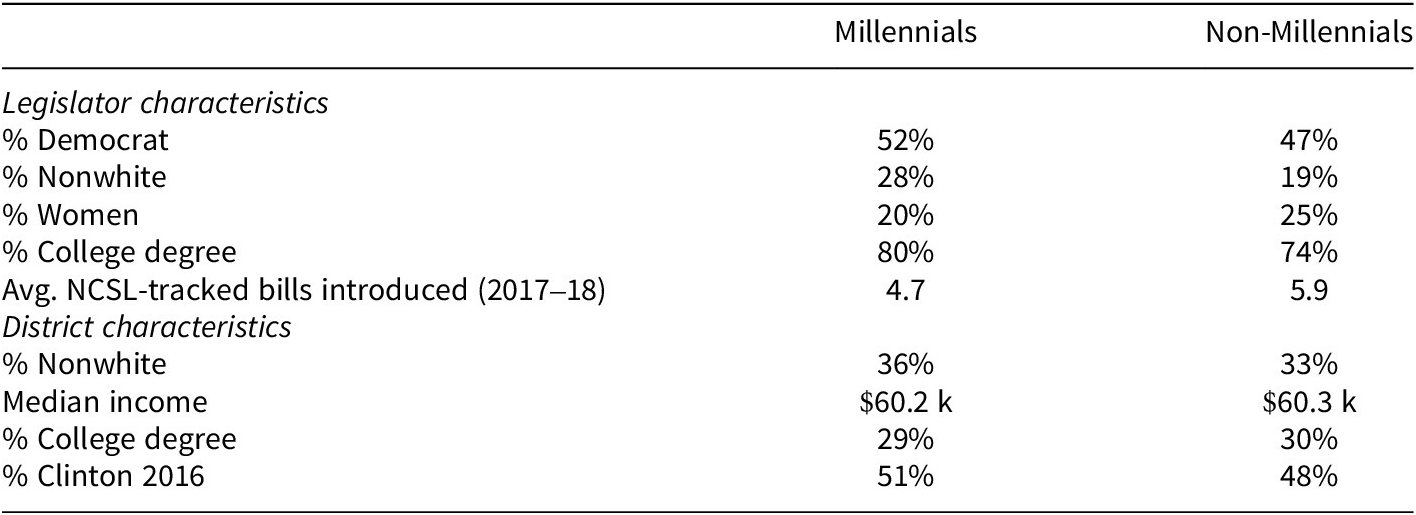
An initial descriptive examination of Millennial state legislators versus their non-Millennial counterparts (Table 1) reveals some key (and mostly anticipated) differences, as well as some consistencies. Millennial state legislators are more likely than their non-Millennial counterparts to be Democrats, nonwhite, and college-educated; however, they are less likely to be women. They are also marginally less productive than non-Millennials in terms of the average number of bills they introduced in 2017 and 2018 (as tracked by the National Conference of State Legislatures), although this is likely a byproduct of diminished legislative experience and seniority rather than structural generational differences. Millennials tend not to represent dissimilar districts than non-Millennials – although districts represented by Millennials have a slightly higher percentage of nonwhite constituents, they are virtually identical to non-Millennial-represented districts in terms of socioeconomic status.
Descriptive statistics, Millennial versus non-Millennial legislators

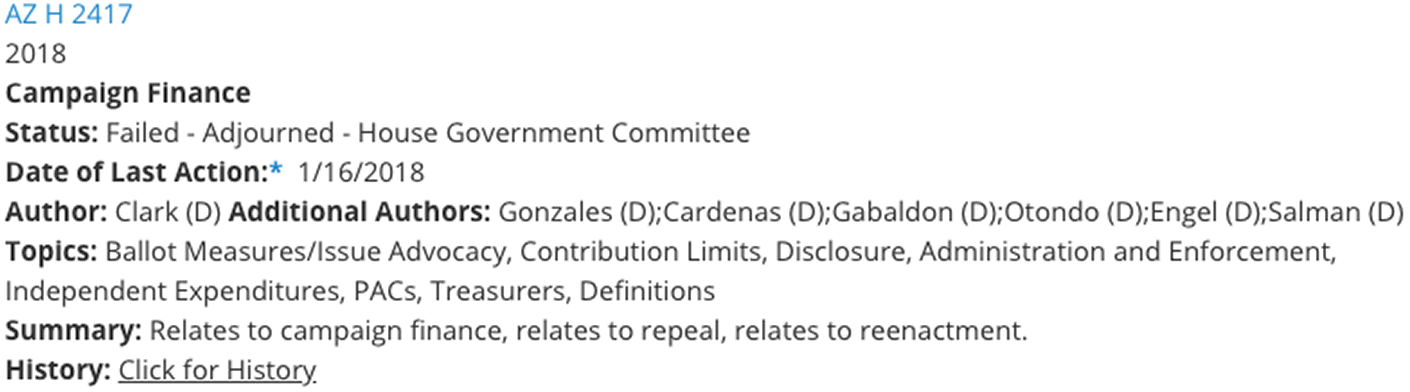
To assess the impact of the Millennial Generation identity on advancing the policy interests of this cohort, we utilize an extensive database of state-level legislation produced between 2017 and 2018 (inclusive) from the National Conference of State Legislatures (NCSL), in coordination with LexisNexis. This database tracks state legislation across all 50 states and across a wide variety of issue categories. Each legislative entry in this database includes bill number, title, sponsor, co-sponsors, state, and year in which it was introduced, current enactment status, NCSL-assigned categories and subcategories, and a short descriptive summary of the legislation. Random manual checks of these bills’ issue categories revealed consistent coding, as well as the quality and substance of subcategories and bill summaries across all states and years, indicating that NCSL’s categorization process is both consistent and reliable.Footnote 9 An example of one such text entry can be found below in Figure 1.
Example of original text data from NCSL’s State Legislation Database.

We were able to scrape, clean, and fully categorize over 22,000 bills covering 29 different broad issue categories across the 31 states for which we coded legislator demographic data. Of these bills, about 10% were coded as bills of special interest to the Millennial Generation. There is no consensus in the identity politics literature about how to clearly determine issues that are important to a particular group (Rouse Reference Rouse2013). However, scholars have utilized two main categories for group-specific interests: objective and subjective measures (Haynie Reference Haynie2001; Swers Reference Swers2002; Wilson Reference Wilson2017). Objective measures are those that disproportionately affect a particular group in a tangible fashion (usually identified through research studies or legislative bill content). Subjective interests are issues of importance to group members (based on feelings and emotions and captured via public opinion surveys). Another way to think of this differentiation is between interests and perceived priorities. Objective (interests) and subjective (priorities) issues often overlap. Identifying a group’s policy priorities is usually based on a combination of both types of measures and is more easily accomplished when a group is more politically homogenous (e.g. African Americans) (Rouse Reference Rouse2013). However, this does not mean that more heterogenous groups cannot have policy priorities. Rather, these priorities (or at least those that can be identified) may be fewer.
Given the diversity of the Millennial Generation and the lack of a previously defined Millennial political agenda, our definition of what constitutes a Millennial bill is based on both objective (interests) and subjective (priority) measures. In other words, we categorize bills of interest to Millennials as ones that address issues that: 1) have a direct, objective, and relatively greater interest-based impact on Millennials compared to their older generational cohorts and 2) have been classified on a subjective basis by Millennials themselves as priorities. In an effort to keep the categorization of Millennial issues more clearly defined, we only coded as “Millennial” issues that satisfied both of these criteria. Thus, we did not include measures that Millennial survey respondents said they care about, but were not also clearly determined to be objective measures that disproportionately affected this cohort (relative to other cohorts) in any discernible way.Footnote 10 This is a more conservative delineation of what counts as a “Millennial issue.” Based on these criteria, we use the following four broad issue categories to code bills that are disproportionately important to Millennials: student loans and college affordability; climate change and energy policy; guns and firearms; and marijuana legalization and decriminalization. We determined that bills concerning these issues are more likely to be sponsored and supported by Millennial legislators. While meeting the bar for objective (interest) measures, we demonstrate that these categories also satisfy the subjective (priority) definition. We do this by relying on the results of a November 2020 original survey conducted by one of the authors. This survey was launched online using a panel of 1,247 respondents recruited by Qualtrics. The panel filled a set of demographic quotas, but most importantly for our purposes, Millennials were purposefully oversampled (Millennials = 412; Non-Millennials = 835).
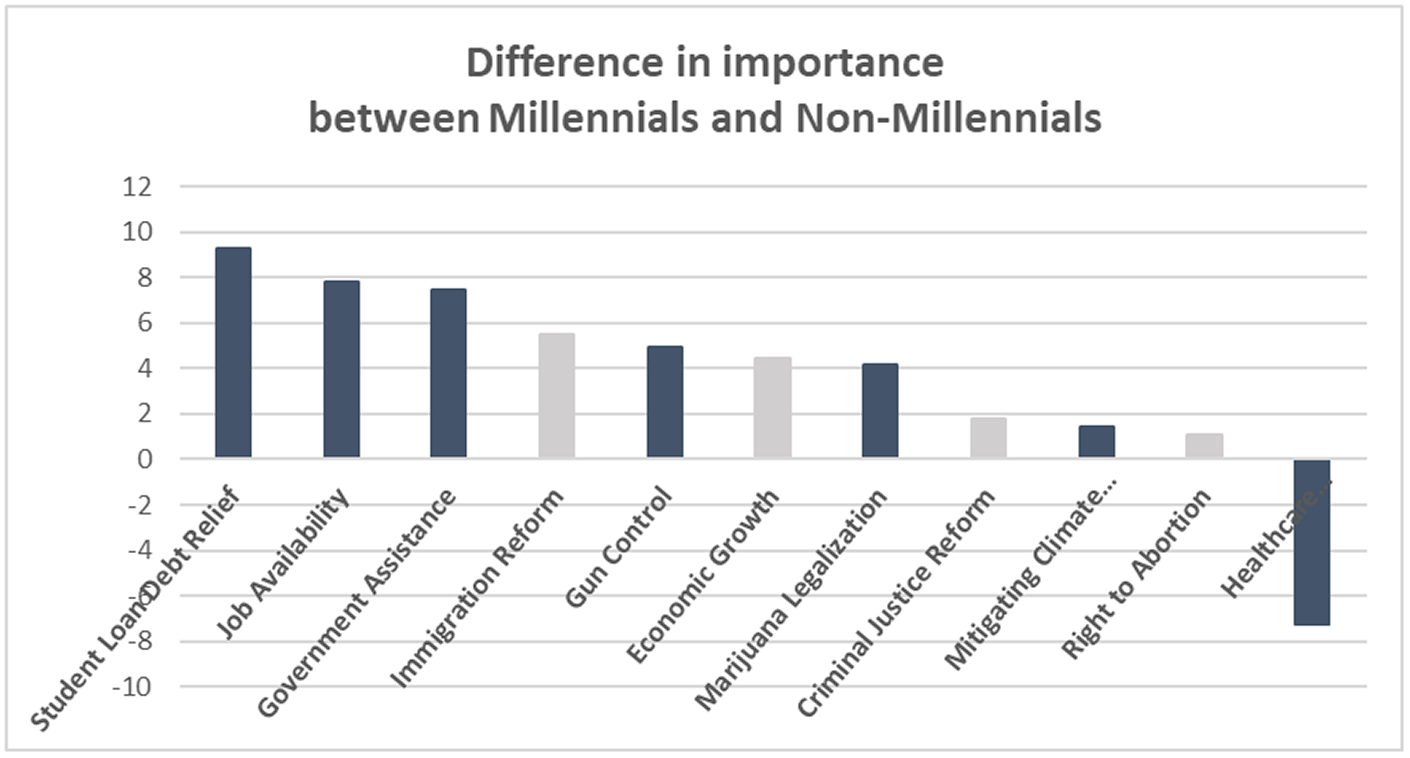
The survey included one question of particular value for exploring the subjective (priority) importance of issues for both Millennials and non-Millennials. Respondents were asked: Considering the following issues, how important do you think each issue is to your age group or generation?Footnote 11 The issues included: job availability, economic growth, healthcare affordability/access, government assistance, gun control, criminal justice reform, student loan debt relief, mitigating climate change, immigration reform, right to abortion, and marijuana legalization. Figure 2 displays differences in the percentage of Millennials and non-Millennials who named an issue as “very important” to their age group or generation.Footnote 12 As the figure shows, only one issue – healthcare affordability/access – was considered very important by a greater number of non-Millennials than Millennials. However, more meaningful to our analyses is whether these differences are statistically significant.
The difference in percentage stating the issue is “very important” to their age group or generation. Above zero = issue more important to Millennials; below 0 = issue more important to Non-Millennials. Dark bars denote statistically significant differences. Millennial N = 412; Non-Millennial N = 835.

To test whether there is a statistically significant difference in importance placed on each issue between Millennials and non-Millennials, we conducted difference of means tests. These tests indicated that Millennials place significantly more importance on job availability, marijuana legalization, student loan debt relief, mitigating climate change, gun control, and government assistance. Non-Millennials place significantly more importance on healthcare affordability/access. Dark bars in Figure 2 denote statistically significant differences between the two groups. There was no significant difference in importance for economic growth, abortion, immigration reform, and criminal justice.Footnote 13 Furthermore, the issues Millennials consider very important in our survey have been similarly identified in other surveys.Footnote 14
These results make clear that marijuana legalization, student loan debt relief, gun control, and climate change mitigation are disproportionately subjective issues (priorities) important to Millennials. We also argue that these four issues are of particular interest or objectively important to the Millennial Generation. Millennials are more likely to use marijuana, compared to older generations (Conway Reference Conway2021). Millennials also have led the way on marijuana legalization in part because they see steeper declines in arrest rates as a result of new marijuana decriminalization laws (Plunk, et al. Reference Plunk, Peglow, Harrell and Grucza2019). In a Pew Research Center survey conducted in 2014 (Gao Reference Gao2015), an almost supermajority of both Republican and Democratic Millennials favored marijuana legalization – the only generation to garner majority support for this policy across partisan lines. Compared to previous generations, Millennials have the highest levels of student loan debt, which combined with other economic factors, puts them on pace to be the first generation to accumulate less wealth than the previous generation (Rouse and Ross Reference Rouse and Ross2018). Millennials were also the first generation to experience the endemic wave of school shootings, beginning with Columbine in 1999, and thus have been disproportionate victims of gun violence, relative to older generational cohorts (Parsons and Johnson Reference Parsons and Johnson2014). They are also twice as likely (along with Generation Z) to express concern about mass shooters as Baby Boomers, and almost 4 in 10 Millennials worry about active shooters when in public (Stockler Reference Stockler2019). The formative years of the Millennial Generation were defined by debates over climate change, and they will likely be the first generation to fully experience an intractable climate crisis (Ross and Rouse Reference Ross and Rouse2022; Ross, Rouse, and Mobley Reference Ross, Rouse and Mobley2019). As a result, surveys consistently show that this generation prioritizes the issue of climate change (Tyson, et al. Reference Tyson, Kennedy and Funk2021).
We do not include job availability or government assistance as issues we examine for bill sponsorship for two reasons. First, the broadness of these categories made it difficult to identify specific related bills. Second, it is not clear that these issues objectively affect Millennials more than they affect other cohorts – that is, job loss and economic concerns are not unique to the time period during which Millennials came of age. While the four Millennial issue categories were not specifically delineated by NCSL, we identified NCSL issue subcategories that include these issues to identify bills of interest to Millennials. We also leveraged the bill summary text using regular expressions to identify any other bills that are relevant to our chosen issue categories, but which may have fallen outside of the NCSL-defined issue subcategories.Footnote 15 Following this initial, broader round of coding, we then used a combination of additional search terms and manual coding to exclude legislation that is related to these topics of interest, but which is either substantively unrelated to or goes directionally against the Millennial generation’s aggregate position on the issue (for example, a bill that mentions guns and firearms, but has the effect of weakening gun safety regulations in schools).Footnote 16
Finally, after identifying the sponsor for each of these bills, we aggregated the bill level data up to the sponsor level, producing counts of total bills sponsored and total Millennial bills sponsored for each individual legislator. We then merged these aggregated bill counts with our original legislator-level data. We were able to match nearly 90% of our original list of legislators with sponsors in the NCSL data. This small shortfall is likely due to the fact that, while the NCSL dataset is incredibly robust, it does not represent the full cross-section of bills introduced in the state legislatures for our 31 states during the two-year time period that our data cover. This is an unavoidable limitation of the NCSL data. However, from an analytical standpoint, this is not a concern for two reasons. First, our broad cross-section of 29 complete and distinct issue areas gives us confidence that we have substantial variation between Millennial and non-Millennial issue categories (indeed, about 10% of the bills included in the data were coded as “Millennial interest” bills). Second, while there are some notable categories missing from the NCSL bill data, we do not have any particular reason to believe that these missing categories should systematically bias our sample of state legislators in a way that would affect the results. The unmatched legislators are not notably biased toward any particular party, race/ethnicity, or other descriptive category.
The structure of the data is in count format – the total number of bills sponsored and the total number of Millennial interest bills sponsored. Therefore, we utilize a count model to predict the number of Millennial interest bills sponsored by both Millennial legislators and non-Millennial legislators in our sample. We employ negative binomial regression rather than a Poisson count model to account for the overdispersion of our dependent variable (legislator sponsorship count) since this measure’s variance (4.9) is several times greater than its mean (0.55) within our sample.Footnote 17 We expect that, on average, Millennial legislators produce higher average counts of sponsored Millennial interest bills than non-Millennial legislators, and that party will play a prominent role in this sponsorship activity as well.
We test our hypothesis while accounting for dispositional and institutional factors that could influence sponsorship activity. First, although the focus of this investigation is on generational identity, we have also included measures of other legislator-level characteristics. Primary among these is legislator party affiliation, which is coded 1 if Democrat, and 0 otherwise. We also include binary indicators for legislator gender (1 if female, 0 if otherwise) and race (1 if nonwhite, 0 if otherwise). In addition, we include institutional controls for a legislator’s seniority within the chamber (captured via KnowWho), and whether the Democratic party holds the majority in the sponsoring legislator’s chamber.Footnote 18 We also cluster standard errors by state in all of the models that follow, in order to account for potential state-level non-independence between legislators.
We include several district-level variables: most notably, the percentage of the district’s population whose age places them in the Millennial generation, in order to account for Millennial legislative behavior that may be constituent-oriented. We also include the percentage of the district with a bachelor’s degree or higher, since this group of voters is more likely to be supportive of action on a set of issues that generally happens to include those we have coded in the Millennial interest categories we denote (particularly student loan debt). We also account for the percentage of the district that voted for Hillary Clinton in 2016 to capture district partisanship; and the percentage of the district that is white, to account for baseline racial heterogeneity between districts.
Finally, we aim to account for generalized legislative productivity – that is, it may be that certain legislators are more likely to sponsor Millennial interest bills because they sponsor higher numbers of bills generally. As a result, we also include a control variable for “Total number of bills sponsored” over the 2017–18 period.
Results
To begin assessing the general impact of the sponsorship of Millennial interest bills, we first ran a model containing all 3,658 legislators and including both Millennial legislator and Democratic party affiliation as separate independent variables. Table 2 shows the coefficients, standard errors, and levels of statistical significance for each of the independent variables in our negative binomial regression model. These initial results indicate that Millennial generation identity among legislators has a suggestive if not statistically significant, positive impact on their propensity to introduce Millennial interest bills.
Effects on Millennial bill sponsorship

Note. Results found using negative binomial regression; standard errors clustered by state.
* p < 0.1.
** p < 0.05.
*** p < 0.01.
We find that Democrats are more likely than Republicans to sponsor bills of interest to Millennials overall (although this coefficient, too, is not statistically significant). This is not too surprising, given that this generation is more liberal and progressive than any other adult generation (Pew Research Center 2018; Rouse and Ross Reference Rouse and Ross2018). Sponsorship of Millennial interest bills is also more likely to happen in legislative chambers controlled by Democrats, and in districts that supported Hillary Clinton for president in 2016. One important question raised in this study is whether Millennials need descriptive representation in order to achieve substantive representation of group interests. In other words, Millennials appear in some ways to be able to receive substantive representation more collectively, via the Democratic Party, without the need for Millennial (descriptive) representatives. However, we hypothesized that, as with other groups, there is a meaningful link between the descriptive representation of Millennials and the substantive representation of their group’s interests, even as the party plays an interactive role in that process (e.g. Haynie Reference Haynie2001; Osborn Reference Osborn2012; Rouse Reference Rouse2013). We see in Table 2 that Millennial generation identity is positively associated with Millennial bill sponsorship, but the result falls short of conventional levels of statistical significance.
However, we also know that Millennial voters and legislators are not equally distributed between the two parties; and that the Millennial generation identity and its impact on Millennial issue advocacy and bill sponsorship may work differently depending on party affiliation. Therefore, an important question in this examination is whether the Millennial generation identity acts in a way that complicates typical partisan stances on Millennial interest issues.
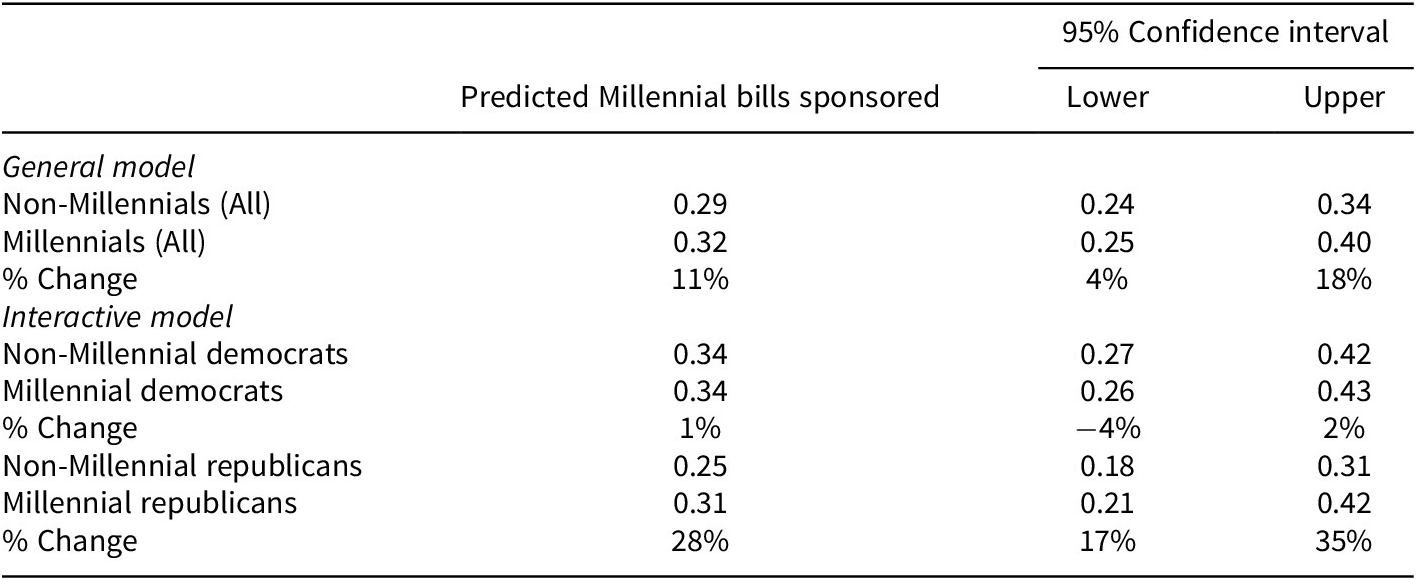
As a descriptive matter, our data indicate that the average Democrat sponsors more issues of interest to Millennials (average of 0.84 sponsorships) compared to the average Republican (0.29 sponsorships). Thus, we examine whether Millennial Democrats, rather than Millennial Republicans, are driving much of the Millennial generation identity findings. We do so by using a model that interacts with the Democrat and Millennial legislator variables and generating predicted counts of Millennial bill sponsorship for the four groups of legislators in question (Millennial and non-Millennial Democrats; and Millennial and non-Millennial Republicans). Table 3 displays these predicted bill sponsorship totals:Footnote 19 first, for Millennials and non-Millennials regardless of party affiliation, as predicted by the general model in Table 2; and then for the model that interacts Millennial with Democratic party affiliation. All predicted values, including the predicted percentage change in sponsorship rates, are accompanied by 95% confidence intervals based on the raw results found in Table A4 in the Supplementary Material.
Predicted counts of Millennial interest sponsorships

Note. Predicted values generated from negative binomial regression count models.
Two findings stand out from Table 3. First, in all cases, all things constant, our results offer suggestive evidence that Millennials out-sponsor their non-Millennial counterparts on these issues, despite being less legislatively active overall. This is true in the general model, and also for both Democrat and Republican Millennials when the interaction term is introduced. As we see in Table A4 in the Supplementary Material, this term falls just short of traditional levels of statistical significance. However, the predicted counts in Table 3 suggest that, interestingly enough, the effects of being a Millennial are substantively larger for Republican legislators rather than Democrats, even though both Millennial and non-Millennial Democrats sponsor more Millennial interest bills than either type of Republican – indeed, only for Republicans can we be confident that the effect of being a Millennial is positive.
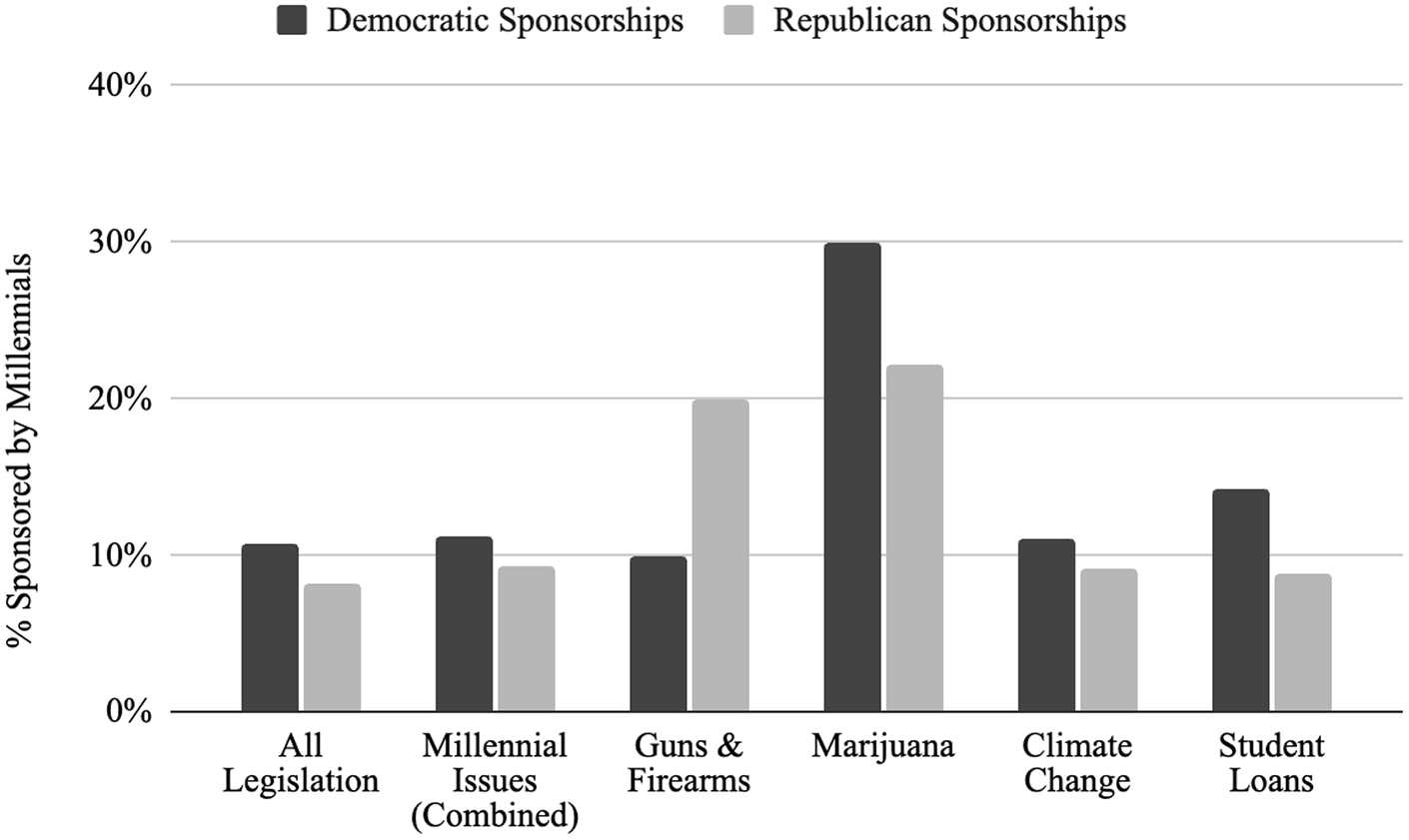
It may be, however, that different issues of importance to Millennials bring out effects that complicate the straightforward role of party affiliation. More specifically, Millennial generation identity may matter more for some Millennial-interest issues; whereas party identity is the greater differentiator on other issues important to this cohort. Descriptive findings bear out these expectations: Figure 3 summarizes the percentage of state legislation sponsored by Millennials, broken down by all legislation; combined Millennial interest bills (the dependent variable in the general model); and each of the four Millennial interest issues that comprise our total counts. For example, we see that of all Democratic-sponsored Millennial legislation, about 12% were sponsored by Millennial legislators, compared to less than 9% of Republican-sponsored Millennial bills.
Descriptive percentages of sponsorships for select bill types, separated by sponsors’ party affiliation.

However, the four issues included in this designation show some significant heterogeneity and descriptive evidence of generation identity at work in both parties. Climate change and student loans follow expected issue patterns, with Millennial generation effects observed primarily among Democratic legislators. This may not be surprising in light of the nationalized polarization around the issue of climate change (Ross and Rouse Reference Ross and Rouse2022), and more recently the association of the student loans issue with elite progressives like Bernie Sanders and Elizabeth Warren. Sponsorship of Millennial interest bills in the areas of guns and marijuana, on the other hand, follows a very different although uncertain pattern. Although they are less likely than Democrats to do so, Republican sponsors of progressive marijuana-related legislation are much more likely to be Millennial than the average sponsor. On the gun and firearm issue, Millennials make up nearly 20% of Republican sponsors of gun control legislation (compared to 8% of all Republican-sponsored bills); Democratic sponsors of this legislation, perhaps surprisingly, are actually less likely to be Millennial on average.
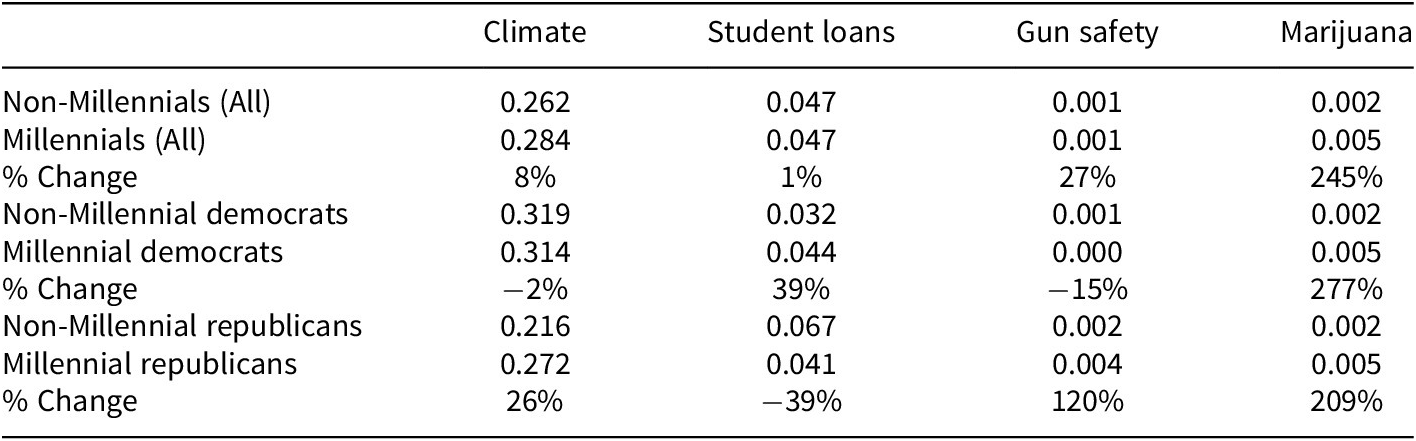
Table 4 offers further suggestive evidence for these heterogeneous effects using the same multivariate negative binomial regression analysis as in the general model, but swapping the generalized “Millennial interest bill count” dependent variable with legislator-level counts of each type of issue legislation, in turn.Footnote 20 We note here that the predicted differences in Table 4 do not reach traditional levels of statistical significance, and thus should be treated with caution. However, we can see that as a descriptive matter, these Millennial interest issue areas are subject to higher rates of Millennial sponsorship than the average piece of state legislation. Additionally, these results tell us that to the extent that we can observe the effects of Millennial generation identity, they are likely not reserved for one party. Rather, the identity can in some cases transcend party lines, and in unexpected directions, depending on the Millennial-interest issue being addressed. For some Millennial interest issues like student loan debt, party identity remains the operative measure in explaining legislators’ sponsorship activity – that is, differences between the parties appear larger than those between generations. For other issues, like marijuana and gun control legislation, the difference in rates of sponsorship between Millennial and non-Millennial legislators in each party is the more substantial differentiator.
Predicted counts of Millennial interest sponsorships by bill type

Note. Predicted values generated from negative binomial regression count models.
Although the party affiliation interaction terms for the model predicting sponsorship of student loan-related legislation were statistically significant, the terms for the other three issues (climate, guns, and marijuana) were not (see Supplementary Table A4). Even so, these results suggest that Millennial generation identity is meaningful not just by itself, but also as a characteristic that intersects the role of partisanship in nuanced ways that merit further attention as Millennials comprise a greater share of American legislatures.
A final result of note is the null effect for district composition – the percentage of constituents in a legislator’s district who are Millennial. Literature on group identity and representation has found that the makeup of a district affects the legislative behavior of elected representatives (Casellas Reference Casellas2011; Haynie Reference Haynie2001). This is especially the case for race and ethnicity, because the percentage of Blacks and Latinos can vary significantly from district to district, and often a legislator shares a particular trait with their constituents (i.e., dyadic representation). However, the age distribution of voters varies very little between legislative districts (e.g. the 25th and 75th percentiles of the “District Percent Millennial” variable are 19 and 25 percent, respectively). Age, much like gender, is fairly consistent across geographic space, and thus less subject to the natural geographic sorting that characterizes identities like race, ethnicity, geography, or economic status that can be more easily carved out or manipulated into or out of specific communities. These latter categories also tend to cluster disproportionately in particular areas of the country (Tam Cho, Gimpel, and Hui Reference Tam Cho, Gimpel and Hui2013).
Due to these exogenous distributions, the relationship between Millennial legislators and Millennial voters is much less dyadic (Millennial legislator-Millennial constituent); Millennial legislators (like women legislators) substantively represent a more national constituency. Millennial-interest issues may also have greater effects in certain districts (e.g., guns in a district where there is high crime or the location of a mass shooting, or a coastal district particularly affected by climate change), allowing Millennial legislators to provide greater substantive representation, irrespective of descriptive representation. The null results for “district percent Millennial” speak to these key differences between descriptive identities and the ways in which their substantive representation is achieved: Millennials receive descriptive representation in state legislatures but as a collective rather than through a dyadic process.
Discussion and conclusion
In this paper, we examine how the Millennial generation identity influences legislative behavior. We expect that similar to other group identities, belonging to the Millennial Generation affects the representation of this cohort’s interests; specifically, that Millennial legislators are more likely than non-Millennial legislators to sponsor bills that advance the policy interests of this cohort. In addition, we acknowledge the important role partisanship plays alongside the Millennial generation identity and argue that any meaningful effects of this identity will be influenced by whether a legislator is a Republican or a Democrat. We examine bill sponsorship activity across 31 state legislatures for the 2017–18 legislative sessions, including on issues that are both objective priorities and subjective interests important to Millennials.
Our results support the general expectation that Millennial generational identity conditions the sponsorship of Millennial interest bills. Millennial legislators are more likely to sponsor bills that disproportionately impact their group members. This result is observed among both Democratic and Republican Millennial legislators, but at different magnitudes and for different issue priorities. Millennial generation identity plays a role in Republican legislators’ advocacy for issues of gun control and marijuana decriminalization and legalization. Democratic Millennial legislators, meanwhile, are far more active on the issue of student loan debt, perhaps because it requires more explicit government intervention and new programs. Although generation identity has a role in all four issues (Table 4), party affiliation is the greater operative differentiator on climate change and gun safety. Future work leveraging a broader cross-section of legislative advocacy should probe these issue- and party-specific interactions further, particularly in light of these suggestive, but not statistically significant, findings.
Our results point to the Millennial generation identity affecting the collective descriptive representation of Millennial interests. While these findings contribute to a broader interpretation of group identities and a more nuanced understanding of the legislative process, they also raise important additional questions. First, does descriptive representation matter for “Millennial issues” beyond those identified here? For example, does this pattern of representation extend to issues that reflect the predominant subjective values of the generation, but that are not so objectively tied to their well-being relative to other generations (e.g., criminal and social justice issues)? While the findings based on a narrow set of issues show promise, further research is necessary to identify a more comprehensive Millennial political agenda. Second, does the number of Millennial representatives in a given legislative chamber make a difference in their ability to effectively represent group interests as a collective? The number of Millennial representatives varies across state legislatures. Some only have “token” Millennials, while others have a large(r) presence. We know from previous research that groups sometimes require a “critical mass” (upward of 15% of the party or the legislative body) in order to effectively represent group interests (Kanter Reference Kanter1977). Do Millennials need to reach a similar threshold in order to be effective representatives, or instead, as Bratton (Reference Bratton2005) and Rouse (Reference Rouse2013) show for women and Latino lawmakers, respectively, can Millennials be more successful in small numbers – behaving as “critical actors” to advance group interests? Finally, Millennials are the most diverse fully adult generation in American history. How does generational identity interact with other identities, such as gender, race, ethnicity, and sexuality; and what is the influence of these overlapping identities on legislative behavior?
Taken as a whole, these results, while not definitive, are suggestive of the influence of the Millennial generation identity in ways that have important implications for representation and policymaking. Although partisanship remains the main driver of legislative activity, particularly in terms of roll call voting and majoritarian legislative agendas and rules, it is not the panacea for understanding legislative behavior; other identities like generation are also important determinants of such behavior. As more Millennials continue to enter the legislative arena and gain seniority within their chambers, we suspect that the results found here will grow in magnitude. This will likely be observed in other areas of the legislative process (beyond sponsorship) that often have greater substantive influence on the passage of legislation. In the meantime, since Democrats appear to be generally more supportive of Millennial-interest issues overall, the party can play a collective role in promoting this group’s interests.
As the country continues to diversify (becoming a majority-minority nation around 2050), group identities are increasingly important for explaining political behavior and representation. Especially in an era of partisan polarization, it is only through a better grasp of how identities inform the scope and intensity of policy preferences, both inside and outside legislative bodies, that can we better comprehend the mechanisms that underlie democratic governance.
Supplementary material
The supplementary material for this article can be found at http://doi.org/10.1017/spq.2024.9.
Data availability statement
Replication materials are available on SPPQ Dataverse at https://doi.org/10.15139/S3/CAULH1 (Hunt, Rouse, and Barth Reference Hunt, Rouse and Barth2024).
Funding statement
The authors would like to acknowledge financial support from the University of Maryland for the open access publication of this article, which was researched and drafted while Stella Rouse was a faculty member at the institution.
Competing interest
The authors declare no potential conflicts of interest with respect to the research, authorship, and/or publication of this article.
Author biographies
Stella Rouse is a Professor of Political Science in the School of Politics and Global Studies and the Director of the Hispanic Research Center at Arizona State University. She specializes in identity politics, with a focus on Latino and generational politics.
Charles Hunt is an Assistant Professor of Political Science in Boise State University’s School of Public Service. He specializes in the study of congressional representation, congressional elections, and electoral competition in the United States.
Jay Barth is an M.E. and Ima Graves Peace Distinguished Professor of Politics, Emeritus at Hendrix College, in Conway, Arkansas.



 Open access

