1 Introduction
The Bronze Age Aegean provides us with nearly 2,000 years of textile history. Evidence of this history has long been found in various forms of material culture, since the early days of Aegean prehistoric research (e.g., Evans Reference Evans1902, 55–58, Fig. 28, 102, Fig. 59; Paribeni Reference Paribeni1908). Through the iconography of clothed human figures in the art of the second millennium BCE, a focus on garments and costume soon became possible. Archaeology of the early twentieth century was concerned with the distinction of Bronze Age ‘ethnic’ identities, and costume seemed an obvious basis for such categorizations (Myres Reference Myres1950; Zora Reference Zora1956). Since this early scholarship paid less attention to issues of production and craftsmanship, the study of cloth and textile craft fell behind the early focus on dress.Footnote 1
From the mid twentieth century onwards, archaeology shifted towards a new paradigm, integrating the study of gender, economy, and technology. This had an impact on the study of Aegean Bronze Age textiles. Craftsmanship, gender and society became important research parameters. In Aegean prehistory, the study of dress iconography began to integrate a technological perspective, discussing the materials and techniques likely employed to manufacture the garments depicted in Aegean Bronze Age art (Sapouna-Sakellaraki Reference Sapouna-Sakellaraki1971). These trends received a boost from the first, synthetic study of Aegean prehistoric textile tools (Carington Smith Reference Carington Smith1975), prompting attention to their systematic recording and collection. Moreover, textiles and textile production, seen as paradigmatic of a gendered division of labour, became analytical units in gender archaeology and a central theme in studies on female agency in history (Gero and Conkey Reference Gero and Conkey1991). The monumental work of E. W. Barber (Reference Barber1991), a milestone in the study of Aegean Bronze Age textiles, wove together all research traditions in a multifaceted and detailed treatment that transcended the geographic and chronological boundaries of the third and second millennia BCE Aegean. The social aspect of textile production was examined in the emblematic book by I. Tzachili (Reference Tzachili1997) through the case study of the Late Bronze Age (LBA) settlement of Akrotiri on Thera, within a gender archaeology perspective. Moreover, the emergence of experimental methodologies aiming at garment reconstruction (Jones Reference Jones1998) paved the way for a more grounded understanding of Aegean Bronze Age dress.
Over the past twenty years, research on Aegean Bronze Age textiles has seen remarkable growth. Scholarship has been influenced especially by the Centre for Textile Research (CTR), University of Copenhagen, which has led the methodological advances in the study of textile tools from a functional perspective (Andersson Strand et al. Reference Andersson Strand, Mannering, Nosch, Ulanowska, Grömer, Berghe and Öhrman2022). As a result, many scholars have taken up studies of textile technology, contributing to an unprecedented accumulation and synthesis of data. Besides a fresh look on second-millennium-BCE dress, this approach allowed for insights into the craft of the third millennium BCE, a historical context largely left out of discussions on Bronze Age textiles in earlier scholarship, given the limited iconographic evidence of dress and a total lack of documentary testimonies from the Early Bronze Age (EBA). Another recent development is the emphasis put on the technological analysis of excavated textiles and textile imprints. Although the Aegean region is not favourable to the preservation of organic materials in archaeological deposits, it is increasingly observed that textiles can survive in special taphonomic environments. New and old textile finds are being (re)examined by a new generation of textile scholars specializing in archaeometric techniques. Their results provide a wealth of information on textile craft.
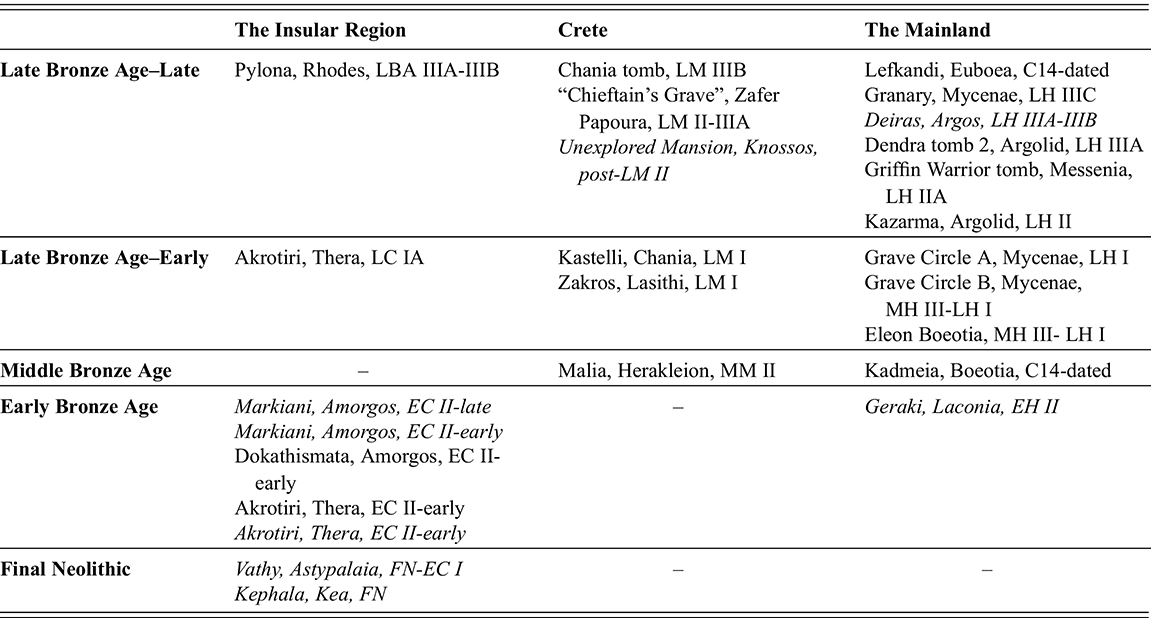
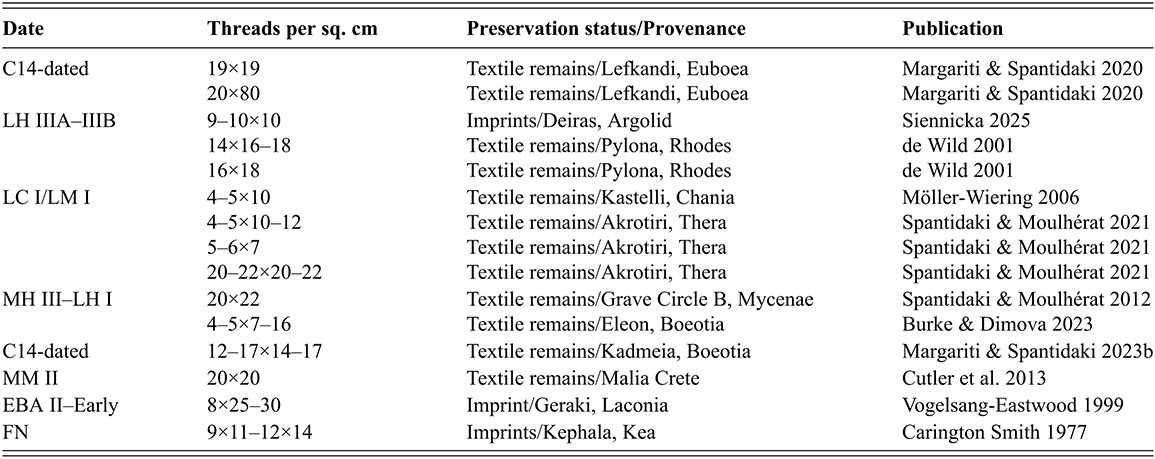
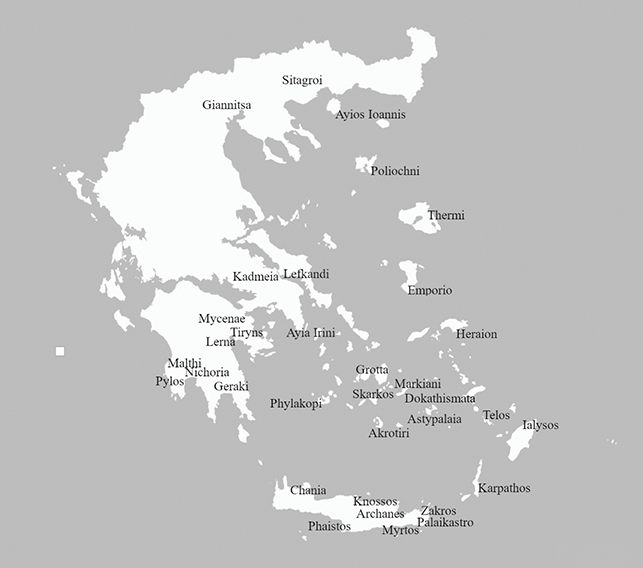
In this Element, an overview of Aegean Bronze Age textiles and textile craft is presented that prioritizes the research of the past twenty years, integrating older finds and reports when necessary. Thus, the focus is on the advances made through the study and analysis of textile tools and excavated textiles and textile imprints of the Early, Middle, and Late Bronze Ages (Table 1, Table 2). The datasets of textile tools are large and ever-expanding, so that a choice of the most well-studied cases or those providing exceptional insight, proved unavoidable (Map 1). This choice renders this Element a frame of reference rather than an exhaustive treatment of the subject. The main insights resulting from the rich body of work on textile and dress iconography will be briefly addressed in Section 2.2.1, with references to seminal, relevant scholarly works. Where deemed necessary, issues of cloth iconography will be raised within the discussions on textile technology.
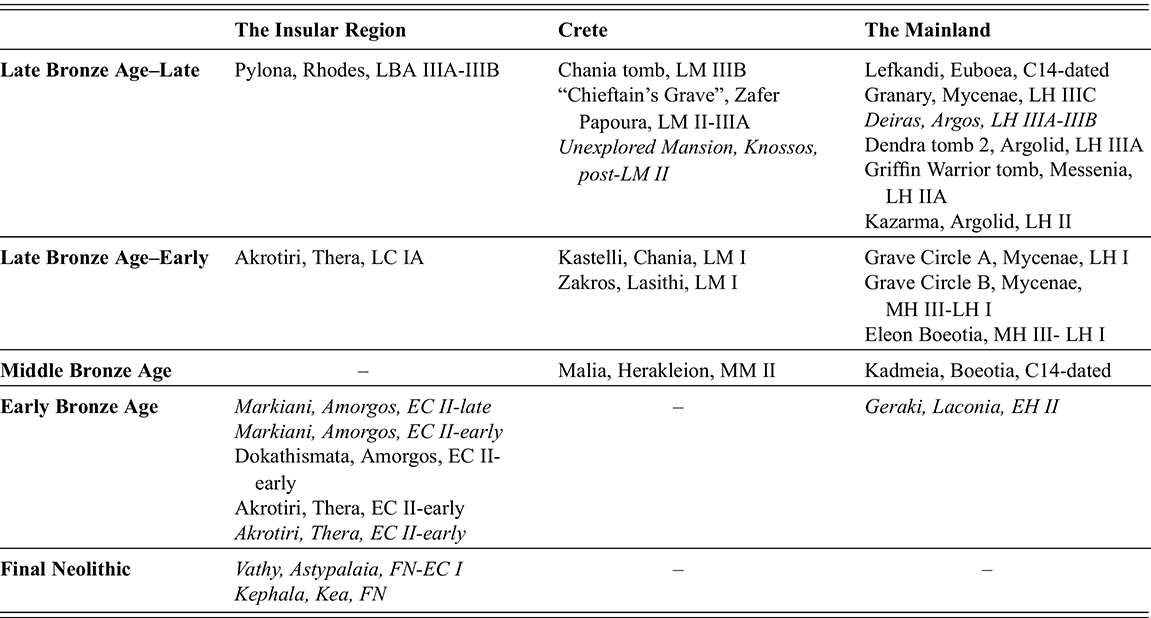
Table 1Long description
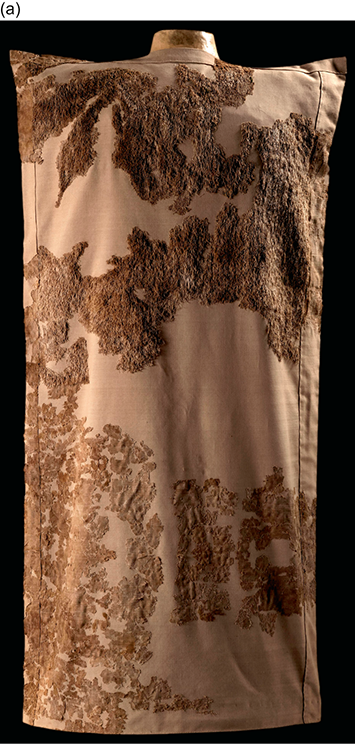
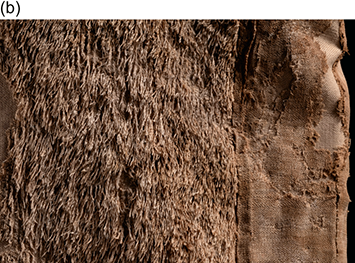
The table includes horizontal registers of textiles published to this date from Aegean archaeological sites on the Greek mainland, on the large island of Crete and on smaller islands of the Aegean archipelago, that are mentioned in the book. The earliest are two textile imprints dating from the period just before the beginning of the Bronze Age, called the Final Neolithic, and both were found on Greek small islands, Kea and Astypalaia respectively. The latest in date mentioned on the table is the garment and the rest of the textile corpus from Lefkandi, a site on the large island of Euboea, which was most probably a heirloom Mycenaean textile deposited in an Iron Age tumulus burial. In between the Final Neolithic and the Lefkandi corpus, are included textiles and textile imprints dating to the Early, the Middle and the Late Bronze Age.
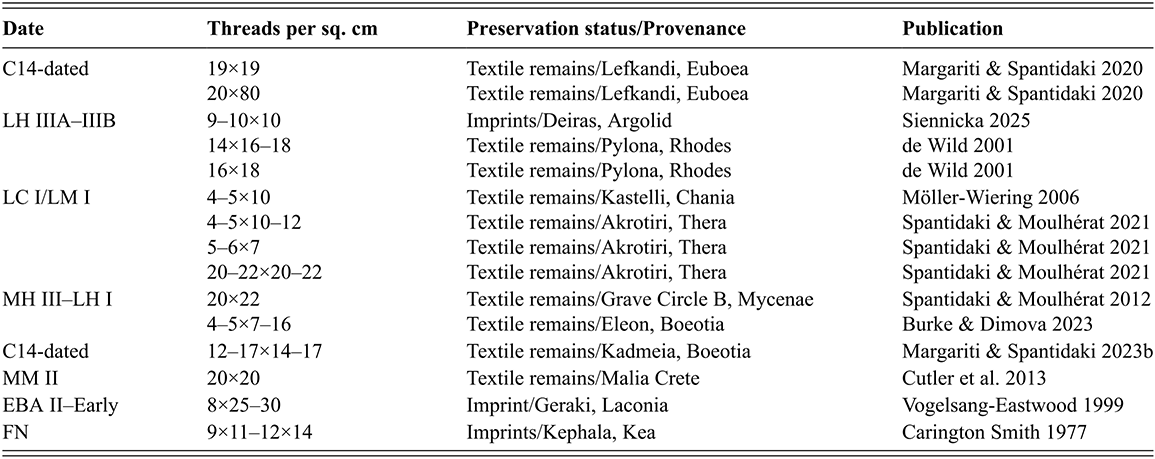
Table 2Long description
The table presents the textiles' thread counts per square cm., that have been published in the archaeological literature of the Bronze Age Aegean thus far. This count describes how many warp threads and how many weft threads occupy one square cm. of each textile. The table is organized chronologically with the earliest specimens on the bottom and the latest on top. The table showcases that as early as the Final Neolithic textles had thread counts of 12 threads versus 14 threads per square cm. It also shows that some very fine textiles had 20 threads versus 20 threads per square sm. The most densely packed thread system mentioned in the table is found in a textile from Lefkandi, Euboea, dated to the end of the Late Bronze Age, with 20 threads versus 80 threads per square cm. For each textile in the table, a bibliographical reference is also provided to indicate its original publication by scholars who studied these textiles and textile imprints.
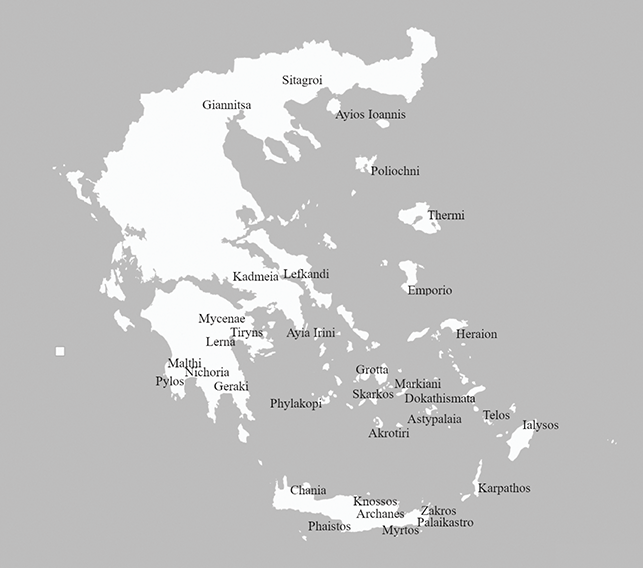
Map 1 Place names and sites mentioned in the text.
2 Background to Aegean Textiles Research
2.1 Textile Craft: Basic Operations and Definitions
Textile production in a pre-industrial technological frame entails a long and time-consuming operational sequence. Its basic stages include the procurement of fibres harvested from plant and/or animal sources, followed by untangling, cleaning and washing the fibres; manufacturing and dying thread (or yarn); fabricating cloth through weaving or other techniques; adding finishing details such as decorative elements during or after weaving; and/or tailoring (Andersson Strand 2015). However, the archaeological visibility of any of these stages depends on the material residues of the manufacturing processes. In the frame of Aegean prehistory, the textile works most frequently represented in the archaeological record are manufacturing thread and weaving cloth, through the recovery of textile tools such as spindle whorls and loomweights.
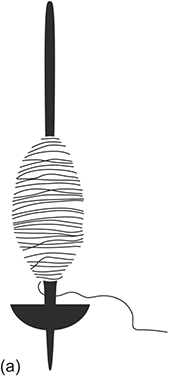
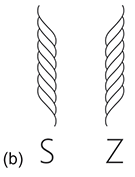
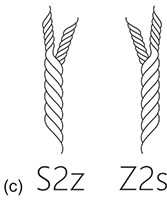
A spindle whorl is an accessory to the spindle, a thin rod, used in the process of twisting fibres into thread, or for plying single threads into thicker ones. It has a simple function but its handling requires skill: the spinner draws a few fibres from a mass of raw material that is fixed on a distaff, attaches these to the tip of the rod, and twirls the spindle while continuously drawing some more fibres. As the rod rotates, the fibres are spun into thread, while the spinner continues ‘feeding’ the spindle, drafting more material from the distaff. The whorl, which has a circular shape, is fixed on the rod through its central perforation and with its weight reinforces the rotation of the spindle (Barber Reference Barber1991, 56–59) (Figure 1a). The spinner stops once in a while to reel the spun thread onto the spindle, and then continues drafting fibres and twirling the spindle. This is called draft-spinning (Barber Reference Barber1991, 41–51). Ethnographic documentation indicates that there exist various technical gestures for handling the spindle in draft-spinning (Vakirtzi et al. Reference Vakirtzi, Papayanni and Mantzourani2022, 175–181). Different gestures may result in distinct primary twist direction, which is conventionally defined with the letters z or s, in accordance with the central slant of these two letters (Figure 1b). E. Barber suggested that a general correlation among direction of primary twist, spinning gesture (suspended or supported spindle), choice of spindle (low or high whorl) and fibre type can be made: z-twist has been associated with suspended, low-whorl spindles and wool, while flax is correlated to high-whorl spindles rolled on the spinners’ thighs (Barber Reference Barber1991, 65–68). However, the more ancient textile analysis progresses, accumulating fresh data, the more Barber’s proposed correlation deserves re-evaluation. The combination of two z -twist threads into a secondary, plied one, manifests a secondary S-twist and is ascribed as S2z. Similarly, two primary s-twist threads plied together will result in a Z2s structure (Skals et al. Reference Skals, Möller-Wiering, Nosch, Strand and Nosch2015, 62) (Figure 1c). A different technique of thread manufacture has been observed in excavated textiles, called splicing. Splicing entails joining individual fibres of plant origin, either continuously along their length or end to end, and then twisting them at their joints (or splices). Spliced threads are then twisted to create a stronger, plied thread, using the spindle (Barber Reference Barber1991, 47, Fig. 2.9; Gleba and Harris Reference Gleba and Harris2019). Depending on the method of manufacture, the threads manifest certain structural features. Spun threads have continuous twists all along their length. Spliced threads demonstrate minimal to no twist, but the joints between fibres may sometimes be distinguished. Because both techniques require the use of the spindle, it is difficult to ascribe ancient whorls straightforwardly to either, although in general splicing is associated with heavier rather than lighter spindle whorls (see Section 2.2.2).
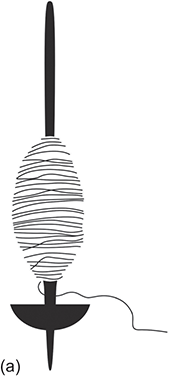
a Spindle with whorl.
Figure 1aLong description
The spindle was made of a thin wooden rod and a round, centrally pierced weight made of clay, stone or bone, called a spindle whorl. Through its central perforation, the whorl was fixed on the rod’s distal end.
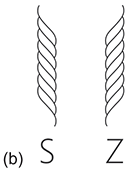
Figure 1b Single s- and z-twist threads.
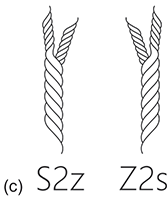
Figure 1c Double S2z and Z2s threads.
Cloth can be produced with various techniques, such as plaiting, twining or felting (Emery Reference Emery1966), but in this Element the focus will be on weaving. This operation, at its most basic version, consists of interlacing two different thread systems – one passive and one active – at a right angle to each other. The threads of one system must be taut, while the threads of the other system are passed over and under them. These are called warps and wefts, respectively. Cross-culturally, several solutions were invented to keep the warp threads taut. These solutions correspond to different loom types. Two of the most well-known ones, the horizontal ground loom and the vertical loom, were certainly in use in the prehistoric Eastern Mediterranean and in the Near East (Barber Reference Barber1991, 81–90). The vertical loom had two basic varieties, the two-beam and the warp-weighted variety, the latter being our main interest in this Element, since it is the only type of loom securely identified from the Bronze Age Aegean, through the recovery of loomweights. We gain glimpses to their function through archaic and classical art (Barber Reference Barber1991, 110–113): these looms were constructed by two vertical supporting beams and an upper horizontal one, where the warp threads were tied to, or were let hanging from a ‘starting border’, a narrow strip of cloth. The lower ends of the warp threads were tied to loomweights that kept them taut so that weavers could pass in the weft threads, as vase paintings indicate (Supplementary Figure 1) (available to access at www.cambridge.org/Vakirtzi). They were also equipped with one or more wooden sticks or bars, called shed and heddle bars, to facilitate the mechanical opening of the warp threads and the faster passing of the weft (Barber 1991, Fig. 3.28). However, the exact structure of the Bronze Age Aegean warp-weighted loom is unknown. Nonetheless, it has been suggested that certain signs of the Linear A script such as AB54 (Figure 2) must have been inspired by the warp-weighted loom (Del Freo et al. Reference Del Freo, Nosch, Rougemont, Michel and Nosch2010, 351).

Figure 2 Schematic drawing of the Linear A sign AB 54.
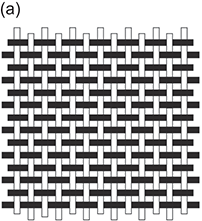
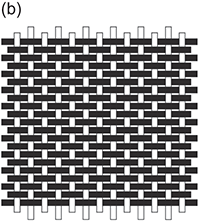
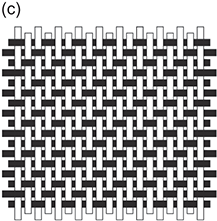
Warp-weighted looms can be used to create several different kinds of fabric structures (or weaves).Footnote 2 In the simplest weave, one thread system passes over and under the threads of the other system. This is called plain or tabby. It may have several variations. In the variety of ‘balanced’ plain weave, the warps and the wefts have approximately the same count per square centimetre (sq. cm) (Figure 3a). When the threads of the warp system are considerably more than those of the weft system, and vice versa, then the weave is ‘faced’, described as warp faced or weft faced, respectively (Figure 3b). A more complex configuration is the diagonal weave, or ‘twill’, where the weft passes alternately over a number of warps and then under a different number of warps (Figure 3c). More sophisticated weaves combine the plain (or tabby) structure with supplementary or floating warp or weft threads inserted by the weaver by hand in the basic (or ‘ground’) fabric, or thread-looping techniques, to create decorative patterns. Tapestry is a more complex structure, developed primarily for creating coloured patterns by inserting discontinuous weft threads of different colours in the weave, following a predetermined design, and is, by definition, a weft-faced type of textile (Emery Reference Emery1966, 78; Vogelsang-Eastwood Reference Vogelsang-Eastwood, Nicholson and Shaw2000, 278). Tapestries from the Bronze Age Eastern Mediterranean have been found in Egypt (Vogelsang-Eastwood Reference Vogelsang-Eastwood, Nicholson and Shaw2000; Spinazzi-Lucchesi Reference Spinazzi-Lucchesi2018), where they are associated to the emergence of the artistic representation of the two-beam loom, and in Syria (Andersson Strand and Nosch Reference Andersson Strand and Nosch2015, Appendix B, with references). Moreover, tapestry is presumably implied by some textile terms found in the Old Assyrian records of Kanesh dating to the nineteenth century BCE (Smith Reference Smith, Nosch, Koefoed and Strand2013, 162, with references). All types of weaves can be further elaborated by fringes, tassels, embroideries and other techniques (Barber Reference Barber1991, 126–144, 166–174).
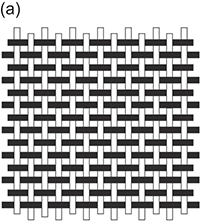
Figure 3a Plain (tabby), balanced weave.
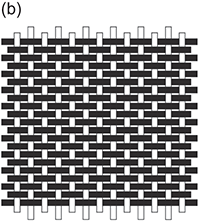
Figure 3b Plain (tabby) weft-faced weave.
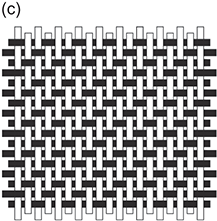
Figure 3c Twill (diagonal) 2/1 weave.
2.2 Sources of Textile Evidence from the Bronze Age Aegean and Methodologies of Research
2.2.1 Cloth Representations
The depiction of clothed human figures in Aegean Bronze Age art is one of the most important sources of textile iconography, thus the discourse on textiles is often conflated with the discourse on dress. For half of the period under discussion, specifically the EBA or the third millennium BCE, the iconographic record related to cloth is limited. The representation of the human body in the art of this period is mostly rendered in three-dimensional figurines modelled either in clay or in stone and less frequently in bone or metal (Marangou Reference Marangou1992). Regardless of region, material, or stylistic tradition, scholars have observed that EBA figurines rarely incorporate iconographic details that can be informative on clothing and textiles (Marangou Reference Marangou1992, 189–190; Mina Reference Mina2008, 87).
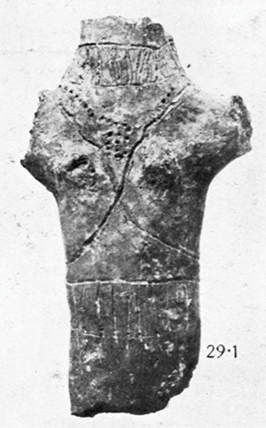
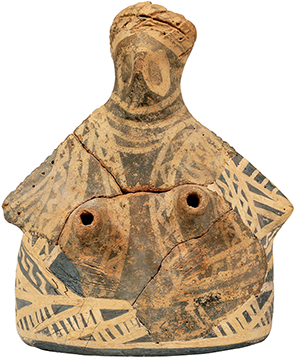
The naturalistic marble Cycladic figurines and their Cycladicizing counterparts, dating from the EBA II onwards, mostly give the impression of the naked human body. Exceptions include figures with sculpted hats or narrow cross-bands worn on the torso to carry weapons such as daggers (Mina Reference Mina2008, 87). However, these bands could have well been manufactured from leather and are not certain to represent textiles. A few clay figurines from this period often bear painted or incised motifs that have been interpreted as clothing items like caps, belts and bands worn around the waist or the hips, as well as cross-bands over the chest (Mina Reference Mina2008, 87). Examples include figurines from Lerna with painted cross-bands on the torso, areas hatched with parallel lines or belts on the waist (Banks Reference Banks1967, 643, Pl. 20; Marangou Reference Marangou1992, 190, Fig. 81) and from Thermi on the island of Lesbos, in the East Aegean, dated from the Third town onwards (Philaniotou Reference Philaniotou, Marthari, Renfrew and Boyd2019, 146). Some of the Thermi figurines bear incised motifs that have been interpreted as dress items (Figure 4), such as a fringed string tied in a knot behind the neck, cross-bands on the chest and a hip-long garment with fringes hanging from its hem on the waist and hips, with punctured dots that were suggested to depict embroidery (Lamb Reference Lamb1928–1929/1929–1930, 31–32, Pl. VIII). In Crete, a class of anthropomorphic clay vessels dating from the Early Minoan (EM) II to the Middle Minoan (MM) IA includes examples that bear painted motifs (Figure 5). Such vessels with painted hatched triangles or rectangles, or elaborate horizontal and vertical bands, are published from the EM settlement of Myrtos (Warren Reference Warren1972, Plates 69–70), from Koumasa, Mochlos, Malia (Warren Reference Warren and Rizza1973, with references) and Phourni-Archanes (Sakellarakis and Sapouna-Sakellaraki Reference Sakellarakis and Sapouna-Sakellaraki1997, 540–541). These anthropomorphic vessels have been considered as representations of female deities wearing elaborate dress (Warren Reference Warren and Rizza1973). However, Jones (Reference Jones2015, 13–22) rejects the interpretation of the painted motifs as garment depictions, arguing that they are typical, decorative patterns on EM non-anthropomorphic pottery.
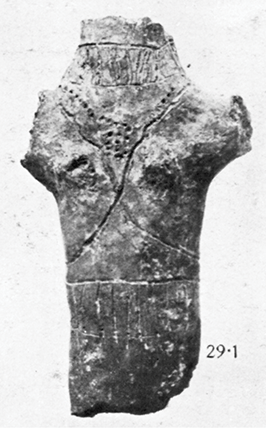
Figure 4 Clay female figurine, from Thermi, Lesbos.
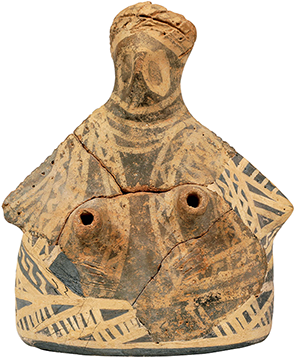
Figure 5 Clay anthropomorphic rhyton, from Malia, Crete.
Other artistic media with presumed dress iconography from the transitional period between the third and second millennia BCE include some Cretan figurines made of bone, stone, and metal, as well as figures carved on Cretan seals. Two figurines made of hippopotamus ivory and another made of marble, found in the Hagios Charalambos cave in the Lasithi area, East Crete, and attributed to the EM III-MM IA period, have body shapes that lack a clear distinction of the legs and have thus been considered as clothed in cloaks or long dresses (Ferrence Reference Ferrence, Stampolides and Sotirakopoulou2017). A metal anthropomorphic figurine from Archanes, dating to the end of the Prepalatial or the beginning of the Protopalatial period, was cast in a shape that suggests a foot-length garment (Sakellarakis and Sapouna-Sakellaraki Reference Sakellarakis and Sapouna-Sakellaraki1997, 527). It was interpreted as a male ‘wearing female dress’ by the excavators (Sakellarakis and Sapouna-Sakellaraki Reference Sakellarakis and Sapouna-Sakellaraki1997, 527) but was considered as a female wearing a bell-shaped skirt by Stefani (Reference Stefani2013, 47–54). Some representations of clothing are also encountered on figurines and seals found in funerary contexts from the Tholos Tombs of Mesara, like the ivory female figurine from Platanos, with a long skirt bordered by parallel bands on the hem (Stefani Reference Stefani2013, 49), and the ivory seal from Archanes depicting a female figure with a long dress and a high collar, known as the ‘Medicis Collar’ (Sakellarakis and Sapouna-Sakellaraki Reference Sakellarakis and Sapouna-Sakellaraki1997, 675–676).
In the course of the Middle Bronze Age, the representation of human clothing found new expression in Cretan art. The anthropomorphic clay figurines found in large quantities in peak sanctuaries render both female and male dress: long, bell-shaped or pleated skirts with wide belts tied in elaborate knots and various types of hats for women (Stefani Reference Stefani2013, 55–79), as well as various types of loincloths and belts for men (Sapouna-Sakellaraki Reference Sapouna-Sakellaraki1971, 7–29; Rehak Reference Rehak1996, 42–43). The details of patterned cloth did not escape the attention of figurine makers: the painted bands on the garments of female figurines from Petsofas (Supplementary Figure 2) is one such case, probably corresponding to colour-patterning. Such patterning has been suggested to be the result of either weaving with supplementary weft techniques or of sewing narrow bands on the hems of skirts (Stefani Reference Stefani2013, 60).
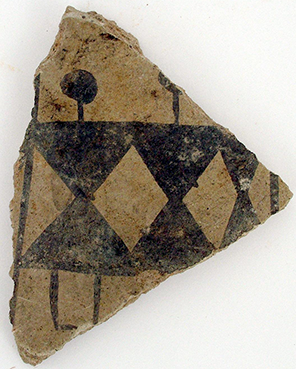
While these developments in representational art were underway on Crete, human imagery was rare in the Middle Bronze Age art of the Greek Mainland and in the rest of the insular Aegean (Tzonou-Herbst Reference Tzonou-Herbst and Cline2012, 215). Pictorial art is largely lacking from the Middle Helladic (MH) material culture (Blakolmer Reference Blakolmer, Philippa-Touchais, Touchais, Voutsaki and Wright2010), rendering the clothing of this period archaeologically invisible. In the insular region, human representation is rare, schematic and mostly confined to vase painting. For example, at Akrotiri, Thera, the human figure as a theme in vase painting of the early second millennium BCE (Doumas Reference Doumas and Vlachopoulos2018) provides few clues to dress of the Middle Cycladic (MC) period. A few anthropomorphic figures depicted on local pottery sherds are rendered in hourglass shape (Nikolakopoulou Reference Nikolakopoulou2019, 276, Fig. 3.2), indicating, at best, knee-length garments (kilts?) (Figure 6). Slightly later, but still in the MC period and locally produced, is an exceptional bichrome jug with a ‘pouring scene’, depicting two males dressed in ‘Minoan cloth’ (Nikolakopoulou Reference Nikolakopoulou2019, Vol. I, 282, Fig. 3.8, Vol. II, 230).
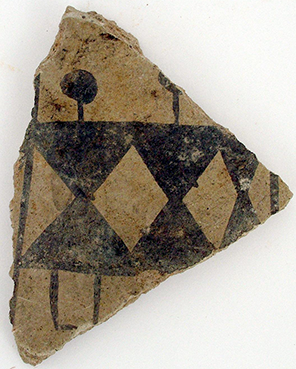
Figure 6 Pottery sherd with painted schematic male figures, from Akrotiri, Thera (Doumas Reference Doumas and Vlachopoulos2018, 31, Fig. 4 c).
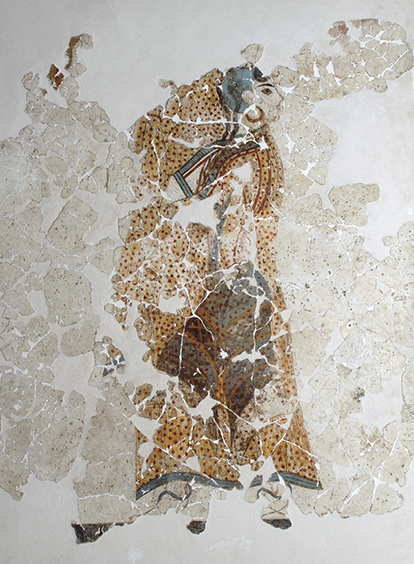
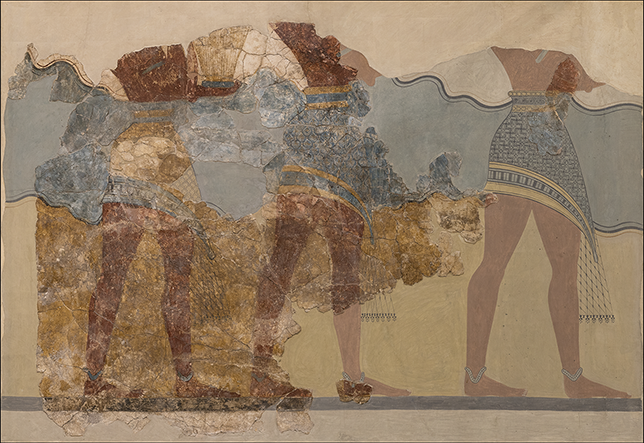
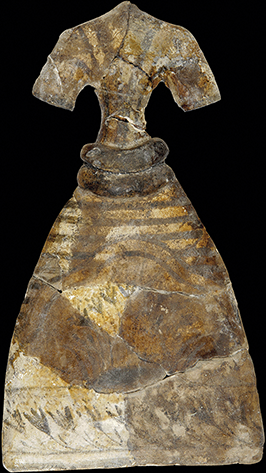
The artistic landscape changed radically in the period marked by the emergence of the New Palaces on Crete, towards the end of the Middle Bronze Age, in the MM III phase. Along with the art of wall-painting, eventually adopted in the Cyclades and the mainland, a rich iconography of clothing emerged, and one that now represented elaborately patterned, multicoloured textiles. Moreover, anthropomorphic figurines crafted in metal, ivory, stone or clay, and developments in glyptic, enrich the sources of cloth iconography. These artistic representations showcase a wide range of garments, including various types of skirts (bell-shaped, flounced, fringed, pleated, with horizontal bands), as well as pants, loincloths, kilts, mantles, long robes with diagonal bands, tight bodices with narrow hem-bands and tassels, aprons, belts and hats (Figures 7–8, Supplementary Figures 3–4). Among these are also items such as knots, scarves and cloaks or garments that are depicted either independently of human figures or as being carried by them, presumably with a symbolic or cult significance (Figure 9, Supplementary Figure 5). Given the identification of the narrated themes or episodes, these dresses and individual cloth items have been characterized as prestige, ritual or sacred (Crowley Reference Crowley, Nosch and Laffineur2012; Boloti Reference Boloti, Harlow, Michel and Nosch2014; Jones Reference Jones2015; Blakolmer Reference Blakolmer, Pavúk, Klontza-Jaklová and Harding2018). Colours, ornamental styles, decorative techniques, embroidery, tailoring and sewing, as well as regional fashions, have been identified in the dress imagery of the LBA (Barber Reference Barber1991, 312–357; Stefani Reference Stefani2013). Research has suggested a distinction between ‘Minoan’ and ‘Mycenaean’ garments, based on this corpus of representations. For example, characteristic types of ‘Minoan’ female dress include the ‘fleece’ or ‘animal-hide’ skirt; the ‘bell-shaped skirt’ and the ‘flounced’ skirt combined with the tight bodice; and several types of pants and headdresses, most of which appear to be richly patterned (Stefani Reference Stefani2013). ‘Mycenaean’ female dress, in contrast, is represented by an ‘all covering chemise’ of less elaborate decoration (Barber Reference Barber1991, 315) or a ‘long robe’ with bands on the hem, and often with a vertical band as well (Boloti Reference Boloti, Harlow, Michel and Nosch2014). Nonetheless, a degree of influence and hybridization between the two cloth-culture spheres has been acknowledged, best expressed in the multi-figured scene painted on the LM III sarcophagus of Ayia Triada, Crete: the types of garments worn by female and male actors within the same ritual episode include both Cretan and mainland elements (Burke Reference Burke2005; Boloti Reference Boloti, Harlow, Michel and Nosch2014).
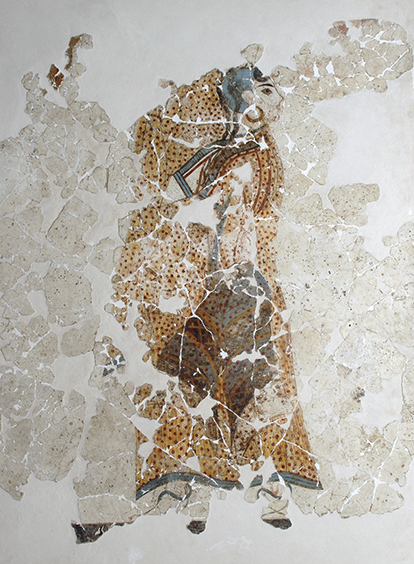
Figure 7 Girl with patterned flounced skirt and bodice, covering her figure with a crocus-coloured, red-dotted, transparent, long veil. Detail from ‘The Adorants’ Fresco, Xeste 3, from Akrotiri, Thera.
Figure 7Long description
The painting depicts a girl wearing elaborate clothing. Her whole body is covered with a yellowish, transparent veil decorated with small red dots. Beneath the veil, she wears a long skirt with flounces and a tight chemise called a “bodice”.
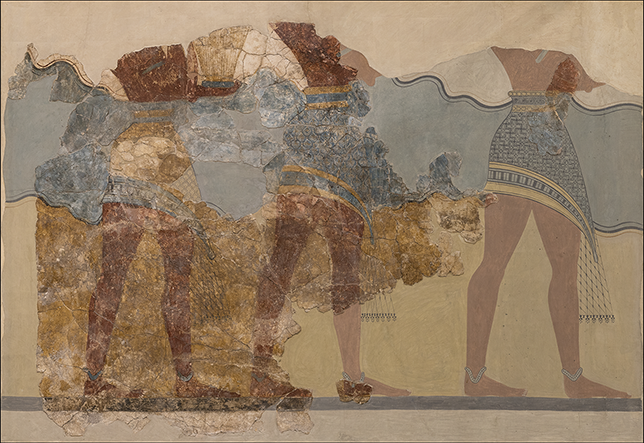
Figure 8 Male figures in procession, wearing colourful, patterned kilts. Detail from the ‘Procession Fresco’, from Knossos, Crete (inv. nr. T3 ©Archaeological Museum of Heraklion/ODAP/Hellenic Ministry of Culture).
Figure 8Long description
The painting depicts the lower bodies of three men walking in procession. All three are depicted wearing thigh-length garments called kilts, made of colourful, patterned fabrics, bordered by coloured, textile bands near the hems.
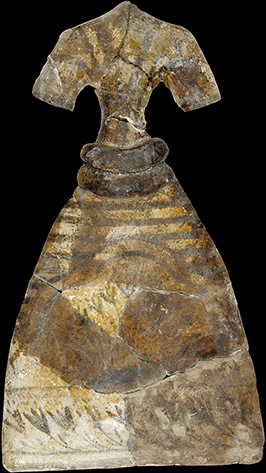
Figure 9 Faience replica of a dress composed by a long skirt decorated with crocuses, a double belt and a tight bodice, from the Temple Repositories, Knossos, Crete.
Figure 9Long description
The object resembles a garment consisting of a long, bell-shaped skirt and a tight, short-sleeved chemise known as “bodice”. The skirt is decorated with painted crocus flowers. The garment also includes a double belt on the waist.
Textile patterns as depicted in LBA dress iconography have received a special focus from scholars. A variety of elaborate and detailed floral and geometric motifs, and in a few cases figurative ones, too (Barber Reference Barber1991, 317–321) appear to have been embellishing the textiles that were tailored into female and male garments. Some of these patterns are not exclusive in the depiction of dress. Wall-painting and vase painting share in this rich repertoire of motifs as well (e.g., Betancourt Reference Betancourt, Gillis and Nosch2007; Hatzaki Reference Hatzaki and Vlachopoulos2018). Careful observation of the iconographic details of these garments and textiles supports theories on the artistic conventions employed to render different cloth textures. Cases in point are the ‘transparent’ dress items and the ‘fleece’ or ‘animal-hide’ skirts. Transparent textiles are identified when the contours of a garment contain the depiction of other items of clothing, or of the arms and legs of human figures, suggesting visibility beneath the cloth (Stefani Reference Stefani2013, 109–110). The ‘fleece’ or ‘animal-hide’ skirt, first attested in ceramic vase painting of Protopalatial Phaistos, recurring in Neopalatial seals and last represented on the Ayia Triada sarcophagus mentioned earlier (Stefani Reference Stefani2013, 104–107), conveys a ‘woolly’ impression. This was suggested to reflect weft-looping (Tzachili Reference Tzachili1997, 242–243), a technique which involves loosely twining supplementary wefts around the warps in a way that leaves small loops hanging on the surface of the woven cloth. This technique survives on actual cloth fragments found in Middle Kingdom Egypt (Vogelsang-Eastwood Reference Vogelsang-Eastwood, Nicholson and Shaw2000, 276).
Besides human dress, LBA iconography informs us on the use of products such as sailcloth, strings, ropes, and nets for captivating animals (e.g., Doumas Reference Doumas1992, Papageorgiou Reference Papageorgiou, Doumas and Devetzi2021, Betancourt Reference Betancourt, Gillis and Nosch2007). These fibre-based artefacts are created with the same manufacturing principles and materials that are also used for weaving cloth for garments. Thus, their study adds important layers of information for a broader understanding of textile crafts (Vakirtzi et al. Reference Vakirtzi, Georma, Karnava, Ulanowska and Siennicka2018).
2.2.2 Textile Tools and Production Facilities
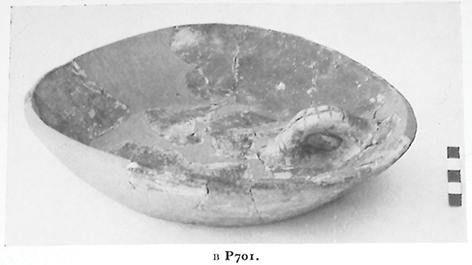
The most frequently occurring tools in Aegean Bronze Age archaeological deposits are the remains of spindles and warp-weighted looms, namely spindle whorls and loomweights (Barber Reference Barber1991; Tzachili Reference Tzachili1997). Other textile implements found in Bronze Age sites include needles made of bone or metal, spinning bowls, that is, a type of clay bowl used for plying thread, pointy bone tools usually identified as pin beaters and pierced spools which have been interpreted as reels possibly related to warping. Throughout the Bronze Age, spindle whorls and loomweights were manufactured in a variety of shapes and sizes (Figures 10–11) and with materials such as clay, stone, or bone. Established tool typologies (Carington Smith Reference Carington Smith1975; Andersson Strand and Nosch Reference Andersson Strand and Nosch2015) facilitate the identification of these objects in the field, but certain types of ambiguous objects are more difficult to identify as implements related to textile craft (Barber Reference Barber1991, 91–93).

Figure 10 Basic spindle whorl types from Bronze Age Aegean sites. From left to right, upper row: biconical, conical, spherical. Lower row: hemispherical, cylindrical, discoid.
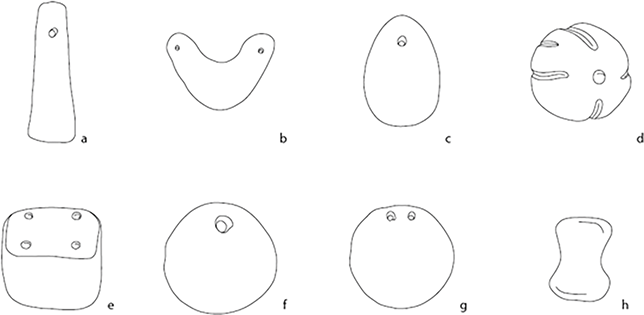
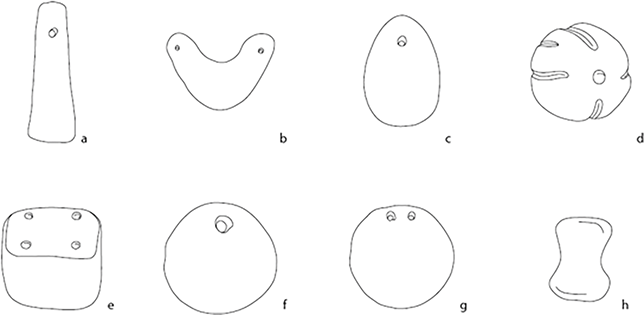
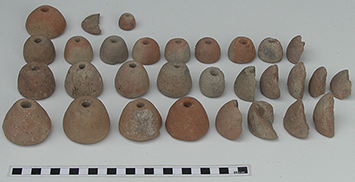
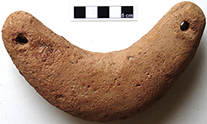
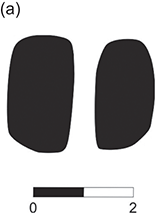
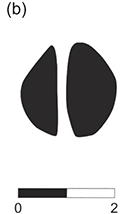
Figure 11 Basic loomweight types from Bronze Age Aegean sites. Upper row: (a) pyramidal, (b) crescent-shaped, (c) piriform, (d) spherical, (e) cuboid, (f) round discoid with one perforation, (g) round discoid with two perforations, (h) spool-shaped
Figure 11Long description
Based on the loomweight form, these types are the a)pyramidal b) the crescent-shaped c) the piriform d) the spherical e) the cuboid f) the round discoid with one perforation g) the round discoid with two perforations and the spool-shaped.
Textile tools lend themselves to an array of analytical approaches. The most widely applied are distribution, typological, and functional analysis. Recently, the potential of clay provenance studies applied in textile tools analysis has been highlighted (Gorogianni et al. Reference Gorogianni, Cutler, Fitzsimons, Stampolidis, Maner and Kopanias2015; Vakirtzi Reference Vakirtzi and Nikolakopoulou2019), which is especially promising in demonstrating the ‘mobility’ of textile craftspeople (Cutler Reference Cutler2021, 258). Another important aspect of textile tools study calls for collaboration with Aegean specialists in administration technologies, including stamping, marking and writing, because in certain cases Aegean Bronze Age textile tools bear traces of these practices on their surfaces (e.g., Vlasaki and Hallager Reference Vlasaki, Hallager, Poursat and Müller1995; Burke Reference Burke and Mountjoy2003; Tzachili Reference Tzachili and Doumas2007a; Burke Reference Burke2010, 57; Evely Reference Evely, Knappett, Cunningham and Palaikastro2012; Militello Reference Militello, Breniquet and Michel2014b, 276; Cutler Reference Cutler and Tsipopoulou2016b, 178; Karnava Reference Karnava2018, 162, 166; Karnava Reference Karnava and Nikolakopoulou2019, 502, with references; Tzigounaki and Karnava Reference Tzigounaki, Karnava, Stampolidis and Giannopoulou2020, 324; Siennicka Reference Siennicka, Quillien and Sarri2020; Cutler Reference Cutler2021, 145, 238). These practices are not yet well understood in terms of the relation between textile craft and the use of administration technology or the extent of Bronze Age ‘literacy’.
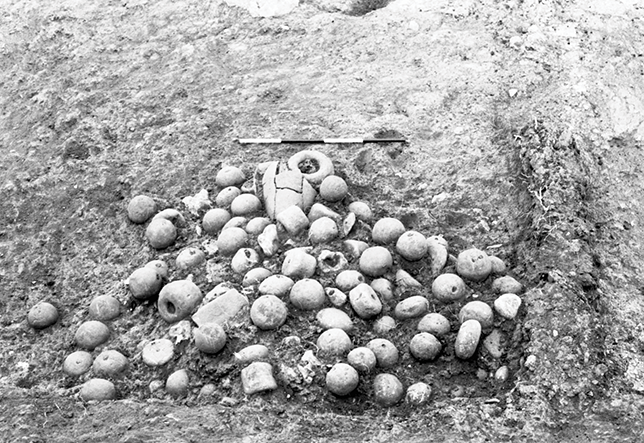
Distribution analysis permits the interpretation of the spatial configuration of tools found in archaeological deposits. On a first level, it aims to distinguish between secondary deposits such as backfills, destruction debris, or building materials where textile tools often end up after being broken and disposed of, and primary deposits implying use spaces, intentional deposition related to funerary customs or other special behavioural patterns (see Section 3.4). On a second level, when textile tools are found in primary deposition in use spaces, their distribution patterns may reveal the organization and scale of production. Distribution analysis may also allow the distinction between loomweights in storage and loomweights fallen from a set-up loom (see Section 3.4.3).
Typological analysis, a conventional archaeological methodology, has enabled the distinction between different manufacturing choices with regard to the shape and size of spindle whorls and loomweights. The first comprehensive survey of Aegean prehistoric textile tools, conducted by J. Carington Smith (Reference Carington Smith1975), led to the development of a detailed typology that remains a point of reference to this day. The attribution of textile tools to distinct types permits the comparison of different assemblages, ultimately allowing to discern patterns of continuity and changes in the habits of tool manufacture at the site level. Typological classification is also the basis of identifying regional interactions or influences among distinct communities of textile craftspeople, after mapping the various types of tools in geographical space. An example of this approach can be seen in the suggestion that the hollow (‘scodelletta’) spindle whorl type indicates the mobility of craftspeople over large spans of space and time (Barber Reference Barber1991, 299–310, see Section 3.1.1).
Functional analysis aims at interpreting the functional potential of textile tools. It is a method developed at the CTR aiming to correlate the tool shape and size with its intended function to produce specific results. In the case of loomweights, it is based on weaving experiments that demonstrated that the tools’ thickness and weight are important functional attributes (Mårtensson et al. Reference Mårtensson, Nosch and Andersson Strand2009). They influence the loom setup, that is, how densely-spaced the warp threads are, and also the types of threads (fine, medium, coarse) and how many threads can be attached to each loomweight (Olofsson et al. Reference Olofsson, Andersson Strand, Nosch, Strand and Nosch2015, 89–92). Thus, when archaeologists record the weight and thickness of loomweights found in archaeological deposits, they provide data that is essential to suggest potential loom setups, and eventually fabric types that could have been produced with a given yarn quality (Olofsson et al. Reference Olofsson, Andersson Strand, Nosch, Strand and Nosch2015, 95–97). The CTR team applied functional analysis to a large sample of Aegean Bronze Age loomweights and suggested that the metrological variation of textile tools reflects not simply preferences in loomweight design, but most probably corresponding preferences in different cloth types (Andersson Strand and Nosch Reference Andersson Strand and Nosch2015, 362–371). For example, it was demonstrated that when producing plain (tabby) weaves, thick loomweights are optimal for weaving ‘open’ fabrics, that is, cloth with loosely distanced warp threads, whereas thin loomweights are optimal for denser cloth (Andersson Strand Reference Andersson Strand, Andersson Strand and Nosch2015b, 143). Nevertheless, this method has its limits in reconstructing the end-product. The weave structure and the overall appearance of the finished fabric are not defined only by warp threads. Among other factors, the arrangement of weft threads also plays an important role in the final appearance of cloth, determining if the weave is balanced or not. For example, open weaves can be filled in by multiple counts of wefts, creating weft-faced fabrics. An important result of the research conducted by the CTR team is the suggestion that despite the wide range of loomweight types of the Bronze Age Aegean, several overlap in a functional sense. This means that although they have a different shape, some loomweights can yield similar results. The loomweight types that are clearly distinct from a functional perspective and would thus have been used for the production of different types of textiles are the spherical, the pyramidal, and the discoid (Andersson Strand and Nosch Reference Andersson Strand and Nosch2015, 371). Based on this assessment, it can be suggested that, although the warp-weighted loom technology was shared by craft communities in different regions of the Bronze Age Aegean, the cloth produced by these communities may have been considerably different from one place to the other. For example, when comparing weaving with pyramidal loomweights at EBA Sitagroi, northern Greece (Elster Reference Elster, Elster and Renfrew2003), to weaving with discoid loomweights at EBA Myrtos, southern Crete (Warren Reference Warren1972), it can be argued that, although both of these communities used the warp-weighted loom technology, their sense of textiles must have been very different, when considering the different functional potential that pyramidal and discoid loomweights have.
In the case of spindle whorls, scholars have been debating what constitutes the most crucial functional attributes that determine their effect on the spinning or plying process, and ultimately on the quality of the produced thread (Vakirtzi et al. Reference Vakirtzi, Papayanni and Mantzourani2022, 181–184). Nonetheless, there is general consensus that their weight is an approximate indication of the quality of fibres and the thread thickness (Andersson Strand and Nosch Reference Andersson Strand and Nosch2015, 359–362). In this rationale, significantly different spindle whorls, in terms of their weight, would be used to manufacture significantly different thread types. Fine yarns generally require well-processed, fine fibres to be spun with a spindle equipped with a light whorl. The manufacture of thick, single threads or plied ones requires using a heavier whorl. Spinning experiments conducted by the CTR have confirmed that the weight of the whorl can be indicative of the thickness of the thread, but it cannot be diagnostic of the fibre source, that is, the plant or animal species (Olofsson et al. Reference Olofsson, Andersson Strand, Nosch, Strand and Nosch2015). It has also been suggested that the whorl’s diameter affects the speed of rotation of the spindle, and therefore influences how loosely or densely spun the thread will be (Barber Reference Barber1991, 53; Olofsson Reference Olofsson, Strand and Nosch2015, 33; Olofsson et al. Reference Olofsson, Andersson Strand, Nosch, Strand and Nosch2015, 87). Thus, for a functional analysis of spindle whorls, the first step requires recording the metric data of these tools, especially the weight and diameter values (Andersson Strand and Nosch Reference Andersson Strand and Nosch2015, passim). By projecting these on a weight-diameter scatterplot, it is possible to demonstrate the frequencies of whorls of different sizes in the sample of tools under study, and to compare patterns of thread production in general, qualitative terms (e.g., Andersson Strand and Nosch Reference Andersson Strand and Nosch2015, passim; Vakirtzi Reference Vakirtzi, Schier and Pollock2020).
2.2.3 Excavated Textiles and Textile Imprints
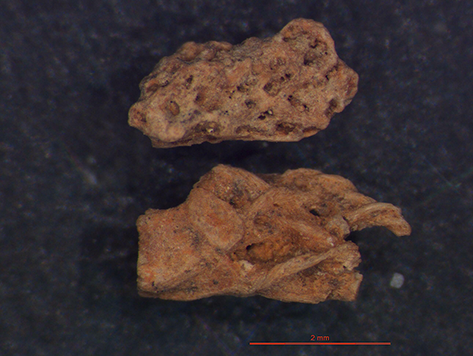
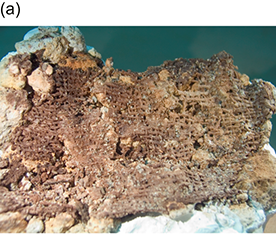
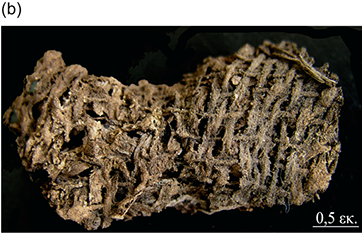
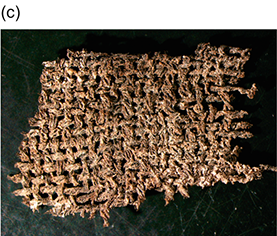
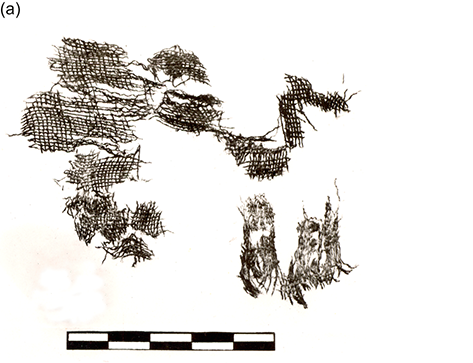
Textiles are repositories of a wealth of information on textile craft, ranging from fibre economy to textile technology, to styles and fashion. Depending on the degree of preservation of excavated textiles, the diagnosis of fibre type, thread-making technology, weave structure or pigments, may be possible, using an array of analytical instruments and physicochemical techniques (Margariti et al. Reference Margariti, Lukesova and Gomes2024). In the Aegean region textiles have survived in archaeological deposits usually following carbonization, mineralization, or calcification (Spantidaki and Margariti Reference Spantidaki and Margariti2017, 51). These are three distinct chemical processes, each triggered by specific pre-depositional or post-depositional conditions. Each of these processes alters the original chemical composition, appearance, and tactile effect of the textiles but at the same time prevents the activity of bacteria that cause the degradation of organic matter.
Excavated textiles can be observed using simple magnifying lenses or optical microscopy to determine the type of weave and to record the density of warp and weft threads in terms of thread count per sq. cm. Special features can also be recognized under low magnification, like the use of supplementary threads for decoration (e.g., embroidery, knotting) or reinforcement of the ground weave (e.g., in hems or selvedges) and even weaving mistakes (Carington Smith Reference Carington Smith and Coleman1977). The compilation of such information can help identify techniques of weaving and distinguish patterns of preferred weave types, when plotting a large statistical sample in space and time (e.g., Gleba Reference Gleba2017). In the case of the Aegean region (including Mainland Greece), almost all extant textiles and textile imprints dating to the Bronze Age demonstrate plain (tabby) weave, in several variations (Spantidaki and Moulhérat Reference Spantidaki, Moulhérat, Gleba and Mannering2012; Spantidaki and Moulhérat Reference Spantidaki, Moulhérat, Doumas and Devetzi2021).
Thread-making technology can be deduced by observing threads or their imprints under high magnification. Spinning can be securely identified as the manufacturing technique when twists are observed all along the length of a thread. In contrast, when minimal twist is present, it is more probable that the technique of splicing had been used (Gleba and Harris Reference Gleba and Harris2019), even if the splices (the joints between individual fibres) are difficult to trace. In the case of spun threads, microscopic observation facilitates the examination of thread structure (single or double/plied) and technical details such as the direction of twist or the twist angle. Average thread diameter and spin direction of thread groups are important when attempting to discern between potentially different textiles found tangled together in an archaeological deposit. However, it should be kept in mind that all measurements taken from archaeological threads and fibres should be interpreted with caution, since experiments have shown that the original dimensions of threads can be distorted following carbonization, mineralization or other processes taking place after the deposition of textiles in the soil (Margariti Reference Margariti2020).
Fibre identification can be attempted with the SEM and Optical microscopes, each type providing certain advantages and constraints for ancient textile analysis (Lukesova and Holst Reference Lukesova and Holst2024). Details of fibre anatomy in mineralized and carbonized textile fragments can be observed under large magnification achieved with the SEM, provided that diagnostic anatomical features have been preserved. At the most basic level, analysis aims to distinguish between cellulosic and proteinaceous fibres, that is, those of plant and animal origin respectively. This is possible due to the distinct anatomical features exhibited by each of these two fibre categories (Rast-Eicher Reference Rast-Eicher2016, 11–42): in general, plant fibres are characterized by nodes along their length, while the surface of animal fibres is configured as small, pointy scales. To specify further the animal or plant species that had been sourced for their fibres, it is necessary to identify further morphological details, or to collect metric data that help distinguish among potential sources, based on a comparison of the archaeological fibres with those in reference collections (Rast-Eicher Reference Rast-Eicher2016). Physicochemical methods for fibre identification include various techniques. Among those, Fourier-Transform Infrared (FTIR) Microspectroscopy, aiming at the definition of the chemical composition of the textile fragments, has been applied on Aegean material; however, the method is not suitable for carbonized textile fragments (Spantidaki and Margariti Reference Spantidaki and Margariti2017, 52). Recently, proteomics analysis has gained momentum in textile archaeology, as a new method of identifying animal textile fibres (Solazzo Reference Solazzo2019; Andersson Strand et al. Reference Andersson Strand, Mannering, Nosch, Ulanowska, Grömer, Berghe and Öhrman2022, 23). Studies aiming at textile fibre identification based on these advanced methods promise significant breakthroughs in our knowledge of prehistoric fibre economies.
Extant textiles are also potential sources of information on textile dyes when textile fragments preserve traces of colour. Dyes can be detected and chemically defined with spectrophotometric analytical techniques, such as High-Performance Liquid-Chromatography (HPLC) (Vanden Berghe Reference Vanden Berghe, Banck-Burgess and Nübold2013). Moreover, being organic materials, excavated textiles can be radiocarbon-dated (Margariti et al. Reference Margariti, Sava, Sava, Boudin and Nosch2023a).
Another source of information on textile craft is provided by the imprints of woven or plaited cloth and threads or strings, depending on the quality of the impression. They occur on clay (Carington Smith Reference Carington Smith and Coleman1977; Vakirtzi et al. Reference Vakirtzi, Georma, Karnava, Ulanowska and Siennicka2018; Ulanowska Reference Ulanowska, Bustamante-Álvarez, López and Ávila2020), soil (Unruh Reference Unruh, Gillis and Nosch2007; Vlachopoulos Reference Vlachopoulos2024, 667–674, Figs. 11–12), plaster (Egan Reference Egan, Lepinski and McFadden2015; Vakirtzi et al. Reference Vakirtzi, Georma, Karnava, Ulanowska and Siennicka2018), and fine metal foil (Konstantinidi-Syvridi Reference Konstantinidi-Syvridi, Harlow, Michel and Nosch2014, 148–151, Fig. 6.15–6.17). They are created either with intentional pressure on a malleable, plastic surface, or by chance, retaining negative impressions of the original thread and cloth structures. Textile imprints analysis can yield information on thread and weave structures but they are not optimal for investigating fibre sources, since the microscopic diagnostic features of fibre anatomy will not leave any impression on clay, plaster, or soil. Nonetheless, the experimental creation and documentation of imprints of threads and strings made of various raw materials have the potential to facilitate the identification of fibres in archaeological imprints, after comparison with the experimental ones (Ulanowska Reference Ulanowska, Bustamante-Álvarez, López and Ávila2020). In considering textile imprints in this Element, only woven structures will be discussed, the imprints of threads and strings being too numerous to present here. A thorough documentation of thread and string imprints on clay sealings of the Bronze Age Aegean can be found in the database that resulted from the research project ‘Textiles and Seals’ directed by A. Ulanowska (https://textileseals.uw.edu.pl/database-description/).
2.2.4 Bioarchaeological Remains of Resources Related to Textile Raw Materials
Indirect evidence for the use of textile raw materials, such as fibres and dyes, may derive from bioarchaeological research. Zooarchaeological and archaeobotanical studies targeting, among other things, the analysis of faunal remains such as ovicaprid bones, and seeds or other parts of plants respectively, may produce results indicative of husbandry and agricultural regimes compatible with wool harvesting, flax cultivation, or other strategies for fibre collection. The detection of flax seeds in Bronze Age contexts (Valamoti Reference Valamoti2011) supports the hypothesis of flax cultivation, one of its probable uses having been for textile production. Sheep and goat bones are commonly found in faunal assemblages, potentially indicating wool production (Halstead and Isaakidou Reference Halstead, Isaakidou, Wilkinson, Sherratt and Bennet2011, 67–68). The moth cocoon of an insect that produces wild silk, found in an urban context in the Late Cycladic (LC) settlement of Akrotiri, Thera, has prompted a discussion on the possible use of wild silk as textile fibre (Panagiotakopulu et al. Reference Panagiotakopulu, Buckland and Day1997). Pina shells found in several Bronze Age sites indicate the possible exploitation of sea silk (Burke Reference Burke, Nosch and Laffineur2012; Soriga and Carannante Reference Soriga, Carannante, Enegren and Meo2017). Heaps of Hexaplex trunculus (murex) shells point to the production of purple dye (Ruscillo Reference Ruscillo and Mayer2005), known to have been used in textile production.
2.2.5 Textual Sources
The corpus of Mycenaean documents written in the Linear B script, spanning a period of about 200 years, is an important source of information on textile economy and craft. These texts are records of the ‘palatial’ administration of economic resources, raw materials, people, and finished products, and they reflect several aspects of textile production as it was run and supervised by the central authorities of the Mycenaean centres of the southern Greek Mainland and Crete (Killen Reference Killen, Gillis and Nosch2007). A high level of craftsmanship and specialization is conveyed in the documents, indicated by professional designations related to textile production. Among these are the spinner (a-ra-ka-te-ja), the weaver (i-te-ja), and the seamstress (ra-pi-ti-ra), while other terms, usually in the feminine, are more obscure in their meaning (Del Freo et al. Reference Del Freo, Nosch, Rougemont, Michel and Nosch2010). Moreover, the Linear B texts collectively refer to several different, more or less standardized types of textiles or garments (Nosch Reference Nosch, Carlier, de Lamberterie and Egetmeyer2012; Nosch Reference Nosch, Breniquet and Michel2014), some of which are described with reference to their colour. A large group of the tablets found at Knossos record the complete cycle of wool production and processing, from the management of sheep (Rougemont Reference Rougemont, Breniquet and Michel2014) to the allocation of the raw material to textile workers and the delivery of finished items (Killen Reference Killen, Gillis and Nosch2007, 52–53; Nosch Reference Nosch, Breniquet and Michel2014). Apart from wool, the only other type of textile fibre identified in the Linear B terminology is flax, in the designation of cloth items as ri-ta, linen (Del Freo et al. Reference Del Freo, Nosch, Rougemont, Michel and Nosch2010, 344).
The Linear B texts are the earliest, secure testimony from the Aegean region for a gendered division of textile labour. Women and girls enlisted in the palatial workforce of cloth production outnumber references on men who were most probably involved in the finishing stage of the operational sequence (Killen Reference Killen, Gillis and Nosch2007, 55). The status of these women is not clear, and was probably not homogeneous from one place to the other. At best, however, they were semi-dependent from the central administrations, since the texts testify that they received rations of food from the palatial authorities. The tablets of Pylos hint at the possibility that some of the female workers were captives of war (Killen Reference Killen, Gillis and Nosch2007, 56). The picture emerging from the Mycenaean texts on the organization and specialization of the palatial textile industries should not be considered necessarily representative for non-palatial contexts of production, or for the total chronological span of the Bronze Age.
2.2.6 Experimental Methodologies in Aegean Textiles Research
Experimentation as a research methodology for understanding ancient textile craft has a long tradition in northern Europe, especially in Scandinavia (Olofsson Reference Olofsson, Strand and Nosch2015, 25–29, with references). Experimental methods target two main research themes: first, the reconstruction of ancient textile technologies (e.g., Andersson Strand and Nosch Reference Andersson Strand and Nosch2015; Ulanowska Reference Ulanowska2016, 325–327; Ulanowska Reference Ulanowska, Siennicka, Rahmstorf and Ulanowska2018a; Ulanowska Reference Ulanowska, Siennicka, Rahmstorf and Ulanowska2018b) and second, the reconstruction of garments and other textile items depicted in art iconography or found as textile remains (Jones Reference Jones2015).
Specialists in Aegean Bronze Age textiles have often included craft experiments and related reconstructions in their studies (Carington Smith Reference Carington Smith, Macdonald and Wilkie1992, 675, 694, Plates 11.1–11.11; Barber Reference Barber, Shaw and Chapin2016, 205), however systematic employment of the experimental methodology in research projects has so far been pursued at the University of Copenhagen (research project ‘Tools and Textiles-Texts and Contexts’ at CTR) and at the University of Warsaw. Besides testing the function of spindle whorls and discoid loomweights (Olofsson et al. Reference Olofsson, Andersson Strand, Nosch, Strand and Nosch2015, 77–78), the CTR experiments included weaving on a warp-weighted loom with the use of copies of crescent-shaped loomweights (Wisti-Lassen Reference Wisti-Lassen, Andersson Strand and Nosch2015) and copies of unpierced clay spools found at Chania, Crete, used as loomweights (Olofsson et al. Reference Olofsson, Andersson Strand, Nosch, Strand and Nosch2015, 92–95).
A series of systematic experiments with copies of possible textile tools was carried out at the University of Warsaw. One of those targeted exploring the potential loomweight function of unpierced clay spools (Siennicka and Ulanowska Reference Ulanowska2016). The working hypothesis of the experiment was that, depending on their size, these objects were multi-purpose within the frame of textile craft (bobbins for thread, tablet-weaving weights, loomweights, shuttles, reels used in the warping of the horizontal ground loom, implements for other cloth-producing techniques such as plaiting). Another experiment at the University of Warsaw focused on weaving with the use of the rigid heddle, a simple device for interlacing warp and weft, not identified so far among the material remains of textile tools recovered from the Bronze Age Aegean (but see Nosch and Ulanowska Reference Nosch, Ulanowska, Boyes, Steele and Astoreca2021, 92–94, for the interpretation of a sign of the Cretan Hieroglyphic script as a rigid heddle referent). Moreover, the manufacture of clay loomweights similar to those of the Aegean Bronze Age was carried out, as well as weaving on a warp-weighted loom (Ulanowska Reference Ulanowska2016).
The patterned, often multicoloured, and occasionally figured textiles of the garments depicted on the wall-painting and glyptic art of the second millennium BCE have been the focus of extended discussion on textile motifs and manufacturing techniques (Sapouna-Sakellaraki Reference Sapouna-Sakellaraki1971, 153–195; Barber Reference Barber1991, 311–382; Tzachili Reference Tzachili1997; Jones Reference Jones2015; Shaw and Chapin Reference Shaw, Chapin, Shaw and Chapin2016; Peterson Murray Reference Peterson Murray, Shaw and Chapin2016; Sarri Reference Sarri, Mannering, Nosch and Drewsen2024). Experimental weaving has been employed to recreate textile patterns similar to those represented in Aegean Bronze Age art and to explore alternative hypotheses on the techniques, the tools and the skill required for pattern-weaving (e.g., Barber Reference Barber1991, 325–326; Spantidaki Reference Spantidaki, Alfaro and Karali2008; Ulanowska Reference Ulanowska, Siennicka, Rahmstorf and Ulanowska2018a).
Experimental reconstruction of complete dresses is exemplified in the work of Bernice Jones (Reference Jones2015, with references). In her work, Jones stresses the importance of observing details on the artistic representation of dress, to understand the design and the sartorial choices that would have ultimately shaped the various types of Aegean garments.
3 Weaving the Threads of Aegean Bronze Age Textile Histories
This section weaves together the results of studies on textile tools, production facilities, and excavated textiles of the Bronze Age Aegean. It is structured around a basic chronological framework, following the conventional division into the Early, Middle, and Late Bronze Age – the latter further subdivided into an early and a late phase. Within each chronological period, the material is organized geographically into three main regions: Crete, the (remainder of the) insular region, and the Greek Mainland. Each regional section is then divided into two parts, according to the main categories of archaeological evidence: (a) textile tools and production facilities, and (b) excavated textiles and imprints. This regional and categorical structure is not rigidly repeated within every chronological section. Instead, the narrative flows from one region or category to another, guided by content-based considerations – such as the availability of evidence and the extent to which earlier discussions inform subsequent ones. For instance, the Early Bronze Age section begins with the insular region, where the earliest imprints of Aegean woven textiles were testified in Final Neolithic to Early Cycladic I contexts on the islands of Kea and Astypalaia respectively. The Middle Bronze Age section, however, begins with Crete because its textile-related archaeological record provides the background to understand the textile craft of the second millennium BCE in the Aegean region as a whole.
3.1 The Early Bronze Age
3.1.1 The Insular Region
Excavated Textiles and Imprints
By the beginning of the EBA, finely woven textiles were used in the Aegean region. Evidence for this exists in the form of a few textile imprints, like those on the soil that was filling the clay vessel used for an infant inhumation, found at Vathy, Astypalaia (Vlachopoulos Reference Vlachopoulos2024, 667–674, Figs. 11–12), and in the walls of pottery sherds found at Kephala on Kea, presumably created during the manufacture of the respective pots (Carington Smith Reference Carington Smith and Coleman1977), dated as early as the Final Neolithic period. It is clear, therefore, that the textile craft practiced at the dawn of the third millennium BCE did not emerge in a vacuum but was drawing from the achievements and traditions of centuries-old technologies.
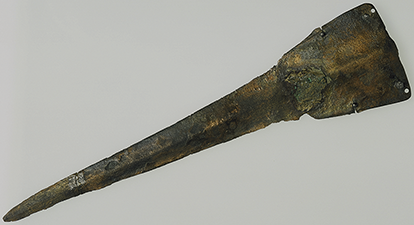
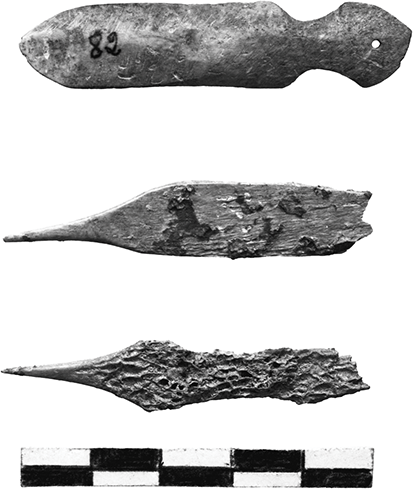
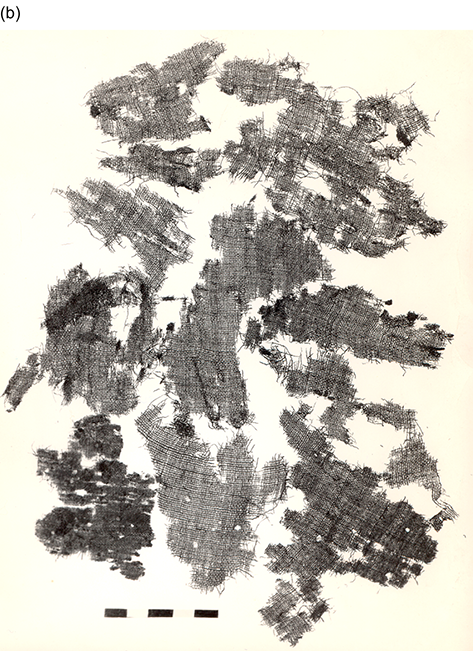
Several centuries of cloth production intervene between the Kea imprints and the next direct textile evidence from the insular Aegean (Table 1, Table 2). At the Early Cycladic (EC) II cemetery of Dokathismata, on the island of Amorgos, one of the graves included a bronze dagger (Figure 12) that preserved the mineralized fragment of a textile on its surface (Gavalas Reference Gavalas, Siennicka, Rahmstorf and Ulanowska2018, 182). The fragment appears to have belonged to a finely woven cloth. Although described as linen in the literature (Gavalas Reference Gavalas, Siennicka, Rahmstorf and Ulanowska2018, 182; Barber Reference Barber1991, 174, n.12), no fibre analysis for this textile has been published to date.
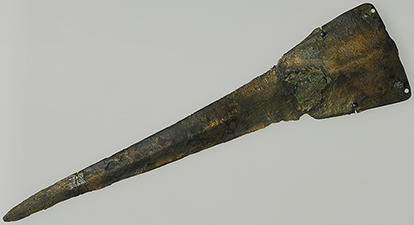
Figure 12 Bronze dagger with mineralized textile fragment from Dokathismata, Amorgos, Cyclades.
More evidence of cloth from EC Amorgos, in the form of textile imprints, emerged from the excavation of Markiani, a settlement on a rocky slope that was founded in the early third millennium BCE (Marangou et al. Reference Marangou, Renfrew, Doumas and Gavalas2006). Three pottery sherds from the site manifest imprints of woven structures that were identified as cloth (Renfrew Reference Renfrew, Housley, Manning, Marangou, Renfrew and Gavalas2006, 199, Fig. 8.18, Plate 45). All three show plain weaves. The contexts of these sherds were dated to Markiani phases III and IV (EC II early and late phases respectively) (Renfrew et al. Reference Renfrew, Housley, Manning, Marangou, Renfrew and Gavalas2006).
Another case of woven cloth impressed on a malleable surface derives from Akrotiri, Thera. A cylinder of reddish-orange pigment was found in an EC context and thus quite probably dates from the third millennium BCE (Birtacha et al. Reference Birtacha, Sotiropoulou, Perdikatsis, Apostolaki, Doumas and Devetzi2021). Its surface preserves the imprint of a woven structure and a rectangular stamp impression. The cloth imprint reflects plain weave and is described as ‘fine and coarse’ so at least two qualities of fabric are attested (Birtacha et al. Reference Birtacha, Sotiropoulou, Perdikatsis, Apostolaki, Doumas and Devetzi2021, Fig. 2). Another example from Akrotiri derives from a special context known as the ‘Sacrificial Complex’, found along with a concentration of EC artefacts (Doumas Reference Doumas, Brodie, Doole, Gavalas and Renfrew2008, 165–166) and thus considered as an EC assemblage. This is a metal tool that has preserved the fragment of a cloth in mineralized state on its surface (Papadima Reference Papadima2005, 81). Moreover, remains of a textile were traced on a metal pin dated to the EC period (Michaelidis and Angelidis Reference Michaelidis and Angelidis2006, 69).
Textile Tools and Production Facilities
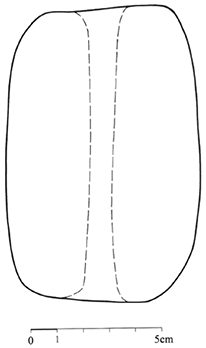
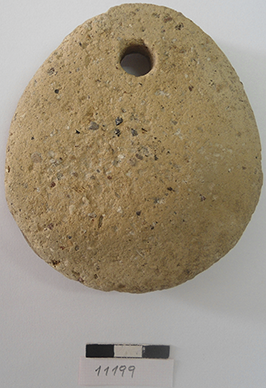
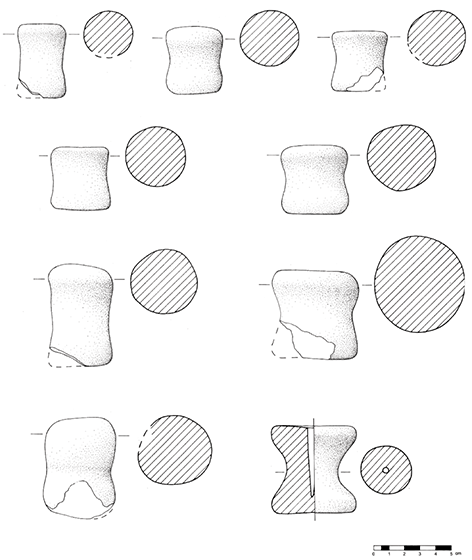
Textile tools dated to the beginning of the EBA are documented at the site of Poliochni on Lemnos. Large numbers of clay, well-shaped, often burnished but undecorated, biconical, and conical spindle whorls were found in deposits of the Blue period (Bernabò Brea Reference Bernabò Brea1964, 155) corresponding to the EB I horizon. The excavator also reported cylindrical, clay objects with one longitudinal perforation from the same period which, if interpreted as loomweights, may indicate the use of the warp-weighted loom (Bernabò Brea Reference Bernabò Brea1964, 658). Such cylindrical clay objects were also found at a contemporary site on the island of Thasos, in the north Aegean. A small settlement radiocarbon-dated to the early EBA was excavated at the bay of Ayios Ioannis, on the southeast coast of the island (Papadopoulos et al. Reference Papadopoulos, Palli, Vakirtzi, Psathi, Dietz, Mavridis, Tankosić and Takaoğlu2018, 361–363). Nine perforated cylinders, manufactured in large sizes and weighing between 500 and 1000 gr, were found and have been identified as loomweights (Figure 13). Their thickness, ranging between 6 and 9 cm, likely suggests very open or weft-faced weaves, while their weight requires thick threads. The over thirty spindle whorls found at the site confirm local production of medium to thick threads: shaped predominantly in the discoid-lentoid type, the majority of the whorls weigh between 30 and 60 gr (Papadopoulos et al. Reference Papadopoulos, Palli, Vakirtzi, Psathi, Dietz, Mavridis, Tankosić and Takaoğlu2018, 361–363; Vakirtzi Reference Vakirtzi, Siennicka, Rahmstorf and Ulanowska2018a). If Carington Smith was right in suggesting that cylindrical loomweights would have been used in sets of eight to ten (1975, 219), then the assemblage of Ayios Ioannis likely corresponds to a more or less complete weaving set for one loom.
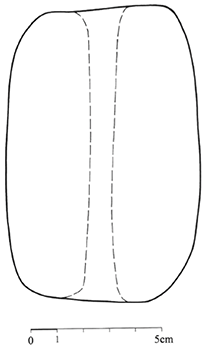
Figure 13 Cylindrical loomweight with one perforation from Ayios Ioannis, Thasos.
In the Cyclades, textile craft of the EC I period is documented through conical spindle whorls that are reported from the EC I sites of Avyssos and Pyrgos on the island of Paros (Rambach Reference Rambach2000, 196–197). At the settlement of Skarkos on the island of Ios, a few contexts attributed to the EC I period (Marthari Reference Marthari, Marthari, Renfrew and Boyd2017; Maniatis et al. Reference Maniatis, Marthari and Polymeris2023) yielded c. twenty clay spindle whorls that are noteworthy for their typological homogeneity. These are predominantly low conical spindle whorls, while just a few are discoid (Vakirtzi Reference Vakirtzi, Siennicka, Rahmstorf and Ulanowska2018a; Vakirtzi Reference Vakirtzi, Schier and Pollock2020). More than half of the overall whorl assemblage includes heavy tools, reaching up to 70 gr, indicating spinning (or plying) thick thread, as in EB I Thasos (Vakirtzi Reference Vakirtzi, Schier and Pollock2020).
During the EB II period, spindle whorls were manufactured and used in settlements spanning from the north Aegean (Skala Sotiros, Thasos), to the Eastern Aegean islands (Poliochni and Koukonisi on Lemnos, Emporio on Chios, Thermi on Lesbos) to the south (Heraion on Samos) clearly indicating the importance of yarn production in the respective communities (Vakirtzi Reference Vakirtzi, Schier and Pollock2020, with references). In the Cyclades, thread spinning or plying is attested in settlements including Ayia Irini on Kea (Wilson Reference Wilson1999), Markiani on Amorgos (Gavalas Reference Gavalas, Siennicka, Rahmstorf and Ulanowska2018) Dhaskalio (Gavalas Reference Gavalas, Renfrew, Philianotou, Brodie, Gavalas and Boyd2013) and Skarkos on Ios where the spindle whorl assemblage now includes biconical and cylindrical types of whorls in addition to the low conical type of the preceding period (Vakirtzi Reference Vakirtzi, Siennicka, Rahmstorf and Ulanowska2018a).
The spindle whorl assemblages of Ayia Irini, Markiani, and Skarkos demonstrate that thread production was not particularly standardized, as suggested by the range of whorl sizes comprising each assemblage. However, they all include tools that are lighter than 20 gr while the heaviest ones have a less pronounced representation (Vakirtzi Reference Vakirtzi2015; Gavalas Reference Gavalas, Siennicka, Rahmstorf and Ulanowska2018; Vakirtzi Reference Vakirtzi, Schier and Pollock2020). This indicates a subtle shift in comparison to the EC/EB I period, with finer rather than coarse thread production at the core of the yarn industries. Among the smallest spindle whorls are those weighing up to 15 gr, found at Skala Sotiros on Thasos, Heraion on Samos, Ayia Irini on Keos, and Koukonisi on Lemnos (Vakirtzi Reference Vakirtzi, Siennicka, Rahmstorf and Ulanowska2018a; Vakirtzi Reference Vakirtzi, Schier and Pollock2020).
Another aspect of thread manufacture in EBA insular societies is highlighted by the fact that tools have sometimes been found in graves (Vakirtzi Reference Vakirtzi2018b). It is noteworthy that some very small, clay whorls weighing between 3 and 10 gr were deposited as burial offerings in a grave at the EC cemetery of Aplomata on Naxos (Vakirtzi Reference Vakirtzi2018b; Vakirtzi Reference Vakirtzi, Schier and Pollock2020). Tools of this size class can be used to produce extremely thin woollen and linen threads that can be then woven into cloth, as the CTR spinning experiments performed with wool and flax show (Möller-Wiering Reference Möller-Wiering, Strand and Nosch2015, 103–109). Metal needles that are part of the EC material culture, and were also deposited in tombs as burial offerings (Doumas Reference Doumas1977, 60; Rambach Reference Rambach2000, 172–173), occasionally in the same tomb with spindle whorls (Rambach Reference Rambach2000, Tafel 63), indicate sewing or embroidery. The smallest and lightest EBA whorls imply careful preparation of the fibres before the spinning stage, a process that requires a considerable amount of time (Andersson Strand 2015). Could the custom of depositing textile tools in graves provide insights to the gender of the islanders who spun thread and sewed? Unfortunately, preserved skeletal remains from the EBA Aegean are minimal. This does not allow us to reach any conclusions on the biological sex, let alone the gender of the people who were buried with spindles and whorls (Vakirtzi Reference Vakirtzi2018b).
Distribution patterns of textile tools in the insular settlements indicate household production. Spinning toolkits that can be ascribed to a single household or production area usually include whorls of considerably different sizes, indicating a tendency to address the need for at least two distinct qualities of thread. Such a nuanced picture is provided by the excavator of the prehistoric settlement at the Heraion on the island of Samos, dated in the late third millennium BCE (Milojčić Reference Milojčić1961). In one case, a group of five spindle whorls was traced in the east part of the ‘Großes Haus’, and in a second case, a group of six spindle whorls was found in a clay vessel in the ‘Magazine’ building (Milojčić Reference Milojčić1961, 23–24, 51). When a sample of these tools was studied, it became clear that each of these small concentrations included spindle whorls of significantly different sizes, from very small to large (Vakirtzi Reference Vakirtzi, Siennicka, Rahmstorf and Ulanowska2018a, 192) (Supplementary Figure 6). A preliminary distribution study of the tools found at Skarkos on Ios reveals a similar picture (Vakirtzi Reference Vakirtzi, Siennicka, Rahmstorf and Ulanowska2018a, 193).
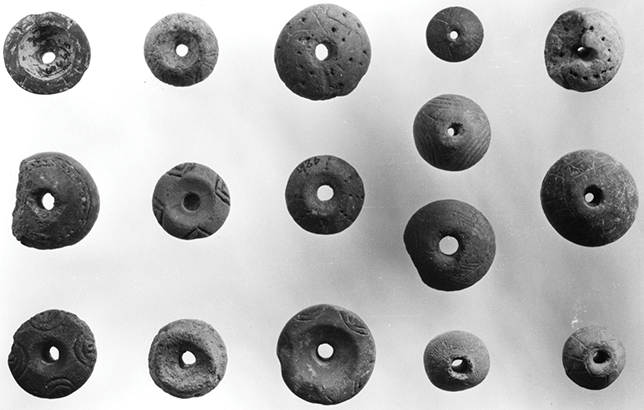
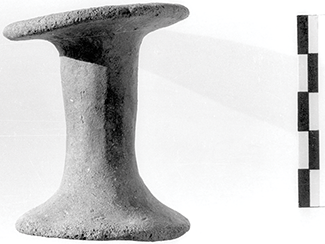
During the EB II period, a spindle whorl type with a hollow top (a concave configuration around the central perforation also known as ‘scodelletta’), often decorated with incised, geometric motifs, was used in the northeastern Aegean islands of Lemnos (Figure 14), Lesbos and Chios (Barber Reference Barber1991, 306–307; Vakirtzi Reference Vakirtzi, Schier and Pollock2020). Examples of this type of whorl were also found in the Cyclades, at Dhaskalio and Markiani (Gavalas Reference Gavalas, Siennicka, Rahmstorf and Ulanowska2018), and in EC II cemeteries on Syros (Chalandriani) and Naxos (Aplomata) (Vakirtzi Reference Vakirtzi, Schier and Pollock2020). To date, however, no such whorls have been found at Skarkos on Ios, while they are rather rare in the EC II–III deposits of Ayia Irini on Kea (Wilson Reference Wilson1999). Barber (Reference Barber1991) surveyed parallels of this type of tool found in earlier sites, from central Asia and Anatolia, and in later sites in northern Italy and as far as Switzerland. She distinguished a gradual, centuries-long westward diffusion of the ‘scodelletta’ spindle whorl type, which she attributed to population mobility (Barber Reference Barber1991, 299–310).
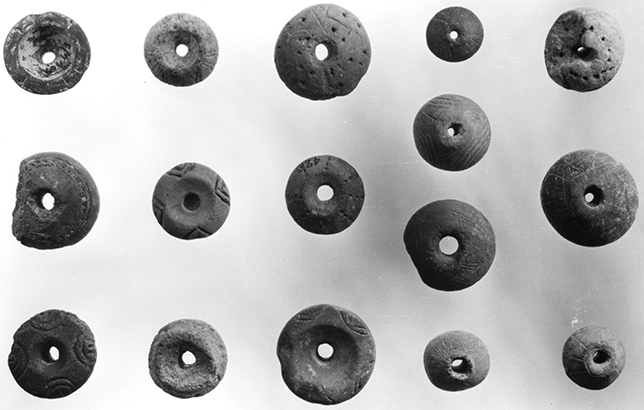
Figure 14 Spindle whorls of the decorated, ‘scodelletta’ type from Poliochni, Lemnos.
Weaving on the warp-weighted loom in the EBA Aegean is indicated at a few insular sites of the northeast Aegean. One of those is Poliochni on Lemnos, where cylindrical weights are reported from the horizon of the Green and Red towns (EB II early) (Bernabò Brea Reference Bernabò Brea1964, 658, Pl. CLXVII: 9). Another one is Thermi on Lesbos, where discoid loomweights have been found (Carington Smith Reference Carington Smith1975, 237). At Ayia Irini on Kea, in the Cyclades, weaving with the technology of the warp-weighted loom is also demonstrated through the recovery of clay loomweights (Wilson Reference Wilson1999, 160) that have been described as ‘Anatolian type’ tools (Davis Reference Davis, Hagg and Marinatos1984, 162). Stone weights of similar shape and size found in the same location, indeed in the same deposits (Davis Reference Davis, Hagg and Marinatos1984, 154–155), were probably also used as loomweights. It is possible that three similar stone weights found at the EC II-late site of Panormos on Naxos (Devetzi Reference Devetzi and Angelopoulou2014, 338–340), had had a loomweight use as well. These finds indicate the possible use of the warp-weighted loom in the Cyclades during the third millennium BCE, perhaps using stone loomweights. However, the most exhaustively excavated EC settlements to date, namely Markiani on Amorgos, Dhaskalio near Keros and Skarkos on Ios, did not yield either clay or stone loomweights of this type or any other identifiable type (Gavalas Reference Gavalas, Siennicka, Rahmstorf and Ulanowska2018; Marthari Reference Marthari, Meller, Gronenborn and Risch2018, 189–192). It is possible that in these settlements either warp-weighted looms were operated with weights made of perishable materials that have not survived in the archaeological deposits; or that loom types other than the warp-weighted were used, like the horizontal ground looms or other weaving devices.
The anatolianizing element identified in the loomweight types of Ayia Irini, Kea, and in the hollow, incised whorls of several insular settlements, with clear parallels in Anatolian sites (most notably in Troy, Balfanz Reference Balfanz1995) have long been highlighted (Carington Smith Reference Carington Smith1975; Davis Reference Davis, Hagg and Marinatos1984, 162; Barber Reference Barber1991). These types of textile tools suggest the integration of textile craftspeople in the regional networks that flourished in the Aegean from the EB II period onwards, and the nodal position of the insular communities in the trajectories that brought people into contact. Finished products of the loom would also have circulated from one place to another, at least as items of clothing worn by travellers. Textile craft, textile tools, and cloth items should therefore be viewed as significant elements of the EBA ‘International Spirit’ that was fostered by the insular Aegean communities in the third millennium BCE (Renfrew Reference Renfrew2017 [Reference Renfrew1972]).
3.1.2 The Mainland
Excavated Textile Imprints
A small, clay sealing found at Geraki, Laconia, in the southern Peloponnese, preserves the imprint of finely woven cloth (Weingarten Reference Weingarten and Müller2000). The context is dated to the EH IIB period, a time of increased connectivity in the Aegean. The imprint demonstrates a plain, faced weave structure (Table 2). Vogelsang-Eastwood (Reference Vogelsang-Eastwood1999) identified a possible selvedge and perhaps the starting border of the cloth, a feature indicating weaving on a warp-weighted loom. She also highlighted a structure identified as the interlacing of warps and wefts in one location, where ‘the crossing of several threads in both systems 1 and 2’ were observed (Vogelsang-Eastwood Reference Vogelsang-Eastwood1999, 372–373, Fig. 21). This find indicates the use of fine textiles in activities such as the sealing practices that resulted in the creation of the Geraki imprint (Weingarten Reference Weingarten and Müller2000). The sealings of Geraki were most probably created within the Peloponnese, and perhaps even at the site itself (Weingarten et al. Reference Weingarten, Crowel, Prent and Vogelsang-Eastwood1999, 368–370), so the cloth too was available in the location where the sealing process took place. Nonetheless, it is unknown where, or by whom, this finely woven textile was produced.
Textile Tools and Production Facilities
Textile craft in the EBA across the Greek Mainland is documented by spindle whorls and loomweights found at various sites. This material, first surveyed by Carington Smith (Reference Carington Smith1975, 196–260, passim), confirms that thread manufacture with spindle and whorl and weaving on the warp-weighted loom were widespread textile technologies. Their morphometric variability indicates diverse production targets, relating to both thread qualities and cloth types, observed across different sites as well as within each site. The general impression is one of accentuated regionality. Within this technological mosaic, Carington Smith has emphasized the hemispherical whorl and the cylindrical loomweight as the most commonly found tool types in the region (Smith Reference Carington Smith1975, 219). Besides these, the pyramidal and the spherical loomweight types also occur, while other types are rare (Smith Reference Carington Smith1975, 237–260).
In the Peloponnese, textile craft of this period is well documented in the Argolid. Spindle whorls are very common finds, but loomweights are few and have been found scattered in archaeological deposits, often as isolated items (Siennicka Reference Siennicka, Quillien and Sarri2020). This distribution can be hardly representative of weaving sets and can only be indicative of the use of the warp-weighted loom, perhaps at a small scale. At Lerna, large numbers of spindle whorls have been found (Banks Reference Banks1967), chronologically distributed across two main phases, EH II and EH III (Siennicka Reference Siennicka, Banck-Burkgess, Marinova and Mischka2023), separated by important changes at the site (Pullen Reference Pullen and Shelmerdine2008, 36, 39). Thread manufacture was practiced throughout the settlement’s life, although the types and sizes of tools differ slightly from one phase to the other. The comparison of the whorl assemblages of the two phases indicates changes in the ways the tools were modelled, perhaps due to a shift in the average quality of the fibres (Banks Reference Banks1967, 538; Siennicka Reference Siennicka, Banck-Burkgess, Marinova and Mischka2023): the EH II assemblage is highly standardized, composed of hemispherical (or ‘domed’) clay whorls with plain, undecorated surfaces. This standardization recedes in EH III, when conical and biconical types are used along with hemispherical ones. Moreover, decorated, incised whorls like those observed in the islands, are now noted here, too, considered by Banks as ‘almost certainly not locally made’ (Banks Reference Banks1967, 537). The size range in the whorl groups of both chronological phases is wide, but most of the EH II whorls were manufactured in large, heavy sizes implying a focus on the production of thick threads, while lighter specimens appear to have increased in the next phase (Siennicka Reference Siennicka, Quillien and Sarri2020; Siennicka Reference Siennicka, Banck-Burkgess, Marinova and Mischka2023, 148–150). Siennicka interprets the typological and metrological shift as potentially indicating a shift in textile fibre from bast to wool (Siennicka Reference Siennicka, Banck-Burkgess, Marinova and Mischka2023, 148–150), while a similar pattern was observed at the EH I–II site of Tsoungiza in Corinthia (Siennicka Reference Siennicka, Banck-Burkgess, Marinova and Mischka2023, 150–151).
Weaving at Lerna is less clearly documented, with only a few loomweights found in EH deposits: Banks recorded just five from periods III and IV (EH II–III), manufactured in the ‘parallelepiped’ (with two longitudinal or lengthwise perforations) and the cylindrical (with either one or two longitudinal perforations) types (Banks Reference Banks1967, 565–566). Siennicka (Reference Siennicka, Quillien and Sarri2020, 34) highlights the occurrence of a cylindrical and a ‘parallelepiped’ loomweight on the floor of a room along with one spindle whorl, underlining that the latter loomweight was stamped several times with a seal. A few clay spools, that might have been used in textile production as loomweights, were also found at Lerna, marking the transition from the EH III period to the MH I. The third millennium BCE examples are less than ten, including pierced and unpierced items, all from EH III deposits (Banks Reference Banks1967, 551–560).
The hemispherical whorl type is also noted at other EH sites in northeastern Peloponnese, including Korakou and Zygouries (Carington Smith Reference Carington Smith1975, 199) as well as in EH deposits at Tiryns (Rahmstorf et al. 2015, 269). Siennicka (Reference Siennicka, Banck-Burkgess, Marinova and Mischka2023) has argued that this regional typological homogeneity (Figure 15), along with the good firing and surface treatment, likely suggest that in this area spindle whorl manufacture might have been carried out in specialized pottery workshops (Siennicka Reference Siennicka, Quillien and Sarri2020, 28). Moreover, she has observed that this is in sharp contrast to the manufacture of weaving implements, considering, for example, the cylinders with three perforations found at Tiryns, which were carelessly made of coarse clay and were left unfired or half-baked (Siennicka Reference Siennicka, Quillien and Sarri2020, 28). Another type of loomweight attested at EH Tiryns is the crescent-shaped, with two perforations, each near one distal end (Rahmstorf et al. 2015) (Figure 16). This weaving implement reveals an Anatolian influence, and is considered suitable for producing diagonal (or twill) weave (Wisti-Lassen Reference Wisti-Lassen, Andersson Strand and Nosch2015). This loomweight type was also attested in EH deposits at Geraki, Laconia (Crouwel et al. Reference Crouwel, Prent and Shipley2007), where the textile imprint discussed earlier was found. Twill weave, however, has not yet been documented in cloth form in the Aegean Bronze Age, even though it had been used in matting since the Neolithic (Perlès Reference Perlès2001, 243).
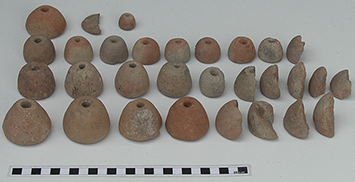
Figure 15 Hemispherical spindle whorls from Tiryns, Argolid.
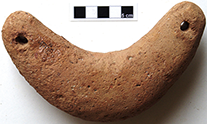
Figure 16 Crescent-shaped loomweight from Tiryns, Argolid.
In northern Greece, textile production was documented in domestic units at a settlement excavated near Archontiko, Giannitsa, dated to the late third millennium BCE (Papadopoulou et al. Reference Papadopoulou, Andersson Strand, Nosch, Cutler, Strand and Nosch2015). The excavators have reported that the spinning equipment, consisting of large, clay spindle whorls in various types, reflects the production of thick threads. The weavers were using pyramidal loomweights, in a range of sizes, from light to very heavy, and with thicknesses that are compatible with open or faced textiles (Papadopoulou et al. Reference Papadopoulou, Andersson Strand, Nosch, Cutler, Strand and Nosch2015, 294–295). A similar picture emerges from EBA Sitagroi, where (mostly biconical) spindle whorls in various sizes, and loomweights of both cylindrical and pyramidal type, were found in domestic contexts (Elster Reference Elster, Elster and Renfrew2003). A varied textile production has been speculated, most probably with a focus on thick threads and coarse textiles in plain balanced weave (Elster et al. Reference Elster, Andersson Strand, Nosch, Cutler, Andersson Strand and Nosch2015).
On present evidence, the textile production across Mainland Greece during the course of the third millennium BCE appears diversified possibly with a focus on coarser products, though not excluding the manufacture of fine threads and finely woven textiles. Fine thread production, suggested by small and light spindle whorls, points to a thorough preparation of textile fibres prior to spinning or splicing. This entails some degree of specialization, as fibre processing is quite time-consuming (Andersson Strand Reference Andersson Strand, Strand and Nosch2015a). Where contextual data is available, it indicates that the production of cloth was organized at the household level, but there is no evidence regarding the division of textile labour, for example along gender lines.
3.1.3 Crete
Textile Tools and Production Facilities
No fragments of cloth or textile imprints dated to the third millennium BCE have been published from Crete to date. Nevertheless, the preservation of textile tools and the identification of spaces for textile processing (Burke Reference Burke2010, 26–31), allow some hypotheses on EM textile production. From the loomweight evidence alone, the technology of the warp-weighted loom in EM Crete appears to have been quite widespread in the central and eastern part of the island. However, at some EM sites textile craft is indicated only by spindle whorls (Cutler Reference Cutler2021, 62), leaving open the possibility that other types of looms were used as well. Nonetheless, with regard to the warp-weighted loom, the typological variability of loomweights across the central/east region is noteworthy: as Burke (Burke Reference Burke2010) and Cutler (Reference Cutler2021, 61–62) point out, textile tools found in EM II deposits at Knossos, Myrtos, and Vasiliki include cylindrical, discoid, spherical and, in the case of the latter site, cuboid loomweights (Cutler Reference Cutler2021, 61). Knossos yielded a few domed and cylindrical loomweights from EM II contexts, and by the MM IA phase, the earliest examples of what would later become the hallmark of Knossian Protopalatial weaving, the discoid loomweight type, appear (Figure 11, f–g). The best representation of EM discoid loomweights to date are published from the settlement of Myrtos, on the south coast of Crete (Warren Reference Warren1972). Those were found along with a group of pierced stones, also interpreted as possible loomweights (Poursat Reference Poursat, Nosch and Laffineur2012). At Phaistos, the remains of an EM settlement explored beneath the palatial complex did not yield securely identified loomweights. However, spindle whorls, mostly heavy hemispherical ones reaching up to 100 gr in weight, small and light cylindrical ones, and biconical ones that came in both small and large sizes, indicate a variable thread production (Militello Reference Militello2014a, 252–253). The Phaistos whorls are well manufactured and have a careful surface finish (Militello Reference Militello2014a, 252–253) but, unlike Myrtos, no painted examples were found among them (Warren Reference Warren1972, 262–263; Burke Reference Burke2010, 27). At Myrtos, thread making is also testified on the basis of clay spinning bowls (Figure 17), believed to have been used for plying thread. As Burke notes, these are among the earliest examples of spinning bowls found in the Eastern Mediterranean, making it likely that this textile implement and the related plying technique were Cretan inventions (Burke Reference Burke2010, 29). Zavadil recently raised awareness as to the lack of use wear traces in vessels of this type found in Western Peloponnese, in contrast to the Cretan examples, thus their use for textile production in the Peloponnese was questioned (Zavadil Reference Zavadil, Lohner-Urban, Spickermann and Trinkl2023).
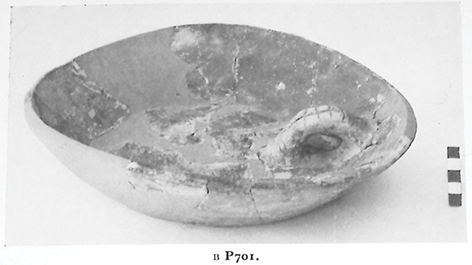
Figure 17 Spinning bowl from Myrtos, Crete.
Overall, the technological landscape of textile craft in EM Crete is characterized by regionalism. This variability indicates different types of textiles woven by different communities. Most of this evidence is found in the eastern part of the island, as the Early Minoan is not well documented in west Crete (Cutler Reference Cutler2021, 62). Where there is good contextual data, textile production appears organized at the household level (Burke Reference Burke2010). The contextual association of loomweights with built structures and installations interpreted as basins, drains, and vats at Myrtos, combined with the results of organic residue analysis that identified animal lipids in one of these features, led Warren to argue that wool washing and probably wool dyeing took place in the settlement (Warren Reference Warren1972). The suggestion that wool was an important textile fibre finds further, indirect support in the emergence of dye workshops in the same region, at least as early as EM III (Brogan et al. Reference Brogan, Betancourt, Apostolakou, Nosch and Laffineur2012). This would be in agreement with dress iconography: as discussed in Section 2.2.1, some of the anthropomorphic vessels dating from EM II to EM III, indicate sophisticated sartorial choices, patterned cloth and quite possibly multicoloured textiles (see also Stefani Reference Stefani2013).
3.2 The Middle Bronze Age
3.2.1 Protopalatial Crete
Excavated Textiles
Direct textile evidence from Protopalatial Crete is very limited. Small, calcified cloth fragments found at Malia (Figure 18) were identified and collected during the examination of water flotation residue, conducted as part of an archaeobotanical study (Sarpaki Reference Sarpaki, Pomadère and Zurbach2007, 884). Their deposit derived from a drain on the east edge of Quartier Mu, a large building complex that hosted weaving activities at several locations (Cutler Reference Cutler2021, 123–131) before its destruction in MM IIB. After examination of one of the fragments, Cutler et al. (Reference Cutler, Andersson Strand, Nosch and Poursat2013) diagnosed a plain, balanced weave (Table 2). They also distinguished different threads used for the two thread systems, spun in opposite directions (s and z respectively). Based on the z-twist direction of the one thread system, they proposed that the textile was woven partly of woollen yarn (Cutler et al. Reference Cutler, Andersson Strand, Nosch and Poursat2013, 118). No further analysis of this textile fragment for fibre identification has been published to date, leaving open the possibility that this may be the earliest documentation of wool in the Aegean, slightly predating the woollen, carbonized threads of Akrotiri, Thera (see Section 3.3.2).
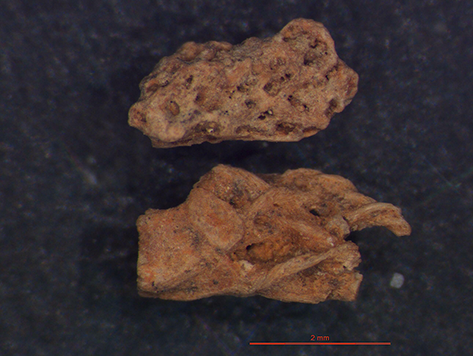
Figure 18 Calcified cloth fragments from Malia, Crete.
Textile Tools and Production Facilities
In the Protopalatial period major weaving centres emerged across Crete, established within or around the first palaces, while textile production is also documented in contemporary urban centres. Overall, the weaving stage is well documented owing to loomweights. However, one of the most puzzling aspects of Protopalatial textile industries concerns the low archaeological visibility of thread manufacture (Burke Reference Burke2010, 50). The pattern of scarcity of spindle whorls on Bronze Age Crete observed in early research (Carington Smith Reference Carington Smith1975, 261, 266) appears to persist, at least with regard to the large weaving centres. If threads were manufactured with the spinning technique, necessitating spindles equipped with whorls, then the scarcity of whorls at the Protopalatial centres demonstrates that spinning was marginal and performed at a limited scale (Cutler Reference Cutler2021, passim). The hypothesis of an alternative technique of thread making, namely splicing, cannot satisfactorily explain this scarcity, since it requires plying the spliced threads with a spindle and whorl, as well (Gleba and Harris Reference Gleba and Harris2019, 2333, 2341). Nonetheless, splicing may be indicated by the occurrence of spinning bowls at a number of Protopalatial sites, in a technical tradition that continued from the Prepalatial period (Burke Reference Burke2010, 19, 61; Militello Reference Militello2014a, 135–138). Other hypotheses have also been proposed, for example, that the spindles and whorls might have been primarily wooden, like the Egyptian ones, and therefore would not have survived in the archaeological record, or that spinning would have taken place at locations other than the major sites (Burke Reference Burke2010, 50). The clay spindle whorls recovered from small settlements in the periphery of the large centres support the latter scenario.
The typological repertoire and the metric data of textile tools from Protopalatial sites have been published in a systematic way in recent publications (e.g., Burke Reference Burke and Mountjoy2003; Militello Reference Militello2014a; Cutler Reference Cutler and Tsipopoulou2016b) but in older works they are often very briefly mentioned, without their weight or diameter values. From what can be surmised based on the most comprehensive reports, spindle whorl sizes fluctuate from 10 gr to more than 80 gr (Cutler Reference Cutler2021, 74, 111, 131). Thus, a pattern of a diversified thread manufacture emerges from this period as well. This corresponds well with the most striking feature of Protopalatial weaving, the wide variety of loomweights, both in terms of types and sizes (Cutler Reference Cutler2021): the typological repertoire across Crete includes discoid, spherical, cuboid, cylindrical, rectangular, torus-shaped, and truncated- pyramidal tools made of clay, as well as pierced stone pebbles, in a range of sizes (Cutler Reference Cutler2021, passim). Some weaving centres manifest only one type, for example the Protopalatial weaving workshop at Knossos, which relied exclusively on discoid loomweights (Cutler Reference Cutler2021, 70–71). Most of the other locations, however, yielded assemblages consisting of various, different types. The dominant loomweight type differs from one place to the other: unlike Knossos, Phaistos lacks discoid loomweights and instead documents cylindrical ones in this period (Militello Reference Militello2014a, 253–254; Cutler Reference Cutler2021, 109). At Malia various types were used, and probably pierced pebbles as well, with a noted predominance of the spherical type (Cutler Reference Cutler2021, 123–131). At Petras in East Crete cuboid loomweights were found in secure Protopalatial deposits, while in the town of Palaikastro, some fills dated to the Protopalatial period included discoid, cuboid, spherical, and pyramidal types (Cutler Reference Cutler2021, 154). The weight and thickness ranges of the loomweights in these deposits differ considerably (Cutler Reference Cutler2021, passim), demonstrating a functional variability. Generally, discoid loomweights were used to weave dense fabrics with fine threads, while spherical and cylindrical ones were suitable for open weaves or weft-faced textiles. Thus, although the warp-weighted loom was widely employed for weaving across the island, this technological choice did not preclude a rich variety of woven products. Protopalatial Cretan weaving was not homogeneous across the island.
However, at Knossos textile production appears to have been highly standardized. Although a few spherical loomweights, along with discoid ones, were found in Protopalatial deposits in the Royal Road South, an area outside of the Palace (Cutler Reference Cutler2021, 73), at the palatial complex itself a large assemblage of about four hundred discoid loomweights was found in an area designated as ‘the Loomweight Basement’ (Cutler Reference Cutler2021, 70–72). It consists of very standardized tools in shape and size: after examining a sample of these, Cutler recorded a thickness range between 1.5 cm and 2.5 cm and a weight range between 128 gr and 200 gr (Cutler Reference Cutler2021, 71, Fig. 6.17). This is a group of tools that points to the manufacture of very fine, densely woven, plain, balanced cloth.
Protopalatial Malia has yielded one of the largest corpora of loomweights on Crete. Weavers based at this palatial centre were using a wide range of loomweights (Cutler Reference Cutler2021, 123–131) but the most frequently attested is the spherical, with discoid ones being much less reported. Thus, textile production at Malia likely differed considerably from that of Knossos. Spherical weights were often found in the same buildings either alongside pierced pebbles or with other types of clay loomweights (Poursat Reference Poursat2013, Pl. 46i) (Figure 19), so that a range of textiles would have been produced even within the same building/weaving workshop. Malia is one of the earliest Cretan sites to demonstrate the use of spherical loomweights, a type that later became dominant in Knossos and at other weaving centres of the Neopalatial period. It should be noted that the excavation at Malia also yielded pointed bone implements known as ‘pin beaters’ (Poursat Reference Poursat1996, Pl. 44a) (Figure 20). These tools have been interpreted as specialized implements used in tapestry weaving in the Eastern Mediterranean (Smith Reference Smith, Nosch, Koefoed and Strand2013). The preference for spherical loomweights, suitable to produce open or weft-faced fabrics is compatible with pattern weaving (Cutler Reference Cutler2021, 249–251), in an arrangement where wefts perhaps even multicoloured ones, would be packed against the more openly arranged warps, to create the desired motifs.
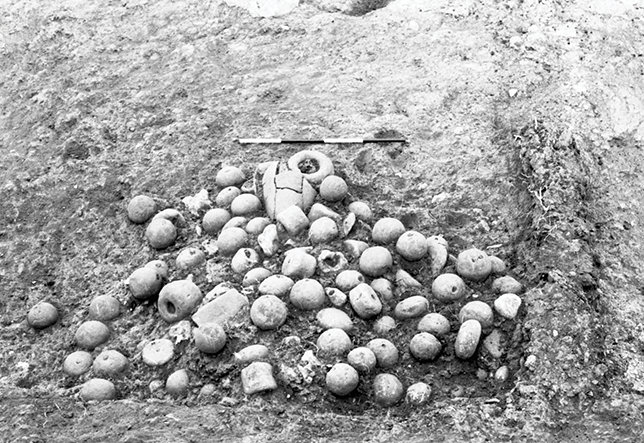
Figure 19 Group of spherical and cylindrical loomweights in situ, from Quartier Mu, Malia, Crete.
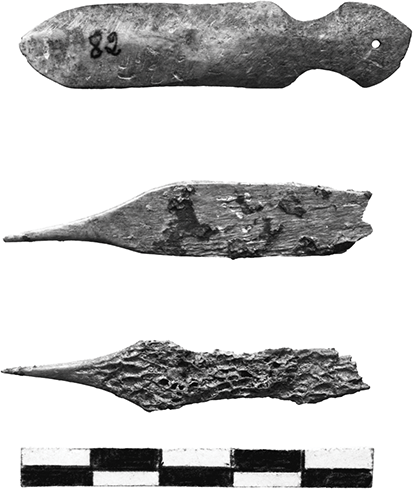
Figure 20 Bone implements known as ‘pin beaters’ from Malia, Crete.
The production of multicoloured textiles in Protopalatial Crete is suggested by an additional category of archaeological finds. Facilities and debris of dye workshops have been identified in the late EM period (Brogan et al. Reference Brogan, Betancourt, Apostolakou, Nosch and Laffineur2012, 187), while the production of dyes probably intensified in the early second millennium BCE (Burke Reference Burke2010, 34–39). Archaeological finds such as piles of crushed murex shells, basins, hearths and pounding tools, concentrating mostly in Eastern Crete, suggest the production of purple dye (Brogan et al. Reference Brogan, Betancourt, Apostolakou, Nosch and Laffineur2012). A configuration of basins and vats on the bedrock at the site of Alatzomouri-Pefka in East Crete revealed an important workshop for the manufacture of more than one dye (Apostolakou et al. Reference Apostolakou, Brogan and Betancourt2020). Organic residue analysis on ceramic utensils indicated that along with purple from the murex shell, yellow and red colours from vegetal resources such as weld and madder were also being produced there (Koh et al. Reference Koh, Betancourt, Pareja, Brogan and Apostolakou2016). The flourishing of purple and other dye industries potentially indicates the rising importance of wool economy during this period, since dyes are better absorbed by wool.Footnote 3
The hundreds of loomweights of various types, the weaving locations, the dye workshops, and even the few scraps of mineralized Protopalatial cloth found to date, create the impression of a dynamic textile landscape, reflected also in the textile imagery of this period, with the first clear depictions of patterned textiles used for garments, as discussed in Section 2.2.1 (Sapouna-Sakellaraki Reference Sapouna-Sakellaraki1971, 7–29; Barber Reference Barber1991, 314; Stefani Reference Stefani2013, 55–79; Jones Reference Jones2015, 25–55 esp. 36). Pattern weaving with multicoloured woollen wefts was probably one of the key technical achievements of Protopalatial textile craft. Such elaborately woven textile items (Alberti Reference Alberti2012, 126–127) were desired by the elites in kingdoms located beyond the Aegean as far as Mari, and were either delivered there, or locally crafted by Near Eastern (or travelling Aegean?) weavers in ‘the Cretan style’, according to the Mariote palace’s cuneiform archives dating to the eighteenth century BCE (Aruz Reference Aruz2008, 117; Alberti Reference Alberti2012).
3.2.2 The Insular Region
Textile fragments contemporaneous with the Protopalatial period of Crete have not been published to date from the Cyclades, the northern Aegean, the southeastern or the southwestern Aegean. Textile consumption is very poorly known, owing not only to the lack of excavated textiles, but also due to a lack of iconographic evidence for clothing, with very few exceptions (see Section 2.2.1).
The most significant body of work on weaving craft in the island communities of the early second millennium BCE was carried out by J. Cutler (Reference Cutler2021) who systematically analysed extensive loomweight assemblages and compared them to the archaeological record of Crete. Thus, she was able to contrast the varied technological landscape of weaving on Protopalatial Crete, that defies the monolithic term ‘Minoan’, to a much more standardized production on the Aegean islands during the MBA, where weaving on the warp-weighted loom appears to have specialized in a certain type of cloth, attainable with the use of the discoid loomweights of Cretan type.
At present, the earliest contact points between the Cretan weaving technology and the Aegean archipelago, manifest in the discoid loomweights, are documented at MBA Kolonna on Aegina (Cutler 2021, 241) and at MC Akrotiri, Thera, where three, extremely standardized, discoid loomweights were found in Phase A deposits equivalent to the transitional EC III/MC I phase (Vakirtzi Reference Vakirtzi and Nikolakopoulou2019) (Figure 21). Significantly, the Akrotiri examples are manufactured of apparently local, Theran clay, suggesting that these particular loomweights had not been transported from Crete. It must be emphasized that weaving on the warp-weighted loom on the islands in the beginning of the MBA testifies, not generally a Cretan, but specifically a Knossian influence, where the discoid was the dominant loomweight type.
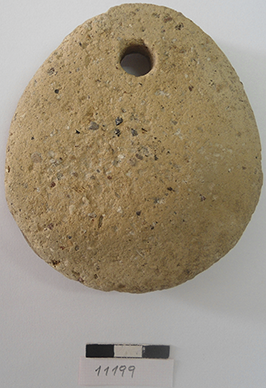
Figure 21 Piriform discoid loomweight with one perforation from MC Phase A, from Akrotiri, Thera.
In the early MBA insular contexts, these tools are very few, usually found in secondary deposits that do not allow for a clear picture of the organization and scale of production. At Ayia Irini on Kea the earliest discoid loomweights date from period IV while at Phylakopi on Melos, from period C (late MBA) (Cutler Reference Cutler2021, 169–182, 216; Cutler et al. Reference Cutler, Whitelaw, Gleba and Barber2024). On Rhodes, in the Dodecanese, Cretan-type loomweights were found in the MBA horizon of the settlement on Mount Philerimos, the port of Akandia, and the town of Trianda (Marketou Reference Marketou, Macdonald, Hallager and Dietrich-Niemeier2009). By the end of the MBA discoid loomweights were also used at Koukonisi, Lemnos, at Kastri on Kythera and other insular and coastal sites around the Aegean Sea (Cutler Reference Cutler2021, 236, 238).
The use of the horizontal loom in the Cyclades during this period has been suggested in two cases. At Ayia Irini on Kea, and Phylakopi on Melos, a special category of objects, namely pierced clay spools with flaring shafts (Cutler Reference Cutler2021, 169, 215) (Figure 22) may have been used as accessories for reeling the warp threads to prepare them for the horizontal loom (Carington Smith Reference Carington Smith1975, 404). Ayia Irini yielded more than one hundred spools but only around thirty from secure MC deposits (Cutler Reference Cutler2021, 172, 180) while at Phylakopi, where the Middle Bronze Age horizon was less extensively excavated, twenty-seven spools were recorded (Cutler Reference Cutler2021, 216; Cutler et al. Reference Cutler, Whitelaw, Gleba and Barber2024). These objects are more frequently found in Middle Helladic deposits on the southern Greek Mainland (Pavúk Reference Pavúk, Nosch and Laffineur2012) so their occurrence in the Cyclades testifies some degree of technological sharing between the craft communities of the two regions. Moreover, it indicates that the islands could be the ‘meeting points’ of different technological traditions: along with pierced clay spools with flaring shafts, both Ayia Irini and Phylakopi were employing the technology of the warp-weighted loom at this time, judging by the discoid loomweights found in deposits of the MC horizon.
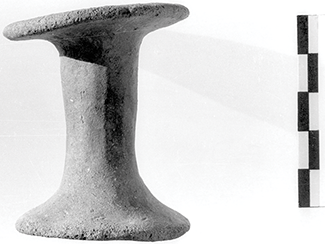
Figure 22 Clay spool with flaring shaft, from Ayia Irini, Keos.
The selective choice and combination of different traditions by the islanders has one more manifestation. The overwhelming influence of Crete, and more specifically Knossos, over weaving practices and loomweight manufacture in the MC/MBA archipelago, does not seem to have hindered the islanders’ use of whorls modelled in characteristically insular EBA types, that appear to have been largely absent in EM Crete (Burke Reference Burke2010, 25–29, with references), such as the hollow, incised (‘scodelletta’) whorl. It should be recalled that yarn manufacture is practically undocumented at Protopalatial Knossos (Cutler Reference Cutler2021, 74). This is an interesting asymmetry, given the technological, operational, and organizational associations between the spinning and the weaving stages of textile production.
Spindle whorls found at MC Ayia Irini, Phylakopi, and Akrotiri, as well as at MBA Koukonisi, demonstrate that spinning with spindle and whorl was a persistent and widespread thread-making technology (Vakirtzi Reference Vakirtzi2015). However, subtle differences compared to the EBA patterns have been observed. Unlike a more pronounced typological variability across the EBA insular Aegean, in the MC/MBA period the biconical spindle whorl dominates over all other types. This is a whorl type that demonstrates a wide range of sizes, therefore suitable for the manufacture of several different thread qualities (Vakirtzi Reference Vakirtzi2015). Moreover, the use of hollow, incised whorls continues to be manifest in the insular communities where it is well represented, especially at Ayia Irini on Kea (Overbeck Reference Overbeck1989; Vakirtzi Reference Vakirtzi2015) and at MBA Koukonisi (Vakirtzi Reference Vakirtzi2015). A metrological analysis on a sample of whorls from MC Ayia Irini, Phylakopi, Akrotiri, and Koukonisi has indicated a pattern of diverse sizes in the toolkits of these settlements, but also revealed a preference for relatively smaller tools in comparison to the earlier period (Vakirtzi Reference Vakirtzi2015). This points to a focus on the production of fine threads that would be compatible with the discoid type of loomweights, considered suitable for weaving fine yarn.
In her discussion of the process of adoption of Cretan weaving technology by communities beyond Crete, Cutler critically examined older theories (Cutler Reference Cutler2021, 248–256) and stressed the varied timing of its initial appearance. This chronological pattern is an indication that in some cases the warp-weighted loom of the Cretan type may have been adopted gradually from one intermediary community to the other, and not directly from Crete (Cutler Reference Cutler2021, 252). As Cutler stresses, the spatial, temporal, and quantitative variability observed in the distribution of discoid loomweights across and around the Aegean in the early centuries of the second millennium BCE most probably indicates several factors behind the spread of weaving fine, densely woven ground fabrics on warp-weighted looms that were invariably equipped with this type of loomweight (Cutler Reference Cutler2021, 247–249). The emulation of Cretan dress in the LC I insular communities has been considered as one of the primary causes of this phenomenon, while mobility of craftswomen through intermarriage is suggested as a likely mechanism of technological diffusion based on the premise that weaving was a highly gendered craft, performed by women (Gorogianni et al. Reference Gorogianni, Cutler, Fitzsimons, Stampolidis, Maner and Kopanias2015). Although the occurrence of textile tools (spindle whorls) in male burials in the southern Greek Mainland (Nordquist Reference Nordquist1987, 56) indicates that a gendered division of textile labour may not have been absolute across MBA Greece, one of the rare occasions where textile tools can possibly be associated with females is found at Ayia Irini on Kea. In a Middle Cycladic grave, an adolescent, most probably a girl, was buried with twenty-one spindle whorls (Overbeck Reference Overbeck1989, 184, 198–199). Kea also provides support for the mobility of craftspeople. Macroscopic examination of the Ayia Irini discoid loomweights indicates that some tools were manufactured with non-local clays, and it is assumed that they had most probably been transported on Kea by their users when they relocated from other Aegean islands (Cutler Reference Cutler2021, 171–178). The same was observed at Akrotiri, Thera, where the textile tools recovered from MC deposits also include some specimens manufactured of non-local clays, both Cretan and non-Theran Cycladic (Vakirtzi Reference Vakirtzi and Nikolakopoulou2019, macroscopic evaluations by J. Hilditch).
As mentioned before, emulation of Cretan dress fashion, at a time when the material culture of Crete influenced communities across the Aegean, has been suggested as the main motive for the adoption of Cretan weaving outside of Crete, given the representation of Cretan dress in the LC I frescoes of Thera (Cutler Reference Cutler, Gorogianni, Pavúk and Girella2016a). However, accumulating evidence for the use of the Cretan warp-weighted loom early in the MC/MBA sequence, such as the early MC discoid loomweights found in Aegina and Thera, indicate that the adoption of Cretan ways of weaving predate the peak of the ‘Minoanization’ phenomenon by a few centuries. The lack of evidence on the type of garments used in the south Aegean islands during this period (see Section 2.2.1) does not encourage a correlation between weaving technological choices and clothing type. An alternative motive for the initial diffusion of the Cretan weaving technology in the Protopalatial period may have been the production of sailcloth (Vakirtzi Reference Vakirtzi and Nikolakopoulou2019). This suggestion was based on the rough synchronization of the earliest iconographic evidence of the sailing ship in the Aegean (Figure 23) with the earliest occurrence of Cretan-type loomweights in harbour towns outside of Crete. Sailing ships are depicted on Cretan seals dated to the turn of the second millennium BCE (Broodbank Reference Broodbank2013, 539), just about when Cretan-type, discoid loomweights turn up at Akrotiri on Thera and Kolonna on Aegina. If the sailing ship technology was first used by Cretans, then sails would have first been produced on Crete as well, perhaps on the warp-weighted loom equipped with discoid loomweights. Although this type of tool is suitable for the weaving of very dense, fine, and patterned cloth, it is also optimal for generic, ‘ground weaves’ (Cutler Reference Cutler, Gorogianni, Pavúk and Girella2016a) and for ‘cloths of greater width’ (Burke Reference Burke2010, 58). The hypothesis posits that soon after their adoption on Crete, sailing ships began to be built in other islands of the Aegean archipelago, and the weaving of sails followed the Cretan way of making textiles (Vakirtzi Reference Vakirtzi and Nikolakopoulou2019).
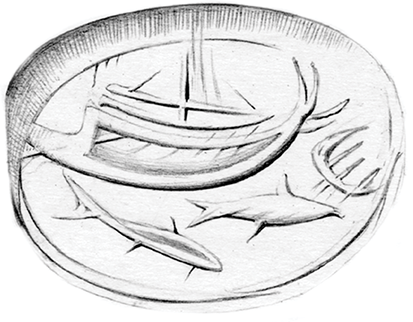
Figure 23 Sailing ship and fish, ivory seal from Platanos, Crete.
This scenario does not rule out the use of discoid loomweights for other types of textiles, including those for garments. However, it inevitably links discoid loomweights with sailcloth and entails the question of whether weaving at Protopalatial Knossos was also targeting the production of sails. While the answer requires further research, what is certain is that textile production at Neopalatial Knossos shifted to a completely different focus, as evidenced by the shift to spherical loomweights, which are better suited to produce open or weft-faced fabrics (see Section 3.3.1). Nonetheless, Neopalatial coastal settlements such as Mochlos, Pseira, and Kommos produced textiles with discoid loomweights (Cutler et al. Reference Cutler, Whitelaw, Gleba and Barber2024, 731). These significant patterns that derive from the archaeological record of Neopalatial Crete will be discussed further in Section 3.3.1.
3.2.3 The Mainland
Textile Tools and Production Facilities
The influence of the MM weaving technology on Mainland Greece reached as far as Lerna, where a MH (Lerna phase V) settlement occupied the coast of the Argolic Gulf, in northeastern Peloponnese, following its EH III (Lerna phase IV) predecessor (Pullen Reference Pullen and Shelmerdine2008, 39). The site yielded three Cretan-type discoid loomweights from MH deposits (Banks Reference Banks1967, 565–570). To date, no study of their ceramic fabric has been undertaken to evaluate whether these were locally made or transported to Lerna from another location.
There are no further reports of this loomweight type from the MH horizon. Moreover, a general scarcity of loomweights across the southern Mainland has been observed, with few exceptions. These include Asea in Arcadia, Eutresis in Boeotia, and Lianokladhi further north (Carington Smith Reference Carington Smith1975, 400–404). Asea and Eutresis yielded a few cylindrical loomweights and Lianokladhi spherical ones. No metric data are published, but the types imply rather thick tools that would be used to weave open or weft-faced cloth. In the south, at MH Malthi in Messenia the lack of identifiable loomweights contrasts sharply to the three hundred spindle whorls found across the site (Carington Smith Reference Carington Smith1975, 402–403; Reference Carington Smith, Macdonald and Wilkie1992, 689). It is assumed that the warp-weighted loom was not the dominant weaving technology in this settlement and instead a different type, perhaps the horizontal loom, would have been used. This is supported by the frequent occurrence at MH Peloponnesian sites of pierced clay spools with flaring shafts, like those discussed previously in the case of the MC settlements of Ayia Irini and Phylakopi, presumably used for reeling the warp before its arrangement on the horizontal loom (ibid., 404–410). They turn up in a variety of subtypes at several locations on the Peloponnese, in west Greece, and the southern Greek Mainland including Thessaly and Boeotia (Pavúk Reference Pavúk, Nosch and Laffineur2012).
In contrast to weaving, yarn manufacture is clearly documented owing to the assemblages of spindle whorls recovered at many MH sites, both in domestic and in funerary contexts (Carington Smith Reference Carington Smith1975, 356–400). Among the most securely dated assemblages are those originating from the two Peloponnesian sites of Malthi and Asine mentioned earlier, as well as from Eutresis in Boeotia. However, detailed reports of their typology and metric data are not available. For the spindle whorls of Asine, a weight range between 10 gr and 90 gr is mentioned (Nordquist Reference Nordquist1987, 59), indicating a varied production of fine to coarse threads.
In the MH period the hollow-type spindle whorl decorated in an ‘Anatolianizing’ style, a standard tool in the whorl assemblages of the Eastern Aegean islands and the Cyclades from EC II to EC III onwards as discussed earlier, turns up on mainland sites. Carington Smith considered this as the ‘hallmark’ whorl type of the MH period (Carington Smith Reference Carington Smith1975, 352–353) and as diagnostic for the gradual mobility of population across a vast area encompassing central Asia through the Aegean (Carington Smith Reference Carington Smith1975, 356–389, 414–417). Barber further highlighted the westward appearance of this type of spindle whorl as far as north Italy and Switzerland, agreeing that these tools indicate patterns of familial mobility, based on the assumption that textile craft at that time was performed by women and girls (Barber Reference Barber1991, 299–310). However, it is possible that making thread was not an exclusively female task in the Bronze Age Aegean, since spindle whorls occur in both male and female MH graves, for example at Asine in the Peloponnese (Nordquist Reference Nordquist1987, 56).
Fragments of possible spinning bowls found in MH deposits at Nichoria, Messenia, in the southwestern Peloponnese were identified by Carington Smith (Reference Carington Smith, Macdonald and Wilkie1992, 687). These implements have been interpreted as accessories for plying to make stronger spun or spliced threads. Their occurrence on the southern Mainland potentially indicates Cretan influence in thread-making technology, since spinning bowls were known in Crete as early as the EM period (Burke Reference Burke2010, 28–29). In a recent article, Zavadil surveys more examples from Western Peloponnesian sites (Zavadil Reference Zavadil, Lohner-Urban, Spickermann and Trinkl2023). As mentioned in Section 3.1.3, she has questioned the use of this type of bowl for thread manufacture, primarily owing to the lack of diagnostic use wear traces in the Peloponnesian fragments. The same study, however, integrates the description of experiments that confirmed that this type of bowl can be effectively used to ply spliced linen threads (Zavadil Reference Zavadil, Lohner-Urban, Spickermann and Trinkl2023).
Excavated Textiles
Cloth remains preserved from MH Greece are extremely rare to date. A few, small, carbonized fragments were found in Kadmeia (Thebes, Boeotia) during a rescue excavation that is still unpublished (Margariti and Spantidaki Reference Margariti, Spantidaki, Frielinghaus, Stroszeck and Sieverling2023b, 21). However, the finds were submitted to radiocarbon dating with the results pointing to the early centuries of the second millennium BCE (Margariti and Spantidaki Reference Margariti, Spantidaki, Frielinghaus, Stroszeck and Sieverling2023b, 14–15), conventionally ascribed to the MH horizon. Even though their context remains obscure, the technical assessment of the fragments provides insights on textile craft. The weave is described as plain, rather balanced (Table 2). Bast fibre, possibly flax, was identified as the raw material. Margariti and Spantidaki make a case for the manufacture of the S-plied threads with the method of splicing instead of spinning, since the primary, single threads show ‘very little twist’ of a z direction, and the degree of twist in the plied thread is variable (Margariti and Spantidaki Reference Margariti, Spantidaki, Frielinghaus, Stroszeck and Sieverling2023b, 25).
The end of the MH period is marked by the earliest burials of Grave Circle B in Mycenae, with the latest tombs dated to LH I (Graziadio Reference Graziadio1988). Given this Grave Circle’s complex taphonomy, the textile fragments recovered from some of its tombs cannot be readily attributed to the earlier or the later phases of its use, and will therefore be discussed in the next section devoted to the early Late Bronze Age.
3.3 The Late Bronze Age–Early
3.3.1 Neopalatial Crete
Excavated Textiles
In contrast to the wealth of representations of clothing, excavated textiles from Neopalatial Crete remain very few. The most thoroughly studied case of Neopalatial Crete consists of c. 20 fragments belonging to the same textile, a narrow weft-faced cloth band (Table 2) preserved in carbonized state (Möller-Wiering Reference Möller-Wiering2006). The find originates from the multi-period site at Kastelli, Chania, West Crete (Bruun-Lundgren et al. Reference Bruun-Lundgren, Andersson Strand, Hallager, Strand and Nosch2015). It was recovered from House IV, a building destroyed by conflagration in the LM IB period. The cloth fragments were resting inside a tripod pyxis found on the floor of Room C of the house (Evely Reference Evely2010, 195). The estimated size of the surviving band, when all fragments are taken into consideration, is 6 mm wide to 9 cm long, making this textile the earliest example of a narrow cloth band found in the Aegean so far. S. Möller-Wiering (Reference Möller-Wiering2006), who performed a technological analysis of the find, has highlighted a number of technical features that suggest, in her opinion, that the manufacturing technique of this band was plaiting rather than weaving. The threads of both systems, where visible, barely show any spin, at best a loose primary twist. The wefts appear to have been inserted as bundles, rather than continuously. This textile manifests the combination of three different fibres: the warp, which is double S-plied, is linen, the weft, showing minimal twist, was made of goat hair, while a supplementary, double S-plied thread made of nettle was used as a decorative or strengthening element (stitch) in the basic plaited structure (Moulhérat and Spantidaki Reference Moulhérat and Spantidaki2009).
A second Neopalatial textile artefact found at Zakros, East Crete, was published in a preliminary report (Platon Reference Platon1972, 178). It consists of the mineralized remains of a textile plaited in a ‘herringbone’ structure. It was traced during the excavation of the Neopalatial ‘Building North of the Harbour Street’. The excavator identified the textile as ‘cloth or mat’ (Platon Reference Platon1972, 178). A decisive criterion for its technological classification would be the morphology of the warps and wefts: if they are plant strips, the find qualifies as a product of matting. If they are threads, either spun or spliced, this would justify its classification as cloth.Footnote 4
The two (probably plaited) artefacts from Neopalatial Crete just discussed, testify to textile manufacturing techniques and fibre-made artefacts complementary to those woven on the warp-weighted looms that were used all over Crete. Although the demonstration of local (Chaniote, or even Cretan) production is not self-evident, the narrow textile band of Kastelli brings the textile evidence closer to the iconographic evidence. In the repertoire of garment representation, the bodices, skirts, and kilts with elaborate ornamentations are often decorated with narrow, patterned bands on the sleeves, or the hems of kilts and skirts (Barber Reference Barber1991, 314–322) (Figures 7 and 8). The find from Kastelli, Chania, is the first tangible testimony of the craftsmanship invested in creating such textile bands.
Textile Tools and Production Facilities
Textile production in Neopalatial Crete is attested through loomweights, spindle whorls, and other production implements (needles, spinning bowls) found at various types of sites across the island: in buildings near palatial centres, in the building complexes defined as ‘villas’, in town houses, and in smaller, ‘rural’ settlements. In some cases, evidence of weaving occurs in special, non-domestic contexts, such as Building 4 at the funerary complex at Phourni, and ‘the sanctuary’ of Anemospilia, both in Archanes (Sakellarakis and Sapouna-Sakellaraki Reference Sakellarakis and Sapouna-Sakellaraki1997, 319–320). Facilities identified as basins to wash the fibres or for dye production are also attested (Alberti Reference Alberti, Gillis and Nosch2007). The relevant evidence has been synthesized in several studies resulting in a voluminous body of work (most notably, Burke Reference Burke2010; Militello Reference Militello2014a; Cutler Reference Cutler2021). As a general remark, it could be noted that cloth production occupied an important place in people’s lives and that textile industries were a crucial facet of Neopalatial household and political economies (Burke Reference Burke2010, Militello Reference Militello2014a, 264–265).
Regarding thread manufacture, the pattern of spindle whorl scarcity, observed in the Protopalatial period, persists. Spindle whorls have occasionally been reported, however, giving the impression of small-scale thread manufacture. Most scholars think that thread would have likely been manufactured with more than the spinning technique, or that whorls would have been made of wood therefore have not survived (Burke Reference Burke2010; Cutler Reference Cutler2021). It is quite likely that plying thread was practiced in some locations with the use of spinning bowls, for example, at Ayia Triada (Militello Reference Militello2014a, 135–138), continuing a Prepalatial and Protopalatial technical tradition (Burke Reference Burke2010, 29). Some of the few Neopalatial locations that yielded low numbers of whorls include Ayios Syllas and Sklavokampos in north-central Crete; the building at Chalara and the ‘villa’ of Ayia Triada, both near Phaistos; Sissi, where one steatite spindle whorl was found; and Kastelli in Chania, where, again, just one spindle whorl is reported from House I (Cutler Reference Cutler2021, 108, 112–113, 138, 157–158). When weight values are reported, they correspond to light spindle whorls, indicating production orientated to rather fine threads (Cutler Reference Cutler2021). The group of ten spindle whorls found at Archanes appears to be an exceptional case of a small assemblage of thread-making tools manufactured of precious stones (Sakellarakis and Sapouna-Sakellaraki Reference Sakellarakis and Sapouna-Sakellaraki1997, 85).
A change can be observed in the organization of ‘palatial’ production, as weaving workshops are no longer located within palatial complexes, but rather in nearby buildings in the vicinity of palaces. This is the case both at Knossos (Cutler 2021) and Phaistos (Militello 2014a). But perhaps the most notable shift regards the type of textiles that were being produced, notably in Neopalatial Knossos, where the focus was on the production of open, probably weft-faced textiles, as indicated by the dominance of the spherical type of loomweight (Figure 11, d) in assemblages recovered from locations around the palatial complex (Cutler Reference Cutler2021, 74–100). It should be reminded that weaving with this type of loomweights was very common at Protopalatial Malia, at a time when only discoid loomweights were used at Knossos, probably for weaving dense, fine fabrics. In the Neopalatial period, however, this type of textiles is no longer produced in Knossos, but apparently in ‘villas’ such as Sklavokampos, towns such as Tylissos (where also spherical loomweights are documented), as well as coastal settlements like Kommos, Mochlos, and Pseira, where discoid loomweights were found (Cutler Reference Cutler2021, 108, 113–117, 139–141).
Spherical loomweights also dominate the weaving toolkit found at the building complex of Tourkogeitonia in Archanes and at the ‘villa’ of Vathypetro. At Kastelli, Chania, in west Crete, the Neopalatial House I accommodated a weaving workshop, judging from the many loomweights found therein, most of which were spherical (Cutler Reference Cutler2021, 106–108, 157). It is interesting that some of these were found on the floors of Rooms M and E. In one case, the spatial distribution of the tools and the recovery of organic material identified as burnt wood from the same area, suggest the identification of a loom that was set-up when the house was abandoned (Bruun-Luundgren et al. Reference Bruun-Lundgren, Andersson Strand, Hallager, Strand and Nosch2015, 199–200, Fig. 6.2.4). At Phaistos, textile production in the palatial complex ceased and a textile industry was instead established at the ‘villa’ of Ayia Triada in the Neopalatial phase. Weaving here relied on spherical loomweights; therefore, the main target of textile production would have been open or weft-faced types of cloth. There are no examples of the cylindrical loomweight type that was common in Protopalatial Phaistos, so that a shift in textile production can be surmised in this case, too. Moreover, the recovery of a few discoid loomweights indicate that fine, densely woven cloth could also have been produced (Militello Reference Militello2014a, 255–256; Cutler Reference Cutler2021, 112–113).
The reorientation of the textile production in (or around) the major palatial centres towards targets different from those of the previous period, as well as the broader picture of a widely diversified production on an insular scale, considering the overall variety of loomweight types found throughout the island, constitute the two main characteristics of Neopalatial Cretan weaving. This picture contrasts sharply to the one emerging from the rest of the insular Aegean, as will be discussed in the next section.
3.3.2 The Insular Region
Textile Tools and Production Facilities
One of the earliest excavations of an insular LC I settlement to yield textile implements was that of Phylakopi in Melos in the late 19th century CE, even though at the time there was some ambiguity as to their exact use (Cutler et al. Reference Cutler, Whitelaw, Gleba and Barber2024). Those early finds of Phylakopi were consequently identified as loomweights of the Cretan, discoid type, but their attribution in the site’s stratigraphy is problematic (Cutler et al. Reference Cutler, Whitelaw, Gleba and Barber2024). From the well-stratified deposits that were investigated with trial trenches in the 1970s campaign (Renfrew et al. Reference Renfrew, Renfrew, Brodie, Morris and Scarre2007), only two fragmentary Cretan-type, discoid loomweights were recovered from Phase D deposits corresponding to the LC I/II. Thus, weaving on the warp-weighted loom is not well documented, although thread production was certainly taking place in Phylakopi in this period, as indicated by spindle whorls (Cherry and Davis Reference Cherry, Davis, Renfrew, Brodie, Morris and Scarre2007, 401–410).
Following the launch of excavations at two other emblematic Cycladic settlements, Ayia Irini on Kea and Akrotiri on Thera, batches of Cretan-type, discoid loomweights began to come up from LC I deposits, manifesting the continued use of the Cretan weaving technology in the insular region. Weaving industries are well attested at both sites, specifically in the large building defined as House A at Ayia Irini (Cummer and Schofield Reference Cummer and Schofield1984; Cutler Reference Cutler2021, 182–216) and in the West House of Akrotiri on Thera (Tzachili Reference Tzachili1997; Reference Tzachili and Doumas2007a), both of which probably accommodated many looms, given the large amounts of tools found therein. Archaeological research elsewhere in the Aegean yielded similar finds at sites expanding from Kythera to Rhodes, and from Karpathos to Samothrace (Cutler Reference Cutler2021; Nikolakopoulou Reference Nikolakopoulou2022, 143).
The more it became clear that Cretan-type, discoid loomweights are the dominant loom implement in the weaving landscape of the insular Aegean, the more weaving practices became part of the discussion on ‘Minoanization’ (e.g., Davis Reference Davis, Hagg and Marinatos1984), eventually receiving the attention of a specialist treatment by J. Cutler (Reference Cutler2021) who suggested that these loomweights in some cases represent the first adoption of the warp-weighted loom technology outside of Crete. Following a thorough analysis of the textile-related archaeological record of the second-millennium-BCE Aegean, Cutler’s study demonstrates variations in the timing and scale of the appearance of Cretan, discoid loomweights in insular settlements. Moreover, Cutler highlighted the multi-directional trajectories that the Cretan influence took, based on a ‘wide variety of non-local fabrics’ used for the manufacture of textile tools (Cutler Reference Cutler2021, 258). Although her analysis suggests that the phenomenon of ‘Minoanization’, weaving included, should be ‘unpacked’ into multiple processes, agents, and driving forces, the study underlines female mobility as a core mechanism of textile technology diffusion (Gorogianni et al. Reference Gorogianni, Cutler, Fitzsimons, Stampolidis, Maner and Kopanias2015; Cutler Reference Cutler2021, 257–258). In this respect, Cutler followed a basic premise in the studies of E. Barber (Reference Barber1991) and I. Tzachili (Reference Tzachili1997), both of whom underlined the gendered division of textile labour cross-culturally and diachronically, to argue that thread manufacture and weaving in the Bronze Age Aegean, too, had been primarily ‘women’s work’.
Tzachili’s research, focusing on Akrotiri, Thera, was undertaken as a case study of how textile production was organized in an Aegean harbour town of the LC I period (Tzachili Reference Tzachili1997; Reference Tzachili and Doumas2007a; Reference Tzachili, Gillis and Nosch2007b). The exceptionally well-preserved Theran town offers the potential for informing our interpretations of the material record with details not widely available elsewhere in the Aegean. Textile tools and especially loomweights of the Cretan, discoid type attest to the use of the warp-weighted loom. However, in the LC phase of Akrotiri this technology should be considered local rather than a foreign influence, since it had been in use for several generations from the beginning of the second millennium (MC Phase A) onwards (Vakirtzi Reference Vakirtzi and Nikolakopoulou2019).
By analysing the textile tools and their distribution, Tzachili demonstrated the technical and social characteristics of the craft, that is, that cloth production was highly standardized and carried out only in some of the town’s houses (Tzachili Reference Tzachili1997, Reference Tzachili, Gillis and Nosch2007b). In just one building, the West House, about four hundred discoid loomweights were kept, indicating a scale of production that exceeded the household’s needs (Tzachili Reference Tzachili and Doumas2007a). A detailed stratigraphic and taphonomic analysis showed that weaving workshops were located in large, well-lit rooms, on the houses’ upper floors (Tzachili Reference Tzachili1997) (Supplementary Figure 7). The recovery of Linear A documents listing about two hundred textiles from one of the town’s building complexes, Complex Delta, suggests that the textile industry of Akrotiri would have been orientated towards some sort of exchange or trade transactions (Boulotis Reference Boulotis2008). The targets of this production would have been densely woven fabrics of rather balanced weaves (Tzachili et al. Reference Tzachili, Spantidaki, Andersson Strand, Nosch, Cutler, Strand and Nosch2015), based on the functional analysis of discoid loomweights. However, following the early 2000s excavation project at Akrotiri, the ‘Pillar Pits’ excavation (Doumas Reference Doumas, Doumas and Devetzi2021) there is evidence that textile production would not have been so strictly standardized as once thought. From the ‘Pillar Pits’ excavations, a few Cretan-type loomweights of the spherical variety were recovered from LC I deposits (Tzachili Reference Tzachili, Doumas and Devetzi2021). These demonstrate that, even if at a smaller scale, Akrotiri weavers were also engaged in cloth production similar to that of Neopalatial Knossos, Archanes, Kastelli-Chania, and the other weaving centres of Crete where spherical loomweights were traced. This type of production would have targeted the type of open weave, weft-faced textiles which were largely confined to Crete.
The ‘Pillar Pit’ excavations also yielded spindle whorls. Thread production at Akrotiri had previously been considered dubious (Tzachili Reference Tzachili, Hardy, Doumas, Sakellarakis and Warren1990), given the scarcity of these tools in the West House (Tzachli Reference Tzachili and Doumas2007a). These are less than ten, while the house accommodated c. 400 loomweights. They are thus too few to produce the amounts of yarn needed for the many looms of the house. It was therefore suggested that yarn would have been locally produced with tools not identifiable archaeologically, and/or that it would have been imported from elsewhere (Tzachili Reference Tzachili, Hardy, Doumas, Sakellarakis and Warren1990). When all the whorls recovered from LC deposits, including recent finds from the ‘Pillar Pits’, are considered (Vakirtzi Reference Vakirtzi2015; Vakirtzi Reference Vakirtzi, Doumas and Devetzi2021) the pattern of small-scale thread-making is reinforced. In many instances they were found in secondary deposits (backfilling, building material, destruction debris) which is not surprising given the more than one destruction that the LC town underwent and the ensuing rebuilding activities, before the volcanic eruption (Nikolakopoulou Reference Nikolakopoulou and και Κ. Μπίρταχα2003). It appears that spinning within the town would have been a routine task aiming to provide at least some of the yarn used for weaving. The spindle whorls recovered from the town are manufactured of clay and stone in a range of types and sizes from very small to large: the weight values of complete or almost complete tools range from almost 3 to 33 gr (Vakirtzi Reference Vakirtzi, Nosch and Laffineur2012; Vakirtzi Reference Vakirtzi2015). This range indicates a varied thread production, including very fine threads. These could have been woollen or linen. Indeed, both textile materials are directly attested at Akrotiri demonstrating that the town was consuming such textiles and the inhabitants were familiar with fine linen and woollen cloth (see further, Excavated Textiles). Other materials might also have been used. Perhaps one of these was wild silk, as suggested by the recovery of a calcified moth cocoon from the town, attributed to a butterfly species that is known as a source of this type of fibre (Panagiotakopulu et al. Reference Panagiotakopulu, Buckland and Day1997). Ethnographic studies indicate that the manufacture of thread from wild silk requires spinning, unlike cultivated silk, in order to create a long filament from the short, cut fibres that remain on the broken cocoon after the insect has escaped it (Douny Reference Douny2013). Some of the lightest and smallest spindle whorls of Akrotiri may well have been used to this purpose (Vakirtzi Reference Vakirtzi, Nosch and Laffineur2012).
Excavated Textiles
A small corpus of textile fragments originates from the ‘Pillar Pits’ excavation. By Aegean standards, textiles at Akrotiri were preserved in relatively good condition, along with several other artefacts made of organic materials (Michaelidis and Angelidis Reference Michaelidis and Angelidis2006). The published corpus consists of three different textiles found in Pillar Pit 68A, Pillar Pit 1B, and Pillar Pit 52N (Figure 24a-c, Table 2). The textile fragments were studied by Youlie Spantidaki and Christophe Moulhérat (Reference Spantidaki, Moulhérat, Doumas and Devetzi2021) who conducted technical analyses of the threads and weaves, as well as fibre identification.
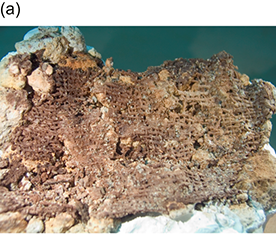
Figure 24a Textile from Pillar Pit 68A, Akrotiri, Thera.
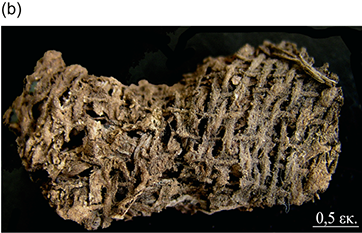
Figure 24b Textile fragment from Pillar Pit 1B, Akrotiri, Thera.
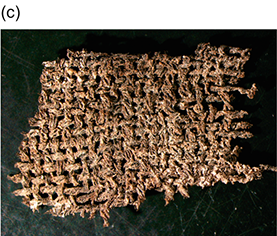
Figure 24c Textile fragment from Pillar Pit 52N, Akrotiri, Thera.
The textile from Pillar Pit 68 A is a carbonized fragment in a plain, open, weft-faced weave. At least three different types of threads were used for its manufacture, an S-plied linen warp, a single z-twisted weft, and thicker threads used presumably as side seams (Spantidaki and Moulhérat Reference Spantidaki, Moulhérat, Doumas and Devetzi2021, 242–245). The weft remains to be determined as to the exact plant species.
The textile fragment of Pillar Pit 1B was found carbonized in a mass of burnt barley grain and was interpreted as a sack (Spantidaki and Moulhérat 2021). It is woven in a plain weave, with double 2-plied warp threads of plant origin and unspun/flat wefts, suggested to be vegetal strips (Spantidaki and Moulhérat Reference Spantidaki, Moulhérat, Doumas and Devetzi2021, 246–247). No further identification of the exact plant species for the warp or the weft was possible. Technologically, it manifests a combination of woven cloth and plaited mat, and as Spantidaki and Moulhérat have pointed out, it presents us with the challenge to recognize the technique or the device with which it would have been created.
The finest textile published from Akrotiri to date was recovered from Pillar Pit 52 N in several small carbonized pieces, some of which were found folded. Careful observation of their technical characteristics indicated that all fragments belonged to the same cloth. The raw material was determined to be flax. The threads in both systems are double S-plied while the weave structure is plain and balanced (Spantidaki and Moulhérat Reference Spantidaki, Moulhérat, Doumas and Devetzi2021, 237). Supplementary threads on the ground weave were diagnosed as embroidery, tassels, or a possible seam, sewn with a thread that is thicker than those of the ground fabric (Spantidaki and Moulhérat Reference Spantidaki, Moulhérat, Doumas and Devetzi2021, 239–242). Knots of various sizes were created to stabilize the edge of the warp system, a technical feature common in Egyptian textiles of the New Kingdom (Kemp and Vogelsang-Eastwood Reference Kemp and Vogelsang-Eastwood2001, 133–144, Fig. 4.55).
Of the three, different findspots of the excavated textiles, the area of Pillar Pit 68 A has not yet been published; therefore, the context of the textile remains to be determined. However, the space revealed in 1B was studied by a team of scholars who recognized a cooking area there (Birtacha Reference Birtacha, Brodie, Doole, Gavalas and Renfrew2008, 390–391). The textile fragments of Pillar Pit 52 N were scattered in a pile of hundreds of horns, mostly of sheep and goats, next to a clay box enclosing a golden, ibex figurine (Alexopoulos Reference Alexopoulos, Doumas and Devetzi2021). Subsequent research in this area has shown that this space was the interior of a room, while the excavation of a second room next to it revealed textile and thread imprints in proximity to an assemblage of metal and ceramic artefacts and beads, including one with a fragment of red thread in its hole (Doumas Reference Doumas2019, 288; Birtacha forthcoming).
The technical features of the cloth fragments found at Akrotiri raise the question of their compatibility with the textile technology used at the site in the LC I period. As discussed earlier, the spindle whorls found scattered in the town manifest a range of sizes. Spindle whorls as light as 4–8 gr were used in experimental spinning at CTR and were proven functional, producing thread qualities comparable to those of the Akrotiri textiles (Möller-Wiering Reference Möller-Wiering, Strand and Nosch2015). These spindle whorls could also have been used to manufacture wool threads, like those found in a carbonized state at Akrotiri (Moulhérat and Spantidaki Reference Spantidaki, Alfaro and Karali2008). Such fine threads could have been woven in plain, balanced types of fabrics, in any of the four textile workshops identified so far in the Late Cycladic town, equipped with discoid loomweights (Tzachili Reference Tzachili, Gillis and Nosch2007b). Thicker threads could have been used as wefts, for embroidery or in weaving with heavier, spherical loomweights. Plied yarns could have been made with spindles equipped with whorls such as those locally found. It could therefore be suggested that the textile tools and the cloth fragments found at Akrotiri are generally compatible. Yet, a growing corpus of technical studies of extant textiles from the Eastern Mediterranean, including Egyptian ones (Andersson Strand and Nosch Reference Andersson Strand and Nosch2015, Appendix B), demonstrates that the craftsmanship manifest in the cloth fragments of Akrotiri was a widespread achievement in the wider region during the second millennium BCE. Based on the aforementioned remarks, while the local production of the textiles found at Akrotiri appears entirely feasible from a technological perspective, it cannot be ruled out that any of these items may have arrived in Thera from another region of the Aegean or even the Eastern Mediterranean.
3.3.3 The Mainland, LH I–II
Excavated Textiles
The LC I textiles of Akrotiri find contemporary parallels on Mainland Greece, excavated in funerary contexts. An assemblage of textiles is known from Grave Circles A and B of Mycenae. In Grave Circle B, several cloth fragments were preserved in Tombs A, B, Γ, Δ, and N (Mylonas Reference Mylonas1972–1973, 22, 38, 49, 81, 88, 162, 171–172): some of these textiles were used to ‘clothe’ or contain weapons such as metal swords (Tomb Γ), arrowheads (Tomb Δ), a spearhead, a dagger, and a knife (Tomb Ν), while others were found on metal vessels (Tomb A) or around ceramic ones (Tomb B). The published photographs of the cloth fragments found in Tombs A and B suggest plain, balanced ground weaves (Mylonas Reference Mylonas1972–1973, Plates 20b, 25) (Figure 25a-b). The textiles that wrapped the spearhead, the dagger and the knife of Tomb N were studied by Y. Spantidaki and C. Moulhérat and were determined to be linen, woven with double threads with S-twist direction, in a plain, balanced weave with a count of 20–22 threads per sq. cm (Spantidaki and Moulhérat Reference Spantidaki, Moulhérat, Gleba and Mannering2012, 192) (Table 2). From Grave Circle A, a few fragments of textiles have been published, found in Graves II and V (Karo Reference Karo1930–1933, 71, 137, 142, 145, Taf. CXLVI).
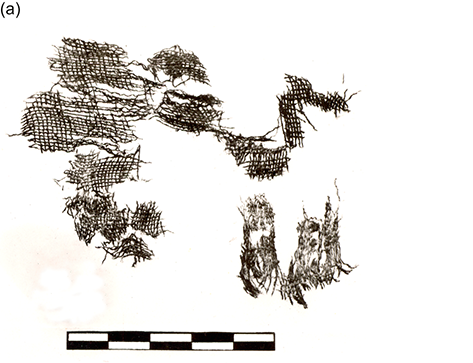
Figure 25a Textile fragments from Grave A, Grave Circle B, Mycenae, Argolid
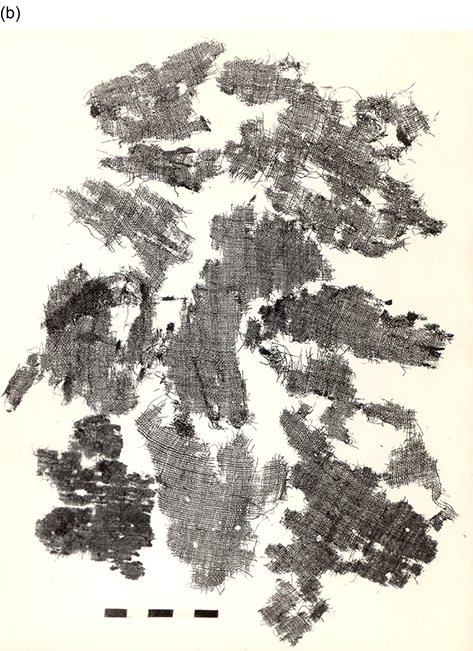
Figure 25b Textile fragments from Grave B, Grave Circle B, Mycenae, Argolid.
The textile corpus of the Grave Circles is currently under study, integrating both a technical analysis of the textiles and an archaeometric determination of the raw materials, from fibres to dyes. Preliminary results suggest a variety of weaving techniques employed for their manufacture, ranging from the ubiquitous plain weave, to weft-faced textiles including tapestry, while purple dye has been traced on some of these textiles (Spantidaki Reference Spantidaki2022).
Tapestry weaving is rarely encountered even in what constitutes the largest corpus of Bronze Age textiles from the Eastern Mediterranean, that is, that of New Kingdom Egypt (Kemp and Vogelsang-Eastwood Reference Kemp and Vogelsang-Eastwood2001, 89; Spinazzi-Lucchesi Reference Spinazzi-Lucchesi2018, 80). In the Egyptian context, too, cloth woven in the tapestry technique originates from royal or elite tombs of the 18th Dynasty and are considered Syrian-inspired, while a few have been determined as imports (Smith Reference Smith, Nosch, Koefoed and Strand2013, 163, 176). Their appearance in the material record of the 18th Dynasty has been associated with the military campaign of the Pharaoh Thutmose III against Megiddo and the captivity of Syrian artisans (Barber Reference Barber1991, 157–158). The Mycenaean find should be considered as the earliest Bronze Age tapestry in the Eastern Mediterranean to have been found, so far, outside of Egypt (Appendix B, Andersson Strand and Nosch Reference Andersson Strand and Nosch2015). Its occurrence in the Grave Circles raises the question of textile craft influences between Mycenae and other locations in the Eastern Mediterranean during the Shaft Grave period (Cline Reference Cline1994, 9–24, 106), given the Syrian and Egyptian connotations of the Bronze Age tapestry technique and the long-distance exchange networks that emerged during this period (Murray Reference Murray2023, 29).
In the Argolid a few more textile fragments were traced in the richly furnished LH II Tholos Tomb of Kazarma (de Wild Reference de Wild and Karantzali2001, 115) while a bowl that was among the contents of chamber tomb 2 at the Mycenaean cemetery of Dendra, retained ‘a large piece of Mycenaean cloth’ (Persson Reference Persson1931, 77) described as plain weave by de Wild (Reference de Wild and Karantzali2001, 115).
In Messenia, southwestern Peloponnese, textile remains were preserved among the grave goods of the lavishly furnished burial of the so-called ‘Griffin Warrior’ (Davis and Stocker Reference Davis and Stocker2016, 632), closely dated to the LH IIA period (Stocker et al. Reference Stocker, McNamee, Vitale, Karkanas and Davis2022). This material, currently under study for publication, will add important insight to our understanding of funerary textiles use associated with an undisturbed, male burial.
Some more evidence from this period originates from Boeotia. Fragments of a funerary textile were preserved in one of the tombs excavated within the so-called ‘Blue Stone Structure’ complex, dated to the transitional MH III-LH I period at Eleon (Burke and Dimova Reference Burke, Dimova, Frielinghaus, Stroszeck and Sieverling2023). Preliminary analysis attributed all of the fragments to the same cloth, based on a consistent warp count. The weave is described as weft-faced, because the weft count is always greater than the warp count (Table 2). Holes of up to 1.6 mm in diameter, in a diagonal arrangement, are considered as indications of supplementary weft. The analysis of the fibres under the SEM was inconclusive as to their identification, due to the degradation of the material. However, according to the study team the raw material was probably wool, based on the thread structure (single, z-twist) and the fibre diameters (Burke and Dimova Reference Burke, Dimova, Frielinghaus, Stroszeck and Sieverling2023, 15).
Textile Tools and Production Facilities
Identification of evidence for textile production during the early LB period in southern Mainland Greece is challenging, owing to the scarcity of well-preserved and adequately excavated settlements: the period is much more documented through surface surveys and excavations of burial sites, while at multi-period sites, the LH I–II horizons are, as a rule, only partially preserved due to the building that took place in the mature Mycenaean phase (Wright Reference Wright and Shelmerdine2008). Since the material culture of this period is much more documented through burial contexts (Crowley Reference Crowley and Shelmerdine2008), there is a bias in favour of the representation of the tools of thread manufacture, because spindle whorls were often deposited in or around tombs (e.g., Tomb O, in Circle Grave B, Mylonas Reference Mylonas1972–1973, 353, Pl. 189) (Supplementary Figure 8) as opposed to loomweights. To date, the most comprehensive, synthetic work on LBA textile tools from the Greek Mainland remains that of Carington Smith (Reference Carington Smith1975), but her study treats the LBA as a whole and does not distinguish between the earlier and later periods. Even so, however, the scarcity of loomweights, especially in the southern region, is noted (Carington Smith Reference Carington Smith1975, 446–457), usually interpreted as negative evidence for the preferred use of loom types other than the warp-weighted loom. Exceptions that change this impression are noted in the settlement of Nichoria in Messenia. Twelve clay loomweights, including two of the discoid, Cretan-type, the rest of a variety of other shapes, were found there in mixed LH II/III deposits (Carington Smith Reference Carington Smith, Macdonald and Wilkie1992, 687). Nine of these were found in a dump deposit that Carington Smith attributed to an ‘early Mycenaean’ building that would have contained one loom (Carington Smith Reference Carington Smith, Macdonald and Wilkie1992, 688). The c. 180 spindle whorls recovered from Nichoria are also attributed to mixed MBA/LBA deposits. Nonetheless they are an indication of the continued importance of yarn industries in the region, earlier documented at MH Malthi (see Section 3.2.3).
The earliest examples of steatite ‘conuli’, or ‘buttons’, a hallmark of Mycenaean material culture, are dated in this period, as is indicated by examples found also at Nichoria (Carington Smith Reference Carington Smith, Macdonald and Wilkie1992, 685–686). This artefact class includes small, centrally pierced cones with straight sides (and a few variations of this shape) that resemble conical whorls. Although some scholars have refuted their use for spinning on the grounds of their size, the diameter of the central hole, or their contextual associations in burials (Carington Smith Reference Carington Smith, Macdonald and Wilkie1992; Iakovidis Reference Iakovidis1977), a recent examination of a sample of those indicates that some were manufactured in shapes and sizes compatible with the whorl use, while surface wear typical of spindle whorls has been observed as well (Vakirtzi Reference Vakirtzi2015). Thus, in some cases the spindle whorl identification is possible. These artefacts are often found along with clay spindle whorls and loomweights in deposits dating from the mature Mycenaean phase, reinforcing such an interpretation.
3.4 The Late Bronze Age–Late
3.4.1 Crete, Final Palatial, and Postpalatial Periods
Excavated Textiles and Imprints
The few cloth fragments that can be dated within this timespan preserve nothing that echoes the sophisticated, specialized textile industry conveyed by the Mycenaean documents found on Crete, specifically in Knossos (Nosch Reference Nosch, Bennet, Karnava and Meißner2024). Extant textiles include: the clay imprint of a textile from ‘post-LM II contexts’ found in the Unexplored Mansion, Knossos (Popham et al. Reference Popham, Betts and Cameron1984, pl. 222.5) which manifests plain weave according to de Wild (Reference de Wild and Karantzali2001, 115); small pieces of a mineralized cloth adhering on one of the swords found in the ‘Chieftain’s Grave’ at the cemetery of Zafer Papoura, Knossos, which Evans described as linen (Evans Reference Evans1935, 866–867), and E. Barber suggested is an open, plain weave (Barber Reference Barber1991, 174, n. 12); and another mineralized fragment preserved on a metal vessel found in a LM IIIB tomb at Chania, showing plain weave (Karantzali Reference Karantzali1986, p. 75, Fig. 17).
Textile Tools and Production Facilities
Knossos was the administrative centre of a large-scale, well-organized textile industry during the Final Palatial period, relying primarily on wool, but also targeting linen textiles. This industry was closely controlled and recorded on clay tablets in the Linear B script, thus testifying to the administrative practices of Greek-speaking (and writing) scribes on Crete (Killen Reference Killen, Gillis and Nosch2007). The documents of Knossos convey the full cycle of the production, from managing herds of sheep destined for wool husbandry (Killen Reference Killen, Gillis and Nosch2007), to distributing the raw wool to workers located at places other than Knossos, to spinning, weaving, returning several different types of finished cloth, and possibly storing them, at least for some time, at Knossos (Del Freo et al. Reference Del Freo, Nosch, Rougemont, Michel and Nosch2010). The territory involved in wool husbandry, and the craft centres where this decentralized manufacture was taking place, have been identified in some cases, based on analyses of place-names and the ‘ethnic’ adjectives of textile workers, mentioned in the tablets (Killen Reference Killen, Gillis and Nosch2007; Bennet Reference Bennet and Killen2024). The Knossian textile industry was extremely specialized, as indicated by the many terms used in the texts to describe several different ‘professions’ within the production cycle. Moreover, for the first time in the Aegean Bronze Age, textile craft appears as a clearly gendered sector, a women’s sphere of work (Killen Reference Killen, Gillis and Nosch2007; Del Freo et al. Reference Del Freo, Nosch, Rougemont, Michel and Nosch2010), at least in the palatial industries.
The study of textile implements contributes to the identification of several facets of Cretan textile production in the Final and Postpalatial periods. In the area of Knossos textile tools from LM II/IIIA-B deposits were found in spaces outside the main palatial complex, but also again in the palace, after a Neopalatial break (Cutler Reference Cutler2021, 72). LM II–III deposits with mixed loomweight types, but with the spherical type dominating, were found in the Royal Road South and the Royal Road North, the South House, at Gypsadhes, at the Unexplored Mansion, and the Southwest Houses (Cutler Reference Cutler2021, 74–75, 85, 91–92, 98). The frequency and the dominance of the spherical loomweight type suggest a level of continuity from the previous period, despite the destructions at the end of the Neopalatial era. A notable difference from the Neopalatial record is the co-occurrence of spindle whorls in some of the same areas, especially in contexts dated to LM III (Cutler Reference Cutler2021). In LM III deposits there is a new element in the typological repertoire of tools found in the palace and the Unexplored Mansion, namely unpierced clay spools (Figure 26). This type should not be confused with the perforated spool type with flaring shafts known from the Middle Bronze Age horizon. The identification of these unpierced spools as loomweights was suggested by Barber (Reference Barber, Laffineur and Betancourt1997, see further) while their efficacy for weaving has been confirmed experimentally (Barber Reference Barber, Laffineur and Betancourt1997; Andersson Strand and Nosch Reference Andersson Strand and Nosch2015; Siennicka and Ulanowska Reference Ulanowska2016).
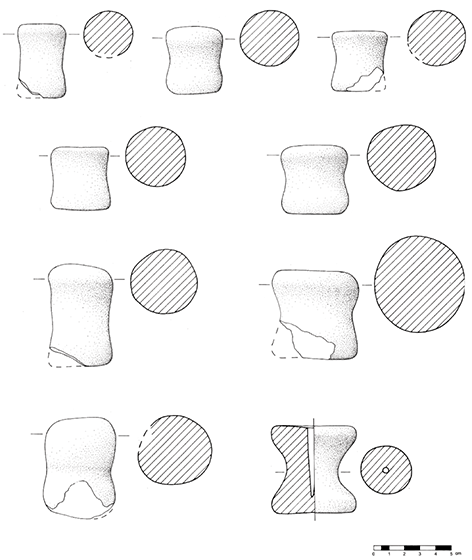
Figure 26 Drawings of some unpierced clay spools from Ayia Triada.
Elsewhere on Crete, textile tools from contexts dated to the LM II and LM III periods are noted from Kommos, where the discoid loomweight type continued to be used almost exclusively (Cutler Reference Cutler2021, 113–117). At Palaikastro, deposits attributed to the LM II and LM III periods from Building I contained a mix of loomweight types (Cutler Reference Cutler2021, 155), known from earlier phases but now also including the unpierced spool type, while LM IIIC deposits excavated in trial trenches at Kastri, Palaikastro, also yielded clay spools (Cutler Reference Cutler2021, 151). Spools were also encountered in LM IIIB-C contexts at Kastelli, Chania, along with discoid, and possibly stone loomweights as well (Bruun-Lundgren et al. Reference Bruun-Lundgren, Andersson Strand, Hallager, Strand and Nosch2015, 199, 203). Over sixty spindle whorls found at Kastelli were attributed to LM IIIB-C deposits, most of which are small and light and therefore suitable for fine thread production (Bruun-Lundgren et al. Reference Bruun-Lundgren, Andersson Strand, Hallager, Strand and Nosch2015, 204). These finds add to the Knossian pattern that indicates both stages of the operational sequence of textile production, thread making and weaving, taking place in the same location within urban centres. At Ayia Triada in the Mesara, weaving is represented by a few discoid and spherical loomweights and unpierced clay spools (Militello Reference Militello2014a, 257). Fine thread production is indicated during the LM IIIA/IIIB periods by small and light spindle whorls made in clay or stone in the ‘conuli’ shape. The latter is regarded by Militello as a more ‘prestigious’ type of whorl (Militello Reference Militello2014a, 256). Prestige in spinning at Phaistos may also be inferred by the deposition of ivory spindles in LM IIIC burials at Kalyvia (Militello Reference Militello2014a, 267), assuming that the consumption of ivory artefacts can be considered as an indication of luxury (but cf. Murray Reference Murray2018 for a different opinion). The spindles of Kalyvia are just ivory rods, no whorls were preserved, unlike their contemporary counterparts recovered at the LH IIIC cemetery at Perati, Attica, on the Greek Mainland (see Section 3.4.2).
The continuity of the weaving choices of the Neopalatial period, exemplified by the undisrupted dominance of the spherical loomweight at Final Palatial Knossos, is noteworthy given the ‘Mycenaean’ administration that was established there and kept record of the textile industry. More generally, Final and Postpalatial textile production on Crete is noted for the increased representation of spindle whorls in the archaeological deposits, in sharp contrast to the Neopalatial pattern; and for the emergence of the unpierced clay spool as a new type of loomweight across Crete. Textile craft in the transition from the Neopalatial to the Final, and ultimately to the Postpalatial period, requires further research to explore these patterns, especially given the wealth of information afforded by the Mycenaean records found on Crete. Spools, however, have caught the attention of E. Barber, who suggested that their function as a special type of loomweight can be supported by ethnographic parallels and based on the results of experimental weaving (Barber Reference Barber, Laffineur and Betancourt1997). She argued that this sort of weaving may have been particularly effective in producing patterned bands that could then be sewn into the multicoloured, Cretan kilts represented in the wall-paintings (Figure 8). She also associated the origin of this type of narrow band weaving to ‘nomadic or semi-nomadic herders on the steppes – the area and lifestyle from which the Indo-European Hittites and Mycenaean Greeks arrived in the North Mediterranean in the second millennium BCE’ (Barber Reference Barber, Laffineur and Betancourt1997, 517). However, as their contexts suggest, unpierced clay spools mark the end of the Mycenaean palatial period rather than its beginning.
3.4.2 The Insular Region
Excavated Textiles and Imprints
Mycenaean-era excavated textiles from the insular region have been reported from the island of Rhodes and the cemetery of Aspropilia at Pylona (LH IIIA2-LH IIIB1), specifically from tombs 1 and 2 C (Karantzali Reference Karantzali2001). Tomb 1 contained a rich burial that included the skeletal remains of one man and two women, furnished with jewellery, metal artefacts, and thirty clay vessels. Among those, two large piriform jars and one jug preserved textile remains. One of the female skeletons also preserved linen textile fragments on the forehead, jaw and forearm, interpreted by the excavator as a ‘funerary band … fastened around the dead person’s jaw and skull … to secure the mouth’ (Karantzali Reference Karantzali2001, 15). The textiles of tomb 1 were preserved in a calcified state, in layers and folds. De Wild analysed the cloth remains and observed plain weave structures, with subtle differences in the thread counts (Table 2) (de Wild Reference de Wild and Karantzali2001, 114–115). The threads have an s -twist, but it is not clarified if they are single or plied. The fibre is suggested to be flax in all cases, although the method or criteria of identification are not elaborated. These textiles had been used to seal the mouths of the respective ceramic vessels (de Wild Reference de Wild and Karantzali2001, 114; Karantzali Reference Karantzali2001, Cpl. 2, pl. 27b-e, pl. 34a-d, pl. 51), exemplifying a more ‘mundane’ or ‘industrial’ use of cloth in daily activities.
Textile Tools and Production Facilities
At Phylakopi, on the island of Melos, two buildings attributed to the Mycenaean period have been excavated, the Megaron (phases E-F, Renfrew Reference Renfrew, Renfrew, Brodie, Morris and Scarre2007, 9–13) and the Mycenaean Sanctuary (Renfrew Reference Renfrew1985), the latter better preserved and documented (Supplementary Figure 9). From the stratigraphical trenches of the 1970s, less than five fragmentary loomweights, all belonging to the Cretan discoid type were found, mainly in the Megaron area, in secondary deposits attributed to Phases E and F (Cherry and Davis Reference Cherry, Davis, Renfrew, Brodie, Morris and Scarre2007, 403–405). In the Mycenaean Sanctuary some more fragmentary loomweights of the Cretan discoid type were collected from deposits corresponding to the various phases identified in the building sequence (Renfrew Reference Renfrew1985, 71–80, 331, 336). Spindle whorls have a limited representation in LH III deposits from the Megaron area (Cherry and Davis Reference Cherry, Davis, Renfrew, Brodie, Morris and Scarre2007, 408, Table 10.1) and most of those recovered from the Sanctuary were in destruction debris or building fills. Nonetheless, some were found in primary deposition on floors, on or near the platforms of the Shrine, as part of the ‘Assemblages’ of votive offerings located there (Assemblages A, B, K and L, Renfrew Reference Renfrew1985, passim). Within these contexts there are clay spindle whorls, in good preservation and in various types and sizes (Figure 27a-c), including small ones weighing less than 10 gr (Vakirtzi Reference Vakirtzi2015).
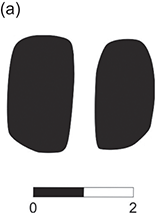
a. cylindrical
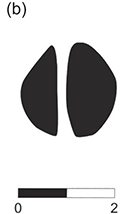
b. spheroid
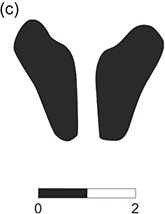
c. conical with concave sides and hollow top.
Figure 27a-c Types of spindle whorls found on or near the platforms of the West Shrine at the Mycenaean Sanctuary of Phylakopi, Melos:
Ayia Irini on Kea is the second Cycladic settlement to provide evidence of textile craft during the Mycenaean phase (phase VIII). However, these deposits are neither extensive nor rich in textile tools. Only a few loomweights of the Cretan discoid type have been attributed to LH III (Cutler Reference Cutler2021, 188–189, 203) raising the question of the scale of production, in contrast to spindle whorls that are more numerous and more widely distributed in this horizon (Cutler Reference Cutler2021, 169–215, passim).
At Naxos, in the Cyclades, an urban centre was founded in Grotta in the Mycenaean period and flourished throughout the LC IIIC phase (Vlachopoulos Reference Vlachopoulos and Angelopoulou2019). The settlement, traced beneath the modern town of Naxos, was partially excavated, preserving part of the city wall as well as domestic areas adjacent to it. Among those was a small room filled with destruction debris where two ivory spindles were found, one of which retained its whorl (Lambrinoudakis and Zafeiropoulou Reference Lambrinoudakis and Zafeiropoulou1984, 324). These finds demonstrate that textile equipment made of exotic material was not restricted for funerary deposition as was the case of the spindles of Kalyvia near Phaistos and Perati in Attica (see Sections 3.4.1–2), but were also used in domestic contexts.
In the southeast Aegean, significant Mycenaean influence has been noted in Rhodes in the Dodecanese. Although this is mostly represented by cemeteries and burial sites (Benzi Reference Benzi, Dietz and Papachristodoulou1988), rescue excavations have revealed facets of everyday life at Mycenaean Ialysos (Marketou Reference Marketou and Cline2010, 785–786). Loomweights of the Cretan, discoid type continued to be used on the warp-weighted loom in this period, following the earlier introduction of Cretan weaving technology on the island during the MBA period (Marketou Reference Marketou, Macdonald, Hallager and Dietrich-Niemeier2009, see Section 3.3.2). At Ialysos, twenty-one loomweights were found on the floor of a room near a kiln, in an arrangement that implies that this space was abandoned while the loom was still set-up. Moreover, the excavator associated the kiln with the manufacture and firing of the loomweights (Marketou Reference Marketou and Kyriatsoulis2004).
3.4.3 The Mainland, LH IIIA-C
Textile Tools and Production Facilities
In the heart of the Mycenaean world in the northeastern Peloponnese, at the peak of the palatial era during the LH IIIA-B periods, thread manufacture took place both at palatial and non-palatial sites, judging from the spindle whorl assemblages. In most cases where metric data have been made available, those reveal a wide range of spindle whorl sizes. Very small whorls weighing less than 10 gr are well represented, indicating that some of the production was orientated to very fine thread (Andersson Strand and Nosch Reference Andersson Strand and Nosch2015, passim). Spindle whorls made of clay or stone, including small ‘conuli’, are widespread in Mycenae, Tiryns, Midea, Asine, Pylos, and Nichoria, to name some of the sites with published textile tools assemblages (Carington Smith Reference Carington Smith1975, 418–457; Carington Smith Reference Carington Smith, Macdonald and Wilkie1992; Rahmstorf Reference Rahmstorf2008, 17–59; Andersson Strand and Nosch Reference Andersson Strand and Nosch2015, passim).
All of these sites document a long and complicated history of building, destructions, and rebuilding, as well as a long history of excavation campaigns, making the distinction of closed contexts, and the clarification of textile craft spaces, challenging. In the case of Mycenae in the Argolid, the seat of the Mycenaean state, Tournavitou et al. (Reference Tournavitou, Andersson Stran, Nosch, Cutler, Strand and Nosch2015, 255) warn against underestimating the taphonomic, stratigraphic, and architectural complexities of the site, when studying potential evidence of thread manufacture and weaving. Identifying spaces of textile craft is difficult, given that many excavated areas remain unpublished. Nonetheless, the analysis of a sample of textile tools found at Mycenae (Tournavitou et al. Reference Tournavitou, Andersson Stran, Nosch, Cutler, Strand and Nosch2015) has highlighted the frequency of stone spindle whorls both on the Citadel and in the Lower Town. In the Citadel, hundreds of steatite ‘conuli’ have been recovered, but only a few from closely dated contexts. One ‘conuli’ group originating from the Shrine with the Frescoes is described as part of a votive assemblage (Tournavitou et al. Reference Tournavitou, Andersson Stran, Nosch, Cutler, Strand and Nosch2015, 259). Although these objects are often rejected as spindle whorls, their identification as such cannot be completely ruled out (see earlier, Section 3.3.3). This is the second case of textile tools having been found in a Mycenaean shrine, following that of Phylakopi on Melos (see Section 3.4.3). In the Lower Town of Mycenae, domestic spinning activities have been identified in the case of the House of the Oil Merchant and House I of the Panagia Houses. Although whorls were also recovered in many other spaces, the contextual analysis of buildings and their contents does not always support the identification of textile production loci (Tournavitou et al. Reference Tournavitou, Andersson Stran, Nosch, Cutler, Strand and Nosch2015, 257–259).
In contrast to spindle whorls, loomweights in LH IIIA and IIIB deposits in Mycenaean Peloponnesian sites are scarce. Only a few loomweights that are variations of the Cretan discoid type are reported from Mycenae (Carington Smith Reference Carington Smith, Macdonald and Wilkie1992, 689), from Tiryns, along with examples of the torus-shaped type (Rahmstorf Reference Rahmstorf2008, 53), from the palatial complex of Pylos and from Nichoria (Carington Smith Reference Carington Smith1975, 448, 450; Reference Carington Smith, Macdonald and Wilkie1992, 687). In the case of Pylos, loomweights of the rectangular type, like those used at Kastri on Kythera (Cutler Reference Cutler2021, 242) were found in the Wine Magazine of the palace, a space unlikely to have been used for weaving (Cutler Reference Cutler2021, 242). The rarity of loomweights suggests that weaving with the warp-weighted loom in the LH IIIA–B Peloponnese was likely limited in scale. Another type of textile tool that occurs in the region during this period, the so-called ‘pin beater’, perhaps indicates the use of a different type of loom: ‘pin beaters’ are considered as an accessory for tapestry weaving (Smith Reference Smith, Nosch and Laffineur2012), a technique that was performed on the vertical two-beam loom in 18th Dynasty Egypt (Barber Reference Barber1991, 158). Given the documentation of tapestry-woven cloth in Myceanae (Spantidaki Reference Spantidaki2022), it is worth considering the possibility that the scarcity of loomweights and the presence of ‘pin beaters’ point to the use of the two-beam loom in this region as well.
At Mycenaean Kadmeia (Thebes), Boeotia, a similar picture emerges, based on the exploration of plots in the modern town (Alberti et al. Reference Alberti, Aravantinos, Fappas, Strand and Nosch2015). Insofar the Mycenaean deposits could be uncovered mainly through rescue excavations, textile tools from LH IIIB contexts are limited to spindle whorls made of stone and clay, as well as stone ‘conuli’. Weaving is indicated primarily by unpierced clay spools that were recovered from LH IIIB2 deposits (Alberti et al. Reference Alberti, Aravantinos, Fappas, Strand and Nosch2015, 288–290) while other types of loomweights are scarce. It is likely that Mycenaean Kadmeia was the centre of a wool industry, as wool administration is attested in the records of the Linear B archive discovered in Thebes. This has led some scholars to identify wool processing and storage areas, including probable wool-washing facilities in the Mycenaean horizon as well (Alberti et al. Reference Alberti, Aravantinos, Fappas, Strand and Nosch2015, 286).
In Athens, Attica, the excavation of a Mycenaean site at Kontopigado, Alimos, revealed features that indicate an industrial installation. The site, abandoned before the LH IIIC period, consists of parallel, elongated channels 30–60 m long, and several pits, all dug in the natural bedrock, as well as three wells, indicating a water regulation system. Although no textile tools or organic remains related to such use have been reported, the excavators identified the site as a facility for the processing of flax (Kaza-Papageorgiou Reference Kaza-Papageorgiou2011): flax needs to lie in water for about 15 days so that the woody parts of the plant rot, making it easier to extract the fibres from the stem (Barber Reference Barber1991, 13).
The weaving technological landscape of the LH IIIC period is marked by the widespread occurrence of the unpierced clay spool type (Figure 26), as was also the case in Crete. At Mycenae, a group of thirty-five spools were found in the East Basement of the LH IIIC building defined as the Granary that was destroyed by fire (Wace et al. Reference Wace, Heurtley, Lamb, Holland and Boethius1921–1923, 54), along with spindle whorls made of stone and clay, as well as a ‘small piece of carbonized canvas’ (Wace et al. Reference Wace, Heurtley, Lamb, Holland and Boethius1921–1923, 55, see further, Excavated Textiles). A group of spools was also found in the large Room XLIV of House I in LH III Asine (Frödin and Persson Reference Frödin and Persson1938, 78, 309, Fig. 213). At Tiryns, more than one hundred spools were recovered from well-stratified, late-LH IIIC contexts in the Lower Acropolis (Rahmstorf Reference Rahmstorf2008, 59–61). These tools also have a strong representation in LH IIIC Lefkandi, on Euboea, where more than three hundred, made of unfired clay, have been found, along with a much smaller group of seven ring-shaped clay artefacts, perhaps also loomweights, and less than fifty clay spindle whorls (Evely Reference Evely and Evely2006, 296–300).
These spools have a wide range of sizes, but on average they are much lighter than other types of Bronze Age loomweights. Whether used for weaving on the warp-weighted loom or for the technique of narrow band weaving envisaged by E. Barber (Reference Barber, Laffineur and Betancourt1997), they would work well with fine types of thread. The small spindle whorls attested in LH IIIA-C deposits are compatible with these production targets. Spinning fine thread requires great skill, and it is possible that craftspeople who were able to produce these yarns were enjoying special status in their communities. Perhaps an indication of this status is exemplified by the deposition of spindles in graves. In the case of Perati, East Attica, where a large LH IIIC cemetery was found, the excavator reported that three female tombs were furnished with ‘at least five spindles’ (Iakovidis Reference Iakovidis1970, 350–354). One of these, made of ivory, was preserved intact and gives us a good idea of how these tools would have looked like (Figure 28). These ivory spindles would have certainly stood out as spinning implements, at least compared to the simpler, wooden ones equipped with clay whorls. However, a different opinion was expressed by Murray (Reference Murray2018) who suggested that exotic items used as funerary offerings at Perati were not necessarily elite markers but may instead be symptoms of the extremely diverse burial customs that can be observed in this LH IIIC cemetery.
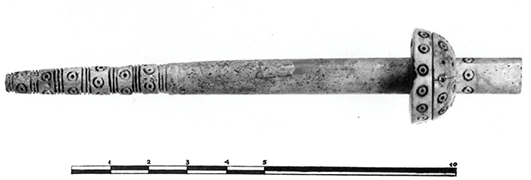
Figure 28 Ivory spindle with spindle whorl from the cemetery of Perati, Attica.
Figure 28Long description
The spindle is made of ivory and has rows of carved, small circles decorating the surface of the whorl and the distal ends of the spindle rod. A scale from 0 to 10 centimeters is shown at the bottom.
Excavated Textiles and Imprints
Evidence of textile craft deriving from extant textiles or textile imprints from the LH III southern Mainland is rare. A few lumps of clay from the interior of Tomb XXI at the cemetery of Deiras, Argos, dated to LHIIIA2-IIIB, preserve cloth imprints (Siennicka Reference Siennicka, Yvanez and Wozniak2025). The ‘canvas’ found in LH IIIC deposits in the Granary at Mycenae mentioned earlier has yet to be re-examined.
The end of the Aegean Bronze Age features the best preserved and most sophisticated textile corpus found in Greece up to date. The excavation of a tumulus at the site of Toumba, Lefkandi, Euboea, revealed the rich burial of a man and a woman (Popham et al. Reference Popham, Touloupa and Sackett1982). The cremated remains of the male burial were found in a bronze amphora imported from Cyprus and dated to the Late Bronze Age (Catling Reference Catling, Popham, Calligas and Sackett1993). Within the amphora, several textiles were found in a good state of preservation, including an almost complete (main) garment (Figure 29a), two textile fragments, and two narrow bands (Margariti and Spantidaki Reference Margariti, Spantidaki, Bustamante-Álvarez, López and Ávila2020).
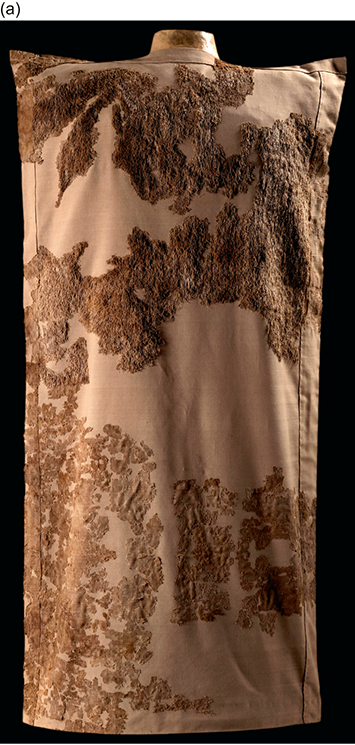
Figure 29a The main garment of Lefkandi.
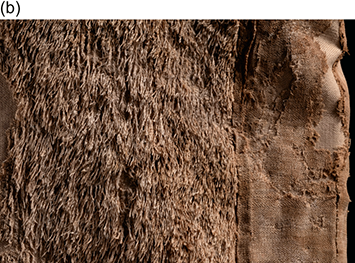
Figure 29b Knotted pile weave, detail of the main garment of Lefkandi.
Given the dating of the burial site of Toumba to the Protogeometric period, the textiles were previously considered to reflect Iron Age textile craft (Barber Reference Barber1991, 197). However, recent radiocarbon dating yielded absolute dates between the late thirteenth to late eleventh centuries BCE for the main garment and one of the other two textile fragments, and a range between the thirteenth and the tenth centuries BCE for the third textile (Margariti and Spantidaki Reference Margariti, Spantidaki, Bustamante-Álvarez, López and Ávila2020, 403, Table 2, 410). It is possible, then, that at least some of the cloth items were Late Bronze Age heirlooms.
The Lefkandi textiles have been recently re-examined, and the results were published in a comprehensive article (Margariti and Spantidaki Reference Margariti, Spantidaki, Bustamante-Álvarez, López and Ávila2020). After conservation, the main garment (Margariti and Spantidaki Reference Margariti, Spantidaki, Bustamante-Álvarez, López and Ávila2020, ‘Textile 1’) was restored as a feet-long garment with an opening for the neck but no sleeves openings (Margariti and Spantidaki Reference Margariti, Spantidaki, Bustamante-Álvarez, López and Ávila2020, 402). The ground weave is plain balanced (Table 2), while the upper part of the garment (Figure 29b) corresponding roughly to the torso area, has additional knotted pile weave with symmetrical knots (Margariti and Spantidaki Reference Margariti, Spantidaki, Bustamante-Álvarez, López and Ávila2020, 403–405). This weave is created with supplementary weft threads twining around two successive warp threads, to create small loops or knots that are left hanging to form a pile surface (Emery Reference Emery1966, 221; Barber Reference Barber1991, 201–202, Fig. 7.10). As to the materials used for these textiles, flax was used in most cases. However, ‘Textile 3’, described as a ‘very fine weft-faced tabby’, with a thread count of 20x80 threads per sq. cm, is suggested to have been made of wool (Barber Reference Barber1991, 410). The narrow bands, manufactured of linen threads, possibly combined with woollen ones, bear geometric patterns such as chevrons and zig-zag designs, created through the weaving of double warps, wefts and probably additional threads (decorative warps?) that are today lost (Barber Reference Barber1991, 405–406).
The textiles of Lefkandi preserve an extraordinary variety of weaves and decorative techniques, including plain weave, knotted pile, weft-wrapping, and tapestry, while testifying to the use of various thread types in each cloth piece, as well as the use of different coloured threads, some of which are dyed in purple (Barber Reference Barber1991, 403). These textiles thus correspond to a level of craftsmanship and creativity that echoes the degree of textile specialization that had been achieved during the peak of the Mycenaean period, at least two centuries earlier, as conveyed in the Linear B documents (Killen Reference Killen, Gillis and Nosch2007). The textile-related records include numerous terms that refer to various colours and textures as well as terms that reflect the elaboration and finishing of the cloth. Some of the professional designations on the Pylos tablets convey specializations such as spinners (Figure 30), decorators of cloth, seamstresses, and o-nu-ke-makers (Killen Reference Killen, Gillis and Nosch2007, 55; Del Freo et al. Reference Del Freo, Nosch, Rougemont, Michel and Nosch2010, 345), while terms on the Knossos tablets refer to blue, red, brown, grey, purple-coloured textiles, as well as to cloth with multicoloured o-nu-ke (Rougemont Reference Rougemont, Breniquet and Michel2014, 355–356). The term o-nu-ke has been understood as ‘fringes’ by some scholars, and as some sort of ‘added decoration’ by others (Nosch Reference Nosch, Breniquet and Michel2014, 387).
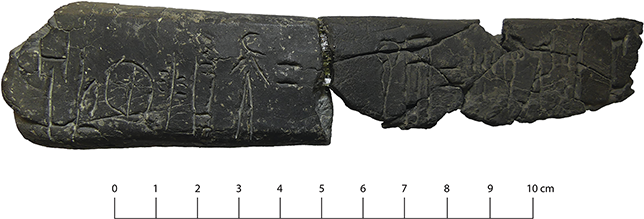
Figure 30 Clay tablet from Pylos (PY Aa240) with a Linear B inscription recording spinning women.
Could the Lefkandi textiles be considered as one of the latest examples of the achievements of palatial weaving workshops? The radiocarbon dating of the textiles to the period between the thirteenth and the tenth centuries allows the contemplation of such a scenario, especially given the presence of another heirloom, the bronze amphora that contained the cloth items, dated to the thirteenth to twelfth centuries BCE (Catling Reference Catling, Popham, Calligas and Sackett1993, 87). The amphora, however, is an import from Cyprus. The possibility that the textiles were also imported, perhaps from Cyprus as well, should not be ruled out, given LH IIIC Lefkandi’s involvement in short and long-distance trade (Sherratt Reference Sherratt and Evely2006, 308–309).
4 Overview of Aegean Bronze Age Textile Craft
Variety, technical diversity, and creativity characterize the textile history of the Aegean region in the 2,000 years encompassing the Bronze Age. The beginning of the period does not herald the start of sophisticated textile production. It is simply the ‘next moment’ in a long trajectory of craftsmanship. Both the thread manufacturing technology and the weaving techniques of the Early Bronze Age draw from considerably older traditions. The spindle and the vertical warp-weighted loom are technologies that date at least as early as the Middle Neolithic (Carington Smith Reference Carington Smith1975). The same is true for fibre economy and fibre technology. It is likely that Bronze Age textile craft relied on a range of textile fibres, perhaps including wild silk as well as nettle. Practices of gathering textile fibres from ‘wild’ or non-domesticated species, apparently drawing from pre-Neolithic traditions that survived into the Neolithic (Rast-Eicher et al. Reference Rast-Eicher, Karg and Bender Jørgensen2021; Bender Jørgensen et al. Reference Bender Jørgensen, Rast-Eicher and Wendrich2023), probably continued in the Bronze Age and coexisted with the practice of harvesting fibre from domesticated species, that resulted in the standardized wool and flax economies of the third and second millennia BCE.
Within the third millennium BCE, advanced technological know-how in thread manufacture can be surmised. The assemblages of spinning tools studied from various sites in the Aegean and Mainland Greece reveal the diversified production of a range of different thread qualities, from very fine to coarse. The scant evidence for actual textiles emerging from imprints and mineralized, carbonized and calcified fragments, showcase the need for the simultaneous use of various thread qualities in the same cloth, for wefts, warps and supplementary decorative, strengthening or ‘sewing’ threads. Textile production in the Early Bronze Age was domestic but sophisticated. Cloth was essential in every aspect of life, from dress for the human body, to more ‘technical uses’, judging from the impressions of textiles on ceramic artefacts and the imprints on clay sealings. Such ‘technical uses’ did not entail only coarse cloth qualities. The few extant textiles and their imprints suggest that the investment in time, effort, and resources for fine products was not intended exclusively for clothing the human body. Fine cloth was also used for ‘dressing’ non-human ‘bodies’, as the metal dagger from the Amorgos tomb seems to suggest. Does this indicate a widespread availability of finely woven cloth?
One notable achievement in the textile craft of the second millennium BCE appears to have been on the level of elaboration and cloth decoration. This was apparently achieved with appliqués, non-textile elements such as beads and metal ornaments (Konstantinidi-Syvridi Reference Konstantinidi-Syvridi, Harlow, Michel and Nosch2014), but also on a purely textile level, with an investment in creating colourful patterning with dyed yarns, and thread decorative techniques such as looping, knotting and tassel-making. The production of dyes for multicoloured textiles became so important that it evolved into a centrally managed industry on Crete, as indicated by the facilities for dye production. In the corpus of excavated textiles, colour is barely traceable, but thanks to figurative art, primarily the art of second-millennium frescoes, it is possible to grasp the rich colour palette at the disposal of weavers. Textile polychromy must have developed in parallel to wool economy, since wool absorbs dyes much better than bast fibres.
The use of supplementary threads in the ground weave for the decoration of cloth with an array of additional thread structures is another important breakthrough of Aegean textile craft during the Bronze Age. ‘Tangible’ evidence of these techniques was encountered for the first time with the discovery of the Akrotiri textiles. It is impressive that the supplementary threads, the knots, the tassels, and the traces of embroidery were observed on miniscule, carbonized cloth fragments. This fact demonstrates the importance of analysing even the smallest scraps of textile finds, and reinforces the hope that even fragments that appear as worn-out and desperate remains at first glance may retain invaluable testimonies of textile history.
The economic and symbolic significance of textiles is underlined by the flourishing of weaving workshops across the Aegean. Textile industries were being established in urban centres in Crete, at important harbour towns of the insular Aegean and in surrounding coastal areas from the early second millennium BCE. Interestingly, the coastal and insular weaving centres that emerged outside of Crete were equipped with Cretan-type warp-weighted looms. However, as the evidence shows, the diffusion of the Cretan weaving technology at its earliest moment, should be understood as a specifically Knossian effect. The weaving technological landscape on Protopalatial Crete is far from homogeneous, and on Crete itself there was no one, specific type of ‘Minoan loomweight’. Malia provides us with ‘hoards’ of spherical loomweights from Protopalatial contexts, standing in contrast to Knossos in terms of the production targets: fine and densely woven, perhaps even patterned textiles were produced at the latter, while open, or weft-faced fabrics at the former. The islanders who adopted ‘Cretan ways of weaving’ in the early second millennium BCE were following the example of Knossos. But then Knossos itself, in its Neopalatial phase, followed the example of other Protopalatial centres, perhaps most importantly Malia, as weavers based around the Knossian palatial complex were now equipping their looms with spherical loomweights. The types of fabrics produced at Knossos were also produced in Archanes and several other locations in north-central Crete. In the islands, however, the Knossian shift to spherical loomweights does not appear to have had an effect. In the Cyclades, the Southeast Aegean and even the North Aegean, weaving continued ‘as usual’, with discoid loomweights, suitable to produce dense, fine, and probably balanced weaves. The only exception is Akrotiri, where along with the dominant discoid loomweights, a few examples of spherical loomweights were found scattered in the LC town. Their occurrence indicates an attempt to engage with the weaving of open or weft-faced textiles following, again, the example of Knossos, and a few other places such as Archanes. Perhaps the Theran weavers had just began weaving a new type of fabric, but there was just not enough time to upscale this production before Akrotiri was abandoned and destroyed by the volcanic eruption.
Mycenaean textile production emerges as an extremely sophisticated sector of the political economy of Mycenaean states, while the textual sources convey a highly specialized industry. However, the documentary evidence does not correspond well with the archaeological record. In terms of textile remains the record is very poor, while the material remains of textile technology document more clearly the stage of spinning thread than the stage of weaving cloth. One of the most poignant emerging patterns, however, regards the association of textile craft and religious practices. The deposition of textile tools in shrines, attested in Mycenae and in Phylakopi, perhaps should be considered related to the ritual offering of cloth (Boloti Reference Boloti2009). On the Mainland, yarn production is quite visible archaeologically, but the weaving technology is elusive, at least in the major centres. Whether this implies a geographical division of labour or an archaeologically invisible weaving technology remains an open question. What is important to note, however, is that the Mycenaean administration of the textile industry at Final Palatial Knossos did not bring about any significant change in the local, weaving technology: the spherical loomweights that dominate in LM II contexts, as they also did in the Neopalatial phase, testify as much. However, change is observed towards the end of the Late Bronze Age, when a new type of loomweight, the unpierced clay spool, appears to spread across the Aegean. Does this tool imply a fashion for colourful narrow bands, created efficiently with these portable weaving implements, wherever one travelled, as E. Barber suggested? And if so, would this technology add to the pattern of weavers travelling around the Aegean and the Eastern Mediterranean, where these spools are also very common (Rahmstorf Reference Rahmstorf2008)?
The end of the Bronze Age did not signify an end for textiles, despite the collapse of the Mycenaean palatial infrastructure that had in many ways supported and advanced textile craftsmanship. The garment of Lefkandi, dated between the thirteenth and the eleventh century BCE, indicates that high-quality cloth was still in demand during this time of severe political and economic destabilization. Moreover, the safeguarding of Late Bronze Age textile heirlooms and their disposition in an Iron Age prestige burial showcases the participation of textiles in strategies of monumentalization and memory making.
5 Conclusion
Although we will likely never fully recover the complete range of techniques, textures, colours, scents, sounds, appearances, and uses of Aegean Bronze Age textiles, the emergence of Textile Archaeology as a dynamic research field in recent decades offers imaginative and innovative approaches to analysing and understanding the material remains of textile production and consumption. A substantial body of new data is being generated through advanced analytical methodologies that focus on the technical aspects of textile material culture. This growing body of evidence invites a critical reassessment of earlier assumptions, hypotheses, and interpretive models concerning Aegean textile craft.
At the same time, current research has the potential to reveal how textiles, by clothing both human and non-human bodies, functioned as active agents of social and economic transformation. The Bronze Age was a period marked by expanding regional and interregional networks among Aegean communities and those in surrounding areas. Textiles likely served as a ‘second skin’ for individuals migrating, whether voluntarily or forcibly, or simply travelling across the Aegean and the Eastern Mediterranean, bringing diverse cloth cultures into contact.
As textile production became increasingly central to political economies, cloth and garments were progressively integrated into systems of exchange, including gift-giving, trade, and other forms of transaction. The intensifying, multidirectional flow of people, goods, and ideas throughout the Bronze Age suggests that textile craftsmanship was a widely interconnected and collaboratively shaped domain of human creativity. It was rich in variation, material expression, and deeply embedded in the enduring maritime networks that defined Bronze Age connectivity.
Acknowledgements
I would like to thank the editors of the series ‘The Aegean Bronze Age’ for inviting me to contribute this Element on Aegean Bronze Age textile craft. Thanks are due to Dr K. Nikolentzos, Head of the Prehistoric Collection, and Dr G. Moraitou, Head of the Department of Conservation, Chemical and Physical Research and Archaeometry of the National Archaeological Museum for granting me permission to examine the mineralized cloth fragment on the EBA dagger of Dokathismata. Also, to Dr E. Gerontakou for discussing with me the textile fragments of Zakros. Many thanks are extended to the Ephorates, Museums and Excavation archives of the Hellenic Ministry of Culture, ODAP, the Athens Archaeological Society, Akrotiri Excavations, Foreign Schools in Athens, CMS Heidelberg, Classics Department/University of Cincinnati, as well as individuals/copyright holders who generously gave permission to use the images of this Element. Warm thanks to V. Papazikou who helped me with the drawings. This Element benefitted considerably from the feedback provided by two anonymous reviewers. Any remaining shortcomings are my own.
Carl Knappett
University of Toronto
Carl Knappett is the Walter Graham/ Homer Thompson Chair in Aegean Prehistory at the University of Toronto.
Irene Nikolakopoulou
Hellenic Ministry of Culture, Archaeological Museum of Heraklion
Irene Nikolakopoulou is an archaeologist and curator at the Archaeological Museum of Heraklion, Crete.
About the Series
This series is devised thematically to foreground the conceptual developments in the Aegean Bronze Age, one of the richest subfields of archaeology, while reflecting the range of institutional settings in which research in this field is conducted. It aims to produce an innovative and comprehensive review of the latest scholarship in Aegean prehistory.