

The 2020 election cycle broke political spending records with more than $14 billion spent on Congressional and Presidential races (Evers-Hillstrom 2021). In that two-year election cycle, PACs (Political Action Committees) raised and spent approximately $12.9 billion (FEC 2021). PACS are political organizations that raise money to elect or defeat specific candidates, and they typically represent businesses, corporations, and labor unions. Congruent with massive spending, PACs are considered influential in U.S. elections and Americans are noticing, perhaps thanks to attention brought to the issue from the landmark Citizens United v FEC case. Polls indicate that roughly 70% of Americans are concerned about the influence of big donors in politics (Jones Reference Jones2018). Related research suggests that corporate political donations can act as a signal of corruption to voters (Bowler and Donovan Reference Bowler and Donovan2016), and prior work finds that both Democratic and Republican voters prefer candidates that are not funded by PACs (Dowling and Miller Reference Dowling and Miller2016; Jenkins and Landgrave Reference Jenkins and Landgrave2021).
In recent election cycles, politicians are taking the no corporate PACs pledge, which was organized by End Citizens United. Democratic politicians such as Alexandria Ocasio Cortez, Cory Booker, and Kamala Harris have pledged to refuse corporate PAC funds (Godfrey, Reference Godfrey2018). Many Republicans are also seeking other funding sources besides corporate PACs (Mullen Reference Mullen2009). However, Republicans are taking a different angle on the trend—Ted Cruz and Josh Hawley have sworn off “woke” corporations (McFadden Reference McFadden2021). Refusing PAC funds, then, is a bipartisan trend even if the motivation for refusing PAC funds is partisan (avoiding corporate influence versus avoiding allegedly woke corporate influence). Still, it is unclear exactly what PAC refusal signals to voters.
There are several traits or features of a candidate that PAC funding could signal. For instance, voters may see PAC funding as shorthand for judging whether candidates cater to special interests or support voters’ interests. Research that leads to the expectation that PAC-funding refusal could improve voters’ evaluations of candidates (Dowling and Miller Reference Dowling and Miller2016) builds on the tradition of political scholarship which documents the ways political elites often struggle to balance the push and pull of influence from citizens and powerful, monied interests (Przeworski Reference Przeworski1985; Orloff and Skocpol Reference Orloff and Skocpol1984). Voters trying to determine whose side a political candidate will take once in office—the donors or the people—may be looking for signals of the candidate’s allegiance. Refusing PAC funds could serve as such a signal. For many Americans suspicious of the corrupting influence of special interest giving and spending (Persily and Lammie Reference Persily and Lammie2004), refusing PAC funds could also signal an ethical candidate.
While appealing to voters who are suspicious of corporate donors’ influence, candidates must also keep up with the cost of campaigning in increasingly expensive election cycles. In addition to ethicality (versus corruption) and working for voters (versus donors), PAC funding could signal a candidate’s skill and ability to raise the donor dollars needed to win elections. In an electoral system where winners out-raise their competitors, the ability to garner large sums could signal either that PACs are confident in a candidate’s ability to win or that the candidate has the skills necessary to compete well (Alexander Reference Alexander2005; Lioz Reference Lioz2003; Sorensen and Philip Reference Sorensen2022).
In addition to not explaining what PAC-funding acceptance or refusal signals to voters, existing research on PAC refusal does not differentiate between White and Black candidates or men and women candidates. This is despite prior research in other areas suggesting that attitudes about political candidates are impacted by the candidates’ respective race and gender (Lemi and Brown Reference Lemi and Brown2019). For instance, previous research establishes the detrimental effects of racial resentment and hostile sexism on voter evaluations of racial minority and female political candidates (Ratliff et al. Reference Ratliff, Redford, Conway and Smith2017; Tesler Reference Tesler2013) that could lead to the expectations that Black candidates and female candidates fare worse than their White male counterparts on any measure of favorability, particularly among White and conservative voters. Female and minority candidates have enough challenges when fundraising (Sorensen and Philip Reference Sorensen2022). They could be further disadvantaged if they are acting on campaign funding advice based on conclusions built around White male candidates or are otherwise guided by racial resentment or sexism. Therefore, it is critical to ask whether PAC funding (or refusal) has the same effect by race and gender.
In the present study, we use an experimental vignette survey with 1,666 Amazon Mechanical Turk workers to formally test the impact of refusing PAC funds on candidate preference ratings for four candidates who vary by race (Black or White) and gender (male or female). We use the setting of a primary election so that respondents will consider policy and campaign issues (Aldrich et al., Reference Aldrich and Michael Alvarez1994) beyond partisan affiliation.
First, we determine whether refusing PAC funds impacts perceptions of political candidates. On average, we find that refusing PAC funds increases the perception that candidates are more ethical and less corrupt, more likely to be working for voters and less likely to be working for donors, and more skilled and capable of winning the election than their PAC-funded counterparts. However, analyzing the effect of candidate race and gender reveals that the effect of refusing PAC funds is not the same for all candidates. We find that the White female candidate benefits the most from refusing PAC funds in terms of the preference ratings we measured – ethicality, corruption, working for voters, working for donors, skill, and capability of winning. For the Black female candidate, there is no significant change in any outcome with respect to the candidate refusing PAC funds. The effects for the Black and White male candidates vary. Refusing PAC funds impacts all outcomes for the White male candidate in the same direction as the White female, except for the perception that he is corrupt (for which there is no significant effect). Refusing PAC funds only impacts the perception that the Black male candidate is working for donors. These findings indicate that refusing PAC funds may have reputational benefits for perceptions of White candidates, but that Black candidates do not receive the same benefit. In fact, baseline perceptions of Black PAC-funded candidates are often more favorable compared to White PAC-funded candidates. Therefore, Black candidates considering taking the no corporate PACs pledge, like some liberal politicians, or avoiding the supposedly “woke” corporations called out by conservative politicians, should reconsider. We contribute to existing literature by demonstrating what qualities and traits PAC funding can signal and by showing that candidates’ race and gender impact the way their campaign funding is perceived.
Literature and Background
The first PAC was created to circumvent the Taft-Hartley ban on labor union contributions in the 1940’s. Businesses followed suit in the 1960’s. PACs became a legally recognized form of campaign finance in the Federal Election Campaign Act of 1970’s prompting an explosion of PACs—from roughly 300 in 1970 to nearly 2,500 in 1980 (Epstein Reference Epstein1980). Some research on PACs focuses on candidate and PAC strategies for campaign finance (Jenkins Reference Jenkins2007), while other research focuses on perceptions of campaign finance sources as corrupt (Donovan and Bowler Reference Donovan and Bowler2019; Persily and Lammie Reference Persily and Lammie2004). Scholars recognize the impact of campaign finance and its regulation on the public’s confidence in the democratic process (Dowling and Miller Reference Dowling and Miller2016). Additionally, research has shown that increases in PAC contributions to Senate elections are associated with reduced voter turnout (Cebula and Durden Reference Cebula and Durden2007). Cebula and Durden (Reference Cebula and Durden2007) argue that voters see the benefits of voting reduced when the influence of a single vote cannot compete with the influence of a PAC, meaning voters feel that their individual vote cannot compete with the influence of a PAC. The impact of campaign spending on election outcomes depends on factors like term limits, professionalism of the legislature, and percentage of independents in the district (Seabrook Reference Seabrook2010). Yet, the reality is that election winners tend to out-raise their opponents who lost (Alexander Reference Alexander2005; Lioz Reference Lioz2003; Sorensen and Chen Reference Sorensen2022). Thus, incorrect assumptions about voters preferring PAC-free or funded candidates can have costly consequences to candidates trying to balance voter concerns with strategic funding. Furthermore, an essential component of understanding these dynamics is to understand how voters perceive PACs.
PAC Funding as a Signal
Voters rely on cues to make sense of the political world (Popkin Reference Popkin1991) and are looking for a signal of the candidate’s priorities. Voters use a variety of information to make decisions about candidates, including campaign finance (Brown and Martin Reference Brown and Martin2015; Lupia Reference Lupia1994; Spencer and Theodoridis Reference Spencer and Theodoridis2020; Wood et al., Reference Wood and Grose2022). Different campaign funding sources can give the appearance of corruption (Donovan and Bowler Reference Donovan and Bowler2019; Persily and Lammie Reference Persily and Lammie2004). In particular, Americans tend not to see individual donations as corrupt, while unlimited independent expenditures can give the appearance of a corrupting influence (Donovan and Bowler Reference Donovan and Bowler2019). Contrary to this, Persily and Lammie (Reference Persily and Lammie2004) argue that, while many Americans perceive the campaign finance system as corrupting the political system, campaign finance reform is unlikely to change these opinions. This is because the perception of corruption is often tied to attitudes about the political climate. Thus, while previous research has measured the negative causal impact of PAC funding on support for a candidate (Dowling and Miller Reference Dowling and Miller2016; Jenkins and Landgrave Reference Jenkins and Landgrave2021), we do not yet have evidence that PAC funding impacts the perception that a candidate is corrupt or ethical. Still, the preponderance of polls, surveys, and experimental research establishes a distaste for candidates funded more by large donors, including PACs (Cebula and Durden Reference Cebula and Durden2007; Donovan and Bowler Reference Donovan and Bowler2019; Dowling and Miller Reference Dowling and Miller2016; Jones Reference Jones2018). This research leads to our first hypothesis.
H1a: PAC-free candidates will be perceived as more ethical and less corrupt than PAC-funded candidates.
The question of support for PAC-free candidates must be situated in an understanding of power and the social construction of the way people understand the state. McVeigh (Reference McVeigh and Estep2019) conceptualize power as an exchange relationship subject to the rules of supply and demand. When the power of a particular individual or group is devalued (for instance, by reduced demand for it), that group will become more receptive to opportunities to restore their lost power. In a political system where state actors are balancing their own interests with pressures from both economic elites and ordinary citizens (Orloff and Skocpol Reference Orloff and Skocpol1984), we conceptualize political representation as a form of exchange relationship. Citizens exchange votes for representation. Economic elites exchange monetary support (i.e., campaign contributions) for more representation than can be bought with a single vote. To that end, the political purchasing power of a single vote is devalued (McVeigh Reference McVeigh1999) compared to what can be bought by large donors. This theoretical perspective coincides with research showing that Americans largely believe that financial contributions to politicians earn the contributor special consideration (Mayer Reference Mayer and Lubenow2001; Persily and Lammie Reference Persily and Lammie2004).
Political decision-makers often seem to represent their donors and corporate elites more effectively than their constituents (Barber Reference Barber2016; Kalla and Broockman Reference Kalla and Broockman2016). Therefore, voters may perceive politicians who pledge not to accept PAC funds as making a symbolic commitment to value the citizens’ vote over the corporate dollar. By revaluing the citizen’s vote, a candidate makes him or herself more attractive to voters who do not want corporate interests to wield an outsized influence in American politics. This leads to our second hypothesis.
H1b: PAC-free candidates will be more likely to be perceived as working “for the people” and not “for donors” than PAC-funded candidates.
While Americans claim a preference for individually financed candidates (Dowling and Miller Reference Dowling and Miller2016) and making corporate interests less influential in politics (Jones Reference Jones2018), more PAC funding is associated with increased electoral success (Alexander Reference Alexander2005). However, it is unclear whether increased PAC funding influences voter perceptions of success. It is possible that the relationship between PAC funding and electoral success could be bi-directional. PACs may back candidates who appear capable of winning. At the same time, increased funding means more money for influencing election outcomes through advertising and outreach. Regardless of whether PAC funding causes electoral success, we believe that the relationship between PAC funding and success could lead Americans to view PAC funding as signaling skill and ability to win. This leads to our third hypothesis.
H1c: PAC-funded candidates will be perceived as more skilled and capable of winning an election than PAC-free candidates.
Voter Opinion on Candidate Race and Gender
Research establishes that candidate race and gender impact voter perceptions (Ditonto et al. Reference Ditonto, Hamilton and Redlawsk2014; Lawless Reference Lawless2015; Mo Reference Mo2015; Sigelman et al. Reference Sigelman, Sigelman, Walkosz and Nitz1995; Schneider and Bos Reference Schneider and Bos2014; Tesler Reference Tesler2013; Washington Reference Washington2006). One branch of candidate evaluation literature suggests that women candidates may be evaluated differently than male candidates and that unfavorable evaluations of women may be the result of hostile sexism (Alexander and Anderson Reference Alexander and Andersen1993; Ratliff et al. Reference Ratliff, Redford, Conway and Smith2017). Hostile sexism, otherwise conceptualized as misogyny, refers to antagonistic attitudes toward women, especially women who seek or wield power (Ratliff et al. Reference Ratliff, Redford, Conway and Smith2017). Politics, both historically and in present contexts, is often seen as a masculine endeavor (Gothreau et al. Reference Gothreau, Arceneaux and Friesen2022). These beliefs toward women voters predicted more positive attitudes toward Donald Trump than Hillary Clinton (Ratliff et al. Reference Ratliff, Redford, Conway and Smith2017). Research by Cassese and Barnes (Reference Cassese and Barnes2019) also reveals that, even after accounting for political ideology, party identification, and racial prejudice, sexist attitudes more generally significantly increased the likelihood of voters choosing Donald Trump over Hillary Clinton in the 2016 election. As an example, sexist attitudes might cause voters to scrutinize female candidates more harshly when they accept PAC funds, perceiving them as less competent or more corrupt. Conversely, it could also be that voters perceive female candidates as more capable when they receive PAC funding because corporations trust them with their money.
Beyond the detrimental effects of sexism, research also shows that voters make judgments about candidates based on candidates’ gender based on stereotypes (Ditonto et al. Reference Ditonto, Hamilton and Redlawsk2014; Lawless Reference Lawless2015; Mo Reference Mo2015). Scholars have documented stereotypes for women candidates, especially compared to men, as compassionate, communitarian, honest, and competent on issues like education and healthcare (see Anzia and Bernhard Reference Anzia and Bernhard2022 for a review of the literature on female candidate stereotypes). Yet, such stereotypes do not appear to be associated with underlying expectations about ethicality versus corruption, or commitment to representing voters. Indeed, research finds that stereotypes that voters hold about political candidates do not always map onto mainstream stereotypes. Notably, the measuring stick for an ideal female politician is in part against the ideals of being a woman and in part against the default male politician. For instance, stereotypes about female politicians are defined by what they lack in relation to their dual statuses (female and politician) (Schneider and Bos Reference Schneider and Bos2014). They might lack sensitivity or compassion (female characteristics) or leadership and competence (male politician characteristics) (ibid). Stereotypes about women and female politicians lead voters to respond positively to female candidates when stereotypically female issues are at stake (e.g., education) (Deckman Reference Deckman2006), in local elections (Bauer Reference Bauer2020), and in the absence of information about candidate issue priorities (Dolan Reference Dolan2014).
Research has also found that providing more qualifying information about a candidate can reduce, though not eliminate, gender bias against female candidates (Mo Reference Mo2015). However, the candidate’s gender can impact what kind of information voters seek out to make judgments about the candidate (Ditonto et al. Reference Ditonto, Hamilton and Redlawsk2014). For example, when evaluating female candidates, voters seek out more information about the candidate’s competency and stance on stereotypically female—or compassion-related—issues such as healthcare, childcare, and education. Male candidates, on the other hand, are evaluated by their stance on supposedly masculine issues such as terrorism and crime (ibid). Regardless of the stereotypes that voters use to evaluate candidates, the reality of electoral outcomes is that women tend to win at the same rate as men when they run for office (Pearson and McGhee Reference Pearson and McGhee2013). This suggests that even though male and female candidates are judged differently, those differences are not necessarily disqualifying in the eyes of voters. Yet, it also suggests that additional qualifying information about candidates can alter voter judgments about candidates beyond a gender bias against a candidate (Mo Reference Mo2015).
Outside of the political arena, scholars have documented that women may be judged negatively for exhibiting the same leadership characteristics that are expected of men (Heilman, Wallen, Fuchs, and Tamkins Reference Heilman, Wallen, Fuchs and Tamkins2004; Martin Reference Martin2007). That is, we might expect that stereotypes about female candidates could interact with expectations about skills and ability to win elections if voters believe that winning elections requires aggression or conflict. It is possible that positive stereotypes about women—compassion, warmth, passivity, and concern for others (Eagly Reference Eagly1987; Spence and Buckner Reference Spence and Buckner2000)—might shape how voters perceive PAC-free versus. PAC-funded women. It is also possible that negative stereotypes about female candidates—lacking sensitivity or leadership skills (Schneider and Bos Reference Schneider and Bos2014)—are more impactful on voters’ perceptions of PAC-free versus PAC-funded women. Based on past research, it is difficult to draw conclusions about how voters will evaluate female candidates who refuse PAC funds because we just do not know what receiving PAC funds signals to voters nor how those signals are gendered.
In addition to gender, race is an important factor in voters’ perceptions of candidates (Sigelman et al. Reference Sigelman, Sigelman, Walkosz and Nitz1995; Tesler Reference Tesler2013; Washington Reference Washington2006). Previous research documented the effect of stereotypes of Black politicians and candidates on voter opinion (Sigelman et al., Reference Sigelman, Sigelman, Walkosz and Nitz1995; Visalvanich Reference Visalvanich2017). Two ideological stereotypes pervade findings about perceptions of Black politicians and candidates. First is the perception of Black candidates as more liberal (Sigelman et al. Reference Sigelman, Sigelman, Walkosz and Nitz1995). Second, is the perception of Black candidates as ill-suited for political office either because of lack of competence or because of perceived ideological extremism (Sigelman et al. Reference Sigelman, Sigelman, Walkosz and Nitz1995; Visalvanich Reference Visalvanich2017). Political scientists have also found that White voters are prejudiced against non-White candidates (Tesler Reference Tesler2013; Washington Reference Washington2006), despite evidence that political party elites support minority candidates the same as non-minority candidates once they win the primary election (Fraga and Hassell Reference Fraga and Hassell2021). Indeed, scholarship has documented Americans’ biases toward White candidates (Greenwald et al. Reference Greenwald, Andrew Poehlman, Uhlmann and Banaji.2009) and a preference for exclusionary ethno-nationalism (Bonikowski and Zhang Reference Bonikowski and Zhang2023) predicting voting outcomes in recent elections. Perhaps in response to these biases, candidates are varying their campaign strategic action depending on the candidate’s race and gender (Karpowitz et al. Reference Karpowitz, King-Meadows, Quin Monson and Pope2021). Strategies that incorporate candidate demographics are wise, considering how, for example, Black candidates have difficulty winning predominantly White districts even when evidence of overt racism is not detected (Highton Reference Highton2004).
Despite research demonstrating the negative impact of stereotypes for Black and minority candidates, there is debate about when those stereotypes matter. In some cases—such as when a Black Republican ran for a Senate seat and when an Indian-American Republican ran for governor, both in South Carolina—party affiliation overcame racial differences (Huffmon et al., Reference Huffmon, Gibbs Knotts and McKee2016). Notably, these cases center on general elections as opposed to primaries, where policy issues are central.
Previous research also suggests that racial resentment affects political behavior, albeit multifaceted and complex in its effects (Karpowitz et al. Reference Karpowitz, King-Meadows, Quin Monson and Pope2021; Knuckey and Mathews Reference Knuckey and Mathews2024; Tesler Reference Tesler2013). Racial resentment is the sentiment held by White Americans toward Black Americans that Black Americans do not try hard enough to overcome the difficulties they face (Kinder and Sanders Reference Kinder and Sanders1996). Sometimes racial resentment is conceptualized as the combination of racial animus and conservative, individualist values (Karpowitz et al. Reference Karpowitz, King-Meadows, Quin Monson and Pope2021). Indeed, research finds that racial resentment has been associated with decreased support for Black candidates in elections. Rather than being an attitude held by a small minority, research finds that a large group of resentful voters is unlikely to support Black candidates or policies supported by Black candidates (Karpowitz et al. Reference Karpowitz, King-Meadows, Quin Monson and Pope2021). For example, Tesler (Reference Tesler2013) artfully shows how Obama’s association with healthcare reform polarized public opinion on healthcare reform along racial lines. Furthermore, despite Obama’s re-election for a second term, racial attitudes still affected the vote choices of White voters in the 2012 presidential elections (Knuckey and Kim Reference Knuckey and Kim2015). Based on this literature, we might expect that PAC-funded Black candidates might be seen less favorably than their White counterparts.
However, Karpowitz et al. (Reference Karpowitz, King-Meadows, Quin Monson and Pope2021) find that Black candidates in districts with high levels of racial resentment can also benefit from those higher levels of racial resentment in the electorate. They find that Black candidates who signal that they embrace individualist values, such as hard work, can sometimes overcome racial resentment among Republican voters. In other words, the context of the candidate’s behavior matters for understanding racial resentment in politics, especially in the presence of campaign cues that convey what racially resentful voters perceive as the proper signals (Karpowitz et al. Reference Karpowitz, King-Meadows, Quin Monson and Pope2021). Given that racial cues interact with other elements of the campaign context, our research extends the existing literature by examining how candidate race and funding might affect voter perceptions of candidates who accept or reject PAC funds. For example, PAC funding could signal that the candidate worked hard to secure big donor support, potentially giving Black candidates greater legitimacy in a political system where they are traditionally underrepresented. However, PAC funding could also signal that Black candidates are beholden to donors, and thus viewed less favorably than their White counterparts who refuse PAC funds.
Very often, research focuses on the ways race and gender undermine the candidacy of Black males or White females, while fewer studies take a truly intersectional approach to studying candidates with multiple marginalized identities (Lemi and Brown Reference Lemi and Brown2019; Sorensen and Philip Reference Sorensen2022). Expectations about Blackness and femaleness affect Black female candidates differently than the same expectations do for Black men or White female candidates, respectively (Mosier et al. Reference Mosier, Pietri and Johnson2022). However, we also know that Black female candidates can experience a double disadvantage for their race and gender (Gershon Reference Gershon2013; Gershon and Monifeti Reference Gershon and Lavariega Monforti2019). One line of research argues that Black women are not perceived the same way as White women because Black women can lean into messaging around masculine traits and turn their disadvantage into an advantage that is not available to White women (Brown-Dean Reference Brown-Dean2019). Research that examines voter evaluations of Black female candidates highlights the way meaning and identity inform candidate evaluations; Black women are often seen as strong, independent, and assertive compared to White women who are viewed as passive, gentle, and dependent (Sanchez-Hucles et al., Reference Sanchez-Hucles and Davis2010). Relatedly, management scholars have shown that Black women may not suffer the same backlash that White women suffer when displaying the type of agentic behaviors that might be expected of leaders (Livingston et al., Reference Livingston, Shelby Rosette and Washington2012). These competing lines of research suggest that more work must be done to understand whether and how women of color are perceived by voters.
We build on the extensive research establishing candidate race and gender impact voter perceptions (Ditonto et al. Reference Ditonto, Hamilton and Redlawsk2014; Lawless Reference Lawless2015; Mo Reference Mo2015; Sigelman et al. Reference Sigelman, Sigelman, Walkosz and Nitz1995; Schneider and Bos Reference Schneider and Bos2014; Tesler Reference Tesler2013; Washington Reference Washington2006). We examine how candidates’ race and gender factor into voter perceptions of PAC funding. This is an important contribution because campaign fundraising in general and from PACs in particular have real consequences for election outcomes (Alexander Reference Alexander2005; Sorensen and Philip Reference Sorensen2022). Furthermore, answering this question has implications for the way scholars understand the meaning of racialized and gendered perceptions of political candidates and campaign funding sources. When researchers operationalize campaign funding without considering the race and gender of the candidates, they risk drawing conclusions that do not apply to non-White and/or female candidates. For example, Americans could respond negatively to women who refuse PAC funds and positively to men who do the same. In this case, voters might see men as especially susceptible to corporate influence, and, therefore, refusing PAC funds may be a viable way to overcome that perception. Similarly, Black candidates might perform better when they accept PAC funds because the funding could signal political legitimacy. In these scenarios, the role of funding in shaping voters’ perceptions may differ depending on the candidate’s race and gender.
In sum, the consensus in the literature is that Americans want big money out of politics. However, research shows that non-White and female politicians are perceived differently than White and male politicians on a variety of traits and qualities. In this study, the intersection of race, gender, and PAC refusal versus PAC acceptance highlights the way the same information is judged differently based on candidates’ race and gender. This leads to our final hypothesis.
H2: The effect of refusing PAC funds will not be equal for men and women and for Black and White candidates. We do not hypothesize a direction for that difference.
Experimental Design, Data, and Analysis
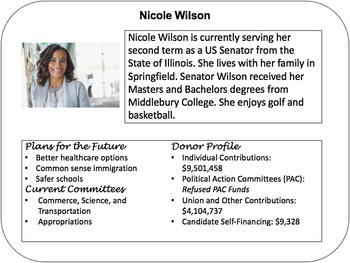
To assess the effect PAC funding has on perceptions of candidates, we conducted a survey experiment using a sample of US residents recruited using Amazon’s Mechanical Turk.Footnote 1 Respondents were randomly assigned to view one of eight possible candidate profiles, which included the candidates’ biographies, plans for the future, committee assignments, and donor profiles. Fictional candidates Joseph Thomas and Nicole Wilson are described as running in a presidential primary election in the respondent’s political party. A benefit of using a primary election for our setting is that issues that matter within respondents’ party can come to the fore, as opposed to partisan affiliation driving support as with general elections (Aldrich et al., Reference Aldrich and Michael Alvarez1994).
The manipulations of interest for this study are the PAC-funding status, race, and gender. The candidates’ race and gender are signaled using photographs. Previous research has used names (Gubitz Reference Gubitz2022; Schachter et al., Reference Schachter, Flores and Maghbouleh2021). In an effort to avoid signaling other qualities, such as socio-economic status, we provide the same name to male and female candidates, respectively, regardless of race. Using photographs is consistent with previous research that used skin tone to signal race (Schachter et al., Reference Schachter, Flores and Maghbouleh2021). Additionally, we pretested the photographs to ensure candidates of different races and genders appeared comparably professional, capable, and as suitable presidential candidates.Footnote 2 Figure 1 contains a sample profile; all profiles are available in Appendix D.
Example candidate profile for Black, female candidate in treatment group with Political Action Committee (PAC)-free candidate. Profiles were identical except for (a) the candidate photo which was varied by race and gender, (b), the candidate name which was varied for male and female candidates, and (c) the donor profile which included a funding amount for PAC-funded candidates or “refused PAC funds” for PAC-free candidates.

Funding status (PAC-free or funded) was signaled by a line in the candidate profile that either said “Political Action Committees (PAC): $9,446,128” or “Political Action Committees (PAC): Refused PAC Funds.” Table 1 describes the experimental design and provides question wording. Additional information about question-wording and coding rules is available in Appendix A. Respondents were evenly and randomly assigned into one of the eight conditions that varied PAC-funding status, as well as candidate race and gender.
Experimental design and question wording

Note: Candidate pronouns reflected the gender of the candidate profile (i.e., he for the Black male and White male; she for the Black female and White female).
Outcomes
After reading the vignette, respondents were asked the degree to which they agreed with the perceptions of the candidate they viewed on several measures (Table 2). The statements describe the candidate as “an ethical politician” (ethical), “working for people like me” (for the people), able to “win a primary race in my political party” (winner), caring “more about donors than voters” (for donors), having “the skills and experience necessary to win” (skilled), and appearing “to be a corrupt politician” (corrupt). Response categories were coded from −3 (strongly disagree) to 3 (strongly) so that candidates who ranked high on a perceived trait had a positive score in that assessment. For example, the mean for ethical is 1.3, which means that, on average, respondents perceived candidates as ethical. The mean for corrupt is −1.0, which means that, on average, respondents perceived candidates as not corrupt. Table 2 summarizes the dependent variables by condition.
Count, mean, and standard deviation for dependent variables by condition

Sample Population
The 1,666 survey respondents were recruited from Amazon MTurk in February 2021. Full respondent demographics are available in Appendix B, Table B1. In this study, we did not seek a representative sample of U.S. voters and, therefore, did not generalize the results to the population of voters. However, internal validity—as opposed to external—is the chief benefit of experimental design, and causal theory testing can be achieved with convenience samples (Mize and Manago Reference Mize and Manago2022). Thus, the Mturk convenience sample is sufficient for this study because we are primarily testing the claim that PAC funding impacts perceptions of the candidates without exploring heterogeneous treatment effects.
Beyond generalizability concerns, social scientists are additionally concerned about the use of online survey platforms such as Mturk for the preponderance of low-quality responses caused by factors such as the use of bot (responses generated by a computer as opposed to an individual taking the survey) and individuals rushing through surveys without reading the prompts (Ahler, Roush, and Sood Reference Ahler, Roush and Sood2021). Consistent with recommendations for best practices in the use of Mturk, specifically, this survey implemented a number of checks to limit or exclude low-quality responses, including attention and timing checks (Appendix B).
Analysis
To determine whether refusing PAC funds impacts perceptions of candidates, we first estimate the average treatment effect for each outcome variable. The effect of refusing PAC funds on the outcome is calculated as the average predicted change in the outcome variable based on whether the candidate accepted or refused PAC funds or the Adjusted Predictions for the estimates. The difference between the Adjusted Predictions for PAC-free and funded candidates is equal to the Average Marginal Effect of refusing PAC funds. We begin by reporting the results of the main effects—the unconditional model using treatment (PAC funding or refusal) to predict ethicality, corruption, working for the people, caring more for donors, skilled, and capable of winning. To measure the different effects of PAC funding by candidate race and gender, we then modeled the interaction of the treatment with candidate race and gender.Footnote 3
We present the results of our analyses in visual form for ease of interpretation. The graphs display the Adjusted Predictions of refusing PAC funds. All regression estimates, standard errors, and statistical significance based on p-values are available in Appendix C.
Preference For Pac-Free Candidates
We find that, on average, respondents prefer PAC-free candidates to PAC-funded candidates. Refusing PAC funds increases the perception that a candidate is ethical, working for the people, skilled, and capable of winning. Refusing PAC funds decreases the perception that candidates are corrupt or working for donors (Figures 2, 3, and 4). Across all 6 outcomes, the differences between the PAC-free and funded candidates are significant. However, often the differences are not substantial. In fact, only the perception that the candidate is working for donors (Figure 3) changes the direction of the effect; PAC-free candidates are seen as not working for donors and funded candidates are seen as working for donors.
Adjusted predictions for refusing Political Action Committee (PAC) funds with 95% confidence intervals, based on linear regression with Ethical (in the left panel) and Corrupt (in the right panel) regressed on treatment (PAC-funding acceptance or refusal) and averaged overall candidates.

Adjusted predictions for refusing Political Action Committee (PAC) funds with 95% confidence intervals, based on linear regression with For The People (in the left panel) and For Donors (in the right panel) regressed on treatment (PAC-funding acceptance or refusal) and averaged over all candidates.

Adjusted predictions for refusing Political Action Committee (PAC) funds with 95% confidence intervals, based on linear regression with Winner (in the left panel) and Skilled (in the right panel) regressed on treatment (PAC-funding acceptance or refusal) and averaged over all candidates.

Figure 2 shows that respondents saw both PAC-free and PAC-funded candidates as ethical and not corrupt. Yet the PAC-free candidate is seen as slightly more ethical and slightly less corrupt. For both outcomes, the differences between PAC-free and funded candidates are small and significant. The effect of refusing PAC funds for the perception that a candidate is working for the people or donors is presented in Figure 3. Figure 3 shows that both the PAC-free and PAC-funded candidates are seen as working for the people. However, that effect is slightly stronger for the PAC-free candidate. In other words, refusing PAC funds slightly increases the perception of working for voters compared to accepting PAC funds. In the second panel of Figure 3, we see that PAC funding increases the perception that a candidate is working for donors. The effect for PAC-funded candidates is quite small, though significant. Concurrent with the small increase in the perception of working for donors for PAC-funded candidates, we find a slightly larger decrease in the same outcome for PAC-free candidates. This likely means that PAC-funding status is a small, but important part of the perception that a candidate is working for donors. The final set of outcomes for which we estimated unconditional effects are displayed in Figure 4. Figure 4 shows that PAC-free and PAC-funded candidates are, on average, seen as both capable of winning and skilled candidates. However, PAC-free candidates are seen as more capable of winning and skilled than PAC-funded candidates.
Based on our findings, we can reject the null for Hypotheses 1a and b, which state that refusing PAC funds makes candidates appear more ethical and less corrupt (1a), and working more for the people and less working for donors (1b). These findings are consistent with other research that says Americans respond unfavorably to PAC-funded candidates (Cebula and Durden Reference Cebula and Durden2007; Donovan and Bowler Reference Donovan and Bowler2019; Dowling and Miller Reference Dowling and Miller2016; Persily and Lammie Reference Persily and Lammie2004). We fail to confirm Hypothesis 1c, which stated that funded candidates would be more likely to be perceived as capable of winning and skilled than PAC-free candidates. The differences between PAC-free and funded candidates are quite small, though they are significant. We will discuss the implications of our findings in the discussion section.
PAC-free versus Funded by Race and Gender
In addition to the average effect of refusing PAC funds, we analyzed the effect by candidate race and gender. Overall, our results reveal that all candidates, regardless of race, gender, or PAC-funding status, are typically seen as ethical and not corrupt, working for the people, capable of winning, and skilled. The perception of working for donors depends on the PAC-funding status and candidate race and gender. While the White male and female PAC-free candidates tend to receive increased favorability, favorability toward Black and female PAC-funded candidates is higher than White and male PAC-funded candidates across a variety of measures.
Figure 5 shows the effect of refusing PAC funds for Black male, White male, Black female, and White female candidates on the perception that they are ethical and corrupt. Refusing PAC funds significantly increases perceptions of ethicality for White candidates. Yet it has no effect on the Black candidates; Black candidates are seen as ethical regardless of PAC-funding status. For the perception that candidates are corrupt, the White female and Black male candidates who refuse PAC funds are significantly less likely to be perceived as corrupt. The Black female and White male candidates are perceived no differently when they refuse PAC funds.
Adjusted predictions for refusing Political Action Committee (PAC) funds with 95% confidence intervals, based on linear regression with Ethical (in the left panel) and Corrupt (in the right panel) regressed on treatment (PAC-funding acceptance or refusal) and candidate race and gender (Black male, White male, Black female, White female). Estimates for funded candidates are presented with the empty circle; estimates for PAC-free candidates are presented with the filled-in circle.

Figure 6 shows the effect of refusing PAC funds on the perception that candidates are working for the people or working for donors. The White candidates are more likely to be perceived as working for the people when they refuse PAC funds. Neither the Black male nor female candidates see any impact. They are seen as working for the people whether or not they refuse PAC funds. The second panel shows the perception that candidates are working for donors. When the Black male, White male, and White female candidates refuse PAC funds, they are less likely to be seen as working for donors. The effects are strongest for the Black male and White female candidates. The effect for the Black female is not significantly different from zero, regardless of her PAC-funding status. However, a surprising finding emerges here: the effect of accepting PAC funding is non-significant for both the funded Black male and female. This means that even when Black male and female candidates accept PAC funds, they are not seen as working for donors.
Adjusted predictions for refusing Political Action Committee (PAC) funds with 95% confidence intervals, based on linear regression with For The People (in the left panel) and For Donors (in the right panel) regressed on treatment (PAC-funding acceptance or refusal) and candidate race and gender (Black male, White male, Black female, White female). Estimates for funded candidates are presented with the empty circle; estimates for PAC-free candidates are presented with the filled-in circle.

Adjusted predictions for refusing Political Action Committee (PAC) funds with 95% confidence intervals, based on linear regression with Winner (in the left panel) and Skilled (in the right panel) regressed on treatment (PAC-funding acceptance or refusal) and candidate race and gender (Black male, White male, Black female, White female). Estimates for funded candidates are presented with the empty circle; estimates for PAC-free candidates are presented with the filled-in circle.

Figure 7 shows the effect of refusing PAC funds on the perception that candidates are capable of winning and/or skilled. As with perceptions of appearing ethical and working for the people, Black male and female candidates are no more likely to be seen as capable of winning when they refuse PAC funds. Compared to accepting PAC funds, refusing PAC funds does not change the perception that Black candidates are skilled. White male and female candidates, on the other hand, are both more likely to be perceived as capable of winning and skilled when they refuse PAC funds.
We find mixed results for Hypothesis 2, which states that the preference for PAC-free candidates differs by candidate race and gender. In all cases, refusing PAC funds significantly impacts perceptions of the White female candidate. For the White male, only the perception that he is corrupt remains unchanged by refusing PAC funds. For the Black male candidate, refusing PAC funds significantly impacts the perception that he is corrupt or working for donors. This means that regardless of whether the Black male candidate refuses or accepts PAC funds, he is not seen as corrupt or working for donors. Meanwhile, there is no significant difference in any outcome for the Black female candidate voter evaluations. Similar to the Black male candidate, she is not seen as corrupt or working for donors regardless of her funding status. Additionally, whether she refuses or accepts PAC funds, she is seen as equally ethical, working for voters, skilled, and capable of winning. Our findings show that accepting or refusing PAC funds signals something different for the Black female candidate than for the other candidates.
Discussion
In this paper, we make two important contributions. First, we test several traits and qualities that PAC funding could signal. In doing so, we contribute to prior research showing that Americans prefer PAC-free candidates (Dowling and Miller Reference Dowling and Miller2016; Jenkins and Landgrave Reference Jenkins and Landgrave2021). Second, we demonstrate that voters’ opinions about campaign finance differ for Black and White candidates, and in some cases male and female candidates. Our findings deepen the literature on PACs, campaign finance, and candidate race and gender in U.S. elections.
We use a primary election in the experiment over a general election to allow respondents to focus on political issues that are particularly important within their party. In contrast, in a general election, party affiliation tends to dominate voter considerations, often overshadowing other factors (Aldrich et al., Reference Aldrich and Michael Alvarez1994), such as candidate race or gender. We also know there are relatively weak preferences among candidates of the same party (Green et al. Reference Green, Palmquist and Schickler2002), implying that any voter evaluation of a candidate may be affected by candidate characteristics, such as race or gender, more so in primary than general elections where policy issues are at the forefront. The theoretical implications of the primary setting are important. It is possible that in a general election setting, respondents would want their party’s candidate to secure funding from all possible sources. Thus, even if voters would vote for their party’s candidate, the PAC-free candidates might see no benefits in a general election. Future research should look at how PAC funding impacts voter perceptions in general elections where party affiliation dominates, especially given that voter turnout is higher (Gerber et al. Reference Gerber, Huber, Biggers and Hendry2017).
The Cost of PAC Refusal
Within the scope of a primary election, we demonstrated that, on average, PAC-free candidates are seen as more ethical, less corrupt, more likely to be working for the people than donors, more skilled, and likely to win elections. However, candidates who accepted PAC funds were not seen as especially unethical, corrupt, unskilled, not capable of winning, and not working for the people (though they are seen as working for donors). One practical implication of this research is that candidates who refuse PAC funds give up a valuable resource without gaining much back in terms of perceptual advantage on the qualities. In this light, the favorability toward PAC-free candidates is likely related to Americans’ desire to see the influence of money in politics reduced (Jones Reference Jones2018; Persily and Lammie Reference Persily and Lammie2004) and not a particular disdain for PACs.
Previous research on PAC funding establishes that voters support candidates not funded by such donors (Dowling and Miller Reference Dowling and Miller2016). There is good reason to believe this is related to the perception that large donors wield undue influence (Cebula and Durden Reference Cebula and Durden2007). Indeed, we show that refusing PAC funds does, on average, increase the perception that a candidate is working for voters and not working for donors. That said, despite voter preferences and perceptions, funding is associated with winning (Gerber Reference Gerber1998; Schuster Reference Schuster2020). Thus, we were surprised that refusing PAC funds increased the perception of skill and ability to win elections. Perhaps this is because PAC-free candidates are perceived to be working harder to secure funding from other sources. We task future research with further exploration of why that relationship exists.
A growing body of research on Americans’ perceptions of and preferences for campaign funding sources has shown that Americans may want big money out of politics and PACs are generally seen as less desirable sources of funding than other campaign funding sources (Bowler and Donovan Reference Bowler and Donovan2016; Miller and Sutherland Reference Miller and Sutherland2023). This research is somewhat puzzling in light of three important factors. First, PACs can be organized by both corporate and labor interests, which means not all PACs represent “big money,” per se. Second, the evidence that Americans prefer PAC-free candidates is built on assumptions about White and male candidates. Third, Americans are not very knowledgeable about campaign finance (Shaw Reference Shaw, Roberts and Baek2021; Primo Reference Primo and Milyo2020). Our study addresses these factors by 1) using vignettes that separate labor donations and 2) allowing race and gender to interact with the treatment (PAC-funded vs. PAC-funding refusal) to determine if PAC funding refusal is a heuristic (or mental shortcut) for qualities and traits—ethicality, corruption, caring for voters or donors, skill, or ability to win. Additionally, we use Americans’ imperfect knowledge to our advantage. By not training respondents on campaign finance ahead of time, we did not prime respondents to look for PAC funding. This means that any effects, however modest, are the result of respondents’ preexisting knowledge, however limited.
Who Benefits from Refusal PAC Funds
We also measure the interaction between PAC funding refusal and candidate race and gender to show that White candidates more often receive a boost for refusing PAC funds than Black candidates. Black candidates who refuse PAC funds see no difference compared to PAC-funded candidates on the appearance that they are ethical, corrupt, working for the people, skilled, or capable of winning. The effect on the appearance of working for donors is modest and not significant for the Black female candidate.
If we think of the PAC-funded candidates as baseline, PAC-funded Black candidates often perform better than PAC-funded White candidates. One possible explanation for the difference in effects between White and Black candidates is that respondents do favor PAC-free candidates overall. However, accepting PAC funds gives Black candidates, who are less represented in the legislature, an air of legitimacy or value alignment. Therefore, taking PAC funds may not hurt their campaigns to the point that they perform comparably to the PAC-free candidates. The flip side of that coin is that, perhaps, White candidates are perceived to be well-resourced already. Accepting PAC funds does not hurt the White candidates but, compared to the funded Black candidates, accepting PAC funds also does not add anything to the baseline perception of the White candidates on any of the outcomes. Instead, refusing PAC funds nudges the PAC-free White candidates in terms of favorability on the outcomes.
Another possibility is that Black candidates are experiencing a ceiling effect. Essentially, some unmeasured characteristic is increasing favorability toward Black candidates and they receive no additional benefit from refusing PAC funds. The unmeasured characteristic could be that Black politicians are viewed as working hard to raise funds, regardless of source. Indeed, Karpowitz et al. (Reference Karpowitz, King-Meadows, Quin Monson and Pope2021) found that certain characteristics like appealing to individualism and hard work, helped overcome racial resentment, even among Conservative voters. Regardless of the source of the positive feelings toward PAC-funded Black candidates, the lack of effect for refusing PAC funds remains.
Given previous research suggesting Black female candidates could win more elections if they were funded comparably to White candidates (Sorensen and Philip Reference Sorensen2022), the implications of our findings are clear: Black female candidates (and, to a lesser extent, Black male candidates), should not let campaign funding research which did not include race and gender analyses guide their own funding strategy. The PAC-funded Black candidates in our study were perceived to be at least as ethical, working for the people, skilled, and capable of winning as their White peers.
On every measure, the PAC-funded White female candidate either performed the worst or tied for the lowest favorability with another candidate. The White female candidate may be experiencing a double-standard. It is possible that her Whiteness leads respondents to view her as a well-resourced member of the political establishment. However, as a woman, she may be held to a higher moral standard. Thus, when she accepts PAC funds, she receives the least favorability and when she refuses PAC funds, she receives the greatest benefit. The effects on the White female candidate are particularly interesting given female candidates’ often tokenized status in US politics (Crowley, Reference Crowley2006).Footnote 4 Sociologists argue that individuals with different tokenized identities can have different experiences in the same space (Turco Reference Turco2010). Previous research could lead scholars to conclude that being a woman would disadvantage both the White and Black female candidates, especially when women are judged more harshly than men for the same behavior (Heilman et al. Reference Heilman, Wallen, Fuchs and Tamkins2004; Martin Reference Martin2007). However, it is not always apparent what aspects of an individual’s identity (e.g., their gender or their race) will be salient for their experiences (Wingfield Reference Wingfield2009). In our study, race tends to be more salient than gender for the impact of PAC-funding status on perceptions of the candidates within primary elections. This is evidenced by the fact that voter perceptions of the White male and female candidates, while not identical, were more often like each other than of the Black male and female candidates (and vice versa). This is in line with previous research that suggests racial resentment can lead to poor outcomes for Black political candidates (Tesler Reference Tesler2013) in the sense that race may drive perceptions of candidates.
It is possible that White candidates have a long history of being influenced by corporate money, which gives PAC-free White candidates a small advantage over PAC-funded White candidates. However, Americans may not see Black candidates as tied up in that history of corporate influence. Therefore, this may suggest that Black candidates who are not burdened by the same history should not use the same strategy to gain support. Given the state of implicit and explicit racism in American elections, social scientists should revisit findings built on research designs in which gender and race of the candidate being tested are not identified (or are presumed to be male and White), or where analyses do not examine gender and race effects of real elections (Alexander Reference Alexander2005; Bowler and Donovan Reference Bowler and Donovan2016; Dowling and Miller Reference Dowling and Miller2016).
We tested the idea that PAC funding acts as a signal of particular qualities and traits. PAC funding or refusal more often acts as a signal for White candidates. However, if refusing PAC funding signals anything in particular for Black candidates, we did not see the same effects beyond the effects for the Black male candidate on the perception of corruption or working for donors. The PAC-free and funded Black candidates were seen as equally ethical, working for the people, capable of winning, and skilled. We encourage future researchers to extend our findings to other racial and minoritized identities.
With our results, we provide a useful connection point between a growing body of work that shows how racial minorities, especially Black politicians, are judged differently than White politicians for the same behavior (Jacobsmeier Reference Jacobsmeier2014; McDermott Reference McDermott1998; Sigelman et al. Reference Sigelman, Sigelman, Walkosz and Nitz1995; Visalvanich Reference Visalvanich2017) and research documenting the ways Americans perceive campaign funding sources (Bowler and Donovan Reference Bowler and Donovan2016; Dowling and Miller Reference Dowling and Miller2016; Wood Reference Wood2018). In doing so, we answer the call for a scholarship of campaign finance that goes beyond donor behavior (Katz Reference Katz2022) and contribute to understanding voter perceptions around campaign funding sources.
In an era of increased deregulation of campaign finance (Southworth Reference Southworth2024; Katz Reference Katz2022), our results suggest more research must be done to examine how other fundraising sources affect voter perceptions. Our findings underscore that the effects of campaign fundraising cannot be assumed to be uniform across race and gender. Moreover, given that voter perceptions of campaign fundraising may vary based on these factors, it is especially relevant to now examine other fundraising sources, such as super PACs and dark money, which have been enabled by recent court rulings (Southworth Reference Southworth2024). We now turn to other limitations and suggestions for future research.
Limitations and Suggestions for Future Research
In designing this experiment, we chose not to sample individuals based on PAC or campaign finance knowledge. We also chose not to educate respondents on PAC funding. We made these choices to avoid priming (through training) or bias (by selecting only people who care enough about campaign finance to seek information about it). This strategy carried some risk. Essentially, it was possible that respondents would not pick up on PAC funding as relevant information to their perception of the candidate they viewed. To that end, we believe that even modest effects are evidence that, in the context of a primary election, Americans may be paying attention to where candidates are getting their funding.
Despite the sanitized environment of the experiment, we believe the manipulation approaches realism in the sense that voters can find profiles of candidates that include similar information on voter information websites (e.g. Ballotpedia), and sometimes candidates will include the names of donors, including PACs, on their own websites. While the profile design enhances the realism of the manipulation, we recognize that most voters do not research candidates in this way and are more likely to receive information passively (i.e. through advertisements, news media, social media, or friends). Because of this limitation, we caution readers about the applicability of our findings to all voters, especially those who do not seek out information about candidates. Additionally, the profiles link PAC activity (as donations) directly to the candidate. However, much PAC activity (particularly Super PACs) may not involve any coordination with the candidate. Future research should consider whether Americans are attuned to PAC activity that is independent of the candidate. For example, when PACs pay for campaign advertisements, are Americans assuming those activities are connected to or even directed by the candidate?
Additional decisions about the research design leave open possibilities for future research. For example, the experimental vignettes in which candidates refused PAC funds did not make up for lost funding elsewhere. This means that candidates who refused PAC funds had less funding overall. While we do not expect that less total funding increases support, especially because respondents were not making comparisons across profiles, that possibility cannot be ruled out. Although total funding could impact the evaluation that a candidate is capable of winning or skilled, we do not expect that it would impact evaluations of a candidate as ethical or corrupt, working for the people, or caring more for donors.
In terms of the conceptualization and operationalization of PAC funding, the construction of the PAC-funding treatment is nebulous because the reality of PAC funding is complicated. PAC funding can include donations from a variety of sources, including labor organizations, super PACS, and corporations. While we separated labor donations from PAC donations in the vignettes, we did not specify that PAC donations were from corporations, financial elites, or other types of special interest groups. Research has already established that candidates do better distancing themselves from “dark money” (Wood and Grose Reference Wood and Grose2022). How might the perception of PAC funding be impacted by candidate behavior such as transparency about funding sources and the candidate’s relationship to the donors? In the same vein, how might the perception of PAC funding be impacted by voters’ desire to regulate campaign funding as opposed to desiring campaign finance solutions not imposed by legislation?
Lastly, while candidates from both the Democratic and Republican parties are publicly foregoing PAC funding and some research has shown bipartisan support for PAC-free candidates (Jenkins and Landgrave Reference Jenkins and Landgrave2021), we are skeptical that both Democratic and Republican voters are concerned about PACs with the same intensity and for the same reason. We chose not to analyze the effects of PAC refusal based on respondents’ partisan affiliation because of sample limitations. However, we strongly believe that an insightful line of inquiry for future research would be to unpack PAC priorities from voter perceptions. Are PACs that are organized by oil and gas companies, retail, or agriculture really judged the same by all voters?
Conclusion
In this article, we have demonstrated that refusing PAC funds can impact perceptions of candidates as ethical, corrupt, working for voters or donors, skilled, or capable of winning. However, refusing PAC funds does not have the same effect for Black male and female candidates as White male and female candidates. Our findings have implications for social scientists studying elections and campaign finance as well as studies of racialized and gendered perceptions in politics. Consistent with previous research demonstrating that stereotypes intersect in unexpected ways – sometimes to the advantage of the stereotyped (Pedulla Reference Pedulla2014)—we find that assumptions about campaign funding sources that do not include candidate race and gender in their design or analyses may not seamlessly apply to Black and female candidates. If Black candidates refused PAC funding in a real election, they could cost themselves a valuable resource without gaining the esteem of voters in primary elections. Furthermore, given the relatively positive performance of PAC-funded candidates in our study, we recommend candidates find a different way to signal their ethics and commitment to valuing voters over donors.
Supplementary material
The supplementary material for this article can be found at https://doi.org/10.1017/rep.2024.32
Acknowledgements
The authors are grateful to the Reviewers for their generative feedback. Even with three reviewers, we had no infamous “Reviewer 2.” The authors would also like to thank Trent Mize for his helpful advice and Patricia Dudley for her gracious assistance with copy editing. Additionally, Jennifer Dudley would like to thank the graduate students and faculty at the University of Notre Dame Sociology Department who provided feedback on several drafts of the paper, especially Erin McDonnell, Brian Fitzpatrick, Rich Williams, Bill Carbonaro, Rory McVeigh, and participants of the Gender Workshop and Culture & Theory Workshop.
Funding statement
Funding for this study was provided by the University of Notre Dame Institute for Scholarship in the Liberal Arts Graduate Student Research Award.
Competing interests
These authors also declare no competing interests.


 Open access

