


Introduction
Opposition politicians often use the phrase ‘throw the bums out’ to rally their supporters to vote the current governing party or parties out of office, as demonstrated in the above quote from the then leader of the Austrian opposition NEOS party. In doing this, they are encouraging voters to hold the government responsible for its past actions or inactions, what is typically referred to as a retrospective assessment of parties. One of the most important mechanisms of representative democracy is this notion of retrospective voting. Through retrospective voting, voters have the opportunity to use elections to hold governments accountable for their past behaviour while in office. Whether and how citizens hold the government accountable for its performance has been extensively studied, largely through the consideration of the economic performance of the government (economic voting) and by treating the government as a homogenous actor (e.g., Fiorina, Reference Fiorina1981; Key, Reference Key1966; Kramer, Reference Kramer1971; Lewis‐Beck & Stegmaier, Reference Lewis‐Beck and Stegmaier2000; Healy & Malhotra, Reference Healy and Malhotra2013).
One of the preconditions to holding the government accountable is voters’ ability to identify its achievements and failures (e.g., Manin et al., Reference Manin, Przeworski, Stokes, Stokes, Przeworski and Manin1999). Decisionmakers in the government must cooperate to pass legislation. This is certainly the case if governments are formed by more than one party, namely coalition governments (Strom, Reference Strøm1997).1 Coalition governments typically govern through what is referred to as ‘collective cabinet responsibility’ (Laver & Shepsle, Reference Laver and Shepsle1996, p. 8). These party cooperations blur lines of electoral responsibility and, as such, make it harder for voters to hold the government, or rather the parties forming the government, to account. In other words, retrospective voting is less likely to be achieved if responsibility cannot clearly be assigned (e.g., Powell & Whitten, Reference Powell and Whitten1993; Whitten & Palmer, Reference Whitten and Palmer1999; Nadeau et al., Reference Nadeau, Niemi and Yoshinaka2002).
There are various strategies voters may adopt to deal with these more complex situations, among which blaming the prime minister's party for the country's (economic) record has received the largest empirical support (Anderson, Reference Anderson2000; Debus et al., Reference Debus, Stegmaier and Tosun2014; Angelova et al., Reference Angelova, Koenig and Proksch2017). The compelling argument in this regard concerns the fact that voters heuristically assign responsibility predominantly to the largest and most powerful party of the coalition, which is usually the party holding the prime minister position (Anderson, Reference Anderson2000; Duch & Stevenson, Reference Duch and Stevenson2008). Another heuristic voters often unconsciously adopt is partisanship. The existing literature finds consistent evidence that partisans of government parties hold potentially biased perceptions of politics that inhibit the effect of performance evaluations on vote choice (e.g., Vivyan et al., Reference Vivyan, Wagner and Tarlov2012).
Despite extensive research on electoral accountability, we continue to lack a systematic understanding of responsibility attribution under coalition governments, and in particular under grand coalition governments. Thus far, most studies exploring retrospective voting for parties in coalition governments have analyzed the impact of overall government performance on their electoral success, that is, whether they are punished or rewarded in the electoral contest (e.g., Fisher & Hobolt, Reference Fisher and Hobolt2010; Klüver & Spoon, Reference Klüver and Spoon2020; Narud & Valen, Reference Narud, Valen, Strøm, Müller and Bergman2008), demonstrating that voters might not assign the same responsibility to all coalition partners. In this article, we examine the step before and focus directly on responsibility attribution (rather than retrospective voting), thereby filling an important gap in the literature. We thus analyse the mechanisms that underlie the retrospective voting act itself: this enables us to get at the core of the accountability mechanism. Specifically, building on the extant literature, we examine the effect of two intertwined mechanisms: first, the performance patterns of each government party, and second, the partisan perception biases. By focusing directly and for the first time on the mechanisms leading to responsibility attribution, we are able to unpack the reasons that lead voters to attribute responsibility to parties.
We develop our theoretical propositions by focusing on grand coalition governments. The accountability deficit of coalition governments is at the extreme in grand coalition governments as they represent the highest instance of complexity for government responsibility attribution. Defined as a coalition that splits portfolios relatively evenly between two ideologically divergent large parties (Laver & Schofield, Reference Laver and Schofield1998), under grand coalition governments, the prime minister's party has far less control over its equally powerful partner than under more typical large party–small partner coalitions. In addition, because coalition partners in grand coalition governments tend not to be located on the same side of the ideological spectrum of party competition, the resulting policy outcomes typically represent more policy compromise. These conditions create greater uncertainty among voters in assigning responsibility, raising the question of whether and how common heuristics such as the prime minister's party and partisan attachments affect voters’ assignment of responsibility to grand coalition parties.
To test responsibility assignment, we utilize original panel data from Austria and Germany – two countries where grand coalition governments have been common (at least in recent years).2 These panel surveys both include extensive measures of responsibility attribution. We find that under grand coalition governments, both partners are equally likely to be punished for poor performance. In addition, we find a partisan perception bias with regards to responsibility assignment as partisans of one coalition party consistently point the finger towards the other coalition party if they are dissatisfied with the performance of the government. What is more, for opposition parties’ supporters, we find that they punish the incumbent party from the opposite ideological camp while non‐identifiers, who lack a directional bias, tend not to blame the prime minister's party but rather the junior coalition party.
This article proceeds as follows. In the next section, we review the relevant literature on retrospective voting and responsibility attribution with a specific focus on electoral accountability in grand coalition governments. We then present our hypotheses, the data used to test the theoretical expectations and the results of our empirical findings. Our final section concludes and discusses the implications for responsibility attribution in grand coalition governments.
Performance evaluation and the role of partisanship in responsibility attribution
In representative democracies, citizens authorize political actors through elections to make decisions on their behalf. They can hold them retrospectively accountable by rewarding or punishing them with their vote on their past actions (Rehfeld, Reference Rehfeld2009; Strøm, Reference Strøm1997). However, the ability of voters to hold political actors accountable depends on whether responsibility can be assigned to them. Institutional factors, such as whether a government is comprised of a single party or multiple parties, can obscure the clarity of responsibility and thus decrease accountability (e.g., Nadeau et al., Reference Nadeau, Niemi and Yoshinaka2002; Powell & Whitten, Reference Powell and Whitten1993; Whitten & Palmer, Reference Whitten and Palmer1999). To hold single government parties responsible, voters need to know what they stand for and what they have achieved. Previous research has, however, shown that voters perceive parties in coalition governments as ideologically rather similar, thereby increasing the difficulty to assign responsibility for poor performance and blurring lines of responsibility (e.g., Fortunato & Stevenson, Reference Fortunato and Stevenson2013; Hobolt et al., Reference Hobolt, Tilley and Banducci2013).
Thus far, studies exploring retrospective voting for parties in coalition governments have mainly analyzed the impact of government performance on their electoral success, that is, whether they are punished or rewarded in the electoral contest. To do so, they have largely relied on voter evaluation of the general performance of a coalition government (e.g., Berry & Howell, Reference Berry and Howell2007).3 More recent literature on retrospective voting has increasingly focused on exploring which coalition partner is held more accountable by the voters in the electoral contest (e.g., Debus et al., Reference Debus, Stegmaier and Tosun2014; Fisher & Hobolt, Reference Fisher and Hobolt2010; Williams et al., Reference Williams, Stegmaier and Debus2017). We therefore know which party in government gets punished or rewarded the most,4 but we do not yet know which party gets assigned responsibility for past performance and to what extent.
With regards to retrospective voting, scholarly work on coalition governments regularly shows that if any one party is overwhelmingly held accountable by voters, it is typically the prime minister's party as it is seen by voters and the media as representative of the entire coalition (e.g., Duch et al., Reference Duch, Wojtek and Stevenson2015; Fortunato & Adams, Reference Fortunato and Adams2015). Most studies accept the idea that, given that larger parties tend to have a bigger say over policy making (Martin & Vanberg, Reference Martin and Vanberg2014), voters will use the heuristic of the senior partner to assign blame or give credit. Consequently, the senior partner in the coalition government is more likely to be punished by the voters if the performance of the government is evaluated negatively. A recent study by Fortunato et al. (Reference Fortunato, Lin, Stevenson and Tromborg2020), for example, finds that voters tend to think that the senior party in a coalition government has more policy‐making influence than smaller coalition partners. Indeed, Klüver and Spoon (Reference Klüver and Spoon2020) have found that voters are more likely to misperceive the position of the junior partner in a coalition than that of the senior partner. Plescia and Kritzinger (Reference Plescia and Kritzinger2018), furthermore, show that senior coalition partners are punished more severely in policy areas where expectations on achievements were high but performance was poor (see also Bélanger & Nadeau, Reference Bélanger and Nadeau2015).
However, unlike in large party‐small partner coalitions, parties in grand coalition governments are equally powerful with (important) portfolios split more evenly among the two coalition partners. This implies a more equal say over policy making as well as a more equal public standing of the two coalition parties in the media. Thus, when voters are dissatisfied with the government's performance and want to ‘throw the bums out’, they may focus their frustration, and thus responsibility attribution on both coalition partners simultaneously, rather than only on the senior partner, the prime minister's party. We thus argue that in grand coalition governments, assigning blame or giving credit is distributed between the coalition partners.5 Our first hypothesis thus reads as follows:
Hypothesis 1: The more dissatisfied voters are with the performance of the grand coalition government, the more likely they will assign responsibility for bad performance to both coalition partners.
Given that evaluating government performance poses both time and cognitive demands on citizens, it is not surprising that voters may have difficulties correctly attributing responsibility to parties. It is thus plausible to expect that responsibility attribution depends on voters’ relationships with the individual coalition parties. As scholars have demonstrated, parties use their ‘brands’ to distinguish themselves from their competitors, and voters in turn use these brands as a shortcut to identify with the parties (Aldrich, Reference Aldrich1995; Cox, Reference Cox1997; Lupu, Reference Lupu2014). In the American context, Jerit and Barabas (Reference Jerit and Barabas2012), for example, have found that when voters find it difficult to process all relevant information, they instead rely on cognitive shortcuts, such as party identification, when faced with difficult political evaluations. Evans and Chzhen, moreover, show that the ‘assessments of government performance is, to a significant degree, a product of party preference’ (Reference Evans and Chzhen2016, p. 213). Partisanship can thus play a significant role in simplifying the task of responsibility assignment.
Existing studies in the United States and European single‐party government contexts demonstrate that partisanship crucially moderates (economic) retrospective attribution resolving ‘incongruities between party support and policy evaluations’ (Marsh & Tilley, Reference Marsh and Tilley2010, p. 115). Other work has looked at how partisanship affects responsibility attribution in particular policy domains, such as the economy (e.g., Rudolph, Reference Rudolph2003, Reference Rudolph2006; Tilley & Hobolt, Reference Tilley and Hobolt2011). These patterns could be driven by the fact that partisan groups may put greater emphasis on information that confirms their initial viewpoints – a process known as confirmation bias – or, they may ‘reject’ information that runs in contrast to their original position – a tendency known as disconfirmation bias (Leeper & Slothuus, Reference Leeper and Slothuus2014; Taber et al., Reference Taber, Cann and Kucsova2009). In fact, following the in‐group bias theory by Tajfel (Reference Tajfel1969), one would expect that partisans favour their own party, the in‐group, and attribute negative outcomes – such as bad performance – to the other government party, the out‐group.6
This in‐group–out‐group differentiation is particularly pronounced in grand coalition governments, which bring parties from different ideological sides together. The out‐group could be blamed for the compromise on policy outcomes, and thus bad government performance. This mechanism is brought to the extreme under grand coalition governments which may bring together parties that are ideologically rather close but nevertheless, ideologically on different sides. Here, the use of partisanship for government assessment can make the difference. Partisans of coalition parties unsatisfied with the performance of the government can thus easily assign responsibility for poor performance to the other coalition partner. As such, we expect the partisan perception bias to help voters to overcome the challenge of assigning responsibility and increase the likelihood of assigning blame to the other coalition partner. This leads to our next hypothesis:
Hypothesis 2a: Under grand coalition governments, partisans of one coalition party are more likely to assign responsibility to the other coalition party if they are dissatisfied with the performance of the government.
What happens to the partisans of opposition parties? Following the in‐group–out‐group mechanisms outlined above, it is possible to hypothesize that partisanship for this group of voters is a relevant heuristic to distinguish between the two parties in a grand coalition government and assign responsibility, as they are located on different sides of the ideological spectrum. It is widely known that individuals prefer parties that are closer to them ideologically (e.g., Downs, Reference Downs1957) or alternatively, that are ideologically in the same direction (e.g., MacDonald et al., Reference Macdonald, Listhaug and Rabinowitz1991). Partisan attachment to either an opposition party on the left or on the right of the ideological spectrum may allow voters to develop a greater ‘attachment’ with those government parties that are on the same side of the ideological spectrum, and thus develop an ideological bias.7 There is ample evidence that ideological cleavages continue to be relevant in explaining voter behaviour and when voters switch, they switch within ideological blocks (e.g., Dassonneville & Dejaeghere, Reference Dassonneville and Dejaeghere2014) or as Mair stated, they switch ‘between friends rather than between enemies’ (Reference Mair1993, p. 124). In addition, in multiparty settings voters are assumed to know (future) coalition patterns since these are rather stable over time (Armstrong & Duch, Reference Armstrong and Duch2010). In a grand coalition government setting, it is possible to imagine that identifiers with opposition parties – albeit currently excluded from the government – will continue to prefer that government party of the same ideological camp, also because they expect to form a government with it again in the future. This is unlikely to happen with the ideologically different government party on the opposite side of the ideological spectrum. In line with this argument, for instance, a voter who identifies with the Green party in Germany might be more likely to blame the right‐wing CDU party for dissatisfying government performance than the left‐wing SPD party precisely because a Green party identifier is on the same ideological camp of the SPD than to the CDU, and expects her party to enter again into coalition with the SPD in a subsequent government, recalling that the SPD and Greens were already in government together in the past.8
The story is substantially different for those who do not have any party identification available, namely non‐party identifiers. In this case, following what has just been discussed, there is no heuristic that usefully helps voters in distinguishing the parties in government, and hence, there will be no motivation for this group of voters to assign responsibility directionally. We can thus formulate the following hypotheses:
Hypothesis 2b: Partisans of opposition parties are more likely to assign responsibility to the grand coalition party from the opposite ideological camp if they are dissatisfied with the performance of the government.
Hypothesis 2c: Non‐partisans are more likely to assign responsibility to all grand coalition parties equally if they are dissatisfied with the performance of the government.
Research design
To study retrospective voting, respondents are typically asked to evaluate government performance, independently of a multiparty or a single‐party government. Specifically for multiparty governments, and here in particular grand coalition governments, this poses the problem that it remains unclear to which specific party in government responsibility for policy outcomes is assigned. To this end, we have collected original data on responsibility attribution in two countries – Austria and Germany.
Data and case selection
To test our theoretical considerations, we focus on responsibility attribution in grand coalition governments. We use the cases of Austria and Germany, where grand coalition governments have been common, recognizing that there have been other instances of grand coalitions (e.g., Belgium, Finland) and they are increasingly becoming considered alternatives in other countries (e.g., Ireland, Spain), where the increasing size of the party system and electoral fragmentation force mainstream parties of opposing ideological camps to join forces in a common government.
Data for Austria comes from the Austrian National Election Study (AUTNES) multi‐mode panel study conducted during the 2017 Austrian national election (Kritzinger et al., Reference Kritzinger, Aichholzer, Büttner, Eberl, Meyer, Plescia, Wagner, Morisi, Boomgaarden and Müller2018).9 While the AUTNES 2017 multi‐mode panel study includes three waves, we rely only on the pre‐election wave conducted in June–August 2017 for this article as this is the only wave including the questions on responsibility attribution. Data for Germany are from the RECONNECT – Reconciling Europe with its Citizens through Democracy and Rule of Law – project conducted during the European Parliament (EP) elections of May 2019 (Plescia et al., Reference Plescia, Wilhelm, Kritzinger, Schüberl and Partheymüller2020).10 We rely on both the pre‐and post‐election waves conducted respectively in April and May/June 2019 because while responsibility attribution and government performance evaluations are measured in the post‐election wave, party identification and all our control variables are exclusively measured in the pre‐election wave.
In both countries, a grand coalition government was in place during the time the survey was conducted. In Austria, the grand coalition government in place before the 2017 national election between the Social Democrats (SPÖ) and the Christian Democratic People's Party (ÖVP) has been described as a forced marriage driven mainly by the absence of a viable alternative between two parties with considerable ideological differences (Dolezal & Zeglovits, Reference Dolezal and Zeglovits2014). The years following the 2013 national election were characterized by intensive quarrels between the two coalition partners, which were intensified by their disagreement on how to tackle economic stagnation, an increasing unemployment rate, which had reached an all‐time high of 10.9 per cent in January 2016, and the so‐called European ‘refugee crisis’ in 2015.
In Germany, the federal election was held on 24 September 2017. Both parties of the then incumbent grand coalition government suffered severe losses. Albeit they ‘won’ the election finishing as the first and second largest party, respectively, the Christian Democratic Union (CDU)/Christian Socialist Union (CSU) received only 32.9 per cent of the decisive list votes (losing 8.6 percentage points) while the Social Democratic Party (SPD) received the worst result in post‐war history (losing 5.2 percentage points) obtaining 20.5 per cent of (list) votes. Understandably, given the ‘devastating result’ (Faas & Klingelhöfer, Reference Faas and Klingelhöfer2019, p. 919), both parties did not want to form a grand coalition government again. However, after the failed attempt to form the so‐called ‘Jamaica Coalition’ between CDU/CSU, Liberals and Greens, the German President, Frank‐Walter Steinmeier, echoing arguments about responsibility for the state, convinced the SPD leadership to (re‐)consider joining a grand coalition with the CDU/CSU, which it eventually did in March 2018.
To sum up, we observe the effects of the two grand coalition governments at different stages of the governing period, namely the Austrian SPÖ–ÖVP grand coalition government after almost four years from its formation and the German grand coalition government about a year after its formation – an aspect we will further discuss below.
Measures
Similar to many election studies, the surveys we have available ask respondents how satisfied they are with the performance to date of the current government. The question specified the names of the parties forming the incumbent government to ensure the composition of the coalition government was known to all respondents at the time of the survey. The follow‐up question then asked respondents an open‐ended question ‘what were you thinking of when assessing the federal government?’ followed by a closed‐ended question ‘which governing party has the responsibility for this?’ For the full question wording please see the Supporting Information.
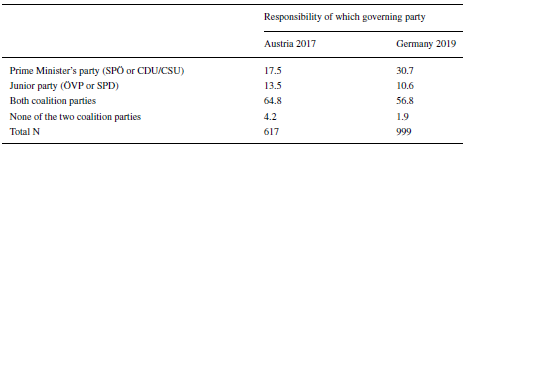
The closed‐ended question on responsibility constitutes the dependent variable of our study. Importantly, we study responsibility for each governing party, regardless of the content of the open‐ended question, which may span policy issues, parties or intra‐coalition conflict. Table 1, which shows the response option of our dependent variable and its distribution, demonstrates that respondents do indeed assign responsibility differently across government parties. While a majority of 64.8 per cent of respondents assigned responsibility to both governing parties in Austria and 56.8 per cent in Germany, the results demonstrate that the prime minister's party is typically held accountable more often compared to the junior coalition party. There is, however, variation across the two countries, where the difference in responsibility attribution between the prime minister's party and the junior party is significantly larger in Germany. About 4.2 per cent of the respondents in Austria and 1.9 per cent in Germany do not hold government parties accountable for past performance.
Responsibility attribution (column per cent)

Note: The information displayed refers to the respondents included in the multivariate models.
To test Hypothesis 1, we use the evaluation of the performance of the current government with possible response options ranging from ‘very dissatisfied’ to ‘very satisfied’. The scale in AUTNES had four possible response options ranging from 1 ‘very dissatisfied’ to 4 ‘very satisfied’ while RECONNECT had an 11‐point scale from 0 ‘very dissatisfied’ to 10 ‘very satisfied’. We re‐coded the variable in both countries to range from 0 to 1 and treat it as continuous (in Austria: M = 0.70, SD = 0.26; in Germany: M = 0.60, SD = 0.25 – see distribution in Figure A1 in the Supporting Information).
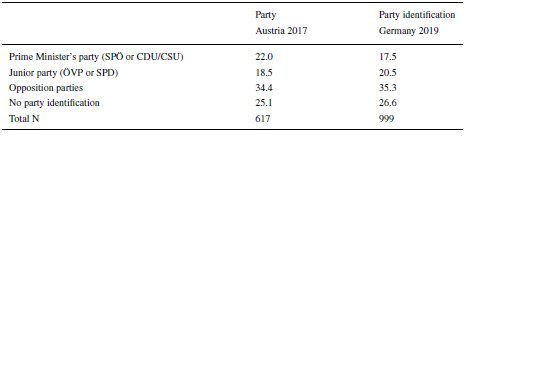
The independent variable to test Hypotheses 2 – party identification – is constructed using two questions. First, respondents were asked whether or not they have a party identification or feel closer to one party, and if their answer is ‘yes’, a follow up question asks for which party. Again, the exact question wording for each country can be found in the Supporting Information. Table 2 reports the party identification of respondents. We see that the results in Austria and Germany are fairly similar – with an average of roughly 22 and 18 per cent of respondents reporting identification with the prime minister's party, 19 and 21 per cent reporting identification with the junior coalition party, and 25 and 27 per cent respectively reporting no party identification. About 1 per cent more respondents in Germany than in Austria feel closer to an opposition party.
Party identification (column %)

Note: The information displayed refers to the respondents included in the multivariate models.
Finally, in all of our models, we control for standard socio‐demographic variables, including age in years (in Austria: M = 37.03, SD = 16.46, min = 16, max = 82; in Germany: M = 53.90, SD = 14.47, min = 18, max = 86), gender with female coded as 1 (in Austria 45.5 per cent and in Germany 46.6 per cent female), education recoded to range from 0 to 1 in both countries (in Austria: M = 0.43, SD = 0.37; in Germany: M = 0.61, SD = 0.32) and left‐right ideology from 0 = extreme left and 10 = extreme right (in Austria: M = 4.69, SD = 2.07; in Germany: M = 4.50, SD = 1.79).
Empirical findings
As our dependent variable is categorical, we run multinomial logit models separately for each country. To test Hypothesis 1 we included the effect of government evaluation and party identification separately; the test for Hypotheses 2a–c instead relies on models including an interaction term between government evaluation and party identification. Since it is difficult to interpret the coefficients of multinomial models, we present figures to display the predicted probabilities for each outcome of our dependent variable separately for Austria and Germany, holding all the other variables constant (full results are available in the Supplementary Material in Table A1).
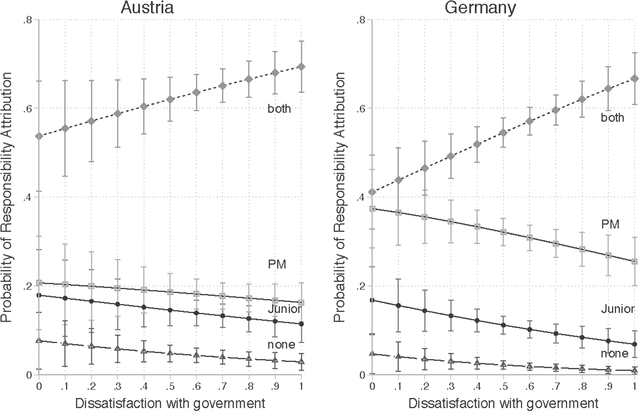
Starting with Figure 1, in both countries, the probability of assigning responsibility to either the prime minister's party or the junior coalition partner decreases slightly as dissatisfaction with the performance of the government increases; however, the effect of dissatisfaction fails to reach the conventional level of statistical significance in either country. The effect of an increase of the dissatisfaction variable on assigning responsibility to both coalition partners instead is positive in both countries but significant only in Germany. Meanwhile, the effect of an increase of the dissatisfaction variable on assigning responsibility to neither government party is negative but not significant for both Germany and Austria. In other words, on average, dissatisfaction with the performance of the government does not increase the responsibility assignment for one party over the other party, but both government parties are likely to suffer when dissatisfaction is high.11 In sum, we find (partial) support for Hypothesis 1 that the more dissatisfied voters are with the performance of the government, the more likely they are to assign responsibility to both parties in the grand coalition government. In other words, in grand coalition governments, it is more likely that we do not find a distinction in responsibility attribution between the prime minister's party and the junior coalition partner, but all government parties are blamed.
Predicted probabilities of responsibility attribution by levels of dissatisfaction. Note: The plots show predicted probabilities and 95 per cent confidence intervals. The plots are based on Table A1. Other variables are held constant at their observed mean value.

To test the second set of hypotheses, we add an interaction between evaluation of government performance and partisanship. While the full results of this second set of multinomial logit models are displayed in Table A2 in the Supporting Information, we plot predictive probabilities of responsibility assignment by party identification by observed levels of satisfaction with the government to help with the interpretation of the results.
Figure 2 shows the predicted effects of party identification by observed levels of satisfaction with the government (x‐axis) by focusing exclusively on the partisans of the two parties in government. The figure clearly shows that the probability of party identifiers to assign responsibility to their ‘own’ party decreases substantially as dissatisfaction with government performance increases. For instance, those respondents who identify with the junior coalition partner, the ÖVP, are substantially less likely to assign responsibility to the ÖVP (see top left plot in Figure 2) the more dissatisfied they are with the government's performance. Specifically, when dissatisfaction is very low (= 0), the probability for the ÖVP identifiers to assign responsibility to their own party is about 50 per cent – thus, attributing half of the reward (and half of the blame) to their own party. Conversely, when dissatisfaction is very high (= 10) the probability for ÖVP identifiers to blame their own party decreases sharply to about 2 per cent – thus, attributing all the blame to the other coalition party, the SPÖ. Very similar results are found for identifiers of the prime minister's party, the SPÖ, when it comes to blaming or rewarding their own party.
The conditional effect of party identification on responsibility attribution: government parties’ identifiers. Note: The plots show predicted probabilities and 95 per cent confidence intervals. The plots are based on Table A2. Other variables are held constant at their observed mean value.

For the German case (right hand side plots in Figure 2), when dissatisfaction is very low (= 0), the probability for SPD identifiers to assign responsibility to their own party is about 70 per cent. Conversely, when dissatisfaction is very high (= 10) the probability for SPD identifiers to blame their own party decreases sharply to less than 1 per cent. These effects are again similar for the prime minister's party, the CDU/CSU.
Overall, these results support Hypothesis 2a: partisans are more likely to assign responsibility to the other coalition party if they are dissatisfied with the performance of the government. The results are strongly significant and consistent in both countries, and thus show a clear partisan perception bias with regards to the evaluation of government performance. In particular, the findings indicate that those who identify with the prime minister's party are much less likely to assign responsibility to their own party compared to the junior coalition partner when they are dissatisfied, and they are furthermore also less likely to assign responsibility to either both parties or neither party (albeit the latter result is non‐significant in both countries as shown in Table A1 in the Supporting Information).
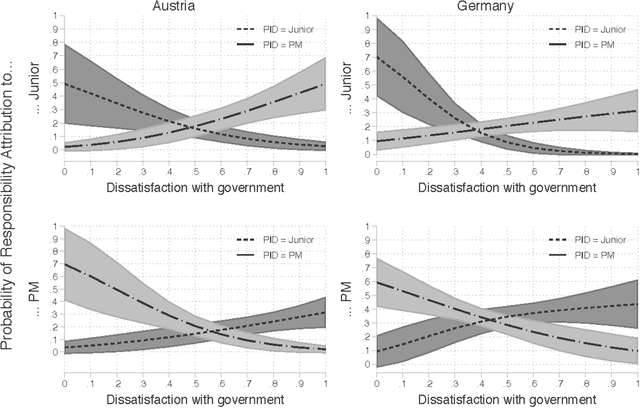
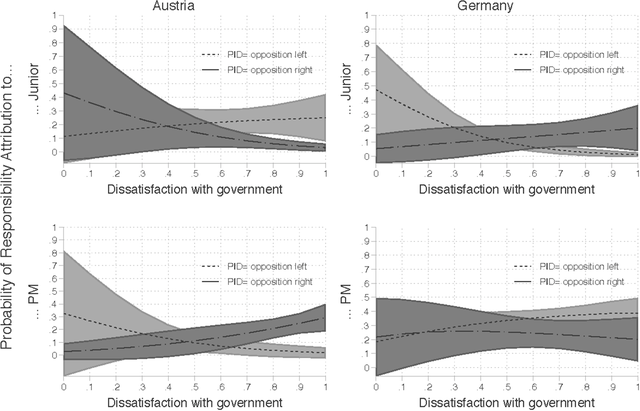
Figure 3 shows the predictive effects of party identification by observed levels of satisfaction with the government (x‐axis) by focusing on two remaining groups of party identifiers, namely those who identify with opposition parties on the left and on the right. In line with Hypothesis 2b, partisans of the opposition parties on the left‐hand side of the ideological spectrum are less likely to assign responsibility to the grand coalition partner on their ‘side’ of the ideological spectrum. Hence, as also shown in Figure 3, partisans of the opposition parties on the left (such as the Green party) in Austria are less likely to assign responsibility for bad government performance to the centre‐left government party, the SPÖ (prime minister's party), but are more likely to assign it to the centre‐right government party, the ÖVP (junior party) when they are dissatisfied. Similarly, in Germany, the right‐hand plots of Figure 3 show that opposition identifiers with the right ideological camp (such as the FDP party) are much less likely to assign responsibility for bad government performance to the centre‐right party in government, the CDU/CSU (prime minister's party), compared to the centre‐left junior partner, the SPD. Table A2 in the Supporting Information shows that the effects are highly significant in both countries.
The conditional effect of party identification on responsibility attribution: opposition identifiers. Note: The plots show predicted probabilities and 95 per cent confidence intervals. The plots are based on Table A2. Other variables are held constant at their observed mean value.

Finally, and in contrast to Hypothesis 2b, non‐partisans are less likely to assign responsibility to both coalition parties if they are dissatisfied with the performance of the government. While the effect is non‐significant in Austria (b = −1.191, SE = 1.713, p = n.s.), it is significant in Germany (b = −5.210, SE = 2.002, p < 0.01). However, non‐partisans appear to less often hold the prime minister's party in the coalition responsible, with significant effects both in Austria (b = −4.362, SE = 2.021, p < 0.05) and Germany (b = −7.826, SE = 2.220, p < 0.01). This suggests that the party suffering the most among the non‐identifiers for poor government performance is the junior coalition partner, corroborating recent findings that junior partners do worse in subsequent elections (e.g., Klüver & Spoon, Reference Klüver and Spoon2020).12
Overall, the results point to two important conclusions regarding responsibility attribution in grand coalitions. First, we find strong evidence of selective attribution of responsibility: favoured parties are not blamed for dissatisfying government performance, while less favoured parties are not credited with satisfying government performance. Second, without partisanship there is neither blame nor praise, which indicates an overall accountability deficit under grand coalition governments. Our findings indicate that partisanship conditions the assignment of responsibility in grand coalition governments, while under more typical large party‐small partner coalitions, voters typically think of the prime minister's party as holding more policy‐making influence (Fortunato et al., Reference Fortunato, Lin, Stevenson and Tromborg2020).
To further unpack the lens that partisanship provides, in other words, to show how partisanship conditions the effect of dissatisfaction, we have also examined the content of the open‐ended questions in which we ask survey respondents what they have in mind when evaluating the government. The examination of such answers reveals that when identifiers evaluate government performance negatively, they are much more likely to mention the other coalition partner, and thus to reason in a partisan‐motivated fashion. They focus on dissatisfying aspects of government performance such as the conflict between the two government parties (using words like ‘dispute’, ‘stalemate’ and ‘disagreement’). On the contrary, positive evaluations often are related to positive mentions of specific issues like ‘economy’, ‘reform’, ‘environment’ or their own party leaders, including the prime minister. Overall, negative evaluations are attributed to the ‘other’ party and connected to rather ‘unspecific’ aspects of politics (using words like ‘everything’, ‘citizens’, ‘people’ or general party names), while positive evaluations are assigned to the respondent's ‘own’ party and rationalized in terms of policy.
Discussion and Conclusions
On Election Day, rational voters hold incumbent governments accountable for their past performance. If voters are satisfied with the government's record, they are likely to reward it, while a performance that fails to meet voters’ standards jeopardizes re‐election (Ferejohn, Reference Ferejohn1986; Fiorina, Reference Fiorina1981). A foundational insight from the literature on retrospective (economic) voting is that government complexity inhibits voters’ ability to clearly assign responsibility for policy performance, thereby reducing democratic accountability. In particular, scholars have focused on the difference between single and multiparty government and argue that clarity of responsibility is hindered in coalition governments because power is dispersed among coalition partners (e.g., Powell & Whitten, Reference Powell and Whitten1993; Whitten & Palmer, Reference Whitten and Palmer1999). Yet, little is known about how voters assign responsibility for government performance in grand coalition governments. Thus far, studies exploring retrospective voting for parties in coalition governments have largely analyzed the impact of government performance on their electoral success, that is, whether they are punished or rewarded in the electoral contest (e.g., Debus et al., Reference Debus, Stegmaier and Tosun2014; Fisher & Hobolt, Reference Fisher and Hobolt2010; Williams et al., Reference Williams, Stegmaier and Debus2017), and do not differentiate whether all coalition partners are assigned responsibility for poor government performance, or rather only one of them, and if so, which one.
In this article, we have first focused on the responsibility attribution mechanism to understand whether and to what extent the parties in grand coalition governments are assigned responsibility for government performance. Building on the extant literature, we tested the effect of two factors on responsibility attribution: the performance patterns of the government and partisan attachments.
The findings show partial support for the hypothesis that in grand coalition governments both government parties are likely to suffer when dissatisfaction with the performance of the government is high. This furthermore shows that voters do not assign responsibility because of the status of a party being the prime minister's party, but it is the more equal distribution of power in grand coalition governments that leads to responsibility attribution. Additionally, the mechanism of responsibility attribution is strongly moderated by a partisan perception bias, that is, partisans of a coalition party consistently point the finger towards the other coalition party if they are dissatisfied with the performance of the government. Partisanship even has an effect when it comes to opposition parties’ identifiers: partisanship for one of the opposition parties allows voters to distinguish between the two parties in grand coalition governments, and direct responsibility to the coalition party on the opposite side of the ideological spectrum when dissatisfaction is high. Hence, partisanship sustains assignment of responsibility across ideological blocks. Qualitative evidence from open‐ended questions shows that partisans selectively mention words and focus on issues that allow them to ‘justify’ their motivated assignment of responsibility.
These findings have important implications for our understanding of retrospective voting. First and foremost, we learn that it is not necessarily true – at least for grand coalition governments – that partisans of parties in the government always provide rosier government evaluations than non‐partisans, but rather that partisanship works in such a way as to allow voters to assign responsibility differently when they are satisfied or unsatisfied with government performance. Second, in terms of party strategy, especially during election campaigns, our findings indicate that a blaming strategy can be particularly helpful especially for the party of the prime minister in the coalition, which should be able to count on a larger share of partisans in the population, even in a grand coalition government. In this regard, blaming strategies may be a better approach and the effectiveness of this strategy may depend largely on the capacity of government parties to convince their supporters – a line of investigation that surely deserves attention. It is however true that blaming strategies in the long run risk endangering the democratic climate and government legitimacy. On a less positive note, overall, the rationalization process of responsibility attribution by partisans that we have identified might have negative consequences for electoral accountability of grand coalition governments. This seems to be true regardless of the specific moment in time during the legislative term the responsibility attribution mechanism is investigated. In particular, despite the fact that the German survey was fielded only a year after government formation – hence, still during what some have defined as the government ‘honeymoon period’ – the findings appear to be substantially similar to those in Austria where government performance was assessed after four years. In the specific case of Germany, dissatisfaction might also well reflect voters’ (dis)satisfaction with the performance of the same grand coalition from the previous legislative period.
Finally, our findings add an important aspect to the clarity of responsibility theory. Parties in grand coalition governments may not be punished less compared to parties in single party governments because of voters’ difficulty assigning responsibility to parties in multiparty governments, but rather because partisans unsatisfied with the performance of the government can more easily assign responsibility for poor performance to the other coalition partner. Thus, responsibility assignment might simply be balanced out between grand coalition partners resulting in less electoral punishment overall for parties in grand coalition governments compared to parties in single party governments. To study the specific amount of responsibility assigned to each grand coalition party, future studies may use a continuous measure of responsibility attribution. Future research should also examine responsibility attribution under other types of government; for example, in large party‐small partner coalitions, minority governments or in single‐party governments to whom do voters assign responsibility? In line with our findings, when the other coalition partner is not present, for example under single‐party governments, partisans of the government may assign responsibility for bad performance to external factors such as multilateral actors or lower‐levels of government. In conclusion, while we have identified important mechanisms at play in understanding responsibility attribution in grand coalition governments, there is still more work to be done.
Funding Information
The Austrian data have been collected within the AUTNES project, which has received funding from the Austrian Federal Ministry of Education, Science and Research: HRSM ‐ ACIER and the Anniversary Fund of the Oesterreichische Nationalbank (Austrian Central Bank): 17449. The German data have been collected as part of the RECONNECT project, which has received funding from the European Union's Horizon 2020 research and innovation programme under Grant Agreement no 770142. The information in this article reflects only the authors’ views and the European Union is not liable for any use that may be made of it.
Acknowledgments
A previous version of this paper was presented at the Austrian National Election Study (AUTNES) workshop, University of Vienna 2019. We would like to thank all the participants for their useful comments and in particular Wolfgang C. Müller and Rune Slothuus.
Online Appendix
Additional supporting information may be found in the Online Appendix section at the end of the article:
Figure A1: Distribution of government performance satisfaction
Table A1: Explaining responsibility attribution: Multinomial logit models
Table A2: Explaining motivated responsibility attribution: Multinomial logit models


 Open access

