


Somatic cell content of milk is informative for mammary gland health status in dairy animals. The total number of somatic cells in the milk, i.e. somatic cell count (SCC) increases in response to intramammary infections and can be a useful indicator for subclinical mastitis as well as milk quality and safety (Bergonier et al., Reference Bergonier, de Crémoux, Rupp, Lagriffoul and Berthelot2003; Albenzio et al., Reference Albenzio, Figliola, Caroprese, Marino, Sevi and Santillo2019). While there is a threshold for acceptable levels of bovine milk SCC (e.g. 400,000 cells/ml in the EU (EU, 2004) and 750,000 cells/ml (FDA, 2023) in the US), this does not apply to sheep and goat milk as, compared to bovine milk, the physiological levels of SCC in the milk of healthy small ruminants can be significantly greater and more variable. Until now, there is no legal limit for SCC in small ruminants’ milk in the EU while the FDA in the US has set the limits at 750,000 and 1,500,00 cells/ml for ovine and caprine milk, respectively (FDA, 2023).
In small ruminants, SCC is reported to be influenced by many non-pathogenic factors, including breed, lactation stage, parity number, milk yield and the milking system (Paape et al., Reference Paape, Poutrel, Contreras, Marco and Capuco2001, Reference Paape, Wiggans, Bannerman, Thomas, Sanders, Contreras, Moroni and Miller2007; Souza et al., Reference Souza, Blagitz, Penna, Della Libera, Heinemann and Cerqueira2012; Kaskous et al., Reference Kaskous, Farschtschi and Pfaffl2023). Specifically, breed has been found to significantly influence SCC in ewes (Zafalon et al., Reference Zafalon, Santana, Esteves and Júnior2018; Lianou et al., Reference Lianou, Michael, Vasileiou, Liagka, Mavrogianni, Caroprese and Fthenakis2021) with mean SCC in mastitis-free animals from different breeds ranging from 40 to 1,600 x 103cells/ml (Kaskous et al., Reference Kaskous, Farschtschi and Pfaffl2023). Furthermore, SCC is found to be significantly affected by the stage of lactation with elevated levels observed at the beginning and end of the lactation period (Morgante et al., Reference Morgante, Ranucci, Pauselli, Casoli and Duranti1996a; Paape et al., Reference Paape, Poutrel, Contreras, Marco and Capuco2001; Kaskous et al., Reference Kaskous, Farschtschi and Pfaffl2023). Research on the impact of parity number on SCC is conflicting, with certain studies showing elevated levels during later parities compared to earlier ones (Paape et al., Reference Paape, Poutrel, Contreras, Marco and Capuco2001; Kraličková et al., Reference Kraličková, Pokorná, Kuchtík and Filipčík2012) and others reporting parity has a minimal effect (Paape et al., Reference Paape, Wiggans, Bannerman, Thomas, Sanders, Contreras, Moroni and Miller2007).
While increased SCC values are generally associated with intramammary infections in ewes, breed differences and other non-pathogenic factors obstruct the use of a universal cut-off SCC value. SCC threshold values for identifying subclinical mastitis vary among sheep breeds as well as among the various lactation stages (Zafalon et al., Reference Zafalon, Santana, Esteves and Júnior2018). Furthermore, diverse SCC thresholds depending on their effect on ovine milk quality and cheese-making technological properties have been suggested (Paape et al., Reference Paape, Poutrel, Contreras, Marco and Capuco2001; Albenzio et al., Reference Albenzio, Caroprese, Santillo, Marino, Taibi and Sevi2004; Moradi et al., Reference Moradi, Omer, Razavi, Valipour and Guimarães2021; Kaskous et al., Reference Kaskous, Farschtschi and Pfaffl2023). Berthelot et al. (Reference Berthelot, Lagriffoul, Concordet, Barillet and Bergonier2006) proposed that two thresholds for SCC can be applied, in a dynamic manner during lactation, to classify ewes as healthy, doubtful or infected.
Recent findings indicate that the distribution of milk leukocyte subsets can be more informative for udder infection status than SCC alone. Milk somatic cells (MSCs) consist predominantly of leukocytes with a smaller proportion of mammary epithelial cells (MECs). Small ruminants’ milk also contains cytoplasmic particles – abundant in goats and present in ewes – the misclassification of which can affect reported SCC and somatic cell subset proportions (Paape et al., Reference Paape, Poutrel, Contreras, Marco and Capuco2001; Souza et al., Reference Souza, Blagitz, Penna, Della Libera, Heinemann and Cerqueira2012; Alhussien and Dang, Reference Alhussien and Dang2018; Moradi et al., Reference Moradi, Omer, Razavi, Valipour and Guimarães2021).
Milk leukocytes comprise innate (neutrophils and macrophages) and adaptive (lymphocytes) populations. Neutrophils are typically the most abundant leukocytes in ewe milk, increase with higher SCC or intramammary infection and have been reported to range between ∼30 and 80% depending on infection status (Morgante et al., Reference Morgante, Ranucci, Pauselli, Casoli and Duranti1996a; Albenzio and Caroprese, Reference Albenzio and Caroprese2011; Albenzio et al., Reference Albenzio, Santillo, Caroprese, Schena, Russo and Sevi2011) and stage of lactation (Cuccuru et al., Reference Cuccuru, Moroni, Zecconi, Casu, Caria and Contini1997; Tatarczuch et al., Reference Tatarczuch, Philip, Bischof and Lee2000, Reference Tatarczuch, Bischof, Philip and Lee2002; Albenzio et al., Reference Albenzio, Caroprese, Santillo, Marino, Taibi and Sevi2004, Reference Albenzio, Santillo, Caroprese, D'Angelo, Marino and Sevi2009). The percentage of macrophages and lymphocytes vary widely across studies. Earlier microscopy-based studies often reported higher macrophage and lower lymphocyte percentages (Morgante et al., Reference Morgante, Ranucci, Pauselli, Casoli and Duranti1996a; Cuccuru et al., Reference Cuccuru, Moroni, Zecconi, Casu, Caria and Contini1997; Lee and Outteridge, Reference Lee and Outteridge1981; Tatarczuch et al., Reference Tatarczuch, Philip, Bischof and Lee2000, Reference Tatarczuch, Bischof, Philip and Lee2002), whereas more recent studies – mostly using flow cytometry – report the opposite (Albenzio et al., Reference Albenzio, Caroprese, Santillo, Marino, Taibi and Sevi2004, Reference Albenzio, Santillo, Caroprese, D'Angelo, Marino and Sevi2009, Reference Albenzio, Santillo, Caroprese, Schena, Russo and Sevi2011; Albenzio and Caroprese, Reference Albenzio and Caroprese2011). This discrepancy is most likely methodological: morphology-based methodology, used in microscopy, can misclassify macrophages and lymphocytes while marker-based flow cytometry reduces such bias.
Consistent with initial innate/phagocytic response, several studies have found increased neutrophil proportions and absolute counts with intramammary infection (Morgante et al., Reference Morgante, Ranucci, Pauselli, Casoli and Duranti1996a, Reference Morgante, Ranucci, Pauselli, Beghelli and Mencaroni1996b) and with increased SCC (Albenzio and Caroprese, Reference Albenzio and Caroprese2011; Albenzio et al., Reference Albenzio, Santillo, Caroprese, Schena, Russo and Sevi2011). Lymphocyte percentage decreased while absolute count remained stable, reflecting dilution by the neutrophil influx (Albenzio and Caroprese, Reference Albenzio and Caroprese2011). Somatic cell subset composition was also found to vary with stage of lactation, with neutrophils increased and lymphocyte and macrophage percentages decreased in late lactation (Albenzio et al., Reference Albenzio, Santillo, Caroprese, D'Angelo, Marino and Sevi2009).
All the above suggest that understanding the factors influencing ovine MSC count and subset composition, in health and disease, remains an interesting topic. Although there is a growing number of reports for various breeds, there is a notable absence of relevant data for Greek sheep. Here, we aim to address this by examining Frizarta ewes, one of the most productive local breeds, well adapted to the geoclimatic conditions of Western Greece. Specifically, we aim to characterize the physiological variation of MSC in Frizarta ewes during the lactation period and in two different parities. Our findings will provide foundational insights into how physiological factors influence the distribution of MSC types and their interactions in healthy animals.
Materials and methods
Animals and experimental design
Forty-eight healthy Frizarta ewes in the first (n = 27) or second (n = 21) parity were randomly selected based on parity and lambing date to assemble groups at similar days in milk (DIM) from a commercial dairy farm of the Agricultural and Livestock Union of Western Greece (ALUWG) located in Agrinio, Greece. Ewes were machine milked, twice daily, in a milkrite|InterPuls (Manchester, United Kingdom) milking parlour, were housed mainly indoors and allowed brief daily outdoor access. The flock was under regular veterinary assessment and health evaluation, and ewes did not show any signs of mastitis. Feeding regimen consisted of alfalfa hay (2.0 kg/d per ewe), barley straw (0.3–0.4 kg/d per ewe) and concentrate (1.4–1.5 kg/d per ewe). The concentrate comprised maize (46%), soybean meal (20%), barley (16%), molasses (1.5%), wheat bran (12%), and a vitamin and mineral premix supplement (3%), sodium bicarbonate (0.8%), salt (0.4%) and zeolite (0.3%). Four milk samplings were performed per animal as described below and daily milk yield (DMY) was also recorded on the day of sampling. Milk yield was recorded using a mechanical volumetric jar-type milk meter with manual reading from a calibrated cylinder. Samples from first parity ewes were obtained at 44 ± 5, 79 ± 5, 110 ± 7 and 142 ± 6 DIM, hereafter referred to as lactation stages 1–4, respectively. Samples from second parity ewes were obtained at 79 ± 5, 110 ± 7, 142 ± 6, 177 ± 4 DIM, hereafter referred to as lactation stages 2–5, respectively. Milk was filtered through gauze to remove large contaminants and three 50 ml milk aliquots per animal were collected in sterile tubes for further analyses.
Milk composition, SCC and bacteriological analyses
At each sampling, the percentages of milk fat, protein, lactose and total solids were determined for each sample using MilkoScanTM 6000 FT (FOSS analytical, Denmark). SCCs were measured using a Fossomatic FC (FOSS analytical) and total bacterial count (TBC) measured as colony forming units (CFU) using BactoScanTM FC (FOSS analytic al, Denmark). Analyses were performed at the Milk Quality Control Laboratory of Ioannina, of the Hellenic Agricultural Organization (EL.G.O.) ‘DIMITRA’.
Isolation of milk somatic cells
Milk samples were kept at 4°C for up to 6 h after sampling until further processing. MSC were isolated from 15 ml of milk following a modified protocol of (Koess and Hamann, Reference Koess and Hamann2008) optimized for sheep milk. Briefly, milk samples were mixed by inversion, left standing on ice for 20 min and filtered through gauze, to remove large contaminants. Samples were centrifuged at 400 × g for 15 min at 4°C. The top fatty layer and liquid supernatant were removed using a vacuum pump. Pellets were resuspended in 15 ml of dilution buffer i.e. phosphate-buffered saline (PBS; Ph 7.4) containing 0.02% sodium azide (NaN3) and 0.2% bovine serum albumin (BSA). Samples were centrifuged at 400 × g for 10 min at 4°C. Pellets were resuspended in 4 ml of dilution buffer and centrifuged at 400 × g for 10 min at 4°C. Cell pellets were resuspended in 1 ml of dilution buffer, filtered through 40 μm cell strainers and cell concentrations were estimated by microscopy using a haemocytometer.
Milk somatic cell immunophenotyping
Cell surface labelling was performed with anti-CD11b, anti-CD14, anti-CD4, anti-CD8 and anti-4 + 5 + 6 + 8 + 10 + 13 + 18(pan-)Cytokeratins (OriGene Techologies, Inc., Rockville, United States) for the identification of granulocytes, macrophages, T-helper, T-cytotoxic and epithelial cells, respectively. In addition, propidium iodide (PI) staining was used to differentiate live from dead cells. Aliquots of MSC prepared as described above containing approximately 2 × 10⁵ cells were centrifuged at 400 × g for 5 min at 4°C and cell pellets were resuspended in 50 μl ice cold antibody solutions containing combinations of (A) 0.002 mg/ml anti-CD11b conjugated to Fluorescein isothiocyanate (FITC), 0.01 mg/ml anti-CD14 R-Phycoerythrin (R-PE) and 0.005 mg/ml anti-pan Cytokeratins conjugated to Allophycocyanin (APC) or (B) 0.002 mg/ml anti-CD4 FITC and 0.002 mg/ml CD8 R-PE antibodies. Cells in the staining solutions were incubated on ice and in the dark for 30 min, then 1 ml dilution buffer was added, samples were centrifuged at 400 × g for 5 min and cell pellets were resuspended in 100 μl dilution buffer. DNA staining was performed by addition of PI at a final concentration of 5ng/μl. Following 10 min incubation at room temperature in the dark, 100 μl of PBS were added and samples were analysed by flow cytometry (Cytomics FC 500, Beckman Coulter Inc., USA).
Instrument voltage/gain for detectors FS, SS, FL1, FL2, FL3, FL4 and FL5 were set at 700/2.0, 680/20.0, 550/1.0, 620/1.0, 620/1.0, 580/1.0 and 601/1.0, respectively. The samples were run at medium speed and approximately 65,000 events were collected per sample. Data were stored as list mode files and analysed with Kaluza Analysis software version 1.3 (Beckman Coulter Inc., USA). Events that were identified as being of appropriate size and granularity based on their position on an FS/SS dot plot and were negative for PI were considered as live cells (Fig. 1). Live cells that stained positive for CD11b (FL1) with higher SS values were classified as neutrophils (NEU) and those with lower SS values as macrophages (MAC) (Fig. 1). Both NEU and MAC populations were further subdivided by CD14 staining and position on the SS axis. Epithelial cells were identified as CD11b-/CD14- live cells that stained positive for pan-cytokeratins. T helper (Th) and cytotoxic (Tc) lymphocytes were identified as live cells of appropriate size and granularity, based on their position in the FS/SS dot plot, that stained positive for CD4 or CD8, respectively. Proportions of each cell MSC subset were estimated as percentages of the live cells.
Identification of different somatic cell subsets in Frizarta ewe milk by flow cytometry. (i–ii) Identification of live cells: (i) Forward/side scatter (FS/SS) dot plot of all events. (ii) Events selected in region A of FS/SS dot plot, were analysed in a histogram of propidium iodide (FL3). Events negative for PI (region B) were considered as live cells and further analysed. (iii–vi) Identification of neutrophils (NEU) and macrophages (MAC): (iii) PI-ve cells were plotted on a CD11b-FITC histogram (FL1). CD11b + ve events were selected in region C. (iv) CD11b + ve cells were plotted on a FS/SS dot plot. Regions D and E correspond to NEU and MAC cells respectively. (v–vi). NEU and MAC were plotted in a CD14-PE histograms (FL2) and NEU and MAC subpopulations positive for CD14 expression were identified, CD14 + NEU (plot v, region F) and CD14 + MAC (plot vi, region G) respectively. (vii–viii) Identification of lymphocytes (LYM) and T cell subtypes: (vii) PI-ve cells (plot ii, region B) were plotted on an FS/SS dot plot and lymphocytes (LYM) were identified based on size and granularity (region H). (viii) Lymphocytes were plotted on a CD4-FITC/CD8-PE (FL1/FL2) dot plot to identify CD4 + T (region I) and CD8 + T (region J) cells. (ix–x) Identification of epithelial cells (EC): (ix) PI-ve cells (plot ii, region B) were plotted on a CD14-PE/CD11b-FITC dot plot (FL1/FL2). CD14-CD11b – double negative cells were selected (region K). (x) Cells from region K are plotted on a Cytokeratin-APC histogram (FL4) and Cytokeratin + ve cells (Region L) were identified as EC.

Figure 1 Long description
The image A showing a dot plot labeled i with title text “(Ungated) FS / SS”. The horizontal axis label is “FS” with values 0 to 1000. The vertical axis label is “SS” with values 0 to 1000. A polygon gate labeled “A” encloses a dense cluster of events. The image B showing a histogram labeled ii with title text “[A] FL3”. The horizontal axis label is “FL3” with tick labels 10 superscript 0, 10 superscript 1, 10 superscript 2, 10 superscript 3, 10 superscript 4 and 10 superscript 5. The vertical axis label is “Count” with values 0 to 250. A filled distribution includes a broad peak around 10 superscript 1 and a tall narrow peak near 10 superscript 4. A bracket labeled “B” marks a lower FL3 range. The image C showing a histogram labeled iii with title text “[B] FL1”. The horizontal axis label is “FL1” with tick labels 10 superscript 0, 10 superscript 1, 10 superscript 2, 10 superscript 3, 10 superscript 4 and 10 superscript 5. The vertical axis label is “Count” with values 0 to 100. A filled distribution shows a main peak around 10 superscript 1 and a smaller peak around 10 superscript 3. A bracket labeled “C” marks a higher FL1 range. The image D showing a dot plot labeled iv with title text “[C] FS / SS”. The horizontal axis label is “FS” with values 0 to 1000. The vertical axis label is “SS” with values 0 to 1000. Two rectangular gates are labeled “D” and “E”. The gate “D” covers a higher SS range than the gate “E”. Events form a dense cluster centered around mid-range FS and SS values. The image E showing a histogram labeled v with title text “[D] FL2”. The horizontal axis label is “FL2” with tick labels 10 superscript 0, 10 superscript 1, 10 superscript 2, 10 superscript 3, 10 superscript 4 and 10 superscript 5. The vertical axis label is “Count” with values 0 to 40. A filled distribution has a main peak around 10 superscript 1 and a smaller feature toward higher FL2 values. A bracket labeled “F” marks a higher FL2 range. The image F showing a histogram labeled vi with title text “[E] FL2”. The horizontal axis label is “FL2” with tick labels 10 superscript 0, 10 superscript 1, 10 superscript 2, 10 superscript 3, 10 superscript 4 and 10 superscript 5. The vertical axis label is “Count” with values 0 to 5. The distribution is shown as vertical bars with multiple peaks across the FL2 range. A bracket labeled “G” marks a higher FL2 range. The image G showing a dot plot labeled vii with title text “[B] FS / SS”. The horizontal axis label is “FS” with values 0 to 1000. The vertical axis label is “SS” with values 0 to 1000. An oval gate labeled “H” encloses a compact cluster at low SS values. The image H showing a dot plot labeled viii with title text “[H] FL1 / FL2”. The horizontal axis label is “FL1” with tick labels 10 superscript 0, 10 superscript 1, 10 superscript 2, 10 superscript 3, 10 superscript 4 and 10 superscript 5. The vertical axis label is “FL2” with tick labels 10 superscript 0, 10 superscript 1, 10 superscript 2, 10 superscript 3, 10 superscript 4 and 10 superscript 5. Two polygon gates are labeled “I” and “J”. The image I showing a dot plot labeled ix with title text “[B] FL2 / FL1”. The horizontal axis label is “FL2” with tick labels 10 superscript 0, 10 superscript 1, 10 superscript 2, 10 superscript 3, 10 superscript 4 and 10 superscript 5. The vertical axis label is “FL1” with tick labels 10 superscript 0, 10 superscript 1, 10 superscript 2, 10 superscript 3, 10 superscript 4 and 10 superscript 5. A square gate labeled “K” encloses a diagonal cluster in the lower FL2 and lower FL1 range. The image J showing a histogram labeled x with title text “[K] FL4”. The horizontal axis label is “FL4” with tick labels 10 superscript 0, 10 superscript 1, 10 superscript 2, 10 superscript 3, 10 superscript 4 and 10 superscript 5. The vertical axis label is “Count” with values 0 to 80. A filled distribution peaks near 10 superscript 1 and tapers toward higher FL4 values. A bracket labeled “L” marks a higher FL4 range.
Statistical analysis
Prior to analysis, variables were subjected to normality testing using the Lilliefors test. The test showed that only Fat%, Protein%, Lactose%, Total Solids% and CD14 + NEU% reasonably approximated the normal distribution. For the remaining variables, log (SCC, TBC, MAC, MEC), square root (DMY, LYM, Th, Tc, NEU) or Log10[(CD14 + NEU/100)/(1-CD14 + NEU/100)] transformation was employed to approach normality. A mixed model was then applied throughout to test for significance of the lactation stage and the parity on the variables. Specifically, the mixed model included the lactation stage (5 classes) and the parity number (2 classes, 1 and 2) as fixed effects and the animal (n = 48) as the random term. After testing for various error covariance structures using information criteria (AIC, BIC and AICC), an autoregressive error structure AR(1) was finally specified to accommodate correlation(s) of residual errors because of repeated measurements per subject (animal). The Satterthwaite option was employed to compute the denominator degrees of freedom in t tests and F tests and the Tukey–Kramer test was used for multiple means comparison. This analysis was performed using the MIXED procedure in SAS 9.4 (for academics). Results of this analysis are presented as least squares means with standard errors. Partial correlations between the various variables were also obtained from the error SSCP matrix after performing two-way multivariate analysis of variance (MANOVA) fitting the lactation stage and the parity as fixed effects. This analysis was carried out using the GLM procedure with the MANOVA option in in SAS 9.4 (for academics).
Results
Distribution of immune and epithelial cell subsets in the milk of Frizarta ewes during lactation
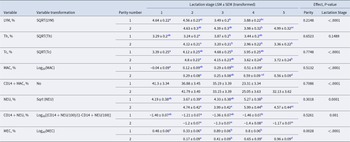
Tables 1 and 2 present total milk SCCs and somatic cell (MSC) type percentages in Frizarta first and second parity ewes and at different lactation time points. SCC was consistently low, under 100,000 cells/ml, in all milk samples tested. The most abundant MSC types across the duration of the lactation period were the lymphocytes (LYM, interquartile range 13–23.6%) and the neutrophils (NEU; interquartile range 10.4–36.3%, Tables 3 and 4). Necrotic cells, i.e. propidium iodide (PI) positive events, represented between 34 and 56% of all events, while of the remaining PI negative events, 29–57% were unclassified based on the classification criteria used here (Tables 3 and 4). In both parities and at the initial stages of lactation, up to stage 3 (110 ± 7 DIM), LYM were more abundant than NEU but the opposite was observed at stage 4 (143 ± 5 DIM). Among LYM, T helper (Th, CD4 + T) cells were less abundant (median ranging between 10.2 and 17.2% of lymphocytes) than T cytotoxic cells (Tc, CD8 + T, median ranging between 10.5 and 24.2%) across lactation in both parities (Tables 3 and 4) and Th/Tc ratios varied in the first parity from 0.67 to 0.96 and in the second from 0.65 to 0.77 (Tables 3 and 4). Macrophages (MAC) were the least populous somatic cell type (median ranging between 1 and 3.7%; Tables 3 and 4) while percentages of MEC, in both parities, increased as lactation progressed (median ranging between 1.3 and 12.2%; Tables 3 and 4). Furthermore, a higher percentage of MAC were positive for surface expression of CD14 (CD14 + MAC, median ranging between 22.2 and 45.2%) compared to NEU (median ranging between 3.1 and 6.7%, Tables 3 and 4).
Effects of parity number and lactation stage on somatic cell count, total bacterial count and milk composition

Table 1 Long description
The table reports transformed least squares means with standard errors for udder health indicators (somatic cell count and total bacterial count) and milk composition by lactation stage and parity (first versus second). Somatic cell count decreases across stages in both parities, from about 4.74 to 4.49 in parity one and from about 4.85 to 4.50 in parity two, with significant effects of parity and stage. Total bacterial count increases with stage, reaching about 4.33 in parity one and about 4.24 in parity two, with a strong stage effect and no clear parity effect. Daily milk yield declines steadily with stage in both parities, from about 46.1 to 37.6 in parity one and from about 41.4 to 32.6 in parity two, with a strong stage effect and no parity effect. Fat, protein, and total solids rise with stage in both parities; for example, fat increases from about 3.23 to 5.36 in parity one and from about 4.9 to 6.35 in parity two, and protein increases from about 4.56 to 5.58 in parity one and from about 5.18 to 5.65 in parity two. Lactose declines with stage in both parities, from about 5.13 to 4.81 in parity one and from about 4.82 to 4.65 in parity two. Most variables show significant parity and stage effects, and letter groupings indicate statistically different means within each parity across stages; values are on transformed scales, so differences reflect the transformed metrics rather than raw units.
Table presents the least squares means with standard errors of the variables recorded per lactation stage and parity number. Values shown are transformed values and means within a row with different superscripts differ significantly (P < 0.05). Lactation stages 1–5: 44 ± 5, 79 ± 5, 110 ± 7, 142 ± 6 and 177 ± 4 days in milk respectively. SCC, somatic cell count; TBC, total bacterial count,; CFU, colony forming units; DMY, daily milk yield.
Effects of parity number and lactation stage on somatic cell subsets

Table 2 Long description
The table reports least squares means with standard errors for several milk somatic cell subsets across lactation stages, shown separately for parity 1 and parity 2, with P-values for parity and stage effects. Lactation stage is significant for lymphocytes, T cytotoxic cells, macrophages, CD14-positive macrophages, neutrophils, CD14-positive neutrophils, and mammary epithelial cells, while T helper cells show no clear stage effect. Lymphocytes generally decline from early to mid lactation in parity 1 and vary modestly in parity 2. Macrophages rise across stages in both parities, while the percentage of CD14-positive macrophages drops notably by the latest stage in parity 1 and is lower mid to late in parity 2. Neutrophils increase toward later stages in parity 1 and peak mid lactation in parity 2; CD14-positive neutrophils change with stage mainly in parity 1. Parity effects are mostly not significant, except mammary epithelial cells, which are higher in parity 2 and increase steadily across stages in parity 2. Values are presented on transformed scales and letter groupings indicate statistically different means within each row, so comparisons should be made using those groupings rather than raw differences.
Table presents the least squares means with standard errors of the variables recorded per lactation stage and parity number. Values shown are transformed values and means within a row with different superscripts differ significantly (P < 0.05). Lactation stages 1–5: 44 ± 5, 79 ± 5, 110 ± 7, 142 ± 6 and 177 ± 4 days in milk, respectively. LYM, lymphocytes; Th, T helper lymphocytes; Tc, T cytotoxic lymphocytes; MAC, macrophages; NEU, neutrophils; CD14 + MAC and CD14 + NEU: % of MAC and NEU, respectively, expressing CD14; MEC, mammary epithelial cells.
Distribution of somatic cell subpopulations in the milk of ewes at the first parity at different lactation stages

Table 3 Long description
The table reports medians with interquartile ranges for milk cell counts, bacterial load, and immune and epithelial cell subpopulations across four lactation stages in first-parity ewes, with about 25 to 27 observations per stage. Somatic cell count decreases from 55 thousand cells per milliliter at stage 1 to 36 thousand at stage 4. Total bacterial count is 8 thousand colony-forming units per milliliter at stages 1 and 2, increases to 11 thousand at stage 3, and reaches 18 thousand at stage 4. The percentage of live cells stays broadly similar across stages, around the low to high 50s. Lymphocytes as a share of live cells drop from 23.6 percent at stage 1 to 13.0 percent at stage 3, then rise slightly to 15.2 percent at stage 4; within lymphocytes, T cytotoxic cells increase to a peak at stage 3 while the helper-to-cytotoxic ratio is lowest at stage 2. Macrophages rise from about 1 percent at stages 1 and 2 to 3.29 percent at stage 4, while the share of macrophages expressing CD14 declines to 23.4 percent at stage 4. Neutrophils are lowest at stage 2 and highest at stage 4, whereas the share of neutrophils expressing CD14 remains low and fairly stable across stages. Mammary epithelial cells are lowest at stage 2 and higher at stages 3 and 4, and the unclassified fraction is similar through stage 3 but lower at stage 4; wide interquartile ranges for several measures indicate substantial variability.
SCC, somatic cell count; TBC, total bacterial count; CFU, colony forming units; LYM, lymphocytes; Th, T helper lymphocytes; Tc, T cytotoxic lymphocytes; Th/Tc, T helper/T cytotoxic ratio; MAC, macrophages; CD14 + MAC, % macrophages expressing CD14; NEU, neutrophils; CD14 + NEU; % NEU expressing CD14; MEC, mammary epithelial cells.
Medians and interquartile ranges are shown per lactation stage (1–4).
Distribution of somatic cell subpopulations in the milk of ewes at the second parity at different lactation stages

Table 4 Long description
The table reports medians with interquartile ranges for milk cell and bacterial measures in second-parity ewes across lactation stages 2 through 5, with 18 to 21 observations per stage. Somatic cell count decreases steadily from 73.5 thousand cells per milliliter at stage 2 to 34.5 thousand at stage 5. Total bacterial count is lowest around stages 2 to 4 (about 9 to 12 thousand CFU per milliliter) and is highest at stage 5 (18.5 thousand). The percentage of live cells is similar at stages 2 and 3 (about 59 percent), rises at stage 4 (66 percent), then drops at stage 5 (43.9 percent). Lymphocytes among live cells are lowest at stage 4 (15.3 percent) and highest at stage 5 (23.3 percent); within lymphocytes, both helper and cytotoxic T-cell percentages generally decline from stage 2 to later stages, while the helper-to-cytotoxic ratio stays near 0.65 to 0.77. Macrophages among live cells increase from about 1.5 to 1.9 percent at stages 2 and 3 to about 3.1 to 3.7 percent at stages 4 and 5, while the share of macrophages expressing CD14 is highest at stage 2 (45.2 percent) and lowest at stage 4 (22.2 percent). Neutrophils show a pronounced spike at stage 4 (36.3 percent of live cells) compared with stages 2, 3, and 5 (about 13.5 to 18.6 percent), and neutrophil CD14 expression remains low across stages (about 3.9 to 6.7 percent). Mammary epithelial cells rise markedly with stage, from 1.3 percent at stage 2 to 12.2 percent at stage 5, while unclassified live cells are highest at stage 3 (57.41 percent) and lowest at stage 4 (29.15 percent). Because values are medians with interquartile ranges, overlap between ranges suggests some differences may be modest despite changes in medians.
SCC, somatic cell count; TBC, total bacterial count; CFU, colony forming units; LYM, lymphocytes; Th, T helper lymphocytes; Tc, T cytotoxic lymphocytes; Th/Tc, T helper/T cytotoxic ratio; MAC, macrophages; CD14 + MAC, % macrophages expressing CD14; NEU, neutrophils; CD14 + NEU, % NEU expressing CD14; MEC, mammary epithelial cells.
Medians and interquartile ranges are shown per lactation stage (2–5).
Effects of parity and stage of lactation on milk yield, composition, somatic cell and total bacterial count parameters
DMY, milk composition (% fat, % protein, % lactose and % total solids) and TBC were also assessed in the same Frizarta ewes along with SCC and MSC subpopulations described above (Tables 1 and 2).
Parity significantly affected all four milk composition variables and SCC, but DMY, TBC and immune MSC subpopulations were not affected. The only MSC type that was significantly affected by parity were the MECs (Table 2).
Stage of lactation significantly affected all variables assessed except for the % of T helper cells (Table 1). As expected, in both parities, DMY and lactose content significantly decreased in later stages of lactation. On the contrary, fat, protein and total solid contents significantly increased (Table 1). TBC, %MAC and %MEC significantly increased as lactation progressed. SCC and the remaining MSC subsets significantly fluctuated between different stages of lactation but no consistently increasing or decreasing trend was observed (Tables 1 and 2).
Correlations between milk TBC, SCC, milk yield and composition parameters
Results of partial correlation analysis between TBC, SCC, DMY and the four milk composition variables are presented in Table 5. Surprisingly, we did not observe a correlation between TBC and SCC (p = 0.9732). On the contrary, DMY and all four milk composition variables were significantly correlated (p < 0.05) with TBC while only protein and total solid contents were correlated with SCC. More specifically, significant negative correlations were observed for DMY and % lactose with TBC (−0.251 and −0.236, respectively). Fat, protein and total solid contents were positively correlated with TBC (0.285, 0.174 and 0.268 respectively, p < 0.05). Furthermore, as expected, DMY was negatively correlated with fat (−0.22, p = 0.0036), protein (−0.212) and total solid (−0.227) contents and positively correlated with lactose content (0.233) (Table 5).
Partial correlations between somatic cell count (SCC), bacterial count (TBC), daily milk yield (DMY), fat (F%), protein (P%), lactose (L%) and total solids (TS%)

Table 5 Long description
The table reports partial correlation coefficients among milk quality and production measures: somatic cell count, total bacterial count, daily milk yield, fat, protein, lactose, and total solids. The strongest association is between fat and total solids, showing a very strong positive relationship. Fat is also moderately positively related to protein, and moderately negatively related to lactose. Protein is positively related to total solids and negatively related to lactose. Daily milk yield is moderately negatively related to fat, protein, and total solids, but moderately positively related to lactose. Total bacterial count is moderately negatively related to daily milk yield and lactose, and moderately positively related to fat, protein, and total solids, while its relationship with somatic cell count is near zero. Somatic cell count has small positive relationships with protein and total solids and little to no relationship with daily milk yield, fat, or lactose. Statistical significance is indicated for several correlations, and results describe association rather than causation.
* p < 0.05, ** p < 0.01, *** p < 0.001.
TBC, total bacterial count; SCC, somatic cell count; DMY, daily milk yield; F, Fat; P, protein; L, lactose; TS, total solids.
Correlations between milk TBC, SCC and MSC subsets
Additional partial correlation analysis between TBC, SCC and MSC subsets revealed a negative correlation between TBC and % LYM (−0.195), while TBC exhibited a positive correlation with % MAC (0.245) and % NEU (0.176) (Table 6). When further subpopulations of MAC were examined, based on their expression of CD14, we observed a negative correlation of CD14 + MAC with TBC (−0.222, Table 6). No correlation was observed between TBC and % MEC (Table 6).
Partial correlations between bacterial count (TBC), somatic cell count (SCC) and % of milk somatic cell subpopulations

Table 6 Long description
The table reports partial correlations among total bacterial count, somatic cell count, and the percentages of several milk somatic cell subpopulations. Total bacterial count is positively related to macrophage percentage and to neutrophil percentage, and negatively related to lymphocyte percentage and to the share of macrophages expressing CD14; its links with somatic cell count and most T cell measures are near zero. Somatic cell count shows weak, non-significant correlations with all listed cell subpopulations. Lymphocyte percentage is strongly negatively related to neutrophil percentage and moderately negatively related to macrophage percentage, while it is positively related to the share of neutrophils expressing CD14 and to mammary epithelial cells. T helper and T cytotoxic lymphocytes are very strongly positively related to each other, but each has little association with other cell types. Macrophage percentage is strongly negatively related to the share of macrophages expressing CD14 and strongly positively related to neutrophil percentage; it is also moderately negatively related to the share of neutrophils expressing CD14 and to mammary epithelial cells. Neutrophil percentage is strongly negatively related to the share of neutrophils expressing CD14 and to mammary epithelial cells, while the share of neutrophils expressing CD14 is moderately positively related to mammary epithelial cells. Statistical markers indicate which correlations are unlikely to be due to chance, but correlations do not establish causation.
* p < 0.05, ** p < 0.01, *** p < 0.001.
TBC, total bacterial count; SCC, somatic cell count; LYM, lymphocytes; Th, T helper lymphocytes; Tc, T cytotoxic lymphocytes; MAC, macrophages; CD14 + MAC, % macrophages expressing CD14; NEU, neutrophils; CD14 + NEU, % NEU expressing CD14; MEC, mammary epithelial cells.
We did not detect significant correlations between SCC with MSC. Among MSC subsets, we observed a negative correlation of LYM with NEU (−0.476) and MAC (−0.291). In contrast, the CD14 + subsets of both NEU and MAC were positively correlated with LYM (0.301 and 0.204, respectively; Table 6). CD14 + NEU and CD14 + MAC were found to be negatively correlated with total %NEU (−0.633 and −0.266) and %MAC, respectively (−0.371 and −0.521; Table 6). Furthermore, we observed a strong positive correlation of MAC with NEU (0.736) and of Th with Tc (0.816). Lastly, MEC was positively correlated with LYM (0.221) and negatively correlated with MAC (−0.366) and NEU (−0.495, Table 6).
No significant correlations were observed between DMY and composition with MSC subsets, apart from a negative correlation of DMY with MAC and positive correlations with LYM and CD14 + MAC (Table 7).
Partial correlations between daily milk yield (DMY) and milk composition with somatic cell subpopulations

Table 7 Long description
The table reports partial correlation coefficients between milk production or composition measures and proportions of somatic cell subpopulations in milk. Daily milk yield shows a small positive correlation with lymphocytes and a moderate negative correlation with macrophages, while it shows a moderate positive correlation with the share of macrophages that are CD14-positive; these are the only statistically supported links for yield. Daily milk yield has near-zero correlations with T helper cells, T cytotoxic cells, neutrophils, CD14-positive neutrophils, and mammary epithelial cells. Fat percent, protein percent, and total solids percent have weak correlations across all cell types, with no statistically supported associations. Lactose percent shows a small positive correlation with T cytotoxic cells, while its correlations with other cell groups are small and not statistically supported. Overall, most relationships are weak, so the coefficients indicate limited linear association and should not be interpreted as causal effects.
* p < 0.05, ** p < 0.01.
TBC, total bacterial count; SCC, somatic cell count; DMY, daily milk yield; F%, % fat; P%, % protein; L%, % lactose; TS%, % total solids; LYM, lymphocytes; Th, T helper lymphocytes; Tc, T cytotoxic lymphocytes; MAC, macrophages; CD14 + MAC, % macrophages expressing CD14; NEU, neutrophils; CD14 + NEU, % NEU expressing CD14; MEC, mammary epithelial cells.
Discussion
In this study, we present findings on SCC and MSC subset distribution during the lactation period in the milk of Frizarta ewes. We also present our findings on the correlation between SCC and MSC populations with milk yield, composition and TBC.
In both first and second parity Frizarta ewes, median SCC ranged from 35 to 74 × 103 cells/ml at different lactation time points. These values are lower compared to previously reported values for Frizarta (Kominakis et al., Reference Kominakis, Papavasiliou and Rogdakis2009; Bontinis et al., Reference Bontinis, Pappa, Sotirakoglou, Pappas, Tsiplakou and Zervas2017; Lianou et al., Reference Lianou, Michael, Vasileiou, Liagka, Mavrogianni, Caroprese and Fthenakis2021; Argyriadou et al., Reference Argyriadou, Michailidou, Vouraki, Tsartsianidou, Triantafyllidis, Gelasakis, Banos and Arsenos2023) and East Friesian ewes (Kraličková et al., Reference Kraličková, Pokorná, Kuchtík and Filipčík2012), suggesting improved udder hygiene and health status. In agreement with previous studies in other ewe breeds (Morgante et al., Reference Morgante, Ranucci, Pauselli, Casoli and Duranti1996a; Kraličková et al., Reference Kraličková, Pokorná, Kuchtík and Filipčík2012), SCC levels significantly declined overtime, consistent with increased susceptibility to infections at the earlier stages of lactation. On the contrary, Bontinis et al. (Reference Bontinis, Pappa, Sotirakoglou, Pappas, Tsiplakou and Zervas2017) did not find a significant effect of month of lactation on SCC in Frizarta ewes. Parity was also found to influence SCC, with values significantly increased in the second compared to the first parity, in line with the findings of Kraličková et al. (Reference Kraličková, Pokorná, Kuchtík and Filipčík2012) but not with those of Paape et al. (Reference Paape, Wiggans, Bannerman, Thomas, Sanders, Contreras, Moroni and Miller2007). The modest increase in SCC observed here in the second compared to the first parity, could be possibly attributed to an increased exposure to environmental pathogens and other microorganisms that increased immunological surveillance in the mammary gland. Nevertheless, SCC values remained low, within the healthy range, well below subclinical level threshold.
The distribution of all MSC subsets in the present study was significantly affected by stage of lactation but not parity. A similar effect of stage of lactation has been previously reported for Comisana ewes (Albenzio et al., Reference Albenzio, Santillo, Caroprese, D'Angelo, Marino and Sevi2009). Among MSC leukocyte subsets, determined using flow cytometry, we found that neutrophils (NEU, 10–36%) and lymphocytes (LYM, 13–24%) were the most abundant immune cell types in the milk of Frizarta ewes, while macrophages (MAC, 1–4%) and MEC (1–12%) were present at much lower percentages (Tables 3 and 4). Furthermore, we detected a significant percentage of unclassified particles in all milk samples that we expect to mainly consist of cytoplasmic particles and other large cellular debris. Paape et al. (Reference Paape, Poutrel, Contreras, Marco and Capuco2001) report that cytoplasmic particles are commonly present in ewe milk. These particles are often similar in size with somatic cells and their presence is consistent with an apocrine component of milk secretion.
More detailed analysis of T lymphocyte subsets showed that the proportion of cytotoxic T was higher than that of T helper cells in agreement with Persson-Waller and Colditz (Reference Persson-Waller and Colditz1998) and Albenzio et al. (Reference Albenzio, Santillo, Caroprese, Ruggieri, Ciliberti and Sevi2012). Furthermore, we observed that the percentage of Th cells was highly correlated with Tc cells (0.816), consistent with a stable Th/Tc ratio that ranged from 0.65 to 0.96 in both parities and all lactation stages. Albenzio et al. (Reference Albenzio, Santillo, Caroprese, Ruggieri, Ciliberti and Sevi2012) reported similar values for Th/Tc ratio in ovine milk, ranging between 0.59 and 0.67, and found that Th and Tc percentages and their ratio were significantly influenced by SCC and SCC interaction with pathogen presence. T lymphocytes facilitate adaptive immune responses, with T helper cells promoting immune activation through cytokine secretion, and cytotoxic T cells participating in pathogen clearance by inducing apoptosis of infected cells. Τhe ratio of these two cell populations is important for effective immune function, particularly in secretory environments such as the mammary gland.
Overall, the relative proportions of innate and adaptive immune cell types in the present study is consistent with studies in Comisana ewes with low SCC, where differential cell count was performed with either light microscopy or flow cytometry, that reported percentages for NEU, LYM and MAC ranging on average between 40–56%, 26–48% and 2.5–8%, respectively, at different stages of lactation (Albenzio et al., Reference Albenzio, Caroprese, Santillo, Marino, Taibi and Sevi2004, Reference Albenzio, Santillo, Caroprese, D'Angelo, Marino and Sevi2009, Reference Albenzio, Santillo, Caroprese, Schena, Russo and Sevi2011, Reference Albenzio, Santillo, Caroprese, Ruggieri, Ciliberti and Sevi2012; Albenzio and Caroprese, Reference Albenzio and Caroprese2011). In contrast, earlier studies with Sardinian and Comisana ewes, mostly using direct microscopy, identified MAC as the most prominent immune cell population (30–80%), followed by the NEU (1–90%) and lower proportions of LYMs (8–40%) (Morgante et al., Reference Morgante, Ranucci, Pauselli, Casoli and Duranti1996a; Cuccuru et al., Reference Cuccuru, Moroni, Zecconi, Casu, Caria and Contini1997; Tatarczuch et al., Reference Tatarczuch, Philip, Bischof and Lee2000, Reference Tatarczuch, Bischof, Philip and Lee2002). These discrepancies could be attributed to the differential cell count methodologies used, and potential differences in their accuracy, and/or breed differences.
Interestingly, the covariation analysis we performed between different variables did not reveal a correlation between SCC and TBC. Elevated SCC levels in ewes with subclinical or clinical mastitis and in bacteriologically positive milk is well documented (Leitner et al., Reference Leitner, Chaffer, Zamir, Mor, Glickman, Winkler, Weisblit and Saran2001; Gonzalo et al., Reference Gonzalo, Ariznabarreta, Carriedo and San Primitivo2002; Bergonier et al., Reference Bergonier, de Crémoux, Rupp, Lagriffoul and Berthelot2003) and a strong correlation between logSCC with the number of bacteriological isolates has been reported (Berthelot et al., Reference Berthelot, Lagriffoul, Concordet, Barillet and Bergonier2006). Elevated SCC in the case of infection is primarily attributed to an increase in neutrophil migration to the mammary gland, the innate immune cell subset mainly responsible for the clearance of bacterial infection. In the present study, the levels of both milk SCC and TBC were low (below 100 × 103 cells/ml and CFU respectively) in all samples implying absence of mastitis. Given that, in the absence of (sub)clinical mastitis, it seems that SCC levels are not correlated with TBC.
TBC was weakly but significantly positively correlated with NEU (0.176) and MAC (0.245), and negatively with LYM (−0.195). This finding is consistent with previous studies reporting an increased percentage of NEU and decreased of LYM in milk with intramammary infections (Cuccuru et al., Reference Cuccuru, Moroni, Zecconi, Casu, Caria and Contini1997, Reference Cuccuru, Meloni, Sala, Scaccabarozzi, Locatelli, Moroni and Bronzo2011; Albenzio and Caroprese, Reference Albenzio and Caroprese2011; Albenzio et al., Reference Albenzio, Santillo, Caroprese, Schena, Russo and Sevi2011, Reference Albenzio, Santillo, Caroprese, Ruggieri, Ciliberti and Sevi2012). Furthermore, we found that NEU and MAC percentages were strongly correlated with each other (0.736) and negatively correlated with LYM (−0.476 and −0.291, respectively). Examination of the cell membrane expression of CD14 revealed that a subset of both milk NEU and MAC were CD14 positive in agreement with the observations of Paape et al. (Reference Paape, Lilius, Wiitanen, Kontio and Miller1996) in bovine leukocytes, reporting that CD14 cell surface expression was detected on bovine mammary but not blood NEU as well as on blood monocytes and MAC and a smaller percentage of mammary MAC. CD14 is an important molecule for innate immune response and functions in microbial-associated molecular pattern recognition, particularly lipopolysaccharides (Paape et al., Reference Paape, Bannerman, Zhao and Lee2003). CD14 is present intracellularly in blood NEU and is translocated to the surface membrane upon migration of the cells to the mammary gland (Paape et al., Reference Paape, Lilius, Wiitanen, Kontio and Miller1996). Nevertheless, bovine NEU that have recently migrated to the mammary gland do not express mCD14 (Paape et al., Reference Paape, Lilius, Wiitanen, Kontio and Miller1996, Reference Paape, Rautiainen, Lilius, Malstrom and Elsasser2002). Here we observed that the proportion of CD14 + cells was negatively correlated with TBC as well as with percentages of total NEU (r = −0.633) and MAC (r = −0.521). These negative correlations could be explained by the absence of mCD14 on NEU that have recently migrated into the mammary gland, since TBC was found to be positively correlated to total NEU and increased TBC is likely to promote NEU migration into the mammary gland. Taken together, these observations suggest that bacterial stimulus affects the number of innate, but not adaptive, immune cells recruited to the mammary gland.
Finally, we observed a weak but significant negative correlation of both DMY and lactose with TBC (−0.251 and –0.268, respectively). Previous studies found that intramammary infections and/or increased SCC were associated with significant losses in milk yield (Fuertes et al., Reference Fuertes, Gonzalo, Carriedo and Primitivo1998; Albenzio et al., Reference Albenzio, Santillo, Caroprese, Schena, Russo and Sevi2011; Cuccuru et al., Reference Cuccuru, Meloni, Sala, Scaccabarozzi, Locatelli, Moroni and Bronzo2011) and that the decrease in milk yield depended upon the type of pathogen (Gonzalo et al., Reference Gonzalo, Ariznabarreta, Carriedo and San Primitivo2002). Our observation further suggests that even in the absence of inflammation, increased bacterial count negatively affects DMY. The positive correlation of TBC with fat and protein observed in the present study (0.285 and 0.174 respectively) could be the consequence of the negative correlation of the latter with milk yield. Alternatively, this correlation could be attributed to the negative effect that milk fat globules and casein reportedly have on the phagocytic and bactericidal activity of NEU (Paape et al., Reference Paape, Bannerman, Zhao and Lee2003).
In conclusion, in this study, we report for the first time a detailed analysis of MSC subset distribution during lactation for Frizarta sheep showing that SCC in healthy animals were affected by lactation stage and parity. Neutrophils and lymphocytes were the most abundant immune cell types, supporting their important role in the defence of the mammary gland. Interestingly, even in the absence of infection, there is a correlation between TBC and distinct immune cell subsets while there is no correlation with total SCC. Our findings provide the basis for further studies on cellular indicators for disease onset in ewes’ mammary gland.
Acknowledgements
This research was supported by the European Union's Horizon 2020 Research and Innovation Action (RIA) through the project ‘SMAll RuminanTs Breeding for Efficiency and Resilience (SMARTER)’, grant number 772787. The authors wish to thank Mr. Panos Peslis, member of ALUWG, for allowing access to his dairy farm and facilitating sampling, and Mr. Vassilis Konstantinou, ALUWG staff, for assistance in milk sampling and for performing milk yield recording. The experimental protocol of this study was approved by the Research Ethics Committee of the Agricultural University of Athens (approval reference number 39/2172021). No invasive procedures were carried out. The publication of this article in Open Access mode was financially supported by HEAL-Link.






 Open access

