The authors regret that there was an error in the original data extraction of the prisoner’s dilemma task reported in this paper. This introduced a unidirectional but varying underestimate of the proportions of cooperative responses used in the data analysis.
In addition, the data analysis section incorrectly stated that the proportions of conditional cooperative responses shown in Figure 3 were tested with a mixed effects ANOVA over arcsine-transformed data, but the reported statistics were generated using one-way ANOVAs over the untransformed data. Analysis of the reextracted and arcsine-transformed data reproduces the published differences, including the reduced cooperative responses on the part of the BPD participants across the two iterated PD games compared with the BD and healthy control participants (see Figure 2; F[2,57] = 4.853, p = 0.011). However, the reduced proportion of cooperative responses on the CC trials for the BPD compared to the BD and healthy control groups, significant with the untransformed data, only approaches significance with the arcsine-transformed data (F[2,57] = 2.552, p = 0.087).
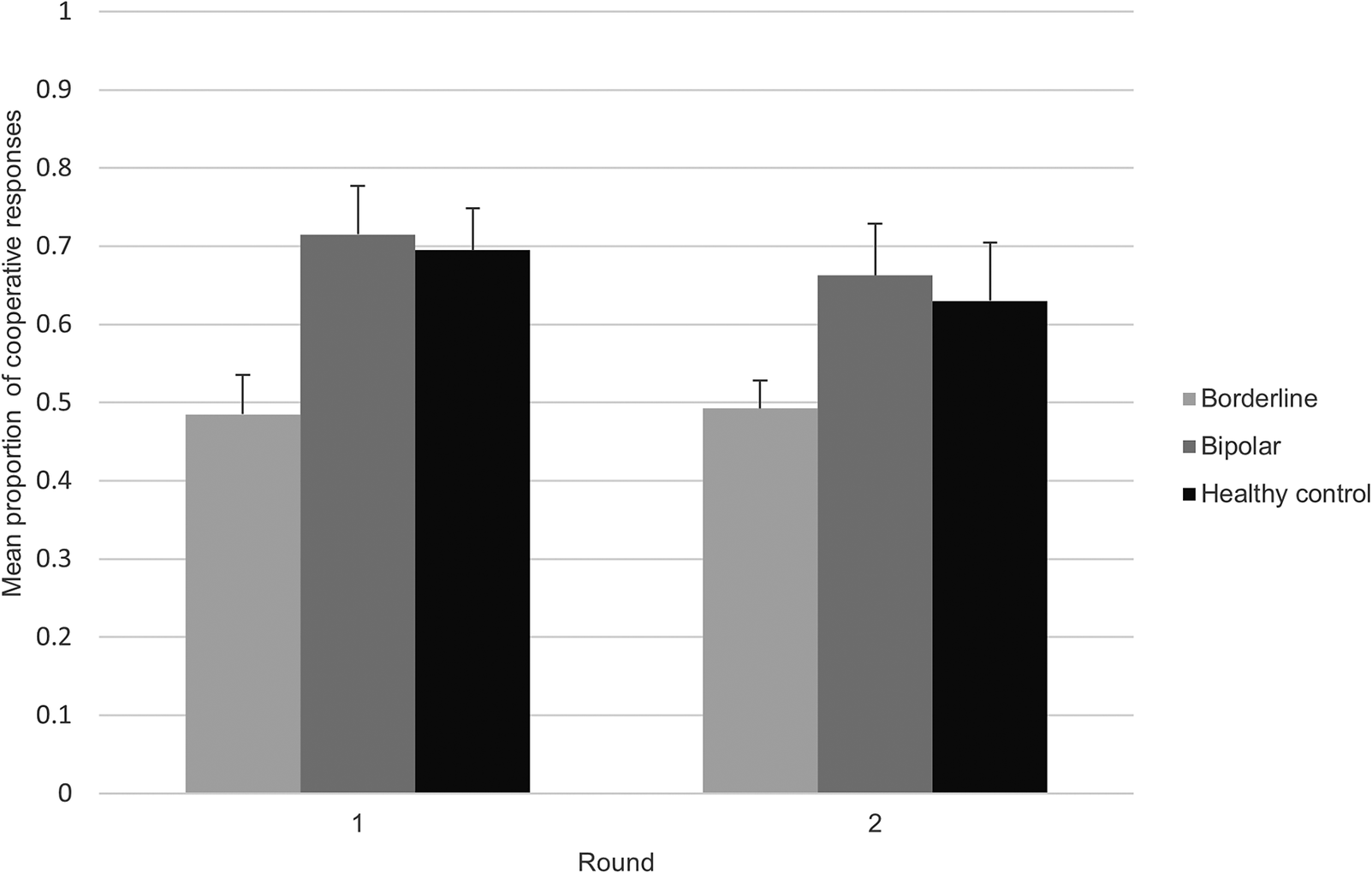
Mean proportion of cooperative choices (SE) of 20 individuals with DSM-IV borderline personality disorder (BPD), 20 (euthymic) individuals with DSM-IV bipolar disorder (BD), and 20 nonclinical healthy controls in two iterated Prisoner’s Dilemma games. In Game 1, playing partners opened with cooperative choices and then played (strict) tit-for-tat; in Game 2, playing partners opened with a defection and then played (strict) tit-for-tat.

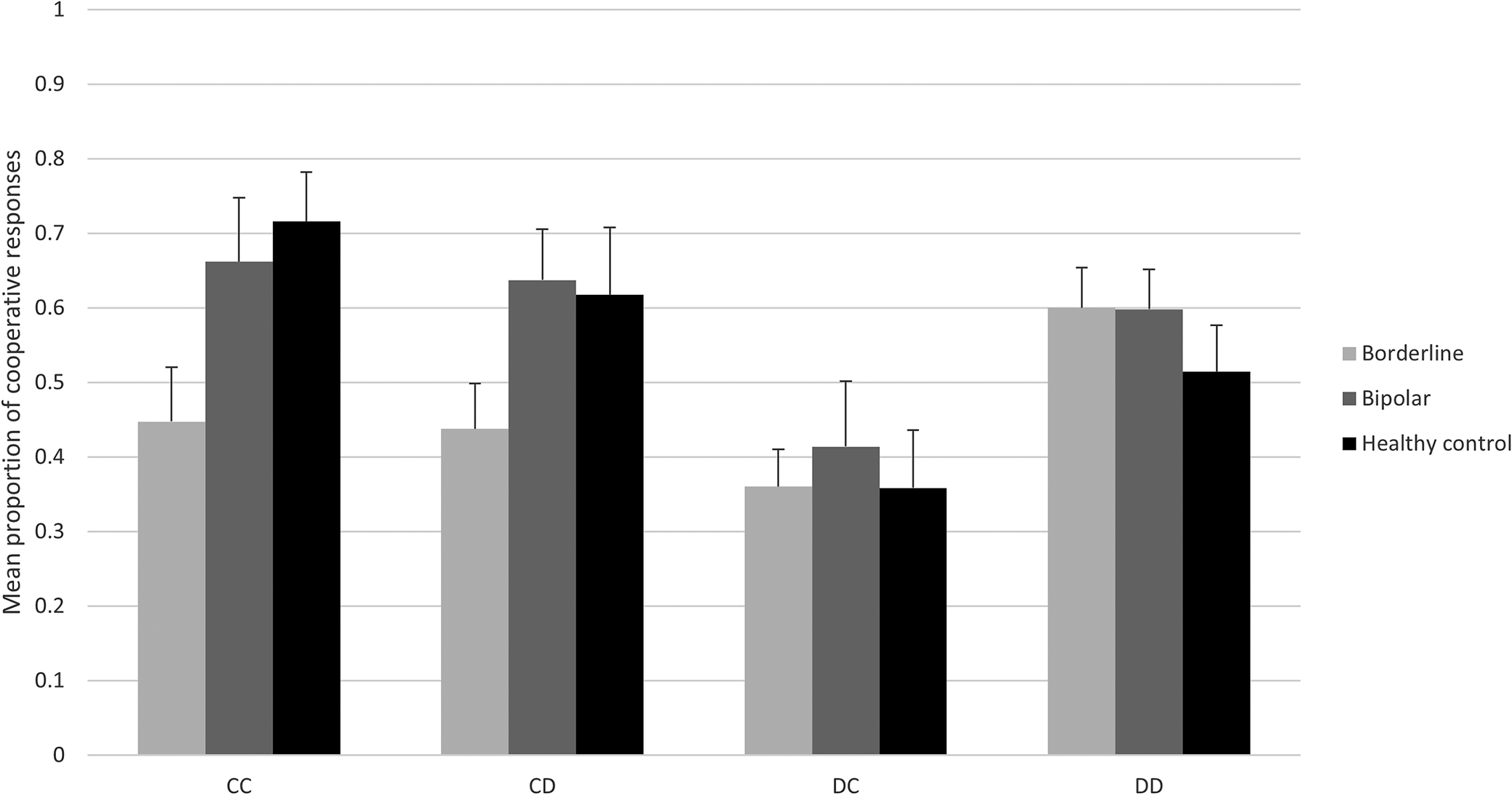
Mean proportions of cooperative choices (SE) following each of the four possible outcomes of the previous round of iterated Prisoner’s Dilemma games in 20 individuals with DSM-IV borderline personality disorder (BPD), 20 (euthymic) individuals with DSM-IV bipolar disorder (BD), and 20 nonclinical healthy controls (CC, both players cooperated [mutual cooperation]; CD, participants cooperated while partners defected; DC, participants defected while partners cooperated; or both players could defect [mutual defection, DD]).

A statistical test was reported inaccurately. The between-group test of participants receiving psychological treatments was reported as χ 2(1) = 6.144, p = 0.038 but should have been χ 2(1) = 4.286, p = 0.038. We represent the corrected data analysis below.
We thank Dr. Benjamin Kuper Smith from the University of Zurich for his inquiry, which prompted the reextraction of the original data. The authors thank the journal for the opportunity to update the scientific record.
The dataset for this analysis is available on OSF at: https://osf.io/4ap95/overview?view_only=6d8cfb411a8e454eaf8722be034cecd4.
Iterated Prisoner’s Dilemma game
BPD participants made significantly fewer cooperative responses while playing the two iterated PD games compared with the BD and healthy control participants (see Figure 2; F[2,57] = 4.853, p = 0.011). Post hoc Tukey tests showed that the BPD participants cooperated less frequently (0.4888 ± 0.0324) than both of the BD participants (0.6888 ± 0.0612) and controls (0.6625 ± 0.0548), p < 0.05. By contrast, a second post hoc Tukey test revealed there was no difference in the proportion of cooperative responses in BD participants compared to the controls (p = 0.903).
Both the BD participants and to a lesser extent, the healthy control participants tended to make fewer cooperative responses on the second game (in response to their playing partners’ opening defection) compared to the first game (in response to their partners’ opening cooperation) (0.72 ± 0.062 vs. 0.66 ± 0.066 [t(19) = 2.174, p = 0.043] and 0.70 ± 0.054 vs. 0.63 ± 0.075 [t(19) = 0.696, p = 0.495], respectively). However, the BPD participants’ cooperative responses did not markedly change between the first and the second game (see Figure 2; 0.49 ± 0.050 vs. 0.49 ± 0.035 [t(19) = 0.106, p = 0.917]). One-sample t-tests against a baseline of 0.5 confirmed that both the BD participants and HCs tended to cooperate more frequently than they defected across the two games, t(19) = 3.086, p = 0.006 and t(19) = 2.968, p = 0.008. By contrast, the proportions of cooperative responses in the BPDs were no greater than chance, t(19) = −0.347, p = 0.732.
Figure 3 shows the proportion of cooperative responses following each of the four possible outcomes on the immediately preceding rounds of both games: CC (both players cooperated), CD (participants cooperated while partners defected), DC (participants defected while partners cooperated), and DD (both partners defected). BPD participants were less likely than the BD participants and the healthy controls to cooperate following mutually cooperative outcomes on CC trials, but this was not statistically significant (F[2,57] = 2.552, p = 0.087). In addition, the BPD participants tended to be less likely to cooperate following trial outcomes in which they cooperated while their partners defected on CD trials; this was also not statistically significant (F[2,57] = 2.730, p = 0.074).
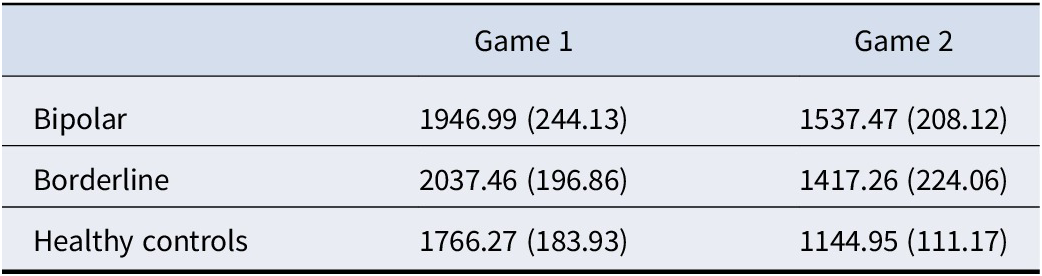
Overall, participants were faster to make their choices in the second PD game than the first game (F[1,57] = 46.130, p < 0.001) (see Table 2). Participants were also slightly (and non-significantly) faster to cooperate than defect (F[1,52] = 1.468, p = 0.231). There were no significant differences between the three groups in the times needed to decide to cooperate (F[2,57] = 0.752, p = 0.476) or defect (F[2,52] = 0.301, p = 0.741). The BPD participants finished the two PD games with smaller winnings compared to the BD participants and the healthy controls (£13.03 vs. £13.98 and £13.95, respectively), where consistent cooperative behavior would have yielded maximal winnings of £15.60. However, this reduction in the BPD winnings was not quite significant, F(2,57) = 2.957, p = 0.060.
Mean deliberation times (ms) for decisions to cooperate or defect across two iterated Prisoner’s Dilemma games in 20 individuals with DSM-IV borderline personality disorder (BPD), 20 (euthymic) individuals with DSM-IV bipolar disorder (BD), and 20 healthy controls

Finally, there were no significant associations between the proportions of cooperative responses on the one hand and trait scores of either impulsivity (BIS-11) or aggression (AQ) on the other hand within either the BPD or the BD groups, all rs < ± 0.2. Age was positively but only weakly associated with increasing cooperation across all groups (combined, r = 0.139, p = 0.291) and does not explain the differences between cases and control groups.