





Introduction
Authoritarian regimes are complex political systems. A key aspect of this complexity lies in state–society relations, including how regimes engage with civil society and civic activism. While early scholarship often portrayed authoritarian rule as relying primarily on coercion and propaganda, recent literature offers a more nuanced view of autocracies. This shift underscores the need for more detailed analysis of various political and non-political actors in authoritarian regimes and the way they operate and interact (Przeworski Reference Przeworski2023).
This paper investigates civic activism in authoritarian regimes, with particular attention to the role of the middle class. Historically, both civil society and the middle classes have played a crucial role in democratization studies. The middle class was seen as a fundamental precondition for democratization (Lipset Reference Lipset1959).Footnote 1 In the same way, observers considered civic activism as the first step toward political activism and societal mobilization leading to democracy. Contemporary scholarship, however, suggests that both civil society (Pietrzyk-Reeves Reference Pietrzyk-Reeves2022) and middle class (Chen Reference Chen2013; Wietzke and Sumner Reference Wietzke and Sumner2018; Rosenfeld Reference Rosenfeld2020) could play an ambiguous role in the process of democratization. At the same time, the discussion of their role in autocracies should not be limited merely to analyzing their potential contribution to democratic transition. Civic activism could have a variety of functions in an authoritarian system, some threatening the regime and some (directly or indirectly) supporting it. Understanding the mechanisms triggering this activism is, therefore, an important task.
A large literature links higher levels of civil activism to the middle class and examines the reasons why its members engage in civic activism. The focus of this paper is on another, less frequently studied topic: the mobilizing capacity of the middle class. Do other groups (i.e., non-middle-class members) follow the middle class in their civic engagement? What are the mechanisms for this contagion effect? If the middle class possesses a strong mobilizing capacity, the resulting changes in behavior of the non-middle classes could turn out to be even more significant – politically and socially – than the actions of the middle-class members themselves.
We examine the mobilizing capacity of the middle class in civic activism using a unique survey conducted in Moscow, Russia, in December 2021. Our analysis has two components. First, we conduct a pre-registered conjoint experiment in which respondents are asked how they would react to an invitation from a hypothetical neighbor to participate in various forms of civic activism.Footnote 2 This design allows us to randomly assign characteristics of the neighbor to each respondent, enabling a causal estimate of the effect of these characteristics.Footnote 3 We then test whether middle-class members can, in fact, mobilize non-middle-class individuals to engage in civic activism. Second, we leverage the fact that our respondents reside in different neighborhoods (rayony) within the city of Moscow, which vary in their share of middle-class residents. One can plausibly conjecture that the larger this share, the more likely it is for non-middle-class residents to interact with middle-class individuals. If middle-class individuals are indeed capable of mobilizing non-middle-class individuals to participate in civic activism, the latter should be more likely to adopt behaviors similar to those of the middle class. We collect data on both hypothetical participation in civic activism and actual experience with civic activism, and we test whether areas of the city with a larger share of middle-class residents are characterized by different levels of inclination to engage in such activities.
Our paper contributes to several strands of research. First, in the broadest sense, we engage with the literature on the role of societal context in shaping political behavior (Przeworski Reference Przeworski1974; Huckfeldt Plutzer and Sprague Reference Huckfeldt, Plutzer and Sprague1993; Zuckerman Reference Zuckerman2005), offering a specific example of how societal context influences civic activism. Second, our study speaks to the literature on authoritarian politics and, more importantly, the societies of authoritarian states and their interaction with the regime (Simpser Slater and Wittenberg Reference Simpser, Slater and Wittenberg2018; Greene and Robertson Reference Greene and Graeme2019; Lankina Reference Lankina2023; Sharafutdinova Reference Sharafutdinova2023; Forrat Reference Forrat2024). We contribute to the growing literature on civic activism in autocracies by examining a highly relevant case – Russia – and investigating the mobilizing potential of the middle class. Third, we also add to the democratization literature, albeit indirectly. As noted above, civic activism should not automatically be viewed as an early step in democratization processes; however, there are instances when such a link exists. Our study speaks to the literature on the role of individual social groups in protests in autocracies (Boix Reference Boix2003; Ansell and Samuels Reference Ansell and David2014; Dahlum Knutsen and Wig Reference Dahlum, Knutsen and Wig2019). Fourth, the paper contributes to research on local politics in autocracies, including within-city spatial divisions. Large cities are highly complex entities that authoritarian regimes often find difficult to govern (Norton Reference Norton2024). They are also extremely heterogeneous, with different neighborhoods or spatial units being characterized by different political and social dynamics; Moscow is a prominent example of this heterogeneity (Gorokhovskaia Reference Gorokhovskaia2018). Nevertheless, research on within-city heterogeneity in autocracies – and its political and social consequences – remains limited.
The remaining part of the paper is organized as follows. The next section summarizes the main theoretical arguments of the study. The subsequent section introduces the Russian context, including the discussion of case selection and local politics. The following sections describe our methodology and summarize the results. The final section concludes.
Civic activism and the middle class in autocracies
Civic activism in authoritarian regimes
While historically civil society has been studied in conjunction with the process of democratization, recent scholarship criticizes this approach as overly simplistic (Pietrzyk-Reeves Reference Pietrzyk-Reeves2022). A vast literature on authoritarian civil societies demonstrates complex and contradictory patterns of their interaction with the regime (Spires Reference Spires2011; Lewis Reference Lewis2013; Teets Reference Teets2014; Sombatpoonsiri Reference Sombatpoonsiri2020). Civil society can become a nucleus of resistance to an authoritarian regime, but it can also play an important functional role contributing to the legitimacy and the functioning of the regime. Civil society institutions can engage in the provision of crucial public goods (thus relieving the regime from this burden), participate in a dialogue with the regime (improving its governance), or even support mobilization in favor of the regime (Lorch and Bunk Reference Lorch and Bunk2017). In the latter case, the regime does not need to resort to coercive – and potentially unpopular – measures, as it can rely on the spontaneous self-organization of its subjects. Authoritarian regimes invest substantial effort into constructing a regime-friendly civil society or capturing the existing one (Teets Reference Teets2013; Kropp, Aasland, Berg-Nordlie et al. Reference Kropp, Aasland, Berg-Nordlie, Holm-Hansen and Schuhmann2017; Owen Reference Owen2020).
Similarly, recent research offers a more nuanced understanding of the role of civic activism in autocracies (Cavatorta Reference Cavatorta2012). On the one hand, civic activism can serve as a preparatory stage for political activism and thus positively influence the prospects for democratization. Civic activists – whether beginning with environmental protests or complaints related to urban planning – acquire organizational skills and experiences that are valuable for political mobilization (Yanitsky Reference Yanitsky2012). Disappointment with the government’s response can also prompt a shift from civic to explicitly political issues. On the other hand, civic activism can be captured by the authoritarian regime, which can use it to obtain information about the societal ills (Marquis and Bird Reference Marquis and Bird2018) and thus adjust its policy. Regime can also channel the dissatisfaction with the autocracy into less dangerous forms for the regime: rather than criticizing the system as such, activists could be encouraged to focus on specific policy problems. Activists themselves may have a strong preference for avoiding the politicization of their initiatives – either out of fear that it would reduce their ability to achieve their goals (due to lower state cooperation) or because they genuinely reject political objectives aimed at regime change.
The Russian case provides a number of prominent examples of how different forms of civic activism and civil society emerge in an authoritarian context and what consequences they have. On the one hand, there is an example of environmental protests (Evans Jr Reference Evans2012; Flikke Reference Flikke2021) that often crossed the boundary from civic to political activism, creating a highly persistent behavioral pattern that has continued even after 2022 (Holmgren Reference Holmgren2025). Several other high-profile forms of civic activism have also emerged (e.g., addressing urban planning issues, garbage disposal, reckless driving, or the use of recreational lands and forests), which in some cases evolved into political protests but in others remained purely non-political. On the other hand, a large segment of civil society in modern Russia provides bottom-up assistance to Russian troops in Ukraine and thus serves as an important pillar for the regime. Russia is also a notable example of regime engagement in the construction of civil society, for instance, through pro-Kremlin youth movements (Hemment Reference Hemment2015; Schwenck Reference Schwenck2023), which, however, should not be viewed merely as products of governmental engineering but rather as outcomes of more complex state–society interactions. A wide variety of civic activism in Russia has historically manifested itself in diverse forms and expressions (Morris, Semenov and Smyth Reference Morris, Semenov and Smyth2023; Morris Reference Morris2025).
In this paper, we focus on middle-class civic activism in an authoritarian context. Definitions of the middle class are numerous (Stearns Reference Stearns1979), yet most relate to two key characteristics of this group: education and relative wealth (distinguishing it both from the poor and from the elites). In our study, we treat education as the primary marker of middle-class status, although we also employ alternative approaches in the empirical analysis and draw on arguments emphasizing wealth in the theoretical discussion. Specifically, as a robustness check, we use a definition of the middle class combining educational traits and professional occupation.
While the middle class is certainly not the only source of civic activism, existing research suggests that it is particularly prone to such engagement (Egerton Reference Egerton2002; Chen and Suen Reference Chen and Suen2017). This is because middle-class members tend to have better access to information about opportunities for civic participation, greater knowledge of political and administrative processes, stronger verbal skills, and a generally more positive attitude toward the possibility of improving life through collective action compared to other social strata. From the perspective of relative wealth, the middle class also possesses greater resources for civic activism. Whether Russian civic activism is primarily driven by the middle class remains disputed (Bahry and Way Reference Bahry and Way1994; Sundstrom, Henry and Sperling Reference Sundstrom, Henry and Sperling2022); nevertheless, as Zeveleva (Reference Zeveleva2024) suggests, the middle class plays a pivotal role in at least some forms of societal self-organization. This connects to the ambiguous position of the middle class in Russian society more broadly: since the early 1990s, its development and role have been the subject of intensive debate (Ross Reference Ross2016; Gontmakher and Ross Reference Gontmakher and Ross2017), both from a sociological perspective – aiming to assess the size and characteristics of the Russian middle class – and from a political perspective concerning its role in the political sphere. Our study seeks to contribute to these ongoing discussions.
Middle class, democracy, and civic activism
Similarly to civil society, the middle class was historically seen as a crucial driver of democratization (the historical changes associated with the rise of the middle class and democratization, see, e.g., Glassman, William and Peter Reference Glassman, Swatos and Kivisto1993). The belief in the pro-democratic effects of the middle class was based on several proposed mechanisms: middle classes were expected to have greater desire for protection of human rights and private property (Doepke and Zilibotti Reference Doepke and Zilibotti2008; Tang Reference Tang2011; Cheeseman Reference Cheeseman2015; Glaeser and Steinberg, Reference Glaeser and Millett Steinberg2017; Wu, Chang and Pan Reference Wu, Chang and Pan2017),Footnote 4 to be more optimistic about politics and their ability to influence it in general (Hillygus Reference Hillygus2005; Glaeser, Ponzetto and Shleifer Reference Glaeser, Giacomo and Andrei2007; Sanborn and Thyne Reference Sanborn and Thyne2014; Chen and Suen Reference Chen and Suen2017), and to hold negative beliefs about the ability of an authoritarian regime to support the country’s development (Leventoglu Reference Leventoğlu2014). Yet, as with civil society, modern research shows that the assumption of the middle class’s inherent democratizing role is overly simplistic.
Numerous studies across the world document the existence of authoritarian middle classes – segments of the middle class that actively support authoritarian rule. First, the middle class itself can be a product of an authoritarian regime – shaped by its education policies or industrialization – and subject to its indoctrination. Second, the willingness of the middle class to embrace democracy depends on the extent to which its members rely on the government to maintain their standard of living and social status. Third, middle-class members may fear the chaos and instability associated with regime change, worrying that it could lead to the loss of their status and property (Jones Reference Jones1998; Chen and Lu Reference Chen and Lu2011; Chen Reference Chen2013; Garrido Reference Garrido2021). Fourth, in contrast to the arguments presented above, the middle class may prefer disengagement from politics over political or civic activism. Even when they favor democracy over authoritarianism, middle-class members may perceive political change as unattainable and therefore withdraw from any form of political involvement (Croke, Grossman, Larreguy et al. Reference Croke, Grossman, Larreguy and Marshall2016; Miao Reference Miao2016).Footnote 5
From this point of view, modern scholarship acknowledges that the middle class – similarly to the civil society – is highly heterogeneous (Tang, Woods and Zhao Reference Tang, Woods and Zhao2009; Zechmeister, Sellers and Seligson Reference Zechmeister, Laura and Mitchell2012; Resnick Reference Resnick2015). The ‘newness’ and the dependence on the state are among frequently mentioned characteristics of the middle class explaining its loyalty to an authoritarian regime or lack thereof (Gontmakher and Ross Reference Gontmakher and Ross2015; Nathan Reference Nathan2016; Rosenfeld Reference Rosenfeld2017, Reference Rosenfeld2020, Reference Rosenfeld2021; Nahmadova Reference Nahmadova2021). If the main source of income for middle-class members comes from public sector salaries or government transfers, their likelihood of engaging in activities that jeopardize the regime is low.Footnote 6 In resource-dependent states, government control over the allocation of rents also helps ensure the loyalty of the middle class (Bourguignon and Verdier Reference Bourguignon and Verdier2000; Jensen and Wantchekon Reference Jensen and Wantchekon2004). By contrast, individuals from families that have belonged to the middle class for generations are more likely to have internalized values associated with a stronger demand for democracy (Lankina Reference Lankina2021; Lankina and Libman Reference Lankina and Libman2021). Conversely, experiences of political instability tend to reduce middle-class support for democratization (Mazaheri and Monroe Reference Mazaheri and Monroe2018).
Thus, not every segment of the middle class is willing to participate in political protests demanding democratization. At the same time, loyalty to an authoritarian regime does not necessarily preclude middle-class groups from engaging in non-political civic activism. The middle class may view such activism as a means of addressing its problems – and improving its social status – within the framework of an authoritarian system, without creating risks of political instability. Libman and Kozlov (Reference Libman and Kozlov2017) refer to this type of engagement as compliant activism: citizens attempt to address the problems they face through channels explicitly approved by the regime, in some cases even strengthening the regime’s stability. The resources and informational capacity of the middle class may make it more inclined toward compliant activism than other social strata.
Still, the factors presented above could also deter the middle class from engaging in non-political civic activism. First, the boundary between political and non-political is often unclear; non-political protests can gain their own dynamics or be hijacked by political groups. Second, not all regimes look favorably at the non-political activism. For regimes insisting on complete depoliticization of their subjects (Gerschewski Reference Gerschewski2023), the costs of non-political activism could outweigh the benefits: the fact that subjects learn the mechanics of bureaucracy and politics, as well as develop some self-organization capacity, could be perceived as more dangerous than legitimacy and information gains. Middle classes loyal to the regime, anticipating this reaction, would refrain from civic activism altogether.
The mobilizing potential and the size of the middle class
The discussion so far has focused on the middle class’s own preference for civic activism. An equally important, yet much less researched, question is whether the middle class has the ability to influence the willingness of other social strata to engage in political or civic activism. There are arguments both for and against this possibility.
On the one hand, middle-class members have relatively high social status and therefore enjoy greater respect in society. Many occupy positions particularly conducive to promoting their worldviews – for example, as teachers. A large body of literature shows that people are more likely to follow the arguments of those with higher status, who are perceived as more knowledgeable and competent. Opinion leadership is ubiquitous in such diverse domains as online networks (Weeks, Ardèvol-Abreu, and Gil de Zúñiga Reference Weeks, Ardèvol-Abreu and Gil de Zúñiga2017), investment (Bursztyn, Ederer, Ferman et al. Reference Bursztyn, Ederer, Ferman and Yuchtman2014), or physician prescription (Nair, Manchanda, and Bhatia Reference Nair, Puneet and Tulikaa2010). For example, in advertising higher social status of the spokesperson increases the persuasiveness of the message (Block and Atkin Reference Block and Atkin1983; Bergkvist and Zhou Reference Bergkvist and Zhou2016). Members of the high-status groups are typically judged as more confident by those interacting with them (Phalet and Poppe Reference Phalet and Poppe1997; Fiske, Cuddy, Glick et al. Reference Fiske, Cuddy, Glick and Xu2002; Brambilla, Sacchi, Castellini et al. Reference Brambilla, Sacchi, Castellini and Riva2010). Psychological literature claims that there is a link between perceived social status and perceived competence (Fiske, Xu, Cuddy et al. Reference Fiske, Xu, Cuddy and Peter1999; Brambilla, Sacchi, Castellini et al. Reference Brambilla, Sacchi, Castellini and Riva2010). The perceived advantage of competence and higher position in the social hierarchy could make the non-middle-class members particularly likely to emulate the middle class (Paulhus and Morgan Reference Paulhus and Kathy1997; Van Ewijk and Sleegers Reference Ewijk and Peter2010).
On the other hand, it is also possible that the mobilizing potential of the middle class is constrained by the social distance between its members and other strata. The middle class can be perceived as distant from the problems of ordinary people or as primarily concerned with its own issues. The homophily argument suggests that people who are more similar to each other are likely to experience mutual sympathy and to perceive one another as more trustworthy (McPherson, Smith-Lovin, and Cook Reference McPherson, Smith-Lovin and Cook2001), and are thus more likely to emulate each other’s behavior. People are more strongly influenced by those whom they perceive to be similar to themselves or to share a common identity (Brock Reference Brock1965; Simons, Berkowitz, and Moyer Reference Simons, Nancy and John Moyer1970; Wilder Reference Wilder1990). From this perspective, members of the middle class, perceived as distant and disconnected, would have little impact on the behavior of members of other strata.
The authoritarian context can affect both of the logics discussed above. On the one hand, many autocracies deliberately use propaganda to sow dissent between individual social groups. In Russia, since the protests of 2012, the regime has actively stigmatized the kreakly (creative class) as a source of disloyalty, portraying them as indifferent to the real interests of the country.Footnote 7 This would reduce the mobilizing potential of the middle class. On the other hand, the hierarchical organization of authoritarian societies could strengthen the association between higher social status and mobilization capacity. Whether this latter consideration applies to Russia – which experienced a period of high instability in the 1990s, leading to a massive loss of status for many formerly privileged members of society – is questionable (Gerber Reference Gerber2000).
The size of the middle class by itself does not necessarily make its members more (or less) convincing to others. For example, a high school teacher in nineteenth-century Russia, where the majority of the population was illiterate, might have been perceived as a greater figure of intellectual authority than a modern Russian teacher, yet at the same time would have been much more distant from most Russians – and possibly even unable to articulate his ideas in language they could understand. However, if members of the middle class are indeed seen as more knowledgeable, and if their mobilizing potential is large, the behavior of non-middle-class members is likely to change to a greater extent when the share of the middle class in society is substantial. This is straightforward: the higher the share of the middle class, the more frequently non-middle-class members interact with them. As a result, the number of social situations in which the diffusion of values (Bisin and Verdier Reference Bisin and Verdier2022) and mobilization can occur increases.
At the same time, the size of the middle class is likely to influence the behavior of its members. First, larger middle classes can more easily create the organizational foundations for civic activism (Ju Reference Ju2004) – for example, by establishing forums, organizations, and networks – and can more effectively disseminate information about opportunities for engagement. In many autocracies, people are unaware of the opportunities available to them or of others engaged in similar activities (Oberschall Reference Oberschall1994). A more numerous middle class could help overcome this information constraint. Second, if the middle class is large, it is more likely to be taken seriously by the government when engaging in civic activism; otherwise, its position may be seen as fringe and ignored by the authoritarian state. This, in turn, would encourage middle-class members to become more active.
This brings us to the key theoretical expectations from our study. First, the middle class is more likely to engage in civic activism than other social groups (this could hold for the middle class connected to the state as well, since not all forms of civic activism in an autocracy are seen by the regime as problematic). Second, middle-class members are likely to be seen as more knowledgeable by other social strata, which would make them capable of mobilizing other social strata for civic activism. Third, in case the share of the middle class is large, it will lead to more numerous encounters between middle-class and non-middle-class members. Combined with the mobilizing capacity of the middle class, it could lead to a situation where, if the share of the middle class is large, the difference between the middle class and other strata will disappear – the latter will behave as the middle-class members. At the same time, if homophily is the decisive factor explaining civic mobilization, then we should expect members of the middle class to be more readily mobilized by other middle-class individuals. If the middle class is large, individual members of it will be even more active in terms of civic activism.
The case of Russia and the city of Moscow
Local politics and civic activism in an authoritarian city
Authoritarian cities often receive particular attention from regimes and are beneficiaries of redistribution aiming to increase the regime’s legitimacy and support (Wallace Reference Wallace2013; Glaeser and Steinberg Reference Glaeser and Millett Steinberg2017). In the last decades, the result of this attention was the phenomenon of global authoritarian cities (Koch Reference Koch2022), serving as showcases of the regime; historically, it supported migration from the periphery to the cities, which in itself became a challenge for many regimes. Capital cities are particularly important in this context, and autocracies employ a plethora of strategies for controlling these cities and co-opting their population (Goodfellow and Jackman Reference Goodfellow and Jackman2020). Some regimes prefer to move the center of power into new capital cities (Shelekpayev Reference Shelekpayev2018); others invest significant effort into managing the old capitals.
The attractiveness and expansion of authoritarian cities (and capitals in particular) lead to substantial heterogeneity within these cities (Bogaert Reference Bogaert2018). Different communities benefit from authoritarian redistribution, adapt to the regime-driven change of the urban landscape, or initiate these changes themselves to a different extent. This within-city variation is important for two reasons. Conceptually, it can lead to the variation of local politics within an authoritarian city.Footnote 8 City neighborhoods offer natural spaces for emergence of local activism, with people connecting to each other to solve their common problems (Elwageeh, Kleinhans, and van Ham Reference Elwageeh, Kleinhans and van Ham2023; O’Connor Reference O’Connor2025). Furthermore, at least in some cities, some forms of officially sanctioned neighborhood governance exist. In some cases, authoritarian regimes allow some level of pluralism in these governance institutions to facilitate the resolution of urban problems (Xia and Guan Reference Xia and Guan2020).Footnote 9 These governance institutions, as well as the boundaries between city districts, affect the ability of an authoritarian regime to exercise political control in the city. They also influence whether the regime can benefit from spontaneous self-organization of the society. The social composition of a neighborhood is likely to have an important impact on the self-organization of its residents, but also on the attention it receives from the government and the benefits (or costs) from redistribution.
Yet another reason why within-city variation is important from the researcher’s point of view is a methodological one. One can leverage this variation to test the general implications of the theories of authoritarian politics reducing unobserved heterogeneity. Pepinsky (Reference Pepinsky2019) points out that there is a trend toward increasing attention to single-country case studies in political science, driven by the better comparability of sub-national units. Within-city comparison is likely to be even more attractive in this context if the data are available (Vasilyeva and Libman Reference Vasilyeva and Libman2024).Footnote 10
Russia and Moscow as empirical cases
Both the Russian Federation and the city of Moscow provide interesting case studies for our analysis. There are two reasons why studying the mobilizing capacity of the middle class in Russia is important. First, Russia is a highly prominent case of a resilient authoritarian regime, which in the last twenty-five years demonstrated a significant level of adaptation and transformation (Gel’man Reference Gel’man2015; Frye Reference Frye2021). Civic activism, as mentioned above, has been both a problem for the Russian regime in some cases and an important resource the regime could have used in others. Second, Russia is among the rare examples of modern authoritarian states with large educated strata and an urbanized population (Paneyakh Reference Paneyakh2018; Rogov Reference Rogov2018). Understanding the role of civic activism and the middle class in such a context is particularly important.
The city of Moscow is interesting to us for several reasons. It is a good example of both authoritarian cities attracting substantial resources, money, and power, and becoming showcases of the regime. Before 2022 (and to some extent even after it), Moscow was particularly characterized by a high standard of living and prevalence of modern international lifestyle (Kolossov and O’Loughlin Reference Kolossov and O’Loughlin2004). It is also a city with a very high level of education in the population and the key center of education and science in Russia. At the same time, it is a very large city (about 12 million people of official population and 2.6 thousand sq. km of territory) – as of now, the largest city in Europe after Istanbul. This provides an enormous heterogeneity of the city population, which could be leveraged for our analysis. Different parts of Moscow differ a lot in terms of the middle class presence: this is driven by the traditional settlement patterns (some parts of the city in the Soviet or even pre-Soviet era were home to major industrial facilities and had higher working-class populations; others specialized in education, science, or service sectors),Footnote 11 by differences in the environmental conditions and quality of housing. At the same time, all parts of the city share the same urban lifestyle; their population encounters problems more similar to each other than those of people living in different regions of Russia.
The administrative division of Moscow can be traced back to 1991, when the city was divided into 10 administrative districts, which in turn consisted of more than 100 municipal districts (later renamed raiony). Initially, this division applied only to the city executive (the legislative bodies at the within-city level existed, but were organized within boundaries of the old Soviet districts); in 1997, local councils were created, which are elected by the residents of the raion.Footnote 12 The introduction of the new territorial division in 1991 signified a breach with the old Soviet division, with the city consisting of about 30 districts.Footnote 13 The boundaries of the municipal districts changed occasionally in the last 35 years, but these changes were marginal. The overall evolution of the local governance in Moscow was heavily influenced not only by the general logic of autocratization in Russia but also by the political dynamics in the city itself (where already in the 1990s the city mayor created a powerful political machine) (Bater, Degtyarev, and Amelin Reference Bater, Andrei and Vladimir1995; Furman Reference Furman1999). The political role of local councils changed over time as well: from more or less powerless entities populated by local bureaucrats to a brief period of politicization in the late 2010s, when the opposition managed to win the majority of votes in elections in some of the raiony (Gorokhovskaia Reference Gorokhovskaia2018).
For us, a more important feature of the city is that due to its size and complexity, many problems its residents face are localized. These localities do not necessarily coincide with the raion boundariesFootnote 14 . Still, raiony can be used as imperfect proxies for quantitative analysis. In the last decades, Moscow witnessed multiple instances of local civic activism, in particular related to the environmental problems, housing construction, and infrastructure (Shomina, Kolossov, and Shukhat Reference Shomina, Kolossov and Shukhat2002; Evans Reference Evans2018; Borisova, Smyth, and Zakharov Reference Borisova, Smyth and Zakharov2023). While the main attention in the literature is devoted to the most visible forms of this activism (protests), Muscovites engage in various other forms of civic activism as well. The determinants of the within-city variation in civic activism remain largely unexplored (although there exists a literature on the variation of civic activism across regions of Russia, see Semenov, Snarski, and Tkacheva Reference Semenov, Snarski and Tkacheva2024). This is closely related to the lack of empirical data on this topic. Our study ought to close this gap.
External validity
While focusing on within-city variation reduces the unobserved heterogeneity, it requires a discussion of the external validity of our findings. There are, in particular, four issues that should be addressed here:
-
First, the education level in the City of Moscow is higher than in many other authoritarian capitals of the Global South. The mobilization capacity of the less numerous middle classes may be different, as discussed above.
-
Second, Moscow has an institutionalized system of limited local self-governance. While Moscow is certainly not unique from this point of view (and can be compared, for example, to Chinese metropolitan cities), its experience cannot be automatically generalized to other cities where such a system is absent (and, for example, informal communities are much more important).
-
Third, the study was conducted in December 2021, when the planet was still in the COVID-19 pandemic. The risk of infection could have also affected the general willingness of Moscow residents to engage in various forms of civic activism.Footnote 15
-
Finally, fourth, the dominance of large residential buildings in Moscow is also not universal and could affect the patterns of civic activism.
While these concerns could identify some of the scope conditions under which the insights from Moscow could be relevant for different authoritarian cities, fundamentally, they do not negate the importance of Moscow as a highly interesting case and the fundamental deficit of research on the topics of this paper. And, in fact, from several perspectives, Russia appears to be a case representative for a rather broad class of authoritarian regimes. Russia in 2021 was a personalistic autocracy relying on controlled elections, targeted repression, and information control – this class of authoritarian regimes is widespread in the modern world (Levitsky and Way Reference Levitsky and Lucan2010; Reuter Reference Reuter2017; Guriev and Treisman Reference Guriev and Treisman2020); the levels of social capital and generalized trust were also similar to other electoral autocracies such as Cameroon, Kazakhstan, or Malaysia (Afrobarometer 2022; EVS/WVS 2022). From this point of view, despite the caveats mentioned, our results could be interesting beyond studying the specific Russian case.
Hypotheses
Our analysis is informed by several hypotheses. The first three concentrate on how individuals belonging to the middle class and the size of the middle class in a district affect individuals’ propensity toward civic activism. The first hypothesis is about an individual’s middle-class background: information advantage and larger resources ought to make such an individual more likely to engage in civic activism. The second and third hypotheses test the implications of the size of the middle class for the behavior of the middle-class members and non-middle-class members. The second hypothesis proceeds from the assumption that the share of the middle class in a district affects the behavior of its residents and makes them more likely to engage in civic activism. In particular, both middle-class and non-middle-class members will engage in civic activism to a larger extent if the share of the middle class in the district is large. The third hypothesis suggests that the effect of the size of the middle class on the middle-class members can be larger or smaller than on non-middle-class members. Therefore, in a district with a large share of the middle class we will observe either (a) a larger increase of civic activism from the middle-class members than from the non-middle-class members or (b) a larger increase of civic activism from the non-middle-class members than from the middle-class members (in this case, the extreme scenario could occur when differences between middle-class and non-middle-class members would disappear). We refer to these as positive and negative compound effects, respectively.
H1 Respondents belonging to the middle class are characterized by higher civic activity.
H2 An individual (regardless of her social status) is more likely to be characterized by higher civic activity if he/she reside in a district with a larger proportion of the middle class.
H3 Neighborhood middle class and belonging to the middle class have a positive compound effect on civic activism.
H3’ Neighborhood middle class and belonging to the middle class have a negative compound effect on civic activism.
Additional hypotheses allow us to focus on the specific mechanisms relating individual middle-class status, group-level middle class, and civic mobilization. In the previous section, we discussed possible drivers of differences between raions, some of which could be linked to the middle class, but others would not. Correspondingly, the conjoint experiment contains explicit hypotheses testing the mobilization capacity of the middle class. Specifically, we compare the extent to which middle-class members are seen as convincing by the non-middle-class members (while deciding whether to engage in civic activism). As mentioned above, members of the middle class are potentially seen as more competent and therefore have a stronger mobilizing capacity. However, members of the middle class could be distrusted for potentially having very different interests than members of other social groups. In this case, the smaller the social distance, the more likely people are to believe that their counterparts share the same interests and are willing to achieve the same societal goals.
This leads us to two pairs of hypotheses. The first pair identifies the relative mobilizing capacity of the middle-class members as opposed to members of other strata.
H4a An individual is more likely to be mobilized to engage in civic activism by someone from a similar social stratum.
H4b An individual is more likely to be mobilized to engage in civic activism by someone with a high social status.
The second pair explains specific reasons for the difference in mobilizing capacity; Hypotheses H4a and H5a, on the one hand, and H4b and H5b, on the other, are linked to each other.
H5a Someone from a similar social stratum is more likely to be perceived as having similar interests.
H5b Someone with a high social status is more likely to be perceived as more competent.
In addition to these main hypotheses, we also advance an additional Hypothesis H6, which focuses on the civic activism of the middle class employed in the public sector. As already discussed, in the democracy-and-middle-class literature, economic dependence on the state (associated with employment in the state sector) is often seen as the primary reason for the lack of support for democracy. For civic activism, this argument does not necessarily hold: civic activism is not necessarily punished by the regime, and the public sector employees may have an even bigger information advantage in terms of the functioning of the regime than other groups of the middle class, which would make them particularly prone to compliant activism. Nevertheless, it is also possible that the state-dependent middle class, being wary of possible incorrect interpretation of its actions, will still try to avoid any form of activism, civic or political. To our knowledge, for the Russian case, this link has never been explored, and therefore, we test the following hypothesis.
H6 Respondents belonging to the middle class and employed in the state sector are characterized by lower civic activity.
Data
Our empirical analysis is based on a conjoint experiment embedded in an online survey of $N = 2107$
inhabitants of Moscow conducted in December 2021.Footnote
16
In what follows, we present the key elements of the survey.
$N = 2107$
inhabitants of Moscow conducted in December 2021.Footnote
16
In what follows, we present the key elements of the survey.
Dependent variables
We use two types of dependent variables: those measuring the hypothetical willingness to engage in civic activism (these variables are extracted from a conjoint experiment described in greater detail below) and the actual self-reported experience of engagement in civic activism. In the main part of the study, we report the results for the hypothetical decisions, leaving the results for the actual experience in the Online Appendix. This is because hypothetical willingness to engage in civic activism can be used in both branches of our analysis: a conjoint experiment (linking the willingness to engage in civic activism to the characteristics of a hypothetical neighbor suggesting it) and a correlational study linking civic activism to the share of the middle class in the specific raion.
Fundamentally, both variables have flaws. With the actual experience of civic activism, we may face a larger problem of social conformity bias. The problem is exacerbated by the fact that, unlike political activism, where we would have expected the authoritarian context to downward bias the responses, for civic activism, the bias can go in both directions – the regime does not clearly discourage it, and there may be some pressure to identify oneself as having an active position and being responsible for the society. For the hypothetical activism, of course, the problem is that intent to engage in civic activism does not necessarily translate into action. At the same time, it threatens our results only in cases if the deviation between hypothetical and actual civic activism is correlated with the characteristics of the hypothetical neighbor (conjoint experiment) or the share of the middle class (correlational study). There are no ex ante reasons for it to be the case.
Hypotheses H1, H2, H3, H3’, H4a, H4b, and H6 deal with the willingness to engage in civic activism. In the conjoint experiment, we ask the respondents whether they would support each of the four different propositions by the neighbor: Signing a petition against a new highway in your district; Taking part in a protest action against a new highway in your district; Leaving a signature in support for someone else’s candidacy for your building’s homeowner’s council; and Leaving a signature in support for someone else’s candidacy for the position of a municipal deputy. The choice of options corresponds to the typical forms of civic activism observed in Moscow. One can notice that the first three forms of civic activism clearly have no political implications and focus on managing infrastructure or residential buildings; these are among the key problems residents of Moscow have to solve using civic action. The final option may have a political dimension, but, as mentioned above, it depends on the specific mode of operations of the municipal council. We refrain from offering additional options to our respondents to keep the survey feasible (respondents may find it difficult to think about a plethora of different options for civic activism if they have never engaged in them).Footnote 17
Hypotheses H5a and H5b concern the attitudes toward civic activists. Correspondingly, following each conjoint experiment scenario, we ask four questions about the neighbor described in the scenario. The first two of these questions deal with trust: Do you trust this neighbor? Do you think other neighbors will trust the neighbor? Two more questions deal with the specific reasons why the neighbor may or may not be trusted. The first of these two questions deals with the neighbor’s perceived competence: Do you think this neighbor is competent in questions related to your building of residence or district? The second question is about the congruence of the neighbor’s interests with those of the respondent: Do you think this neighbor’s interests are the same as yours? This way, we are interested in how the neighbor is evaluated along valence and position dimensions (Groseclose Reference Groseclose2001; Zakharov Reference Zakharov2009). All eight dependent variables in the conjoint experiment are standardized to make the standard deviation equal to 1.
Middle class, individual-level and raion-level
To test hypotheses H1, H2, H3, H3’, and H6, we correlate the responses of the survey participants with their middle-class status and the share of the middle class in the raion of their residence. In the main part of the analysis, we use education as the main criterion for identifying the middle class, treating as middle-class members those respondents who indicated that they have a university degree (i.e., higher education or PhD; students or individuals with incomplete higher education are not included). Furthermore, we implement a robustness check: acknowledging that education could be a simplistic measure for the middle class, similar to Rosenfeld (Reference Rosenfeld2020), we use the information on the individual’s higher education and employment to proxy for her middle-class status. The survey includes several open-ended questions to obtain the ISCO-08 classification of the respondent’s occupation. We code the respondent’s occupation as professional if her ISCO major group was 1, 2, or 3 (‘Managers’, ‘Professionals’, or ‘Technicians and Associate Professionals’). In this case, we consider respondents as middle-class members if they both have higher education and professional occupations. In the main part of the paper, results based on the educational definition of the middle class are reported; we indicate the robustness of the findings to adjusting the definition, including occupation.Footnote 18
Our raion-level dataset includes data from 125 raions of Moscow. We use demographic data from the 2010 Russian census, which does not cover 21 settlements of the so-called ‘New Moscow’ – previously mostly rural territories incorporated into Moscow in 2012.Footnote 19 We proxy the raion-level share of the middle class by the share of the population above 15 having a university degree; by adding it to our regressions, we capture the group-level middle class effects. Online Appendix F provides some qualitative examples of raions with a particularly high and a particularly low share of the middle class to offer an intuition for the factors driving the distribution of the middle class in Moscow and its potential political effects.
Neighbor attributes from the conjoint experiment
To test Hypotheses H4a, H4b, H5a, and H5b, we look at how civic participation is affected by the attribute levels in the conjoint experiment scenario involving interaction with a hypothetical neighbor. We vary several neighbors’ attributes that are relevant to their middle-class status. Higher education is either present or absent, one’s position at work is either managerial or subordinate, and we also vary one’s salary – either 20,000, 40,000, 60,000, 100,000, or 150,000 roubles per month. These values were selected to match the cutoff values for the individual income question in the survey. Individuals with manager positions had incomes of 60,000, 100,000, or 150,000 roubles only. In December 2021, the nominal exchange rate was around 73–74 Russian roubles per 1 USD. In addition, one could be employed either in state or private sector and be a neighborhood resident either for 1 year or 4 years. We also vary gender (male/female) and age (30, 45, and 60 years).
Empirical strategy
In the conjoint experiment, each respondent is presented with five scenarios, a total of 10535 scenarios that serve as our units of analysis.
Hypotheses H1, H2, H3, H3’, and H6 are tested using the following model:
 $${y_{il}} = \alpha + {b_1}{m_i} + {b_2}{M_i} + \delta {X_i} + \tilde \beta {\tilde X_{il}} + {\mu _l} + {\varepsilon _{il}},$$
where ${y_{il}}$
is the likelihood that individual
${y_{il}}$
is the likelihood that individual $i$
will react positively to a proposal from the hypothetical neighbor in vignette
$i$
will react positively to a proposal from the hypothetical neighbor in vignette $l$
,
$l$
, ${m_i}$
is individual
${m_i}$
is individual $i$
’s higher education,
$i$
’s higher education, ${M_i}$
is the percentage of residents with higher education in
${M_i}$
is the percentage of residents with higher education in $i$
’s district of residence,
$i$
’s district of residence, ${X_i}$
is the vector of control variables at the individual and district levels, and
${X_i}$
is the vector of control variables at the individual and district levels, and ${\tilde X_{il}}$
is the vector of dummy variables for the different levels of attributes (gender, age group, higher education, income group, works for state company, works in a senior position, and has lived 4 years, rather than 1 year, in the building) for conjoint experiment scenario
${\tilde X_{il}}$
is the vector of dummy variables for the different levels of attributes (gender, age group, higher education, income group, works for state company, works in a senior position, and has lived 4 years, rather than 1 year, in the building) for conjoint experiment scenario $l$
and individual
$l$
and individual $i$
.
$i$
.
Hypothesis H1 implies that ${b_1} \gt 0$
, and H2 implies that
${b_1} \gt 0$
, and H2 implies that ${b_2} \gt 0$
. To test Hypotheses H3 and H3’, we interact individual and raion-level higher education:
${b_2} \gt 0$
. To test Hypotheses H3 and H3’, we interact individual and raion-level higher education:
 $${y_{il}} = \alpha + {b_1}{m_i} + {b_2}{M_i} + {b_3}{m_i}{M_i} + \delta {X_i} + \tilde \beta {\tilde X_{il}} + {\mu _l} + {\varepsilon _{il}}.$$
Hypothesis H3 implies that ${b_3} \gt 0$
, while H3’ implies that
${b_3} \gt 0$
, while H3’ implies that ${b_3} \lt 0$
.
${b_3} \lt 0$
.
For the analysis of Hypothesis H6, we interact an individual’s higher education with a public sector employment dummy:
 $${y_i} = a + {b_1}{m_i} + {b_2}{M_i} + {b_3}{S_i} + {b_4}{m_i}{S_i} + \delta ^{\rm{\prime}}{X}_{i}^{\prime} + \tilde \beta {\tilde X_{il}} + {\mu _l} + {\varepsilon _{il}},$$
where ${S_i}$
stands for the individual
${S_i}$
stands for the individual $i$
working in the state sector and
$i$
working in the state sector and ${X}_{i}^{\prime}$
are the remaining individual and raion-level controls. Hypothesis H6 implies that
${X}_{i}^{\prime}$
are the remaining individual and raion-level controls. Hypothesis H6 implies that ${b_4} \lt 0$
.
${b_4} \lt 0$
.
For Hypotheses H4a, H4b, H5a, and H5b, we estimate the following model:
 $${y_{il}} = \alpha + \bar \beta {\bar X_i} + \tilde \beta {\tilde X_{il}} + \gamma {D_{il}} + {\mu _l} + {\varepsilon _{il}}.$$
Here, the vector ${\bar X_i}$
denotes those individual-level controls that have a counterpart among the attributes of the neighbor: gender, age group, higher education, income group, and employment in a state company. The vector
${\bar X_i}$
denotes those individual-level controls that have a counterpart among the attributes of the neighbor: gender, age group, higher education, income group, and employment in a state company. The vector ${D_{il}}$
denotes the similarities between the genders, ages, incomes, and education of individual
${D_{il}}$
denotes the similarities between the genders, ages, incomes, and education of individual $i$
and the neighbor in scenario
$i$
and the neighbor in scenario $l$
. The similarity between genders is 1 (same genders) or zero; the similarity between educations is 1 (both have higher education or both don’t have it) or zero; the similarity between ages is equal to the negative absolute difference between the age categories of individual
$l$
. The similarity between genders is 1 (same genders) or zero; the similarity between educations is 1 (both have higher education or both don’t have it) or zero; the similarity between ages is equal to the negative absolute difference between the age categories of individual $i$
and neighbor
$i$
and neighbor $j$
, taking values 0, −1, or −2, as there are three age categories; the income similarity is the negative absolute difference between income categories, taking values between −5 and 0.
$j$
, taking values 0, −1, or −2, as there are three age categories; the income similarity is the negative absolute difference between income categories, taking values between −5 and 0.
Hypotheses H4a and H5a imply positive coefficients in $\gamma $
, indicating that the individuals exhibit homophily: one is more likely to be mobilized by someone similar along various characteristics (age, gender, income, and education). Hypotheses 4b and 5b imply positive coefficients for the components of
$\gamma $
, indicating that the individuals exhibit homophily: one is more likely to be mobilized by someone similar along various characteristics (age, gender, income, and education). Hypotheses 4b and 5b imply positive coefficients for the components of $\tilde \beta $
corresponding to higher social status: higher education, higher income groups, and a senior position at work.
$\tilde \beta $
corresponding to higher social status: higher education, higher income groups, and a senior position at work.
For Hypotheses H1, H2, H3, H3’, H4a, H4b, and H6, ${y_{il}}$
are the likelihoods that individual
${y_{il}}$
are the likelihoods that individual $i$
will react positively to a proposal from the hypothetical neighbor in vignette
$i$
will react positively to a proposal from the hypothetical neighbor in vignette $l$
. For Hypotheses H5a and H5b,
$l$
. For Hypotheses H5a and H5b, ${y_{il}}$
are the trust toward the neighbor, assessment of their competence, and perceived similarity of interests with the neighbor. The dependent variables are coded from 0 (Definitely no) to 1 (Definitely yes); Difficult to say responses to the dependent variable question were treated as missing. All regressions are estimated using ordinary least squares. Standard errors are clustered at the raion level in models 1, 2, and 3, and at the individual level in model 4.
${y_{il}}$
are the trust toward the neighbor, assessment of their competence, and perceived similarity of interests with the neighbor. The dependent variables are coded from 0 (Definitely no) to 1 (Definitely yes); Difficult to say responses to the dependent variable question were treated as missing. All regressions are estimated using ordinary least squares. Standard errors are clustered at the raion level in models 1, 2, and 3, and at the individual level in model 4.
Results
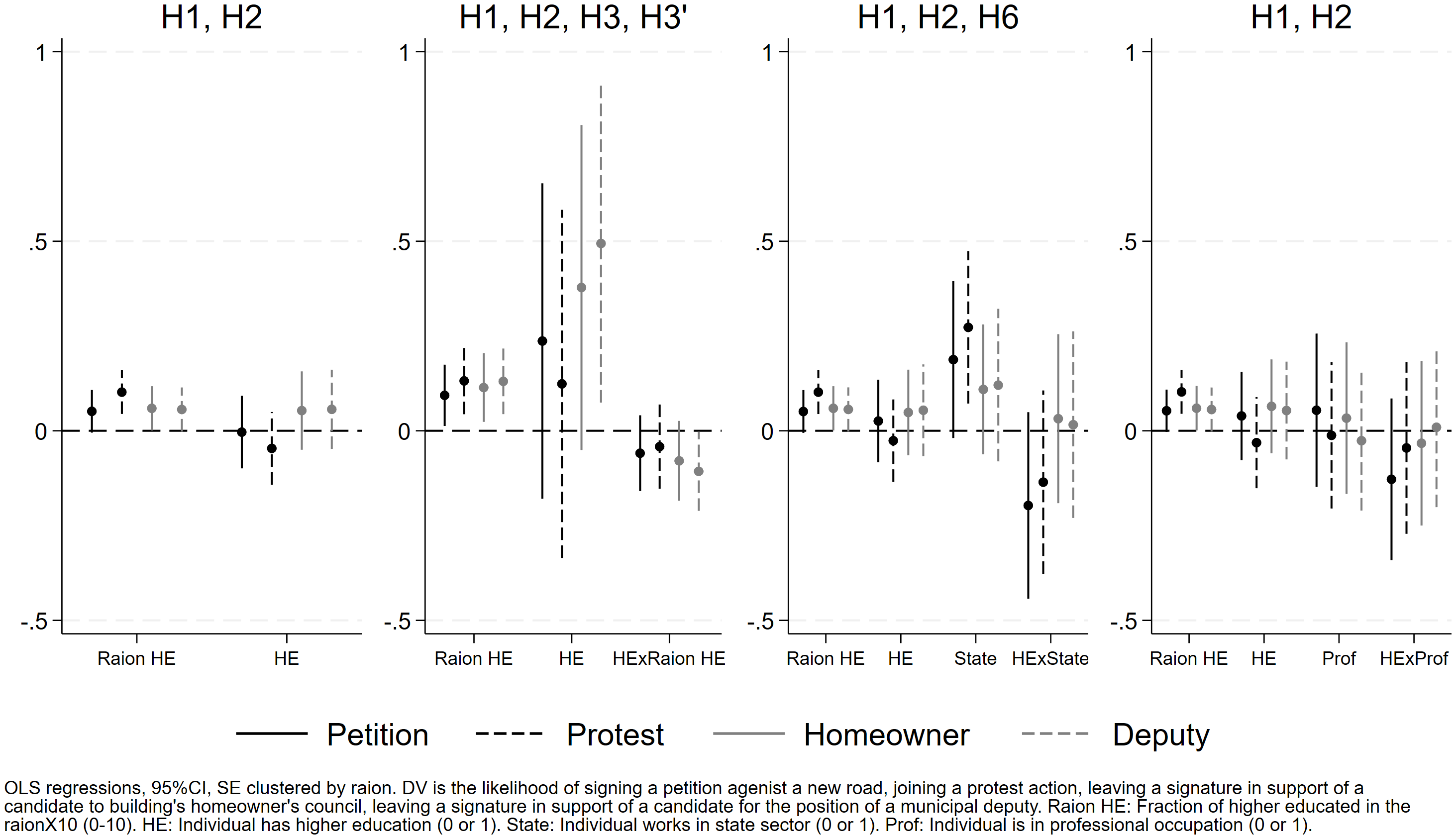
We first report the results for Hypotheses H1–H3 and H6. In the first panel of Figure 1, we report the main coefficients of interest for model (1), regressing individual and vignette-specific indicators of the willingness to engage in civic activism on the individual’s higher education and higher education in the raion. In the second panel, we report model (2), adding an interaction term between the two independent variables. The third panel reports model (3), where the association between higher education and activism can be different if the individual works in the state sector. Finally, in the fourth panel, we consider a variation of model (1) where we replace the proxy for the middle class based on education by one based on professional status.Footnote 20
The effect of raion-level and individual middle class on civic activism, hypothetical participation choices.
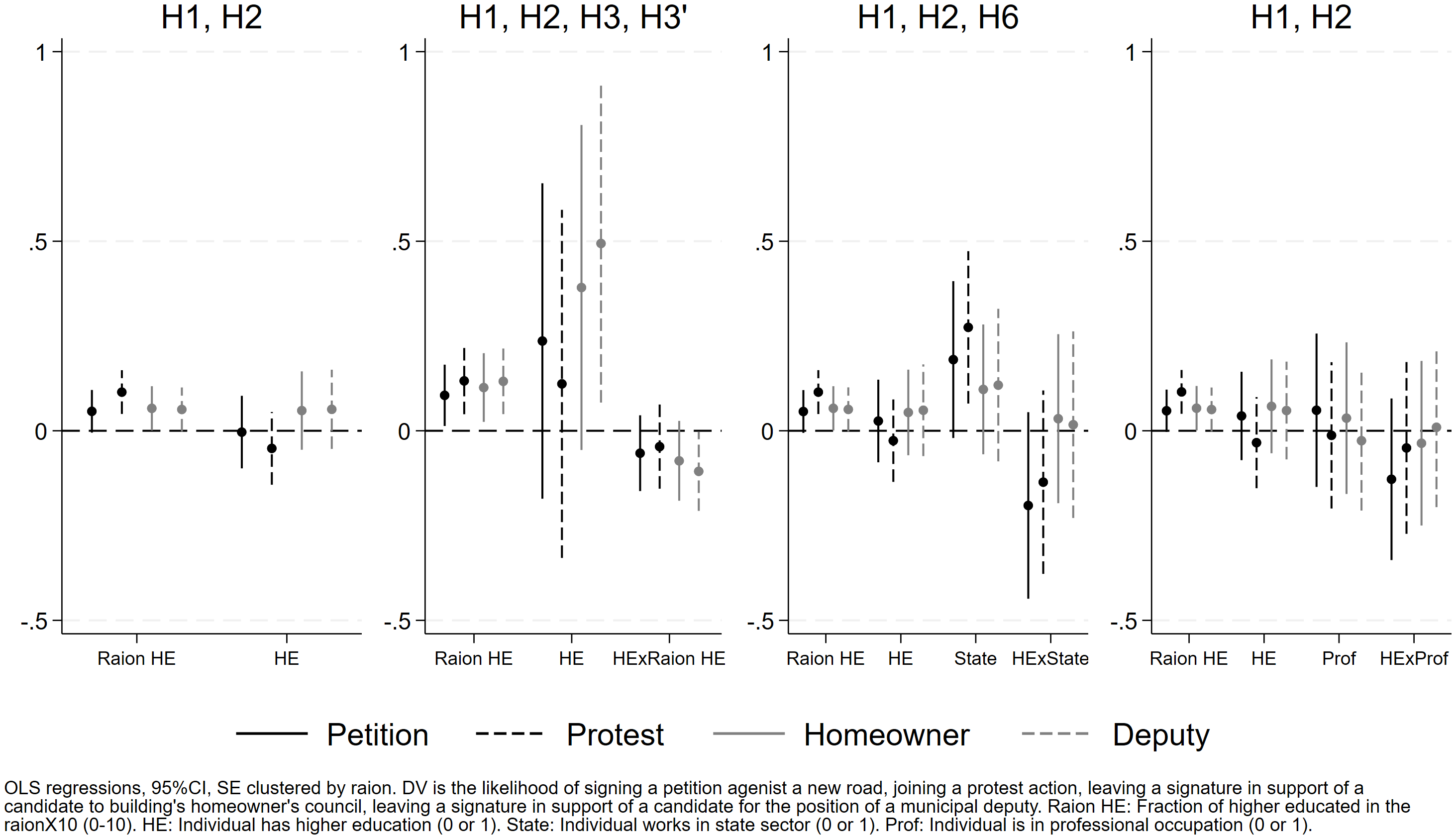
Hypothesis H2 is strongly supported. In the first, third, and fourth models, the share of the population with higher education in a raion (denoted raion HE in the figures) is positively associated with all four dependent variables. A 10% increase in the share of college-educated residents is associated with a 0.05–0.1 standard deviation increase in the dependent variables, with $p \lt 0.077$
for all twelve specifications.
$p \lt 0.077$
for all twelve specifications.
For Hypotheses H1, H3, and H6, we generally find no confirmation. An individual’s status as part of the middle class (denoted HE in the figures) is not associated with civic activism, as is evident from the first and last panels. In the second panel, we either find no effect for different levels of raion higher education, or a negative interaction term for one of the activism variables, lending some support to H3’; the interaction term is mostly insignificant though. At the same time, for two of our dependent variables, the marginal effects of individual higher education as estimated by model (2) are positive if the raion-level higher education is sufficiently low. For the intention to leave a signature in support of a municipal deputy candidate, the marginal effect of higher education is positive and significant at a 95% level if the share of higher educated in the raion is 36.2% or smaller; for the 90% significance level, the corresponding figure is 37.8%. These two figures correspond to the 29th and 40th percentiles of the share of highly educated (see Online Appendix Figure OA5 for marginal effects estimation). For the intention to leave a signature in support of a homeowner council candidate, the effect is significant at a 90% level if the share of higher educated in the raion is 36.2% or smaller. It means that individuals with higher education differ from those without higher education in terms of their willingness to engage in civic activism only in raions with a low share of the middle class. In raions with a high share of the middle class, the difference between individuals belonging to the middle class and not belonging to it is absent.
In the third panel, individual higher education is not associated with any of the civic activism variables for either state sector employees or others. Interaction of individual higher education with the raion-level share of the middle class is either not significant or, for the willingness to leave a signature for someone else’s candidacy for the position of municipal deputy, is negative with $p = 0.003$
.
$p = 0.003$
.
Being employed in the public sector similarly does not moderate the hypothetical willingness to engage in civic activism; public sector employees are more likely to show intention to engage in some forms of civic activism than other groups. This underscores the importance of distinguishing between civic activism and political activism in an authoritarian context – civic activism could be very much in line with the will of the autocrat.
In Online Appendix A.1, we report the results where the dependent variables measure the respondent’s actual experience of civic activism over the past three years. We find some evidence of positive correlation between individual- and raion-level middle class and engagement in civic activism, though the results are not robust to specifications and inclusion of controls. Furthermore, the evidence on the co-movement of the share of the middle class in a district and the hypothetical willingness to engage in protests is, unlike the previously reported findings, correlational, and endogeneity could threaten our results. We address this problem using an instrumental variable strategy, which is discussed in the Online Appendix ]A.2. The results corroborate our main findings.
Our findings suggest that, first, an individual from a raion with a higher share of the middle class is more likely to claim the willingness to engage in civic activism than an individual from a raion with a lower share of the middle class; and second, that in raions with a lower share of the middle class, an individual belonging to the middle class is more likely to claim willingness to engage in civic activism than an individual, who does not belong to the middle class (the last results holds only for some of the dependent variables). While Hypothesis H1 is not supported in our main regressions, in the auxiliary analysis, we find evidence that there are settings where middle-class members show a higher declared willingness to engage in civic activism than other individuals.
The result is in line with our theoretical reasoning. Assuming that middle-class members have strong mobilizing capacity, in the high-middle-class raions this would lead to the non-middle-class members behaving as if they were middle-class members. The overall social environment in these raions could also be more conducive to civic activism (infrastructure, organizational foundations, etc.). At the same time, if the share of the middle class is low and the encounters between the middle-class members and other individuals are less frequent, the non-middle-class individuals show more distinctive behavior from that of the middle class than they do in the high-middle-class raions. Under these conditions, we find a significant difference between the middle-class members and the non-middle-class members.
The analysis so far, however, merely speculated on the existence of the mobilizing capacity of the middle class, but did not provide any empirical evidence for it (i.e., we do not know yet whether middle-class members are seen as more convincing by people not belonging to the middle class). This issue is addressed in the conjoint experiment. The main results of the experiment are presented in Figure 2, which plots the estimated coefficients and 95% confidence intervals for model (4).Footnote
21
It is apparent that neighbors with traits that are characteristic of higher social status and are related to middle-class status are more likely to elicit civic engagement and are perceived as more trustworthy. For all eight dependent variables, a neighbor’s higher education is positive and highly significant. The attitude towards a neighbor’s proposition is 0.09–0.11 standard deviations higher if the neighbor had higher education, and the trust toward the neighbor, trustworthiness, and perceived competence and alignment of interests are 0.15–0.16 standard deviations higher, with $p \lt 0.001$
for all dependent variables.
$p \lt 0.001$
for all dependent variables.
Average effects of hypothetical neighbor attributes on civic action and attitudes toward the neighbor, 95% CIs.
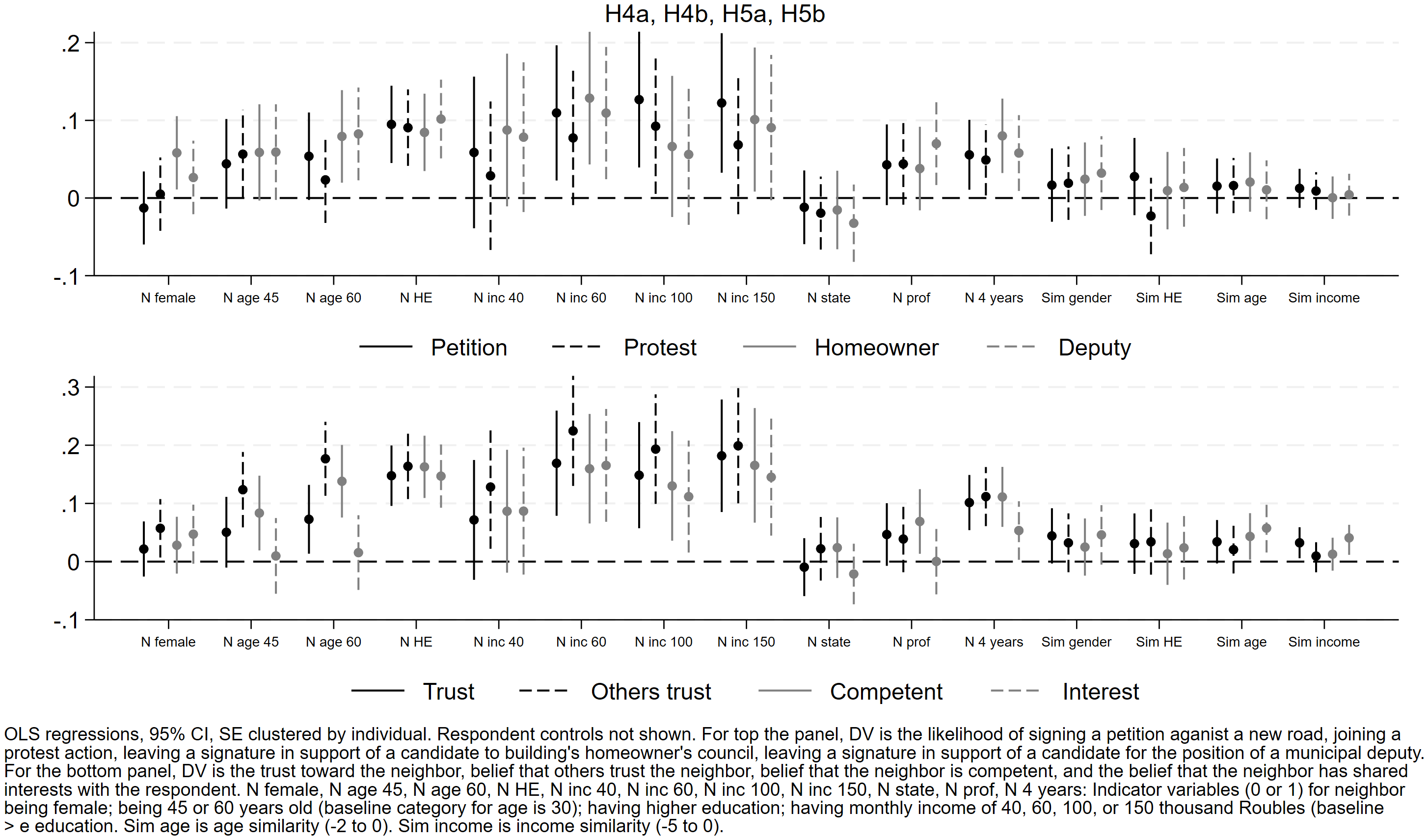
Likewise, a neighbor of a higher income is more likely to elicit civic engagement. The effect of the neighbor’s income is particularly strong on trust, trustworthiness, and perceived competence/shared interests: Increasing income to 60,000, 100,000, or 150,000 roubles per month from 20,000 roubles per month increases these variables by 0.11–0.23 standard deviations, with all effects significant at $p \lt 0.023$
. Younger individuals (age 18–34) are less likely to elicit civic engagement and are perceived as less competent and trustworthy than those belonging to older age groups. An individual in a senior position elicits a more positive response to one of the civic initiatives, is more trustworthy, and has higher perceived competence (these variables increase by 0.047–0.07 standard deviations,
$p \lt 0.023$
. Younger individuals (age 18–34) are less likely to elicit civic engagement and are perceived as less competent and trustworthy than those belonging to older age groups. An individual in a senior position elicits a more positive response to one of the civic initiatives, is more trustworthy, and has higher perceived competence (these variables increase by 0.047–0.07 standard deviations, $p \lt 0.09$
).
$p \lt 0.09$
).
This way, Hypotheses H4b and H5b are both supported in our data, with most results being robust accounting for multiple hypothesis testing (see Online Appendix A.3). Similar results are obtained if the model (4) is estimated without the similarity variables ${D_{il}}$
(see Table OA4 in Online Appendix).
${D_{il}}$
(see Table OA4 in Online Appendix).
Our findings generally do not support Hypothesis 4a. There is no evidence that being contacted by someone of similar age, income, education, or gender makes one more or less likely to engage in civic activism. Hypothesis 5a is supported: shared gender, and, especially, similar age and income, make one more likely to believe that the neighbor has shared interests. Similar income and age, and shared gender, are also important for whether the respondent trusts the neighbor, and a neighbor of similar age is perceived as more competent.
For none of our dependent variables, it mattered whether the neighbor worked in a state company or not (i.e., we refute the Hypothesis H6). Thus, the power of persuasion is unrelated to employment in the state sector, and the members of the potentially government-loyal middle class have the same ability to mobilize respondents as do members of the middle class employed in the private sector. Interestingly, respondents were more willing to follow those hypothetical neighbors who lived for a longer period of time in the current place of residence. This again may indicate the importance of competence and knowledge advantage for respondents in terms of deciding whether to join civic activism or not – in this case, it is the tacit knowledge acquired while living in a certain place.
Conclusion
The paper investigated the origins of civic activism in an authoritarian context, and, in particular, the role of the middle class in it. In the case of Moscow in December 2021, civic activism (or, at least, self-reported readiness to engage in civic activism) is strongly correlated with the share of the middle class in individual districts of the city. We also find that individuals see middle-class members as more ‘convincing’ when it comes to civic activism (and more convincing than the members of their own social group). This leads us to the following hypothetical mechanism: if the middle class is numerous, difference between middle-class and non-middle-class members disappears, as the latter are likely to engage in civic activism to the same extent as the middle-class members themselves. If the share of the middle class is small, there is some evidence that middle-class members are more likely to claim willingness to engage in civic activism than non-middle-class members.
There are several caveats with respect to the results of the paper we have to highlight. First, to validate the mechanism derived from the quantitative analysis, qualitative research tracing individual mechanisms based on extensive fieldwork would be beneficial. Unfortunately, in the Russian context, since February 2022, conducting such a qualitative study would be very difficult.Footnote 22 Second, we acknowledge the limits of the study in terms of external validity, which we discussed in the paper. From this point of view, our study is but a first step, hopefully encouraging further research on the role of the middle class and its mobilizing potential in the civic activism in autocracies.
Furthermore, the fact that our survey was conducted before February 2022 constitutes another constraint on the generalization of our results. Russian politics and society currently undergo dramatic changes. In particular, these changes affect the way how the government interacts with the civic activists and the spaces of possible and punishable. Large out-migration affects the social composition of urban centers. Unfortunately, empirical data on any of these processes are limited (even for such phenomena like the emigration of educated urban population, we have only tentative observations). While some of the patterns we observe in this article could have survived the change of the last four years, others possibly did not.
As a final remark, we have to point out the possibility of an alternative, and very interesting, theoretical framing of the results we reported in this paper. The pre-registered experiment and the observational study focused on the behavior of the middle class and its mobilizing capacity for other social strata. The observational component of our research project (differences between districts of Moscow) could be interpreted differently: districts, which are characterized by a high share of the middle class, could have stronger local communities, based on more intensive social connections and in possession of larger resources, both symbolic and material. The fact that longer residence in a district also correlates with involvement in civic activism fits this interpretation – it would mean that more established members of the local community are also more inclined to civic activism.
If that is the case, our paper should be seen as one demonstrating the differences in behavior of more integrated and robust local communities as opposed to less integrated (and possibly more heterogeneous) ones. This offers an avenue for further fascinating research.
Supplementary material
The supplementary material for this article can be found at https://doi.org/10.1017/S1475676525100613
Data availability statement
The data is published at the journal website as online supplementary material.
Acknowledgements
The authors are grateful to Paola Conconi, Diego Gambetta, Arye Hilman, Krzysztof Krakowski, Tomila Lankina, Bryn Rosenfeld, the participants of the research seminars at the Collegio Carlo Alberto, Nazarbayev University, Silvaplana Workshop for Political Economy, and the Midwest Eurasian Political Economy Workshop, as well as two anonymous referees. All mistakes remain our own.
Funding statement
None.
Competing interests
The authors report no conflicts of interest.
Appendix: Sample details and control variables
Sample characteristics: The sample was stratified according to gender and age group (18-29, 39-39, 49-49, and 50+) to match demographic distribution, and was limited to respondents who lived in Moscow since 2016 or earlier. This is done for two reasons. First, we exclude people who have spent a relatively short time in the city to minimize the influence of socialization effects. Second, and more importantly, before the local elections of 2017, almost all district councils in Moscow were controlled by the United Russia – the “party of power” loyal to Vladimir Putin. In 2017, the opposition managed to establish control over some of the district councils. As a result, some respondents moving to the city could have chosen specific districts to match their political preferences.
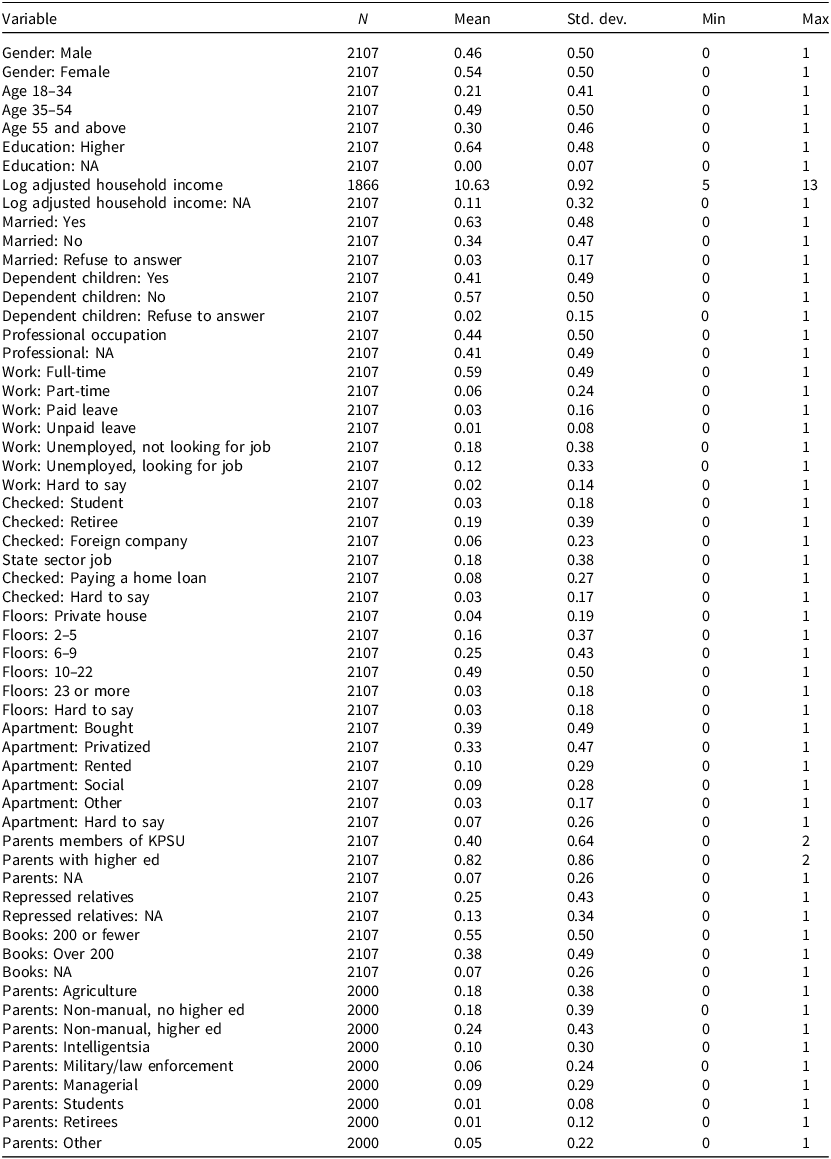
Individual control variables: Our analysis includes a broad range of individual-level controls. Demographic controls include the respondent’s gender, age category, whether the respondent is married or living with a partner, as well as whether the respondent has dependent children. As an income measure, we use the logarithm of household income divided by the square root of household size. We include variables indicating the employment status: Whether one works full-time, part-time, is on paid leave, unpaid leave, or is unemployed, looking, or not looking for a job. Other variables indicate whether one is a student, retired, works for a state-owned company or a foreign company, and is paying a mortgage. These variables could affect civic and political participation via the bargaining power of the state vis-à-vis the individual; they can be used to test whether state dependence changes the civic activism of the middle-class members. In particular, we expect that employees of state-owned enterprises and institutions could be more likely to face workplace intimidation in retaliation for undesirable civic activism. We also control for the number of floors in the individual’s building of residence, which can serve as a proxy for the size of a building and the strength of within-building social ties.Footnote 23 Multi-apartment buildings in Moscow vary a lot: while in the 1960s 5-storey buildings were typical, in the 1990s and the 2000s 20- to 30-storey buildings accommodating about 1,000 residents became more frequent. Smaller buildings are likely to be characterized by a greater level of social exchange. In addition, residents of 5-floor buildings are likely to have participated in deliberations related to the ongoing redevelopment program, leading to greater civic interactions (in 2017, the city government of Moscow decided to demolish older buildings from the 1960s and to resettle their inhabitants into new buildings; this decision triggered a wave of protests in the city). We also include variables indicating how the individual acquired the apartment – whether it was privatized by the respondents or their relatives (meaning that it was initially received from the state in the Soviet period and transferred to private property after the collapse of the USSR), was purchased, or is rented.
Several variables are used to control for the parental human and/or social capital. First, this is the number (0 to 2) of parents with higher education, and the number of parents who were members of the Communist Party of the Soviet Union (a variable arguably with strong influence on political attitudes and behavior, see Libman and Obydenkova, 2021). Second, similarly to Evans et al. (2010), we ask about the number of books the respondent had at their home at age 16, and include binary variables indicating whether the individual had 200 or fewer books and over 200 books. The composition of the family library could be an indicator of more intensive value transmission across middle-class generations. For descendants of the historical middle class, books served as a symbol of status (Lankina and Libman, 2021). Third, there is a dummy variable indicating whether one of the relatives was subject to Stalinist repressions. Fourth, there are indicator variables for the social strata (based on occupation) of one’s parents when the respondent was 16.Footnote 24
Raion-level control variables: We also consider several raion-level variables potentially confounding the effect of raion-level higher education. Larger communities might have stronger coordination problems and greater distance between elected officials and their electorates (Oliver, 2001). Therefore, we control for the log of the raion population. Given the increasing trend for within-city ethnic segregation in Moscow (Vendina, 2002; Shatilo, 2015; Kashnitsky and Gunko, 2016), we control for the share of the ethnic Russians, since ethnic minorities might be different in their civic and political behaviors. We control additionally for the share of the employed among the population 15 to 72 years old, since neighborhoods with a high proportion of employed residents might differ in terms of the amount of time and effort their residents can devote to civic activities as well as to their demand for local public goods.
Summary statistics, individual controls




 Open access

