

The study of policymaking has long captivated scholars in part because it reveals how governments respond to changing demands and challenges. Across the states, policymakers confront similar problems – budget shortfalls, public health crises, regulatory gaps – but they rarely arrive at solutions in isolation. Instead, they observe peers, weigh the successes and failures of neighboring experiments, and strategically adapt ideas to their own contexts. This interdependence lies at the heart of policy diffusion: It is not merely about the spread of “good” ideas or the mimicry of trends, but about the ways one government’s actions affect another’s actions. Rather than simply tracing patterns of policy adoption, diffusion pinpoints how one government’s policy decision reshapes the strategic calculations of another – making state choices inherently interdependent.
Policy diffusion research examines how the policy choices of one political entity influence another’s choices, whether that political unit is a state, city, or national government. Walker’s (Reference Walker1969) foundational work offered an early and enduring model of this influence, positing that geographic proximity – especially contiguous neighbors – could explain the spread of new policies across the American states. Building on that foundation, subsequent scholars have dramatically expanded the scope of diffusion research. Some studies trace how legislators attend conferences or receive policy toolkits that diffuse across state capitols; others show how federal mandates or incentives reverberate downward; and still others demonstrate how court rulings in one jurisdiction cascade through judicial networks. They have also explored the limits of diffusion, asking not only why some policies spread but why others fail to gain traction. In each case, diffusion demands more than parallel action; it requires demonstrable influence, a measurable mechanism by which one government’s decision raises – or lowers – the odds that another will act in kind. At its best, diffusion research helps reveal how the American states are not isolated policy islands but are embedded in an evolving web of relationships that shape their political behavior.
As the flagship journal of the state politics section, State Politics & Policy Quarterly (SPPQ) has been a consistent venue for diffusion research, publishing some of the field’s most important theoretical, empirical, and methodological contributions. From its earliest issues, SPPQ has served as a home for work that explores how states respond to one another, how scholars can best detect these patterns, and what these interdependencies reveal about the nature of policymaking in a federal system. That SPPQ has become a central venue for policy diffusion research is no accident: State politics scholars have long led the way in diffusion research. The 25th anniversary of the journal offers an ideal opportunity to reflect on that legacy.
This article reviews and synthesizes the journal’s contributions to the study of policy diffusion. We build our review around a close reading of all diffusion articles appearing in the journal since its inception. The nearly 100 articles that we identify – representing a fifth of all articles published in SPPQ – demonstrate the journal’s leading role in the study of policy diffusion. Building on Karch’s (Reference Karch2007, 56) observation that diffusion is “but a part of the larger process of adoption,” and drawing from Gilardi’s (Reference Gilardi2016) call to integrate questions of theory, measurement, and substance, we identify three types of diffusion articles appearing in the journal’s pages since 2000: those seeking specific theoretical advances, applying new methods or measures, and utilizing the tools of diffusion to understand the spread of specific policies. We identify major themes that appear within each grouping and, as appropriate, situate them within the broader literature. We find that diffusion studies in SPPQ push the field forward theoretically in innovative ways, broaden our understanding of diffusion by studying new policy areas, and fill in the gaps by reviewing long-standing and emerging methods or measures to improve empirical analysis.
Mapping the terrain of diffusion research in SPPQ relative to the broader literature helps us identify areas of strength. It also suggests areas for possible growth. For example, in developing our three theme areas, we also identify a sizeable fourth group of near-diffusion studies. These studies may focus on other questions but examine outcomes that appear ripe for possible diffusion effects. Incorporating diffusion into these studies would both strengthen them on their own terms and expand our knowledge about diffusion itself.
We hope this review serves as an entry point into the field of policy diffusion for students, scholars, and practitioners alike. In addition to providing an overview of cutting-edge research and emerging trends in policy diffusion through articles appearing in SPPQ, our aim is to encourage the next generation of work in three ways. First, we describe the types of articles that have been published in the journal and how they contribute to the broader study of diffusion. Second, we highlight areas in which the journal could expand its role. Third, we outline a substantial portion of articles that would benefit from a more direct consideration of diffusion effects. We look forward to the pages of SPPQ being filled over the next 25 years with original research that continues testing and refining policy diffusion theories and methods, provides for a better understanding and explanation of how intergovernmental influence shapes policymaking, and contributes to the development of more effective and responsive public policies.
Identifying articles about diffusion (and those that could be)
To begin, we set out to identify every article published in SPPQ since 2000 that examines policy diffusion or closely related topics. To construct our collection of articles, we used two complementary search strategies. First, we conducted keyword searches across the journal’s publishers’ platforms (Sage Journals and Cambridge University Press), scanning the full text of journal articles for “diffusion,” “policy diffusion,” “policy adoption,” and “innovation.” To ensure our list was as exhaustive as possible, we then reviewed the table of contents from every issue published beginning in 2000, visually inspecting the title, abstract, and keywords for studies that include policy diffusion, policy adoption, and policy innovation. These two strategies together yielded a total of 97 articles.
We read these articles in detail to get a sense of the landscape of the study of policy diffusion in SPPQ. In doing so, we whittled them down to 79 articles that engaged with policy diffusion research in a meaningful way or that fit the profile of diffusion studies without explicit consideration.Footnote 1 This latter group of articles includes, for example, event history studies that lack measures of cross-state influence. From this reading, three broad diffusion-related themes emerged, with advancements being made in applications to specific policies, theory, and measurement and methods. We assigned each article to one of the themes based on our subjective view of its primary contribution.Footnote 2 While these categories help organize the field, much of the most influential work resists clean classification – advancing theoretical, methodological, and empirical insights at the same time.
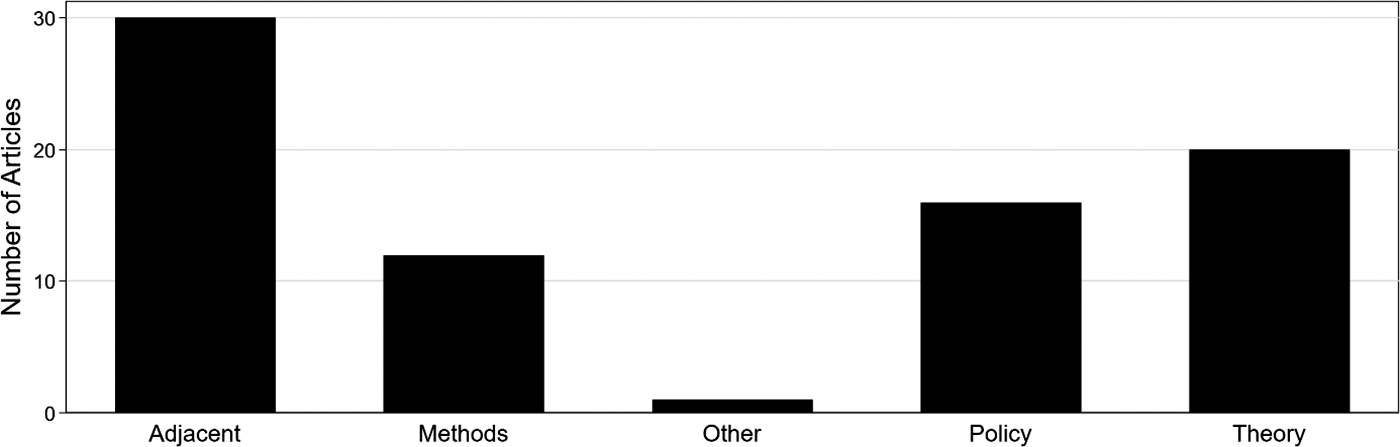
In Figure 1, we show that policy diffusion articles were spread across the four areas of primary contribution fairly evenly. The presence of 30 articles in the diffusion-adjacent category suggests that its contribution could be expanded even further if it were incorporated into these studies. Only one diffusion article ended up in the “other” category – this was the introduction to a special issue on policy diffusion in 2016. While most studies focus on the US states, scholars also explore diffusion among and between local, state, and national governments. And while the focus was almost always on the United States, at least one study examined federal governments and states in the United States and Mexico (Beer and Cruz-Aceves Reference Beer and Cruz-Aceves2018).
Diffusion articles in SPPQ by primary focus.
Note: Articles coded by diffusion topic focus area by authors. See text for details.

A sizable group – 20 articles – expanded or generated new theories, testing mechanisms in new arenas from court networks (Hinkle and Nelson Reference Hinkle and Nelson2016; Matthews Reference Matthews2024) to bureaucratic influence (Parinandi Reference Parinandi2013) and by exploring less frequently studied forms like vertical diffusion (Howell and Magazinnik Reference Howell and Magazinnik2020). Several expanded the scope of inquiry beyond initial policy adoption to examine phenomena such as the diffusion of policy reversals (Lowry Reference Lowry2005) or the spread of failed policies (Volden Reference Volden2016), offering a fuller picture of how intergovernmental influence can shape not only when but also how states disengage from or adapt past policy decisions.
A second group of 12 articles contributed methodological innovations. Some introduced more sophisticated estimation strategies, such as pooled-event history models (Kreitzer and Boehmke Reference Kreitzer and Boehmke2016) or Cox proportional hazards models (Jones and Branton Reference Jones and Branton2005), while others advanced the measurement of diffusion itself. For example, Mallinson (Reference Mallinson2016) proposed measuring the speed of diffusion for individual policies to better understand the pace of state policy adoption, and Seljan and Weller (Reference Seljan and Weller2011) directly surveyed policymakers to measure the flow of information between state actors – making interdependence observable rather than inferred.
Sixteen articles investigated whether specific policies had diffused across states, applying established theories to topics ranging from firearm regulation (Schiller and Sidorsky Reference Schiller and Sidorsky2022) to same-sex marriage bans (Haider-Markel Reference Haider-Markel2001), drug testing for welfare recipients (Gordon-Rogers Reference Gordon-Rogers2025), and voting reforms (Caron Reference Caron2022; Smith, Hill, and Ancheva Reference Smith, Hill and Ancheva2023). Across these policy domains, we noticed several thematic concentrations – most notably around moral and cultural issues, economic development incentives, and the role of interest group networks in shaping state-level policymaking. These issue clusters suggest that certain types of policies may be more likely to diffuse than others, potentially due to the salience of the issue, the presence of mobilized advocates, or the strategic value of adopting policies already implemented elsewhere.
The remaining 30 articles, while clearly concerned with state policy innovation, did not include measures of intergovernmental influence – what diffusion scholars consider the defining element of diffusion. We categorize these as policy adoption or diffusion-adjacent studies. These works often employed similar research designs and modeling techniques as diffusion research – discrete-time hazard models or cross-sectional time series – but their focus was purely internal: institutional configurations, political alignments, or socioeconomic characteristics. Although they lack the interdependent structure required for diffusion analysis, many mirror the theoretical concerns and empirical frameworks of the diffusion literature. Given that our primary aim was to identify policy diffusion, the articles we categorize as diffusion adjacent are likely an undercount of the total number of such articles published in the journal. We include these in our discussion because they demonstrate substantial missed opportunities for furthering our understanding of diffusion and raise awareness of its importance for research that may have overlooked the relevance of diffusion while pursuing other contributions.
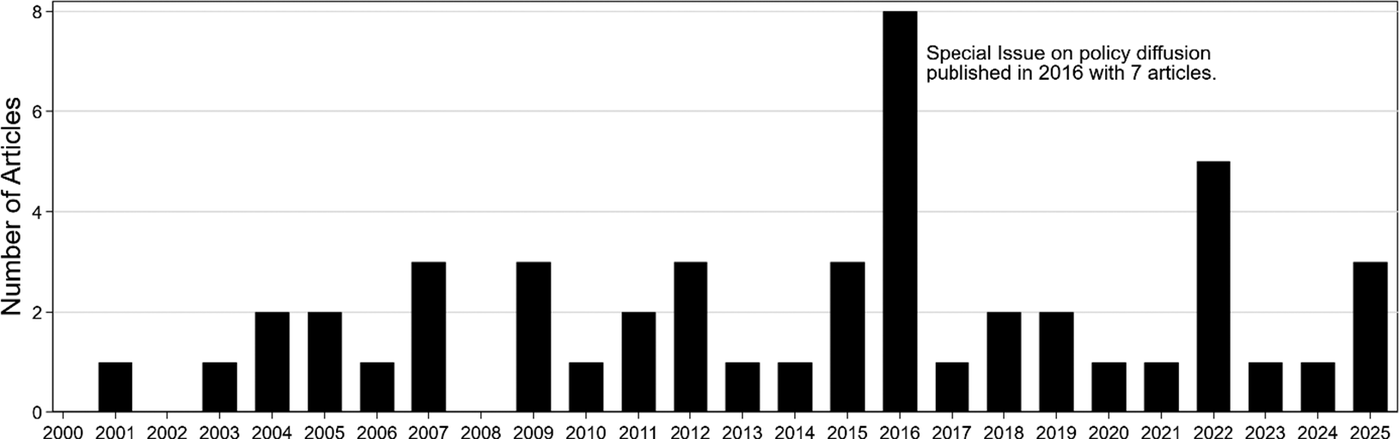
Not including diffusion-adjacent studies, articles on policy diffusion therefore account for about 11% of all research articles published in SPPQ since its inception; including diffusion-related articles takes this to nearly 18%.Footnote 3 That nearly one in five articles in the journal engages with questions related to policy diffusion or adoption clearly indicates the centrality of this topic within state politics. The number of policy diffusion articles fluctuates from year to year, as depicted in Figure 2 but reveals no substantial time trend, especially once we account for the high-water mark of eight articles in 2016. This peak results from the publication of a special issue on diffusion that included seven articles. The lack of a time trend may reflect the fact that the discipline had been studying policy diffusion for roughly half a century before SPPQ began and that the primary methodology for studying diffusion, event history analysis (EHA), had been introduced to the discipline nearly 10 years before that (Berry and Berry Reference Berry and Berry1990).Footnote 4
Diffusion articles in SPPQ fluctuate but appear consistently over time.
Note: Articles coded for diffusion content by authors. See text for details. Excludes articles coded as diffusion adjacent.

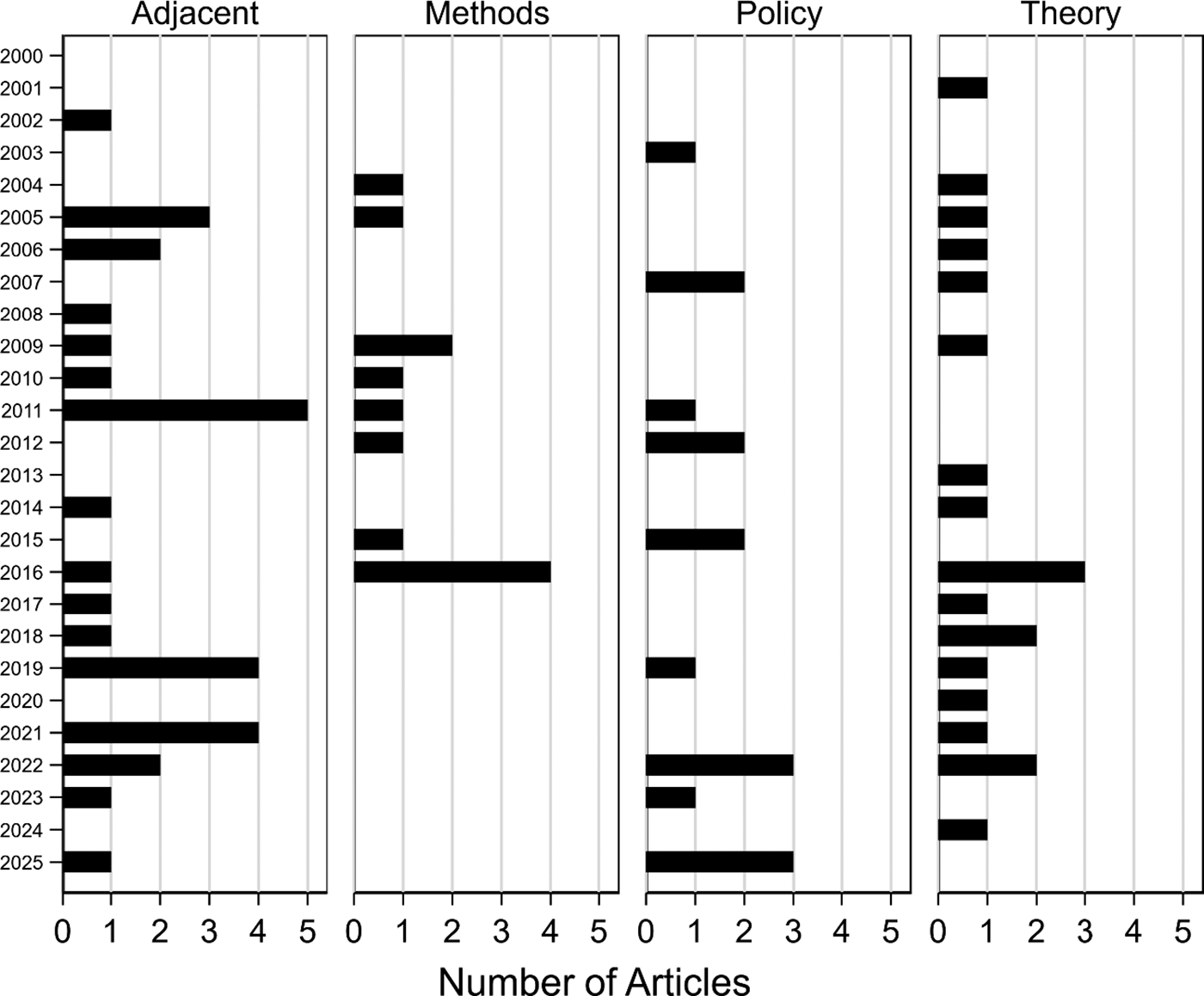
The balance of these contributions has also remained fairly consistent over time, as shown in Figure 3. The modal number of articles published in each of the four major categories per year is always zero or one. Further, for the three categories explicitly engaging with diffusion, there are only four years (out of 76 opportunities) in which more than two articles appear. In terms of time trends, none of the four areas of primary contribution shows a notable increase or decrease over time. Articles focused on specific policies and diffusion-adjacent studies appear consistently once – or occasionally twice – per year, with peaks of three and five articles in 2011 and 2022, respectively. Articles focused on methods and measures appear somewhat concentrated, with all of them appearing between 2004 and 2016 and 10 of the total of 12 published from 2009 to 2016. As we will see in the next section as we explore the content of articles, this period featured the introduction of methods and measures based on larger collections of policies.
Diffusion and diffusion-adjacent articles appear in SPPQ consistently over time.
Note: Articles coded by diffusion focus area by authors. See text for details. Figure omits the category “other,” which includes one article total.

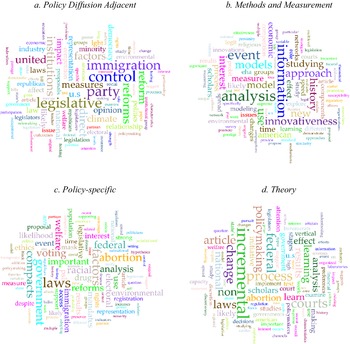
What did these articles focus on? In the following sections, we provide a close reading of the contents and contributions of each set of articles. Before doing so, and drawing inspiration from Frances Berry’s (Reference Berry2023) review of policy diffusion in political science and public management research, we create word clouds for each category based on the text of the abstracts. These word clouds, displayed in Figure 4, offer an at-a-glance sense of the categories, with the most frequently used terms visually dominating the space. The patterns are unsurprising in some respects – theoretical articles (bottom-right) cluster around terms like learning, incremental, and vertical, while methods articles (top-right) feature terms like analysis, models, and innovativeness. In each case, the clouds align impressionistically with the expected emphases, yet also hint at overlaps across categories.
Word clouds from diffusion articles’ abstracts.
Note: Includes the top 100 appearing terms from abstracts from articles in each of our four categories of diffusion focus. In clockwise order beginning in the top left: policy adjacent, methods, theory, and policy-specific studies. We exclude common stop words and omnipresent words like “diffusion,” “policy,” “adoption,” and “evidence.” Created using https://voyant-tools.org.

Taken together, these word clouds offer a quick visual shorthand for how diffusion research in SPPQ is distributed across our four categories. Yet, they are only a starting point. To understand the field’s development, and SPPQ’s role in shaping it, we must move beyond the surface of recurring terms to examine the substance of the scholarship itself. In the sections that follow, we take up each category in turn: studies that focus on specific policies, theoretical innovations, methodological advances, and policy-adjacent contributions that together define the contours of diffusion research over the past quarter century.
Why diffusion occurs: theoretical developments
Since 2000, SPPQ authors have pushed the boundaries of what we know about policy diffusion. As Gilardi (Reference Gilardi2016) observed, novel theoretical contributions to policy diffusion research have become increasingly difficult to achieve in recent years, yet SPPQ authors continue to innovate. These scholars expand our theoretical conceptions, generate new questions, and subject diffusion’s mechanisms to rigorous empirical tests. Informed by a variety of research designs, these articles make contributions to the diffusion literature itself (Gilardi Reference Gilardi2016).
SPPQ has nurtured two key avenues of theoretical progress in policy diffusion. First, scholars have probed the foundations of diffusion by isolating its underlying mechanisms. Second, others have pushed the boundaries of diffusion theory by introducing new actors, reconceptualizing diffusion as a process, and blending it with adjacent policy theories. We review each in turn.
Mechanisms of diffusion
We begin with the first avenue – explicit tests of diffusion’s mechanisms. Diffusion mechanisms explain why and how one state’s policy choices influence another’s choices. Although researchers propose many explanations, scholars identify four primary mechanisms: imitation, learning, coercion, and competition. Ten articles focus on testing these mechanisms.
The learning mechanism was the focus of many of the articles published in SPPQ. Learning is the process by which one government unit examines the actions of other states and assesses the benefits and risks associated with adopting that policy. Pollert and Mooney (Reference Pollert and Mooney2022) remind us that learning “is a long-used argument, but one that has only come under empirical scrutiny in recent years.”
Two articles attempt to crack open the black box of information to test the mechanism in direct and novel ways by asking how policymakers learn or what information legislators use when evaluating whether to adopt a policy in their home jurisdiction. Nicholson-Crotty and Carley (Reference Nicholson-Crotty and Carley2018) went to the source and asked state policymakers and bureaucrats which states they relied on for information. Matthews (Reference Matthews2024) turns to state supreme court citations and network analysis to directly test whether state supreme courts are learning from or imitating their sister state supreme courts. Pollert and Mooney (Reference Pollert and Mooney2022) go further, demonstrating that lawmakers internalize substantive policy lessons – design details, implementation pitfalls – but not mere symbolic gestures. And Nicholson-Crotty and Carley (Reference Nicholson-Crotty and Carley2016) add a crucial qualifier: Policymakers scout peers whose administrative capacities match their own.
Examples like these also reveal the limits of our typology. The categories we use are analytically useful but not mutually exclusive. Nicholson-Crotty and Carley (Reference Nicholson-Crotty and Carley2016), for example, are coded as primarily a contribution to methods and measures but also advance diffusion theory. Seljan and Weller (Reference Seljan and Weller2011) is likewise coded as a measurement article, yet it offers a meaningful theoretical contribution to the diffusion of information. Matthews (Reference Matthews2024) contributes in equal measure to theory and measures. These overlaps underscore how diffusion scholarship often advances multiple dimensions of the field at once.
Learning does not end with success stories. A second learning sub-strand shifts attention from successful adoptions to policy failures and reversals. As Pacheco (Reference Pacheco2017, 300) cautions, the policy process unfolds long before and after formal enactment. Several authors step beyond successful policy adoption restrictions to examine policies that were abandoned or later reversed. Volden (Reference Volden2016) finds that states – especially ideologically aligned ones – abandon laws that floundered elsewhere. While Lowry (Reference Lowry2005) reveals that policy reversals diffuse more slowly and nationally than initial adoptions. As these studies reveal, policymakers learn not only from others’ successes but also from their missteps. These insights remind us that diffusion involves a continuous feedback loop of adoption and rejection.
While these studies sharpen our view of how policymakers learn, other theoretical strands analyze the competitive and coercive underpinnings of diffusion. Turning to competitive and coercive pressures, Pacheco (Reference Pacheco2017) offers a theory that states compete when policies impose clear costs, yet free-ride when positive spillovers emerge. Parallel research on vertical diffusion (coercion) examines federal levers that nudge states. Karch and Rosenthal (Reference Karch and Rosenthal2016) find that members of Congress from policy-adopting states drive national bill sponsorship, though their influence wanes in later stages. Allen, Pettus, and Haider-Markel (Reference Allen, Pettus and Haider-Markel2004) underscore the power of federal signals: Ambiguous federal signals can sway state choices, but clear incentives yield stronger effects. Howell and Magazinnik (Reference Howell and Magazinnik2020) build on this by combining federal grants and state resource measures to explain variation in uptake. Hoekstra (Reference Hoekstra2009) ventures further, treating the US Supreme Court as a coercive actor who can constrain state legislators, though her study stops short of integrating classic diffusion measures.
Beyond mechanisms: new directions in diffusion theory
Beyond mechanisms, authors published in SPPQ made several theoretical advancements including embracing new actors, reconceiving diffusion as an evolving process, and weaving multiple policy theories into one. First, scholars broadened the cast of actors. Early diffusion work centered on legislators, but SPPQ authors expanded their focus of who is likely to influence diffusion. Hinkle and Nelson (Reference Hinkle and Nelson2016), Kastellec (Reference Kastellec2018), Matthews (Reference Matthews2024), and Hoekstra (Reference Hoekstra2009) apply diffusion concepts to judicial decision-makers and show that courts – not just legislators – shape policy. Parinandi (Reference Parinandi2013) spotlights bureaucrats’ discretion in shaping policy, while LaCombe and Boehmke (Reference LaCombe and Boehmke2021) assess how citizen initiatives drive innovation, showing that while states with the initiative process tend to innovate more quickly across hundreds of policies of many types, signature and distribution requirements moderate that effect.
Scholars made contributions to diffusion itself by representing policy diffusion as a process. Karch and Cravens (Reference Karch and Cravens2014) and Karch and Rosenthal (Reference Karch and Rosenthal2016) model diffusion as a multistage process – agenda setting, enactment, and implementation – where mechanisms are not static but can vary throughout the policy process. Haider-Markel (Reference Haider-Markel2001) complements this by “expanding the scope of conflict,” tracing legislators’ consideration of policy, even when adoption never occurred. Finally, Holyoke and Brown (Reference Holyoke and Brown2019) weave diffusion into punctuated equilibrium theory, arguing that bursts of policy adoption coincide with moments when venues widen and stasis breaks.
Collectively, SPPQ’s contributions over the last quarter century have deepened our understanding of why and how policies travel across states – whether through discrete mechanisms of learning, competition, and coercion, or via broader expansions of the diffusion framework to new actors, multistage processes, and integrated theories.
Innovation in studying innovation: developing methods and measures
The study of state policy innovation began with a measure – Walker’s (Reference Walker1969) state policy innovativeness scores – and exploded with a method – Berry’s and Berry’s (Reference Berry and Berry1990) application of EHA to state lottery adoptions. So, it is not surprising that the creation of new measures and new methods for capturing diffusion has been a major theme in the field in general and specifically within the pages of SPPQ. Finding evidence of diffusion mechanisms is inherently challenging given the limitations of policy adoption data. In response, the field continues to evolve through the creative use of new data to develop alternate measures and the adaptation of existing methods to better suit state policy diffusion. For example, consider the many new variants of EHA proposed or adapted by policy diffusion scholars: dyadic, pooled, and network. SPPQ has played a substantial role in the scholarly discussion of these new methods and measures, as we see in the 12 articles assigned to this theme. These articles divide pretty clearly by their main contribution, with eight of them developing new measures and the other four offering advice on methods used to model diffusion data. While this grouping includes fewer articles than the three others that we discuss, we see many examples of new methods being used or developed in articles in our other groupings. For example, we identified at least seven articles using dyadic approaches to studying diffusion that were spread across three of our categories. Finally, because articles focused on methods and measurement often respond more directly to current challenges and developments in the literature, we found it helpful to frame some of these themes within the broader literature to provide that context.
The four methods articles target improvements and variations on EHA, which has long been the workhorse of policy innovation and diffusion studies. They also split neatly based on their dates of publication and the progression of the field. The first two, Buckley and Westerland (Reference Buckley and Westerland2004) and Jones and Branton (Reference Jones and Branton2005), offer advice on capturing duration dependence in EHA models, whether through covariates in discrete EHA models such as logit or probit or through parametric continuous-time models such as the Weibull or the semiparametric Cox model. These are fundamental issues for EHA models that the field was still working through as the method was applied more broadly and reflect broader work in the discipline on the subject (e.g., Beck, Katz, and Tucker Reference Beck, Katz and Tucker1998; Carter and Signorino Reference Carter and Signorino2010).
The second two methods articles appear later (Boehmke Reference Boehmke2009; Kreitzer and Boehmke Reference Kreitzer and Boehmke2016) and grapple with the then-emerging practice of analyzing multiple policies simultaneously. Pooling, or stacking, separate policies into one model offers advantages such as increased power: because adoption is a usually rare event, EHA analysis of a single policy may involve hundreds of state-years with no adoptions (coded as zeros) and two or three dozen with adoptions (coded as ones). Combining multiple policies, or multiple dimensions of a single policy, into one model may not make the event any less rare, but it will provide more observations to help researchers better estimate relationships of interest.
Early applications in the field that combined multiple policies took various approaches. For example, Shipan and Volden (Reference Shipan and Volden2006) treated three components of anti-smoking policies as repeated events in a single process, whereas Shipan and Volden (Reference Shipan and Volden2008) treated them as distinct events but pooled the policies into a single EHA model. Bowman and Woods (Reference Bowman and Woods2007) analyzed the count of compact adoptions in their 2007 article. Jones and Branton (Reference Jones and Branton2005) are among the first to engage with this issue in their 2005 article by discussing the repeated events and competing risks variants of the Cox model. An extended discussion of these and other approaches forms the basis of Boehmke’s Reference Boehmke2009 article on ways to model policies with multiple components. The article connects these approaches to features of diffusion that scholars might wish to study, i.e., pooling components facilitates studying the effect of features of the components on adoption.
As researchers more frequently studied collections of related policies (e.g., Kreitzer Reference Kreitzer2015; Makse and Volden Reference Makse and Volden2011; Taylor et al. Reference Taylor, Lewis, Jacobsmeier and DiSarro2012) or larger collections of unrelated policies (e.g., LaCombe and Boehmke Reference LaCombe and Boehmke2021) via pooled EHA (PEHA), attention to related methodological issues continued. Pooling has advantages such as offering the opportunity to uncover smaller but consistent effects that may be hard to estimate with one policy. But in its most basic form, this ability comes at the cost of treating distinct policies as following the same adoption and diffusion process, an assumption that becomes ever more tenuous as the diversity of the pooled policies increases. Kreitzer and Boehmke’s (Reference Kreitzer and Boehmke2016) article tackles this head-on by advocating for the use of multilevel models, which allow researchers to model heterogeneity across policies via random effects and random coefficients. The PEHA approach has been widely used in recent studies with the availability of data sets including the adoption of over 100 policies. One of the first of these collections appeared in SPPQ in 2009 with Boehmke and Skinner’s expansion of the data from Walker’s (Reference Walker1969) American Political Science Review article; later successors, such as the State Policy Innovation and Diffusion Database (Boehmke et al. Reference Boehmke, Brockway, Desmarais, Harden, LaCombe, Linder and Wallach2020), include over 700 policies.
The second set of articles focuses on creating new measures to improve our tests of policy diffusion theory, again highlighting the tendency of articles to contribute to more than one of our groups. Some of them respond to the challenges of measuring diffusion directly and identifying the influence of the mechanisms that drive it. Since the vast majority of diffusion studies rely on readily available information on the sequencing of adoptions to infer diffusion, i.e., a state adopts a policy more quickly when a greater number of its contiguous neighbors have adopted it, these studies focus on customized data collected for a particular policy or set of policies. This tailored information is time-consuming to create but crucial for sorting out the role of various diffusion mechanisms.
For example, Nicholson-Crotty and Carley (Reference Nicholson-Crotty and Carley2016) conduct a survey of state legislators and agency officials to ask them which states they look to when evaluating whether to adopt new energy policies in order to develop a list of possible channels for information exchange. The channels identified by respondents include features such as shared energy markets, regular overlap at conferences, and ideology. Even after controlling for diffusion between contiguous states and ideological distance, most of the pairings identified by respondents show significant effects on policy adoption.
Shifting from policy learning or emulation to the competition mechanism, Konisky (Reference Konisky2009) uses four indicators to develop a measure of state susceptibility to interstate competition and tests whether highly susceptible states respond more to competitor regulatory enforcement of pollution control programs. A series of spatial regression models shows some evidence of a race to the bottom but no consistent modifying effect of susceptibility to competition. Djupe and Olson (Reference Djupe and Olson2010) utilize a custom survey of clergy in Ohio and South Carolina and a national survey on religion and politics that asks respondents whether they had received information on protecting the environment and whether they would like their congregation to be more politically involved to show how religious organizations can serve as policy entrepreneurs. Seljan and Weller (Reference Seljan and Weller2011) evaluate the distinct effects of passed and failed ballot measures to identify diffusion effects through learning about policy (from measures that pass) or about politics (from those that pass and those that fail).
Another set of studies sets aside the standard dichotomous indicator of policy adoption to employ more direct measures of diffusion. Such direct measures provide better indicators of diffusion rather than attempting to infer diffusion from the sequence of adoptions as in a typical EHA model. The first of these studies (Garrett and Jansa Reference Garrett and Jansa2015) uses the actual text of state legislation to measure the degree of overlap between a state’s adopted policy and the policies of states that adopted prior to it. A greater degree of overlap suggests a greater chance that a state borrowed its policy from another state. Alternatively, Hinkle and Nelson (Reference Hinkle and Nelson2016) study the diffusion of precedent across state high courts by using citations for all states in 2010. They find that courts more often cite courts from bordering states and those with higher prestige. Matthews (Reference Matthews2024), which falls into our theory grouping, pairs a similar measure with network theory to test for network-level dependencies in court citations by estimating a temporal exponential random graph model.
The final set of articles focuses on improving and developing new measures of state and policy innovativeness. These may be used as outcomes of interest in their own right or as independent variables in diffusion studies or in non-diffusion studies seeking to control for state innovativeness. Boehmke and Skinner (Reference Boehmke and Skinner2012) introduce an expanded version of Walker’s (Reference Walker1969) data set on policy adoptions and use it to develop an improved innovation rate measure of state policy innovativeness that builds off the EHA approach to address shortcomings in Walker’s (Reference Walker1969) original scores. Mallinson (Reference Mallinson2016) provides an intriguing switch on policy innovativeness by swapping states as the units of analysis for the policies themselves. His continuous measure of policy speed updates prior dichotomous measures (e.g., Nicholson-Crotty Reference Nicholson-Crotty2009) and provides a way for researchers to understand why some policies spread more quickly than others.
While the articles falling into our methods and measures section make clear contributions on that front, it is notable that they all seek to further scholars’ ability to test the theoretical mechanisms of diffusion. The methods articles do so by improving statistical specifications to reduce threats to inference and by leveraging information from hundreds of policies to help estimate small effects and understand the scope in which the major mechanisms operate. The measurement articles develop innovative new variables to provide more detailed and appropriate measures of diffusion forces. As in the mechanisms literature, then, some of the strongest measurement studies also carry theoretical weight, underscoring the productive blurring of boundaries in diffusion research.
Together, these methodological innovations have not merely refined how scholars identify diffusion – they have expanded what we can know about its underlying mechanisms. The earliest studies struggled to separate learning, competition, or imitation from one another, often inferring the process indirectly. New approaches make it possible to observe interdependence directly and to distinguish among the mechanisms. For example, network analyses such as exponential random graph models and dyadic event history research designs reveal how diffusion depends not only on geography but also on the relationships among the states: ideological similarity, institutional design, or patterns of judicial citation. Similarly, pooled-event history analyses that combine dozens or hundreds of policies allow researchers to test whether learning or competition mechanisms generalize across policy domains or vary systematically by issue area or salience. These innovations reveal that diffusion is not uniform or universal and that who influences whom and when can be as important as how influence occurs.
Theory and methodological progress thus reinforce one another. Theories of learning, emulation, and competition have motivated new methodological designs, while those designs have, in turn, clarified, refined, and expanded the theories themselves. Looking forward, further theoretical advances could emerge from methodological innovations that move beyond the single-level, state-to-state framework that is dominant in the literature, including approaches that capture multilevel diffusion across local, state, and federal institutions. Scholars could also model temporal dependencies across multiple waves of adoption. Similarly, applying text-as-data or machine learning techniques could uncover how the content and framing of policy shape intergovernmental learning. In short, theoretical and methodological progress in diffusion research are deeply intertwined. New methods have made it possible to evaluate previously untestable mechanisms, while theoretical advances have guided the development of more sophisticated analytic tools.
A means to an end: diffusion in policy-specific studies
We identified 16 articles as policy-specific because their focus was primarily on the adoption of a specific policy, yet they engaged with concepts or variables related to policy diffusion in some way. Some did so directly, while others did so more in passing; our reading splits the articles evenly on their engagement with policy diffusion. As a whole, the articles covered a wide range of policy areas including many high-profile and often contentious political issues such as abortion, drug testing for welfare recipients, e-verify laws, gun control, gay and transgender laws, and greenhouse gas regulations. A second grouping of articles focused on political rules and structures, including laws governing ballot access, campaign finance, citizen initiatives, legislative ethics commissions, and convenience voting reforms.
The eight articles that included diffusion as a primary focus did so in a variety of ways, accounting for multiple forms of diffusion. All eight captured policy diffusion in its most common form with a measure of the count or level of policy in geographically contiguous states, but only three stopped there. Four examined alternate state-to-state diffusion pathways, including those based on regional effects, distances between state capitals, ideological distance from prior adopters, and a variety of relative state differences included in a dyadic EHA model (Smith, Hill, and Ancheva Reference Smith, Hill and Ancheva2023). Three moved beyond horizontal diffusion to consider vertical effects, both from above and below. Schiller and Sidorsky (Reference Schiller and Sidorsky2022) test whether the timing of federal domestic violence policy laws influences the adoption of state domestic violence firearm laws, while Bowman and Woods (Reference Bowman and Woods2007) consider the role of federal policy activism on state compact participation.
The other eight articles all treated diffusion as a secondary focus or merely accounted for it as a control variable. Unsurprisingly, then, these articles almost all exclusively captured policy diffusion through policy activity in geographically contiguous states. Two additional measures of cross-state diffusion were utilized as well, though: ideological diffusion as proposed by Grossback, Nicholson-Crotty, and Peterson (Reference Grossback, Nicholson-Crotty and Peterson2004) (see also Cruz-Aceves and Mallinson Reference Cruz-Aceves and Mallinson2019) or from a state’s persistent policy sources following Desmarais, Harden, and Boehmke (Reference Desmarais, Harden and Boehmke2015).
The inclusion of diffusion measures in most of these articles underlines its influence on the study of state policy diffusion. Even among articles primarily motivated by the policy in question, many offered valuable theoretical or measurement contributions by furthering our understanding and when and how diffusion matters. The fact that the other half of these studies accounted for diffusion even though it was not a primary part of the focus acknowledges the progress the diffusion literature has made in persuading researchers that states do not operate in a vacuum and that decisions made in other states ought to be accounted for even when they are not a focus of the main research question. Given the much greater number of articles we found that studied policy adoption but did not account for diffusion (but perhaps should), there is still room for improvement in spreading its relevance.
Policy adoptions: diffusion-adjacent studies
Policy adoption research runs parallel to – but distinct from – diffusion studies. While diffusion scholars examine how one political unit influences another, adoption researchers turn inward, exploring political, social, and economic factors as key explanations for policy adoption. This inward gaze has produced a diverse body of work that together paints a rich picture of state policy innovation.
Like the diffusion studies explored in this article, policy adoption scholars explore a variety of topics. At one end of the spectrum, environmental policy has become a fertile testing ground. Bromley-Trujillo, Holman, and Sandoval (Reference Bromley-Trujillo, Holman and Sandoval2019) show how temperature fluctuations and political ideology shape climate change legislation, while Zacher (Reference Zacher2023) dissects the fractured politics of fracking – revealing how the potential to frack diminishes state lawmakers’ incentive to pass stringent climate policies. Fowler and Kettler (Reference Fowler and Kettler2021) then step back to survey broad environmental statutes, demonstrating that partisan control across the federal system, in both the governor’s office and majority control of Congress, affects environmental policies. These studies echo diffusion’s topical breadth but anchor their explanations in internal coalitions, resource endowments, and institutional veto points.
Next, institutional design itself captures scholars’ imaginations. Cayton (Reference Cayton2016) mines state constitutions to explain why some legislatures resist reform, and Palazzolo and Moscardelli (Reference Palazzolo and Moscardelli2006) uncover the stakes of emergency election-law changes during crises, when appointed and elected leaders advocate for innovation. Baumann, Nelson, and Neumann (Reference Baumann, Nelson and Neumann2021) then quantify how party competition shapes policy liberalism, finding that even small shifts in seat margins can open or close the door to economic and social reform. These works collectively underscore that internal checks and balances, electoral incentives, and constitutional quirks hold the key to state action.
Morality politics, too, remains a vibrant thread. Frendreis and Tatalovich (Reference Frendreis and Tatalovich2010) revisit Prohibition-era dry counties to trace enduring cultural legacies, while Lewis (Reference Lewis2011) juxtaposes anti-minority citizen-led ballot initiatives with formal legislation to reveal a state-by-state patchwork of moral reform. Medoff, Dennis, and Stephens (Reference Medoff, Dennis and Stephens2011) probe parental-rights bills in abortion debates, and Taylor, Haider-Markel, and Rogers (Reference Taylor, Haider-Markel and Rogers2019) create a novel measure of LGBT interest group strength using Internal Revenue Service (IRS) revenue and asset data. Together, these studies illustrate how moral entrepreneurs marshal framing, mobilization, and legislative tactics without ever turning to neighboring states for cues.
Methodologically, adoption scholars balance large-N models with richly textured case studies. Many begin by coding adoption as a simple binary outcome and estimating cross-sectional or Cox regressions across all 50 states. Reich and Mendoza (Reference Reich and Mendoza2008) show the limits of this approach: By analyzing Kansas’s HB 2008 through floor speeches, public-hearing comments, and legislator interviews, they reveal how supporters recast an immigration bill as an education measure to win bipartisan backing. Beer and Cruz-Aceves (Reference Beer and Cruz-Aceves2018) add another layer by combining international and subnational case comparisons with multilevel models, demonstrating that a national-only lens misses the heterogeneity of subnational LGBT-rights diffusion. In the realm of agency rulemaking, Crow, Albright, and Koebele (Reference Crow, Albright and Koebele2019) sift through dozens of public comments, meeting minutes, and stakeholder interviews to map the behind-the-scenes tug-of-war that precedes formal adoption, while Hansen, Carnes, and Gray (Reference Hansen, Carnes and Gray2019) tap an unconventional data source – legislators’ occupational backgrounds – to link professional identity to policy portfolios.
Unlike diffusion projects that demand 50-state coverage over decades, adoption research often narrows its gaze in time or space. Several scholars limit their designs to two-year windows (Bali and Silver Reference Bali and Silver2006; Best and Teske Reference Best and Teske2002; Hartney and Flavin Reference Hartney and Flavin2011) trading breadth for depth. Burden (Reference Burden2005) extends to only a handful of years, while Patterson (Reference Patterson2022) conducts a study of stay-at-home orders over mere weeks during the COVID-19 crisis. This intense focus captures policy entrepreneurs at work in real time but invites reflection on how those findings might generalize to slower, more deliberative topics.
Finally, many adoption studies include regional dummies – most commonly a “South” indicator defined by former Confederacy membership – to capture shared political culture (Gainsborough Reference Gainsborough2009; Taylor, Haider-Markel, and Rogers Reference Taylor, Haider-Markel and Rogers2019; Zingher Reference Zingher2014). While Preuhs (Reference Preuhs2005) justifies this choice by tying legacy politics to English-only laws, these regional controls fall short of modeling the spirit and influence of neighboring states. Adoption scholars could enrich their explanations by borrowing diffusion’s neighbor-effect measures – contiguity, geographically proximate neighbors, or policy clusters – to see when culture overlaps with genuine intergovernmental learning.
By illuminating the inner workings of single-state decisions, from environmental statutes to moral crusades, from elite speeches to occupational networks, policy adoption research complements diffusion scholarship. Its deep dives into internal determinants offer crucial context for understanding when, why, and how states innovate. The next frontier lies in blending these insights with intergovernmental designs, forging a truly integrated approach to federal system policymaking.
Discussion and conclusion
SPPQ has long stood at the vanguard of policy diffusion research. Eleven percent of its articles since 2000 explicitly investigate diffusion. If we include diffusion-adjacent work, the proportion swells to nearly 20% – outpacing all of its sister outlets. That concentration of scholarship has propelled SPPQ into a premier venue for diffusion studies. Related data underscore this perspective. For example, Mallinson (Reference Mallinson2020) identifies policy diffusion articles that use EHA. His listings put SPPQ as the top outlet for such work since 2000 with 20 such articles. We expanded on this by performing a similar comparison for select journals using our own policy-diffusion-focused search terms for the period 2000–2025. SPPQ retains the crown with 19.9% of articles containing these terms, though Journal of Public Policy and Policy Studies Journal come close with 19.7% and 16.7%, respectively. Publius hits 10.9%, while American Journal of Political Science (5.2%), Journal of Politics (4.4%), American Political Science Review (4.3%), Political Research Quarterly (4.3%), Social Science Quarterly (3.8%), and American Politics Research (3.0%) all fall below half of that. Because of its smaller size, SPPQ falls in the middle of the pack in terms of the absolute count.
The work has also had a tremendous impact. While there are numerous ways to measure scholarly influence, citation counts offer one clear metric. Eight of the journal’s top 20 most-cited pieces interrogate diffusion (Allen, Pettus, and Haider-Markel Reference Allen, Pettus and Haider-Markel2004; Boehmke and Skinner Reference Boehmke and Skinner2012; Buckley and Westerland Reference Buckley and Westerland2004; Gilardi Reference Gilardi2016; Haider-Markel Reference Haider-Markel2001; Jones and Branton Reference Jones and Branton2005; Karch Reference Karch2007; Kreitzer Reference Kreitzer2015), while several others introduce core variables – legislative professionalism (Squire Reference Squire2007, Reference Squire2017), elite and mass ideology (Berry et al. Reference Berry, Fording, Ringquist, Hanson and Klarner2010), partisan balance (Klarner Reference Klarner2003) – upon which diffusion researchers often rely.Footnote 5 It makes sense that SPPQ is a leader in this field because policy diffusion is a topic where state politics scholars should and do lead the way. Opportunities to study intergovernmental learning, competition, and emulation are far more abundant at the state level than at the national level – unlike research on voting, legislatures, or executives, which may draw more evenly across federal contexts.
Looking ahead, SPPQ and its contributors can build on this foundation in at least four interlocking ways. First, policy-specific diffusion studies should remain a centerpiece. These publications apply diffusion’s framework to contemporary, timely, and important policies that are substantively and theoretically interesting. Near-real-time research on COVID-19 mask mandates (Adolph et al. Reference Adolph, Amano, Bang-Jensen, Fullman, Magistro, Reinke and Wilkerson2022), analyses of antiabortion legislation before Dobbs (Kreitzer Reference Kreitzer2015), and inquiries into climate policy under increasing partisan polarization (Bromley-Trujillo, Holman, and Sandoval Reference Bromley-Trujillo, Holman and Sandoval2019; Glasgow et al. Reference Glasgow, Rai, Zhao, Taylor and Haider-Markel2025; Nicholson-Crotty and Carley Reference Nicholson-Crotty and Carley2018; Zacher Reference Zacher2023) demonstrate that tightly focused, issue-driven work yields fresh insights into both the mechanics and politics of intergovernmental influence. Far from being narrow, these studies deepen our understanding of diffusion’s variation across time, space, and policy type. Yet, many policy domains – from data privacy to artificial intelligence – remain virtually unexplored through a diffusion lens, offering fertile ground for future inquiry. We encourage scholars conducting their own reviews of policy diffusion, including work published in SPPQ, to focus more directly on policies themselves. For example, by undertaking a meta-analysis of all policies to identify broader trends across issue areas.
Second, scholars should refine and expand measures of diffusion and develop new methods. Early waves of methodological innovation in SPPQ sharpened event history techniques and introduced multi-policy models; the journal now stands ready to champion a third methodological renaissance. Latent network estimation, network-based EHA, and large language models promise to reveal how ideas, norms, and pressures flow among states. But these innovations are relatively recent, and their strengths and weaknesses should be evaluated in more detail. Expanding the ability of these and related methods to accommodate the heterogeneity contained in larger collections of policies would be of clear benefit. In parallel, additional studies containing more direct or microlevel tests of diffusion – identifying diffusion through the actions of individual policymakers, surveying legislators on whom they consult, mapping interest group networks, or tracing judicial citations – can move interdependence from theoretical assumption to empirically observed fact.
One notable feature of our review is how few of the 79 articles we identified relied primarily on qualitative research methods. A handful of articles employ case studies (Beer and Cruz-Aceves Reference Beer and Cruz-Aceves2018; James Reference James2022; Reich and Mendoza Reference Reich and Mendoza2008) or interviews (Crow, Albright, and Koebele Reference Crow, Albright and Koebele2019; Djupe and Olson Reference Djupe and Olson2010), but most of these pair their qualitative efforts with quantitative models. Only two contributions – Reich and Mendoza (Reference Reich and Mendoza2008) and James (Reference James2022) – rely solely on qualitative analysis. This pattern underscores the extent to which diffusion research in SPPQ has been dominated by large-N, quantitative designs. That dominance is understandable: Policy diffusion is inherently comparative, lending itself to statistical modeling across time and space. Yet qualitative approaches hold promise for probing mechanisms that are difficult to capture, such as how policymakers interpret signals from peers or the informal channels through which information circulates. Greater use of interviews, process tracing, or ethnographic methods could enrich future work by uncovering dynamics that quantitative measures alone cannot fully reveal.
Third, we encourage scholars studying policy adoption and other diffusion-adjacent topics to incorporate diffusion theories and measures into their work. No policymaker or state operates in isolation. Even when internal determinants like legislative professionalism, public opinion, or institutional constraints dominate the story, these factors interact with external cues. Researchers of adoption would do well to borrow diffusion’s toolkit – geographic lags, regional averages, ideological proximities – but also its theories and mechanisms, and deploy them alongside measures of partisanship, capacity, and media framing. Doing so will yield richer, more realistic models of state decision-making in which adoption and diffusion emerge not as separate categories but as a unified process.
Finally, scholars can leverage SPPQ’s open-data ethos to accelerate collective progress. The journal’s replication policy ensures that many datasets are publicly available, and publicly available pooled cross-policy datasets lower barriers for testing new theories, methods, and measurements. Continued investments in open scholarship – publishing replication archives, encouraging multi-policy compilations, and fostering shared coding protocols – will benefit the entire field and propel the next decades of research.
In sum, the next 25 years of diffusion research promise to be as dynamic as the last. Across mechanisms, measures, and theory, the most impactful diffusion scholarship often refuses to stay in one lane, challenging us to think less in rigid categories and more in terms of how insights travel across them. By deepening its focus on topical innovation, pioneering new measurement strategies, integrating internal and external determinants, and embracing open-data practices, SPPQ will not only sustain its leadership in state politics but also continue to shape the trajectory of policy diffusion research.
Supplementary material
The supplementary material for this article can be found at http://doi.org/10.1017/spq.2026.10020.
Data availability statement
Replication materials are available on SPPQ Dataverse at https://doi.org/10.7910/DVN/QL4HNQ (Boehmke and Matthews Reference Boehmke and Matthews2026).
Funding statement
The authors received no financial support for the research, authorship, and/or publication of this article.
Competing interests
The authors declared no potential conflicts of interest with respect to the research, authorship, and/or publication of this article.
Author biographies
Abigail A. Matthews is an Assistant Professor of Political Science at the University at Buffalo, SUNY, where she studies law and courts, state politics, and policy diffusion.
Frederick J. Boehmke is a Professor and the Marvin and Rose Lee Pomerantz Chair in Political Science at the University of Iowa, where he studies political methodology and state politics. His research on policy diffusion began with his first political science graduate class paper three decades ago.


 Open access

