


Introduction
Why do some countries or governments provide more social spending and national public goods than others? This issue has been at the heart of debates in political science and has received a great deal of attention. In this article I seek to make an advance on this literature by providing a better understanding of the electoral conditions that affect politicians’ strategic use of public social spending. My theoretical claim is that the territorial incentives to provide different types of spending policies are contingent upon political parties’ geography of votes. More specifically, I argue that the degree of territorialisation of parties’ electoral support will affect politicians’ distributive strategies independently of the electoral system. The higher the degree of nationalisation of political parties’ electoral support, the greater the probability that politicians seek to attract large groups in the electorate through broad social programmes. This also works in the opposite direction: the higher the degree of vote territorialisation, the greater the probability that politicians seek support from smaller groups in the electorate through geographically targeted programmes and the less they will provide social spending. Using data from 22 OECD countries for the 1980−2006 period, this article shows that there is a consistent and robust positive relationship between the level of party system nationalisation and the provision of social spending.
The article enriches the study of social spending by focusing on the electoral geography − a variable that has been overlooked in the literature on social spending. While there is a flourishing literature that analyses the causes of the nationalisation of the party system, the study of its consequences has lagged behind. This article contributes towards advancing the literature by exploring how electoral geography affects political parties’ spending policies. In the next section I review some of the explanations of public spending composition provided by the literature and develop the main theoretical argument. The following section presents the data and the methodology used for the analyses. I then discuss the empirical results and present some concluding remarks.
Explaining variation in the provision of social spending
Explaining variation in the composition of public spending across countries is a question of fundamental importance in political science. Some research has attempted to address this question by focusing on the structure of capital‐labour relations or the strength of left‐wing parties. For instance, there is evidence that social policies are more comprehensive in countries with strong labour movements and trade unions (Korpi Reference Korpi; Esping‐Andersen Reference Esping‐Andersen) or incumbent left parties (Hicks & Swank Reference Hicks and Swank; Huber & Stephens Reference Huber and Stephens).
Other authors have conceived social policies as insurance instruments. This insurance becomes more prominent in small open economies vulnerable to external demand shocks (Katzenstein Reference Katzenstein), countries with increasing exposure to globalisation (Rodrik Reference Rodrik), or economies based on industries that require specific‐skills investments (Hall and Soskice Reference Hall and Soskice).
More recent contributions in the area have emphasised the role of electoral systems in explaining the composition of public spending (Persson & Tabellini Reference Persson and Tabellini, Reference Persson and Tabellini, Reference Persson and Tabellini; Lizzeri & Persico Reference Lizzeri and Persico; Milesi‐Ferretti et al. Reference Milesi‐Ferretti, Perotti and Rostagno; Stratmann & Baur Reference Stratmann and Baur; Grossman & Helpman Reference Grossman and Helpman; Chang Reference Chang; Gagliarducci et al. Reference Gagliarducci, Nannicini and Naticchionia; Breunig & Busemeyer Reference Breunig and Busemeyer; Funk & Gathmann Reference Funk and Gathmannforthcoming). This research argues that parties’ spending strategies can essentially be narrowed down to two: the provision of national broad distributive programmes (social transfers, national public goods) to seek the support of large groups in the electorate; or the distribution of resources to specific areas or groups in order to target a small set of voters (targeted transfers, local public goods). The argument is that under proportional systems politicians will have incentives to provide broad social programmes to attract a large proportion of the electorate, whereas majoritarian systems will induce governments to target public spending to the most competitive districts. Put differently, proportional systems encourage politicians to build large voter coalitions, whereas under majoritarian structures politicians have more incentives to target a geographically defined set of voters.Footnote
However, the empirical evidence on the effect of electoral rules on the composition of public spending is not conclusive (Franzese & Nooruddin Reference Franzese and Nooruddin; Rickard Reference Rickard). This may be due to the assumption that territorial incentives are simply shaped by electoral system. In this article I seek to advance the existing mixed empirical findings by providing a better understanding of the role of territorial electoral dynamics in shaping the composition of public spending. My argument is that politicians’ public spending incentives are affected by the nationalisation of the party system, which is defined by the territorial distribution of parties’ electoral support. The underlying assumption in comparative political economy and in the study of distributive policies is that statewide parties are national parties that enjoy uniform distributions of territorial support. However, the level of competitiveness across districts is not always constant, but may vary between and within countries as the territorial dynamics of electoral support change between different elections.Footnote
My claim is that the degree of party system nationalisation explains the public spending choices of parties in government. When parties get electoral support throughout a territory, they will be more interested in providing national level policies, such as social spending, social transfers and national public goods. As the electoral support becomes more regionalised, parties’ spending strategies will rely comparatively more on particularistic and locally targeted policies. There are two theoretical mechanisms that support this argument. First, parties’ interest in a type of spending policy has to do with their expected electoral benefits and how efficiently policies target voters. When parties are able to win electoral support in all districts, they will have strong incentives to provide policies that deliver benefits throughout the whole country. These policies will be more capable of attracting a national electorate by spreading benefits without geographic discrimination. Conversely, where electoral support is concentrated in particular territories and parties’ success varies across districts, parties will not have incentives to provide policies that spread benefits nationally. Instead, they will have incentives to formulate distributive policies that exclusively target the areas where their voters are located. Thus, politicians’ distributive electoral strategies will rely more on targeted public spending (i.e., local public goods and targeted transfers) and less on national policies.
Hence, the key idea put forward here is that the geographical distribution of voters sets up a trade off between national policy programmes and localised public goods and transfers. Political parties will target voters by means of a combination of national or local policies depending on the territorial structure of electoral competition and the electoral performance of political parties across regions.
There is also a demand side mechanism. When parties obtain regionalised support, voters might be, at least partially, taking local factors into account to make their national vote choices (Tunstall et al. Reference Tunstall; Johnston & Pattie Reference Johnston and Pattie; Cutler Reference Cutler). These particularistic and locally based interests and demands should undermine the incentives of politicians to provide national policies. As Baldi (Reference Baldi: 11) states:
[A] high regionalisation of national parties and/or the presence of regionally unique parties increase the possibility of territorially divergent majorities, and provide a political channel for the representation of territorial interests within the national Parliament.
Thus, more regionalised party systems will increase parties’ incentives to provide more regionalised distribution, and fewer broad national policy programmes.Footnote Conversely, voters in nationalised electorates will share more interests and will be more likely to converge in the demand for similar national policies.
In summary, I hypothesise that, ceteris paribus, party systems with greater levels of nationalisation will exhibit higher levels of public spending on social transfers and national public goods than party systems where electoral support is more regionalised. We may also expect variation within‐countries over time: the composition of public spending will become increasingly biased against social spending and will lean towards targeted transfers and local public goods as the nationalisation of the incumbent party's electoral support decreases.
This article extends current research on public spending composition in several ways. First, it provides a more accurate understanding of the nature of party competition by introducing the degree of territorialisation of parties’ electoral support (Kasuya & Moenius Reference Kasuya and Moenius). The underlying logic in my argument is similar to that found in theories based on electoral rules: parties provide more broad social spending the broader the territorial base of their constituency, whereas parties that mobilise around narrow constituencies will have more incentives to provide targeted distributive policies to specific groups of voters. However, unlike electoral system theories, I depart from the assumption that the distribution of party competitiveness across districts is only defined by the electoral rule and introduce a more dynamic explanatory factor in the analysis: the degree of nationalisation of parties’ electoral support.
Second, this article expands the studies that explore the consequences of the nationalisation of the party system. Whereas there is an increasing literature that analyses the causes of the nationalisation of the party system, the study of its consequences lags behind. The few studies that explore the consequences of the nationalisation of party systems conclude that the more regionalised a party system is, the more likely it is that national politicians seek to attract regional constituencies through a downward transfer of political power (decentralisation) (see, e.g., Chhibber & Kollman Reference Chhibber and Kollman) or funding (intergovernmental transfers).Footnote Advancing this elite‐centred strategic rationale, this paper argues that national politicians’ use of public spending will be contingent upon the degree of nationalisation of their electoral support. In this vein, it directly builds on and helps to advance recent contributions in the literature by providing a more nuanced empirical estimation of the degree of nationalisation of party systems and its impact on public spending. In recent research, Hicken et al. (Reference Hicken, Kollman and Simmons) find a relation between the nationalisation of the party system and the provision of public health services and immunisation rates in developing countries. Castañeda‐Angarita (Reference Castañeda‐Angarita) analyses data from seven Latin American countries and shows that party system nationalisation has a negative effect on the level of transfers from central to subnational governments. This effect is less intense as the president's coalition becomes larger. Focusing on OECD countries, Lago‐Peñas and Lago‐Peñas (Reference Lago‐Peñas and Lago‐Peñas) analyse whether the structure of national electoral competition determines the composition of expenditure, finding no significant effect on social spending. Building on this research, and using several party system nationalisation and spending measures for 22 OECD countries, I find a positive and significant correlation between the degree of nationalisation of the party system and social expenditure.
Data, variables and methodology
In order to operationalise the main dependent variable of my theoretical model – broad national policies − I use two variables: the level of social expenditure and the level of social security transfers, both measured as a percentage of gross domestic product (GDP) and taken from the OECD Social Expenditure and Welfare Statistics (OECD ).Footnote It is conventional in the literature to assume that the higher the level of total social spending, the greater the nationalisation of public spending. In particular, social expenditure and social security transfers are the most representative measures of the aggregate level of universalistic spending programmes that provide non‐exclusive benefits affecting voters with very different profiles in all geographic locations. The lion's share of social security transfers is destined to entitlement programmes, such as unemployment, sickness and disability benefits and retirement pensions. These are universalistic and encompassing policies, which address common and generalised needs and situations. The social expenditure measure includes, apart from these transfers, other broad social programmes like health and education. These are paradigmatic universalistic spending policies with a geographically broad set of beneficiaries.
The literature tends to consider all social policies as national policies. However, even an entitlement policy that is not explicitly targeted can sometimes have pronounced geographic impacts. The recipients, particularly in the case of programmes like unemployment benefits, can concentrate in regional clusters.Footnote Different kinds of social spending can be associated with different regional patterns, so that policies, which in theory are not regionally targeted, could have de facto a diverse and asymmetric impact throughout the country. Therefore, to account for the robustness of the results, I will also run the analyses on four specific social policy programmes: health expenditure, old age benefits, family benefits and unemployment benefits − all measured as a percentage of GDP and taken from the OECD Social Expenditure and Welfare Statistics (OECD ). On the one extreme, health spending is an insurance‐based social programme that provides protection against risks that affect all types of voters in all regions. On the other extreme, the risk of being unemployed applies to a more restricted set of citizens that, in addition, are more likely to be geographically clustered. Thus, some social policies can be more ‘national’ than others, and this should be reflected in the significance and magnitude of the effect of the party system variables.
The most important independent variable of the theoretical model is the degree of party system nationalisation. As Lago and Montero (Reference Lago and Montero) argue, there are two broad categories of nationalisation/regionalisation measures: those based on the homogeneity of parties’ electoral support across districts, and those based on their territorial coverage in elections. As I am interested in the variation of parties’ electoral success across the territory − and not simply in whether they formally compete in all districts − I draw upon two that capture territorial voting patterns in a country: the Electoral Gini and the Index of Party Regionalisation.Footnote These types of indices measure ‘the extent to which parties compete with equal strength across various geographic units within a nation’ (Kasuya & Moenius Reference Kasuya and Moenius: 126). A highly nationalised electorate results in parties obtaining a more even vote share across districts, while regionalised electorates lead to parties obtaining greater variation in electoral support across districts.
Both the Electoral Gini and the Index of Party Regionalisation are operationalised using electoral data from the Constituency‐Level Election Archive (Kollman et al. Reference Kollman). Note that the two indices in fact measure the level of party system regionalisation, so lower values imply higher levels of nationalisation. Thus, the relation with social spending should be negative.Footnote
The Electoral Gini index (Jones & Mainwaring Reference Jones and Mainwaring) captures the degree of asymmetry in a party's vote distribution across constituencies.Footnote I calculate each party's Gini (Gi ) using Deaton's (Reference Deaton) approximation for discrete data. The different Gini are aggregated weighting each party by their vote share at national level (Vn).

The second measure is the Index of Party Regionalisation (IPR) used by Caramani (Reference Caramani, Reference Caramani), and based on Lee (Reference Lee). This index measures the dispersion of each party's subnational vote share from their national average, adjusting for the size of the party and the number of districts/territorial units. The Index of Party Regionalisation results from:
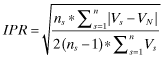
where VN is each party's vote share at the national level, and Vs the vote share in each of the ns subnational units.
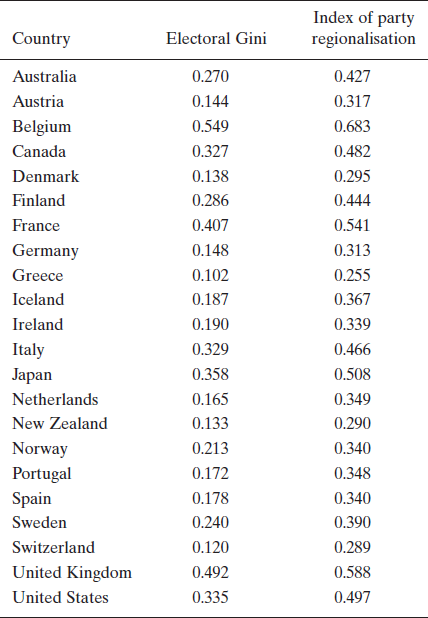
Table contains the mean values of both indices for all countries in the period of analysis. Belgium has the most regionalised party system in the sample. This is because since the 1980s there have been no statewide parties. Flemish parties only compete in Flanders, while Wallon parties only compete in Wallonia. Conversely, Greece and Sweden have the most nationalised party systems.Footnote
Mean party system regionalisation indices

The dependent and independent variables allow us to construct a panel of 22 countries for the period 1980−2006.Footnote The econometric models also include a set of economic, political, demographic and institutional independent variables. First, I control for the potential number of recipients of social programmes − that is, for the demand of social policies − by introducing the unemployment rate and the elderly share (i.e., the percentage of the population over 65). I also include the GDP, both in its growth and level values. The GDP growth controls for the effect of economic growth on governments’ expenditure. The Ln GDP level controls whether richer countries provide higher levels of social spending. The variable openness accounts for the sum of exports and imports as a percentage of the GDP. The literature provides conflicting predictions on the effect globalisation might have on social policies. The compensation hypothesis predicts that openness is associated with higher levels of government social spending, which operates as an insurance device (Katzenstein Reference Katzenstein; Rodrik Reference Rodrik). On the other hand, globalisation could reduce social spending because tax and trade competition constrains the spending power of governments (Tanzi Reference Tanzi; Busemeyer Reference Busemeyer).
As for the political controls, I introduce the variable left government, which measures the percentage of cabinet posts that belong to social democratic or left parties.Footnote The common expectation is that left governments will provide more social policies (see, e.g., Huber & Stephens Reference Huber and Stephens; Bradley et al. Reference Bradley).Footnote
As institutional controls, I include the Hooghe et al.'s (Reference Hooghe, Marks and Schakel) Regional Authority Index (RAI). This measures the level of power decentralisation to regions as a combination of their shared‐ and self‐rule capacity.Footnote By including it in the models, I control for the fact that more decentralised countries could have more regionalised electoral systems.Footnote The RAI also captures the existence of more veto actors in decentralised countries that can block governments’ capacity to spend more. Likewise, I also introduce Schmidt's (Reference Schmidt) measure of institutional constraints Footnote to capture the extent to which the central government has room to manoeuvre on social spending. More institutional constraints should be associated with lower levels of social spending and less variation over time.
Finally, the most important institutional control in the econometric model is the electoral system. I use the effective threshold to capture disproportionality in the electoral system (Taagepera & Shugart Reference Taagepera and Shugart; Lijphart Reference Lijphart). This variable measures the average share of votes that a party needs to win to secure parliamentary representation with a probability of at least 50 per cent. Its inclusion allows us to test whether the nationalisation of the party system is still associated with higher universalistic social spending once we account for the degree of electoral system proportionality. There is no sign of multicollinearity between the variables. Using Golder's (Reference Golder) categorisation of proportional systems, the mean Electoral Gini in PR countries in the sample is 0.236, while in the rest of the countries it is 0.255. Likewise, the mean Index of Party Regionalisation is 0.389 in proportional systems, and 0.409 in the rest. In none of the cases are the differences significant at the 95 per cent confidence level. Thus, there is no evidence that proportional systems are related to deeper regional cleavages (and therefore higher values of party system regionalisation).
With these variables, I estimate several models. First, I run time‐series cross‐sectional models (TSCS) with panel corrected standard errors (Beck & Katz Reference Beck and Katz). In a first set of models, I include country fixed effects. The fixed effects allow us to control for the effect of country‐specific and time‐invariant institutional and economic features on the dependent variable. This model specification captures how governments’ distributive policies respond to within‐country variation. To explore whether the party system regionalisation variables also explain between‐country differences, in a second set of models I replicate the estimations without the country unit effects.
The models are robust to the inclusion of a lagged dependent variable. However, in the models shown here, no lagged dependent variable is included. Achen (Reference Achen) argues that its inclusion in a TSCS model picks up the effect of the independent variables that show a temporal trend, overestimating the effect of the lagged dependent variable and collapsing the remainder of the variables to small and implausible effects. In addition, Nickell (Reference Nickell) and Kittel and Winner (Reference Kittel and Winner) highlight that the combination of a lagged dependent variable and fixed effects produce biased estimators, as the lagged dependent variables highly correlate with the unit effects.
As a robustness check, I run dynamic models with a lagged dependent variable that account for the aforementioned problems. First, as the social spending measures tend to exhibit high temporal persistence, I estimate error‐correction models with country unit effects and clustered standard errors. These models are particularly useful in dealing with serial correlation (Beck Reference Beck). The dependent variable is explicitly modelled as first‐difference, mitigating the potential autocorrelation bias at the unit level. In addition, all independent variables are included both in their first difference and lagged values: the former accounting for the short‐term effects, and the latter for the long‐term effects of the independent variables. Second, I replicate the models with Arellano‐Bond estimations, where the first differenced lagged dependent variable is instrumented with further lags. This model also allows me to specifically account for the potential endogeneity of the level of party system nationalisation.
Results
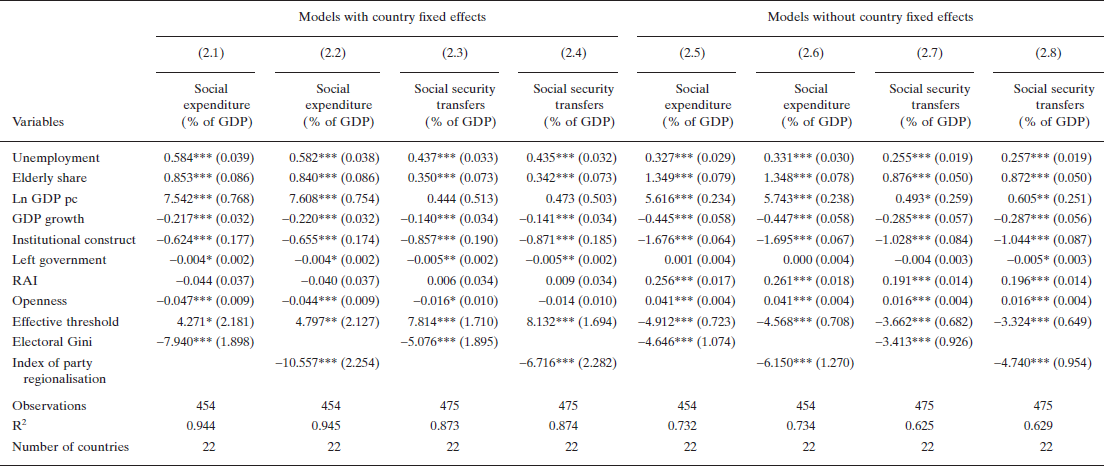
Table exhibits the results for the time‐series‐cross‐sectional econometric models with panel‐corrected standard errors on social expenditure and social security transfers. Models 2.1 to 2.4 display the results of the models with country fixed effects, and models 2.5 to 2.8 replicate them without fixed unit effects.
Time‐series cross‐sectional models on social expenditure and social security transfers
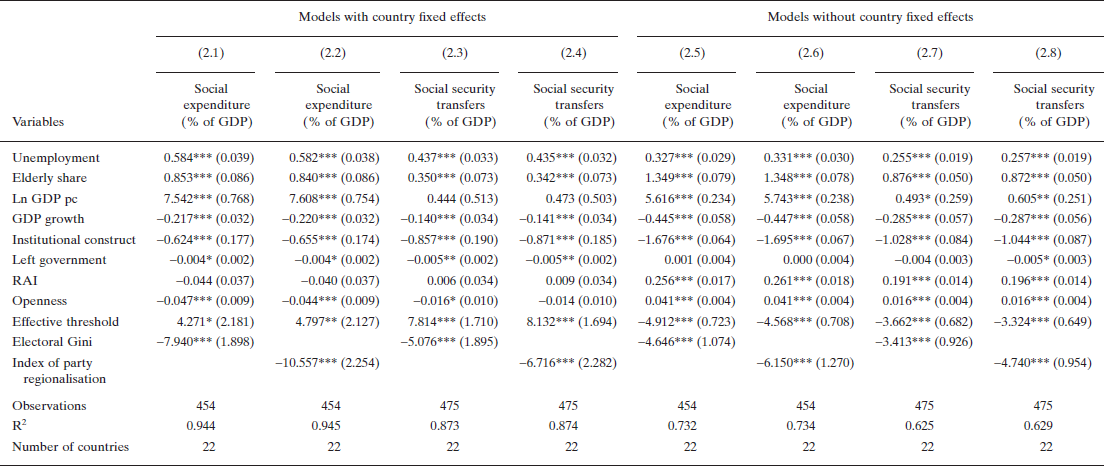
Notes: Constant not shown. Panel corrected standard errors in parentheses, *** p < 0.01; ** p < 0.05; * p < 0.1.
Some comment on the control variables is necessary. Social need variables exhibit high and positive significant coefficients. As expected, high unemployment rates and a higher proportion of elderly people have a strong impact on the level of social expenditure. The logarithm of GDP per capita is positively associated to the provision of social expenditure, giving support to Wagner's law, although it has no effect on social security transfers. Annual GDP growth, however, decreases the provision of social spending (measured by both dependent variables), as the automatic stabilisers (which would increase social spending) do not come into play. A negative impact of left governments is detected. However, the magnitude of the effect is so low that, when simulated, government's partisanship almost makes no difference, consistently with recent research (Brooks & Manza Reference Brooks and Manza; Breunig Reference Breunig).
With regards to the institutional variables, they tend to be sensitive to the inclusion of fixed effects. There is a positive effect of regional authority on the overall level of social spending when the country fixed effects are not included.Footnote Conversely, the institutional constraints exhibit negative and significant coefficients, showing that countries with more rigid institutional systems are less able to increase social spending. Openness shows an inconsistent sign, and does not allow us to draw any conclusion on the effect of globalisation on governments’ spending policies. Finally, the electoral system variable is also inconsistent across models. While in models 2.5 to 2.8 the electoral system has the expected negative impact on social spending, the inclusion of fixed effects actually changes the direction of the effect.
Regarding the variables of interest – the party system regionalisation indices − results provide support to the main hypothesis of this article. Table shows a strong negative relation between party system regionalisation and the provision of national social expenditure. Both regionalisation indices show a very significant and consistent impact (p < 0.001) on both within‐country and between‐country variation in social spending. The more regionalised the party system, the fewer incentives governments have to increase social expenditure and social security transfers.
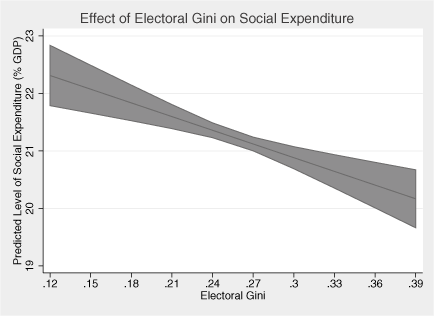
The effect of party system regionalisation is not only significant, but also of an important magnitude. Using the fixed‐effects models as a benchmark, a one standard deviation increase in party system regionalisation yields a decrease of around 1.15 per cent in social expenditure and 0.7 per cent in social security transfers. Figures and simulate the impact of the Electoral Gini on both dependent variables for a range of nationalisation values.Footnote The mean Electoral Gini in the sample is 0.253. The expected level of social expenditure at that level of regionalisation is 21.25 per cent of the GDP. In a country with a highly nationalised party system, the government provides, on average, higher levels of social spending. A country with an Electoral Gini Index of 0.12 (equivalent to a standard deviation below the mean) is expected to provide a level of social expenditure of almost 22.4 per cent of GDP. This level of social expenditure decreases as the party system becomes more regionalised. A switch to a party system one standard deviation above the mean (an Electoral Gini of 0.39) decreases the predicted level of social expenditure to 20.10 per cent of GDP. This is quite a substantial decrease. A variation of 2.30 per cent of GDP in social expenditure is equivalent to the existing differences between Spain and Norway in 2000.
Effect of electoral Gini on social expenditure.

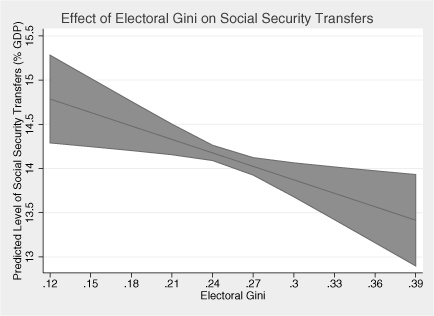
Effect of electoral Gini on social security transfers.

The results also show a very significant impact of party system regionalisation on social security transfers. A similar increase of the Electoral Gini from one standard deviation below the mean to one standard deviation above the mean reduces the predicted level of social security transfers from 14.8 to 13.4 per cent of the GDP. This is very similar to the differences in transfers between Denmark and Greece in 2000.
It is important to note that the impact of party system nationalisation on social spending is robust to the inclusion of the degree of proportionality in the electoral system (the effective threshold).Footnote Thus, the empirical findings suggest that territorial distribution of votes is a much stronger and consistent mechanism explaining the composition of public spending than the electoral system (as the conventional argument claims). This invites us to rethink the predictions of the electoral system literature. It could be that some of the mechanisms by which this literature claims that social policy provision will decrease are not due to the electoral system but to party system nationalisation/regionalisation.
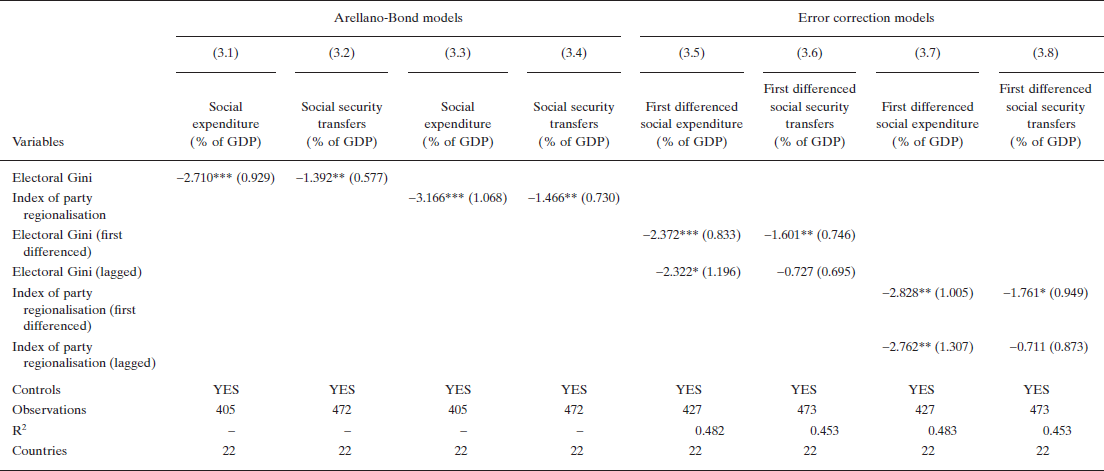
Table replicates the previous models using Arellano‐Bond estimations (3.1−3.4) and error correction models (ECM) with a first‐differenced dependent variable (models 3.5−3.8). The results are remarkably robust to the model specification. The first set of Arellano‐Bond estimations yield highly significant results for both nationalisation indices. For the second set of error correction models, Table displays the coefficient of the lagged value and the first difference of the indices. It shows again a consistent negative effect of party system regionalisation on social spending. This is more significant in the social expenditure models, where there is both a short‐ and long‐term effect of regionalisation, than in the social security transfers, where only a short‐term effect is detected. In any case, these models confirm the negative impact of regionalisation on national social spending. Regardless of the index used, all estimations in Table conclude that regionalised party systems yield significantly lower levels of social spending.
Dynamic panel data models on social expenditure and social security transfers

Notes: Constant and control variables not shown. Standard errors in parentheses. *** p < 0.01; ** p < 0.05; * p < 0.1.
The previous models estimated the effect of party system regionalisation on social expenditure and social security transfers as a percentage of GDP. As said, these are the most representative measures of social spending in a country. However, they are very comprehensive measures that capture very diverse spending programmes. Part of the spending included in these variables can still be particularistic and targeted and not have national coverage. Therefore, I also run the analyses on four specific social policy programmes: health expenditure, unemployment benefits, old age benefits and family benefits. This allows us to test whether the effect of party system regionalisation is more or less intense depending on the national coverage of each policy.
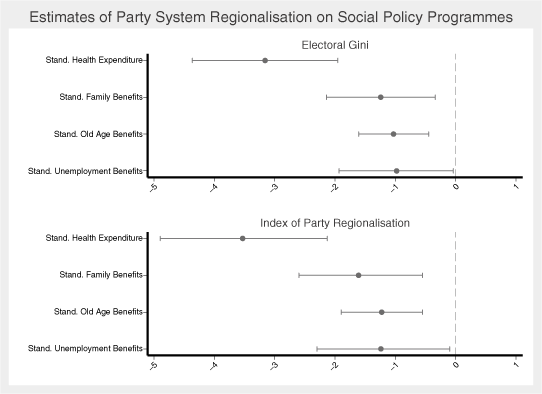
Figure shows the estimates and 95 per cent confidence interval of both regionalisation indices, when I replicate the fixed‐effects time‐series cross‐sectional models on each social policy programme.Footnote As some policy measures involve more spending than others, all of them have been standardised to a mean of 0 and a standard deviation of 1 to be able to compare the effect between policies. Thus, each coefficient captures the standard deviation increase in spending as a result of a unit increase in party system regionalisation.
Estimates of party system regionalisation on social policy programmes.

It can be seen that the strongest effect of party system regionalisation is on health expenditure. This is not surprising. Health expenditure is one of the main insurance‐based social programmes. Health policies provide protection against risks that affect all types of voters. Individuals with very different profiles, including high‐income citizens, benefit from them (Moene & Wallerstein Reference Moene and Wallerstein). Thus, we expect that health expenditure is a national policy, demanded by very different individuals throughout the territory. This is why, among all social policies, the effect of party system nationalisation on health policies is of the highest magnitude.
Old age benefits and family benefits are also significantly shaped by the party system. Although the geographic distribution of old people or households with children is not completely homogeneous, both are policy programmes that cover situations that are quite similarly distributed across regions. Thus, these are policies that distribute resources across all regions, and the provision will be high in nationalised party systems. As parties achieve more regionalised electoral support, the provision of these policies decreases (although not as intensely as with health expenditure).
Finally, it is not surprising that unemployment benefits produce the lowest in magnitude and least significant effect for both indices. In fact, the lowest bound of the Electoral Gini coefficient is only marginally different from zero at a 95 per cent confidence level. As was argued above, unemployment rates are rarely homogeneous across the territory. Formally, unemployment benefits are a national social policy, but in reality some regions and districts will clearly benefit more than others. Thus, their provision produces regional biases and will affect some parties’ constituencies more than others. Therefore, the relation with party system nationalisation should be weaker, as the results show.
Taken together, Figure provides very reassuring results. It shows that the effect of party system regionalisation on national social spending varies for different policy programmes. Those policies that are less ‘national’ in their coverage are less influenced by party system nationalisation. In summary, the empirical analyses confirm the main hypothesis: nationalised party system governments provide higher levels of national social policies compared to regionalised party systems.
Conclusions and future research
In this article I have provided a new argument to explain when governments have incentives to increase social spending. The main result is that there is a positive effect of party system nationalisation on the provision of national social policies. I have tested this argument using two different measures of party system nationalisation and various dependent variables and empirical tests. The results are remarkably robust and show that the differences between a highly nationalised electorate and a highly regionalised one can explain more than a 2 per cent GDP difference in social expenditure.
Future research should investigate the conditions under which the results of this article hold. One possible path would be to explore if there are interactive effects between party system regionalisation and the institutional setting. It could be that party system regionalisation becomes more relevant under institutions that prime regional policy demands. A second area of future research will be to complement the results of this article by testing the effect of party system regionalisation on targeted distribution. I have shown that in countries with strongly regionalised party systems, parties have fewer incentives to provide national social policies. Instead, they should rely more on distributive policies that allocate expenditure in their electorate strongholds. Overcoming the data limitations, a direct cross‐country test on this complementary hypothesis would shed more light on the relation between distributive dynamics and the distribution of the electorate across districts.
Finally, this article has shown that the effect of party system nationalisation varies depending on the national coverage of policies. It would be interesting to introduce direct measures of the geographic distribution of social policy recipients into the empirical models. It could be that in those countries where unemployment is geographically highly concentrated, the regionalisation of the party system would in fact have a positive effect on the provision of unemployment benefits.
Taken together, this research would contribute to the understanding of the relation between party system regionalisation and parties’ spending strategies. This agenda has implications for understanding future welfare state dynamics and would contribute to current debates on welfare state retrenchment. If the current economic crisis yields more territorially fragmented electorates, we should expect politicians to face increasing incentives to base their public spending strategies more on selective, narrow and targeted distributive policies, rather than national welfare programmes.
Acknowledgements
Previous versions of this article were presented in the 2013 EPSA Conference, the 2011 ECPR General Conference, the University of Oxford, the University of Princeton and the Juan March Institute. I want to thank all participants for comments and suggestions. This article has benefitted from very valuable feedback and remarks by Sandra León. I also thank Francesc Amat, Pablo Beramendi, Klaus Brösamle, Tim Hicks, Sebastián Lavezzolo, José‐María Maravall, Sergi Pardos‐Prado, David Rueda, Rubén Ruíz‐Rufino, David Soskice and two anonymous reviewers for their excellent comments. I am grateful to the ESRC and Fundación Caja Madrid for their financial support. Funding to pay the Open Access publication charges for this article was provided by the University of Manchester.

 Open access

