




On October 5, 2023, Ubisoft Entertainment SA (Ubisoft) released Assassin’s Creed Mirage, the thirteenth installment in its video-game series launched in 2007. Since its inception, the Assassin’s Creed franchise has engaged hundreds of millions of players around the world; the most recent estimates indicate that Mirage players number in the millions.Footnote 1 Set in 9th-century Baghdad, the game centers on Basim Ibn Ishaq, a character introduced in Assassin’s Creed Valhalla (2020). The authors of this article served as consultants and collaborators for the game, under the auspices of the Digital Lab for Islamic Culture and Collections (DLIVCC), based at the University of Edinburgh. As such, we were among the external historians and institutions who helped create and contribute to the game’s educational feature.Footnote 2 This article offers reflections on our collective experiences working on Assassin’s Creed Mirage, reviews historical representation of Islamicate cultures in video games, discusses the remit of the DLIVCC consultancy, and identifies some structural challenges to diversifying and decolonizing video games and game-development processes.Footnote 3 Lastly, we propose steps for scholars and institutions wishing to broaden the impact of their research through decolonization work across the academic, video games, and GLAM (Galleries, Libraries, Archives, Museums) sectors.
From the onset, we emphasize that the interdisciplinary work of the Digital Lab, which requires familiarity with several fields of scholarship, means that the format of this paper reflects scholarship in history, art history, and digital game studies. This work is a case study, a format more reflective of scholarship in the social sciences than in history. This article speaks across disciplines in the hope that better understandings of how various fields operate can lead to fruitful partnerships between historians of MENA societies and game developers in the future. Why? One answer is that new media, which boast audiences in the billions, continue to advance Orientalist notions of MENA cultures in persistent and problematic ways. Given the significant impact that games can and do have on public perceptions of the past, we assert that scholars interested in public engagement should be aware of such representations and the implications on how global publics perceive Muslims and Islamicate societies.Footnote 4 For public-facing scholars and games developers committed to making historically authentic, inclusive games, we argue that one means to address the proliferation of problematic representations of Islamic histories is for scholars of the global Middle Ages to engage with, and ideally collaborate with, game developers, a position already advocated by scholars and developers.Footnote 5
Establishing Positionality
Before reflecting on our experiences working with Ubisoft, it is important to acknowledge not only the nature of the consultancy but also highlight our academic and personal backgrounds. The partnership between the DLIVCC and Ubisoft arose out of conversations between Glaire Anderson and Maxime Durand, World Design Director at Ubisoft. These conversations were sparked by Anderson’s longstanding interest in the representation of Islamic-Viking Age connections in Assassin’s Creed Valhalla and the educational game Viking Age: Discovery Tour, with its GLAM content and connections. This initial contact began in the fall of 2021 and resulted in collaboration over the course of 2022.Footnote 6 All work was done remotely, in two major phases: the first phase lasted from April–July 2022 and consisted of iterative conversations and in-house training for the Ubisoft teams; the second phase, from September–December 2022, supported the production of the in-game historical codex, History of Baghdad, which consisted of suggesting artifacts and museum objects, brokering partnerships with cultural institutions, and historical text review. Each of these are discussed in further detail below. The DLIVCC was paid only for the hours of the consultancy and the Digital Lab as an entity does not receive financial remuneration from the sales of the game.Footnote 7
As individuals, we bring a variety of backgrounds, experiences, and academic priorities to our work. Half of the DLIVCC team are from the MENA region and have both an academic and personal interest in the (self-)representation of Islamicate pasts and cultures in video games. The founder’s approach to issues of inclusion, equity, diversity, and visibility has been shaped by her personal background and experiences as a Filipino-born Asian-American Pacific Islander. All members of the team bring formal training or linguistic expertise in either Arabic, Persian, or Turkish. The research interests of the individuals of DLIVCC informed the content of the educational feature, shaped by a priori research and commitments to challenging dominant Orientalist and problematic narratives, including those related to the representation of women and gender; an over-emphasis on religiosity characteristic of popular perceptions of Islamicate societies and civilization; and contributions of medieval Islamicate societies to broader histories of science, technology, and artistic innovation.Footnote 8
The partnership between Ubisoft and the DLIVCC was based on shared values and vision. The DLIVCC’s previous work developing Digital Munya 2.0, an immersive 3D model of a 10th-century Córdoban Umayyad villa type, provided background for conceptualizing Islamicate spaces, objects, and historical arguments using the Unity game engine.Footnote 9 This experience convinced us that the immersive video game, as a medium, offers a fruitful tool for critical reflective scholarly practice. Creating representations in video-game space offers a way to make scholarship accessible and shape public understandings of Islamic architectural history and heritage in ways that supersede even the most popular academic publications. Thus, the aim of the collaboration was to transfer accurate historical knowledge out of the academy and foster a more inclusive and authentic depiction of Islamicate history and visual culture in a mainstream game. From Ubisoft’s perspective, our consultancy and collaboration supported their aim of creating expert-informed content for greater authenticity and immersion in the game.
Representation of Islamicate Cultures in Video Games
Before discussing the iterative processes of the partnership, we pause to offer a summary of the video-game landscape leading up to Assassin’s Creed Mirage. Video games, even those marketed and widely perceived as historically accurate or authentic, nevertheless often perpetuate problematic representations of the Islamicate past rooted in longstanding Orientalist tropes.Footnote 10 This is by no means a comprehensive review of scholarship on issues of diversity, representation, and Orientalism in video games. Many video-game professionals and researchers engaged with the game industry discuss these topics, and we encourage those interested in issues raised here to further engage with this scholarship.Footnote 11 Rather, this summary aims to familiarize MENA scholars with the representation of and current conversations around Muslims and Islamicate cultures in video games.
Are we really still talking about Orientalism? In short, yes. Those in MENA fields might find this to be an over-discussed topic or consider it “dealt with,” but the reality is that this is a conversation held within the academy and not in the public space. One example that demonstrates the inefficacy of these conversations to filter into public discourse is found in persistent misrepresentations of MENA peoples and cultures in video games.Footnote 12 Before moving to discuss representations of Islamicate cultures in video games, we pause to clarify what we mean by “Orientalism” – a term which, at times, has become unmoored from its academic foundation.
Though Edward Said did not coin the term or concept, the publishing of his book Orientalism in 1979 put Western ways of conceptualizing non-Western cultures squarely at the forefront of academic discussions in the humanities.Footnote 13 One of Said’s contributions was to highlight the chimeral nature of the constructs of “the Orient” and “the West.” He emphasized that neither were stable categories in which characteristics could be assigned and never revised: the core of his argument lay in the idea that relations between the two would always be a discursive process in constant need of evaluation and reflection. With this understanding, we argue the video-game industry participates in the most fundamental of Orientalist acts. At its core, the industry’s foundation in Western societies requires analysis: as detailed below, the relative lack of inclusion of MENA video-game professionals has meant that games detailing the region’s history are often conceived by professionals in Europe, North America, Japan, and China.
Starting in the middle of the 20th century, American universities and companies pioneered technologies that resulted in the first games, including Spacewar! and Pong. In the 1970s, American and Japanese companies partnered together to expand the market and offering, taking the lead in video-game manufacturing and production.Footnote 14 Though the market has diversified, none of the largest video-game companies in the world are based in MENA countries. The top five companies, which had a combined annual gaming revenue of almost $80 billion in 2022, are all housed in either the United States, Japan, or China: Sony Interactive Entertainment based in Tokyo ($28.2 billion); Microsoft based in Redmont, Washington ($16.3 billion); Nintendo based in Kyoto ($14 billion); Tencent Holdings Limited based in Shenzhen ($13.9 billion); and Activision Blizzard based in Santa Monica, California ($7.53 billion).Footnote 15 The nature of video-game production is international, yet few of the largest studios support MENA partners.Footnote 16 This means that, for the most part, games featuring the region are created without the participation of local peoples. The strength of East Asian participation in “Orientalist” productions provides one example of the instability of categories such as “Western” and “Oriental” – and one question that scholars looking at the representation of MENA peoples by East Asian companies and developers must contend with is the murky relationship between non-Western cultures that represent other non-Western cultures in line with Western-defined Orientalist tropes.
According to Newzoo, the largest nations purchasing video games are in the Americas (the United States, Canada, and Brazil), Europe (Germany, the United Kingdom, France, and Italy) and East Asia (China, Japan, and South Korea).Footnote 17 While Said examined cultural production of the “Occident” in literature, what we provide here is a summary of artistic production in video games from the 20th century to the present, arguing that the founding and creative outputs of this industry, as well as its continued partnerships in Western European and East Asian contexts, have been an Othering exercise comparable to the arguments advanced by Said, now relevant to an industry expected to engage with 3.32 billion people in 2024.Footnote 18 To ignore this industry is to ignore a contemporary cultural production whose impact on public perceptions is comparable to that of film and television, and whose global reach is arguably much greater.
Although the field of game studies encompasses digital outputs far broader than video games, the games in which the Middle East has appeared as a setting (in a variety of forms) or inspiration for characters and storylines include the genres of strategy, shooter, and action-adventure. In strategy games, which rely less on visuals and narrative and more on the logical thinking of the player, historic MENA civilizations have featured in some of the most popular and genre-defining franchises. This includes Sid Meir’s Civilization, in which players have the option to play as a “historical” civilization of their choice. The two main MENA-playable civilizations in this franchise are the “Arabians,” based on a combination of persons, cities, and characteristics from the early Islamic, Umayyad, Abbasid, and Ayyubid periods, and the “Persians,” a medley of pre-Islamic and Islamicate dynasties drawn from historical and modern Iran.Footnote 19 The strategy genre, and Civilization specifically, has been acclaimed by scholars who praise its historically meaningful gameplay, which can help players develop a general understanding of world history.Footnote 20 However, the franchise has also received substantial criticism for its portrayal of MENA civilizations: critics point out that, in general, the “Arabian Empire” is more often defined by its religion than its in-game Christian counterparts; and “Persia” is represented as a war-mongering empire ruled by a totalitarian emperor, perpetuating the dated stereotype of the Oriental despot, while the visualizations of Persian culture are a mixture of Middle Eastern and Indian cultures and Orientalist fantasies.Footnote 21
First-person shooter video games (“FPS” or “shooters”) include those in which the player controls a character and works towards defeating enemies and, as its name suggests, revolves around violence. This genre has produced some of the most problematic representations of Muslims in video games, often featuring Islamicate empires and modern nations and societies as the enemy. Time period seems to have relatively little to do with defining the enemy; Islamicate societies are nearly always the “bad guys,” ranging from Battlefield I (2016), in which the enemy is the Ottoman Empire, to Call of Duty: Modern Warfare (2007), whose antagonists include a fictional terrorist organization, “al-Qatala,” and a Saudi Arabian warlord, Khaled Al-Asad, who leads an anti-Western military movement.Footnote 22 The narrative of the Call of Duty: Modern Warfare series is based heavily on the “War on Terror,” and is one in which Muslims are overwhelmingly represented as a terrorist other. The problematic representation of “Muslims” in shooter games was discussed at the 2016 Game Developers Conference (GDC), when panelist and independent game developer Rami Ismail declared, “Muslim blood is the cheapest on Earth right now,” highlighting how the player in Call of Duty is expected to “just shoot the Arab.”Footnote 23 Finally, the detailed 3D environments of shooter games often represent MENA regions as war-torn, desolate landscapes of crumbling buildings, debris, and devoid of life, in what Osama Dorias described as “Arabistan” game environments.Footnote 24
Action-adventure, a genre that combines the narrative and exploration-based structure of adventure games with the reflex-based gameplay features of action games, is the final genre to historically feature Islamicate societies. In this genre, the most notable games that engage with MENA cultures are the Prince of Persia and Assassin’s Creed series.
The first game of the Prince of Persia series was released in 1989 by the American video-game company Broderbund, making it one of the earliest video-game series. It was also the first video game to be set in the Middle East; the narrative and setting of the Prince of Persia series were partially inspired by 1001 Nights. The cover of the first game depicts an “evil vizier (Jaffar)” leering at a scantily-clad woman, playing into stereotypical Orientalist fantasy tropes (Fig. 1).Footnote 25 The game, in which the player embodies the prince who must challenge the evil vizier or despotic sultan, has been criticized as reinforcing “notions of arbitrary cruelty and barbarism” often associated with Middle Eastern rulers and societies in Orientalist discourse.Footnote 26 While drawing on MENA cultures and literature, the game is set in an entirely fictional and “fantastical Middle East.” In 2001, Ubisoft bought the rights to the Prince of Persia franchise and has released four additional titles, with another on the way.Footnote 27
Cover image of Prince of Persia, Broderbund, 1989. Public Domain.

The Assassin’s Creed franchise, widely considered to be the spiritual successor to the Prince of Persia, started with the release of Assassin’s Creed in 2007 and has since sold more than 200 million copies worldwide.Footnote 28 What set Assassin’s Creed apart from its predecessor, and many other historical games, was its players’ perception of the game as historically authentic and its producers’ aim of taking history seriously.Footnote 29
The story of Assassin’s Creed revolves around a fictionalized version of the Order of Assassins (Hashishiyya), a Nizari branch of the Ismaʿili sect active in greater Syria and Iran from the 11th–13th centuries, but who act in gameplay as a secret international society dedicated to fighting evil and protecting humanity. The first game of the series takes place in Damascus, Masyaf (Syria), Jerusalem, and Acre in 1191, during the Third Crusade. The game follows the hero, a member of the order named Altaïr Ibn-La’Ahad, a Muslim born in present-day Syria. The villains of the game are the Templar Order, the European Christian crusaders, often shown harassing the local Muslim populace.Footnote 30 The construct of Muslim hero versus Western Christian enemy was something of a novelty in AAA video games in 2007 (the same year in which Call of Duty: Modern Warfare was released). The in-game environments of the Assassin’s Creed series, while not devoid of violence, depart significantly from the desolate and hostile setting of Call of Duty: Modern Warfare, as they are populated by everyday people who run errands and well-maintained and lived-in buildings (Figs. 2–3).
In-game outdoor environment of Assassin’s Creed Mirage, 2024, © Ubisoft Entertainment SA. Used with permission.

In-game outdoor environment in Assassin’s Creed Mirage, 2024, © Ubisoft Entertainment SA. Used with permission.

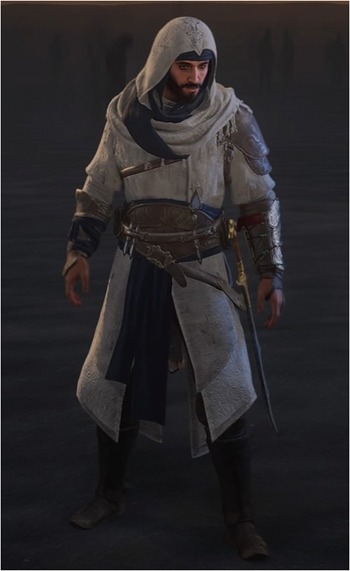
The popularity of the game led to several installations featuring Islamicate societies or Muslim characters: Revelations (2011), the fourth game in the series, set in the Ottoman Empire; Origins (2017), the ninth game, set in Ptolemaic Egypt and featuring modern-day Egyptian engineer Layla Hassan as protagonist (Fig. 4); Odyssey (2018), the tenth game, set primarily in Ancient Greece but also featuring Layla; and Valhalla (2020), the eleventh game, which introduces another major Muslim character, Basim Ibn Ishaq (Fig. 5). Basim is the protagonist in Mirage, and the setting of 9th-century Abbasid Baghdad was conceived as a part of his origin story.Footnote 31
Layla Hassan, one of the protagonists in Assassin’s Creed Valhalla, 2020, 2024, © Ubisoft Entertainment SA. Used with permission.

Basim ibn Ishaq, protagonist of Assassin’s Creed Mirage, 2024, © Ubisoft Entertainment SA. Used with permission.

Assassin’s Creed has received praise for its positive and overall well-researched representation of Muslims.Footnote 32 However, despite the accolades, critiques of the series have also been levelled in both academic and non-academic publications, including criticism of its misrepresentation of Nizari history and problematic self-Orientalizing tendencies.Footnote 33 While the game depicts cities as bustling, alive, and, as expressed by reviewers, beautiful, well-researched, and realistic, these environments are not as historically accurate as reviews may suggest.Footnote 34
Remit and Process: The Aims and Goals of the Collaboration Between Ubisoft and the DLIVCC
The DLIVCC’s role in Assassin’s Creed Mirage was to provide the Ubisoft team with historically accurate and current research regarding Abbasid and caliphal architecture, art, and history to inform both the broader game and the History of Baghdad educational codex feature (Fig. 6). Given the constraints imposed by the game’s narrative setting, as well as Ubisoft’s aim to emphasize the internationalism of Abbasid Baghdad, our approach was to provide the wider artistic and historical contexts for the 9th–13th centuries.Footnote 35 It is important to emphasize that DLIVCC’s role throughout this process was to educate, review the text written by Ubisoft’s in-house Mirage historian, Raphaël Weyland, and recommend museum artifacts to illustrate the educational feature – not to make final decisions on representations in the game. By providing an overview of this experience, we aim to give a sense of the process, challenges, and rewards of such partnerships for academics interested in engaging with the games and entertainment industry for public education purposes.
Menu featuring History of Baghdad Codex on right. Assassin’s Creed Mirage, 2024, © Ubisoft Entertainment SA. Used with permission.

The Ubisoft-DLIVCC collaboration can be categorized in two phases. The first phase could be termed the in-house training stage, in which the DLIVCC provided historical background for and responded to questions posed by Ubisoft in the form of seminar-style workshops. Over the course of ten weeks, we answered questions ranging from the quotidian (i.e., what did non-elite people’s clothing look like?) to the meso (i.e., how could we use a historical figure to inspire a character or quest?) and the macro (i.e., what did 9th-century Muslims believe about death?). As a team, we approached the work by dividing our labor according to both our specialties and the nature of the sources. We provided primary sources not only on material culture but also medieval Arabic texts. The goal was to provide Ubisoft with quick, accurate, current, and approachable distillations that could inform the larger game. It was not uncommon to receive a request to summarize involved historical processes in less than ten minutes. Outputs related to this first phase of consulting included contributions to the larger game environment (Figs. 2–3, 7), the use of historically accurate artifacts in the game (Figs. 8–11), the use of material sources as inspiration for in-game objects (Fig. 12), and inspiration for characters and quests. Another DLIVCC contribution involved serving as a broker between cultural institutions. For example, the connection between Iraqi-based heritage organization Safina Projects and Ubisoft resulted in the inclusion of models of traditional Iraqi Guffa coracles, round watercraft, in the main game (Figs. 13–14).
In-game depiction of Samarra in Assassin’s Creed Mirage, 2024, © Ubisoft Entertainment SA. Used with permission.

Goblet with incised designs dating to the 8th–9th centuries, Iraq or Syria, MET; Accession Number: 65.173.1. Licensed under Creative Commons Zero (CC0).

Reconstructions of MET goblets in-game. Assassin’s Creed Mirage, 2024, © Ubisoft Entertainment SA. Used with permission.

In-game image of 9th-century astrolabe in The Khalili Collections. Assassin’s Creed Mirage, 2024, © Ubisoft Entertainment SA. Used with permission.

Codex entry featuring scientific instruments from the Shangri La Museum of Islamic Art, Culture & Design. Assassin’s Creed Mirage, 2024, © Ubisoft Entertainment SA. Used with permission.

Use of “Drawing of Self trimming lamp” in Ahmad ibn Musa ibn Shakir’s Treatise on Mechanical Devices repurposed as a book cover. Assassin’s Creed Mirage, 2024, © Ubisoft Entertainment SA. Used with permission.

Pitch being applied during the reconstruction of traditional Guffa coracles by Safina Projects in Hilla, Iraq, May 2018. © Rashad Salim. Used with permission.

Iraqi round boats in game, Assassin’s Creed Mirage, 2024, © Ubisoft Entertainment SA. Used with permission.

The second phase made use of the DLIVCC’s specific expertise in Islamic art and architectural history to research appropriate artifacts and monuments to illustrate the historical codex, which essentially acts as an online museum exhibition. This feature, the History of Baghdad, allows players to discover sixty-six historical sites populated by seventy-one art objects, buildings, archaeological sites, or original concept art. This phase required identifying objects, researching provenance, co-creating descriptive texts centered around chosen objects, and brokering museum partnerships in order to affect as diverse a representation of object, time period, geography, cultures, and institutional involvement as possible. In this stage, the lab worked closely with Ubisoft to select and write “label-text” for the objects in the codex (Figs. 11 and 15). Each codex entry includes images of the primary sources, a curated description of its significance, and an attribution page where players can see where each object is held or located. In this phase, our research interests and specializations allowed us to make critical interventions in the representations of gender, science, religion, and triumphalist Abbasid historical narratives. In this second phase, we had significant influence over the final in-game product.
Example of History of Baghdad codex entry, Assassin’s Creed Mirage, 2024, © Ubisoft Entertainment SA. Used with permission.

Challenges: Real World Constraints in the Video-game Industry
Academics and video-game developers have different needs and aims, though at times these align. In the Ubisoft-DLIVCC partnership, several challenges emerged relating to the constraints of video games, the priorities of the game-development teams, and the viability of desired museum partnerships.Footnote 36 This next section outlines procedural hurdles the DLIVCC faced throughout the collaboration, including the pace of work, technological limitations, and conceptions of authenticity versus accuracy.
The first constraint that both phases of the Ubisoft-DLIVCC collaboration had to work within was temporal. The video-game industry works at a much faster speed than academia and the GLAM sector. Any individual or entity hoping to participate in future collaborations with this industry should be prepared for accelerated timelines. For this reason, academics hoping to be involved with video games should be aware that clear understandings and communication of what lies within your area of expertise is crucial to potential partners. There is no time to become an expert on something you do not already know. Successful collaboration is dependent on video-game partners being able to trust that any question they ask can be answered quickly and accurately, often in less than a week.
A second constraint, which historians and art historians may not expect, is the parameters of technology. Computer graphics have come a long way in the last two decades, yet real-time applications – such as video games – continue to be computationally more demanding at more or less the same rate. In this domain, performance and efficiency remain one of the most important factors. Given the need to produce commercial products that function, questions of content – including accurate representations of MENA cultures – may understandably be less of a priority for developers. In addition, budget considerations are tied to technological capabilities. Video games are large-scale applications made by teams of considerable size. Designing, developing, marketing, and releasing a AAA game can take several years and requires the participation of several departments throughout the development cycle. Different genres of games can have contrasting needs. Ubisoft has invested considerable resources in engaging academics with the stated aim of creating historically authentic games. However, in other genres in which historical accuracy or authenticity are not driving factors of player experience, developers may devote little to no financial resources to support engagement with academics. As a result, decisions unrelated to content and historical accuracy often have repercussions on what can be represented in a game environment. No matter how accurate developers may hope to be, staffing considerations, time, resource management, efficiency, and the technological complexities of the medium will affect what can be accomplished. The wider picture is more complex, yet the consideration of economic and technological factors specific to game design can make cultural representations challenging. Decisions that lead to certain visual outcomes are entangled in a web of interconnected socio-economic forces that affect the representation of tangible culture.
A third constraint is the concept of authenticity versus accuracy.Footnote 37 Though at times the two terms are understood as synonymous or fluid, authenticity is generally understood as how a player experiences and interprets the game environment as “real,” while accuracy is more tied to the presentation of “factual” history. In the case of MENA history in video games, pervasive misunderstandings of Islamicate cultures within the general public have repercussions on what a player will understand to be “authentic.” It is an interesting “chicken and egg” dilemma, making it is difficult to pinpoint if historically inaccurate games created players’ Orientalist expectations or if players’ Orientalist beliefs created a demand for historically inaccurate games. Given this reality, scholars working with game developers should be prepared for slow but steady movement towards accuracy. For example, tiled geometric ornament is often used to visually signal a MENA setting to players, even if its appearance is inaccurate to the time and place of the game’s narrative setting. In such instances, using historically accurate visual representations might come across as “inauthentic” to players, because it does not conform to expectations.
The final challenge relates to the visual assets of the game itself. Many game studios rely on modular design models to easily reiterate and improve their work in a recursive fashion. For designers, elements that make up the environment of one game should ideally be reusable in another, as this removes the need to reinvent everything for successive games. This approach to design demands that assets, including objects, nature, characters, and architecture, are broken into small components that can be rearranged into new configurations. While this can accelerate the development cycle, in the case of historical games, it can also morph cultures in inaccurate and misleading ways. One major challenge that video-game designers continue to face is the lack of modular components specific to the regional and chronological specificities of Islamic architecture. Video-game designers are often faced with the task of creating non-Western environments with a toolset made almost entirely of non-Islamic architectural features or only a small segment of forms employed in Islamic architectural traditions. This means that, to date, video-game environments of Islamicate societies reflect an amalgamation of what was available to designers, often resulting in worlds in which elements from various centuries and geographies sit together in fantastical and ahistorical representations – such as a scene from Mirage that combines the architecture of the medieval Levant and pigeon towers from Saudi Arabia with that of early modern South Asia (Fig. 16).
Example of Pigeon Tower in Sharkiyah, Assassin’s Creed Mirage, 2024, © Ubisoft Entertainment SA. Used with permission.

These These challenges in turn are perhaps symptomatic of art institutions and games curricula in which MENA topics in general, and Islamic art and architectural history specifically, are limited or absent. It is likely that artists who create visual assets for games have not had access to courses focused on MENA topics or an education that challenged traditional Orientalizing stereotypes. Given the relative rarity of specialists on the history of Islamic art and architecture, even in academic programs specializing in art and architectural history, those studying video-game development often do not have access to courses on Islamic art and architecture, postcolonial studies, or Orientalism and visual representation as part of their educational formation. Indeed, it is unclear to us to what extent courses on art and architectural history are part of game development and game-environment design curricula at all. An evaluation of this aspect as part of game-design curricula would therefore be an important step to more inclusive, historically authentic visual representations of global non-European pasts in general, and Islamicate cultures specifically. Dedicating resources to collaboration with academics offers a useful short-term path forward from the industry side and responds to the recommendations of academics and the games industry alike.Footnote 38 Including academic art-history consultation and training for creative teams in the earliest stages of game development would help developers avoid the inadvertent perpetuation of problematic representations of non-European peoples, places, and histories.
Challenges: External Real-world Constraints
Finally, the scope of what was achievable in Assassin’s Creed Mirage was constrained by external factors. One of the biggest hurdles to including non-Western institutions lay in larger structural issues within the museum field affecting accessibility and equity. As mentioned earlier, the pace of video-game production is much faster than that of academia or museums. The need to respond to unexpected requests within very short time periods affected potential partners’ ability to participate, particularly non-Western institutions without the infrastructure to support online engagement with their collections. The DLIVCC team found that institutions with easily searchable online collections, a willingness to share resources freely, and pre-existing institutional policies for shared digital use resulted in representation in Mirage. Currently, the ways in which game studios use material culture depends on what is fast and cheap. One of the difficult conversations for GLAM institutions revolves around open-access licensing. We could question the ethics of practices in which Western museums act as custodians of non-Western art created prior to international intellectual property laws and charge fees for access to images of such works, which belong to the public domain. We do not believe that virtual engagement with art will lessen the value of seeing it in person, rather the opposite: awareness of and familiarity with art drives museum engagement. A major hurdle to the inclusion of local MENA partners was the lack of museums with a web presence and/or imaging and scans of objects in collections. Western countries and individuals participated in predatory practices that established their collections, but institutions still largely have yet to address issues of restitution, reconciliation, and return of looted objects. Open licensing offers one way to address some existing inequalities.
Regarding turn-around time, one issue the DLIVCC faced when brokering relationships between GLAM institutions and Ubisoft was the lack of clear institutional policies and dedicated staff to provide definitive answers regarding the use of artifacts in digital media. There were some relationships that did not come to fruition because institutions were not positioned to respond to requests on an accelerated timeline. It would be helpful if GLAM institutions had established procedures and staff to answer questions regarding the use of digital media in a timely fashion (ideally within a week). Museums should be prepared for an increasing number of questions from the public regarding use of digital media and would be smart to anticipate this trend. In addition, museums wishing to engage with this public must be prepared for both the legal nature and the ambiguity of non-disclosure agreements (NDAs). NDAs do not mean artifacts or institutions will be included, only that they can be included. In the Ubisoft-DLIVCC process, museums retained varying levels of control over how their artifacts were presented based on institutional parameters. However, museums cannot advance to a stage of consideration for inclusion in video games without starting the contracts process.
There is the complex question of financial remuneration for cultural assets that remains for the immediate future. Though AAA studios have big budgets, they also have big expenses, and thus the prioritization of free assets will continue. This dynamic runs the risk of perpetuating and exacerbating colonial dynamics in video games. However, the DLIVCC firmly believes that it is possible for scholars and cultural heritage institutions to affect change, and that to do so requires thoughtful, intentional engagement with the games industry. Further scholarly engagement with video games would be helpful if we are to advocate for ethical practices in game development from a position of awareness and understanding.
Finally, geo-politics was an unexpected constraint that affected the inclusion of artifacts. During production, for example, Russia’s invasion of Ukraine disrupted and endangered the lives of Ubisoft’s Kyiv employees and their families. This created unease around partnering with institutions with some of the best collections of Sogdian art in the world. As a result, though original recommendations from the DLIVCC included artifacts from Afrasiab and Panjikent, sensitivity to ongoing international politics inhibited further exploration of these collaborations. Partners should be aware that international tensions between countries in which studios are based might affect access to collections that would be priority institutions from an academic standpoint.
Towards a New Digital Media Paradigm?
While we are confident that, as consultants, we were able to support Ubisoft’s aim to create a more authentic and immersive world and story, our ability to impact the final game was limited by the realities of game development and production. Our academic training prepared us to provide guidance on accurate historical contexts and artifacts, and our experience in this collaboration was significant to helping us better understand the distinct processes, workflows, and timelines of game development in a AAA-studio context. Through sharing the above constraints, we hope to highlight both the challenges and possibilities that await scholars and museum professionals wishing to engage in public education through video games and other forms of digital media.
There are actions that those working at universities can take to support this work, including advocating for more inclusive curricula for game designers. We encourage those working at universities to think of ways in which academia can address structural issues that make interdisciplinary work difficult or impossible. This has a lot to do with course requirements and registrar offices. However, we think it is worth advocating for cross-listed and core classes that introduce Islamic art history to the people who make and play the games that engage 3.22 billion gamers worldwide (as of 2023).Footnote 39 Creating modules on Islamic art, architecture, and environmental game assets that reflect the historical and chronological specificity of the architecture and visual culture of Islamicate societies can support the decolonization efforts for which the games industry has been calling. We as academics might also need to be more expansive in the scholarship with which we engage and lean into more collaborative models of work, taking us outside our academic comfort zones. One can do this work in universities by learning from “centers” that bring together people from various fields to do this kind of work.
Museum professionals might consider how Western support for MENA colleagues and institutions in the sharing of technology, expertise, and mentorship would allow museums in this region to compete equitably in web presence. In addition, institutions should prepare for the legal ramifications of requests for digital assets, a reality that is coming, independent of the video-game specific contexts on which this essay has focused. It is our hope that by sharing our observations about this process, we can raise awareness for those in the GLAM sector and academic institutions interested in working with the video games and entertainment industries in the future to support public-facing scholarship decolonizing efforts beyond the academy.
There are larger questions to grapple with, which are also potentially affected by the increased engagement of MENA experts in academia and GLAM industries in video-game production. Concerning tropes continue to persist, especially in characters and narratives: the violent Muslim, the anti-crusader hero, over-sexed, mysterious, exotic women, the street thief, genies and jinn, etc. A good first step is to learn about the ways in which new media are presenting and grappling with the histories of MENA regions. A desired next step is to engage with the cultural production of popular media by participating in its development. The field of games studies is embracing new paradigms in both work models and content, making this an opportune moment for academics to engage. The plethora of opinions and viewpoints from MENA scholars can only enrich a field demonstrating marked interest in global engagement.
Acknowledgments
We would like to extend our sincere thanks to Maxime Durand and Raphaël Weyland; Amy Jenkins-Le Guerroué, Antoine Guignard, Jean-Luc Sala, Pierre Miazga, Marine Armand, Joao Paulo Gonçalves, and the Ubisoft Montréal, Bordeaux, and Paris teams. We thank the David Collection, the Khalili Collection of Islamic Art, the Shangri La Museum of Islamic Art, Culture & Design, the Institut du Monde Arabe, and Safina Projects. For advice at various stages, we thank Rosalind Wade Haddon, Christiane Gruber, Matthew Saba, Mariam Rosser-Owen, Seif El Rashidi, Hugo Cook, Martin Poulter, Saba Sami, and the International Journals of Middle East Studies anonymous reviewers. At Edinburgh Innovations, we are grateful to Claire Pembleton, Emma Thompson, Aileen Appleyard, and Megan Welford; at the School of History of Art and Edinburgh College of Art at the University of Edinburgh, Heather Pulliam, Carol Richardson, Juan Cruz, Malene Nafisi, and Nicholas Main. This work would not have been possible without the Creative Commons Licensing policies of the Metropolitan Museum of Art and the Walters Art Museum. The project was supported by a Major Grant (G2022/A3/771) from The Barakat Trust, and an Impact Acceleration Main Grant (Ed-21/22 P0068) and CRoSS ASPECT Innovation Fellowship from the UK Economic and Social Science Research Council.




 Open access

